


In the original publication [1], there was a mistake in Figure 5A and Figure S34 (both figures are identical). The authors apologize for this mistake and have verified that this error occurred due to the use of one image from an incorrect data series, which led to images from the same sample being used with different captioning, incorrectly described as two different experimental conditions (the left column of the original Figure 5A and Figure S34). Below the revised Figure 5A (Figure S34) is shown. All fluorescence recordings were performed in triplicate and thus in the corrected Figure 5A (Figure S34) the images in the left column are taken from a different recording.
We note that our interpretation was not based only on individual images (Figure 5A), and that flow cytometry data were also used (Figure 6). For the low TEOS 4 h w/o FBS + 20 h FBS data, Figure 6 shows that for both conditions the transfection is similar. As commented on in the manuscript, the addition of chloroquine resulted in a slight rise in the transfection of cells (around 2–5%). However, even when the same trend is observed for these SiO2-based capsules (as shown in Figure 6), such numbers are within the error bars. Consequently, also in Figure 5A (Figure S34) for both conditions (with or without chloroquine) a similar fluorescence is to be expected. This can now be seen in the revised Figure 5A (Figure S34).
The authors also want to point out that, in all of the images shown in Figure 5A (Figure S34), there is an artifact in the form of a little light spot in the center of the image, which cannot be seen by the naked eye. This light spot is caused by scattering in the optical pathway of the fluorescence microscope due to alignment problems, and thus is present in all images. This, however, does not affect the interpretation of the images, as the artifact is so small that it basically cannot be seen in the images.
The authors state that the scientific conclusions are unaffected. This correction was approved by the Academic Editor. The original publication has also been updated.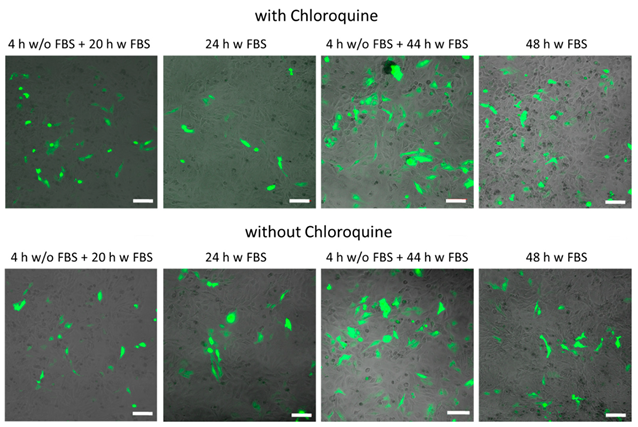
Reference
- Zyuzin, M.V.; Zhu, D.; Parak, W.J.; Feliu, N.; Escudero, A. Development of Silica-Based Biodegradable Submicrometric Carriers and Investigating Their Characteristics as in Vitro Delivery Vehicles. Int. J. Mol. Sci. 2020, 21, 7563. [Google Scholar] [CrossRef] [Scilit] [PubMed]
Disclaimer/Publisher’s Note: The statements, opinions and data contained in all publications are solely those of the individual author(s) and contributor(s) and not of MDPI and/or the editor(s). MDPI and/or the editor(s) disclaim responsibility for any injury to people or property resulting from any ideas, methods, instructions or products referred to in the content. |
© 2025 by the authors. Licensee MDPI, Basel, Switzerland. This article is an open access article distributed under the terms and conditions of the Creative Commons Attribution (CC BY) license (https://creativecommons.org/licenses/by/4.0/).