Article

Graphitic Carbon Nitride-Decorated Cobalt Diselenide Composites for Highly Efficient Hydrogen Evolution Reaction


1
Division of System Semiconductor, Dongguk University-Seoul, Seoul 04620, Republic of Korea
2
Department of Mechanical Engineering, K. Ramakrishnan College of Technology, Trichy 621112, Tamil Nadu, India
3
Department of Chemistry, CMS College of Engineering, Namakkal 637003, Tamil Nadu, India
4
Department of Electrical & Computer Engineering, National University of Singapore, Singapore 117608, Singapore
5
Quantum-Functional Semiconductor Research Center, Dongguk University-Seoul, Seoul 04620, Republic of Korea
*
Author to whom correspondence should be addressed.
Int. J. Mol. Sci. 2025, 26(24), 12188; https://doi.org/10.3390/ijms262412188
Submission received: 9 November 2025 / Revised: 16 December 2025 / Accepted: 16 December 2025 / Published: 18 December 2025

Abstract

Transition-metal dichalcogenides have emerged as promising non-noble-metal electrocatalysts for efficient hydrogen production through the hydrogen evolution reaction (HER). In this work, we fabricated the graphitic carbon nitride-decorated cobalt diselenide (gC3N4-CoSe2) nanocomposites via the facile hydrothermal method. The prepared gC3N4-CoSe2 nanocomposites displayed an interconnected and aggregated morphology of gC3N4-decorated CoSe2 nanoparticles with offering large surface area of 82 m2/g. The gC3N4-CoSe2 nanocomposites exhibited excellent HER activity with a low overpotential (141 mV) and tiny Tafel slope (62 mV/dec) with excellent durability for 100 h at 10 mA/cm2 in an alkaline electrolyte. These outstanding HER performances of gC3N4-CoSe2 can be ascribed to the synergistic interaction between the electrochemically active porous CoSe2 nanoparticles and the highly conductive gC3N4 nanosheets. These results indicate that the gC3N4-CoSe2 nanocomposites hold promising and efficient HER electrocatalysts for sustainable green hydrogen production.

1. Introduction

The increasing global energy demand, depletion of conventional fossil fuels, and escalating environmental deterioration have intensified the pursuit of sustainable, clean, and renewable energy alternatives. Recently, hydrogen has emerged as a highly promising alternative energy carrier due to its environmental sustainability, extraordinary energy density, and abundant availability [1,2,3]. Among the various hydrogen fabrication methods, water electrolysis is a prospective and efficient method for hydrogen production via hydrogen evolution reaction (HER) because of its low energy consumption and zero carbon emissions [4,5]. Although platinum (Pt)-based derivates demonstrate excellent HER performance, owing to their poor sluggish kinetics, inferior durability, and expensiveness their practical applications were limited [6,7,8]. Consequently, the development of advanced HER catalysts that exhibit high activity, outstanding stability, and cost-effectiveness remains a crucial challenge in achieving sustainable hydrogen energy technologies [9,10].
Recently, enormous efforts have been devoted to developing alternative catalysts (e.g., chalcogenides, sulfides, hydroxides, phosphides, oxides, and carbides) that are highly earth-abundant, cost-effectiveness, environmentally sustainable, and possess high electrochemical activities [11,12,13,14]. Owing to their tunable structures, low cost, intrinsic activity, and unique physicochemical properties, transition metal dichalcogenides (TMDs)-based materials have recently attracted considerable attention as promising electrocatalysts for HER [15,16,17]. Among various TMDs, cobalt diselenide (CoSe2) has emerged as a highly promising electrocatalysts for HER due to its tunable electronic structure, high chemical stability, low cost, huge availability, and good intrinsic activity [18,19,20,21]. However, the pure CoSe2 nanostructures demonstrate limited HER activity owing to their poor electrical conductivity, insufficient active sites, sluggish reaction kinetics, and agglomerate during the catalytic process [22,23,24]. Therefore, several approaches have been developed to hybridize CoSe2 nanostructures with transition metal oxides/chalcogenides, and carbon-based materials to enhance their catalytic HER efficiency and stability [25,26,27,28,29]. Recently, graphitic carbon nitride (gC3N4) has gained considerable attention as a promising co-catalyst owing to its outstanding chemical stability, facile synthesis, tunable electronic structure, low cost, earth abundance, distinctive 2D layered structure, and easily adjustable framework [30,31,32,33]. The integrating gC3N4 with CoSe2 can effectively enhance electrical conductivity, increase the surface area, and expose additional active sites, thereby substantially improving the electrocatalytic HER performance [27,28,34]. For instance, Dileepkumar et al. [27] prepared CoSe2 grafted onto g-C3N4 via a facile hydrothermal process and achieved an overpotential of 210 mV at −50 mA/cm2 for HER in an alkaline electrolyte. Sekar et al. [33] prepared 2D–2D gC3N4–MoS2 nanocomposites via the sonication method and demonstrated the overpotential of 156 mV at −10 mA/cm2 for HER in 1 M KOH. Priyakshree et al. [35] synthesized CoS2/g-C3N4 using the hydrothermal technique and showed the excellent HER performance of 230 mV at −10 mA/cm2 in 1 M KOH. Zulqarnain et al. [28] synthesized CoSe2 embedded in g-C3N4 using hydrothermal method and exhibited the overpotential of 193 mV at −20 mA/cm2 for HER in an acidic electrolyte. Dileepkumar et al. [36] prepared the NiSe2 on S-doped g-C3N4 composites by using facile hydrothermal process and achieved the overpotential of 128 mV at −10 mA/cm2 in 1 M KOH. Krishnamurthy et al. [37] fabricated sea urchin-like Ni-doped CoSe2/g-C3N4 using solvothermal method and achieved the excellent electrocatalytic performances. Despite all of the above, the electrocatalytic HER performance of the g-C3N4-CoSe2 nanocomposites has rarely been investigated.
In spite of all the above, we synthesized the gC3N4-CoSe2 nanocomposites via the facile hydrothermal method and examined their electrocatalytic HER performances. The gC3N4-CoSe2 nanocomposites showed excellent HER performance with a low overpotential of 141 mV at 10 mA/cm2 in 1 M KOH. Herein, the material synthesis, material characteristics, and electrocatalytic HER activity of the gC3N4-CoSe2 nanocomposites are technically evaluated and deliberated in detail.

2. Results and Discussion

The microstructure of the bare CoSe2 and gC3N4-CoSe2 nanocomposites were examined using FE-SEM, as presented in Figure 1a–d. The bare CoSe2 sample exhibits interconnected and irregularly aggregated porous nanoparticles (Figure 1a,b). In contrast, the gC3N4-CoSe2 nanocomposites clearly revealed the gC3N4 nanosheets anchored on the CoSe2 nanoparticles, forming a porous and densely hybridized structure (Figure 1c,d). The in situ EDX spectra (Figure 1e,f) confirm the existence of Co, Se, C, and N elements in both samples, indicating their high purity and absence of any detectable impurities.
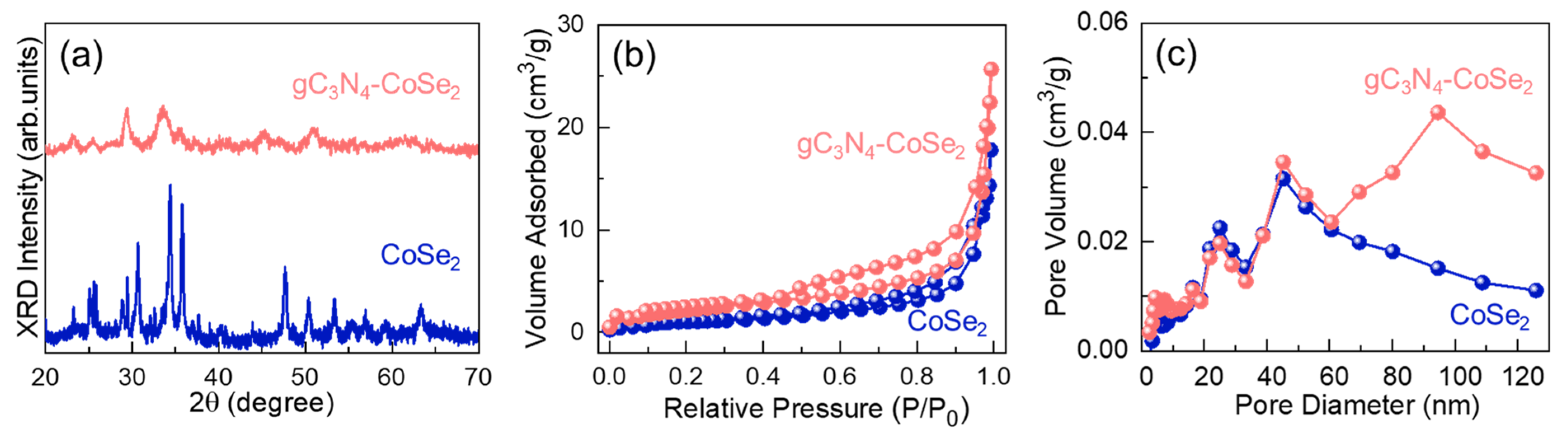
The crystallographic characteristics of the bare CoSe2 nanoparticles and gC3N4-CoSe2 nanocomposites were characterized by Powder XRD measurements. Figure 2a demonstrates the XRD pattern of the bare CoSe2 and gC3N4-CoSe2. Both samples displays distinct diffraction peaks at 23.65, 29.04, 30.67, 34.42, 35.83, 43.81, 47.75, 50.37, 53.37, 55.44, 56.94, 59.29, and 63.21° corresponding to the (110), (011), (101), (111), (120), (121), (211), (002), (031), (221), (131), (310), and (122) planes of orthorhombic CoSe2 (JCPDS card no: 53-0449), respectively [38,39,40,41,42]. Moreover, no distinct gC3N4 peak was observed in the gC3N4-CoSe2 nanocomposite because of the low amount of gC3N4 and high diffraction intensity of crystalline CoSe2 nanoparticles in the composite system. The reduced peak intensity further confirms the successful incorporation of gC3N4 onto the CoSe2 surface, indicating the hybrid composite formation [27,43].
The BET and BJH techniques were employed to investigate the specific surface area and porosity characteristics of the bare CoSe2 nanoparticles and gC3N4-CoSe2 nanocomposites. Figure 2b nitrogen adsorption–desorption isotherm curves of the bare CoSe2 nanoparticles and gC3N4-CoSe2 nanocomposites. Both samples showed a Type IV adsorption curve with a typical H3 hysteresis pattern (categorized by IUPAC), indicating the mesoporous nature of the materials [20,27,33,44]. From BET analysis, the specific BET surface areas of the bare CoSe2 nanoparticles and gC3N4-CoSe2 nanocomposites are 35 and 82 m2/g, respectively. The gC3N4-CoSe2 nanocomposites exhibited a high specific surface area compared to the bare CoSe2 nanoparticles and other reported catalysts, as summarized in Table S1. In addition, the BJH analysis revealed pore surface areas of 21 m2/g for bare CoSe2 nanoparticles and 67 m2/g for the gC3N4-CoSe2 nanocomposite (Figure 2c). Furthermore, the average pore diameters of the bare CoSe2 nanoparticles and gC3N4-CoSe2 nanocomposites were 28.57 and 17.16 nm, respectively. The gC3N4-CoSe2 nanocomposite also showed a higher total pore volume (0.0335 cm3/g) compared to the bare CoSe2 nanoparticles (0.0237 cm3/g), attributed to the incorporation of gC3N4 nanosheets into the composite system. The enhanced surface area and porous structure of the gC3N4-CoSe2 nanocomposite facilitate faster ion transport and greater accessibility of active sites, significantly enhancing HER performance in alkaline media.
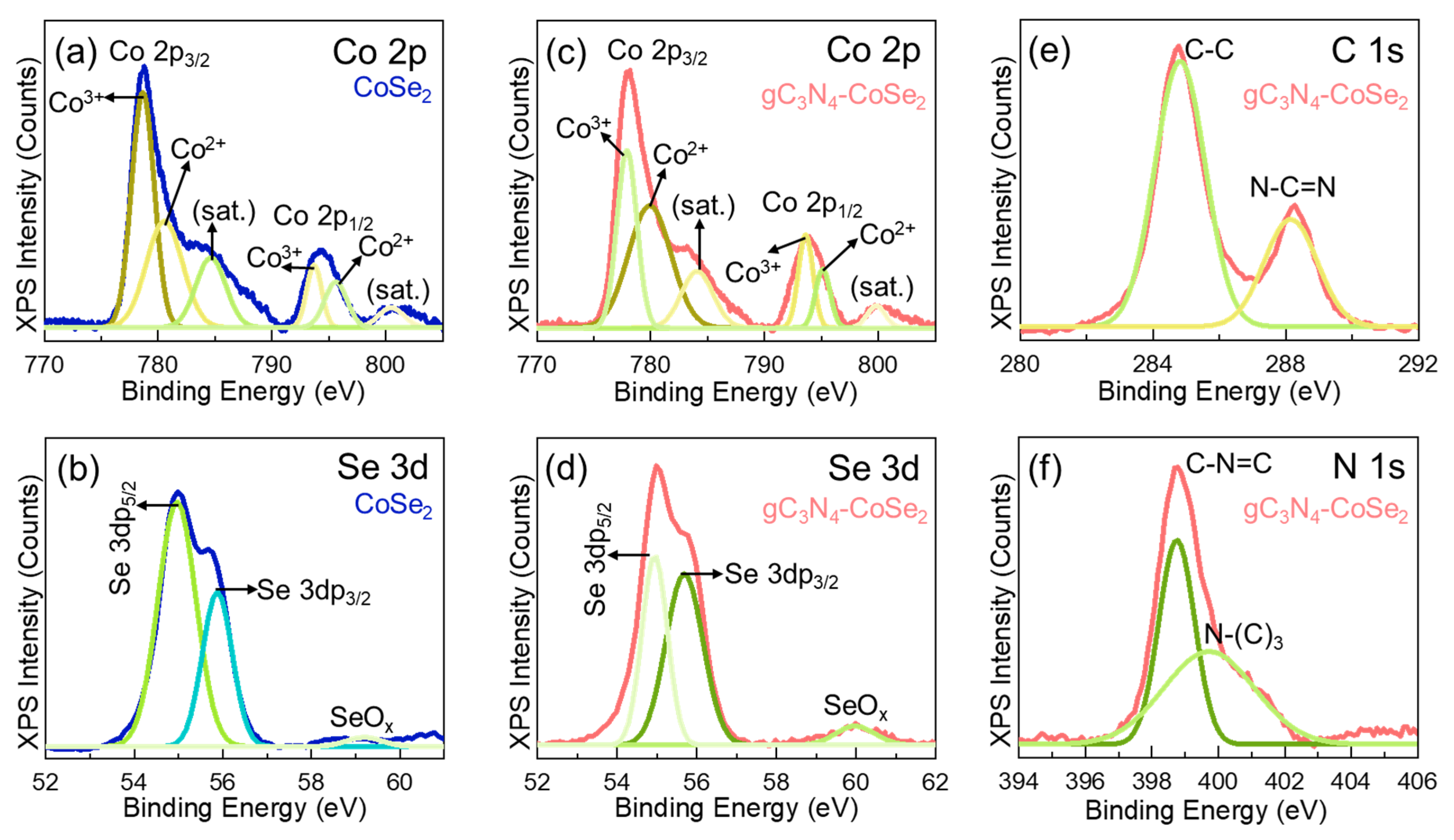
The surface chemical composition and ionic states of the bare CoSe2 nanoparticles, pristine gC3N4 nanosheets and gC3N4-CoSe2 nanocomposites were characterized by XPS measurement. The XPS full survey spectra of the bare CoSe2 nanoparticles, pristine gC3N4 nanosheets and gC3N4-CoSe2 nanocomposites clearly confirmed the presence of Co, Se, N and C components (Figure S1a–c). For the Co 2p core level spectra (Figure 3a), the bare CoSe2 nanoparticles exhibited two major binding energy at 778.7 and 794.3 eV are ascribed to the Co 2p3/2 and Co 2p1/2, respectively, among their corresponding satellites peaks [26]. After deconvolution, the distinct binding energy at 778.9 and 793.8 eV are accredited to the Co3+ 2p3/2 and Co3+ 2p1/2, indicating the existence of Co-Se bonds [43,45]. Meanwhile, the peaks at 780.5 and 795.7 eV correspond to Co2+ 2p3/2 and Co2+ 2p1/2 associated with Co-O bonds formed through slight surface oxidation [46,47]. This clearly indicates the presence of both Co2+ and Co3+ oxidation states in the CoSe2 nanoparticles. For Se 3d (Figure 3b), the two binding energy at 54.9 and 55.8 eV are relating to the Se 3d5/2 and Se 3d3/2, respectively [38]. Additionally, the broad peak observed at 60.0 eV correspond to the SeOx due to the surface oxidation of Se [40,48]. The C 1s spectrum of pristine gC3N4 nanosheets (Figure S2a) showed two distinct peaks at 284.9 and 287.9 eV are ascribed to the C-C and N-C=N bonds, respectively [27,49]. Similarly, the N 1s spectrum of pristine gC3N4 nanosheets (Figure S2b) obtained two peaks at 398.9 eV and 399.8 eV, accrediting to the pyridinic C–N=C and triazine N–(C3) bonds, respectively [33,50]. The gC3N4-CoSe2 nanocomposites exhibited characteristic features similar to those of bare CoSe2 nanoparticles and pristine gC3N4 nanosheets (Figure 3c–f). However, compared to the individual components, the binding energies in the composite shifted toward lower values, indicating effective electronic interaction between CoSe2 and gC3N4 [36,51]. Moreover, the reduced N–C=N intensity and the increased C–C contribution in the C 1s spectrum suggest that the interaction with CoSe2 partially modifies the heptazine framework of gC3N4, leading to the development of carbon-rich regions within the structure [49,50,52]. These results clearly demonstrate strong electronic coupling between CoSe2 and gC3N4 in the composite system, which is beneficial for improving HER performance.
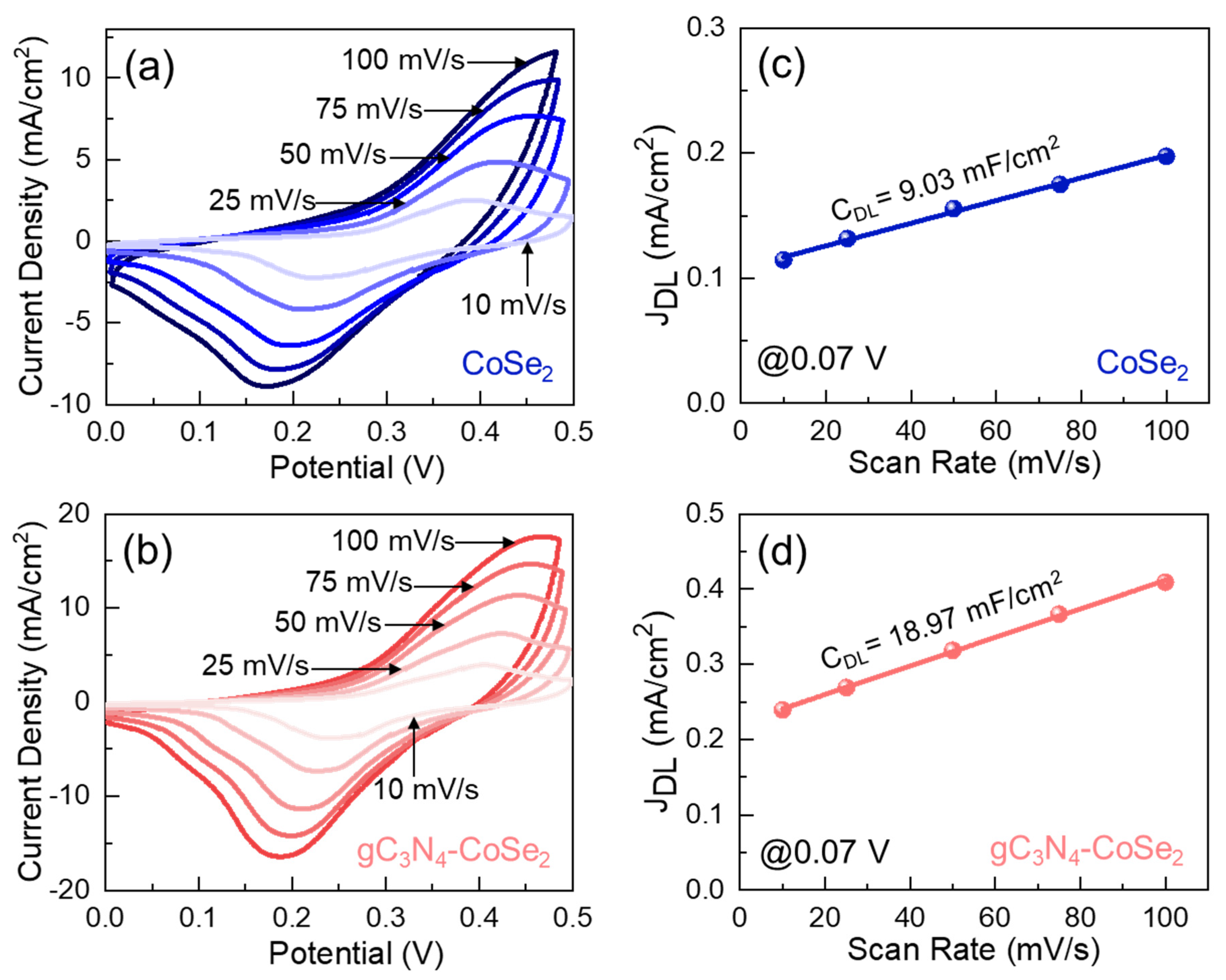
The HER performance of the bare CoSe2 nanoparticles and gC3N4-CoSe2 nanocomposites was examined using CV measurements. As shown in Figure 4a,b, both catalysts exposed distinct oxidation and reduction signals, indicating typical pseudocapacitive activities originating arising from faradaic redox reactions. With increasing scan rate from 10 to 100 mV/s, the current density also increased, suggesting efficient ion transport and low diffusion resistance. Compared with bare CoSe2, the gC3N4-CoSe2 composite showed a larger CV area and higher current response, suggesting more accessible active sites and enhanced electrical conductivity. The gradual increase in redox peak intensity with increasing scan rate further indicated that the redox process mainly occurred on the catalyst surface, demonstrating the excellent electrochemical stability and improved catalytic performance of the gC3N4-CoSe2 composite. To further clarify the enhanced electrocatalytic behavior of the gC3N4-CoSe2 catalyst, the electrochemically active surface area (ECSA) was evaluated using Equations (1) and (2). The ECSA values were derived from the non-faradaic CV regions (0–0.1 V) for both CoSe2 and gC3N4-CoSe2 at 0.07 V (Figure S3a,b). From Figure 4c,d, the CDL values were determined to be 9.03 and 18.97 mF/cm2 for CoSe2 and gC3N4-CoSe2, respectively. Using these CDL values in Equation (2), the ECSA values were 225 cm2 for CoSe2 and 474 cm2 for gC3N4-CoSe2. The higher ECSA of gC3N4-CoSe2 indicated that gC3N4 incorporation increased the number of active sites and enhanced the catalytic activity of the composites.
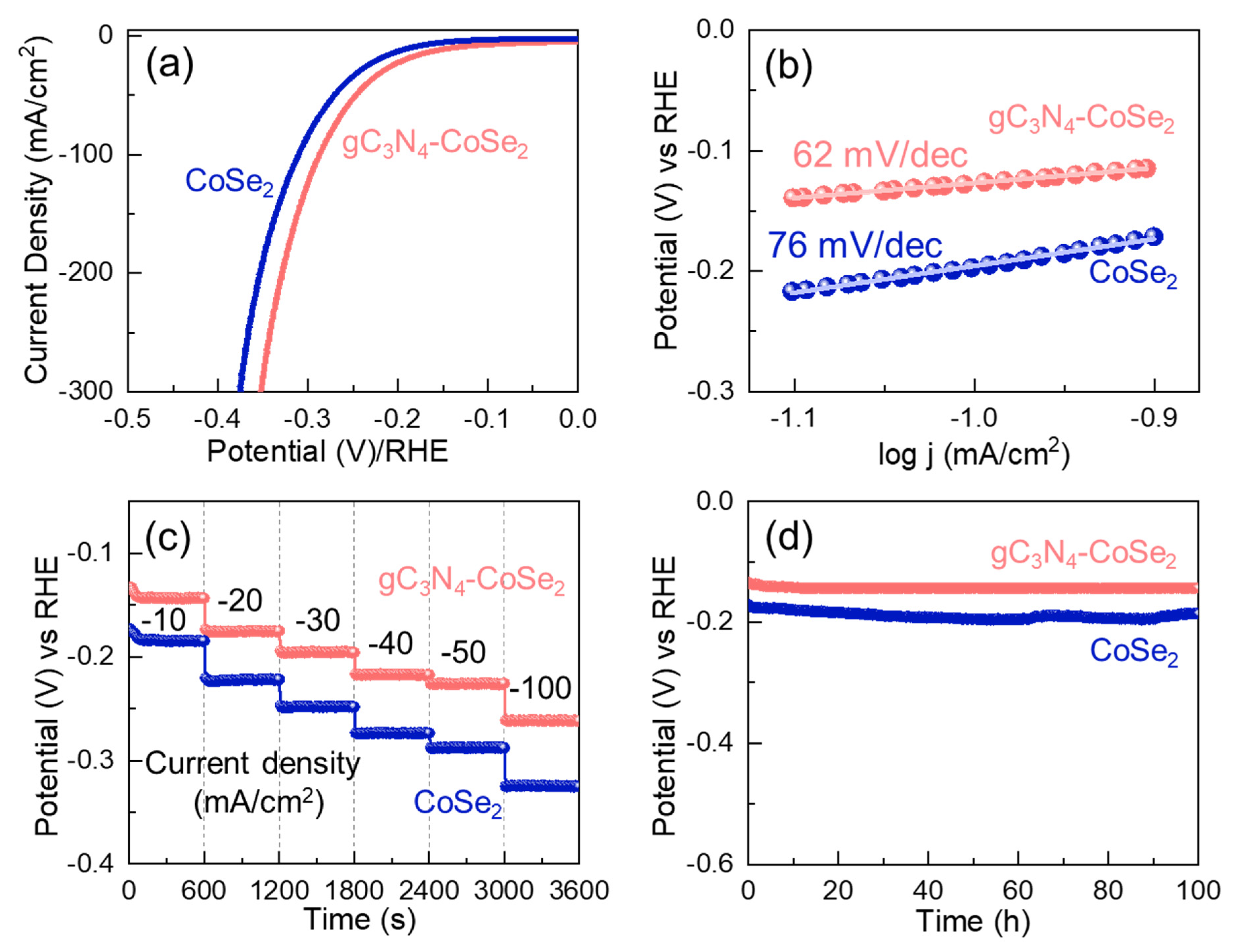
The LSV polarization curve provides valuable insight into the intrinsic electrocatalytic activity of the materials toward the HER process. Figure 5a displays the iR-corrected LSV polarization curves for CoSe2 and gC3N4-CoSe2 performed at 1 mV/s. Based on the LSV data and using Equations (3) and (4), the overpotential (η) of CoSe2 and gC3N4-CoSe2 were measured to be 187 and 141 mV at −10 mA/cm2, respectively. Compared with bare CoSe2, the gC3N4-CoSe2 nanocomposite showed a lower η due to its larger ECSA and higher number of active sites. Furthermore, the gC3N4-CoSe2 catalyst showed a comparable or even lower η value than those reported in the literature (Table 1), proving its superior catalytic efficiency. Moreover, the improved HER kinetic were evaluated via the Tafel slope calculated from Equation (5). As illustrated in Figure 5b, the ST values for CoSe2 and gC3N4-CoSe2 were calculated to be 76 and 62 mV/dec, respectively. The attained ST values suggests that the CoSe2 and gC3N4-CoSe2 catalysts arises the Volmer–Heyrovsky mechanism, where the electrochemical desorption step ( H ads +   H 2 O +   e     H 2 + OH ) served as the rate-determining stage. The gC3N4-CoSe2 catalyst exhibited a smaller Tafel slope than the bare CoSe2 and those reported in previous studies (Table 1). Compared to other electrocatalysts, the gC3N4-CoSe2 catalyst showed superior HER activity with lower η and ST values, owing to its larger ECSA, higher porosity, and high electrical conductivity with enhanced intrinsic reaction kinetics. Specifically, the increase in electrochemically active sites combined with the improved electrical conductivity leads to the faster reaction kinetics. This interpretation is further supported by the ECSA-corrected LSV curve analysis (see Figure S4).
To further evaluate the catalytic stability under different operating conditions, multi-step chronopotentiometry (CP) tests were characterized at progressively increasing current densities ranging from −10 to −100 mA/cm2, with each step maintained for 10 min. Figure 5c shows the multi-step CP slopes of the CoSe2 and gC3N4-CoSe2 catalysts. Both CoSe2 and gC3N4-CoSe2 catalysts exhibited stable potential responses with rapid recovery at each step, indicating excellent reversibility and strong catalytic durability. However, the bare CoSe2 catalyst showed higher potential at all current densities, suggesting lower charge-transfer efficiency and slower hydrogen evolution kinetics. In contrast, the gC3N4-CoSe2 catalyst demonstrated superior performance, attributed to its highly conductive hybrid composite system that enabled efficient ion diffusion, faster electron transport, and reduced interfacial resistance at the electrode–electrolyte interface. The long-term durability of the catalysts was further assessed through continuous CP stability test at a constant current density of −10 mA/cm2 for 100 h, as shown in Figure 5d. The gC3N4-CoSe2 catalyst exhibited excellent operational stability with minimal potential degradation, while the CoSe2 catalyst showed a gradual increase in overpotential overtime. The superior durability of the gC3N4-CoSe2 catalyst could be attributed to the strong interfacial coupling between CoSe2 and gC3N4 within the composite system, which reduced structural degradation and prevented active site detachment during prolonged electrolysis, as supported by the post-stability LSV curves (Figure S5). These results indicated that the gC3N4-CoSe2 catalyst acted as a highly efficient and durable electrocatalyst for hydrogen evolution. After the HER stability test, we performed FE-SEM measurements to observe the changes in microstructural characteristics of the catalysts. From FE-SEM measurements, the CoSe2 catalyst displayed the aggregated structure of the nanoparticles (see Figure S6a). However, the gC3N4-CoSe2 catalyst still retained its original structure of the gC3N4 nanosheets-decorated CoSe2 nanocomposites (see Figure S6b).
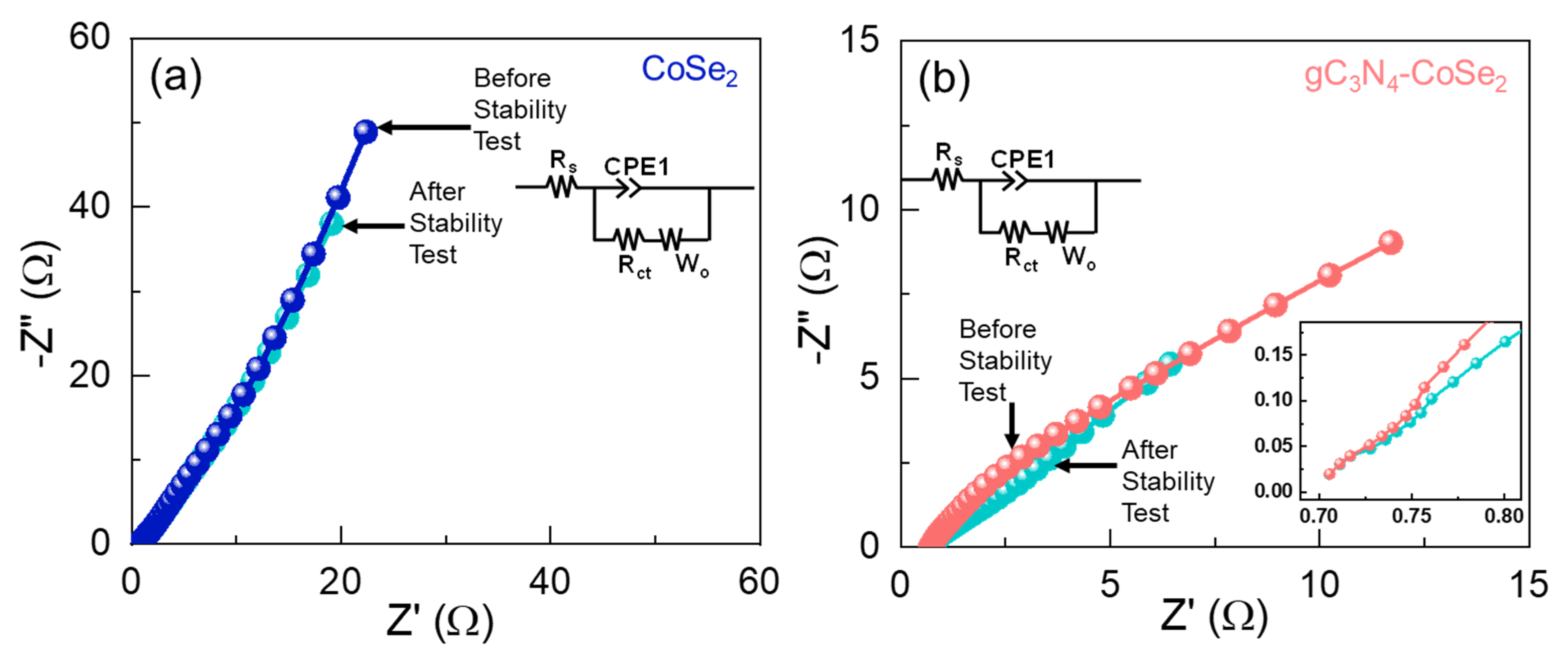
Finally, to further elucidate the improved HER kinetics and resistive characteristics of the CoSe2 and gC3N4-CoSe2 catalysts were analyzed by EIS measurement. Figure 6 indicates the Nyquist plots of CoSe2 and gC3N4-CoSe2 with their corresponding equivalent circuit (inset). The EIS curves reveal a distinct difference in the quasi-parabolic curves between the CoSe2 and gC3N4-CoSe2 catalysts. The low-frequency response was attributed to the dispersion of electrolytes over the catalyst surface [22,40,63], while the high-frequency region was associated with the series resistance (Rs) and charge-transfer resistance (Rct) of the catalysts [28,48,64]. From the fitted EIS curves using the equivalent circuit model (insets of Figure 6a,b), the Rs and Rct values were measured to be 0.75 and 8.61 Ω for CoSe2 and 0.70 and 0.13 Ω for gC3N4-CoSe2. The lower resistance of the gC3N4-CoSe2 catalyst indicated improved charge-transfer efficiency compared to bare CoSe2, which can be attributed to the enhanced electrical conductivity and higher porosity provided by the incorporated gC3N4 nanosheets. The gC3N4-CoSe2 electrode exhibits a significantly smaller quasi-parabolic curve and the steeper Warburg impedance compared to bare CoSe2 catalyst, indicating a comparatively lower charge-transfer resistance and improved efficient ion diffusion, which is a result of the facilitated charge transport across the electrode–electrolyte interface. The improvement can be ascribed to the strong interfacial coupling between the conductive and highly porous gC3N4 nanosheets and CoSe2 nanoparticles, which facilitates rapid charge migration across the heterointerface and minimizes recombination losses. After long-term stability test, the EIS analysis revealed an almost insignificant change in the charge-transfer resistance (see inset Figure 6b), confirming the excellent durability of the catalyst due to surface reformation and strengthened electrode–electrolyte interactions. These results revealed the remarkable promise of the hydrothermally synthesized gC3N4-CoSe2 nanocomposites as efficient and durable HER electrocatalysts for sustainable green hydrogen production.

3. Materials and Methods

3.1. Materials

All the regents including cobalt acetate tetrahydrate (Co(CH3COO)2·4H2O, ≥98.0%), ethylenediamine (NH2CH2CH2NH2, ≥99%), sodium selenite (Na2SeO3, 99%), carbohydrazide (CO(NHNH2)2, 98%), potassium hydroxide (KOH, ≥85%), melamine (C3H6N6, 99%) were procured from Sigma-Aldrich (Seoul, Republic of Korea) and used as received without additional purification. Deionized (DI) water was utilized throughout the experiments to prevent any form of contamination.

3.2. Synthesis of CoSe2 Nanoparticles

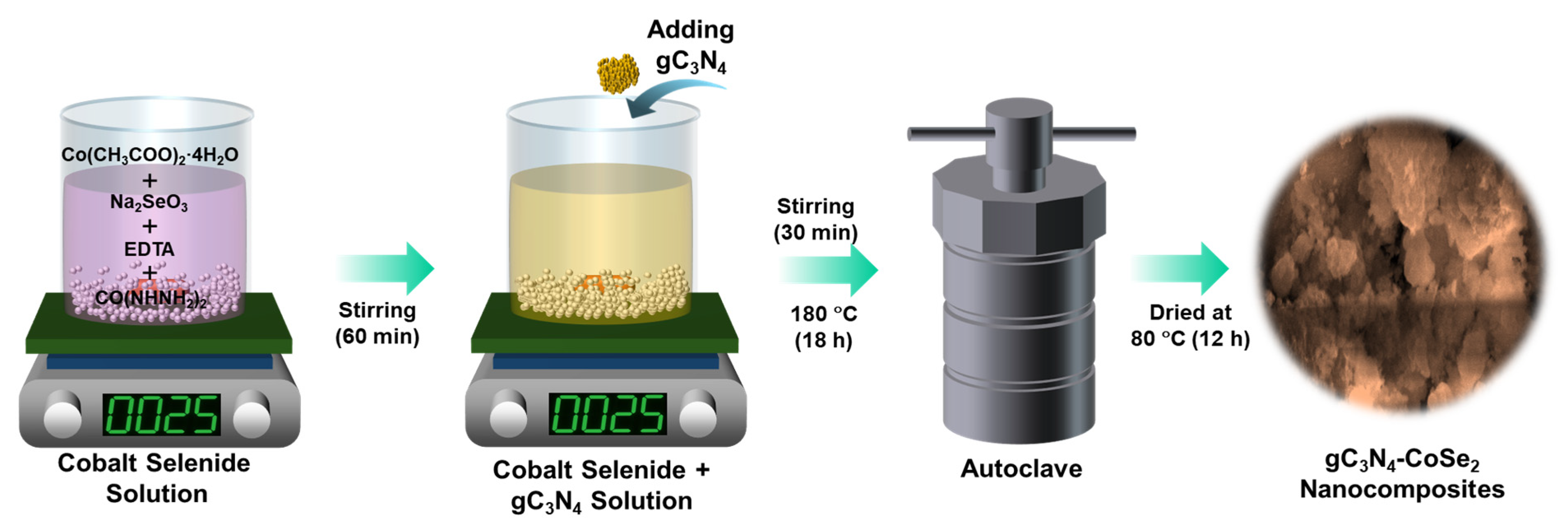
Figure 7 illustrates the schematic diagram of the hydrothermal process used to synthesize the gC3N4-CoSe2 nanocomposites. The orthorhombic CoSe2 nanoparticles were synthesized using a simple hydrothermal approach. Initially, 0.5 g of Co(CH3COO)2·4H2O, 0.8 g of Na2SeO3 and 6 mL of ethylenediamine were dissolve in 50 mL of DI water and stirred for 10 min. Then, 40 mmol of carbohydrazide was slowly added dropwise to the solution and stirred for another 60 min. The above solution was moved to the 100 mL of Teflon-lined autoclave and maintained at 180 °C for 18 h. After the reaction mixture was cooled to room temperature (RT), the precipitate was amassed, washed five times with DI water, and dried at 80 °C for 12 h to achieve pure CoSe2 nanoparticles.

3.3. Synthesis of gC3N4 Nanosheets

The gC3N4 nanosheets were prepared from melamine using a simple pyrolysis approach, as described in our previous work [33]. Primarily, 5 g of melamine was placed in a covered alumina crucible and calcined at 550 °C for 4 h in a muffle furnace. After cooling to RT, a yellow powder of gC3N4 nanosheets was obtained.

3.4. Synthesis of gC3N4-CoSe2 Nanocomposites

The gC3N4-CoSe2 nanocomposites were synthesized using a simple hydrothermal method. Firstly, 0.5 g of Co(CH3COO)2·4H2O, 0.8 g of Na2SeO3 and 6 mL of ethylenediamine were mixed with 50 mL of DI water and stirred for 10 min. Next, carbohydrazide (40 mmol) was slowly added dropwise to the solution and continuously stirred for 60 min. Subsequently, 0.3 g of gC3N4 nanosheets was introduced into the CoSe2 precursor solution and stirred for an additional 30 min. The final mixture was then transferred into a 100 mL Teflon-lined autoclave and heated at 180 °C for 18 h. After cooling to RT, the colloidal gC3N4-CoSe2 wet powder was collected, cleaned three times with DI water, and dried at 80 °C for 12 h to attain the gC3N4-CoSe2 nanocomposites.

3.5. Material Characterization

The microstructure and the elemental composition of the CoSe2 and gC3N4-CoSe2 catalysts were analyzed by using scanning electron microscopy (FE-SEM, Clara LMH, Tescan, Brno, Czech Republic) equipped with an in-situ energy-dispersive X-ray spectroscopy (EDX), respectively. For SEM-EDX analysis, a small amount of the sample was placed onto a double-sided carbon tape and gently air-blown to remove loosely bound excess particles prior to measurement. The structural properties of the catalysts were inspected by X-ray diffraction (XRD, D8-Advance system, Bruker, Billerica, MA, USA) measurement by using Cu Kα radiation (λ = 1.5406 Å), with the dried powders uniformly spread on the sample holders. The ionic states of the bare CoSe2, pristine gC3N4, and gC3N4-CoSe2 nanocomposites were examined employing X-ray photoelectron spectroscopy (XPS, ESCALab250Xi system, Thermos Fisher Scientific, Waltham, MA, USA) using vacuum-dried samples mounted on carbon tape. The textural properties of the catalysts were evaluated using Brunauer–Emmett–Teller (BET, BELSORP-mini II system, MicrotracBEL, Osaka, Japan) and Barrett–Joyner–Halenda (BJH) analyses after degassing the samples under vacuum prior to nitrogen adsorption measurements.

3.6. Electrocatalytic HER Measurements

The electrocatalytic HER performance of the CoSe2 nanoparticles and gC3N4-CoSe2 nanocomposites were evaluated employing a VersaSTAT3 electrochemical analyzer (Ametek Scientific Company, Mahwah, NJ, USA) in a three-electrode setup with 1 M KOH. To prepare the working electrodes, the catalysts (i.e., CoSe2 nanoparticles and gC3N4-CoSe2 nanocomposites) were dispersed in N-methyl-2-pyrrolidone and coated onto nickel foam (NF, 1 × 1 cm) substrates, followed by drying at 80 °C for 8 h using an air-circulating electric oven. A coiled platinum wire served as the counter electrode, while a saturated calomel electrode (SCE) was used as the reference electrode. The electrocatalytic measurements including cyclic voltammetry (CV), linear sweep voltammetry (LSV), chronopotentiometry (CP), and electrochemical impedance spectroscopy (EIS) were performed to assess the electrochemical performance and the stability of the prepared catalysts. The CV tests were performed in the potential window of 0 to 0.5 V with scan rates between 10 and 100 mV/s. The LSV measurements were investigated at −1 to −1.8 V under a persistent scan rate of 1 mV/s. Additionally, the CP characteristics were assessed at various current densities (i.e., −10 to −100 mA/cm2), with each step maintained for 10 min. The EIS test was performed over a frequency domain of 1 Hz to 10 kHz with an AC amplitude of 10 mV. The double-layer capacitance (CDL) was obtained from the non-faradaic CV region and used to calculate the electrochemically active surface area (ECSA) using the following equations [65]:
J DL = C DL   × ν / A
E C S A = C D L / C e
where CDL, JDL, Ce, A, and v are the double-layer capacitance, non-Faradaic charging current, KOH specific capacitance (KOH ~ 0.04 mF/cm2), fabricated electrode area, and the scan rate, respectively. The overpotential (η) and Tafel slope (ST) of HER was calculated using from the below equations [66,67,68,69,70,71,72]:
E RHE = E SCE + E 0 SCE + 0.059 pH
η = E RHE
η = S T log   J + c  
where E0SCE, η, J, c, and ERHE are the SCE potential, overpotential, current density, fitting parameter, and the reversible hydrogen electrode potential.

4. Conclusions

The high-performance HER electrocatalyst of gC3N4-CoSe2 nanocomposites was successfully synthesized using a simple hydrothermal approach. The gC3N4-CoSe2 nanocomposites showed an interconnected and aggregated morphology with a high mesoporous structure. The gC3N4-CoSe2 catalyst delivered a lower η of 141 mV and small ST of 62 mV/dec, demonstrating its excellent intrinsic HER activity. Moreover, the gC3N4-CoSe2 nanocomposites displayed an increased number of active sites and lowered interfacial resistance facilitated faster charge transfer and efficient ion transport. The long-term CP stability test conducted for 100 h at 10 mA/cm2 endorsed the catalysts mechanical robustness and outstanding durability. These results suggest that the hydrothermally synthesized gC3N4-CoSe2 nanocomposites are promising materials for efficient electrocatalytic water splitting.

Supplementary Materials

The following supporting information can be downloaded at: https://www.mdpi.com/article/10.3390/ijms262412188/s1. Refs. [20,33,34,52,54,58,61,73,74,75,76,77,78,79,80] are cited in Supplementary Materials file.

Author Contributions

A.T.A.A.: Methodology, Formal analysis, Investigation, Writing—original draft. S.S. (Saravanan Sekar): Methodology, Investigation. S.S. (Sutha Sadhasivam): Formal analysis, Data curation, Investigation. B.M.: Formal analysis, Investigation. S.C.: Formal analysis, Investigation. Y.L.: Data curation, Formal analysis, Validation. S.L.: Conceptualization, Supervision, Validation. S.S. (Sankar Sekar): Conceptualization, Formal analysis, Investigation, Writing—review and editing. All authors have read and agreed to the published version of the manuscript.

Funding

This research was supported by the National Research Foundation (NRF) of Korea through the basic science research program (RS-2023-NR076644 and RS-2023-00236798) funded by the Korean Government.

Institutional Review Board Statement

Not applicable.

Informed Consent Statement

Not applicable.

Data Availability Statement

The original contributions presented in this study are included in the article/Supplementary Materials. Further inquiries can be directed to the corresponding authors.

Conflicts of Interest

The authors declare that they have no known competing financial interests or personal relationships that could have appeared to influence the work reported in this paper.

References

  1. Qian, Q.; Zhu, Y.; Ahmad, N.; Feng, Y.; Zhang, H.; Cheng, M.; Liu, H.; Xiao, C.; Zhang, G.; Xie, Y. Recent Advancements in Electrochemical Hydrogen Production via Hybrid Water Splitting. Adv. Mater. 2024, 36, 2306108. [Google Scholar] [CrossRef]
  2. Bhuiyan, M.M.H.; Siddique, Z. Hydrogen as an alternative fuel: A comprehensive review of challenges and opportunities in production, storage, and transportation. Int. J. Hydrogen Energy 2025, 102, 1026–1044. [Google Scholar] [CrossRef]
  3. Sekar, S.; Lee, E.; Yun, J.; Arumugasamy, S.K.; Choi, M.-J.; Lee, Y.; Lee, S. High-performance electrocatalyst of activated carbon-decorated molybdenum trioxide nanocomposites for effective production of H2 and H2O2. Sep. Purif. Technol. 2025, 361, 131614. [Google Scholar] [CrossRef]
  4. Wang, S.; Lu, A.; Zhong, C.-J. Hydrogen production from water electrolysis: Role of catalysts. Nano Converg. 2021, 8, 4. [Google Scholar] [CrossRef]
  5. Zhai, W.; Ma, Y.; Chen, D.; Ho, J.C.; Dai, Z.; Qu, Y. Recent progress on the long-term stability of hydrogen evolution reaction electrocatalysts. InfoMat 2022, 4, e12357. [Google Scholar] [CrossRef]
  6. Kazemi, A.; Manteghi, F.; Tehrani, Z. Metal Electrocatalysts for Hydrogen Production in Water Splitting. ACS Omega 2024, 9, 7310–7335. [Google Scholar] [CrossRef]
  7. Zhu, S.; Liu, X.; Wang, X.; Zhao, Q.; Shao, M. Some remaining puzzles in hydrogen electrocatalysis mechanisms on platinum surfaces. Joule 2024, 8, 1890–1918. [Google Scholar] [CrossRef]
  8. Dhanasekaran, B.; Sekar, S.; Veerapandian, M.; Sekar, S.; Lee, S.; Govindaraju, S.; Yun, K. Tailoring active sites on heterostructures through electrocatalytic engineering for efficient bifunctional production of H2 and H2O2. Mater. Today Phys. 2025, 59, 101951. [Google Scholar] [CrossRef]
  9. Li, J.; Wu, G.; Huang, Z.; Han, X.; Wu, B.; Liu, P.; Hu, H.; Yu, G.; Hong, X. Vertically Stacked Amorphous Ir/Ru/Ir Oxide Nanosheets for Boosted Acidic Water Splitting. JACS Au 2024, 4, 1243–1249. [Google Scholar] [CrossRef]
  10. Xu, S.; Zhang, P.; Li, L.; Moon, M.-W.; Chung, C.-H.; Li, H.; Lee, J.Y.; Yoo, P.J. Challenges and Emerging Trends in Hydrogen Energy Industrialization: From Hydrogen Evolution Reaction to Storage, Transportation, and Utilization. Small 2025, 21, 2502000. [Google Scholar] [CrossRef]
  11. Kumar, N.; Aepuru, R.; Lee, S.-Y.; Park, S.-J. Advances in Catalysts for Hydrogen Production: A Comprehensive Review of Materials and Mechanisms. Nanomaterials 2025, 15, 256. [Google Scholar] [CrossRef]
  12. Prabhu, P.; Jose, V.; Lee, J.-M. Design Strategies for Development of TMD-Based Heterostructures in Electrochemical Energy Systems. Matter 2020, 2, 526–553. [Google Scholar] [CrossRef]
  13. Chhowalla, M.; Shin, H.S.; Eda, G.; Li, L.-J.; Loh, K.P.; Zhang, H. The chemistry of two-dimensional layered transition metal dichalcogenide nanosheets. Nat. Chem. 2013, 5, 263–275. [Google Scholar] [CrossRef]
  14. Mohanty, B.; Bhanja, P.; Jena, B.K. An overview on advances in design and development of materials for electrochemical generation of hydrogen and oxygen. Mater. Today Energy 2022, 23, 100902. [Google Scholar] [CrossRef]
  15. Yu, J.; Peng, G.; Peng, L.; Chen, Q.; Su, C.; Shang, L.; Zhang, T. Recent advancements in two-dimensional transition metal dichalcogenide materials towards hydrogen-evolution electrocatalysis. Green Energy Environ. 2025, 10, 1130–1152. [Google Scholar] [CrossRef]
  16. Liu, Q.; Shi, J.; Hu, J.; Asiri, A.M.; Luo, Y.; Sun, X. CoSe2 Nanowires Array as a 3D Electrode for Highly Efficient Electrochemical Hydrogen Evolution. ACS Appl. Mater. Interfaces 2015, 7, 3877–3881. [Google Scholar] [CrossRef] [PubMed]
  17. Mudoi, R.; Saikia, L. Heteroatom Doping, Defect Engineering, and Stability of Transition Metal Diselenides for Electrocatalytic Water Splitting. Chem. Asian J. 2025, 20, e00755. [Google Scholar] [CrossRef]
  18. Aggarwal, P.; Sarkar, D.; Dwivedi, P.K.; Menezes, P.W.; Awasthi, K. Deciphering the Influence of Morphology and Crystal Structure on Alkaline Hydrogen Evolution Activity in Polymorphic Cobalt Diselenide. ACS Appl. Energy Mater. 2024, 7, 1550–1560. [Google Scholar] [CrossRef]
  19. Wei, G.; Xu, Z.; Zhao, X.; Wang, S.; Kong, F.; An, C. N-doped CoSe2 nanomeshes as highly-efficient bifunctional electrocatalysts for water splitting. J. Alloys Compd. 2022, 893, 162328. [Google Scholar] [CrossRef]
  20. Lan, K.; Li, J.; Zhu, Y.; Gong, L.; Li, F.; Jiang, P.; Niu, F.; Li, R. Morphology engineering of CoSe2 as efficient electrocatalyst for water splitting. J. Colloid Interface Sci. 2019, 539, 646–653. [Google Scholar] [CrossRef]
  21. Jiang, K.; Liu, B.; Luo, M.; Ning, S.; Peng, M.; Zhao, Y.; Lu, Y.-R.; Chan, T.-S.; de Groot, F.M.F.; Tan, Y. Single platinum atoms embedded in nanoporous cobalt selenide as electrocatalyst for accelerating hydrogen evolution reaction. Nat. Commun. 2019, 10, 1743. [Google Scholar] [CrossRef]
  22. El-marghany, A.; Sillanpää, M.; Manzoor, S.; Abid, A.G.; Nisa, M.U. Solvothermally fabricated cobalt selenide supported on graphitic carbon nitride for enhanced oxygen evolution reaction. Appl. Phys. A 2023, 129, 605. [Google Scholar] [CrossRef]
  23. Cui, W.; Sun, X.; Xu, S.; Li, C.; Bai, J. CoS2-CoSe2 hybrid nanoparticles grown on carbon nanofibers as electrode for supercapacitor and hydrogen evolution reaction. J. Alloys Compd. 2024, 990, 174366. [Google Scholar] [CrossRef]
  24. Nithya, V.D. Recent advances in CoSe2 electrocatalysts for hydrogen evolution reaction. Int. J. Hydrogen Energy 2021, 46, 36080–36102. [Google Scholar] [CrossRef]
  25. Zhou, W.; Lu, J.; Zhou, K.; Yang, L.; Ke, Y.; Tang, Z.; Chen, S. CoSe2 nanoparticles embedded defective carbon nanotubes derived from MOFs as efficient electrocatalyst for hydrogen evolution reaction. Nano Energy 2016, 28, 143–150. [Google Scholar] [CrossRef]
  26. Taherinia, D.; Moazzeni, M.; Moravej, S. Comparison of hydrothermal and electrodeposition methods for the synthesis of CoSe2/CeO2 nanocomposites as electrocatalysts toward oxygen evolution reaction. Int. J. Hydrogen Energy 2022, 47, 17650–17661. [Google Scholar] [CrossRef]
  27. Dileepkumar, V.G.; Balaji, K.R.; Vishwanatha, R.; Basavaraja, B.M.; Ashoka, S.; Al-Akraa, I.M.; Santosh, M.S.; Rtimi, S. CoSe2 grafted on 2D gC3N4: A promising material for wastewater treatment, electrocatalysis and energy storage. Chem. Eng. J. 2022, 446, 137023. [Google Scholar] [CrossRef]
  28. Zulqarnain, M.; Shah, A.; Khan, M.A.; Iftikhar, F.J.; Nisar, J. FeCoSe2 Nanoparticles Embedded in g-C3N4: A Highly Active and Stable bifunctional electrocatalyst for overall water splitting. Sci. Rep. 2020, 10, 6328. [Google Scholar] [CrossRef]
  29. Kong, D.; Wang, H.; Lu, Z.; Cui, Y. CoSe2 Nanoparticles Grown on Carbon Fiber Paper: An Efficient and Stable Electrocatalyst for Hydrogen Evolution Reaction. J. Am. Chem. Soc. 2014, 136, 4897–4900. [Google Scholar] [CrossRef] [PubMed]
  30. Ong, W.-J.; Tan, L.-L.; Ng, Y.H.; Yong, S.-T.; Chai, S.-P. Graphitic Carbon Nitride (g-C3N4)-Based Photocatalysts for Artificial Photosynthesis and Environmental Remediation: Are We a Step Closer to Achieving Sustainability? Chem. Rev. 2016, 116, 7159–7329. [Google Scholar] [CrossRef]
  31. Pan, F.; Khan, M.; Lei, T.; Kamli, M.R.; Sabir, J.S.M.; Khan, I.; Ansari, M.Z. Visible light driven hydrogen generation and pollutant degradation with Au loaded 2D/2D heterojunctional nanocomposite of MoS2 and g-C3N4. Int. J. Hydrogen Energy 2024, 51, 1141–1153. [Google Scholar] [CrossRef]
  32. Li, C.; Harikrishnan, L.; Ding, L.; Pitcheri, R.; Qi, K. Graphitic carbon nitride-based photocatalysts and sonocatalysts for energy and environment. Renew. Sustain. Energy Rev. 2026, 226, 116435. [Google Scholar] [CrossRef]
  33. Sekar, S.; Shanmugam, A.; Lee, Y.; Lee, S. Highly Efficient Electrocatalyst of 2D–2D gC3N4–MoS2 Composites for Enhanced Overall Water Electrolysis. Materials 2025, 18, 3775. [Google Scholar] [CrossRef] [PubMed]
  34. Wang, R.; Dai, A.; Vijayalakshmi, M.; Jang, W.Y.; Kakarla, R.R.; Shim, J.; Aminabhavi, T.M.; Reddy, C.V. Synthesis of novel 2D g-C3N4/3D CoSe2 hierarchical microflower-like hybrids for high-performance energy-storage applications. J. Energy Storage 2024, 104, 114577. [Google Scholar] [CrossRef]
  35. Borthakur, P.; Boruah, P.K.; Das, M.R.; Ibrahim, M.M.; Altalhi, T.; El-Sheshtawy, H.S.; Szunerits, S.; Boukherroub, R.; Amin, M.A. CoS2 Nanoparticles Supported on rGO, g-C3N4, BCN, MoS2, and WS2 Two-Dimensional Nanosheets with Excellent Electrocatalytic Performance for Overall Water Splitting: Electrochemical Studies and DFT Calculations. ACS Appl. Energy Mater. 2021, 4, 1269–1285. [Google Scholar] [CrossRef]
  36. Dileepkumar, V.G.; Sirichandana, B.; Sanaulla, P.F.; Hegde, G.; Basavaraja, B.M.; Santosh, M.S. Synergistic effects of NiSe2 on S-doped g-C3N4 for efficient caffeine degradation and electrocatalysis. Inorg. Chem. Commun. 2025, 178, 114657. [Google Scholar] [CrossRef]
  37. Krishnamurthy, P.; Maiyalagan, T. Sea urchin-like nickel-doped cobalt selenide decorated on graphitic carbon nitride nanosheets as efficient electrocatalysts for oxygen evolution reaction in alkaline medium. Int. J. Hydrogen Energy 2025, 133, 491–501. [Google Scholar] [CrossRef]
  38. Do, H.H.; Le, Q.V.; Cho, J.H.; Ahn, S.H.; Kim, S.Y. Comparative Study on Hydrogen Evolution Reaction of Various Cobalt-Selenide-Based Electrocatalysts. Int. J. Energy Res. 2023, 2023, 6016603. [Google Scholar] [CrossRef]
  39. Pi, Z.-G.; Ye, H.; Han, Z.; Yu, P.; Yin, Z.; Ma, X. Promising CoSe2-CNT composite catalyst for efficient photoelectrochemical hydrogen evolution reaction. Front. Mater. 2022, 9, 1005221. [Google Scholar] [CrossRef]
  40. Yue, H.; Yang, D.; Yu, B.; Lu, Y.; Zhang, W.; Chen, Y. Porous interwoven CoSe2/C microsphere: A highly efficient and stable nonprecious electrocatalyst for hydrogen evolution reaction. J. Mater. Sci. 2019, 54, 14123–14133. [Google Scholar] [CrossRef]
  41. Lu, W.; Xue, M.; Chen, X.; Chen, C. CoSe2 Nanoparticles as Anode for Lithium Ion Battery. Int. J. Electrochem. Sci. 2017, 12, 1118–1129. [Google Scholar] [CrossRef]
  42. Kale, V.N.; Jayasurya, B.; Bhavani, R.; Maiyalagan, T. Heterostructured FeSe2-CoSe2 Nanorods Supported on Nitrogen and Sulfur co-doped Reduced Graphene Oxide as High-Performance Electrocatalyst for Oxygen Evolution Reaction. J. Alloys Compd. 2024, 978, 173313. [Google Scholar] [CrossRef]
  43. Zheng, H.; Xu, H.-S.; Hu, J.; Liu, H.; Wei, L.; Wu, S.; Li, J.; Huang, Y.; Tang, K. Electrochemical performance of CoSe2 with mixed phases decorated with N-doped rGO in potassium-ion batteries. RSC Adv. 2022, 12, 21374–21384. [Google Scholar] [CrossRef]
  44. Che, S.; Ta, N.; Yang, F.; Yan, X.; Liu, H.; Chen, N.; Sun, S.; Wang, C.; Jiang, B.; Sun, Y.; et al. One-pot construction of CoSe nanoparticles anchored on single-atomic-Co doped carbon for pH-universal hydrogen evolution. Mater. Chem. Front. 2022, 6, 3577–3588. [Google Scholar] [CrossRef]
  45. Wei, W.; Wang, L.; Liang, C.; Liu, W.; Li, C.; An, Y.; Zhang, L.; Sun, X.; Wang, K.; Zhang, H.; et al. Interface engineering of CoSe2/N-doped graphene heterostructure with ultrafast pseudocapacitive kinetics for high-performance lithium-ion capacitors. Chem. Eng. J. 2023, 474, 145788. [Google Scholar] [CrossRef]
  46. Li, B.; Liu, Y.; Jin, X.; Jiao, S.; Wang, G.; Peng, B.; Zeng, S.; Shi, L.; Li, J.; Zhang, G. Designed Formation of Hybrid Nanobox Composed of Carbon Sheathed CoSe2 Anchored on Nitrogen-Doped Carbon Skeleton as Ultrastable Anode for Sodium-Ion Batteries. Small 2019, 15, 1902881. [Google Scholar] [CrossRef]
  47. Cao, H.; Li, H.; Liu, L.; Xue, K.; Niu, X.; Hou, J.; Chen, L. Salt-Templated Nanoarchitectonics of CoSe2-NC Nanosheets as an Efficient Bifunctional Oxygen Electrocatalyst for Water Splitting. Int. J. Mol. Sci. 2022, 23, 5239. [Google Scholar] [CrossRef] [PubMed]
  48. Luo, W.; Wang, J.; Zhang, Z.; Lu, D.; Yu, Y.; Ji, Y.; Qiao, H.; Qi, X.; Liu, Y. In situ derived nanocomposites electrocatalysts from cobalt molybdates for hydrogen evolution reaction. J. Mater. Sci. Mater. Electron. 2020, 31, 14977–14985. [Google Scholar] [CrossRef]
  49. Cao, Y.; Gao, Q.; Li, Q.; Jing, X.; Wang, S.; Wang, W. Synthesis of 3D porous MoS2/g-C3N4 heterojunction as a high efficiency photocatalyst for boosting H2 evolution activity. RSC Adv. 2017, 7, 40727–40733. [Google Scholar] [CrossRef]
  50. Ye, L.; Wang, D.; Chen, S. Fabrication and Enhanced Photoelectrochemical Performance of MoS2/S-Doped g-C3N4 Heterojunction Film. ACS Appl. Mater. Interfaces 2016, 8, 5280–5289. [Google Scholar] [CrossRef]
  51. Tan, L.; Xu, J.; Zhang, X.; Hang, Z.; Jia, Y.; Wang, S. Synthesis of g-C3N4/CeO2 nanocomposites with improved catalytic activity on the thermal decomposition of ammonium perchlorate. Appl. Surf. Sci. 2015, 356, 447–453. [Google Scholar] [CrossRef]
  52. Hao, Q.; Liu, Y.; Zou, R.; Shi, G.; Yang, S.; Zhong, L.; Yang, W.; Chi, X.; Liu, Y.; Admassie, S.; et al. g-C3N4 nanosheets coupled with CoSe2 as co-catalyst for efficient photooxidation of xylose to xylonic acid. Green Energy Environ. 2025, 10, 231–238. [Google Scholar] [CrossRef]
  53. Zheng, Y.-R.; Gao, M.-R.; Yu, Z.-Y.; Gao, Q.; Gao, H.-L.; Yu, S.-H. Cobalt diselenide nanobelts grafted on carbon fiber felt: An efficient and robust 3D cathode for hydrogen production. Chem. Sci. 2015, 6, 4594–4598. [Google Scholar] [CrossRef]
  54. Fageria, P.; Sudharshan, K.Y.; Nazir, R.; Basu, M.; Pande, S. Decoration of MoS2 on g-C3N4 surface for efficient hydrogen evolution reaction. Electrochim. Acta 2017, 258, 1273–1283. [Google Scholar] [CrossRef]
  55. Zhang, X.; Ding, P.; Sun, Y.; Wang, Y.; Li, J.; Guo, J. MoS2 nanosheets on C3N4 realizing improved electrochemical hydrogen evolution. Mater. Lett. 2017, 197, 41–44. [Google Scholar] [CrossRef]
  56. Bai, X.; Cao, T.; Xia, T.; Wu, C.; Feng, M.; Li, X.; Mei, Z.; Gao, H.; Huo, D.; Ren, X.; et al. MoS2/NiSe2/rGO Multiple-Interfaced Sandwich-like Nanostructures as Efficient Electrocatalysts for Overall Water Splitting. Nanomaterials 2023, 13, 752. [Google Scholar] [CrossRef]
  57. Sekar, S.; Yun, J.-S.; Park, S.; Kim, D.Y.; Lee, Y.; Lee, S. Excellent Bifunctional Water Electrolysis Activities of α-MoO3/AC Nanocomposites. Int. J. Energy Res. 2024, 2024, 3167699. [Google Scholar] [CrossRef]
  58. Srividhya, G.; Viswanathan, C.; Ponpandian, N. Interfacing NiV layered double hydroxide with sulphur-doped g-C3N4 as a novel electrocatalyst for enhanced hydrogen evolution reaction through Volmer–Heyrovský mechanism. Energy Adv. 2023, 2, 1464–1475. [Google Scholar] [CrossRef]
  59. Yue, H.; Yu, B.; Qi, F.; Zhou, J.; Wang, X.; Zheng, B.; Zhang, W.; Li, Y.; Chen, Y. Interwoven CoSe2/CNTs hybrid as a highly efficient and stable electrocatalyst for hydrogen evolution reaction. Electrochim. Acta 2017, 253, 200–207. [Google Scholar] [CrossRef]
  60. Tong, J.; Li, W.; Wei, B.; Bo, L.; Li, Q.; Li, Y.; Li, T.; Zhang, Q. Facile preparing composite of CoSe2 wrapping N-doped mesoporous carbon with highly electrocatalytic activity for hydrogen evolution reaction. Int. J. Hydrogen Energy 2018, 43, 17021–17029. [Google Scholar] [CrossRef]
  61. Nguyen, T.V.; Tekalgne, M.; Tran, C.V.; Nguyen, T.P.; Dao, V.; Le, Q.V.; Ahn, S.H.; Kim, S.Y. Synthesis of MoS2/WS2 Nanoflower Heterostructures for Hydrogen Evolution Reaction. Int. J. Energy Res. 2024, 2024, 3192642. [Google Scholar] [CrossRef]
  62. Zhao, G.; Li, P.; Rui, K.; Chen, Y.; Dou, S.X.; Sun, W. CoSe2/MoSe2 Heterostructures with Enriched Water Adsorption/Dissociation Sites towards Enhanced Alkaline Hydrogen Evolution Reaction. Chem. Eur. J. 2018, 24, 11158–11165. [Google Scholar] [CrossRef]
  63. Bose, R.; Kim, T.-H.; Koh, B.; Jung, C.-Y.; Yi, S.C. Influence of Phosphidation on CoSe2 Catalyst for Hydrogen Evolution Reaction. ChemistrySelect 2017, 2, 10661–10667. [Google Scholar] [CrossRef]
  64. Tang, Y.; Li, J.; Lu, Z.; Wang, Y.; Tao, K.; Lin, Y. MOF-Derived CoSe2@NiFeOOH Arrays for Efficient Oxygen Evolution Reaction. Nanomaterials 2023, 13, 2621. [Google Scholar] [CrossRef]
  65. McCrory, C.C.L.; Jung, S.; Peters, J.C.; Jaramillo, T.F. Benchmarking Heterogeneous Electrocatalysts for the Oxygen Evolution Reaction. J. Am. Chem. Soc. 2013, 135, 16977–16987. [Google Scholar] [CrossRef]
  66. Ahmed, A.T.A.; Sekar, S.; Khadtare, S.S.; Rochman, N.T.; Chinna, B.; Ansari, A.S. Anion-exchange synthesis of an MnCo2S4 electrocatalyst towards facilitated ultralong hydrogen evolution reaction in acidic and alkaline media. CrystEngComm 2024, 26, 215–222. [Google Scholar] [CrossRef]
  67. Pazhamalai, P.; Krishnamoorthy, K.; Natraj, V.; Mohan, V.; Chennakrishnan, J.; Kim, S.J. Unveiling the bi-functional electrocatalytic properties of rhenium di-sulfide nanostructures towards the development of high-rate alkaline water electrolyzer. Chem. Eng. J. 2024, 500, 156356. [Google Scholar] [CrossRef]
  68. Krishnamoorthy, K.; Pazhamalai, P.; Swaminathan, R.; Mohan, V.; Kim, S.-J. Unravelling the Bi-Functional Electrocatalytic Properties of {Mo72Fe30} Polyoxometalate Nanostructures for Overall Water Splitting Using Scanning Electrochemical Microscope and Electrochemical Gating Methods. Adv. Sci. 2024, 11, 2401073. [Google Scholar] [CrossRef]
  69. Saleem, M.S.M.; Pazhamalai, P.; Ali, N.U.H.L.; Chennakrishnan, J.; Kim, S.J. Exploring the catalytic insights of nanoengineered binder-free cobalt sulfide in industrial-condition alkaline water electrolyzers for sustainable green hydrogen production. Int. J. Hydrogen Energy 2025, 156, 150357. [Google Scholar] [CrossRef]
  70. Ali, N.U.H.L.; Saleem, M.S.M.; Sathyaseelan, A.; Krishnan, V.; Pazhamalai, P.; Saj, A.A.; Kim, S.-J. Thermo-Electric Powered High Energy-Density Hybrid Supercapattery for Driving Overall Water Splitting: A Novel Trifunctional Builder for Self-Powered Hydrogen Production. Small 2025, 21, 2504667. [Google Scholar] [CrossRef]
  71. Shinde, K.R.; Mali, S.S.; Patel, T.M.; Sonkawade, R.G.; Pawar, S.M. Recent progress in transition metal based organic framework for electrochemical water splitting and CO2 reduction applications. Int. J. Hydrogen Energy 2026, 197, 152628. [Google Scholar] [CrossRef]
  72. Vempuluru, N.R.; Yoon, Y.; Das, J.P.; Elumalai, V.; Saj, A.A.; Lee, H.; Kim, T.K.; Kim, K.; Sathyaseelan, A.; Muthukumar, P.; et al. Nanocluster catalyst driving ampere-level current density in direct seawater electrolysis quantum leap towards sustainable energy. Mater. Sci. Eng. R Rep. 2026, 167, 101092. [Google Scholar] [CrossRef]
  73. Li, W.; Zheng, M.; Tian, Z.; Long, G.; Zhang, S.; Chen, Q.; Zhong, Q. Coral-Like CoSe2-Nitrogen-Doped Porous Carbon as Efficient Counter Electrodes for Quantum Dot Sensitized Solar Cells. ECS J. Solid State Sci. Technol. 2021, 10, 045012. [Google Scholar] [CrossRef]
  74. Joseph, A.; Kumar, D.S.H.; Ramadoss, M.; Muralidharan, K. Organic-free NiSe2, CoSe2, and NiSe2/CoSe2 for non-enzymatic glucose sensing. J. Solid State Electrochem. 2025, 29, 4461–4471. [Google Scholar] [CrossRef]
  75. Xinxing, S.; Hongjing, G.; Shuangke, L.; Weiwei, S.; Yujie, L.; Danqin, W.; Qingpeng, G.; Xiaobin, H.; Jing, X.; Chunman, Z. Space-confined synthesis of CoSe2-NC nanoclusters anchored on honeycomb-like carbon framework towards high-performance lithium sulfur battery. Ionics 2023, 29, 4707–4722. [Google Scholar] [CrossRef]
  76. Gan, R.; Ma, X.; Wang, G.; Jin, Z. CoSe2 Clusters as Efficient Co-Catalyst Modified CdS Nanorod for Enhance Visible Light Photocatalytic H2 Evolution. Catalysts 2019, 9, 616. [Google Scholar] [CrossRef]
  77. Yan, Z.; Li, J.; Chen, Q.; Chen, S.; Luo, L.; Chen, Y. Synthesis of CoSe2/Mxene composites using as high-performance anode materials for lithium-ion batteries. Adv. Compos. Hybrid Mater. 2022, 5, 2977–2987. [Google Scholar] [CrossRef]
  78. Yu, B.; Tressel, J.; Cui, T.; Pan, D.; DuBois, D.B.; Jones, C.; Hou, B.; Mayford, K.; Liu, Q.; Bridges, F.; et al. Rapid synthesis of carbon-supported CoS2/CoSe2 heterostructures by magnetic induction heating for efficient hydrogen evolution reaction in acidic media. J. Power Sources 2025, 641, 236897. [Google Scholar] [CrossRef]
  79. Wang, Y.; Liu, Z.; Li, Y.; Yang, X.; Zhao, L.; Peng, J. Boosting Photocatalytic Performance of ZnO Nanowires via Building Heterojunction with g-C3N4. Molecules 2023, 28, 5563. [Google Scholar] [CrossRef] [PubMed]
  80. Mousavi, M.; Moradian, S.; Pourhakkak, P.; Zhang, G.; Habibi, M.M.; Madadi, M.; Ghasemi, J.B. Fabrication of S-scheme heterojunction g-C3N4-nanosheet/ZnMoO4 nanocomposite with high efficiency in photocatalytic N2 fixation and Cr(VI) detoxification. J. Mater Sci. 2022, 57, 9145–9163. [Google Scholar] [CrossRef]
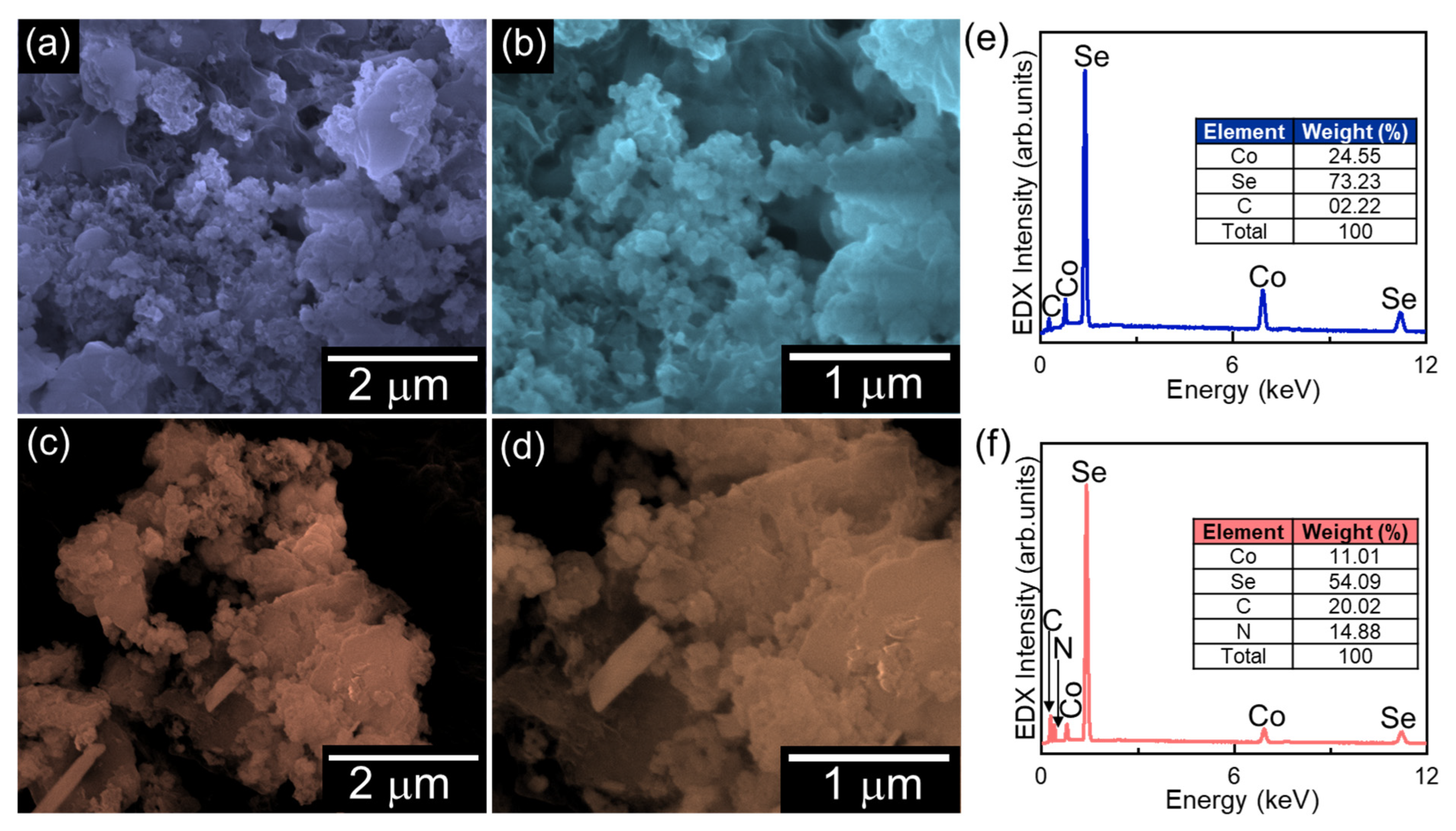
Figure 1. Low and high magnification FE-SEM images of (a,b) CoSe2 nanoparticles and (c,d) gC3N4-CoSe2 nanocomposites. EDX spectra of (e) CoSe2 and (f) gC3N4-CoSe2.
Ijms 26 12188 g001
Figure 2. (a) XRD patterns, (b) nitrogen adsorption–desorption isotherm, and (c) pore characteristics of the CoSe2 nanoparticles and gC3N4-CoSe2 nanocomposites.
Ijms 26 12188 g002
Figure 3. (a) Co 2p and (b) Se 3d of the XPS core levels spectra of CoSe2 nanoparticles. (c) Co 2p, (d) Se 3d, (e) C 1s, and (f) N 1s of the XPS core level spectra of gC3N4-CoSe2 nanocomposites.
Ijms 26 12188 g003
Figure 4. CV curves of the (a) CoSe2 and (b) gC3N4-CoSe2 catalysts. Non-Faradaic double-layer charging current (JDL) at 0.07 V as a function of scan rate for (c) CoSe2 and (d) gC3N4-CoSe2 catalysts.
Ijms 26 12188 g004
Figure 5. HER performances of the CoSe2 and gC3N4-CoSe2 catalysts. (a) iR-corrected LSV curves, (b) Tafel plots, (c) chronopotentiometric profiles at different current densities (−10 to −100 mA/cm2), and (d) long-term stability characteristics.
Ijms 26 12188 g005
Figure 6. Nyquist plots of (a) CoSe2 and (b) gC3N4-CoSe2 catalysts before and after the stability test (zoomed image of (b)). The insets show the corresponding equivalent circuit models of the working catalysts.
Ijms 26 12188 g006
Figure 7. Schematic illustration of the hydrothermal synthesis of CoSe2 nanoparticles and gC3N4-CoSe2 nanocomposites.
Ijms 26 12188 g007
Table 1. Comparison of HER performance for CoSe2 and gC3N4-CoSe2 with previously reported electrocatalysts.
CatalystCurrent Density (mA/cm2)Overpotential η10 (mV)Tafel Slope (mV/dec)ElectrolyteReference
gC3N4-CoSe210141621 M KOHThis work
CoSe210187761 M KOHThis work
Three-dimensional CoSe2/CFF10141680.5 M H2SO4[53]
g-C3N4-MoS2101561011 M KOH[33]
CoSe2/MoO2/MoSe21023036.80.5 M H2SO4[48]
MoS2/g-C3N410240631 M KOH[54]
CoSe2-gC3N4/NF50210841 M KOH[55]
CoSe2-g-C3N4/GCE20193-0.5 M H2SO4[28]
MoS2/NiSe2/rGO10127731 M KOH[56]
MoO3/AC103531241 M KOH[57]
S-gC3N4/NiV LDH10560791 M KOH[58]
CoSe2/C10189341 M KOH[40]
CoSe2/CNT10180350.5 M H2SO4[59]
CoSe2/NC-17010159830.5 M H2SO4[60]
MoS2/WS2 NF10251611 M KOH[61]
CoSe2/MoSe210218761 M KOH[62]
CoSe2|CoP/CFP10140420.5 M H2SO4[63]
Disclaimer/Publisher’s Note: The statements, opinions and data contained in all publications are solely those of the individual author(s) and contributor(s) and not of MDPI and/or the editor(s). MDPI and/or the editor(s) disclaim responsibility for any injury to people or property resulting from any ideas, methods, instructions or products referred to in the content.