The Effect of Dopaminergic Therapies in Parkinson’s Disease on Non-Motor Symptoms


Abstract
1. Introduction
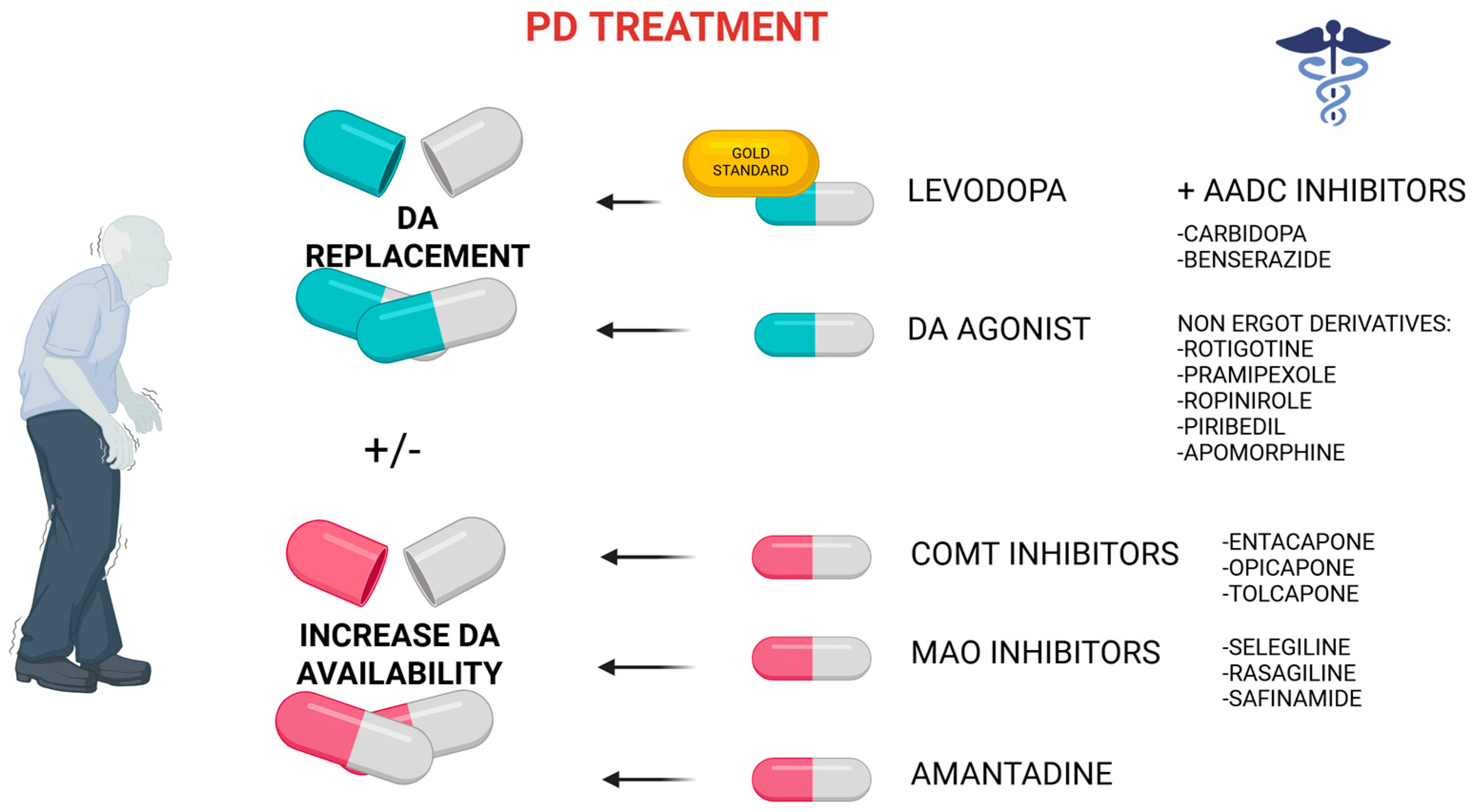
2. Current Dopaminergic Therapies for Parkinson’s Disease
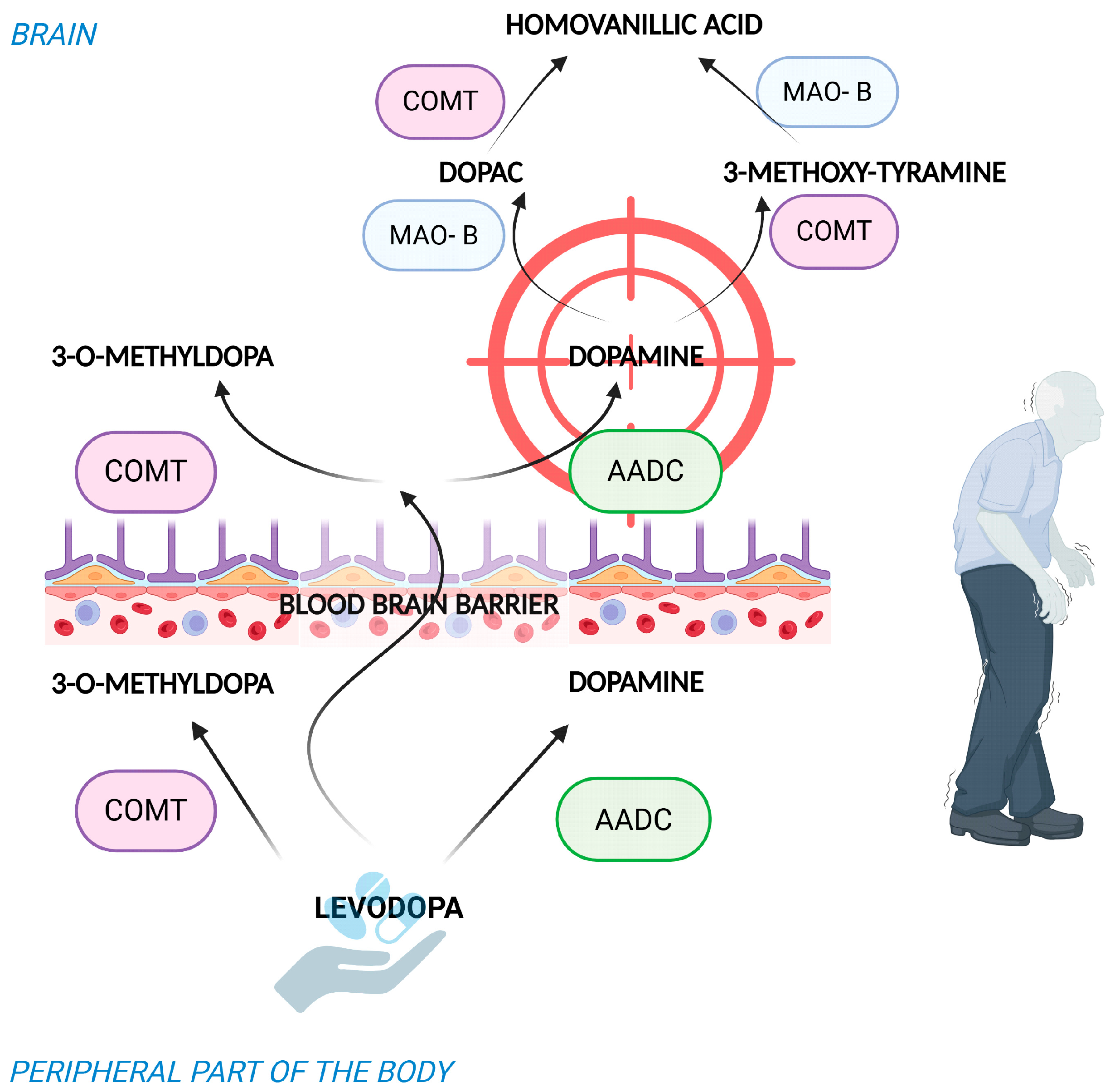
2.1. Levodopa
2.2. Monoamine Oxidase B (MAO-B) and Catechol-O-Methyl Transferase (COMT) Inhibitors
2.3. Dopamine Agonists
2.4. Amantadine
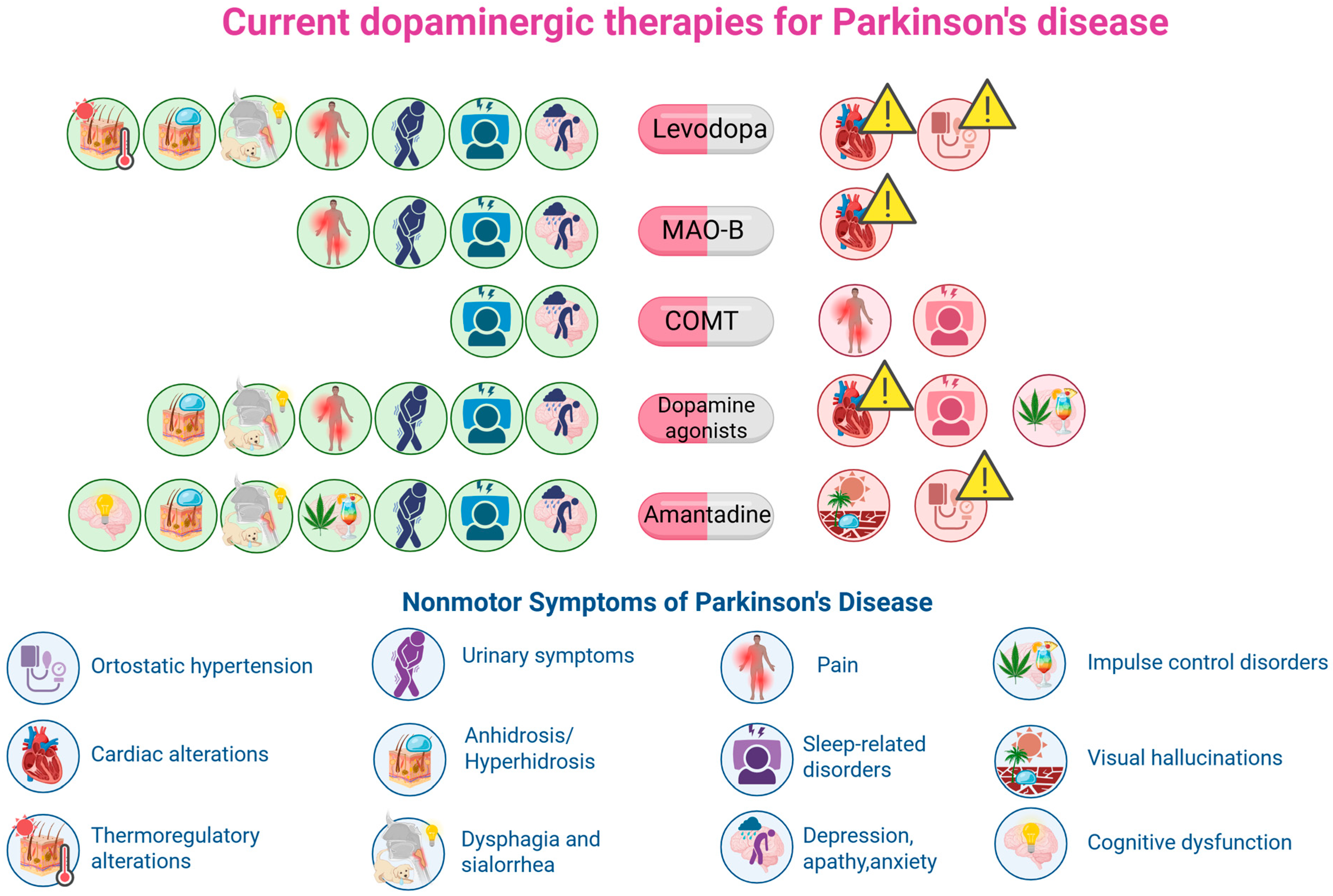
3. Impact of Dopaminergic Therapies in Parkinson’s Disease on the Non-Motor Symptoms
3.1. Autonomic Dysfunction in Parkinson’s Disease
3.1.1. Cardiovascular Dysfunctions
Orthostatic Hypotension (OH)
3.1.2. Thermoregulatory Changes
3.1.3. Dysphagia and Drooling
3.1.4. Urinary Symptoms
3.2. Sleep-Related Disorders in Parkinson’s Disease
3.2.1. Night-Time Sleep Disturbances and Excessive Daytime Sleepiness (EDS)
3.2.2. Sleep-Disordered Breathing (SDB)—Obstructive Sleep Apnea (OSA)
3.2.3. Restless Legs Syndrome (RLS)
3.3. Pain
3.4. Neuropsychiatric Manifestations in Parkinson’s Disease
4. Conclusions
Author Contributions
Funding
Institutional Review Board Statement
Data Availability Statement
Conflicts of Interest
References
- Hornykiewicz, O. Brain monoamines and parkinsonism. In Aminergic Hypotheses of Behavior, Reality or Cliche? Monograph Series; National Institute on Drug Abuse Research: Bethesda, MD, USA, 1975; Volume 3, pp. 13–21. [Google Scholar] [CrossRef]
- Hornykiewicz, O. The discovery of dopamine deficiency in the parkinsonian brain. J. Neural. Transm. Suppl. 2006, 70, 9–15. [Google Scholar] [CrossRef]
- Przedborski, S. Neuroinflammation and Parkinson’s disease. Handb. Clin. Neurol. 2007, 83, 535–551. [Google Scholar] [CrossRef]
- Błaszczyk, J.W. Motor deficiency in Parkinson’s disease. Acta Neurobiol. Exp. 1998, 58, 79–93. [Google Scholar] [CrossRef] [PubMed]
- Scatton, B.; Javoy-Agid, F.; Rouquier, L.; Dubois, B.; Agid, Y. Reduction of cortical dopamine, noradrenaline, serotonin and their metabolites in Parkinson’s disease. Brain Res. 1983, 275, 321–328. [Google Scholar] [CrossRef] [PubMed]
- Chaudhuri, K.R.; Schapira, A.H. Non-motor symptoms of Parkinson’s disease: Dopaminergic pathophysiology and treatment. Lancet Neurol. 2009, 8, 464–474. [Google Scholar] [CrossRef] [PubMed]
- Caminiti, S.P.; Presotto, L.; Baroncini, D.; Garibotto, V.; Moresco, R.M.; Gianolli, L.; Volonté, M.A.; Antonini, A.; Perani, D. Axonal damage and loss of connectivity in nigrostriatal and mesolimbic dopamine pathways in early Parkinson’s disease. Neuroimage Clin. 2017, 14, 734–740. [Google Scholar] [CrossRef]
- Acharya, S.; Kim, K.M. Roles of the Functional Interaction between Brain Cholinergic and Dopaminergic Systems in the Pathogenesis and Treatment of Schizophrenia and Parkinson’s Disease. Int. J. Mol. Sci. 2021, 22, 4299. [Google Scholar] [CrossRef]
- Berg, D.; Postuma, R.B.; Adler, C.H.; Bloem, B.R.; Chan, P.; Dubois, B.; Gasser, T.; Goetz, C.G.; Halliday, G.; Joseph, L.; et al. MDS research criteria for prodromal Parkinson’s disease. Mov. Disord. 2015, 30, 1600–1611. [Google Scholar] [CrossRef]
- Murakami, H.; Shiraishi, T.; Umehara, T.; Omoto, S.; Iguchi, Y. Recent Advances in Drug Therapy for Parkinson’s Disease. Intern. Med. 2023, 62, 33–42. [Google Scholar] [CrossRef]
- Oertel, W.H. Recent advances in treating Parkinson’s disease. F1000Research 2017, 6, 260. [Google Scholar] [CrossRef]
- Zahoor, I.; Shafi, A.; Haq, E. Pharmacological Treatment of Parkinson’s Disease. In Parkinson’s Disease: Pathogenesis and Clinical Aspects; Codon Publications: Singapore, 2018; pp. 129–144. [Google Scholar] [CrossRef]
- Gray, R.; Patel, S.; Ives, N.; Rick, C.; Woolley, R.; Muzerengi, S.; Gray, A.; Jenkinson, C.; McIntosh, E.; Wheatley, K.; et al. Long-term Effectiveness of Adjuvant Treatment With Catechol-O-Methyltransferase or Monoamine Oxidase B Inhibitors Compared With Dopamine Agonists Among Patients With Parkinson Disease Uncontrolled by Levodopa Therapy: The PD MED Randomized Clinical Trial. JAMA Neurol. 2022, 79, 131–140. [Google Scholar] [CrossRef] [PubMed]
- Jost, W.H. A critical appraisal of MAO-B inhibitors in the treatment of Parkinson’s disease. J. Neural. Transm. 2022, 129, 723–736. [Google Scholar] [CrossRef]
- Kaakkola, S. Problems with the present inhibitors and a relevance of new and improved COMT inhibitors in Parkinson’s disease. Int. Rev. Neurobiol. 2010, 95, 207–225. [Google Scholar] [CrossRef]
- Mochizuki, H.; Hattori, N.; Hasegawa, K.; Nomoto, M.; Uchida, E.; Terahara, T.; Okawa, K.; Fukuta, H. Long-term study of ropinirole patch in Parkinson’s disease patients with/without basal L-dopa. Park. Relat. Disord. 2021, 83, 105–109. [Google Scholar] [CrossRef]
- Binde, C.D.; Tvete, I.F.; Gåsemyr, J.I.; Natvig, B.; Klemp, M. Comparative effectiveness of dopamine agonists and monoamine oxidase type-B inhibitors for Parkinson’s disease: A multiple treatment comparison meta-analysis. Eur. J. Clin. Pharmacol. 2020, 76, 1731–1743. [Google Scholar] [CrossRef]
- Borovac, J.A. Side effects of a dopamine agonist therapy for Parkinson’s disease: A mini-review of clinical pharmacology. Yale J. Biol. Med. 2016, 89, 37. [Google Scholar] [PubMed]
- Lin, I.C.; Wang, Y.H.; Wang, T.J.; Wang, I.J.; Shen, Y.D.; Chi, N.F.; Chien, L.N. Glaucoma, Alzheimer’s disease, and Parkinson’s disease: An 8-year population-based follow-up study. PLoS ONE 2014, 9, e108938, Correction in PLoS ONE 2016, 11, e0150789. [Google Scholar] [CrossRef]
- Rascol, O.; Fabbri, M.; Poewe, W. Amantadine in the treatment of Parkinson’s disease and other movement disorders. Lancet Neurol. 2021, 20, 1048–1056. [Google Scholar] [CrossRef]
- Park, S.; Shin, J.H.; Jeon, S.H.; Lee, C.Y.; Kim, H.J.; Jeon, B. Investigation of the Long-Term Effects of Amantadine Use in Parkinson’s Disease. J. Mov. Disord. 2023, 16, 224–226. [Google Scholar] [CrossRef]
- Chang, C.; Ramphul, K. Amantadine. In StatPearls; StatPearls Publishing: Treasure Island, FL, USA, 2023. Available online: https://www.ncbi.nlm.nih.gov/books/NBK499953/ (accessed on 12 November 2025).
- Cuenca-Bermejo, L.; Almela, P.; Navarro-Zaragoza, J.; Villalba, E.F.; González-Cuello, A.M.; Laorden, M.L.; Herrero, M.-T. Cardiac Changes in Parkinson’s Disease: Lessons from Clinical and Experimental Evidence. Int. J. Mol. Sci. 2021, 22, 13488. [Google Scholar] [CrossRef] [PubMed]
- Grosu, L.; Grosu, A.I.; Crisan, D.; Zlibut, A.; Perju-Dumbrava, L. Parkinson’s disease and cardiovascular involvement: Edifying insights (Review). Biomed. Rep. 2023, 18, 25. [Google Scholar] [CrossRef]
- Goldstein, D.S. Dysautonomia in Parkinson’s disease: Neurocardiological abnormalities. Lancet Neurol. 2003, 2, 669–676. [Google Scholar] [CrossRef]
- Pfeiffer, R.F. Autonomic Dysfunction in Parkinson’s Disease. Neurotherapeutics 2020, 17, 1464–1479. [Google Scholar] [CrossRef]
- Noack, C.; Schroeder, C.; Heusser, K.; Lipp, A. Cardiovascular effects of levodopa in Parkinson’s disease. Park. Relat. Disord. 2014, 20, 815–818. [Google Scholar] [CrossRef]
- Günaydin, Z.Y.; Özer, F.F.; Karagöz, A.; Bektaş, O.; Karataş, M.B.; Vural, A.; Bayramoğlu, A.; Çelik, A.; Yaman, M. Evaluation of cardiovascular risk in patients with Parkinson disease under levodopa treatment. J. Geriatr. Cardiol. 2016, 13, 75–80. [Google Scholar] [CrossRef]
- Liu, Z.; Su, D.; Zhou, J.; Wang, X.; Wang, Z.; Yang, Y.; Ma, H.; Feng, T. Acute effect of levodopa on orthostatic hypotension and its association with motor responsiveness in Parkinson’s disease: Results of acute levodopa challenge test. Park. Relat. Disord. 2023, 115, 105860. [Google Scholar] [CrossRef] [PubMed]
- Su, D.; Zhang, X.; Su, Y.; Chan, P.; Xu, E. Effects of different levodopa doses on blood pressure in older patients with early and middle stages of Parkinson’s disease. Heliyon 2023, 9, e17876. [Google Scholar] [CrossRef] [PubMed]
- Cani, I.; Guaraldi, P.; Giannini, G.; Sambati, L.; Barletta, G.; Cortelli, P.; Calandra-Buonaura, G. Levodopa-induced orthostatic hypotension in parkinsonism: A red flag of autonomic failure. Eur. J. Neurol. 2024, 31, e16061. [Google Scholar] [CrossRef] [PubMed]
- Buongiorno, M.; Antonelli, F.; Cámara, A.; Puente, V.; de Fabregues-Nebot, O.; Hernandez-Vara, J.; Calopa, M.; Pascual-Sedano, B.; Campolongo, A.; Valldeoriola, F.; et al. Long-term response to continuous duodenal infusion of levodopa/carbidopa gel in patients with advanced Parkinson disease: The Barcelona registry. Park. Relat. Disord. 2015, 21, 871–876. [Google Scholar] [CrossRef]
- Juhász, A.; Aschermann, Z.; Ács, P.; Janszky, J.; Kovács, M.; Makkos, A.; Harmat, M.; Tényi, D.; Karádi, K.; Komoly, S.; et al. Levodopa/carbidopa intestinal gel can improve both motor and non-motor experiences of daily living in Parkinson’s disease: An open-label study. Park. Relat. Disord. 2017, 37, 79–86. [Google Scholar] [CrossRef]
- Standaert, D.G.; Rodriguez, R.L.; Slevin, J.T.; Lobatz, M.; Eaton, S.; Chatamra, K.; Facheris, M.F.; Hall, C.; Sail, K.; Jalundhwala, Y.J.; et al. Effect of Levodopa-carbidopa Intestinal Gel on Non-motor Symptoms in Patients with Advanced Parkinson’s Disease. Mov. Disord. Clin. Pract. 2017, 4, 829–837. [Google Scholar] [CrossRef]
- Choi, J.; Horner, K.A. Dopamine Agonists. In StatPearls; StatPearls Publishing: Treasure Island, FL, USA, 2023. Available online: https://www.ncbi.nlm.nih.gov/books/NBK551686/ (accessed on 13 November 2025).
- Lau, A.C.W.; Diggle, J.L.; Bring, P.P. Improvement in Severe Orthostatic Hypotension Following Carbidopa Dose Reduction. Can. J. Neurol. Sci. 2018, 45, 252–253. [Google Scholar] [CrossRef]
- Regensburger, M.; Ip, C.W.; Kohl, Z.; Schrader, C.; Urban, P.P.; Kassubek, J.; Jost, W.H. Clinical benefit of MAO-B and COMT inhibition in Parkinson’s disease: Practical considerations. J. Neural. Transm. 2023, 130, 847–861. [Google Scholar] [CrossRef] [PubMed]
- Perez-Lloret, S.; Rey, M.V.; Crispo, J.; Krewski, D.; Lapeyre-Mestre, M.; Montastruc, J.L.; Rascol, O. Risk of heart failure following treatment with dopamine agonists in Parkinson’s disease patients. Expert Opin. Drug Saf. 2014, 13, 351–360. [Google Scholar] [CrossRef]
- Scott, I.M.; Boulant, J.A. Dopamine effects on thermosensitive neurons in hypothalamic tissue slices. Brain Res. 1984, 306, 157–163. [Google Scholar] [CrossRef]
- Coon, E.A.; Low, P.A. Thermoregulation in Parkinson disease. Handb. Clin. Neurol. 2018, 157, 715–725. [Google Scholar] [CrossRef]
- Li, B.Y.; Lou, M. Severe hypothermia in Parkinson’s disease. CNS Neurosci. Ther. 2012, 18, 864–866. [Google Scholar] [CrossRef] [PubMed]
- Renga, V.; Hickey, W.F.; Bernat, J.L. Spontaneous periodic hypothermia in Parkinson disease with hypothalamic involvement. Neurol. Clin. Pract. 2017, 7, 538–540. [Google Scholar] [CrossRef] [PubMed]
- Blake, E.; Neilson, L. Hypothermia in Parkinson’s Disease and Related Disorders: A Case Series (P9-5.032). Neurology 2025, 104, 5805. [Google Scholar] [CrossRef]
- Kataoka, H.; Eura, N.; Kiriyama, T.; Uchihara, Y.; Sugie, K. Accidental hypothermia in Parkinson’s disease. Oxf. Med. Case Rep. 2018, 2018, omy089. [Google Scholar] [CrossRef]
- Serrano-Dueñas, M. Neuroleptic malignant syndrome-like, or—Dopaminergic malignant syndrome—Due to levodopa therapy withdrawal. Clinical features in 11 patients. Park. Relat. Disord. 2003, 9, 175–178. [Google Scholar] [CrossRef]
- Acebrón Sánchez-Herrera, F.; García-Barragán, N.; Estévez-Fraga, C.; Martínez-Castrillo, J.C.; López-Sendón Moreno, J.L. Dyskinesia-hyperpyrexia syndrome under continuous dopaminergic stimulation. Park. Relat Disord 2017, 36, 103–104. [Google Scholar] [CrossRef]
- Sarchioto, M.; Ricchi, V.; Melis, M.; Deriu, M.; Arca, R.; Melis, M.; Morgante, F.; Cossu, G. Dyskinesia-Hyperpyrexia Syndrome in Parkinson’s Disease: A Heat Shock-Related Emergency? Mov. Disord. Clin. Pract. 2018, 5, 534–537. [Google Scholar] [CrossRef] [PubMed]
- van Wamelen, D.J.; Leta, V.; Podlewska, A.M.; Wan, Y.M.; Krbot, K.; Jaakkola, E.; Martinez-Martin, P.; Rizos, A.; Parry, M.; Metta, V.; et al. Exploring hyperhidrosis and related thermoregulatory symptoms as a possible clinical identifier for the dysautonomic subtype of Parkinson’s disease. J. Neurol. 2019, 266, 1736–1742. [Google Scholar] [CrossRef] [PubMed]
- Takubo, H.; Harada, T.; Hashimoto, T.; Inaba, Y.; Kanazawa, I.; Kuno, S.; Mizuno, Y.; Mizuta, E.; Murata, M.; Nagatsu, T.; et al. A collaborative study on the malignant syndrome in Parkinson’s disease and related disorders. Park. Relat. Disord. 2003, 9, 31–41. [Google Scholar] [CrossRef] [PubMed]
- Pursiainen, V.; Haapaniemi, T.H.; Korpelainen, J.T.; Sotaniemi, K.A.; Myllylä, V.V. Sweating in Parkinsonian patients with wearing-off. Mov. Disord. 2007, 22, 828–832. [Google Scholar] [CrossRef]
- Saito, H. Sudomotor deficits in Parkinson’s disease with special reference to motor subtypes. Park. Relat. Disord. 2023, 114, 105489. [Google Scholar] [CrossRef]
- Yu, X.X.; Fernandez, H.H. Dopamine agonist withdrawal syndrome: A comprehensive review. J. Neurol. Sci. 2017, 374, 53–55. [Google Scholar] [CrossRef]
- Hirayama, M. Sweating dysfunctions in Parkinson’s disease. J. Neurol. 2006, 253, vii42–vii47. [Google Scholar] [CrossRef]
- Sage, J.I.; Mark, M.H. Drenching sweats as an off phenomenon in Parkinson’s disease: Treatment and relation to plasma levodopa profile. Ann. Neurol. 1995, 37, 120–122. [Google Scholar] [CrossRef]
- Martinez-Martin, P.; Reddy, P.; Antonini, A.; Henriksen, T.; Katzenschlager, R.; Odin, P.; Todorova, A.; Naidu, Y.; Tluk, S.; Chandiramani, C.; et al. Chronic subcutaneous infusion therapy with apomorphine in advanced Parkinson’s disease compared to conventional therapy: A real life study of non motor effect. J. Park. Dis. 2011, 1, 197–203. [Google Scholar] [CrossRef]
- Rudisch, D.M.; Krasko, M.N.; Burdick, R.; Broadfoot, C.K.; Rogus-Pulia, N.; Ciucci, M.R. Dysphagia in Parkinson Disease: Part I—Pathophysiology and Diagnostic Practices. Curr. Phys. Med. Rehabil. Rep. 2023, 11, 176–187. [Google Scholar] [CrossRef] [PubMed]
- Isaacson, J.; Patel, S.; Torres-Yaghi, Y.; Pagán, F. Sialorrhea in Parkinson’s Disease. Toxins 2020, 12, 691. [Google Scholar] [CrossRef]
- Sutton, J.P. Dysphagia in Parkinson’s disease is responsive to levodopa. Park. Relat. Disord. 2013, 19, 282–284. [Google Scholar] [CrossRef]
- Warnecke, T.; Suttrup, I.; Schröder, J.B.; Osada, N.; Oelenberg, S.; Hamacher, C.; Suntrup, S.; Dziewas, R. Levodopa responsiveness of dysphagia in advanced Parkinson’s disease and reliability testing of the FEES-Levodopa-test. Park. Relat. Disord. 2016, 28, 100–106. [Google Scholar] [CrossRef]
- Paez Maggio, M.; Perez-Lloret, S.; Merello, M. Drooling and dysphagia in Parkinson’s disease. In International Review of Movement Disorders; Academic Press: Cambridge, MA, USA, 2021; Volume 1, pp. 147–178. [Google Scholar] [CrossRef]
- Hirano, M.; Isono, C.; Sakamoto, H.; Ueno, S.; Kusunoki, S.; Nakamura, Y. Rotigotine Transdermal Patch Improves Swallowing in Dysphagic Patients with Parkinson’s Disease. Dysphagia 2015, 30, 452–456. [Google Scholar] [CrossRef]
- Sato, H.; Yamamoto, T.; Sato, M.; Furusawa, Y.; Murata, M. Dysphagia Causes Symptom Fluctuations after Oral L-DOPA Treatment in a Patient with Parkinson Disease. Case Rep. Neurol. 2018, 10, 101–107. [Google Scholar] [CrossRef] [PubMed]
- Gokula, M.; Rubeen, S.; Thotakura, S. Does amantadine help elderly residents with symptomless dysphagia? Ann. Long-Term Care 2011, 19, 37–40. [Google Scholar]
- Yeo, L.; Singh, R.; Gundeti, M.; Barua, J.M.; Masood, J. Urinary tract dysfunction in Parkinson’s disease: A review. Int. Urol. Nephrol. 2012, 44, 415–424. [Google Scholar] [CrossRef]
- Sakakibara, R.; Tateno, F.; Nagao, T.; Yamamoto, T.; Uchiyama, T.; Yamanishi, T.; Yano, M.; Kishi, M.; Tsuyusaki, Y.; Aiba, Y. Bladder function of patients with Parkinson’s disease. Int. J. Urol. 2014, 21, 638–646. [Google Scholar] [CrossRef]
- Yoshimura, N.; Miyazato, M.; Kitta, T.; Yoshikawa, S. Central nervous targets for the treatment of bladder dysfunction. Neurourol. Urodyn. 2014, 33, 59–66. [Google Scholar] [CrossRef] [PubMed]
- Brusa, L.; Ponzo, V.; Stefani, A.; Ceravolo, R.; Palermo, G.; Agrò, E.F.; Viselli, F.; Altavista, M.C.; Iani, C.; Stocchi, F.; et al. Extended release levodopa at bedtime as a treatment for nocturiain Parkinson’s disease: An open label study. J. Neurol. Sci. 2020, 410, 116625. [Google Scholar] [CrossRef] [PubMed]
- Brusa, L.; Petta, F.; Pisani, A.; Moschella, V.; Iani, C.; Stanzione, P.; Miano, R.; Finazzi-Agrò, E. Acute vs chronic effects of l-dopa on bladder function in patients with mild Parkinson disease. Neurology 2007, 68, 1455–1459. [Google Scholar] [CrossRef]
- Brusa, L.; Musco, S.; Bernardi, G.; Iani, C.; Pierantozzi, M.; Stanzione, P.; Stefani, A.; Finazzi Agro, E. Rasagiline effect on bladder disturbances in early mild Parkinson’s disease patients. Park. Relat. Disord. 2014, 20, 931–932. [Google Scholar] [CrossRef]
- Bianchi, M.L.E.; Riboldazzi, G.; Mauri, M.; Versino, M. Efficacy of safinamide on non-motor symptoms in a cohort of patients affected by idiopathic Parkinson’s disease. Neurol. Sci. 2019, 40, 275–279, Erratum in Neurol. Sci. 2019, 40, 281. https://doi.org/10.1007/s10072-018-3658-x. [Google Scholar] [CrossRef]
- Gómez-López, A.; Sánchez-Sánchez, A.; Natera-Villalba, E.; Ros-Castelló, V.; Beltrán-Corbellini, Á.; Fanjul-Arbós, S.; Pareés Moreno, I.; López-Sendon Moreno, J.L.; Martínez Castrillo, J.C.; Alonso-Canovas, A. SURINPARK: Safinamide for Urinary Symptoms in Parkinson’s Disease. Brain Sci. 2021, 11, 57. [Google Scholar] [CrossRef] [PubMed]
- De Micco, R.; Satolli, S.; Siciliano, M.; De Mase, A.; Giordano, A.; Tedeschi, G.; Tessitore, A. Effects of safinamide on non-motor, cognitive, and behavioral symptoms in fluctuating Parkinson’s disease patients: A prospective longitudinal study. Neurol. Sci. 2022, 43, 357–364. [Google Scholar] [CrossRef]
- Hiromi, T.; Uchiyama, T.; Yamamoto, T.; Watanabe, Y.; Hashimoto, K.; Shibata-Yamaguchi, C.; Miki, F.; Takao, K.; Tomonori, Y.; Ryuji, S.; et al. Amantadine can Ameliorate Lower Urinary Tract Dysfunction and Nocturnal Polyuria in Patients with Parkinson Disease and Vascular Parkinsonism. Dokkyo J. Med. Sci. 2015, 42, 21–29. [Google Scholar]
- Brusa, L.; Petta, F.; Farullo, G.; Iacovelli, V.; Ponzo, V.; Iani, C.; Stanzione, P.; Agró, E.F. Rotigotine Effects on Bladder Function in Patients with Parkinson’s Disease. Mov. Disord. Clin. Pract. 2017, 4, 586–589. [Google Scholar] [CrossRef]
- Bollu, P.C.; Sahota, P. Sleep and Parkinson Disease. Mo. Med. 2017, 114, 381–386. [Google Scholar] [CrossRef]
- Dodet, P.; Houot, M.; Leu-Semenescu, S.; Corvol, J.C.; Lehéricy, S.; Mangone, G.; Vidailhet, M.; Roze, E.; Arnulf, I. Sleep disorders in Parkinson’s disease, an early and multiple problem. NPJ Park. Dis. 2024, 10, 46. [Google Scholar] [CrossRef]
- Iranzo, A.; Cochen De Cock, V.; Fantini, M.L.; Pérez-Carbonell, L.; Trotti, L.M. Sleep and sleep disorders in people with Parkinson’s disease. Lancet Neurol. 2024, 23, 925–937. [Google Scholar] [CrossRef] [PubMed]
- Falup-Pecurariu, C.; Diaconu, Ş. Sleep Dysfunction in Parkinson’s Disease. Int. Rev. Neurobiol. 2017, 133, 719–742. [Google Scholar] [CrossRef]
- Menza, M.; Dobkin, R.D.F.; Marin, H.; Bienfait, K. Sleep disturbances in Parkinson’s disease. Mov. Disord. 2010, 25, S117–S122. [Google Scholar] [CrossRef]
- Taximaimaiti, R.; Luo, X.; Wang, X.-P. Pharmacological and Non-pharmacological Treatments of Sleep Disorders in Parkinson’s Disease. Curr. Neuropharmacol. 2021, 19, 2233–2249. [Google Scholar] [CrossRef]
- Scanga, A.; Lafontaine, A.L.; Kaminska, M. An overview of the effects of levodopa and dopaminergic agonists on sleep disorders in Parkinson’s disease. J. Clin. Sleep Med. 2023, 19, 1133–1144. [Google Scholar] [CrossRef]
- Falup-Pecurariu, C.; Muntean, M.L.; Ungureanu, L.; Murasan, I.; Popławska-Domaszewicz, K.; Chaudhuri, K.R.; Diaconu, S. Pharmacological and non-pharmacological management of sleep disturbances in Parkinson’s disease: If when and how. Expert Opin. Pharmacother. 2024, 25, 2135–2149. [Google Scholar] [CrossRef] [PubMed]
- Arias-Carrion, O.; Ortega-Robles, E.; Ortuno-Sahagun, D.; Ramirez-Bermudez, J.; Hamid, A.; Shalash, A. Sleep-Related Disorders in Parkinson’s Disease: Mechanisms, Diagnosis, and Therapeutic Approaches. CNS Neurol. Disord. Drug Targets 2025, 24, 132–143. [Google Scholar] [CrossRef] [PubMed]
- Domaszewicz, K.P.; Metta, V.; Chen, R.; Falup-Pecurariu, C.; Wu, K.; Chaudhuri, K.R. Pharmacological Management of Insomnia in Parkinson’s Disease. Sleep Med. Clin. 2025, 20, 389–396. [Google Scholar] [CrossRef]
- Diaconu, Ş.; Irincu, L.; Ţînţ, D.; Falup-Pecurariu, C. Long-term effects of intrajejunal levodopa infusion on sleep in people with advanced Parkinson’s disease. Front. Neurol. 2023, 14, 1105650. [Google Scholar] [CrossRef]
- Park, K.W.; Jo, S.; Lee, S.H.; Hwang, Y.S.; Lee, D.; Ryu, H.S.; Chung, S.J. Therapeutic Effect of Levodopa/Carbidopa/Entacapone on Sleep Disturbance in Patients with Parkinson’s Disease. J. Mov. Disord. 2020, 13, 205–215. [Google Scholar] [CrossRef]
- Schaeffer, E.; Vaterrodt, T.; Zaunbrecher, L.; Liepelt-Scarfone, I.; Emmert, K.; Roeben, B.; Elshehabi, M.; Hansen, C.; Becker, S.; Nussbaum, S. Effects of Levodopa on quality of sleep and nocturnal movements in Parkinson’s Disease. J. Neurol. 2021, 268, 2506–2514. [Google Scholar] [CrossRef]
- Hauser, R.A.; Videnovic, A.; Soares-da-Silva, P.; Liang, G.S.; Olson, K.; Jen, E.; Rocha, J.F.; Klepitskaya, O. OFF-times before, during, and after nighttime sleep periods in Parkinson’s disease patients with motor fluctuations and the effects of opicapone: A post hoc analysis of diary data from BIPARK-1 and -2. Park. Relat. Disord. 2024, 123, 106971. [Google Scholar] [CrossRef]
- Ferreira, J.J.; Gago, M.F.; Costa, R.; Fonseca, M.M.; Almeida, J.; Rocha, J.F.; Holenz, J.; Trenkwalder, C. Opicapone for Parkinson’s disease-related sleep disturbances: The OASIS clinical trial. J. Park. Dis. 2025, 15, 87–96. [Google Scholar] [CrossRef]
- Ledda, C.; Romagnolo, A.; Covolo, A.; Imbalzano, G.; Montanaro, E.; Rizzone, M.G.; Artusi, C.A.; Lopiano, L.; Zibetti, M. Effects of dopaminergic therapy on sleep quality in fluctuating Parkinson’s disease patients. J. Neurol. 2024, 271, 3625–3630. [Google Scholar] [CrossRef] [PubMed]
- Grigoriou, S.; Janz, C.; Horne, M.; Bergquist, F.; Dizdar, N.; Odin, P. Effects of rotigotine on sleep in Parkinson’s disease patients: A Parkinson’s KinetiGraph study. Front. Neurol. 2025, 16, 1591537. [Google Scholar] [CrossRef] [PubMed]
- Sportelli, C.; Poplawska-Domaszewicz, K.; Borley, C.; Metta, V.; Leta, V.; Wu, K.; Sauerbier, A.; Santoro, C.; Landolfo, S.; Urso, D.; et al. “Dozing off” in the car and excessive daytime sleepiness (EDS) in Parkinson’s disease: A survey of 125 patients. J. Neural. Transm. 2025. [Google Scholar] [CrossRef]
- Martinez-Martin, P.; Reddy, P.; Katzenschlager, R.; Antonini, A.; Todorova, A.; Odin, P.; Henriksen, T.; Martin, A.; Calandrella, D.; Rizos, A.; et al. EuroInf: A multicenter comparative observational study of apomorphine and levodopa infusion in Parkinson’s disease. Mov. Disord. 2015, 30, 510–516. [Google Scholar] [CrossRef] [PubMed]
- De Cock, V.C.; Dodet, P.; Leu-Semenescu, S.; Aerts, C.; Castelnovo, G.; Abril, B.; Drapier, S.; Olivet, H.; Corbillé, A.G.; Leclair-Visonneau, L.; et al. Safety and efficacy of subcutaneous night-time only apomorphine infusion to treat insomnia in patients with Parkinson’s disease (APOMORPHEE): A multicentre, randomised, controlled, double-blind crossover study. Lancet Neurol. 2022, 21, 428–437. [Google Scholar] [CrossRef]
- Tsuboi, T.; Satake, Y.; Hiraga, K.; Yokoi, K.; Hattori, M.; Suzuki, M.; Hara, K.; Ramirez-Zamora, A.; Okun, M.S.; Katsuno, M. Effects of MAO-B inhibitors on non-motor symptoms and quality of life in Parkinson’s disease: A systematic review. NPJ Park. Dis. 2022, 8, 75. [Google Scholar] [CrossRef]
- Solleiro Vidal, Á.; Yáñez Baña, R.; Labandeira Guerra, C.; Cimas Hernando, M.I.; Cabo López, I.; Paz González, J.M.; Alonso Losada, M.G.; Santos García, D. Effect of Safinamide on Non-Motor Symptoms and Quality of Life in Parkinson’s Disease Patients According to Sex, Age, Disease Duration and Levodopa Equivalent Daily Dose. Brain Sci. 2025, 15, 666. [Google Scholar] [CrossRef]
- Santos García, D.; Cabo López, I.; Labandeira Guerra, C.; Yáñez Baña, R.; Cimas Hernando, M.I.; Paz González, J.M.; Alonso Losada, M.G.; Gonzalez Palmás, M.J.; Bartolomé, C.C.; Martínez Miró, C. Safinamide improves sleep and daytime sleepiness in Parkinson’s disease: Results from the SAFINONMOTOR study. Neurol. Sci. 2022, 43, 2537–2544. [Google Scholar] [CrossRef]
- Leta, V.; van Wamelen, D.J.; Aureli, F.; Metta, V.; Trivedi, D.; Cortelli, P.; Rodriguez-Blazquez, C.; Rizos, A.; Chaudhuri, K.R. The real-life effect of catechol-O-methyltransferase inhibition on non-motor symptoms in levodopa-treated Parkinson’s disease: Opicapone versus entacapone. J. Neural. Transm. 2023, 130, 925–930. [Google Scholar] [CrossRef]
- Mehta, S.H.; Pahwa, R.; Tanner, C.M.; Hauser, R.A.; Johnson, R. Effects of Gocovri (Amantadine) Extended Release Capsules on Non-Motor Symptoms in Patients with Parkinson’s Disease and Dyskinesia. Neurol. Ther. 2021, 10, 307–320. [Google Scholar] [CrossRef] [PubMed]
- Anderson, K.N.; Keogh, M.J.; Gosse, L. Sleep Disturbance in Parkinson’s Disease: Consequences for the Brain and Disease Progression—A Narrative Review. Nat. Sci. Sleep 2025, 17, 1521–1537. [Google Scholar] [CrossRef]
- Maggi, G.; Giacobbe, C.; Iannotta, F.; Santangelo, G.; Vitale, C. Prevalence and clinical aspects of obstructive sleep apnea in Parkinson disease: A meta-analysis. Eur. J. Neurol. 2024, 31, e16109. [Google Scholar] [CrossRef]
- Zhang, Y.; Ren, R.; Sanford, L.D.; Yang, L.; Zhou, J.; Tan, L.; Li, T.; Zhang, J.; Wing, Y.K.; Shi, Y.; et al. Sleep in Parkinson’s disease: A systematic review and meta-analysis of polysomnographic findings. Sleep Med. Rev. 2020, 51, 101281. [Google Scholar] [CrossRef]
- Jeon, S.H.; Hwang, Y.S.; Oh, S.Y.; Shin, B.S.; Kang, M.G.; Lee, M.G.; Yeom, S.W.; Lee, J.H.; Kang, H.G.; Kim, J.S. Bidirectional association between Parkinson’s disease and obstructive sleep apnea: A cohort study. J. Clin. Sleep Med. 2023, 19, 1615–1623. [Google Scholar] [CrossRef]
- Chou, P.S.; Lai, C.L.; Chou, Y.H.; Chang, W.P. Sleep apnea and the subsequent risk of Parkinson’s disease: A 3-year nationwide population-based study. Neuropsychiatr. Dis. Treat. 2017, 13, 959–965. [Google Scholar] [CrossRef] [PubMed]
- Valko, P.O.; Hauser, S.; Sommerauer, M.; Werth, E.; Baumann, C.R. Observations on sleep-disordered breathing in idiopathic Parkinson’s disease. PLoS ONE 2014, 9, e100828. [Google Scholar] [CrossRef] [PubMed]
- Gros, P.; Mery, V.P.; Lafontaine, A.L.; Robinson, A.; Benedetti, A.; Kimoff, R.J.; Kaminska, M. Obstructive sleep apnea in Parkinson’s disease patients: Effect of Sinemet CR taken at bedtime. Sleep Breath. 2016, 20, 205–212. [Google Scholar] [CrossRef]
- Vincken, W.G.; Darauay, C.M.; Cosio, M.G. Reversibility of upper airway obstruction after levodopa therapy in Parkinson’s disease. Chest 1989, 96, 210–212. [Google Scholar] [CrossRef] [PubMed]
- Herer, B.; Arnulf, I.; Housset, B. Effects of levodopa on pulmonary function in Parkinson’s disease. Chest 2001, 119, 387–393. [Google Scholar] [CrossRef]
- Cochen De Cock, V.; Benard-Serre, N.; Driss, V.; Granier, M.; Charif, M.; Carlander, B.; Desplan, M.; Langenier, M.C.; Cugy, D.; Bayard, S. Supine sleep and obstructive sleep apnea syndrome in Parkinson’s disease. Sleep Med. 2015, 16, 1497–1501. [Google Scholar] [CrossRef]
- Kaczyńska, K.; Orłowska, M.E.; Andrzejewski, K. Respiratory Abnormalities in Parkinson’s Disease: What Do We Know from Studies in Humans and Animal Models? Int. J. Mol. Sci. 2022, 23, 3499. [Google Scholar] [CrossRef]
- Maggi, G.; Barone, A.; Mastromarino, C.; Santangelo, G.; Vitale, C. Prevalence and clinical profile of patients with restless legs syndrome in Parkinson’s disease: A meta-analysis. Sleep Med. 2024, 121, 275–286. [Google Scholar] [CrossRef]
- Wang, Z.; Zhang, S.; Li, J.; Liu, H.; Hu, X.; Yu, Q.; Kuang, G.; Liu, L.; Zhang, H.; Yu, D.; et al. Restless legs syndrome in Parkinson’s disease: Epidemiology, pathogenetic overlaps, and clinical management. J. Neurol. 2025, 272, 567. [Google Scholar] [CrossRef] [PubMed]
- Wang, Y.; Yang, Y.C.; Lan, D.M.; Wu, H.J.; Zhao, Z.X. An observational clinical and video-polysomnographic study of the effects of rotigotine in sleep disorder in Parkinson’s disease. Sleep Breath. 2017, 21, 319–325. [Google Scholar] [CrossRef] [PubMed]
- Wilson, S.M.; Wurst, M.G.; Whatley, M.F.; Daniels, R.N. Classics in Chemical Neuroscience: Pramipexole. ACS Chem. Neurosci. 2020, 11, 2506–2512. [Google Scholar] [CrossRef]
- Cochen De Cock, V. Therapies for Restless Legs in Parkinson’s Disease. Curr. Treat. Options Neurol. 2019, 21, 56. [Google Scholar] [CrossRef]
- Kim, J.; Hartzema, A.G. Adherence and persistence to ropinirole, pramipexole, and gabapentin in patients with newly diagnosed restless legs syndrome. Sleep Med. 2018, 44, 45–52. [Google Scholar] [CrossRef]
- Sun, Y.; Van Valkenhoef, G.; Morel, T. A mixed treatment comparison of gabapentin enacarbil, pramipexole, ropinirole and rotigotine in moderate-to-severe restless legs syndrome. Curr. Med. Res. Opin. 2014, 30, 2267–2278. [Google Scholar] [CrossRef] [PubMed]
- Madhaw, G.; Gupta, R.; Dhamija, P.; Kumar, N. A Randomized, Open Label, Exploratory Trial Comparing Efficacy of Amantadine and Ropinirole in Restless Legs Syndrome. Sleep Sci. 2023, 16, 174–182. [Google Scholar] [CrossRef]
- Garcia-Borreguero, D.; Cano-Pumarega, I. New concepts in the management of restless legs syndrome. BMJ 2017, 356, j104. [Google Scholar] [CrossRef] [PubMed]
- Mylius, V.; Ciampi de Andrade, D.; Cury, R.G.; Teepker, M.; Ehrt, U.; Eggert, K.M.; Beer, S.; Kesselring, J.; Stamelou, M.; Oertel, W.H.; et al. Pain in Parkinson’s Disease: Current Concepts and a New Diagnostic Algorithm. Mov. Disord. Clin. Pract. 2015, 2, 357–364. [Google Scholar] [CrossRef]
- Tai, Y.C.; Lin, C.H. An overview of pain in Parkinson’s disease. Clin. Park. Relat. Disord. 2020, 2, 1–8. [Google Scholar] [CrossRef]
- Cattaneo, C.; Jost, W.H. Pain in Parkinson’s Disease: Pathophysiology, Classification and Treatment. J. Integr. Neurosci. 2023, 22, 132. [Google Scholar] [CrossRef]
- Vila-Chã, N.; Cavaco, S.; Mendes, A.; Gonçalves, A.; Moreira, I.; Fernandes, J.; Damásio, J.; Azevedo, L.F.; Castro-Lopes, J. Unveiling the relationship between central parkinsonian pain and motor symptoms in Parkinson’s disease. Eur. J. Pain 2019, 23, 1475–1485. [Google Scholar] [CrossRef]
- Rukavina, K.; Staunton, J.; Zinzalias, P.; Skoric, M.K.; Poplawska-Domaszewicz, K.; Pisani, A.; Bannister, K.; Chaudhuri, K.R. Pain in Parkinson’s disease is impacted by motor complications, anxiety and sleep disturbances. Eur. J. Pain 2025, 29, e4765. [Google Scholar] [CrossRef]
- Rana, A.Q.; Qureshi, D.; Sabeh, W.; Mosabbir, A.; Rahman, E.; Sarfraz, Z.; Rana, R. Pharmacological therapies for pain in Parkinson’s disease—A review paper. Expert Rev. Neurother. 2017, 17, 1209–1219. [Google Scholar] [CrossRef] [PubMed]
- Sung, S.; Vijiaratnam, N.; Chan, D.W.C.; Farrell, M.; Evans, A.H. Parkinson disease: A systemic review of pain sensitivities and its association with clinical pain and response to dopaminergic stimulation. J. Neurol. Sci. 2018, 395, 172–206. [Google Scholar] [CrossRef] [PubMed]
- Li, J.; Zhu, B.F.; Gu, Z.Q.; Zhang, H.; Mei, S.S.; Ji, S.Z.; Liu, S.Y.; Han, C.; Chen, H.Z.; Chan, P. Musculoskeletal Pain in Parkinson’s Disease. Front. Neurol. 2022, 12, 756538. [Google Scholar] [CrossRef] [PubMed]
- Camargo, C.H.F.; Blood, M.R.Y.; Medyk, C.; Ferreira, M.G.; Ferro, M.M.; Teive, H.A.G. Chronic Pain and Levodopa Therapy in Parkinson’s Disease Patients. Open Neurol. J. 2022, 16, e1874205X2209260. [Google Scholar] [CrossRef]
- Rascol, O.; Zesiewicz, T.; Chaudhuri, K.R.; Asgharnejad, M.; Surmann, E.; Dohin, E.; Nilius, S.; Bauer, L. A Randomized Controlled Exploratory Pilot Study to Evaluate the Effect of Rotigotine Transdermal Patch on Parkinson’s Disease-Associated Chronic Pain. J. Clin. Pharmacol. 2016, 56, 852–861. [Google Scholar] [CrossRef]
- Borgohain, R.; Szasz, J.; Stanzione, P.; Meshram, C.; Bhatt, M.; Chirilineau, D.; Stocchi, F.; Lucini, V.; Giuliani, R.; Forrest, E.; et al. Randomized trial of safinamide add-on to levodopa in Parkinson’s disease with motor fluctuations. Mov. Disord. 2014, 29, 229–237. [Google Scholar] [CrossRef] [PubMed]
- Nishikawa, N.; Hatano, T.; Nishioka, K.; Ueno, S.I.; Saiki, S.; Nakamura, R.; Yoritaka, A.; Ogawa, T.; Shimo, Y.; Sako, W.; et al. Safinamide as adjunctive therapy to levodopa monotherapy for patients with Parkinson’s disease with wearing-off: The Japanese observational J-SILVER study. J. Neurol. Sci. 2024, 461, 123051. [Google Scholar] [CrossRef]
- Cattaneo, C.; Kulisevsky, J.; Tubazio, V.; Castellani, P. Long-term Efficacy of Safinamide on Parkinson’s Disease Chronic Pain. Adv. Ther. 2018, 35, 515–522. [Google Scholar] [CrossRef]
- García, D.S.; Guerra, C.L.; Baña, R.Y.; Hernando, M.I.C.; López, I.C.; Paz Gonález, J.M.; Alonso Losada, M.G.; González Palmás, M.J.; Martínez Miró, C. Safinamide Improves Non-Motor Symptoms Burden in Parkinson’s Disease: An Open-Label Prospective Study. Brain Sci. 2021, 11, 316. [Google Scholar] [CrossRef]
- Zhang, Z.; Shao, M.; Chen, S.; Liu, C.; Peng, R.; Li, Y.; Wang, J.; Zhu, S.; Qu, Q.; Zhang, X.; et al. Adjunct rasagiline to treat Parkinson’s disease with motor fluctuations: A randomized, double-blind study in China. Transl. Neurodegener. 2018, 7, 14. [Google Scholar] [CrossRef]
- Hattori, N.; Takeda, A.; Takeda, S.; Nishimura, A.; Kato, M.; Mochizuki, H.; Nagai, M.; Takahashi, R. Efficacy and safety of adjunctive rasagiline in Japanese Parkinson’s disease patients with wearing-off phenomena: A phase 2/3, randomized, double-blind, placebo-controlled, multicenter study. Park. Relat. Disord. 2018, 53, 21–27. [Google Scholar] [CrossRef]
- Solla, P.; Ercoli, T.; Masala, C.; Orofino, G.; Fadda, L.; Corda, D.G.; Zarbo, I.R.; Meloni, M.; Sechi, E.; Bagella, C.F.; et al. Rasagiline Withdrawal Syndrome in Parkinson’s Disease. Brain Sci. 2022, 12, 219. [Google Scholar] [CrossRef]
- Kaakkola, S. Clinical Pharmacology, Therapeutic Use and Potential of COMT Inhibitors in Parkinson’s Disease. Drugs 2000, 59, 1233–1250. [Google Scholar] [CrossRef] [PubMed]
- Kleinböhl, D.; Görtelmeyer, R.; Bender, H.J.; Hölzl, R. Amantadine sulfate reduces experimental sensitization and pain in chronic back pain patients. Anesth. Analg. 2006, 102, 840–847. [Google Scholar] [CrossRef]
- Espay, A.J.; Ostrem, J.L.; Formella, A.E.; Tanner, C.M. Extended-release amantadine for OFF-related dystonia in Parkinson’s disease. Park. Relat. Disord. 2024, 122, 106088. [Google Scholar] [CrossRef] [PubMed]
- Alis, C.; Demirelli, D.S.; Ay, E.; Genc, G. Characterizing pain in Parkinson’s disease: Types, predictors, and management implications. Korean J. Pain 2025, 38, 43–50. [Google Scholar] [CrossRef]
- Dlay, J.K.; Duncan, G.W.; Khoo, T.K.; Williams-Gray, C.H.; Breen, D.P.; Barker, R.A.; Burn, D.J.; Lawson, R.A.; Yarnall, A.J. Progression of Neuropsychiatric Symptoms over Time in an Incident Parkinson’s Disease Cohort (ICICLE-PD). Brain Sci. 2020, 10, 78. [Google Scholar] [CrossRef]
- Macías-García, P.; Rashid-López, R.; Cruz-Gómez, Á.J.; Lozano-Soto, E.; Sanmartino, F.; Espinosa-Rosso, R.; González-Rosa, J.J. Neuropsychiatric Symptoms in Clinically Defined Parkinson’s Disease: An Updated Review of Literature. Behav. Neurol. 2022, 2022, 1213393. [Google Scholar] [CrossRef]
- Taylor, J.; Anderson, W.S.; Brandt, J.; Mari, Z.; Pontone, G.M. Neuropsychiatric Complications of Parkinson Disease Treatments: Importance of Multidisciplinary Care. Am. J. Geriatr. Psychiatry 2016, 24, 1171–1180. [Google Scholar] [CrossRef]
- Angelopoulou, E.; Stanitsa, E.; Karpodini, C.C.; Bougea, A.; Kontaxopoulou, D.; Fragkiadaki, S.; Koros, C.; Georgakopoulou, V.G.; Fotakopoulos, G.; Koutedakis, Y.; et al. Pharmacological and Non-Pharmacological Treatments for Depression in Parkinson’s Disease: An Updated Review. Medicina 2023, 59, 1454. [Google Scholar] [CrossRef]
- Heim, B.; Djamshidian, A. Neuropsychiatric disorders in Parkinson’s disease. Ther. Adv. Neurol. Disord. 2025, 18, 17562864251356062. [Google Scholar] [CrossRef] [PubMed]
- McGuigan, S.; Zhou, S.H.; Brosnan, M.B.; Thyagarajan, D.; Bellgrove, M.A.; Chong, T.T.J. Dopamine restores cognitive motivation in Parkinson’s disease. Brain 2019, 142, 719–732. [Google Scholar] [CrossRef]
- Mcallister, M.; Gruber-Baldini, A.; Anderson, K.; Reich, S.; Fishman, P.; Weiner, W.; Shulman, L. Levodopa Improves Psychiatric Symptoms of Parkinson’s Disease More Than Dopamine Agonists (P04.195). Neurology 2013, 80, P04.195. [Google Scholar] [CrossRef]
- Ciurleo, R.; Corallo, F.; Bonanno, L.; Lo Buono, V.; Di Lorenzo, G.; Versaci, R.; Allone, C.; Palmeri, R.; Bramanti, P.; Marino, S. Assessment of Duodopa® effects on quality of life of patients with advanced Parkinson’s disease and their caregivers. J. Neurol. 2018, 265, 2005–2014. [Google Scholar] [CrossRef]
- Corvol, J.C.; Artaud, F.; Cormier-Dequaire, F.; Rascol, O.; Durif, F.; Derkinderen, P.; Marques, A.R.; Bourdain, F.; Brandel, J.P.; Pico, F.; et al. Longitudinal analysis of impulse control disorders in Parkinson disease. Neurology 2018, 91, e189–e201. [Google Scholar] [CrossRef] [PubMed]
- Wang Htian Wang, L.; He, Y.; Yu, G. Rotigotine transdermal patch for the treatment of neuropsychiatric symptoms in Parkinson’s disease: A meta-analysis of randomized placebo-controlled trials. J. Neurol. Sci. 2018, 393, 31–38. [Google Scholar] [CrossRef]
- Yan, J.; Ma, H.; Liu, A.; Huang, J.; Wu, J.; Yang, J. Efficacy and Safety of Rotigotine Transdermal Patch on Neuropsychiatric Symptoms of Parkinson’s Disease: An Updated Meta-Analysis and Systematic Review. Front. Neurol. 2021, 12, 722892. [Google Scholar] [CrossRef]
- Pérez-Pérez, J.; Pagonabarraga, J.; Martínez-Horta, S.; Fernández-Bobadilla, R.; Sierra, S.; Pascual-Sedano, B.; Gironell, A.; Kulisevsky, J. Head-to-Head Comparison of the Neuropsychiatric Effect of Dopamine Agonists in Parkinson’s Disease: A Prospective, Cross-Sectional Study in Non-demented Patients. Drugs Aging 2015, 32, 401–407. [Google Scholar] [CrossRef]
- Mueller, C.; Rajkumar, A.P.; Wan, Y.M.; Velayudhan, L.; Ffytche, D.; Chaudhuri, K.R.; Aarsland, D. Assessment and Management of Neuropsychiatric Symptoms in Parkinson’s Disease. CNS Drugs 2018, 32, 621–635. [Google Scholar] [CrossRef]
- Ji, N.; Meng, P.; Xu, B.; Zhou, X. Efficacy and safety of pramipexole in Parkinson’s disease with anxiety or depression: A meta-analysis of randomized clinical trials. Am. J. Transl. Res. 2022, 14, 1757–1764. [Google Scholar]
- Thobois, S.; Lhommée, E.; Klinger, H.; Ardouin, C.; Schmitt, E.; Bichon, A.; Kistner, A.; Castrioto, A.; Xie, J.; Fraix, V.; et al. Parkinsonian apathy responds to dopaminergic stimulation of D2/D3 receptors with piribedil. Brain 2013, 136, 1568–1577. [Google Scholar] [CrossRef] [PubMed]
- Cattaneo, C.; Müller, T.; Bonizzoni, E.; Lazzeri, G.; Kottakis, I.; Keywood, C. Long-Term Effects of Safinamide on Mood Fluctuations in Parkinson’s Disease. J. Park. Dis. 2017, 7, 629–634. [Google Scholar] [CrossRef]
- Huang, Y.H.; Chen, J.H.; Loh, E.W.; Chan, L.; Hong, C.T. The effect of monoamine oxidase-B inhibitors on the alleviation of depressive symptoms in Parkinson’s disease: Meta-analysis of randomized controlled trials. Ther. Adv. Psychopharmacol. 2021, 11, 2045125320985993. [Google Scholar] [CrossRef]
- Santos García, D.; Fernández Pajarín, G.; Oropesa-Ruiz, J.M.; Escamilla Sevilla, F.; Rahim López, R.R.A.; Muñoz Enríquez, J.G. Opicapone Improves Global Non-Motor Symptoms Burden in Parkinson’s Disease: An Open-Label Prospective Study. Brain Sci. 2022, 12, 383. [Google Scholar] [CrossRef] [PubMed]
- Schofield, C.; Chaudhuri, K.R.; Carroll, C.; Sharma, J.C.; Pavese, N.; Evans, J.; Foltynie, T.; Reichmann, H.; Zurowska, L.; Soares-da-Silva, P.; et al. Opicapone in UK clinical practice: Effectiveness, safety and cost analysis in patients with Parkinson’s disease. Neurodegener. Dis. Manag. 2022, 12, 77–91. [Google Scholar] [CrossRef] [PubMed]
- Cera, N.; Bifolchetti, S.; Martinotti, G.; Gambi, F.; Sepede, G.; Onofrj, M.; Di Giannantonio, M.; Thomas, A. Amantadine and cognitive flexibility: Decision making in Parkinson’s patients with severe pathological gambling and other impulse control disorders. Neuropsychiatr. Dis. Treat. 2014, 10, 1093–1101. [Google Scholar] [CrossRef] [PubMed][Green Version]
- Yablonskaya, A.Y.; Fedorova, N.V.; Belgusheva, M.E. Effects of Amantadine Sulfate on Cognitive Impairments in Patients with Parkinson’s Disease. Neurosci. Behav. Physiol. 2011, 41, 567–573. [Google Scholar] [CrossRef]
- Bougea, A.; Efthymiopoulou, Ε.; Degirmenci, Y.; Zikos, P. Amantadine improves executive and memory functions in patients with Parkinsons Disease: Double blind parallel two-arm randomized controlled trial. preprint 2025. [Google Scholar] [CrossRef]



| Levodopa | MAO Inhibitors | COMT Inhibitors | DA Agonists | Amantadine | |
|---|---|---|---|---|---|
| Autonomic Dysfunction in Parkinson’s Disease | |||||
| Orthostatic Hypotension | − [28,29,30,31] | − [22] | |||
| Cardiac Alterations | − [34,35] | − [37] | − [38] | ||
| Thermoregulatory Alterations | + [42]/− [46,47] | ||||
| Urinary Symptoms | + [67,68] | + [69,70,72] | + [55,74] | + [73] | |
| Anhidrosis/Hyperhidrosis | + [53] | + [54] | + [55] | ||
| Dysphagia and Sialorrhea | + [58] | + [61,62] | + [63] | ||
| Sensory Alterations in Parkinson’s Disease | |||||
| Pain | + [126] | + [130,131] | − [137] | + [126,129] | |
| Sleep-Related Disorders in Parkinson’s Disease | |||||
| REM Sleep Behavior Disorder | + [86] | ||||
| Insomnia and Sleep Fragmentation | + [85] | + [95,96] | + [88,89] | + [55,90,91,94] | |
| Excessive Daytime Sleepiness (EDS) | + [97] | − [98] | + [91]/− [92] | + [99] | |
| Obstructive Sleep Apnea (OSA) | + [107,108]/− [110] | ||||
| Restless Leg Syndrome (RLS) | + [93] | + [93,113,114,115,116,117,118,119] | + [118] | ||
| Neuropsychiatric Manifestations in Parkinson’s Disease | |||||
| Depression | + [147,148,155] | + [156,157] | + [150,151] | + [99] | |
| Apathy | + [146,155] | + [158,159] | + [150,151,152] | ||
| Anxiety | + [147,148] | + [159] | + [154] | ||
| Visual Hallucinations | − [99] | ||||
| Impulse Control Disorders (ICD) | − [143] | + [160] | |||
| Cognitive Dysfunction | + [162] | ||||
Disclaimer/Publisher’s Note: The statements, opinions and data contained in all publications are solely those of the individual author(s) and contributor(s) and not of MDPI and/or the editor(s). MDPI and/or the editor(s) disclaim responsibility for any injury to people or property resulting from any ideas, methods, instructions or products referred to in the content. |
© 2025 by the authors. Licensee MDPI, Basel, Switzerland. This article is an open access article distributed under the terms and conditions of the Creative Commons Attribution (CC BY) license (https://creativecommons.org/licenses/by/4.0/).
Share and Cite
Jampolska, M.; Kaczyńska, K. The Effect of Dopaminergic Therapies in Parkinson’s Disease on Non-Motor Symptoms. Int. J. Mol. Sci. 2025, 26, 11996. https://doi.org/10.3390/ijms262411996
Jampolska M, Kaczyńska K. The Effect of Dopaminergic Therapies in Parkinson’s Disease on Non-Motor Symptoms. International Journal of Molecular Sciences. 2025; 26(24):11996. https://doi.org/10.3390/ijms262411996
Chicago/Turabian StyleJampolska, Monika, and Katarzyna Kaczyńska. 2025. "The Effect of Dopaminergic Therapies in Parkinson’s Disease on Non-Motor Symptoms" International Journal of Molecular Sciences 26, no. 24: 11996. https://doi.org/10.3390/ijms262411996
APA StyleJampolska, M., & Kaczyńska, K. (2025). The Effect of Dopaminergic Therapies in Parkinson’s Disease on Non-Motor Symptoms. International Journal of Molecular Sciences, 26(24), 11996. https://doi.org/10.3390/ijms262411996