
Review

Development of αβ and γδ T Cells in the Thymus and Methods of Analysis

1
Laboratory of Molecular Immunology, Federal State Budgetary Scientific Institution Research Institute of Fundamental and Clinical Immunology, Novosibirsk 630099, Russia
2
Federal State Autonomous Educational Institution of Higher Education I.M. Sechenov, First Moscow State Medical University of the Ministry of Health of the Russian Federation, Moscow 119435, Russia
*
Author to whom correspondence should be addressed.
Int. J. Mol. Sci. 2025, 26(24), 11939; https://doi.org/10.3390/ijms262411939
Submission received: 8 October 2025 / Revised: 4 December 2025 / Accepted: 5 December 2025 / Published: 11 December 2025
(This article belongs to the Section Molecular Immunology)

Abstract

The thymus, as the primary lymphoid organ for T cell development, orchestrates a complex continuum of processes encompassing precursor migration, lymphocyte lineage commitment, and antigen-guided selection to generate a self-tolerant and immunocompetent T cell repertoire. The thymus is anatomically divided into the cortex, which facilitates the positive selection of thymocytes through interactions between T cell receptors and self-peptide–MHC complexes on cortical epithelial cells, and the medulla, which mediates negative selection by medullary epithelial cells in concert with dendritic cells via the presentation of self-antigens. Key regulatory elements controlling thymocyte development include the transcription factors ThPOK/Runx3 and Sox13/PLZF, chemokine-driven migration mediated by CXCR4 and CCR7, and cytokine signaling. These components collectively exert a profound influence on the final outcome: the establishment of TCR affinity thresholds for tissue-specific antigens in mature T cells. In summary, the integration of multidimensional methodologies highlights the pivotal role of the thymus in immune tolerance, with translational implications for autoimmunity, cancer immunotherapy, and regenerative medicine, as reviewed herein.

1. Introduction

The thymus serves as a primary organ of the human immune system, responsible for maintaining immune response homeostasis and regulating the T-lymphocyte pool. The thymus reaches maturity in utero and subsequently undergoes age-related involution. This process involves architectural remodeling through the gradual replacement of thymic parenchyma with adipose and connective tissue, leading to a decline in the organ’s functional capacity [1]. Structurally, the thymus is composed of cortical and medullary zones, enclosed by a connective tissue capsule [2,3]. The cortex is predominantly populated by cortical thymic epithelial cells (cTECs) [4,5], which support the early maturation of thymocytes, TCR gene rearrangement, and positive selection. The medulla, in contrast, is primarily constituted by medullary thymic epithelial cells (mTECs) [6,7], which mediate negative selection and facilitate differentiation into CD4+ or CD8+ single-positive (SP) T cells based on TCR affinity [5]. Upon maturation, T cells migrate to secondary lymphoid organs to orchestrate immune responses.
In this review, we focus on human thymopoiesis, with relevant comparisons to murine models. The review encompasses the entry of progenitor cells, lineage commitment (to αβ versus γδ T cell lineages), selection processes, molecular regulators, and contemporary analytical methodologies. We highlight recent advances in the field, such as the role of TCR signaling gradients and mechanotransduction. Additionally, we address extrathymic T cell development and present applications in immunotherapy and transplantation, addressing current challenges associated with the thymus.

2. Starting Point of αβ and γδ Thymocyte Formation

First, it is necessary to discuss the fact that early T cell progenitors, phenotypically characterized as CD34+CD38+CD127+, migrate into the thymus at the corticomedullary junction, a process directed primarily by the CCR9/CCL25 and CCR7/CCL19/CCL21 chemokine axes expressed by thymic stromal cells [8,9]. A critical interspecies divergence is observed in the homing mechanism, which is vascular-dependent in humans; in mice, in comparison, it occurs independently of vascular pressure [10,11]. Concurrently, the upregulation of c-Kit and FLT3 in these early progenitors enhances their responsiveness to the corresponding stromal factors, SCF and FLT3L, thereby facilitating their migration and subsequent integration into the thymic microenvironment [12,13].
Upon migration of T cell progenitors into the thymus, cortical thymic epithelial cells (cTECs) activate the Notch signaling pathway via the Delta-like ligand 4 (DLL4) [14], inducing the key transcription factors TCF-1 (encoded by Tcf7) and GATA-3 to initiate T cell lineage commitment [15]. Concurrently, TCR gene rearrangement proceeds at the TRG (γ), TRD (δ), and TRB (β) loci, a process mediated by RAG1/2 and TdT enzymes during the double-negative (DN) stages (DN1 to DN3) of development [16]. The critical lineage choice between the αβ and γδ T cell fates is governed by a kinetic signaling model, where the signal’s duration and intensity dictate the developmental outcome: prolonged/weak signals favor the αβ lineage, whereas strong/rapid signals promote the γδ lineage [17,18]. This mouse model experiment is further supported by evidence demonstrating that T cell lineage specification can occur independently of the TCR type itself, being primarily determined by signal strength [19].
Following successful αβ pre-TCR assembly (composed of pTα and TRB chains) at the DN3 stage, a signaling cascade is initiated through the kinases LCK and ZAP70, triggering a robust proliferative burst and facilitating the transition from the double-negative (DN) to the double-positive (DP) stage, a process mediated by the ERK/MAPK pathway [20,21]. In DP thymocytes, recombination of the TRA (α) locus occurs, generating a complete αβTCR complex that is then poised for subsequent selection processes [22,23]. Conversely, commitment to the γδ T cell lineage is driven by a strong CD3-mediated signal, which activates the ERK/MAPK pathway. This signaling induces the expression of the key transcription factors PLZF and Sox13, which act to suppress the genetic program for αβ lineage development and prepare γδTCR-expressing thymocytes for their specific selection [24]. In contrast, the αβ lineage relies on the expression of Bcl11b, a factor that represses genes associated with the γδ fate [25]. The pre-selection events at the DN3 stage are therefore critical for determining thymocyte fate, as it is during this phase that the fundamental αβ and γδ TCR chains are assembled, setting the stage for their subsequent evaluation during the distinct selection processes within the thymus.
For the subsequent discussion in this review, the processes will be delineated based on the fundamentally divergent differentiation pathways undertaken by DP thymocytes bearing human αβ or γδ T cell receptors. The distinct developmental trajectories and selection mechanisms for αβ and γδ T cells will therefore be discussed in separate, dedicated sections.

3. Formation αβ TCR T Cells

For newly formed αβTCR thymocytes, their subsequent fate is determined by two critical checkpoints: positive and negative selection. Positive selection serves to assess the reactivity of the αβTCR to self-peptide–MHC (pMHC) complexes presented by cortical thymic epithelial cells (cTECs). Mechanistically, cTECs express unique proteasomes (e.g., the thymoproteasome for MHC-I) and proteases (e.g., cathepsin L for MHC-II) to generate a specialized repertoire of self-pMHC ligands [26,27]. This unique antigen-processing machinery enables the thymus to evaluate the signal strength transmitted by the engaged TCR (Figure 1). For instance, interactions of intermediate affinity governed by TCR-pMHC recruitment frequency and digital sensitivity gradients rescue thymocytes from death by neglect [28]. Notably, studies of TCR mechanotransduction reveal that high-affinity interactions form stable bonds under physiological forces, sustaining lifetimes of several seconds even with micromolar equilibrium dissociation constants (KD) [29].
Following positive selection, the lineage commitment of thymocytes is determined by the strength and context of TCR-pMHC interactions, which establish a reciprocal regulatory axis between the transcription factors ThPOK and Runx3. A weak but sustained TCR signal, typically resulting from MHC-II engagement, activates the LCK/ZAP70/calcineurin/NFAT signaling cascade, inducing the expression of ThPOK (encoded by Zbtb7b), which directs CD4+ lineage commitment by directly repressing Runx3 transcription and simultaneously activating CD4+ lineage genes, such as Cd4 and Foxp3, via recruitment of histone acetyltransferases (HATs) [30,31]. Conversely, TCR engagement with MHC-I, often involving stronger signals and β-catenin accumulation, promotes Runx3 upregulation. Runx3 then orchestrates CD8+ lineage commitment by binding to enhancers of the Cd8a and Cd8b1 genes to activate their transcription, while simultaneously repressing Zbtb7b through the recruitment of histone deacetylases (HDACs). Furthermore, Runx3 induces the expression of Eomesodermin (Eomes), a critical factor for the development of cytotoxic function in CD8+ T cells [32,33]. Thus, the post-positive selection fate of a single-positive (SP) thymocyte is ultimately determined by the competitive balance between ThPOK and Runx3, which reinforces the chosen lineage and suppresses the alternative pathway [34,35].
A key observation during the maturation of single-positive (SP) thymocytes is the concurrent upregulation of surface proteins CD24 and CD69, which serve as markers of successful proliferation and readiness for migration [36,37]. In addition to these phenotypic changes, SP thymocytes undergo a chemokine receptor switch that facilitates their relocation: they downregulate CXCR4, which responds to CXCL12 and retains thymocytes in the cortex, while concurrently upregulating CCR7. This enhanced expression of CCR7 enables their chemotactic entry into the medulla, a process mediated by ligands CCL19 and CCL21 expressed by medullary thymic epithelial cells (mTECs) (Figure 1) [38,39].
The process of negative selection is implemented within the thymic medulla, typically occurring during the transition of thymocytes from the DP to the semi-mature CD24+ SP stage [40]. This selection is critically regulated by the interplay between medullary thymic epithelial cells and dendritic cells (DCs). mTECs, through the expression of the transcriptional regulator Aire (Autoimmune Regulator), promote the expression of a broad repertoire of tissue-specific antigens (e.g., insulin and thyroglobulin) via chromatin remodeling, thereby presenting these self-antigens primarily in the context of MHC-II [41]. Conversely, DCs contribute by cross-presenting antigens derived from degraded mTEC proteins on MHC-I molecules [42] (Figure 1). The role of Aire+ mTECs is pivotal in purging the emerging T cell repertoire of autoimmune potential [41,43], with DCs also assuming a broad role in the deletion of autoreactive thymocytes (Figure 1) [44]. Autoreactive thymocytes receiving a strong TCR signal initiate the calcineurin-dependent NFAT pathway. In conjunction with AP-1 (Fos/Jun) [45], this induces the expression of pro-apoptotic proteins such as Bim (Bcl2l11) [46] and Nur77 (Nr4a1) [47]. Bim triggers the mitochondrial apoptotic pathway by compromising membrane integrity, leading to cytochrome c release and subsequent activation of caspases-9 and -3 [48]. Alternatively, in the absence of CD28 co-stimulation (e.g., due to low B7 expression on antigen-presenting cells), TCR signaling can induce clonal anergy. This state of functional inactivation is mediated by E3 ubiquitin ligases like Cbl-b and GRAIL, which degrade key signaling molecules such as CD3ζ and PKCθ [49,50] (Figure 1). For instance, the work of Wang and colleagues demonstrated that inhibiting Bim expression impaired the deletion of autoreactive thymocytes, leading to their escape from apoptosis [51]. A small fraction of autoreactive T cells may evade clonal deletion and enter a state of anergy, characterized by suppressed IL-2 production and heightened expression of inhibitory receptors such as PD-1 and CTLA-4. However, under certain conditions such as inflammation, these cells can be reactivated by cytokine-driven proliferation (e.g., via IL-7 and IL-15) and may subsequently undergo peripheral deletion in secondary lymphoid organs where DCs present tissue-specific antigens.
A key and unique outcome of negative selection is the diversion of a subset of high-affinity, autoreactive T cells from clonal deletion towards a specialized fate as regulatory T cells (Tregs). These cells are generated precisely as a consequence of high-affinity TCR interactions with self-antigens presented during the negative selection process. In contrast to conventional CD4+ T cells, these precursors escape apoptosis through a combination of intense TCR and CD28 co-stimulatory signaling, which activates the transcription factor FOXP3. FOXP3 serves as the master regulator and definitive molecular marker for Treg lineage commitment and function [52,53] (Figure 1). It is noteworthy that a population of Tregs with intermediate TCR affinity also exists and plays a critical role in maintaining immune homeostasis by suppressing other autoreactive T cells, thereby providing a complementary mechanism for peripheral tolerance [54]. A key event in Treg stabilization is the upregulation of CD25 (IL-2Rα), the high-affinity subunit of the IL-2 receptor. This process enables Tregs to compete for IL-2, leading to the activation of the transcription factor STAT5, which in turn reinforces and stabilizes FOXP3 expression, cementing the Treg differentiation program [55] (Figure 1). Ultimately, the high-level expression of FOXP3 drives the functional specialization of Tregs into potent inducers of immune tolerance, whose primary role is the suppression of immune responses against self-antigens.
Another distinct population of αβ T cells that undergoes a multi-stage thymic selection process is the Mucosal-Associated Invariant T (MAIT) cell lineage. MAIT cells constitute a distinctive T cell subset that bridges innate and adaptive immunity, primarily specialized in mounting responses against bacterial pathogens [56]. Their development is initiated by a specific TCR gene rearrangement, leading to the expression of an invariant TCR α-chain (Vα7.2-Jα33) paired with a limited repertoire of TCR β-chains [57,58]. Subsequently, MAIT cell precursors undergo a unique thymic selection process mediated by the MHC class I-related protein 1 (MR1). MR1 ligands are broadly classified into endogenous metabolites and microbial products; their origin dictates compartmentalized function. During this selection process, TCR affinity for MR1-presented mucosal or endogenous metabolites is evaluated rather than the canonical self-pMHC complexes that select conventional αβ T cells [59] (Figure 1). A remarkable feature of this process is the ability of MR1 to present a broad spectrum of antigenic ligands, ranging from riboflavin (vitamin B2) biosynthesis intermediates to other vitamin B-derived metabolites [60]. Furthermore, environmental factors can modulate this system; for instance, recent research in mice has demonstrated that tobacco smoke, which contains numerous xenobiotic compounds, can upregulate MR1 surface expression and alter MAIT cell effector function [61]. The transcriptional programming and functional maturation of MAIT cells are regulated by factors such as the transcription factor PLZF and potentially miR-181a/b-1, which promote an innate-like effector phenotype and migratory readiness [62,63] (Figure 1). Following positive selection via MR1, MAIT cells complete their final maturation, transitioning from a CD24+CD44CD27CD161 to a CD24CD44+CD27+CD161+ phenotype as they migrate to peripheral tissues in response to signals such as IL-18 and microbial stimulation [59] (Figure 1). In summary, the developmental pathways of αβ T cells exhibit remarkable plasticity, encompassing a wide spectrum of mechanistic adaptations—as exemplified by MAIT cells—to tailor immune responses to specific antigenic challenges.
In conclusion, negative selection emerges as a multi-layered process that integrates TCR signaling, co-stimulatory inputs, and complex transcriptional networks to eliminate autoreactive T cell clones. The flexibility of its outcomes—ranging from clonal deletion and anergy to the diversion of cells into regulatory T cell (Treg) and Mucosal-Associated Invariant T (MAIT) cell lineages—collectively safeguards the critical balance between self-tolerance and effective immune defense.

4. Formation γδ TCR T Cells

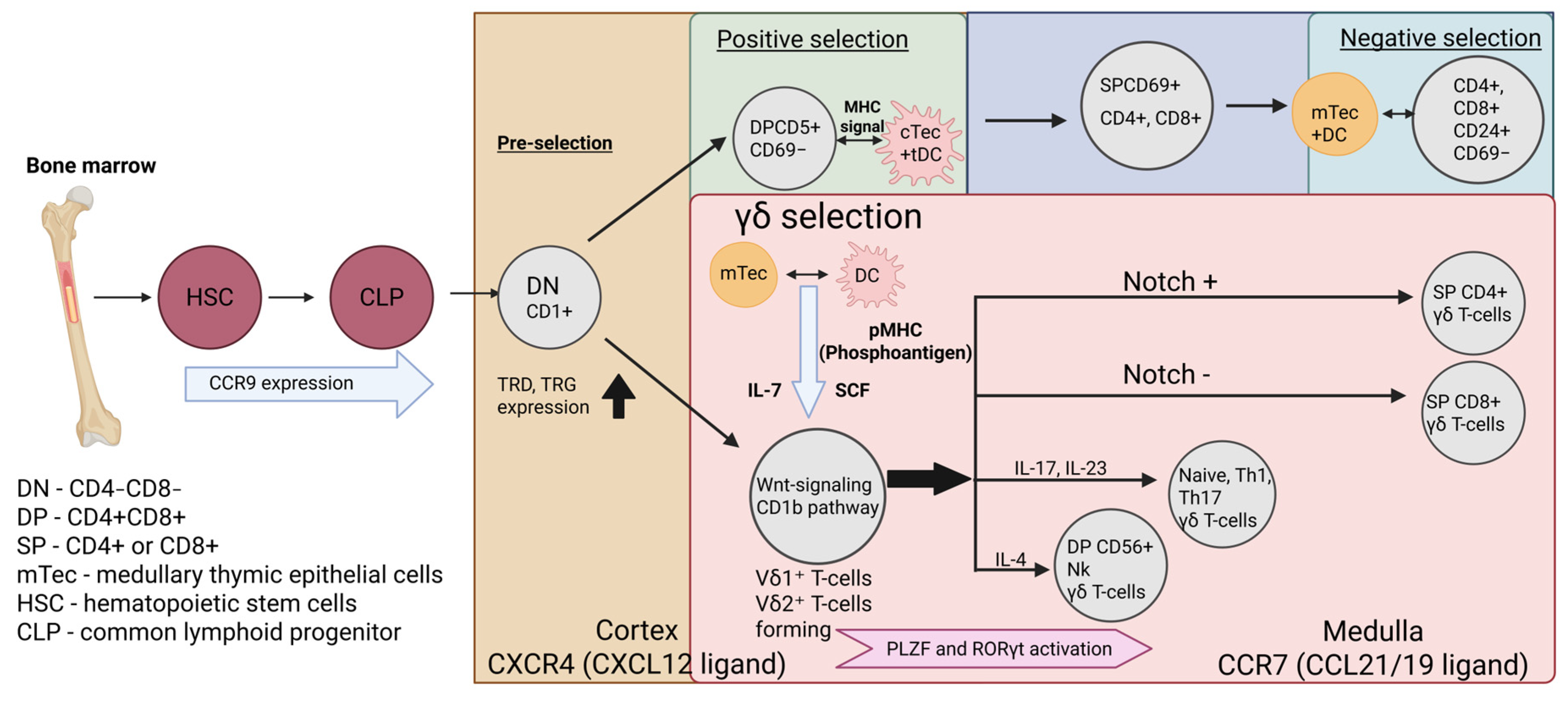
In contrast to the αβ T cell developmental pathway, which is defined by discrete positive and negative selection checkpoints, γδ T cells diverge early at the DN1a/b to DN3 stages, undergoing a more permissive and subset-dependent selection process. Their commitment is driven by simultaneous TRG and TRD gene rearrangement, which generates strong CD3-ERK/MAPK signals that instruct lineage specification [64,65]. A fundamental distinction from αβ TCRs lies in their antigen recognition strategy. Unlike the strict peptide–MHC restriction of αβ T cells, the γδ TCR, formed by an alternative architecture of γ- and δ-chains and influenced by early Sox13 expression, confers the ability to perceive a broader spectrum of antigens in an MHC-independent manner. This remarkable property enables the recognition of both exogenous and endogenous ligands, including foreign and self-antigens such as phosphoantigens [66]. The selection process for γδ T cells occurs in distinct phases (Figure 2). Initially, CCR9-expressing γδ thymocyte precursors interact with mTECs that secrete IL-7 [67] and SCF [68] into the microenvironment, promoting survival and proliferation. Subsequently, mesenchymal stromal cells provide Wnt ligands to sustain the γδ lineage through β-catenin and transcription factor TCF-1 activation [69]. A critical event at this stage is the regulation of two key transcriptional determinants, PLZF (Promyelocytic Leukemia Zinc Finger) and RORγt (Figure 2). The balance of these factors dictates the ultimate fate and phenotype of mature γδ T cells, polarizing them towards distinct subsets such as Vδ1+ (TRDV1+) or Vδ2+ (TRDV2+) cells. The activity of PLZF and RORγt also upregulates the production of IL-17 and IL-23, key cytokines that equip the γδ T cell population with its immune potential prior to peripheral migration [24,70,71]. It has been demonstrated that the outcome of γδ T cell differentiation in the thymus, regulated by the Notch signaling pathway, is directly dependent on the strength of the signal originating from TCR. A gradient of TCR signal strength dictates the choice between alternative differentiation lineages: weak signals lead to the formation of IL-4-producing Vγ1+ γδ T cells, whereas strong signals induce the development of IL-17-producing Vγ2+ γδ T cells [72]. Thus, Notch-mediated regulation, contingent upon TCR signal strength, drives the generation of both NK-like and helper-like γδ T cells. Furthermore, contrary to the prevailing view that γδ T cells are double-negative for the CD4 and CD8 co-receptors, evidence indicates that upon antigenic stimulation via the TCR in combination with Notch signaling, γδ T cells can upregulate the expression of either the CD4 [73] or CD8 [74] co-receptors, thereby demonstrating the plasticity of the CD4+ or CD8+ γδ TCR T cell phenotype (Figure 2). Thus, γδ T cell selection is characterized by permissive TCR interactions that guide subset-specific functional programming, rather than enforcing stringent self-tolerance checkpoints.
γδ T cell selection in the thymus is now understood to be permissive rather than strictly dichotomous. In comparison to αβ T cells, the thymic selection of γδ T cells can be viewed as affinity-based screening, whereby high-affinity clones develop into distinct T cell populations, whereas low-affinity clones are eliminated through apoptosis or can be converted to Vδ2+ T cells with antigen-presenting capabilities. Lastly, the functional maturation of selected γδ T cells involves interaction with a combined response from mTECs and dendritic cells. This engagement, often mediated through BTNL proteins, triggers ERK/MAPK signaling, refining the repertoire towards functional effector clones [75].

4.1. Vδ1+ T Cell Population

Vδ1+ T cells are generated during the early DN1-DN2 thymocyte stages and express a TCR incorporating the Vδ1 chain. Their development is influenced by IL-7 and Wnt signaling, which activate the transcription factor TCF-1 via a CD1d-dependent pathway [76]. Following their thymic development, Vδ1+ T cells migrate to peripheral tissues, where they reside and function as sentinels at barrier sites such as the skin, mucosa, and intestine [77,78]. Their homing to these locations is directed by specific chemokine axes; for instance, keratinocyte-derived CCL20 (MIP-3α) and CCL27 (CTACK) activate CCR6 on Vδ1+ T cells to guide their migration [79]. Similarly, CXCR16 expression by mucosal cells facilitates the recruitment of CXCR6-expressing Vδ1+ T cells [80]. Functionally, this subset is primarily responsible for reinforcing immune barriers at epithelial surfaces. They achieve this through the production of IL-17 and IL-22, cytokines that are crucial for maintaining mucosal integrity and defense against pathogens [81]. Concurrently, Vδ1+ T cells also exhibit potent cytotoxic activity. Via the expression of receptors such as NKG2D and DNAM-1, they are capable of eliminating infected and malignant cells [82,83].
This unique combination of barrier surveillance and effector functions currently makes Vδ1+ T cells a subject of intense scientific interest, highlighting their significant potential for application in personalized immunotherapeutic strategies.

4.2. Vδ2+ T Cell Population

The Vδ2+ T cell subpopulation develops later than its Vδ1+ counterparts, primarily originating from DP thymocytes that express a TCRγ9δ2 receptor. Their development is driven by phosphoantigens presented by DCs and mTECs [84,85]. A notable feature of these cells is their capacity to function as APCs even prior to peripheral migration. Selected, thymus-matured Vδ2+ T cells can leverage their unique TCRγ9δ2 to acquire and present antigens, thereby acting as non-conventional APCs [86,87]. Following their thymic egress, Vδ2+ T cells predominantly circulate in the blood and lymphoid organs. Their homing to sites of inflammation is guided by the expression of chemokine receptors such as CCR5 (binding RANTES) and CXCR3 (binding CXCL11) [88,89]. Due to their antigen-presenting capability, Vδ2+ T cells often play an immunostimulatory role by activating αβ T cells through antigen cross-presentation via MHC-I molecules [90]. Furthermore, Vδ2+ T cells are potent effectors in antimicrobial and antitumor immunity. Upon recruitment to inflammatory foci, they secrete key pro-inflammatory cytokines, including IFN-γ and TNF-α, and directly mediate the lysis of target cells through the release of cytolytic molecules such as perforin and granzymes [91].
Thus, the unique developmental pathway of γδ T cells endows them with a broad and versatile immunological repertoire, encompassing hybrid innate–adaptive functions, diverse antigen recognition and presentation capabilities, and the capacity to recruit and modulate αβ T cell responses, collectively positioning them as pivotal regulators of integrated immune surveillance.

5. Affinity and Its Role in T Cell Formation

The interaction strength between the T cell receptor and the peptide–MHC complex is a primary determinant of T cell efficacy in antigen recognition and response. TCR affinity is a decisive factor in determining the fate of individual T cell clones and in maintaining overall immune homeostasis. Consequently, significant research efforts are now focused on elucidating the precise mechanisms by which the thymus and its cellular constituents interpret this affinity threshold to shape the entire peripheral T cell repertoire.
The binding affinity of T cell receptors is conventionally quantified using dissociation and association rates (koff and kon, respectively) and the equilibrium dissociation constant (KD). These parameters define the strength, duration, and kinetics of the TCR-pMHC interaction [92,93]. At the molecular level, TCR-pMHC binding is often assessed using solution-based surface plasmon resonance (SPR), which measures 3D binding affinity. A significant limitation of this approach, however, is its inability to account for the effects of TCR-pMHC rebinding kinetics (kon) under physiological, two-dimensional (2D) conditions on the cell membrane [94]. To address this limitation, novel tetramer-based technologies, such as NTAmer assays, have been developed to evaluate both the strength and repetitiveness of TCR-pMHC engagements in a more biologically relevant context [95]. For γδ T cells, affinity is typically determined using tetramers loaded with phosphoantigens, with binding strength quantified by means of atomic force microscopy [96]. The application of these diverse methodologies for investigating intermolecular interactions across human T cell populations of varying affinity has been instrumental in identifying key biophysical and molecular factors that govern antigen recognition (Table 1).
To complete the signaling landscape characterized by each affinity threshold, it is established that a high-affinity TCR interaction is defined by stable binding to pMHC complexes, a feature often associated with autoreactive potential. Such engagements trigger intense signaling cascades: Lck/ZAP70-mediated phosphorylation of CD3ζ ITAMs initiates calcineurin-dependent activation of NFAT and AP-1 (Fos/Jun). These factors subsequently induce the expression of pro-apoptotic genes, including Bim and Nur77, through their specific enhancer elements, ultimately leading to clonal deletion in the thymic medulla [97]. Concurrent activation of the ERK/MAPK pathway further reinforces negative selection by upregulating anergy-associated markers such as PD-1 and CTLA-4 [98].
In the case of γδ T cells, selection is modulated by interactions with BTNL proteins on mTECs, which facilitate γδTCR engagement and signal transduction [99]. Furthermore, the transcription factor TOX (Thymocyte Selection-Associated HMG Box) plays a critical role in mediating the apoptotic fate of self-reactive thymocytes by regulating the expression of Bim [100]. Consequently, only the high-affinity γδ T cell clones, such as the Vδ1+ subset, are positively selected to mature and fulfill their pivotal role in adaptive immunity.
Notably, an intermediate TCR affinity is optimal for generating a functional T cell repertoire. TCR signaling, when coupled with CD28 co-stimulation, activates the PI3K-AKT-mTOR pathway, which drives proliferation and differentiation into effector subsets such as Th1, Th17, and cytotoxic CD8+ T cells. This process involves the induction of lineage-defining transcription factors: T-bet (for Th1) via STAT4 and RORγt (for Th17) via STAT3. Simultaneously, TCF-1 (encoded by Tcf7) and LEF-1 support clonal expansion by modulating chromatin accessibility at key cytokine loci (e.g., IFN-γ and IL-17) [101,102]. T cells with intermediate affinity sustain CD25 (IL-2Rα) expression, thereby enhancing their survival through IL-2 signaling. Furthermore, the sustained expression of CD69, induced via the NFAT pathway, serves as a key marker of successful thymic selection and activation [103]. The critical balance of CD28 and CD69 signaling is essential; disruptions in this equilibrium can cause a failure in positive selection, leading to apoptosis and resulting in immunodeficiency [104,105].
Finally, weak TCR signaling, characteristic of low-affinity TCR interactions, is a hallmark of naive T-lymphocytes and specific regulatory subsets. These low-intensity signals activate Foxo1, which inhibits the mTOR pathway and induces the expression of Klf2. This transcription factor upregulates the homing receptors CCR7 and S1PR1, facilitating the egress and circulation of naive T cells. In the context of low-affinity regulatory T cells (Tregs), the master regulator Foxp3 suppresses pro-inflammatory genes (e.g., *IL-2* and IFN-γ) and activates suppressive molecules (e.g., *CTLA-4* and *IL-10*) by recruiting chromatin-modifying enzymes such as HDACs and EZH2 to target gene promoters [54,106,107]. Low-affinity signaling is also intrinsically linked to the induction of anergy. TCR engagement in the absence of co-stimulation activates E3 ubiquitin ligases such as Cbl-b and GRAIL, which degrade key signaling molecules such as CD3ζ and PKCθ, thereby rendering the cell unresponsive [108,109]. The transcription factor NR4A serves as a marker for cells that have escaped deletion but remain in a state of tolerance.
Among γδ T cells, a low-affinity developmental path is associated with the expression of PLZF (Zbtb16), which dictates a tissue-resident phenotype, as seen in many Vδ2+ T cells. These low-affinity γδ T cells can subsequently participate in local immune responses by presenting phosphoantigens in the periphery [110,111].
In summary, the TCR binding affinity serves as the principal determinant orchestrating T cell fate during thymic development. It directly governs the survival and maturation of thymocytes, dictates the outcomes of negative selection, and directs the lineage choice between clonal deletion, anergy, and regulatory T cell differentiation. Collectively, these affinity-driven processes are fundamental in shaping a functional and self-tolerant T cell repertoire.

6. Methods for Analyzing the Processes of T Cell Formation in the Thymus

The seminal interest in thymic function emerged in the early 1960s, when Jacques Miller, through thymectomy experiments in mice, discovered its pivotal role in immunity and identified T-lymphocytes [112]. By the 1990s and early 2000s, researchers had delineated the thymic architecture and stromal components critical for T cell selection, alongside key regulatory proteins such as Aire, which governs the presentation of self-antigens by thymic dendritic cells and the pMHC-TCR axis.
The advent of advanced TCR affinity assessment tools—including tetramer technology and microfluidic platforms—has aided in elucidating the mechanisms underlying the selection of T cells based on high or low TCR affinity, in addition to the deletion of autoreactive clones. Furthermore, the rise of sequencing technologies, particularly bulk and single-cell RNA-seq, has enabled comprehensive analysis of cellular transcriptomes. These methods have been instrumental in revealing regulatory pathways and delineating the heterogeneity of thymic cell populations at single-cell resolution. For instance, scRNA-seq has refined the classification of γδ T cell subsets, such as Vδ1+ and Vδ2+ lineages [113]. Thus, technological progress has provided a comprehensive toolkit for dissecting thymic processes, greatly advancing our understanding of its role in both health and disease.

6.1. Experimental Models for Studying Thymopoiesis In Vitro

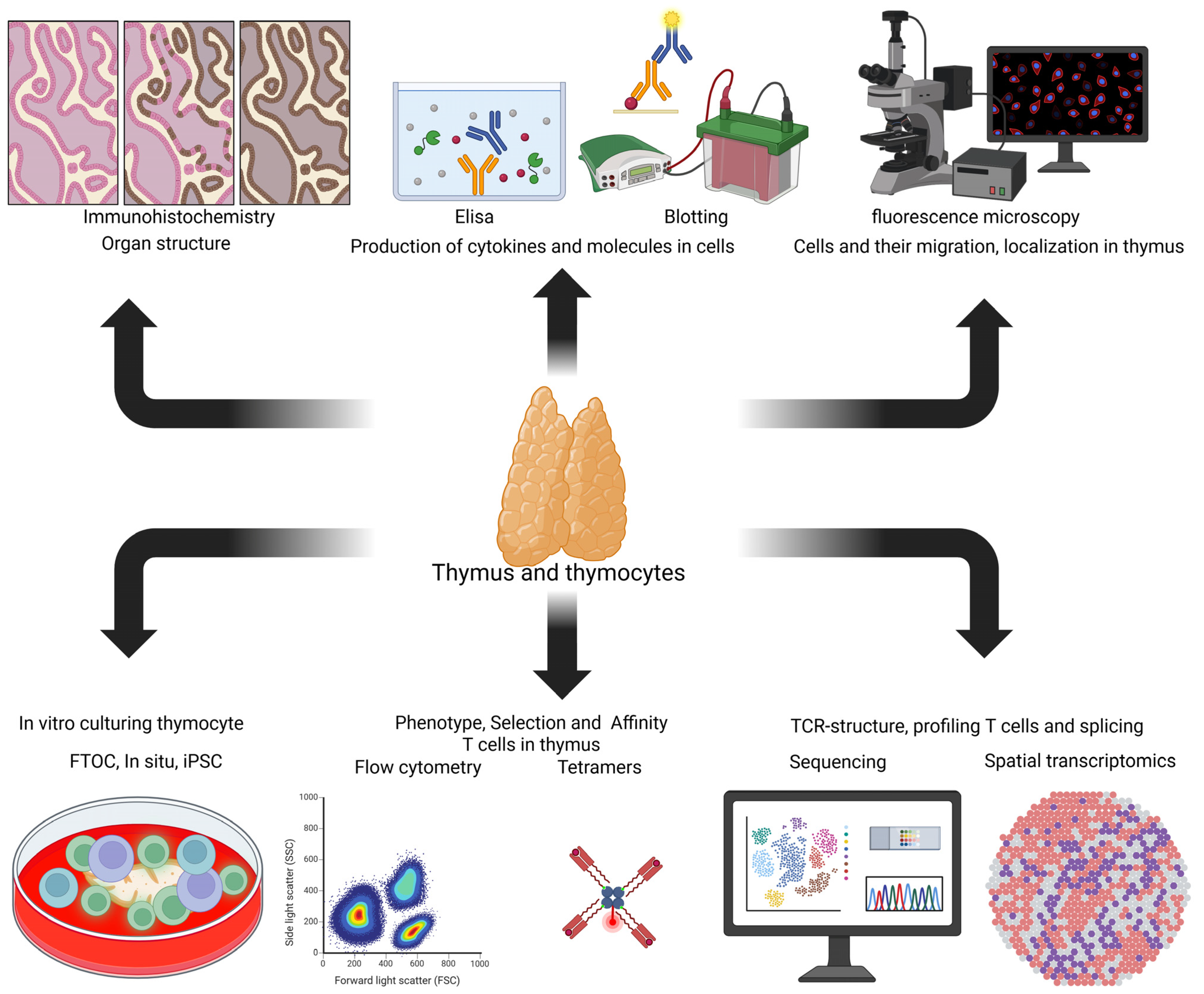
The study of T cell selection processes in the thymus actively involves complex experimental approaches that enable the reproduction of key differentiation stages in vitro (Figure 3). The main methods employed are as follows:
Fetal Thymus Organ Culture (FTOC): The application of this technique, which maintains the natural 3D architecture of both human fetal and neonatal mouse thymus, has been pivotal in elucidating the indispensable function of the stromal microenvironment. The results of studies involving FTOC have demonstrated that stromal-derived cues and cytokines, such as IL-7, are essential for supporting thymocyte proliferation and survival during the early DN-to-DP transition [114].
Reaggregate Thymus Organ Culture (RTOC): In contrast to FTOC, the RTOC methodology involves the initial disaggregation of thymic tissue followed by the re-aggregation of its cellular components. This key feature provides a unique platform for manipulating the cellular composition (e.g., by adding or removing specific stromal cell types) and genetic background (e.g., by introducing mutations). The capacity for such precise manipulation in RTOC has enabled direct experimental proof of the functional role of specific molecules, such as the Aire protein in mTECs, in mediating negative selection and establishing central immune tolerance [115].
Thymus Slice Culture (in situ model): This contemporary approach utilizes 200–400 μm thick sections of an intact thymus, prepared using a vibratome. The slices are cultured on porous membranes in a specialized medium, often supplemented with IL-7 and Stem Cell Factor (SCF). Its primary advantage lies in the preservation of the organ’s intricate 3D architecture and native stromal interactions, which are unattainable in fully dissociated systems. Fluorescently labeled progenitor cells (e.g., DN cells: CD4CD8CD44+CD25+) can be introduced into these slices, enabling real-time tracking of their differentiation and migration. As the model that best preserves the native architecture and cellular crosstalk, it has provided key evidence for the spatiotemporal organization of differentiation processes, including elucidating the role of the CCL21/CCR7 gradient in guiding thymocyte migration and revealing a two-step mechanism for Treg cell development that depends on integrated TCR and IL-2/STAT5 signaling within their natural niche [116,117,118].
Artificial Thymic Organoids (ATOs) and iPSC-derived Models: Recent advances in the generation of artificial thymic organoids (ATOs) and models derived from induced pluripotent stem cells (iPSCs) have provided unique platforms for modeling human thymopoiesis in vitro. These self-organizing three-dimensional structures mimic the native thymic microenvironment, effectively supporting the full spectrum of T cell development, including the generation of conventional αβ T cells, various γδ T cell subsets, and the evaluation of T cell maturation, thereby enabling the identification of key factors governing T cell differentiation [119,120,121]. These patient-specific models offer powerful tools for investigating T cell immunity, modeling genetic defects, and advancing the development of novel T cell-based therapies.

6.2. Analytical Methods for Studying the Thymus

A deep study of the various stages of differentiation and functions of thymus cells relies on a wide range of analytical techniques (Figure 3):
Flow Cytometry and Fluorescence-Activated Cell Sorting (FACS): Established flow cytometry protocols serve as a fundamental tool for identifying and isolating thymocyte subsets at distinct developmental stages. For instance, the use of biotinylated antibodies against CD69 and CD5 enables the efficient isolation of T cell fractions that have undergone negative selection. Multidimensional analysis combining markers such as CD24, CD4, CD8, and CD5 enables precise resolution of cell populations with low, intermediate, and high expression levels of key surface molecules, thereby facilitating the characterization of subtle differentiation transitions [122].
T Cell Receptor Sequencing (TCR-Seq): This technique enables comprehensive analysis of the clonality and diversity of the T cell repertoire. For example, the application of TCR-Seq to thymic cells has proven instrumental in characterizing V(D)J recombination events, tracking clonal dynamics during positive and negative selection, and identifying potentially autoreactive T cell clones [123]. In addition, an in situ TCR-seq approach aided in delineating significant variations in the T cell receptor (TCR) repertoire throughout T cell maturation, effectively mapping onto the canonical differentiation routes towards CD4+ and CD8+ fates [118]. The advent of TCR sequencing has further unlocked the potential to trace the evolving landscape of immune responses, thereby cementing its utility as a critical tool for personalized therapeutic interventions.
Single-Cell RNA Sequencing (scRNA-seq): This revolutionary technique has unveiled previously unrecognized heterogeneous populations and transcriptional trajectories during thymic development. For instance, scRNA-seq has refined the classification of γδ T cell subsets (e.g., Vδ1+ vs. Vδ2+) and revealed the presence and functional contributions of non-thymic lineages, such as dendritic cells and monocytes, within the thymic microenvironment [124]. Furthermore, the method is applied to investigate alternative splicing events during T cell differentiation, providing deeper insights into post-transcriptional regulation [125,126]. By capturing and analyzing full-length transcriptomes, the technique is increasingly applied to profile alternative splicing dynamics and isoform usage throughout T cell differentiation. This capability provides a deeper, more nuanced insight into the complex layer of post-transcriptional regulation that governs cell fate decisions, complementing the data on gene expression levels with information on the diversity of protein-coding messages generated [125,126]. The integration of these multifaceted data solidifies scRNA-seq as a cornerstone technique for constructing a comprehensive and high-resolution map of thymopoiesis.
Single-Cell Multi-Omics: Contemporary approaches integrate transcriptomics, cell surface protein analysis (CITE-seq), and epigenomics (scATAC-seq) within a unified analytical framework. These methods provide a comprehensive view of the interconnected regulatory networks governing cell fate decisions. For instance, the combined application of scRNA-seq and scATAC-seq has elucidated the epigenetic mechanisms—specifically, dynamic changes in chromatin accessibility—that underlie the lineage commitment to either the CD4+ or CD8+ T cell fates, revealing how key transcription factors such as ThPOK and Runx3 are regulated [127,128]. Ultimately, the systematic integration of these complementary data modalities is transforming our understanding of thymopoiesis by moving beyond correlative observations to construct causal models of gene regulatory network operation and cell identity establishment.
Spatial Transcriptomics/Multi-Omics: This approach represents a critically important contemporary technique that preserves the spatial context of molecular data. Spatial transcriptomics enables the direct correlation of gene expression patterns with a cell’s location within specific thymic niches (e.g., cortex and medulla), which is essential for deciphering the molecular foundations of cellular migration, selection, and intercellular communication. The application of this technique has been pivotal, for instance, in defining a specific niche within the thymic medulla that supports the formation of germinal centers and promotes the development of autoimmune responses in myasthenia gravis-associated thymoma [129]. Consequently, by integrating molecular profiling with histological structure, spatial transcriptomics transcends the limitations of dissociative techniques, offering a systems-level framework to resolve the spatial orchestration of immunity and its dysregulation in disease.
Immunohistochemistry (IHC) and Fluorescence Microscopy: These methods are indispensable for analyzing the spatiotemporal dynamics of thymopoiesis. Immunohistochemistry (IHC) is a method whereby protein localization in thymic tissue is visualized using enzyme-conjugated antibodies. Formalin-fixed, paraffin-embedded sections are stained with antibodies against markers such as keratins (K5/8), immune cell antigens (CD3 and CD25), or transcription factors (Aire and Foxp3), followed by chromogenic detection. IHC has been pivotal, for example, in defining KIT expression patterns in thymic epithelial cells during carcinoma [130,131,132,133]. Complementarily, fluorescence microscopy provides high-resolution imaging of cellular structures and interactions within the intact thymic architecture. It offers critical insights into thymocyte development and the thymic microenvironment, with key applications including the characterization of mTECs and their role in T-regulatory cell development [134,135,136,137].
MHC Tetramers: The use of MHC tetramers loaded with peptide ligands of defined affinity enables the direct study of TCR engagement with its cognate pMHC complex [138,139]. For instance, stimulating thymocytes with MHC tetramers loaded with low-affinity ligands—mimicking the conditions of positive selection—demonstrated that low-affinity tetramers induce sustained, yet low-amplitude, downstream TCR signaling events, particularly through the PI3K-AKT-mTOR pathway, thereby promoting survival and lineage commitment without triggering negative selection [140].
Immunoblotting (Western blot) and Enzyme-Linked Immunosorbent Assay (ELISA): These techniques collectively enable the quantitative analysis of protein expression and cytokine secretion. Immunoblotting provides quantitative data on key signaling molecules (e.g., p-AKT and Bcl-2), transcription factors (e.g., Foxp3 and Aire), and receptors, in addition to essential post-translational modifications such as phosphorylation [141,142]. ELISA has been crucial for demonstrating specific physiological changes, such as the reduction in IL-7 production linked to the decline in double-negative thymocytes during age-related thymic involution [143]. The integrated application of these methods is a powerful strategy. For example, it has been pivotal in correlating diminished IL-7 levels with impaired downstream signaling, such as reduced STAT5 phosphorylation, across various pathological contexts [144,145,146].

7. Concluding Remarks and Future Perspectives

The contemporary understanding of thymus biology, achieved through an integration of sophisticated culture systems and high-resolution analytical technologies, is paving the way for novel translational applications. A primary and promising frontier is the harnessing of fundamental knowledge on thymopoiesis for the controlled de novo generation of T cells with predefined antigen specificity. This approach holds significant translational potential, particularly in two key areas: enhancing the efficacy of cancer immunotherapy through the production of T cells with high-affinity TCRs for tumor antigens and preventing transplant rejection by generating T cells tolerant to alloantigens. However, the realization of this potential faces substantial hurdles. Technical challenges include the difficulty of recreating a fully functional thymic niche in vitro—the issue of “thymic mimicry”—and limitations imposed by MHC polymorphism. Immunological obstacles involve the precise control of TCR affinity and ensuring the long-term functional stability of in vitro-derived regulatory T cells. Critical unresolved questions remain, including the precise mechanisms governing αβ/γδ lineage commitment. Ultimately, overcoming these barriers—thymic mimicry, MHC restrictions, and Treg instability—will depend on the continued advancement of techniques that can more accurately reconstruct the thymic microenvironment and provide a comprehensive analysis of the molecular processes governing thymocyte selection and differentiation. Future methodological progress is anticipated to resolve these challenges, thereby yielding powerful new therapeutic strategies for oncology and transplantation medicine.

Author Contributions

A.B. and E.G. wrote the manuscript and created the figures and table. S.S. conceived the original idea, designed the study and supervised the writing of the manuscript. All authors have read and agreed to the published version of the manuscript.

Funding

This research was funded by the Ministry of Higher Education and Science, State Assignment No. 12411200103-3.

Informed Consent Statement

Not applicable.

Data Availability Statement

The data that support the findings of this study are available upon an email request from the corresponding author, S.V. Sennikov.

Acknowledgments

This research was supported by the Academic Leadership Program Priority 2030 proposed by the Federal State Autonomous Educational Institution of Higher Education I.M. Sechenov First Moscow State Medical University of the Ministry of Health of the Russian Federation (Sechenov University).

Conflicts of Interest

The authors declare no conflicts of interest.

References

  1. Raica, M.; Cîmpean, A.M.; Encică, S.; Cornea, R. Involution of the thymus: A possible diagnostic pitfall. Rom. J. Morphol. Embryol. 2007, 48, 101–106. [Google Scholar]
  2. Petrie, H.T.; Zúñiga-Pflücker, J.C. Zoned out: Functional mapping of stromal signaling microenvironments in the thymus. Annu. Rev. Immunol. 2007, 25, 649–679. [Google Scholar] [CrossRef]
  3. Gouse, H.; Suban, M.; Suban, M.G.; Gunasegaran, J.P. Histological and histometrical study on human fetal thymus. Health Sci. 2019, 8, 90–109. [Google Scholar]
  4. Takada, K.; Ohigashi, I.; Kasai, M.; Nakase, H.; Takahama, Y. Development and function of cortical thymic epithelial cells. Curr. Top. Microbiol. Immunol. 2014, 373, 1–17. [Google Scholar] [CrossRef] [PubMed]
  5. Klein, L.; Kyewski, B.; Allen, P.M.; Hogquist, K.A. Positive and negative selection of the T cell repertoire: What thymocytes see (and don’t see). Nat. Rev. Immunol. 2014, 14, 377–391. [Google Scholar] [CrossRef] [PubMed]
  6. Anderson, M.S.; Venanzi, E.S.; Klein, L.; Chen, Z.; Berzins, S.P.; Turley, S.J.; von Boehmer, H.; Bronson, R.; Dierich, A.; Benoist, C.; et al. Projection of an immunological self shadow within the thymus by the aire protein. Science 2002, 298, 1395–1401. [Google Scholar] [CrossRef] [PubMed]
  7. Givony, T.; Leshkowitz, D.; Del Castillo, D.; Nevo, S.; Kadouri, N.; Dassa, B.; Gruper, Y.; Khalaila, R.; Ben-Nun, O.; Gome, T.; et al. Thymic mimetic cells function beyond self-tolerance. Nature 2023, 622, 164–172, Correction in: Nature 2023, 624, E4. [Google Scholar] [CrossRef]
  8. Robin, C.; Bennaceur-Griscelli, A.; Louache, F.; Vainchenker, W.; Coulombel, L. Identification of human T-lymphoid progenitor cells in CD34+ CD38low and CD34+ CD38+ subsets of human cord blood and bone marrow cells using NOD-SCID fetal thymus organ cultures. Br. J. Haematol. 1999, 104, 809–819. [Google Scholar] [CrossRef]
  9. Calderón, L.; Boehm, T. Three chemokine receptors cooperatively regulate homing of hematopoietic progeni-tors to the embryonic mouse thymus. Proc. Natl. Acad. Sci. USA 2011, 108, 7517–7522. [Google Scholar] [CrossRef]
  10. Kong, F.; Chen, C.H.; Cooper, M.D. Thymic function can be accurately monitored by the level of recent T cell emigrants in the circulation. Immunity 1998, 8, 97–104. [Google Scholar] [CrossRef]
  11. Benz, C.; Heinzel, K.; Bleul, C.C. Homing of immature thymocytes to the subcapsular microenvironment within the thymus is not an absolute requirement for T cell development. Eur. J. Immunol. 2004, 34, 3652–3663. [Google Scholar] [CrossRef]
  12. Karima, G.; Kim, H.D. Unlocking the regenerative key: Targeting stem cell factors for bone renewal. J Tissue Eng. 2024, 15, 20417314241287491. [Google Scholar] [CrossRef] [PubMed]
  13. Kenins, L.; Gill, J.W.; Boyd, R.L.; Holländer, G.A.; Wodnar-Filipowicz, A. Intrathymic expression of Flt3 ligand enhances thymic recovery after irradiation. J. Exp. Med. 2008, 205, 523–531. [Google Scholar] [CrossRef] [PubMed]
  14. Hozumi, K.; Mailhos, C.; Negishi, N.; Hirano, K.; Yahata, T.; Ando, K.; Zuklys, S.; HollänDer, G.A.; Shima, D.T.; Habu, S. Delta-like 4 is indispensable in thymic environment specific for T cell development. J. Exp. Med. 2008, 205, 2507–2513. [Google Scholar] [CrossRef] [PubMed]
  15. Famili, F.; Wiekmeijer, A.S.; Staal, F.J. The development of T cells from stem cells in mice and humans. Future Sci. OA 2017, 3, FSO186. [Google Scholar] [CrossRef]
  16. Soboloff, J.; Kappes, D.J. (Eds.) Signaling Mechanisms Regulating T Cell Diversity and Function; CRC Press/Taylor & Francis: Boca Raton, FL, USA, 2018. [Google Scholar]
  17. Parker, M.E.; Ciofani, M. Regulation of γδ T Cell Effector Diversification in the Thymus. Front. Immunol. 2020, 11, 42. [Google Scholar] [CrossRef] [PubMed]
  18. Shinzawa, M.; Moseman, E.A.; Gossa, S.; Mano, Y.; Bhattacharya, A.; Guinter, T.; Alag, A.; Chen, X.; Cam, M.; McGavern, D.B.; et al. Reversal of the T Cell Immune System Reveals the Molecular Basis for T Cell Lineage Fate Determination in the Thymus. Nat. Immunol. 2022, 23, 731–742. [Google Scholar] [CrossRef]
  19. Turchinovich, G.; Hayday, A.C. Skint-1 Identifies a Common Molecular Mechanism for the Development of Interferon-γ-Secreting Versus Interleukin-17-Secreting γδ T Cells. Immunity 2011, 35, 59–68. [Google Scholar] [CrossRef]
  20. D’Souza, W.N.; Chang, C.F.; Fischer, A.M.; Li, M.; Hedrick, S.M. The Erk2 MAPK regulates CD8 T cell proliferation and survival. J. Immunol. 2008, 181, 7617–7629. [Google Scholar] [CrossRef]
  21. Van Laethem, F.; Tikhonova, A.N.; Pobezinsky, L.A.; Tai, X.; Kimura, M.Y.; Le Saout, C.; Guinter, T.I.; Adams, A.; Sharrow, S.O.; Bernhardt, G.; et al. Lck Availability During Thymic Selection Determines the Recognition Specificity of the T Cell Repertoire. Cell 2013, 154, 1326–1341. [Google Scholar] [CrossRef]
  22. Palacios, E.H.; Weiss, A. Distinct Roles for Syk and ZAP-70 During Early Thymocyte Development. J. Exp. Med. 2007, 204, 1703–1715. [Google Scholar] [CrossRef]
  23. Lagattuta, K.A.; Kohlgruber, A.C.; Abdelfattah, N.S.; Nathan, A.; Rumker, L.; Birnbaum, M.E.; Elledge, S.J.; Raychaudhuri, S. The T Cell Receptor Sequence Influences the Likelihood of T Cell Memory Formation. bioRxiv 2023, Preprint. [Google Scholar] [CrossRef]
  24. Lu, Y.; Cao, X.; Zhang, X.; Kovalovsky, D. PLZF Controls the Development of Fetal-Derived IL-17+Vγ6+ γδ T Cells. J. Immunol. 2015, 195, 4273–4281. [Google Scholar] [CrossRef]
  25. Hosokawa, H.; Romero-Wolf, M.; Yui, M.A.; Ungerbäck, J.; Quiloan, M.L.G.; Matsumoto, M.; Nakayama, K.I.; Tanaka, T.; Rothenberg, E.V. Bcl11b sets pro-T cell fate by site-specific cofactor recruitment and by repressing Id2 and Zbtb16. Nat Immunol. 2018, 19, 1427–1440. [Google Scholar] [CrossRef]
  26. Matsuda-Lennikov, M.; Ohigashi, I.; Takahama, Y. Tissue-Specific Proteasomes in Generation of MHC Class I Peptides and CD8+ T Cells. Curr. Opin. Immunol. 2022, 77, 102217. [Google Scholar] [CrossRef] [PubMed]
  27. Arudchelvan, Y.; Nishimura, Y.; Tokuda, N.; Sawada, T.; Shinozaki, F.; Fukumoto, T. Differential Expression of MHC Class II Antigens and Cathepsin L by Subtypes of Cortical Epithelial Cells in the Rat Thymus: An Immunoelectron Microscopic Study. J. Electron. Microsc. 2002, 51, 173–181. [Google Scholar] [CrossRef] [PubMed]
  28. Ozga, A.J.; Moalli, F.; Abe, J.; Swoger, J.; Sharpe, J.; Zehn, D.; Kreutzfeldt, M.; Merkler, D.; Ripoll, J.; Stein, J.V. pMHC Affinity Controls Duration of CD8+ T Cell-DC Interactions and Imprints Timing of Effector Differentiation Versus Expansion. J. Exp. Med. 2016, 213, 2811–2829. [Google Scholar] [CrossRef]
  29. Puech, P.H.; Bongrand, P. Mechanotransduction as a Major Driver of Cell Behaviour: Mechanisms, and Relevance to Cell Organization and Future Research. Open Biol. 2021, 11, 210256. [Google Scholar] [CrossRef] [PubMed]
  30. Carpenter, A.C.; Grainger, J.R.; Xiong, Y.; Kanno, Y.; Chu, H.H.; Wang, L.; Naik, S.; dos Santos, L.; Wei, L.; Jenkins, M.K.; et al. The Transcription Factors Thpok and LRF Are Necessary and Partly Redundant for T Helper Cell Differentiation. Immunity 2012, 37, 622–633. [Google Scholar] [CrossRef]
  31. Twu, Y.C.; Teh, H.S. The ThPOK Transcription Factor Differentially Affects the Development and Function of Self-Specific CD8+ T Cells and Regulatory CD4+ T Cells. Immunology 2014, 141, 431–445. [Google Scholar] [CrossRef]
  32. Istaces, N.; Splittgerber, M.; Lima Silva, V.; Nguyen, M.; Thomas, S.; Le, A.; Achouri, Y.; Calonne, E.; Defrance, M.; Fuks, F.; et al. EOMES Interacts with RUNX3 and BRG1 to Promote Innate Memory Cell Formation Through Epigenetic Reprogramming. Nat. Commun. 2019, 10, 3306. [Google Scholar] [CrossRef]
  33. Zitti, B.; Hoffer, E.; Zheng, W.; Pandey, R.V.; Schlums, H.; Perinetti Casoni, G.; Fusi, I.; Nguyen, L.; Kärner, J.; Kokkinou, E.; et al. Human Skin-Resident CD8+ T Cells Require RUNX2 and RUNX3 for Induction of Cytotoxicity and Expression of the Integrin CD49a. Immunity 2023, 56, 1285–1302.e7. [Google Scholar] [CrossRef]
  34. Kappes, D.J. Expanding Roles for ThPOK in Thymic Development. Immunol. Rev. 2010, 238, 182–194. [Google Scholar] [CrossRef]
  35. Hassan, H.; Sakaguchi, S.; Tenno, M.; Kopf, A.; Boucheron, N.; Carpenter, A.C.; Egawa, T.; Taniuchi, I.; Ellmeier, W. Cd8 Enhancer E8I and Runx Factors Regulate CD8α Expression in Activated CD8+ T Cells. Proc. Natl. Acad. Sci. USA 2011, 108, 18330–18335. [Google Scholar] [CrossRef]
  36. Zhang, X.; Liu, J.Q.; Shi, Y.; Reid, H.H.; Boyd, R.L.; Khattabi, M.; El-Omrani, H.Y.; Zheng, P.; Liu, Y.; Bai, X. CD24 on Thymic APCs Regulates Negative Selection of Myelin Antigen-Specific T Lymphocytes. Eur. J. Immunol. 2012, 42, 924–935. [Google Scholar] [CrossRef] [PubMed]
  37. Yamashita, I.; Nagata, T.; Tada, T.; Nakayama, T. CD69 Cell Surface Expression Identifies Developing Thymocytes Which Audition for T Cell Antigen Receptor-Mediated Positive Selection. Int. Immunol. 1993, 5, 1139–1150. [Google Scholar] [CrossRef] [PubMed]
  38. Kozai, M.; Kubo, Y.; Katakai, T.; Kondo, H.; Kiyonari, H.; Schaeuble, K.; Luther, S.A.; Ishimaru, N.; Ohigashi, I.; Takahama, Y. Essential Role of CCL21 in Establishment of Central Self-Tolerance in T Cells. J. Exp. Med. 2017, 214, 1925–1935. [Google Scholar] [CrossRef] [PubMed]
  39. Lucas, B.; White, A.J.; Parnell, S.M.; Henley, P.M.; Jenkinson, W.E.; Anderson, G. Progressive Changes in CXCR4 Expression That Define Thymocyte Positive Selection Are Dispensable For Both Innate and Conventional αβT-cell Development. Sci. Rep. 2017, 7, 5068. [Google Scholar] [CrossRef]
  40. Choi, E.Y.; Jung, K.C.; Park, H.J.; Chung, D.H.; Song, J.S.; Yang, S.D.; Simpson, E.; Park, S.H. Thymocyte-Thymocyte Interaction for Efficient Positive Selection and Maturation of CD4 T Cells. Immunity 2005, 23, 387–396. [Google Scholar] [CrossRef]
  41. Peterson, P.; Org, T.; Rebane, A. Transcriptional Regulation by AIRE: Molecular Mechanisms of Central Tolerance. Nat. Rev. Immunol. 2008, 8, 948–957. [Google Scholar] [CrossRef]
  42. Anderson, M.S.; Venanzi, E.S.; Chen, Z.; Berzins, S.P.; Benoist, C.; Mathis, D. The Cellular Mechanism of Aire Control of T Cell Tolerance. Immunity 2005, 23, 227–239. [Google Scholar] [CrossRef] [PubMed]
  43. Shevyrev, D.; Tereshchenko, V.; Kozlov, V.; Sennikov, S. Phylogeny, Structure, Functions, and Role of AIRE in the Formation of T-Cell Subsets. Cells 2022, 11, 194. [Google Scholar] [CrossRef]
  44. Passos, G.A.; Speck-Hernandez, C.A.; Assis, A.F.; Mendes-da-Cruz, D.A. Update on Aire and Thymic Negative Selection. Immunology 2018, 153, 10–20. [Google Scholar] [CrossRef]
  45. Alvarez Arias, D.A.; McCarty, N.; Lu, L.; Maldonado, R.A.; Shinohara, M.L.; Cantor, H. Unexpected Role of Clathrin Adaptor AP-1 in MHC-Dependent Positive Selection of T Cells. Proc. Natl. Acad. Sci. USA 2010, 107, 2556–2561. [Google Scholar] [CrossRef]
  46. Pellegrini, M.; Bouillet, P.; Robati, M.; Belz, G.T.; Davey, G.M.; Strasser, A. Loss of Bim Increases T Cell Production and Function in Interleukin 7 Receptor-Deficient Mice. J. Exp. Med. 2004, 200, 1189–1195. [Google Scholar] [CrossRef]
  47. Lith, S.C.; van Os, B.W.; Seijkens, T.T.P.; de Vries, C.J.M. ‘Nur’turing Tumor T Cell Tolerance and Exhaustion: Novel Function for Nuclear Receptor Nur77 in Immunity. Eur. J. Immunol. 2020, 50, 1643–1652. [Google Scholar] [CrossRef]
  48. Sade, H.; Sarin, A. Reactive Oxygen Species Regulate Quiescent T-Cell Apoptosis via the BH3-Only Proapoptotic Protein BIM. Cell Death Differ. 2004, 11, 416–423. [Google Scholar] [CrossRef]
  49. Nguyen, T.T.T.; Wang, Z.E.; Shen, L.; Schroeder, A.; Eckalbar, W.; Weiss, A. Cbl-b Deficiency Prevents Functional But Not Phenotypic T Cell Anergy. J. Exp. Med. 2021, 218, e20202477. [Google Scholar] [CrossRef]
  50. Nurieva, R.I.; Zheng, S.; Jin, W.; Chung, Y.; Zhang, Y.; Martinez, G.J.; Reynolds, J.M.; Wang, S.-L.; Lin, X.; Sun, S.-C.; et al. The E3 Ubiquitin Ligase GRAIL Regulates T Cell Tolerance and Regulatory T Cell Function by Mediating T Cell Receptor-CD3 Degradation. Immunity 2010, 32, 670–680. [Google Scholar] [CrossRef] [PubMed]
  51. Wang, J.; He, N.; Zhang, N.; Quan, D.; Zhang, S.; Zhang, C.; Yu, R.T.; Atkins, A.R.; Zhu, R.; Yang, C.; et al. NCoR1 Restrains Thymic Negative Selection by Repressing Bim Expression to Spare Thymocytes Undergoing Positive Selection. Nat. Commun. 2017, 8, 959. [Google Scholar] [CrossRef] [PubMed]
  52. Bettini, M.L.; Vignali, D.A. Development of Thymically Derived Natural Regulatory T Cells. Ann. N. Y. Acad. Sci. 2010, 1183, 1–12. [Google Scholar] [CrossRef]
  53. Tai, X.; Indart, A.; Rojano, M.; Guo, J.; Apenes, N.; Kadakia, T.; Craveiro, M.; Alag, A.; Etzensperger, R.; Badr, M.E.; et al. How Autoreactive Thymocytes Differentiate into Regulatory Versus Effector CD4+ T Cells After Avoiding Clonal Deletion. Nat. Immunol. 2023, 24, 637–651. [Google Scholar] [CrossRef] [PubMed]
  54. Sprouse, M.L.; Shevchenko, I.; Scavuzzo, M.A.; Joseph, F.; Lee, T.; Blum, S.; Borowiak, M.; Bettini, M.L.; Bettini, M. Cutting Edge: Low-Affinity TCRs Support Regulatory T Cell Function in Autoimmunity. J. Immunol. 2018, 200, 909–914. [Google Scholar] [CrossRef]
  55. Lee, W.; Lee, G.R. Transcriptional Regulation and Development of Regulatory T Cells. Exp. Mol. Med. 2018, 50, e456. [Google Scholar] [CrossRef]
  56. Jabeen, M.F.; Hinks, T.S.C. MAIT Cells and the Microbiome. Front. Immunol. 2023, 14, 1127588. [Google Scholar] [CrossRef]
  57. Salou, M.; Legoux, F.; Lantz, O. MAIT Cell Development in Mice and Humans. Mol. Immunol. 2021, 130, 31–36. [Google Scholar] [CrossRef]
  58. Garner, L.C.; Amini, A.; FitzPatrick, M.E.B.; Lett, M.J.; Hess, G.F.; Filipowicz Sinnreich, M.; Provine, N.M.; Klenerman, P. Single-Cell Analysis of Human MAIT Cell Transcriptional, Functional and Clonal Diversity. Nat. Immunol. 2023, 24, 1565–1578. [Google Scholar] [CrossRef]
  59. Koay, H.F.; Gherardin, N.A.; Enders, A.; Loh, L.; Mackay, L.K.; Almeida, C.F.; Russ, B.E.; Nold-Petry, C.A.; Nold, M.F.; Bedoui, S.; et al. A Three-Stage Intrathymic Development Pathway for the Mucosal-Associated Invariant T Cell Lineage. Nat. Immunol. 2016, 17, 1300–1311. [Google Scholar] [CrossRef] [PubMed]
  60. Kjer-Nielsen, L.; Patel, O.; Corbett, A.; Le Nours, J.; Meehan, B.; Liu, L.; Bhati, M.; Chen, Z.; Kostenko, L.; Reantragoon, R.; et al. MR1 Presents Microbial Vitamin B Metabolites to MAIT Cells. Nature 2012, 491, 717–723. [Google Scholar] [CrossRef] [PubMed]
  61. Awad, W.; Mayall, J.R.; Xu, W.; Johansen, M.D.; Patton, T.; Lim, X.Y.; Galvao, I.; Howson, L.J.; Brown, A.C.; Haw, T.J.; et al. Cigarette Smoke Components Modulate the MR1-MAIT Axis. J. Exp. Med. 2025, 222, e20240896. [Google Scholar] [CrossRef]
  62. Drashansky, T.T.; Helm, E.Y.; Curkovic, N.; Cooper, J.; Cheng, P.; Chen, X.; Gautam, N.; Meng, L.; Kwiatkowski, A.J.; Collins, W.O.; et al. BCL11B Is Positioned Upstream of PLZF and RORγt to Control Thymic Development of Mucosal-Associated Invariant T Cells and MAIT17 Program. iScience 2021, 24, 102307. [Google Scholar] [CrossRef]
  63. Winter, S.J.; Kunze-Schumacher, H.; Imelmann, E.; Grewers, Z.; Osthues, T.; Krueger, A. MicroRNA miR-181a/b-1 Controls MAIT Cell Development. Immunol. Cell Biol. 2019, 97, 190–202. [Google Scholar] [CrossRef]
  64. Oh, S.; Liu, X.; Tomei, S.; Luo, M.; Skinner, J.P.; Berzins, S.P.; Naik, S.H.; Gray, D.H.D.; Chong, M.M.W. Distinct Subpopulations of DN1 Thymocytes Exhibit Preferential γδ T Lineage Potential. Front. Immunol. 2023, 14, 1106652. [Google Scholar] [CrossRef]
  65. Lee, S.Y.; Stadanlick, J.; Kappes, D.J.; Wiest, D.L. Towards a Molecular Understanding of the Differential Signals Regulating Alphabeta/Gammadelta T Lineage Choice. Semin. Immunol. 2010, 22, 237–246. [Google Scholar] [CrossRef]
  66. Mallis, R.J.; Duke-Cohan, J.S.; Das, D.K.; Akitsu, A.; Luoma, A.M.; Banik, D.; Stephens, H.M.; Tetteh, P.W.; Castro, C.D.; Krahnke, S.; et al. Molecular Design of the γδT Cell Receptor Ectodomain Encodes Biologically Fit Ligand Recognition in the Absence of Mechanosensing. Proc. Natl. Acad. Sci. USA 2021, 118, e2023050118. [Google Scholar] [CrossRef]
  67. Laky, K.; Lefrançois, L.; von Freeden-Jeffry, U.; Murray, R.; Puddington, L. The Role of IL-7 in Thymic and Extrathymic Development of TCR Gamma Delta Cells. J. Immunol. 1998, 161, 707–713. [Google Scholar] [CrossRef] [PubMed]
  68. Ruiz Pérez, M.; Vandenabeele, P.; Tougaard, P. The Thymus Road to a T Cell: Migration, Selection, and Atrophy. Front. Immunol. 2024, 15, 1443910. [Google Scholar] [CrossRef] [PubMed]
  69. Fahl, S.P.; Contreras, A.V.; Verma, A.; Qiu, X.; Harly, C.; Radtke, F.; Zúñiga-Pflücker, J.C.; Murre, C.; Xue, H.-H.; Sen, J.M.; et al. The E Protein-TCF1 Axis Controls γδ T Cell Development and Effector Fate. Cell Rep. 2021, 34, 108716. [Google Scholar] [CrossRef]
  70. Liu, Y.; Shi, C.; Ma, S.; Ma, Y.; Lu, X.; Zhu, J.; Yang, D. The Protective Role of Tissue-Resident Interleukin 17A-Producing Gamma Delta T Cells in Mycobacterium Leprae Infection. Front. Immunol. 2022, 13, 961405. [Google Scholar] [CrossRef]
  71. Venken, K.; Jacques, P.; Mortier, C.; Labadia, M.E.; Decruy, T.; Coudenys, J.; Hoyt, K.; Wayne, A.L.; Hughes, R.; Turner, M.; et al. RORγt Inhibition Selectively Targets IL-17 Producing iNKT and γδ-T Cells Enriched in Spondyloarthritis Patients. Nat. Commun. 2019, 10, 9. [Google Scholar] [CrossRef] [PubMed]
  72. Chen, E.L.Y.; Lee, C.R.; Thompson, P.K.; Wiest, D.L.; Anderson, M.K.; Zúñiga-Pflücker, J.C. Ontogenic timing, T cell receptor signal strength, and Notch signaling direct γδ T cell functional differentiation in vivo. Cell Rep. 2021, 35, 109227. [Google Scholar] [CrossRef]
  73. Karner, K.H.; Menon, M.P.; Inamdar, K.V.; Carey, J.L. Post-Transplant CD4+ Non-Cytotoxic γδ T Cell Lymphoma With Lymph Node Involvement. J. Hematop. 2018, 11, 107–113. [Google Scholar] [CrossRef]
  74. Sato, K.; Ohtsuka, K.; Watanabe, H.; Asakura, H.; Abo, T. Detailed characterization of gamma delta T cells within the organs in mice: Classification into three groups. Immunology 1993, 80, 380–387. [Google Scholar]
  75. Born, W.K.; Kemal Aydintug, M.; O’Brien, R.L. Diversity of γδ T-Cell Antigens. Cell. Mol. Immunol. 2013, 10, 13–20. [Google Scholar] [CrossRef]
  76. McMurray, J.L.; von Borstel, A.; Taher, T.E.; Syrimi, E.; Taylor, G.S.; Sharif, M.; Rossjohn, J.; Remmerswaal, E.B.; Bemelman, F.J.; Braga, F.A.V.; et al. Transcriptional Profiling of Human Vδ1 T Cells Reveals a Pathogen-Driven Adaptive Differentiation Program. Cell Rep. 2022, 39, 110858. [Google Scholar] [CrossRef]
  77. Li, Y.; Liu, Y.; Bu, X.; Qin, Y.; Zhang, Y. Research Progress on V Delta 1+ T Cells and Their Effect on Pathogen Infection. PeerJ 2024, 12, e18313. [Google Scholar] [CrossRef]
  78. Sun, Z.; Ji, H.; Zhou, Y.; Duan, H.; Ma, B.; Qi, H. Profiles, Distribution, and Functions of Gamma Delta T Cells in Ocular Surface Homeostasis and Diseases. Front. Biosci. 2024, 29, 146. [Google Scholar] [CrossRef] [PubMed]
  79. Hammerich, L.; Bangen, J.M.; Govaere, O.; Zimmermann, H.W.; Gassler, N.; Huss, S.; Liedtke, C.; Prinz, I.; Lira, S.A.; Luedde, T.; et al. Chemokine Receptor CCR6-Dependent Accumulation of γδ T Cells in Injured Liver Restricts Hepatic Inflammation and Fibrosis. Hepatology 2014, 59, 630–642. [Google Scholar] [CrossRef] [PubMed]
  80. Wang, Y.; Guan, Y.; Hu, Y.; Li, Y.; Lu, N.; Zhang, C. Murine CXCR3+CXCR6+γδT Cells Reside in the Liver and Provide Protection Against HBV Infection. Front. Immunol. 2022, 12, 757379. [Google Scholar] [CrossRef] [PubMed]
  81. Eyerich, S.; Eyerich, K.; Cavani, A.; Schmidt-Weber, C. IL-17 and IL-22: Siblings, Not Twins. Trends Immunol. 2010, 31, 354–361. [Google Scholar] [CrossRef]
  82. Zingoni, A.; Ardolino, M.; Santoni, A.; Cerboni, C. NKG2D and DNAM-1 Activating Receptors and Their Ligands in NK-T Cell Interactions: Role in the NK Cell-Mediated Negative Regulation of T Cell Responses. Front. Immunol. 2013, 3, 408. [Google Scholar] [CrossRef]
  83. Sugai, S.; Yoshikawa, T.; Iwama, T.; Tsuchiya, N.; Ueda, N.; Fujinami, N.; Shimomura, M.; Zhang, R.; Kaneko, S.; Uemura, Y.; et al. Hepatocellular Carcinoma Cell Sensitivity to Vγ9Vδ2 T Lymphocyte-Mediated Killing Is Increased by Zoledronate. Int. J. Oncol. 2016, 48, 1794–1804. [Google Scholar] [CrossRef]
  84. Xi, X.; Guo, Y.; Chen, H.; Xu, C.; Zhang, H.; Hu, H.; Cui, L.; Ba, D.; He, W. Antigen Specificity of Gammadelta T Cells Depends Primarily on the Flanking Sequences of CDR3δ. J. Biol. Chem. 2009, 284, 27449–27455. [Google Scholar] [CrossRef]
  85. Tieppo, P.; Papadopoulou, M.; Gatti, D.; McGovern, N.; Chan, J.K.Y.; Gosselin, F.; Goetgeluk, G.; Weening, K.; Ma, L.; Dauby, N.; et al. The Human Fetal Thymus Generates Invariant Effector γδ T Cells. J. Exp. Med. 2020, 217, e20190580. [Google Scholar] [CrossRef] [PubMed]
  86. Xin, W.; Huang, B.; Chi, X.; Liu, Y.; Xu, M.; Zhang, Y.; Li, X.; Su, Q.; Zhou, Q. Structures of Human γδ T Cell Receptor-CD3 Complex. Nature 2024, 630, 222–229. [Google Scholar] [CrossRef] [PubMed]
  87. Wang, S.; Li, H.; Chen, T.; Zhou, H.; Zhang, W.; Lin, N.; Yu, X.; Lou, Y.; Li, B.; Yinwang, E.; et al. Human γδ T Cells Induce CD8+ T Cell Antitumor Responses via Antigen-Presenting Effect Through HSP90-MyD88-Mediated Activation of JNK. Cancer Immunol. Immunother. 2023, 72, 1803–1821. [Google Scholar] [CrossRef]
  88. Glatzel, A.; Wesch, D.; Schiemann, F.; Brandt, E.; Janssen, O.; Kabelitz, D. Patterns of Chemokine Receptor Expression on Peripheral Blood Gamma Delta T Lymphocytes: Strong Expression of CCR5 Is a Selective Feature of V Delta 2/V Gamma 9 Gamma Delta T Cells. J. Immunol. 2002, 168, 4920–4929. [Google Scholar] [CrossRef]
  89. Poggi, A.; Carosio, R.; Fenoglio, D.; Brenci, S.; Murdaca, G.; Setti, M.; Indiveri, F.; Scabini, S.; Ferrero, E.; Zocchi, M.R. Migration of V Delta 1 and V Delta 2 T Cells in Response to CXCR3 and CXCR4 Ligands in Healthy Donors and HIV-1-Infected Patients: Competition by HIV-1 Tat. Blood 2004, 103, 2205–2213. [Google Scholar] [CrossRef] [PubMed]
  90. Zhao, Y.; Niu, C.; Cui, J. Gamma-Delta (γδ) T Cells: Friend or Foe in Cancer Development? J. Transl. Med. 2018, 16, 3. [Google Scholar] [CrossRef]
  91. Sant, S.; Jenkins, M.R.; Dash, P.; Watson, K.A.; Wang, Z.; Pizzolla, A.; Koutsakos, M.; Nguyen, T.H.; Lappas, M.; Crowe, J.; et al. Human γδ T-Cell Receptor Repertoire Is Shaped by Influenza Viruses, Age and Tissue Compartmentalisation. Clin. Transl. Immunol. 2019, 8, e1079. [Google Scholar] [CrossRef]
  92. Shi, J.; Yin, W.; Chen, W. Mathematical Models of TCR Initial Triggering. Front. Immunol. 2024, 15, 1411614. [Google Scholar] [CrossRef]
  93. Aleksic, M.; Dushek, O.; Zhang, H.; Shenderov, E.; Chen, J.L.; Cerundolo, V.; Coombs, D.; van der Merwe, P.A. Dependence of T Cell Antigen Recognition on T Cell Receptor-Peptide MHC Confinement Time. Immunity 2010, 32, 163–174. [Google Scholar] [CrossRef]
  94. Gunasinghe, S.D.; Peres, N.G.; Goyette, J.; Gaus, K. Biomechanics of T Cell Dysfunctions in Chronic Diseases. Front. Immunol. 2021, 12, 600829. [Google Scholar] [CrossRef]
  95. Allard, M.; Couturaud, B.; Carretero-Iglesia, L.; Duong, M.N.; Schmidt, J.; Monnot, G.C.; Romero, P.; Speiser, D.E.; Hebeisen, M.; Rufer, N. TCR-Ligand Dissociation Rate Is a Robust and Stable Biomarker of CD8+ T Cell Potency. JCI Insight 2017, 2, e92570. [Google Scholar] [CrossRef] [PubMed]
  96. Yuan, L.; Ma, X.; Yang, Y.; Qu, Y.; Li, X.; Zhu, X.; Ma, W.; Duan, J.; Xue, J.; Yang, H.; et al. Phosphoantigens Glue Butyrophilin 3A1 and 2A1 to Activate Vγ9Vδ2 T Cells. Nature 2023, 621, 840–848. [Google Scholar] [CrossRef] [PubMed]
  97. Lo, W.L.; Shah, N.H.; Ahsan, N.; Horkova, V.; Stepanek, O.; Salomon, A.R.; Kuriyan, J.; Weiss, A. Lck Promotes Zap70-Dependent LAT Phosphorylation by Bridging Zap70 to LAT. Nat. Immunol. 2018, 19, 733–741. [Google Scholar] [CrossRef] [PubMed]
  98. Wither, M.J.; White, W.L.; Pendyala, S.; Leanza, P.J.; Fowler, D.; Kueh, H.Y. Antigen Perception in T Cells by Long-Term Erk and NFAT Signaling Dynamics. bioRxiv 2023, Preprint. [Google Scholar] [CrossRef]
  99. Willcox, C.R.; Vantourout, P.; Salim, M.; Zlatareva, I.; Melandri, D.; Zanardo, L.; George, R.; Kjaer, S.; Jeeves, M.; Mohammed, F.; et al. Butyrophilin-Like 3 Directly Binds a Human Vγ4+ T Cell Receptor Using a Modality Distinct from Clonally-Restricted Antigen. Immunity 2019, 51, 813–825.e4. [Google Scholar] [CrossRef]
  100. Wilkinson, B.; Chen, J.Y.; Han, P.; Rufner, K.M.; Goularte, O.D.; Kaye, J. TOX: An HMG Box Protein Implicated in the Regulation of Thymocyte Selection. Nat. Immunol. 2002, 3, 272–280. [Google Scholar] [CrossRef]
  101. Williams, C.L.; Schilling, M.M.; Cho, S.H.; Lee, K.; Wei, M.; Aditi; Boothby, M. STAT4 and T-bet Are Required for the Plasticity of IFN-γ Expression Across Th2 Ontogeny and Influence Changes in Ifng Promoter DNA Methylation. J. Immunol. 2013, 191, 678–687. [Google Scholar] [CrossRef]
  102. Wang, X.; Han, C.; Yang, D.; Zhou, J.; Dong, H.; Wei, Z.; Xu, S.; Xu, C.; Zhang, Y.; Sun, Y.; et al. STAT3 and SOX-5 Induce BRG1-Mediated Chromatin Remodeling of RORCE2 in Th17 Cells. Commun. Biol. 2024, 7, 10. [Google Scholar] [CrossRef]
  103. Adachi, S.; Amasaki, Y.; Miyatake, S.; Arai, N.; Iwata, M. Successive Expression and Activation of NFAT Family Members During Thymocyte Differentiation. J. Biol. Chem. 2000, 275, 14708–14716. [Google Scholar] [CrossRef]
  104. Sancho, D.; Gómez, M.; Viedma, F.; Esplugues, E.; Gordón-Alonso, M.; García-López, M.A.; de la Fuente, H.; Martínez-A, C.; Lauzurica, P.; Sánchez-Madrid, F. CD69 Down-Regulates Autoimmune Reactivity Through Active Transforming Growth Factor-Beta Production in Collagen-Induced Arthritis. J. Clin. Investg. 2003, 112, 872–882. [Google Scholar] [CrossRef]
  105. Noel, P.J.; Alegre, M.L.; Reiner, S.L.; Thompson, C.B. Impaired Negative Selection in CD28-Deficient Mice. Cell. Immunol. 1998, 187, 131–138. [Google Scholar] [CrossRef] [PubMed]
  106. Akimova, T.; Ge, G.; Golovina, T.; Mikheeva, T.; Wang, L.; Riley, J.L.; Hancock, W.W. Histone/Protein Deacetylase Inhibitors Increase Suppressive Functions of Human FOXP3+ Tregs. Clin. Immunol. 2010, 136, 348–363. [Google Scholar] [CrossRef] [PubMed]
  107. Alfar, R.; Napoleon, J.V.; Shahriar, I.; Finnell, R.; Walchle, C.; Johnson, A.; Low, P.S. Selective Reprogramming of Regulatory T Cells in Solid Tumors Can Strongly Enhance or Inhibit Tumor Growth. Front. Immunol. 2023, 14, 1274199. [Google Scholar] [CrossRef] [PubMed]
  108. Thien, C.B.; Langdon, W.Y. c-Cbl and Cbl-b Ubiquitin Ligases: Substrate Diversity and the Negative Regulation of Signalling Responses. Biochem. J. 2005, 391, 153–166. [Google Scholar] [CrossRef]
  109. Isakov, N.; Altman, A. PKC-Theta-Mediated Signal Delivery from the TCR/CD28 Surface Receptors. Front. Immunol. 2012, 3, 273. [Google Scholar] [CrossRef]
  110. Zehn, D.; Lee, S.; Bevan, M. Complete but Curtailed T-Cell Response to Very Low-Affinity Antigen. Nature 2009, 458, 211–214. [Google Scholar] [CrossRef]
  111. Tan, L.; Fichtner, A.S.; Bruni, E.; Odak, I.; Sandrock, I.; Bubke, A.; Borchers, A.; Schultze-Florey, C.; Koenecke, C.; Förster, R.; et al. A Fetal Wave of Human Type 3 Effector γδ Cells with Restricted TCR Diversity Persists into Adulthood. Sci. Immunol. 2021, 6, eabf0125. [Google Scholar] [CrossRef]
  112. Miller, J.F. Immunological Function of the Thymus. Lancet 1961, 278, 748–749. [Google Scholar] [CrossRef]
  113. Song, Z.; Henze, L.; Casar, C.; Schwinge, D.; Schramm, C.; Fuss, J.; Tan, L.; Prinz, I. Human γδ T Cell Identification from Single-Cell RNA Sequencing Datasets by Modular TCR Expression. J. Leukoc. Biol. 2023, 114, 630–638. [Google Scholar] [CrossRef]
  114. Kim, E.M.; Stultz, R.; Bonde, S.; Zavazava, N. Embryonic Stem Cell-Derived T Cells Induce Lethal Graft-Versus-Host Disease and Reject Allogenic Skin Grafts Upon Thymic Selection. Am. J. Transpl. 2012, 12, 600–609. [Google Scholar] [CrossRef]
  115. Miyao, T.; Miyauchi, M.; Kelly, S.T.; Terooatea, T.W.; Ishikawa, T.; Oh, E.; Hirai, S.; Horie, K.; Takakura, Y.; Ohki, H.; et al. Integrative Analysis of scRNA-seq and scATAC-seq Revealed Transit-Amplifying Thymic Epithelial Cells Expressing Autoimmune Regulator. elife 2022, 11, e73998. [Google Scholar] [CrossRef]
  116. Lu, I.N.; Chiang, B.L.; Lou, K.L.; Huang, P.T.; Yao, C.C.; Wang, J.S.; Lin, L.-D.; Jeng, J.-H.; Chang, B.-E. Cloning, Expression and Characterization of CCL21 and CCL25 Chemokines in Zebrafish. Dev. Comp. Immunol. 2012, 38, 203–214. [Google Scholar] [CrossRef]
  117. Thome, J.J.; Grinshpun, B.; Kumar, B.V.; Kubota, M.; Ohmura, Y.; Lerner, H.; Sempowski, G.D.; Shen, Y.; Farber, D.L. Longterm Maintenance of Human Naive T Cells Through in Situ Homeostasis in Lymphoid Tissue Sites. Sci. Immunol. 2016, 1, eaah6506. [Google Scholar] [CrossRef]
  118. Weist, B.M.; Kurd, N.; Boussier, J.; Chan, S.W.; Robey, E.A. Thymic Regulatory T Cell Niche Size Is Dictated by Limiting IL-2 from Antigen-Bearing Dendritic Cells and Feedback Competition. Nat. Immunol. 2015, 16, 635–641. [Google Scholar] [CrossRef] [PubMed]
  119. Ramos, S.A.; Armitage, L.H.; Morton, J.J.; Alzofon, N.; Handler, D.; Kelly, G.; Homann, D.; Jimeno, A.; Russ, H.A. Generation of Functional Thymic Organoids from Human Pluripotent Stem Cells. Stem Cell Rep. 2023, 18, 829–840. [Google Scholar] [CrossRef] [PubMed]
  120. A Tissue-Engineered Artificial Human Thymus from Human iPSCs to Study T Cell Immunity. Nat. Methods 2022, 19, 1191–1192. [CrossRef] [PubMed]
  121. Montel-Hagen, A.; Seet, C.S.; Li, S.; Chick, B.; Zhu, Y.; Chang, P.; Tsai, S.; Sun, V.; Lopez, S.; Chen, H.-C.; et al. Organoid-Induced Differentiation of Conventional T Cells from Human Pluripotent Stem Cells. Cell Stem Cell 2019, 24, 376–389.e8. [Google Scholar] [CrossRef]
  122. Hu, Q.; Nicol, S.A.; Suen, A.Y.; Baldwin, T.A. Examination of Thymic Positive and Negative Selection by Flow Cytometry. J. Vis. Exp. 2012, 68, 4269. [Google Scholar] [CrossRef]
  123. Camaglia, F.; Ryvkin, A.; Greenstein, E.; Reich-Zeliger, S.; Chain, B.; Mora, T.; Walczak, A.M.; Friedman, N. Quantifying Changes in the T Cell Receptor Repertoire During Thymic Development. eLife 2023, 12, e81622. [Google Scholar] [CrossRef]
  124. Cordes, M.; Canté-Barrett, K.; van den Akker, E.B.; Moretti, F.A.; Kiełbasa, S.M.; Vloemans, S.A.; Garcia-Perez, L.; Teodosio, C.; van Dongen, J.J.M.; Pike-Overzet, K.; et al. Single-Cell Immune Profiling Reveals Thymus-Seeding Populations, T Cell Commitment, and Multilineage Development in the Human Thymus. Sci. Immunol. 2022, 7, eade0182. [Google Scholar] [CrossRef]
  125. Sadovskaya, V.A.; Sennikov, S.V.; Ostanin, A.A.; Seledtsova, G.V.; Silkov, A.N.; Kozlov, V.A. Ontogenetic Features of the Expression of mRNA Isoforms for Leukemia-Inhibitory Factor in Human Fetal Tissues and Mononuclear Cells. Bull. Exp. Biol. Med. 2009, 147, 521–524. [Google Scholar] [CrossRef]
  126. Le, J.; Park, J.E.; Ha, V.; Luong, A.; Branciamore, S.; Rodin, A.S.; Gogoshin, G.; Li, F.; Loh, Y.E.; Camacho, V.; et al. Single-Cell RNA-Seq Mapping of Human Thymopoiesis Reveals Lineage Specification Trajectories and a Commitment Spectrum in T Cell Development. Immunity 2020, 52, 1105–1118.e9. [Google Scholar] [CrossRef]
  127. Moskowitz, D.M.; Zhang, D.W.; Hu, B.; Le Saux, S.; Yanes, R.E.; Ye, Z.; Buenrostro, J.D.; Weyand, C.M.; Greenleaf, W.J.; Goronzy, J.J. Epigenomics of Human CD8 T Cell Differentiation and Aging. Sci. Immunol. 2017, 2, eaag0192. [Google Scholar] [CrossRef]
  128. Bao, X.; Qin, Y.; Lu, L.; Zheng, M. Transcriptional Regulation of Early T-Lymphocyte Development in Thymus. Front. Immunol. 2022, 13, 884569. [Google Scholar] [CrossRef] [PubMed]
  129. Suzuki, K.; Nojima, S.; Koizumi, N.; Okuzaki, D.; Funaki, S.; Shintani, Y.; Ohkura, N.; Morii, E.; Okuno, T.; Mochizuki, H. Spatial Transcriptomics Elucidates Medulla Niche Supporting Germinal Center Response in Myasthenia Gravis-Associated Thymoma. Cell Rep. 2024, 43, 114677. [Google Scholar] [CrossRef]
  130. Kojika, M.; Ishii, G.; Yoshida, J.; Nishimura, M.; Hishida, T.; Ota, S.J.; Murata, Y.; Nagai, K.; Ochiai, A. Immunohistochemical Differential Diagnosis Between Thymic Carcinoma and Type B3 Thymoma: Diagnostic Utility of Hypoxic Marker, GLUT-1, in Thymic Epithelial Neoplasms. Mod. Pathol. 2009, 22, 1341–1350. [Google Scholar] [CrossRef] [PubMed]
  131. Janardhan, K.S.; Jensen, H.; Clayton, N.P.; Herbert, R.A. Immunohistochemistry in Investigative and Toxicologic Pathology. Toxicol. Pathol. 2018, 46, 488–510. [Google Scholar] [CrossRef] [PubMed]
  132. Hansenne, I.; Louis, C.; Martens, H.; Dorban, G.; Charlet-Renard, C.; Peterson, P.; Geenen, V. Aire and Foxp3 Expression in a Particular Microenvironment for T Cell Differentiation. Neuroimmunomodulation 2009, 16, 35–44. [Google Scholar] [CrossRef]
  133. Nakagawa, K.; Matsuno, Y.; Kunitoh, H.; Maeshima, A.; Asamura, H.; Tsuchiya, R. Immunohistochemical KIT (CD117) Expression in Thymic Epithelial Tumors. Chest 2005, 128, 140–144. [Google Scholar] [CrossRef]
  134. Hirakawa, M.; Nagakubo, D.; Kanzler, B.; Avilov, S.; Krauth, B.; Happe, C.; Swann, J.B.; Nusser, A.; Boehm, T. Fundamental Parameters of the Developing Thymic Epithelium in the Mouse. Sci. Rep. 2018, 8, 11095. [Google Scholar] [CrossRef]
  135. Hu, D.; Nicholls, P.K.; Yin, C.; Kelman, K.; Yuan, Q.; Greene, W.K.; Shi, Z.; Ma, B. Immunofluorescent Localization of Non-Myelinating Schwann Cells and Their Interactions With Immune Cells in Mouse Thymus. J. Histochem. Cytochem. 2018, 66, 775–785. [Google Scholar] [CrossRef] [PubMed]
  136. Lancaster, J.N.; Ehrlich, L.I. Analysis of Thymocyte Migration, Cellular Interactions, and Activation by Multiphoton Fluorescence Microscopy of Live Thymic Slices. Methods Mol. Biol. 2017, 1591, 9–25. [Google Scholar] [CrossRef]
  137. Nazzal, D.; Gradolatto, A.; Truffault, F.; Bismuth, J.; Berrih-Aknin, S. Human Thymus Medullary Epithelial Cells Promote Regulatory T-Cell Generation by Stimulating Interleukin-2 Production via ICOS Ligand. Cell Death Dis. 2014, 5, e1420. [Google Scholar] [CrossRef]
  138. Pircher, H.; Pinschewer, D.D.; Boehm, T. MHC I Tetramer Staining Tends to Overestimate the Number of Functionally Relevant Self-Reactive CD8 T Cells in the Preimmune Repertoire. Eur. J. Immunol. 2023, 53, e2350402. [Google Scholar] [CrossRef] [PubMed]
  139. Dileepan, T.; Malhotra, D.; Kotov, D.I.; Kolawole, E.M.; Krueger, P.D.; Evavold, B.D.; Jenkins, M.K. MHC Class II Tetramers Engineered for Enhanced Binding to CD4 Improve Detection of Antigen-Specific T Cells. Nat. Biotechnol. 2021, 39, 943–948. [Google Scholar] [CrossRef] [PubMed]
  140. Martinez, R.J.; Andargachew, R.; Martinez, H.A.; Evavold, B.D. Low-Affinity CD4+ T Cells Are Major Responders in the Primary Immune Response. Nat. Commun. 2016, 7, 13848. [Google Scholar] [CrossRef]
  141. Matson, C.A.; Choi, S.; Livak, F.; Zhao, B.; Mitra, A.; Love, P.E.; Singh, N.J. CD5 Dynamically Calibrates Basal NF-κB Signaling in T Cells During Thymic Development and Peripheral Activation. Proc. Natl. Acad. Sci. USA 2020, 117, 14342–14353. [Google Scholar] [CrossRef]
  142. Giam, M.; Mintern, J.D.; Rautureau, G.J.; Hinds, M.G.; Strasser, A.; Bouillet, P. Detection of Bcl-2 Family Member Bcl-G in Mouse Tissues Using New Monoclonal Antibodies. Cell Death Dis. 2012, 3, e378. [Google Scholar] [CrossRef] [PubMed]
  143. Phillips, J.A.; Brondstetter, T.I.; English, C.A.; Lee, H.E.; Virts, E.L.; Thoman, M.L. IL-7 Gene Therapy in Aging Restores Early Thymopoiesis Without Reversing Involution. J. Immunol. 2004, 173, 4867–4874. [Google Scholar] [CrossRef]
  144. Burchill, M.A.; Goetz, C.A.; Prlic, M.; O’Neil, J.J.; Harmon, I.R.; Bensinger, S.J.; Turka, L.A.; Brennan, P.; Jameson, S.C.; Farrar, M.A. Distinct Effects of STAT5 Activation on CD4+ and CD8+ T Cell Homeostasis: Development of CD4+CD25+ Regulatory T Cells Versus CD8+ Memory T Cells. J. Immunol. 2003, 171, 5853–5864. [Google Scholar] [CrossRef]
  145. Hemmers, S.; Schizas, M.; Azizi, E.; Dikiy, S.; Zhong, Y.; Feng, Y.; Altan-Bonnet, G.; Rudensky, A.Y. IL-2 Production by Self-Reactive CD4 Thymocytes Scales Regulatory T Cell Generation in the Thymus. J. Exp. Med. 2019, 216, 2466–2478. [Google Scholar] [CrossRef] [PubMed]
  146. Malin, S.; McManus, S.; Cobaleda, C.; Novatchkova, M.; Delogu, A.; Bouillet, P.; Strasser, A.; Busslinger, M. Role of STAT5 in Controlling Cell Survival and Immunoglobulin Gene Recombination During pro-B Cell Development. Nat. Immunol. 2010, 11, 171–179. [Google Scholar] [CrossRef] [PubMed]
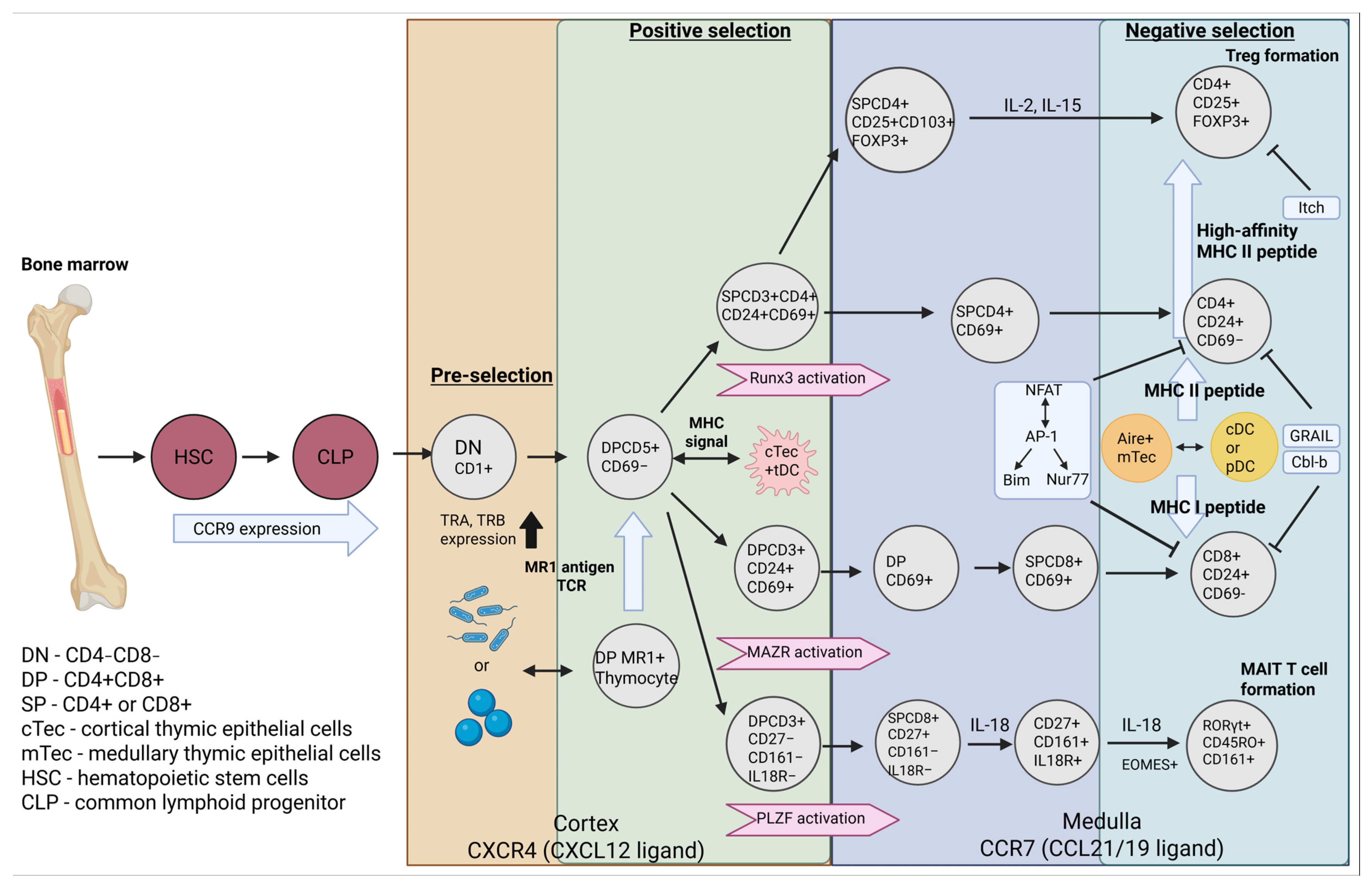
Figure 1. The process of differentiation of thymocytes into αβ T cells. During migration of thymocytes into the thymus, expression of TRA and TRB loci leads to the formation of the αβ TCR-CD3 complex, then the already formed thymocyte undergoes a gradual stage of positive and negative selection, during which CD4 or CD8 subpopulations of T cells are formed, possessing a function from immune response to tolerance. Tregs undergo their development through the expression of FOXP3, IL-2, and IL-15, which maintain their high TCR affinity. MAIT T cells begin their development by receiving a microbial metabolite at the DP stage, after which the formed MR1 undergoes positive selection and, mediated by the expression of PLZF and IL-18, further development.
Ijms 26 11939 g001
Figure 2. The process of thymocyte proliferation into γδ T cells. Unlike αβ T cells, γδ T cells undergo selection with increased expression of the TRD and TRG loci, which determine the fate of T cells along the γδ lineage. During selection in the triad between mTEC, tDCs and thymocytes, antigen presentation and signal induction from TCR via TFC-1 Wnt signaling via the CD1d-dependent pathway occur, during which, upon induction of transcription factors, γδ T cells differentiate into various subpopulations.
Ijms 26 11939 g002
Figure 3. Methodologies employed for the analysis of human and mouse thymic tissue. Experimental models of thymopoiesis in vitro help to easily reproduce situations occurring in the thymus (formation, selection, etc.). Tetramers and flow cytometry help to determine the stages of thymus cell differentiation and determine their functionality. The use of sequencing and multiomics provides a complete picture of the architecture of formed TCR αβ and γδ T cells and, simultaneously, determines alternative splicing in differentiating T cells. IHC and fluorescence microscopy provide opportunities to study the dynamics of thymocyte distribution and their interaction with thymic cells. Immunoblotting and ELISA aid in studying the production of cytokines and various isoforms of key transcription factors that are crucial for thymocyte differentiation at all stages of development in the thymus.
Ijms 26 11939 g003
Table 1. Key points in affinity grading of αβ and γδ T cell subsets using the dissociation constant (KD). At KD < 1 μM, high-affinity αβ T cells may undergo clonal deletion. Only a small percentage of T cells, under the influence of FOXP3 locus expression, become Tregs. γδ T cells form a population of Vδ1+ T cells, which are mainly responsible for adaptive immunity and form an immune barrier in areas in direct contact with foreign antigens. At KD ~1–10 μM, in relation to naive T cells, CD4+ and CD8+ helper and effector T cells are formed, respectively. KD > 10 μM, αβ naïve T cells, and those T cells that have failed negative selection are located, which leads to anergy and, notably, in a borderline state with anergy, T cells can differentiate into Tregs. Low-affinity γδ T cells form Vδ2+ T cells, the function of which is mainly antigen presentation.
Affinity LevelKD RangeOutcomes/MarkersSignaling/MechanismsExamples/Type of Cells
High (Strong Signal)KD < 1 μMαβ T cellsClonal deletion/apoptosis (Bim/Nur77);αβ T cellsLack costimulation → anergy (Cbl-b/GRAIL)αβ T cellsAutoreactive αβ T cells
Treg induction (FOXP3/CD25)Prolonged ERK/NFAT/AP-1high-affinity Tregs
γδ T cellsγδ selection (PLZF/Sox13, Bim)γδ T cellsModulation by BTNL and activation TOXγδ T cellsVδ1+ T cells phosphoantigen response
Intermediate (Survival)1–10 μMαβ T cellsPositive selection → SP (CD69+)αβ T cellsLCK/ZAP70 → ThPOK/Runx3 balanceαβ T cellsNaive CD4+/CD8+
migration (CCR7↑)metabolic shift (mTOR)low Treg suppression
γδ T cellsγδ selection (PLZF/Sox13, Bim)γδ T cellsActivation RORγt and Notch pathwayγδ T cellsNK, Th, Th17 and Vδ2+
Low
(Weak Signal, anergy)
>10 μMαβ T cellsAnergy after Negative selection (NR4A/Nur77)αβ T cellsHDAC/EZH2 suppressionαβ T cellsNaive/low-affinity Aβ; anergic clones
memory potential Aβ T cellsFOXO1/Klf2 (CCR7/S1PR1 migration)Tolerogenic Aβ T cells
γδ T cellsDeath by neglectγδ T cellsActivation RANTES and CXCR3γδ T cellsNaive/low-affinity γδ; anergic clones
γδ selection (PLZF)Vδ2+ phosphoantigen presentation
Disclaimer/Publisher’s Note: The statements, opinions and data contained in all publications are solely those of the individual author(s) and contributor(s) and not of MDPI and/or the editor(s). MDPI and/or the editor(s) disclaim responsibility for any injury to people or property resulting from any ideas, methods, instructions or products referred to in the content.