Why “Where” Matters as Much as “How Much”: Single-Cell and Spatial Transcriptomics in Plants
 , , , , , , , and
Abstract
1. Introduction
2. Single-Cell Transcriptomics in Plants
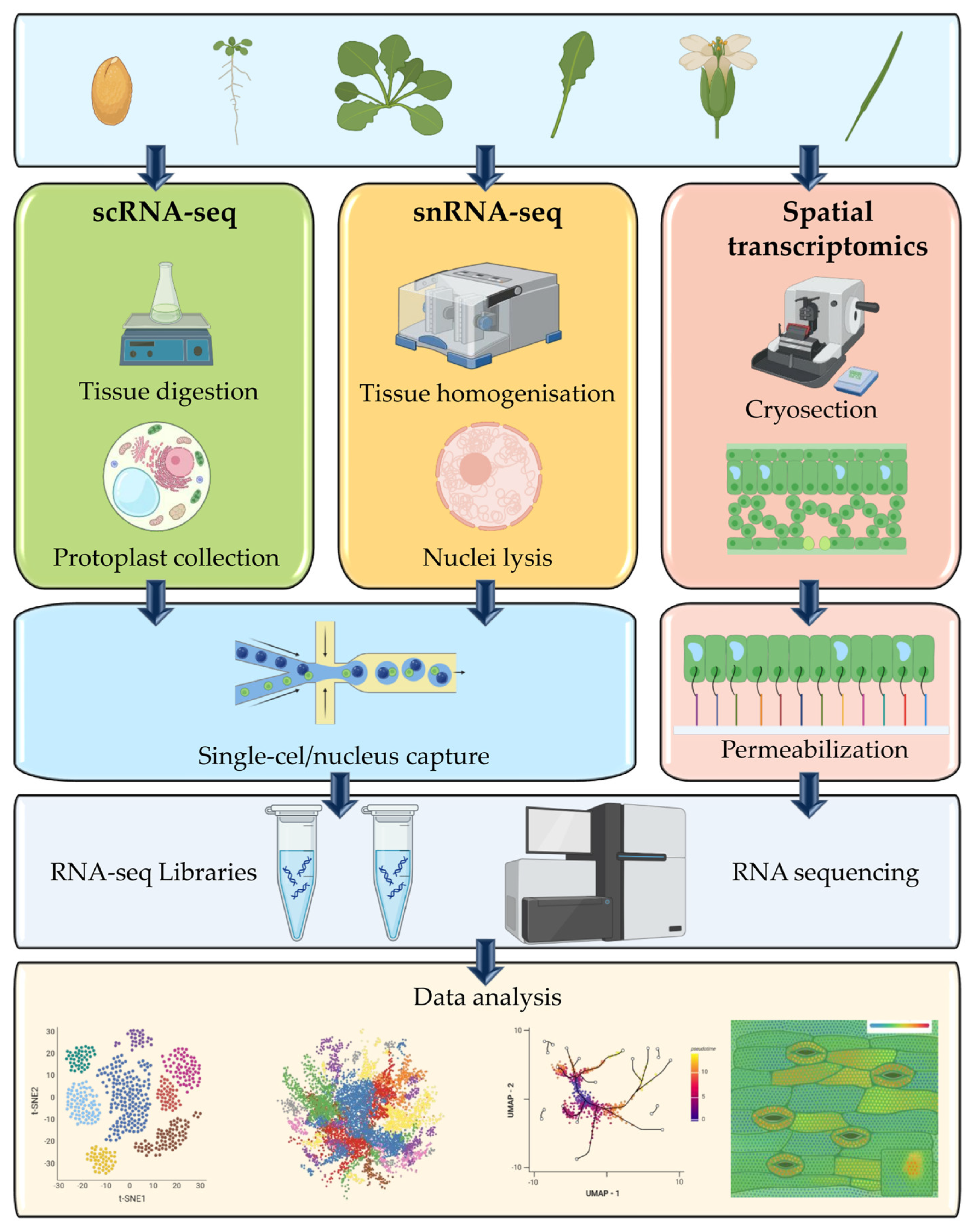
2.1. Platforms and Material Preparation
2.1.1. Protoplast-Based scRNA-seq: Opportunities and Limitations
2.1.2. SnRNA-seq: A Solution for Recalcitrant Tissues
2.1.3. Compatibility with Chromatin Assays and Emergence of the Multiome
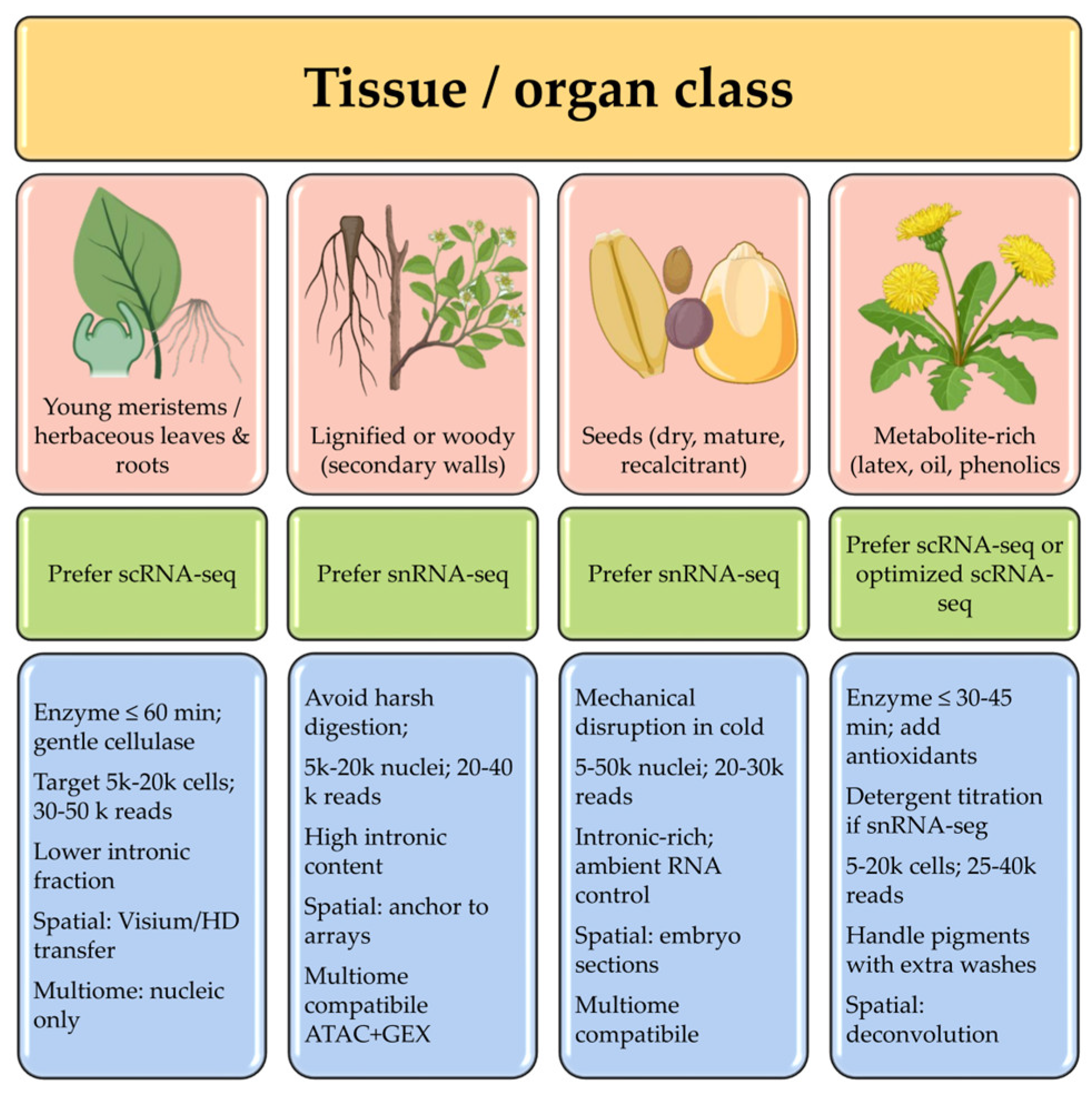
2.1.4. Best-Practice Recommendations
2.1.5. Emerging Technologies and Future Directions
2.2. Quality Control and Plant-Specific Artifacts
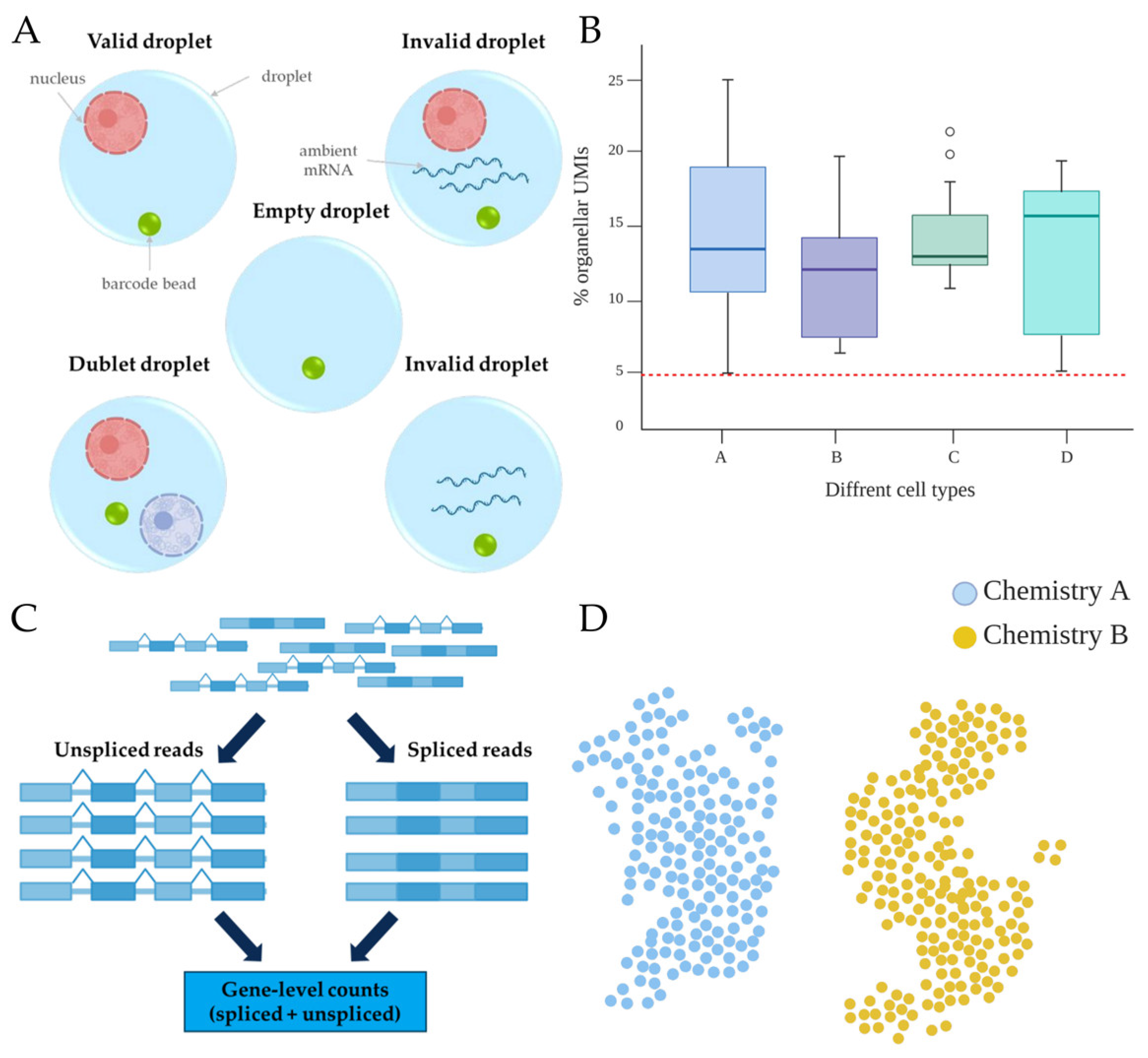
2.2.1. Ambient RNA
2.2.2. Organellar and Intronic Metrics
2.2.3. Doublet Detection
2.2.4. Batch Effects and Harmonization
2.3. Resources and Recent Syntheses
Databases and Interactive Portals
2.4. Key Takeaways
- Plant single-cell transcriptomics relies on two platforms: protoplast-based scRNA-seq (high cytoplasmic resolution, but prone to stress artifacts and cell-type bias) and nucleus-based snRNA-seq (less prone to artifacts, better for lignified and complex tissues, but with slightly lower UMI depth).
- snRNA-seq is compatible with a single-nucleus multiome (ATAC + gene expression), enabling direct linkage of chromatin accessibility to transcription and facilitating the discovery of cis-regulatory modules relevant to agronomic traits.
- Emerging technologies, such as enzyme-free mechanical dissociation, high-throughput droplet systems, and pilot triomics assays (RNA + ATAC + Hi-C), are enabling the exploration of new questions in more diverse tissues and species.
- Rigorous quality control for plants is essential. It must address ambient RNA, organellar and intronic read fractions, doublets, and batch effects, using appropriate computational tools and plant-specific thresholds.
- Dedicated databases and portals (e.g., scPlantDB, PlantscRNAdb, PCMDB, GreenCells, and species-specific atlases) provide curated markers and user-friendly interfaces.
3. Spatial Transcriptomics in Plants—Technologies and Adaptations
3.1. Capture-Based Sequencing Platforms for Spatial Transcriptomics in Plants
3.1.1. 10× Visium HD: Near-Cellular Resolution on Standard Slides
3.1.2. Stereo-seq: Subcellular Resolution and Centimeter-Scale Fields
3.1.3. Bead-Array Alternatives: Slide-seq v2 and HDST
3.2. Targeted Imaging-Based Methods for Plant Spatial Transcriptomics
3.2.1. smFISH and HCR-FISH in Whole-Mount Tissues
3.2.2. MERFISH: Combinatorial Barcoding at Scale
3.2.3. ISS and Padlock-Probe Chemistries
3.2.4. Validation and Integration Pipelines
3.3. Plant-Specific Adaptations
3.4. Key Takeaways
- Capture-based platforms (10× Visium HD, Stereo-seq, Slide-seq v2/HDST) offer complementary trade-offs between spatial resolution, field of view, cost and data volume; all require plant-specific optimization of section thickness, permeabilization and data processing.
- Visium HD delivers near-cellular resolution on standard slides and is readily integrated with sc/snRNA-seq label transfer, but in plants it demands longer permeabilization, mitigation of chloroplast RNA and substantial computational/storage resources.
- Stereo-seq achieves subcellular resolution over centimeter-scale areas, enabling whole-organ maps (e.g., caryopses, siliques, tubers) and fine expression gradients, at the cost of demanding cryo-sectioning, fixation and specialized vendor pipelines.
- Bead-array methods (Slide-seq v2, HDST) provide flexible and often more affordable alternatives, with HDST improving spatial precision via ordered 2 µm wells; resolution-enhancement tools such as BayesSpace and experimental refinements (mosaic-seq, clearing and adhesion strategies) are critical for high-quality plant data.
- Targeted imaging (smFISH, HCR-FISH, MERFISH, ISS) supplies single-molecule and subcellular readouts that validate markers from sc/snRNA-seq, refine tissue domains and resolve rare or specialized cell states that are difficult to capture with sequencing alone.
- Dedicated integration pipelines (FISH-Quant, starfish, CellPose/PlantSeg, Baysor, ANTs) enable rigorous alignment of imaging and capture data, improving cell-type annotation, boundary sharpness and ligand–receptor neighborhood inference in plant atlases.
- Across technologies, successful spatial transcriptomics in plants hinges on organ- and species-specific adaptations—particularly for wall/cuticle permeability, diffusion control and staining regimes—with emerging standardized protocols (e.g., soybean Visium) beginning to codify best practices.
4. Integrating sc/snRNA-seq with Spatial Transcriptomics
4.1. Mapping Cell Identities
4.2. Deconvolution: Transforming Mixtures into Cell-Type Abundances and States
4.3. Spatial Toolkits for Pattern Discovery and Image Integration
4.4. Cell Segmentation and Reconstruction from High-Definition Data
4.5. Neighbor-Aware Inference of Cell–Cell Communication
4.6. Key Takeaways
- Integrating sc/snRNA-seq with spatial transcriptomics links high-resolution cell states to their anatomical context, enabling cell-type maps and trajectories that respect tissue architecture and neighborhood structure.
- Label transfer tools (Seurat, Scanpy, Tangram, TACCO) project sc/snRNA-seq references onto spatial data, providing cell-type annotations and continuous state scores while flagging ambiguous regions at tissue boundaries.
- Deconvolution methods (RCTD, cell2location, DestVI, Stereoscope, CARD) transform mixed spatial spots into cell-type abundances and states; models that explicitly incorporate uncertainty and spatial context outperform simple regression-based approaches.
- Spatial toolkits (Squidpy, Giotto, SpatialPCA, and STAMP) support pattern discovery, dimensionality reduction and image integration, revealing spatial gene modules that often coincide with morphogen gradients and tissue layers.
- High-definition platforms require explicit cell reconstruction: pipelines such as Bin2Cell and ENACT combine image-based segmentation with expression similarity to yield per-cell matrices with sharper boundaries, integrating smoothly with downstream typing and CCC analysis.
- Neighbor-aware CCC frameworks (COMMOT, SpatialDM, DeepTalk, and niche-DE) move beyond simple ligand–receptor co-expression to infer directional signaling and neighborhood-dependent responses, providing a mechanistic link between local tissue organization and transcriptional regulation in plants.
5. From Tissue Atlases to Stimulus Maps—Case Studies
5.1. Developmental and Organ Atlases
5.2. Plant–Microbe Interactions
5.3. Abiotic Stresses and Environmental Factors
5.4. Key Takeaways
- Integrated plant atlases that combine sc/snRNA-seq, chromatin accessibility and spatial transcriptomics have moved from proof-of-concept to experimentally actionable references, supporting label transfer, deconvolution and neighborhood-aware analyses.
- Life-cycle and multi-tissue atlases in Arabidopsis, soybean and maize provide anatomically grounded maps of cell types and trajectories, together with cis-regulatory landscapes, which can be reused to study diverse developmental and stress contexts.
- These atlases now underpin “stimulus maps” that resolve how environmental cues (light, nutrients, temperature, water) remodel specific microdomains and cell neighborhoods rather than inducing uniform organ-wide responses.
- Spatial omics in Portulaca demonstrates how C4 and inducible CAM are temporally and spatially integrated across mesophyll and bundle sheath layers, providing a template for analyzing complex metabolic partitioning under drought.
- Dual-kingdom and nodulation atlases (AM symbiosis, soybean and Lotus nodules) reveal how combining snRNA-seq with spatial anchoring reveals rare and transitional states at host–microbe interfaces and identifies candidate regulators that are obscured in bulk data.
- Pathogenesis studies in Arabidopsis leaves reveal immune “microneighborhoods” organized around rare PRIMER cells with distinctive regulatory programs, surrounded by bystander cells primed for long-distance signaling, illustrating how spatial context shapes defense roles.
- Spatial transcriptomics under abiotic stress (rice and Arabidopsis roots) indicates that adaptation is driven by anatomically precise, enhancer-level modulation of fate decisions and barrier properties, highlighting the need to interpret stress responses in a cell- and tissue-resolved framework.
6. Pitfalls and Specifics of the Plant Data
Key Takeaways
- Plant single-cell and spatial data cannot use generic animal pipelines: rigid walls, abundant plastids and polyploids, repetitive genomes create plant-specific dissociation, mapping and QC artifacts that must be handled explicitly.
- Protoplast scRNA-seq induces stress reprogramming and selectively recovers easily digested cell types, whereas snRNA-seq sacrifices UMI depth for more balanced cell-type representation and fewer dissociation artifacts, especially in rigid, chloroplast-rich tissues.
- In spatial assays, mRNA diffusion and “spot swapping” blur borders; carefully tuned fixation/permeabilisation plus model-based decontamination (e.g., SpotClean) should precede domain calling, spatial differential expression (DE) and ligand–receptor analyses.
- Organellar reads, particularly from chloroplasts, often reflect true biology; tissue- and species-specific thresholds, together with markers and spatial context, are preferred over rigid mitochondrial-style cut-offs, and key results should be tested across alternative organelle filters.
- Polyploidy and incomplete annotations require homeolog-aware quantification: EM-based mappers (e.g., alevin-fry), curated SNPs and orthology-anchored markers help preserve sub-genome asymmetry, whereas spatial probe design and deconvolution must account for multimapping and reporting uncertainty.
- Ambient RNA contamination is ubiquitous in plant sc/snRNA-seq and affects nuclei as well as cells; deep generative, Bayesian and empirical decontamination approaches should be adapted to nuclear data, with ambient profiles and per-cell contamination estimates reported alongside atlas outputs.
7. Horizons: From Maps to Trait Modification
Key Takeaways
- Single-cell and spatial transcriptomics (including the RNA + ATAC multiome) turn descriptive atlases into cell type-resolved maps of cis-regulatory logic, enabling direct prioritization of editing targets from the CRE and GRN/TRN frameworks.
- Enhancer- and promoter-centered cis editing (CRISPRa/i and small cis changes) enables graded, tissue-specific and cell type-specific tuning of expression, reducing pleiotropy and supporting dosage- and place-aware trait modification, including in polyploids.
- Atlas-based pipelines rank CREs by activity in the causal tissue/state, editability (base/prime editing) and overlap with GWAS/eQTL signals, whereas spatial readouts verify that perturbations act in the intended anatomical domain.
- A toolkit of delivery routes—DR-assisted transformation, de novo meristem induction, HI-Edit/IMGE and viral/mobile-guide systems—shortens the path from the spatial hypothesis to the edited line and opens recalcitrant genotypes to editing.
- Base and prime editors, PAM-related Cas variants and optimized pegRNA/editor designs now enable motif-level, homeolog-aware cis editing across complex genomes, matching the resolution of single-cell/multiome regulatory maps.
- Single-cell and spatial atlases provide “place-aware” markers that refine QTL-to-gene assignment, prioritize noncoding variants and offer tissue- and interface-specific readouts (e.g., infection sites, grain loading zones) for validating edits and accelerating selection.
8. Conclusions
Supplementary Materials
Author Contributions
Funding
Institutional Review Board Statement
Informed Consent Statement
Data Availability Statement
Acknowledgments
Conflicts of Interest
References
- Molla Desta, G.; Birhanu, A.G. Advancements in single-cell RNA sequencing and spatial transcriptomics: Transforming biomedical research. Acta Biochim. Pol. 2025, 72, 13922. [Google Scholar] [CrossRef] [Scilit]
- Chen, C.; Ge, Y.; Lu, L. Opportunities and challenges in the application of single-cell and spatial transcriptomics in plants. Front. Plant Sci. 2023, 14, 1185377. [Google Scholar] [CrossRef] [Scilit]
- Yu, X.; Liu, Z.; Sun, X. Single-cell and spatial multi-omics in the plant sciences: Technical advances, applications, and perspectives. Plant Commun. 2023, 4, 100508. [Google Scholar] [CrossRef] [Scilit]
- Nobori, T. Exploring the untapped potential of single-cell and spatial omics in plant biology. New Phytol. 2025, 247, 1098–1116. [Google Scholar] [CrossRef] [Scilit]
- Ke, Y.; Pujol, V.; Staut, J.; Pollaris, L.; Seurinck, R.; Eekhout, T.; Grones, C.; Saura-Sanchez, M.; Van Bel, M.; Vuylsteke, M. A single-cell and spatial wheat root atlas with cross-species annotations delineates conserved tissue-specific marker genes and regulators. Cell Rep. 2025, 44, 115240. [Google Scholar] [CrossRef] [Scilit]
- Guo, X.; Wang, Y.; Zhao, C.; Tan, C.; Yan, W.; Xiang, S.; Zhang, D.; Zhang, H.; Zhang, M.; Yang, L. An Arabidopsis single-nucleus atlas decodes leaf senescence and nutrient allocation. Cell 2025, 188, 2856–2871.e2816. [Google Scholar] [CrossRef] [Scilit] [PubMed]
- Lv, K.; Liu, N.; Niu, Y.; Song, X.; Liu, Y.; Yue, Z.; Ali, M.; Guo, Q.; Lv, C.; Lu, D. Spatial transcriptome analysis reveals de novo regeneration of poplar roots. Hortic. Res. 2024, 11, uhae237. [Google Scholar] [CrossRef] [Scilit] [PubMed]
- Tenorio Berrío, R.; Verhelst, E.; Eekhout, T.; Grones, C.; De Veylder, L.; De Rybel, B.; Dubois, M. Dual and spatially resolved drought responses in the Arabidopsis leaf mesophyll revealed by single-cell transcriptomics. New Phytol. 2025, 246, 840–858. [Google Scholar] [CrossRef] [Scilit]
- Pirona, R.; Frugis, G.; Locatelli, F.; Mattana, M.; Genga, A.; Baldoni, E. Transcriptomic analysis reveals the gene regulatory networks involved in leaf and root response to osmotic stress in tomato. Front. Plant Sci. 2023, 14, 1155797. [Google Scholar] [CrossRef] [Scilit]
- Wan, X.; Xiao, J.; Tam, S.S.T.; Cai, M.; Sugimura, R.; Wang, Y.; Wan, X.; Lin, Z.; Wu, A.R.; Yang, C. Integrating spatial and single-cell transcriptomics data using deep generative models with SpatialScope. Nat. Commun. 2023, 14, 7848. [Google Scholar] [CrossRef] [Scilit]
- Rurek, M.; Smolibowski, M. Variability of plant transcriptomic responses under stress acclimation: A review from high throughput studies. Acta Biochim. Pol. 2024, 71, 13585. [Google Scholar] [CrossRef] [Scilit]
- Ren, S.; Wang, Y. Protoplast Isolation for Plant Single-Cell RNA-seq. In Flower Development: Methods and Protocols; Springer: New York, NY, USA, 2023; pp. 301–305. [Google Scholar]
- Wang, J.; Wang, Y.; Lü, T.; Yang, X.; Liu, J.; Dong, Y.; Wang, Y. An efficient and universal protoplast isolation protocol suitable for transient gene expression analysis and single-cell RNA sequencing. Int. J. Mol. Sci. 2022, 23, 3419. [Google Scholar] [CrossRef] [Scilit] [PubMed]
- Kim, M.-S.; Lee, S.-W.; Kim, K.; Kim, Y.; Hwang, H.; Hinterdorfer, P.; Choi, D.; Ko, K. Single-cell transcriptome sequencing of plant leaf expressing anti-HER2 VHH–FcK cancer therapeutic protein. Sci. Data 2023, 10, 911. [Google Scholar] [CrossRef] [Scilit] [PubMed]
- Cervantes-Pérez, S.A.; Thibivillliers, S.; Tennant, S.; Libault, M. Challenges and perspectives in applying single nuclei RNA-seq technology in plant biology. Plant Sci. 2022, 325, 111486. [Google Scholar] [CrossRef] [Scilit] [PubMed]
- Sunaga-Franze, D.Y.; Muino, J.M.; Braeuning, C.; Xu, X.; Zong, M.; Smaczniak, C.; Yan, W.; Fischer, C.; Vidal, R.; Kliem, M. Single-nucleus RNA sequencing of plant tissues using a nanowell-based system. Plant J. 2021, 108, 859–869. [Google Scholar] [CrossRef] [Scilit]
- Ryu, K.H.; Huang, L.; Kang, H.M.; Schiefelbein, J. Single-cell RNA sequencing resolves molecular relationships among individual plant cells. Plant Physiol. 2019, 179, 1444–1456. [Google Scholar] [CrossRef] [Scilit]
- Grones, C.; Eekhout, T.; Shi, D.; Neumann, M.; Berg, L.S.; Ke, Y.; Shahan, R.; Cox, K.L., Jr.; Gomez-Cano, F.; Nelissen, H. Best practices for the execution, analysis, and data storage of plant single-cell/nucleus transcriptomics. Plant Cell 2024, 36, 812–828. [Google Scholar] [CrossRef] [Scilit]
- Wang, K.; Zhao, C.; Xiang, S.; Duan, K.; Chen, X.; Guo, X.; Sahu, S.K. An optimized FACS-free single-nucleus RNA sequencing (snRNA-seq) method for plant science research. Plant Sci. 2023, 326, 111535. [Google Scholar] [CrossRef] [Scilit]
- Denyer, T.; Ma, X.; Klesen, S.; Scacchi, E.; Nieselt, K.; Timmermans, M.C. Spatiotemporal developmental trajectories in the Arabidopsis root revealed using high-throughput single-cell RNA sequencing. Dev. Cell 2019, 48, 840–852.e845. [Google Scholar] [CrossRef] [Scilit]
- Liu, Q.; Ma, W.; Chen, R.; Li, S.T.; Wang, Q.; Wei, C.; Hong, Y.; Sun, H.X.; Cheng, Q.; Zhao, J. Multiome in the same cell reveals the impact of osmotic stress on Arabidopsis root tip development at single-cell level. Adv. Sci. 2024, 11, 2308384. [Google Scholar] [CrossRef] [Scilit]
- Zhang, X.; Luo, Z.; Marand, A.P.; Yan, H.; Jang, H.; Bang, S.; Mendieta, J.P.; Minow, M.A.; Schmitz, R.J. A spatially resolved multi-omic single-cell atlas of soybean development. Cell 2025, 188, 550–567.e519. [Google Scholar] [CrossRef] [Scilit] [PubMed]
- Farmer, A.; Thibivilliers, S.; Ryu, K.H.; Schiefelbein, J.; Libault, M. Single-nucleus RNA and ATAC sequencing reveals the impact of chromatin accessibility on gene expression in Arabidopsis roots at the single-cell level. Mol. Plant 2021, 14, 372–383. [Google Scholar] [CrossRef] [Scilit] [PubMed]
- Cui, Y.; Su, Y.; Bian, J.; Han, X.; Guo, H.; Yang, Z.; Chen, Y.; Li, L.; Li, T.; Deng, X.W. Single-nucleus RNA and ATAC sequencing analyses provide molecular insights into early pod development of peanut fruit. Plant Commun. 2024, 5, 100979. [Google Scholar] [CrossRef] [Scilit]
- Li, Y.; Huang, Z.; Xu, L.; Fan, Y.; Ping, J.; Li, G.; Chen, Y.; Yu, C.; Wang, Q.; Song, T. UDA-seq: Universal droplet microfluidics-based combinatorial indexing for massive-scale multimodal single-cell sequencing. Nat. Methods 2025, 22, 1199–1212. [Google Scholar] [CrossRef] [Scilit]
- Seufert, I.; Sant, P.; Bauer, K.; Syed, A.P.; Rippe, K.; Mallm, J.-P. Enhancing sensitivity and versatility of Tn5-based single cell omics. Front. Epigenet. Epigenom. 2023, 1, 1245879. [Google Scholar] [CrossRef] [Scilit]
- Mitra, S.; Malik, R.; Wong, W.; Rahman, A.; Hartemink, A.J.; Pritykin, Y.; Dey, K.K.; Leslie, C.S. Single-cell multi-ome regression models identify functional and disease-associated enhancers and enable chromatin potential analysis. Nat. Genet. 2024, 56, 627–636, Erratum in Nat. Genet. 2024, 56, 1319. [Google Scholar] [CrossRef] [Scilit]
- Sun, F.; Li, H.; Sun, D.; Fu, S.; Gu, L.; Shao, X.; Wang, Q.; Dong, X.; Duan, B.; Xing, F. Single-cell omics: Experimental workflow, data analyses and applications. Sci. China Life Sci. 2025, 68, 5–102. [Google Scholar] [CrossRef] [Scilit]
- Hie, B.; Bryson, B.; Berger, B. Efficient integration of heterogeneous single-cell transcriptomes using Scanorama. Nat. Biotechnol. 2019, 37, 685–691. [Google Scholar] [CrossRef] [Scilit]
- Korsunsky, I.; Millard, N.; Fan, J.; Slowikowski, K.; Zhang, F.; Wei, K.; Baglaenko, Y.; Brenner, M.; Loh, P.-r.; Raychaudhuri, S. Fast, sensitive and accurate integration of single-cell data with Harmony. Nat. Methods 2019, 16, 1289–1296. [Google Scholar] [CrossRef] [Scilit]
- Young, M.D.; Behjati, S. SoupX removes ambient RNA contamination from droplet-based single-cell RNA sequencing data. Gigascience 2020, 9, giaa151. [Google Scholar] [CrossRef] [Scilit]
- Berg, M.; Petoukhov, I.; van den Ende, I.; Meyer, K.B.; Guryev, V.; Vonk, J.M.; Carpaij, O.; Banchero, M.; Hendriks, R.W.; van den Berge, M. FastCAR: Fast correction for ambient RNA to facilitate differential gene expression analysis in single-cell RNA-sequencing datasets. BMC Genom. 2023, 24, 722. [Google Scholar] [CrossRef] [Scilit] [PubMed]
- Wolock, S.L.; Lopez, R.; Klein, A.M. Scrublet: Computational identification of cell doublets in single-cell transcriptomic data. Cell Syst. 2019, 8, 281–291.e289. [Google Scholar] [CrossRef] [Scilit]
- Bernstein, N.J.; Fong, N.L.; Lam, I.; Roy, M.A.; Hendrickson, D.G.; Kelley, D.R. Solo: Doublet identification in single-cell RNA-seq via semi-supervised deep learning. Cell Syst. 2020, 11, 95–101.e105. [Google Scholar] [CrossRef] [Scilit]
- Thibivilliers, S.; Farmer, A.; Schroeder, S.; Libault, M. Plant Single-Cell/Nucleus RNA-seq Workflow. In Single Cell Transcriptomics: Methods and Protocols; Springer: New York, NY, USA, 2022; pp. 165–181. [Google Scholar]
- Caglayan, E.; Liu, Y.; Konopka, G. Neuronal ambient RNA contamination causes misinterpreted and masked cell types in brain single-nuclei datasets. Neuron 2022, 110, 4043–4056.e4045. [Google Scholar] [CrossRef] [Scilit]
- La Manno, G.; Soldatov, R.; Zeisel, A.; Braun, E.; Hochgerner, H.; Petukhov, V.; Lidschreiber, K.; Kastriti, M.E.; Lönnerberg, P.; Furlan, A. RNA velocity of single cells. Nature 2018, 560, 494–498. [Google Scholar] [CrossRef] [Scilit] [PubMed]
- Bergen, V.; Lange, M.; Peidli, S.; Wolf, F.A.; Theis, F.J. Generalizing RNA velocity to transient cell states through dynamical modeling. Nat. Biotechnol. 2020, 38, 1408–1414. [Google Scholar] [CrossRef] [Scilit]
- McGinnis, C.S.; Murrow, L.M.; Gartner, Z.J. DoubletFinder: Doublet detection in single-cell RNA sequencing data using artificial nearest neighbors. Cell Syst. 2019, 8, 329–337.e324. [Google Scholar] [CrossRef] [Scilit]
- Xi, N.M.; Li, J.J. Benchmarking computational doublet-detection methods for single-cell RNA sequencing data. Cell Syst. 2021, 12, 176–194.e176. [Google Scholar] [CrossRef] [Scilit] [PubMed]
- Shaw, R.; Tian, X.; Xu, J. Single-cell transcriptome analysis in plants: Advances and challenges. Mol. Plant 2021, 14, 115–126. [Google Scholar] [CrossRef] [Scilit]
- Schriever, H.; Kostka, D. Vaeda computationally annotates doublets in single-cell RNA sequencing data. Bioinformatics 2023, 39, btac720. [Google Scholar] [CrossRef] [Scilit]
- Zhao, X.; Du, A.; Qiu, P. scMODD: A model-driven algorithm for doublet identification in single-cell RNA-sequencing data. Front. Syst. Biol. 2023, 2, 1082309. [Google Scholar] [CrossRef] [Scilit]
- Haghverdi, L.; Lun, A.T.; Morgan, M.D.; Marioni, J.C. Batch effects in single-cell RNA-sequencing data are corrected by matching mutual nearest neighbors. Nat. Biotechnol. 2018, 36, 421–427. [Google Scholar] [CrossRef] [Scilit]
- Lee, T.A.; Illouz-Eliaz, N.; Nobori, T.; Xu, J.; Jow, B.; Nery, J.R.; Ecker, J.R. A single-cell, spatial transcriptomic atlas of the Arabidopsis life cycle. Nat. Plants 2025, 11, 1960–1975. [Google Scholar] [CrossRef] [Scilit]
- Tran, H.T.N.; Ang, K.S.; Chevrier, M.; Zhang, X.; Lee, N.Y.S.; Goh, M.; Chen, J. A benchmark of batch-effect correction methods for single-cell RNA sequencing data. Genome Biol. 2020, 21, 12. [Google Scholar] [CrossRef] [Scilit]
- Ergen, C.; Pour Amiri, V.V.; Kim, M.; Kronfeld, O.; Streets, A.; Gayoso, A.; Yosef, N. Scvi-hub: An actionable repository for model-driven single-cell analysis. Nat. Methods 2025, 22, 1836–1845. [Google Scholar] [CrossRef] [Scilit]
- He, Z.; Luo, Y.; Zhou, X.; Zhu, T.; Lan, Y.; Chen, D. scPlantDB: A comprehensive database for exploring cell types and markers of plant cell atlases. Nucleic Acids Res. 2024, 52, D1629–D1638. [Google Scholar] [CrossRef] [Scilit]
- Chen, H.; Yin, X.; Guo, L.; Yao, J.; Ding, Y.; Xu, X.; Liu, L.; Zhu, Q.-H.; Chu, Q.; Fan, L. PlantscRNAdb: A database for plant single-cell RNA analysis. Mol. Plant 2021, 14, 855–857. [Google Scholar] [CrossRef] [Scilit]
- PlantscRNAdb v 4.0. Available online: http://ibi.zju.edu.cn/plantscrnadb/ (accessed on 14 September 2025).
- Jin, J.; Lu, P.; Xu, Y.; Tao, J.; Li, Z.; Wang, S.; Yu, S.; Wang, C.; Xie, X.; Gao, J. PCMDB: A curated and comprehensive resource of plant cell markers. Nucleic Acids Res. 2022, 50, D1448–D1455. [Google Scholar] [CrossRef] [Scilit] [PubMed]
- Rao, A.; Barkley, D.; França, G.S.; Yanai, I. Exploring tissue architecture using spatial transcriptomics. Nature 2021, 596, 211–220. [Google Scholar] [CrossRef] [Scilit]
- Ren, P.; Zhang, R.; Wang, Y.; Zhang, P.; Luo, C.; Wang, S.; Li, X.; Zhang, Z.; Zhao, Y.; He, Y. Systematic benchmarking of high-throughput subcellular spatial transcriptomics platforms. bioRxiv 2024. [Google Scholar] [CrossRef] [Scilit]
- Lim, H.J.; Wang, Y.; Buzdin, A.; Li, X. A practical guide for choosing an optimal spatial transcriptomics technology from seven major commercially available options. BMC Genom. 2025, 26, 47. [Google Scholar] [CrossRef] [Scilit] [PubMed]
- Xia, K.; Sun, H.-X.; Li, J.; Li, J.; Zhao, Y.; Chen, L.; Qin, C.; Chen, R.; Chen, Z.; Liu, G. The single-cell stereo-seq reveals region-specific cell subtypes and transcriptome profiling in Arabidopsis leaves. Dev. Cell 2022, 57, 1299–1310.e1294. [Google Scholar] [CrossRef] [Scilit] [PubMed]
- Wang, Y.; Luo, Y.; Guo, X.; Li, Y.; Yan, J.; Shao, W.; Wei, W.; Wei, X.; Yang, T.; Chen, J. A spatial transcriptome map of the developing maize ear. Nat. Plants 2024, 10, 815–827. [Google Scholar] [CrossRef] [Scilit]
- Williams, C.G.; Lee, H.J.; Asatsuma, T.; Vento-Tormo, R.; Haque, A. An introduction to spatial transcriptomics for biomedical research. Genome Med. 2022, 14, 68. [Google Scholar] [CrossRef] [Scilit]
- Stickels, R.R.; Murray, E.; Kumar, P.; Li, J.; Marshall, J.L.; Di Bella, D.J.; Arlotta, P.; Macosko, E.Z.; Chen, F. Highly sensitive spatial transcriptomics at near-cellular resolution with Slide-seqV2. Nat. Biotechnol. 2021, 39, 313–319. [Google Scholar] [CrossRef] [Scilit] [PubMed]
- Vickovic, S.; Eraslan, G.; Salmén, F.; Klughammer, J.; Stenbeck, L.; Schapiro, D.; Äijö, T.; Bonneau, R.; Bergenstråhle, L.; Navarro, J.F. High-definition spatial transcriptomics for in situ tissue profiling. Nat. Methods 2019, 16, 987–990. [Google Scholar] [CrossRef] [Scilit]
- Zhao, E.; Stone, M.R.; Ren, X.; Guenthoer, J.; Smythe, K.S.; Pulliam, T.; Williams, S.R.; Uytingco, C.R.; Taylor, S.E.; Nghiem, P. Spatial transcriptomics at subspot resolution with BayesSpace. Nat. Biotechnol. 2021, 39, 1375–1384. [Google Scholar] [CrossRef] [Scilit]
- Giacomello, S. A new era for plant science: Spatial single-cell transcriptomics. Curr. Opin. Plant Biol. 2021, 60, 102041. [Google Scholar] [CrossRef] [Scilit]
- Sakamoto, Y.; Ishimoto, A.; Sakai, Y.; Sato, M.; Nishihama, R.; Abe, K.; Sano, Y.; Furuichi, T.; Tsuji, H.; Kohchi, T. Improved clearing method contributes to deep imaging of plant organs. Commun. Biol. 2022, 5, 12. [Google Scholar] [CrossRef] [Scilit]
- Zhao, L.; Fonseca, A.; Meschichi, A.; Sicard, A.; Rosa, S. Whole-mount smFISH allows combining RNA and protein quantification at cellular and subcellular resolution. Nat. Plants 2023, 9, 1094–1102. [Google Scholar] [CrossRef] [Scilit]
- Tsuneoka, Y.; Funato, H. Modified in situ hybridization chain reaction using short hairpin DNAs. Front. Mol. Neurosci. 2020, 13, 75. [Google Scholar] [CrossRef] [Scilit]
- Huang, T.; Guillotin, B.; Rahni, R.; Birnbaum, K.D.; Wagner, D. A rapid and sensitive, multiplex, whole mount RNA fluorescence in situ hybridization and immunohistochemistry protocol. Plant Methods 2023, 19, 131. [Google Scholar] [CrossRef] [Scilit]
- Chen, K.H.; Boettiger, A.N.; Moffitt, J.R.; Wang, S.; Zhuang, X. Spatially resolved, highly multiplexed RNA profiling in single cells. Science 2015, 348, aaa6090. [Google Scholar] [CrossRef] [Scilit]
- Moffitt, J.R.; Hao, J.; Wang, G.; Chen, K.H.; Babcock, H.P.; Zhuang, X. High-throughput single-cell gene-expression profiling with multiplexed error-robust fluorescence in situ hybridization. Proc. Natl. Acad. Sci. USA 2016, 113, 11046–11051. [Google Scholar] [CrossRef] [Scilit]
- Nobori, T.; Monell, A.; Lee, T.A.; Sakata, Y.; Shirahama, S.; Zhou, J.; Nery, J.R.; Mine, A.; Ecker, J.R. A rare PRIMER cell state in plant immunity. Nature 2025, 638, 197–205. [Google Scholar] [CrossRef] [Scilit]
- Gyllborg, D.; Langseth, C.M.; Qian, X.; Choi, E.; Salas, S.M.; Hilscher, M.M.; Lein, E.S.; Nilsson, M. Hybridization-based in situ sequencing (HybISS) for spatially resolved transcriptomics in human and mouse brain tissue. Nucleic Acids Res. 2020, 48, e112, Erratum in Nucleic Acids Res. 2020, 49, 9002. [Google Scholar] [CrossRef] [Scilit]
- Atkinson, J.A.; Wells, D.M. An updated protocol for high throughput plant tissue sectioning. Front. Plant Sci. 2017, 8, 1721. [Google Scholar] [CrossRef] [Scilit]
- Magoulopoulou, A.; Salas, S.M.; Tiklová, K.; Samuelsson, E.R.; Hilscher, M.M.; Nilsson, M. Padlock probe–based targeted in situ sequencing: Overview of methods and applications. Annu. Rev. Genom. Hum. Genet. 2023, 24, 133–150. [Google Scholar] [CrossRef] [Scilit] [PubMed]
- Wang, Y.; Liu, B.; Zhao, G.; Lee, Y.; Buzdin, A.; Mu, X.; Zhao, J.; Chen, H.; Li, X. Spatial transcriptomics: Technologies, applications and experimental considerations. Genomics 2023, 115, 110671. [Google Scholar] [CrossRef] [Scilit] [PubMed]
- Zhang, Y.; Petukhov, V.; Biederstedt, E.; Que, R.; Zhang, K.; Kharchenko, P.V. Gene panel selection for targeted spatial transcriptomics. Genome Biol. 2024, 25, 35. [Google Scholar] [CrossRef] [Scilit] [PubMed]
- Imbert, A.; Ouyang, W.; Safieddine, A.; Coleno, E.; Zimmer, C.; Bertrand, E.; Walter, T.; Mueller, F. FISH-quant v2: A scalable and modular tool for smFISH image analysis. RNA 2022, 28, 786–795. [Google Scholar] [CrossRef] [Scilit]
- Axelrod, S.; Cai, M.; Carr, A.J.; Freeman, J.; Ganguli, D.; Kiggins, J.T.; Long, B.; Tung, T.; Yamauchi, K.A. Starfish: Scalable pipelines for image-based transcriptomics. J. Open Source Softw. 2021, 6, 2440. [Google Scholar] [CrossRef] [Scilit]
- Stringer, C.; Wang, T.; Michaelos, M.; Pachitariu, M. Cellpose: A generalist algorithm for cellular segmentation. Nat. Methods 2021, 18, 100–106. [Google Scholar] [CrossRef] [Scilit] [PubMed]
- Pachitariu, M.; Stringer, C. Cellpose 2.0: How to train your own model. Nat. Methods 2022, 19, 1634–1641. [Google Scholar] [CrossRef] [Scilit]
- Wolny, A.; Cerrone, L.; Vijayan, A.; Tofanelli, R.; Barro, A.V.; Louveaux, M.; Wenzl, C.; Strauss, S.; Wilson-Sánchez, D.; Lymbouridou, R. Accurate and versatile 3D segmentation of plant tissues at cellular resolution. Elife 2020, 9, e57613. [Google Scholar] [CrossRef] [Scilit] [PubMed]
- Avants, B.B.; Tustison, N.J.; Song, G.; Cook, P.A.; Klein, A.; Gee, J.C. A reproducible evaluation of ANTs similarity metric performance in brain image registration. NeuroImage 2011, 54, 2033–2044. [Google Scholar] [CrossRef] [Scilit]
- Wu, H.; Zhang, R.; Niklas, K.J.; Scanlon, M.J. Multiplexed transcriptomic analyzes of the plant embryonic hourglass. Nat. Commun. 2025, 16, 802. [Google Scholar] [CrossRef] [Scilit]
- Peirats-Llobet, M.; Yi, C.; Liew, L.C.; Berkowitz, O.; Narsai, R.; Lewsey, M.G.; Whelan, J. Spatially resolved transcriptomic analysis of the germinating barley grain. Nucleic Acids Res. 2023, 51, 7798–7819. [Google Scholar] [CrossRef] [Scilit]
- You, Y.; Fu, Y.; Li, L.; Zhang, Z.; Jia, S.; Lu, S.; Ren, W.; Liu, Y.; Xu, Y.; Liu, X. Systematic comparison of sequencing-based spatial transcriptomic methods. Nat. Methods 2024, 21, 1743–1754. [Google Scholar] [CrossRef] [Scilit]
- Serrano, K.; Bezrutczyk, M.; Goudeau, D.; Dao, T.; O’Malley, R.; Malmstrom, R.R.; Visel, A.; Scheller, H.V.; Cole, B. Spatial co-transcriptomics reveals discrete stages of the arbuscular mycorrhizal symbiosis. Nat. Plants 2024, 10, 673–688. [Google Scholar] [CrossRef] [Scilit]
- Luo, Z.; Schmitz, R.J. Protocol for preparing fresh frozen soybean tissues for spatial transcriptomics. STAR Protoc. 2025, 6, 103790. [Google Scholar] [CrossRef] [Scilit] [PubMed]
- Stuart, T.; Butler, A.; Hoffman, P.; Hafemeister, C.; Papalexi, E.; Mauck, W.M.; Hao, Y.; Stoeckius, M.; Smibert, P.; Satija, R. Comprehensive integration of single-cell data. Cell 2019, 177, 1888–1902.e1821. [Google Scholar] [CrossRef] [Scilit]
- Wolf, F.A.; Angerer, P.; Theis, F.J. SCANPY: Large-scale single-cell gene expression data analysis. Genome Biol. 2018, 19, 15. [Google Scholar] [CrossRef] [Scilit]
- Biancalani, T.; Scalia, G.; Buffoni, L.; Avasthi, R.; Lu, Z.; Sanger, A.; Tokcan, N.; Vanderburg, C.R.; Segerstolpe, Å.; Zhang, M. Deep learning and alignment of spatially resolved single-cell transcriptomes with Tangram. Nat. Methods 2021, 18, 1352–1362. [Google Scholar] [CrossRef] [Scilit]
- Mages, S.; Moriel, N.; Avraham-Davidi, I.; Murray, E.; Watter, J.; Chen, F.; Rozenblatt-Rosen, O.; Klughammer, J.; Regev, A.; Nitzan, M. TACCO unifies annotation transfer and decomposition of cell identities for single-cell and spatial omics. Nat. Biotechnol. 2023, 41, 1465–1473. [Google Scholar] [CrossRef] [Scilit]
- Cable, D.M.; Murray, E.; Zou, L.S.; Goeva, A.; Macosko, E.Z.; Chen, F.; Irizarry, R.A. Robust decomposition of cell type mixtures in spatial transcriptomics. Nat. Biotechnol. 2022, 40, 517–526. [Google Scholar] [CrossRef] [Scilit]
- Kleshchevnikov, V.; Shmatko, A.; Dann, E.; Aivazidis, A.; King, H.W.; Li, T.; Elmentaite, R.; Lomakin, A.; Kedlian, V.; Gayoso, A. Cell2location maps fine-grained cell types in spatial transcriptomics. Nat. Biotechnol. 2022, 40, 661–671. [Google Scholar] [CrossRef] [Scilit]
- Lopez, R.; Li, B.; Keren-Shaul, H.; Boyeau, P.; Kedmi, M.; Pilzer, D.; Jelinski, A.; Yofe, I.; David, E.; Wagner, A. DestVI identifies continuums of cell types in spatial transcriptomics data. Nat. Biotechnol. 2022, 40, 1360–1369. [Google Scholar] [CrossRef] [Scilit]
- Andersson, A.; Bergenstråhle, J.; Asp, M.; Bergenstråhle, L.; Jurek, A.; Fernández Navarro, J.; Lundeberg, J. Single-cell and spatial transcriptomics enables probabilistic inference of cell type topography. Commun. Biol. 2020, 3, 565. [Google Scholar] [CrossRef] [Scilit] [PubMed]
- Li, H.; Zhou, J.; Li, Z.; Chen, S.; Liao, X.; Zhang, B.; Zhang, R.; Wang, Y.; Sun, S.; Gao, X. A comprehensive benchmarking with practical guidelines for cellular deconvolution of spatial transcriptomics. Nat. Commun. 2023, 14, 1548. [Google Scholar] [CrossRef] [Scilit] [PubMed]
- Zhou, Z.; Zhong, Y.; Zhang, Z.; Ren, X. Spatial transcriptomics deconvolution at single-cell resolution using Redeconve. Nat. Commun. 2023, 14, 7930. [Google Scholar] [CrossRef] [Scilit]
- Li, Y.; Luo, Y. STdGCN: Spatial transcriptomic cell-type deconvolution using graph convolutional networks. Genome Biol. 2024, 25, 206. [Google Scholar] [CrossRef] [Scilit]
- Palla, G.; Spitzer, H.; Klein, M.; Fischer, D.; Schaar, A.C.; Kuemmerle, L.B.; Rybakov, S.; Ibarra, I.L.; Holmberg, O.; Virshup, I. Squidpy: A scalable framework for spatial omics analysis. Nat. Methods 2022, 19, 171–178. [Google Scholar] [CrossRef] [Scilit] [PubMed]
- Dries, R.; Zhu, Q.; Dong, R.; Eng, C.-H.L.; Li, H.; Liu, K.; Fu, Y.; Zhao, T.; Sarkar, A.; Bao, F. Giotto: A toolbox for integrative analysis and visualization of spatial expression data. Genome Biol. 2021, 22, 78. [Google Scholar] [CrossRef] [Scilit] [PubMed]
- Del Rossi, N.; Chen, J.G.; Yuan, G.C.; Dries, R. Analyzing spatial transcriptomics data using Giotto. Curr. Protoc. 2022, 2, e405. [Google Scholar] [CrossRef] [Scilit] [PubMed]
- Shang, L.; Zhou, X. Spatially aware dimension reduction for spatial transcriptomics. Nat. Commun. 2022, 13, 7203. [Google Scholar] [CrossRef] [Scilit]
- Zhong, C.; Ang, K.S.; Chen, J. Interpretable spatially aware dimension reduction of spatial transcriptomics with STAMP. Nat. Methods 2024, 21, 2072–2083. [Google Scholar] [CrossRef] [Scilit]
- Polański, K.; Bartolomé-Casado, R.; Sarropoulos, I.; Xu, C.; England, N.; Jahnsen, F.L.; Teichmann, S.A.; Yayon, N. Bin2cell reconstructs cells from high resolution Visium HD data. Bioinformatics 2024, 40, btae546. [Google Scholar] [CrossRef] [Scilit]
- Kamel, M.; Song, Y.; Solbas, A.; Villordo, S.; Sarangi, A.; Senin, P.; Sunaal, M.; Ayestas, L.C.; Levin, C.; Wang, S. ENACT: End-to-end analysis of Visium High Definition (HD) data. Bioinformatics 2025, 41, btaf094. [Google Scholar] [CrossRef] [Scilit]
- Cang, Z.; Zhao, Y.; Almet, A.A.; Stabell, A.; Ramos, R.; Plikus, M.V.; Atwood, S.X.; Nie, Q. Screening cell–cell communication in spatial transcriptomics via collective optimal transport. Nat. Methods 2023, 20, 218–228. [Google Scholar] [CrossRef] [Scilit]
- Li, Z.; Wang, T.; Liu, P.; Huang, Y. SpatialDM for rapid identification of spatially co-expressed ligand–receptor and revealing cell–cell communication patterns. Nat. Commun. 2023, 14, 3995. [Google Scholar] [CrossRef] [Scilit]
- Yang, W.; Wang, P.; Xu, S.; Wang, T.; Luo, M.; Cai, Y.; Xu, C.; Xue, G.; Que, J.; Ding, Q. Deciphering cell–cell communication at single-cell resolution for spatial transcriptomics with subgraph-based graph attention network. Nat. Commun. 2024, 15, 7101. [Google Scholar] [CrossRef] [Scilit]
- Mason, K.; Sathe, A.; Hess, P.R.; Rong, J.; Wu, C.-Y.; Furth, E.; Susztak, K.; Levinsohn, J.; Ji, H.P.; Zhang, N. Niche-DE: Niche-differential gene expression analysis in spatial transcriptomics data identifies context-dependent cell-cell interactions. Genome Biol. 2024, 25, 14. [Google Scholar] [CrossRef] [Scilit]
- Shahan, R.; Hsu, C.-W.; Nolan, T.M.; Cole, B.J.; Taylor, I.W.; Greenstreet, L.; Zhang, S.; Afanassiev, A.; Vlot, A.H.C.; Schiebinger, G. A single-cell Arabidopsis root atlas reveals developmental trajectories in wild-type and cell identity mutants. Dev. Cell 2022, 57, 543–560.e549. [Google Scholar] [CrossRef] [Scilit] [PubMed]
- Gala, H.P.; Lanctot, A.; Jean-Baptiste, K.; Guiziou, S.; Chu, J.C.; Zemke, J.E.; George, W.; Queitsch, C.; Cuperus, J.T.; Nemhauser, J.L. A single-cell view of the transcriptome during lateral root initiation in Arabidopsis thaliana. Plant Cell 2021, 33, 2197–2220. [Google Scholar] [CrossRef] [Scilit] [PubMed]
- Wendrich, J.R.; Yang, B.; Vandamme, N.; Verstaen, K.; Smet, W.; Van de Velde, C.; Minne, M.; Wybouw, B.; Mor, E.; Arents, H.E. Vascular transcription factors guide plant epidermal responses to limiting phosphate conditions. Science 2020, 370, eaay4970. [Google Scholar] [CrossRef] [Scilit]
- Nolan, T.M.; Vukašinović, N.; Hsu, C.-W.; Zhang, J.; Vanhoutte, I.; Shahan, R.; Taylor, I.W.; Greenstreet, L.; Heitz, M.; Afanassiev, A. Brassinosteroid gene regulatory networks at cellular resolution in the Arabidopsis root. Science 2023, 379, eadf4721. [Google Scholar] [CrossRef] [Scilit] [PubMed]
- Zhang, T.-Q.; Chen, Y.; Wang, J.-W. A single-cell analysis of the Arabidopsis vegetative shoot apex. Dev. Cell 2021, 56, 1056–1074.e1058. [Google Scholar] [CrossRef] [Scilit]
- Liu, Z.; Wang, J.; Zhou, Y.; Zhang, Y.; Qin, A.; Yu, X.; Zhao, Z.; Wu, R.; Guo, C.; Bawa, G. Identification of novel regulators required for early development of vein pattern in the cotyledons by single-cell RNA-sequencing. Plant J. 2022, 110, 7–22. [Google Scholar] [CrossRef] [Scilit]
- Kim, J.-Y.; Symeonidi, E.; Pang, T.Y.; Denyer, T.; Weidauer, D.; Bezrutczyk, M.; Miras, M.; Zöllner, N.; Hartwig, T.; Wudick, M.M. Distinct identities of leaf phloem cells revealed by single cell transcriptomics. Plant Cell 2021, 33, 511–530. [Google Scholar] [CrossRef] [Scilit]
- Nobori, T.; Oliva, M.; Lister, R.; Ecker, J.R. Multiplexed single-cell 3D spatial gene expression analysis in plant tissue using PHYTOMap. Nat. Plants 2023, 9, 1026–1033. [Google Scholar] [CrossRef] [Scilit]
- Zhu, J.; Lolle, S.; Tang, A.; Guel, B.; Kvitko, B.; Cole, B.; Coaker, G. Single-cell profiling of Arabidopsis leaves to Pseudomonas syringae infection. Cell Rep. 2023, 42, 112676. [Google Scholar] [CrossRef] [Scilit]
- Lopez-Anido, C.B.; Vatén, A.; Smoot, N.K.; Sharma, N.; Guo, V.; Gong, Y.; Gil, M.X.A.; Weimer, A.K.; Bergmann, D.C. Single-cell resolution of lineage trajectories in the Arabidopsis stomatal lineage and developing leaf. Dev. Cell 2021, 56, 1043–1055.e1044. [Google Scholar] [CrossRef] [Scilit] [PubMed]
- Sun, X.; Feng, D.; Liu, M.; Qin, R.; Li, Y.; Lu, Y.; Zhang, X.; Wang, Y.; Shen, S.; Ma, W. Single-cell transcriptome reveals dominant subgenome expression and transcriptional response to heat stress in Chinese cabbage. Genome Biol. 2022, 23, 262. [Google Scholar] [CrossRef] [Scilit] [PubMed]
- Li, C.; Wood, J.C.; Vu, A.H.; Hamilton, J.P.; Rodriguez Lopez, C.E.; Payne, R.M.; Serna Guerrero, D.A.; Gase, K.; Yamamoto, K.; Vaillancourt, B. Single-cell multi-omics in the medicinal plant Catharanthus roseus. Nat. Chem. Biol. 2023, 19, 1031–1041. [Google Scholar] [CrossRef] [Scilit] [PubMed]
- Sun, S.; Shen, X.; Li, Y.; Li, Y.; Wang, S.; Li, R.; Zhang, H.; Shen, G.; Guo, B.; Wei, J. Single-cell RNA sequencing provides a high-resolution roadmap for understanding the multicellular compartmentation of specialized metabolism. Nat. Plants 2023, 9, 179–190. [Google Scholar] [CrossRef] [Scilit]
- Liu, Z.; Kong, X.; Long, Y.; Liu, S.; Zhang, H.; Jia, J.; Cui, W.; Zhang, Z.; Song, X.; Qiu, L. Integrated single-nucleus and spatial transcriptomics captures transitional states in soybean nodule maturation. Nat. Plants 2023, 9, 515–524. [Google Scholar] [CrossRef] [Scilit]
- Sun, Y.; Han, Y.; Sheng, K.; Yang, P.; Cao, Y.; Li, H.; Zhu, Q.-H.; Chen, J.; Zhu, S.; Zhao, T. Single-cell transcriptomic analysis reveals the developmental trajectory and transcriptional regulatory networks of pigment glands in Gossypium bickii. Mol. Plant 2023, 16, 694–708. [Google Scholar] [CrossRef] [Scilit]
- Liang, X.; Ma, Z.; Ke, Y.; Wang, J.; Wang, L.; Qin, B.; Tang, C.; Liu, M.; Xian, X.; Yang, Y. Single-cell transcriptomic analyses reveal cellular and molecular patterns of rubber tree response to early powdery mildew infection. Plant Cell Environ. 2023, 46, 2222–2237. [Google Scholar] [CrossRef] [Scilit]
- Frank, M.; Fechete, L.I.; Tedeschi, F.; Nadzieja, M.; Nørgaard, M.M.M.; Montiel, J.; Andersen, K.R.; Schierup, M.H.; Reid, D.; Andersen, S.U. Single-cell analysis identifies genes facilitating rhizobium infection in Lotus japonicus. Nat. Commun. 2023, 14, 7171. [Google Scholar] [CrossRef] [Scilit]
- Cervantes-Pérez, S.A.; Thibivilliers, S.; Laffont, C.; Farmer, A.D.; Frugier, F.; Libault, M. Cell-specific pathways recruited for symbiotic nodulation in the Medicago truncatula legume. Mol. Plant 2022, 15, 1868–1888. [Google Scholar] [CrossRef] [Scilit]
- Jhu, M.-Y.; Heffer, J.; Deamer, A.; Moraes, T.A.; Piskorz, A.M.; Xia, C. Plant-Compatible Xenium In Situ Sequencing: Optimised Protocol for Spatial Transcriptomics in Medicago truncatula Roots and Nodules. bioRxiv 2025. [Google Scholar] [CrossRef] [Scilit]
- Liu, Q.; Liang, Z.; Feng, D.; Jiang, S.; Wang, Y.; Du, Z.; Li, R.; Hu, G.; Zhang, P.; Ma, Y. Transcriptional landscape of rice roots at the single-cell resolution. Mol. Plant 2021, 14, 384–394. [Google Scholar] [CrossRef] [Scilit] [PubMed]
- Zhang, T.-Q.; Chen, Y.; Liu, Y.; Lin, W.-H.; Wang, J.-W. Single-cell transcriptome atlas and chromatin accessibility landscape reveal differentiation trajectories in the rice root. Nat. Commun. 2021, 12, 2053. [Google Scholar] [CrossRef] [Scilit] [PubMed]
- Wang, Y.; Huan, Q.; Li, K.; Qian, W. Single-cell transcriptome atlas of the leaf and root of rice seedlings. J. Genet. Genom. 2021, 48, 881–898. [Google Scholar] [CrossRef] [Scilit]
- Wang, W.; Zhang, X.; Zhang, Y.; Zhang, Z.; Yang, C.; Cao, W.; Liang, Y.; Zhou, Q.; Hu, Q.; Zhang, Y. Single-Cell and Spatial Transcriptomics Reveals a Stereoscopic Response of Rice Leaf Cells to Magnaporthe oryzae Infection. Adv. Sci. 2025, 12, 2416846. [Google Scholar] [CrossRef] [Scilit]
- Chen, X.; Ru, Y.; Takahashi, H.; Nakazono, M.; Shabala, S.; Smith, S.M.; Yu, M. Single-cell transcriptomic analysis of pea shoot development and cell-type-specific responses to boron deficiency. Plant J. 2024, 117, 302–322. [Google Scholar] [CrossRef] [Scilit]
- Tung, C.-C.; Kuo, S.-C.; Yang, C.-L.; Yu, J.-H.; Huang, C.-E.; Liou, P.-C.; Sun, Y.-H.; Shuai, P.; Su, J.-C.; Ku, C. Single-cell transcriptomics unveils xylem cell development and evolution. Genome Biol. 2023, 24, 3. [Google Scholar] [CrossRef] [Scilit]
- Xie, J.; Li, M.; Zeng, J.; Li, X.; Zhang, D. Single-cell RNA sequencing profiles of stem-differentiating xylem in poplar. Plant Biotechnol. J. 2021, 20, 417. [Google Scholar] [CrossRef] [Scilit]
- Du, J.; Wang, Y.; Chen, W.; Xu, M.; Zhou, R.; Shou, H.; Chen, J. High-resolution anatomical and spatial transcriptome analyses reveal two types of meristematic cell pools within the secondary vascular tissue of poplar stem. Mol. Plant 2023, 16, 809–828. [Google Scholar] [CrossRef] [Scilit]
- Moreno-Villena, J.J.; Zhou, H.; Gilman, I.S.; Tausta, S.L.; Cheung, C.M.; Edwards, E.J. Spatial resolution of an integrated C4+ CAM photosynthetic metabolism. Sci. Adv. 2022, 8, eabn2349. [Google Scholar] [CrossRef] [Scilit]
- Song, X.; Guo, P.; Wang, M.; Chen, L.; Zhang, J.; Xu, M.; Liu, N.; Liu, M.; Fang, L.; Xu, X. Spatial transcriptomic atlas of shoot organogenesis in tomato callus. bioRxiv 2023. [Google Scholar] [CrossRef] [Scilit]
- Li, X.; Wan, Y.; Wang, D.; Li, X.; Wu, J.; Xiao, J.; Chen, K.; Han, X.; Chen, Y. Spatiotemporal transcriptomics reveals key gene regulation for grain yield and quality in wheat. Genome Biol. 2025, 26, 93. [Google Scholar] [CrossRef] [Scilit]
- Satterlee, J.W.; Strable, J.; Scanlon, M.J. Plant stem-cell organization and differentiation at single-cell resolution. Proc. Natl. Acad. Sci. USA 2020, 117, 33689–33699. [Google Scholar] [CrossRef] [Scilit]
- Arabidopsis Developmental Atlas Viewer. Available online: http://neomorph.salk.edu:9000/ (accessed on 14 September 2025).
- MDESTA: Maize Development Ear Spatial Transcriptome Atlas. Available online: https://db.cngb.org/stomics/mdesta/ (accessed on 14 September 2025).
- Reyna-Llorens, I.; Aubry, S. As right as rain: Deciphering drought-related metabolic flexibility in the C4–CAM Portulaca. J. Exp. Bot. 2022, 73, 4615–4619. [Google Scholar] [CrossRef] [Scilit]
- Ferrari, R.C.; Cruz, B.C.; Gastaldi, V.D.; Storl, T.; Ferrari, E.C.; Boxall, S.F.; Hartwell, J.; Freschi, L. Exploring C4–CAM plasticity within the Portulaca oleracea complex. Sci. Rep. 2020, 10, 14237. [Google Scholar] [CrossRef] [Scilit]
- Gilman, I.S.; Moreno-Villena, J.J.; Lewis, Z.R.; Goolsby, E.W.; Edwards, E.J. Gene co-expression reveals the modularity and integration of C4 and CAM in Portulaca. Plant Physiol. 2022, 189, 735–753. [Google Scholar] [CrossRef] [Scilit]
- Wang, X.; Ma, X.; Yan, G.; Hua, L.; Liu, H.; Huang, W.; Liang, Z.; Chao, Q.; Hibberd, J.M.; Jiao, Y. Gene duplications facilitate C4-CAM compatibility in common purslane. Plant Physiol. 2023, 193, 2622–2639. [Google Scholar] [CrossRef] [Scilit]
- Guralnick, L.J.; Cline, A.; Smith, M.; Sage, R.F. Evolutionary physiology: The extent of C4 and CAM photosynthesis in the genera Anacampseros and Grahamia of the Portulacaceae. J. Exp. Bot. 2008, 59, 1735–1742. [Google Scholar] [CrossRef] [Scilit] [PubMed]
- Cervantes-Pérez, S.A.; Zogli, P.; Amini, S.; Thibivilliers, S.; Tennant, S.; Hossain, M.S.; Xu, H.; Meyer, I.; Nooka, A.; Ma, P. Single-cell transcriptome atlases of soybean root and mature nodule reveal new regulatory programs that control the nodulation process. Plant Commun. 2024, 5, 100984. [Google Scholar] [CrossRef] [Scilit] [PubMed]
- Sun, B.; Wang, Y.; Yang, Q.; Gao, H.; Niu, H.; Li, Y.; Ma, Q.; Huan, Q.; Qian, W.; Ren, B. A high-resolution transcriptomic atlas depicting nitrogen fixation and nodule development in soybean. J. Integr. Plant Biol. 2023, 65, 1536–1552. [Google Scholar] [CrossRef] [Scilit]
- Zhu, J.; Moreno-Pérez, A.; Coaker, G. Understanding plant pathogen interactions using spatial and single-cell technologies. Commun. Biol. 2023, 6, 814. [Google Scholar] [CrossRef] [Scilit]
- Delannoy, E.; Batardiere, B.; Pateyron, S.; Soubigou-Taconnat, L.; Chiquet, J.; Colcombet, J.; Lang, J. Cell specialization and coordination in Arabidopsis leaves upon pathogenic attack revealed by scRNA-seq. Plant Commun. 2023, 4, 100676. [Google Scholar] [CrossRef] [Scilit]
- Zhong, L.; Geng, L.; Xiang, Y.; Guang, X.; Cao, L.; Shi, J.; Li, W.; Wang, J.; He, W.; Huang, L. Comparative spatial transcriptomics reveals root dryland adaptation mechanism in rice and HMGB1 as a key regulator. Mol. Plant 2025, 18, 797–819. [Google Scholar] [CrossRef] [Scilit]
- Wang, Y.; Wang, F.; Lu, H.; Lin, R.; Liu, J.; Liu, Y.; Xu, J.; Wu, Y.; Wang, Z.; Zhou, M. Rice chromatin protein OsHMGB1 is involved in phosphate homeostasis and plant growth by affecting chromatin accessibility. New Phytol. 2023, 240, 727–743. [Google Scholar] [CrossRef] [Scilit]
- Zhu, M.; Hsu, C.-W.; Peralta Ogorek, L.L.; Taylor, I.W.; La Cavera, S.; Oliveira, D.M.; Verma, L.; Mehra, P.; Mijar, M.; Sadanandom, A. Single-cell transcriptomics reveal how root tissues adapt to soil stress. Nature 2025, 642, 721–729. [Google Scholar] [CrossRef] [Scilit]
- Madrid, G.; Raimundo, G.A.S.; Reyes, F.A.; Picoli, E.A.d.T.; Resende, M.F., Jr.; Balmant, K.M. An improved nuclei isolation protocol from leaf tissue for single-cell transcriptomics. PLoS ONE 2025, 20, e0302118. [Google Scholar] [CrossRef] [Scilit] [PubMed]
- Ren, Y.; Huang, Z.; Zhou, L.; Xiao, P.; Song, J.; He, P.; Xie, C.; Zhou, R.; Li, M.; Dong, X. Spatial transcriptomics reveals niche-specific enrichment and vulnerabilities of radial glial stem-like cells in malignant gliomas. Nat. Commun. 2023, 14, 1028. [Google Scholar] [CrossRef] [Scilit] [PubMed]
- Poovathingal, S.; Davie, K.; Borm, L.E.; Vandepoel, R.; Poulvellarie, N.; Verfaillie, A.; Corthout, N.; Aerts, S. Nova-ST: Nano-patterned ultra-dense platform for spatial transcriptomics. Cell Rep. Methods 2024, 4, 100831. [Google Scholar] [CrossRef] [Scilit] [PubMed]
- Ni, Z.; Prasad, A.; Chen, S.; Halberg, R.B.; Arkin, L.M.; Drolet, B.A.; Newton, M.A.; Kendziorski, C. SpotClean adjusts for spot swapping in spatial transcriptomics data. Nat. Commun. 2022, 13, 2971. [Google Scholar] [CrossRef] [Scilit]
- Castandet, B.; Hotto, A.M.; Strickler, S.R.; Stern, D.B. ChloroSeq, an optimized chloroplast RNA-Seq bioinformatic pipeline, reveals remodeling of the organellar transcriptome under heat stress. G3 Genes Genomes Genet. 2016, 6, 2817–2827. [Google Scholar] [CrossRef] [Scilit]
- Forsythe, E.S.; Grover, C.E.; Miller, E.R.; Conover, J.L.; Arick, M.A.; Chavarro, M.C.F.; Leal-Bertioli, S.C.; Peterson, D.G.; Sharbrough, J.; Wendel, J.F. Organellar transcripts dominate the cellular mRNA pool across plants of varying ploidy levels. Proc. Natl. Acad. Sci. USA 2022, 119, e2204187119. [Google Scholar] [CrossRef] [Scilit]
- Loudya, N.; Barkan, A.; López-Juez, E. Plastid retrograde signaling: A developmental perspective. Plant Cell 2024, 36, 3903–3913. [Google Scholar] [CrossRef] [Scilit] [PubMed]
- Cao, S.; Zhao, X.; Li, Z.; Yu, R.; Li, Y.; Zhou, X.; Yan, W.; Chen, D.; He, C. Comprehensive integration of single-cell transcriptomic data illuminates the regulatory network architecture of plant cell fate specification. Plant Divers. 2024, 46, 372–385. [Google Scholar] [CrossRef] [Scilit] [PubMed]
- He, D.; Zakeri, M.; Sarkar, H.; Soneson, C.; Srivastava, A.; Patro, R. Alevin-fry unlocks rapid, accurate and memory-frugal quantification of single-cell RNA-seq data. Nat. Methods 2022, 19, 316–322. [Google Scholar] [CrossRef] [Scilit]
- Sun, J.; Okada, M.; Tameshige, T.; Shimizu-Inatsugi, R.; Akiyama, R.; Nagano, A.J.; Sese, J.; Shimizu, K.K. A low-coverage 3′ RNA-seq to detect homeolog expression in polyploid wheat. NAR Genom. Bioinform. 2023, 5, lqad067. [Google Scholar] [CrossRef] [Scilit] [PubMed]
- Aufiero, G.; Fruggiero, C.; D’Angelo, D.; D’Agostino, N. Homoeologs in Allopolyploids: Navigating Redundancy as Both an Evolutionary Opportunity and a Technical Challenge—A Transcriptomics Perspective. Genes 2024, 15, 977. [Google Scholar] [CrossRef] [Scilit]
- Xu, X.; Lin, H.; Zhang, J.; Burguener, G.; Paraiso, F.; Li, K.; Tumelty, C.; Li, C.; Liu, Y.; Dubcovsky, J. Spatial and single-cell expression analyses reveal complex expression domains in early wheat spike development. bioRxiv 2025. [Google Scholar] [CrossRef] [Scilit]
- Dong, R.; Yuan, G.-C. SpatialDWLS: Accurate deconvolution of spatial transcriptomic data. Genome Biol. 2021, 22, 145. [Google Scholar] [CrossRef] [Scilit]
- Fleming, S.J.; Chaffin, M.D.; Arduini, A.; Akkad, A.-D.; Banks, E.; Marioni, J.C.; Philippakis, A.A.; Ellinor, P.T.; Babadi, M. Unsupervised removal of systematic background noise from droplet-based single-cell experiments using CellBender. Nat. Methods 2023, 20, 1323–1335. [Google Scholar] [CrossRef] [Scilit]
- Liu, S.; Hamilton, M.C.; Cowart, T.; Barrera, A.; Bounds, L.R.; Nelson, A.C.; Dornbaum, S.F.; Riley, J.W.; Doty, R.W.; Allen, A.S. Characterization and bioinformatic filtering of ambient gRNAs in single-cell CRISPR screens using CLEANSER. Cell Genom. 2025, 5, 100766. [Google Scholar] [CrossRef] [Scilit]
- Janssen, P.; Kliesmete, Z.; Vieth, B.; Adiconis, X.; Simmons, S.; Marshall, J.; McCabe, C.; Heyn, H.; Levin, J.Z.; Enard, W. The effect of background noise and its removal on the analysis of single-cell expression data. Genome Biol. 2023, 24, 140. [Google Scholar] [CrossRef] [Scilit]
- Marand, A.P.; Chen, Z.; Gallavotti, A.; Schmitz, R.J. A cis-regulatory atlas in maize at single-cell resolution. Cell 2021, 184, 3041–3055.e3021. [Google Scholar] [CrossRef] [Scilit]
- Zhu, T.; Xia, C.; Yu, R.; Zhou, X.; Xu, X.; Wang, L.; Zong, Z.; Yang, J.; Liu, Y.; Ming, L. Comprehensive mapping and modelling of the rice regulome landscape unveils the regulatory architecture underlying complex traits. Nat. Commun. 2024, 15, 6562. [Google Scholar] [CrossRef] [Scilit]
- Goliasse, M.; Johary, A.; Platts, A.E.; Ortner-Krause, F.; Edger, P.P.; Choi, J.Y.; Purugganan, M.D.; Joly-Lopez, Z. Uncovering the multi-layer cis-regulatory landscape of rice via integrative nascent RNA analysis. Genome Biol. 2025, 26, 250. [Google Scholar] [CrossRef] [Scilit] [PubMed]
- Li, Q.; Feng, Q.; Snouffer, A.; Zhang, B.; Rodríguez, G.R.; van der Knaap, E. Increasing fruit weight by editing a cis-regulatory element in tomato KLUH promoter using CRISPR/Cas9. Front. Plant Sci. 2022, 13, 879642. [Google Scholar] [CrossRef] [Scilit] [PubMed]
- Karavolias, N.G.; Patel-Tupper, D.; Gallegos Cruz, A.; Litvak, L.; Lieberman, S.E.; Tjahjadi, M.; Niyogi, K.K.; Cho, M.J.; Staskawicz, B.J. Engineering quantitative stomatal trait variation and local adaptation potential by cis-regulatory editing. Plant Biotechnol. J. 2024, 22, 3442–3452. [Google Scholar] [CrossRef] [Scilit] [PubMed]
- Ludwig, Y.; Dueñas, C., Jr.; Arcillas, E.; Macalalad-Cabral, R.J.; Kohli, A.; Reinke, R.; Slamet-Loedin, I.H. CRISPR-mediated promoter editing of a cis-regulatory element of OsNAS2 increases Zn uptake/translocation and plant yield in rice. Front. Genome Ed. 2024, 5, 1308228. [Google Scholar] [CrossRef] [Scilit]
- Zhang, C.; Tang, Y.; Tang, S.; Chen, L.; Li, T.; Yuan, H.; Xu, Y.; Zhou, Y.; Zhang, S.; Wang, J. An inducible CRISPR activation tool for accelerating plant regeneration. Plant Commun. 2024, 5, 100823. [Google Scholar] [CrossRef] [Scilit]
- Houbaert, A.; Denervaud Tendon, V.; Hoermayer, L.; Morffy, N.; Strader, L.C.; Geldner, N. Efficient, cell-type-specific production of flavonols by multiplexed CRISPR activation of a suite of metabolic enzymes. Nat. Commun. 2025, 16, 6559. [Google Scholar] [CrossRef] [Scilit]
- Shan, S.; Pisias, M.T.; Mavrodiev, E.V.; Spoelhof, J.P.; Hauser, B.A.; Barbazuk, W.B.; Soltis, P.S.; Soltis, D.E.; Yang, B. Development of a homeolog-specific gene editing system in an evolutionary model for the study of polyploidy in nature. Front. Genome Ed. 2025, 7, 1645542. [Google Scholar] [CrossRef] [Scilit] [PubMed]
- Maher, M.F.; Nasti, R.A.; Vollbrecht, M.; Starker, C.G.; Clark, M.D.; Voytas, D.F. Plant gene editing through de novo induction of meristems. Nat. Biotechnol. 2020, 38, 84–89. [Google Scholar] [CrossRef] [Scilit] [PubMed]
- Lian, Z.; Nguyen, C.D.; Liu, L.; Wang, G.; Chen, J.; Wang, S.; Yi, G.; Wilson, S.; Ozias-Akins, P.; Gong, H. Application of developmental regulators to improve in planta or in vitro transformation in plants. Plant Biotechnol. J. 2022, 20, 1622–1635. [Google Scholar] [CrossRef] [Scilit] [PubMed]
- Sheng, H.; Gao, P.; Yang, C.; Quilichini, T.D.; Kochian, L.V.; Datla, R.; Xiang, D. Advances in Genome Editing Through Haploid Induction Systems. Int. J. Mol. Sci. 2025, 26, 4779. [Google Scholar] [CrossRef] [Scilit]
- Li, L.; Fu, X.; Qi, X.; Xiao, B.; Liu, C.; Wu, Q.; Zhu, J.; Xie, C. Harnessing haploid-inducer mediated genome editing for accelerated maize variety development. Plant Biotechnol. J. 2025, 23, 1604–1614. [Google Scholar] [CrossRef] [Scilit]
- Liu, Q.; Zhao, C.; Sun, K.; Deng, Y.; Li, Z. Engineered biocontainable RNA virus vectors for non-transgenic genome editing across crop species and genotypes. Mol. Plant 2023, 16, 616–631. [Google Scholar] [CrossRef] [Scilit]
- Uranga, M.; Aragonés, V.; Daròs, J.-A.; Pasin, F. Heritable CRISPR-Cas9 editing of plant genomes using RNA virus vectors. STAR Protoc. 2023, 4, 102091. [Google Scholar] [CrossRef] [Scilit]
- Daròs, J.-A.; Pasin, F.; Merwaiss, F. CRISPR-Cas-based plant genome engineering goes viral. Mol. Plant 2023, 16, 660–661. [Google Scholar] [CrossRef] [Scilit]
- Jiang, C.; Li, Y.; Wang, R.; Sun, X.; Zhang, Y.; Zhang, Q. Development and optimization of base editors and its application in crops. Biochem. Biophys. Res. Commun. 2024, 739, 150942. [Google Scholar] [CrossRef] [Scilit]
- Yang, X.; Zhu, P.; Gui, J. Advancements of CRISPR-mediated base editing in crops and potential applications in populus. Int. J. Mol. Sci. 2024, 25, 8314. [Google Scholar] [CrossRef] [Scilit]
- Liu, T.; Zou, J.; Xi, Y.; Wang, K.; Rao, Y.; Wang, C. Development and application of prime editing in plants. Rice Sci. 2023, 30, 509–522. [Google Scholar] [CrossRef] [Scilit]
- Zhong, Z.; Fan, T.; He, Y.; Liu, S.; Zheng, X.; Xu, Y.; Ren, J.; Yuan, H.; Xu, Z.; Zhang, Y. An improved plant prime editor for efficient generation of multiple-nucleotide variations and structural variations in rice. Plant Commun. 2024, 5, 100976. [Google Scholar] [CrossRef] [Scilit] [PubMed]
- Jin, S.; Lin, Q.; Gao, Q.; Gao, C. Optimized prime editing in monocot plants using PlantPegDesigner and engineered plant prime editors (ePPEs). Nat. Protoc. 2023, 18, 831–853. [Google Scholar] [CrossRef] [Scilit]
- Li, G.; Zhao, Q.; Shi, X.; Li, B.; Yang, L.; Wang, Y.; Zhou, Y. Full-length RNA sequencing and single-nucleus sequencing deciphers programmed cell death and developmental trajectories in laticiferous canals of Decaisnea insignis fruits. Front. Plant Sci. 2024, 15, 1446561. [Google Scholar] [CrossRef] [Scilit]
- Lieben, L. Spatial transcriptomics in plants. Nat. Rev. Genet. 2017, 18, 394. [Google Scholar] [CrossRef] [Scilit]
- Staut, J.; Pérez, N.M.; Ferrando, A.M.; Dissanayake, I.; Vandepoele, K. A map of integrated cis-regulatory elements enhances gene regulatory analysis in maize. Plant Commun. 2025, 6, 101376. [Google Scholar] [CrossRef] [Scilit]
- Marand, A.P.; Jiang, L.; Gomez-Cano, F.; Minow, M.A.; Zhang, X.; Mendieta, J.P.; Luo, Z.; Bang, S.; Yan, H.; Meyer, C. The genetic architecture of cell type–specific cis regulation in maize. Science 2025, 388, eads6601. [Google Scholar] [CrossRef] [Scilit] [PubMed]



| Species | Tissue/Cell Type | Technology | Reference |
|---|---|---|---|
| Arabidopsis thaliana | Root | scRNA-seq Spatial (10× Visium) | [20,23,107,108,109] [110] |
| Shoot apex | scRNA-seq | [111] | |
| Leaf | scRNA-seq Spatial (MERFISH) | [55,112,113,114,115] [114] | |
| Stomata | scRNA-seq | [116] | |
| Multiple tissues | snRNA-seq Spatial (MERFISH) | [6,45] [45] | |
| Epidermal cell | Spatial (scStereo-seq) | [55] | |
| Brassica pekinensis | Leaf | scRNA-seq | [117] |
| Catharanthus roseus | Leaf | scRNA-seq | [118,119] |
| Glycine max | Root | scRNA-seq Stereo-seq | [120] [120] |
| Gossypium bickii | Cotyledon | scRNA-seq | [121] |
| Hevea brasiliensis | Leaf | scRNA-seq | [122] |
| Hordeum vulgare | Seed | Spatial (10× Visium) | [81] |
| Lotus japonicus | Root | scRNA-seq | [123] |
| Medicago truncatula | Nodule | scRNA-seq Spatial (10× Visium) Spatial (10× Xenium) | [124] [83] [125] |
| Nicotiana attenuata | Corolla cell | scRNA-seq | [124] |
| Oryza sativa | Root | scRNA-seq | [126,127,128] |
| Leaf | scRNA-seq | [128,129] | |
| Pisum sativum | Shoot | scRNA-seq | [130] |
| Populus trichocarpa | Xylem | scRNA-seq | [131,132] |
| Populus spp. | Stem | Spatial (10× Visium) | [133] |
| Portulaca oleracea | Leaf | Spatial (LCM, 10× Visium) | [134] |
| Solanum lycopersicum | Callus (shoot) | scRNA-seq Spatial (Stereo-seq) Spatial (10× Visium) | [135] |
| Triticum aestivum | Grain (early development) | Spatial (BMKManu) | [136] |
| Zea mays | Ear | scRNA-seq | [56] |
| Spatial (Stereo-seq) | [56] | ||
| Shoot apical meristem | scRNA-seq | [137] |
Disclaimer/Publisher’s Note: The statements, opinions and data contained in all publications are solely those of the individual author(s) and contributor(s) and not of MDPI and/or the editor(s). MDPI and/or the editor(s) disclaim responsibility for any injury to people or property resulting from any ideas, methods, instructions or products referred to in the content. |
© 2025 by the authors. Licensee MDPI, Basel, Switzerland. This article is an open access article distributed under the terms and conditions of the Creative Commons Attribution (CC BY) license (https://creativecommons.org/licenses/by/4.0/).
Share and Cite
Moskal, K.; Puchta-Jasińska, M.; Bolc, P.; Motor, A.; Frankowski, R.; Pietrusińska-Radzio, A.; Rucińska, A.; Tomiczak, K.; Boczkowska, M. Why “Where” Matters as Much as “How Much”: Single-Cell and Spatial Transcriptomics in Plants. Int. J. Mol. Sci. 2025, 26, 11819. https://doi.org/10.3390/ijms262411819
Moskal K, Puchta-Jasińska M, Bolc P, Motor A, Frankowski R, Pietrusińska-Radzio A, Rucińska A, Tomiczak K, Boczkowska M. Why “Where” Matters as Much as “How Much”: Single-Cell and Spatial Transcriptomics in Plants. International Journal of Molecular Sciences. 2025; 26(24):11819. https://doi.org/10.3390/ijms262411819
Chicago/Turabian StyleMoskal, Kinga, Marta Puchta-Jasińska, Paulina Bolc, Adrian Motor, Rafał Frankowski, Aleksandra Pietrusińska-Radzio, Anna Rucińska, Karolina Tomiczak, and Maja Boczkowska. 2025. "Why “Where” Matters as Much as “How Much”: Single-Cell and Spatial Transcriptomics in Plants" International Journal of Molecular Sciences 26, no. 24: 11819. https://doi.org/10.3390/ijms262411819
APA StyleMoskal, K., Puchta-Jasińska, M., Bolc, P., Motor, A., Frankowski, R., Pietrusińska-Radzio, A., Rucińska, A., Tomiczak, K., & Boczkowska, M. (2025). Why “Where” Matters as Much as “How Much”: Single-Cell and Spatial Transcriptomics in Plants. International Journal of Molecular Sciences, 26(24), 11819. https://doi.org/10.3390/ijms262411819