


In the original publication [1], there was a mistake in Figure 7 as published. There was disorganization in the pictures. The corrected Figure 7 appears below. The authors state that the scientific conclusions are unaffected. This correction was approved by the Academic Editor. The original publication has also been updated.
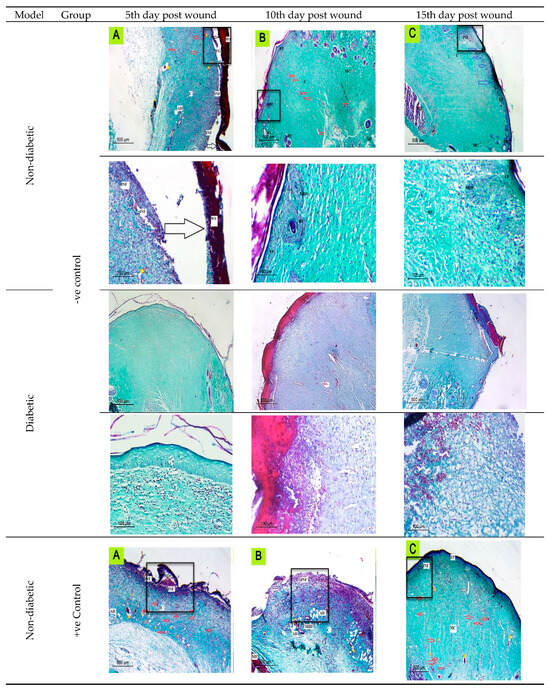
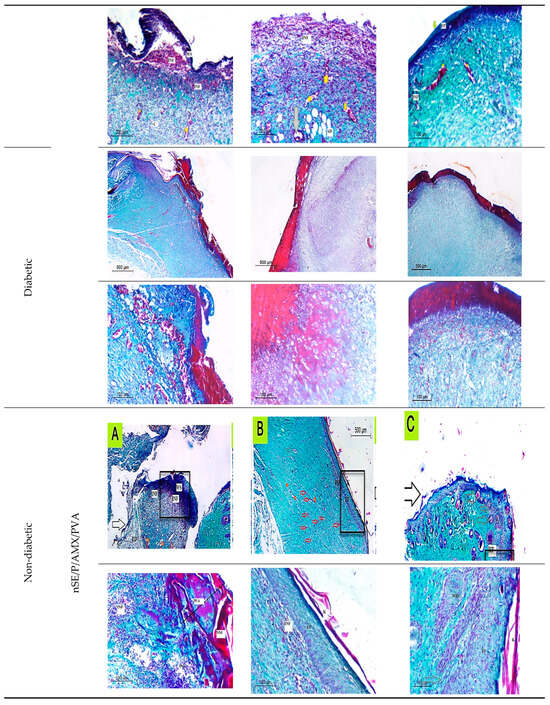
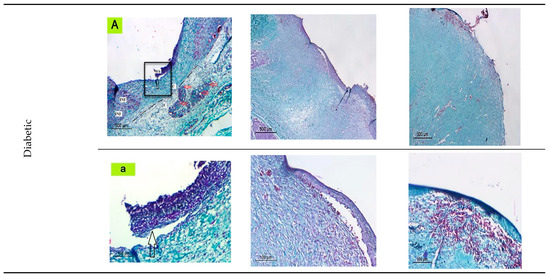
Figure 7.
The histological evaluation of skin wounds at different time intervals (5th, 10th, and 15th) indicated regression of the lesions with better epithelialization (blue arrows) and more effective re-organization of the dermis by collagen fiber maturation. Inflammatory cells (INF); Adipose connective tissue; blood vessels (red arrows); Immature collagen (IMC); mature collagen (MC); epidermis (EP); maturating hair follicle (MHF); Wound Gap (WG); wound area (WA); wound scab (WS) dilated blood vessels (Yellow Strikes); Muscle Fibers (MF); detached scabs (black arrows).
Reference
- Diab, S.E.; Tayea, N.A.; Elwakil, B.H.; Gad, A.A.E.M.; Ghareeb, D.A.; Olama, Z.A. Novel Amoxicillin-Loaded Sericin Biopolymeric Nanoparticles: Synthesis, Optimization, Antibacterial and Wound Healing Activities. Int. J. Mol. Sci. 2022, 23, 11654. [Google Scholar] [CrossRef] [PubMed]
Disclaimer/Publisher’s Note: The statements, opinions and data contained in all publications are solely those of the individual author(s) and contributor(s) and not of MDPI and/or the editor(s). MDPI and/or the editor(s) disclaim responsibility for any injury to people or property resulting from any ideas, methods, instructions or products referred to in the content. |
© 2024 by the authors. Licensee MDPI, Basel, Switzerland. This article is an open access article distributed under the terms and conditions of the Creative Commons Attribution (CC BY) license (https://creativecommons.org/licenses/by/4.0/).