

Preparation of New 2,3-Diphenylpropenoic Acid Esters – Good Yields Even for the More Hindered Z Isomers


Abstract
:Introduction

| Acid | Reaction time h | Yield %a |
|---|---|---|
| 2,3-Diphenylpropionic acid | 0.5 | 94 |
| E-2,3-Diphenylpropenoic acid | 4 | 77 |
| Z-2,3-Diphenylpropenoic acid | 15 | 17 |
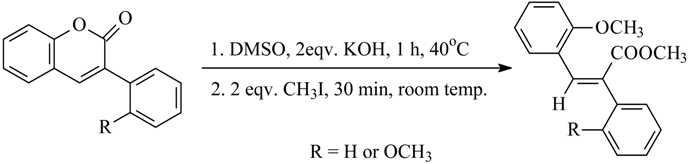
Results and discussion
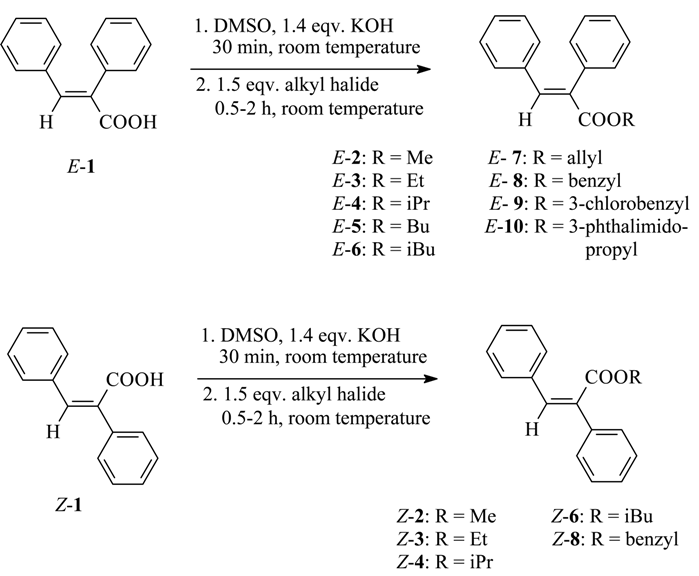
| Entry | Acid | Alkyl halide | Reaction time (h) | Ester Formula | Yielda (%) |
|---|---|---|---|---|---|
| 1 | E-1 | MeI | 0.5 | E-2 C16H14O2 | 95 |
| 2 | Z-1 | MeI | 0.5 | Z-2 C16H14O2 | 91 |
| 3 | E-1 | EtI | 0.5 | E-3 C17H16O2 | 80 |
| 4 | E-1 | EtBr | 1 | E-3 C17H16O2 | 75 |
| 5 | Z-1 | EtI | 0.5 | Z-3 C17H16O2 | 78 |
| 6 | E-1 | iPrBr | 2 | E-4 C18H18O2 | 36 |
| 7 | Z-1 | iPrBr | 2 | Z-4 C18H18O2 | 38 |
| 8 | E-1 | BuI | 1 | E-5 C19H20O2 | 91 |
| 9 | E-1 | BuBr | 1 | E-5 C19H20O2 | 55 |
| 10 | E-1 | BuCl | 1 | E-5 C19H20O2 | 2-3 |
| 11 | E-1 | iBuI | 1 | E-6 C19H20O2 | 31 |
| 12 | Z-1 | iBuI | 1 | Z-6 C19H20O2 | 38 |
| 13 | E-1 | Allyl bromide | 1 | E-7 C18H16O2 | 79 |
| 14 | E-1 | BnBr | 1 | E-8 C22H18O2 | 82 |
| 15 | E-1 | BnCl | 1 | E-8 C22H18O2 | 75 |
| 16 | Z-1 | BnBr | 1 | Z-8 C22H18O2 | 78 |
| 17 | E-1 | 1-Bromo-3-chloropropane | 1 | E-9 C18H17ClO2 | 79 |
| 18 | E-1 | 2-Bromoethyl phenylether | 1 | E-10 C23H19O3 | 83 |
| 19 | E-1 | N-(3-Bromopropyl)-phthalimide | 1 | E-11 C26H21NO4 | 92 |
Conclusions
Experimental
General
General Procedures
Acid-catalysed esterification
Esterification with the DMSO/KOH/alkyl halide system
| Ester | M.p. °C (Lit.) | nD20 | Rf | 1H-NMR δ, ppm, CDCl3 | 13C-NMR δ, ppm, CDCl3 | GC-MS Rt (min) and m/z (rel.int. %) |
|---|---|---|---|---|---|---|
| E-2 | 75-76(75-76 [2]) | – | 0.81 | excellent agreement with literature data [15] | 29.8; 238 (M+, 72), 205 (15), 179 (93), 178 (100), 152 (23), 121 (84) | |
| Z-2 | oil | 1.6198 | 0.83 | excellent agreement with literature data [15] | 31.4; 238 (M+, 66), 205(14), 179 (90), 178 (100), 152 (26), 121 (86) | |
| E-3 | oil | 1.5960 | 0,83 | 1.26-1.29 (t, 3H), 4.23-4.27 (q, 2H), 7.02-7.35 (m, 10H), 7.83 (s, 1H) | 14.2, 61.1, 127.6, 128.1, 128.4, 128.8, 129.7, 130.4, 132.7, 134.6, 135.8, 140.0, 167.7 | 31.2; 252 (M+, 67), 179 (90), 178 (100), 152 (23), 135 (50), 107 (36) |
| Z-3 | oil | 1.6073 | 0.86 | 1.16-1.19 (t, 3H), 4.23-4.27 (q, 2H), 7.02 (s, 1H), 7,30-7,47 (m, 10H) | 13.8, 61.2, 126.4, 128.1, 128.2, 128.3, 128.6, 131.1, 135.3, 135.8, 136.9, 169.5 | 32.9; 252 (M+, 65), 179 (94), 178 (100), 152 (25), 135 (51), 107 (37) |
| E-4 | 68-70(70-71 [14]) | – | 0.89 | 1.26-1.27 (d, 6H), 5.12-5.14 (m, 1H), 7.02-7.35 (m, 10H),7.84 (s, 1H) | 21.8, 68.5, 127.6, 128.1, 128.4, 128.7, 129.8, 130.4, 133.2, 134.7, 135.9, 139.6, 167.2 | 31.4; 266 (M+, 48), 179 (100), 178 (93), 152 (20), 118 (20), 107 (27) |
| Z-4 | 49-51 | – | 0.91 | 1.17-1.19 (d, 6H), 5.17-5.20 (m, 1H), 7.01 (s, 1H),7.28-7.47 (m, 10H) | 21.4, 68.9, 126.3, 128.1, 128.2, 128.3, 128.35, 128.6, 130.6, 135.7, 135.8, 137.0, 169.1 | 33.7; 266 (M+, 48), 179 (100), 178 (92), 152 (21), 118 (20), 107 (27) |
| E-5 | oil | 1.5788 | 0.93 | 0.89-0.92 (t, 3H), 1.32-1.42 (m, 2H), 1.60-1.65 (m, 2H), 4.18-4.21 (t, 2H), 7.03-7.34 (m, 10H), 7.82 (s, 1H) | 13.6, 19.1, 30.6, 64.9, 127.6, 128.1, 128.4, 128.8, 129.7, 130.5, 134.3, 132.7, 136.0, 139.9, 167.8 | 39; 80 (M+, 49), 224 (25), 179 (100), 178 (90), 152 (19), 107 (43) |
| E-6 | oil | 1.5765 | 0.88 | 0.87-0.88 (d, 6H), 1.91-1.94 (m, 1H), 3.97-3.98 (d, 2H), 7.04-7.34 (m, 10H) 7.84 (s, 1H) | 19.1, 27.8, 71.2, 127.7, 128.1, 128.5, 128.9, 129.7, 129.9, 130.6 132.9, 134.7, 136.1, 140.0, 167.8 | 37; 280 (M+, 38), 224 (24), 207 (14), 179 (100), 178 (80), 152 (16), 107 (28) |
| Z-6 | oil | 1.5860 | 0.92 | 0.76-0.77 (d, 6H), 1.83-1.85 (m, 1H), 3.95-3.96 (d, 2H), 7.03 (s, 1H), 7.26-7.47 (m, 10H) | 19.0, 27.4, 71.6, 126.4, 128.2, 128.3, 128.5, 128.7, 132.1, 135.5, 135.9, 136.9, 169.8 | 37.9; 280 (M+, 33), 224 (21), 207 (15), 179 (100), 178 (84), 152 (16), 107 (23) |
| E-7 | oil | 1.6013 | 0.85 | 4.68-4.70 (m, 2H), 5.17-5.26 (m, 2H), 5.89-5.95 (m, 1H), 7.03-7.34 (m, 10H), 7.86 (s, 1H) | 65.5, 117.6, 127.7, 128.1, 128.5, 128.9, 129.7, 130.5, 132.1, 132.5, 134.6, 135.8, 140.4, 167.3 | 34.4; 264 (M+, 56), 179 (82), 178 (100), 152 (25), 105 (26) |
| E-8 | 59-61 | – | 0.88 | 5.24 (s, 2H), 7.02-7.34 (m, 15H), 7.86 (s, 1H) | 66.6, 127.71, 127.74, 127.9, 128.1, 128.4, 128.5, 129.0, 129.7, 130.5, 132.4, 134.5, 135.7, 136.1, 140.5, 167.4 | – |
| Z-8 | 69-71 | – | 0.93 | 5.20 (s, 2H), 7.01 (s, 1H), 7.15-7.43 (m, 15H) | 67.2, 126.5, 128.3, 128.4, 128.5, 128.7, 128.8, 131.7, 135.0, 135.1, 135.7, 136.9, 169.4 | – |
| E-9 | oil | 1.5983 | 0.92 | 2.04-2.10 (m, 2H), 3.473.50 (t, 2H), 4.31-4.33 (t, 2H), 7.03-7.34 (m, 10H), 7.83 (s, 1H) | 31.5, 41.1, 61.7, 127.7, 128.1, 128.5, 129.0, 129.6, 130.5, 132.4, 134.5, 135.8, 140.4, 167.4, | 48.2; 300 (M+, 37), 179 (100), 178 (99), 152 (21), 107 (39) |
| E-10 | 78-80 | – | 0.51 | 4.18-4.19 (t, 2H), 4.52-4.54 (t, 2H), 6.88-7.32 (m, 15H), 7.84 (s, 1H) | 63.7, 66.1, 115.0, 121.3, 128.0, 128.3, 128.7, 129.2, 129.7, 129.8, 130.0, 130.8, 132.5,, 134.7, 135.8, 140.9, 158.8, 167.8 | – |
| E-11 | 77-77.5 | – | 0.75 | 2.04-2.09 (m, 2H), 3.74-3.77 (t, 2H), 4.24-4.27 (t, 2H), 7,0-7.81 (m, 14H), 7.78 (s, 1H) | 27.6, 35.0, 62.4, 123.1, 127.7, 128.0, 128.5, 128.9, 129.7, 130.6, 132.0, 132.4, 133.8, 143.5, 135.7, 140.3, 167.5, 168.2 | – |
Acknowledgements
References
- Fischer, L. F. Experiments in Organic Chemistry; Heath and Co.: Boston, 1957; pp. 182–185. [Google Scholar]
- Geirsson, J. K. F.; Gudmundsson, B. Ö.; Sigurdardottir, R. Unexpected lack of stereoselectivity in the Horner-Wadsworth-Emmond reaction when applied to the synthesis of E- and Z-methyl α-arylcinnamates. Acta Chem. Scand. 1993, 47, 1112–1116. [Google Scholar] [CrossRef]
- Bergens, S. H.; Noheda, P.; Whelan, J.; Bosnich, B. Asymmetric catalysis. Production of chiral diols by enantioselective catalytic intramolecular hydrosililation of olefins. J. Am. Chem. Soc. 1992, 114, 2121–2128. [Google Scholar]
- Newkome, G. R.; Robinson, J. M. Chemistry of heterocyclic compounds. 22. Condensation reactions of 2-substituted pyridines. J. Org. Chem. 1976, 41, 2536–2541. [Google Scholar] [CrossRef]
- Deleux, J. P.; Leroy, G.; Weiler, J. Pyrazoline ring. I. cis- and trans-3,4-diphenyl-3- (methoxycarbonyl)-1-pyrazolines. Tetrahedron 1973, 29, 1135–1144. [Google Scholar] [CrossRef]
- Ogliaruso, M. A.; Wolfe, J. F. Supplement B: The chemistry of acid derivatives, Part 1; (ed. S. Patai); J. Wiley and Sons: New York, 1979; pp. 415–436. [Google Scholar]
- Chakraborti, A. K.; Basak, A.; Grover, V. Chemoselective protection of carboxylic acid as methyl ester: A practical alternative to diazomethane protocol. J. Org. Chem. 1999, 64, 8014–8017. [Google Scholar] [CrossRef]
- Fatope, M. O.; Adeniyi, A. E. Enhanced methylation of sodium carboxylates in methyl ethyl ketone. The effect of quaternary ammonium salt. Synth. Commun. 1985, 15, 307–310. [Google Scholar] [CrossRef]
- Barry, J.; Bram, G.; Decodts, G.; Loupy, A.; Orange, C.; Petit, A.; Sansoulet, J. Solid-liquid phase-transfer catalysis without added solvent. A simple, efficient, and inexpensive synthesis of aromatic carboxylic esters by alkylation of potassium carboxylates. Synthesis 1985, 40–45. [Google Scholar]
- Lee, J. C.; Choi, Y. An improved method for preparation of carboxylic esters using CsF-Celite/alkyl halide/CH3CN. Synth. Commun. 1998, 28, 2021–2026. [Google Scholar]
- Le Bigot, Y.; Delmas, M.; Gorrichon, J.P.; Gaset, A. Synthesis of furoates and furfurylic alcohol esters under very mild conditions using supported base catalysts. A. Synth. Commun. 1982, 12, 327–332. [Google Scholar] [CrossRef]
- Xu, R.; Sim, M-K.; Go, M.-L. Synthesis, antimuscarinic activity and quantitative structure-activity relationship (QSAR) of tropinyl and piperidinyl esters. Chem. Pharm. Bull. 1998, 46, 231–241. [Google Scholar] [CrossRef] [PubMed]
- Felföldi, K.; Sutyinszki, M.; Nagy, N.; Pálinkó, I. Synthesis of E- and Z-o-methoxy-substituted 2,3-diphenyl propenoic acids and its methyl esters. Synth. Commun. 2000, 30, 1543–1553. [Google Scholar] [CrossRef]
- Bordwell, F. G.; Crooks, S.C. Relative rates of cleavage by alkoxide ions of diphenylcyclopropenne and diphenylthiirene 1,1-dioxide. J. Am. Chem. Soc. 1969, 91, 2084–2086. [Google Scholar] [CrossRef]
- Bradley, J. C.; Durst, T. Base-catalyzed ring openings of benzocyclobutenones and -ols. Can. J. Chem. 1995, 73, 1660–1665. [Google Scholar] [CrossRef]
- Sample availability: Contact the authors
© 2004 by MDPI (http:www.mdpi.org). Reproduction is permitted for noncommercial purposes.
Share and Cite
Boros, L.; Felföldi, K.; Pálinkó, I. Preparation of New 2,3-Diphenylpropenoic Acid Esters – Good Yields Even for the More Hindered Z Isomers. Molecules 2004, 9, 256-263. https://doi.org/10.3390/90400256
Boros L, Felföldi K, Pálinkó I. Preparation of New 2,3-Diphenylpropenoic Acid Esters – Good Yields Even for the More Hindered Z Isomers. Molecules. 2004; 9(4):256-263. https://doi.org/10.3390/90400256
Chicago/Turabian StyleBoros, László, Károly Felföldi, and István Pálinkó. 2004. "Preparation of New 2,3-Diphenylpropenoic Acid Esters – Good Yields Even for the More Hindered Z Isomers" Molecules 9, no. 4: 256-263. https://doi.org/10.3390/90400256
APA StyleBoros, L., Felföldi, K., & Pálinkó, I. (2004). Preparation of New 2,3-Diphenylpropenoic Acid Esters – Good Yields Even for the More Hindered Z Isomers. Molecules, 9(4), 256-263. https://doi.org/10.3390/90400256
