

Practical and Efficient Procedure for the In Situ Preparation of B-Alkoxyoxazaborolidines. Enantioselective Reduction of Prochiral Ketones

Abstract
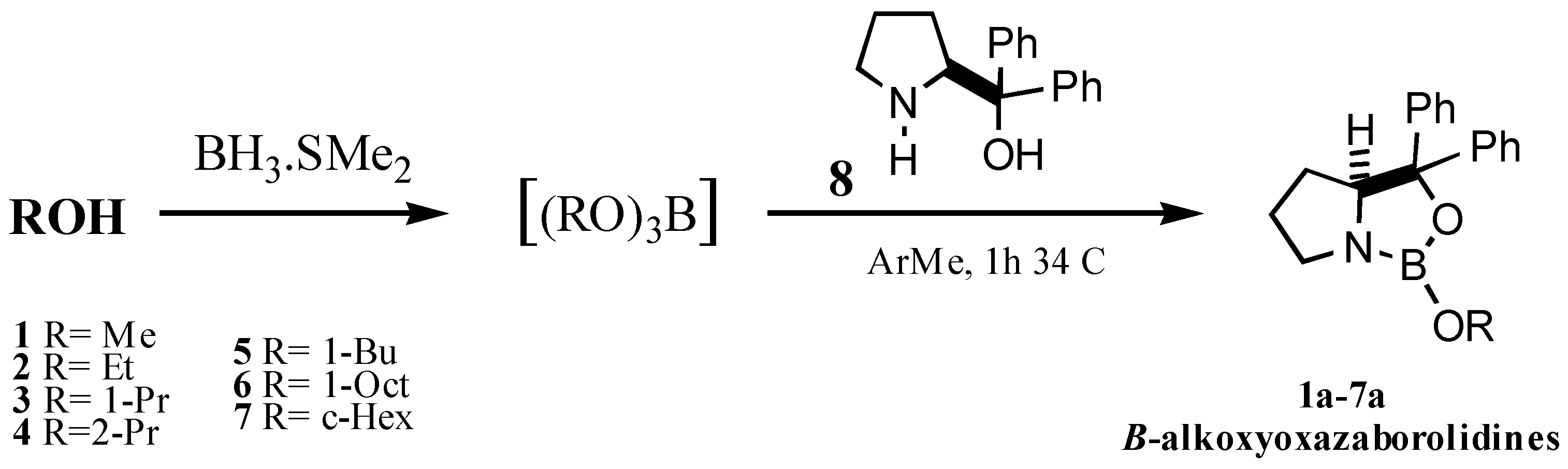
:
| Product | B-alkoxy-OAB | ee(%) | Yield (%) |
| R-1-(3,4-dimethoxyphenyl)ethanol | 1a-7a | >95 | >93 |
| R-1-(4-acetoxy-3-methoxyphenyl)ethanol | 5a | 97 | ≈100 |
| R-1-(4-hydroxy-3-methoxyphenyl)ethanol | 6a | >98 | 98 |
| R-1-(2,4-dimethoxyphenyl)ethanol | 6a | 90 | ≈100 |
| R-1(4-nitrophenyl)ethanol | 6a | >95 | ≈100 |
| R-1(4-aminophenyl)ethanol | 6a | 95 | ≈100 |
| R-1(4-bromophenyl)ethanol | 6a | 97 | 98 |
Acknowledgements
References and Notes
- Corey, E. J.; Shibata, S.; Bakshi, R. J. Am. Chem. Soc. 1987, 109, 5551.
- Corey, E. J.; Helal, C. Angew. Chem. Int. Ed. Eng. 1998, 37, 1986.
- Wallbaum, S.; Martens, J. Tetrahedron: Asymmetry 1992, 3, 1475.
- Corey, E. J.; Bakshi, R. Tetrahedron Lett. 1990, 31, 611.
- Mathre, D.; Jones, T.; Xavier, L.; Blacklock, L. T.; Reamer, R.; Mohan, J.; Turner Jones, T.; Hoogsteen, K.; Baum, M.; Grabowski, E. J. J. Org. Chem. 1991, 56, 751.
- Masui, M.; Shiori, T. Synlett 1997, 273.
Share and Cite
Ponzo, V.L.; Kaufman, T.S. Practical and Efficient Procedure for the In Situ Preparation of B-Alkoxyoxazaborolidines. Enantioselective Reduction of Prochiral Ketones. Molecules 2000, 5, 495-496. https://doi.org/10.3390/50300495
Ponzo VL, Kaufman TS. Practical and Efficient Procedure for the In Situ Preparation of B-Alkoxyoxazaborolidines. Enantioselective Reduction of Prochiral Ketones. Molecules. 2000; 5(3):495-496. https://doi.org/10.3390/50300495
Chicago/Turabian StylePonzo, Viviana L., and Teodoro S. Kaufman. 2000. "Practical and Efficient Procedure for the In Situ Preparation of B-Alkoxyoxazaborolidines. Enantioselective Reduction of Prochiral Ketones" Molecules 5, no. 3: 495-496. https://doi.org/10.3390/50300495
APA StylePonzo, V. L., & Kaufman, T. S. (2000). Practical and Efficient Procedure for the In Situ Preparation of B-Alkoxyoxazaborolidines. Enantioselective Reduction of Prochiral Ketones. Molecules, 5(3), 495-496. https://doi.org/10.3390/50300495
