Bruton’s Tyrosine Kinase Inhibitors in Multiple Sclerosis: Mechanistic Considerations Across Relapsing and Progressive Disease


Abstract
1. Introduction
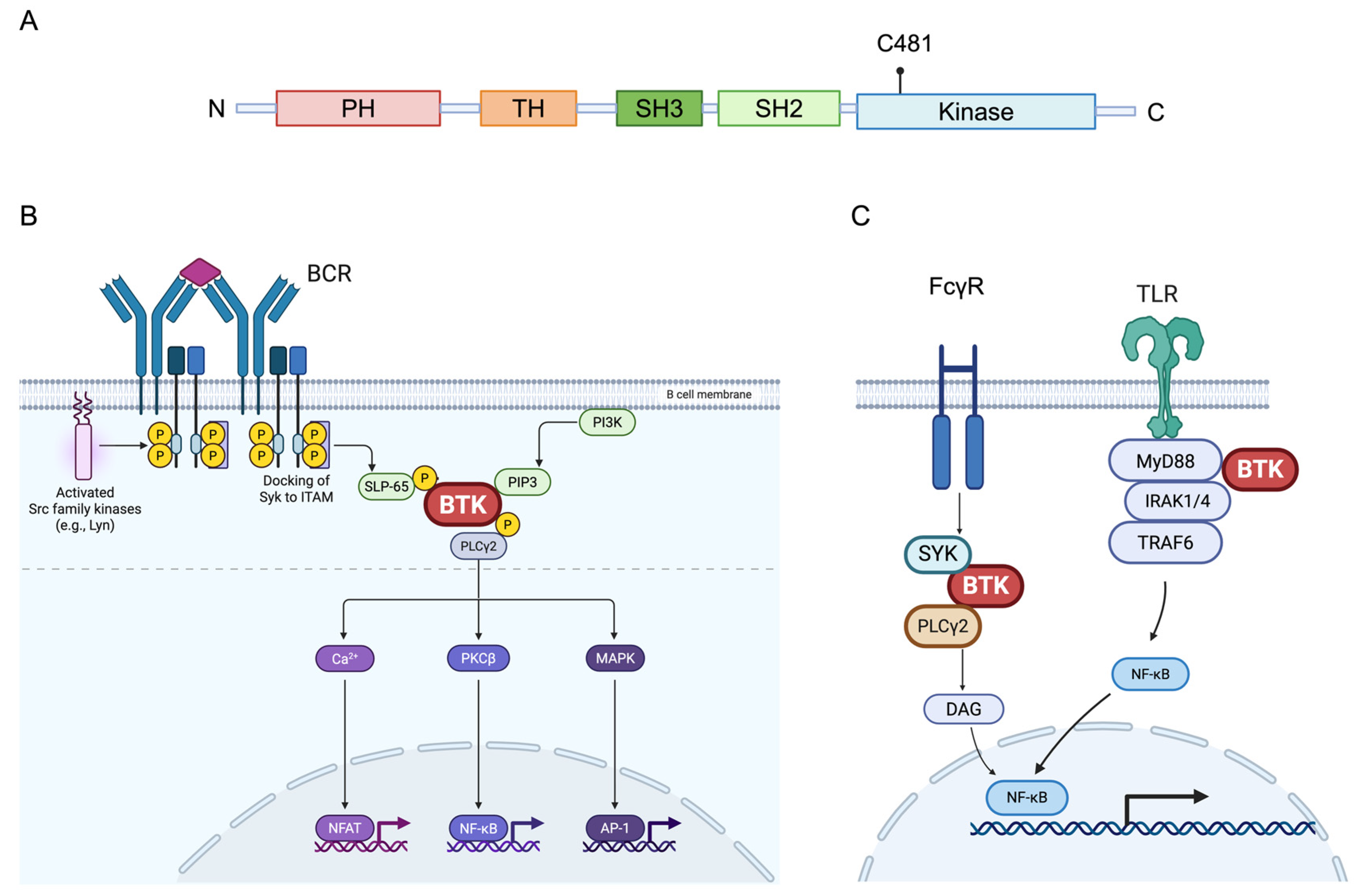
2. BTK Structure, Signaling, and Mechanisms of Inhibition
2.1. Structural Architecture of BTK
2.2. BTK Signaling in Peripheral Immune Cells
2.3. BTK Signaling in Myeloid Cells and Microglia
2.4. Mechanisms of BTK Inhibition
2.5. Preclinical Evidence Supporting BTK Inhibition in MS Models
3. Evolution of BTK Inhibitors: From Oncology to CNS-Targeted Agents
3.1. First-Generation Covalent Inhibitors
3.2. Second-Generation Covalent Inhibitors
3.3. CNS-Penetrant and MS-Focused BTK Inhibitors
3.3.1. Binding Mode and Target Engagement
3.3.2. Kinase Selectivity
3.3.3. Pharmacokinetics and CNS Penetration
3.3.4. Individual Agents in Clinical Development
4. Divergence of Clinical Outcomes Across Disease Stages
4.1. Relapsing MS Trials
4.2. Progressive MS Trials: Testing the CNS-Compartment Hypothesis
4.2.1. Clinical Signals from Progressive Trials
4.2.2. Biological Heterogeneity in Progressive MS
4.2.3. The Role of Biomarker-Guided Interpretation
4.2.4. Conceptual Implications
5. Safety and Pharmacologic Considerations
5.1. Hepatic Safety and Regulatory Considerations
5.2. Reproductive and Postpartum Considerations in Women of Childbearing Age
6. Future Perspectives in BTK-Targeted CNS Therapy
6.1. Optimization of Molecular Design
6.2. Broader Implications in Neuroimmune and Neurodegeneration Disorders
7. Conclusions
Author Contributions
Funding
Institutional Review Board Statement
Informed Consent Statement
Data Availability Statement
Conflicts of Interest
Abbreviations
| MS | Multiple sclerosis |
| CNS | Central nervous system |
| BTK | Bruton’s tyrosine kinase |
| BTKi | Bruton’s tyrosine kinase inhibitor |
| TLR | Toll-like receptor |
| BCR | B-cell receptor |
| PH | Pleckstrin homology |
| TH | Tec homology |
| PIP3 | Phosphatidylinositol (3,4,5)-trisphosphate |
| ITAM | Immunoreceptor tyrosine-based activation motifs |
| PI3K | Phosphoinositide 3-kinase |
| PLCγ2 | Phospholipase Cγ2 |
| FCγR | Fcγ receptors |
| sNFL | Serum neurofilament light chain |
| sGFAP | Serum glial fibrillary acidic protein |
| ALT | Alanine aminotransferase |
| AST | Aspartate aminotransferase |
| DILI | Drug-induced liver injury |
| ARR | Annualized relapse rate |
References
- Boutitah-Benyaich, I.; Eixarch, H.; Villacieros-Alvarez, J.; Hervera, A.; Cobo-Calvo, A.; Montalban, X.; Espejo, C. Multiple sclerosis: Molecular pathogenesis and therapeutic intervention. Signal Transduct. Target. Ther. 2025, 10, 324. [Google Scholar] [CrossRef]
- Woo, M.S.; Engler, J.B.; Friese, M.A. The neuropathobiology of multiple sclerosis. Nat. Rev. Neurosci. 2024, 25, 493–513. [Google Scholar] [CrossRef]
- Lublin, F.D.; Reingold, S.C. Defining the clinical course of multiple sclerosis: Results of an international survey. National Multiple Sclerosis Society (USA) Advisory Committee on Clinical Trials of New Agents in Multiple Sclerosis. Neurology 1996, 46, 907–911. [Google Scholar] [CrossRef]
- Lublin, F.D.; Reingold, S.C.; Cohen, J.A.; Cutter, G.R.; Sorensen, P.S.; Thompson, A.J.; Wolinsky, J.S.; Balcer, L.J.; Banwell, B.; Barkhof, F.; et al. Defining the clinical course of multiple sclerosis: The 2013 revisions. Neurology 2014, 83, 278–286. [Google Scholar] [CrossRef]
- Kuhlmann, T.; Moccia, M.; Coetzee, T.; Cohen, J.A.; Correale, J.; Graves, J.; Marrie, R.A.; Montalban, X.; Yong, V.W.; Thompson, A.J.; et al. Multiple sclerosis progression: Time for a new mechanism-driven framework. Lancet Neurol. 2023, 22, 78–88. [Google Scholar] [CrossRef] [PubMed]
- Krieger, S.; Cook, K.; Hersh, C.M. Understanding multiple sclerosis as a disease spectrum: Above and below the clinical threshold. Curr. Opin. Neurol. 2024, 37, 189–201. [Google Scholar] [CrossRef] [PubMed]
- Pittock, S.J. Multiple sclerosis research in 2025: Earlier diagnosis and halting progression. Lancet Neurol. 2026, 25, 20–22. [Google Scholar] [CrossRef]
- Touil, H.; Li, R.; Zuroff, L.; Moore, C.S.; Healy, L.; Cignarella, F.; Piccio, L.; Ludwin, S.; Prat, A.; Gommerman, J.; et al. Cross-talk between B cells, microglia and macrophages, and implications to central nervous system compartmentalized inflammation and progressive multiple sclerosis. EBioMedicine 2023, 96, 104789. [Google Scholar] [CrossRef]
- Najm, L.; Chomyk, A.; Cyncynatus, K.; Davalos, D.; Mahajan, K.R.; Trapp, B.D. Demyelinated lesion associated compartmental inflammation in progressive multiple sclerosis brains. Acta Neuropathol. Commun. 2025, 13, 204. [Google Scholar] [CrossRef] [PubMed]
- Faissner, S.; Plemel, J.R.; Gold, R.; Yong, V.W. Progressive multiple sclerosis: From pathophysiology to therapeutic strategies. Nat. Rev. Drug Discov. 2019, 18, 905–922. [Google Scholar] [CrossRef]
- Yong, H.Y.F.; Yong, V.W. Mechanism-based criteria to improve therapeutic outcomes in progressive multiple sclerosis. Nat. Rev. Neurol. 2022, 18, 40–55. [Google Scholar] [CrossRef] [PubMed]
- Pithakumar, A.; Basha, S.; Pai, A.R.; Mahato, K.K. From pathogenesis to precision medicine: Targeting immune imbalance in multiple sclerosis. Ageing Res. Rev. 2026, 113, 102921. [Google Scholar] [CrossRef]
- Rodriguez Murua, S.; Farez, M.F.; Quintana, F.J. The Immune Response in Multiple Sclerosis. Annu. Rev. Pathol. 2022, 17, 121–139. [Google Scholar] [CrossRef] [PubMed]
- Pardo, G.; Jones, D.E. The sequence of disease-modifying therapies in relapsing multiple sclerosis: Safety and immunologic considerations. J. Neurol. 2017, 264, 2351–2374. [Google Scholar] [CrossRef] [PubMed]
- Portaccio, E.; Fonderico, M.; Iaffaldano, P.; Pasto, L.; Razzolini, L.; Bellinvia, A.; De Luca, G.; Ragonese, P.; Patti, F.; Brescia Morra, V.; et al. Disease-Modifying Treatments and Time to Loss of Ambulatory Function in Patients With Primary Progressive Multiple Sclerosis. JAMA Neurol. 2022, 79, 869–878. [Google Scholar] [CrossRef]
- Albelo-Martinez, M.; Rizvi, S. Progressive multiple sclerosis: Evaluating current therapies and exploring future treatment strategies. Neurotherapeutics 2025, 22, e00601. [Google Scholar] [CrossRef]
- Rocca, M.A.; Preziosa, P.; Filippi, M. Progressive multiple sclerosis: Six trials to watch. Med 2026, 7, 100960. [Google Scholar] [CrossRef] [PubMed]
- de Seze, J.; Maillart, E.; Gueguen, A.; Laplaud, D.A.; Michel, L.; Thouvenot, E.; Zephir, H.; Zimmer, L.; Biotti, D.; Liblau, R. Anti-CD20 therapies in multiple sclerosis: From pathology to the clinic. Front. Immunol. 2023, 14, 1004795. [Google Scholar] [CrossRef]
- Macaron, G.; Ontaneda, D. Diagnosis and Management of Progressive Multiple Sclerosis. Biomedicines 2019, 7, 56. [Google Scholar] [CrossRef]
- McGinley, M.P.; Cohen, J.A. Sphingosine 1-phosphate receptor modulators in multiple sclerosis and other conditions. Lancet 2021, 398, 1184–1194. [Google Scholar] [CrossRef]
- McGinley, M.P.; Goldschmidt, C.H.; Rae-Grant, A.D. Diagnosis and Treatment of Multiple Sclerosis: A Review. JAMA 2021, 325, 765–779. [Google Scholar] [CrossRef]
- Olejnik, P.; Roszkowska, Z.; Adamus, S.; Kasarello, K. Multiple sclerosis: A narrative overview of current pharmacotherapies and emerging treatment prospects. Pharmacol. Rep. 2024, 76, 926–943. [Google Scholar] [CrossRef]
- Prajjwal, P.; Patel, P.V.; Patel, Z.V.; Inban, P.; Patel, D.; Mahato, P.; Shamim, L.; Godinho, N.J.S.; Tekuru, Y. Multiple sclerosis updates and the safety and efficacy of Bruton tyrosine kinase inhibitors in it: A systematic review. Disease-a-Month 2025, 71, 102012. [Google Scholar] [CrossRef]
- McDonald, C.; Xanthopoulos, C.; Kostareli, E. The role of Bruton’s tyrosine kinase in the immune system and disease. Immunology 2021, 164, 722–736. [Google Scholar] [CrossRef] [PubMed]
- Elkjaer, M.L.; Waede, M.R.; Kingo, C.; Damsbo, K.; Illes, Z. Expression of Bruton s tyrosine kinase in different type of brain lesions of multiple sclerosis patients and during experimental demyelination. Front. Immunol. 2023, 14, 1264128. [Google Scholar] [CrossRef]
- Smith, C.I.; Baskin, B.; Humire-Greiff, P.; Zhou, J.N.; Olsson, P.G.; Maniar, H.S.; Kjellen, P.; Lambris, J.D.; Christensson, B.; Hammarstrom, L.; et al. Expression of Bruton’s agammaglobulinemia tyrosine kinase gene, BTK, is selectively down-regulated in T lymphocytes and plasma cells. J. Immunol. 1994, 152, 557–565. [Google Scholar] [CrossRef] [PubMed]
- Garg, N.; Padron, E.J.; Rammohan, K.W.; Goodman, C.F. Bruton’s Tyrosine Kinase Inhibitors: The Next Frontier of B-Cell-Targeted Therapies for Cancer, Autoimmune Disorders, and Multiple Sclerosis. J. Clin. Med. 2022, 11, 6139. [Google Scholar] [CrossRef] [PubMed]
- Pal Singh, S.; Dammeijer, F.; Hendriks, R.W. Role of Bruton’s tyrosine kinase in B cells and malignancies. Mol. Cancer 2018, 17, 57. [Google Scholar] [CrossRef]
- Airas, L. Bruton’s tyrosine kinase inhibitors for multiple sclerosis. Lancet Neurol. 2025, 24, 627–628. [Google Scholar] [CrossRef]
- Schneider, R.; Oh, J. Bruton’s Tyrosine Kinase Inhibition in Multiple Sclerosis. Curr. Neurol. Neurosci. Rep. 2022, 22, 721–734. [Google Scholar] [CrossRef]
- Reich, D.S.; Arnold, D.L.; Vermersch, P.; Bar-Or, A.; Fox, R.J.; Matta, A.; Turner, T.; Wallstrom, E.; Zhang, X.; Mares, M.; et al. Safety and efficacy of tolebrutinib, an oral brain-penetrant BTK inhibitor, in relapsing multiple sclerosis: A phase 2b, randomised, double-blind, placebo-controlled trial. Lancet Neurol. 2021, 20, 729–738. [Google Scholar] [CrossRef] [PubMed]
- Kramer, J.; Bar-Or, A.; Turner, T.J.; Wiendl, H. Bruton tyrosine kinase inhibitors for multiple sclerosis. Nat. Rev. Neurol. 2023, 19, 289–304. [Google Scholar] [CrossRef]
- Airas, L.; Bermel, R.A.; Chitnis, T.; Hartung, H.P.; Nakahara, J.; Stuve, O.; Williams, M.J.; Kieseier, B.C.; Wiendl, H. A review of Bruton’s tyrosine kinase inhibitors in multiple sclerosis. Ther. Adv. Neurol. Disord. 2024, 17, 17562864241233041. [Google Scholar] [CrossRef] [PubMed]
- Fares, A.; Carracedo Uribe, C.; Martinez, D.; Rehman, T.; Silva Rondon, C.; Sandoval-Sus, J. Bruton’s Tyrosine Kinase Inhibitors: Recent Updates. Int. J. Mol. Sci. 2024, 25, 2208. [Google Scholar] [CrossRef]
- Mohamed, A.J.; Yu, L.; Backesjo, C.M.; Vargas, L.; Faryal, R.; Aints, A.; Christensson, B.; Berglof, A.; Vihinen, M.; Nore, B.F.; et al. Bruton’s tyrosine kinase (Btk): Function, regulation, and transformation with special emphasis on the PH domain. Immunol. Rev. 2009, 228, 58–73. [Google Scholar] [CrossRef]
- Mano, H. Tec family of protein-tyrosine kinases: An overview of their structure and function. Cytokine Growth Factor Rev. 1999, 10, 267–280. [Google Scholar] [CrossRef]
- Yang, W.C.; Collette, Y.; Nunes, J.A.; Olive, D. Tec kinases: A family with multiple roles in immunity. Immunity 2000, 12, 373–382. [Google Scholar] [CrossRef]
- Wang, Q.; Vogan, E.M.; Nocka, L.M.; Rosen, C.E.; Zorn, J.A.; Harrison, S.C.; Kuriyan, J. Autoinhibition of Bruton’s tyrosine kinase (Btk) and activation by soluble inositol hexakisphosphate. Elife 2015, 4, e06074. [Google Scholar] [CrossRef]
- Wang, Q.; Pechersky, Y.; Sagawa, S.; Pan, A.C.; Shaw, D.E. Structural mechanism for Bruton’s tyrosine kinase activation at the cell membrane. Proc. Natl. Acad. Sci. USA 2019, 116, 9390–9399. [Google Scholar] [CrossRef] [PubMed]
- Rawlings, D.J.; Scharenberg, A.M.; Park, H.; Wahl, M.I.; Lin, S.; Kato, R.M.; Fluckiger, A.C.; Witte, O.N.; Kinet, J.P. Activation of BTK by a phosphorylation mechanism initiated by SRC family kinases. Science 1996, 271, 822–825. [Google Scholar] [CrossRef] [PubMed]
- Zain, R.; Vihinen, M. Structure-Function Relationships of Covalent and Non-Covalent BTK Inhibitors. Front. Immunol. 2021, 12, 694853. [Google Scholar] [CrossRef]
- Najmi, A.; Thangavel, N.; Mohanan, A.T.; Qadri, M.; Albratty, M.; Ashraf, S.E.; Saleh, S.F.; Nayeem, M.; Mohan, S. Structural Complementarity of Bruton’s Tyrosine Kinase and Its Inhibitors for Implication in B-Cell Malignancies and Autoimmune Diseases. Pharmaceuticals 2023, 16, 400. [Google Scholar] [CrossRef] [PubMed]
- Sultan, M.M.; Denny, R.A.; Unwalla, R.; Lovering, F.; Pande, V.S. Millisecond dynamics of BTK reveal kinome-wide conformational plasticity within the apo kinase domain. Sci. Rep. 2017, 7, 15604. [Google Scholar] [CrossRef] [PubMed]
- Byun, J.Y.; Koh, Y.T.; Jang, S.Y.; Witcher, J.W.; Chan, J.R.; Pustilnik, A.; Daniels, M.J.; Kim, Y.H.; Suh, K.H.; Linnik, M.D.; et al. Target modulation and pharmacokinetics/pharmacodynamics translation of the BTK inhibitor poseltinib for model-informed phase II dose selection. Sci. Rep. 2021, 11, 18671. [Google Scholar] [CrossRef]
- Darragh, A.C.; Hanna, A.M.; Lipner, J.H.; King, A.J.; Servant, N.B.; Jahic, M. Comprehensive Characterization of Bruton’s Tyrosine Kinase Inhibitor Specificity, Potency, and Biological Effects: Insights into Covalent and Noncovalent Mechanistic Signatures. ACS Pharmacol. Transl. Sci. 2025, 8, 917–931. [Google Scholar] [CrossRef]
- Fu, C.; Turck, C.W.; Kurosaki, T.; Chan, A.C. BLNK: A central linker protein in B cell activation. Immunity 1998, 9, 93–103. [Google Scholar] [CrossRef] [PubMed]
- Rolli, V.; Gallwitz, M.; Wossning, T.; Flemming, A.; Schamel, W.W.; Zurn, C.; Reth, M. Amplification of B cell antigen receptor signaling by a Syk/ITAM positive feedback loop. Mol. Cell 2002, 10, 1057–1069. [Google Scholar] [CrossRef]
- Okada, T.; Maeda, A.; Iwamatsu, A.; Gotoh, K.; Kurosaki, T. BCAP: The tyrosine kinase substrate that connects B cell receptor to phosphoinositide 3-kinase activation. Immunity 2000, 13, 817–827. [Google Scholar] [CrossRef]
- Saito, K.; Scharenberg, A.M.; Kinet, J.P. Interaction between the Btk PH domain and phosphatidylinositol-3,4,5-trisphosphate directly regulates Btk. J. Biol. Chem. 2001, 276, 16201–16206. [Google Scholar] [CrossRef]
- Hendriks, R.W.; Yuvaraj, S.; Kil, L.P. Targeting Bruton’s tyrosine kinase in B cell malignancies. Nat. Rev. Cancer 2014, 14, 219–232. [Google Scholar] [CrossRef]
- Hendriks, R.W.; Middendorp, S. The pre-BCR checkpoint as a cell-autonomous proliferation switch. Trends Immunol. 2004, 25, 249–256. [Google Scholar] [CrossRef]
- Corneth, O.B.J.; Klein Wolterink, R.G.J.; Hendriks, R.W. BTK Signaling in B Cell Differentiation and Autoimmunity. Curr. Top. Microbiol. Immunol. 2016, 393, 67–105. [Google Scholar] [CrossRef]
- Cencioni, M.T.; Mattoscio, M.; Magliozzi, R.; Bar-Or, A.; Muraro, P.A. B cells in multiple sclerosis—From targeted depletion to immune reconstitution therapies. Nat. Rev. Neurol. 2021, 17, 399–414. [Google Scholar] [CrossRef]
- Jain, R.W.; Yong, V.W. B cells in central nervous system disease: Diversity, locations and pathophysiology. Nat. Rev. Immunol. 2022, 22, 513–524. [Google Scholar] [CrossRef] [PubMed]
- Gruber, R.C.; Wirak, G.S.; Blazier, A.S.; Lee, L.; Dufault, M.R.; Hagan, N.; Chretien, N.; LaMorte, M.; Hammond, T.R.; Cheong, A.; et al. BTK regulates microglial function and neuroinflammation in human stem cell models and mouse models of multiple sclerosis. Nat. Commun. 2024, 15, 10116. [Google Scholar] [CrossRef]
- Ben Mkaddem, S.; Benhamou, M.; Monteiro, R.C. Understanding Fc Receptor Involvement in Inflammatory Diseases: From Mechanisms to New Therapeutic Tools. Front. Immunol. 2019, 10, 811. [Google Scholar] [CrossRef] [PubMed]
- Amigorena, S.; Bonnerot, C. Fc receptor signaling and trafficking: A connection for antigen processing. Immunol. Rev. 1999, 172, 279–284. [Google Scholar] [CrossRef] [PubMed]
- Jefferies, C.A.; Doyle, S.; Brunner, C.; Dunne, A.; Brint, E.; Wietek, C.; Walch, E.; Wirth, T.; O’Neill, L.A. Bruton’s tyrosine kinase is a Toll/interleukin-1 receptor domain-binding protein that participates in nuclear factor kappaB activation by Toll-like receptor 4. J. Biol. Chem. 2003, 278, 26258–26264. [Google Scholar] [CrossRef] [PubMed]
- Kawasaki, T.; Kawai, T. Toll-like receptor signaling pathways. Front. Immunol. 2014, 5, 461. [Google Scholar] [CrossRef]
- Gurung, P.; Li, B.; Subbarao Malireddi, R.K.; Lamkanfi, M.; Geiger, T.L.; Kanneganti, T.D. Chronic TLR Stimulation Controls NLRP3 Inflammasome Activation through IL-10 Mediated Regulation of NLRP3 Expression and Caspase-8 Activation. Sci. Rep. 2015, 5, 14488. [Google Scholar] [CrossRef]
- Healy, L.M.; Stratton, J.A.; Kuhlmann, T.; Antel, J. The role of glial cells in multiple sclerosis disease progression. Nat. Rev. Neurol. 2022, 18, 237–248. [Google Scholar] [CrossRef] [PubMed]
- Jackle, K.; Zeis, T.; Schaeren-Wiemers, N.; Junker, A.; van der Meer, F.; Kramann, N.; Stadelmann, C.; Bruck, W. Molecular signature of slowly expanding lesions in progressive multiple sclerosis. Brain 2020, 143, 2073–2088. [Google Scholar] [CrossRef] [PubMed]
- Gu, D.; Tang, H.; Wu, J.; Li, J.; Miao, Y. Targeting Bruton tyrosine kinase using non-covalent inhibitors in B cell malignancies. J. Hematol. Oncol. 2021, 14, 40. [Google Scholar] [CrossRef] [PubMed]
- Shah, P.V.; Gladstone, D.E. Covalent and Non-Covalent BTK Inhibition in Chronic Lymphocytic Leukemia Treatment. Curr. Treat. Options Oncol. 2025, 26, 754–763. [Google Scholar] [CrossRef] [PubMed]
- Turner, T.J.; Brun, P.; Gruber, R.C.; Ofengeim, D. Comparative CNS Pharmacology of the Bruton’s Tyrosine Kinase (BTK) Inhibitor Tolebrutinib Versus Other BTK Inhibitor Candidates for Treating Multiple Sclerosis. Drugs R. D 2024, 24, 263–274. [Google Scholar] [CrossRef]
- Pulz, R.; Angst, D.; Cenni, B. Next generation Bruton’s tyrosine kinase inhibitors—Characterization of in vitro potency and selectivity. Eur. J. Pharmacol. 2025, 1002, 177747. [Google Scholar] [CrossRef] [PubMed]
- Dybowski, S.; Thode, J.; Freier, M.; Saberi, D.; Nessler, S.; Geladaris, A.; Hausser-Kinzel, S.; Ringelstein, M.; Torke, S.; Weber, M.S. Bruton Tyrosine Kinase Inhibition Limits Multiple Sclerosis Disease-Driving Inflammation While Promoting Regulatory B Cells. Neurol. Neuroimmunol. Neuroinflamm. 2026, 13, e200510. [Google Scholar] [CrossRef]
- Geladaris, A.; Torke, S.; Saberi, D.; Alankus, Y.B.; Streit, F.; Zechel, S.; Stadelmann-Nessler, C.; Fischer, A.; Boschert, U.; Hausler, D.; et al. BTK inhibition limits microglia-perpetuated CNS inflammation and promotes myelin repair. Acta Neuropathol. 2024, 147, 75. [Google Scholar] [CrossRef] [PubMed]
- Nuesslein-Hildesheim, B.; Ferrero, E.; Schmid, C.; Huck, C.; Smith, P.; Tisserand, S.; Rubert, J.; Bornancin, F.; Eichlisberger, D.; Cenni, B. Remibrutinib (LOU064) inhibits neuroinflammation driven by B cells and myeloid cells in preclinical models of multiple sclerosis. J. Neuroinflamm. 2023, 20, 194. [Google Scholar] [CrossRef]
- Cool, A.; Nong, T.; Montoya, S.; Taylor, J. BTK inhibitors: Past, present, and future. Trends Pharmacol. Sci. 2024, 45, 691–707. [Google Scholar] [CrossRef]
- Wen, T.; Wang, J.; Shi, Y.; Qian, H.; Liu, P. Inhibitors targeting Bruton’s tyrosine kinase in cancers: Drug development advances. Leukemia 2021, 35, 312–332. [Google Scholar] [CrossRef] [PubMed]
- de Claro, R.A.; McGinn, K.M.; Verdun, N.; Lee, S.L.; Chiu, H.J.; Saber, H.; Brower, M.E.; Chang, C.J.; Pfuma, E.; Habtemariam, B.; et al. FDA Approval: Ibrutinib for Patients with Previously Treated Mantle Cell Lymphoma and Previously Treated Chronic Lymphocytic Leukemia. Clin. Cancer Res. 2015, 21, 3586–3590. [Google Scholar] [CrossRef]
- Munir, T.; Brown, J.R.; O’Brien, S.; Barrientos, J.C.; Barr, P.M.; Reddy, N.M.; Coutre, S.; Tam, C.S.; Mulligan, S.P.; Jaeger, U.; et al. Final analysis from RESONATE: Up to six years of follow-up on ibrutinib in patients with previously treated chronic lymphocytic leukemia or small lymphocytic lymphoma. Am. J. Hematol. 2019, 94, 1353–1363. [Google Scholar] [CrossRef]
- O’Brien, S.; Furman, R.R.; Coutre, S.; Flinn, I.W.; Burger, J.A.; Blum, K.; Sharman, J.; Wierda, W.; Jones, J.; Zhao, W.; et al. Single-agent ibrutinib in treatment-naive and relapsed/refractory chronic lymphocytic leukemia: A 5-year experience. Blood 2018, 131, 1910–1919. [Google Scholar] [CrossRef] [PubMed]
- Duminuco, A.; De Luca, P.; Stanzione, G.; Caruso, L.A.; Lavenia, G.; Scarso, S.; Garibaldi, B.; Palumbo, F.E.; Vetro, C.; Palumbo, G.A. BTK Inhibition in Hematology: From CLL/SLL to Emerging Applications Across B-Cell and Immune Disorders. Biomolecules 2026, 16, 123. [Google Scholar] [CrossRef]
- Byrd, J.C.; Brown, J.R.; O’Brien, S.; Barrientos, J.C.; Kay, N.E.; Reddy, N.M.; Coutre, S.; Tam, C.S.; Mulligan, S.P.; Jaeger, U.; et al. Ibrutinib versus ofatumumab in previously treated chronic lymphoid leukemia. N. Engl. J. Med. 2014, 371, 213–223. [Google Scholar] [CrossRef]
- Burger, J.A.; Tedeschi, A.; Barr, P.M.; Robak, T.; Owen, C.; Ghia, P.; Bairey, O.; Hillmen, P.; Bartlett, N.L.; Li, J.; et al. Ibrutinib as Initial Therapy for Patients with Chronic Lymphocytic Leukemia. N. Engl. J. Med. 2015, 373, 2425–2437. [Google Scholar] [CrossRef]
- Moreno, C.; Greil, R.; Demirkan, F.; Tedeschi, A.; Anz, B.; Larratt, L.; Simkovic, M.; Samoilova, O.; Novak, J.; Ben-Yehuda, D.; et al. Ibrutinib plus obinutuzumab versus chlorambucil plus obinutuzumab in first-line treatment of chronic lymphocytic leukaemia (iLLUMINATE): A multicentre, randomised, open-label, phase 3 trial. Lancet Oncol. 2019, 20, 43–56. [Google Scholar] [CrossRef]
- Estupinan, H.Y.; Berglof, A.; Zain, R.; Smith, C.I.E. Comparative Analysis of BTK Inhibitors and Mechanisms Underlying Adverse Effects. Front. Cell Dev. Biol. 2021, 9, 630942. [Google Scholar] [CrossRef]
- Paydas, S. Management of adverse effects/toxicity of ibrutinib. Crit. Rev. Oncol. Hematol. 2019, 136, 56–63. [Google Scholar] [CrossRef] [PubMed]
- Mouhssine, S.; Maher, N.; Matti, B.F.; Alwan, A.F.; Gaidano, G. Targeting BTK in B Cell Malignancies: From Mode of Action to Resistance Mechanisms. Int. J. Mol. Sci. 2024, 25, 3234. [Google Scholar] [CrossRef] [PubMed]
- Mulder, T.A.; Pena-Perez, L.; Berglof, A.; Meinke, S.; Estupinan, H.Y.; Heimersson, K.; Zain, R.; Mansson, R.; Smith, C.I.E.; Palma, M. Ibrutinib Has Time-dependent On- and Off-target Effects on Plasma Biomarkers and Immune Cells in Chronic Lymphocytic Leukemia. Hemasphere 2021, 5, e564. [Google Scholar] [CrossRef] [PubMed]
- Leong, D.P.; Caron, F.; Hillis, C.; Duan, A.; Healey, J.S.; Fraser, G.; Siegal, D. The risk of atrial fibrillation with ibrutinib use: A systematic review and meta-analysis. Blood 2016, 128, 138–140. [Google Scholar] [CrossRef]
- Jaradat, J.H.; Alkhawaldeh, I.M.; Al-Bojoq, Y.; Ramadan, M.N.; Abuawwad, M.T.; Alabdallat, Y.J.; Nashwan, A.J. Efficacy and safety of ibrutinib in central nervous system lymphoma: A systematic review and meta-analysis. Crit. Rev. Oncol. Hematol. 2025, 206, 104597. [Google Scholar] [CrossRef]
- Guo, Y.; Liu, Y.; Hu, N.; Yu, D.; Zhou, C.; Shi, G.; Zhang, B.; Wei, M.; Liu, J.; Luo, L.; et al. Discovery of Zanubrutinib (BGB-3111), a Novel, Potent, and Selective Covalent Inhibitor of Bruton’s Tyrosine Kinase. J. Med. Chem. 2019, 62, 7923–7940. [Google Scholar] [CrossRef]
- Ke, L.; Li, S.; Huang, D.; Wang, Y. Efficacy and safety of first- versus second-generation Bruton tyrosine kinase inhibitors in chronic lymphocytic leukemia: A systematic review and meta-analysis. Front. Pharmacol. 2024, 15, 1413985. [Google Scholar] [CrossRef]
- Sharman, J.P.; Egyed, M.; Jurczak, W.; Skarbnik, A.; Pagel, J.M.; Flinn, I.W.; Kamdar, M.; Munir, T.; Walewska, R.; Corbett, G.; et al. Acalabrutinib with or without obinutuzumab versus chlorambucil and obinutuzmab for treatment-naive chronic lymphocytic leukaemia (ELEVATE TN): A randomised, controlled, phase 3 trial. Lancet 2020, 395, 1278–1291. [Google Scholar] [CrossRef]
- Ghia, P.; Pluta, A.; Wach, M.; Lysak, D.; Kozak, T.; Simkovic, M.; Kaplan, P.; Kraychok, I.; Illes, A.; de la Serna, J.; et al. ASCEND: Phase III, Randomized Trial of Acalabrutinib Versus Idelalisib Plus Rituximab or Bendamustine Plus Rituximab in Relapsed or Refractory Chronic Lymphocytic Leukemia. J. Clin. Oncol. 2020, 38, 2849–2861. [Google Scholar] [CrossRef]
- Thompson, P.A.; Burger, J.A. Bruton’s tyrosine kinase inhibitors: First and second generation agents for patients with Chronic Lymphocytic Leukemia (CLL). Expert. Opin. Investig. Drugs 2018, 27, 31–42. [Google Scholar] [CrossRef]
- Kim, H.O. BTK inhibitors and next-generation BTK-targeted therapeutics for B-cell malignancies. Arch. Pharmacal Res. 2025, 48, 426–449. [Google Scholar] [CrossRef] [PubMed]
- Gupta, S.; Sharma, A.; Shukla, A.; Mishra, A.; Singh, A. From development to clinical success: The journey of established and next-generation BTK inhibitors. Investig. New Drugs 2025, 43, 377–393. [Google Scholar] [CrossRef] [PubMed]
- Muhowski, E.M.; Ravikrishnan, J.; Gordon, B.; Yu, L.; Misra, S.; Walker, B.; Eathiraj, S.; Sampath, D.; Rogers, K.A.; Byrd, J.C.; et al. Preclinical evaluation of combination nemtabrutinib and venetoclax in chronic lymphocytic leukemia. J. Hematol. Oncol. 2022, 15, 166. [Google Scholar] [CrossRef] [PubMed]
- Kuter, D.J.; Efraim, M.; Mayer, J.; Trneny, M.; McDonald, V.; Bird, R.; Regenbogen, T.; Garg, M.; Kaplan, Z.; Tzvetkov, N.; et al. Rilzabrutinib, an Oral BTK Inhibitor, in Immune Thrombocytopenia. N. Engl. J. Med. 2022, 386, 1421–1431. [Google Scholar] [CrossRef]
- Robak, T.; Iskierka-Jazdzewska, E.; Pula, A.; Robak, P.; Pula, B. The Development of Novel Therapies for Chronic Lymphocytic Leukaemia in the Era of Targeted Drugs. J. Clin. Med. 2025, 14, 8247. [Google Scholar] [CrossRef]
- Woyach, J.A.; Stephens, D.M.; Flinn, I.W.; Bhat, S.A.; Savage, R.E.; Chai, F.; Eathiraj, S.; Reiff, S.D.; Muhowski, E.M.; Granlund, L.; et al. First-in-Human Study of the Reversible BTK Inhibitor Nemtabrutinib in Patients with Relapsed/Refractory Chronic Lymphocytic Leukemia and B-Cell Non-Hodgkin Lymphoma. Cancer Discov. 2024, 14, 66–75. [Google Scholar] [CrossRef] [PubMed]
- Schaefer, D.; Cheng, X. Recent Advances in Covalent Drug Discovery. Pharmaceuticals 2023, 16, 663. [Google Scholar] [CrossRef]
- Becker, A.; Martin, E.C.; Mitchell, D.Y.; Grenningloh, R.; Bender, A.T.; Laurent, J.; Mackenzie, H.; Johne, A. Safety, Tolerability, Pharmacokinetics, Target Occupancy, and Concentration-QT Analysis of the Novel BTK Inhibitor Evobrutinib in Healthy Volunteers. Clin. Transl. Sci. 2020, 13, 325–336. [Google Scholar] [CrossRef]
- Barf, T.; Kaptein, A. Irreversible protein kinase inhibitors: Balancing the benefits and risks. J. Med. Chem. 2012, 55, 6243–6262. [Google Scholar] [CrossRef]
- Yang, Z.; Wang, W.; Wang, X.; Qin, Z. Cardiotoxicity of Epidermal Growth Factor Receptor 2-Targeted Drugs for Breast Cancer. Front. Pharmacol. 2021, 12, 741451. [Google Scholar] [CrossRef] [PubMed]
- Lucchini, E.; Pilotto, S.; Spada, E.; Melisi, D.; Bria, E.; Tortora, G. Targeting the epidermal growth factor receptor in solid tumors: Focus on safety. Expert Opin. Drug Saf. 2014, 13, 535–549. [Google Scholar] [CrossRef]
- Fabian, M.A.; Biggs, W.H., 3rd; Treiber, D.K.; Atteridge, C.E.; Azimioara, M.D.; Benedetti, M.G.; Carter, T.A.; Ciceri, P.; Edeen, P.T.; Floyd, M.; et al. A small molecule-kinase interaction map for clinical kinase inhibitors. Nat. Biotechnol. 2005, 23, 329–336. [Google Scholar] [CrossRef]
- Bender, A.T.; Gardberg, A.; Pereira, A.; Johnson, T.; Wu, Y.; Grenningloh, R.; Head, J.; Morandi, F.; Haselmayer, P.; Liu-Bujalski, L. Ability of Bruton’s Tyrosine Kinase Inhibitors to Sequester Y551 and Prevent Phosphorylation Determines Potency for Inhibition of Fc Receptor but not B-Cell Receptor Signaling. Mol. Pharmacol. 2017, 91, 208–219. [Google Scholar] [CrossRef]
- Li, W.; Sano, R.; Apatira, M.; DeAnda, F.; Gururaja, T.; Yang, M.; Lundgaard, G.; Pan, C.; Liu, J.; Zhai, Y.; et al. Bruton’s Tyrosine Kinase Inhibitors with Distinct Binding Modes Reveal Differential Functional Impact on B-Cell Receptor Signaling. Mol. Cancer Ther. 2024, 23, 35–46. [Google Scholar] [CrossRef]
- Haselmayer, P.; Camps, M.; Liu-Bujalski, L.; Nguyen, N.; Morandi, F.; Head, J.; O’Mahony, A.; Zimmerli, S.C.; Bruns, L.; Bender, A.T.; et al. Efficacy and Pharmacodynamic Modeling of the BTK Inhibitor Evobrutinib in Autoimmune Disease Models. J. Immunol. 2019, 202, 2888–2906. [Google Scholar] [CrossRef] [PubMed]
- Qiu, H.; Ali, Z.; Bender, A.; Caldwell, R.; Chen, Y.Y.; Fang, Z.; Gardberg, A.; Glaser, N.; Goettsche, A.; Goutopoulos, A.; et al. Discovery of potent and selective reversible Bruton’s tyrosine kinase inhibitors. Bioorganic Med. Chem. 2021, 40, 116163. [Google Scholar] [CrossRef] [PubMed]
- Lipsky, A.; Lamanna, N. Managing toxicities of Bruton tyrosine kinase inhibitors. Hematol. Am. Soc. Hematol. Educ. Program. 2020, 2020, 336–345. [Google Scholar] [CrossRef]
- Owens, T.D.; Smith, P.F.; Redfern, A.; Xing, Y.; Shu, J.; Karr, D.E.; Hartmann, S.; Francesco, M.R.; Langrish, C.L.; Nunn, P.A.; et al. Phase 1 clinical trial evaluating safety, exposure and pharmacodynamics of BTK inhibitor tolebrutinib (PRN2246, SAR442168). Clin. Transl. Sci. 2022, 15, 442–450. [Google Scholar] [CrossRef]
- Montalban, X.; Arnold, D.L.; Weber, M.S.; Staikov, I.; Piasecka-Stryczynska, K.; Willmer, J.; Martin, E.C.; Dangond, F.; Syed, S.; Wolinsky, J.S.; et al. Placebo-Controlled Trial of an Oral BTK Inhibitor in Multiple Sclerosis. N. Engl. J. Med. 2019, 380, 2406–2417. [Google Scholar] [CrossRef] [PubMed]
- Arnold, D.L.; Elliott, C.; Martin, E.C.; Hyvert, Y.; Tomic, D.; Montalban, X. Effect of Evobrutinib on Slowly Expanding Lesion Volume in Relapsing Multiple Sclerosis: A Post Hoc Analysis of a Phase 2 Trial. Neurology 2024, 102, e208058. [Google Scholar] [CrossRef]
- Montalban, X.; Piasecka-Stryczynska, K.; Kuhle, J.; Benkert, P.; Arnold, D.L.; Weber, M.S.; Seitzinger, A.; Guehring, H.; Shaw, J.; Tomic, D.; et al. Efficacy and safety results after >3.5 years of treatment with the Bruton’s tyrosine kinase inhibitor evobrutinib in relapsing multiple sclerosis: Long-term follow-up of a Phase II randomised clinical trial with a cerebrospinal fluid sub-study. Mult. Scler. 2024, 30, 558–570. [Google Scholar] [CrossRef] [PubMed]
- Montalban, X.; Vermersch, P.; Arnold, D.L.; Bar-Or, A.; Cree, B.A.C.; Cross, A.H.; Kubala Havrdova, E.; Kappos, L.; Stuve, O.; Wiendl, H.; et al. Safety and efficacy of evobrutinib in relapsing multiple sclerosis (evolutionRMS1 and evolutionRMS2): Two multicentre, randomised, double-blind, active-controlled, phase 3 trials. Lancet Neurol. 2024, 23, 1119–1132. [Google Scholar] [CrossRef]
- Oh, J.; Fox, R.J.; Arnold, D.L.; Syed, S.; Dukovic, D.; Vargas, W.S.; Turner, T.J.; Underwood, C.F.; Long, T.M.; Traboulsee, A.L.; et al. Tolebrutinib Phase 2b Long-Term Extension Study: Two-Year Safety, MRI, and Clinical Efficacy Outcomes in Patients With Relapsing Multiple Sclerosis Patients. Neurol. Open Access 2025, 1, e000028. [Google Scholar] [CrossRef]
- Fox, R.J.; Bar-Or, A.; Traboulsee, A.; Oreja-Guevara, C.; Giovannoni, G.; Vermersch, P.; Syed, S.; Li, Y.; Vargas, W.S.; Turner, T.J.; et al. Tolebrutinib in Nonrelapsing Secondary Progressive Multiple Sclerosis. N. Engl. J. Med. 2025, 392, 1883–1892. [Google Scholar] [CrossRef]
- Reich, D.S.; Bar-Or, A.; Vermersch, P.; Oreja-Guevara, C.; Traboulsee, A.; Giovannoni, G.; Syed, S.; Sun, F.; Salloum, N.; Turner, T.J.; et al. Efficacy and Safety of Tolebrutinib Versus Placebo in Primary Progressive Multiple Sclerosis: Results From the Phase 3 PERSEUS Trial. In Proceedings of the ACTRIMS Forum 2026, San Diego, CA, USA, 2 July 2026. [Google Scholar]
- Herman, A.E.; Chinn, L.W.; Kotwal, S.G.; Murray, E.R.; Zhao, R.; Florero, M.; Lin, A.; Moein, A.; Wang, R.; Bremer, M.; et al. Safety, Pharmacokinetics, and Pharmacodynamics in Healthy Volunteers Treated With GDC-0853, a Selective Reversible Bruton’s Tyrosine Kinase Inhibitor. Clin. Pharmacol. Ther. 2018, 103, 1020–1028. [Google Scholar] [CrossRef]
- Bar-Or, A.; Dufek, M.; Budincevic, H.; Drulovic, J.; Habek, M.; Hua, L.H.; Weber, M.S.; Thomas, P.; Napieralski, J.; Mitzner, M.C.; et al. Safety and efficacy of fenebrutinib in relapsing multiple sclerosis (FENopta): A multicentre, double-blind, randomised, placebo-controlled, phase 2 trial and open-label extension study. Lancet Neurol. 2025, 24, 656–666. [Google Scholar] [CrossRef] [PubMed]
- Bar-Or, A.; Oh, J.; Giovannoni, G.; Sormani, M.; Weber, M.S.; Stoll, S.; Nicholas, J.; von Büdingen, H.; Lopez, J.; Roberts, L.; et al. Efficacy and Safety of Fenebrutinib vs Ocrelizumab in Primary Progressive Multiple Sclerosis: Primary Results of the Phase III FENtrepid Study. In Proceedings of the ACTRIMS 2026, San Diego, CA, USA, 2 July 2026. [Google Scholar]
- Roche Holding AG. Roche’s Fenebrutinib Shows Unprecedented Positive Phase III Results as the Potential First and Only BTK Inhibitor in both Relapsing and Primary Progressive Multiple Sclerosis. Available online: https://www.roche.com/media/releases/med-cor-2025-11-10 (accessed on 11 September 2025).
- Hopkins, B.T.; Bame, E.; Bajrami, B.; Black, C.; Bohnert, T.; Boiselle, C.; Burdette, D.; Burns, J.C.; Delva, L.; Donaldson, D.; et al. Discovery and Preclinical Characterization of BIIB091, a Reversible, Selective BTK Inhibitor for the Treatment of Multiple Sclerosis. J. Med. Chem. 2022, 65, 1206–1224. [Google Scholar] [CrossRef] [PubMed]
- Bame, E.; Tang, H.; Burns, J.C.; Arefayene, M.; Michelsen, K.; Ma, B.; Marx, I.; Prince, R.; Roach, A.M.; Poreci, U.; et al. Next-generation Bruton’s tyrosine kinase inhibitor BIIB091 selectively and potently inhibits B cell and Fc receptor signaling and downstream functions in B cells and myeloid cells. Clin. Transl. Immunol. 2021, 10, e1295. [Google Scholar] [CrossRef] [PubMed]
- Himmelbauer, M.K.; Bajrami, B.; Basile, R.; Capacci, A.; Chen, T.; Choi, C.K.; Gilfillan, R.; Gonzalez-Lopez de Turiso, F.; Gu, C.; Hoemberger, M.; et al. Discovery and Preclinical Characterization of BIIB129, a Covalent, Selective, and Brain-Penetrant BTK Inhibitor for the Treatment of Multiple Sclerosis. J. Med. Chem. 2024, 67, 8122–8140. [Google Scholar] [CrossRef] [PubMed]
- Wiendl, H.; Airas, L.; Chitnis, T.; Williams, M.; Nakahara, J.; Bermel, R.; Mann, A.; Ziehn, M.; Bhatt, A.; Hunter, B.; et al. Phase 3 REMODEL I/II Trials: Effectiveness, Safety, and Tolerability of Remibrutinib in Patients with Relapsing Multiple Sclerosis (P7-4.003). Neurology 2022, 98, 2562. [Google Scholar] [CrossRef]
- Xu, Y.; Chen, X.; Tang, W. Positive Phase 2 Results of Orelabrutinib in Patients with Relapsing-Remitting Multiple Sclerosis. In Proceedings of the ACTRIMS Forum 2025, West Palm Beach, FL, USA, 27 February–1 March 2025. [Google Scholar]
- Mato, A.R.; Woyach, J.A.; Brown, J.R.; Ghia, P.; Patel, K.; Eyre, T.A.; Munir, T.; Lech-Maranda, E.; Lamanna, N.; Tam, C.S.; et al. Pirtobrutinib after a Covalent BTK Inhibitor in Chronic Lymphocytic Leukemia. N. Engl. J. Med. 2023, 389, 33–44. [Google Scholar] [CrossRef] [PubMed]
- Naydovich, L.R.; Orthmann-Murphy, J.L.; Markowitz, C.E. Beyond relapses: How BTK inhibitors are shaping the future of progressive MS treatment. Neurotherapeutics 2025, 22, e00602. [Google Scholar] [CrossRef]
- Held, U.; Heigenhauser, L.; Shang, C.; Kappos, L.; Polman, C.; Sylvia Lawry Centre for MS Research. Predictors of relapse rate in MS clinical trials. Neurology 2005, 65, 1769–1773. [Google Scholar] [CrossRef]
- Nicholas, R.; Straube, S.; Schmidli, H.; Schneider, S.; Friede, T. Trends in annualized relapse rates in relapsing-remitting multiple sclerosis and consequences for clinical trial design. Mult. Scler. 2011, 17, 1211–1217. [Google Scholar] [CrossRef] [PubMed]
- Hemond, C.C.; Bakshi, R. Magnetic Resonance Imaging in Multiple Sclerosis. Cold Spring Harb. Perspect. Med. 2018, 8, a028969. [Google Scholar] [CrossRef]
- Zhang, Y.; Salter, A.; Wallstrom, E.; Cutter, G.; Stuve, O. Evolution of clinical trials in multiple sclerosis. Ther. Adv. Neurol. Disord. 2019, 12, 1756286419826547. [Google Scholar] [CrossRef]
- Oh, J.; O’Connor, P.W. Teriflunomide in the treatment of multiple sclerosis: Current evidence and future prospects. Ther. Adv. Neurol. Disord. 2014, 7, 239–252. [Google Scholar] [CrossRef]
- O’Connor, P.; Wolinsky, J.S.; Confavreux, C.; Comi, G.; Kappos, L.; Olsson, T.P.; Benzerdjeb, H.; Truffinet, P.; Wang, L.; Miller, A.; et al. Randomized trial of oral teriflunomide for relapsing multiple sclerosis. N. Engl. J. Med. 2011, 365, 1293–1303. [Google Scholar] [CrossRef]
- Bar-Or, A.; Pachner, A.; Menguy-Vacheron, F.; Kaplan, J.; Wiendl, H. Teriflunomide and its mechanism of action in multiple sclerosis. Drugs 2014, 74, 659–674. [Google Scholar] [CrossRef]
- Oh, J.; Arnold, D.L.; Cree, B.A.C.; Ionete, C.; Kim, H.J.; Sormani, M.P.; Syed, S.; Chen, Y.; Maxwell, C.R.; Benoit, P.; et al. Tolebrutinib versus Teriflunomide in Relapsing Multiple Sclerosis. N. Engl. J. Med. 2025, 392, 1893–1904. [Google Scholar] [CrossRef] [PubMed]
- Barr, P.M.; Brown, J.R.; Hillmen, P.; O’Brien, S.; Barrientos, J.C.; Reddy, N.M.; Coutre, S.; Mulligan, S.P.; Jaeger, U.; Furman, R.R.; et al. Impact of ibrutinib dose adherence on therapeutic efficacy in patients with previously treated CLL/SLL. Blood 2017, 129, 2612–2615. [Google Scholar] [CrossRef]
- Sanofi. Media Update: Patient Enrollment of Phase III Tolebrutinib Trials Paused in the U.S. 2022. Available online: https://www.sanofi.com/en/media-room/press-releases/2022/2022-06-30-05-30-00-2471767 (accessed on 3 April 2026).
- Wang, Y.C.; Meyerson, L.; Tang, Y.Q.; Qian, N. Statistical methods for the analysis of relapse data in MS clinical trials. J. Neurol. Sci. 2009, 285, 206–211. [Google Scholar] [CrossRef] [PubMed]
- Steinvorth, S.M.; Rover, C.; Schneider, S.; Nicholas, R.; Straube, S.; Friede, T. Explaining temporal trends in annualised relapse rates in placebo groups of randomised controlled trials in relapsing multiple sclerosis: Systematic review and meta-regression. Mult. Scler. 2013, 19, 1580–1586. [Google Scholar] [CrossRef]
- Afzali, A.M.; Korn, T. The role of the adaptive immune system in the initiation and persistence of multiple sclerosis. Semin. Immunol. 2025, 78, 101947. [Google Scholar] [CrossRef]
- Hemmer, B.; Kerschensteiner, M.; Korn, T. Role of the innate and adaptive immune responses in the course of multiple sclerosis. Lancet Neurol. 2015, 14, 406–419. [Google Scholar] [CrossRef]
- Lassmann, H.; van Horssen, J.; Mahad, D. Progressive multiple sclerosis: Pathology and pathogenesis. Nat. Rev. Neurol. 2012, 8, 647–656. [Google Scholar] [CrossRef]
- Miller, D.H.; Leary, S.M. Primary-progressive multiple sclerosis. Lancet Neurol. 2007, 6, 903–912. [Google Scholar] [CrossRef] [PubMed]
- Cree, B.A.C.; Arnold, D.L.; Chataway, J.; Chitnis, T.; Fox, R.J.; Pozo Ramajo, A.; Murphy, N.; Lassmann, H. Secondary Progressive Multiple Sclerosis: New Insights. Neurology 2021, 97, 378–388. [Google Scholar] [CrossRef] [PubMed]
- Bar-Or, A.; Li, R. Cellular immunology of relapsing multiple sclerosis: Interactions, checks, and balances. Lancet Neurol. 2021, 20, 470–483. [Google Scholar] [CrossRef] [PubMed]
- Correale, J.; Gaitan, M.I.; Ysrraelit, M.C.; Fiol, M.P. Progressive multiple sclerosis: From pathogenic mechanisms to treatment. Brain 2017, 140, 527–546. [Google Scholar] [CrossRef] [PubMed]
- Serafini, B.; Rosicarelli, B.; Magliozzi, R.; Stigliano, E.; Aloisi, F. Detection of ectopic B-cell follicles with germinal centers in the meninges of patients with secondary progressive multiple sclerosis. Brain Pathol. 2004, 14, 164–174. [Google Scholar] [CrossRef] [PubMed]
- Magliozzi, R.; Howell, O.; Vora, A.; Serafini, B.; Nicholas, R.; Puopolo, M.; Reynolds, R.; Aloisi, F. Meningeal B-cell follicles in secondary progressive multiple sclerosis associate with early onset of disease and severe cortical pathology. Brain 2007, 130, 1089–1104. [Google Scholar] [CrossRef] [PubMed]
- Choi, S.R.; Howell, O.W.; Carassiti, D.; Magliozzi, R.; Gveric, D.; Muraro, P.A.; Nicholas, R.; Roncaroli, F.; Reynolds, R. Meningeal inflammation plays a role in the pathology of primary progressive multiple sclerosis. Brain 2012, 135, 2925–2937. [Google Scholar] [CrossRef] [PubMed]
- Sempik, I.; Dziadkowiak, E.; Moreira, H.; Zimny, A.; Pokryszko-Dragan, A. Primary Progressive Multiple Sclerosis—A Key to Understanding and Managing Disease Progression. Int. J. Mol. Sci. 2024, 25, 8751. [Google Scholar] [CrossRef]
- Howell, O.W.; Reeves, C.A.; Nicholas, R.; Carassiti, D.; Radotra, B.; Gentleman, S.M.; Serafini, B.; Aloisi, F.; Roncaroli, F.; Magliozzi, R.; et al. Meningeal inflammation is widespread and linked to cortical pathology in multiple sclerosis. Brain 2011, 134, 2755–2771. [Google Scholar] [CrossRef] [PubMed]
- Revesz, T.; Kidd, D.; Thompson, A.J.; Barnard, R.O.; McDonald, W.I. A comparison of the pathology of primary and secondary progressive multiple sclerosis. Brain 1994, 117, 759–765. [Google Scholar] [CrossRef]
- Antel, J.; Antel, S.; Caramanos, Z.; Arnold, D.L.; Kuhlmann, T. Primary progressive multiple sclerosis: Part of the MS disease spectrum or separate disease entity? Acta Neuropathol. 2012, 123, 627–638. [Google Scholar] [CrossRef] [PubMed]
- Husseini, L.; Jung, J.; Boess, N.; Kruse, N.; Nessler, S.; Stadelmann, C.; Metz, I.; Haupts, M.; Weber, M.S. Neurofilament Light Chain Serum Levels Mirror Age and Disability in Secondary Progressive Multiple Sclerosis: A Cross-Sectional Study. Neurol. Neuroimmunol. Neuroinflamm. 2024, 11, e200279. [Google Scholar] [CrossRef]
- Cross, A.H.; Gelfand, J.M.; Thebault, S.; Bennett, J.L.; von Budingen, H.C.; Cameron, B.; Carruthers, R.; Edwards, K.; Fallis, R.; Gerstein, R.; et al. Emerging Cerebrospinal Fluid Biomarkers of Disease Activity and Progression in Multiple Sclerosis. JAMA Neurol. 2024, 81, 373–383. [Google Scholar] [CrossRef]
- Gafson, A.R.; Jiang, X.; Shen, C.; Kapoor, R.; Zetterberg, H.; Fox, R.J.; Belachew, S. Serum Neurofilament Light and Multiple Sclerosis Progression Independent of Acute Inflammation. JAMA Netw. Open 2022, 5, e2147588. [Google Scholar] [CrossRef]
- Kapoor, R.; Smith, K.E.; Allegretta, M.; Arnold, D.L.; Carroll, W.; Comabella, M.; Furlan, R.; Harp, C.; Kuhle, J.; Leppert, D.; et al. Serum neurofilament light as a biomarker in progressive multiple sclerosis. Neurology 2020, 95, 436–444. [Google Scholar] [CrossRef]
- Bar-Or, A.; Nicholas, J.; Feng, J.; Sorrell, F.; Cascione, M. Exploring the Clinical Utility of Neurofilament Light Chain Assays in Multiple Sclerosis Management. Neurol. Neuroimmunol. Neuroinflamm. 2025, 12, e200427. [Google Scholar] [CrossRef]
- Freedman, M.S.; Gnanapavan, S.; Booth, R.A.; Calabresi, P.A.; Khalil, M.; Kuhle, J.; Lycke, J.; Olsson, T.; Consortium of Multiple Sclerosis, C. Guidance for use of neurofilament light chain as a cerebrospinal fluid and blood biomarker in multiple sclerosis management. EBioMedicine 2024, 101, 104970. [Google Scholar] [CrossRef]
- Madill, E.; Healy, B.C.; Molazadeh, N.; Polgar-Turcsanyi, M.; Glanz, B.I.; Weiner, H.L.; Chitnis, T. Serum glial fibrillary acidic protein predicts disease progression in multiple sclerosis. Ann. Clin. Transl. Neurol. 2024, 11, 2719–2730. [Google Scholar] [CrossRef] [PubMed]
- Axelsson, M.; Malmestrom, C.; Nilsson, S.; Haghighi, S.; Rosengren, L.; Lycke, J. Glial fibrillary acidic protein: A potential biomarker for progression in multiple sclerosis. J. Neurol. 2011, 258, 882–888. [Google Scholar] [CrossRef] [PubMed]
- Enache, I.I.; Tiu, V.E.; Anghel, C.A.; Tiu, C.; Popa-Cherecheanu, A.; Bostan, M.; Scippa, S.; Balestrieri, A.; Smaldone, G.; Soricelli, A. GFAP, CHI3L1 and GCIPL Thickness as Baseline Predictors of Early Disability Progression in MS. Int. J. Mol. Sci. 2025, 26, 11774. [Google Scholar] [CrossRef]
- Ayrignac, X.; Le Bars, E.; Duflos, C.; Hirtz, C.; Maleska Maceski, A.; Carra-Dalliere, C.; Charif, M.; Pinna, F.; Prin, P.; Menjot de Champfleur, N.; et al. Serum GFAP in multiple sclerosis: Correlation with disease type and MRI markers of disease severity. Sci. Rep. 2020, 10, 10923. [Google Scholar] [CrossRef]
- Meier, S.; Willemse, E.A.J.; Schaedelin, S.; Oechtering, J.; Lorscheider, J.; Melie-Garcia, L.; Cagol, A.; Barakovic, M.; Galbusera, R.; Subramaniam, S.; et al. Serum Glial Fibrillary Acidic Protein Compared With Neurofilament Light Chain as a Biomarker for Disease Progression in Multiple Sclerosis. JAMA Neurol. 2023, 80, 287–297. [Google Scholar] [CrossRef]
- Barro, C.; Healy, B.C.; Liu, Y.; Saxena, S.; Paul, A.; Polgar-Turcsanyi, M.; Guttmann, C.R.G.; Bakshi, R.; Kropshofer, H.; Weiner, H.L.; et al. Serum GFAP and NfL Levels Differentiate Subsequent Progression and Disease Activity in Patients With Progressive Multiple Sclerosis. Neurol. Neuroimmunol. Neuroinflamm. 2023, 10, e200052. [Google Scholar] [CrossRef] [PubMed]
- Jafari, A.; Babajani, A.; Rezaei-Tavirani, M. Multiple Sclerosis Biomarker Discoveries by Proteomics and Metabolomics Approaches. Biomark. Insights 2021, 16, 11772719211013352. [Google Scholar] [CrossRef]
- Sanofi. Sanofi Provides Update on Tolebrutinib Regulatory Submission in Non-Relapsing Secondary Progressive Multiple Sclerosis. 2025. Available online: https://www.sanofi.com/en/media-room/press-releases/2025/2025-12-24-06-00-00-3210238 (accessed on 3 April 2026).
- U.S. Food and Drug Administration. Complete Response Letter for Tolebrutinib (NDA 219624); U.S. Food and Drug Administration: Silver Spring, MD, USA, 2025.
- Chodup, P.; Samodelov, S.L.; Visentin, M.; Kullak-Ublick, G.A. Drug-Induced Liver Injury Associated With Emerging Cancer Therapies. Liver Int. 2025, 45, e70002. [Google Scholar] [CrossRef]
- Niemann, C.U. BTK inhibitors: Safety + efficacy = outcome. Blood 2023, 142, 679–680. [Google Scholar] [CrossRef]
- Houtchens, M.K. Pregnancy and reproductive health in women with multiple sclerosis: An update. Curr. Opin. Neurol. 2024, 37, 202–211. [Google Scholar] [CrossRef] [PubMed]
- Gavoille, A.; Leray, E.; Marignier, R.; Rollot, F.; Casey, R.; Mathey, G.; Michel, L.; De Seze, J.; Ciron, J.; Ruet, A.; et al. Sex-Related Gap in the Use of Disease-Modifying Therapies in Multiple Sclerosis. Neurology 2025, 105, e213907. [Google Scholar] [CrossRef] [PubMed]
- Varyte, G.; Zakareviciene, J.; Ramasauskaite, D.; Lauzikiene, D.; Arlauskiene, A. Pregnancy and Multiple Sclerosis: An Update on the Disease Modifying Treatment Strategy and a Review of Pregnancy’s Impact on Disease Activity. Medicina 2020, 56, 49. [Google Scholar] [CrossRef] [PubMed]
- Shipley, J.; Beadnall, H.N.; Sanfilippo, P.G.; Yeh, W.Z.; Horakova, D.; Havrdova, E.K.; Hradilek, P.; Kalincik, T.; Roos, I.; Prat, A.; et al. Pregnancy-Related Disease Outcomes in Women With Moderate to Severe Multiple Sclerosis Disability. JAMA Netw. Open 2025, 8, e2531581. [Google Scholar] [CrossRef]
- Miller, D.H.; Fazekas, F.; Montalban, X.; Reingold, S.C.; Trojano, M. Pregnancy, sex and hormonal factors in multiple sclerosis. Mult. Scler. 2014, 20, 527–536. [Google Scholar] [CrossRef] [PubMed]
- Yeh, W.Z.; Widyastuti, P.A.; Van der Walt, A.; Stankovich, J.; Havrdova, E.; Horakova, D.; Vodehnalova, K.; Ozakbas, S.; Eichau, S.; Duquette, P.; et al. Natalizumab, Fingolimod and Dimethyl Fumarate Use and Pregnancy-Related Relapse and Disability in Women With Multiple Sclerosis. Neurology 2021, 96, e2989–e3002. [Google Scholar] [CrossRef]
- Anderson, A.; Rowles, W.; Poole, S.; Balan, A.; Bevan, C.; Brandstadter, R.; Ciplea, A.I.; Cooper, J.; Fabian, M.; Hale, T.W.; et al. Anti-CD20 monoclonal antibody therapy in postpartum women with neurological conditions. Ann. Clin. Transl. Neurol. 2023, 10, 2053–2064. [Google Scholar] [CrossRef]
- Gklinos, P.; Dobson, R. Monoclonal Antibodies in Pregnancy and Breastfeeding in Patients with Multiple Sclerosis: A Review and an Updated Clinical Guide. Pharmaceuticals 2023, 16, 770. [Google Scholar] [CrossRef]
- Iyer, P.; Dobson, R. Multiple Sclerosis in Pregnancy: A Commentary on Disease Modification and Symptomatic Drug Therapies. Neurol. Ther. 2023, 12, 1–10. [Google Scholar] [CrossRef]
- Dubinsky, M.C.; Charles, L.; Selmaj, K.W.; Comi, G.; Krakovich, A.; Rosen, M.; van der Woude, C.J.; Mahadevan, U. Pregnancy Outcomes in the Ozanimod Clinical Development Program in Patients With Ulcerative Colitis, Crohn’s Disease, and Relapsing Multiple Sclerosis. Inflamm. Bowel Dis. 2024, 30, 2512–2515. [Google Scholar] [CrossRef]
- Hellwig, K.; Geissbuehler, Y.; Sabido, M.; Popescu, C.; Adamo, A.; Klinger, J.; Ornoy, A.; Huppke, P.; European Interferon-beta Pregnancy Study, G. Pregnancy outcomes in interferon-beta-exposed patients with multiple sclerosis: Results from the European Interferon-beta Pregnancy Registry. J. Neurol. 2020, 267, 1715–1723. [Google Scholar] [CrossRef]
- Kaplan, S.; Zeygarnik, M.; Stern, T. Pregnancy, Fetal, and Infant Outcomes Following Maternal Exposure to Glatiramer Acetate During Pregnancy and Breastfeeding. Drug Saf. 2022, 45, 345–357. [Google Scholar] [CrossRef]
- Pauliat, E.; Onken, M.; Weber-Schoendorfer, C.; Rousson, V.; Addor, M.C.; Baud, D.; Theaudin, M.; Diav-Citrin, O.; Cottin, J.; Agusti, A.; et al. Pregnancy outcome following first-trimester exposure to fingolimod: A collaborative ENTIS study. Mult. Scler. 2021, 27, 475–478. [Google Scholar] [CrossRef]
- Haghikia, A.; Langer-Gould, A.; Rellensmann, G.; Schneider, H.; Tenenbaum, T.; Elias-Hamp, B.; Menck, S.; Zimmermann, J.; Herbstritt, S.; Marziniak, M.; et al. Natalizumab use during the third trimester of pregnancy. JAMA Neurol. 2014, 71, 891–895. [Google Scholar] [CrossRef]
- Bast, N.; Dost-Kovalsky, K.; Haben, S.; Friedmann, N.; Witt, L.; Oganowski, T.; Gold, R.; Thiel, S.; Hellwig, K. Impact of disease-modifying therapies on pregnancy outcomes in multiple sclerosis: A prospective cohort study from the German multiple sclerosis and pregnancy registry. Lancet Reg. Health Eur. 2025, 48, 101137. [Google Scholar] [CrossRef] [PubMed]
- Andersen, J.B.; Sellebjerg, F.; Magyari, M. Pregnancy outcomes after early fetal exposure to injectable first-line treatments, dimethyl fumarate, or natalizumab in Danish women with multiple sclerosis. Eur. J. Neurol. 2023, 30, 162–171. [Google Scholar] [CrossRef] [PubMed]
- Dobson, R.; Dassan, P.; Roberts, M.; Giovannoni, G.; Nelson-Piercy, C.; Brex, P.A. UK consensus on pregnancy in multiple sclerosis: ’Association of British Neurologists’ guidelines. Pr. Neurol. 2019, 19, 106–114. [Google Scholar] [CrossRef] [PubMed]
- Capone, F.; Albanese, A.; Quadri, G.; Di Lazzaro, V.; Falato, E.; Cortese, A.; De Giglio, L.; Ferraro, E. Disease-Modifying Drugs and Breastfeeding in Multiple Sclerosis: A Narrative Literature Review. Front. Neurol. 2022, 13, 851413. [Google Scholar] [CrossRef]
- Ciplea, A.I.; Kurzeja, A.; Thiel, S.; Haben, S.; Alexander, J.; Adamus, E.; Hellwig, K. Eighteen-month safety analysis of offspring breastfed by mothers receiving glatiramer acetate therapy for relapsing multiple sclerosis—COBRA study. Mult. Scler. 2022, 28, 1641–1650. [Google Scholar] [CrossRef]
- Ciplea, A.I.; Langer-Gould, A.; Stahl, A.; Thiel, S.; Queisser-Wahrendorf, A.; Gold, R.; Hellwig, K. Safety of potential breast milk exposure to IFN-beta or glatiramer acetate: One-year infant outcomes. Neurol. Neuroimmunol. Neuroinflamm. 2020, 7, e757. [Google Scholar] [CrossRef]
- Liu, X.; Lin, Y.; Zhuang, Q.; Deng, H.; Liu, A.; Sun, J. BTK inhibitors resistance in B cell malignancies: Mechanisms and potential therapeutic strategies. Blood Rev. 2025, 71, 101273. [Google Scholar] [CrossRef]
- Tam, C.S.; Balendran, S.; Blombery, P. Novel mechanisms of resistance in CLL: Variant BTK mutations in second-generation and noncovalent BTK inhibitors. Blood 2025, 145, 1005–1009. [Google Scholar] [CrossRef]
- Nawaratne, V.; Sondhi, A.K.; Abdel-Wahab, O.; Taylor, J. New Means and Challenges in the Targeting of BTK. Clin. Cancer Res. 2024, 30, 2333–2341. [Google Scholar] [CrossRef]
- Das, D.; Ghosh, A.; Greco, D.; Michalickova, D.; Slanar, O. Bruton’s Tyrosine Kinase: A Potential Novel Target for Neurological Disorders. Physiol. Res. 2025, 74, 233–248. [Google Scholar] [CrossRef]
- Lee, H.J.; Jeon, S.G.; Kim, J.; Kang, R.J.; Kim, S.M.; Han, K.M.; Park, H.; Kim, K.T.; Sung, Y.M.; Nam, H.Y.; et al. Ibrutinib modulates Abeta/tau pathology, neuroinflammation, and cognitive function in mouse models of Alzheimer’s disease. Aging Cell 2021, 20, e13332. [Google Scholar] [CrossRef] [PubMed]
- Bivona, G.; Iemmolo, M.; Agnello, L.; Lo Sasso, B.; Gambino, C.M.; Giglio, R.V.; Scazzone, C.; Ghersi, G.; Ciaccio, M. Microglial Activation and Priming in Alzheimer’s Disease: State of the Art and Future Perspectives. Int. J. Mol. Sci. 2023, 24, 884. [Google Scholar] [CrossRef] [PubMed]
- Miao, J.; Ma, H.; Yang, Y.; Liao, Y.; Lin, C.; Zheng, J.; Yu, M.; Lan, J. Microglia in Alzheimer’s disease: Pathogenesis, mechanisms, and therapeutic potentials. Front. Aging Neurosci. 2023, 15, 1201982. [Google Scholar] [CrossRef] [PubMed]
- Prater, K.E.; Green, K.J.; Mamde, S.; Sun, W.; Cochoit, A.; Smith, C.L.; Chiou, K.L.; Heath, L.; Rose, S.E.; Wiley, J.; et al. Human microglia show unique transcriptional changes in Alzheimer’s disease. Nat. Aging 2023, 3, 894–907. [Google Scholar] [CrossRef]
- Cai, Y.; Liu, J.; Wang, B.; Sun, M.; Yang, H. Microglia in the Neuroinflammatory Pathogenesis of Alzheimer’s Disease and Related Therapeutic Targets. Front. Immunol. 2022, 13, 856376. [Google Scholar] [CrossRef]
- Keaney, J.; Gasser, J.; Gillet, G.; Scholz, D.; Kadiu, I. Inhibition of Bruton’s Tyrosine Kinase Modulates Microglial Phagocytosis: Therapeutic Implications for Alzheimer’s Disease. J. Neuroimmune Pharmacol. 2019, 14, 448–461. [Google Scholar] [CrossRef] [PubMed]


| Compound | Binding Mode | Selectivity Profile | CNS Penetration | PK/PD Characteristics | Clinical Implication |
|---|---|---|---|---|---|
| Ibrutinib (PCI-32765) | Covalent (irreversible) | Broad (multiple off-target kinases) | Moderate (not CNS-optimized) | Sustained, turnover-dependent | Primarily systemic; limited CNS targeting |
| Acalabrutinib (ACP-196) | Covalent (irreversible) | Moderate (reduced off-target activity) | Low-moderate (limited data) | Sustained, improved selectivity | Peripheral modulation; reduced off-target effects |
| Zanubrutinib (BGB-3111) | Covalent (irreversible) | Moderate-high (improved selectivity) | Unclear/limited data | Sustained, high occupancy | Hematologic focus; CNS relevance unclear |
| Tirabrutinib (ONO-4059) | Covalent (irreversible) | High (limited off-target activity) | Moderate (CNS lymphoma evidence) | Sustained, selective | CNS activity in oncology; MS relevance uncertain |
| Nemtabrutinib | Non-covalent (reversible) | Moderate-high (broad kinase profile) | Unclear/limited data | Reversible, concentration-dependent; active against Cys481 mutations | Designed to overcome resistance; primarily hematologic, CNS relevance unclear |
| Evobrutinib | Covalent (irreversible) | High (improved specificity) | Low-moderate | Sustained, partial exposure dependence | Likely peripheral-dominant effects |
| Fenebrutinib (GDC-0853) | Non-covalent (reversible) | High (highly selective) | Moderate (exposure-dependent) | Reversible, concentration-dependent | Requires continuous exposure; CNS effects limited |
| Tolebrutinib | Covalent (irreversible) | High | High (CNS-optimized) | Sustained, CNS-penetrant | Potential CNS-compartment targeting (progressive MS) |
| Orelabrutinib | Covalent (irreversible) | High (minimal off-target activity) | Unclear/limited data | Sustained, selective | Favorable safety; CNS role unclear |
| Remibrutinib | Covalent (irreversible) | High (highly selective) | Limited (not CNS-optimized) | Potent, sustained | High selectivity; CNS effects under investigation |
| BIIB091 | Non-covalent (reversible) | High | Limited (predicted) | Reversible, concentration-dependent | Combination strategy (±DRF); clinical role under evaluation |
| Drug | Trial Name | Phase | n | Population | Comparator | Duration | Primary Endpoint | Key Outcome |
|---|---|---|---|---|---|---|---|---|
| Evobrutinib | Phase II study | II | ~260 | RMS | Placebo (with DMF reference) | 24–48 w | Gd lesions | Reduced lesions |
| EVOLUTION I/II | III | ~2290 | RMS | Teriflunomide | ~156 w | ARR | Not superior | |
| Tolebrutinib | Phase IIb | II | 130 | RMS | Placebo | 16 w | Gd lesions | Reduced lesions |
| GEMINI 1/2 | III | ~1870 | RMS | Teriflunomide | ~139 w | ARR | Not superior | |
| HERCULES | III | ~1130 | non-relapsing SPMS | Placebo | ~133 w | CDP | Reduced progression | |
| PERSEUS | III | — | PPMS | Placebo | Not reported | CDP | Not met (sponsor-reported) | |
| Fenebrutinib | FENopta | II | ~110 | RMS | Placebo | 12 w | Gd lesions | Reduced lesions |
| FENhance 2 | III | ~1500 | RMS | Teriflunomide | ≥96 w | ARR | Reduced ARR (sponsor-reported, topline) | |
| FENtrepid | III | ~985 | PPMS | Ocrelizumab | ≥120 w | CDP | Non-inferior (sponsor-reported, preliminary) | |
| Orelabrutinib | Phase II study | II | ~158 | RMS | Placebo | 24 w | Gd lesions | Reduced lesions (conference report) |
| Remibrutinib | REMODEL 1/2 | III | — | RMS | Teriflunomide | Not reported | ARR | Ongoing |
| BIIB091 | FUSION | II | — | RMS | DRF | ~48 w | Safety and MRI measures | Not yet reported |
Disclaimer/Publisher’s Note: The statements, opinions and data contained in all publications are solely those of the individual author(s) and contributor(s) and not of MDPI and/or the editor(s). MDPI and/or the editor(s) disclaim responsibility for any injury to people or property resulting from any ideas, methods, instructions or products referred to in the content. |
© 2026 by the authors. Licensee MDPI, Basel, Switzerland. This article is an open access article distributed under the terms and conditions of the Creative Commons Attribution (CC BY) license.
Share and Cite
Ye, Q.; Ma, S. Bruton’s Tyrosine Kinase Inhibitors in Multiple Sclerosis: Mechanistic Considerations Across Relapsing and Progressive Disease. Molecules 2026, 31, 1272. https://doi.org/10.3390/molecules31081272
Ye Q, Ma S. Bruton’s Tyrosine Kinase Inhibitors in Multiple Sclerosis: Mechanistic Considerations Across Relapsing and Progressive Disease. Molecules. 2026; 31(8):1272. https://doi.org/10.3390/molecules31081272
Chicago/Turabian StyleYe, Qiying, and Siming Ma. 2026. "Bruton’s Tyrosine Kinase Inhibitors in Multiple Sclerosis: Mechanistic Considerations Across Relapsing and Progressive Disease" Molecules 31, no. 8: 1272. https://doi.org/10.3390/molecules31081272
APA StyleYe, Q., & Ma, S. (2026). Bruton’s Tyrosine Kinase Inhibitors in Multiple Sclerosis: Mechanistic Considerations Across Relapsing and Progressive Disease. Molecules, 31(8), 1272. https://doi.org/10.3390/molecules31081272