Analysis of Quality Distinctions of Pumpkin Seed Oil (Cucurbita pepo var. oleifera) and Walnut Oil (Juglans regia L.)

 , , ,
, , ,  ,
,  , and
, and 
Abstract
1. Introduction
2. Results and Discussion
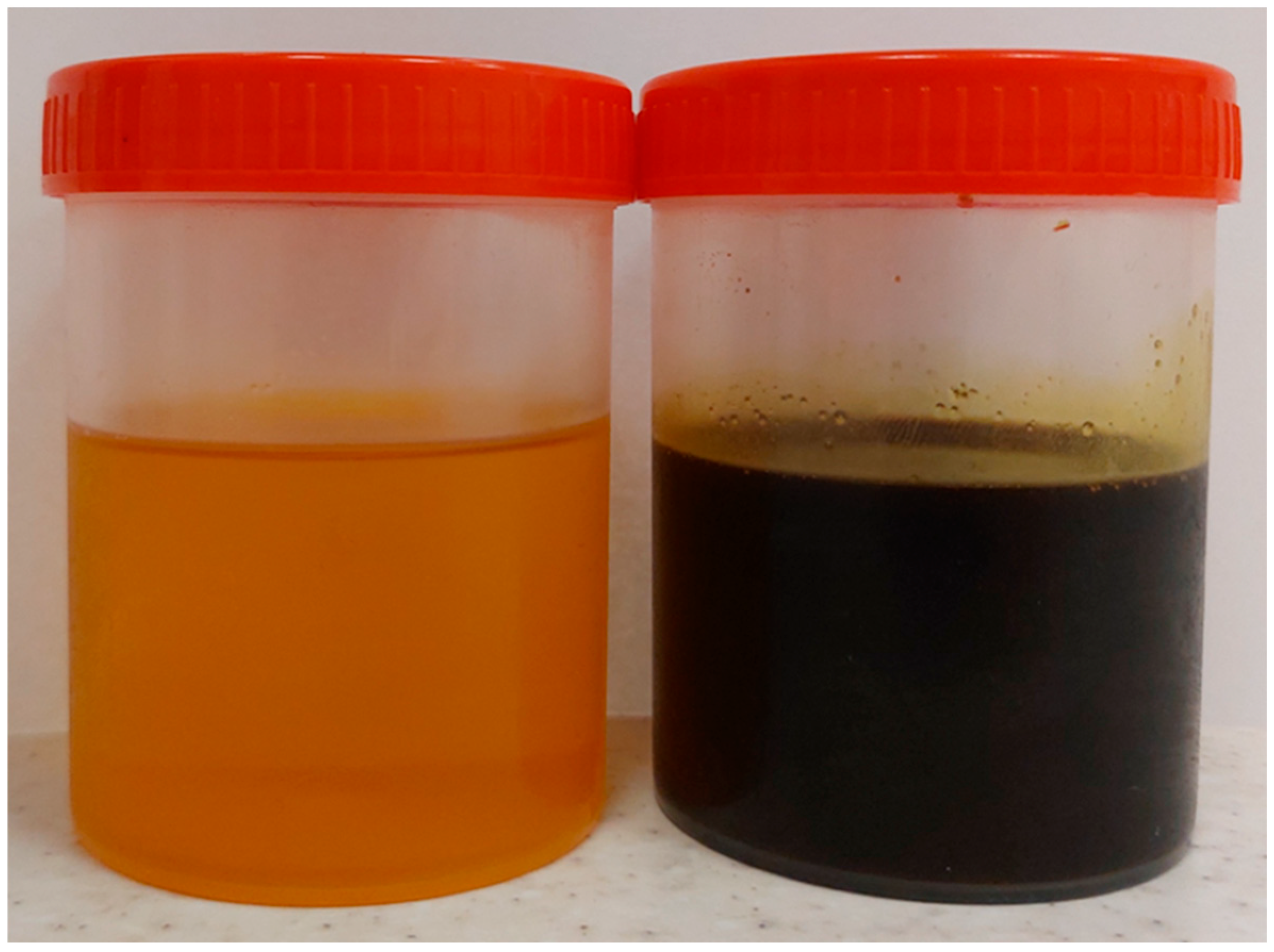
2.1. Organoleptic Characteristics of the Oils Obtained
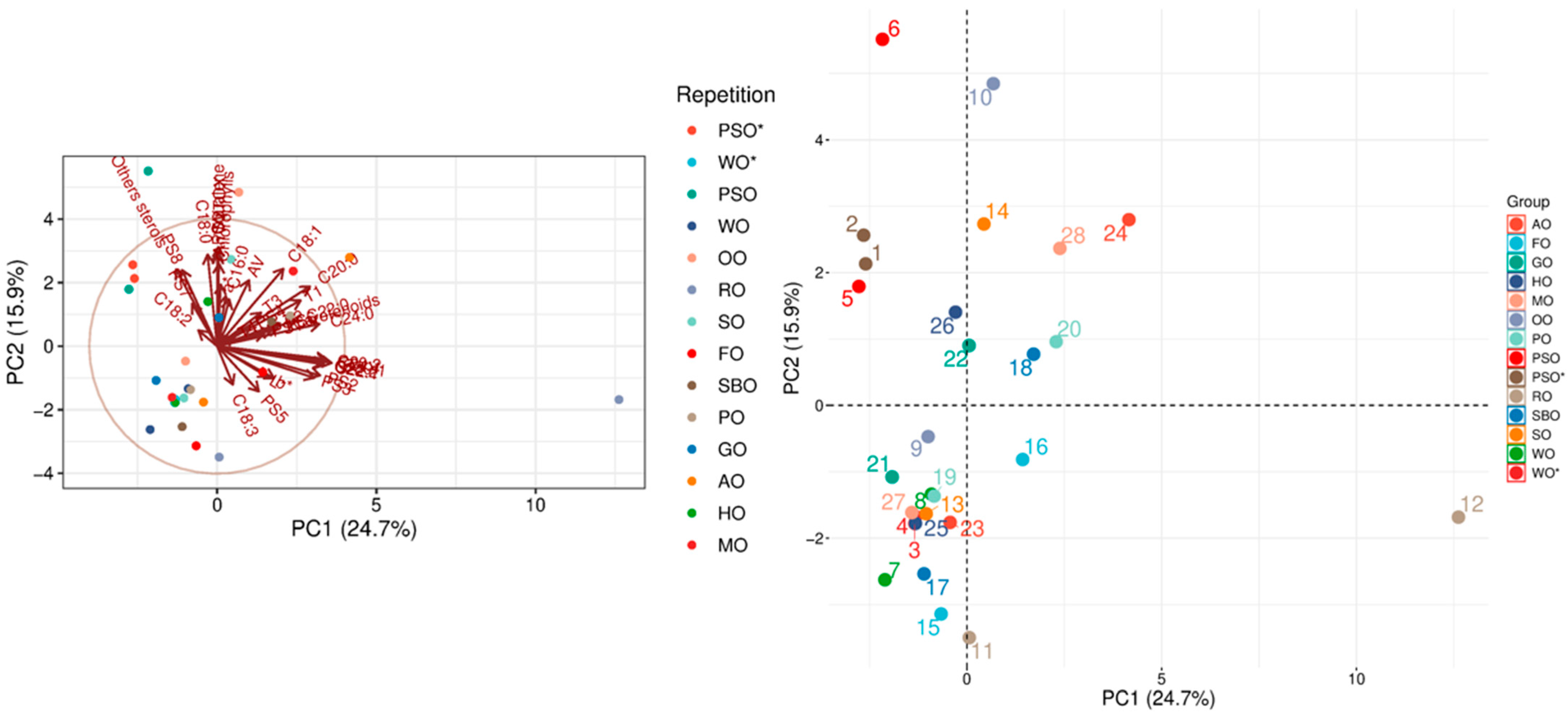
2.2. Discussion of Instrumental Analysis

| AV | POV | AnV | TOTOX | References | |
|---|---|---|---|---|---|
| PSO* | 1.23 ± 0.04 | 5.43 ± 0.37 | 4.89 ± 0.30 | 15.73 ± 0.52 | [-] |
| WO* | 1.19 ± 0.04 | 4.58 ± 0.07 | 2.04 ± 0.17 | 10.17 ± 0.15 | [-] |
| PSO | 0.14–0.29 | 0.98–16.40 | 3.61–4.53 | 5.57–37.33 | [24] |
| WO | 0.05–1.52 | 0.94–4.14 | 0.47–1.09 | 2.35–9.37 | [38,39,40,41] |
| OO | 0.20–4.20 | 5.00–17.40 | 2.60–8.10 | 12.60–42.90 | [42] |
| RO | 0.17–1.37 | 0.45–1.65 | nd–1.96 | 0.90–5.26 | [43,44] |
| SO | 0.63–7.51 | 1.10–18.20 | 1.91–7.53 | 4.11–43.93 | [45,46,47,48] |
| FO | 0.60–0.90 | 0.75–1.28 | 0.45–1.14 | 1.95–3.70 | [49] |
| SBO | 0.05–2.09 | 0.79–1.99 | 1.58–4.68 | 3.16–8.66 | [50,51] |
| PO | 0.42–1.95 | 0.52–3.26 | 0.65–2.02 | 1.69–8.54 | [52,53,54] |
| GO | 0.26–2.20 | 4.88–7.33 | 7.24–8.73 | 17.00–23.39 | [48,55,56] |
| AO | 0.46–1.41 | 1.58–12.90 | 0.75–4.68 | 3.91–30.48 | [57,58] |
| HO | 0.70–1.76 | 1.94–22.40 | 0.11–3.58 | 3.99–48.38 | [59,60,61,62] |
| MO | 0.11–4.01 | 0.49–3.31 | 8.08–9.32 | 9.06–15.94 | [63,64] |
| Chlorophylls | Carotenoids | Σ | References | |
|---|---|---|---|---|
| PSO* | 71.77 ± 8.66 | 25.61 ± 2.74 | 97.38 ± 23.01 | [-] |
| WO* | 7.05 ± 0.10 | 9.69 ± 0.13 | 16.73 ± 1.32 | [-] |
| PSO | 46.00–159.00 | 8.21–27.40 | 54.21–186.40 | [24] |
| WO | 0.13–3.97 | 14.22–15.44 | 14.35–19.41 | [40,66] |
| OO | 0.15–61.96 | 0.53–31.51 | 0.68–93.47 | [6,67] |
| RO | 4.32–44.49 | 52.60–358.70 | 56.92–403.19 | [6,68] |
| SO | nd-0.89 | 0.74–6.83 | 0.74–7.82 | [69,70] |
| FO | 1.14–130.50 | 2.75–76.90 | 3.89–207.40 | [6,71] |
| SBO | 0.13–158.76 | 12.31–122.53 | 12.44–281.39 | [72] |
| PO | nd-4.36 | 30.00–988.00 | 30.00–992.36 | [73,74,75] |
| GO | 1.00–9.11 | 2.60–598.50 | 3.60–607.11 | [76] |
| AO | nd-0.72 | 0.18–1.80 | 0.18–2.52 | [6,57,58] |
| HO | 56.30–84.00 | 23.40–53.00 | 79.70–137.00 | [59,77] |
| MO | nd-4.90 | nd-307.50 | nd-312.40 | [6,78,79] |
| PSO* | WO* | PSO | WO | OO | RO | SO | FO | SBO | PO | GO | AO | HO | MO | |
|---|---|---|---|---|---|---|---|---|---|---|---|---|---|---|
| C16:0 | 11.68 ± 0.04 | 6.63 ± 0.00 | 13.2–16.4 | 6.0–8.0 | 7.5–20.0 | 1.5–6.0 | 7.9–12.0 | 4.0–11.3 | 8.0–13.5 | 39.3–47.5 | 5.5–11.0 | 5.0–14.0 | 6.2–6.6 | 8.6–16.5 |
| C18:0 | 5.90 ± 0.11 | 1.38 ± 0.01 | 11.2–15.8 | 1.0–3.0 | 0.5–5.0 | 0.5–3.1 | 4.5–6.7 | 2.0–8.0 | 2.0–5.4 | 3.5–6.0 | 3.0–6.5 | 1.0–4.5 | 3.1–3.6 | nd-3.3 |
| C18:1 | 31.30 ± 0.11 | 14.48 ± 0.05 | 28.7–40.7 | 14.0–23.0 | 55.0–83.0 | 8.0–60.0 | 34.4–45.5 | 9.8–36.0 | 17.0–30.0 | 36.0–44.0 | 12.0–28.0 | 35.0–80.0 | 11.3–12.4 | 20.0–42.2 |
| C18:2 | 50.49 ± 0.04 | 61.25 ± 0.03 | 26.7–29.0 | 54.0–65.0 | 3.5–21.0 | 11.0–23.0 | 36.9–47.9 | 8.3–30.0 | 48.0–59.0 | 9.0–12.0 | 58.0–78.0 | 4.0–43.0 | 54.0–55.0 | 34.0–65.6 |
| C18:3 | 0.21 ± 0.00 | 12.25 ± 0.02 | 0.6–1.9 | 9.0–15.4 | 0.0–1.0 | 5.0–13.0 | 0.2–1.0 | 43.8–70.0 | 4.5–11.0 | nd-0.5 | nd-1.0 | nd-0.5 | 20.1–21.6 | nd-2.0 |
| C20:0 | 0.42 ± 0.00 | nd | 1.1–1.9 | nd-0.3 | 0.0–0.6 | nd-3.0 | 0.3–0.7 | nd-1.0 | 0.1–0.6 | nd-1.0 | nd-1.0 | 0.7–2.0 | 0.3–1.3 | 0.3–1.0 |
| C20:1 | nd | nd | nd | nd-0.3 | 0.0–0.4 | 3.0–15.0 | nd-0.3 | nd-1.2 | nd-0.5 | nd-0.4 | nd-0.3 | 0.7–3.2 | 0.4–0.6 | 0.2–0.6 |
| C20:2 | nd | nd | nd | nd | nd | nd-1.0 | nd | nd | nd-0.1 | nd | nd | nd | 0.0–0.1 | nd-0.1 |
| C22:0 | nd | nd | nd | nd-0.2 | 0.0–0.2 | nd-2.0 | nd-1.1 | nd-0.5 | nd-0.7 | nd-0.2 | nd-0.5 | 1.5–4.5 | 0.3–0.6 | nd-0.5 |
| C22:1 | nd | nd | nd | nd | nd | 2.0–60.0 | nd | nd-1.2 | nd-0.3 | nd | nd-0.3 | nd-0.6 | nd | nd-0.3 |
| C22:2 | nd | nd | nd | nd | nd | nd-2.0 | nd | nd | nd | nd | nd | nd | nd | nd |
| C24:0 | nd | nd | nd | nd | 0.0–0.2 | nd-2.0 | nd-0.3 | nd-0.3 | nd-0.5 | nd | nd-0.4 | 0.5–2.5 | nd-0.3 | nd-0.5 |
| C24:1 | nd | nd | nd | nd | nd | nd-3.0 | nd | nd | nd | nd | nd | nd-0.3 | nd | nd |
| References | [-] | [-] | [24] | [65] | [80,81,82] | [65] | [65] | [65] | [65] | [65] | [65] | [65] | [35] | [65] |
| [%] | PSO* | WO* | PSO | WO | OO | RO | SO | FO | SBO | PO | GO | AO | HO | MO |
|---|---|---|---|---|---|---|---|---|---|---|---|---|---|---|
| Cholesterol | nd | 1.5 ± 0.0 | nd | nd | nd | nd-1.3 | 0.1–0.5 | nd | 0.2–1.4 | 2.6–7.0 | nd-0.5 | nd-3.8 | nd | 0.2–0.6 |
| Brassicasterol | nd | nd | nd | nd | nd | 5.0–13.0 | 0.1–0.2 | nd-1.0 | nd-0.3 | nd | nd-0.2 | nd-0.2 | nd | nd-0.2 |
| Campesterol | nd | 8.1 ± 0.2 | 0.8–2.0 | 4.0–6.5 | 1.2–9.0 | 24.7–38.6 | 10.1–20.0 | 25.0–31.0 | 15.8–24.2 | 18.7–27.5 | 7.5–14.0 | 12.0–19.8 | 15.0–15.8 | 16.0–24.1 |
| Stigmasterol | nd | nd | nd | nd | 0.9–7.3 | 0.2–1.0 | 3.4–12.0 | 7.0–9.0 | 14.9–19.1 | 8.5–13.9 | 7.5–12.0 | 5.4–13.2 | 1.6–2.3 | 4.3–8.0 |
| β-sitosterol | 5.8 ± 0.3 | 63.0 ± 1.1 | 7.1–7.6 | 70.0–92.0 | 36.4–52.8 | 45.1–57.9 | 57.7–61.9 | 45.0–53.0 | 47.0–60.0 | 50.2–62.1 | 64.0–70.0 | 47.4–69.0 | 61.4–66.8 | 54.8–66.6 |
| Δ-5-avenasterol | nd | 5.2 ± 0.2 | nd | 0.5–6.0 | nd-10.3 | 2.5–6.6 | 6.2–7.8 | 8.0–12.0 | 1.5–3.7 | nd-2.8 | 1.0–3.5 | 5.0–18.8 | 7.3–7.6 | 1.5–8.2 |
| Δ-7-stigmasterol | 50.4 ± 2.5 | nd | nd | nd-3.0 | nd | nd-1.3 | 0.5–7.6 | nd | 1.4–5.2 | 0.2–2.4 | 0.5–3.5 | nd-5.1 | nd | 0.2–4.2 |
| Δ-7-avenasterol | 18.2 ± 1.1 | nd | 40.7–43.9 | nd-2.0 | nd | nd-0.8 | 1.2–5.6 | nd | 1.0–4.6 | nd-5.1 | 0.5–1.5 | nd-5.5 | 2.7–4.5 | 0.3–2.7 |
| Others | 25.6 ± 2.0 | 22.2 ± 1.6 | 46.5–51.5 | nd | 20.6–26.1 | nd-4.2 | 0.7–9.2 | nd | nd-1.8 | nd | nd-5.1 | nd-1.4 | 5.4–9.5 | nd-2.4 |
| Σ PS [mg/100 g] | 450.0 ± 15.6 | 135.0 ± 4.7 | 54.5–62.7 | 50–176 | 211.7–288.0 | 450–1130 | 450–1900 | 230–690 | 180–450 | 30–70 | 200–700 | 90–290 | 195–213 | 700–2210 |
| Squalene [mg/g] | 2.10 ± 0.10 | nd | 0.59–3.35 | 0.09–0.12 | 1.5–7.5 | 0.02–0.13 | 0.09–0.61 | 0.02–0.83 | 0.02–0.92 | 0.07–0.48 | 0.12–0.13 | 0.05–1.33 | nd | 0.01–2.57 |
| References | [-] | [-] | [6,7] | [6,65] | [6,80,83] | [6,65] | [6,65] | [6,65] | [6,65] | [6,65] | [6,65] | [6,65] | [35] | [6,65] |
| α-T | β-T | γ-T | δ-T | References | |
|---|---|---|---|---|---|
| PSO* | 103.2 ± 0.8 | 1.2 ± 0.0 | 452.9 ± 3.0 | 6.3 ± 0.1 | [-] |
| WO* | 12.5 ± 0.2 | 1.1 ± 0.1 | 283.9 ± 1.1 | 28.9 ± 0.3 | [-] |
| PSO | 7.4–88.5 | nd | 54.1–397.3 | 10.4–45.0 | [7,24] |
| WO | nd-170.0 | nd-110.0 | 120.0–400.0 | nd-60.0 | [65] |
| OO | 264.3–290.0 | 2.55–10.0 | 10.0–15.90 | 1.0–4.46 | [6,83] |
| RO | 100.0–386.0 | nd-140.0 | 189.0–753.0 | nd-22.0 | [65] |
| SO | nd-3.3 | nd | 521.0–983.0 | 4.0–21.0 | [65] |
| FO | 2.0–265.0 | nd | 100.0–712.0 | nd-14.0 | [65] |
| SBO | 9.0–352.0 | nd-36.0 | 89.0–2307.0 | 154.0–932.0 | [65] |
| PO | 4.0–193.0 | nd-234.0 | nd-526.0 | nd-123.0 | [65] |
| GO | 16.0–38.0 | nd-89.0 | nd-73.0 | nd-4.0 | [65] |
| AO | 49.0–373.0 | nd-41.0 | 88.0–389.0 | nd-22.0 | [65] |
| HO | 2.7–53.0 | nd-5.8 | 594.0–967.0 | 3.2–50.3 | [84,85] |
| MO | 23.0–573.0 | nd-356.0 | 268.0–2468.0 | 23.0–75.0 | [65] |
2.3. Additional Parameters Analyzed
3. Materials and Methods
3.1. Oil Pressing
3.1.1. Pumpkin Seed Oil
3.1.2. Walnut Oil
3.2. Color Using the CIE Lab Method
3.3. Acid Value (AV)
- CKOH—concentration of KOH solution [mol·dm−3],
- V—volume of standard KOH solution used to titrate the analyzed oil sample [cm3],
- V0—volume of standard KOH solution consumed to titrate the blank sample [cm3],
- MKOH—molar mass of KOH [g·mol−1],
- m—mass of analyzed sample [g].
3.4. Peroxide Value (POV)
- C—concentration of Na2S2O3 solution 0.01 mol·dm−3,
- V—volume of standard Na2S2O3 solution used to titrate the analyzed oil sample [cm3],
- V0—volume of standard Na2S2O3 solution consumed to titrate the blank sample [cm3],
- m—mass of analyzed sample [g].
3.5. Anisidine Value (AnV)
- Q—content of the sample in the measured solution, based on which the anisidine value is expressed [g∙cm−3], Q = 0.01 g∙cm−3,
- V—volume in which the test sample was dissolved [cm3], V = 25 cm3,
- m—mass of analyzed sample [g],
- 1.2—correction factor resulting from the dilution of the test solution with 1 cm3 of the anisidine reagent or glacial acetic acid,
- A0—absorbance of the unreacted test solution (oil and glacial acetic acid),
- A1—absorbance of the reacted test solution (oil and anisidine reagent),
- A2—absorbance of the blank sample (iso-octane and anisidine reagent).
3.6. TOTOX
3.7. Natural Dyes
- D—amount of solvent added [cm3],
- m—weight of oil collected [g].
3.8. Fatty Acid Profile (FAP)
3.9. Phytosterol Profile (PSP)
3.10. Tocopherol Content (TC)
3.11. Phosphorus Content
3.12. Water Content
3.13. Oxidative Stability
3.14. Statistical Analysis
4. Conclusions
Author Contributions
Funding
Institutional Review Board Statement
Informed Consent Statement
Data Availability Statement
Conflicts of Interest
Abbreviations
| UFA | unsaturated fatty acid |
| PUFA | polyunsaturated fatty acids |
| GC-FID | gas chromatography—flame ionization detector |
| HPLC | high-performance liquid chromatography |
| NIR | near-infrared spectroscopy |
| FTIR | Fourier transform infrared spectroscopy |
| PSO* | obtained pumpkin seed oil |
| WO* | obtained walnut oil |
| PSO | pumpkin seed oil reported in the literature |
| WO | walnut oil reported in the literature |
| OO | olive oil reported in the literature |
| RO | rapeseed oil reported in the literature |
| SO | sesame oil reported in the literature |
| FO | flaxseed oil reported in the literature |
| PO | palm oil reported in the literature |
| GO | grape seed oil reported in the literature |
| AO | peanut oil reported in the literature |
| HO | hemp oil reported in the literature |
| CO | corn oil reported in the literature |
| AV | acid value |
| POV | peroxide value |
| AnV | anisidine value |
| TOTOX | Total Oxidation Value |
| α-T | α-tocopherol |
| β-T | β-tocopherol |
| γ-T | γ-tocopherol |
| δ-T | δ-tocopherol |
| PCA | principal component analysis |
| WC | water content |
| P | phosphorus content |
| OS | oxidative stability |
| TTRAN | total transmission mode |
| PTFE | poli(tetrafluoroetylen) |
| BSTFA | N,O-Bis(trimethylsilyl)trifluoroacetamide |
| TMCS | trimetylochlorosilan |
References
- Czwartkowski, K.; Wierzbic, A.; Golimowski, W. Quality, Key Production Factors, and Consumption Volume of Niche Edible Oils Marketed in the European Union. Sustainability 2022, 14, 1846. [Google Scholar] [CrossRef]
- Sumara, A.; Stachniuk, A.; Montowska, M.; Kotecka-Majchrzak, K.; Grywalska, E.; Mitura, P.; Saftić Martinović, L.; Kraljević Pavelić, S.; Fornal, E. Comprehensive Review of Seven Plant Seed Oils: Chemical Composition, Nutritional Properties, and Biomedical Functions. Food Rev. Int. 2023, 39, 5402–5422. [Google Scholar] [CrossRef]
- Alsalamah, S.A.; Alghonaim, M.I.; Mohammad, A.M.; Khalel, A.F.; Alqahtani, F.S.; Abdelghany, T.M. Ozone-Modified Properties of Pumpkin Seed Oil as Anti-H. Pylori, Anticancer, Anti-Diabetic and Anti-Obesity Agent. Sci. Rep. 2025, 15, 25959. [Google Scholar] [CrossRef] [PubMed]
- Boujemaa, I.; El Bernoussi, S.; Harhar, H.; Tabyaoui, M. The Influence of the Species on the Quality, Chemical Composition and Antioxidant Activity of Pumpkin Seed Oil. OCL—Oilseeds Fats Crops Lipids 2020, 27, 40. [Google Scholar] [CrossRef]
- Mazzocchi, A.; De Cosmi, V.; Risé, P.; Milani, G.P.; Turolo, S.; Syrén, M.L.; Sala, A.; Agostoni, C. Bioactive Compounds in Edible Oils and Their Role in Oxidative Stress and Inflammation. Front. Physiol. 2021, 12, 659551. [Google Scholar] [CrossRef] [PubMed]
- Tian, M.; Bai, Y.; Tian, H.; Zhao, X. The Chemical Composition and Health-Promoting Benefits of Vegetable Oils—A Review. Molecules 2023, 28, 6393. [Google Scholar] [CrossRef]
- Grajzer, M.; Kozłowska, W.; Zalewski, I.; Matkowski, A.; Wiland-Szymańska, J.; Rękoś, M.; Prescha, A. Nutraceutical Prospects of Pumpkin Seeds: A Study on the Lipid Fraction Composition and Oxidative Stability Across Eleven Varieties. Foods 2025, 14, 354. [Google Scholar] [CrossRef]
- Kalinowska, M.; Płońska, A.; Trusiak, M.; Gołębiewska, E.; Gorlewska-Pietluszenko, A. Comparing the Extraction Methods, Chemical Composition, Phenolic Contents and Antioxidant Activity of Edible Oils from Cannabis Sativa and Silybum Marianu Seeds. Sci. Rep. 2022, 12, 20609. [Google Scholar] [CrossRef]
- Choudhury, N.D.; Saha, N.; Bhaumik, S.; Kataki, R. Production and Evaluation of Physicochemical, Rheological, and Tribological Properties of Cucurbita pepo L. Seed Oil. Biomass Convers. Biorefin. 2023, 13, 1101–1114. [Google Scholar] [CrossRef]
- Dülger, G.Ç.; Geçgel, Ü. Investigation of Chemical Properties and Bioactive Compounds of Oils from Different Pumpkin Seeds (Cucurbita pepo L.) during Maturation. JAOCS J. Am. Oil Chem. Soc. 2024, 101, 551–562. [Google Scholar] [CrossRef]
- Zhang, G.; Li, Z.; Fu, M. Comparison of Quality and Oxidative Stability of Pumpkin Seed (Cucurbita maxima) Oil between Conventional and Enzymatic Extraction Methods. Sustain. Food Technol. 2024, 2, 1033–1040. [Google Scholar] [CrossRef]
- Batool, M.; Ranjha, M.M.A.N.; Roobab, U.; Manzoor, M.F.; Farooq, U.; Nadeem, H.R.; Nadeem, M.; Kanwal, R.; Abdelgawad, H.; Al Jaouni, S.K.; et al. Nutritional Value, Phytochemical Potential, and Therapeutic Benefits of Pumpkin (Cucurbita sp.). Plants 2022, 11, 1394. [Google Scholar] [CrossRef] [PubMed]
- Pandey, V.K.; Singh, K.; Suthar, T.; Srivastava, S.; Rustagi, S.; Ungai, D.; Kovács, B.; Shaikh, A.M. Current Strategies to Modify the Functional Properties of Proteins Extracted from Pumpkin Seeds: A Comprehensive Review. Horticulturae 2024, 10, 1194. [Google Scholar] [CrossRef]
- Gao, P.; Ding, Y.; Chen, Z.; Zhou, Z.; Zhong, W.; Hu, C.; He, D.; Wang, X. Characteristics and Antioxidant Activity of Walnut Oil Using Various Pretreatment and Processing Technologies. Foods 2022, 11, 1698. [Google Scholar] [CrossRef] [PubMed]
- Liu, L.; Cai, H.; Zhang, Y.; Jin, Q.; Wang, X.; Jin, J. Chemical Compositions and Oxidative Stabilities of Cold-Pressed Walnut Oils (Juglans regia L.): Effects of Chemical Refining, Water Degumming, and Molecular Distillation. J. Food Sci. 2024, 89, 7589–7598. [Google Scholar] [CrossRef]
- Pei, X.C.; Yin, F.W.; Zhong, X.; Liu, H.L.; Song, L.; Zhao, G.H.; Wang, Y.F.; Zhou, D.Y. Effects of Different Antioxidants and Their Combinations on the Oxidative Stability of DHA Algae Oil and Walnut Oil. Food Sci. Nutr. 2022, 10, 2804–2812. [Google Scholar] [CrossRef]
- Xi, B.N.; Zhang, J.J.; Li, C.; Xu, X.; Zeng, Q.; Zhang, Y.; Chen, B.; Shen, Y. Effects of Natural and Synthetic Antioxidants Addition on the Characteristic Flavor and Metabolites of Walnut Oil during Oxidation. Food Biosci. 2024, 61, 104788. [Google Scholar] [CrossRef]
- Li, H.; Han, J.; Zhao, Z.; Tian, J.; Fu, X.; Zhao, Y.; Wei, C.; Liu, W. Roasting Treatments Affect Oil Extraction Rate, Fatty Acids, Oxidative Stability, Antioxidant Activity, and Flavor of Walnut Oil. Front. Nutr. 2023, 9, 1077081. [Google Scholar] [CrossRef]
- Sun, L.N.; Wang, G.W.; Qi, Y.L.; Cui, K.B.; Ma, Y.; Yang, Z.Q.; Li, Y.Y. Comprehensive Characterization of Physicochemical Quality and Volatile Organic Compounds of Walnut Oil under Different Treatment Conditions Based on HS-GC-IMS and Chemometrics. Food Chem. Adv. 2025, 9, 101141. [Google Scholar] [CrossRef]
- Ghasemzadeh Rahbardar, M.; Hosseinzadeh, H. Neuroprotective Effects of Walnut (Juglans regia L.) in Nervous System Disorders: A Comprehensive Review. Iran. J. Basic Med. Sci. 2024, 27, 1492–1505. [Google Scholar] [CrossRef]
- Sun, L.; Wang, G.; Xiong, L.; Yang, Z.; Ma, Y.; Qi, Y.; Li, Y. Characterization of Volatile Organic Compounds in Walnut Oil with Various Oxidation Levels Using Olfactory Analysis and HS-SPME-GC/MS. Curr. Res. Food Sci. 2024, 9, 100848. [Google Scholar] [CrossRef] [PubMed]
- Fadda, A.; Sanna, D.; Sakar, E.H.; Gharby, S.; Mulas, M.; Medda, S.; Yesilcubuk, N.S.; Karaca, A.C.; Gozukirmizi, C.K.; Lucarini, M.; et al. Innovative and Sustainable Technologies to Enhance the Oxidative Stability of Vegetable Oils. Sustainability 2022, 14, 849. [Google Scholar] [CrossRef]
- Czwartkowski, K.; Wierzbic, A.; Golimowski, W. Awareness and Expectations of Polish Consumers Regarding Edible Niche Oils as a Food Product. Sustainability 2022, 14, 14239. [Google Scholar] [CrossRef]
- Ordoñez Lozada, M.I.; Rodrigues Maldonade, I.; Bobrowski Rodrigues, D.; Silva Santos, D.; Ortega Sanchez, B.A.; Narcizo de Souza, P.E.; Longo, J.P.; Bernardo Amaro, G.; de Lacerda de Oliveira, L. Physicochemical Characterization and Nano-Emulsification of Three Species of Pumpkin Seed Oils with Focus on Their Physical Stability. Food Chem. 2021, 343, 128512. [Google Scholar] [CrossRef]
- Fediuc, G.; Spinei, M.; Oroian, M. Cold-Pressed Walnut-Oil Adulteration with Edible Oils Detection Using Vis-NIR Spectroscopy. Foods 2025, 14, 3877. [Google Scholar] [CrossRef]
- Gómez-Robledo, L.; Melgosa, M.; Huertas, R.; Roa, R.; Moyano, M.J.; Heredia, F.J. Virgin-Olive-Oil Color in Relation to Sample Thickness and the Measurement Method. JAOCS J. Am. Oil Chem. Soc. 2008, 85, 1063–1071. [Google Scholar] [CrossRef]
- Marudova, M.; Viraneva, A.; Antova, G.; Nikolova, K.; Petkova, Z.; Teneva, O. Physico-Chemical Characterization of Sesame/Rapeseed Oil Mixtures. Appl. Sci. 2025, 15, 704. [Google Scholar] [CrossRef]
- Wu, Y.; Zhou, R.; Wang, Z.; Wang, B.; Yang, Y.; Ju, X.; He, R. The Effect of Refining Process on the Physicochemical Properties and Micronutrients of Rapeseed Oils. PLoS ONE 2019, 14, e0212879. [Google Scholar] [CrossRef]
- Choo, W.S.; Birch, E.J.; Dufour, J.P. Physicochemical and Stability Characteristics of Flaxseed Oils during Pan-Heating. JAOCS J. Am. Oil Chem. Soc. 2007, 84, 735–740. [Google Scholar] [CrossRef]
- Choo, W.S.; Birch, J.; Dufour, J.P. Physicochemical and Quality Characteristics of Cold-Pressed Flaxseed Oils. J. Food Compos. Anal. 2007, 20, 202–211. [Google Scholar] [CrossRef]
- Borges, T.H.; Malheiro, R.; de Souza, A.M.; Casal, S.; Pereira, J.A. Microwave Heating Induces Changes in the Physicochemical Properties of Baru (Dipteryx alata Vog.) and Soybean Crude Oils. Eur. J. Lipid Sci. Technol. 2015, 117, 503–513. [Google Scholar] [CrossRef]
- Bomfim, G.B.R.; dos Santos, W.A.; Sousa, L.S.; Tavares, P.P.L.G.; de Oliveira Mamede, M.E. Physicochemical and Sensory Evaluation of the Quality of Crude Palm Oil (Elaeis guineensis) Produced Artisanally and Industrially in Brazil. Semin. Cienc. Agrar. 2024, 45, 1505–1520. [Google Scholar] [CrossRef]
- Assumpção, C.F.; Nunes, I.L.; Mendonça, T.A.; Bortolin, R.C.; Jablonski, A.; Flôres, S.H.; De Oliveira Rios, A. Bioactive Compounds and Stability of Organic and Conventional Vitis Labrusca Grape Seed Oils. JAOCS J. Am. Oil Chem. Soc. 2016, 93, 115–124. [Google Scholar] [CrossRef]
- Peng, Z.; Zhang, Y.; Xu, C.; Ai, Z.; Zhang, A.; Liu, Y. Effect of Novel Radio Frequency Roasting on Color Appearance, Volatile Compounds, Fatty Acid Composition, and Storage Stability of Peanut Oil. Food Chem. 2025, 485, 144534. [Google Scholar] [CrossRef]
- Golimowski, W.; Teleszko, M.; Marcinkowski, D.; Kmiecik, D.; Grygier, A.; Kwaśnica, A. Quality of Oil Pressed from Hemp Seed Varieties: ‘Ealina 8FC’, ‘Secueni Jubileu’ and ‘Finola’. Molecules 2022, 27, 3171. [Google Scholar] [CrossRef]
- Kiliç, K.; Onal-Ulusoy, B.; Boyaci, I.H. A Novel Method for Color Determination of Edible Oils in L*a*b* Format. Eur. J. Lipid Sci. Technol. 2007, 109, 157–164. [Google Scholar] [CrossRef]
- Aydeniz Güneser, B.; Yilmaz, E.; Ok, S. Cold Pressed versus Refined Winterized Corn Oils: Quality, Composition and Aroma. Grasas Y Aceites 2017, 68, e194. [Google Scholar] [CrossRef]
- Gharibzahedi, S.M.T.; Mousavi, S.M.; Hamedi, M.; Khodaiyan, F. Determination and Characterization of Kernel Biochemical Composition and Functional Compounds of Persian Walnut Oil. J. Food Sci. Technol. 2014, 51, 34–42. [Google Scholar] [CrossRef]
- Ma, X.; Huang, C.; Zheng, C.; Wang, W.; Ying, H.; Liu, C. Effect of Oil Extraction Methods on Walnut Oil Quality Characteristics and the Functional Properties of Walnut Protein Isolate. Food Chem. 2024, 438, 138052. [Google Scholar] [CrossRef]
- Elouafy, Y.; El Yadini, A.; El Moudden, H.; Harhar, H.; Alshahrani, M.M.; Awadh, A.A.A.; Goh, K.W.; Ming, L.C.; Bouyahya, A.; Tabyaoui, M. Influence of the Extraction Method on the Quality and Chemical Composition of Walnut (Juglans regia L.) Oil. Molecules 2022, 27, 7681. [Google Scholar] [CrossRef]
- Zhou, Y.; Fan, W.; Chu, F.; Wang, C.; Pei, D. Identification of Volatile Oxidation Compounds as Potential Markers of Walnut Oil Quality. J. Food Sci. 2018, 83, 2745–2752. [Google Scholar] [CrossRef] [PubMed]
- Willenberg, I.; Matthäus, B.; Gertz, C. A New Statistical Approach to Describe the Quality of Extra Virgin Olive Oils Using Near Infrared Spectroscopy (NIR) and Traditional Analytical Parameters. Eur. J. Lipid Sci. Technol. 2019, 121, 1800361. [Google Scholar] [CrossRef]
- Tynek, M.; Pawłowicz, R.; Gromadzka, J.; Tylingo, R.; Wardencki, W.; Karlovits, G. Virgin Rapeseed Oils Obtained from Different Rape Varieties by Cold Pressed Method—Their Characteristics, Properties, and Differences. Eur. J. Lipid Sci. Technol. 2012, 114, 357–366. [Google Scholar] [CrossRef]
- Dąbrowski, G.; Skrajda, M.; Tańska, M.; Roszkowska, B. Influence of Different Storage Conditions on Rapeseed Oils Quality. Am. J. Exp. Agric. 2016, 10, 1–12. [Google Scholar] [CrossRef]
- Zanjani, N.D.; Afshar, P.G.; Milani, M.A. Evaluation of the Composition and Oxidative Stability of Cold-Pressed Sesame Oils in the Market of Zanjan Province. J. Hum. Environ. Health Promot. 2019, 6, 159–166. [Google Scholar]
- Martínez, M.L.; Bordón, M.G.; Lallana, R.L.; Ribotta, P.D.; Maestri, D.M. Optimization of Sesame Oil Extraction by Screw-Pressing at Low Temperature. Food Bioproc. Technol. 2017, 10, 1113–1121. [Google Scholar] [CrossRef]
- Chau, C.F.; Ciou, J.Y.; Wu, C.L. Commercialized Sesame Oil Analysis: Quality Characterization and Oxidative Stability of Blended Sesame Oil. ACS Food Sci. Technol. 2021, 1, 1222–1227. [Google Scholar] [CrossRef]
- Khakbaz Heshmati, M.; Jafarzadeh-Moghaddam, M.; Pezeshki, A.; Shaddel, R. The Oxidative and Thermal Stability of Optimal Synergistic Mixture of Sesame and Grapeseed Oils as Affected by Frying Process. Food Sci. Nutr. 2022, 10, 1103–1112. [Google Scholar] [CrossRef]
- Shadyro, O.I.; Sosnovskaya, A.A.; Edimecheva, I.P. Flaxseed Oil Stabilization Using Natural and Synthetic Antioxidants. Eur. J. Lipid Sci. Technol. 2017, 119, 1700079. [Google Scholar] [CrossRef]
- Fan, K.; Chen, L.; Wei, X.; He, J.; Yan, Z.; Yan, F. Antioxidative Properties of Rapeseed Meal Extract on Soybean Oil During Accelerated Storage. J. Food Process. Preserv. 2015, 39, 2455–2465. [Google Scholar] [CrossRef]
- Zamindar, N.; Bashash, M.; Khorshidi, F.; Serjouie, A.; Shirvani, M.A.; Abbasi, H.; Sedaghatdoost, A. Antioxidant Efficacy of Soybean Cake Extracts in Soy Oil Protection. J. Food Sci. Technol. 2017, 54, 2077–2084. [Google Scholar] [CrossRef]
- Nid Ahmed, M.; Asbbane, A.; Chouacha, W.; Guenaze, B.; Majourhat, K.; Asdadi, A.; Al Abdulmonem, W.; Bouyahya, A.; Sakar, E.H.; Gharby, S. Prediction Refined Vegetable Oils Oxidative Stability Using the Accelerated Thermal Test: Evidence from Soybean, Sunflower, Palm and Palm Olein Oils. Food Chem. X 2026, 33, 103466. [Google Scholar] [CrossRef]
- Siddiq, M.; Shah, H.U. Effect of Stress Conditions on the Quality and Stability of Olive and Palm Oil Blends. Sarhad J. Agric. 2016, 32, 134–141. [Google Scholar] [CrossRef]
- Halim, Y.; Halim, J.M.; Soedirga, L.C.; Yakhin, L.A. Physical and Chemical Characteristics of Frying Oil in Indonesia in a Repeated Frying Model. J. Chem. Pharm. Res. 2016, 8, 583–589. [Google Scholar]
- Ravagli, C.; Pasini, F.; Marzocchi, S.; Caboni, M.F. Oxidation of Fatty Acids in Oils Subjected to Mild Temperature Stress: The Case of Grapeseed Oil. J. Food Compos. Anal. 2025, 148, 108208. [Google Scholar] [CrossRef]
- de Menezes, M.L.; Johann, G.; Diório, A.; Schuelter Boeing, J.; Visentainer, J.V.; Raimundini Aranha, A.C.; Curvelo Pereira, N. Comparison of the Chemical Composition of Grape Seed Oil Extracted by Different Methods and Conditions. J. Chem. Technol. Biotechnol. 2023, 98, 1103–1113. [Google Scholar] [CrossRef]
- Suri, K.; Singh, B.; Kaur, A.; Yadav, M.P. Physicochemical Characteristics, Oxidative Stability, Pigments, Fatty Acid Profile and Antioxidant Properties of Co-Pressed Oil from Blends of Peanuts, Flaxseed and Black Cumin Seeds. Food Chem. Adv. 2023, 2, 100231. [Google Scholar] [CrossRef]
- Idrissi, Z.L.E.; El Moudden, H.; Mghazli, N.; Bouyahya, A.; Guezzane, C.E.; Alshahrani, M.M.; Al Awadh, A.A.; Goh, K.W.; Ming, L.C.; Harhar, H.; et al. Effects of Extraction Methods on the Bioactivities and Nutritional Value of Virginia and Valencia-Type Peanut Oil. Molecules 2022, 27, 7709. [Google Scholar] [CrossRef]
- Liang, J.; Aachary, A.A.; Hydamaka, A.; Eskin, N.A.M.; Eck, P.; Thiyam-Holländer, U. Reduction of Chlorophyll in Cold-Pressed Hemp (Cannabis sativa) Seed Oil by Ultrasonic Bleaching and Enhancement of Oxidative Stability. Eur. J. Lipid Sci. Technol. 2018, 120, 1700349. [Google Scholar] [CrossRef]
- Spano, M.; Di Matteo, G.; Rapa, M.; Ciano, S.; Ingallina, C.; Cesa, S.; Menghini, L.; Carradori, S.; Giusti, A.M.; Di Sotto, A.; et al. Commercial Hemp Seed Oils: A Multimethodological Characterization. Appl. Sci. 2020, 10, 6933. [Google Scholar] [CrossRef]
- Leonard, W.; Zhang, P.; Ying, D.; Fang, Z. Hempseed in Food Industry: Nutritional Value, Health Benefits, and Industrial Applications. Compr. Rev. Food Sci. Food Saf. 2020, 19, 282–308. [Google Scholar] [CrossRef]
- Mikulcová, V.; Kašpárková, V.; Humpolíček, P.; Buňková, L. Formulation, Characterization and Properties of Hemp Seed Oil and Its Emulsions. Molecules 2017, 22, 700. [Google Scholar] [CrossRef] [PubMed]
- Cho, S.; Kim, J.; Han, D.; Lim, H.-J.; Yoon, M.; Park, J.; Yang, H.; Lee, S.-H.; Noh, B.Y.; Park, E.-j.; et al. Thermal Oxidative Stability of Corn Oil in Ultra-High Temperature Short-Time Processed Seasoned Laver. Food Sci. Biotechnol. 2015, 24, 947–953. [Google Scholar] [CrossRef]
- Zheng, L.; Ji, C.; Jin, J.; Xie, D.; Liu, R.; Wang, X.; Jin, Q.; Huang, J. Effect of Moisture and Heat Treatment of Corn Germ on Oil Quality. JAOCS J. Am. Oil Chem. Soc. 2018, 95, 383–390. [Google Scholar] [CrossRef]
- Codex Alimentarius. Standard for Named Vegetable Oils CXS 210-1999; Food and Agriculture Organization of the United Nations/World Health Organization: Rome, Italy, 1999.
- Górnaś, P.; Siger, A.; Juhņeviča, K.; Lacis, G.; Šne, E.; Segliņa, D. Cold-Pressed Japanese Quince (Chaenomeles japonica (Thunb.) Lindl. Ex Spach) Seed Oil as a Rich Source of α-Tocopherol, Carotenoids and Phenolics: A Comparison of the Composition and Antioxidant Activity with Nine Other Plant Oils. Eur. J. Lipid Sci. Technol. 2014, 116, 563–570. [Google Scholar] [CrossRef]
- Jimenez-Lopez, C.; Carpena, M.; Lourenço-Lopes, C.; Gallardo-Gomez, M.; Lorenzo, J.M.; Barba, F.J.; Prieto, M.A.; Simal-Gandara, J. Bioactive Compounds and Quality of Extra Virgin Olive Oil. Foods 2020, 9, 1014. [Google Scholar] [CrossRef]
- Franke, S.; Fröhlich, K.; Werner, S.; Böhm, V.; Schöne, F. Analysis of Carotenoids and Vitamin E in Selected Oilseeds, Press Cakes and Oils. Eur. J. Lipid Sci. Technol. 2010, 112, 1122–1129. [Google Scholar] [CrossRef]
- Sundar, S.; Singh, B.; Kaur, A.; Yadav, M.P. Impact of Infrared and Dry-Air Roasting on Antioxidant Potential, Oxidative Stability, Chemical Characteristics, and Fatty Acid Profile of Black and White Sesame (Sesamum indicum L.) Oil. J. Food Process. Preserv. 2022, 46, e17252. [Google Scholar] [CrossRef]
- Amini, M.; Golmakani, M.T.; Abbasi, A.; Nader, M. Effects of Sesame Dehulling on Physicochemical and Sensorial Properties of Its Oil. Food Sci. Nutr. 2023, 11, 6596–6603. [Google Scholar] [CrossRef]
- Herchi, W.; Sakouhi, F.; Boukhchina, S.; Kallel, H.; Pepe, C. Changes in Fatty Acids, Tocochromanols, Carotenoids and Chlorophylls Content during Flaxseed Development. JAOCS J. Am. Oil Chem. Soc. 2011, 88, 1011–1017. [Google Scholar] [CrossRef]
- Shih, Y.S.; Ho, Y.C.; Wang, S.C.; Lee, W.J. Optimization Strategies for Black Soybean Oil Development: Investigating the Effects of Different Processing and Storage Methods on Nutritional Value and Oxidative Stability. LWT 2025, 224, 117846. [Google Scholar] [CrossRef]
- Ayu, D.F.; Diharmi, A.; Herawati, N.; Juarsa, R.P. Effect of Light Intensity on the Photo-Oxidation Stability of Red and Yellow Palm Olein Mixture. Potravin. Slovak J. Food Sci. 2024, 18, 512–522. [Google Scholar] [CrossRef]
- Madoromae, H.; Lertcanawanichakul, M. Red Palm Oil: Nutritional Composition, Bioactive Properties, and Potential Applications in Health and Cosmetics: A Narrative Review. Molecules 2025, 30, 4402. [Google Scholar] [CrossRef] [PubMed]
- Ribeiro, J.A.A.; Almeida, E.S.; Neto, B.A.D.; Abdelnur, P.V.; Monteiro, S. Identification of Carotenoid Isomers in Crude and Bleached Palm Oils by Mass Spectrometry. LWT 2018, 89, 631–637. [Google Scholar] [CrossRef]
- Laqui-Estaña, J.; Obreque-Slier, E.; García-Nauto, N.; Saldaña, E. Advances in Grape Seed Oil Extraction Techniques and Their Applications in Food Products: A Comprehensive Review and Bibliometric Analysis. Foods 2024, 13, 3561. [Google Scholar] [CrossRef]
- Allay, A.; Moumen, A.B.; Rbah, Y.; Fauconnier, M.L.; Nkengurutse, J.; Caid, H.S.; Elamrani, A.; Mansouri, F. Effect of Screw Pressing Temperature on Yield, Bioactive Compounds, and Quality of Hemp (Cannabis sativa L.) Seed Oil. J. Cannabis Res. 2025, 7, 37. [Google Scholar] [CrossRef]
- Zio, S.; Tarnagda, B.; Sankara, S.; Tapsoba, F.; Zongo, C.; Savadogo, A. Nutritional and Therapeutic Interest of Most Widely Produced and Consumed Plant Oils by Human: A Review. Appl. Food Res. 2025, 5, 101093. [Google Scholar] [CrossRef]
- Moreau, R.A.; Johnston, D.B.; Hicks, K.B. A Comparison of the Levels of Lutein and Zeaxanthin in Corn Germ Oil, Corn Fiber Oil and Corn Kernel Oil. JAOCS J. Am. Oil Chem. Soc. 2007, 84, 1039–1044. [Google Scholar] [CrossRef]
- Codex Alimentarius. Standard for Olive Oils and Olive Pomace Oils CXS 33-1981; Food and Agriculture Organization of the United Nations/World Health Organization: Rome, Italy, 1981.
- Kosma, I.; Badeka, A.; Vatavali, K.; Kontakos, S.; Kontominas, M. Differentiation of Greek Extra Virgin Olive Oils According to Cultivar Based on Volatile Compound Analysis and Fatty Acid Composition. Eur. J. Lipid Sci. Technol. 2016, 118, 849–861. [Google Scholar] [CrossRef]
- Harwood, J.L.; Yaqoob, P. Nutritional and Health Aspects of Olive Oil. Eur. J. Lipid Sci. Technol. 2002, 104, 685–697. [Google Scholar] [CrossRef]
- Wu, L.; Zhao, J.; Wu, L.; Zhang, Y.; Li, J. Simultaneous Determination of Squalene, Tocopherols and Phytosterols in Edible Vegetable Oil by SPE Combined with Saponification and GC-MS. LWT 2022, 169, 114026. [Google Scholar] [CrossRef]
- Tura, M.; Mandrioli, M.; Valli, E.; Rubino, R.C.; Parentela, D.; Gallina Toschi, T. Changes in the Composition of a Cold-Pressed Hemp Seed Oil during Three Months of Storage. J. Food Compos. Anal. 2022, 106, 104270. [Google Scholar] [CrossRef]
- Mandrioli, M.; Tura, M.; Valli, E.; Toschi, T.G. Composition of cold-pressed hemp seed oils: Key elements of quality and authencity. La Riv. Ital. Delle Sostanze Grasse 2023, 100, 5–17. [Google Scholar]
- Liu, K.T.; Gao, S.; Chung, T.W.; Huang, C.M.; Lin, Y. Sen Effect of Process Conditions on the Removal of Phospholipids from Jatropha Curcas Oil during the Degumming Process. Chem. Eng. Res. Des. 2012, 90, 1381–1386. [Google Scholar] [CrossRef]
- Łaska-Zieja, B.; Golimowski, W.; Marcinkowski, D.; Niedbała, G.; Wojciechowska, E. Low-Cost Investment with High Quality Performance. Bleaching Earths for Phosphorus Reduction in the Low-Temperature Bleaching Process of Rapeseed Oil. Foods 2020, 9, 603. [Google Scholar] [CrossRef]
- PN-EN ISO 660; Animal and Vegetable Fats and Oils—Determination of Acid Value and Acidity. Polish Committee for Standardization: Warszawa, Poland, 2021.
- PN-EN ISO 3960:2017; Animal and Vegetable Fats and Oils—Determination of Peroxide Value—Iodometric (Visual) Endpoint Determination. Polish Committee for Standardization: Warszawa, Poland, 2017.
- PN-EN ISO 6885:2016; Animal and Vegetable Fats and Oils—Determination of Anisidine Value. Polish Committee for Standardization: Warszawa, Poland, 2016.
- Xu, T.; Li, J.; Fan, Y.-W.; Zheng, T.; Deng, Z.-Y. Comparison of Oxidative Stability among Edible Oils under Continuous Frying Conditions. Int. J. Food Prop. 2015, 18, 1478–1490. [Google Scholar] [CrossRef]
- Wellburn, A.R. The Spectral Determination of Chlorophylls a and b, as Well as Total Carotenoids, Using Various Solvents with Spectrophotometers of Different Resolution. J. Plant Physiol. 1994, 144, 307–313. [Google Scholar] [CrossRef]
- Firestone, D. (Ed.) Official Methods and Recommended Practices, 5th ed.; American Oil Chemists’ Society: Champaign, IL, USA, 1998. [Google Scholar]
- Tang, D.; Chen, M.; Huang, X.; Zhang, G.; Zeng, L.; Zhang, G.; Wu, S.; Wang, Y. SRplot: A Free Online Platform for Data Visualization and Graphing. PLoS ONE 2023, 18, e0294236. [Google Scholar] [CrossRef] [PubMed]


| L* | a* | b* | References | |
|---|---|---|---|---|
| PSO* | 1.75 ± 0.01 | 12.59 ± 0.01 | 2.99 ± 0.02 | [-] |
| WO* | 92.44 ± 0.00 | −1.75 ± 0.01 | 52.20 ± 0.00 | [-] |
| PSO | 5.12–11.65 | 1.93–5.07 | −1.08–0.77 | [24] |
| WO | 20.55–21.13 | −1.28–(−0.70) | 4.70–5.74 | [25] |
| OO | 90.31–95.80 | 25.49–42.23 | 94.39–95.78 | [26] |
| RO | 90.35–95.50 | 2.77–5.48 | 87.00–88.60 | [27,28] |
| SO | 96.60–98.00 | 0.70–1.50 | 13.40–16.00 | [27] |
| FO | 60.05–63.71 | 3.28–6.10 | 91.08–99.80 | [29,30] |
| SBO | 69.35–78.05 | −12.43–(−10.07) | 82.79–84.71 | [31] |
| PO | 54.07–80.37 | 21.73–33.49 | 37.58–82.45 | [32] |
| GO | 30.52–47.61 | 2.78–4.10 | 5.65–26.85 | [33] |
| AO | 24.02–25.09 | −0.86–(−0.67) | 34.53–35.41 | [34] |
| HO | 22.03–23.59 | 1.12–2.04 | 2.84–5.47 | [35] |
| MO | 33.45–40.20 | −1.80–5.12 | 9.89–10.70 | [36,37] |
| Temperature [°C] | Induction Time [hh:mm:ss] | |
|---|---|---|
| PSO* | 140 | 00:42:33 |
| 120 | 02:36:31 | |
| 100 | 11:10:50 | |
| 80 | 60:50:26 | |
| WO* | 140 | 00:20:29 |
| 120 | 00:51:56 | |
| 100 | 03:12:14 | |
| 80 | 18:12:04 |
Disclaimer/Publisher’s Note: The statements, opinions and data contained in all publications are solely those of the individual author(s) and contributor(s) and not of MDPI and/or the editor(s). MDPI and/or the editor(s) disclaim responsibility for any injury to people or property resulting from any ideas, methods, instructions or products referred to in the content. |
© 2026 by the authors. Licensee MDPI, Basel, Switzerland. This article is an open access article distributed under the terms and conditions of the Creative Commons Attribution (CC BY) license.
Share and Cite
Czwartkowski, K.; Nizio, E.; Marcinkowski, D.; Kmiecik, D.; Grygier, A.; Siger, A.; Golimowski, W. Analysis of Quality Distinctions of Pumpkin Seed Oil (Cucurbita pepo var. oleifera) and Walnut Oil (Juglans regia L.). Molecules 2026, 31, 1263. https://doi.org/10.3390/molecules31081263
Czwartkowski K, Nizio E, Marcinkowski D, Kmiecik D, Grygier A, Siger A, Golimowski W. Analysis of Quality Distinctions of Pumpkin Seed Oil (Cucurbita pepo var. oleifera) and Walnut Oil (Juglans regia L.). Molecules. 2026; 31(8):1263. https://doi.org/10.3390/molecules31081263
Chicago/Turabian StyleCzwartkowski, Kamil, Edyta Nizio, Damian Marcinkowski, Dominik Kmiecik, Anna Grygier, Aleksander Siger, and Wojciech Golimowski. 2026. "Analysis of Quality Distinctions of Pumpkin Seed Oil (Cucurbita pepo var. oleifera) and Walnut Oil (Juglans regia L.)" Molecules 31, no. 8: 1263. https://doi.org/10.3390/molecules31081263
APA StyleCzwartkowski, K., Nizio, E., Marcinkowski, D., Kmiecik, D., Grygier, A., Siger, A., & Golimowski, W. (2026). Analysis of Quality Distinctions of Pumpkin Seed Oil (Cucurbita pepo var. oleifera) and Walnut Oil (Juglans regia L.). Molecules, 31(8), 1263. https://doi.org/10.3390/molecules31081263