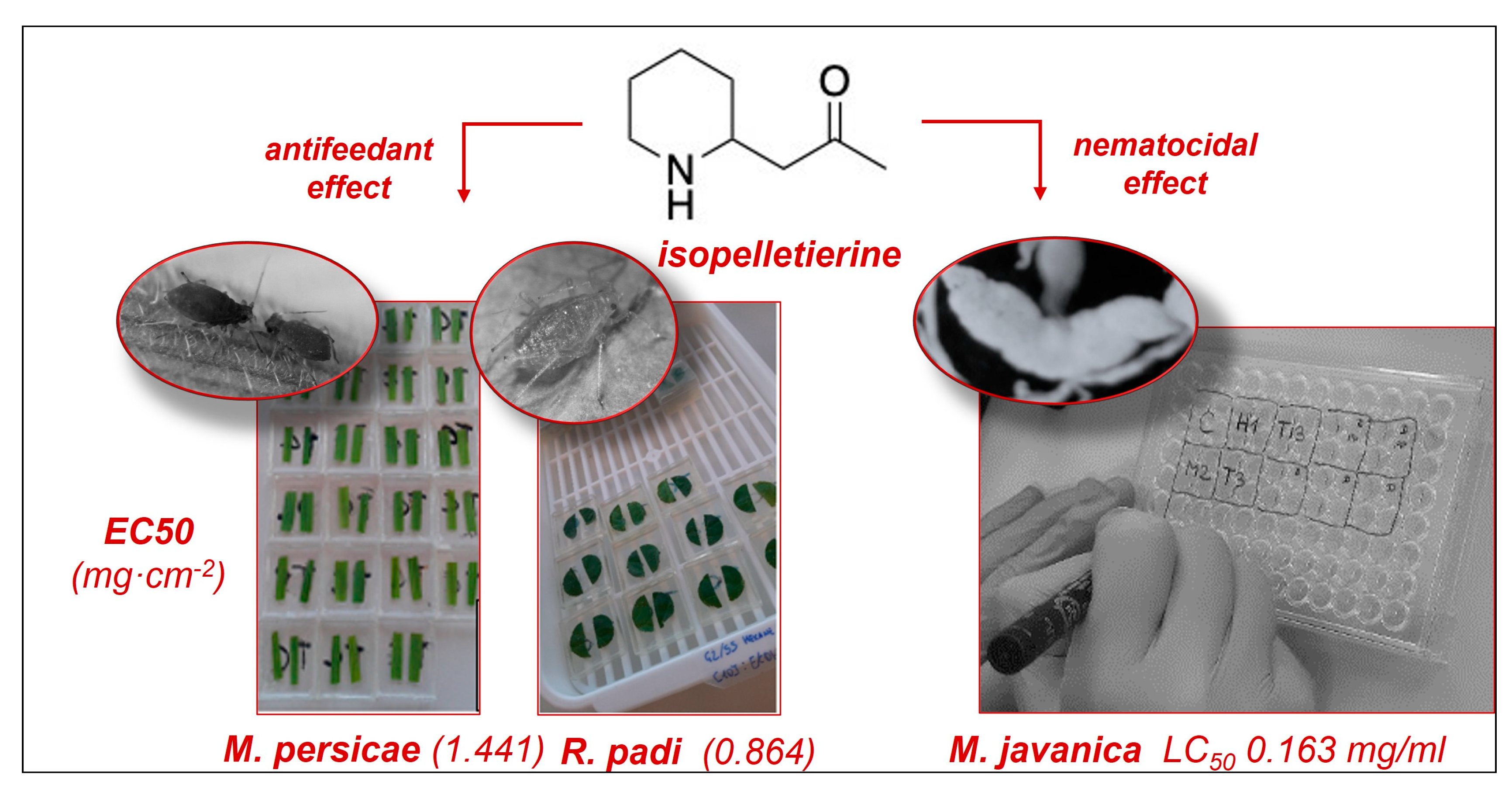

The Truth Behind the Myth of Pomegranate Tree Root: Proofs on Anti-Nematode and Anti-Feeding Properties of Pelletierine-like Alkaloids

 ,
,  ,
, 
 ,
,  ,
,  ,
,  and
and 
Abstract
1. Introduction
2. Results and Discussion
2.1. Chemical Characterization of Pomegranate Root Bark Extract
2.2. Antifeedant Effect
2.3. In Vitro Nematicidal Effect
3. Materials and Methods
4. Conclusions and Future Perspectives
Supplementary Materials
Author Contributions
Funding
Data Availability Statement
Acknowledgments
Conflicts of Interest
Abbreviations
| GC-MS | Gas Chromatography Mass Spectrometry |
| LC-ESI-HRMS | Liquid Chromatography Electron Spray Ionization High resolution mass Spectrometry |
| AE | Alkaloids Extract |
| HAE | Hydro-Alcoholic Extract |
| EI-MS | Electronic Ionization Mass spectrometry |
| EC50 | Effective Concentration (50% inhibition) |
| LC50 | Lethal Concentration (50% mortality) |
| LC90 | Lethal Concentration (90% mortality) |
| FI | Feeding Inhibition |
| SI | Settling Inhibition |
| LD50 | Lethal Dose (50% mortality) |
References
- Aktar, M.W.; Sengupta, D.; Chowdhury, A. Impact of pesticides use in agriculture: Their benefits and hazards. Interdiscip. Toxicol. 2009, 2, 1–12. [Google Scholar] [CrossRef]
- Rajwinder, K.; Diksha, C.; Samriddhi, B.; Shubhdeep, S.B.; Varinder, S.; Md Altamash, A.; Nidhi, R.; Thakur, G.S.; Balakumar, C. Pesticides: An alarming detrimental to health and environment. Sci. Total Environ. 2024, 915, 170113. [Google Scholar]
- Aadil, K.; Manzoor, A.R.; Vikrant, J.; Ab Rouf, W.; Shahid, R.; Rukhsana, N.; Nisar, A.M.; Sheikh, A.M. Plant based natural products as potential ecofriendly and safer biopesticides: A comprehensive overview of their advantages over conventional pesticides, limitations and regulatory aspects. Microb. Pathog. 2022, 173, 105854. [Google Scholar] [CrossRef] [PubMed]
- Nicoletti, M.; Murugan, K.; Benelli, G. Emerging Insect-Borne Diseases of Agricultural, Medical and Veterinary Importance. In Insecticides Resistance; Trdan, S., Ed.; InTechOpen: London, UK, 2016. [Google Scholar] [CrossRef][Green Version]
- Daraban, G.M.; Hlihor, R.-M.; Suteu, D. Pesticides vs. Biopesticides: From Pest Management to Toxicity and Impacts on the Environment and Human Health. Toxics 2023, 11, 983. [Google Scholar] [CrossRef] [PubMed]
- Ghidoli, M.; Pesenti, M.; Colombo, F.; Nocito, F.F.; Pilu, R.; Araniti, F. Camelina sativa (L.) Crantz as a Promising Cover Crop Species with Allelopathic Potential. Agronomy 2023, 13, 2187. [Google Scholar] [CrossRef]
- Zhang, P.; Qin, D.; Chen, J.; Zhang, Z. Plants in the Genus Tephrosia: Valuable Resources for Botanical Insecticides. Insects 2020, 11, 721. [Google Scholar] [CrossRef]
- Mayer, M.; Vogl, C.R.; Amorena, M.; Hamburger, M.; Walkenhorst, M. Treatment of organic livestock with medicinal plants: A systematic review of European ethnoveterinary research. Forsch. Komplementmed. 2014, 21, 375–386. [Google Scholar] [CrossRef]
- Adams, F. Genuine Works of Hippocrates; William Wood and Co.: New York, NY, USA, 1849. [Google Scholar]
- Lansky, E.; Shubert, S.; Neeman, I. Pharmacological and therapeutic properties of pomegranate. In Production, Processing and Marketing of Pomegranate in the Mediterranean Region; Melgarejo, P., Martinez-Nicolas, J.J., Martinez-Tome, J., Eds.; Options Méditerranéennes Série A N°42; Ciheam-Iamz: Montpellier, France, 2000. [Google Scholar]
- Dardona, Z. Literature Review: Punica granatum (pomegranate) with an emphasis on its anti-parasitic activity. GSC Biol. Pharm. Sci. 2023, 23, 100–114. [Google Scholar] [CrossRef]
- Mahajan, D.C.; Satyapal, U.S.; Tatke, P.A.; Naharwar, V. Antimicrobial and anthelmentic activity of Punica granatum fruit peel extracts. Int. J. Pharmacogn. Phytochem. Res. 2014, 6, 482–487. [Google Scholar]
- Abdel-Hafeez, E.H.; Ahmed, A.K.; Abdellatif, M.Z.M.; Kamal, A.M.; Toni, N.D.M. The Efficacy of Pomegranate (Punica granatum) Peel Extract on Experimentally Infected Rats with Blastocystis Spp. J. Infect. Dis. Prev. Med. 2016, 4, 131. [Google Scholar] [CrossRef]
- Hassan, N.M.F.; Sedky, D.; Abd El-Aziz, T.H.; Shalaby, H.A.; Abou-Zeina, H.A.A. Anthelmintic potency and curative effect of pomegranate peels ethanolic extract against Haemonchus contortus infection in goats. Int. J. Vet. Sci. 2020, 9, 210–216. [Google Scholar]
- Regaieg, H.; Bouajila, M.; Hajji, L.; Larayadh, A.; Chiheni, N.; Guessmi-Mzoughi, I.; Horrigue-Raouani, N. Evaluation of pomegranate (Punica granatum L. var. Gabsi) peel extract for control of root-knot nematode Meloidogyne javanica on tomato. Arch. Phytopathol. Plant Prot. 2017, 50, 839–849. [Google Scholar] [CrossRef]
- Emam, A.M.; Ahmed, M.A.M.; Tammam, M.A.A.; El-Dakar, H.A.M.; Hanaa, Z.S. Isolation and Structural Identification of Compounds with Antioxidant, Nematicidal and fungicidal Activities from Punica granatum L. var. nana. Int. J. Sci. Eng. Res. 2015, 6, 1023–1040. [Google Scholar]
- Youssef, M.M.A.; El-Nagdi, W.M.A.; Abd-El-Khair, H.; Elkelany, U.S.; Abd-Elgawad, M.M.M.; Dawood, M.G. Is use of two Trichoderma species sole or combined with a plant extract effective for the biocontrol Meloidogyne incognita on potato and soil microorganisms’ diversity? Pak. J. Nematol. 2023, 41, 153–164. [Google Scholar] [CrossRef]
- El-Nagdi, W.M.; Youssef, M.M.; Abd-El-Khair, H.; Elkelany, U.S.; Abd-Elgawad, M.M.; Dawood, M.G. Effect of integration of two bacterial bioagents and a plant residue extract for biocontrolling root-knot nematode, Meloidogyne incognita infesting potatoes. Egypt. Pharm. J. 2023, 22, 67–77. [Google Scholar] [CrossRef]
- Roshan-Bakhsh, A.; Pourjam, E.; Ayyari, M.; Pedram, M. Biocontrol properties of some agricultural waste extracts on three nematode species in in vitro and in vivo conditions. Nematology 2019, 21, 837–846. [Google Scholar] [CrossRef]
- Aggarwal, R.; Kaur, K.; Suri, M.; Bagai, U. Anthelmintic potential of Calotropis procera, Azadirachta indica and Punica granatum against Gastrothylax indicus. J. Parasit. Dis. 2016, 40, 1230–1238. [Google Scholar] [CrossRef]
- Mostafa, F.A.M.; Refaei, A.R.; Khalil, A.E.; El-Deriny, M.M. Potential Use of Botanicals Rich in Alkaloids for Controlling Meloidogyne incognita and Rotylenchulus reniformis Infecting Cucurbits. Egypt. J. Agronematol. 2016, 15, 29–43. [Google Scholar] [CrossRef]
- Bahmani, M.; Rafieian-Kopaei, M.; Hassanzadazar, H.; Saki, K.; Karamati, S.A.; Delfan, B. A review on most important herbal and synthetic antihelmintic drugs. Asian Pac. J. Trop. Med. 2014, 7, S29–S33. [Google Scholar] [CrossRef]
- Jayaprakash, A. Punica granatum: A Review on Phytochemicals, Antioxidant and Antimicrobial properties. J. Acad. Ind. Res. 2017, 5, 132–138. [Google Scholar]
- Sicker, D.; Zeller, K.-P.; Siehl, H.-U.; Berger, S. Pseudopelletierinee from the pomegranate to cycloctatetraene. In Natural Products: Isolation, Structure Elucidation, History; John Wiley & Sons: Weinheim, Germany, 2019; pp. 9–28. [Google Scholar]
- Meisenheimer, J.E.M., VIII. Mitteilung zur Stereochemie des gesättigten dreiwertigen Stickstoffatoms. Über das Methylisopelletierine. Justus Liebigs. Ann. Chem. 1928, 462, 301–316. [Google Scholar] [CrossRef]
- Quick, J.; Meltz, M. The pelletierinee condensation. Mechanistic studies. J. Org. Chem. 1979, 44, 573–578. [Google Scholar] [CrossRef]
- Carlson, E.C.; Rathbone, L.K.; Yang, H.; Collett, N.D.; Carter, R.G. Improved protocol for asymmetric, intramolecular heteroatom Michael addition using organocatalysis: Enantioselective syntheses of homoproline, pelletierinee, and homopipecolic acid. J. Org. Chem. 2008, 73, 5155–5158. [Google Scholar] [CrossRef] [PubMed]
- Beng, T.K.; Gawley, R.E. Highly enantioselective catalytic dynamic resolution of N-Boc-2-lithiopiperidine: Synthesis of (R)-(+)-N-Boc-pipecolic acid,(S)-(−)-coniine,(S)-(+)-pelletierinee,(+)-β conhydrine, and (S)-(−)-ropivacaine and formal synthesis of (−)-lasubine II and (+)-cermizine C. J. Am. Chem. Soc. 2010, 132, 12216–12217. [Google Scholar]
- Bosque, I.; González-Gómez, J.C.; Foubelo, F.; Yus, M. Straightforward access to enantioenriched 2-allylpiperidine: Application to the synthesis of alkaloids. J. Org. Chem. 2012, 77, 780–784. [Google Scholar] [CrossRef]
- Glasby, J.S. Encyclopedia of the Alkaloids; Springer: New York, NY, USA, 2012; Volume 2 (I–Z). [Google Scholar]
- Zheicen, L. Colour Atlas of Chinese Traditional Drugs; Science Press: Beijing, China, 1987; pp. 75–76. [Google Scholar]
- El-Sakka, M.A. Phytochemistry of Alkaloids, 3rd ed.; Al Azhar University: Cairo, Egypt, 2010; pp. 7–22. [Google Scholar]
- Sentandreu, E.; Cerdán-Calero, M.; Sendra, J.M. Phenolic profile characterization of pomegranate (Punica granatum) juice by high-performance liquid chromatography with diode array detection coupled to an electrospray ion trap mass analyzer. J. Food Comp. Anal. 2013, 30, 32–40. [Google Scholar] [CrossRef]
- Elshamy, S.; Motaal, A.A.; Abdel-Halim, M.; Medhat, D.; Handoussa, H. Potential neuro protective activity of Mentha longifolia L. in aluminum chloride-induced rat model of Alzheimer’s disease. J. Food Chem. 2021, 45, e13644. [Google Scholar]
- Quick, J.; Oterson, R. A convenient synthesis of Pelletierine (2-Piperidylpropanone). Synthesis 1976, 11, 745–746. [Google Scholar] [CrossRef]
- Kaushik, N.; Díaz, C.E.; Chhipa, H.; Julio, L.F.; Andrés, M.F.; González-Coloma, A. Chemical Composition of an Aphid Antifeedant Extract from an Endophytic Fungus, Trichoderma sp. EFI671. Microorganisms 2020, 8, 420. [Google Scholar] [CrossRef]
- Wu, Y.; Ren, D.; Gao, C.; Li, J.; Du, B.; Wang, Z.; Qian, S. Recent advances for alkaloids as botanical pesticides for use in organic agriculture. Int. J. Pest Manag. 2021, 69, 288–298. [Google Scholar] [CrossRef]
- Ujváry, I. Chapter 3—Pest Control Agents from Natural Products. In Hayes’ Handbook of Pesticide Toxicology, 3rd ed.; Krieger, R., Ed.; Academic Press: Cambridge, MA, USA, 2010; pp. 119–229. [Google Scholar]
- Petroski, R.J.; Stanley, D.W. Natural Compounds for Pest and Weed Control. J. Agric. Food Chem. 2009, 57, 8171–8179. [Google Scholar] [CrossRef]
- El Namaky, A.H.; El Sadawy, H.A.; Al Omari, F.; Bahareth, O.M. Insecticidal activity of Punica granatum L. extract for the control of Rhynchophorus ferrugineus (Olivier) (Coleoptera: Curculionidae) and some of its histological and immunological aspects. J. Biopest. 2020, 13, 13–20. [Google Scholar]
- Nasiou, E.; Giannakou, I.O. Nematicidal Potential of Thymol against Meloidogyne javanica (Treub) Chitwood. Plants 2023, 12, 1851. [Google Scholar] [CrossRef] [PubMed]
- Singh, A.; Kaul, R.K.; Khapte, P.S.; Jadon, K.S.; Rouphael, Y.; Basile, B.; Kumar, P. Root Knot Nematode Presence and Its Integrated Management in Pomegranate Orchards Located in Indian Arid Areas. Horticulturae 2022, 8, 160. [Google Scholar] [CrossRef]
- Abdel-Wahab, D.A.; El-Zawahry, A.M.I.; Hamada, A.M.; Abdel-Salam, M.M.; Samy, A.M. Nanoparticles boost pomegranate growth and defense, suppressing root-knot nematodes. Front. Plant Sci. 2025, 16, 1560126. [Google Scholar] [CrossRef]
- Castagna, F.; Britti, D.; Oliverio, M.; Bosco, A.; Bonacci, S.; Iriti, G.; Ragusa, M.; Musolino, V.; Rinaldi, L.; Palma, E.; et al. In Vitro Anthelminthic Efficacy of Aqueous Pomegranate (Punica granatum L.) Extracts against Gastrointestinal Nematodes of Sheep. Pathogenes 2020, 9, 1063. [Google Scholar] [CrossRef]
- Abdel-Basat, S.H.; Abdel-Monaim, M.F. Nematicidal Potential of some Natural Botanical Extracts in Biocontrolling Meloidogyne javanica on Soybean under Laboratory and Greenhouse Conditions. Egypt. J. Agronematol. 2020, 19, 1–18. [Google Scholar] [CrossRef]
- El-Habashy, D.E.; Abdel Rasoul, M.A.; Abdelgaleil, S.A.M. Nematicidal activity of phytochemicals and their potential use for the control of Meloidogyne javanica infected eggplant in the greenhouse. Eur. J. Plant Pathol. 2020, 158, 381–390. [Google Scholar] [CrossRef]
- Gonzalez-Coloma, A.; Andrés, M.F.; Contreras, R.; Zúñiga, G.E.; Díaz, C.E. Sustainable Production of Insecticidal Compounds from Persea indica. Plants 2022, 11, 418. [Google Scholar] [CrossRef]
- Navarro-Rocha, J.; Fe Andrés, M.; Díaz, C.E.; Burillo, J.; González-Coloma, A. Composition and biocidal properties of essential oil from pre-domesticated Spanish Satureja montana. Ind. Crops Prod. 2020, 145, 111958. [Google Scholar] [CrossRef]
- Andrés, M.F.; González-Coloma, A.; Muñoz, R.; De la Peña, F.; Julio, L.F.; Burillo, J. Nematicidal potential of hydrolates from the semi industrial vapor-pressure extraction of Spanish aromatic plants. Environ. Sci. Pollut. Res. 2018, 25, 29834–29840. [Google Scholar] [CrossRef]
- Galisteo, A.; González-Coloma, A.; Castillo, P.; Andrés, M.F. Valorization of the Hydrolate Byproduct from the Industrial Extraction of Purple Alium sativum Essential Oil as a Source of Nematicidal Products. Life 2022, 12, 905. [Google Scholar] [CrossRef]
- Aviles-Gomez, J.; Cristóbal-Alejo, J.; Andrés, M.F.; González-Coloma, A.; Carnevali, G.; Pérez-Brito, D.; Moo-Koh, F.A.; Gamboa-Angulo, M. Nematicidal Screening of Aqueous Extracts from Plants of the Yucatan Peninsula and Ecotoxicity. Plants 2022, 11, 2138. [Google Scholar] [CrossRef] [PubMed]
- Moo-Koh, F.A.; Cristóbal-Alejo, J.; Andrés, M.F.; Martín, J.; Reyes, F.; Tun-Suárez, J.M.; Gamboa-Angulo, M. In Vitro Assessment of Organic and Residual Fractions of Nematicidal Culture Filtrates from Thirteen Tropical Trichoderma Strains and Metabolic Profiles of Most-Active. J. Fungi 2022, 8, 82. [Google Scholar] [CrossRef]
- Schneider-Orelli, O. Entomologisches Praktikum: Einführung in Die Land-und Forstwirtschaftliche Insektenkunde; H. R. Sauerlander: Aarau, Switzerland, 1947. [Google Scholar]
- Meurant, G. The Alkaloids: Chemistry and Physiology; Academic Press: New York, NY, USA, 1965; Volume 1. [Google Scholar]
- Duke, J.A. Handbook of Phytochemical Constituents of GRAS Herbs and Other Economic Plants; CRC Press: Boca Raton, FL, USA, 1992. [Google Scholar]
- Calvo-Araya, J.A. A Novel Nematicide for the Control of Root-Knot Nematodes in Tomato Crop. Int. J. Phytopathol. 2017, 6, 35–40. [Google Scholar] [CrossRef]



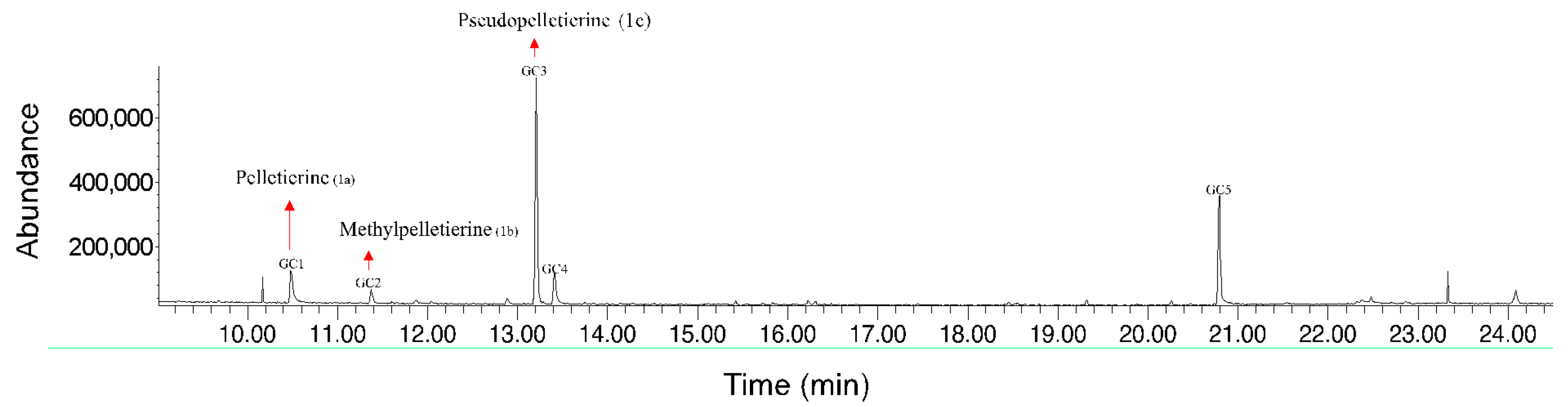
| Peak | Retention Time (min) | Identification | Molecular Formula | Relative Percentage (%) |
|---|---|---|---|---|
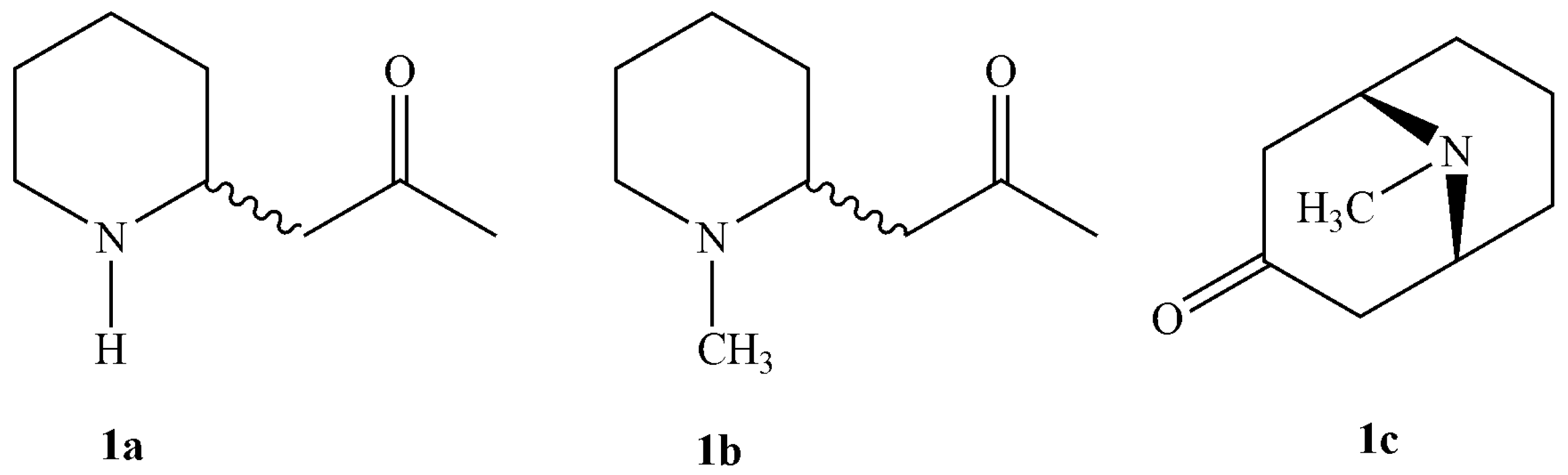
| GC1 | 10.49 | Isopelletierine (1a) | C8H15NO | 8.77 |
| GC2 | 11.38 | Methylpelletierine (1b) | C9H17NO | 3.09 |
| GC3 | 13.21 | Pseudopelletierine (1c) | C9H15NO | 44.37 |
| GC4 | 13.41 | trans-benzylidenacetone | C10H10O | 8.82 |
| GC5 | 20.79 | heptadeca-5,8-dione | C17H32O2 | 21.70 |
| others | - | - | - | 13.25 |
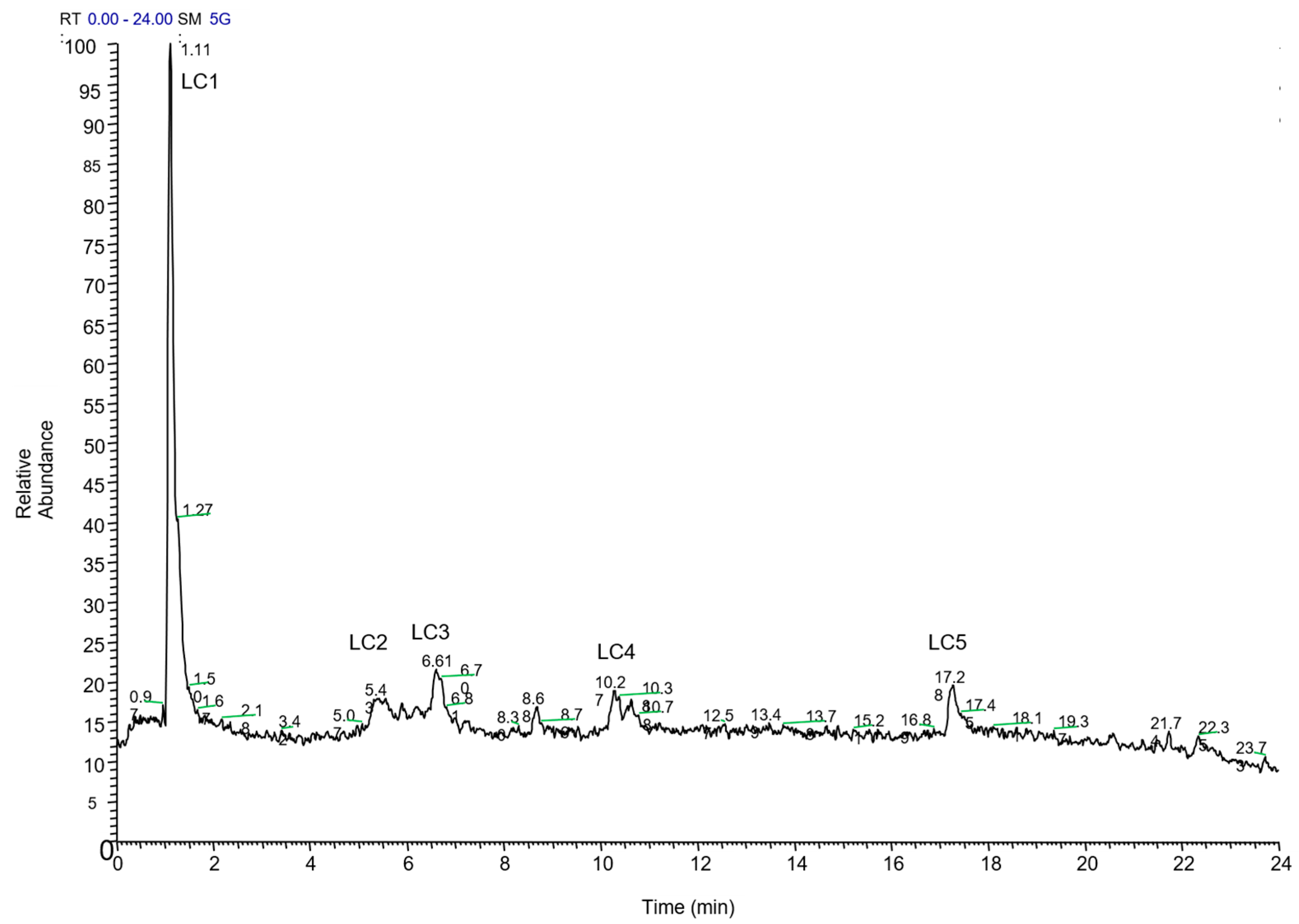
| Peak | Retention Time (min) | Identification | Molecular Formula | [M-H]−/[M-H]−2 (m/z) | Main Detected Fragments (m/z) | Relative Percentage (%) |
|---|---|---|---|---|---|---|
| LC1 | 1.11 | 3-(4-hydroxyphenyl) lactic acid | C9H10O4 | 181.0769 | 163.0593, 101.0255, 89.0255, 71.0121 | 76.36 |
| LC2 | 6.61 | punicalagin | C48H28O30 | 1083.0586 541.0262 | 781.0529, 600.9899, 541.0262, 300.9901, 275.0198 | 7.83 |
| LC3 | 8.68 | hexahydroxyflavan isomer (gallocatechin) | C15H14O7 | 305.0702 | 225.1129, 96.9588 | 3.70 |
| LC4 | 10.24 | epicatechin | C15H14O6 | 288.9991 | 245.0090, 217.0137 | 4.63 |
| LC5 | 17.28 | quercetin | C15H10O7 | 300.9999 | - | 7.47 |
| Treatments | Conc. (µg·cm−2) | S. littoralis | R. padi | M. persicae |
|---|---|---|---|---|
| %FI 1 | %SI 1 | %SI 1 | ||
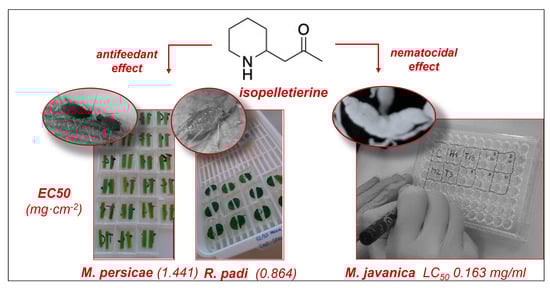
| Isopelletierine (1a) | 50.0 | 33.52 ± 11.55 | 63.32 ± 6.38 * 0.864 (0.354–2.112) 2 | 54.57 ± 7.71 * 1.441 (0.732–2.836) 2 |
| 25.0 | n.t. 3 | 43.06 ± 6.99 | 33.24 ± 6.69 | |
| 12.5 | n.t. 3 | n.t. 3 | n.t. 3 | |
| 6.25 | n.t. 3 | n.t. 3 | n.t. 3 | |
| Pseudopelletierine (1c) | 50.0 | 41.59 ± 18.68 | 49.24 ± 7.92 | 38.71 ± 8.70 |
| AE | 50.0 | 33.44 ± 7.25 | 59.55 ± 8.69 | 47.20 ± 9.18 |
| HAE | 50.0 | 22.56 ± 15.90 | 48.35 ± 7.84 | 53.80 ± 9.42 |
| Control: | - | 0.00 | 89.01 ± 1.86 | 83.94 ± 4.07 |
| Treatments | J2 Mortality (M%) | |||
|---|---|---|---|---|
| Conc. % (w/v) 1 | Eff. (%) 2 | LC50 (95% CL) 3 | LC90 (95% CL) | |
| Isopelletierine (1a) | 1.0 | 100 | 0.163 (0.123–0.217) | 0.389 (0.293–0.517) |
| 0.50 | 100 | |||
| 0.25 | 100 | |||
| 0.13 | 5.98 ± 1.27 | |||
| 0.063 | 3.65 ± 1.38 | |||
| 0.032 | 1.27 ± 0.15 | |||
| Pseudopelletierine (1c) | 1.0 | 5.96 ± 1.42 | n.t. 4 | n.t. 4 |
| AE | 1.0 | 100 | 0.256 (0.192–0.340) | 0.566 (0.425–0.753) |
| 0.50 | 100 | |||
| 0.25 | 100 | |||
| 0.13 | 48.75 ± 6.47 | |||
| 0.063 | 12.13 ± 2.48 | |||
| 0.032 | 1.27 ± 0.15 | |||
| HAE | 1.0 | 6.43 ± 1.93 | n.t. 4 | n.t. 4 |
| Positive control: thymol | 1.0 5 | 100 | 0.143 (0.137–0.148) | 0.195 (0.188–0.204) |
Disclaimer/Publisher’s Note: The statements, opinions and data contained in all publications are solely those of the individual author(s) and contributor(s) and not of MDPI and/or the editor(s). MDPI and/or the editor(s) disclaim responsibility for any injury to people or property resulting from any ideas, methods, instructions or products referred to in the content. |
© 2026 by the authors. Licensee MDPI, Basel, Switzerland. This article is an open access article distributed under the terms and conditions of the Creative Commons Attribution (CC BY) license.
Share and Cite
Bonacci, S.; Scarano, P.; Iriti, G.; Gonzáles-Coloma, A.; Andrés, M.F.; Guarino, C.; Oliverio, M.; Procopio, A. The Truth Behind the Myth of Pomegranate Tree Root: Proofs on Anti-Nematode and Anti-Feeding Properties of Pelletierine-like Alkaloids. Molecules 2026, 31, 1254. https://doi.org/10.3390/molecules31081254
Bonacci S, Scarano P, Iriti G, Gonzáles-Coloma A, Andrés MF, Guarino C, Oliverio M, Procopio A. The Truth Behind the Myth of Pomegranate Tree Root: Proofs on Anti-Nematode and Anti-Feeding Properties of Pelletierine-like Alkaloids. Molecules. 2026; 31(8):1254. https://doi.org/10.3390/molecules31081254
Chicago/Turabian StyleBonacci, Sonia, Pierpaolo Scarano, Giuseppe Iriti, Azucena Gonzáles-Coloma, María Fe Andrés, Carmine Guarino, Manuela Oliverio, and Antonio Procopio. 2026. "The Truth Behind the Myth of Pomegranate Tree Root: Proofs on Anti-Nematode and Anti-Feeding Properties of Pelletierine-like Alkaloids" Molecules 31, no. 8: 1254. https://doi.org/10.3390/molecules31081254
APA StyleBonacci, S., Scarano, P., Iriti, G., Gonzáles-Coloma, A., Andrés, M. F., Guarino, C., Oliverio, M., & Procopio, A. (2026). The Truth Behind the Myth of Pomegranate Tree Root: Proofs on Anti-Nematode and Anti-Feeding Properties of Pelletierine-like Alkaloids. Molecules, 31(8), 1254. https://doi.org/10.3390/molecules31081254