Artificial Intelligence-Enabled Intelligent Sensory Systems for Quality Evaluation of Traditional Chinese Medicine: A Review of Electronic Nose, Electronic Tongue, and Machine Vision Approaches

Abstract
1. Introduction
2. Intelligent Sensory System
2.1. Basic Principles
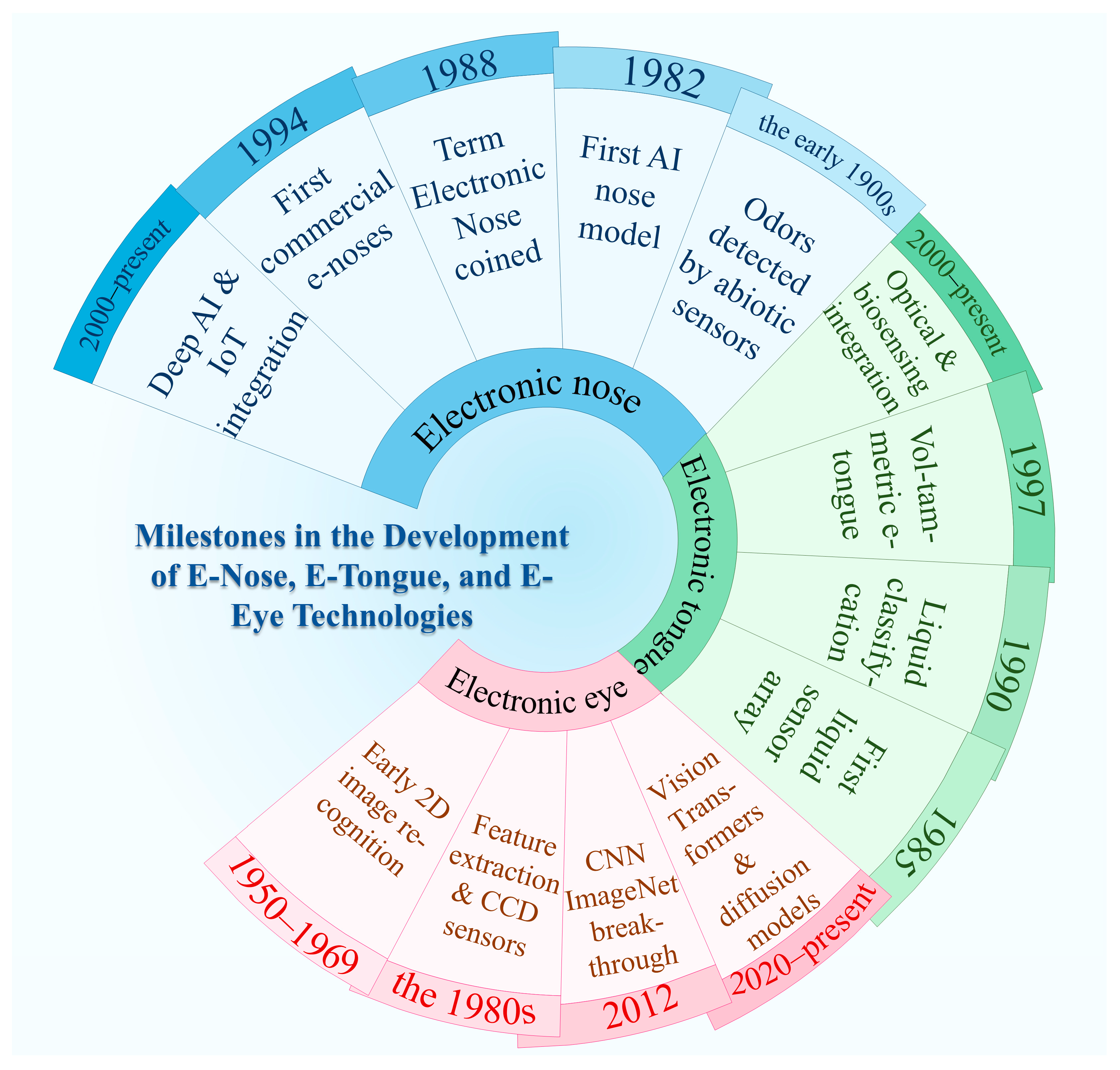
2.2. Historical Development
2.3. Exploration and Validation of Evaluation of Properties and Flavors of TCM
2.4. Cutting-Edge Development Trends in Intelligent Sensory Technology
3. Smart Sensory Instruments: AI’s Data Factory
3.1. E-Nose and E-Tongue
3.2. Electronic Eye
3.3. Multisource Information Fusion
4. Data Processing and Analysis Methodologies Powered by Artificial Intelligence
4.1. Supervised Learning Algorithms
4.1.1. Support Vector Machine (SVM)
4.1.2. Random Forest (RF)
4.1.3. Partial Least Squares Discriminant Analysis (PLS-DA)
4.2. Unsupervised Learning
4.2.1. Principal Component Analysis (PCA)
4.2.2. K-Means Clustering (K-Means)
4.3. Deep Learning Model
4.3.1. Convolutional Neural Network (CNN)
4.3.2. Long Short-Term Memory (LSTM) Network
5. Specific Applications
5.1. Raw Material Authentication: Verification of Origin, Species, and Authenticity
5.2. Process Monitoring and Optimization in Herbal Processing
5.3. Quality Grading
5.4. Efficacy Correlation and Ingredient Prediction
6. Current Challenges and Future Outlook
6.1. Current Challenges
6.1.1. Data Bottlenecks: Insufficient Quality, Standardization, and Sharing Mechanisms
6.1.2. Model Bottlenecks: Insufficient Generalizability, Interpretability, and Robustness
6.1.3. Bottlenecks in Integrating Technology and Theory: Bridging the Gap from Correlation to Mechanism
6.2. Future Outlook
6.2.1. Building Robust Data Infrastructure and Adaptive Modeling Strategies
6.2.2. Advancing Explainable and Deployable Intelligent Sensory Systems
6.2.3. Promoting Mechanism-Oriented Integration and Future Value Creation
7. Conclusions
Funding
Institutional Review Board Statement
Informed Consent Statement
Data Availability Statement
Conflicts of Interest
References
- Luo, H.; Vong, C.T.; Chen, H.; Gao, Y.; Lyu, P.; Qiu, L.; Zhao, M.; Liu, Q.; Cheng, Z.; Zou, J.; et al. Naturally occurring anti-cancer compounds: Shining from Chinese herbal medicine. Chin. Med. 2019, 14, 48. [Google Scholar] [CrossRef] [Scilit]
- Wang, J.; Zou, J.; Shi, Y.; Zeng, N.; Guo, D.; Wang, H.; Zhao, C.; Luan, F.; Zhang, X.; Sun, J. Traditional Chinese medicine and mitophagy: A novel approach for cardiovascular disease management. Phytomedicine 2024, 128, 155472. [Google Scholar] [CrossRef] [Scilit]
- Xi, Z.; Dai, R.; Ze, Y.; Jiang, X.; Liu, M.; Xu, H. Traditional Chinese medicine in lung cancer treatment. Mol. Cancer 2025, 24, 57. [Google Scholar] [CrossRef] [Scilit]
- Liu, J.; Lee, P.-K.; Wu, W.; Huang, J.; Zhao, D. Medicine food homology materials for promoting resilience against metabolic syndrome: Recent technology advances and challenges. Trends Food Sci. Technol. 2025, 164, 105236. [Google Scholar] [CrossRef] [Scilit]
- Lv, Z.; Chen, L.; Ouyang, H.; Zhu, Y.; Ma, J.; Zhang, K.; Lin, W.; Li, W.; Zhang, Z.; He, J. Development, basic information, classifications, pharmacological activities, and underlying mechanisms of medicine food homology: A review. J. Funct. Foods 2024, 122, 106552. [Google Scholar] [CrossRef] [Scilit]
- Zhao, H.; Xin, G.; Guo, Y. Research progress on Cistanches Herba as medicine and food homologous traditional Chinese medicine. Chin. Tradit. Herb. Drugs 2025, 56, 3316–3329. [Google Scholar]
- Zhao, L.; Liu, S.; Chen, X.; Wu, Z.; Yang, R.; Shi, T.; Zhang, Y.; Zhou, K.; Li, J. Hyperspectral Identification of Ginseng Growth Years and Spectral Importance Analysis Based on Random Forest. Appl. Sci. 2022, 12, 5852. [Google Scholar] [CrossRef] [Scilit]
- Wei, F.; Liu, W.; Yan, H.; Shi, Y.; Zhang, W. National Wide Quality Surveillance and Analysis of Chinese Material Medica and Decoction Pieces. Chin. Pharm. J. 2015, 50, 277–283. [Google Scholar]
- Shang, Z. Shennong Ben Cao Jing; Beijing Science and Technology Press: Beijing, China, 2019. [Google Scholar]
- Shen, M.-R.; He, Y.; Shi, S.-M. Development of chromatographic technologies for the quality control of Traditional Chinese Medicine in the Chinese Pharmacopoeia. J. Pharm. Anal. 2021, 11, 155–162. [Google Scholar] [CrossRef] [Scilit]
- Huang, Y.; Bian, C.; Yang, Y.; Kang, T.; Xu, L. Research Progress of Mass Spectrometry Imaging Technology in Quality Identification and Biosynthesis Pathway of Chinese Medicinal Materials. Chin. Arch. Tradit. Chin. Med. 2025, 43, 124–128+286. [Google Scholar] [CrossRef]
- Ji, P.; Yang, X.; Zhao, X. Application of metabolomics in quality control of traditional Chinese medicines: A review. Front. Plant Sci. 2024, 15, 1463666. [Google Scholar] [CrossRef] [Scilit]
- Liu, Y.; Zhang, L.; Zhang, X.; Bian, X.; Tian, W. Modern spectroscopic techniques combined with chemometrics for process quality control of traditional Chinese medicine: A review. Microchem. J. 2025, 213, 113605. [Google Scholar] [CrossRef] [Scilit]
- Śliwińska, M.; Wiśniewska, P.; Dymerski, T.; Namieśnik, J.; Wardencki, W. Food Analysis Using Artificial Senses. J. Agric. Food Chem. 2014, 62, 1423–1448. [Google Scholar] [CrossRef] [Scilit] [PubMed]
- Khaydukova, M.; Kirsanov, D.; Pein-Hackelbusch, M.; Immohr, L.I.; Gilemkhanova, V.; Legin, A. Critical view on drug dissolution in artificial saliva: A possible use of in-line e-tongue measurements. Eur. J. Pharm. Sci. 2017, 99, 266–271. [Google Scholar] [CrossRef] [Scilit] [PubMed]
- Fitzgerald, J.E.; Bui, E.T.H.; Simon, N.M.; Fenniri, H. Artificial Nose Technology: Status and Prospects in Diagnostics. Trends Biotechnol. 2017, 35, 33–42. [Google Scholar] [CrossRef] [Scilit]
- Moufid, M.; Hofmann, M.; El Bari, N.; Tiebe, C.; Bartholmai, M.; Bouchikhi, B. Wastewater monitoring by means of e-nose, VE-tongue, TD-GC-MS, and SPME-GC-MS. Talanta 2021, 221, 121450. [Google Scholar] [CrossRef] [Scilit]
- Chen, B.; Lin, X.; Liang, Z.; Chang, X.; Wang, Z.; Huang, M.; Zeng, X.-A. Advances in food flavor analysis and sensory evaluation techniques and applications: Traditional vs. emerging. Food Chem. 2025, 494, 146235. [Google Scholar] [CrossRef] [Scilit]
- Galvan, D.; Aquino, A.; Effting, L.; Mantovani, A.C.G.; Bona, E.; Conte-Junior, C.A. E-sensing and nanoscale-sensing devices associated with data processing algorithms applied to food quality control: A systematic review. Crit. Rev. Food Sci. Nutr. 2022, 62, 6605–6645. [Google Scholar] [CrossRef] [Scilit]
- Qu, C.; Liu, C.; Gu, Y.; Chai, S.; Feng, C.; Chen, B. Open-set gas recognition: A case-study based on an electronic nose dataset. Sens. Actuators B Chem. 2022, 360, 131652. [Google Scholar] [CrossRef] [Scilit]
- Zhang, S.; Gong, Y.; Wang, J. The Development of Deep Convolution Neural Network and Its Applications on Computer Vision. Chin. J. Comput. 2019, 42, 453–482. [Google Scholar]
- Pandey, V.K.; Srivastava, S.; Dash, K.K.; Singh, R.; Mukarram, S.A.; Harsányi, E. Machine Learning Algorithms and Fundamentals as Emerging Safety Tools in Preservation of Fruits and Vegetables: A Review. Processes 2023, 11, 1720. [Google Scholar] [CrossRef] [Scilit]
- Kaushal, S.; Tammineni, D.K.; Rana, P.; Sharma, M.; Sridhar, K.; Chen, H.-H. Computer vision and deep learning-based approaches for detection of food nutrients/nutrition: New insights and advances. Trends Food Sci. Technol. 2024, 146, 104408. [Google Scholar] [CrossRef] [Scilit]
- Xie, D.S.; Peng, W.; Chen, J.C.; Li, L.; Zhao, C.B.; Yang, S.L.; Xu, M.; Wu, C.J.; Ai, L. A novel method for the discrimination of Hawthorn and its processed products using an intelligent sensory system and artificial neural networks. Food Sci. Biotechnol. 2016, 25, 1545–1550. [Google Scholar] [CrossRef] [Scilit]
- Lu, L.; Hu, Z.; Hu, X.; Li, D.; Tian, S. Electronic tongue and electronic nose for food quality and safety. Food Res. Int. 2022, 162, 112214. [Google Scholar] [CrossRef] [Scilit] [PubMed]
- Zhu, L.; Spachos, P.; Pensini, E.; Plataniotis, K.N. Deep learning and machine vision for food processing: A survey. Curr. Res. Food Sci. 2021, 4, 233–249. [Google Scholar] [CrossRef] [Scilit]
- Mahanti, N.K.; Shivashankar, S.; Chhetri, K.B.; Kumar, A.; Rao, B.B.; Aravind, J.; Swami, D.V. Enhancing food authentication through E-nose and E-tongue technologies: Current trends and future directions. Trends Food Sci. Technol. 2024, 150, 104574. [Google Scholar] [CrossRef] [Scilit]
- Facure, M.H.M.; Braunger, M.L.; Mercante, L.A.; Paterno, L.G.; Riul, A., Jr.; Correa, D.S. Encyclopedia of Sensors and Biosensors; Elsevier: Amsterdam, The Netherlands, 2023; Volume 3. [Google Scholar]
- Imam, M.; Nagpal, K. The electronic tongue: An advanced taste-sensing multichannel sensory tool with global selectivity for application in the pharmaceutical and food industry. Pharm. Dev. Technol. 2023, 28, 318–332. [Google Scholar] [CrossRef] [Scilit] [PubMed]
- Zhao, Z.; Wang, R.; Liu, M.; Bai, L.; Sun, Y. Application of machine vision in food computing: A review. Food Chem. 2025, 463, 141238. [Google Scholar] [CrossRef] [Scilit] [PubMed]
- Qi, Y.; Yang, Z.; Sun, W.; Lou, M.; Lian, J.; Zhao, W.; Deng, X.; Ma, Y. A Comprehensive Overview of Image Enhancement Techniques. Arch. Comput. Methods Eng. 2022, 29, 583–607. [Google Scholar] [CrossRef] [Scilit]
- Tan, Y.; Chen, Y.; Zhao, Y.; Liu, M.; Wang, Z.; Du, L.; Wu, C.; Xu, X. Recent advances in signal processing algorithms for electronic noses. Talanta 2025, 283, 127140. [Google Scholar] [CrossRef] [Scilit]
- Boyle, W.S.; Smith, G.E. Charge coupled semiconductor devices. Bell Syst. Tech. J. 1970, 49, 587–593. [Google Scholar] [CrossRef] [Scilit]
- Persaud, K.; Dodd, G. Analysis of discrimination mechanisms in the mammalian olfactory system using a model nose. Nature 1982, 299, 352–355. [Google Scholar] [CrossRef] [Scilit] [PubMed]
- Toko, K. Taste sensor with global selectivity. Mater. Sci. Eng. C 1996, 4, 69–82. [Google Scholar] [CrossRef] [Scilit]
- Ding, H.; Tong, L.; Huang, Q.; Wang, X.; Ying, Q.; Ma, A.; Xiao, T.; Chen, M. Odor-Chemical Correlation-Based Quality Evaluation of Atractylodes macrocephala via Electronic Nose, HPLC, and Machine Learning. Biomed. Chromatogr. 2025, 39, e70212. [Google Scholar] [CrossRef] [Scilit] [PubMed]
- Qin, C.; Du, Q.; Zhang, Y.; Sun, M.; Zhan, Z.; Wang, J. Research advances on the chemical constituents and pharmacological activities of the essential oil from Atractylodis Rhizoma. Chin. Tradit. Pat. Med. 2023, 45, 1944–1952. [Google Scholar] [CrossRef]
- Hongyan, L.; Yanni, M. Clinical Chinese Pharmacy, 1st ed.; China Press of Traditional Chinese Medicine: Beijing, China; p. 186.
- Aliya, A.; Li, C.; Wei, N.; Sun, Q.; Xu, J.; Sun, X.; Zhang, Y.; Xie, J. Investigating the Bitter Substance Foundation of Platycodonis Radix Based on Taste-Component Correlation Analysis. J. Li-Shizhen Tradit. Chin. Med. 2024, 35, 1767–1772. [Google Scholar] [CrossRef]
- Zhang, X.; Zhong, Y.; Feng, Y.; Zhang, X.; Zhang, J. Study on the antitussive and expectorant activities and mechanism of platycodin D based on metabolomics method. Acta Pharm. Sin. 2024, 59, 724–734. [Google Scholar] [CrossRef]
- Yang, T.; Zhao, S.; Yuan, Y.; Zhao, X.; Bu, F.; Zhang, Z.; Li, Q.; Li, Y.; Wei, Z.; Sun, X.; et al. Platycodonis Radix Alleviates LPS-Induced Lung Inflammation through Modulation of TRPA1 Channels. Molecules 2023, 28, 5213. [Google Scholar] [CrossRef] [Scilit]
- Guan, Y.; Jiang, C.; Zhang, Z.; Wu, W.; Zhu, W.; Jin, C.; Wu, X.; Chen, L. Research advances on the chemical constituents, pharmacological activities and clinical applications of the essential oil from Ligustici Rhizoma. Chin. Tradit. Pat. Med. 2024, 46, 873–880. [Google Scholar]
- Zhang, J.; Wang, B.; Zhang, Y.; Wu, Y.; Li, M.; Gao, T.; Lu, T.-l.; Bian, Z.; Su, L. E-eye and FT-NIR combined with multivariate algorithms to rapidly evaluate the dynamic changes in the quality of Gastrodia elata during steaming process. Food Chem. 2024, 439, 138148. [Google Scholar] [CrossRef] [Scilit]
- Lu, Q.; Yi, M.; Jiang, J. Bioelectronic nose for ultratrace odor detection via brain–computer interface with olfactory bulb electrode arrays. Biosens. Bioelectron. 2025, 285, 117585. [Google Scholar] [CrossRef] [Scilit]
- Kang, M.; Han, J.-K.; Lee, K.; Jeong, J.; Yoo, C.; Jeon, J.W.; Park, B.; Choi, W.; Ahn, J.; Yoon, K.-J.; et al. Neuromorphic olfaction with ultralow-power gas sensors and ovonic threshold switch. Sci. Adv. 2025, 11, eadv9222. [Google Scholar] [CrossRef] [Scilit] [PubMed]
- Li, L.; Guo, L.; Ying, B.; Chen, X.; Zhang, W.; Liu, K.; Xu, S.; Zhou, L.; Li, T.; Luo, W.; et al. Materials-Algorithm Co-Optimization for Specific and Quantitative Gas Detection. Interdiscip. Mater. 2025, 4, 630–639. [Google Scholar] [CrossRef] [Scilit]
- Wang, C.; Chen, Z.; Chan, C.L.J.; Wan, Z.; Ye, W.; Tang, W.; Ma, Z.; Ren, B.; Zhang, D.; Song, Z.; et al. Biomimetic olfactory chips based on large-scale monolithically integrated nanotube sensor arrays. Nat. Electron. 2024, 7, 157–167. [Google Scholar] [CrossRef] [Scilit]
- Seo, S.E.; Lim, S.G.; Kim, K.H.; Kim, J.; Shin, C.J.; Kim, S.; Kim, L.; Lee, S.H.; Jang, S.Y.; Oh, H.W.; et al. Reusable Electronic Tongue Based on Transient Receptor Potential Vanilloid 1 Nanodisc-Conjugated Graphene Field-Effect Transistor for a Spiciness-Related Pain Evaluation. Adv. Mater. 2023, 35, e2206198. [Google Scholar] [CrossRef] [Scilit]
- Kim, H.J.; Lee, C.W.; Park, S.; Choi, S.; Park, S.H.; Nam, G.B.; Ryu, J.-E.; Eom, T.H.; Kim, B.; Kim, C.-J.; et al. MXene-based high performance microfluidic pH sensors for electronic tongue. Sens. Actuators B Chem. 2024, 409, 135636. [Google Scholar] [CrossRef] [Scilit]
- Nargesi, M.H.; Kheiralipour, K. Non-destructive prediction of sucrose, proline, ash, and fructose/glucose ratio in date syrup using hyperspectral imaging and machine learning. LWT 2025, 229, 118153. [Google Scholar] [CrossRef] [Scilit]
- Agarwal, A.; de Jesus Colwell, F.; Bello Rodriguez, J.; Sommer, S.; Barman, M.; Correa Galvis, V.A.; Hill, T.R.; Boonham, N.; Prashar, A. Synergistic 3D, multispectral, and thermal image analysis via supervised machine learning for improved detection of root rot symptoms in hydroponically grown flat-leaf parsley. Smart Agric. Technol. 2025, 12, 101364. [Google Scholar] [CrossRef] [Scilit]
- Montes de Oca, A.; Magney, T.; Vougioukas, S.G.; Racano, D.; Torrez-Orozco, A.; Fennimore, S.A.; Martin, F.N.; Earles, M. Strawberry fruit yield forecasting using image-based time-series plant phenological stages sequences. Comput. Electron. Agric. 2025, 237, 110516. [Google Scholar] [CrossRef] [Scilit]
- Wesoły, M.; Przewodowski, W.; Ciosek-Skibińska, P. Electronic noses and electronic tongues for the agricultural purposes. TrAC Trends Anal. Chem. 2023, 164, 117082. [Google Scholar] [CrossRef] [Scilit]
- Wilson, A.D.; Baietto, M. Applications and Advances in Electronic-Nose Technologies. Sensors 2009, 9, 5099–5148. [Google Scholar] [CrossRef] [Scilit]
- Park, S.; Kim, Y.; Kim, T.; Eom, T.H.; Kim, S.Y.; Jang, H. Chemoresistive materials for electronic nose: Progress, perspectives, and challenges. InfoMat 2019, 1, 289–316. [Google Scholar] [CrossRef] [Scilit]
- Chen, H.; Huo, D.; Zhang, J. Gas Recognition in E-Nose System: A Review. IEEE Trans. Biomed. Circuits Syst. 2022, 16, 169–184. [Google Scholar] [CrossRef] [Scilit]
- Yan, J.; Guo, X.; Duan, S.; Jia, P.; Wang, L.; Peng, C.; Zhang, S. Electronic Nose Feature Extraction Methods: A Review. Sensors 2015, 15, 27804–27831. [Google Scholar] [CrossRef] [Scilit] [PubMed]
- Wijaya, D.R.; Afianti, F.; Arifianto, A.; Rahmawati, D.; Kodogiannis, V.S. Ensemble machine learning approach for electronic nose signal processing. Sens. Bio-Sens. Res. 2022, 36, 100495. [Google Scholar] [CrossRef] [Scilit]
- Piłat-Rożek, M.; Łazuka, E.; Majerek, D.; Szeląg, B.; Duda-Saternus, S.; Łagód, G. Application of Machine Learning Methods for an Analysis of E-Nose Multidimensional Signals in Wastewater Treatment. Sensors 2023, 23, 487. [Google Scholar] [CrossRef] [Scilit]
- Kaushal, S.; Nayi, P.; Rahadian, D.; Chen, H.-H. Applications of Electronic Nose Coupled with Statistical and Intelligent Pattern Recognition Techniques for Monitoring Tea Quality: A Review. Agriculture 2022, 12, 1359. [Google Scholar] [CrossRef] [Scilit]
- Chen, Y.; Wang, X.; Yang, W.; Peng, G.; Chen, J.; Yin, Y.; Yan, J. An efficient method for chili pepper variety classification and origin tracing based on an electronic nose and deep learning. Food Chem. 2025, 479, 143850. [Google Scholar] [CrossRef] [Scilit] [PubMed]
- Ni, W.; Wang, T.; Wu, Y.; Liu, X.; Li, Z.; Yang, R.; Zhang, K.; Yang, J.; Zeng, M.; Hu, N.; et al. Multi-task deep learning model for quantitative volatile organic compounds analysis by feature fusion of electronic nose sensing. Sens. Actuators B Chem. 2024, 417, 136206. [Google Scholar] [CrossRef] [Scilit]
- Wang, T.; Zhang, H.; Wu, Y.; Jiang, W.; Chen, X.; Zeng, M.; Yang, J.; Su, Y.; Hu, N.; Yang, Z. Target discrimination, concentration prediction, and status judgment of electronic nose system based on large-scale measurement and multi-task deep learning. Sens. Actuators B Chem. 2022, 351, 130915. [Google Scholar] [CrossRef] [Scilit]
- Ren, G.; Wu, R.; Yin, L.; Zhang, Z.; Ning, J. Description of tea quality using deep learning and multi-sensor feature fusion. J. Food Compos. Anal. 2024, 126, 105924. [Google Scholar] [CrossRef] [Scilit]
- Song, Z.; Li, Y.; Zhao, H.; Liu, X.; Ding, H.; Ding, Q.; Ma, D.; Liu, S.; Mao, J. Application of computer vision techniques to fermented foods: An overview. Trends Food Sci. Technol. 2025, 160, 104982. [Google Scholar] [CrossRef] [Scilit]
- Song, Y.; Yan, H. Image Segmentation Techniques Overview. In Proceedings of the 2017 Asia Modelling Symposium (AMS), Kota Kinabalu, Malaysia, 4–6 December 2017; pp. 103–107. [Google Scholar]
- Ponce, J.M.; Aquino, A.; Andújar, J.M. Olive-Fruit Variety Classification by Means of Image Processing and Convolutional Neural Networks. IEEE Access 2019, 7, 147629–147641. [Google Scholar] [CrossRef] [Scilit]
- Guo, Q.; Li, M.; Fu, R.; Wan, X.; Dong, W.; Mao, C.; Bian, Z.; Ji, D.; Lu, T.; Li, Y. Rapid evaluation of Curcuma origin and quality based on E-eye, flash GC e-nose, and FT-NIR combined with machine learning technologies. Food Chem. 2025, 481, 143953. [Google Scholar] [CrossRef] [Scilit] [PubMed]
- Zhang, P.; Li, T.; Yuan, Z.; Luo, C.; Wang, G.; Liu, J.; Du, S. A data-level fusion model for unsupervised attribute selection in multi-source homogeneous data. Inf. Fusion 2022, 80, 87–103. [Google Scholar] [CrossRef] [Scilit]
- Lei, K.; Yuan, M.; Li, S.; Zhou, Q.; Li, M.; Zeng, D.; Guo, Y.; Guo, L. Performance evaluation of E-nose and E-tongue combined with machine learning for qualitative and quantitative assessment of bear bile powder. Anal. Bioanal. Chem. 2023, 415, 3503–3513. [Google Scholar] [CrossRef] [Scilit] [PubMed]
- Wei, Y.; Wu, D.; Terpenny, J. Decision-Level Data Fusion in Quality Control and Predictive Maintenance. IEEE Trans. Autom. Sci. Eng. 2021, 18, 184–194. [Google Scholar] [CrossRef] [Scilit]
- Salentinig, A.; Iannelli, G.C.; Gamba, P. Comprehensive Remote Sensing, 2nd ed.; Elsevier: Amsterdam, The Netherlands, 2026; Volume 2. [Google Scholar]
- Wang, S.; Zhu, R.; Huang, Z.; Zheng, M.; Yao, X.; Jiang, X. Synergetic application of thermal imaging and CCD imaging techniques to detect mutton adulteration based on data-level fusion and deep residual network. Meat Sci. 2023, 204, 109281. [Google Scholar] [CrossRef] [Scilit] [PubMed]
- Xu, M.; Wang, J.; Gu, S. Rapid identification of tea quality by E-nose and computer vision combining with a synergetic data fusion strategy. J. Food Eng. 2019, 241, 10–17. [Google Scholar] [CrossRef] [Scilit]
- Xu, M.; Wang, J.; Zhu, L. The qualitative and quantitative assessment of tea quality based on E-nose, E-tongue and E-eye combined with chemometrics. Food Chem. 2019, 289, 482–489. [Google Scholar] [CrossRef] [Scilit]
- Li, H.; Li, B.; Li, H.; Chen, M.; Song, Y.; Liu, Z. A lightweight decision-level fusion model for pig disease identification using multi-modal data. Comput. Electron. Agric. 2025, 231, 109936. [Google Scholar] [CrossRef] [Scilit]
- An, T.; Wang, Z.; Li, G.; Fan, S.; Huang, W.; Duan, D.; Zhao, C.; Tian, X.; Dong, C. Monitoring the major taste components during black tea fermentation using multielement fusion information in decision level. Food Chem. X 2023, 18, 100718. [Google Scholar] [CrossRef] [Scilit]
- Zheng, W.; Yuan, Q.; Zhang, A.; Lei, Y.; Pan, G. Data augmentation of flavor information for electronic nose and electronic tongue: An olfactory-taste synesthesia model combined with multiblock reconstruction method. Expert Syst. Appl. 2025, 272, 126810. [Google Scholar] [CrossRef] [Scilit]
- Zhang, Y.; Liu, Y.; Li, H.; Cheng, C.; Jia, Z. MPFBL: Modal pairing-based cross-fusion bootstrap learning for multimodal emotion recognition. Neurocomputing 2025, 658, 131577. [Google Scholar] [CrossRef] [Scilit]
- Shi, C.; Wang, C.; Zhou, X.; Qin, Z. Multi-modality complementary learning network with cross-modality interaction and adaptive fusion for face forgery detection. Eng. Appl. Artif. Intell. 2025, 162, 112373. [Google Scholar] [CrossRef] [Scilit]
- Utomo, S.; Pratap, A.; Karthikeyan, P.; Ayeelyan, J.; Hsu, H.-C.; Hsiung, P.-A. When explainable artificial intelligence meets data governance: Enhancing trustworthiness in multimodal gas classification. Inf. Fusion 2026, 125, 103440. [Google Scholar] [CrossRef] [Scilit]
- Dong, X.; Zhao, H.; Liu, Y.; Qu, B.; Liu, S.; Xiao, B. Identification of key factors bioconcentration potential of organic chemicals in fish by integrating multimodal learning and ensemble learning strategies. J. Hazard. Mater. 2025, 498, 139761. [Google Scholar] [CrossRef] [Scilit]
- Guo, S.; Shen, Q.; Cao, H.-h.; Li, P.; Zhang, K.; Xie, H.; Yan, G.; Mao, C. Study on quality of standard decoction of Coptidis Rhizoma based on traditional decoction process. China J. Chin. Mater. Medica 2019, 44, 3985–3993. [Google Scholar] [CrossRef]
- Cao, L.; Zhao, Y.; Chen, X.; Zhang, H.; Zhao, N.; Ding, Y.; Duan, S.; Qian, M.; Ren, G.; Wang, Z.; et al. Integrated quality evaluation of traditional Chinese medicine based on chemical composition and biological effects using high-level data fusion of near-infrared and ultraviolet spectroscopy combined with machine learning. Measurement 2026, 258, 118972. [Google Scholar] [CrossRef] [Scilit]
- Jia, S.; Lai, H.; Bai, H.; Li, M.; Zhang, Q.; Zhao, P.; Wang, Y.; Tang, Y.; Lai-Han Leung, E. Harnessing the application of artificial intelligence in identification of traditional Chinese medicines. J. Ethnopharmacol. 2026, 355, 120704. [Google Scholar] [CrossRef] [Scilit]
- Xu, Q.; Huang, Z.; Yao, S.; Chen, Y.; Ning, X.; Hou, Z.; Chen, X. Comparative study on quantitative methods of medicinal properties of some traditional Chinese medicines based on chemical elements. Chin. Tradit. Herb. Drugs 2024, 55, 5964–5971. [Google Scholar]
- Wang, Y.; Zhao, H.; Fang, H.; Wang, T. MALDI-TOF MS with Random Forest Fusion Model Applied to the Geographical Origin Traceability of Atractylodes Macrocephala Koidz. J. Instrum. Anal. 2025, 44, 1147–1153. [Google Scholar]
- Wang, L.; Yang, Y.; Li, J.; Dong, X.; Yuan, Q.; Zhou, T. Assessment of the ecological quality of P. heterophylla polysaccharides based on machine learning models. Ind. Crops Prod. 2025, 236, 121859. [Google Scholar] [CrossRef] [Scilit]
- Bai, Y.; Zhang, H. The cluster analysis of traditional Chinese medicine authenticity identification technique assisted by chemometrics. Heliyon 2024, 10, e37479. [Google Scholar] [CrossRef] [Scilit]
- Meng, X.; Yin, C.; Yuan, L.; Zhang, Y.; Ju, Y.; Xin, K.; Chen, W.; Lv, K.; Hu, L. Rapid detection of adulteration of olive oil with soybean oil combined with chemometrics by Fourier transform infrared, visible-near-infrared and excitation-emission matrix fluorescence spectroscopy: A comparative study. Food Chem. 2023, 405, 134828. [Google Scholar] [CrossRef] [Scilit]
- Zhang, J.; Wu, X.; Liu, S.; Fan, Y.; Chen, Y.; Lyu, G.; Liu, P.; Liu, Z.; He, S. Adaptive batch-fusion self-supervised learning for ultrasound image pretraining. Comput. Med. Imaging Graph. 2025, 124, 102599. [Google Scholar] [CrossRef] [Scilit]
- Lankasena, N.; Nugara, R.N.; Wisumperuma, D.; Seneviratne, B.; Chandranimal, D.; Perera, K. Misidentifications in ayurvedic medicinal plants: Convolutional neural network (CNN) to overcome identification confusions. Comput. Biol. Med. 2024, 183, 109349. [Google Scholar] [CrossRef] [Scilit]
- Kuang, L.; Tian, X.; Su, Y.; Chen, C.; Zhao, L.; Ma, X.; Han, L.; Chen, C.; Zhang, J. Rapid identification of horse oil adulteration based on deep learning infrared spectroscopy detection method. Spectrochim. Acta Part A Mol. Biomol. Spectrosc. 2025, 330, 125604. [Google Scholar] [CrossRef] [Scilit]
- Abbasi, K.; Razzaghi, P.; Gharizadeh, A.; Ghareyazi, A.; Dehnad, A.; Rabiee, H.R.; Mofrad, M.R.K. Computational Drug Design in the AI Era: A Systematic Review of Molecular Representations, Generative Architectures, and Performance Assessment. Pharmacol. Rev. 2025, 78, 100095. [Google Scholar] [CrossRef] [Scilit]
- Afroz, S.; Islam, N.; Habib, M.A.; Reza, M.S.; Ashad Alam, M. Multi-omics data integration and drug screening of AML cancer using Generative Adversarial Network. Methods 2024, 226, 138–150. [Google Scholar] [CrossRef] [Scilit]
- Wang, B.; He, Y.; Du, X.; Zhu, L.; Wang, J.; Wang, T. VAE-GANMDA: A microbe-drug association prediction model integrating variational autoencoders and generative adversarial networks. Artif. Intell. Med. 2025, 167, 103198. [Google Scholar] [CrossRef] [Scilit]
- Rodriguez Gamboa, J.C.; da Silva, A.J.; Araujo, I.C.S.; Albarracin E., E.S.; Duran A., C.M. Validation of the rapid detection approach for enhancing the electronic nose systems performance, using different deep learning models and support vector machines. Sens. Actuators B Chem. 2021, 327, 128921. [Google Scholar] [CrossRef] [Scilit]
- Chen, P.; Wang, X.; Fu, R.; Xiao, X.; Li, Y.; Lu, T.; Wang, T.; Guo, Q.; Zhou, P.; Fei, C. Enhanced multivariate data fusion and optimized algorithm for comprehensive quality profiling and origin traceability of Chinese jujube. Food Chem. X 2025, 25, 102190. [Google Scholar] [CrossRef] [Scilit]
- Rasekh, M.; Karami, H. Application of electronic nose with chemometrics methods to the detection of juices fraud. J. Food Process. Preserv. 2021, 45, e15432. [Google Scholar] [CrossRef] [Scilit]
- Palacín, J.; Rubies, E.; Clotet, E. Classification of Three Volatiles Using a Single-Type eNose with Detailed Class-Map Visualization. Sensors 2022, 22, 5262. [Google Scholar] [CrossRef] [Scilit]
- Zhang, G.; Wei, G.; Yin, R.; Shen, N.; Zhu, Z.; Yu, J. Construction of an Electronic Nose for Disinfectant Concentration Detection in Cold Chain Environment. In Proceedings of the 2022 IEEE Sensors, Dallas, TX, USA, 30 October–2 November 2022; pp. 1–4. [Google Scholar]
- Blanchet, L.; Vitale, R.; van Vorstenbosch, R.; Stavropoulos, G.; Pender, J.; Jonkers, D.; Schooten, F.-J.v.; Smolinska, A. Constructing bi-plots for random forest: Tutorial. Anal. Chim. Acta 2020, 1131, 146–155. [Google Scholar] [CrossRef] [Scilit]
- Liu, H.; Fu, M.; Wu, J.; Yu, Y.; Si, W.; Xu, Y.; Yang, J. Flavor characterization of aged Citri Reticulatae Pericarpium from core regions: An integrative approach utilizing GC-IMS, GC–MS, E-nose, E-tongue, and chemometrics. Food Chem. 2025, 490, 144995. [Google Scholar] [CrossRef] [Scilit]
- Lee, N.-Y.; Na, I.-S.; Lee, K.-W.; Lee, D.-H.; Kim, J.-W.; Kook, M.-C.; Hong, S.-J.; Son, J.-Y.; Lee, A.Y.; Om, A.-S.; et al. Detection of physical hazards from fruit processed products using hyperspectral imaging and prediction based on PLS-DA and logistic regression machine learning models. Appl. Food Res. 2024, 4, 100506. [Google Scholar] [CrossRef] [Scilit]
- Degejirihu; Wuniri; Arigun; Buren; Wusiqinbilige; Haiying; Baolechaolu. Evaluation of hemp tongue sensation grade and prediction of diester alkaloid content of processed products of Aconiti Kusnezoffii Radix based on electronic tongue bitterness value. Chin. Tradit. Herb. Drugs 2025, 56, 6173–6183. [Google Scholar]
- Giuliani, A. The application of principal component analysis to drug discovery and biomedical data. Drug Discov. Today 2017, 22, 1069–1076. [Google Scholar] [CrossRef] [Scilit] [PubMed]
- Wei, S.; Wei, L.; Xie, B.; Li, J.; Lyu, J.; Wang, S.; Khan, M.A.; Xiao, X.; Yu, J. Characterization of volatile profile from different coriander (Coriandrum sativum L.) varieties via HS-SPME/GC–MS combined with E-nose analyzed by chemometrics. Food Chem. 2024, 457, 140128. [Google Scholar] [CrossRef] [Scilit]
- Celdrán, A.C.; Oates, M.J.; Molina Cabrera, C.; Pangua, C.; Tardaguila, J.; Ruiz-Canales, A. Low-Cost Electronic Nose for Wine Variety Identification through Machine Learning Algorithms. Agronomy 2022, 12, 2627. [Google Scholar] [CrossRef] [Scilit]
- Lee, K.; Cho, I.; Kang, M.; Jeong, J.; Choi, M.; Woo, K.Y.; Yoon, K.-J.; Cho, Y.-H.; Park, I. Ultra-Low-Power E-Nose System Based on Multi-Micro-LED-Integrated, Nanostructured Gas Sensors and Deep Learning. ACS Nano 2023, 17, 539–551. [Google Scholar] [CrossRef] [Scilit]
- Sun, H.; Hua, Z.; Yin, C.; Li, F.; Shi, Y. Geographical traceability of soybean: An electronic nose coupled with an effective deep learning method. Food Chem. 2024, 440, 138207. [Google Scholar] [CrossRef] [Scilit]
- Yan, Y.; Xu, R.; Zhao, Z.; Gao, T.; Shao, G.; Lu, X.; Wei, C.; Zhao, X. Integrating digital image analysis, flash GC E-nose, and SHAP-driven interpretable deep learning for non-destructive aging assessment of citri reticulatae pericarpium. Food Chem. X 2025, 30, 102927. [Google Scholar] [CrossRef] [Scilit]
- Ma, Z.; Liu, Y.; Cheng, Q.; Wang, P. Detection of the origin of wolfberry based on electronic nose and electronic tongue combined with LSTM-AM-M1DCNN. Food Mach. 2024, 40, 51–58. [Google Scholar] [CrossRef]
- Wang, Y.; Wang, H.; Wen, X.; Liu, J.; Shi, Y.; Men, H. Origin identification of Angelica dahurica using a bidirectional mixing network combined with an electronic nose system. Sens. Actuators B Chem. 2025, 429, 137356. [Google Scholar] [CrossRef] [Scilit]
- Wang, S.; Lin, Z.; Zhang, B.; Du, J.; Li, W.; Wang, Z. Data fusion of electronic noses and electronic tongues aids in botanical origin identification on imbalanced Codonopsis Radix samples. Sci. Rep. 2022, 12, 19120. [Google Scholar] [CrossRef] [Scilit]
- Jiang, X.; Liu, Q.; Yan, L.; Cao, X.; Chen, Y.; Wei, Y.; Wang, F.; Xing, H. Hyperspectral imaging combined with spectral-imagery feature fusion convolutional neural network to discriminate different geographical origins of wolfberries. J. Food Compos. Anal. 2024, 132, 106259. [Google Scholar] [CrossRef] [Scilit]
- Chen, P.; Fu, R.; Shi, Y.; Liu, C.; Yang, C.; Su, Y.; Lu, T.; Zhou, P.; He, W.; Guo, Q.; et al. Optimizing BP neural network algorithm for Pericarpium Citri Reticulatae (Chenpi) origin traceability based on computer vision and ultra-fast gas-phase electronic nose data fusion. Food Chem. 2024, 442, 138408. [Google Scholar] [CrossRef] [Scilit] [PubMed]
- Shao, Y.; Liu, X.; Zhang, Z.; Wang, P.; Li, K.; Li, C. Comparison and discrimination of the terpenoids in 48 species of huajiao according to variety and geographical origin by E-nose coupled with HS-SPME-GC-MS. Food Res. Int. 2023, 167, 112629. [Google Scholar] [CrossRef] [Scilit]
- Fei, X.; Ma, L.; Wei, A.; Shi, Q. Regional quality differences in Zanthoxylum bungeanum using sensor-based analysis and climate factors. Food Chem. 2025, 490, 145135. [Google Scholar] [CrossRef] [Scilit]
- Li, X.; Zhao, Q.; Chen, H.; Lai, M.; Zhao, S.; Feng, W.; Liu, W.; Li, Y.; Zhao, M. Regional discrimination of volatile organic compounds in Ocimum× citriodorum from Three Regions of China using HS-SPME-GC-MS, HS-GC-IMS, E-nose and E-tongue. Ind. Crops Prod. 2025, 235, 121840. [Google Scholar] [CrossRef] [Scilit]
- Chen, X.; Yang, D.; Huang, L.; Li, M.; Gao, J.; Liu, C.; Bao, X.; Huang, Z.; Yang, J.; Huang, H.; et al. Comparison and identification of aroma components in 21 kinds of frankincense with variety and region based on the odor intensity characteristic spectrum constructed by HS–SPME–GC–MS combined with E-nose. Food Res. Int. 2024, 195, 114942. [Google Scholar] [CrossRef] [Scilit]
- Song, Y.; Li, J.; Guo, T.; Feng, Y.; Wang, Z.; Liang, H.; Chen, J.; Lv, L. Discrimination and screening of volatile compounds in polygonati rhizoma and polygonati odorati rhizoma using GC-IMS and electronic nose combined with chemometric analysis. Appl. Food Res. 2025, 5, 100991. [Google Scholar] [CrossRef] [Scilit]
- Lin, H.; Li, X.; Song, Z.; Liu, Y.; Li, Z.; He, Q.; Wei, B.; Wang, Z. Exploration of the varieties differences on the volatile and non-volatile metabolites of Alpinia galanga and Myristica fragrans utilizing electronic sensing evaluation and untargeted metabolomics analysis. Food Chem. X 2025, 28, 102514. [Google Scholar] [CrossRef] [Scilit] [PubMed]
- Liu, Q.; Yu, C.; Li, Z.; Zhang, H.; Wang, F.; Fan, S.; Yan, L.; Li, J. Differentiation of jujube varieties using dual-hyperspectral imaging: A deep learning method based on convolutional neural network and bidirectional gated recurrent unit. Food Biosci. 2025, 72, 107441. [Google Scholar] [CrossRef] [Scilit]
- Liu, J.; Chen, Y.; Zhang, J.; Wang, L.; Li, K.; Hu, H.; Ma, X.; Jin, L. Multidimensional comparative analysis of wild and cultivated Gentiana macrophylla based on electronic intelligent sensory technology and chemical composition. Heliyon 2025, 11, e42198. [Google Scholar] [CrossRef] [Scilit]
- Yu, D.; Zhang, X.; Guo, S.; Yan, H.; Wang, J.; Zhou, J.; Yang, J.; Duan, J.-A. Headspace GC/MS and fast GC e-nose combined with chemometric analysis to identify the varieties and geographical origins of ginger (Zingiber officinale Roscoe). Food Chem. 2022, 396, 133672. [Google Scholar] [CrossRef] [Scilit]
- Wójcik, S.; Ciepiela, F.; Jakubowska, M. Computer vision analysis of sample colors versus quadruple-disk iridium-platinum voltammetric e-tongue for recognition of natural honey adulteration. Measurement 2023, 209, 112514. [Google Scholar] [CrossRef] [Scilit]
- Brar, D.S.; Singh, B.; Nanda, V. Deep Neural Networks for Adulteration Detection in Red Chilli Powder: A Pillar for Food Quality 4.0. J. Future Foods 2025, 6, 1000–1013. [Google Scholar] [CrossRef] [Scilit]
- Bai, T.; Wan, Q.; Liu, X.; Ke, R.; Xie, Y.; Zhang, T.; Huang, M.; Zhang, J. Drying kinetics and attributes of fructus aurantii processed by hot air thin-layer drying at different temperatures. Heliyon 2023, 9, e15554. [Google Scholar] [CrossRef] [Scilit]
- Zhu, K.; Zhang, X.; Ma, J.; Mubeen, H.M.; Zhang, T.; Lei, H.; Zhao, W.; Xu, H.; Li, M. Electronic nose, HS-GC-IMS, HS-SPME-GC-MS, and deep learning model were used to analyze and predict the changes and contents of VOCs in in-shell walnut kernels under different roasting conditions. Food Chem. 2025, 492, 145342. [Google Scholar] [CrossRef] [Scilit]
- Wang, M.; Li, X.; Ding, H.; Chen, H.; Liu, Y.; Wang, F.; Chen, L. Comparison of the volatile organic compounds in Citrus reticulata ‘Chachi’ peel with different drying methods using E-nose, GC-IMS and HS-SPME-GC-MS. Front. Plant Sci. 2023, 14, 1169321. [Google Scholar] [CrossRef] [Scilit]
- Nie, X.; Mei, X.; Zhang, J.; Shen, K.; Li, M.; Chen, P.; Wu, Y.; Jin, H.; Shen, Z.; Su, L.; et al. Rapid identification of different roasting degrees of Cyperus Rhizome based on multi-source data fusion and Artificial Intelligence algorithms. Microchem. J. 2025, 213, 113825. [Google Scholar] [CrossRef] [Scilit]
- Song, Y.; Jia, Z.; Yan, L.; Liu, Y.; Cui, Z.; Wang, Y.; Zhang, C. Exploring the material basis and formation pathways of the burnt aroma during the stir-frying process of Gardeniae Fructus using Sensomics and chemical components approach. Food Chem. X 2025, 29, 102690. [Google Scholar] [CrossRef] [Scilit] [PubMed]
- Fan, X.; Zhang, K.; Wang, S.; Qi, Y.; Dai, G.; Lu, T.; Mao, C. Discrimination between raw and ginger juice processed Fructus Gardeniae based on UHPLC-Q-TOF-MS and Heracles NEO ultra-fast gas phase electronic nose. Phytochem. Anal. 2025, 36, 377–393. [Google Scholar] [CrossRef] [Scilit]
- Rasekh, M.; Karami, H.; Kamruzzaman, M.; Azizi, V.; Gancarz, M. Impact of different drying approaches on VOCs and chemical composition of Mentha spicata L. essential oil: A combined analysis of GC/MS and E-nose with chemometrics methods. Ind. Crops Prod. 2023, 206, 117595. [Google Scholar] [CrossRef] [Scilit]
- Zhou, S.; Lin, H.; Meng, J. Discrimination and chemical composition quantitative model of Raw Moutan Cortex and Moutan Cortex Carbon based on electronic nose and machine learning. Math. Biosci. Eng. 2022, 19, 9079–9097. [Google Scholar] [CrossRef] [Scilit]
- Zhu, X.; Dong, W.; Zhao, Y.; Chen, P.; Li, M.; Chen, M.; Li, W.; Fei, C. Integrated electronic eye, electronic nose and high performance liquid chromatography for identification of raw and salt-processed Psoralea corylifolia fructus. J. Pharm. Biomed. Anal. 2025, 263, 116915. [Google Scholar] [CrossRef] [Scilit]
- Qiao, J.; Li, J.; Liu, C.; Zhang, Y.; Liu, S.; Weng, X.; Chang, Z. Efficient detection technology of Ganoderma lucidum spore powder quality based on electronic nose. Chem. Eng. J. 2025, 511, 162158. [Google Scholar] [CrossRef] [Scilit]
- Han, Y.; Hu, X.; Li, M.; Zhao, X.; Wang, X.; Yang, M.; Zhao, J.; Zhang, X.; Wang, J.; Huan, X.; et al. A novel integrated ESID strategy of critical property-flavor quality attributes of Huangqi Shengmai Yin. Fundam. Res. 2024; in press. [CrossRef] [Scilit]
- Ma, L.; Li, B.; Ma, J.; Wu, C.; Li, N.; Zhou, K.; Yan, Y.; Li, M.; Hu, X.; Yan, H.; et al. Novel discovery of schisandrin A regulating the interplay of autophagy and apoptosis in oligoasthenospermia by targeting SCF/c-kit and TRPV1 via biosensors. Acta Pharm. Sin. B 2023, 13, 2765–2777. [Google Scholar] [CrossRef] [Scilit]
- Alim, A.; Huang, C.; Zhao, X.; Sarengaowa; Zhang, R.; Zhang, J.; Zhang, X.; Jin, Y.; Wu, G.; Hu, W. GC-IMS/GC-MS/E-nose and molecular simulation analysis of the effects of aging duration on the aroma of Citri Reticulatae Pericarpium and its associated antidepressant effects. J. Agric. Food Res. 2025, 24, 102359. [Google Scholar] [CrossRef] [Scilit]
- Tan, X.; Wangle, P.; Li, X.; Zhang, P.; Sun, J.; Liu, R. Classification and identification of cold and hot medicinal properties of traditional Chinese medicine based on multi-source intelligent sensory information fusion. Chin. Tradit. Herb. Drugs 2025, 56, 5407–5418. [Google Scholar]
- Yan, J.; Zhang, A.; Sun, R.; Zhang, C.; Wang, X.; Li, Z.; Chen, J.; Yin, Y.; Liu, T. Aroma evaluation for chili pepper using an E-nose combined with a novel feature fusion technology based on machine learning. J. Food Compos. Anal. 2025, 145, 107821. [Google Scholar] [CrossRef] [Scilit]
- Wang, Z.; Zhang, X.; Liu, S.; Chen, H.; Liu, Y. Historical Evolution and Research Status of Citri Reticulatae Pericarpium. Chin. Arch. Tradit. Chin. Med. 2017, 35, 2580–2584. [Google Scholar] [CrossRef]
- Qin, Y.; Zhao, Q.; Zhou, D.; Shi, Y.; Shou, H.; Li, M.; Zhang, W.; Jiang, C. Application of flash GC e-nose and FT-NIR combined with deep learning algorithm in preventing age fraud and quality evaluation of pericarpium citri reticulatae. Food Chem. X 2024, 21, 101220. [Google Scholar] [CrossRef] [Scilit]
- Ren, Y.; Feng, W.; Liu, H.; Fan, X. Discussion on binary classification identification method of five flavors of drug properties based on artificial intelligence sensory and multi-source information fusion technology. Chin. Tradit. Herb. Drugs 2023, 54, 3080–3092. [Google Scholar]
- Li, Y.; Fan, J.; Cheng, X.; Jin, H.; Wang, Y.; Wei, F.; An, F.; Ma, S. New revolution for quality control of TCM in industry 4.0: Focus on artificial intelligence and bioinformatics. TrAC Trends Anal. Chem. 2024, 181, 118023. [Google Scholar] [CrossRef] [Scilit]
- Chen, Z.; Vong, C.T.; Zhang, T.; Yao, C.; Wang, Y.; Luo, H. Quality evaluation methods of chinese medicine based on scientific supervision: Recent research progress and prospects. Chin. Med. 2023, 18, 126. [Google Scholar] [CrossRef] [Scilit]
- Song, Z.; Chen, G.; Chen, C.Y.-C. AI empowering traditional Chinese medicine? Chem. Sci. 2024, 15, 16844–16886. [Google Scholar] [CrossRef] [Scilit]
- Ren, L.; Cheng, G.; Chen, W.; Li, P.; Wang, Z. Advances in drift compensation algorithms for electronic nose technology. Sens. Rev. 2024, 44, 733–745. [Google Scholar] [CrossRef] [Scilit]
- Sanislav, T.; Mois, G.D.; Zeadally, S.; Folea, S.; Radoni, T.C.; Al-Suhaimi, E.A. A Comprehensive Review on Sensor-Based Electronic Nose for Food Quality and Safety. Sensors 2025, 25, 4437. [Google Scholar] [CrossRef] [Scilit]
- Ijaz, U.; Ali, M.; Ahmad, I.; Hamza, S.A.; Kim, H.-D. A comprehensive review of electronic nose systems: Design, sensors, and future directions. Chem. Eng. J. 2025, 524, 169482. [Google Scholar] [CrossRef] [Scilit]
- Li, S.; Tang, H. Multimodal Alignment and Fusion: A Survey. Int. J. Comput. Vis. 2026, 134, 103. [Google Scholar] [CrossRef] [Scilit]
- Kim, H.J.; Hyun, J.U.; Jang, H.W. Electronic tongue: Active channels, molecular sieves, receptors and arrays. Sustain. Food Technol. 2025, 3, 1681–1704. [Google Scholar] [CrossRef] [Scilit]
- Zeng, J.; Jia, X. Systems Theory-Driven Framework for AI Integration into the Holistic Material Basis Research of Traditional Chinese Medicine. Engineering 2024, 40, 28–50. [Google Scholar] [CrossRef] [Scilit]
- Liu, G.; Long, X.; Peng, Q.; Tian, S.; Hu, S. Advances and prospects of the integration of multi-omics and artificial intelligence in traditional Chinese medicine research. Digit. Chin. Med. 2025, 8, 300–312. [Google Scholar] [CrossRef] [Scilit]
- Wang, Z.; Liu, B.; Hussain, A.; Sun, Z.; Wang, L.; Li, P. Point-of-need and portable sensing strategies for quality and safety assessment of Traditional Chinese Medicine products: A critical analytical review. Anal. Chim. Acta 2026, 1394, 345119. [Google Scholar] [CrossRef] [Scilit]
- Gao, J.; Wang, S.; Erdogdu, F.; Marra, F.; Sarghini, F.; Chen, L. Machine learning-driven innovations in food processing: A systematic review of applications, challenges, and future developments. Trends Food Sci. Technol. 2025, 164, 105204. [Google Scholar] [CrossRef] [Scilit]
- Xie, Y.; Chang, Y.; Li, M.; Qin, A.K.; Zhang, X. AutoSGRL: Automated framework construction for self-supervised graph representation learning. Neural Netw. 2026, 194, 108119. [Google Scholar] [CrossRef] [Scilit] [PubMed]
- Khac, L.T.D.; Leyer, M. Towards an integrative model of organizational human-AI collaboration: A semi-systematic review of the current state of the art. Technol. Soc. 2026, 84, 103064. [Google Scholar] [CrossRef] [Scilit]
- Hassan, R.; Nguyen, N.; Finserås, S.R.; Adde, L.; Strümke, I.; Støen, R. Unlocking the black box: Enhancing human-AI collaboration in high-stakes healthcare scenarios through explainable AI. Technol. Forecast. Soc. Change 2025, 219, 124265. [Google Scholar] [CrossRef] [Scilit]




| Algorithm Type | Representative Algorithms | Main Analytical Task | Core Advantages | Main Limitations | Typical Applications in TCM/MFH | Refs. |
|---|---|---|---|---|---|---|
| Traditional ML | Linear Regression/Logistic Regression | Regression; classification | Simple model structure and strong interpretability | Assumes linear relationships and has limited ability to capture complex patterns | Quality standard research of TCM | [83] |
| SVM | Classification; regression | Suitable for small-sample and high-dimensional data; solid theoretical foundation | Sensitive to parameter and kernel function selection, with slow training on large-scale data | Comprehensive Quality Evaluation of TCM | [84,85] | |
| Decision Tree | Classification | Intuitive and easy to interpret | Prone to overfitting; sensitive to data fluctuations | Quantification of Medicinal Properties of TCM | [86] | |
| RF | Classification; regression; feature importance analysis | Handles high-dimensional data well; resistant to overfitting; can assess feature importance | Limited interpretability; computational cost may increase with model complexity | Geographical origin traceability | [87] | |
| XGBoost | Classification; regression | High prediction accuracy, effectively handles missing values and complex nonlinear relationships | Many parameters; optimization can be complex | Ecological quality assessment of TCM | [88] | |
| K-means | Clustering | Simple algorithm with high computational efficiency | Requires predefinition of cluster number; sensitive to noise and outliers | Authenticity identification of TCM | [89] | |
| PCA | Dimensionality reduction; visualization | Intuitive visualization; reduces multicollinearity; no labels required | Captures only linear relationships | Food adulteration identification | [90] | |
| Deep Learning | Self-Supervised Learning | Representation learning from unlabeled data | Reduces dependence on expensive labeled data; useful for large unlabeled datasets | Pretext task design remains challenging | Potential identification of new TCM varieties and large-scale sensory data mining | [91] |
| CNN | Feature extraction; classification | Strong automatic spatial feature learning; avoids manual feature design | Requires large labeled datasets and high computational resources | Identification of medicinal plant varieties; image-based quality evaluation | [92] | |
| RNN/LSTM | Sequential modeling; classification; prediction | Suitable for dynamic processes and sequential data; captures temporal dependencies | Training and parameter tuning can be complex | Adulteration identification; dynamic sensory signal analysis | [93] | |
| GNN | Relational learning; graph-based analysis | Capable of modeling non-Euclidean data and complex topological relationships | Computationally complex; depends on graph construction quality | Potential constituent–target–efficacy relationship modeling | [94] | |
| GAN | Data augmentation; synthetic data generation | Generates realistic data and can alleviate data scarcity | Training instability and risk of mode collapse | Potential data augmentation for limited sensory datasets | [95] | |
| Autoencoder | Nonlinear dimensionality reduction; denoising; feature extraction | Effective for data compression, denoising, and latent feature learning | Learned representations may not align with downstream tasks | Potential latent feature learning | [96] |
| Application Task | Sample/Material | Sensory Platform | Algorithm Type/Model | Main Result/Performance | Refs. |
|---|---|---|---|---|---|
| Origin Traceability | Angelica dahurica samples | E-nose | Deep learning/BM-Net | BM-Net enabled high-accuracy origin discrimination, achieving 97.75% accuracy for wide-range origins and 96.08% accuracy for small-range origins, with consistently high precision and recall | [113] |
| Soybean samples | E-nose | Deep learning/AKCA-Net | AKCA-Net achieved superior origin traceability performance, with 98.21% accuracy, 98.57% precision, and 98.60% recall | [110] | |
| Codonopsis Radix samples | E-nose, E-tongue | Supervised learning/PLS-DA | Multisource fusion of E-nose and E-tongue data improved origin identification; the PLS-DA model on z-score normalized fused data provided the most balanced discrimination performance | [114] | |
| Wolfberry fruit samples | Vis-NIR HSI | Deep learning/S-IFCNN | The S-IFCNN model effectively fused spectral and image features for geographical origin identification, achieving 91.99% accuracy | [115] | |
| Citri Reticulatae Pericarpium (Guang Chenpi) samples | GC-MS, GC-IMS, E-nose, E-tongue | Supervised learning/RF, PLS-DA | Aging affected flavor more strongly than origin; the RF model achieved 100% accuracy for origin discrimination and 96% accuracy for aging year prediction | [103] | |
| Chenpi samples | Computer Vision, UF-GC-E-nose | Deep learning/BPNN | Fusion of computer vision and UF-GC-E-nose data identified 57 discriminative marker traits and achieved 100% accuracy in origin discrimination | [116] | |
| Zanthoxylum bungeanum samples | HS-SPME-GC-MS, E-nose | Unsupervised learning/PCA | E-nose combined with GC-MS enabled preliminary discrimination of huajiao from different origins and varieties, while key terpenoid biomarkers supported regional and cultivar differentiation | [117] | |
| Zanthoxylum bungeanum samples | E-nose, E-tongue, GC-MS, HPLC | Chemometric analysis/PCA-entropy model | Multidimensional analysis combined with PCA-entropy modeling revealed significant climate–quality relationships, providing an objective basis for regional quality differentiation | [118] | |
| Ocinum × citriodorum samples | E-nose, E-tongue, HS-GC-IMS, HS-SPME-GC-MS | Supervised learning/OPLS-DA | A dual-modality sensory–chemical framework identified 33 origin-discriminatory VOC markers and effectively differentiated samples from distinct geographical regions | [119] | |
| Chili pepper samples | E-nose | Deep learning/SACNet | SACNet showed excellent performance in variety classification and origin traceability, achieving 98.56%, 97.43%, and 99.31% accuracy across different datasets | [61] | |
| Frankincense samples | E-nose, HS-SPME-GC-MS | Supervised learning/PLS-DA | PLS-DA effectively distinguished frankincense from Oman/Somalia and other origins; 149 VOCs were characterized, and p-cymenol was identified as a major contributor to citrus aroma | [120] | |
| Chinese jujube fruit samples | Computer Vision, UF-GC-E-nose, GC-MS | Supervised learning/SVM | Multidimensional feature fusion identified 46 discriminative trait markers and achieved 100.0% accuracy in origin discrimination using the optimized SVM model | [98] | |
| Variety differentiation | Polygonati Rhizoma and Polygonati Odorati Rhizoma samples | HS-GC-IMS, E-nose | Supervised learning/OPLS-DA | Combined E-nose and GC-IMS analysis identified 16 key differential VOCs and enabled effective discrimination between PR and POR samples | [121] |
| Alpinia galanga and Myristica fragrans samples | E-nose, HS-GC-MS, UPLC-QTOF-MS | Chemometric analysis/PCA, OPLS-DA | Integrated volatile and non-volatile metabolite analysis identified key discriminatory compounds and demonstrated superior antioxidant capacity in Myristica fragrans | [122] | |
| Jujube fruit samples | HSI (VNIR + SWIR), 2DCOS-CARS | Deep learning/PSO-CNN-BiGRU | The PSO-CNN-BiGRU model based on fused VNIR and SWIR hyperspectral data achieved 98.26% accuracy, 98.41% precision, 99.75% specificity, and 98.26% sensitivity | [123] | |
| Gentiana macrophylla samples | E-eye, E-nose, HS-SPME-GC-MS, HPLC | Chemometric analysis/PCA, OPLS-DA | Fusion of intelligent sensory technologies with chemical analysis enabled rapid discrimination between wild and cultivated samples, with distinct volatile and compositional markers identified | [124] | |
| Coriander samples | HS-SPME, GC-MS, E-nose | Unsupervised learning/HCA, PCA | A total of 207 volatile compounds and 37 aroma-active components were identified; HCA and PCA effectively differentiated 40 coriander varieties | [107] | |
| Ginger rhizome samples | HS-GC-MS, Fast GC E-nose | Supervised learning/RF | HS-GC-MS and fast GC E-nose enabled rapid discrimination of ginger varieties and geographical origins, with RF showing the highest classification accuracy among compared models | [125] | |
| Authenticity verification | Bear bile powder samples | E-tongue, E-nose, GC-MS | Supervised learning/RF | RF achieved the best qualitative and quantitative performance, with 100% accuracy, precision, recall, and F1-score for authentication, as well as the highest R2 and lowest RMSE for content prediction | [70] |
| Honey samples | E-tongue, E-eye | Supervised learning/SVR | Computer vision enabled highly accurate adulteration prediction, with RMSE = 0.46% and R2 = 0.9993; voltammetric E-tongue showed even higher predictive accuracy (RMSE = 0.25%, R2 = 0.9998) | [126] | |
| Red chili powder samples | E-eye | Deep learning/1D-CNN, 2D-CNN | CNN-based computer vision models demonstrated feasibility for adulteration detection, with 1D-CNN and 2D-CNN achieving test accuracies of 84.56% and 84.62%, respectively | [127] | |
| Processing and preparation | Aurantii Fructus samples | SEM, Ultrafast GC E-nose | Unsupervised learning/PCA | Drying at 55 °C provided the best balance between product quality and aroma preservation; PCA revealed significant changes in volatile profiles during the drying process | [128] |
| Walnut kernel samples | E-nose, HS-SPME-GC-MS, HS-GC-IMS | Deep learning/BP Neural Network | Roasting at 140 °C for 60 min was identified as the optimal condition for aroma enhancement, and the backpropagation neural network predicted VOC contents with satisfactory accuracy (0.9448) | [129] | |
| Guang Chenpi samples | E-nose, GC-IMS, HS-SPME-GC-MS | Chemometric analysis/PCA, OPLS-DA | Vacuum-freeze drying preserved the highest VOC content and the richest volatile composition, and chemometric analysis identified terpenes and esters as the main differential metabolites | [130] | |
| Cyperus Rhizome samples | E-eye, Flash GC, E-nose, HPLC | Supervised learning/WOA-RF | Multisource fusion combined with the WOA-RF model achieved 100% classification accuracy for vinegar-processed samples at different roasting levels | [131] | |
| Gardeniae Fructus samples | E-eye, HPLC, E-nose, HS-SPME-GC-MS, GC-IMS | Chemometric analysis/HCA, PLS-DA | Integrated sensory and chemical analysis identified 28 key flavor compounds and clarified that the burnt aroma mainly originated from Maillard/caramelization reactions and lipid oxidation during stir-frying | [132] | |
| Gardeniae Fructus samples | HPLC, UHPLC-Q-TOF-MS, Ultrafast GC E-nose | Chemometric analysis/PCA, OPLS-DA | Identified the differential chemical components in Gardeniae Fructus before and after ginger juice processing, and pinpointed multiple specific non-volatile and volatile markers | [133] | |
| Mentha spicata L. samples | E-nose, GC-MS | Supervised learning/Nu-SVM | Hot-air drying produced the highest essential oil yield, and the Nu-SVM model classified eight essential oil groups with 97.5% accuracy | [134] | |
| Moutan Cortex samples | E-nose, HPLC | Supervised learning/PLSR, SVR | Achieved objective identification between raw and carbonized Moutan Cortex, and established an odor-based chemical content prediction model | [135] | |
| Psoralea corylifolia fructus samples | E-eye, E-nose, HPLC | Chemometric analysis/PCA, OPLS-DA | Established an innovative method for rapid discrimination between raw and salt-processed Psoralea corylifolia fructus by integrating multisource sensory and analytical data | [136] | |
| Quality grading | Chenpi samples | Computer Vision, Flash GC E-nose | Deep learning/1D-CNN-GRU-Attention, SHAP | The 1D-CNN-GRU-Attention model achieved 98.19% classification accuracy for aging year discrimination, while SHAP analysis improved interpretability by identifying key color and texture features | [111] |
| Tea samples | E-nose, E-tongue, E-eye | Supervised learning/RF, SVM, PLS | 100% accurate tea grade identification via feature-level fusion of multisource information; fused signals showed superior performance in quantitative chemical prediction | [75] | |
| Ganoderma lucidum spore powder samples | E-nose, FTIR, UV-Vis | Supervised learning/MeanSVM | MeanSVM provided the highest quality classification accuracy (98.7%), and the E-nose-based method achieved 100% correct classification for validation samples | [137] | |
| Atractylodes macrocephala | E-nose, HPLC | Supervised learning/XGBoost | Machine learning and SHAP analysis identified aroma-related features and atractylon as key markers for distinguishing high-quality samples | [36] | |
| Efficacy correlation | Huangqi Shengmai Yin samples | Biosensor, UPLC-MS | Biosensing strategy/receptor-based screening | Sweet-taste receptor biosensor screened 5 strongly binding components with proven efficacy in improving vascular damage and enhancing immunity | [138] |
| Huangjing Zanyu Capsules | Biosensor | Biosensing strategy/receptor-based screening | Revealed that schisandrin A improves oligoasthenospermia by effectively binding to c-kit, antagonizing TRPV1 to inhibit autophagy, and ultimately reversing apoptosis | [139] | |
| aged tangerine peel | GC-IMS, GC-MS, E-nose, Molecular Docking | Chemometric analysis/PCA | Clarified aging-related aroma evolution in aged tangerine peel; revealed molecular basis for depression prevention by 10 key aroma compounds | [140] | |
| 97 types of TCM decoction pieces | E-nose, E-tongue | Supervised learning/PLS-DA, LS-SVM | Developed a prediction model for the cold/hot nature of TCM based on multisource electronic sensory information, achieving a correct classification rate of 85.57% | [141] |
Disclaimer/Publisher’s Note: The statements, opinions and data contained in all publications are solely those of the individual author(s) and contributor(s) and not of MDPI and/or the editor(s). MDPI and/or the editor(s) disclaim responsibility for any injury to people or property resulting from any ideas, methods, instructions or products referred to in the content. |
© 2026 by the authors. Licensee MDPI, Basel, Switzerland. This article is an open access article distributed under the terms and conditions of the Creative Commons Attribution (CC BY) license.
Share and Cite
Shi, J.; Wu, J.; Xu, L.; Tang, C.; Zhang, Y. Artificial Intelligence-Enabled Intelligent Sensory Systems for Quality Evaluation of Traditional Chinese Medicine: A Review of Electronic Nose, Electronic Tongue, and Machine Vision Approaches. Molecules 2026, 31, 1140. https://doi.org/10.3390/molecules31071140
Shi J, Wu J, Xu L, Tang C, Zhang Y. Artificial Intelligence-Enabled Intelligent Sensory Systems for Quality Evaluation of Traditional Chinese Medicine: A Review of Electronic Nose, Electronic Tongue, and Machine Vision Approaches. Molecules. 2026; 31(7):1140. https://doi.org/10.3390/molecules31071140
Chicago/Turabian StyleShi, Jingqiu, Jinyi Wu, Li Xu, Ce Tang, and Yi Zhang. 2026. "Artificial Intelligence-Enabled Intelligent Sensory Systems for Quality Evaluation of Traditional Chinese Medicine: A Review of Electronic Nose, Electronic Tongue, and Machine Vision Approaches" Molecules 31, no. 7: 1140. https://doi.org/10.3390/molecules31071140
APA StyleShi, J., Wu, J., Xu, L., Tang, C., & Zhang, Y. (2026). Artificial Intelligence-Enabled Intelligent Sensory Systems for Quality Evaluation of Traditional Chinese Medicine: A Review of Electronic Nose, Electronic Tongue, and Machine Vision Approaches. Molecules, 31(7), 1140. https://doi.org/10.3390/molecules31071140