Article

Ultrasound-Assisted Extraction of Polyphenols from Hericium erinaceus: Optimization, Bioactivities and LC-MS-Based Chemical Profiling


1
College of Chemistry, Changchun Normal University, Changchun 130032, China
2
Institute of Science and Technology Innovation, Changchun Normal University, Changchun 130032, China
3
College of Life Sciences, Changchun Normal University, Changchun 130032, China
*
Authors to whom correspondence should be addressed.
These authors contributed equally to this work.
Molecules 2026, 31(7), 1138; https://doi.org/10.3390/molecules31071138
Submission received: 3 March 2026 / Revised: 25 March 2026 / Accepted: 27 March 2026 / Published: 30 March 2026

Abstract

In this study, the Box–Behnken Design (BBD) was adopted to optimize the ultrasound-assisted extraction (UAE) conditions of polyphenols from Hericium erinaceus (H. erinaceus) on the basis of single-factor experiments, with extraction time, solid–liquid ratio and ethanol concentration as the key investigation factors. The optimal extraction parameters were determined as follows: extraction time of 56.85 min, solid–liquid ratio of 1:56.71 g/mL and ethanol concentration of 44.64%, under which the actual yield of the total polyphenol crude extract (TPCE) reached 0.9985 ± 0.03%, which was highly consistent with the theoretical predicted value of 0.9960%, verifying the good fitting degree of the established model. Taking L-ascorbic acid as the positive control, the antioxidant activity of TPCE was evaluated by determining its scavenging capacity against ABTS·+, ·OH and DPPH· free radicals, and the half-maximal effective concentration (EC50) values were measured to be 0.8850, 0.9490 and 4.198 mg/mL, respectively. With acarbose as the reference drug, the inhibitory effects of TPCE on α-amylase and α-glucosidase related to carbohydrate metabolism were assayed, and the corresponding half-maximal inhibitory concentration (IC50) values were 0.0135 and 130.3 mg/mL, respectively. Furthermore, ultra-high performance liquid chromatography-quadrupole time-of-flight mass spectrometry (UHPLC-QTOF-MS) was employed for the tentative identification of bioactive components in TPCE, and a total of 48 and 64 chemical constituents were characterized in negative and positive ion modes, respectively, providing a chemical basis for the biological activities of TPCE. This study confirmed that UAE is an efficient and feasible technology for extracting polyphenols from H. erinaceus, which lays a theoretical foundation for the development and utilization of its polyphenols, and also provides novel insights into the development of natural functional ingredients and potential therapeutic agents for the intervention of type 2 diabetes. Additionally, the findings further validate edible fungi as a valuable reservoir of natural bioactive substances, with promising application prospects in the research and development of functional foods and pharmaceuticals targeting metabolic diseases.

1. Introduction

Edible mushrooms are widely appreciated for their nutritional properties, as well as for their biological activities and therapeutic potential. Regarding medicinal values, mushrooms have emerged as an important source of compounds with antioxidant, antimicrobial and antitumor features [1]. H. erinaceus has historically been broadly cultivated and widely consumed as traditional medicinal herbs as well as functional food in the orient for several hundred years [2]. Members of the genus H. erinaceus produce fleshy, whitish basidiomata, such as H. erinaceus coralloides (Scop.) Pers. (in Hericiaceae, Russulales, Agaricomycetes, Basidiomycota) [3]. It is distributed across the Northern Hemisphere in Europe, Asia and North America [4]. There are 73 records in the Fungus Index (http://www.indexfungorum.org/Names/NAMES.ASP (accessed on 26 March 2026)), indicating that H. erinaceus is rich in a variety of functional active ingredients, with various physiological functions such as anticancer and enhancing immunity [5]. Studies have shown that, in addition to functional macromolecules such as polysaccharides and proteins, H. erinaceus also contains small molecular active components such as terpenoids, cerebrosides, phenols and sterols [4]. These bioactive compounds have various physiological activities in healthcare functions [6].
Plant polyphenols, secondary metabolites in plants, possess valuable functional properties, including anti-inflammatory, antioxidative and hypoglycemic effects [7]. These substances vary from simple molecules to complex structures, all featuring benzenic rings with two or more hydroxy groups. These active components are essential for development, fertility, and immunity against infections, pathogens, and diseases. Polyphenolic compounds are naturally occurring biologically active compounds that have been thoroughly researched due to their beneficial impact on health [8,9]. In addition to their therapeutic roles, polyphenols contribute to the taste, appearance, and organoleptic characteristics of foods [10]. A variety of compounds have been identified in H. erinaceus across different studies, including acetohydroxamic acid, catechin hydrate, resveratrol, myricetin, fumaric acid, gallic acid, protocatechuic acid, 4-hydroxybenzoic acid, phloridzin dihydrate, 2-hydroxycinnamic acid, naringenin, quercetin, and luteolin [11]; 3,4-dihydroxybenzoic acid, caffeic acid, syringic acid, rutin, ellagic acid, p-coumaric acid, salicylic acid, vanillin, ferulic acid, sinapic acid, rosmarinic acid, and t-cinnamic acid [12]; α-resorcylic acid and 4-coumaric acid [13]; as well as succinic acid, catechin, and 2-hydroxybenzoic acid [14]. Based on the above, it is necessary to conduct in-depth research on polyphenols from H. erinaceus.
The use of ultrasound-assisted extraction (UAE) of bioactive compounds has been in-creasing because it is a good alternative to the conventional extraction methods. UAE was used to maximize total polyphenol content [15,16]. Also, two primary systems have been widely employed in ultrasonic extraction: ultrasonic probes and ultrasonic baths. Previous studies have demonstrated that ultrasonic probes exhibit superior efficiency in extracting active components [17], while ultrasonic baths offer the advantage of protecting the structural integrity and biological activity of target active substances throughout the extraction process [18]. The selection of extraction solvent for ultrasonic-assisted extraction is also critically important. Although methanol has been reported to be the optimal solvent for extracting total phenolic compounds from G. applanatum and F. fomentarius, ethanol was still employed as the extraction solvent in this study. Distinct from the commonly used methanol, ethanol is classified as a GRAS (Generally Recognized as Safe) solvent, which constitutes the core reason for selecting ethanol as the extraction solvent in the present experiment [19,20].
Type 2 diabetes mellitus and its related complications are growing public health problems. Many natural products including polyphenols can be used in treating and managing type 2 diabetes mellitus and different diseases, owing to their numerous biological properties [21]. Controlling carbohydrate digestibility by inhibiting starch digestive enzyme (α-amylase and α-glucosidase) activities is an efficient strategy to control postprandial hyperglycemia [22]. Hyperglycemia in DM is known to increase reactive oxygen species production, enhancing oxidative stress and glycation, which in turn contributes to the development of advanced glycation end products, exacerbating diabetic complications [23]. The potent antioxidant capabilities of polyphenols can help battle oxidative stress, one of the key factors in the pathogenesis of diabetes. Although H. erinaceus contains phenolic components and exhibits diverse physiological activities, studies on its polyphenol extraction, antioxidant and enzyme inhibitory activities, as well as their links to hypoglycemic effects, remain limited and insufficient.
In order to fully explore the potential of H. erinaceus polyphenols as natural antioxidants and hypoglycemic active substances, and fill the research gap in this field, polyphenols yield was used as the core evaluation index in the present study to optimize the extraction process of polyphenols from H. erinaceus. On this basis, the antioxidant activity and starch digestive enzyme inhibition activity of the extracted polyphenol components were systematically investigated, aiming to provide experimental data and theoretical support for the in-depth development and utilization of H. erinaceus as a functional food resource for the prevention and auxiliary treatment of type 2 diabetes mellitus.

2. Results and Discussion

2.1. Optimization of Polyphenol Extraction Procedure

2.1.1. Effect of Different Factors on Polyphenol Yield

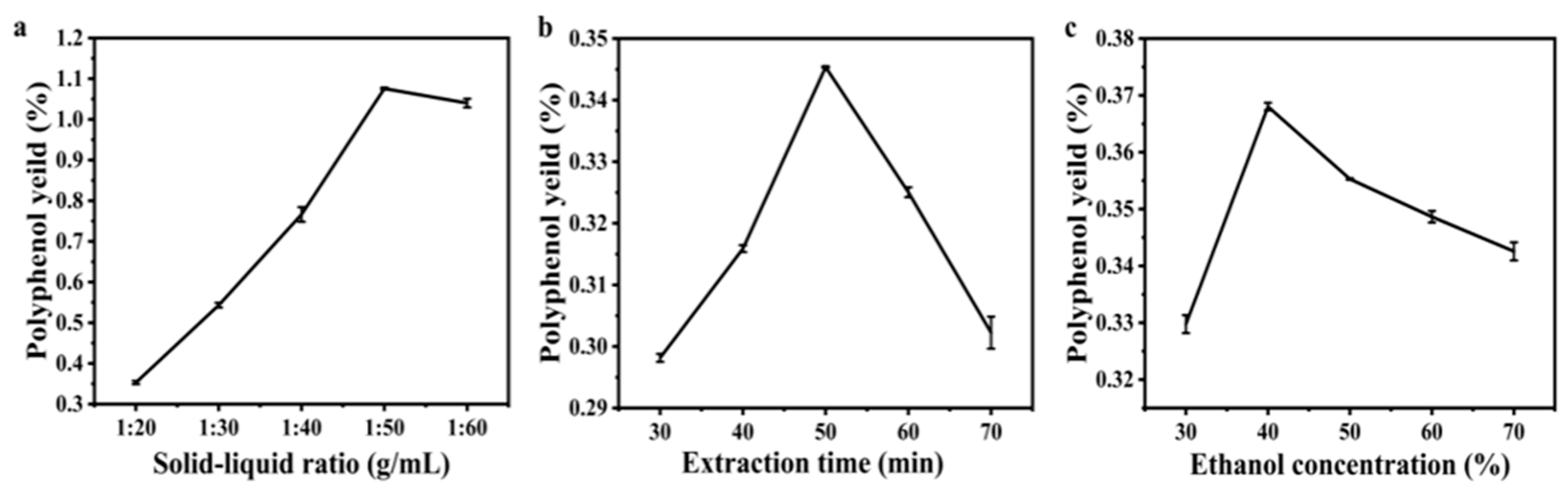
The relationship between the concentration of gallic acid (x) and absorbance (y) fitted the standard curve: y = 3.8469x + 0.0075. Polyphenol content was calculated based on this regression. The polyphenol content initially increased, then decreased with a rising solid–liquid ratio. The highest polyphenol content was achieved at a solid–liquid ratio of 1:50, after which it continuously declined with further increasing solid–liquid ratio (Figure 1a). This may be attributed to the fact that a low solid–liquid ratio restricts sufficient contact between the sample and the solvent, while an excessively high ratio may increase the dissolution of impurities and even cause the degradation of polyphenols [24]. Extraction time significantly impacted polyphenol dissolution, reaching its peak at 50 min. At this point, polyphenol was mostly dissolved, and extending the ultrasonic time beyond 50 min resulted in decreased polyphenol content (Figure 1b). This may be attributed to the loss of target bioactive components caused by excessive extraction. The effect of ethanol concentration on polyphenol extraction yield follows a similar pattern, peaking at 40% ethanol concentration. Beyond this point, the polyphenol content decreases consistently (Figure 1c). As documented by Rahimah et al., 40% ethanol offers the optimal polarity for recovering phenolic compounds from edible mushrooms, as higher ethanol levels increase the solubility of unwanted macromolecules and reduce the extraction selectivity for polyphenols [25].

2.1.2. Polyphenol BBD Analysis

The extraction temperature, extraction time and solid–liquid ratio were further optimized by BBD based on the results of single-way experiments. Table 1 shows the experimental data of BBD under different combinations of extraction conditions. Table 2 shows the results of ANOVA. Accordingly, the second-order polynomial equation was established as follows:
Y = 9.16012 + 0.123691 × A + 0.143075 × B + 0.162185 × C 0.0001375 × A × B 7.5   ×   10 5 × A × C + 3   ×   10 5 × B × C 0.0014058 × A 2 0.0013893 × B 2 0.0015433 × C 2
From Table 2, it is evident that the model’s regression is highly significant (p < 0.0001), with a lack of fit of 0.3369, exceeding the significance threshold of 0.05. This indicates a strong model fit, capable of depicting the relationship between the response value and various factors. ANOVA showed that the model was significant, while the linear term of extraction time (A) was insignificant (p = 0.7567). Primary items B, along with secondary factors A2, B2 and C2, exhibited extremely significant differences. The effects of the three factors on polyphenol extraction ranked as follows: Solid–liquid ratio (B) > Ethanol concentration (C) > Extraction time (A). This ranking was observed despite the insignificance of the linear term for A, which could be attributed to the highly significant quadratic term (A2, p < 0.0001) masking the non-significance of its linear term.

2.1.3. Interactions in BBD Experiments of Polyphenol Extraction

Based on the fitted equations, three-dimensional response surface plots of different factors on the composite scores were developed using Design-Expert 8.0.6 software.
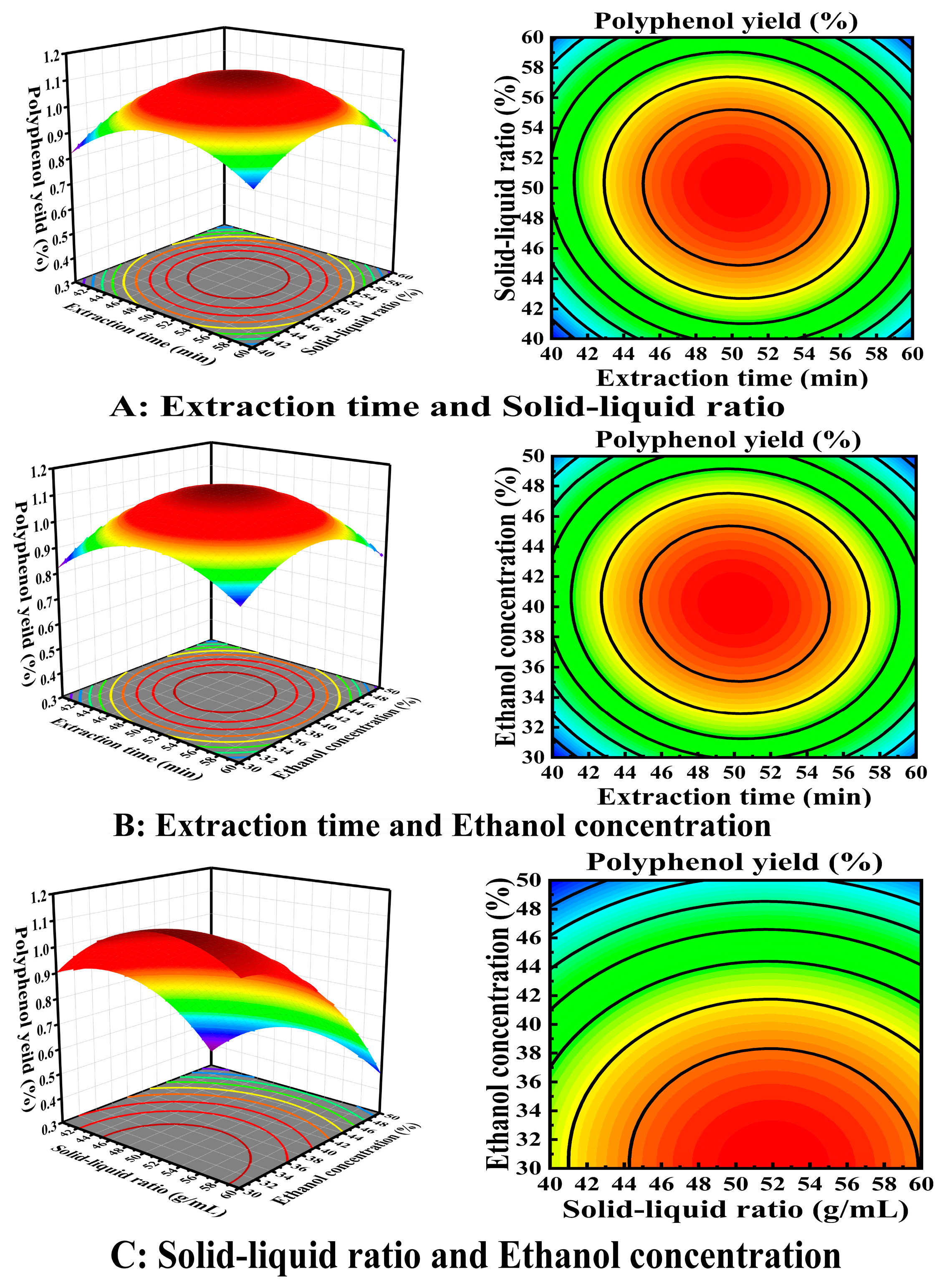
As shown in Figure 2, the interaction between the polyphenol extraction variables was visualized on a three-dimensional surface reflecting the combined effect of a number of factors on the response values when they intersect. Figure 2A shows that when the ethanol concentration remained constant, the yield first increased with increasing extraction time. After the highest yield was reached, the yield decreased with increasing extraction time; the yield increased and then decreased as the solid–liquid ratio increased. Figure 2B shows that when the solid–liquid ratio was constant, the polyphenol yield first showed a rapid upward trend with increasing extraction time. When the extraction time increased to a certain value, the polyphenol yield decreased immediately; the polyphenol yield decreased with increasing ethanol concentration. Figure 2C shows that when the extraction time was constant, the polyphenol yield first increased and then decreased with increasing solid–liquid ratio and the ethanol concentration increased; the polyphenol yield first increased, but after the highest peak was reached, the yield decreased with the solid–liquid ratio. The results show that the response surface plot for AC is steeper for this interaction term, indicating that AC has a significant effect on the composite score.

2.1.4. Experimental Verification of Polyphenol Extraction

The optimal extraction conditions of polyphenol from H. erinaceus were obtained by the Box–Behnken experiment, under the extraction conditions of extraction time 56.85 min, solid–liquid ratio 1:56.71 g/mL, and ethanol concentration 44.64%; the theoretical prediction value of polyphenol yield was 0.9960%. We repeated the experiment three times under those conditions, and the average polyphenol yield from H. erinaceus was 0.9985 ± 0.03%, which is basically consistent with the predicted value and further verifies the feasibility of the theoretical model. Notably, the targeted components in this extraction study mainly comprised polyphenolic compounds (such as protocatechuic acid, gallic acid, p-coumaric acid) from H. erinaceus, and the optimized conditions were precisely screened to enable efficient extraction of these bioactive substances.

2.2. Analysis of the Extracts by LC-MS

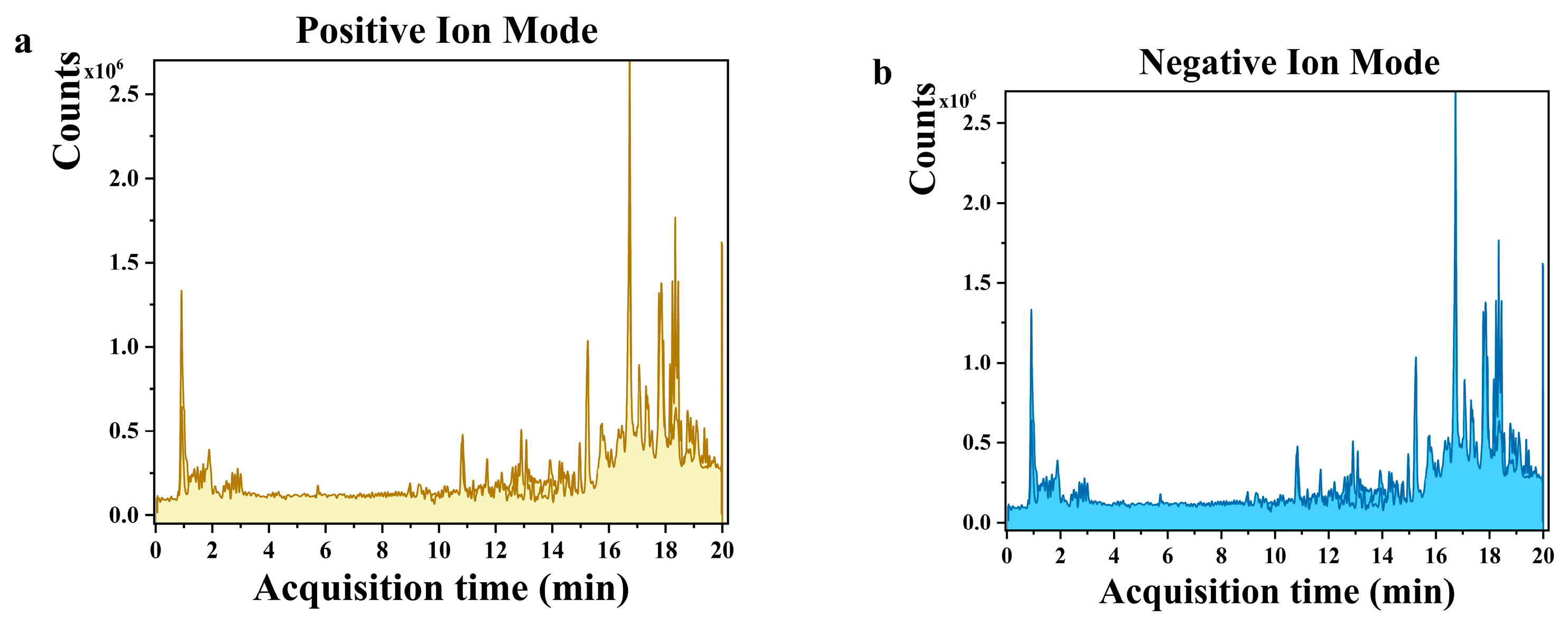
The crude extract of H. erinaceus was analyzed using LC-MS with electrospray ionization. Figure 3 shows the spectra for both positive and negative ion modes.
By comparing the acquired high-resolution mass spectrometry data against an established spectral library, 48 and 64 chemical constituents in negative ion modes (Table 3) and positive ion modes (Table 4) were tentatively identified, respectively. These constituents cover multiple compound classes, including primary metabolites such as sugar alcohols, organic acids, free amino acids, and small peptides, as well as lipid components including glycerophospholipids, fatty acids and their oxidized derivatives, together with several terpenoids, steroids and mushroom-specific bioactive components. In addition, compounds including D-arabitol, D-(+)-malic acid, and uridine diphosphate-N-acetylglucosamine are consistent with the results reported by Sevindik [11]. The results confirm the presence of multiple bioactive compounds in the extract, though their specific biological functions remain to be further validated experimentally.

2.3. Antioxidant Activity

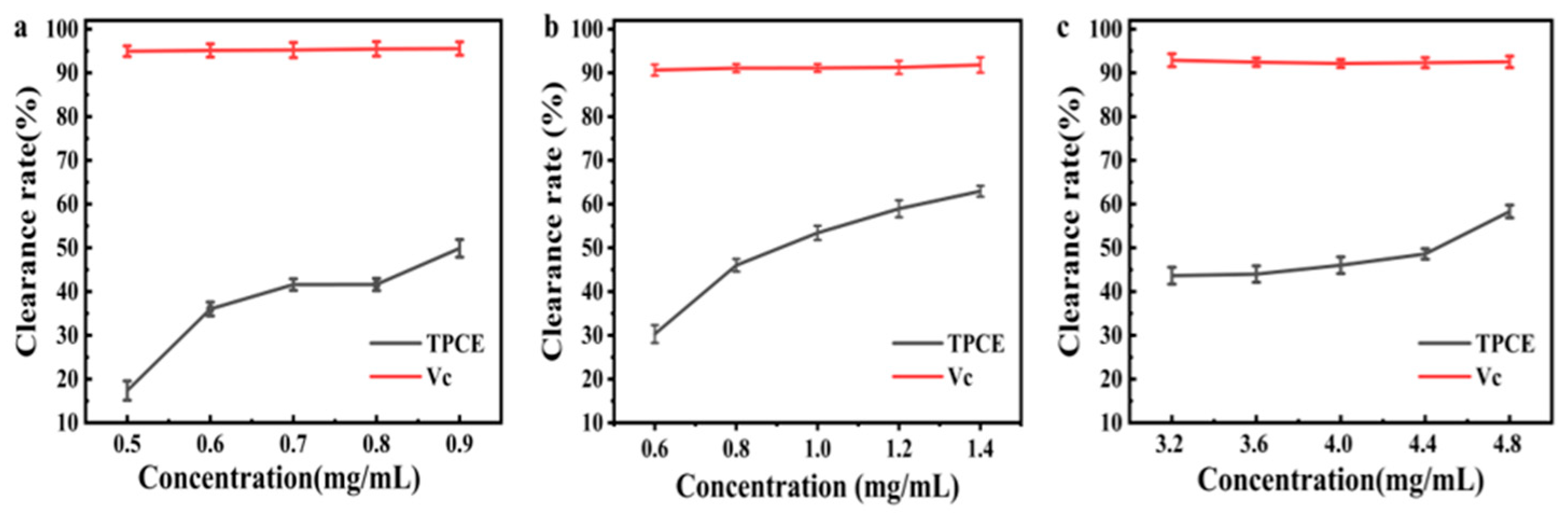
As depicted in Figure 4, the scavenging effects of TPCE on ABTS+·, ·OH, and DPPH· radicals show a concentration-dependent enhancement with increasing TPCE concentration. TPCE showed markedly different scavenging capacities toward the three free radicals. Although its scavenging activity was lower than that of Vc within the tested concentration range, TPCE is a complex mixture rather than a monomeric compound, indicating its potential for strong antioxidant activity. Specifically, EC50 values of TPCE for ABTS+·, ·OH, and DPPH· were calculated as 0.8850 mg/mL, 0.9490 mg/mL, and 4.198 mg/mL, respectively. Compared with the reported EC50 values for analogous natural and edible mushroom extracts in the literature, the EC50 values determined in the present study fall well within the range of crude extracts with moderate antioxidant activity, except for a noticeably weaker DPPH radical scavenging capacity [26,27]. Based on LC-MS profiling, primary metabolites including D-arabitol, D-(+)-malic acid, uridine diphosphate-N-acetylglucosamine, together with terpenoids and mushroom-specific bioactive compounds, were suggested to contribute collectively to the antioxidant effects observed in this study, which was reported in the findings of Sevindik, M. et al. [11].

2.4. Enzyme Inhibitory Activity

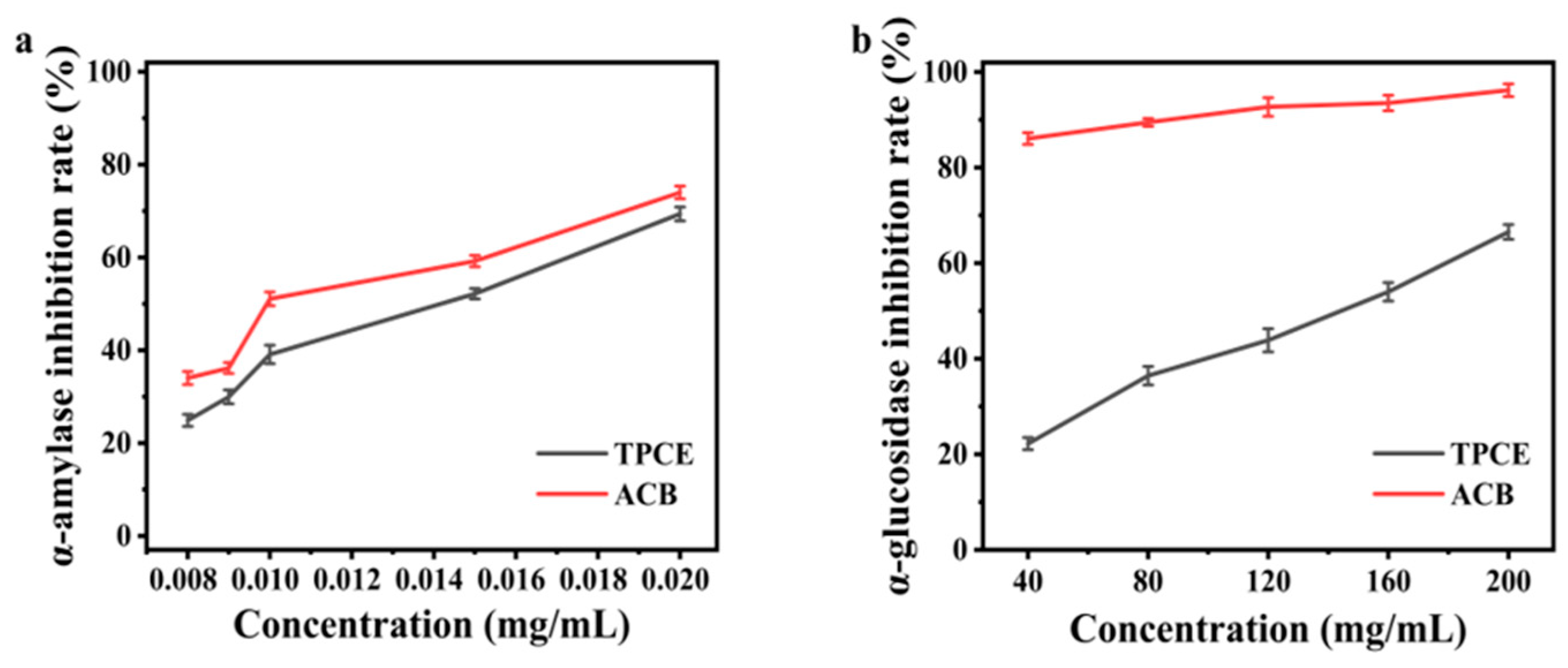
As shown in Figure 5a, the inhibition of α-amylase by TPCE intensified with increased concentrations. The inhibition rate improved from 24.91 ± 1.31% to 69.36 ± 1.49% as TPCE concentrations increased from 0.008 to 0.020 mg/mL, with an IC50 determined at 0.0135 mg/mL. Then, the inhibition of α-glucosidase by TPCE intensified with increased concentrations, as depicted in Figure 5b. The inhibition rate improved from 22.22 ± 1.26 to 66.54 ± 1.53% as TPCE concentrations increased from 40 to 200 mg/mL, with an IC50 determined at 130.3 mg/mL. For the reaction of the positive control, the IC50 values of ACB on the α-amylase and α-glucosidase enzymes were 0.0113 mg/mL and 2.028 mg/mL, respectively.
The results demonstrated that TPCE exhibited favorable inhibitory activity against α-amylase, with IC50 data similar to that of the positive control drug. However, its inhibitory effect on α-glucosidase was weaker than that of the positive control. When compared with literature data for similar wild edible mushroom crude extracts, the IC50 values of TPCE against both α-amylase and α-glucosidase fell within the reported ranges for mushroom-derived hypoglycemic agents. Regarding the enzyme inhibitory activity, multiple compounds identified in TPCE and widely reported in the literature exerted potent α-amylase and α-glucosidase inhibitory effects, including polysaccharides, phenolic derivatives, terpenoids, malic acid, and sugar alcohols, which are believed to act synergistically to contribute to the observed antidiabetic potential of TPCE [28,29]. TPCE, as a crude extract, exhibited IC50 against α-amylase very close to that of the positive control ACB, indicating its potent inhibitory activity against this enzyme. Given that TPCE is a crude extract while the positive control is a pure compound, these findings indicate that TPCE possesses potential for development as an antidiabetic agent. In future studies, we will further investigate the active monomers present in TPCE.

3. Materials and Methods

3.1. Reagents and Materials

Materials: Dried H. erinaceus from Jilin Province was crushed and sieved through an 80 mesh sieve. Folin–Ciocalteu reagent (10% (v/v)) and anhydrous ethanol analytical grade) were acquired from Beijing Chemical Reagent Co., Ltd. (Beijing, China). Gallic acid standard, L-ascorbic acid (Vc), ferrous sulfate, 2,2-Diphenyl-1-Picrylhydrazyl (DPPH), hydrogen peroxide, salicylic acid, 2,2′-Azinobis-(3-Ethylbenzthiazoline-6-Sulphonic acid) (ABTS), Acarbose (ACB), α-glucosidase, and α-amylase were purchased from Shanghai Yuanye Biotechnology Co., Ltd. (Shanghai, China). DNS reagent came from Beijing Soleberg Technology Co., Ltd. (Beijing, China).
Equipment: Numerical control ultrasonic cleaner (Kunshan Hechuang Ultrasonic Instrument Co., Ltd., Kunshan, China); Rotary evaporator (Heidolph, Schwabach, Germany); High-speed refrigerated centrifuge (Sigma, Cream Ridge, NJ, USA); Multifunctional microplate reader (Molecular Devices, San Jose, CA, USA); UHPLC-QTOF system (Agilent Technologies Co., Ltd., Santa Clara, CA, USA).

3.2. Optimization of Polyphenol Extraction Process

3.2.1. Polyphenol Standard Curve

Polyphenol content was quantified using a standard curve with gallic acid as the reference standard, the most widely adopted compound for Folin–Ciocalteu (F-C) total phenolic analysis due to its stability, consistent reactivity with F-C reagent, and common use in phytochemical studies [29]. Concentrations of 0.016–0.08 mg/L gallic acid standard solution were added. Another 0.5 mL of 10% F-C reagent and 1 mL of 10% Na2CO3 were added in sequence. Then, the solution was placed in the dark for 0.5 h, and the absorbance (A) was measured at a wavelength of 760 nm. The abscissa was taken as the solution concentration, and the ordinate was taken as the absorbance A760 to form a standard working curve [30].

3.2.2. Determination of Polyphenol Yield

Following extraction, the polyphenol yield from H. erinaceus was calculated according to the following formula [31]:
Y = ( C × V × n / m ) × 100 %
where C is the mass concentration of H. erinaceus polyphenol calculated according to the absorption value, %; V is the total amount of H. erinaceus polyphenol extract volume, mL; m is the weight of H. erinaceus, mg; and n is the dilution ratio.

3.2.3. Effect of Solid–Liquid Ratio on Polyphenol Yield

Five parts of 1 g of H. erinaceus power were accurately weighed in a 100 mL Erlenmeyer flask, the extraction conditions were fixed, with an ethanol solvent of 60%, extraction time of 50 min, ultrasonic power of 400 W, and extraction temperature of 25 °C. Subsequently, a single-factor test was conducted by adjusting the solid–liquid ratio. Each experiment was duplicated twice, and the two extracts were merged. The filtrate was concentrated under reduced pressure and djusted to 5 mL with 60% ethanol prior to the determination of polyphenol yield.

3.2.4. Effect of Extraction Time on Polyphenol Yield

After accurately weighing five aliquots of 1 g each of H. erinaceus power and transferring each aliquot to a 100 mL Erlenmeyer flask, the extraction conditions were kept constant: 60% ethanol was used as the extraction solvent, the solid–liquid ratio was set at 1:20 (g/mL), the ultrasonic power was fixed at 400 W, and the temperature was maintained at 25 °C. Subsequently, a single-factor experiment was performed by varying only the extraction time. Each experiment was duplicated twice, and the two extracts were merged. The filtrate was concentrated under reduced pressure, and djusted to 5 mL with 60% ethanol, prior to the determination of polyphenol yield.

3.2.5. Effect of Ethanol Concentration on Polyphenol Yield

Five 1 g aliquots of H. erinaceus power were precisely weighed, with each aliquot placed into a 100 mL Erlenmeyer flask; the extraction parameters were maintained at constant values: a solid–liquid ratio of 1:20 (g/mL), extraction duration of 50 min, ultrasonic power of 400 W, and ultrasonic temperature of 25 °C. A single-factor assay was then performed, where the only variable was the concentration of ethanol used for extraction. Each experiment was duplicated twice, and the two extracts were merged. The filtrate was concentrated under reduced pressure and djusted to 5 mL with 60% ethanol prior to the determination of polyphenol yield.

3.2.6. Polyphenol Extraction BBD Response Surface Method Experimental Design

The experimental scheme was obtained using Design-Expert 8.0 software and BBD. Based on the results of the one-factor test, the main factors with significant effects on polyphenol yield were selected, and according to the principle of Box–Behnken central combination experimental design, a three-factor, three-level central composite design was carried out with the polyphenol yield of H. erinaceus as the response value. The experiment was repeated three times, and the polyphenol yield response values were obtained and averaged for data analysis. As shown in Table 5, the experimental factors and levels used the fitted second-order polynomial model volume:
Y = i = 1 3 β i X i + i = 1 3 β i i X i 2 + i = 1 2 j = i + 1 3 β i j X i X j
where Y is the predicted response; βi, βii and βij are regression coefficients of intercept term, linear term, quadratic term and interaction term, respectively, and Xi and Xj are coding parameters.

3.3. LC-MS Analysis

LC-MS analysis was performed using an Agilent 1290II-6545 UHPLC-QTOF system, equipped with a Waters (Milford, MA, USA) ACQUITY UPLC BEH C18 (2.1 × 50 mm, 1.7 µm). The mobile phase consisted of two components; mobile phase A comprised 0.1% formic acid in water, while mobile phase B was 0.1% formic acid solution in acetonitrile. Data were collected in both positive and negative ionization modes. The full scan was conducted at 100 to 3000 m/z.
H. erinaceus extract was prepared using 80% methanol solution, filtered with a 0.22 µm microporous nylon membrane, and then evaluated.

3.4. Determination of Antioxidant Activity

3.4.1. ABTS+· Radical Scavenging Assay

An ABTS+· radical scavenging capacity assay was performed with minor modifications in reference to the method of Re et al. [32]. To evaluate the ABTS+· radical scavenging capacity of TPCE, a reaction mixture consisting of 7 mM ABTS reagent and 140 mM potassium persulfate (K2S2O8) was prepared. This mixture was then incubated in the dark at 4 °C for 12 h, to facilitate the generation of ABTS+· radicals. Subsequently, 100 μL of TPCE samples with various concentrations were separately mixed thoroughly with 100 μL of the ABTS+· stock solution. After standing in the dark for 30 min, the absorbance of each mixture was measured at a wavelength of 734 nm. Each group of experiments was performed in triplicate to ensure the reliability and reproducibility of the experimental results. The absorbance of the sample reaction system was denoted as Ai, while A0 represented the absorbance measured by substituting the sample with the sample solvent. Aj was defined as the absorbance obtained when the ABTS+· solution was replaced by the sample solvent. Vc served as the positive control, and the ABTS+· radical scavenging activity was calculated by applying the following formula:
ABTS + .   radical   scavenging   rate   =   1     ( A i     A j ) / A 0   ×   100 %

3.4.2. OH· Radical Scavenging Assay

The free radical was determined using the method of Smirnof and Geng with minor modifications [33,34]. A volume of 50 μL TPCE sample solutions was mixed with 50 μL of 50 mmol/L ferrous sulfate (FeSO4) solution, 50 μL of 10 mmol/L salicylic acid–ethanol solution, and 50 μL of 3% hydrogen peroxide (H2O2) solution. The resulting mixture was incubated in the dark for 30 min. Triplicate measurements were carried out for each experimental group to ensure the reliability and repeatability of the results. After the incubation period, the absorbance of reaction system (designated as Areaction) was measured at a wavelength of 510 nm. For the control group (Acontrol), distilled water was used to replace the salicylic acid–ethanol solution, and the corresponding absorbance was recorded. For the blank group (Ablank), the sample was substituted with the sample solvent, and its absorbance was measured as well. Vc was employed as the positive control, and the OH· radical scavenging capacity was computed in accordance with the following formula:
O H .   r a d i c a l   s c a v e n g i n g   r a t e = 1 A r e a c t i o n A c o n t r o l A b l a n k × 100 %
where A r e a c t i o n represents the absorbance of the sample, A c o n t r o l represents the absorbance of the blank control group, and A b l a n k represents the absorbance of the sample without hydrogen peroxide.

3.4.3. DPPH· Radical Scavenging Assay

The experiments were carried out using the method described in Brand-Williams [35]. TPCE samples with different concentration gradients (100 μL each) were individually mixed with 100 μL of DPPH· solution. Each experimental group was run in triplicate to ensure that the experimental results were reliable and reproducible. After incubating the mixture for 30 min, the absorbance (denoted as Ai) was determined at a wavelength of 517 nm. The control absorbance values were recorded: Aj was measured by substituting the TPCE sample with the sample solvent, while Ac was obtained by replacing the DPPH· solution with anhydrous ethanol. Vc was used as the positive control, and the DPPH· radical scavenging capacity was calculated by means of the following formula:
D P P H .   c l e a r a n c e = 1 ( A i A j ) / A c × 100 %

3.5. Determination of Inhibition Rate

3.5.1. Determination of α-Amylase Inhibition Rate

The experiments were carried out using the method described in Padilla-Camberos, et al. [36]. TPCE solutions (0.008–0.020 mg/mL) in volumes of 100 µL were mixed with 50 µL of α-amylase (1.0 U/mL); following a 15 min incubation period at 37 °C, 50 µL of 1% (w/v) soluble starch was added, and the solutions were then incubated for a further 10 min. Subsequently, 100 µL of DNS was introduced into the mixture, and then heated at 100 °C for 5 min. After cooling, 1 mL of distilled water was added, and the absorbance at 540 nm was measured. Each experimental group was run in triplicate to ensure that the experimental results were reliable and reproducible. The inhibition rate was calculated using the following equation:
I n h i b i t i o n   r a t e = 1 ( A 1 A 2 ) / ( A 0 A 0 ) × 100 %
where A1, A2, A0, and A0 are the absorbances at 540 nm for the sample group, blank sample group, control group, and blank control group, respectively. IC50 was determined from the regression equation of the inhibition curve.

3.5.2. Determination of α-Glucosidase Inhibition Rate

The experiments were carried out using the method described in Yao et al. [37]. TPCE solutions (5–160 mg/mL) in volumes of 100 µL were mixed with 50 µL of α-glucosidase solution (0.5 U/mL). The mixture was subsequently incubated at 37 °C for 15 min. Subsequently, 100 µL of PNPG (5.0 mmol/L) was added to the reaction mixture, which was then incubated at 37 °C for 10 min. The reaction was terminated by the addition of 750 µL of Na2CO3 (1.0 mol/L), and the absorbance was recorded at 405 nm. Triplicate measurements were carried out for each experimental group to ensure the reliability and repeatability of the results. The inhibition rate was calculated using the following equation:
I n h i b i t i o n   r a t e = 1 ( A 1 A 2 ) / ( A 0 A 0 ) × 100 %
where A1, A2, A0, and A0 are the absorbances at 405 nm for the sample group, blank sample group, control group, and blank control group, respectively. IC50 was determined from the regression equation of the inhibition curve.

4. Conclusions

In this research, ultrasound-assisted extraction was employed to extract polyphenols from H. erinaceus, and the effects of extraction duration, solid–liquid ratio, and ethanol concentration on polyphenol yield were systematically evaluated. Subsequent optimization via BBD response surface methodology determined the optimal extraction parameters: extraction time of 56.85 min, solid–liquid ratio of 1:56.71 g/mL, and ethanol concentration of 44.64%, under which the TPCE yield reached 0.9985 ± 0.03%, verifying the effectiveness and reproducibility of the optimized extraction protocol for H. erinaceus polyphenols. In addition, LC-MS analysis tentatively identified multiple bioactive constituents in TPCE (including polysaccharides, phenolics, terpenoids, malic acid, and sugar alcohols), laying a preliminary chemical foundation for the observed bioactivities. In vitro bioactivity assessments revealed that TPCE possessed notable free radical scavenging capacity, with the potency ranking ABTS+· > ·OH > DPPH·, corresponding to EC50 values of 0.8850 mg/mL, 0.9490 mg/mL, and 4.198 mg/mL, respectively. Furthermore, TPCE exhibited remarkable inhibitory activity against carbohydrate-digesting enzymes, with IC50 values of 0.0135 mg/mL for α-amylase and 130.3 mg/mL for α-glucosidase; the IC50 of ACB on α-amylase was 0.0113 mg/mL, indicating that TPCE possesses favorable inhibitory activity against α-amylase. Collectively, these quantitative and qualitative findings provide robust scientific evidence supporting the nutritional and medicinal value of H. erinaceus and highlight its promising application potential as a natural adjudicative agent for blood glucose regulation and oxidative stress relief.

Author Contributions

Methodology, S.P.; Formal analysis, L.C.; Investigation, H.L., S.P. and Y.S.; Writing—original draft, H.L. and C.Z.; Writing—review and editing, J.W.; Visualization, H.L. and C.Z.; Supervision, L.C., J.W. and H.B. All authors have read and agreed to the published version of the manuscript.

Funding

This research was supported by the Natural Science Foundation of Changchun Normal University (CSJJ2025003ZK) and the Natural Science Foundation of Jilin Province (YDZJ202601ZYTS266).

Institutional Review Board Statement

This research exclusively focuses on the extraction, isolation, and bioactivity evaluation of bioactive compounds from Hericium erinaceus; no studies involving human subjects, animal testing, or clinical samples were performed by any of the authors.

Informed Consent Statement

Not applicable.

Data Availability Statement

Data are contained within the article.

Acknowledgments

The authors gratefully acknowledge the technical support provided by the National Local Joint Engineering Laboratory for Natural Medicine Separation, Purification and Activity Screening Technology, and Jilin Provincial Innovation Laboratory for Research and Development of Cold-Region Economic Plants and Edible-Medicinal Fungi.

Conflicts of Interest

The authors declare no conflict of interest.

References

  1. Soković, M.; Glamočlija, J.; Ćirić, A.; Petrović, J.; Stojković, D. Mushrooms as sources of therapeutic foods. In Therapeutic Foods; Academic Press: Cambridge, MA, USA, 2018; pp. 141–178. [Google Scholar] [CrossRef]
  2. Nguyen, B.T.; Ngo, N.; Le, V.; Nguyen, L.; Tran, A.; Nguyen, L.H. Identification of Optimal Culture Conditions for Mycelial Growth and Cultivation of Monkey Head Mushrooms (Hericium erinaceus (Bull.: fr.) Pers). Vietnam. J. Agric. Sci. 2018, 1, 117–126. [Google Scholar] [CrossRef]
  3. Wang, F.; Wang, K.; Cai, L.; Zhao, M.; Kirk, P.M.; Fan, G.; Sun, Q.; Li, B.; Wang, S.; Yu, Z. Fungal names: A comprehensive nomenclatural repository and knowledge base for fungal taxonomy. Nucleic Acids Res. 2023, 51, D708–D716. [Google Scholar] [CrossRef]
  4. Deshmukh, S.K.; Sridhar, K.R.; Gupta, M.K. Hericium erinaceus—A Rich Source of Diverse Bioactive Metabolites. Fungal Biotechnol. 2021, 1, 10–38. [Google Scholar] [CrossRef]
  5. Qiu, Y.; Lin, G.; Liu, W.; Zhang, F.; Linhardt, R.J.; Wang, X.; Zhang, A. Bioactive compounds in Hericium erinaceus and their biological properties: A review. Food Sci. Hum. Wellness 2024, 13, 1825–1844. [Google Scholar] [CrossRef]
  6. Thongbai, B.; Rapior, S.; Hyde, K.D.; Wittstein, K.; Stadler, M. Hericium erinaceus, an amazing medicinal mushroom. Mycol. Prog. 2015, 14, 91. [Google Scholar] [CrossRef]
  7. Pan, F.; Liu, X.; Qiao, M.; Liu, J.; Pang, Y.; Zhang, M.; Yu, W. Innovative composite systems for enhancing plant polyphenol stability and bioavailability. Food Sci. Biotechnol. 2025, 34, 1819–1834. [Google Scholar] [CrossRef] [PubMed]
  8. Asfaw, D.E. Antioxidant Properties of Phenolic Compounds to Manage Oxidative Stress/A Review. J. Adv. Agron. Crop 2023, 1, 1–16. [Google Scholar] [CrossRef]
  9. Banwo, K.; Olojede, A.O.; Adesulu-Dahunsi, A.T.; Verma, D.K.; Thakur, M.; Tripathy, S.; Singh, S.; Patel, A.R.; Gupta, A.K.; Aguilar, C.N.; et al. Functional importance of bioactive compounds of foods with Potential Health Benefits: A review on recent trends. Food Biosci. 2021, 43, 101320. [Google Scholar] [CrossRef]
  10. de Camargo, A.C.; Schwember, A.R. Phenolic-driven sensory changes in functional foods. J. Food Bioact. 2019, 5, 6–7. [Google Scholar] [CrossRef]
  11. Sevindik, M.; Gürgen, A.; Khassanov, V.T.; Bal, C. Biological Activities of Ethanol Extracts of Hericium erinaceus Obtained as a Result of Optimization Analysis. Foods 2024, 13, 1560. [Google Scholar] [CrossRef]
  12. Szydłowska-Tutaj, M.; Szymanowska, U.; Tutaj, K.; Domagała, D.; Złotek, U. The addition of reishi and lion’s mane mushroom powder to pasta influences the content of bioactive compounds and the antioxidant, potential anti-inflammatory, and anticancer properties of pasta. Antioxidants 2023, 12, 738. [Google Scholar] [CrossRef]
  13. Li, H.; Park, S.; Moon, B.; Yoo, Y.B.; Lee, Y.W.; Lee, C. Targeted phenolic analysis in Hericium erinaceum and its antioxidant activities. Food Sci. Biotechnol. 2012, 21, 881–888. [Google Scholar] [CrossRef]
  14. Darmasiwi, S.; Aramsirirujiwet, Y.; Kimkong, I. Antibiofilm activity and bioactive phenolic compounds of ethanol extract from the Hericium erinaceus basidiome. J. Adv. Pharm. Technol. Res. 2022, 13, 111–116. [Google Scholar] [CrossRef]
  15. Ruangchuay, S.; Wang, Q.Q.; Wang, L.Y.; Lin, J.; Wang, Y.C.; Zhong, G.H.; Maneenoon, K.; Huang, Z.B.; Chusri, S. Antioxidant and antiaging effect of traditional Thai rejuvenation medicines in Caenorhabditis elegans. J. Integr. Med. 2021, 19, 362–373. [Google Scholar] [CrossRef]
  16. Machado-Carvalho, L.; Martins, T.; Aires, A.; Marques, G. Optimization of phenolic compounds extraction and antioxidant activity from Inonotus hispidus using ultrasound-assisted extraction technology. Metabolites 2023, 13, 524. [Google Scholar] [CrossRef]
  17. Wu, X.Q.; Ding, H.F.N.; Hu, X.; Pan, J.H.; Liao, Y.J.; Gong, D.; Zhang, G.W. Exploring inhibitory mechanism of gallocatechin gallate on a-amylase and a-glucosidase relevant to postprandial hyperglycemia. J. Funct. Foods 2018, 48, 200–209. [Google Scholar] [CrossRef]
  18. Dzah, C.S.; Duan, Y.Q.; Zhang, H.H.; Wen, C.T.; Chen, G.Y.; Ma, H.L. The effects of ultrasound assisted extraction on yield, antioxidant, anticancer and antimicrobial activity of polyphenol extracts: A review. Food Biosci. 2020, 35, 100547. [Google Scholar] [CrossRef]
  19. Abugri, D.A.; McElhenney, W.H. Extraction of total phenolic and flavonoids from edible wild and cultivated medicinal mushrooms as affected by different solvents. J. Nat. Prod. Plant Resour. 2013, 3, 37–42. [Google Scholar]
  20. Takeuchi, T.M.; Pereira, C.G.; Braga, M.E.; Maróstica, M.R.; Leal, P.F.; Meireles, M.A.A. Low-pressure solvent extraction (solid–liquid extraction, microwave assisted, and ultrasound assisted) from condimentary plants. In Extracting Bioactive Compounds for Food Products; CRC Press: Boca Raton, FL, USA, 2008; pp. 137–218. [Google Scholar] [CrossRef]
  21. Naz, R.; Saqib, F.; Awadallah, S.; Wahid, M.; Latif, M.F.; Iqbal, I.; Mubarak, M.S. Food Polyphenols and Type II Diabetes Mellitus: Pharmacology and Mechanisms. Molecules 2023, 28, 3996. [Google Scholar] [CrossRef] [PubMed]
  22. Li, X.X.; Bai, Y.X.; Jin, Z.Y.; Svensson, B. Food-derived non-phenolic α-amylase and α-glucosidase inhibitors for controlling starch digestion rate and guiding diabetes-friendly recipes. LWT 2022, 153, 112455. [Google Scholar] [CrossRef]
  23. Husain, A.; Khanam, A.; Alouffi, S.; Shahab, U.; Alharazi, T.; Maarfi, F.; Khan, S.; Hasan, Z.; Akasha, R.; Farooqui, A.; et al. C-phycocyanin from cyanobacteria: A therapeutic journey from antioxidant defence to diabetes management and beyond. Phytochem. Rev. 2024, 24, 4489–4507. [Google Scholar] [CrossRef]
  24. Hu, D.B.; Xue, R.; Zhuang, X.C.; Zhang, X.S.; Shi, S.L. Ultrasound-assisted extraction optimization of polyphenols from Boletus bicolor and evaluation of its antioxidant activity. Front. Nutr. 2023, 10, 1135712. [Google Scholar] [CrossRef] [PubMed]
  25. Rahimah, S.B.; Djunaedi, D.D.; Soeroto, A.Y.; Bisri, T. The Phytochemical Screening, Total Phenolic Contents and Antioxidant Activities In Vitro of White Oyster Mushroom (Pleurotus ostreatus) Preparations. Open Access Maced. J. Med. Sci. 2019, 7, 2404–2412. [Google Scholar] [CrossRef]
  26. Rajendra Prasad, R.P.; Varshney, V.K.; Harsh, N.S.K.; Manoj Kumar, M.K. Antioxidant capacity and total phenolics content of the fruiting bodies and submerged cultured mycelia of sixteen higher Basidiomycetes mushrooms from India. Int. J. Med. Mushrooms 2015, 17, 933–941. [Google Scholar] [CrossRef]
  27. Ramesh, C.H.; Pattar, M.G. Antimicrobial properties, antioxidant activity and bioactive compounds from six wild edible mushrooms of western ghats of Karnataka. Pharmacogn. Res. 2010, 2, 107. [Google Scholar] [CrossRef]
  28. Deveci, E.; Çayan, F.; Tel-Çayan, G.; Duru, M.E. Inhibitory activities of medicinal mushrooms on α-amylase and α-glucosidase-enzymes related to type 2 diabetes. S. Afr. J. Bot. 2021, 137, 19–23. [Google Scholar] [CrossRef]
  29. Das, A.; Chen, C.M.; Mu, S.C.; Yang, S.H.; Ju, Y.M.; Li, S.C. Medicinal components in edible mushrooms on diabetes mellitus treatment. Pharmaceutics 2022, 14, 436. [Google Scholar] [CrossRef]
  30. Singleton, V.L.; Rossi, J.A. Colorimetry of total phenolics with phosphomolybdic-phosphotungstic acid reagents. Am. J. Enol. Vitic. 1965, 16, 144–158. [Google Scholar] [CrossRef]
  31. Liu, C.; Gong, F.; Chen, Y.; Xiong, Z.; Wang, C.; Li, J.; Guo, J. Comparison and Optimization of Three Extraction Methods for Epimedium polysaccharides. Separations 2024, 11, 296. [Google Scholar] [CrossRef]
  32. Re, R.; Pellegrini, N.; Proteggente, A.; Pannala, A.; Yang, M.; Rice-Evans, C. Antioxidant activity applying an improved ABTS radical cation decolorization assay. Free. Radic. Biol. Med. 1999, 26, 1231–1237. [Google Scholar] [CrossRef] [PubMed]
  33. Smirnoff, N.; Cumbes, Q.J. Hydroxyl radical scavenging activity of compatible solutes. Phytochemistry 1989, 28, 1057–1060. [Google Scholar] [CrossRef]
  34. Geng, M.J.; Ren, M.X.; Liu, Z.L.; Shang, X.J. Free radical scavenging activities of pigment extract from Hibiscus syriacus L. petals in vitro. Afr. J. Biotechnol. 2012, 11, 429–435. [Google Scholar] [CrossRef]
  35. Brand-Williams, W.; Cuvelier, M.E.; Berset, C. Use of a Free Radical Method to Evaluate Antioxidant Activity. LWT—Food Sci. Technol. 1995, 28, 25–30. [Google Scholar] [CrossRef]
  36. Padilla-Camberos, E.; Lazcano-Díaz, E.; Flores-Fernandez, J.M.; Owolabi, M.S.; Allen, K.; Villanueva-Rodríguez, S. Evaluation of the Inhibition of Carbohydrate Hydrolyzing Enzymes, the Antioxidant Activity, and the Polyphenolic Content of Citrus limetta Peel Extract. Sci. World J. 2014, 2014, 121760. [Google Scholar] [CrossRef]
  37. Yao, M.; Liu, J.; Zhou, F.; Li, H.; Wang, R.; Han, Z.; Liu, J.; Chen, W.; Liu, G.; Yang, S.; et al. α-Glucosidase inhibitory activity of polyphenol-rich sugarcane extract: Screening and mechanistic insights based on biolayer interferometry-mass spectrometry. Front. Nutr. 2025, 12, 1575409. [Google Scholar] [CrossRef] [PubMed]
Figure 1. Effects of different factors on ultrasonic extraction of polyphenol from H. erinaceus. (a). Effect of solid–liquid ratio on polyphenol yield; (b). Effect of extraction time on polyphenol yield; (c). Effect of ethanol concentration on polyphenol yield.
Molecules 31 01138 g001
Figure 2. Response Surface and contour map of interaction between three factors affecting H. erinaceus polyphenol extraction content.
Molecules 31 01138 g002
Figure 3. Positive and negative ion mode spectra. (a) Positive ion mode spectra; (b) negative ion mode spectra.
Molecules 31 01138 g003
Figure 4. The scavenging activities of TPCE against three types of free radicals. (a) ABTS+·, (b) ·OH, (c) DPPH·.
Molecules 31 01138 g004
Figure 5. Inhibition of two enzymatic activities by different concentrations of TPCE. (a) α-amylase, (b) α-glucosidase.
Molecules 31 01138 g005
Table 1. BBD experimental results.
NumberA: Extraction Time
(min)
B: Solid–Liquid Ratio
(g/mL)
C: Ethanol Concentration
(%)
Polyphenol Yield
(%)
16050300.8399
24040400.7616
35050401.1139
45040300.7458
55060300.8965
65040500.7682
76050500.8291
84060400.8741
95050401.1038
104050300.8239
114050500.8681
126040400.7729
135050401.1309
146060400.8974
155050401.1305
165060500.8889
175050401.1197
Table 2. Regression equation model and analysis of variance.
SourceSum of SquaresdfMean SquareF-Valuep-Value
Model0.329490.0366225.88<0.0001 ***
A0100.10380.7567
B0.032310.0323199.37<0.0001 ***
C0.000310.00031.790.2225
AB0100.22210.6517
AC0.000810.00084.670.0676
BC0.000210.00021.390.2772
A20.081310.0813501.49<0.0001 ***
B20.100310.1003618.83<0.0001 ***
C20.083210.0832513.47<0.0001 ***
Residual0.001170.0002
Lack of Fit0.000630.00021.530.3369
Pure Error0.000540.0001
Cor Total0.330616
R20.9966
R2 Adj0.9922
R2 Pre0.9682
Adeq Precision38.0992
Note: *** indicates extremely significant differences, p < 0.001.
Table 3. Results of the negative ion modes.
NO.Retention Time
(min)
Mass-to-Charge Ratio (m/z)NameFormula
10.877227.0775L-IditolC6H14O6
20.903487.1816Ala His Met MetC19H32N6O5S2
30.908181.0728LathyrineC7H10N4O2
40.922573.1516Cys Asp Glu TyrC21H28N4O10S
50.932355.09365-Hydroxy-4-methoxy-3-methyl-2,6-canthinedioneC16H12N2O4
60.934231.03119-Hydroxy-4-methoxypsoralenC12H8O5
70.94387.1175Fructoselysine 6-phosphateC12H25N2O10P
80.945311.1028FlurprimidolC15H15F3N2O2
90.966439.08663,5-Dihydroxyphenyl 1-O-(6-O-galloyl-beta-D-glucopyranoside)C19H20O12
100.97151.062D-ArabitolC5H12O5
111.017133.0154D-(+)-Malic acidC4H6O5
121.026267.0742cis-ACCPC7H15N2O4P
131.065606.0768Uridine diphosphate-N-acetylglucosamineC17H27N3O17P2
141.074191.021Citric acidC6H8O7
151.345191.02012,3-Dioxogulonic acidC6H8O7
161.477231.01596-Cyano-7-nitroquinoxaline-2,3-dioneC9H4N4O4
171.673115.0039FormylpyruvateC4H4O4
1810.804740.4941PS(P-16:0/18:3(9Z,12Z,15Z))C40H72NO9P
1912.616429.1565Thr His Cys AlaC16H26N6O6S
2012.863429.156217β-hydroxy WortmanninC23H26O8
2113.911331.156Gibberellin A20C19H24O5
2214.731415.1771Erioflorin methacrylateC23H28O7
2315.716293.212alpha-kamlolenic acidC18H30O3
2415.733295.22839(R)-HODEC18H32O3
2515.982265.1486Lauryl hydrogen sulfateC12H26O4S
2616.378564.3322PE(20:2(11Z,14Z)/0:0)C25H48NO7P
2716.547459.2976Lys Lys Ser ValC20H40N6O6
2816.615489.3084Phe Ile Ile ValC26H42N4O5
2916.724333.22959,10-dihydroxy-hexadecanoic acidC16H32O4
3016.74379.2376EmopamilC23H30N2
3116.764279.23389(E),11(E)-Conjugated Linoleic AcidC18H32O2
3216.787459.3003Eicosapentaenoyl SerotoninC30H40N2O2
3316.813311.1691N-Undecylbenzenesulfonic acidC17H28O3S
3416.936339.23341,1′-[1,11-Undecanediylbis(oxy)]bisbenzeneC23H32O2
3517.116435.2983Termitomycamide BC28H40N2O2
3617.31669.5314Glycerol 1-dodecanoate 2-tetradecanoate 3-octanoateC37H70O6
3717.317281.2494C18:1n-13C18H34O2
3817.372451.2842PA(19:0/0:0)C22H45O7P
3917.407461.3134Sorbitan palmitateC22H42O6
4017.581325.18484-Dodecylbenzenesulfonic acidC18H30O3S
4117.766279.235Linoleic acidC18H32O2
4217.793413.1007DihydrogriseofulvinC17H19ClO6
4317.845293.1802Sodium Tetradecyl SulfateC14H30O4S
4417.926407.2488DimethamineC24H32N4O2
4518.393323.2209TOFAC19H32O4
4618.408255.2335Palmitic AcidC16H32O2
4718.786415.1156BAY-u3405C21H21FN2O4S
4819.453319.232120-HETEC20H32O3
Table 4. Results of the positive ion modes.
NO.Retention Time
(min)
Mass-to-Charge Ratio (m/z)NameFormula
10.86104.106CholineC5H14NO
20.971148.0601L-Glutamic acidC5H9NO4
31.01258.1098GlycerophosphocholineC8H21NO6P
41.064118.0855L-ValineC5H11NO2
51.689129.0543Methyl 4-oxo-2-pentenoateC6H8O3
61.867132.1024L-LeucineC6H13NO2
72.739166.0851DL-PhenylalanineC9H11NO2
810.841701.4922PC(10:0/18:0)C36H73NO8P
913.05353.1347Gibberellin A95C19H22O5
1013.943355.1492DinoctonC16H22N2O7
1115.053365.1321Ser Ser Gly AspC12H20N4O9
1215.17301.13937-MethylinosineC11H15N4O5
1315.225579.286Ala Arg Asp Pro ValC23H40N8O8
1415.281279.1563Monomenthyl succinateC14H24O4
1515.629357.25748-iso Prostaglandin E2-d4C20H28D4O5
1615.668401.2831Arg Ile IleC18H36N6O4
1715.723445.308717-phenyl trinor Prostaglandin F2α cyclopropyl amideC26H37NO4
1815.846489.3342(17Z)-1α,25-dihydroxy-26,27-dimethyl-17,20,22,22,23,23-hexadehydro-24a,24b-dihomovitamin D3/(17Z)-1α,25-dihydroxy-26,27-dimethyl-17,20,22,22,23,23-hexadehydro-24a,24b-dihomocholecalciferolC31H46O3
1916.371520.3338Thr Arg Arg AlaC19H38N10O6
2016.384542.3155Asn Pro Arg ArgC21H39N11O6
2116.393639.3999PA(18:2(9Z,12Z)/12:0)C33H61O8P
2216.435595.3745PS(22:2(13Z,16Z)/0:0)C28H52NO9P
2316.553437.2822HericerinC27H33O3
2416.592385.2883Kalkitoxin thioamide alcoholC21H40N2O2S
2516.598399.267610′-apo-beta-carotenalC27H36O
2616.615473.3394PhylloquinoneC31H46O2
2716.709341.262612-epi Leukotriene B4-d4C20H28D4O4
2816.712429.3139FesoterodineC26H37NO3
2916.722781.5185PI(P-18:0/13:0)C40H77O12P
3016.734357.2218(R,E)-S-2-acetamido-13-(methylamino)-13-oxotridec-3-enyl ethanethioateC18H32N2O3S
3116.753693.4676PG(12:0/18:1(9Z))C36H69O10P
3216.766605.4164PA(17:1(9Z)/12:0)C32H61O8P
3316.775737.4934PC(18:3(9Z,12Z,15Z)/13:0)C39H73NO8P
3416.792437.2832Pangamic acidC20H40N2O8
3516.866425.2824Lys Lys LysC18H38N6O4
3616.874413.28241α-fluoro-25-hydroxy-16,17,23,23,24,24-hexadehydrovitamin D3/1α-fluoro-25-hydroxy-16,17,23,23,24,24-hexadehydrocholecalciferolC27H37FO2
3716.888522.3488DipyridamoleC24H40N8O4
3817.102439.2978Apo-8′-lycopenalC30H40O
3917.501629.48841-(6-[5]-ladderane-hexanyl)-2-(8-[3]-ladderane-octanyl)-sn-glycerolC41H66O3
4017.646457.3445N-arachidonoyl vanillylamineC28H41NO3
4117.665427.2985LeupeptinC20H38N6O4
4217.667501.3704Deterrol stearateC33H50O2
4317.689589.422Arg Arg Leu LysC24H49N11O5
4417.788809.5503PI(P-20:0/13:0)C42H81O12P
4517.797853.5748PS(22:6(4Z,7Z,10Z,13Z,16Z,19Z)/18:0)C46H78NO10P
4617.798721.4987PG(14:0/18:1(9Z))C38H73O10P
4717.804585.46373,4-DihydrospheroidenoneC41H60O2
4817.804765.5238SpinetoramC42H69NO10
4917.832435.3627PetrosterolC29H48O
5017.835479.38842-Tricosanamidoethanesulfonic acidC25H51NO4S
5117.838677.4725Lansioside AC38H61NO8
5217.864633.447PA(17:0/14:1(9Z))C34H65O8P
5317.867369.29342,3-dinor-6-keto Prostaglandin F1α-d9C18H21D9O6
5417.875545.396DaphniphyllineC32H49NO5
5517.918413.3194N-Octadecyl-N’-propyl-sulfamideC21H46N2O2S
5617.944431.2388DeoxypyridinolineC18H29N4O7
5718.129515.3321Ile Leu Arg AsnC22H42N8O6
5818.256475.33975beta-Cholestane-3alpha,7alpha,12alpha,23,26-pentolC27H48O5
5918.37441.3139dolichyl phosphateC25H45O4P
6018.392401.3224,4′-DiapolycopeneC30H40
6119.09381.29331′H-5alpha-Androst-2-eno[3,2-b]indol-17beta-olC25H33NO
6219.101803.5327PE(22:6(4Z,7Z,10Z,13Z,16Z,19Z)/18:3(9Z,12Z,15Z))C45H72NO8P
6319.104413.2617Diisooctyl phthalateC24H38O4
6419.699451.3124N-arachidonoyl glutamic acidC25H39NO5
Table 5. Response surface BBD experimental factors and levels.
VariablesSymbolCoded Levels
−10+1
Extraction time (min)A405060
Solid–liquid ratio (g/mL)B405060
Ethanol concentration (%)C304050
Disclaimer/Publisher’s Note: The statements, opinions and data contained in all publications are solely those of the individual author(s) and contributor(s) and not of MDPI and/or the editor(s). MDPI and/or the editor(s) disclaim responsibility for any injury to people or property resulting from any ideas, methods, instructions or products referred to in the content.