Correction: Hui et al. Omics Reveals the Antibacterial Mechanism of Dihydromyricetin and Vine Tea Extract Against Staphylococcus aureus via Cell Wall and Membrane Disruption. Molecules 2026, 31, 313

1. Error in Figure/Table
2. Missing Citation
3. Text Correction
4. References
References
- Hui, Q.; Li, T.; He, K.; Ma, W.; Guo, Y.; Zhang, Y.; Song, L. Omics Reveals the Antibacterial Mechanism of Dihydromyricetin and Vine Tea Extract Against Staphylococcus aureus via Cell Wall and Membrane Disruption. Molecules 2026, 31, 313. [Google Scholar] [CrossRef] [PubMed]
- Yilmaz, M.A.; Ertas, A.; Yener, I.; Akdeniz, M.; Cakir, O.; Altun, M.; Demirtas, I.; Boga, M.; Temel, H. A Comprehensive Lc-Ms/Ms Method Validation for the Quantitative Investigation of 37 Fingerprint Phytochemicals in Achillea Species: A Detailed Examination of A. coarctata and A. monocephala. J. Pharm. Biomed. Anal. 2018, 154, 413–424. [Google Scholar] [CrossRef] [PubMed]


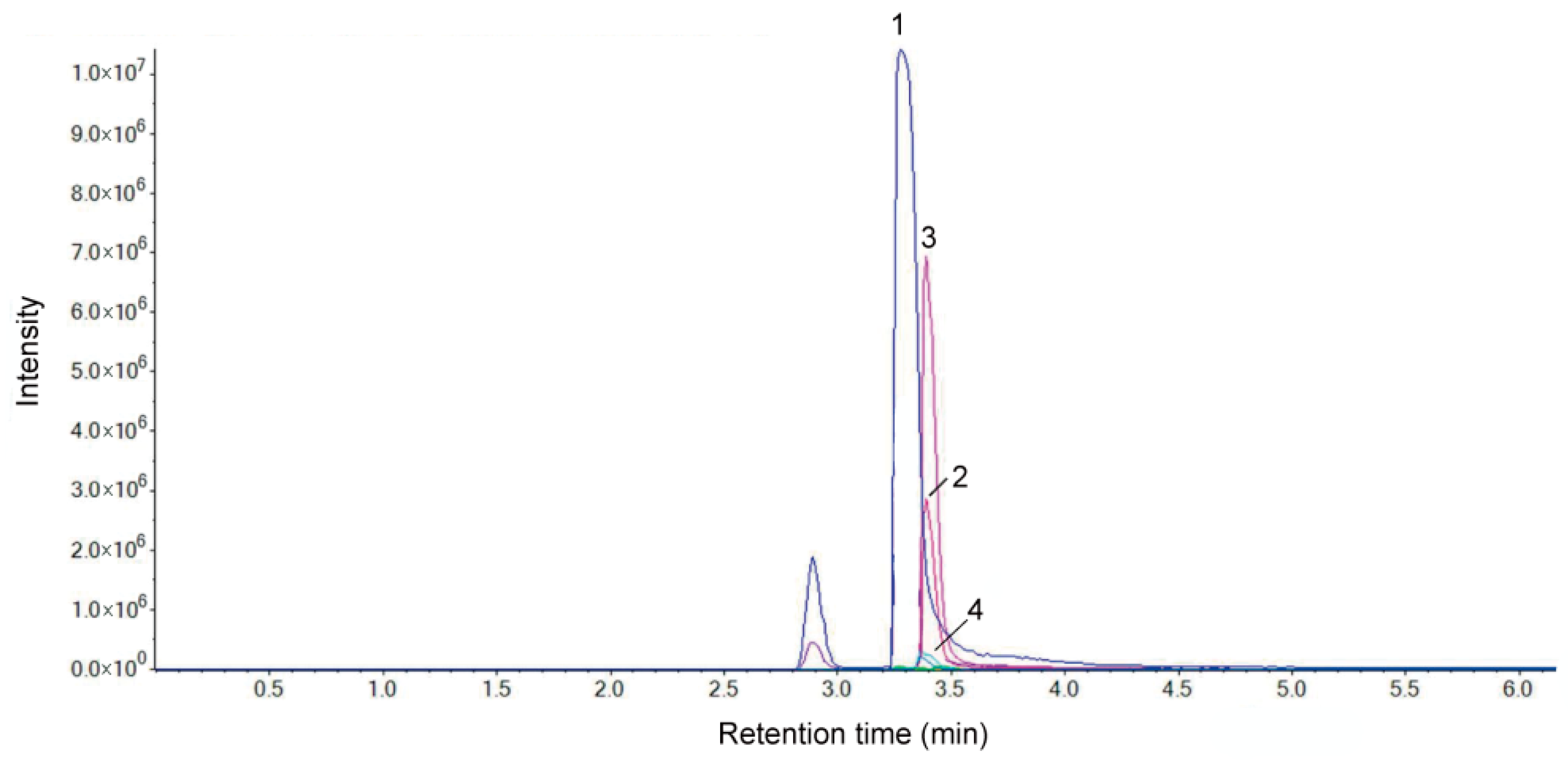
| Peak No. | Compound | RT (min) | Quantifier Transition (m/z) | Qualifier Transition (m/z) | Ion Ratio | Concentration (μg/mL) |
|---|---|---|---|---|---|---|
| 1 | Dihydromyricetin | 3.29 | 319.3/193.0 | 319.3/125.1 | 0.2724 (0.2498) | 2780.237 |
| 2 | Dihydroquercetin | 3.38 | 303.1/151.0 | 303.1/175.0 | 0.6823 (0.6235) | 157.658 |
| 3 | Myricetin-3-O-rhamnoside | 3.40 | 463.1/316.0 | 463.1/271.0 | 0.3520 (0.3605) | 308.769 |
| 4 | Myricetin | 3.46 | 317.0/151.0 | 317.0/179.0 | 0.7162 (0.7429) | 0.589 |
Disclaimer/Publisher’s Note: The statements, opinions and data contained in all publications are solely those of the individual author(s) and contributor(s) and not of MDPI and/or the editor(s). MDPI and/or the editor(s) disclaim responsibility for any injury to people or property resulting from any ideas, methods, instructions or products referred to in the content. |
© 2026 by the authors. Licensee MDPI, Basel, Switzerland. This article is an open access article distributed under the terms and conditions of the Creative Commons Attribution (CC BY) license.
Share and Cite
Hui, Q.; Li, T.; He, K.; Ma, W.; Guo, Y.; Zhang, Y.; Song, L. Correction: Hui et al. Omics Reveals the Antibacterial Mechanism of Dihydromyricetin and Vine Tea Extract Against Staphylococcus aureus via Cell Wall and Membrane Disruption. Molecules 2026, 31, 313. Molecules 2026, 31, 1081. https://doi.org/10.3390/molecules31071081
Hui Q, Li T, He K, Ma W, Guo Y, Zhang Y, Song L. Correction: Hui et al. Omics Reveals the Antibacterial Mechanism of Dihydromyricetin and Vine Tea Extract Against Staphylococcus aureus via Cell Wall and Membrane Disruption. Molecules 2026, 31, 313. Molecules. 2026; 31(7):1081. https://doi.org/10.3390/molecules31071081
Chicago/Turabian StyleHui, Qiaoni, Ting Li, Keke He, Wei Ma, Ying Guo, Yao Zhang, and Liya Song. 2026. "Correction: Hui et al. Omics Reveals the Antibacterial Mechanism of Dihydromyricetin and Vine Tea Extract Against Staphylococcus aureus via Cell Wall and Membrane Disruption. Molecules 2026, 31, 313" Molecules 31, no. 7: 1081. https://doi.org/10.3390/molecules31071081
APA StyleHui, Q., Li, T., He, K., Ma, W., Guo, Y., Zhang, Y., & Song, L. (2026). Correction: Hui et al. Omics Reveals the Antibacterial Mechanism of Dihydromyricetin and Vine Tea Extract Against Staphylococcus aureus via Cell Wall and Membrane Disruption. Molecules 2026, 31, 313. Molecules, 31(7), 1081. https://doi.org/10.3390/molecules31071081