Article

Synthesis and Biological Evaluation of Curvularin-Type Derivatives with Potential Anti-Inflammatory, Anticancer, and Antimicrobial Activities


1
Division of Life Sciences, Korea Polar Research Institute, Incheon 21990, Republic of Korea
2
CRYOTECH Inc., 2F-211-3, 71 Mieumsandan 5-ro 41beon-gil, Gangseo-gu, Busan 46744, Republic of Korea
3
Department of Marine Sciences, Incheon National University, Incheon 22012, Republic of Korea
4
Department of Polar Science, University of Science and Technology, Daejeon 34113, Republic of Korea
*
Authors to whom correspondence should be addressed.
These authors contributed equally to this work.
Molecules 2026, 31(6), 1061; https://doi.org/10.3390/molecules31061061
Submission received: 12 February 2026 / Revised: 11 March 2026 / Accepted: 21 March 2026 / Published: 23 March 2026
(This article belongs to the Special Issue Chemical Constituents and Biological Activities of Natural Sources)

Abstract

Curvularins, a class of macrocyclic lactones, have cytotoxic, antimicrobial, and anti-inflammatory properties. Curvularin, a 12-membered macrolactone, was used as a scaffold to design and synthesize structurally modified analogues to investigate structure–activity relationships and improve biological efficacy. Three series of curvularin-based analogues, Cur-5H-OMe, Cur-4P-OMe, and Cur-OMe, were synthesized with the same core structure but different substituent sizes and positions. Nine representative derivatives were evaluated for anti-inflammatory, anticancer, antibacterial, and antifungal activities. In LPS-stimulated RAW 264.7 macrophages, most compounds inhibited nitric oxide (NO) production in a concentration-dependent manner but exhibited cytotoxicity at high concentrations. Cytotoxicity assays against HaCaT cells and human cancer cell lines (HCT116, HeLa, and A375) revealed limited selectivity toward cancer cells. Antimicrobial evaluation indicated selective activity against the Gram-positive bacteria, Staphylococcus aureus. Compound 23 exhibited superior antibacterial potency compared with kanamycin and notable antifungal activity against Candida albicans. This study provides a versatile synthetic platform and identifies key structural features of curvularin derivatives, demonstrating their potential as anti-inflammatory and antimicrobial lead compounds.

1. Introduction

The exploration of extreme environments, particularly in polar marine ecosystems, has revealed several microorganisms that were previously unknown [1,2,3]. Among these, marine-derived fungi have emerged as a prolific and promising source of structurally unique and biologically active secondary metabolites [4,5]. Unlike terrestrial and mesophilic fungal species, marine psychrophilic fungi have adapted to survive and thrive under extreme environmental stressors, such as sub-zero temperatures, high salinity, and limited nutrient availability. These harsh conditions have driven the evolution of distinct metabolic pathways that enable the production of novel bioactive compounds [6,7,8]. Consequently, psychrophilic fungi have attracted growing interest in the fields of natural product chemistry, biotechnology, and pharmaceutical research.
Marine fungi isolated from polar environments are particularly noteworthy for their ability to biosynthesize metabolites with both unprecedented chemical scaffolds and a wide range of physiological functions. Many of these compounds have demonstrated antimicrobial, antifungal, anticancer, and anti-inflammatory properties [9,10,11,12]. Such characteristics render polar marine fungi an invaluable and relatively untapped reservoir for drug discovery and development. The fungi have biosynthetic gene clusters that differ significantly from those of more commonly studied fungi, opening new avenues for identifying structurally novel compounds with desirable pharmacological properties. Moreover, the increasing global demand for alternative therapies to treat chronic diseases, such as inflammation-related disorders, has further underscored the need to explore new and sustainable biological resources [13,14,15].
Among the marine-derived psychrophilic fungi investigated by our research group, the strain Penicillium sp. SF-5859 has shown particularly promising potential [16]. This strain was isolated from a marine sponge collected in the frigid waters of the Antarctic Ocean, an environment characterized by extreme cold and ecological isolation. During preliminary studies, this fungal isolate was found to produce a range of curvularin-type secondary metabolites. Curvularins are a class of macrocyclic lactones known for their cytotoxic, antimicrobial, and anti-inflammatory properties. In this case, the secondary metabolites isolated from Penicillium sp. SF-5859 demonstrated strong anti-inflammatory activity, particularly through the suppression of inflammatory mediators such as nitric oxide (NO) and prostaglandin E2 (PGE2).
Given the demonstrated efficacy of the natural curvularin-type metabolites in reducing key inflammatory markers, expanding upon this discovery through chemical modification is crucial. Derivatives of natural products often display improved pharmacokinetic profiles, enhanced potency, and increased selectivity compared with their parent compounds. Therefore, in this study, we aimed to synthesize a series of curvularin-based analogues to investigate the relationship between molecular structure and anti-inflammatory activity. Moreover, we explored how specific functional group modifications affect the biological activity of these compounds.

2. Results and Discussion

2.1. Synthesis of Curvularin Analogues

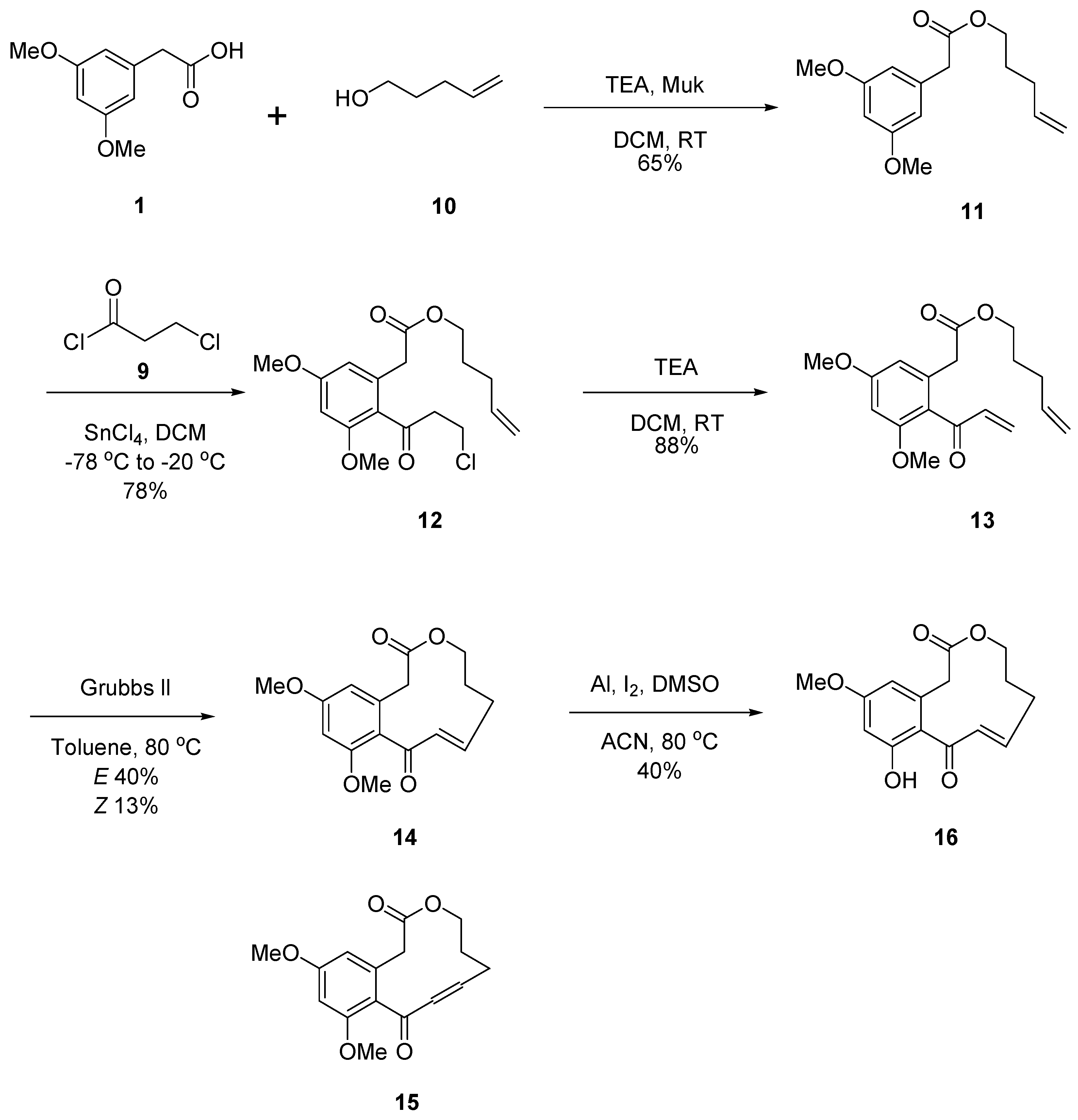
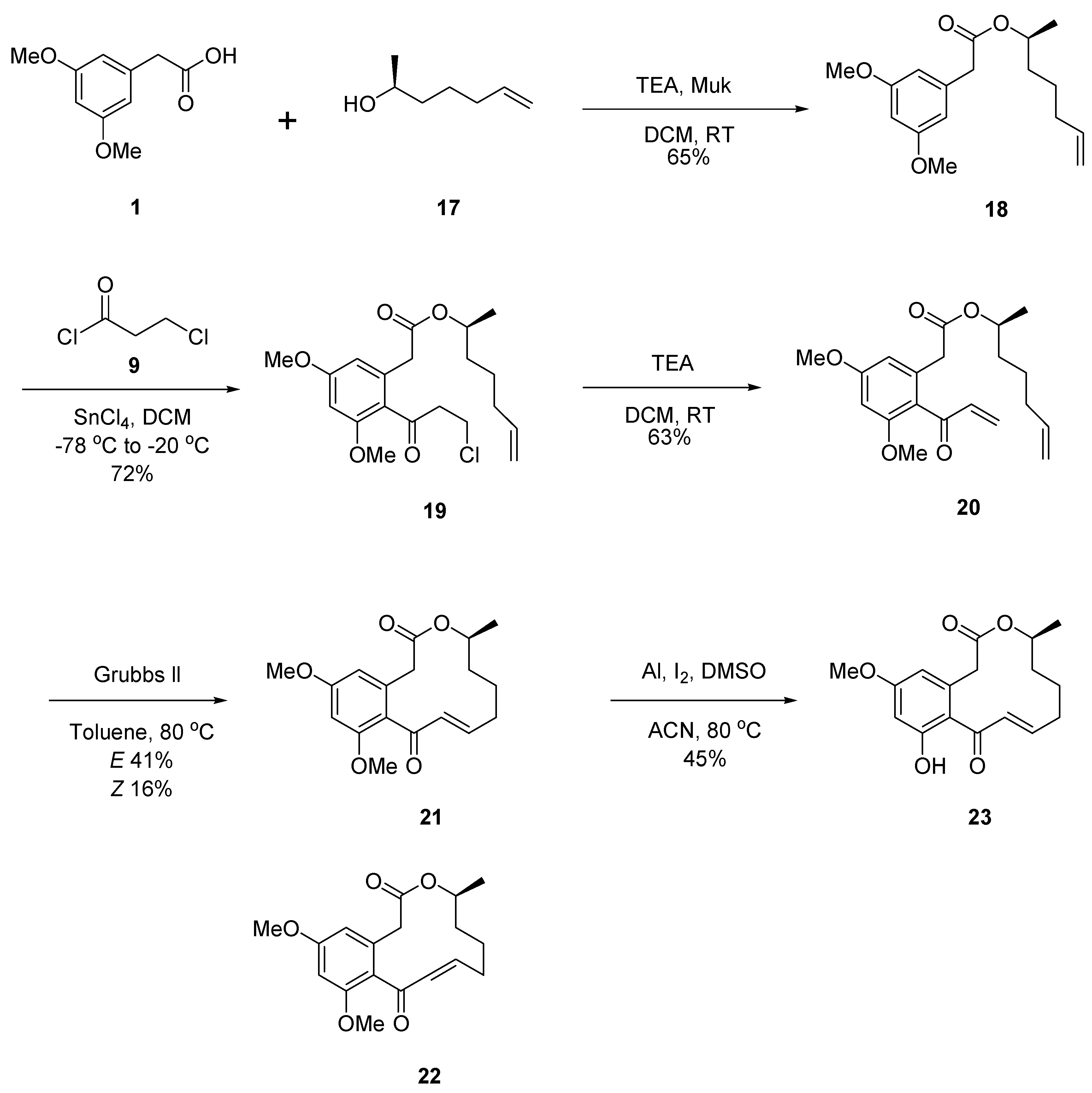
To systematically investigate the structure–activity relationships (SARs) of curvularin, three series of analogues, namely Cur-5H-OMe (8), Cur-4P-OMe (16), and Cur-OMe (23), were synthesized. The synthesis of all three series followed a unified, convergent strategy comprising esterification, Friedel–Crafts acylation, dehydrohalogenation, ring-closing metathesis (RCM), and selective demethylation (Scheme 1, Scheme 2 and Scheme 3).
Initially, the esterification of 3,5-dimethoxyphenylacetic acid (1) with the respective alcohols (2, 10, 17) was attempted using DCC and DMAP. However, the complete removal of the dicyclohexylurea (DCU) byproduct posed difficulty, which reduced the overall purification efficiency [17]. By switching to the Mukaiyama reagent (2-chloro-1-methylpyridinium iodide) in the presence of triethylamine (TEA), the esterification proceeded smoothly [18]. This optimized condition successfully afforded the ester intermediates 3 (76%), 11 (65%), and 18 (65%).
The ester intermediates were subsequently subjected to Friedel–Crafts acylation with 3-chloropropanoyl chloride (9). For this transformation, SnCl4 was specifically selected as a mild Lewis acid catalyst; unlike stronger Lewis acids (such as AlCl3), SnCl4 efficiently promotes the acylation of the highly electron-rich 3,5-dimethoxyphenyl ring while preventing unwanted side reactions, such as the cleavage of the methyl ether groups (demethylation) [19,20]. This optimized acylation yielded the acylated compounds 4 (56%), 12 (78%), and 19 (72%). Following this acylation, dehydrohalogenation was performed by treating these compounds with TEA, which successfully yielded the key diene intermediates 5 (89%), 13 (88%), and 20 (63%) ready for cyclization.
The RCM step was extensively optimized using diene 20 as a model. Notably, rigorous degassing (argon bubbling for 2 h) and highly diluted conditions (4 mM in toluene) at 80 °C with 20 mol% of Grubbs II catalyst were critical to prevent intermolecular oligomerization and overcome the entropic penalties of medium-to-large macrocycle formation. Under these optimized conditions, the RCM of the dienes provided the corresponding macrolactones as mixtures of E/Z diastereomers: the 12-membered rings 6 (E, 35%) and 7 (Z, 10%); the 11-membered rings 14 (E, 40%) and 15 (Z, 13%); and the 12-membered rings 21 (E, 41%) and 22 (Z, 16%).
Although these conditions were heavily optimized, the overall yields remained moderate (45–57%). This can be attributed to the difficulty in the formation of medium-sized (11- to 12-membered) rings, which inherently suffer from high transannular ring strain and severe entropic penalties [21]. Furthermore, despite the highly diluted environment, unavoidable competitive intermolecular oligomerization, along with potential catalyst deactivation caused by the chelation of Lewis basic oxygen atoms (such as ester, ketone, and methoxy groups) present in the diene substrates, likely limited the final RCM efficiency [22,23].
Regarding stereoselectivity, the RCM reactions predominantly yielded the thermodynamically more stable E-isomers across all series. Interestingly, during structural characterization, we observed an isomeric phase transition for the purified Z-isomers (7, 15, and 22). When dissolved in nuclear magnetic resonance (NMR) solvents, these Z-isomers slowly and spontaneously isomerized to their respective E-isomers over time, further confirming the strong thermodynamic preference for the E-configuration in these curvularin scaffolds.
Finally, to generate the mono-methoxy target derivatives, the E-isomer macrolactones (6, 14, and 21) were subjected to selective demethylation using aluminum powder, iodine, and dimethyl sulfoxide (DMSO) in acetonitrile [19]. This final step successfully afforded the newly synthesized derivatives 8 (73%), 16 (40%), and 23 (45%).
The Cur-5H-OMe, Cur-4P-OMe, and Cur-OMe analogues were designed to retain the 12-membered macrolactone skeleton, the principal physiologically active framework of curvularin, while modulating electronic and steric properties by varying substituent position and sizes. Curvularin derivatives exhibit a range of biological activities, including antibacterial [24], antifungal [25], anti-inflammatory [16,26,27], anticancer [28], and cytoprotective activity [29]. The results of this synthesis are significant because they demonstrate the successful preparation of various curvularin analogues through a unified reaction, building on previous studies [19,30,31]. Although the process is sensitive to the conditions of each step, it provides high yield and selectivity and establishes a synthetic paradigm useful for constructing future bioactivity screening libraries. This synthetic route provides a stable platform for expanding the activity range of curvularin derivatives and conducting precise SAR studies.

2.2. Anti-Inflammatory Activity

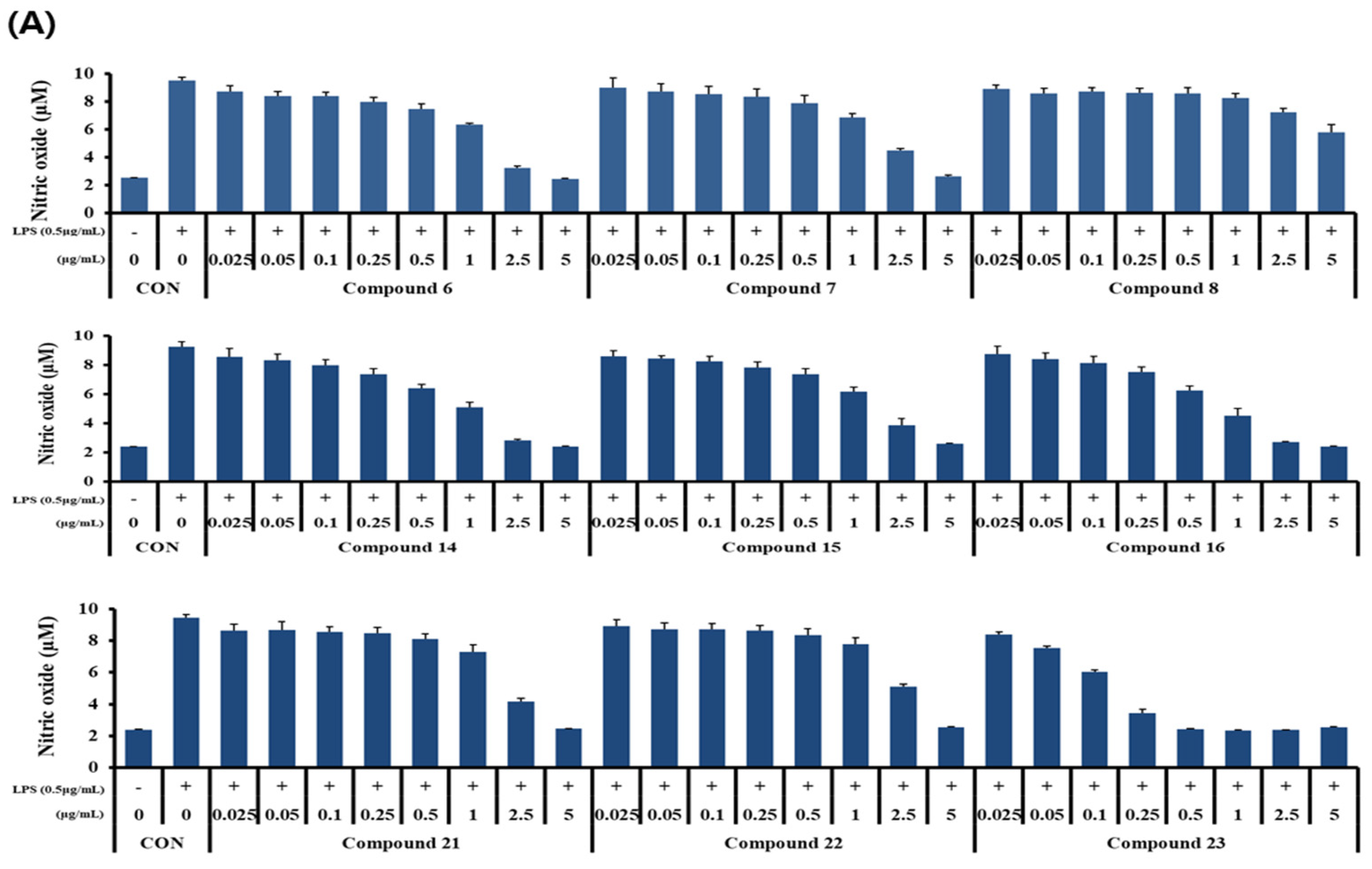
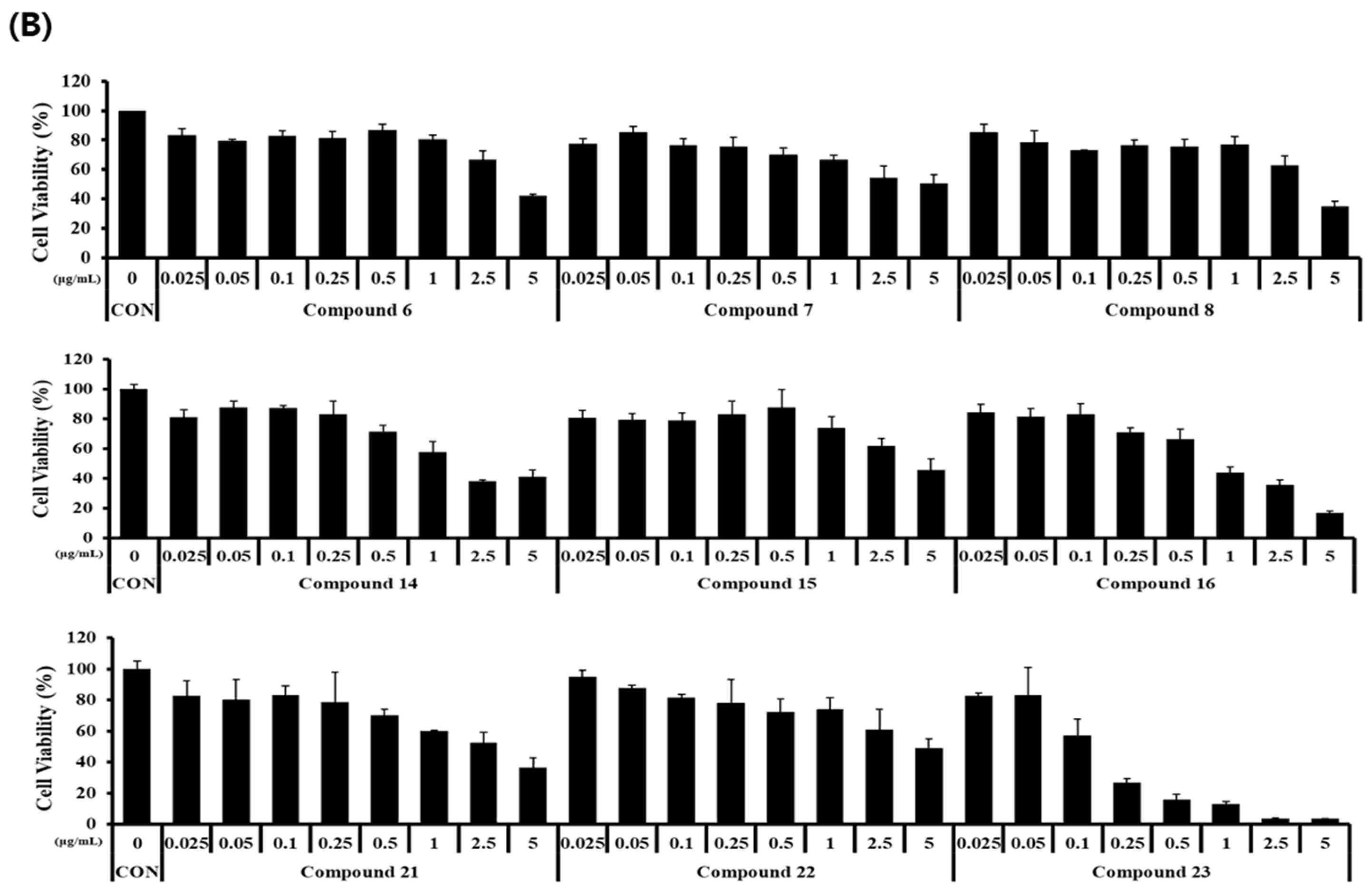
Inhibition of nitric oxide (NO) production in LPS-induced RAW 264.7 cells was measured to determine the nitric oxide activity of nine derivatives (compounds 68, 1416, and 2123). The concentrations of the nine derivatives were 0, 0.025, 0.05, 0.1, 2.5, and 5 μg/mL. Nitrite concentrations were measured using the Griess reaction and were found to be significantly increased in LPS-stimulated RAW 264.7 cells. However, NO production was inhibited in a concentration-dependent manner by the compounds synthesized in this study, except for compound 8 (Figure 1A). Although the synthesized compounds reduced NO production at high concentrations, a corresponding decrease in cell viability was observed, indicating that the NO reduction at these doses was likely due to cytotoxicity (Figure 1B). Compound 7 exhibited an anti-inflammatory effect, inhibiting NO production by more than 70% while maintaining cell survival by more than 50% even at high concentrations.
The anti-inflammatory potential of curvularin derivatives has been previously explored [16,26,29,32]. In the present study, most derivatives inhibited NO production in LPS-induced RAW 264.7 cells. However, to distinguish true anti-inflammatory activity from cytotoxicity mediated NO reduction, a concern raised by the correlation between NO inhibition and cell death at high concentrations, we calculated the selectivity index (SI) for each compound (Table 1).
While some derivatives (e.g., compounds 16 and 23) exhibited low SI values (<1.0), indicating that their apparent inhibitory effects were primarily due to cytotoxicity, compounds 6, 7, and 15 demonstrated a favourable safety profile with SI values greater than 2.0. Notably, compound 6 (SI = 2.27) and compound 7 (SI = 2.20) inhibited NO production with half-maximal inhibitory concentration (IC50 values) of 1.83 μg/mL and 2.32 μg/mL, respectively, which were significantly lower than their cytotoxic concentrations (IC50 > 4.0 μg/mL). These quantitative results suggest that compounds 6 and 7 exhibit genuine anti-inflammatory potential and warrant further development as therapeutic agents.
Notably, from an SAR perspective, compound 7 (12-membered macrocycle with a Z-alkene configuration and di-methoxy substituents) exhibited the most favourable anti-inflammatory profile (high NO inhibition with low cytotoxicity). This suggests that the increased conformational flexibility of the 12-membered ring, combined with the specific spatial arrangement dictated by the Z-geometry, may facilitate selective binding to inflammatory targets such as iNOS [33,34]. Furthermore, retaining the di-methoxy groups (avoiding free phenols) appears crucial for mitigating generalized cytotoxicity, thereby widening the therapeutic window for anti-inflammatory applications [35].

2.3. Anticancer Activity

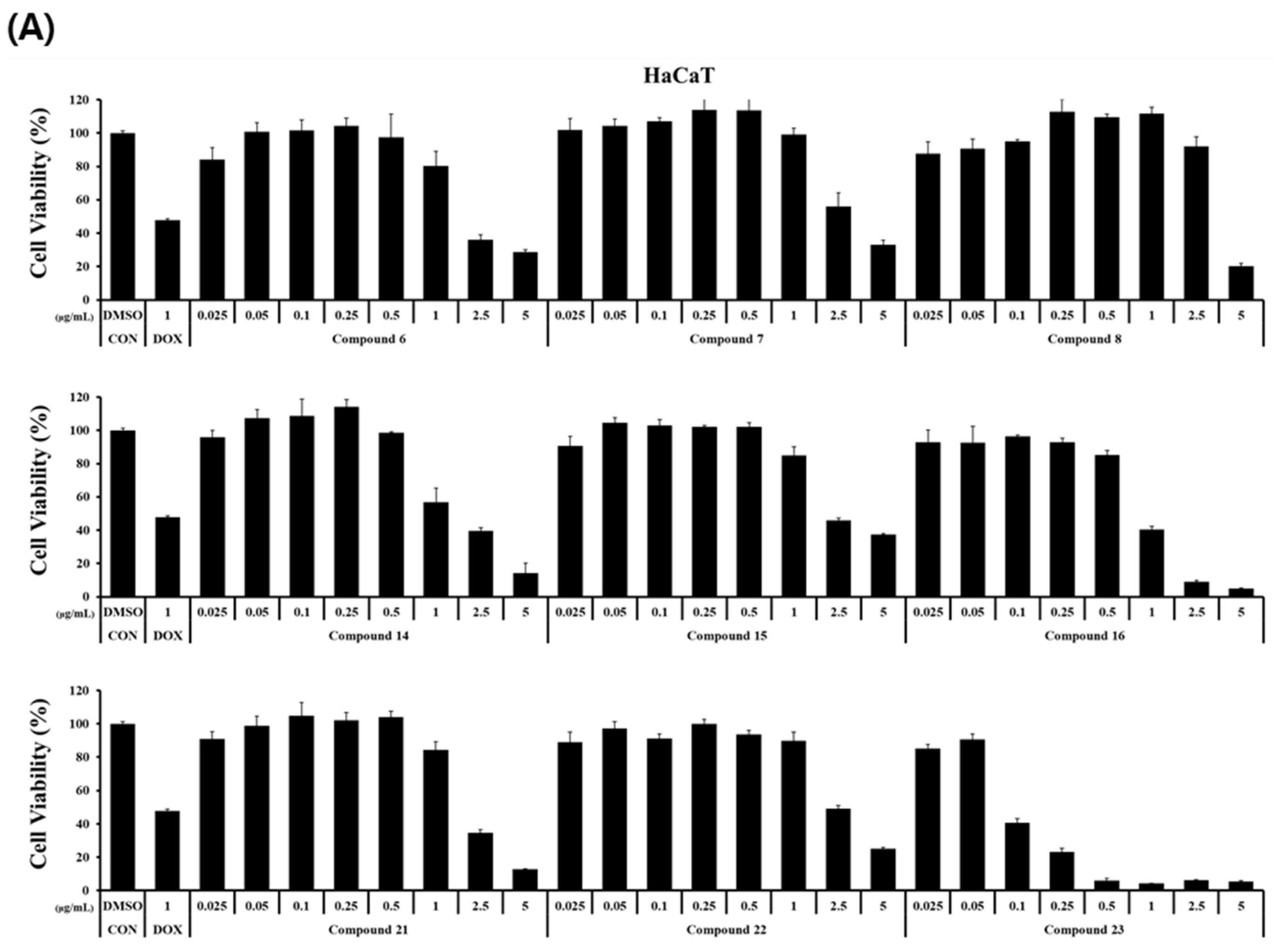
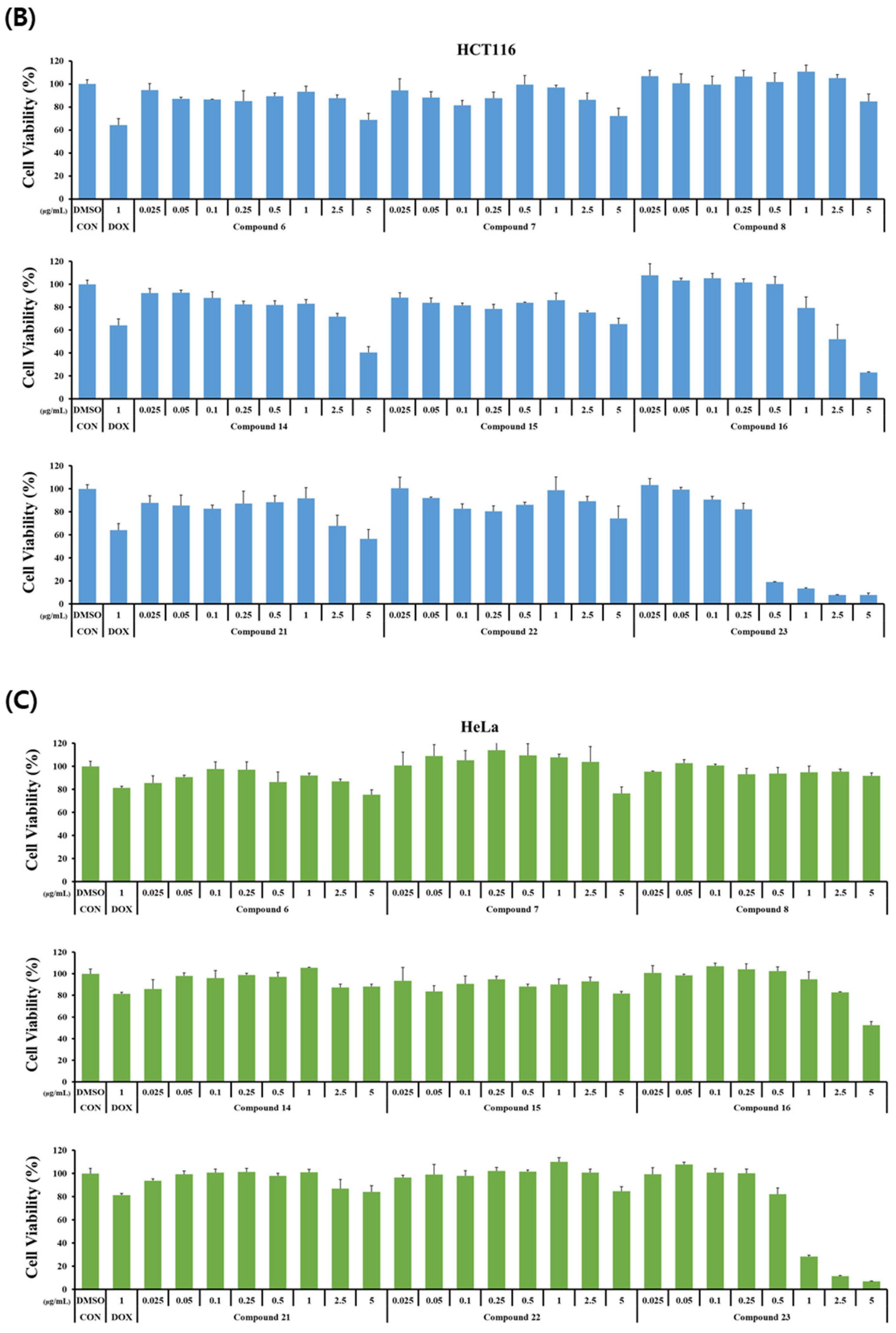
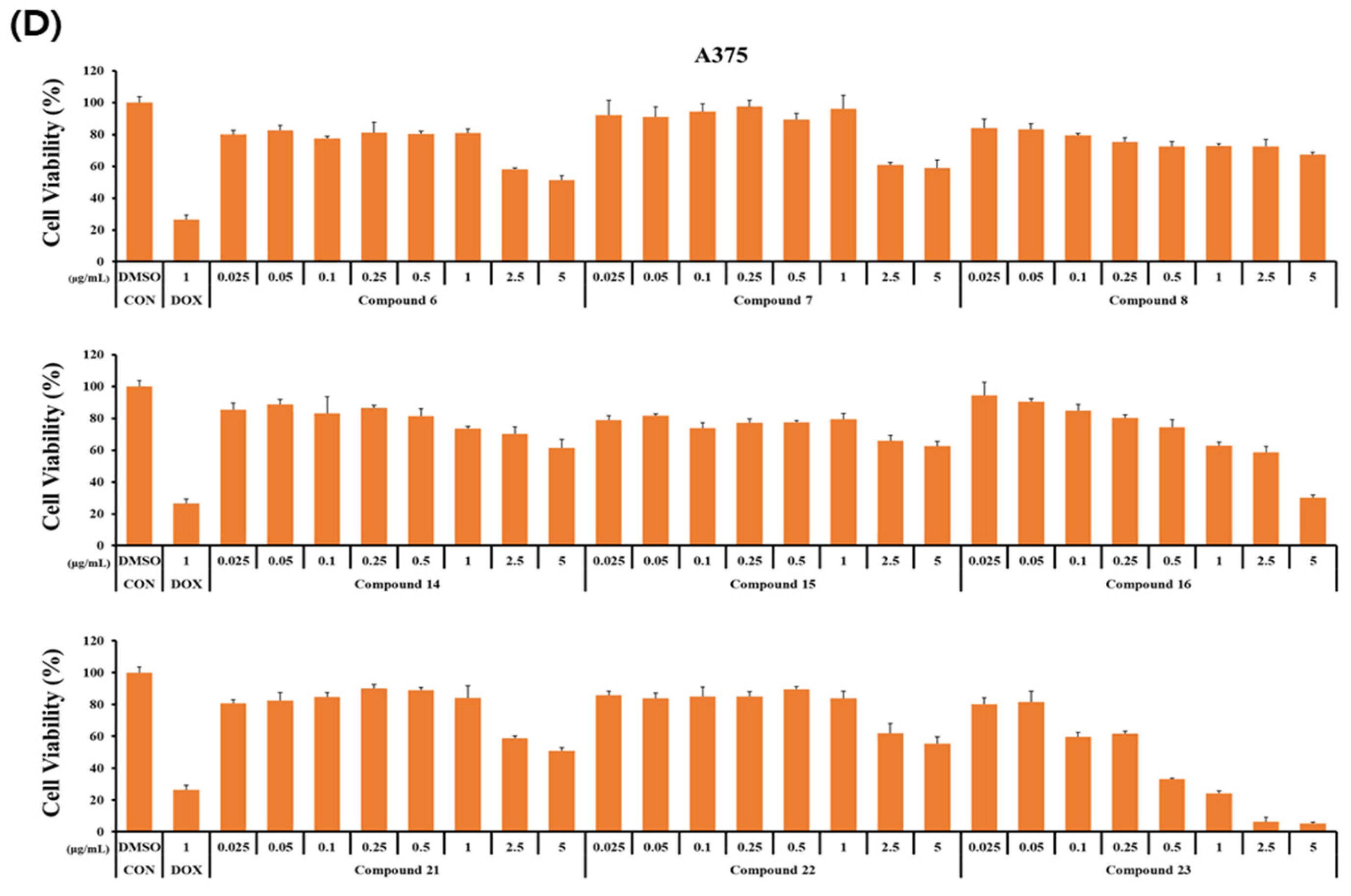
The cytotoxicity of the synthesized curvularin derivatives was investigated on normal human keratinocytes (HaCaT) and three human cancer cell lines (HCT116, HeLa, and A375). Cells were incubated with the nine derivatives at concentrations ranging from 0 to 5 μg/mL for 24 h. The dose–response profiles are presented in Figure 2, and the corresponding half-maximal inhibitory concentration (IC50) values are summarized in Table 2.
Most derivatives exhibited weak cytotoxicity against the tested cancer cell lines (Figure 2). This observation is confirmed by the quantitative analysis in Table 2, which indicates that the majority of compounds display IC50 values greater than 5.0 μg/mL. While compounds 16 and 23 displayed potent inhibitory effects on cancer cell growth (Figure 2), a comparison with normal HaCaT cells revealed a lack of selectivity.
Specifically, compound 23 exhibited strong cytotoxicity against all cancer cell lines, with IC50 values ranging from 0.35 to 0.79 μg/mL (Table 2). However, it was significantly more toxic to normal HaCaT cells (IC50 = 0.09 μg/mL). Similarly, compound 16 displayed moderate activity against cancer cells (IC50 = 2.68–3.25 μg/mL) but demonstrated higher toxicity toward HaCaT cells (IC50 = 0.89 μg/mL).
These findings align with those of previous studies indicating that curvularin derivatives often exhibit a broad spectrum of cytotoxicity, as observed in HT1080, T46D, A2780S [36], A549, HeLa, MCF-7 [25], and other human tumour cell lines [37]. Although potent cytotoxicity has been reported repeatedly for curvularin analogues, selective activity against specific cancer cell lines remains limited. Therefore, our data suggest that while compounds 16 and 23 are potent cytotoxic agents, further target-directed design is required to improve their selectivity for cancer cells over normal cells.
The SAR analysis of the anticancer results reveals a clear integration of chemical modification and pharmacological outcome. The notable increase in cytotoxicity observed for compounds 16 and 23 highlights the critical role of the selective demethylation step in our synthetic strategy. The unmasking of a free phenolic hydroxyl group on the benzene ring serves as a structural “on-switch” for cytotoxicity [38]. While the completely methylated precursors were largely inactive against cancer cells, the free phenol likely enhances non-specific interactions with cell membranes, acts as a potent hydrogen bond donor to protein targets, or participates in redox cycling to generate cytotoxic reactive oxygen species (ROS) [39]. However, as this leads to potent, but non-selective, toxicity (affecting normal HaCaT cells as well), future synthetic efforts must focus on modifying the macrocyclic backbone of these mono-hydroxy derivatives to impart target-specific selectivity.

2.4. Antibacterial and Antifungal Activity

Cell inhibition against S. aureus and E. coli was measured at concentrations of 0, 2.5, 25, 50, 100, and 200 μg/mL to determine the antibacterial activity of nine derivatives (compounds 68, 1416, and 2123). The IC50 values revealed no activity against E. coli; however, seven derivatives (compounds 7, 8, 14, 16, 21, 22, and 23) exhibited activity against S. aureus. Four derivatives (compounds 8, 14, 16, and 23) showed minimum inhibitory concentration (MIC) values against S. aureus within the tested concentration range. Compound 23 exhibited an IC50 value of 8.90 ± 2.28 μg/mL, which was stronger than that of kanamycin (14.97 ± 6.17 μg/mL), suggesting the potential for antibiotic activity (Table 3).
The growth inhibition of C. albicans cells was measured at concentrations of 0, 2.5, 25, 50, 100, and 200 μg/mL to determine the antifungal activity of the nine derivatives. The IC50 values confirmed the activity of six derivatives (compounds 7, 8, 15, 16, 22, and 23) against C. albicans, whereas MIC values were obtained for three derivatives (compounds 8, 16, 23). Compounds 8 and 23 exhibited low IC50 values, indicating the potential for these derivatives to exhibit potent antifungal effects (Table 4).
In tests targeting S. aureus and E. coli, no significant inhibitory effect was observed against E. coli, whereas seven derivatives (7, 8, 14, 16, 21, 22, 23) displayed activity against S. aureus. This is consistent with previous reports indicating that the curvularin skeleton was more effective at targeting Gram-positive bacteria than Gram-negative bacteria [25]. Previous studies have shown that some curvularin derivatives also displayed activity against E. coli; therefore, a detailed investigation is needed to understand how structural differences affect efficacy [36,40,41].
Moreover, antifungal activity against C. albicans was confirmed for curvularin and 11-alpha-methoxycurvularin [36,42]. Among the nine compounds synthesized in this study, compounds 8, 16, and 23, each comprising only one O-methyl group on the benzene ring, exhibited relatively higher antibacterial and antifungal activities than the other compounds. This can be attributed to the fact that methylation often reduces the polarity of drug molecules, which can change the binding affinity for specific receptors and reduce toxicity [35]. The presence of two O-methyl groups on the benzene ring appears to reduce toxicity, resulting in lower antibacterial and antifungal activity in the other compounds.
Curvularin derivatives were effective against B. megaterium, M. violaceum, S. tritici, C. fusca [43], H. pylori [44], P. capsici zoospores [45], M. marinum [46], V. alginolyticus, V. harveyi [24], and M. tuberculosis [47]. The compounds synthesized in this study also need to be further studied for their efficacy against different types of pathogenic microorganisms. Compound 23, which has antibacterial and antifungal activity, is considered a promising starting material that can be developed into an antibiotic candidate through structural optimization.

2.5. Quantitative Comparison of Activities of Curvularin and Its Derivatives

The physiological activities of curvularin, dehydrocurvularin, and the derivative (i.e., compound 23) synthesized in this study were quantitatively compared (Table 5). Compound 23 exhibited anti-inflammatory activity with an IC50 value of 0.59 μM, which was higher than that of dehydrocurvularin (0.44 μM) but significantly lower than that of curvularin (18.1 μM). Although a direct comparison of anti-cancer activity was difficult, compound 23 exhibited lower IC50 values than that previously reported. The compounds synthesized in this study did not show MIC against E. coli within the tested concentrations, whereas previous studies have shown that dehydrocurvularin exhibited activity, and compound 23 exhibited better activity against S. aureus. Compound 23 exhibited lower MIC against C. albicans than that of dehydrocurvularin.

3. Materials and Methods

3.1. General Experimental Information

Anhydrous solvents and reagents used in this study were purchased from Sigma-Aldrich (St. Louis, MO, USA) and TCI (Tokyo, Japan) and used as directed without further purification. All glassware was completely dried in a drying oven at 80 °C and cooled under dry argon immediately before use. All reactions were performed under argon gas, and solvents and liquid reagents were transferred using syringes. The organic extract was dried over MgSO4 and concentrated under reduced pressure using a rotary evaporator. The residual solvent was removed under high vacuum (Vacuubrand RZ 2.5, Wertheim, Germany, 1 × 10⁻² mbar). TLC was performed using 0.25 mm silica gel plates (Merck, Darmstadt, Germany) and observed under 254 nm ultraviolet light (UV CABINET CN-15.LC, VILBER, Vilber Lourmat, France). Flash column chromatography used silica gel 60 (230–400 mesh, Merck, Darmstadt, Germany) as the stationary phase and a mixture of n-hexane and ethyl acetate as the mobile phase. Reversed-phase flash column chromatography was performed using an AI-580S system (Yamazen Science, Inc., Burlingame, CA, USA). C18 resin (ODS-SM, 50 μm, 120 Å) was used as the stationary phase, eluted with a gradient of water and methanol.
The NMR spectra were measured using a Jeol JNM ECP-400 spectrometer (Jeol Ltd., Tokyo, Japan) and a Bruker Avance III HD 600 MHz spectrometer (Bruker Daltonics, Leipzig, Germany), using methanol-d4 (CD3OD) or chloroform-d4 (CDCl3) as the solvent. Chemical shifts were set based on internal standards or residual solvent signals (MeOH-d4: δH 3.31/δC 49.1; CDCl3: δH 7.27/δC 77.0; tetramethylsilane). Peak splitting patterns were abbreviated as m (multiplets), s (singlets), d (doublets), t (triplets), dd (doublet of doublets), dt (doublet of triplets), td (triplet of doublets), and br (broad). Accurate mass was measured using an AB Sciex Triple TOF 4600 instrument (AB Sciex, Framingham, MA, USA) in direct injection mode.

3.2. General Procedures for the Synthesis of Curvularin Derivatives

3.2.1. General Procedure A: Esterification (Step 1)

In a flame-dried round-bottom flask, 3,5-dimethoxyphenylacetic acid (1.0 equiv), the corresponding primary alcohol (e.g., 5-hexen-1-ol, 4-propan-1-ol, or (S)-hept-6-en-2-ol; 1.2 equiv), and 2-chloro-1-methylpyridinium iodide (Mukaiyama reagent, 1.2 equiv) were dissolved in anhydrous DCM. The mixture was stirred at room temperature for 15 min. Triethylamine (TEA, 3.0 equiv) was then added dropwise, and the reaction mixture was stirred at room temperature for 20 h. Subsequently, the mixture was filtered and concentrated under reduced pressure. The crude product was purified by flash column chromatography (hexane/EtOAc) to afford the corresponding ester intermediate.

3.2.2. General Procedure B: Friedel–Crafts Acylation (Step 2)

A flame-dried flask was charged with anhydrous DCM and cooled to −78 °C before adding 3-chloropropanoyl chloride (1.3 equiv). A 1 M solution of SnCl4 in DCM (1.3 equiv) was added slowly, and the mixture was stirred for 15 min. The ester intermediate prepared in Step 1 (1.0 equiv) was dissolved in DCM and added dropwise to the reaction mixture at −78 °C. The temperature was gradually raised to −20 °C, and the mixture was stirred for 1.5–2.5 h. The reaction was quenched by pouring the mixture into a separatory funnel containing ice and water. The organic layer was separated, washed successively with saturated aqueous NaHCO3 and water, dried over MgSO4, filtered, and concentrated. The crude product was purified by flash column chromatography to obtain the acylated intermediate.

3.2.3. General Procedure C: Dehydrohalogenation (Step 3)

The acylated intermediate (1.0 equiv) was dissolved in anhydrous DCM, and TEA (2.0 equiv) was added. The mixture was stirred overnight at room temperature to promote dehydrohalogenation and intramolecular ring-forming rearrangement. The reaction was quenched with saturated aqueous NH4Cl and extracted with DCM. The combined organic layers were dried over MgSO4, filtered, and concentrated. The concentrate was purified using flash column chromatography (hexane/EtOAc, 8:2) to afford the diene intermediate.

3.2.4. General Procedure D: Ring-Closing Metathesis (Step 4)

In a flame-dried round-bottom flask, the diene compound prepared in Step 3 (1.0 equiv) was dissolved in anhydrous toluene to reach a highly dilute concentration (approx. 4 mM). The solution was thoroughly degassed by bubbling argon gas for 2 h. A solution of Grubbs second-generation catalyst (0.2 equiv, 20 mol%) in a small amount of toluene was added, and the reaction mixture was heated to 80 °C and stirred for 1 h. Upon completion, the mixture was concentrated, pre-adsorbed onto silica gel for dry loading, and purified using an open silica-gel column (hexane/EtOAc eluents) to yield the corresponding metathesis products (E/Z mixtures).

3.2.5. General Procedure E: Selective Demethylation (Step 5)

The metathesis product (1.0 equiv) was dissolved in anhydrous ACN, followed by the addition of aluminum powder (10.0 equiv) and DMSO (5.0 equiv). Iodine (3.3 equiv) was added in one portion, and the reaction mixture was heated to 80 °C for 30 min. After cooling to room temperature, the mixture was diluted with 2 M aqueous HCl and extracted with ethyl acetate. The combined organic layers were dried over MgSO4, filtered, and concentrated. The final crude product was purified via flash column chromatography (hexane/EtOAc, 7:3) to yield the target curvularin analogues.

3.2.6. Synthesis of Hex-5-en-1-yl 2-(3,5-dimethoxyphenyl)acetate (3)

General procedure A. TLC Rf = 0.57 (hexane/EtOAc, 7:3). 1H NMR (400 MHz, CD3OD) δ 6.43 (d, J = 2.3 Hz, 1H, H-4; 1H, H-8), 6.37 (t, J = 2.3 Hz, 1H, H-6), 5.77 (m, 1H, H-5′), 4.98 (m, 2H, H-6′), 4.93 (m, 2H, H-6′), 4.09 (t, J = 6.4 Hz, 2H, H-1′), 3.75 (s, 3H, H-5 OMe; 3H, H-7 OMe), 3.52 (s, 2H, H-2), 2.04 (m, 2H, H-4′), 1.62 (m, 2H, H-2′), 1.40 (m, 2H, H-3′); 13C NMR (100 MHz, CD3OD) δ 173.4, 162.4, 162.4, 139.5, 137.7, 115.2, 108.3, 108.3, 100.0, 65.8, 55.7, 55.7, 42.3, 34.3, 29.1, 26.3; HRESIMS m/z 279.1596 [M + H]+ (calcd for C16H23O4, 279.1596).

3.2.7. Synthesis of Hex-5-en-1-yl 2-(2-(3-chloropropanoyl)-3,5-dimethoxyphenyl)acetate (4)

General procedure B. TLC Rf = 0.42 (hexane/EtOAc, 7:3). 1H NMR (400 MHz, CDCl3) δ 6.41 (d, J = 2.3 Hz, 1H, H-6), 6.37 (d, J = 2.3 Hz, 1H, H-4), 5.78 (m, 1H, H-5′), 5.00 (m, 2H, H-6′), 4.95 (m, 2H, H-6′), 4.08 (t, J = 6.9 Hz, 2H, H-1′), 3.84 (s, 3H, H-5 OMe), 3.82 (s, 3H, H-7 OMe), 3.82 (m, 2H, H-11), 3.67 (s, 2H, H-2), 3.35 (t, J = 7.1 Hz, 2H, H-10), 2.05 (m, 2H, H-4′), 1.64 (m, 2H, H-2′), 1.43 (m, 2H, H-3′); 13C NMR (100 MHz, CDCl3) δ 202.5, 171.5, 162.0, 159.5, 138.5, 135.8, 122.8, 114.9, 108.6, 97.6, 65.0, 55.8, 55.6, 47.1, 39.5, 39.2, 33.4, 28.1, 25.5; HRESIMS m/z 369.1476 [M + H]+ (calcd for C19H26ClO5, 369.1469).

3.2.8. Synthesis of Hex-5-en-1-yl 2-(2-acryloyl-3,5-dimethoxyphenyl)acetate (5)

General procedure C. TLC Rf = 0.42 (hexane/EtOAc, 7:3). 1H NMR (400 MHz, CDCl3) δ 6.68 (dd, J = 17.4, 10.5 Hz, 1H, H-10), 6.42 (d, J = 2.3 Hz, 1H, H-4), 6.40 (d, J = 2.3 Hz, 1H, H-6), 6.09 (dd, J = 17.4, 1.4 Hz, 2H, H-11), 5.79 (m, 2H, H-11), 5.76 (m, 1H, H-5′), 4.99 (m, 2H, H-6′), 4.94 (m, 2H, H-6′), 4.05 (t, J = 6.9 Hz, 2H, H-1′), 3.82 (s, 3H, H-5 OMe), 3.77 (s, 3H, H-7 OMe), 3.61 (s, 2H, H-2), 2.04 (m, 2H, H-4′), 1.40 (m, 2H, H-3′); 13C NMR (100 MHz, CDCl3) δ 195.8, 171.2, 161.8, 159.3, 138.5, 138.2, 135.5, 128.5, 122.3, 114.9, 107.9, 97.7, 64.9, 55.8, 38.9, 33.3, 28.1, 25.2; HRESIMS m/z 333.1632 [M + H]+ (calcd for C19H25O5, 333.1702).

3.2.9. Synthesis of (E)-11,13-Dimethoxy-4,5,6,7-tetrahydro-2H-benzo[d][1]oxacyclododecine-2,10(1H)-dione (6)

General procedure D. TLC Rf = 0.38 (hexane/EtOAc, 6:4). 1H NMR (400 MHz, CDCl3) δ 6.55 (d, J = 1.8, 1H, H-4), 6.53 (d, J = 2.3, 1H, H-6), 6.46 (dd, J = 15.8, 7.8, 1H, H-11), 6.21 (dt, J = 15.6, 1.2 Hz, 1H, H-10), 4.06 (t, J = 4.6, 2H, H-15), 3.83 (s, 3H, H-5 OMe), 3.75 (s, 3H, H-7 OMe), 3.40 (s, 2H, H-2), 2.31 (m, 2H, H-14), 1.71 (m, 2H, H-12; 2H, H-13); 13C NMR (100 MHz, CDCl3) δ 201.3, 172.2, 162.8, 159.4, 159.0, 133.9, 133.7, 125.6, 108.3, 98.5, 68.1, 56.2, 56.0, 40.1, 34.8, 28.3, 27.2; HRESIMS m/z 305.1378 [M + H]+ (calcd for C17H21O5, 305.1389).

3.2.10. Synthesis of 11,13-Dimethoxy-4,5,6,7-tetrahydro-2H-benzo[d][1]oxacyclododecine-2,10(1H)-dione (7)

General procedure D. TLC Rf = 0.48 (hexane/EtOAc, 6:4). 1H NMR (400 MHz, CDCl3) δ 6.47 (m, 1H, H-10), 6.41 (m, 1H, H-4), 6.37 (m, 1H, H-6), 5.90 (dt, J = 11.9, 8.2 Hz, 1H, H-11), 4.01 (m, 2H, H-15), 3.83 (s, 3H, H-5 OMe), 3.74 (s, 3H, H-7 OMe), 3.41 (s, 2H, H-2), 2.29 (m, 2H, H-12), 1.60 (m, 2H, H-13), 1.60 (m, 2H, H-14); 13C NMR (100 MHz, CDCl3) δ 197.6, 170.7, 161.7, 159.3, 144.1, 134.4, 133.1, 124.5, 108.0, 97.9, 67.6, 56.0, 55.6, 39.3, 28.2, 27.6, 24.8; HRESIMS m/z 305.1378 [M + H]+ (calcd for C17H21O5, 305.1389).

3.2.11. Synthesis of (E)-11-Hydroxy-13-methoxy-4,5,6,7-tetrahydro-2H-benzo[d][1]oxacyclododecine-2,10(1H)-dione (8)

General procedure E. TLC Rf = 0.53 (hexane/EtOAc, 1:1). 1H NMR (600 MHz, CDCl3) δ 6.70 (m, 1H, H-10), 6.60 (m, 1H, H-11), 6.42 (d, J = 2.6 Hz, 1H, H-6), 6.33 (t, J = 2.9 Hz, 1H, H-4), 4.17 (dd, J = 6.2, 2.5 Hz, 2H, H-15), 3.83 (s, 3H, OMe), 3.82 (s, 2H, H-2), 2.45 (m, 2H, H-14), 1.83 (m, 2H, H-12; 2H, H-13); 13C NMR (150 MHz, CDCl3) δ 196.0, 171.3, 167.0, 164.3, 148.1, 137.4, 131.7, 114.0, 113.6, 100.4, 66.3, 55.5, 43.9, 32.8, 27.1, 26.7; HRESIMS m/z 291.1223 [M + H]+ (calcd for C16H19O5, 291.1232).

3.2.12. Synthesis of Pent-4-en-1-yl 2-(3,5-dimethoxyphenyl)acetate (11)

General procedure A. TLC Rf = 0.60 (hexane/EtOAc, 7:3). 1H NMR (400 MHz, CDCl3) δ 6.44 (d, J = 2.3 Hz, 1H, H-4; 1H, H-8), 6.37 (t, J = 2.3 Hz, 1H, H-6), 5.77 (m, 1H, H-4′), 5.00 (m, 2H, H-5′), 4.97 (m, 2H, H-5′), 4.10 (t, J = 6.6 Hz, 2H, H-1′), 3.78 (s, 3H, H-5 OMe; 3H, H-7 OMe), 3.55 (s, 2H, H-2′), 2.09 (m, 2H, H-3′), 1.72 (m, 2H, H-2′); 13C NMR (100 MHz, CDCl3) δ 171.5, 161.0, 161.0, 137.5, 136.3, 115.4, 107.4, 107.4, 99.3, 64.4, 55.4, 55.4, 41.8, 30.1, 27.9; HRESIMS m/z 265.1437 [M + H]+ (calcd for C15H21O4, 265.1440).

3.2.13. Synthesis of Pent-4-en-1-yl 2-(2-(3-chloropropanoyl)-3,5-dimethoxyphenyl)acetate (12)

General procedure B. TLC Rf = 0.5 (hexane/EtOAc, 7:3). 1H NMR (400 MHz, CDCl3) δ 6.41 (d, J = 2.3 Hz, 1H, H-6), 6.37 (d, J = 2.3 Hz, 1H, H-4), 5.78 (m, 1H, H-4′), 5.02 (m, 2H, H-5′), 4.97 (m, 2H, H-5′), 4.09 (t, J = 6.6 Hz, 2H, H-1′), 3.84 (s, 3H, H-5 OMe), 3.82 (s, 3H, H-7 OMe), 3.81 (m, 2H, H-11), 3.67 (s, 2H, H-2), 3.35 (t, J = 7.1 Hz, 2H, H-10), 2.10 (m, 2H, H-3′), 1.72 (m, 2H, H-2′); 13C NMR (100 MHz, CDCl3) δ 202.5, 171.5, 162.1, 159.5, 137.6, 135.8, 122.8, 115.4, 108.6, 97.6, 64.5, 55.8, 55.6, 47.1, 39.5, 39.2, 30.1, 27.9; HRESIMS m/z 355.1286 [M + H]+ (calcd for C18H24ClO5, 355.1312).

3.2.14. Synthesis of Pent-4-en-1-yl 2-(2-acryloyl-3,5-dimethoxyphenyl)acetate (13)

General procedure C. TLC Rf = 0.78 (hexane/EtOAc, 6:4). 1H NMR (400 MHz, CDCl3) δ 6.69 (dd, J = 17.4, 10.5 Hz, 1H, H-10), 6.42 (d, J = 2.3 Hz, 1H, H-4), 6.41 (d, J = 2.3 Hz, 1H, H-6), 6.09 (dd, J = 17.4, 1.4 Hz, 2H, H-11), 5.79 (m, 2H, H-11), 5.76 (m, 1H, H-4′), 4.97 (m, 2H, H-5′), 4.05 (t, J = 6.6 Hz, 2H, H-1′), 3.82 (s, 3H, H-5 OMe), 3.77 (s, 3H, H-7 OMe), 3.61 (s, 2H, H-2), 2.07 (m, 2H, H-3′), 1.69 (m, 2H, H-2′); 13C NMR (100 MHz, CDCl3) δ 195.8, 171.2, 161.8, 159.3, 138.2, 137.6, 135.5, 128.5, 122.3, 115.3, 107.9, 97.7, 64.4, 55.8, 55.5, 38.9, 30.1, 27.8; HRESIMS m/z 319.1517 [M + H]+ (calcd for C18H23O5, 319.1545).

3.2.15. Synthesis of (E)-10,12-Dimethoxy-5,6-dihydrobenzo[d][1]oxacycloundecine-2,9(1H,4H)-dione (14)

General procedure D. TLC Rf = 0.44 (hexane/EtOAc, 6:4). 1H NMR (400 MHz, CDCl3) δ 6.43 (s, 1H, H-4; 1H, H-6), 6.38 (m, 1H, H-11), 6.25 (td, J = 16.0, 1.4 Hz, 1H, H-10), 4.29 (m, 2H, H-14), 3.84 (s, 3H, H-5 OMe), 3.76 (s, 3H, H-7 OMe), 3.36 (s, 2H, H-2), 2.45 (m, 2H, H-12), 2.36 (m, 2H, H-12), 2.02 (m, 2H, H-13), 1.78 (m, 2H, H-13); 13C NMR (100 MHz, CDCl3) δ 197.9, 171.1, 161.3, 157.8, 155.8, 133.2, 132.5, 122.9, 108.4, 97.9, 65.1, 56.1, 55.6, 40.3, 31.1, 26.9; HRESIMS m/z 291.1132 [M + H]+ (calcd for C16H19O5, 291.1232).

3.2.16. Synthesis of 10,12-Dimethoxy-5,6-dihydrobenzo[d][1]oxacycloundecine-2,9(1H,4H)-dione (15)

General procedure D. TLC Rf = 0.58 (hexane/EtOAc, 6:4). 1H NMR (400 MHz, CDCl3) δ 6.49 (s, 1H, H-4; 1H, H-6), 6.38 (m, 1H, H-11), 5.93 (m, 1H, H-10), 4.29 (m, 2H, H-14), 3.84 (s, 3H, H-5 OMe), 3.76 (s, 3H, H-7 OMe), 3.36 (s, 2H, H-2), 2.45 (m, 2H, H-12), 2.36 (m, 2H, H-12), 2.02 (m, 2H, H-13), 1.80 (m, 2H, H-13); 13C NMR (100 MHz, CDCl3) δ 197.9, 171.1, 161.3, 157.8, 140.4, 133.2, 132.5, 122.9, 108.4, 97.9, 65.1, 56.1, 55.6, 40.3, 31.1, 26.9; HRESIMS m/z 291.1132 [M + H]+ (calcd for C16H19O5, 291.1232).

3.2.17. Synthesis of (E)-10-Hydroxy-12-methoxy-5,6-dihydrobenzo[d][1]oxacycloundecine-2,9(1H,4H)-dione (16)

General procedure E. TLC Rf = 0.55 (hexane/EtOAc, 1:1). 1H NMR (600 MHz, CDCl3) δ 6.45 (d, J = 2.5 Hz, 1H, H-4), 6.40 (d, J = 2.5 Hz, 1H, H-6), 6.36 (dt, J = 16.3, 1.5 Hz, 1H, H-10), 5.91 (dt, J = 16.2, 7.0 Hz, 1H, H-11), 4.31 (t, J = 6.0 Hz, 2H, H-14), 3.83 (s, 3H, OMe), 3.46 (s, 2H, H-2), 2.40 (m, 2H, H-12), 1.97 (m, 2H, H-13); 13C NMR (150 MHz, CDCl3) δ 200.6, 171.7, 164.4, 163.6, 147.0, 137.3, 131.7, 116.1, 113.5, 100.3, 64.8, 55.7, 42.2, 30.5, 24.6; HRESIMS m/z 277.0906 [M + H]+ (calcd for C15H17O5, 277.1076).

3.2.18. Synthesis of (S)-Hept-6-en-2-yl 2-(3,5-dimethoxyphenyl)acetate (18)

General procedure A. TLC Rf = 0.67 (hexane/EtOAc, 7:3). 1H NMR (400 MHz, CD3OD) δ 6.43 (d, J = 2.3 Hz, 1H, H-4; 1H, H-8), 6.37 (t, J = 2.3 Hz, 1H, H-6), 5.74 (m, 1H, H-5′), 4.96 (m, 2H, H-6′), 4.93 (m, 1H, H-1′), 4.90 (m, 2H, H-6′), 3.75 (s, 3H, H-5 OMe; 3H, H-7 OMe), 3.52 (s, 2H, H-2), 1.99 (m, 2H, H-4′), 1.54 (m, 2H, H-2′), 1.34 (m, 2H, H-3′), 1.20 (d, J = 6.4 Hz, 3H, H-7′); 13C NMR (100 MHz, CD3OD) δ 173.1, 162.4, 162.4, 139.6, 137.8, 115.1, 108.3, 108.3, 100.0, 72.7, 55.7, 55.7, 42.8, 36.4, 34.5, 25.7, 20.2; HRESIMS m/z 293.1761 [M + H]+ (calcd for C17H25O4, 293.1753).

3.2.19. Synthesis of (S)-Hept-6-en-2-yl 2-(2-(3-chloropropanoyl)-3,5-dimethoxyphenyl)acetate (19)

General procedure B. TLC Rf = 0.5 (hexane/EtOAc, 7:3). 1H NMR (600 MHz, CDCl3) δ 6.40 (d, J = 2.3 Hz, 1H, H-6), 6.37 (d, J = 2.3 Hz, 1H, H-4), 5.78 (m, 1H, H-5′), 5.00 (m, 2H, H-6′), 4.95 (m, 2H, H-6′), 4.89 (m, 2H, H-1′), 3.83 (s, 3H, H-5 OMe), 3.82 (m, 2H, H-11), 3.81 (s, 3H, H-7 OMe), 3.67 (s, 2H, H-2), 3.35 (t, J = 7.1 Hz, 2H, H-10), 2.03 (m, 2H, H-4′), 1.58 (m, 2H, H-2′), 1.49 (m, 2H, H-2′), 1.38 (m, 2H, H-3′), 1.21 (d, J = 6.4 Hz, 3H, H-7′); 13C NMR (150 MHz, CDCl3) δ 202.3, 170.9, 161.8, 159.2, 138.4, 135.6, 122.6, 114.6, 108.2, 97.3, 71.4, 55.6, 55.3, 46.9, 39.3, 39.2, 35.2, 33.4, 24.5, 19.8; HRESIMS m/z 383.1616 [M + H]+ (calcd for C20H28ClO5, 383.1625).

3.2.20. Synthesis of (S)-Hept-6-en-2-yl 2-(2-acryloyl-3,5-dimethoxyphenyl)acetate (20)

General procedure C. TLC Rf = 0.60 (hexane/EtOAc, 6:4). 1H NMR (600 MHz, CDCl3) δ 6.68 (dd, J = 17.4, 10.5 Hz, 1H, H-10), 6.43 (d, J = 2.3 Hz, 1H, H-4), 6.41 (d, J = 2.3 Hz, 1H, H-6), 6.09 (dd, J = 17.4, 1.4 Hz, 2H, H-11), 5.79 (m, 2H, H-11), 5.76 (m, 1H, H-5′), 4.96 (m, 2H, H-6′), 4.94 (m, 2H, H-6′), 4.88 (m, 2H, H-1′), 3.83 (s, 3H, H-5 OMe), 3.78 (s, 3H, H-7 OMe), 3.60 (s, 2H, H-2), 2.03 (m, 2H, H-4′), 1.57 (m, 2H, H-2′), 1.36 (m, 2H, H-3′), 1.18 (d, J = 6.4 Hz, 3H, H-7′); 13C NMR (150 MHz, CDCl3) δ 195.8, 170.7, 161.6, 159.1, 138.5, 138.1, 135.4, 128.5, 122.2, 114.6, 107.6, 97.5, 71.4, 55.6, 55.4, 38.9, 35.2, 33.4, 24.5, 19.9; HRESIMS m/z 347.1882 [M + H]+ (calcd for C20H27O5, 347.1858).

3.2.21. Synthesis of (S,E)-11,13-Dimethoxy-4-methyl-4,5,6,7-tetrahydro-2H-benzo[d][1]oxacyclododecine-2,10(1H)-dione (21)

General procedure D. TLC Rf = 0.38 (hexane/EtOAc, 6:4). 1H NMR (400 MHz, CD3OD) δ 6.54 (d, J = 2.3 Hz, 1H, H-4), 6.53 (d, J = 2.3 Hz, 1H, H-6), 6.48 (dd, J = 15.6, 7.8 Hz, 1H, H-11), 6.21 (dt, J = 15.6, 1.2 Hz, 1H, H-10), 4.89 (m, 1H, H-15), 3.83 (s, 3H, H-5 OMe), 3.75 (s, 3H, H-7 OMe), 3.37 (s, 2H, H-2), 2.33 (m, 2H, H-12), 2.20 (m, 2H, H-12), 1.90 (m, 2H, H-13), 1.80 (m, 2H, H-14), 1.49 (m, 2H, H-14), 1.42 (m, 2H, H-13), 1.15 (d, J = 6.4 Hz, 3H, H-16); 13C NMR (100 MHz, CD3OD) δ 201.2, 172.0, 162.8, 159.4, 159.0, 134.1, 133.8, 123.4, 108.3, 98.5, 74.5, 56.3, 56.0, 40.2, 35.1, 35.0, 25.5, 20.5; HRESIMS m/z 319.1466 [M + H]+ (calcd for C18H23O5, 319.1545).

3.2.22. (S)-11,13-Dimethoxy-4-methyl-4,5,6,7-tetrahydro-2H-benzo[d][1]oxacyclododecine-2,10(1H)-dione (22)

General procedure D. TLC Rf = 0.45 (hexane/EtOAc, 6:4). 1H NMR (400 MHz, CD3OD) δ 6.53 (d, J = 1.8 Hz, 1H, H-4), 6.51 (d, J = 2.3 Hz, 1H, H-6), 6.37 (dt, J = 12.4, 1.6 Hz, 1H, H-10), 5.99 (dt, J = 12.4, 8.2 Hz, 1H, H-11), 4.80 (m, 1H, H-15), 3.83 (s, 3H, H-5 OMe), 3.78 (s, 3H, H-7 OMe), 3.37 (s, 2H, H-2), 1.40–2.25 (m, 2H, H-12; 2H, H-13; 2H, H-14), 1.13 (d, J = 6.4 Hz, 3H, H-16); 13C NMR (100 MHz, CD3OD) δ 199.9, 171.8, 163.6, 160.6, 146.3, 135.2, 133.8, 125.4, 109.4, 98.5, 75.2, 56.5, 56.0, 40.1, 31.9, 28.4, 26.0, 19.8; HRESIMS m/z 319.1466 [M + H]+ (calcd for C18H23O5, 319.1545).

3.2.23. Synthesis of (S,E)-11-Hydroxy-13-methoxy-4-methyl-4,5,6,7-tetrahydro-2H-benzo[d][1]oxacyclododecine-2,10(1H)-dione (23)

General procedure E. TLC Rf = 0.64 (hexane/EtOAc, 1:1). 1H NMR (400 MHz, CDCl3) δ 6.67 (dd, J = 16.5, 1.0 Hz, 1H, H-10), 6.62 (ddd, J = 15.1, 8.2, 3.6 Hz, 1H, H-11), 6.41 (d, J = 2.8 Hz, 1H, H-6), 6.32 (d, J = 2.8 Hz, 1H, H-4), 4.85 (m, 1H, H-15), 4.04 (d, J = 17.9 Hz, 2H, H-2), 3.82 (s, 3H, OMe), 3.54 (d, J = 17.9 Hz, 2H, H-2), 2.47 (m, 2H, H-12), 2.32 (m, 2H, H-12), 1.97 (m, 2H, H-14), 1.89 (m, 2H, H-13), 1.65 (m, 2H, H-14), 1.64 (m, 2H, H-13), 1.24 (d, J = 6.4 Hz, 3H, H-16); 13C NMR (100 MHz, CDCl3) δ 196.4, 171.3, 166.9, 164.4, 148.3, 137.6, 131.5, 114.3, 113.6, 100.6, 72.7, 55.6, 44.2, 34.1, 32.8, 24.2, 20.1; HRESIMS m/z 305.1411 [M + H]+ (calcd for C17H21O5, 305.1389).

3.3. Measurement of NO Production

Nitrite concentrations were measured in culture supernatants using the Griess reagent (1% sulfanilamide, 0.1% N-(1-naphthyl)-ethylenediamine dihydrochloride, 5% phosphoric acid). Cells were seeded in 96-well plates at a density of 5 × 10⁵ cells/mL and treated with specific concentrations of compounds 6, 7, 8, 14, 15, 16, 21, 22, and 23 at 37 °C for 1 h. Subsequently, cells were stimulated with 0.5 μg/mL LPS (Sigma-Aldrich, Carlsbad, CA, USA) and incubated for 24 h at a final volume of 200 μL. Thereafter, 100 μL of the cell culture supernatant was mixed with an equal volume of the Griess reagent. The mixture was incubated at room temperature for 5 min. A standard curve was generated using sodium nitrite, and the absorbance was measured at 540 nm to calculate the nitrite concentration. All experiments were performed in triplicate.

3.4. Cytotoxicity Measurement

Cytotoxicity was determined using the 3-(4,5-dimethyl-2-thiazolyl)-2,5-diphenyl-2H-tetrazolium bromide (MTT, Amresco, Solon, OH, USA) assay. RAW 264.7 cells were seeded in 96-well plates at a concentration of 1 × 10⁵ cells/mL and incubated at 37 °C for 24 h with various concentrations of compounds 6, 7, 8, 14, 15, 16, 21, 22, and 23. Thereafter, 5 μL of a 5 mg/mL MTT solution was added to the cells and incubated at 37 °C for 4 h. To dissolve the crystals, 100 μL of fresh DMSO was added and incubated for 10 min. The absorbance was measured at 570 nm using a microplate reader (Thermo Scientific Inc., San Diego, CA, USA). Relative cell viability was calculated based on the absorbance of the untreated control. All experiments were performed in triplicate.

3.5. Measurement of Antibiotic and Antibacterial Activity

Antibacterial and antifungal activity assays were performed using 96-well plates with Staphylococcus aureus KCTC 3881 (bacterium), Escherichia coli DH5α (bacterium), and Candida albicans KCTC 27242 (yeast) (Korean Collection for Type Cultures, Daejeon, Republic of Korea). Cell cultures were diluted with a sterile medium to a 0.5 McFarland Standard, and the C. albicans culture was further diluted 100-fold before use. After dispensing 95 μL of culture medium into each well, compounds dissolved in DMSO were added to achieve final concentrations of 12.5, 25, 50, 100, and 200 μg/mL, and the final volume in each well was adjusted to 100 μL. The plates were incubated at 37 °C for 24 h, and cell inhibition was measured at 600 nm for S. aureus and E. coli and at 530 nm for C. albicans using a Multiskan GO Microplate Spectrophotometer (Thermo Scientific, Waltham, MA, USA). IC50 values were calculated using an exponential trend line in Excel software (Microsoft, Redmond, WA, USA), and values were expressed as the mean ± SD of triplicate measurements. Kanamycin was used as a positive control for bacteria (S. aureus and E. coli) and nystatin was used as the positive control for fungi (C. albicans).

4. Conclusions

In this study, we synthesized derivatives based on the structure of curvularin isolated from Penicillium sp. derived from Antarctic marine sponges, and systematically evaluated their anti-inflammatory, anticancer, and antibacterial activities. Among the synthesized derivatives, compounds 6, 7, 8, 14, 15, 16, and 23 were newly synthesized. Some exhibited high cancer cytotoxicity and inhibitory effects on inflammatory mediators, confirming their potential as anti-inflammatory and anticancer candidates. Furthermore, antibacterial activity tests demonstrated that the novel derivatives exhibited excellent growth inhibition against S. aureus and C. albicans, suggesting their potential as novel antibacterial agents. This study confirms the possibility of enhancing physiological activity through structural changes in curvularin derivatives, thereby suggesting an important direction for future research on natural product-based drug development.

Supplementary Materials

The following supporting information can be downloaded at: https://www.mdpi.com/article/10.3390/molecules31061061/s1, Synthetic procedures and characterization data for the compounds 38, 1116, 1823.

Author Contributions

Conceptualization, J.H.Y., I.-C.K. and S.J.H.; methodology, formal analysis, and investigation, K.H.K. and T.K.K.; validation and data curation, K.H.K., J.-M.H., J.A.K. and M.J.K.; writing—original draft preparation, K.H.K. and S.J.H.; writing—review and editing, T.K.K. and S.J.H.; supervision, J.H.Y.; project administration, I.-C.K.; funding acquisition, J.-H.K. All authors have read and agreed to the published version of the manuscript.

Funding

This work was supported by the Korea Polar Research Institute (KOPRI) grant funded by the Ministry of Oceans and Fisheries (KOPRI PE26160).

Institutional Review Board Statement

Not applicable.

Informed Consent Statement

Not applicable.

Data Availability Statement

The original contributions presented in this study are included in the article. Further inquiries can be directed to the corresponding author.

Conflicts of Interest

Author Tai Kyoung Kim was employed by CRYOTECH Inc. The remaining authors declare that the research was conducted in the absence of any commercial or financial relationships that could be construed as a potential conflict of interest.

Abbreviations

The following abbreviations are used in this manuscript:
NONitric oxide
RCMRing-closing metathesis
SARStructure–activity relationship
SISelectivity index
DMSODimethyl sulfoxide
NMRNuclear magnetic resonance
TLCThin-layer chromatography
MTT3-(4,5-dimethyl-2-thiazolyl)-2,5-diphenyl-2H-tetrazolium bromide

References

  1. Lund-Hansen, L.C.; Gradinger, R.; Hassett, B.; Jayasinghe, S.; Kennedy, F.; Martin, A.; McMinn, A.; Søgaard, D.H.; Sorrell, B.K. Sea ice as habitat for microalgae, bacteria, virus, fungi, meio- and macrofauna: A review of an extreme environment. Polar Biol. 2024, 47, 1275–1306. [Google Scholar] [CrossRef]
  2. Cao, S.; Zhang, W.; Ding, W.; Wang, M.; Fan, S.; Yang, B.; McMinn, A.; Wang, M.; Xie, B.B.; Qin, Q.L.; et al. Structure and function of the Arctic and Antarctic marine microbiota as revealed by metagenomics. Microbiome 2020, 8, 47. [Google Scholar] [CrossRef] [PubMed]
  3. Dickinson, I.; Goodall-Copestake, W.; Thorne, M.A.; Schlitt, T.; Avila-Jimenez, M.L.; Pearce, D.A. Extremophiles in an Antarctic marine ecosystem. Microorganisms 2016, 4, 8. [Google Scholar] [CrossRef] [PubMed]
  4. Fu, Z.; Gong, X.; Hu, Z.; Wei, B.; Zhang, H. Unveiling biosynthetic potential of an Arctic marine-derived strain Aspergillus sydowii MNP-2. BMC Genom. 2024, 25, 603. [Google Scholar] [CrossRef]
  5. Song, Y.P.; Ji, N.Y. Chemistry and biology of marine-derived Trichoderma metabolites. Nat. Prod. Bioprospect. 2024, 14, 14. [Google Scholar] [CrossRef]
  6. Arrieche, D.; Cabrera-Pardo, J.R.; San-Martin, A.; Carrasco, H.; Taborga, L. Natural products from Chilean and Antarctic marine fungi and their biomedical relevance. Mar. Drugs 2023, 21, 00098. [Google Scholar] [CrossRef]
  7. Cavalcante, S.B.; Dos Santos Biscaino, C.; Kreusch, M.G.; da Silva, A.F.; Duarte, R.T.D.; Robl, D. The hidden rainbow: The extensive biotechnological potential of Antarctic fungi pigments. Braz. J. Microbiol. 2023, 54, 1675–1687. [Google Scholar] [CrossRef]
  8. Jodłowska, I.; Białkowska, A.M. Cold-adapted fungi: Goldmine of biomolecules applicable in industry. Appl. Sci. 2024, 14, 11950. [Google Scholar] [CrossRef]
  9. Zhao, H.; Cai, C.; Liu, X.; Jiao, B.; Chen, B.; Cai, M.; He, P. Secondary metabolites of Antarctic fungi antagonistic to aquatic pathogenic bacteria. Open Life Sci. 2018, 13, 11–21. [Google Scholar] [CrossRef]
  10. Camacho, K.F.; de Melo Carlos, L.; Bernal, S.P.F.; de Oliveira, V.M.; Ruiz, J.L.M.; Ottoni, J.R.; Vieira, R.; Neto, A.; Rosa, L.H.; Passarini, M.R.Z. Antarctic marine sediment as a source of filamentous fungi-derived antimicrobial and antitumor compounds of pharmaceutical interest. Extremophiles 2024, 28, 21. [Google Scholar] [CrossRef]
  11. Ha, T.M.; Kim, D.C.; Sohn, J.H.; Yim, J.H.; Oh, H. Anti-inflammatory and protein tyrosine phosphatase 1B inhibitory metabolites from the Antarctic marine-derived fungal strain Penicillium glabrum SF-7123. Mar. Drugs 2020, 18, 247. [Google Scholar] [CrossRef]
  12. Hang, S.; Lu, H.; Jiang, Y. Marine-derived metabolites act as promising antifungal agents. Mar. Drugs 2024, 22, 180. [Google Scholar] [CrossRef] [PubMed]
  13. Deng, W.; Du, H.; Liu, D.; Ma, Z. Editorial: The role of natural products in chronic inflammation. Front. Pharmacol. 2022, 13, 901538. [Google Scholar] [CrossRef] [PubMed]
  14. Newman, D.J. Natural products and drug discovery. Natl. Sci. Rev. 2022, 9, nwac206. [Google Scholar] [CrossRef] [PubMed]
  15. Ahmad, M.; Tahir, M.; Hong, Z.; Zia, M.A.; Rafeeq, H.; Ahmad, M.S.; Rehman, S.U.; Sun, J. Plant and marine-derived natural products: Sustainable pathways for future drug discovery and therapeutic development. Front. Pharmacol. 2024, 15, 1497668. [Google Scholar] [CrossRef]
  16. Ha, T.M.; Ko, W.; Lee, S.J.; Kim, Y.C.; Son, J.Y.; Sohn, J.H.; Yim, J.H.; Oh, H. Anti-inflammatory effects of curvularin-type metabolites from a marine-derived fungal strain Penicillium sp. SF-5859 in lipopolysaccharide-induced RAW264.7 macrophages. Mar. Drugs 2017, 15, 282. [Google Scholar] [CrossRef]
  17. Valeur, E.; Bradley, M. Amide bond formation: Beyond the myth of coupling reagents. Chem. Soc. Rev. 2009, 38, 606–631. [Google Scholar] [CrossRef]
  18. Mukaiyama, T.; Usui, M.; Shimada, E.; Saigo, K. A convenient method for the synthesis of carboxylic esters. Chem. Lett. 1975, 4, 1045–1048. [Google Scholar] [CrossRef]
  19. Allu, S.R.; Banne, S.; Jiang, J.; Qi, N.; Guo, J.; He, Y. A unified synthetic approach to optically pure curvularin-type metabolites. J. Org. Chem. 2019, 84, 7227–7237. [Google Scholar] [CrossRef]
  20. Punch, K.A.; Piggott, M.J. Total synthesis of monosporascone and dihydromonosporascone. Org. Biomol. Chem. 2014, 12, 2801–2810. [Google Scholar] [CrossRef]
  21. Michaut, A.; Rodriguez, J. Selective construction of carbocyclic eight-membered rings by ring-closing metathesis of acyclic precursors. Angew. Chem. Int. Ed. Engl. 2006, 45, 5740–5750. [Google Scholar] [CrossRef]
  22. Deiters, A.; Martin, S.F. Synthesis of oxygen- and nitrogen-containing heterocycles by ring-closing metathesis. Chem. Rev. 2004, 104, 2199–2238. [Google Scholar] [CrossRef] [PubMed]
  23. Vougioukalakis, G.C.; Grubbs, R.H. Ruthenium-based heterocyclic carben-coordinated olefin metathesis catalyst. Chem. Rev. 2010, 110, 1746–1787. [Google Scholar] [CrossRef] [PubMed]
  24. Wang, Y.R.; Dong, Y.L.; Li, X.M.; Shi, X.S.; Li, H.L.; Meng, L.H.; Xu, R.; Wang, B.G. Curvularin derivatives from the marine mangrove derived fungus Penicillium sumatrense MA-325. Phytochemistry 2024, 220, 114000. [Google Scholar] [CrossRef] [PubMed]
  25. Xie, L.W.; Ouyang, Y.C.; Zou, K.; Wang, G.H.; Chen, M.J.; Sun, H.M.; Dai, S.K.; Li, X. Isolation and difference in anti-Staphylococcus aureus bioactivity of curvularin derivates from fungus Eupenicillium sp. Appl. Biochem. Biotechnol. 2009, 159, 284–293. [Google Scholar] [CrossRef]
  26. Yu, C.; Xia, Z.; Xu, Z.; Tang, X.; Ding, W.; Wei, J.; Tian, D.; Wu, B.; Tang, J. Curvularin derivatives from hydrothermal vent sediment fungus Penicillium sp. HL-50 guided by molecular networking and their anti-inflammatory activity. Chin. J. Nat. Med. 2025, 23, 119–128. [Google Scholar] [CrossRef]
  27. Yang, J.; Yao, F.H.; Xu, S.F.; Shi, J.Y.; Li, X.Y.; Yi, X.X.; Gao, C.H. Mauritone A, a new polyketide from a fungal-bacterial symbiont Aspergillus spelaeus GXIMD 04541/Sphingomonas echinoides GXIMD 04532. Nat. Prod. Res. 2025, 39, 6259–6264. [Google Scholar] [CrossRef]
  28. Santagata, S.; Xu, Y.M.; Wijeratne, E.M.; Kontnik, R.; Rooney, C.; Perley, C.C.; Kwon, H.; Clardy, J.; Kesari, S.; Whitesell, L.; et al. Using the heat-shock response to discover anticancer compounds that target protein homeostasis. ACS Chem. Biol. 2012, 7, 340–349. [Google Scholar] [CrossRef]
  29. Banala, R.R.; Vemuri, S.K.; Ev, S.; Av, G.R.; Gpv, S. The anti-inflammatory and cytoprotective efficiency of curvularin, a fungal macrolactone against lipopolysaccharide-induced inflammatory response in nucleus pulposus cells: An in vitro study. Asian Spine J. 2021, 15, 143–154. [Google Scholar] [CrossRef]
  30. Miyagi, T.; Kuwahara, S. A concise synthetic approach to β,γ-dehydrocurvularin: Synthesis of (±)-di-O-methyl-β,γ-dehydrocurvularin. Biosci. Biotechnol. Biochem. 2007, 71, 1592–1594. [Google Scholar] [CrossRef]
  31. Krishna, M.R.; Sridha, G.; Syed, T.; Jayaprakash, H.V. Stereoselective total synthesis of (-)-curvularin. Synth. Commun. 2022, 52, 37–42. [Google Scholar] [CrossRef]
  32. Zhao, Q.; Feng, M.; Jin, S.; Liu, X.; Li, S.; Guo, J.; Cheng, X.; Zhou, G.; Yu, X. 10,11-Dehydrocurvularin attenuates inflammation by suppressing NLRP3 inflammasome activation. Chin. J. Nat. Med. 2023, 21, 163–171. [Google Scholar] [CrossRef] [PubMed]
  33. Elzner, S.; Schmidt, D.; Schollmeyer, D.; Erkel, G.; Anke, T.; Kleinert, H.; Forstermann, U.; Kunz, H. Inhibitors of inducible NO synthase expression: Total synthesis of (S)-curvularin and its ring homologues. ChemMedChem 2008, 3, 924–939. [Google Scholar] [CrossRef] [PubMed]
  34. Mallinson, J.; Collins, I. Macrocycles in new drug discovery. Future Med. Chem. 2012, 4, 1409–1438. [Google Scholar] [CrossRef] [PubMed]
  35. Sun, S.; Fu, J. Methyl-containing pharmaceuticals: Methylation in drug design. Bioorg. Med. Chem. Lett. 2018, 28, 3283–3289. [Google Scholar] [CrossRef]
  36. Wang, C.; Zaman, K.; Sarotti, A.M.; Wu, X.; Zheng, S.L.; Cao, S. NF-κB inhibitory, antimicrobial and antiproliferative potentials of compounds from Hawaiian fungus Aspergillus polyporicola FS910. 3 Biotech 2021, 11, 391. [Google Scholar] [CrossRef]
  37. Greve, H.; Schupp, P.J.; Eguereva, E.; Kehraus, S.; Kelter, G.; Maier, A.; Fiebig, H.H.; Konig, G.M. Apralactone A and a new stereochemical class of curvularins from the marine fungus Curvularia sp. Eur. J. Org. Chem. 2008, 2008, 5085–5092. [Google Scholar] [CrossRef]
  38. Chang, C.F.; Ke, C.Y.; Wu, Y.C.; Chuang, T.H. Structure-Activity Relationship of Synthetic 2-Phenylnaphthalenes with Hydroxyl Groups that Inhibit Proliferation and Induce Apoptosis of MCF-7 Cancer Cells. PLoS ONE 2015, 10, e0141184. [Google Scholar] [CrossRef]
  39. Selassie, C.D.; Kapur, S.; Verma, R.P.; Rosario, M. Cellular apoptosis and cytotoxicity of phenolic compounds: A quantita-tive structure-activity relationship study. J. Med. Chem. 2005, 48, 7234–7242. [Google Scholar] [CrossRef]
  40. Zhang, A.Y.; Shi, X.S.; Wang, B.G.; Meng, L.H. New curvularin and norlignanolide derivatives from cocultures of marine mangrove endophytic fungus Penicillium brocae MA-231 and phytopathogen Curvularia spicifera QA-26. Chem. Biodivers. 2025, 22, e202500761. [Google Scholar] [CrossRef]
  41. Zhou, J.T.; Wu, Q.; Zhao, J.X.; Wu, L.L.; He, X.H.; Liang, L.Q.; Zhang, G.H.; Li, J.; Xu, W.F.; Yang, R.Y. Sucurchalasins A and B, sulfur-containing heterodimers of a cytochalasan and a macrolide from the endophytic fungus Aspergillus spelaeus GDGJ-286. J. Nat. Prod. 2024, 87, 2327–2334. [Google Scholar] [CrossRef]
  42. Busi, S.; Peddikotla, P.; Upadyayula, S.M.; Yenamandra, V. Secondary metabolites of Curvularia oryzae MTCC 2605. Rec. Nat. Prod. 2009, 3, 204–208. [Google Scholar]
  43. Dai, J.; Krohn, K.; Flörke, U.; Pescitelli, G.; Kerti, G.; Papp, T.; Kövér, K.E.; Bényei, A.C.; Draeger, S.; Schulz, B.; et al. Curvularin-type metabolites from the fungus Curvularia sp. isolated from a marine alga. Eur. J. Org. Chem. 2010, 2010, 6928–6937. [Google Scholar] [CrossRef]
  44. Huo, R.Y.; Zhang, J.X.; Jia, J.; Bi, H.K.; Liu, L. Alternarialone A, a new curvularin-type metabolite from the mangrove-derived fungus Alternaria longipes. J. Asian Nat. Prod. Res. 2023, 25, 610–616. [Google Scholar] [CrossRef]
  45. Mondol, M.A.; Farthouse, J.; Islam, M.T.; Schuffler, A.; Laatsch, H. Metabolites from the endophytic fungus Curvularia sp. M12 act as motility inhibitors against Phytophthora capsici zoospores. J. Nat. Prod. 2017, 80, 347–355. [Google Scholar] [CrossRef]
  46. Cadelis, M.M.; Li, S.A.; van de Pas, S.J.; Grey, A.; Mulholland, D.; Weir, B.S.; Copp, B.R.; Wiles, S. Antimicrobial natural products from plant pathogenic fungi. Molecules 2023, 28, 1142. [Google Scholar] [CrossRef]
  47. de Souza, A.O.; Galetti, F.; Silva, C.L.; Bicalho, B.; Parma, M.M.; Fonseca, S.F.; Marsaioli, A.J.; Trindade, A.C.L.B.; Freitas Gil, R.P.; Bezerra, F.S.; et al. Antimycobacterial and cytotoxicity activity of synthetic and natural compounds. Química Nova 2007, 30, 1563–1566. [Google Scholar] [CrossRef]
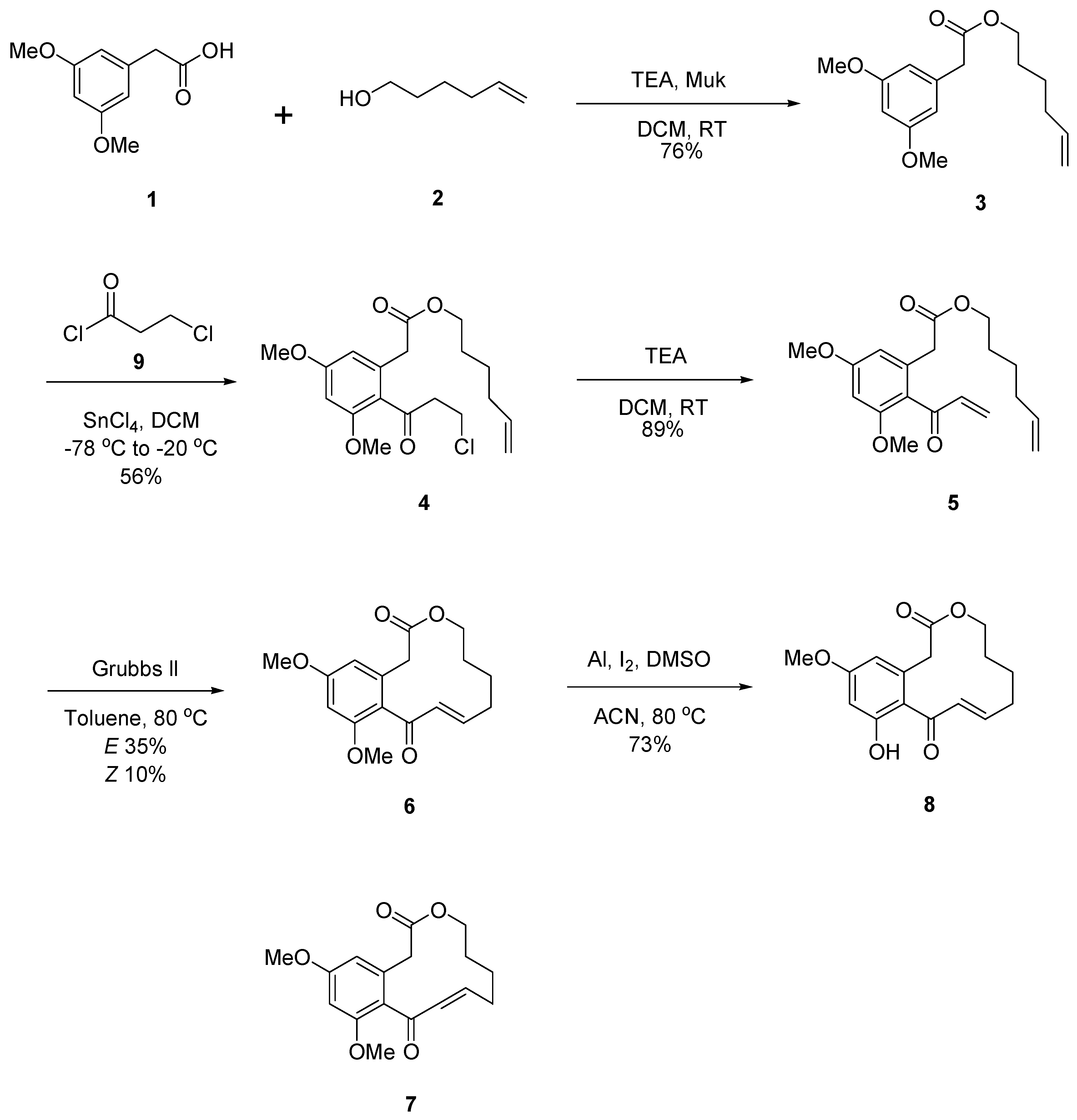
Scheme 1. Schematic outlining the preparation of Cur-5H-OMe2-F1 (6), Cur-5H-OMe2-F2 (7), and Cur-5H-OMe1 (8). The Supplementary Materials section describes the synthesis and properties of the compounds.
Molecules 31 01061 sch001
Scheme 2. Schematic outlining the preparation of Cur-4P-OMe2-F1 (14), Cur-4P-OMe2-F2 (15), and Cur-4P-OMe1 (16). The Supplementary Materials section describes the synthesis and properties of the compounds.
Molecules 31 01061 sch002
Scheme 3. Schematic outlining the preparation of Cur-OMe2-F1 (21), Cur-OMe2-F2 (22), and Cur-OMe1 (23). The Supplementary Materials section describes the synthesis and properties of the compounds.
Molecules 31 01061 sch003
Figure 1. Effects of curvularin derivatives on (A) LPS-induced nitric oxide (NO) production and (B) cell viability in RAW 264.7 macrophages. NO levels were quantified using the Griess assay, and viability was measured using the MTT assay. Data are presented as mean ± SD (n = 3).
Molecules 31 01061 g001aMolecules 31 01061 g001b
Figure 2. Cytotoxic effects of curvularin derivatives on four human cell lines. Cells were treated for 24 h with compounds (68, 1416, 2123) at concentrations of 0.025, 0.05, 0.1, 0.25, 0.5, 1, 2.5, and 5 μg/mL. Cell viability was assessed after treatment; the data represent the mean ± SD values of three independent experiments: (A) HaCaT keratinocytes, (B) HCT116 colorectal carcinoma cells, (C) HeLa cervical carcinoma cells, and (D) A375 melanoma cells.
Molecules 31 01061 g002aMolecules 31 01061 g002bMolecules 31 01061 g002c
Table 1. Anti-inflammatory activity and selectivity index (SI) of derivatives.
CompoundsNO InhibitionCytotoxicity SI (Selectivity Index)
IC50 Value (μg/mL)(Cytotoxicity/
NO Inhibition)
61.834.152.27
72.325.12.20
8>5.03.63<1.0
141.311.351.03
152.014.282.13
160.950.850.89
212.212.891.31
222.844.911.73
230.180.130.72
Table 2. Anticancer activity of curvularin derivatives.
CompoundsIC50 Value (μg/mL)
HaCaTHCT116HeLaA375
62.02>5.0>5.0>5.0
73.16>5.0>5.0>5.0
83.97>5.0>5.0>5.0
141.594.25>5.0>5.0
152.34>5.0>5.0>5.0
160.892.68>5.03.25
212.03>5.0>5.0>5.0
222.47>5.0>5.0>5.0
230.090.380.790.35
Table 3. Antibacterial activity of curvularin derivatives.
CompoundsStaphylococcus aureusEscherichia coli
IC50 (μg/mL)MIC (μg/mL)IC50 (μg/mL)MIC (μg/mL)
Kanamycin a14.97 ± 6.1729.18 ± 4.717.31 ± 2.6126.32 ± 2.50
6>200->200-
7137.43 ± 27.62->200-
849.94 ± 3.29120.24 ± 6.60>200-
1490.56 ± 14.35168.50 ± 42.88>200-
15>200->200-
1639.04 ± 8.9793.46 ± 15.59>200-
21192.99 ± 14.36->200-
22192.47 ± 5.30->200-
238.90 ± 2.2825.70 ± 1.34>200-
a Positive control: Kanamycin (S. aureus, E. coli).
Table 4. Antifungal activity of curvularin derivatives.
CompoundsCandida albicans
IC50 (μg/mL) MIC (μg/mL)
Nystatin a0.83 ± 0.221.11 ± 0.07
6>200-
7116.10 ± 9.22-
86.86 ± 0.5957.36 ± 0.85
14>200-
15157.02 ± 7.53-
1632.25 ± 5.32139.58 ± 12.21
21>200-
22133.30 ± 9.29-
235.24 ± 0.0210.48 ± 0.04
a Positive control: Nystatin (C. albicans).
Table 5. Comparison of the physiological activities of curvularin and its derivatives.
CompoundActivityReference
Anti-Inflamatory (IC50)Anti-Cancer
(IC50)
Anti-Bacteria
(MIC)
Anfi-Fungal
(MIC)
Curvularin18.1 μM [16]
Dehydrocurvularin0.44 μM [26]
10.56–29.17 μM (against HT1080, T46D, and A2780S)40 μg/mL (against S. aureus)40 (μg/mL) (against C. albicans)[36]
10.3 μg/mL (against HeLa)375 μg/mL (against S. aureus)-[25]
1.25–30.06 μM (against human tumour cell lines) [37]
1 μg/mL (against E. coli) [40]
7.9 μM (against HeLa)2.5 μg/mL (against E. coli) [41]
11-α-methoxycurvularin 50 μg/mL (against S. aureus)
50 μg/mL (against E. coli)
[42]
Compound 23
(S,E)-11-hydroxy-13-methoxy-4-methyl-4,5,6,7-tetrahydro-2H-benzo[d][1]oxacyclododecine-2,10(1H)-dione
0.59 μM0.38 μM (HCT116), 0.79 μM (HeLa), 0.35 μM (A375)25.7 μg/mL (against S. aureus)10.48 μg/mL (against C. albicans)This study
Disclaimer/Publisher’s Note: The statements, opinions and data contained in all publications are solely those of the individual author(s) and contributor(s) and not of MDPI and/or the editor(s). MDPI and/or the editor(s) disclaim responsibility for any injury to people or property resulting from any ideas, methods, instructions or products referred to in the content.