Prediction of Bandgap and Key Feature Analysis of Lead-Free Double Perovskite Oxides Based on Deep Learning


Abstract
1. Introduction
2. Results and Discussion
2.1. Feature Engineering
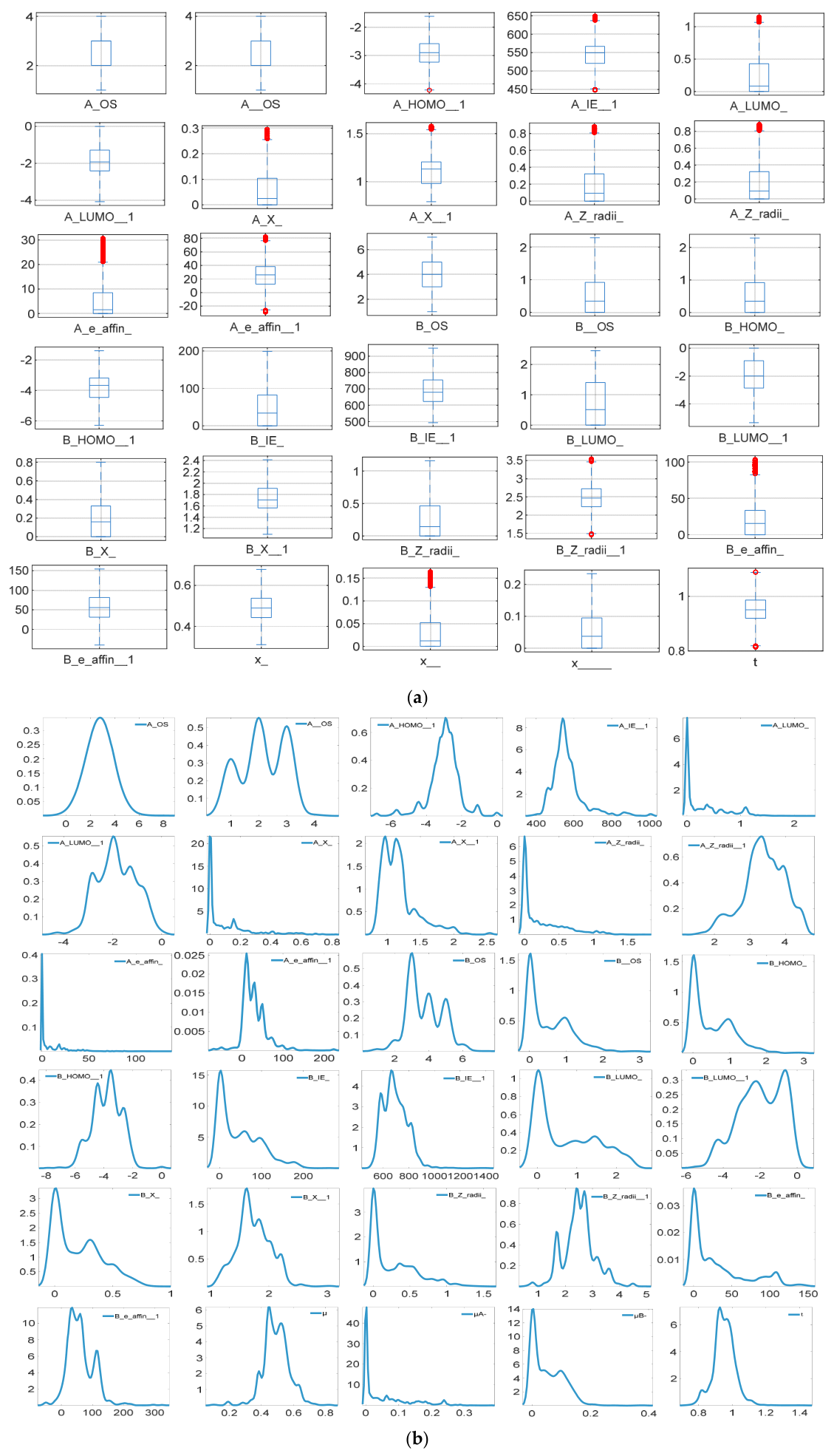
2.1.1. Feature Processing
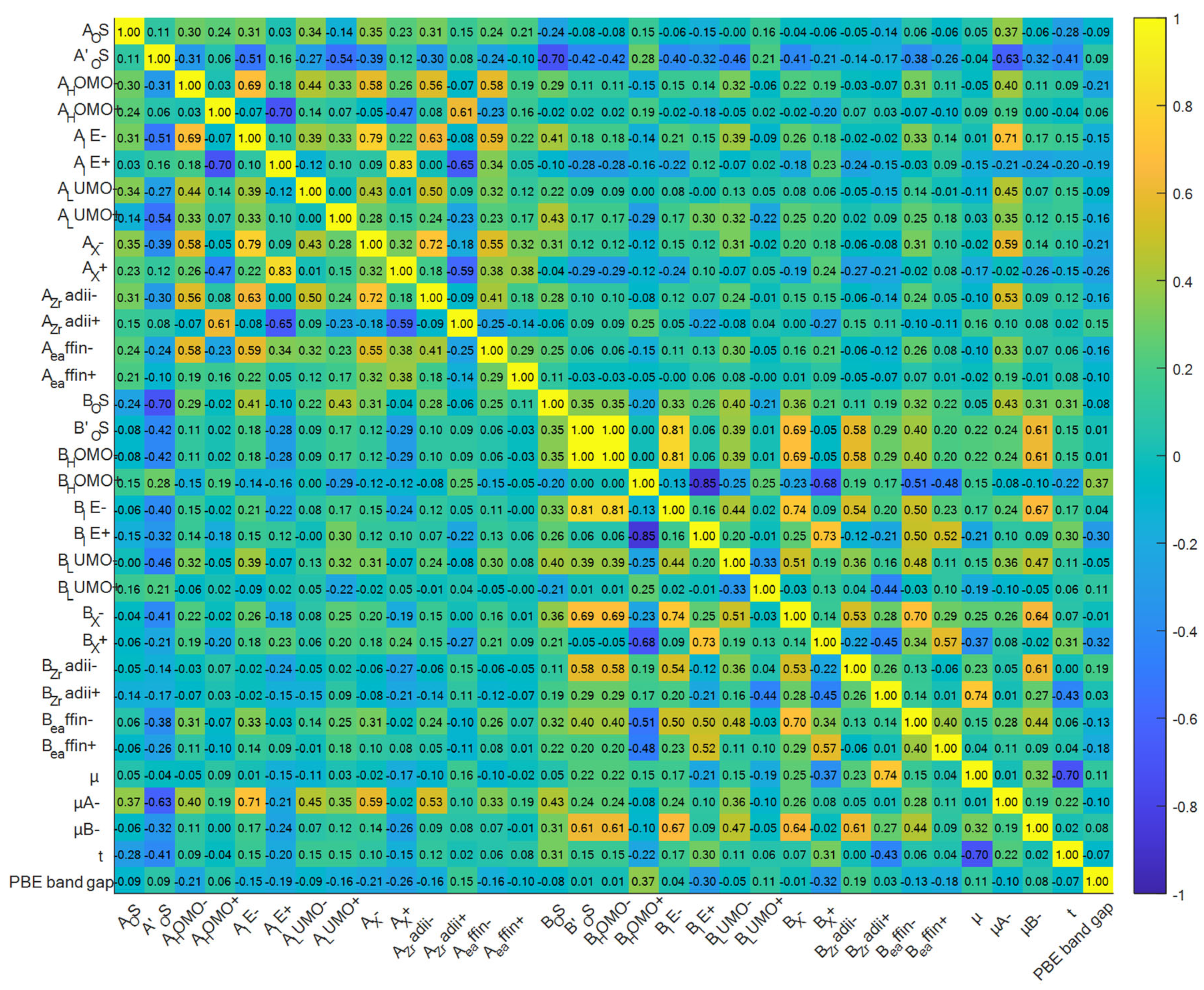
2.1.2. Feature Association Analysis
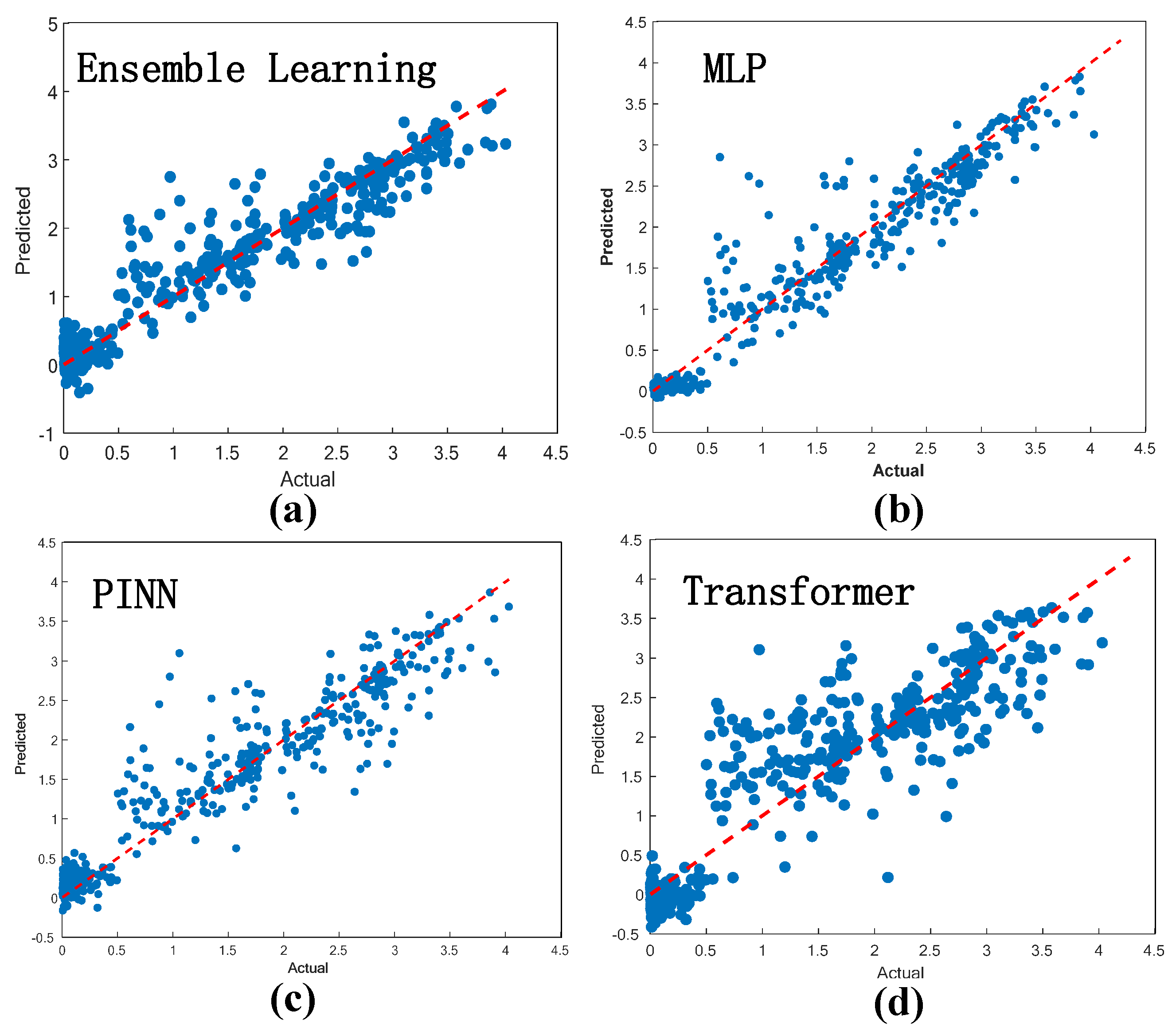
2.2. Model Prediction Results
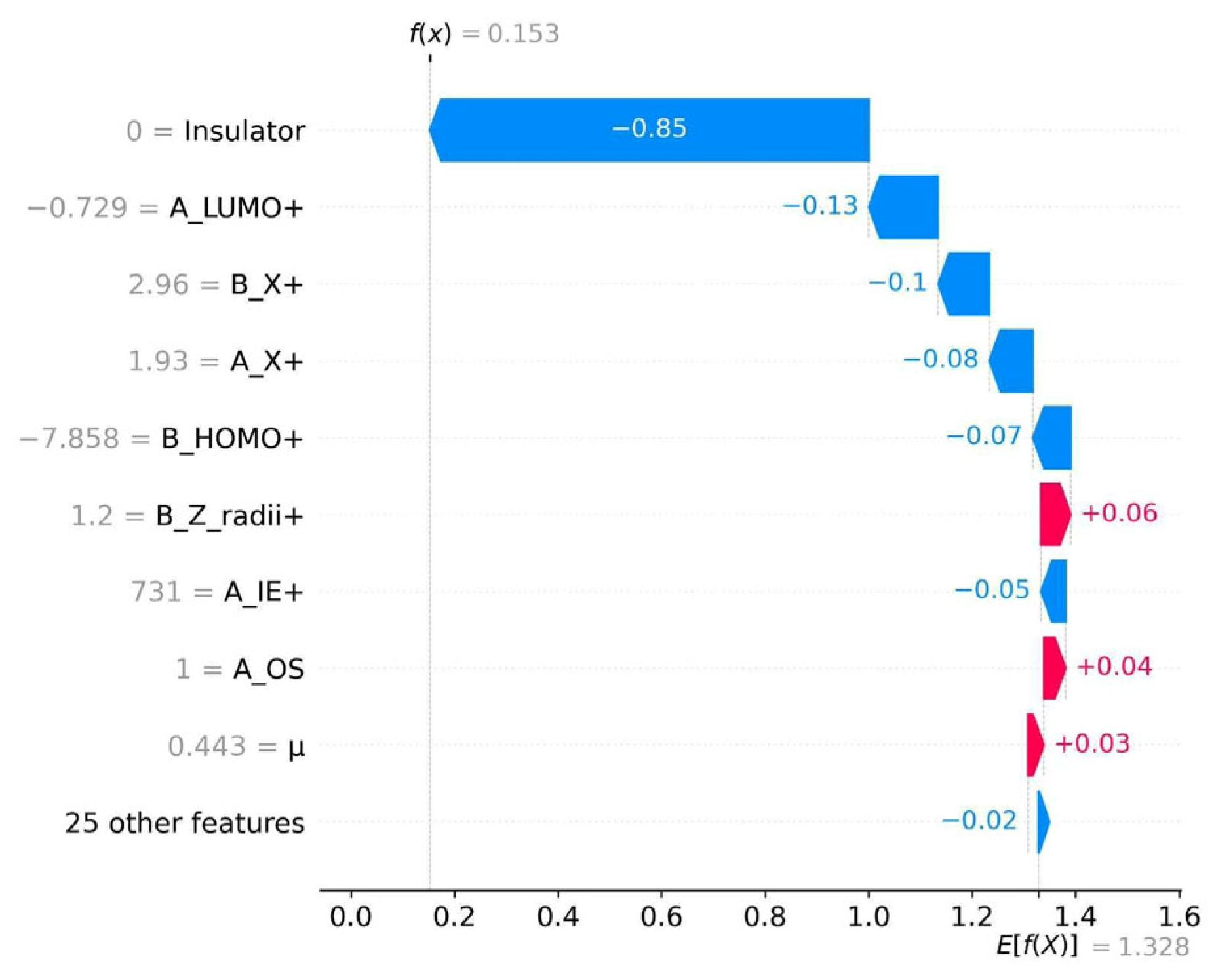
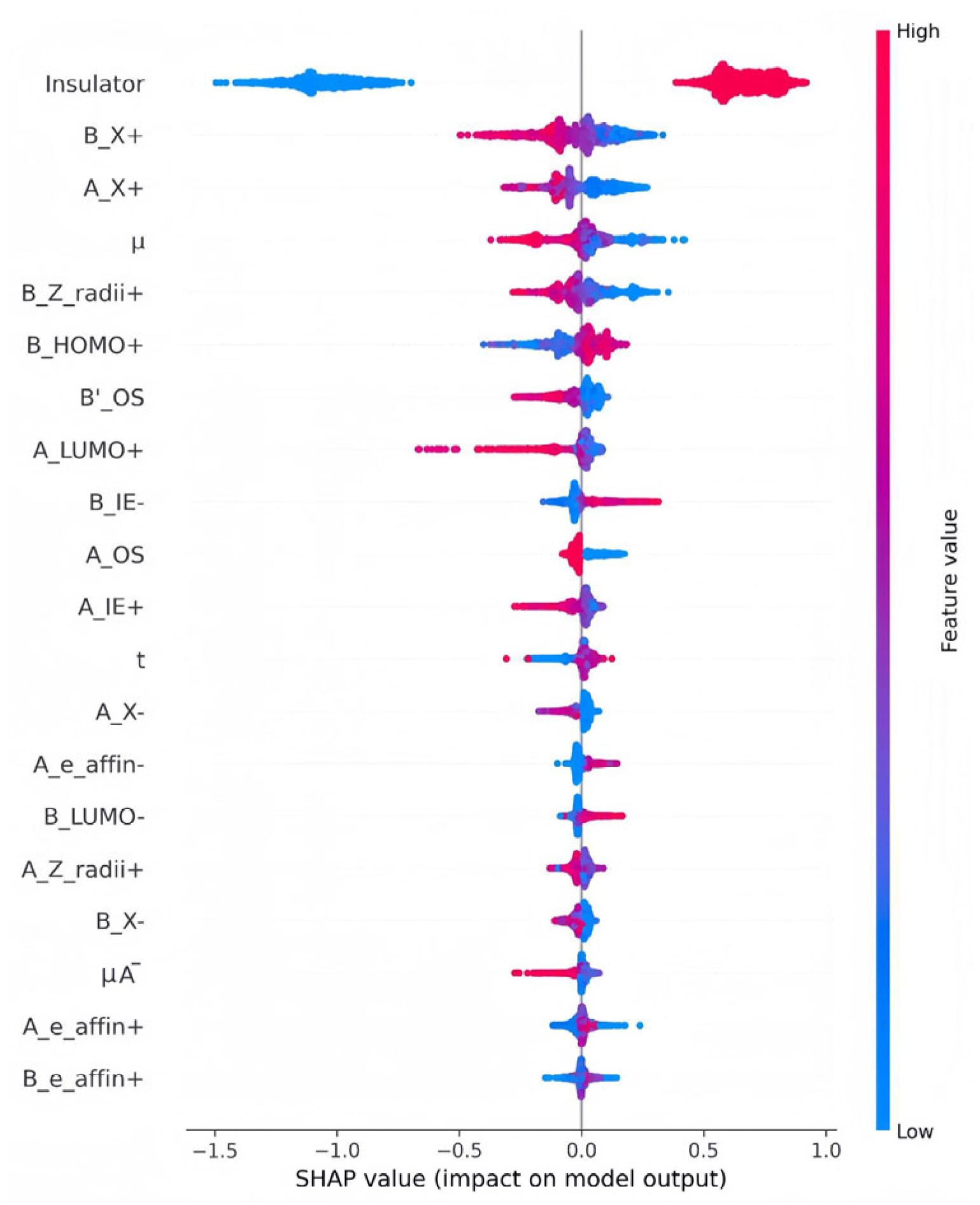
2.3. Feature Importance Analysis
3. Materials and Methods
3.1. Dataset Preparation
3.1.1. Data Sources
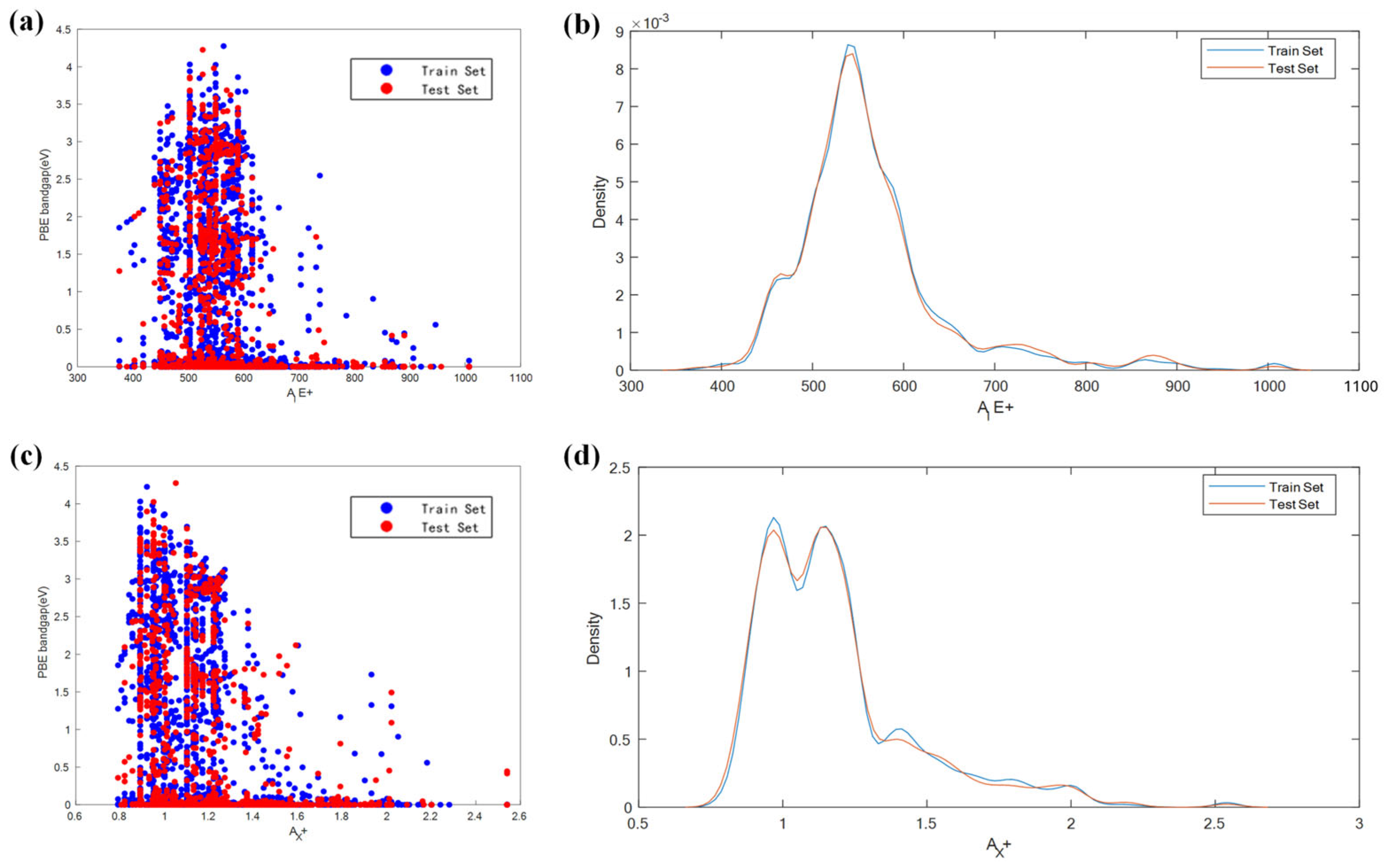
3.1.2. Dataset Division
3.2. Prediction Model
3.2.1. MLP Model
3.2.2. Deep Ensemble Learning Model
3.2.3. PINN Algorithm
3.2.4. Transformer Model
3.3. Valuation Criteria
4. Conclusions
Author Contributions
Funding
Institutional Review Board Statement
Informed Consent Statement
Data Availability Statement
Conflicts of Interest
References
- Rafique, H.; Abbas, G.; Mendes, M.J.; Barquinha, P.; Martins, R.; Fortunato, E.; Águas, H.; Jana, S. Recent advancements and perspectives of low-dimensional halide perovskites for visual perception and optoelectronic applications. Nano-Micro Lett. 2025, 18, 44. [Google Scholar] [CrossRef]
- Zhou, H.P.; Chen, Q.; Li, G.; Luo, S.; Song, T.-B.; Duan, H.-S.; Hong, Z.R.; You, J.B.; Liu, Y.S.; Yang, Y. Interface engineering of highly efficient perovskite solar cells. Science 2014, 345, 542–546. [Google Scholar] [CrossRef] [PubMed]
- Miah, M.H.; Khandaker, M.U.; Hossen, M.J.; Jahan, I.; Shahinuzzaman, M.; Nur-E-Alam, M.; Hanfi, M.Y.; Ullah, M.H.; Islam, M.A. Lead-free alternatives and toxicity mitigation strategies for sustainable perovskite solar cells: A critical review. Mater. Adv. 2025, 6, 2718–2752. [Google Scholar] [CrossRef]
- Wang, Y.N.; Liu, J.X.; Liu, Y.J.; Li, S.P.; Xu, X.L.; Lou, Z.D. Recent advances in lead-free halide perovskites: From synthesis to applications. J. Mater. Chem. C 2024, 12, 10267–10329. [Google Scholar] [CrossRef]
- Bi, J.Y.; Lv, H.J.; Wang, H.G.; Du, L.P.; Liu, Y.; Shen, Y.Q.; Wu, B.; Wang, Y.; Ning, W.H. Bandgap engineering of lead-free double perovskites for efficient photocatalysis. Nanoscale 2025, 17, 14263–14270. [Google Scholar] [CrossRef]
- Wang, Z.J.; Chen, C.C.; Yun, X.F.; Han, Z.; Tuo, Y.L.; Du, Y.X.; Zhang, X.H.; Zhang, C.L.; Guan, X.N.; Xie, J.Z.; et al. Synergistic optimization of lead-free double perovskite solar cell performance through deep learning and density functional theory. Acta Phys. Sin. 2026, 75, 030810. [Google Scholar] [CrossRef]
- Guo, Z.M.; Lin, B. Machine learning stability and band gap of lead-free halide double perovskite materials for perovskite solar cells. Sol. Energy 2021, 228, 689–699. [Google Scholar] [CrossRef]
- Fatima, S.K.; Alzard, R.H.; Amna, R.; Alzard, M.H.; Zheng, K.; Abdellah, M. Lead-free perovskites for next-generation applications: A comprehensive computational and data-driven review. Adv. Mater. 2025, 6, 7634–7661. [Google Scholar] [CrossRef]
- Samantaray, N.; Singh, A.; Tonk, A. Identifying the best ML model for predicting the bandgap in a perovskite solar cell. RSC Sustain. 2024, 2, 3520–3524. [Google Scholar] [CrossRef]
- Liu, H.Y.; Feng, J.G.; Dong, L.F. Rapid prediction of band gap values of perovskite oxides based on machine learning. Nat. Sci. Ed. 2025, 46, 75–82. [Google Scholar]
- Ren, C.; Wu, Y.Y.; Zou, J.J.; Cai, B.W. Employing the Interpretable Ensemble Learning Approach to Predict the Bandgaps of the Halide Perovskites. Materials 2024, 17, 2686. [Google Scholar] [CrossRef]
- Ye, Y.; Li, R.; Qu, B.; Wang, H.; Liu, Y.; Chen, Z.; Zhang, J.; Xiao, L. Machine learning for energy band prediction of halide perovskites. Mater. Futures 2025, 4, 035601. [Google Scholar] [CrossRef]
- Kumar, U.; Kim, H.W.; Maurya, G.K.; Raj, B.B.; Singh, S.; Kushwaha, A.K.; Cho, S.B.; Ko, H. Machine learning-enhanced design of lead-free halide perovskite materials using density functional theory. Curr. Appl. Phys. 2025, 69, 1–7. [Google Scholar] [CrossRef]
- Vu, T.-S.; Ha, M.-Q.; Nguyen, D.-N.; Nguyen, V.-C.; Abe, Y.; Tran, T.; Tran, H.; Kino, H.; Miyake, T.; Tsuda, K.; et al. Towards understanding structure–property relations in materials with interpretable deep learning. Npj Comput. Mater. 2023, 9, 215. [Google Scholar] [CrossRef]
- Masuda, T.; Tanabe, K. Neural network ensembles for band gap prediction. Comput. Mater. Sci. 2025, 246, 113327. [Google Scholar] [CrossRef]
- Saidi, W.A.; Shadid, W.; Castelli, I.E. Machine-learning structural and electronic properties of metal halide perovskites using a hierarchical convolutional neural network. npj Comput. Mater. 2020, 6, 36. [Google Scholar] [CrossRef]
- Stoichev, Z.; Allam, O.A.; Jang, S.S. Artificial Neural Networks for Accurate Prediction and Analysis of Perovskite Bandgaps. ECS Meet. Abstr. 2019, MA2019-02, 2345. [Google Scholar] [CrossRef]
- Qin, M.Y.; Sun, Z.Y.; Feng, L.; Han, C.Y.; Xia, J.J.; Han, L.Y. MoleculeFormer is a GCN-transformer architecture for molecular property prediction. Commun. Biol. 2025, 8, 1668. [Google Scholar] [CrossRef]
- Mammeri, M.; Lakhder, D.; Bencherif, H. An efficient neural network approach for perovskite materials band gap prediction. In 2023 International Conference on Electrical Engineering and Advanced Technology; IEEE: New York, NY, USA, 2023; Volume 1, pp. 1–4. [Google Scholar]
- Jo, J.; Jeong, Y.; Kim, J.; Yoo, J. Thermal conductivity estimation using Physics-Informed Neural Networks with limited data. Eng. Appl. Artif. Intell. 2024, 137, 109079. [Google Scholar] [CrossRef]
- Yu, H.Q.; Yang, K.Y.; Zhang, L.S.; Wang, W.T.; Ouyang, M.Z.; Ma, B.; Yang, S.C.; Li, J.F.; Liu, X.H. Multi-output ensemble deep learning: A framework for simultaneous prediction of multiple electrode material properties. Chem. Eng. J. 2023, 475, 146280. [Google Scholar] [CrossRef]
- Jin, L.Z.J.; Du, Z.J.; Shu, L.; Cen, Y.; Xu, Y.F.; Mei, Y.F.; Zhang, H. Transformer-generated atomic embeddings to enhance prediction accuracy of crystal properties with machine learning. Nat. Commun. 2025, 16, 1210. [Google Scholar] [CrossRef]
- Su, J.M.; Liu, H.F.; Xiang, F.T.; Wu, J.Z.; Yuan, X.S. Survey of Interpretation Methods for Deep Neural Networks. Comput. Eng. 2020, 46, 1–15. [Google Scholar]
- Guidotti, R.; Monreale, A.; Ruggieri, S.; Turini, F.; Pedreschi, D.; Giannotti, F. A survey of methods for explaining black box models. ACM Comput. Surv. 2018, 51, 1–42. [Google Scholar] [CrossRef]
- Zhang, Q.S.; Zhu, S.C. Visual interpretability for deep learning: A survey. Front. Inf. Technol. Electron. Eng. 2018, 19, 27–39. [Google Scholar] [CrossRef]
- Wang, Y.D.; Sun, D.; Zhao, B.; Zhu, T.Y.; Liu, C.C.; Xu, Z.X.; Zhou, T.H.; Xu, C.M. Data-Driven Perovskite Design via High-Throughput Simulation and Machine Learning. Processes 2025, 13, 3049. [Google Scholar] [CrossRef]
- Li, J.; Cheng, K.; Wang, S.; Morstatter, F.; Trevino, R.P.; Tang, J.; Liu, H. Feature selection: A data perspective. ACM Comput. Surv. 2017, 50, 1–45. [Google Scholar] [CrossRef]
- Zhao, F.; Zhao, J.Y.; Niu, X.X.; Luo, S.S.; Xin, Y. A Filter Feature Selection Algorithm Based on Mutual Information for Intrusion Detection. Appl. Sci. 2018, 8, 1535. [Google Scholar] [CrossRef]
- Ghosh, S.; Chowdhury, J. Predicting band gaps of ABN3 perovskites: An account from machine learning and first-principle DFT studies. RSC Adv. 2024, 14, 6385–6397. [Google Scholar] [CrossRef]
- Yaghoobi, M.; Alaei, M.; Shirazi, M.; Rezaei, N.; de Gironcoli, S. Discovery of novel silicon allotropes with optimized band gaps to enhance solar cell efficiency through evolutionary algorithms and machine learning. Comput. Mater. Sci. 2025, 246, 113392. [Google Scholar] [CrossRef]
- Qin, H.; Zhang, Y.; Guo, Z.; Wang, S.; Zhao, D.; Xue, Y. Prediction of bandgap in lithium-ion battery materials based on explainable boosting machine learning techniques. Materials 2024, 17, 6217. [Google Scholar] [CrossRef] [PubMed]
- Zhong, X.T.; Gallagher, B.; Liu, S.S.; Kailkhura, B.; Hiszpanski, A.; Han, T.Y.-J. Explainable machine learning in materials science. npj Comput. Mater. 2022, 8, 204. [Google Scholar] [CrossRef]
- Guo, P.F.; Wang, J.S.; Shen, X.; Lv, Q.H.; Li, X.Y.; Xu, Z.T.; Han, S.P.; Bian, Y.X.; Meng, Y.; Yang, L.Z.; et al. Bandgap engineering of halide perovskite nanoribbons for high-performance photodetection. Nano Res. 2025, 18, 94907347. [Google Scholar] [CrossRef]
- Liu, C.Y.; Celiberti, L.; Decker, R.; Ruotsalainen, K.; Siewierska, K.; Kusch, M.; Wang, R.P. Orbital-overlap-driven hybridization in 3d-transition metal perovskite oxides LaMO3 (M = Ti-Ni) and La2CuO4. Commun. Phys. 2024, 7, 156. [Google Scholar] [CrossRef]
- Guo, X.P.; Li, Y.B.; Xiao, W.B.; Wu, H.M. First-principles study on the electronic structure and optical properties of orthorhombic CaTiO3 under different pressures. Phys. C Supercond. Appl. 2024, 617, 1354447. [Google Scholar] [CrossRef]
- Sun, Y.; Liu, Z.Y.; Zhang, W.; Chu, X.F.; Cong, Y.G.; Huang, K.K.; Feng, S.H. Unfolding B-O-B bonds for an enhanced ORR performance in ABO3-type perovskites. Small 2019, 15, 1803513. [Google Scholar] [CrossRef] [PubMed]
- Ma, T.X.; Su, X.X.; Dong, H.W.; Wang, Y.S.; Zhang, C.Z. Review of bandgap characteristics and acousto-optical coupling in phoxonic crystals. Chin. J. Theor. Appl. Mech. 2017, 49, 743–757. [Google Scholar]
- Talapatra, A.; Uberuaga, B.P.; Stanek, C.R.; Gubernatis, J.E. Band gap predictions of double perovskite oxides using machine learning. Commun. Mater. 2023, 4, 46. [Google Scholar] [CrossRef]
- Jin, J.R.; Faraji, S.; Liu, B.; Liu, M.J. Comparative analysis of conventional machine learning and graph neural network models for perovskite property prediction. Phys. Chem. C 2024, 128, 16672–16683. [Google Scholar] [CrossRef]
- Talapatra, A.; Uberuaga, P.P.; Stanek, C.R.; Pilania, G. A machine learning approach for the prediction of formability and thermodynamic stability of single and double perovskite oxides. Chem. Mater. 2021, 33, 845–858. [Google Scholar] [CrossRef]
- Sechidis, K.; Tsoumakas, G.; Vlahavas, I.; Dimitrios, G.; Thomas, H.; Donato, M.; Michalis, V. On the Stratification of Multi-Label Data; Springer: Berlin/Heidelberg, Germany, 2011; Volume 6913, pp. 145–158. [Google Scholar]
- Heaton, J. Ian Goodfellow, Yoshua Bengio, and Aaron Courville: Deep learning. Genet. Program. Evolvable Mach. 2018, 19, 305–307. [Google Scholar] [CrossRef]
- Yann, L.C.; Bengio, Y.S.; Hinton, G. Deep learning. Nature 2015, 521, 436–444. [Google Scholar] [CrossRef]
- Nijhawan, R.; Koundal, D.; Kaur, A.; Thukral, A.; Verma, A. Deep ensemble learning using transfer learning for food classification. Recent Adv. Comput. Sci. Commun. 2025, 18, E26662558310306. [Google Scholar] [CrossRef]
- Kim, D.J.; Lee, J. A review of physics informed neural networks for multiscale analysis and inverse problems. Multiscale Sci. Eng. 2024, 6, 1–11. [Google Scholar] [CrossRef]
- Raissi, M.; Perdikaris, P.; Karniadakis, G.E. Physics-informed neural networks: A deep learning framework for solving forward and inverse problems involving nonlinear partial differential equations. J. Comput. Phys. 2019, 378, 686–707. [Google Scholar] [CrossRef]
- Li, X.; Dan, Y.B.; Dong, R.Z.; Cao, Z.; Niu, C.C.; Song, Y.Q.; Li, S.B.; Hu, J.J. Computational Screening of New Perovskite Materials Using Transfer Learning and Deep Learning. Appl. Sci. 2019, 9, 5510. [Google Scholar] [CrossRef]
- Jiang, C.; He, H.Y.; Guo, H.Q.; Zhang, X.X.; Han, Q.Y.; Weng, Y.H.; Fu, X.Z.; Zhu, Y.L.; Yan, N.; Tu, X.; et al. Transfer learning guided discovery of efficient perovskite oxide for alkaline water oxidation. Nat. Commun. 2024, 15, 6301. [Google Scholar] [CrossRef]
- Takase, S.; Kiyono, S.; Kobayashi, S.; Suzuki, J. On Layer Normalizations and Residual Connections in Transformers. arXiv 2022, arXiv:2206.00330. [Google Scholar]
- Chai, T.; Draxler, R.R. Root mean square error (RMSE) or mean absolute error (MAE). Geosci. Model Dev. Discuss. 2014, 7, 1525–1534. [Google Scholar]






| Feature | Unit | Description |
|---|---|---|
| A_OS, A’_OS | None | The oxidation states of the elements at positions A and A’ |
| A_HOMO−, A_HOMO+ | eV | The energy of the highest occupied molecular orbital (HOMO) of element A |
| A_IE−, A_IE+ | kJ/mol | Ionisation energy of element A |
| A_LUMO−, A_LUMO+ | eV | The lowest unoccupied molecular orbital (LUMO) energy of the A position element |
| A_X−, A_X+ | None | Electronegativity of element A |
| A_Z_radii−, A_Z_radii+ | a.u. | The Zunger pseudopotential radius of element A |
| A_e_affin−, A_e_affin+ | kJ/mol | Electronic affinity of element at position A |
| B_OS, B’_OS | None | The oxidation states of the elements at positions B and B’ |
| B_HOMO−, B_HOMO+ | eV | The B element occupies the highest energy level of the molecular orbital (HOMO) |
| B_IE−, B_IE+ | kJ/mol | Ionisation energy of the B element |
| B_LUMO−, B_LUMO+ | eV | The lowest unoccupied molecular orbital (LUMO) energy of the B-type element |
| B_X−, B_X+ | None | Electronegativity of the B element |
| B_Z_radii−, B_Z_radii+ | a.u. | The radius of the Zunger pseudopotential for the B element |
| B_e_affin−, B_e_affin+ | kJ/mol | The electron affinity of the B element |
| μ | None | Octahedral factor |
| μ | None | A-position mismatch factor |
| μ | None | B-position mismatch factor |
| None | Tolerance factor |
| Feature A | Feature B | Correlation Coefficient |
|---|---|---|
| B_HOMO+ | B_IE+ | −0.8536 |
| B_HOMO− | B_IE− | 0.8050 |
| B’_OS | B_IE− | 0.8050 |
| A_IE+ | A_X+ | 0.8330 |
| B’_OS | B_HOMO− | 1.0000 |
| Algorithm | Evaluation Indicators | |||
|---|---|---|---|---|
| MAE | MSE | RMSE | R2 | |
| Deep ensemble learning | 0.2287 | 0.1183 | 0.3440 | 0.9163 |
| MLP | 0.1915 | 0.0975 | 0.3122 | 0.9311 |
| PINN | 0.2370 | 0.1353 | 0.3678 | 0.9044 |
| Transformer | 0.3591 | 0.2577 | 0.5076 | 0.8178 |
| LFDP-Os Order Number | Functional Group | PBE Bandgap (eV) | Prediction Bandgap (eV) | Prediction Error (eV) |
|---|---|---|---|---|
| 1 | AgCdReAuO6 | 0.0215 | 0.0344 | −0.0129 |
| 2 | AgTaO3 | 1.7301 | 1.5509 | 0.1792 |
| 3 | AsBO3 | 0.5587 | 1.0036 | −0.4449 |
| 4 | AuBaMnInO6 | 0.0058 | 0.0223 | 0.0165 |
| 5 | Ba2BiCeO6 | 0.0110 | 0.1021 | −0.0911 |
| 6 | Ba2BiCrO6 | 0.0072 | 0.0672 | −0.0600 |
| 7 | Ba2BiDyO6 | 1.7309 | 1.7762 | −0.0453 |
| 8 | Ba2CdTeO6 | 0.7433 | 0.9496 | −0.2063 |
| 9 | Ba2DySbO6 | 3.4682 | 3.5536 | −0.0854 |
| 10 | Ba2DyWO6 | 0.0414 | 0.0280 | 0.0134 |
| 11 | Ba2ErBiO6 | 1.6093 | 1.5892 | 0.0201 |
| 12 | Ba2ErSbO6 | 3.3728 | 3.4768 | −0.1040 |
| 13 | Ba2GaNbO6 | 3.0858 | 3.2184 | −0.1326 |
| 14 | Ba2GdTaO6 | 3.1809 | 3.3374 | −0.1566 |
| 15 | Ba2HfSiO6 | 4.0303 | 3.1283 | 0.9020 |
| 16 | Ba2HfZrO6 | 3.2399 | 3.1877 | 0.0522 |
| 17 | Ba2InSbO6 | 0.4948 | 0.0935 | 0.4013 |
| 18 | Ba2MgTeO6 | 1.7447 | 2.5726 | −0.8279 |
| 19 | Ba2NbHoO6 | 2.8549 | 2.4990 | 0.3559 |
| 20 | Ba2NdTaO6 | 3.3132 | 3.2104 | 0.1028 |
| Bandgap Range (eV) | Sample Size | MAE (eV) | MSE (eV2) | RMSE (eV) | Error ≤ 0.4 eV Percentage |
|---|---|---|---|---|---|
| Low bandgap (0–1.0) | 214 | 0.1915 | 0.0975 | 0.3122 | 91.12% |
| Medium–low bandgap (1.0–2.0) | 97 | 0.1922 | 0.0979 | 0.3128 | 81.44% |
| Medium–high bandgap (2.0–3.5) | 153 | 0.1932 | 0.0990 | 0.3146 | 86.27% |
| High bandgap (>3.5) | 9 | 0.1942 | 0.0983 | 0.3135 | 66.67% |
Disclaimer/Publisher’s Note: The statements, opinions and data contained in all publications are solely those of the individual author(s) and contributor(s) and not of MDPI and/or the editor(s). MDPI and/or the editor(s) disclaim responsibility for any injury to people or property resulting from any ideas, methods, instructions or products referred to in the content. |
© 2026 by the authors. Licensee MDPI, Basel, Switzerland. This article is an open access article distributed under the terms and conditions of the Creative Commons Attribution (CC BY) license.
Share and Cite
Wang, B.; Wang, J. Prediction of Bandgap and Key Feature Analysis of Lead-Free Double Perovskite Oxides Based on Deep Learning. Molecules 2026, 31, 1032. https://doi.org/10.3390/molecules31061032
Wang B, Wang J. Prediction of Bandgap and Key Feature Analysis of Lead-Free Double Perovskite Oxides Based on Deep Learning. Molecules. 2026; 31(6):1032. https://doi.org/10.3390/molecules31061032
Chicago/Turabian StyleWang, Beibei, and Juan Wang. 2026. "Prediction of Bandgap and Key Feature Analysis of Lead-Free Double Perovskite Oxides Based on Deep Learning" Molecules 31, no. 6: 1032. https://doi.org/10.3390/molecules31061032
APA StyleWang, B., & Wang, J. (2026). Prediction of Bandgap and Key Feature Analysis of Lead-Free Double Perovskite Oxides Based on Deep Learning. Molecules, 31(6), 1032. https://doi.org/10.3390/molecules31061032