


Harnessing Endophytic Fungi as a Sustainable Source of Novel Anticancer Agents: Opportunities, Challenges, and Future Directions

 ,
,  , and
, and 
Abstract
1. Introduction
Scope and Aim of This Review Paper
2. Search Strategy and Selection Criteria
2.1. Review Design and Methodological Framework
2.2. Literature Search Strategy
2.2.1. Data Sources and Search Period
2.2.2. Search Terms and Query Design
2.3. Study Screening and Eligibility Assessment
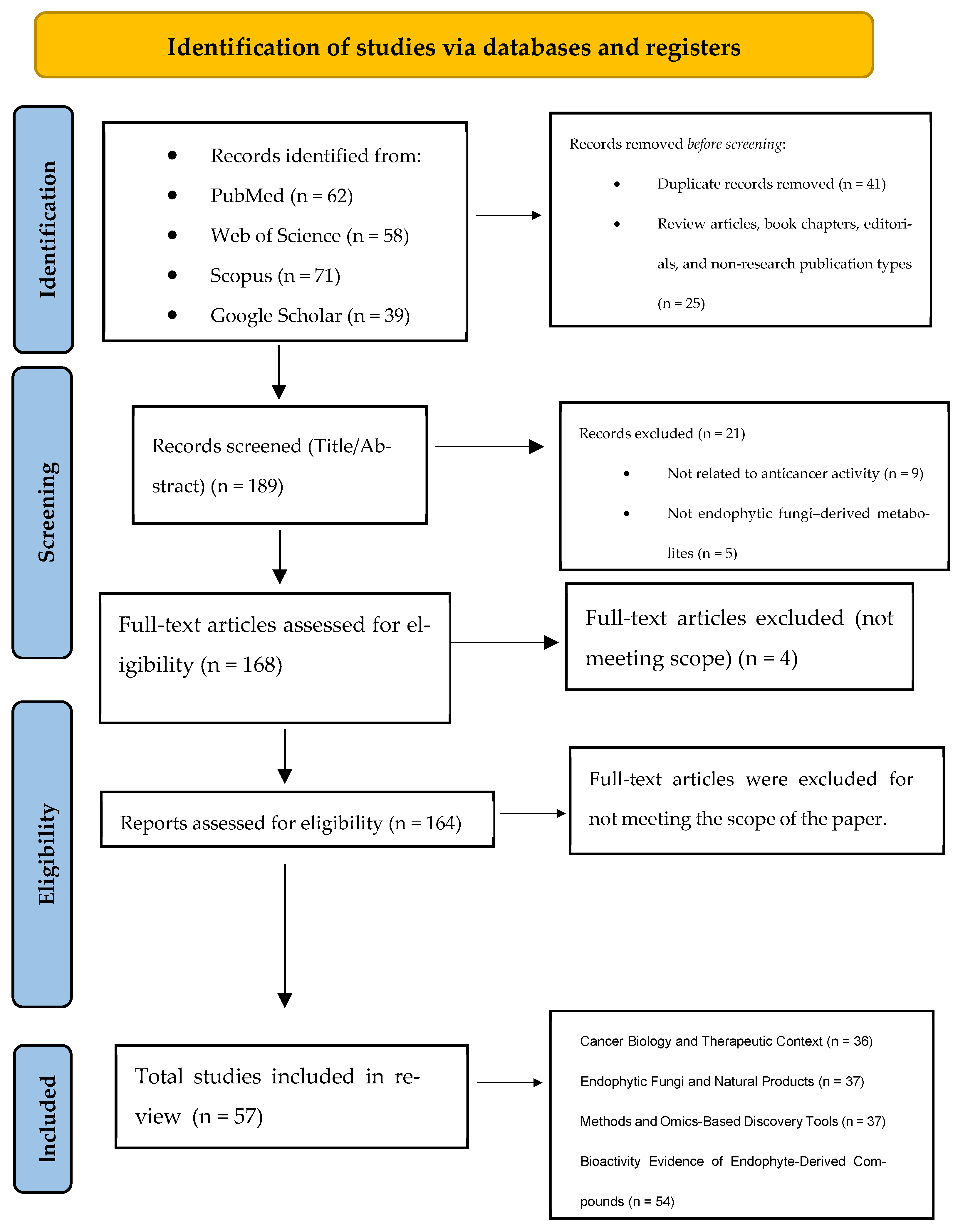
2.3.1. PRISMA-Based Screening Process
2.3.2. Inclusion Criteria
- In vitro and/or in vivo evaluation of anticancer activity derived from endophytic fungal extracts, fractions, or purified metabolites;
- Use of human or animal cancer models with appropriate experimental controls;
- Reporting of quantitative cytotoxicity data, such as IC50 values or equivalent dose–response metrics;
- Inclusion of mechanistic validation, including but not limited to apoptosis induction, cell-cycle arrest, mitochondrial dysfunction, reactive oxygen species (ROS) generation, or modulation of oncogenic signaling pathways.
2.3.3. Exclusion Criteria
- Focused exclusively on antimicrobial, agricultural, or ecological outcomes without anticancer evaluation;
- Lacked sufficient methodological detail or reproducible biological data;
- Failed to report quantitative cytotoxicity or mechanistic outcomes;
- Reported only preliminary screening observations without compound characterization or biological validation.
2.4. Data Extraction
2.5. Taxonomy-Based Data Categorization and Evidence Synthesis
3. Endophytic Fungi and Their Relevance to Anticancer Drug Discovery
3.1. Definition and Biological Characteristics of Endophytic Fungi
3.2. Ecological and Evolutionary Drivers of Metabolite Diversity
3.3. Biosynthesis Versus Bioconversion of Anticancer Metabolites
3.4. Sustainability and Biotechnological Advantages
Recent Research Highlights the Practical Impact of These Advantages
4. Mechanisms of Anticancer Action of Endophyte-Derived Compounds
4.1. Microtubule Disruption and Mitotic Arrest
4.1.1. Paclitaxel
4.1.2. Vinblastine
4.2. DNA Interaction and Topoisomerase Inhibition
4.2.1. Camptothecin
4.2.2. Podophyllotoxin
4.3. Mitochondrial Dysfunction and ROS Generation
4.3.1. Beauvericin
4.3.2. Hypericin
4.4. Oncogenic Signaling Pathway Modulation
4.4.1. Diosgenin
4.4.2. Toosendanin (TSN)
4.5. Recent Advances of New Endophyte-Derived Compounds and Their Mechanisms
4.6. Mechanistic Overview by Chemical Class
5. Translational Insights and Pharmacological Validation
5.1. In Vitro, Cytotoxicity and Mechanism-Based Assays
5.2. In Vivo Pharmacological Studies and Preclinical Models
5.3. Consideration of Cytotoxicity Toward Normal Cells and Therapeutic Selectivity
5.4. Comparative Efficacy Against Standard Chemotherapies
5.5. From Lead Discovery to Drug Candidacy
5.6. Challenges and Opportunities for Clinical Advancement
6. Strategies for Enhancing Discovery and Sustainable Production of Antitumor Natural Products from Plant-Derived Endophytic Fungi
6.1. Targeted Bioprospecting and Habitat-Informed Fungal Selection
6.2. Awakening Silent Biosynthetic Gene Clusters
6.3. Culture-Based Elicitation: OSMAC Designs, Co-Culture Systems, and Epigenetic Activation
6.4. Multi-Omics and Analytical Dereplication Tools
6.5. Omics-Driven Discovery and Dereplication: LC–MS/MS Molecular Networking, Paired Genomics–Metabolomics, and BGC Annotation
6.6. Genome Mining, Pathway Activation, and Synthetic Biology for Scalable Supply
6.7. Bioprocess Development for Sustainable Production: Fermentation Mode, Scale-Up, and Downstream Recovery
6.8. Translational Rigor, Sustainability, and Governance: From Credible Attribution to Responsible Bioprospecting
7. Sustainability, Bioprospecting, and Future Perspectives
7.1. Persistent Research Gaps in Endophyte-Based Drug Development
7.2. Genomics and Metabolomics Integration for Precision Discovery
7.3. Biodiversity-Driven Bioprospecting and Translational Challenges in Endophytic Fungal Anticancer Research
7.3.1. Biodiversity-Driven Bioprospecting and Chemical Innovation
7.3.2. Translational and Manufacturing Challenges
- (i)
- Synthetic biology and metabolic engineering to stabilize BGC expression and enable scalable, GMP-compatible production;
- (ii)
- Multi-omics-guided dereplication and genome mining to accelerate lead prioritization and strengthen mechanistic validation;
- (iii)
8. Conclusions
Funding
Data Availability Statement
Conflicts of Interest
Abbreviations
| AKT | Protein kinase B |
| BGC | Biosynthetic Gene Cluster |
| CML | Chronic myeloid leukaemia |
| CPT | Camptothecin |
| CRISPR/Cas9 | Clustered Regularly Interspaced Short Palindromic Repeats/CRISPR-associated protein 9 |
| DNMT | DNA methyltransferase |
| DMSO | Dimethyl sulfoxide |
| EFSA | European Food Safety Authority |
| EMT | Epithelial–mesenchymal transition |
| ERK | Extracellular signal-regulated kinase |
| GMP | Good Manufacturing Practice |
| GNPS | Global Natural Products Social Molecular Networking |
| GSK-3 | Glycogen synthase kinase 3 |
| HDAC | Histone deacetylase |
| HR-MS | High-resolution mass spectrometry |
| IC50 | Half Maximal Inhibitory Concentration |
| IND | Investigational New Drug |
| ITS | Internal transcribed spacer |
| ITSN | Isotoosendanin |
| JAK | Janus kinase |
| JNK | c-Jun N-terminal kinase |
| LC–MS/MS | Liquid chromatography–tandem mass spectrometry |
| LD50 | Median lethal dose |
| MAPK | Mitogen-Activated Protein Kinase |
| MDR | Multidrug resistance |
| MGM | Melanocyte Growth Medium |
| mTOR | Mechanistic target of rapamycin |
| NCI-60 | National Cancer Institute 60 human tumour cell line panel |
| NF-κB | Nuclear Factor kappa B– Phosphatidylinositol 3-Kinase/Protein Kinase B |
| NMR | Nuclear magnetic resonance |
| NRPS | Non-ribosomal peptide synthetase |
| OSMAC | One Strain–Many Compounds |
| PARP | Poly (ADP-ribose) polymerase |
| PD | Pharmacodynamics |
| PEG-400 | Polyethylene glycol 400 |
| PDT | Photodynamic therapy |
| PI3K/Akt | Phosphatidylinositol-3-kinase |
| PK | Pharmacokinetics |
| PKS | Polyketide synthase |
| PKS–NRPS | Polyketide Synthase-Non-Ribosomal Peptide Synthetase |
| PRISMA | Preferred Reporting Items for Systematic Reviews and Meta-Analyses |
| ROS | Reactive Oxygen Species |
| SAHA | Suberoylanilide hydroxamic acid |
| STAT3 | Signal Transducer and Activator of Transcription 3 |
| TLR4 | Toll-like receptor 4 |
| TNBC | Triple-negative breast cancer |
| TSN | Toosendanin |
| TUNEL | Terminal deoxynucleotidyl transferase dUTP nick end labelling |
| VOCs | Volatile organic compounds |
References
- Hanahan, D. Hallmarks of Cancer: New Dimensions. Cancer Discov. 2022, 12, 31–46. [Google Scholar] [CrossRef]
- Atanasov, A.G.; Zotchev, S.B.; Dirsch, V.M.; The International Natural Product Sciences Taskforce; Supuran, C.T. Natural products in drug discovery: Advances and opportunities. Nat. Rev. Drug Discov. 2021, 20, 200–216. [Google Scholar] [CrossRef]
- Wen, J.; Okyere, S.K.; Wang, S.; Wang, J.; Xie, L.; Ran, Y.; Hu, Y. Endophytic Fungi: An Effective Alternative Source of Plant-Derived Bioactive Compounds for Pharmacological Studies. J. Fungi 2022, 8, 205. [Google Scholar] [CrossRef]
- Hashem, A.H.; Attia, M.S.; Kandil, E.K.; Fawzi, M.M.; Abdelrahman, A.S.; Khader, M.S.; Khodaira, M.A.; Emam, A.E.; Goma, M.A.; Abdelaziz, A.M. Bioactive compounds and biomedical applications of endophytic fungi: A recent review. Microb. Cell Factories 2023, 22, 107. [Google Scholar] [CrossRef]
- Mishra, S.; Priyanka; Sharma, S. Metabolomic Insights Into Endophyte-Derived Bioactive Compounds. Front. Microbiol. 2022, 13, 835931. [Google Scholar] [CrossRef] [PubMed]
- Gaudencio, S.P.; Bayram, E.; Lukic Bilela, L.; Cueto, M.; Diaz-Marrero, A.R.; Haznedaroglu, B.Z.; Jimenez, C.; Mandalakis, M.; Pereira, F.; Reyes, F.; et al. Advanced Methods for Natural Products Discovery: Bioactivity Screening, Dereplication, Metabolomics Profiling, Genomic Sequencing, Databases and Informatic Tools, and Structure Elucidation. Mar. Drugs 2023, 21, 308. [Google Scholar] [CrossRef] [PubMed]
- Page, M.J.; McKenzie, J.E.; Bossuyt, P.M.; Boutron, I.; Hoffmann, T.C.; Mulrow, C.D.; Shamseer, L.; Tetzlaff, J.M.; Akl, E.A.; Brennan, S.E.; et al. The PRISMA 2020 statement: An updated guideline for reporting systematic reviews. BMJ 2021, 372, n71. [Google Scholar] [CrossRef] [PubMed]
- Haddaway, N.R.; Page, M.J.; Pritchard, C.C.; McGuinness, L.A. PRISMA2020: An R package and Shiny app for producing PRISMA 2020-compliant flow diagrams, with interactivity for optimised digital transparency and Open Synthesis. Campbell Syst. Rev. 2022, 18, e1230. [Google Scholar] [CrossRef]
- van der Hooft, J.J.J.; Mohimani, H.; Bauermeister, A.; Dorrestein, P.C.; Duncan, K.R.; Medema, M.H. Linking genomics and metabolomics to chart specialized metabolic diversity. Chem. Soc. Rev. 2020, 49, 3297–3314. [Google Scholar] [CrossRef]
- Zaferanloo, B.; Pepper, S.A.; Coulthard, S.A.; Redfern, C.P.F.; Palombo, E.A. Metabolites of endophytic fungi from Australian native plants as potential anticancer agents. FEMS Microbiol. Lett. 2018, 365, fny078. [Google Scholar] [CrossRef]
- Meng, X.; Fang, Y.; Ding, M.; Zhang, Y.; Jia, K.; Li, Z.; Collemare, J.; Liu, W. Developing fungal heterologous expression platforms to explore and improve the production of natural products from fungal biodiversity. Biotechnol. Adv. 2022, 54, 107866. [Google Scholar] [CrossRef]
- Strobel, G.; Daisy, B. Bioprospecting for microbial endophytes and their natural products. Microbiol. Mol. Biol. Rev. 2003, 67, 491–502. [Google Scholar] [CrossRef]
- Kusari, S.; Hertweck, C.; Spiteller, M. Chemical ecology of endophytic fungi: Origins of secondary metabolites. Chem. Biol. 2012, 19, 792–798. [Google Scholar] [CrossRef]
- Zhang, C.; Gao, H.; Liu, Z.; Lai, J.; Zhan, Z.; Chen, Y.; Huang, H. Mechanisms involved in the anti-tumor effects of Toosendanin in glioma cells. Cancer Cell Int. 2021, 21, 492. [Google Scholar] [CrossRef] [PubMed]
- Deshmukh, S.K.; Verekar, S.A.; Bhave, S.V. Endophytic fungi: A reservoir of antibacterials. Front. Microbiol. 2014, 5, 715. [Google Scholar] [CrossRef] [PubMed]
- Vishnu, V.Y.; Padma Srivastava, M.V. Innovations in Acute Stroke Reperfusion Strategies. Ann. Indian Acad. Neurol. 2019, 22, 6–12. [Google Scholar] [CrossRef]
- Newman, D.J.; Cragg, G.M. Natural Products as Sources of New Drugs over the Nearly Four Decades from 01/1981 to 09/2019. J. Nat. Prod. 2020, 83, 770–803. [Google Scholar] [CrossRef]
- Li, F.; Jiang, T.; Li, Q.; Ling, X. Camptothecin (CPT) and its derivatives are known to target topoisomerase I (Top1) as their mechanism of action: Did we miss something in CPT analogue molecular targets for treating human disease such as cancer? Am. J. Cancer Res. 2017, 7, 2350–2394. [Google Scholar] [PubMed]
- Zhao, Z.; Zhu, Y.; Wan, D. Exercise and tissue fibrosis: Recent advances in therapeutic potential and molecular mechanisms. Front. Endocrinol. 2025, 16, 1557797. [Google Scholar] [CrossRef]
- Yang, Y.; Zhao, B.; Wang, Y.; Lan, H.; Liu, X.; Hu, Y.; Cao, P. Diabetic neuropathy: Cutting-edge research and future directions. Signal Transduct. Target. Ther. 2025, 10, 132. [Google Scholar] [CrossRef]
- Cai, X.Y.; Li, N.; Li, Y.; Zhang, R.J.; Lin, P.; Liu, L.; Ye, H.Y.; Wu, W.S.; Zhao, M. An epigenetic modifier enhances the generation of anti-phytopathogenic compounds from the endophytic fungus Chaetomium globosporum of Euphorbia humifusa. Phytochemistry 2022, 203, 113426. [Google Scholar] [CrossRef]
- Yu, M.; Zheng, C.; Zheng, G.; Dai, H.; Wang, Q. Structural Diversity and Bioactivities of Mangrove-Derived Fungal Polyketids (2020–2025). Mar. Drugs 2025, 23, 474. [Google Scholar] [CrossRef]
- Zhang, Y.; Yu, W.; Lu, Y.; Wu, Y.; Ouyang, Z.; Tu, Y.; He, B. Epigenetic Regulation of Fungal Secondary Metabolism. J. Fungi 2024, 10, 648. [Google Scholar] [CrossRef]
- Weaver, B.A. How Taxol/paclitaxel kills cancer cells. Mol. Biol. Cell 2014, 25, 2677–2681. [Google Scholar] [CrossRef] [PubMed]
- Kampan, N.C.; Madondo, M.T.; McNally, O.M.; Quinn, M.; Plebanski, M. Paclitaxel and Its Evolving Role in the Management of Ovarian Cancer. Biomed Res. Int. 2015, 2015, 413076. [Google Scholar] [CrossRef]
- Pandi, M.; SenthilKumaran, R.; Rajapriya, P.; Yogeswari, S.; Muthumary, J. Taxol, A potential drug for the treatment of cancer. Biores Bull 2013, 2, 1–9. [Google Scholar]
- Chakravarthi, B.V.; Sujay, R.; Kuriakose, G.C.; Karande, A.A.; Jayabaskaran, C. Inhibition of cancer cell proliferation and apoptosis-inducing activity of fungal taxol and its precursor baccatin III purified from endophytic Fusarium solani. Cancer Cell Int. 2013, 13, 105. [Google Scholar] [CrossRef]
- Kumaran, R.S.; Jung, H.; Kim, H.J. In vitro screening of taxol, an anticancer drug produced by the fungus. Eng. Life Sci. 2011, 11, 264–271. [Google Scholar] [CrossRef]
- Noble, R.L. The discovery of the vinca alkaloids—Chemotherapeutic agents against cancer. Biochem. Cell Biol. 1990, 68, 1344–1351. [Google Scholar] [CrossRef]
- Allemani, C.; Matsuda, T.; Di Carlo, V.; Harewood, R.; Matz, M.; Niksic, M.; Bonaventure, A.; Valkov, M.; Johnson, C.J.; Esteve, J.; et al. Global surveillance of trends in cancer survival 2000-14 (CONCORD-3): Analysis of individual records for 37 513 025 patients diagnosed with one of 18 cancers from 322 population-based registries in 71 countries. Lancet 2018, 391, 1023–1075. [Google Scholar] [CrossRef] [PubMed]
- Guo, B.; Wang, Y.; Sun, X.; Tang, K. Bioactive natural products from endophytes: A review. Appl. Biochem. Microbiol. 2008, 44, 153–158. [Google Scholar] [CrossRef]
- Zhang, L.; Guo, B.; Li, H.; Zeng, S.; Shao, H.; Gu, S.; Wei, R. Preliminary study on the isolation of endophytic fungus of Catharanthus roseus and its fermentation to produce products of therapeutic value. Zhong Cao Yao Chin. Tradit. Herb. Drugs 2000, 31, 805–807. [Google Scholar]
- Cheng, T.; Chepkirui, C.; Decock, C.; Matasyoh, J.C.; Stadler, M. Heimiomycins A–C and calamenens from the African basidiomycete Heimiomyces sp. J. Nat. Prod. 2020, 83, 2501. [Google Scholar] [CrossRef] [PubMed]
- Ling, L.; Wang, Y.; Cheng, W.; Jiang, K.; Luo, H.; Pang, M.; Yue, R. Research progress of volatile organic compounds produced by plant endophytic bacteria in control of postharvest diseases of fruits and vegetables. World J. Microbiol. Biotechnol. 2023, 39, 149. [Google Scholar] [CrossRef]
- Yasin, Y.S.; Jumaa, A.H.; Jabbar, S.; Abdulkareem, A.H. Effect of Laetrile Vinblastine Combination on the Proliferation of the Hela Cancer Cell Line. Asian Pac. J. Cancer Prev. 2023, 24, 4329–4337. [Google Scholar] [CrossRef]
- Frosi, I.; Montagna, I.; Colombo, R.; Milanese, C.; Papetti, A. Recovery of Chlorogenic Acids from Agri-Food Wastes: Updates on Green Extraction Techniques. Molecules 2021, 26, 4515. [Google Scholar] [CrossRef]
- Rathke, M.W.; Inoue, N.; Varma, K.R.; Brown, H.C. A Stereospecific Synthesis of Alicyclic and Bicyclic Amines Via Hydroboration. J. Am. Chem. Soc. 1966, 88, 2870–2871. [Google Scholar] [CrossRef]
- Pommier, Y. Topoisomerase I inhibitors: Camptothecins and beyond. Nat. Rev. Cancer 2006, 6, 789–802. [Google Scholar] [CrossRef] [PubMed]
- Beretta, G.L.; Gatti, L.; Perego, P.; Zaffaroni, N. Camptothecin resistance in cancer: Insights into the molecular mechanisms of a DNA-damaging drug. Curr. Med. Chem. 2013, 20, 1541–1565. [Google Scholar] [CrossRef]
- Puri, S.C.; Verma, V.; Amna, T.; Qazi, G.N.; Spiteller, M. An endophytic fungus from Nothapodytes foetida that produces Camptothecin. J. Nat. Prod. 2005, 68, 1717–1719. [Google Scholar] [CrossRef]
- El-Sayed, A.S.A.; Zayed, R.A.; El-Baz, A.F.; Ismaeil, W.M. Bioprocesses optimization and anticancer activity of camptothecin from Aspergillus flavus, an endophyte of in vitro cultured Astragalus fruticosus. Mol. Biol. Rep. 2022, 49, 4349–4364. [Google Scholar] [CrossRef] [PubMed]
- Eyberger, A.L.; Dondapati, R.; Porter, J.R. Endophyte fungal isolates from Podophyllum peltatum produce podophyllotoxin. J. Nat. Prod. 2006, 69, 1121–1124. [Google Scholar] [CrossRef]
- Yang, X.; Ali, S.; Zhao, M.; Richter, L.; Schafer, V.; Schliehe-Diecks, J.; Frank, M.; Qi, J.; Larsen, P.K.; Skerra, J.; et al. The Mycotoxin Beauvericin Exhibits Immunostimulatory Effects on Dendritic Cells via Activating the TLR4 Signaling Pathway. Front. Immunol. 2022, 13, 856230. [Google Scholar] [CrossRef]
- Patra, A.; Arora, A.; Ghosh, S.S.; Kaur Saini, G. Beauvericin Reverses Epithelial-to-Mesenchymal Transition in Triple-Negative Breast Cancer Cells through Regulation of Notch Signaling and Autophagy. ACS Pharmacol. Transl. Sci. 2024, 7, 2878–2893. [Google Scholar] [CrossRef]
- Knutsen, H.K.; Akesson, A.; Bampidis, V.; Bodin, L.; Chipman, J.K.; Degen, G.; Hernández-Jerez, A.; Hofer, T.; Hogstrand, C.; Landi, S.; et al. Genotoxicity of beauvericin. Efsa J. 2024, 22, e9031. [Google Scholar] [CrossRef]
- Kusari, S.; Lamshoft, M.; Zuhlke, S.; Spiteller, M. An endophytic fungus from Hypericum perforatum that produces hypericin. J. Nat. Prod. 2008, 71, 159–162. [Google Scholar] [CrossRef]
- Pape, A.; Schmitz, O.J. Dielectric barrier discharge in mass spectrometry—An overview over plasma investigations and ion sources applications. TrAC Trends Anal. Chem. 2024, 170, 117420. [Google Scholar] [CrossRef]
- Agostinis, P.; Vantieghem, A.; Merlevede, W.; de Witte, P.A. Hypericin in cancer treatment: More light on the way. Int. J. Biochem. Cell Biol. 2002, 34, 221–241. [Google Scholar] [CrossRef]
- Huygens, A.; Kamuhabwa, A.R.; Van Laethem, A.; Roskams, T.; Van Cleynenbreugel, B.; Van Poppel, H.; Agostinis, P.; De Witte, P.A. Enhancing the photodynamic effect of hypericin in tumour spheroids by fractionated light delivery in combination with hyperoxygenation. Int. J. Oncol. 2005, 26, 1691–1697. [Google Scholar] [CrossRef] [PubMed]
- Pandey, P.; Ramniwas, S.; Baldaniya, L.; Lakhanpal, S.; Mahmood, D.; Chaudhary, K.; Pandey, S.; Choi, M.; Choi, J.; Kim, H.J.; et al. An Updated Review of Molecular Mechanisms Implicated with the Anticancer Potential of Diosgenin and Its Nanoformulations. Drug Des. Dev. Ther. 2025, 19, 2205–2227. [Google Scholar] [CrossRef]
- Chen, Y.; Wang, G.; Yuan, Y.; Zou, G.; Yang, W.; Tan, Q.; Kang, W.; She, Z. Metabolites With Cytotoxic Activities From the Mangrove Endophytic Fungus Fusarium sp. 2ST2. Front. Chem. 2022, 10, 842405. [Google Scholar] [CrossRef] [PubMed]
- Li, S.J.; Jiao, F.W.; Li, W.; Zhang, X.; Yan, W.; Jiao, R.H. Cytotoxic Xanthone Derivatives from the Mangrove-Derived Endophytic Fungus Peniophora incarnata Z4. J. Nat. Prod. 2020, 83, 2976–2982. [Google Scholar] [CrossRef]
- Wang, L.; Zeng, J.H.; Song, J.; Feng, S.J.; Yang, Z.M. miRNA778 and SUVH6 are involved in phosphate homeostasis in Arabidopsis. Plant Sci. 2015, 238, 273–285. [Google Scholar] [CrossRef]
- Amina, S.J.; Iqbal, M.; Faisal, A.; Shoaib, Z.; Niazi, M.B.K.; Ahmad, N.M.; Khalid, N.; Janjua, H.A. Synthesis of diosgenin conjugated gold nanoparticles using algal extract of sp. and in-vitro application of their antiproliferative activities. Mater. Today Commun. 2021, 27, 102360. [Google Scholar] [CrossRef]
- Shishodia, S.; Aggarwal, B.B. Diosgenin inhibits osteoclastogenesis, invasion, and proliferation through the downregulation of Akt, I kappa B kinase activation and NF-kappa B-regulated gene expression. Oncogene 2006, 25, 1463–1473. [Google Scholar] [CrossRef]
- Kim, H.; Kim, S.W.; Seok, K.H.; Hwang, C.W.; Ahn, J.C.; Jin, J.O.; Kang, H.W. Hypericin-assisted photodynamic therapy against anaplastic thyroid cancer. Photodiagnosis Photodyn. Ther. 2018, 24, 15–21. [Google Scholar] [CrossRef]
- Li, B.; Zhou, D.; Li, S.; Feng, Y.; Li, X.; Chang, W.; Zhang, J.; Sun, Y.; Qing, D.; Chen, G.; et al. Licochalcone A reverses NNK-induced ectopic miRNA expression to elicit in vitro and in vivo chemopreventive effects. Phytomedicine 2020, 76, 153245. [Google Scholar] [CrossRef]
- Zhao, J.; Shan, T.; Mou, Y.; Zhou, L. Plant-derived bioactive compounds produced by endophytic fungi. Mini Rev. Med. Chem. 2011, 11, 159–168. [Google Scholar] [CrossRef]
- Liu, B.; Zhang, L.; Lu, R.; Zhu, T.; Wang, Y.; Tian, X.; Liu, Y.; Chen, N.; Li, W. Two new compounds with anticancer and antibacterial activities purified from Fusarium oxysporum LZC03. Nat. Prod. Res. 2025. Online ahead of print. [Google Scholar] [CrossRef] [PubMed]
- Li, Q.; Ye, Z.; Wang, G.; Chen, Y.; Deng, J.; Wang, D.; Wang, Y. Natural Products as Novel Therapeutic Agents for Triple-Negative Breast Cancer: Current Evidence, Mechanisms, Challenges, and Opportunities. Molecules 2025, 30, 1201. [Google Scholar] [CrossRef] [PubMed]
- Wang, C.F.; Ma, J.; Jing, Q.Q.; Cao, X.Z.; Chen, L.; Chao, R.; Zheng, J.Y.; Shao, C.L.; He, X.X.; Wei, M.Y. Integrating Activity-Guided Strategy and Fingerprint Analysis to Target Potent Cytotoxic Brefeldin A from a Fungal Library of the Medicinal Mangrove Acanthus ilicifolius. Mar. Drugs 2022, 20, 432. [Google Scholar] [CrossRef] [PubMed]
- Zhang, J.; Yang, F.; Mei, X.; Yang, R.; Lu, B.; Wang, Z.; Ji, L. Toosendanin and isotoosendanin suppress triple-negative breast cancer growth via inducing necrosis, apoptosis and autophagy. Chem. Biol. Interact. 2022, 351, 109739. [Google Scholar] [CrossRef]
- Li, X.; Liu, J.; Zuo, T.T.; Hu, Y.; Li, Z.; Wang, H.D.; Xu, X.Y.; Yang, W.Z.; Guo, D.A. Advances and challenges in ginseng research from 2011 to 2020: The phytochemistry, quality control, metabolism, and biosynthesis. Nat. Prod. Rep. 2022, 39, 875–909. [Google Scholar] [CrossRef]
- Liu, R.; Ouyang, J.; Li, L. Anti-tumor activity of beauvericin: Focus on intracellular signaling pathways. Mycotoxin Res. 2024, 40, 535–546. [Google Scholar] [CrossRef]
- Chowdhury, R.; Bhuia, M.S.; Al Hasan, M.S.; Hossain Snigdha, S.; Afrin, S.; Busselberg, D.; Habtemariam, S.; Sonmez Gurer, E.; Sharifi-Rad, J.; Ahmed Aldahish, A.; et al. Anticancer potential of phytochemicals derived from mangrove plants: Comprehensive mechanistic insights. Food Sci. Nutr. 2024, 12, 6174–6205. [Google Scholar] [CrossRef]
- Khare, E.; Vishwakarma, A.; Maurya, V.; Kaistha, S.D. Endophytic fungi from parasitic-plant, and their potential for producing L-asparaginase of pharmaceutical significance. Environ. Sustain. 2024, 7, 93–101. [Google Scholar] [CrossRef]
- Sarikurkcu, C.; Kirkan, B.; Sahinler, S.S.; Tepe, B. Can Acanthus spinosus be used as an alternative antioxidant and enzyme inhibitory agent? S. Afr. J. Bot. 2022, 145, 135–141. [Google Scholar] [CrossRef]
- Tang, B.Q.; Li, Z.W.; Li, L.; Li, B.J.; Bian, Y.Q.; Yu, G.D.; Chang, Y.; Lee, S.M.; Zhang, X.Q. New iboga-type alkaloids from Ervatamia officinalis and their anti-inflammatory activity. Fitoterapia 2022, 156, 105085. [Google Scholar] [CrossRef] [PubMed]
- Wang, C.; Tang, S.Y.; Cao, S.G. Antimicrobial compounds from marine fungi. Phytochem. Rev. 2021, 20, 85–117. [Google Scholar] [CrossRef]
- de Souza Falcao, L.; Santiago do Amaral, T.; Bittencourt Brasil, G.; Melchionna Albuquerque, P. Improvement of endoglucanase production by Aspergillus brasiliensis in solid-state fermentation using cupuacu (Theobroma grandiflorum) residue as substrate. J. Appl. Microbiol. 2022, 132, 2859–2869. [Google Scholar] [CrossRef]
- Pfutze, S.; Khamsim, A.; Surup, F.; Decock, C.; Matasyoh, J.C.; Stadler, M. Calamene-Type Sesqui-, Mero-, and Bis-sesquiterpenoids from Cultures of Heimiomyces sp., a Basidiomycete Collected in Africa. J. Nat. Prod. 2023, 86, 390–397. [Google Scholar] [CrossRef]
- Jin, J.; Meng, M.; Jian, J.Y.; Gu, W.; Yuan, C.M.; Hao, X.J.; Huang, L.J. Cardiac sapogenins from. Phytochem. Lett. 2023, 54, 70–75. [Google Scholar] [CrossRef]
- Khusnutdinova, E.F.; Petrova, A.V.; Kazakova, O.B. Antiviral potency of lupane and oleanane alkynyl-derivatives against human cytomegalovirus and papillomavirus. J. Antibiot. 2024, 77, 50–56. [Google Scholar] [CrossRef]
- Kalimuthu, A.K.; Parasuraman, P.; Sivakumar, P.; Murugesan, S.; Arunachalam, S.; Pandian, S.R.K.; Ravishankar, V.; Ammunje, D.N.; Sampath, M.; Panneerselvam, T.; et al. In silico, in vitro screening of antioxidant and anticancer potentials of bioactive secondary metabolites from an endophytic fungus (Curvularia sp.) from Phyllanthus niruri L. Environ. Sci. Pollut. Res. Int. 2022, 29, 48908–48925. [Google Scholar] [CrossRef] [PubMed]
- Moubasher, H.A.; Balbool, B.A.; Helmy, Y.A.; Alsuhaibani, A.M.; Atta, A.A.; Sheir, D.H.; Abdel-Azeem, A.M. Insights into Asparaginase from Endophytic Fungus Lasiodiplodia theobromae: Purification, Characterization and Antileukemic Activity. Int. J. Environ. Res. Public Health 2022, 19, 680. [Google Scholar] [CrossRef] [PubMed]
- Heilos, D.; Rodriguez-Carrasco, Y.; Englinger, B.; Timelthaler, G.; van Schoonhoven, S.; Sulyok, M.; Boecker, S.; Sussmuth, R.D.; Heffeter, P.; Lemmens-Gruber, R.; et al. The Natural Fungal Metabolite Beauvericin Exerts Anticancer Activity In Vivo: A Pre-Clinical Pilot Study. Toxins 2017, 9, 258. [Google Scholar] [CrossRef]
- El-Zehery, H.R.A.; Ashry, N.M.; Faiesal, A.A.; Attia, M.S.; Abdel-Maksoud, M.A.; El-Tayeb, M.A.; Aufy, M.; El-Dougdoug, N.K. Antibacterial and anticancer potential of bioactive compounds and secondary metabolites of endophytic fungi isolated from Anethum graveolens. Front. Microbiol. 2024, 15, 1448191. [Google Scholar] [CrossRef] [PubMed]
- Gao, M.; He, Y.; Yin, X.; Zhong, X.; Yan, B.; Wu, Y.; Chen, J.; Li, X.; Zhai, K.; Huang, Y.; et al. Ca2+ sensor-mediated ROS scavenging suppresses rice immunity and is exploited by a fungal effector. Cell 2021, 184, 5391–5404.e17. [Google Scholar] [CrossRef]
- Gong, J.; Zhang, W.; Balthasar, J.P. Camptothein-Based Anti-Cancer Therapies and Strategies to Improve Their Therapeutic Index. Cancers 2025, 17, 1032. [Google Scholar] [CrossRef]
- Perez-Ortega, H.U.; Cordova-Espiritu, R.R.; Cano-Serrano, S.; Garcia-Gonzalez, E.; Bravo-Sanchez, M.G.; Orozco-Mosqueda, M.D.C.; Jimenez-Islas, H.; Luna-Barcenas, G.; Villasenor-Ortega, F. Camptothecin in Cancer Therapy: Current Challenges and Emerging Strategies with Nanoemulsions. Pharmaceutics 2025, 17, 1414. [Google Scholar] [CrossRef]
- El-Sayed, A.S.A.; ElSayed, A.I.; Wadan, K.M.; El-Saadany, S.S.; Abd El-Hady, N.A.A. Camptothecin bioprocessing from Aspergillus terreus, an endophyte of Catharanthus roseus: Antiproliferative activity, topoisomerase inhibition and cell cycle analysis. Microb. Cell Factories 2024, 23, 15. [Google Scholar] [CrossRef]
- Semwal, P.; Painuli, S.; Abu-Izneid, T.; Rauf, A.; Sharma, A.; Dastan, S.D.; Kumar, M.; Alshehri, M.M.; Taheri, Y.; Das, R.; et al. Diosgenin: An Updated Pharmacological Review and Therapeutic Perspectives. Oxidative Med. Cell. Longev. 2022, 2022, 1035441. [Google Scholar] [CrossRef]
- Meshram, V.; Kapoor, N.; Dwibedi, V.; Srivastava, A.; Saxena, S. Extracellular resveratrol producing endophytic fungus. S. Afr. J. Bot. 2022, 146, 409–416. [Google Scholar] [CrossRef]
- Jacobson, G.M.; Kraakman, K.; Wallace, O.; Pan, J.; Hennebry, A.; Smolenski, G.; Cursons, R.; Hodgkinson, S.; Williamson, A.; Kelton, W. Immunogenic fusion proteins induce neutralizing SARS-CoV-2 antibodies in the serum and milk of sheep. Biotechnol. Rep. 2023, 38, e00791. [Google Scholar] [CrossRef]
- Cao, X.; Xu, L.; Wang, J.; Dong, M.; Xu, C.; Kai, G.; Wan, W.; Jiang, J. Endophytic fungus Pseudodidymocyrtis lobariellae KL27 promotes taxol biosynthesis and accumulation in Taxus chinensis. BMC Plant Biol. 2022, 22, 12. [Google Scholar] [CrossRef] [PubMed]
- Li, H.; Lin, C.; Chen, K.; Zhou, Z.; Chen, Z.; Ding, B.; Huang, H.; Tao, Y. New polyketides and cytotoxic alkaloids from the mangrove endophytic fungus Talaromyces sp. SAF14. Nat. Prod. Res. 2025, 39, 4497–4501. [Google Scholar] [CrossRef] [PubMed]
- Basu, B.; Rahaman, M.; Ghosh, S.; Dutta, S.; Kumar, A.; Mukherjee, S.; Singh, S. Emerging silk sericin-based formulation fortified with therapeutics in the management of diabetic wound and skin tissue regeneration. Z. Naturforsch. C J. Biosci. 2025, 80, 597–626. [Google Scholar] [CrossRef]
- Kuriakose, G.C.; Palem, P.P.; Jayabaskaran, C. Fungal vincristine from Eutypella spp.—CrP14 isolated from Catharanthus roseus induces apoptosis in human squamous carcinoma cell line -A431. BMC Complement. Altern. Med. 2016, 16, 302. [Google Scholar] [CrossRef]
- Tonk, D.; Mujib, A.; Maqsood, M.; Khusrau, M.; Alsughayyir, A.; Dewir, Y.H. Fungal Elicitation Enhances Vincristine and Vinblastine Yield in the Embryogenic Tissues of Catharanthus roseus. Plants 2023, 12, 3373. [Google Scholar] [CrossRef] [PubMed]
- Verma, A.; Gupta, P.; Rai, N.; Tiwari, R.K.; Kumar, A.; Salvi, P.; Kamble, S.C.; Singh, S.K.; Gautam, V. Assessment of Biological Activities of Fungal Endophytes Derived Bioactive Compounds Isolated from Amoora rohituka. J. Fungi 2022, 8, 285. [Google Scholar] [CrossRef]
- Ming, Q.; Li, Y.; Jiang, X.; Huang, X.; He, Y.; Qin, L.; Liu, Y.; Tang, Y.; Gao, N. Xanthones and benzophenones isolated from the endophytic fungus Penicillium sp. ct-28 of Corydlis tomentella and their cytotoxic activity. Fitoterapia 2022, 157, 105127. [Google Scholar] [CrossRef]
- Wang, D.; Jin, S.; Lu, Q.; Chen, Y. Advances and Challenges in CRISPR/Cas-Based Fungal Genome Engineering for Secondary Metabolite Production: A Review. J. Fungi 2023, 9, 362. [Google Scholar] [CrossRef]
- Barbero, M.; Artuso, E.; Prandi, C. Fungal Anticancer Metabolites: Synthesis Towards Drug Discovery. Curr. Med. Chem. 2018, 25, 141–185. [Google Scholar] [CrossRef]
- Conrado, R.; Gomes, T.C.; Roque, G.S.C.; De Souza, A.O. Overview of Bioactive Fungal Secondary Metabolites: Cytotoxic and Antimicrobial Compounds. Antibiotics 2022, 11, 1604. [Google Scholar] [CrossRef] [PubMed]
- Grisendi, S.; Mecucci, C.; Falini, B.; Pandolfi, P.P. Nucleophosmin and cancer. Nat. Rev. Cancer 2006, 6, 493–505. [Google Scholar] [CrossRef]
- Trachootham, D.; Alexandre, J.; Huang, P. Targeting cancer cells by ROS-mediated mechanisms: A radical therapeutic approach? Nat. Rev. Drug Discov. 2009, 8, 579–591. [Google Scholar] [CrossRef] [PubMed]
- Niland, C.N.; Jankowsky, E.; Harris, M.E. Optimization of high-throughput sequencing kinetics for determining enzymatic rate constants of thousands of RNA substrates. Anal. Biochem. 2016, 510, 1–10. [Google Scholar] [CrossRef]
- Barcellona, M.N.; Johnson, N.; Bernards, M.T. Characterizing Drug Release from Nonfouling Polyampholyte Hydrogels. Langmuir 2015, 31, 13402–13409. [Google Scholar] [CrossRef] [PubMed]
- Gao, N.; Gao, X.; Du, M.; Xiang, Y.; Zuo, H.; Huang, R.; Wan, W.; Hu, K. Lutein protects senescent ciliary muscle against oxidative stress through the Keap1/Nrf2/ARE pathway. Phytomedicine 2024, 134, 155982. [Google Scholar] [CrossRef]
- Zhang, H.; Gomika Udugamasooriya, D. Linker optimization and activity validation of a cell surface vimentin targeted homo-dimeric peptoid antagonist for lung cancer stem cells. Bioorganic Med. Chem. 2024, 97, 117560. [Google Scholar] [CrossRef]
- Shin, D.; Lee, J.; Roh, J.L. Pioneering the future of cancer therapy: Deciphering the p53-ferroptosis nexus for precision medicine. Cancer Lett. 2024, 585, 216645. [Google Scholar] [CrossRef] [PubMed]
- Floros, D.J.; Xu, K.; Berthiller, F.; Schwartz-Zimmermann, H. Comparison of chromatographic conditions for the targeted tandem mass spectrometric determination of 354 mammalian metabolites. J. Chromatogr. A 2023, 1697, 463985. [Google Scholar] [CrossRef]
- Kaur, P.; Kumar, V.; Singh, R.; Dwivedi, P.; Dey, A.; Pandey, D.K. Biotechnological strategies for production of camptothecin from fungal and bacterial endophytes. S. Afr. J. Bot. 2020, 134, 135–145. [Google Scholar] [CrossRef]
- Senbeta, B.S.; Liche, T.N.; Ararame, G.G.; Sime, L.U.; Guji, A.A. Systematic review and meta-analysis of chemotherapy-induced adverse drug reactions among children with cancer in Africa. Infect. Agents Cancer 2025, 21, 10. [Google Scholar] [CrossRef]
- Asprea, M.; Tatini, F.; Piazzini, V.; Rossi, F.; Bergonzi, M.C.; Bilia, A.R. Stable, Monodisperse, and Highly Cell-Permeating Nanocochleates from Natural Soy Lecithin Liposomes. Pharmaceutics 2019, 11, 34. [Google Scholar] [CrossRef] [PubMed]
- Manavi, M.A.; Fathian Nasab, M.H.; Mohammad Jafari, R.; Dehpour, A.R. Mechanisms underlying dose-limiting toxicities of conventional chemotherapeutic agents. J. Chemother. 2024, 36, 623–653. [Google Scholar] [CrossRef]
- Singh, V.K.; Kumar, A. Secondary metabolites from endophytic fungi: Production, methods of analysis, and diverse pharmaceutical potential. Symbiosis 2023, 90, 111–125. [Google Scholar] [CrossRef]
- Hasegawa, T.; Oka, T.; Demehri, S. Protocol to assess the cytotoxicity of autologous human skin immune cells against senescent fibroblasts. STAR Protoc. 2025, 6, 104101. [Google Scholar] [CrossRef]
- Komoshvili, K.; Israel, K.; Levitan, J.; Yahalom, A.; Barbora, A.; Liberman-Aronov, S. W-Band Millimeter Waves Targeted Mortality of H1299 Human Lung Cancer Cells without Affecting Non-Tumorigenic MCF-10A Human Epithelial Cells In Vitro. Appl. Sci. 2020, 10, 4813. [Google Scholar] [CrossRef]
- Prajapati, C.; Rai, S.N.; Singh, A.K.; Chopade, B.A.; Singh, Y.; Singh, S.K.; Haque, S.; Prieto, M.A.; Ashraf, G.M. An Update of Fungal Endophyte Diversity and Strategies for Augmenting Therapeutic Potential of their Potent Metabolites: Recent Advancement. Appl. Biochem. Biotechnol. 2025, 197, 2799–2866. [Google Scholar] [CrossRef]
- Rochin-Hernandez, L.S.; Rochin-Hernandez, L.J.; Flores-Cotera, L.B. Endophytes, a Potential Source of Bioactive Compounds to Curtail the Formation-Accumulation of Advanced Glycation End Products: A Review. Molecules 2022, 27, 4469. [Google Scholar] [CrossRef]
- Khazaei, S.; Abdul Hamid, R.; Ramachandran, V.; Mohd Esa, N.; Pandurangan, A.K.; Danazadeh, F.; Ismail, P. Cytotoxicity and Proapoptotic Effects of Allium atroviolaceum Flower Extract by Modulating Cell Cycle Arrest and Caspase-Dependent and p53-Independent Pathway in Breast Cancer Cell Lines. Evid. Based Complement. Altern. Med. 2017, 2017, 1468957. [Google Scholar] [CrossRef]
- Rana, K.L.; Kour, D.; Sheikh, I.; Yadav, N.; Yadav, A.N.; Kumar, V.; Singh, B.P.; Dhaliwal, H.S.; Saxena, A.K. Biodiversity of endophytic fungi from diverse niches and their biotechnological applications. In Advances in Endophytic Fungal Research: Present Status and Future Challenges; Springer: Berlin/Heidelberg, Germany, 2019; pp. 105–144. [Google Scholar]
- Corsello, S.M.; Bittker, J.A.; Liu, Z.; Gould, J.; McCarren, P.; Hirschman, J.E.; Johnston, S.E.; Vrcic, A.; Wong, B.; Khan, M.; et al. The Drug Repurposing Hub: A next-generation drug library and information resource. Nat. Med. 2017, 23, 405–408. [Google Scholar] [CrossRef]
- Keller, N.P. Fungal secondary metabolism: Regulation, function and drug discovery. Nat. Rev. Microbiol. 2019, 17, 167–180. [Google Scholar] [CrossRef]
- Sercombe, L.; Veerati, T.; Moheimani, F.; Wu, S.Y.; Sood, A.K.; Hua, S. Advances and Challenges of Liposome Assisted Drug Delivery. Front. Pharmacol. 2015, 6, 286. [Google Scholar] [CrossRef] [PubMed]
- Wu, Z.X.; Teng, Q.X.; Cai, C.Y.; Wang, J.Q.; Lei, Z.N.; Yang, Y.; Fan, Y.F.; Zhang, J.Y.; Li, J.; Chen, Z.S. Tepotinib reverses ABCB1-mediated multidrug resistance in cancer cells. Biochem. Pharmacol. 2019, 166, 120–127. [Google Scholar] [CrossRef]
- Razzaq, A.; Zafar, M.M.; Ali, A.; Ihsan, L.; Qadir, F.; Khan, M.N.; Zhang, Y.; Gao, L.; Cong, H.; Iqbal, R.; et al. Elicitor-mediated enhancement of secondary metabolites in plant species: A review. Front. Plant Sci. 2025, 16, 1706600. [Google Scholar] [CrossRef] [PubMed]
- Christoforou, I.; Kalatzis, A.; Siamidi, A.; Vlachou, M.; Pispas, S.; Pippa, N. The Ubiquitous Use of Polyethylene Glycol in Pharmaceutical Design and Development: Technological Aspects and Future Perspectives. Nanomaterials 2025, 15, 1762. [Google Scholar] [CrossRef]
- Han, T.; Miao, G. Strategies, Achievements, and Potential Challenges of Plant and Microbial Chassis in the Biosynthesis of Plant Secondary Metabolites. Molecules 2024, 29, 2106. [Google Scholar] [CrossRef] [PubMed]
- Kowalczyk, T.; Merecz-Sadowska, A.; Picot, L.; Brcic Karaconji, I.; Wieczfinska, J.; Sliwinski, T.; Sitarek, P. Genetic Manipulation and Bioreactor Culture of Plants as a Tool for Industry and Its Applications. Molecules 2022, 27, 795. [Google Scholar] [CrossRef]
- Lee, C.; Shim, S.H. Endophytic Fungi Inhabiting Medicinal Plants and Their Bioactive Secondary Metabolites. Nat. Prod. Sci. 2020, 26, 10–27. [Google Scholar] [CrossRef]
- Stierle, A.; Strobel, G.; Stierle, D. Taxol and taxane production by Taxomyces andreanae, an endophytic fungus of Pacific yew. Science 1993, 260, 214–216. [Google Scholar] [CrossRef]
- Zhou, Q.; Wu, X.; Wen, C.; Wang, H.; Wang, H.; Liu, H.; Peng, J. Toosendanin induces caspase-dependent apoptosis through the p38 MAPK pathway in human gastric cancer cells. Biochem. Biophys. Res. Commun. 2018, 505, 261–266. [Google Scholar] [CrossRef]
- Jiao, R.H.; Xu, S.; Liu, J.Y.; Ge, H.M.; Ding, H.; Xu, C.; Zhu, H.L.; Tan, R.X. Chaetominine, a cytotoxic alkaloid produced by endophytic Chaetomium sp. IFB-E015. Org. Lett. 2006, 8, 5709–5712. [Google Scholar] [CrossRef]
- Zhou, J.; Feng, Z.; Zhang, W.; Xu, J. Evaluation of the antimicrobial and cytotoxic potential of endophytic fungi extracts from mangrove plants Rhizophora stylosa and R. mucronata. Sci. Rep. 2022, 12, 2733. [Google Scholar] [CrossRef]
- El-Naggar, N.E.; El-Shweihy, N.M. Bioprocess development for L-asparaginase production by Streptomyces rochei, purification and in-vitro efficacy against various human carcinoma cell lines. Sci. Rep. 2020, 10, 7942. [Google Scholar] [CrossRef] [PubMed]
- Enyi, E.O.; Chigozie, V.U.; Okezie, U.M.; Udeagbala, N.T.; Oko, A.O. A review of the pharmaceutical applications of endophytic fungal secondary metabolites. Nat. Prod. Res. 2025, 39, 3295–3311. [Google Scholar] [CrossRef]
- Tiwari, P.; Bae, H. Endophytic Fungi: Key Insights, Emerging Prospects, and Challenges in Natural Product Drug Discovery. Microorganisms 2022, 10, 360. [Google Scholar] [CrossRef] [PubMed]
- Chen, J.; Hu, S.; Sun, M.; Shi, J.; Zhang, H.; Yu, H.; Yang, Z. Recent advances and clinical translation of liposomal delivery systems in cancer therapy. Eur. J. Pharm. Sci. 2024, 193, 106688. [Google Scholar] [CrossRef] [PubMed]
- Basak, S.; Das, T.K. Liposome-Based Drug Delivery Systems: From Laboratory Research to Industrial Production-Instruments and Challenges. Chemengineering 2025, 9, 56. [Google Scholar] [CrossRef]
- Al Bostami, R.D.; Abuwatfa, W.H.; Husseini, G.A. Recent Advances in Nanoparticle-Based Co-Delivery Systems for Cancer Therapy. Nanomaterials 2022, 12, 2672. [Google Scholar] [CrossRef] [PubMed]
- Bertrand, S.; Schumpp, O.; Bohni, N.; Bujard, A.; Azzollini, A.; Monod, M.; Gindro, K.; Wolfender, J.L. Detection of metabolite induction in fungal co-cultures on solid media by high-throughput differential ultra-high pressure liquid chromatography-time-of-flight mass spectrometry fingerprinting. J. Chromatogr. A 2013, 1292, 219–228. [Google Scholar] [CrossRef]
- Walton, Z.E.; Bishop, A.C. Target-specific control of lymphoid-specific protein tyrosine phosphatase (Lyp) activity. Bioorganic Med. Chem. 2010, 18, 4884–4891. [Google Scholar] [CrossRef][Green Version]
- Szabó, K.; Miskei, M.; Farkas, I.; Dombrádi, V. The phosphatome of opportunistic pathogen Candida species. Fungal Biol. Rev. 2021, 35, 40–51. [Google Scholar] [CrossRef]
- Caesar, L.K.; Butun, F.A.; Robey, M.T.; Ayon, N.J.; Gupta, R.; Dainko, D.; Bok, J.W.; Nickles, G.; Stankey, R.J.; Johnson, D.; et al. Correlative metabologenomics of 110 fungi reveals metabolite-gene cluster pairs. Nat. Chem. Biol. 2023, 19, 846–854. [Google Scholar] [CrossRef]
- Pinedo-Rivilla, C.; Aleu, J.; Duran-Patron, R. Cryptic Metabolites from Marine-Derived Microorganisms Using OSMAC and Epigenetic Approaches. Mar. Drugs 2022, 20, 84. [Google Scholar] [CrossRef]
- Knowles, S.L.; Raja, H.A.; Roberts, C.D.; Oberlies, N.H. Fungal-fungal co-culture: A primer for generating chemical diversity. Nat. Prod. Rep. 2022, 39, 1557–1573. [Google Scholar] [CrossRef]
- Xu, Q.; Kowalski, J. NBBC: A non-B DNA burden explorer in cancer. Nucleic Acids Res. 2023, 51, W357–W364. [Google Scholar] [CrossRef]
- Pillay, L.C.; Nekati, L.; Makhwitine, P.J.; Ndlovu, S.I. Epigenetic Activation of Silent Biosynthetic Gene Clusters in Endophytic Fungi Using Small Molecular Modifiers. Front. Microbiol. 2022, 13, 815008. [Google Scholar] [CrossRef] [PubMed]
- Qin, G.F.; Zhang, X.; Zhu, F.; Huo, Z.Q.; Yao, Q.Q.; Feng, Q.; Liu, Z.; Zhang, G.M.; Yao, J.C.; Liang, H.B. MS/MS-Based Molecular Networking: An Efficient Approach for Natural Products Dereplication. Molecules 2022, 28, 157. [Google Scholar] [CrossRef] [PubMed]
- Nothias, L.F.; Petras, D.; Schmid, R.; Duhrkop, K.; Rainer, J.; Sarvepalli, A.; Protsyuk, I.; Ernst, M.; Tsugawa, H.; Fleischauer, M.; et al. Feature-based molecular networking in the GNPS analysis environment. Nat. Methods 2020, 17, 905–908. [Google Scholar] [CrossRef]
- Wang, M.; Carver, J.J.; Phelan, V.V.; Sanchez, L.M.; Garg, N.; Peng, Y.; Nguyen, D.D.; Watrous, J.; Kapono, C.A.; Luzzatto-Knaan, T.; et al. Sharing and community curation of mass spectrometry data with Global Natural Products Social Molecular Networking. Nat. Biotechnol. 2016, 34, 828–837. [Google Scholar] [CrossRef]
- Medema, M.H.; Kottmann, R.; Yilmaz, P.; Cummings, M.; Biggins, J.B.; Blin, K.; de Bruijn, I.; Chooi, Y.H.; Claesen, J.; Coates, R.C.; et al. Minimum Information about a Biosynthetic Gene cluster. Nat. Chem. Biol. 2015, 11, 625–631. [Google Scholar] [CrossRef]
- Si, T.; Luo, Y.; Xiao, H.; Zhao, H. Utilizing an endogenous pathway for 1-butanol production in Saccharomyces cerevisiae. Metab. Eng. 2014, 22, 60–68. [Google Scholar] [CrossRef] [PubMed]
- Roux, I.; Woodcraft, C.; Hu, J.; Wolters, R.; Gilchrist, C.L.M.; Chooi, Y.H. CRISPR-Mediated Activation of Biosynthetic Gene Clusters for Bioactive Molecule Discovery in Filamentous Fungi. ACS Synth. Biol. 2020, 9, 1843–1854. [Google Scholar] [CrossRef]
- Mozsik, L.; Hoekzema, M.; de Kok, N.A.W.; Bovenberg, R.A.L.; Nygard, Y.; Driessen, A.J.M. CRISPR-based transcriptional activation tool for silent genes in filamentous fungi. Sci. Rep. 2021, 11, 1118. [Google Scholar] [CrossRef] [PubMed]
- Lin, S.Y.; Oakley, C.E.; Jenkinson, C.B.; Chiang, Y.M.; Lee, C.K.; Jones, C.G.; Seidler, P.M.; Nelson, H.M.; Todd, R.B.; Wang, C.C.C.; et al. A heterologous expression platform in Aspergillus nidulans for the elucidation of cryptic secondary metabolism biosynthetic gene clusters: Discovery of the Aspergillus fumigatus sartorypyrone biosynthetic pathway. Chem. Sci. 2023, 14, 11022–11032. [Google Scholar] [CrossRef] [PubMed]
- Khatami, K.; Qazanfarzadeh, Z.; Jimenez-Quero, A. Fungal fermentation: The blueprint for transforming industrial side streams and residues. Bioresour. Technol. 2026, 440, 133426. [Google Scholar] [CrossRef]
- Crater, J.S.; Lievense, J.C. Scale-up of industrial microbial processes. FEMS Microbiol. Lett. 2018, 365, fny138. [Google Scholar] [CrossRef]
- Beato, M.S.; Veneroso, V. The Nagoya Protocol on access and benefit sharing: The neglected issue of animal health. Front. Microbiol. 2023, 14, 1124120. [Google Scholar] [CrossRef]
- Tironi, L.S.; Carletto, L.B.; Silva, E.O.; Schripsema, J.; Luiz, J.H.H. Endophytic Fungi Co-Culture: An Alternative Source of Antimicrobial Substances. Microorganisms 2024, 12, 2413. [Google Scholar] [CrossRef]
- Marks, B.B.; Nogueira, M.A.; Hungria, M. Microbial Secondary Metabolites and Their Use in Achieving Sustainable Agriculture: Present Achievements and Future Challenges. Agronomy 2025, 15, 1350. [Google Scholar] [CrossRef]
- Alum, E.U.; Nwuruku, O.A.; Uti, D.E.; Echegu, D.A.; Ugwu, O.P.; Egba, S.I.; Agu, P.C.; Aja, P.M. Unlocking the potential of endophytes in enhancing plant secondary metabolite biosynthesis. Biochem. Biophys. Rep. 2026, 45, 102385. [Google Scholar] [CrossRef]
- Vandermolen, K.M.; Raja, H.A.; El-Elimat, T.; Oberlies, N.H. Evaluation of culture media for the production of secondary metabolites in a natural products screening program. AMB Express 2013, 3, 71. [Google Scholar] [CrossRef]
- Evidente, A. Advances on anticancer fungal metabolites: Sources, chemical and biological activities in the last decade (2012–2023). Nat. Prod. Bioprospecting 2024, 14, 31. [Google Scholar] [CrossRef]
- Yuan, S.; Gopal, J.V.; Ren, S.; Chen, L.; Liu, L.; Gao, Z. Anticancer fungal natural products: Mechanisms of action and biosynthesis. Eur. J. Med. Chem. 2020, 202, 112502. [Google Scholar] [CrossRef]
- Zhu, S.; Xu, H.; Liu, Y.; Hong, Y.; Yang, H.; Zhou, C.; Tao, L. Computational advances in biosynthetic gene cluster discovery and prediction. Biotechnol. Adv. 2025, 79, 108532. [Google Scholar] [CrossRef]
- Fadiji, A.E.; Babalola, O.O. Elucidating Mechanisms of Endophytes Used in Plant Protection and Other Bioactivities with Multifunctional Prospects. Front. Bioeng. Biotechnol. 2020, 8, 467. [Google Scholar] [CrossRef] [PubMed]
- Yadav, A.N.; Kour, D.; Kaur, T.; Devi, R.; Yadav, A. Endophytic fungal communities and their biotechnological implications for agro-environmental sustainability. Folia Microbiol. 2022, 67, 203–232. [Google Scholar] [CrossRef]
- Qin, F.; Song, Z.S.; Luo, L.; Bo, X.L.; Wu, F.R.; Tan, M.J.; Wang, F.F.; Huang, X.S.; Wang, H.S. Diisoprenyl Cyclohexene-Type Meroterpenoids with Cytotoxic Activity from a Mangrove Endophytic Fungus Aspergillus sp. GXNU-Y85. Mar. Drugs 2024, 22, 58. [Google Scholar] [CrossRef] [PubMed]
- Heinrich, M.; Appendino, G.; Efferth, T.; Furst, R.; Izzo, A.A.; Kayser, O.; Pezzuto, J.M.; Viljoen, A. Best practice in research—Overcoming common challenges in phytopharmacological research. J. Ethnopharmacol. 2020, 246, 112230. [Google Scholar] [CrossRef] [PubMed]
- Masarone, S.; Beckwith, K.V.; Wilkinson, M.R.; Tuli, S.; Lane, A.; Windsor, S.; Lane, J.; Hosseini-Gerami, L. Advancing predictive toxicology: Overcoming hurdles and shaping the future. Digit. Discov. 2025, 4, 303–315. [Google Scholar] [CrossRef]
- Eche Samuel, O.; Emmanuel Adikwu, U.; Abayomi, B.D.; Joy Otibhor, O. Advancing Infrastructure in Developing Nations: A Synthesis of AI Integration Strategies for Smart Pavement Engineering. Eng. Sci. Technol. J. 2023, 4, 533–554. [Google Scholar] [CrossRef]


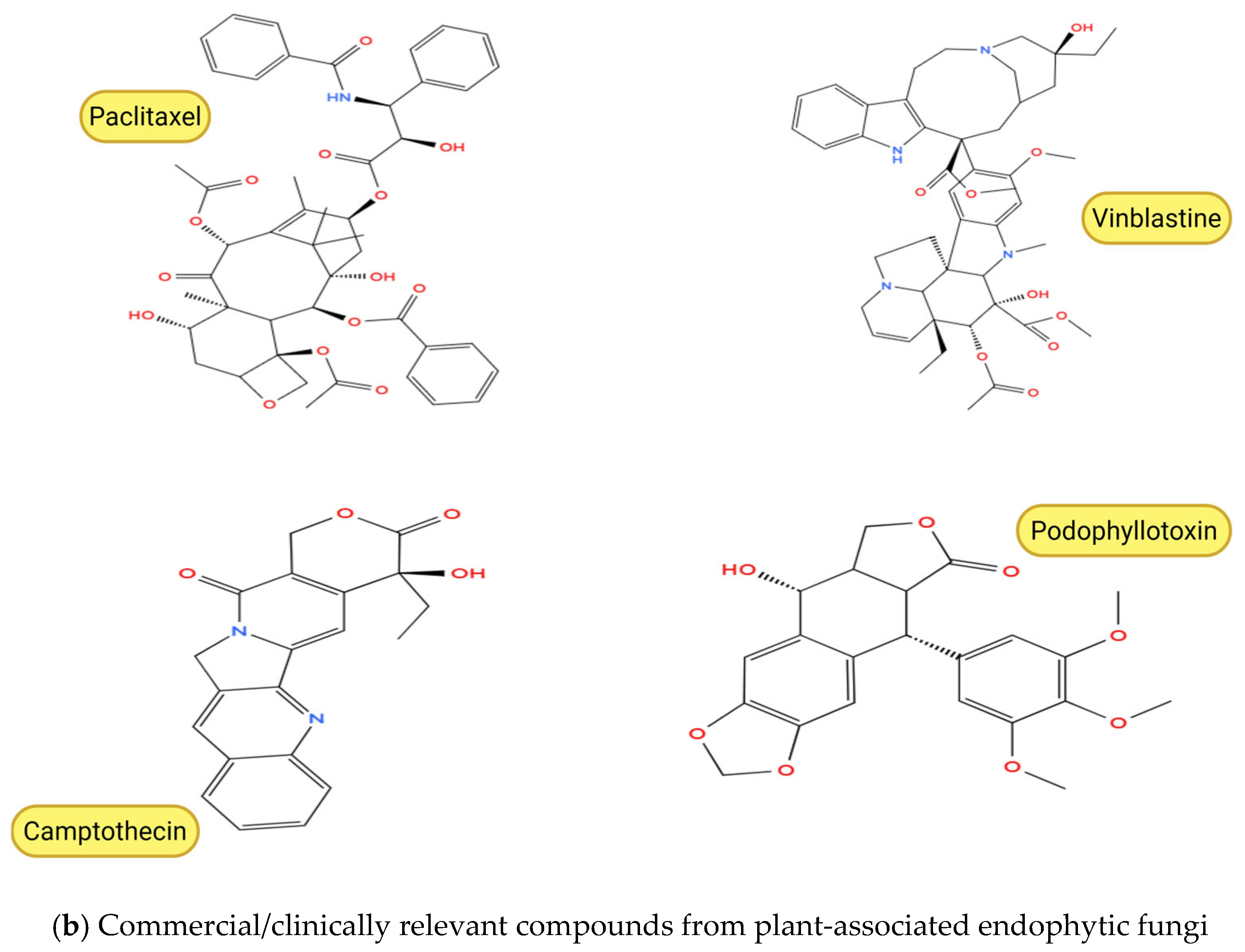

| Compound | Endophytic Fungal Source(s) | Chemical Structure | Mechanism of Action | Target Cancer Type Cell Line(s) | Tumor Activity (IC50; Model) | Normal-Cell Toxicity (IC50; Model) | Development Status | Ref. |
|---|---|---|---|---|---|---|---|---|
| 2-Methyl-7-phenylindole | Curvularia geniculata | Indole derivative | Activates mitochondrial apoptotic pathways | Not specified | Activates mitochondrial apoptotic pathways; tumor inhibition reported | NR | Preclinical | [74] |
| Asparaginase (L-asparaginase) | Lasiodiplodia theobromae | Protein enzyme | Induces apoptosis via L-asparagine depletion and signal activation | MCF-7 (breast) | Anti-leukemic activity reported; IC50 ~35.2 ± 0.7 U/mL (M-NFS-60) | CC50 ~79.4 ± 1.9 U/mL (WI-38) | Clinically used enzyme; endophytic source preclinical | [75] |
| Beauvericin | Fusarium spp., Beauveria spp. | Cyclic hexadepsipeptide | Induces ROS production; disrupts mitochondrial potential; activates caspase-9/3; PI3K/AKT and MAPK modulation | Hepatocellular-lar, MDA-MB-231, PC-3, Colo-rectal | Low µM range in breast, colorectal and prostate cancer models | Variable; NR in several studies | Preclinical | [44,64,76,77] |
| Camptothecin (CPT) | Aspergillus flavus, A. niger, Nothapodytes foetida | Quinoline alkaloid | Topoisomerase I; induces DNA damage and apoptosis via p53, mTOR, ERK pathways | HEPG-2, MCF-7, HCT-29, Ovarian, Lung | Low µM range against HepG2, MCF-7 and HCT-116 cells | NR | Clinically enabling lead (derivatives approved); fungal source: preclinical | [78,79,80,81] |
| Diosgenin | Rhizopus oryzae, Fusarium sp. | Steroidal sapogenin | Inhibits NF-κB, STAT3, AKT/mTOR pathways; reduces Skp2 and JNK signaling; induces apoptosis and anti-metastatic effects | Breast, Lung, Prostate, Colon, Hepatic carcinoma, CML | Low–mid µM across breast, prostate, colon and liver cancer models | NR | Preclinical | [82] |
| Hypericin | Thielavia subther-mophila (from Hyper-icum perforatum) | Anthraquinone derivative | Generates ROS; triggers caspase activation; releases cytochrome c; induces G2 arrest; enhances PDT response | T-cell lymphoma, Breast, Skin, Colorectal, Thyroid, Leukemia | Low µM; strongly PDT-dependent | Reduced toxicity under PDT; NR | Preclinical/clinical-adjacent (PDT) | [48] |
| Paclitaxel | Talaromyces andreanae, Alternaria alternata, Seimatoantlerium nepalense, Chaetomella raphigera | Taxane diterpenoid | Stabilizes microtubules; prevents de-polymerization; arrests cell cycle at G2–M phase; induces apoptosis via Bax/Bcl-2 modulation | MCF-7, HLK-210, HL-251, ovarian and hepatic carcinoma | nM–low µM range depending on cancer cell line | NR | Clinically approved drug; fungal production: preclinical/biotechnological | [48] |
| Podophyllotoxin | Sinopodophyllum hexandrum, Dysos-ma veitchii | Aryltetralin lignan | Topoisomerase II; induces double-strand DNA breaks; inhibits replication; triggers apoptosis (parent of etopo-side) | HL-60, NT2/D1, PC-3, A549, SKOV-3 | Cytotoxic activity in leukemia, lung, breast and ovarian cancer models | NR | Preclinical lead; derivatives clinically approved | [24] |
| Polyketide “comoclathrin” | Quambalaria cyanescens | Polyketide | Induces ROS-mediated apoptosis; inhibits tumor growth | Multiple tumor cell lines | NR (no primary tumor IC50 located from accessible sources) | NR | Preclinical (insufficient primary quantitative data located) | [83] |
| Resveratrol | Quambalaria cyanescens | Stilbene polyphenol | Induces apoptosis; causes G1/S arrest; reduces A549 cell viability by 82% | A549 (lung) | ~82% reduction in A549 viability; apoptosis + G1/S arrest reported | NR | Preclinical/nutraceutical-adjacent | [83,84] |
| Taxol derivatives | Pseudodidymocyrtis lobariellae KL27 | Taxane diterpenoid variants | Microtubule stabilization and apoptosis | Multiple human cancers | Study demonstrates promotion of Taxol biosynthesis/accumulation in Taxus | NR | Preclinical/biotech (taxane production platform); parent drug approved | [85] |
| Terpenoids | Laguncularia racemosa (mangrove endophyte) Mangrove plant Laguncularia racemosa as host origin reported in endophyte literature | Isoprenoid terpenes | Induce mitochondrial apoptosis | Human carcinoma | NR in accessible sources for the specific “terpenoids” row (the host/endophyte link is documented, but quantitative tumor IC50 for this exact entry was not retrievable here) | NR | Preclinical (needs primary quantitative tumor data) | [72] |
| Toosendanin (TSN) | Melia toosendan derived endophytes | Triterpenoid li-monoid | Inhibits PI3K/Akt, MAPK, and JNK pathways; induces apoptosis via caspase activation; G1/S arrest | Leukemia, Colorectal, Hepatic, Prostate, Glioblastoma, TNBC | Low µM in glioma, gastric and TNBC models | NR | Preclinical | [85,86] |
| Vinblastine/Vincristine | Catharanthus roseus, Fusarium oxysporum | Vinca alkaloid | Binds tubulin; prevents microtubule polymerization; mitotic arrest (anaphase block); apoptosis | Lymphoblastic leukemia, HepG-2, MCF-7, CHO-K1, HeLa | As low as 7.48 µg/mL in selected in vitro assays | NR | Clinically approved drugs; fungal forms: preclinical | [87,88,89] |
| Volatile organic compounds (VOCs) | Penicillium oxalicum | Low-MW organics (mixed structure) | Induces apoptosis and suppresses proliferation | Not specified | Cytotoxic activity reported with IC50 values for breast cancer models including MDA-MB-231 | NR | Preclinical | [90] |
| Xanthone derivatives | Penicillium sp. ct-28 | Tricyclic aromatic xanthones | Cytochrome c–mediated apoptosis | HepG2 (liver) | Cytotoxicity against HepG2 reported for EtOAc extract and isolated xanthone/benzophenone constituents | NR | Preclinical | [91] |
| Compound/Class (Representative Source Endophyte) | Core Mechanism(s) of Action | In Vitro Cytotoxicity & Selectivity Profiling | In Vivo/Preclinical (Models, PK, Toxicology) | Comparative Performance vs. Conventional Chemotherapeutics | Criteria for Advancing Toward Drug Candidacy | Formulation Solvents & Implications | References |
|---|---|---|---|---|---|---|---|
| Vincristine/Vinblastine (Catharanthus roseus endophytes) | Disrupt mitotic spindle formation; inhibit microtubule assembly. | Potent activity across hematologic and solid tumor lines; mitotic arrest. | Validated in rodent xenografts; low systemic toxicity. | Comparable to clinical vinca alkaloids. | Reproducible yields; validated biomarkers. | DMSO/ethanol improve solubility but may induce neurotoxicity at high dose. | [122] |
| Camptothecin (CPT) (Trichoderma atroviride, Nothapodytes endophytes) | Topoisomerase I inhibition causes DNA replication block. | Strong activity in SW480, HepG2, A549 lines. | Validated in xenograft models; synergistic with mTOR inhibitors. | Comparable to Topotecan; reduced resistance. | Stable yield; confirmed topo-I engagement. | Formulated in PEG-400/DMSO mixtures; DMSO limited by injection-site irritation. | [40] |
| Paclitaxel (PTX) (Taxomyces andreanae, Pestalotiopsis spp.) | Microtubule stabilization; G2/M arrest; p53/p21 pathway activation. | High antiproliferative potency in A549, MCF-7. | Effective in breast and lung models. | Comparable or superior to standard PTX. | Scalable fermentation titers; toxicity assessed. | Lipid emulsions improve solubility; ethanol-based preps risk hypersensitivity. | [123] |
| Colchicine (Diaporthe perseae, Cladosporium spp.) | Inhibits microtubule polymerization; induces apoptosis. | Nanomolar IC50; tumor selective. | Preclinical tox data suggests narrow therapeutic window. | Like standard colchicine. | Validated biosynthesis; myelosuppression screening. | Ethanol and DMSO commonly used; solubility favorable but GI toxicity limiting. | [124] |
| Berberine (endophyte-linked) | Wnt/β-catenin inhibition; G1 arrest and apoptosis. | Potent in HCT116 and colon lines. | Colon xenografts validated; low systemic tox. | Synergistic with kinase inhibitors. | Optimized oral formulations under study. | Ethanol/water extracts used; moderate solubility and stability advantages. | [58] |
| Chaetominine (Chaetomium spp. IFB-E015) | Mitochondrial apoptosis via Bax/Bcl-2 modulation. | Nanomolar IC50; selective to leukemia lines. | Leukemia xenografts show strong PD activity. | Comparable to tubulin inhibitors. | Validated selectivity, tox screening. | DMSO and methanol-based extracts; stable but require cryoprotection. | [125] |
| Secalonic acid D (mangrove endophyte ZSU44) | GSK-3/β-catenin suppression; apoptosis induction. | Potent in leukemia lines. | Effective in hematologic xenografts. | Novel vs. topo/tubulin drugs. | Pathway biomarker validated. | PEG-400 and ethanol solubilizers enhance bioavailability; high-cost limits. | [31] |
| Ergoflavin (Mimusops elengi endophytes) | Suppresses TNF-α/IL-6; multi-target antiproliferative. | Micromolar IC50 in solid tumors. | Preclinical PK/tox ongoing. | Distinct scaffold from taxanes. | Cytokine modulation markers validated. | Ethanol and DMSO extracts; mild toxicity, stable in refrigerated storage. | [15] |
| Cladosporols (Cladosporium cladosporioides) | Disrupt mitochondrial membrane; regulate p21/cyclin D1. | Selective cytotoxicity in HeLa and colorectal lines. | Preliminary xenograft validation. | Comparable to microtubule inhibitors. | Tumor-specific and tolerable. | Methanol extracts yield stable formulations; moderate bioavailability. | [126] |
| L-Asparaginase (Aspergillus sp., Cassia fistula endophyte) | Depletes extracellular asparagine; inhibits protein synthesis. | Robust activity in leukemia lines. | Comparable to bacterial enzyme. | Parallel efficacy with reduced immunogenicity. | GLP tox and purity validation ongoing. | Aqueous/PEG systems preferred for enzyme stabilization; avoids DMSO toxicity. | [127] |
Disclaimer/Publisher’s Note: The statements, opinions and data contained in all publications are solely those of the individual author(s) and contributor(s) and not of MDPI and/or the editor(s). MDPI and/or the editor(s) disclaim responsibility for any injury to people or property resulting from any ideas, methods, instructions or products referred to in the content. |
© 2026 by the authors. Licensee MDPI, Basel, Switzerland. This article is an open access article distributed under the terms and conditions of the Creative Commons Attribution (CC BY) license.
Share and Cite
Lowen, E.; Moulton, S.E.; Palombo, E.A.; Kwa, F.; Zaferanloo, B. Harnessing Endophytic Fungi as a Sustainable Source of Novel Anticancer Agents: Opportunities, Challenges, and Future Directions. Molecules 2026, 31, 693. https://doi.org/10.3390/molecules31040693
Lowen E, Moulton SE, Palombo EA, Kwa F, Zaferanloo B. Harnessing Endophytic Fungi as a Sustainable Source of Novel Anticancer Agents: Opportunities, Challenges, and Future Directions. Molecules. 2026; 31(4):693. https://doi.org/10.3390/molecules31040693
Chicago/Turabian StyleLowen, Elly, Simon E. Moulton, Enzo A. Palombo, Faith Kwa, and Bita Zaferanloo. 2026. "Harnessing Endophytic Fungi as a Sustainable Source of Novel Anticancer Agents: Opportunities, Challenges, and Future Directions" Molecules 31, no. 4: 693. https://doi.org/10.3390/molecules31040693
APA StyleLowen, E., Moulton, S. E., Palombo, E. A., Kwa, F., & Zaferanloo, B. (2026). Harnessing Endophytic Fungi as a Sustainable Source of Novel Anticancer Agents: Opportunities, Challenges, and Future Directions. Molecules, 31(4), 693. https://doi.org/10.3390/molecules31040693