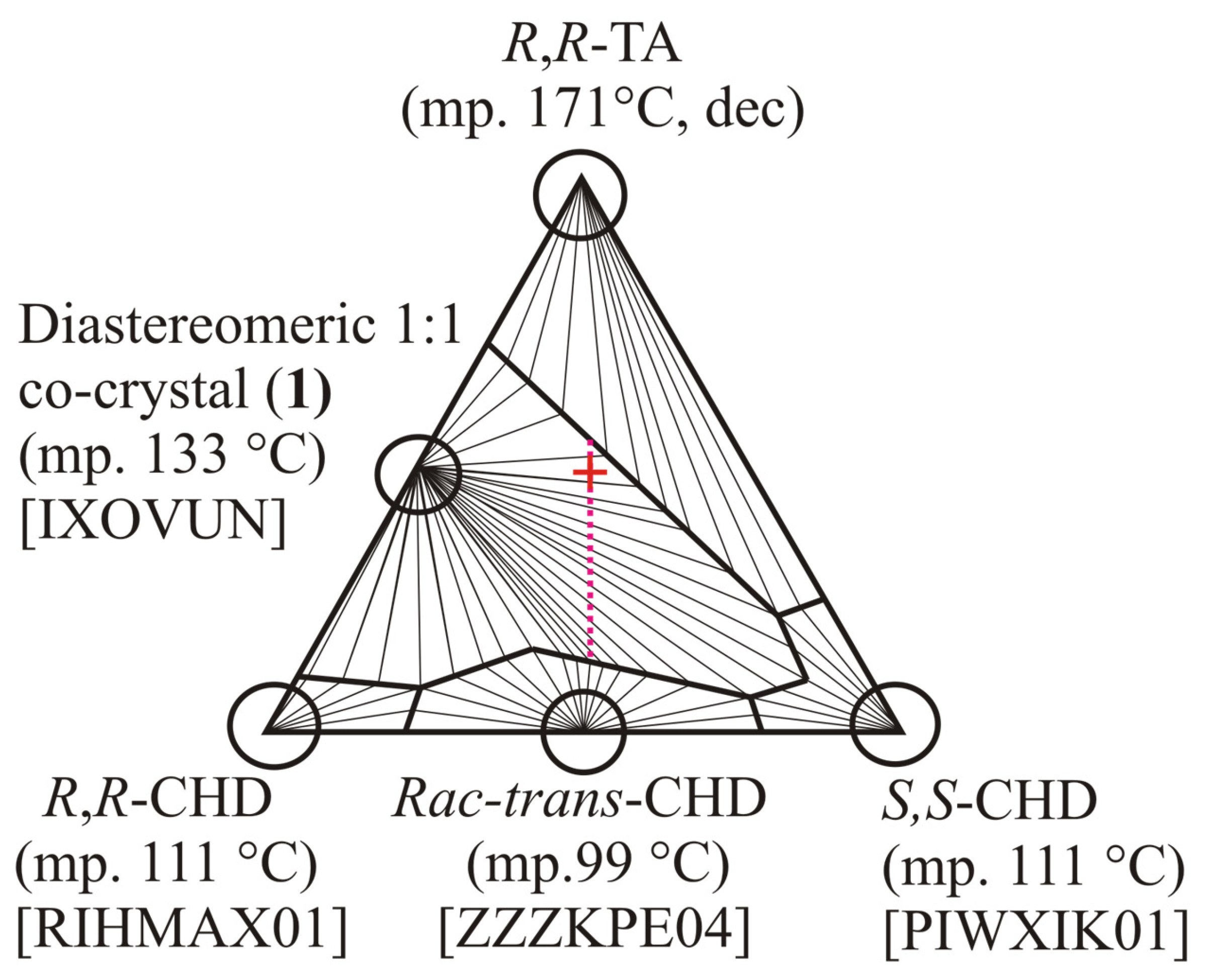
Compressing Experiences of Optical Resolution Trials, Based on Diastereomeric Salt or Co-Crystal Formation, into Ternary Equilibrium Melting Phase Diagrams of Two Chiral Enantiomers and a Resolving Agent Molecule with the Help of DSC and Powder XRD
Abstract
1. Introduction
2. Results and Discussion
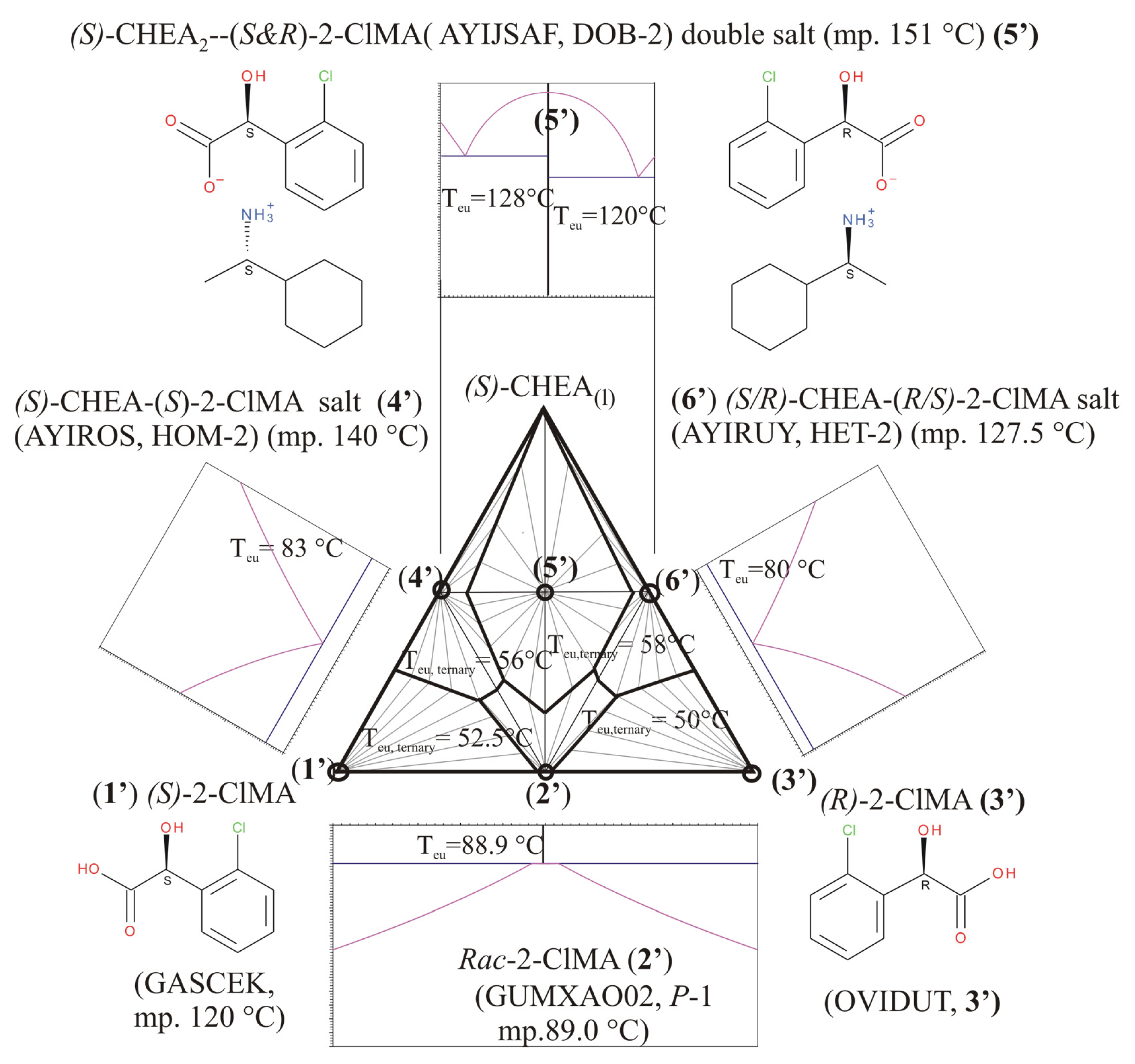
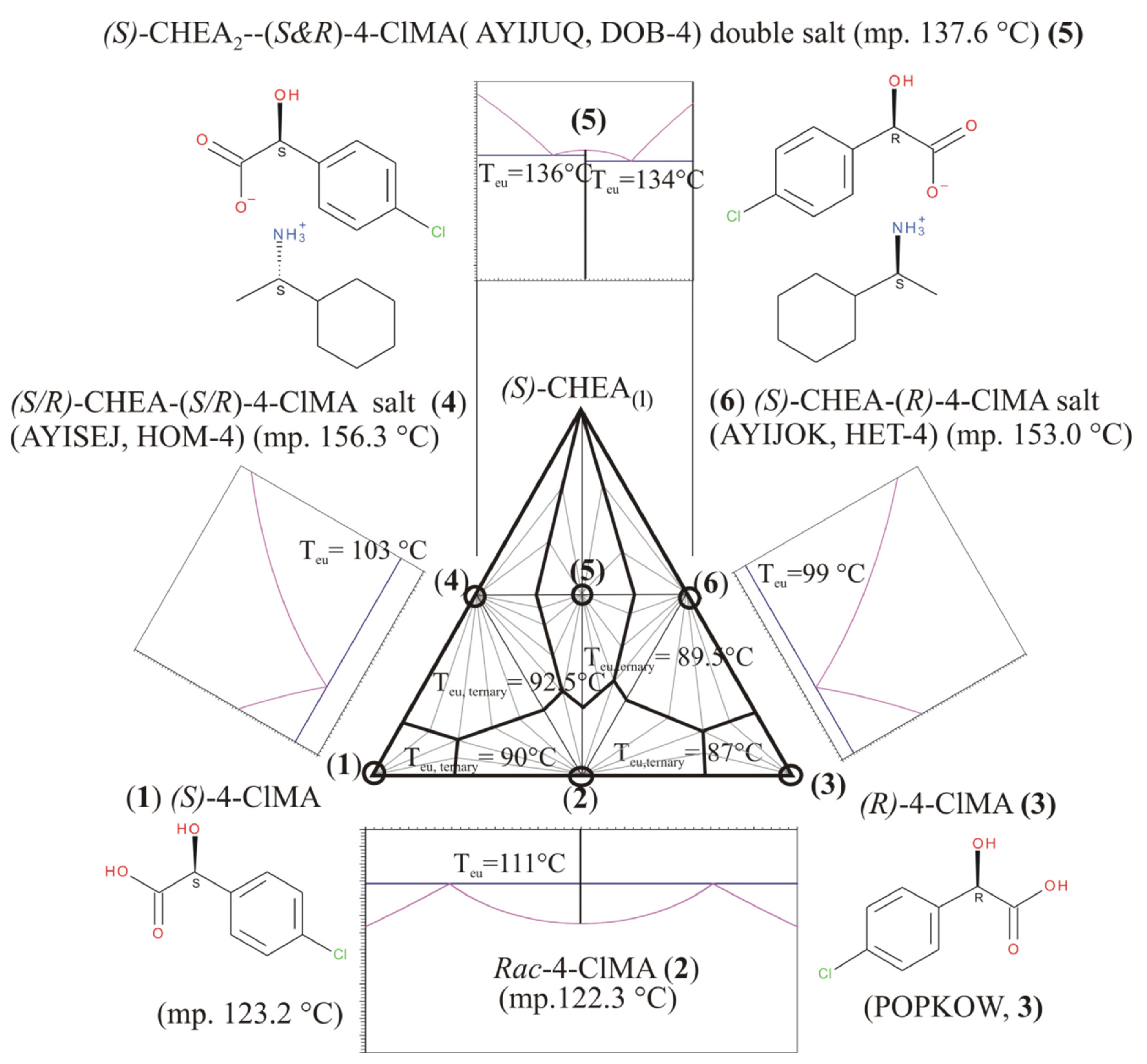
2.1. Construction of Ternary (Triangular) Phase Diagrams of p- and o-Chloromandelic Acids with Chiral 1-Cyclohexylethylamines; Extraordinary Occurrence of the ‘Mixed Diastereomeric Salt’, Double Salt of Diastereomeric Salt Pair (Case Nos. 1 and 2)
2.2. Construction of Ternary Phase Diagrams of o-Chloromandelates with Chiral Pregabalin (Case No. 3)
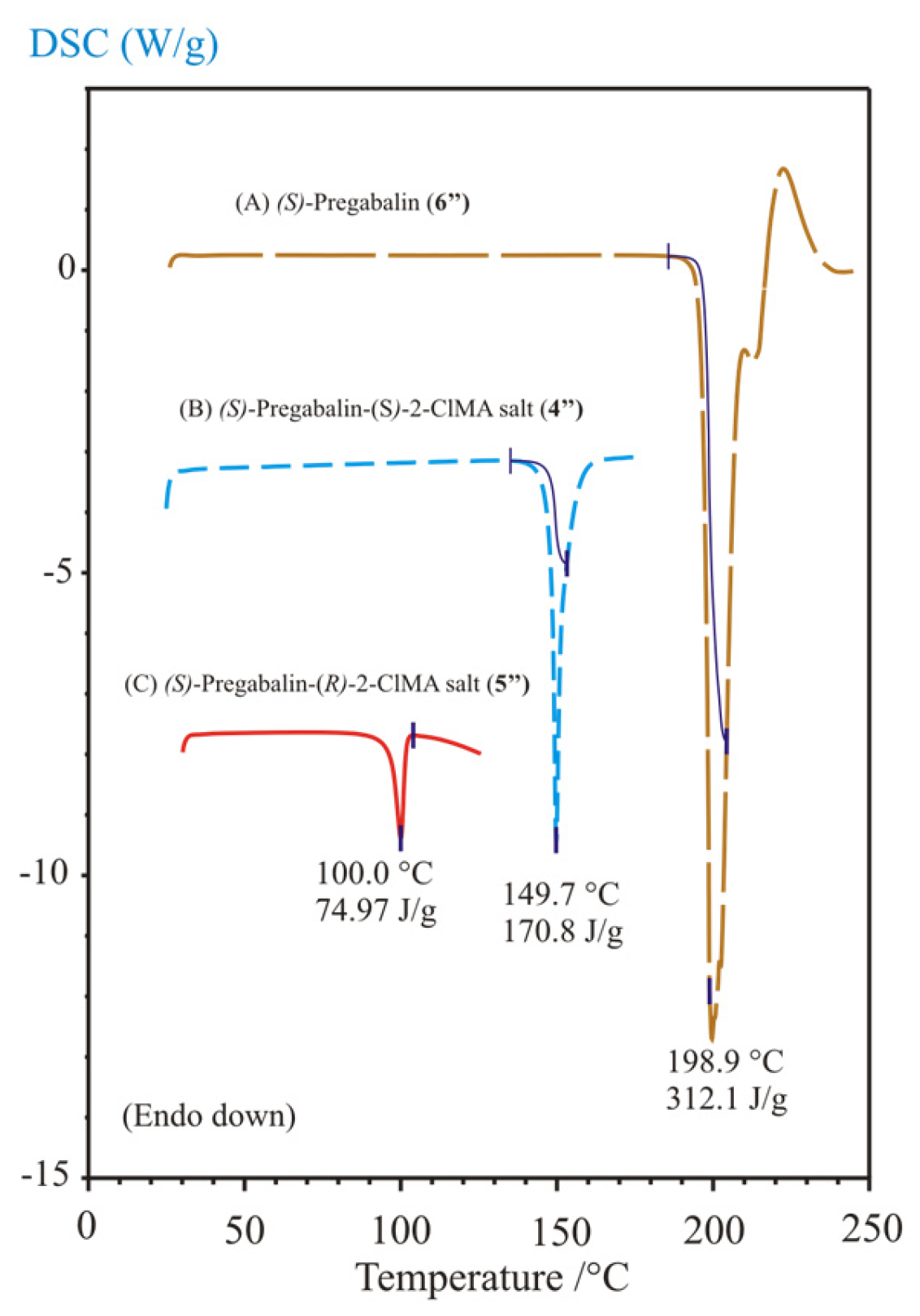
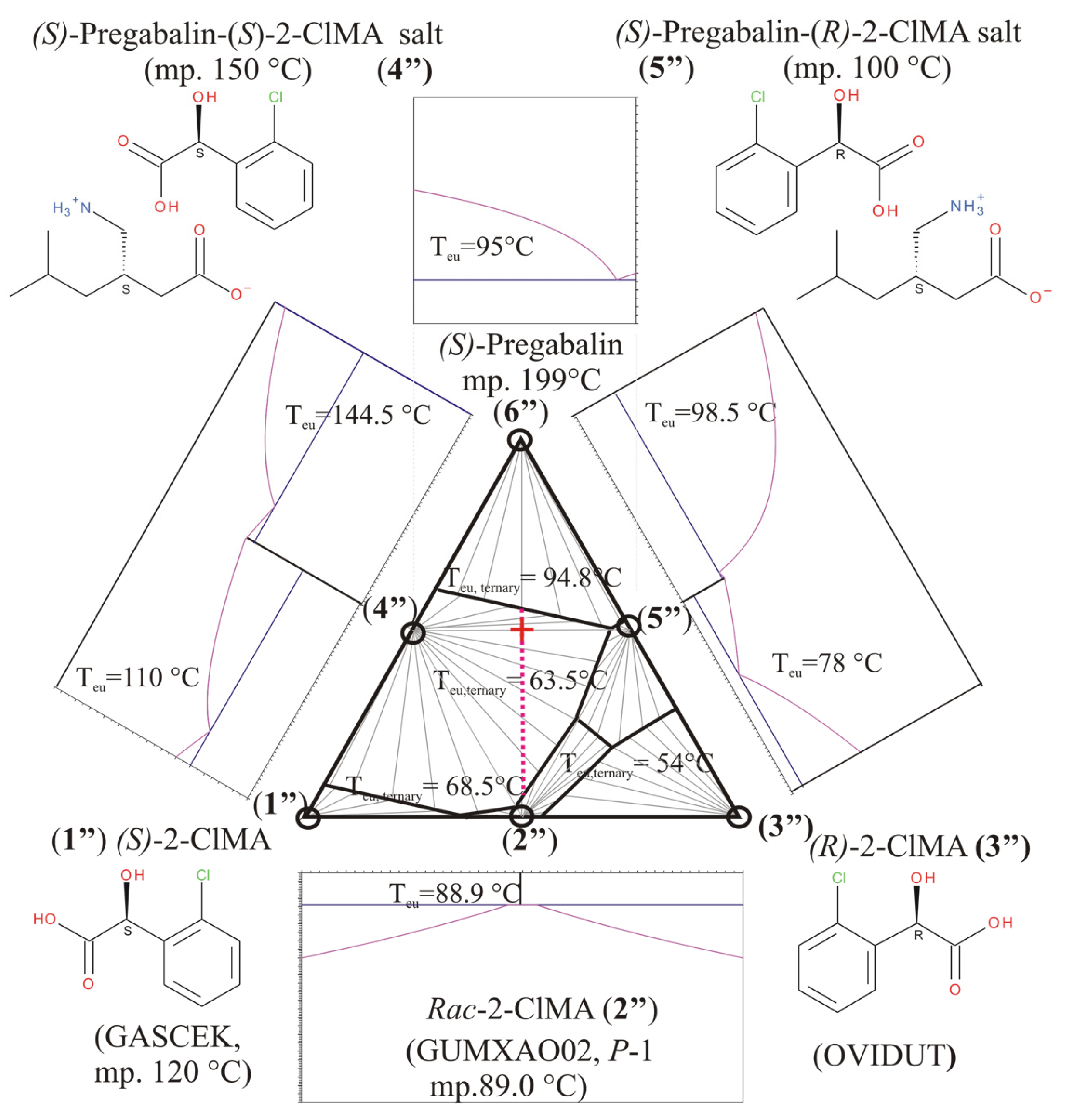
2.2.1. DSC Measurements and the Corresponding Triangular Phase Diagram
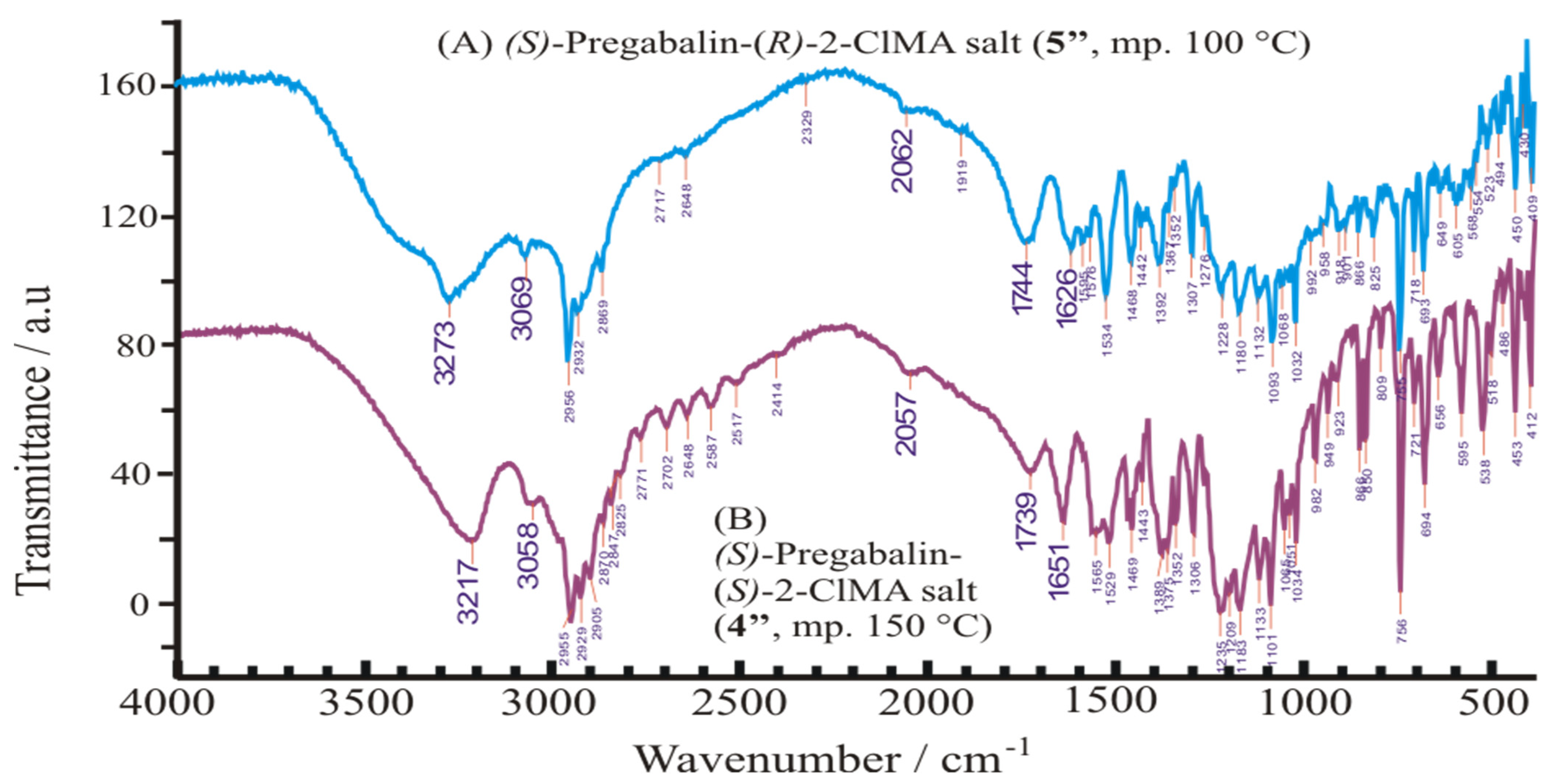
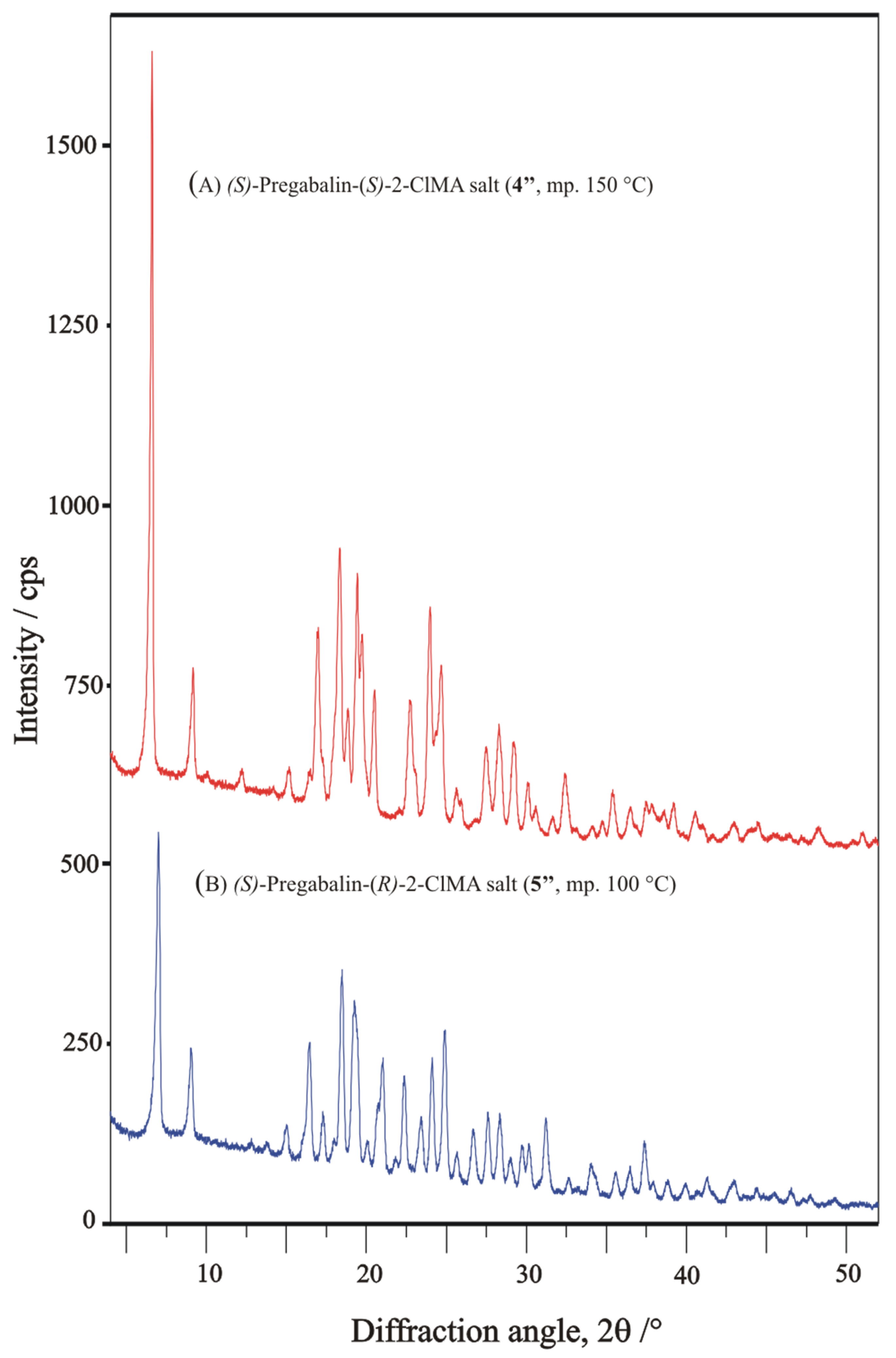
2.2.2. Powder XRD Patterns and FTIR Spectra of the Pure Diastereomeric Salts (4″ and 5″)
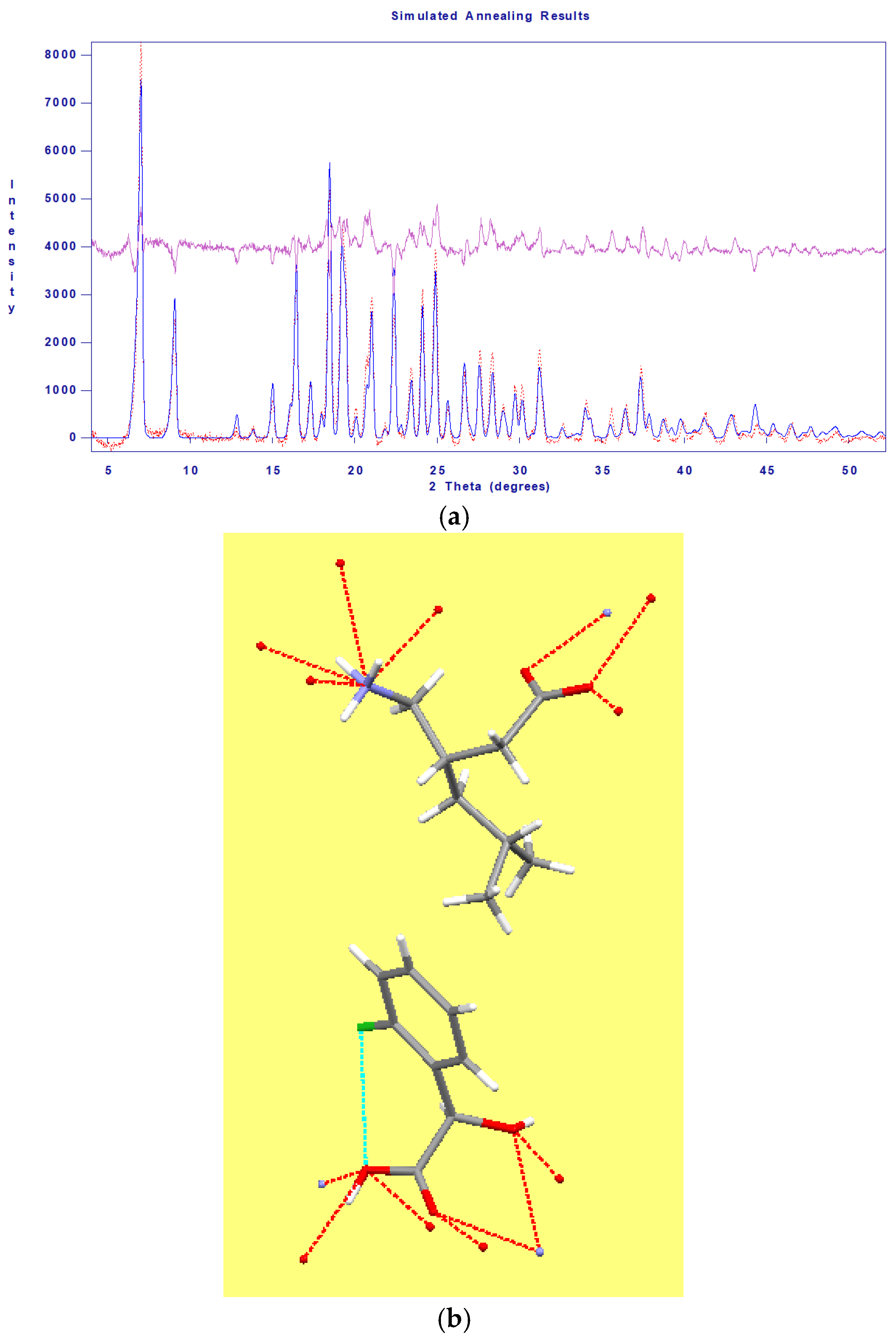
2.2.3. Indexing and Modelling Diastereomeric Salts’ Unit Cell by Means of Powder X-Ray Diffraction, Applying the DASH Software Package (4.0.0 Release) and Crystal Coordinates Coming from Former Single-Crystal X-Ray Structure Determination
3. Materials and Methods
3.1. Construction of Triangular Ternary Phase Diagrams of the Resolution Systems
3.2. Powder X-Ray Diffraction (XRD)
3.3. Unit Cell Indexing and Structure Modelling Based on Powder XRD Pattern by DASH Program Package
3.4. FT-IR Spectroscopy
3.5. Differential Scanning Calorimetry (DSC)
4. Conclusions, Assumptions and Limitations
Funding
Institutional Review Board Statement
Informed Consent Statement
Data Availability Statement
Acknowledgments
Conflicts of Interest
References
- Jacques, J.; Collet, A.; Wilen, S.H. Enantiomers, Racemates, and Resolution; John Wiley & Sons: New York, NY, USA, 1981. [Google Scholar]
- Li, Z.J.; Zell, M.T.; Munson, E.J.; Grant, D.J.W. Characterization of Racemic Species of Chiral Drugs Using Thermal Analysis, Thermodynamic Calculation, and Structural Studies. J. Pharm. Sci. 1999, 88, 337–346. [Google Scholar] [CrossRef] [PubMed]
- Lloyd, M.A.; Patterson, G.E.; Simpson, G.H.; Duncan, L.L.; King, D.P.; Fu, Y.; Patrick, B.O.; Parkin, S.; Brock, C.P. Solid-state compounds of stereoisomers: Cis and trans isomers of 1,2-cyclohexanediol and 2,3-tetralindiol. Acta Crystallogr. Sect. B Struct. Sci. 2007, B63, 433–447. [Google Scholar] [CrossRef]
- Smith, A.A. Calculation of the efficiency of purification by crystallization of ideal multicomponent stereoisomeric mixtures. Tetrahedron Asymmetry 1998, 9, 2925–2937. [Google Scholar] [CrossRef]
- Kozma, D.; Pokol, G.; Ács, M. Calculation of the efficiency of optical resolutions on the basis of the binary phase diagram for the diastereoisomeric salts. J. Chem. Soc. Perkin Trans. 2 1992, 3, 435–439. [Google Scholar] [CrossRef]
- Madarász, J.; Pokol, G.; Ács, M.; Fogassy, E. Merit of estimations from DSC measurements for the efficiency of optical resolutions. J. Thermal. Anal. Calorim. 1994, 42, 877–894. [Google Scholar] [CrossRef]
- Kozma, D.; Ács, M.; Fogassy, E. Predictions of which diastereoisomeric salt precipitates during an optical resolution via diastereoisomeric salt formation. Tetrahedron 1994, 50, 6907–6912. [Google Scholar] [CrossRef]
- Zodge, A.D.; Bombicz, P.; Székely, E.; Pokol, G.; Madarász, J. Structural, analytical and DSC references to resolution of 2-methoxy-2-phenylacetic acids with chiral 1-cyclohexylethylamine through gas-antisolvent precipitation. Thermochim. Acta 2017, 648, 23–31. [Google Scholar] [CrossRef][Green Version]
- Allen, F.H. The Cambridge Structural Database: A quarter of a million crystal structures and rising. Acta Crystallogr. Sect. B Struct. Sci. 2002, 58, 380–388. [Google Scholar] [CrossRef]
- Gladstone, C.G.; Tanski, J.M. CSD Communication (Private Communication to CSD) 2019; CCDC Deposition No. 1915804. Available online: https://www.ccdc.cam.ac.uk/structures/Search?Ccdcid=1915804&DatabaseToSearch=Published (accessed on 1 February 2026).
- Hartung, J.; Spehar, K.; Svoboda, I.; Fuess, H. 2-Methoxy-2-phenylacetic acid. Acta Crystallogr. Sect. E Struct. Rep. 2004, 60, o95. [Google Scholar] [CrossRef]
- Faigl, F.; Mátravölgyi, B.; Holczbauer, T.; Czugler, M.; Madarász, J. Resolution of 1-[2-carboxy-6-(trifluoromethyl)phenyl]-1H-pyrrole-2-carboxylic acid with methyl (R)-2-phenylglycinate, reciprocal resolution and second order asymmetric transformation. Tetrahedron Asymmetry 2011, 22, 1879–1884. [Google Scholar] [CrossRef]
- Thorey, P.; Bombicz, P.; Szilágyi, I.M.; Molnár, P.; Bánsághi, G.; Székely, E.; Simándi, B.; Párkányi, L.; Pokol, G.; Madarász, J. Co-crystal of (R,R)-1,2-cyclohexanediol with (R,R)-tartaric acid, a key structure in resolution of the (±)-trans-diol by supercritical extraction, and the related ternary phase system. Thermochim. Acta 2010, 497, 129–136. [Google Scholar] [CrossRef]
- Bebiano, S.V.S.; Rosado, M.T.S.; Castro, R.A.E.; Silva, M.R.; Canotilho, J.; Maria, T.M.R.; Eusébio, M.E.S. Polymorphism of cis-1,4-cyclohexanediol, a new plastic crystal former. Considerations on isomeric cyclohexanediols plastic crystal forming abilities. Mol. Struct. 2014, 1078, 10–19. [Google Scholar] [CrossRef]
- Kőrösi, M.; Madarász, J.; Sohajda, T.; Székely, E. A fast, new method to enhance the enantiomeric purity of non-racemic mixtures: Self-disproportionation of enantiomers in the gas antisolvent fractionation of chlorine-substituted mandelic acid derivatives. Tetrahedron Asymmetry 2017, 28, 1568–1572. [Google Scholar] [CrossRef]
- Bereczki, L.; Zodge, A.; Kőrösi, M.; Holczbauer, T.; De, S.; Székely, E.; Bombicz, P. A bug in enantiomer separation: Double salt formation—Diastereomeric and double salt structures of 1-cyclohexylethylammonium 2- and 4-chloromandelate. CrystEngComm 2021, 23, 5367–5376, Together with its Electronic Supplementary Material (ESI). [Google Scholar] [CrossRef]
- Coles, S.J.; Ellis, A.L.; Leung, K.; Sarson, J.; Threlfall, T.L.; Tizzard, G.J. Relationships between the racemic structures of substituted mandelic acids containing 8- and 10-membered hydrogen bonded dimer rings. CrystEngComm 2014, 16, 10816. [Google Scholar] [CrossRef]
- Davey, R.J.; Sadiq, G.; Back, K.; Wilkinson, L.; Seaton, C.C. The isolation of a metastable conglomerate using a combined computational and controlled crystallization approach. Chem. Commun. 2012, 48, 1976. [Google Scholar] [CrossRef]
- Lorenz, H.; von Langermann, J.; Sadiq, G.; Seaton, C.C.; Davey, R.J.; Seidel-Morgenstern, A. The Phase Behavior and Crystallization of 2-Chloromandelic Acid: The Crystal Structure of the Pure Enantiomer and the Behavior of Its Metastable Conglomerate. Cryst. Growth Des. 2011, 11, 1549. [Google Scholar] [CrossRef]
- He, Q.; Rohani, S.; Zhu, J.; Gomaa, H. Crystallization of the Racemic Compound and Conglomerate of (RS)-2-Chloromandelic Acid. Cryst. Growth Des. 2010, 10, 5136. [Google Scholar] [CrossRef]
- Szeleczky, Z.; Bagi, P.; Pálovics, E.; Fogassy, E. The effect of SDE on the separation of diastereomeric salts: A case study for the resolution of mandelic acid derivatives with Pregabalin. Tetrahedron Asymmetry 2014, 25, 1095–1099. [Google Scholar] [CrossRef]
- Nagy, G. Effectiveness of Resolutions Based on Diastereomeric Salt Formation. Bachelor’s Thesis, Budapest University of Technology and Economics, Budapest, Hungary, 2015. Chapter 5.2. Supervisors Pokol Gy.; Szeleczky Z.; Nagygyörgy V., Chapter 5.2. Resolution of 2-chloro-mandalic acid with (S)-pregabalin. (In Hungarian) [Google Scholar]
- David, W.I.F.; Shankland, K.; Van De Streek, J.; Pidcock, E.; Motherwell, W.S.; Cole, J.C. DASH: A program for crystal structure determination from powder diffraction data. J. Appl. Crystallogr. 2006, 39, 910–915. [Google Scholar] [CrossRef]
- David, W.I.F.; Shankland, K. Structure determination from powder diffraction data. Acta Cryst. 2008, A64, 52–64. [Google Scholar] [CrossRef] [PubMed]
- Shankland, K.; Spillman, M.J.; Kabova, E.A.; Edgeley, D.S.; Shankland, N. The principles underlying the use of powder diffraction data in solving pharmaceutical crystal structures. Acta Cryst. 2013, C69, 1251–1259. [Google Scholar] [CrossRef]
- Kabova, E.A.; Cole, J.C.; Korb, O.; Lopez-Ibanez, M.; Williams, A.C.; Shankland, K. Improved performance of crystal structure solution from powder diffraction data through parameter tuning of a simulated annealing algorithm. J. Appl. Cryst. 2017, 50, 1411–1420. [Google Scholar] [CrossRef]
- Kabova, E.A.; Cole, J.C.; Korb, O.; Williams, A.C.; Shankland, K. Improved crystal structure solution from powder diffraction data by the use of conformational information. J. Appl. Cryst. 2017, 50, 1421–1427. [Google Scholar] [CrossRef]
- Kaduk, J.A.; Crowder, C.E.; Zhong, K.; Fawcett, T.G.; Suchomel, M.R. Crystal Structure of Atomoxetine Hydrochloride (Strattera), C17H22NOCl. Powder Diffr. 2014, 29, 269–273. [Google Scholar]
- Kaduk, J.A.; Dosen, A.; Blanton, T.N. Crystal structure of ribociclib hydrogen succinate, (C23H31N8O)(HC4H4O4). Powder Diffr. 2024, 39, 227–234. [Google Scholar] [CrossRef]
- Florence, A.J.; Shankland, N.; Shankland, K.; David, W.I.F.; Pidcock, E.; Xu, X.; Johnston, A.; Kennedy, A.R.; Cox, P.J.; Evans, J.S.O.; et al. Solving molecular crystal structures from laboratory X-ray powder diffraction data with DASH: The state of the art and challenges. J. Appl. Cryst. 2005, 38, 249–259. [Google Scholar] [CrossRef]
- Bánhegyi, D.F.; Madarász, J.; Fogassy, E.; Pálovics, E.; Pokol, G. Crystalline Forms of 4,4’-Methylenediantipyrine: Crystallographic Unit Cell for the Anhydrous Form, from Laboratory Powder XRD Pattern by DASH Program Package. Period. Polytech. Chem. Eng. 2023, 67, 557–564. [Google Scholar] [CrossRef]
- Boultif, A.; Louer, D. Indexing of powder diffraction patterns for low-symmetry lattices by the successive dichotomy method. J. Appl. Crystallogr. 1991, 24, 987–993. [Google Scholar] [CrossRef]
- Markvardsen, A.J.; David, W.I.F.; Johnson, J.C.; Shankland, K. A probabilistic approach to space-group determination from powder diffraction data. Acta Cryst. 2001, A57, 47–54. [Google Scholar]
- Markvardsen, A.J.; Shankland, K.; David, W.I.F.; Johnston, J.C.; Ibberson, R.M.; Tucker, M.; Nowell, H.; Griffin, T. ExtSym: A program to aid space-group determination from powder diffraction data. J. Appl. Crystallogr. 2008, 41, 1177–1181. [Google Scholar] [CrossRef]
- Samas, B.; Wang, W.; Godrej, D.B. 1:1 Cocrystal of (S)-3-(ammoniomethyl)-5-methylhexanoate and (S)-mandelic acid. Acta Crystallogr. Sect. E Struct. Rep. Online 2007, 63, o3938. [Google Scholar] [CrossRef]
- Venu, N.; Vishweshwar, P.; Ram, T.; Surya, D.; Apurba, B. (S)-3-(Ammoniomethyl)-5-methyl-hexanoate (pregabalin). Acta Crystallogr. Sect. C Cryst. Struct. Commun. 2007, 63, o306. [Google Scholar] [CrossRef]
- Komisarek, D.; Sohi, T.H.H.; Vasylyeva, V. Co-crystals of zwitterionic GABA API′s pregabalin and phenibut: Properties and application. CrystEngComm 2022, 24, 8390–8398. [Google Scholar] [CrossRef]
- Szeleczky, Z.; Kis-Mihály, E.; Semsey, S.; Pataki, H.; Bagi, P.; Pálovics, E.; Marosi, G.; Pokol, G.; Fogassy, E.; Madarász, J. Effect of ultrasound-assisted crystallization in the diastereomeric salt resolution of tetramisole enantiomers in ternary system with O,O′-dibenzoyl-(2R,3R)-tartaric acid. Ultrason. Sonochemistry 2016, 32, 8–17. [Google Scholar] [CrossRef]
- Coquerel, G. Preferential Crystallization. In Novel Optical Resolution Technologies; Sakai, K., Hirayama, N., Tamura, R., Eds.; Topics in Current Chemistry; Springer: Berlin/Heidelberg, Germany, 2006; Volume 269, pp. 1–51. [Google Scholar] [CrossRef]
- Rougeot, C.; Hein, J.E. Application of Continuous Preferential Crystallization to Efficiently Access Enantiopure Chemicals. Org. Process Res. Dev. 2015, 19, 1809–1819. [Google Scholar] [CrossRef]






| Solids | Compound Label | Melting Point (Tfi Peak Temperature °C/K) | Enthalpy of Fusion, ΔHi (J/mol) | Source of DSC Data (Ref.) |
|---|---|---|---|---|
| (S)-4-chloromandelic acid | (S)-4ClMA, 1 | 123.2/396.3 | 21,850 | [15] |
| (R)-4-chloromandelic acid | (R)-4ClMA, 3 | 123/396.3 | 21,850 | [assumed to be the same as that of S)-enantiomer] |
| rac-4-chloromandelic acid | rac-4ClMA, 2 | 122.4/395.4 | 50,418 | [15] |
| S(R)-S(R)-salt of 4ClMA with CHEA | (S/R)-CHEA- -(S/R)-4ClMA, 4 | 161/434.1 | 31,585 | [16] Data read-outs from the ESI |
| S-R-salt of 4ClMA with CHEA | (S)-CHEA- -(R)-4ClMA, 6 | 157/430.1 | 26,736 | [16] Data read-outs from the ESI |
| (S)2-(S&R)-double salt of 4ClMA | [(S)-CHEA]2- -(R&S)-4ClMA, 5 | 142/415.1 | 65,680 | [16] Data read-outs from the ESI |
| (S)-2-chloromandelic acid | (S)-2ClMA, 1′ | 120/393.1 | 24,033 | [15] |
| (R)-2-chloromandelic acid | (R)-2ClMA, 3′ | 120/393.1 | 24,033 | [assumed to be the same as that of S)-enantiomer] |
| rac-2-chloromandelic acid | (rac-2ClMA, 2′ | 89/362.1 | 43,076 | [15] |
| S-S-salt of 2ClMA with CHEA | (S)-CHEA-(S)- -2ClMA, 4′ | 140/413.1 | 13,200 | [16] Data read-outs from the ESI |
| S-R-salt of 2ClMA with CHEA | (S/R)-CHEA- -(R/S)-2ClMA, 6′ | 127.5/400.6 | 13,714 | [16] Data read-outs from the ESI |
| (S)2-(S&R)-double salt of 2ClMA | [(S)-CHEA]2- (R&S)-2ClMA, 5′ | 151.5/424.6 | 54,832 | [16] Data read-outs from the ESI |
| Crystallographic Unit Cell Parameters | Prepared Pure (S)-Pregabalin-(R)-2-ClMA (5″, rt.) [This Work] | Recrystallized Precipitation of (S)-Pregabalin-(S)-2-ClMA (4″, rt.) [This Work] | SILFEZ (S)-Pregabalin-(S)- -2-Mandelic Acid (rt.) [35] |
|---|---|---|---|
| Chemical formula | C8H17NO2· ·C8H7ClO3= =C16H24ClNO5 | C8H17NO2 ·C8H7ClO3= =C16H24ClNO5 | C8H17NO2· ·C8H8O3= =C16H25NO5 |
| Crystal system | monoclinic | monoclinic | monoclinic |
| Space group | P21 (No. 4) | P21 (No. 4) | P21 (No. 4) |
| a (Å) | 13.56 | 14.19 | 6.292 (1) |
| b (Å) | 6.742 | 6.55128 | 27.423 (6) |
| c (Å) | 10.42 | 10.12 | 10.009 (2) |
| α (°) | 90 | 90 | 90 |
| β (°) | 106.6 | 102.0 | 90.84 (3) |
| γ (°) | 90 | 90 | 90 |
| V (Å3) | 912.5 | 920.1 | 1726.877 |
| Z/Z′ (No of formula units) | 2/1 | 2/1 | 4/2 |
| Vm (Volume per formula unit) (Å3) | 456.2545 | 460.0605 | 431.719 |
| Zero-point shift (°) | 0.2724 | 0.2947 | |
| Zmatrices | CIDDEZ_1 + OVIDUT_1 | CIDDEZ_1 + GASCEK_1 | |
| Degrees of freedom | 19 = 12 + 7 (torsional) | 19 = 12 + 7 (torsional) | |
| Pauli refinement (χ2) | 3.852 | 10.30 | |
| Profile χ2 after SA * | 18.75 | 221.5 |
Disclaimer/Publisher’s Note: The statements, opinions and data contained in all publications are solely those of the individual author(s) and contributor(s) and not of MDPI and/or the editor(s). MDPI and/or the editor(s) disclaim responsibility for any injury to people or property resulting from any ideas, methods, instructions or products referred to in the content. |
© 2026 by the author. Licensee MDPI, Basel, Switzerland. This article is an open access article distributed under the terms and conditions of the Creative Commons Attribution (CC BY) license.
Share and Cite
Madarász, J. Compressing Experiences of Optical Resolution Trials, Based on Diastereomeric Salt or Co-Crystal Formation, into Ternary Equilibrium Melting Phase Diagrams of Two Chiral Enantiomers and a Resolving Agent Molecule with the Help of DSC and Powder XRD. Molecules 2026, 31, 623. https://doi.org/10.3390/molecules31040623
Madarász J. Compressing Experiences of Optical Resolution Trials, Based on Diastereomeric Salt or Co-Crystal Formation, into Ternary Equilibrium Melting Phase Diagrams of Two Chiral Enantiomers and a Resolving Agent Molecule with the Help of DSC and Powder XRD. Molecules. 2026; 31(4):623. https://doi.org/10.3390/molecules31040623
Chicago/Turabian StyleMadarász, János. 2026. "Compressing Experiences of Optical Resolution Trials, Based on Diastereomeric Salt or Co-Crystal Formation, into Ternary Equilibrium Melting Phase Diagrams of Two Chiral Enantiomers and a Resolving Agent Molecule with the Help of DSC and Powder XRD" Molecules 31, no. 4: 623. https://doi.org/10.3390/molecules31040623
APA StyleMadarász, J. (2026). Compressing Experiences of Optical Resolution Trials, Based on Diastereomeric Salt or Co-Crystal Formation, into Ternary Equilibrium Melting Phase Diagrams of Two Chiral Enantiomers and a Resolving Agent Molecule with the Help of DSC and Powder XRD. Molecules, 31(4), 623. https://doi.org/10.3390/molecules31040623