Solvatochromic Polarity, Physicochemical Properties, and Spectral Analysis of New Triple NADES-Based on Urea–Glycerol

 ,
,  ,
,  ,
,  and
and 
Abstract
1. Introduction
2. Results and Discussion
2.1. Physico-Chemical Properties of NADESs
2.1.1. Density
2.1.2. Refractive Index
2.2. IR Spectral Characteristic of NADES
2.3. Contact Angle and Surface Tension
2.3.1. General Information
2.3.2. Theoretical Background
2.3.3. Surface Tension of NADESs
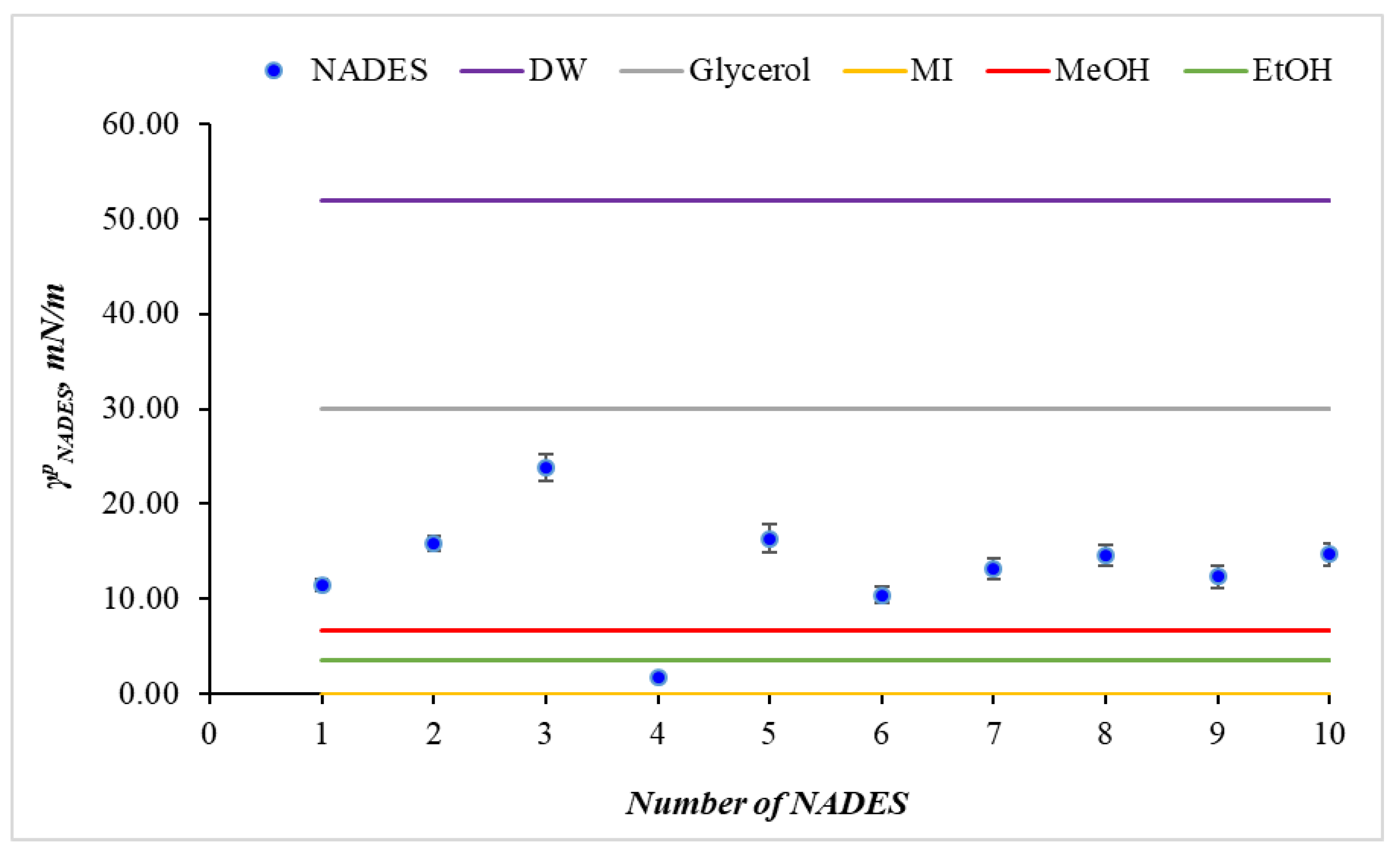
2.3.4. Polar Part of Surface Tension of NADESs
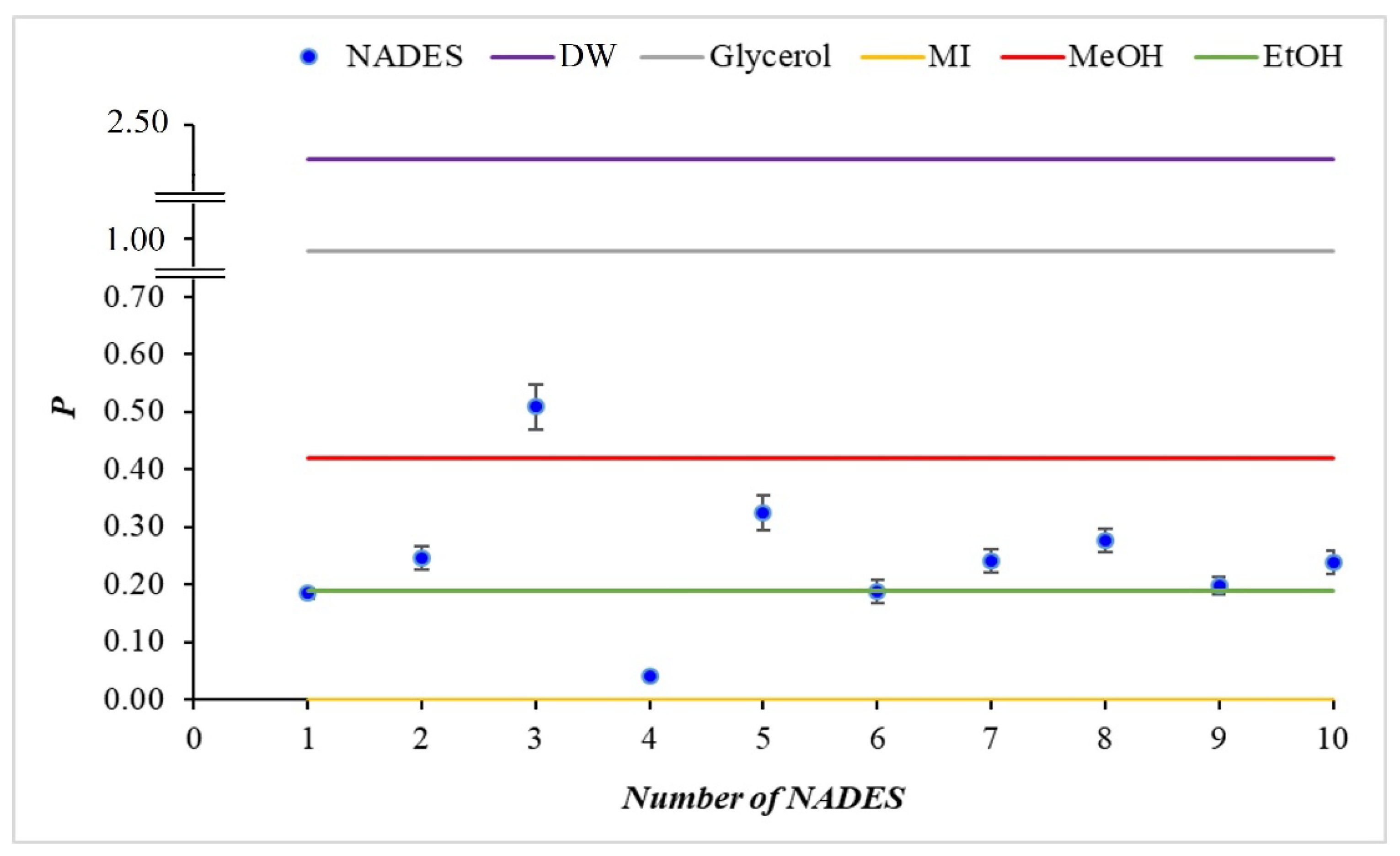
2.3.5. Polarity of NADESs
- High-polarity NADESs. This is NADES 3 (p = 0.51), having a value higher than that of MeOH but lower than that of glycerol. NADES 3 has a strongly polar character and can be classified as an adhesive system, showing strong interaction with surfaces and good wettability.
- Medium-polarity NADESs. For these NADESs, the polarity values are between those of EtOH and MeOH and correspond to NADES 2 and NADESs 5–10. They all have a pronounced polar character comparable to the standard solvents EtOH and MeOH.
- Low-polarity NADESs. Their values are lower than those of EtOH. NADES 4 (0.04) and NADES 1 (0.18) belong to this category. Those are cohesive systems, characterized by high internal stability and limited spreading on hard surfaces.
2.4. Solvatochromism
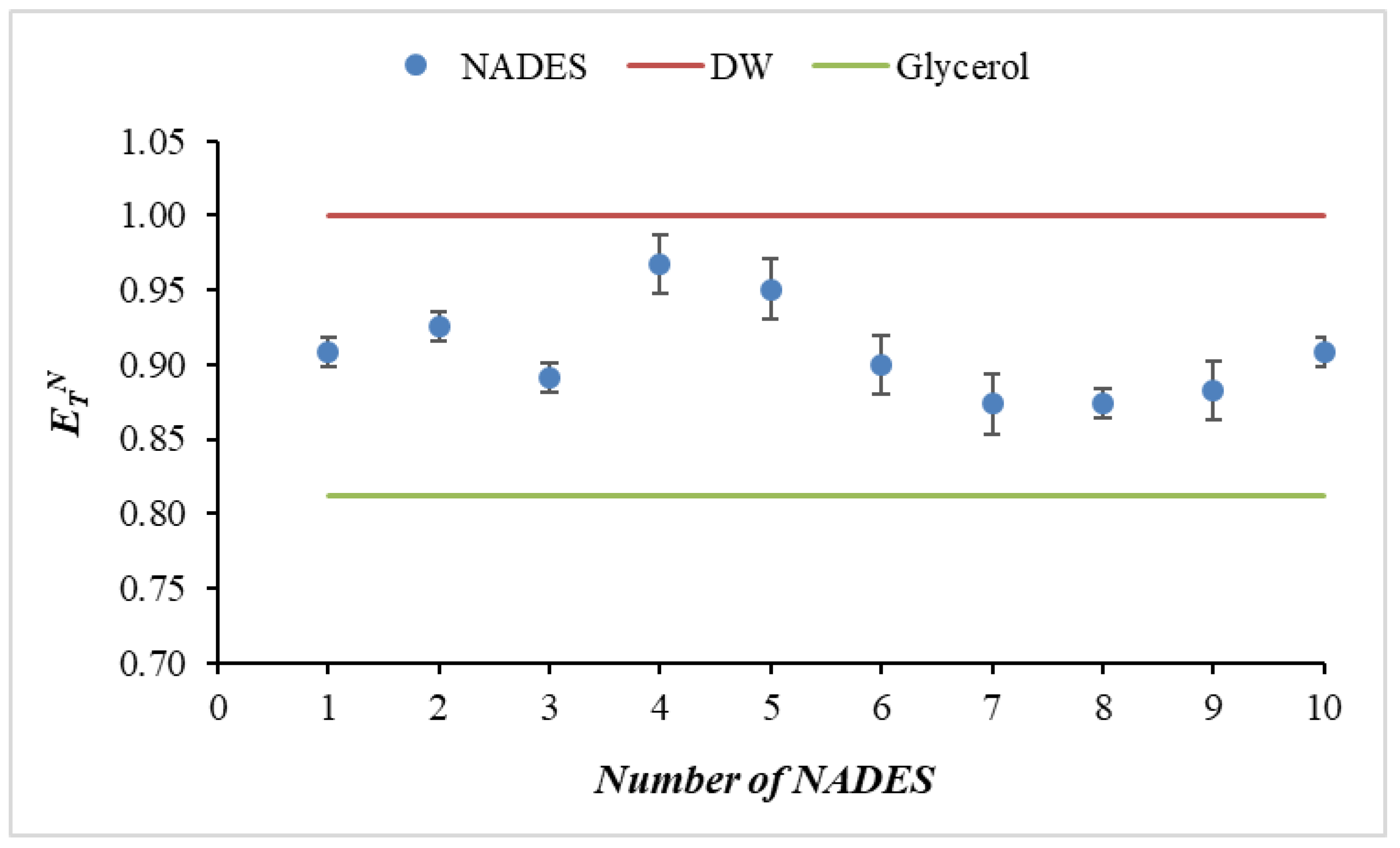
2.4.1. Electron Transition Between Solvent and Solute
2.4.2. Kamlet−Taft Multiparameter Scale
Acidity Parameter (α)
Basicness Parameter (β)
Dipolarity/Polarizability Parameter (π*)
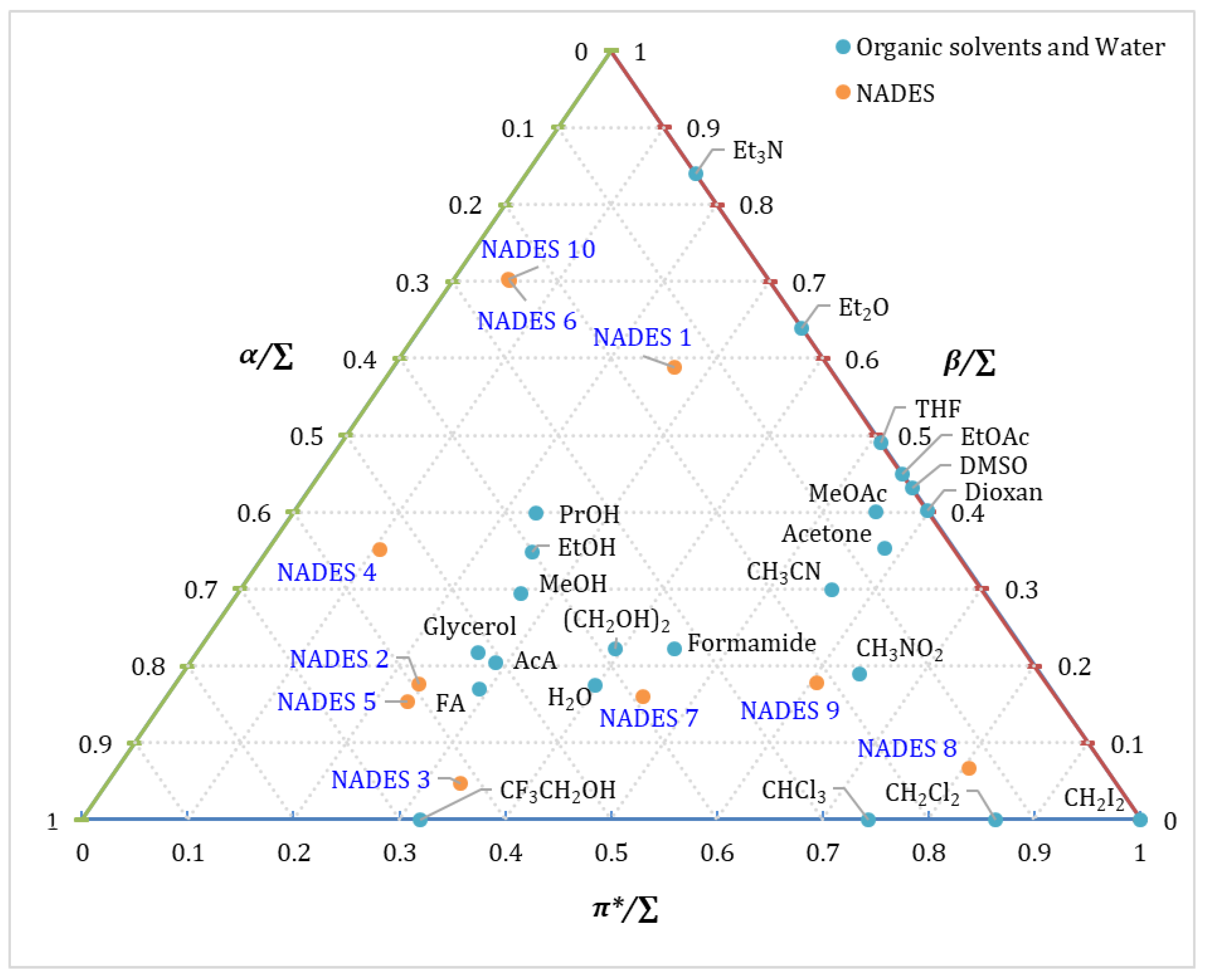
Normalization of Kamlet–Taft Parameters—Assessment of NADES Polarity Relative to Classical Organic Solvents
- A.
- H-Acceptor Group (High Basicity, β/∑):
- B.
- H-Donor Group (High Acidity, α/∑):
- C.
- Dipole Group (High Polarizability, π*/∑):
3. Materials and Methods
3.1. Materials
3.2. Preparation of NADESs and Determination of Water Content
3.3. Determination of Physico-Chemical Properties
3.3.1. Density
3.3.2. Refractive Index
3.4. FTIR Spectral Analysis
3.5. Surface Tension
3.6. Solvatochromism
3.7. Statistical Analysis
4. Conclusions
Supplementary Materials
Author Contributions
Funding
Institutional Review Board Statement
Informed Consent Statement
Data Availability Statement
Conflicts of Interest
References
- Anastas, P.T.; Warner, R. Green Chemistry: Theory and Practice; Oxford University Press: New York, NY, USA, 1998; p. 30. [Google Scholar]
- Keith, L.H.; Gron, L.U.; Young, J.L. Green analytical methodologies. Chem. Rev. 2007, 107, 2695–2708. [Google Scholar] [CrossRef] [PubMed]
- Halder, A.K.; Cordeiro, M.N.D.S. Probing the Environmental Toxicity of Deep Eutectic Solvents and Their Components: An In Silico Modeling Approach. ACS Sustain. Chem. Eng. 2019, 7, 10649–10660. [Google Scholar] [CrossRef]
- Zhang, Q.; De Oliveira Vigier, K.; Royer, S.; Jérôme, F. Deep Eutectic Solvents: Syntheses, Properties and Applications. Chem. Soc. Rev. 2012, 41, 7108–7146. [Google Scholar] [CrossRef] [PubMed]
- Coutinho, J.A.P.; Pinho, S.P. Special Issue on Deep Eutectic Solvents: A Foreword. Fluid Phase Equilib. 2017, 448, 1. [Google Scholar] [CrossRef]
- El Achkar, T.; Greige-Gerges, H.; Fourmentin, S. Basics and Properties of Deep Eutectic Solvents: A Review. Environ. Chem. Lett. 2021, 19, 3397–3408. [Google Scholar] [CrossRef]
- Dai, Y.; van Spronsen, J.; Witkamp, G.-J.; Verpoorte, R.; Choi, Y.H. Ionic Liquids and Deep Eutectic Solvents in Natural Products Research: Mixtures of Solids as Extraction Solvents. J. Nat. Prod. 2013, 76, 2162–2173. [Google Scholar] [CrossRef]
- Smith, E.L.; Abbott, A.P.; Ryder, K.S. Deep Eutectic Solvents (DESs) and Their Applications. Chem. Rev. 2014, 114, 11060–11082. [Google Scholar] [CrossRef]
- Sangiorgi, S.; Albertini, B.; Bertoni, S.; Passerini, N. An Overview on the Role of Ionic Liquids and Deep Eutectic Solvents in Oral Pharmaceuticals. Pharmaceutics 2025, 17, 300. [Google Scholar] [CrossRef]
- Hansen, F.A.; Pedersen-Bjergaard, S. Emerging Extraction Strategies in Analytical Chem-istry. Anal. Chem. 2020, 92, 2–15. [Google Scholar] [CrossRef]
- Abbott, A.P.; Capper, G.; McKenzie, K.J.; Ryder, K.S. Electrodeposition of Zinc–Tin Alloys from Deep Eutectic Solvents Based on Choline Chloride. J. Electroanal. Chem. 2007, 599, 288–294. [Google Scholar] [CrossRef]
- Hansen, B.B.; Spittle, S.; Chen, B.; Poe, D.; Zhang, Y.; Klein, J.M.; Horton, A.; Adhikari, L.; Zelovich, T.; Doherty, B.W.; et al. Deep Eutectic Solvents: A Review of Fundamentals and Applications. Chem. Rev. 2021, 121, 1232–1285. [Google Scholar] [CrossRef]
- Shah, P.A.; Chavda, V.; Hirpara, D.; Sharma, V.S.; Shrivastav, P.S.; Kumar, S. Exploring the Potential of Deep Eutectic Solvents in Pharmaceuticals: Challenges and Opportunities. J. Mol. Liq. 2023, 390, 123171. [Google Scholar] [CrossRef]
- Choi, Y.H.; van Spronsen, J.; Dai, Y.; Verberne, M.; Hollmann, F.; Arends, I.W.C.E.; Witkamp, G.-J.; Verpoorte, R. Are Natural Deep Eutectic Solvents the Missing Link in Understanding Cellular Metabolism and Physiology? Plant Physiol. 2011, 156, 1701–1705. [Google Scholar] [CrossRef] [PubMed]
- El Achkar, T.; Fourmentin, S.; Greige-gerges, H. Deep Eutectic Solvents: An Overview on Their Interactions with Water and Biochemical Compounds. J. Mol. Liq. 2019, 288, 111028. [Google Scholar] [CrossRef]
- González, C.G.; Mustafa, N.R.; Wilson, E.G.; Verpoorte, R.; Choi, Y.H. Application of Natural Deep Eutectic Solvents for the “Green” Extraction of Vanillin from Vanilla Pods. Flavour. Fragr. J. 2018, 33, 91–96. [Google Scholar] [CrossRef]
- Duarte, A.R.C.; Ferreira, A.S.D.; Barreiros, S.; Cabrita, E.; Reis, R.L.; Paiva, A. A Comparison between Pure Active Pharmaceutical Ingredients and Therapeutic Deep Eutectic Solvents: Solubility and Permeability Studies. Eur. J. Pharm. Biopharm. 2017, 114, 296–304. [Google Scholar] [CrossRef]
- Swebocki, T.; Barras, A.; Abderrahmani, A.; Haddadi, K.; Boukherroub, R. Deep Eutectic Solvents Comprising Organic Acids and Their Application in (Bio)Medicine. Int. J. Mol. Sci. 2023, 24, 8492. [Google Scholar] [CrossRef]
- Hayyan, M. Versatile Applications of Deep Eutectic Solvents in Drug Discovery and Drug Delivery Systems: Perspectives and Opportunities. Asian J. Pharm. Sci. 2023, 18, 100780. [Google Scholar] [CrossRef]
- Stott, P.W.; Williams, A.C.; Barry, B.W. Transdermal Delivery from Eutectic Systems: Enhanced Permeation of a Model Drug, Ibuprofen. J. Control. Release 1998, 50, 297–308. [Google Scholar] [CrossRef]
- Morrison, H.G.; Sun, C.C.; Neervannan, S. Characterization of Thermal Behavior of Deep Eutectic Solvents and Their Potential as Drug Solubilization Vehicles. Int. J. Pharm. 2009, 378, 136–139. [Google Scholar] [CrossRef]
- Aroso, I.M.; Craveiro, R.; Rocha, Â.; Dionísio, M.; Barreiros, S.; Reis, R.L.; Paiva, A.; Duarte, A.R.C. Design of Controlled Release Systems for THEDES—Therapeutic Deep Eutectic Solvents, Using Supercritical Fluid Technology. Int. J. Pharm. 2015, 492, 73–79. [Google Scholar] [CrossRef]
- Aroso, I.M.; Silva, J.C.; Mano, F.; Ferreira, A.S.D.; Dionísio, M.; Sá-nogueira, I.; Barreiros, S.; Reis, R.L.; Paiva, A.; Rita, A.; et al. European Journal of Pharmaceutics and Biopharmaceutics Dissolution Enhancement of Active Pharmaceutical Ingredients by Therapeutic Deep Eutectic Systems. Eur. J. Pharm. Biopharm. 2016, 98, 57–66. [Google Scholar] [CrossRef]
- Wang, H.; Gurau, G.; Shamshina, J.; Cojocaru, O.A.; Janikowski, J.; Macfarlane, D.R.; Davis, J.H.; Rogers, R.D. Chemical Science Simultaneous Membrane Transport of Two Active Hydrogen Bond Complex Formation. Chem. Sci. 2014, 5, 3449–3456. [Google Scholar] [CrossRef]
- Wu, J.; Yin, T. Novel Paeonol-Matrine Deep Eutectic Solvent: Physicochemical Properties and Cytotoxicity. J. Mol. Liq. 2022, 348, 118068. [Google Scholar] [CrossRef]
- Jiang, J.; Yan, C.; Zhao, X.; Luo, H.; Xue, Z.; Mu, T. A PEGylated Deep Eutectic Solvent for Controllable Solvothermal Synthesis of Porous NiCo2S4 for Efficient Oxygen Evolution Reaction. Green Chem. 2017, 19, 3023–3031. [Google Scholar] [CrossRef]
- Jiang, J.; Bai, X.; Zhao, X.; Chen, W.; Yu, T.; Li, Y.; Mu, T. Poly-Quasi-Eutectic Solvents (PQESs): Versatile Solvents for Dissolving Metal Oxides. Green Chem. 2019, 21, 5571–5578. [Google Scholar] [CrossRef]
- Marcus, Y. Deep Eutectic Solvents; Springer: Berlin/Heidelberg, Germany, 2019. [Google Scholar]
- Nowosielski, B.; Jamrógiewicz, M.; Łuczak, J.; Śmiechowski, M.; Warmińska, D. Experimental and Predicted Physicochemical Properties of Monopropanolamine-Based Deep Eutectic Solvents. J. Mol. Liq. 2020, 309, 113110. [Google Scholar] [CrossRef]
- Shahbaz, K.; Baroutian, S.; Mjalli, F.S.; Hashim, M.A.; AlNashef, I.M. Densities of Ammonium and Phosphonium Based Deep Eutectic Solvents: Prediction Using Artificial Intelligence and Group Contribution Techniques. Thermochim. Acta 2012, 527, 59–66. [Google Scholar] [CrossRef]
- Mjalli, F.S.; Murshid, G.; Al-Zakwani, S.; Hayyan, A. Monoethanolamine-Based Deep Eutectic Solvents, Their Synthesis and Characterization. Fluid Phase Equilib. 2017, 448, 30–40. [Google Scholar] [CrossRef]
- Wang, Y.; Hou, Y.; Wu, W.; Liu, D.; Ji, Y.; Ren, S. Roles of a Hydrogen Bond Donor and a Hydrogen Bond Acceptor in the Extraction of Toluene from N-Heptane Using Deep Eutectic Solvents. Green Chem. 2016, 18, 3089–3097. [Google Scholar] [CrossRef]
- Omar, K.A.; Sadeghi, R. Novel Nonanol-Based Deep Eutectic Solvents: Thermophysical Properties and Their Applications in Liquid-Liquid Extraction and Amino Acid Detection. J. Mol. Liq. 2021, 336, 116359. [Google Scholar] [CrossRef]
- Sarmad, S.; Xie, Y.; Mikkola, J.-P.; Ji, X. Screening of Deep Eutectic Solvents (DESs) as Green CO2 Sorbents: From Solubility to Viscosity. New J. Chem. 2017, 41, 290–301. [Google Scholar] [CrossRef]
- D’Agostino, C.; Harris, R.C.; Abbott, A.P.; Gladden, L.F.; Mantle, M.D. Molecular Motion and Ion Diffusion in Choline Chloride Based Deep Eutectic Solvents Studied by 1H Pulsed Field Gradient NMR Spectroscopy. Phys. Chem. Chem. Phys. 2011, 13, 21383–21391. [Google Scholar] [CrossRef] [PubMed]
- Florindo, C.; Oliveira, F.S.; Rebelo, L.P.N.; Fernandes, A.M.; Marrucho, I.M. Insights into the Synthesis and Properties of Deep Eutectic Solvents Based on Cholinium Chloride and Carboxylic Acids. ACS Sustain. Chem. Eng. 2014, 2, 2416–2425. [Google Scholar] [CrossRef]
- Abbott, A.P.; Harris, R.C.; Ryder, K.S.; Agostino, C.D.; Gladden, F.; Mantle, M.D. Glycerol Eutectics as Sustainable Solvent Systems. Green Chem. 2011, 13, 82–90. [Google Scholar] [CrossRef]
- Pandey, A.; Pandey, S. Solvatochromic Probe Behavior within Choline Chloride-Based Deep Eutectic Solvents: Effect of Temperature and Water. J. Phys. Chem. B 2014, 118, 14652–14661. [Google Scholar] [CrossRef]
- Teles, A.R.R.; Capela, E.V.; Carmo, R.S.; Coutinho, J.A.P.; Silvestre, A.J.D.; Freire, M.G. Solvatochromic Parameters of Deep Eutectic Solvents Formed by Ammonium-Based Salts and Carboxylic Acids. Fluid Phase Equilib. 2017, 448, 15–21. [Google Scholar] [CrossRef]
- Andrade, J.D.; Smith, L.M.; Gregonis, D.E. The Contact Angle and Interface Energetics. In Surface and Interfacial Aspects of Biomedical Polymers: Volume 1 Surface Chemistry and Physics; Springer: Boston, MA, USA, 1985; pp. 249–292. [Google Scholar]
- Ghaedi, H.; Ayoub, M.; Sufian, S.; Shariff, A.M.; Lal, B. The Study on Temperature Dependence of Viscosity and Surface Tension of Several Phosphonium-Based Deep Eutectic Solvents. J. Mol. Liq. 2017, 241, 500–510. [Google Scholar] [CrossRef]
- Chen, Y.; Chen, W.; Fu, L.; Yang, Y.; Wang, Y.; Hu, X.; Wang, F.; Mu, T. Surface Tension of 50 Deep Eutectic Solvents: Effect of Hydrogen-Bonding Donors, Hydrogen-Bonding Acceptors, Other Solvents, and Temperature. Ind. Eng. Chem. Res. 2019, 58, 12741–12750. [Google Scholar] [CrossRef]
- Jiménez, E.; Cabanas, M.; Segade, L.; García-Garabal, S.; Casas, H. Excess Volume, Changes of Refractive Index and Surface Tension of Binary 1,2-Ethanediol + 1-Propanol or 1-Butanol Mixtures at Several Temperatures. Fluid Phase Equilib. 2001, 180, 151–164. [Google Scholar] [CrossRef]
- Sernaglia, M.; Bartolomé, M.; Viesca, J.L.; González, R.; Battez, A.H. Application of Deep Eutectic Solvents in Lubrication: A Review. J. Mol. Liq. 2025, 427, 127464. [Google Scholar] [CrossRef]
- Murshid, G.; Mjalli, F.S.; Naser, J.; Al-Zakwani, S.; Hayyan, A. Novel Diethanolamine Based Deep Eutectic Mixtures for Carbon Dioxide (CO2) Capture: Synthesis and Characterisation. Phys. Chem. Liq. 2019, 57, 473–490. [Google Scholar] [CrossRef]
- Su, H.Z.; Yin, J.M.; Liu, Q.S.; Li, C.P. Properties of four deep eutectic solvents: Density, electrical conductivity, dynamic viscosity and refractive index. Acta Phys.-Chim. Sinica. 2015, 31, 1468–1473. [Google Scholar] [CrossRef]
- Devi, M.; Moral, R.; Thakuria, S.; Mitra, A.; Paul, S. Hydrophobic Deep Eutectic Solvents as Greener Substitutes for Conventional Extraction Media: Examples and Techniques. ACS Omega 2023, 8, 9702–9728. [Google Scholar] [CrossRef]
- Chen, Y.; Zhao, D.; Bai, Y.; Duan, Y.; Liu, C.; Gu, J.; Wang, X.; Sun, X.; Li, Y.; Zhang, L. Tuning Refractive Index of Deep Eutectic Solvents. J. Mol. Liq. 2022, 348, 118031. [Google Scholar] [CrossRef]
- Alishlah, T.; Mun’im, A.; Jufri, M. Optimization of Urea-Glycerin Based NADES-UAE for Oxyresveratrol Extraction from Morus Alba Roots for Preparation of Skin Whitening Lotion. J. Young Pharm. 2019, 11, 155–160. [Google Scholar] [CrossRef]
- Fuad, F.M.; Nadzir, M.M.; Harun, A. Hydrophilic Natural Deep Eutectic Solvent: A Review on Physicochemical Properties and Extractability of Bioactive Compounds. J. Mol. Liq. 2021, 339, 116923. [Google Scholar] [CrossRef]
- Cichocki, Ł.; Warminska, D.; Łuczak, J.; Przyjazny, A.; Boczkaj, G. New Simple and Robust Method for Determination of Polarity of Deep Eutectic Solvents (DESs) by Means of Contact. Molecules 2022, 27, 4198. [Google Scholar] [CrossRef]
- Aroso, I.M.; Paiva, A.; Reis, R.L.; Duarte, A.R.C. Natural Deep Eutectic Solvents from Choline Chloride and Betaine—Physicochemical Properties. J. Mol. Liq. 2017, 241, 654–661. [Google Scholar] [CrossRef]
- Craveiro, R.; Aroso, I.; Flammia, V.; Carvalho, T.; Viciosa, M.T.; Dionísio, M.; Barreiros, S.; Reis, R.L.; Duarte, A.R.C.; Paiva, A. Properties and Thermal Behavior of Natural Deep Eutectic Solvents. J. Mol. Liq. 2016, 215, 534–540. [Google Scholar] [CrossRef]
- Cui, Y.; Li, C.; Yin, J.; Li, S.; Jia, Y.; Bao, M. Design, Synthesis and Properties of Acidic Deep Eutectic Solvents Based on Choline Chloride. J. Mol. Liq. 2017, 236, 338–343. [Google Scholar] [CrossRef]
- Abbasi, N.M.; Farooq, M.Q.; Anderson, J.L. Investigating the Variation in Solvation Interactions of Choline Chloride-Based Deep Eutectic Solvents Formed Using Different Hydrogen Bond Donors. ACS Sustain. Chem. Eng. 2021, 9, 11970–11980. [Google Scholar] [CrossRef]
- Abbott, A.P.; Boothby, D.; Capper, G.; Davies, D.L.; Rasheed, R.K. Deep Eutectic Solvents Formed between Choline Chloride and Carboxylic Acids: Versatile Alternatives to Ionic Liquids. J. Am. Chem. Soc. 2004, 126, 9142–9147. [Google Scholar] [CrossRef] [PubMed]
- Aduloju, E.I.; Yahaya, N.; Mohammad Zain, N.; Anuar Kamaruddin, M.; Ariffuddin Abd Hamid, M. An Overview on the Use of DEEP Eutectic Solvents for Green Extraction of Some Selected Bioactive Compounds from Natural Matrices. Adv. J. Chem. Sect. A 2023, 6, 253–300. [Google Scholar] [CrossRef]
- Airouyuwa, J.O.; Mostafa, H.; Ranasinghe, M.; Maqsood, S. Influence of Physicochemical Properties of Carboxylic Acid-Based Natural Deep Eutectic Solvents (CA-NADES) on Extraction and Stability of Bioactive Compounds from Date (Phoenix dactylifera L.) Seeds: An Innovative and Sustainable Extraction Technique. J. Mol. Liq. 2023, 388, 122767. [Google Scholar] [CrossRef]
- Aktaş, H.; Kurek, M.A. Deep Eutectic Solvents for the Extraction of Polyphenols from Food Plants. Food Chem. 2024, 444, 138629. [Google Scholar] [CrossRef]
- Bajkacz, S.; Adamek, J. Development of a Method Based on Natural Deep Eutectic Solvents for Extraction of Flavonoids from Food Samples. Food Anal. Methods 2018, 11, 1330–1344. [Google Scholar] [CrossRef]
- Cannavacciuolo, C.; Pagliari, S.; Frigerio, J.; Giustra, C.M.; Labra, M.; Campone, L. Natural Deep Eutectic Solvents (NADESs) Combined with Sustainable Extraction Techniques: A Review of the Green Chemistry Approach in Food Analysis. Foods 2023, 12, 56. [Google Scholar] [CrossRef]
- Dabetić, N.; Todorović, V.; Panić, M.; Redovniković, I.R.; Šobajić, S. Impact of Deep Eutectic Solvents on Extraction of Polyphenols from Grape Seeds and Skin. Appl. Sci. 2020, 10, 4830. [Google Scholar] [CrossRef]
- García-Roldán, A.; Piriou, L.; Jauregi, P. Natural Deep Eutectic Solvents as a Green Extraction of Polyphenols from Spent Coffee Ground with Enhanced Bioactivities. Front. Plant Sci. 2023, 13, 1072592. [Google Scholar] [CrossRef]
- Mišan, A.; Nađpal, J.; Stupar, A.; Pojić, M.; Mandić, A.; Verpoorte, R.; Choi, Y.H. The Perspectives of Natural Deep Eutectic Solvents in Agri-Food Sector. Crit. Rev. Food Sci. Nutr. 2020, 60, 2564–2592. [Google Scholar] [CrossRef] [PubMed]
- Ngasakul, N.; Kozlu, A.; Klojdová, I.; Chockchaisawasdee, S. Applications of Deep Eutectic Solvents in the Recovery of Bioactive Compounds from Brewer Spent Grains. Food Rev. Int. 2024, 40, 2514–2538. [Google Scholar] [CrossRef]
- Ozturk, B.; Parkinson, C.; Gonzalez-Miquel, M. Extraction of Polyphenolic Antioxidants from Orange Peel Waste Using Deep Eutectic Solvents. Sep. Purif. Technol. 2018, 206, 1–13. [Google Scholar] [CrossRef]
- Pal, C.B.T.; Jadeja, G.C. Deep Eutectic Solvent-Based Extraction of Polyphenolic Antioxidants from Onion (Allium cepa L.) Peel. J. Sci. Food Agric. 2019, 99, 1969–1979. [Google Scholar] [CrossRef]
- Popovic, B.M.; Micic, N.; Potkonjak, A.; Blagojevic, B.; Pavlovic, K.; Milanov, D.; Juric, T. Novel Extraction of Polyphenols from Sour Cherry Pomace Using Natural Deep Eutectic Solvents—Ultrafast Microwave-Assisted NADES Preparation and Extraction. Food Chem. 2022, 366, 130562. [Google Scholar] [CrossRef]
- Qin, G.; Zhang, F.; Ren, M.; Chen, X.; Liu, C.; Li, G.; Gao, Q.; Qiao, L.; Jiang, Y.; Zhu, L.; et al. Eco-Friendly and Efficient Extraction of Polyphenols from Ligustrum Robustum by Deep Eutectic Solvent Assisted Ultrasound. Food Chem. 2023, 429, 136828. [Google Scholar] [CrossRef]
- Razborsek, M.; Ivanovic, M.; Krajnc, P.; Kolar, M. Choline Chloride Based Natural Deep Eutectic Solvents as Extraction Media for Extracting Phenolic compounds from chokeberry (Aronia melanocarpa). Molecules 2020, 25, 1619. [Google Scholar] [CrossRef]
- Saha, S.K.; Dey, S.; Chakraborty, R. Effect of Choline Chloride-Oxalic Acid Based Deep Eutectic Solvent on the Ultrasonic Assisted Extraction of Polyphenols from Aegle Marmelos. J. Mol. Liq. 2019, 287, 110956. [Google Scholar] [CrossRef]
- Zheng, B.; Yuan, Y.; Xiang, J.; Jin, W.; Johnson, J.B.; Li, Z.; Wang, C.; Luo, D. Green Extraction of Phenolic Compounds from Foxtail Millet Bran by Ultrasonic-Assisted Deep Eutectic Solvent Extraction: Optimization, Comparison and Bioactivities. LWT-Food Sci. Technol. 2022, 154, 112740. [Google Scholar] [CrossRef]
- Zhou, M.; Fakayode, O.A.; Li, H. Green Extraction of Polyphenols via Deep Eutectic Solvents and Assisted Technologies from Agri-Food By-Products. Molecules 2023, 28, 6852. [Google Scholar] [CrossRef]
- Škulcová, A.; Majová, V.; Dubaj, T.; Jablonský, M. Physical Properties and Thermal Behavior of Novel Ternary Green Solvents. J. Mol. Liq. 2019, 287, 110991. [Google Scholar] [CrossRef]
- Sanati, A.; Malayeri, M.R.; Busse, O.; Weigand, J.J.; Beckmann, M. Surface Energy and Wetting Behavior of Dolomite in the Presence of Carboxylic Acid-Based Deep Eutectic Solvents. Langmuir 2022, 38, 15622–15631. [Google Scholar] [CrossRef] [PubMed]
- Mahmoodi, L.; Malayeri, M.R.; Farshchi Tabrizi, F.; Aghaei, H. Mitigation of Mineral Deposition in Carbonate and Sandstone Rocks Using Green Scale Inhibitors. Langmuir 2022, 38, 1797–1810. [Google Scholar] [CrossRef] [PubMed]
- Mu, L.; Gao, J.; Zhang, Q.; Kong, F.; Zhang, Y.; Ma, Z.; Sun, C.; Lv, S. Research Progress on Deep Eutectic Solvents and Recent Applications. Processes 2023, 11, 1986. [Google Scholar] [CrossRef]
- Adamson, A.W.; Gast, A.P. Physical Chemistry of Surfaces, 6th ed.; Wiley: Hoboken, NJ, USA, 1967; ISBN 0-471-14873-3. [Google Scholar]
- Aronov, D.; Rosenman, G. Surface Energy Modification by Electron Beam. Surf. Sci. 2007, 601, 5042–5049. [Google Scholar] [CrossRef]
- Baldan, A. Adhesion Phenomena in Bonded Joints. Int. J. Adhes. Adhes. 2012, 38, 95–116. [Google Scholar] [CrossRef]
- Deshmukh, R.R.; Bhat, N. V The Mechanism of Adhesion and Printability of Plasma Processed PET Films. Mater. Res. Innov. 2003, 7, 283–290. [Google Scholar] [CrossRef]
- van Ossn, C.J. Chapter Two: The Apolar and Polar Properties of Liquid Water and Other Condensed-Phase Materials. In The Properties of Water and Their Role in Colloidal and Biological Systems, Science and Technology Series; Elsevier: Amsterdam, The Netherlands, 2008; Volume 16, pp. 13–30. [Google Scholar] [CrossRef]
- Young, T., III. An Essay on the Cohesion of Fluids. Philos. Trans. R. Soc. Lond. 1805, 95, 65–87. [Google Scholar] [CrossRef]
- Matijevic, E. (Ed.) Surface and Colloid Science; Wiley: Hoboken, NJ, USA, 1969; Volume 2. [Google Scholar]
- Owens, D.K.; Wendt, R.C. Estimation of the Surface Free Energy of Polymers. J. Appl. Polym. Sci. 1969, 13, 1741–1747. [Google Scholar] [CrossRef]
- Kaelble, D.H.; Uy, K.C. A Reinterpretation of Organic Liquid-Polytetrafluoroethylene Surface Interactions. J. Adhes. 1970, 2, 50–60. [Google Scholar] [CrossRef]
- Jasper, J.J. The Surface Tension of Pure Liquid Compounds. J. Phys. Chem. Ref. Data 1972, 1, 841–1010. [Google Scholar] [CrossRef]
- Gurau, V.; Bluemle, M.J.; De Castro, E.S.; Tsou, Y.-M.; Mann, J.A.; Zawodzinski, T.A. Characterization of Transport Properties in Gas Diffusion Layers for Proton Exchange Membrane Fuel Cells: 1. Wettability (Internal Contact Angle to Water and Surface Energy of GDL Fibers). J. Power Sources 2006, 160, 1156–1162. [Google Scholar] [CrossRef]
- Dwamena, A.K.; Raynie, D.E. Solvatochromic Parameters of Deep Eutectic Solvents: Effect of Different Carboxylic Acids as Hydrogen Bond Donor. J. Chem. Eng. Data 2020, 65, 640–646. [Google Scholar] [CrossRef]
- Cataldo, F. Conventional and Green Rubber Plasticizers Classified through Nile Red [E(NR)] and Reichardt’s Polarity Scale [ET(30)]. Liquids 2024, 4, 305–321. [Google Scholar] [CrossRef]
- Deye, L.F.; Berger, T.A.; Anderson, A.G. Nile Red as a Solvatochromic Dye for Measuring Solvent Strength in Normal Liquids and Mixtures of Normal Liquids with Supercritical and Near Critical Fluids; Routledge: London, UK, 2017; Volume 62, ISBN 9780203741252. [Google Scholar]
- Wyatt, V.T.; Bush, D.; Lu, J.; Hallett, J.P.; Liotta, C.L.; Eckert, C.A. Determination of Solvatochromic Solvent Parameters for the Characterization of Gas-Expanded Liquids. J. Supercrit. Fluids 2005, 36, 16–22. [Google Scholar] [CrossRef]
- Siddiqui, M.; Alam, M.S.; Ali, M. Preparation and Characterization of Novel Polyols-Based DESs and Their Use in Efficient Sequestration of Radioactive Iodine. J. Mol. Liq. 2024, 412, 125883. [Google Scholar] [CrossRef]
- Waghorne, W.E. A Study of Kamlet–Taft β and π* Scales of Solvent Basicity and Polarity/Polarizability Using Computationally Derived Molecular Properties. J. Solut. Chem. 2020, 49, 466–485. [Google Scholar] [CrossRef]
- Kim, H.S.; Park, S.; Yu, H.; Kim, J.H.; Kim, H.J.; Kim, K.J.; Yang, Y.-H.; Kan, E.; Kim, Y.H.; Lee, S.H. Effect of Deep Eutectic Solvent Mixtures on Lipase Activity and Stability. J. Mol. Catal. B Enzym. 2016, 128, 65–72. [Google Scholar] [CrossRef]
- Aryafard, M.; Abbasi, M.; Řeha, D.; Harifi-Mood, A.R.; Minofar, B. Experimental and Theoretical Investigation of Solvatochromic Properties and Ion Solvation Structure in DESs of Reline, Glyceline, Ethaline and Their Mixtures with PEG 400. J. Mol. Liq. 2019, 284, 59–67. [Google Scholar] [CrossRef]
- Jessop, P.G.; Jessop, D.A.; Fu, D.; Phan, L. Solvatochromic Parameters for Solvents of Interest in Green Chemistry. Green Chem. 2012, 14, 1245–1259. [Google Scholar] [CrossRef]
- Su, J.; An, Y.; Li, L.; Wang, J.; Han, Y.; Zhang, J.; Zhao, Y. Acid-Enhanced Ternary DES Pretreatment of Wheat Straw Guided by Kamlet–Taft Parameters: Boosting Lignin Separation and Enzymatic Hydrolysis. RSC Adv. 2025, 15, 44410–44422. [Google Scholar] [CrossRef]
- Silva, L.P.; Fernández, L.; Conceição, J.H.F.; Rodrigues, M.A.; Sosa, A.; Ortega, J.; Pinho, S.P.; Coutinho, J.A.P. Design and Characterization of Sugar-Based Deep Eutectic Solvents Using COSMO-RS. ACS Sustain. Chem. Eng. 2018, 6, 10724–10734. [Google Scholar] [CrossRef]
- Snyder, L.R.; Carr, P.W.; Rutan, S.C. Solvatochromically Based Solvent-Selectivity Triangle. J. Chromatogr. A 1993, 656, 537–547. [Google Scholar] [CrossRef]
- Alotaibi, M.A.; Malik, T.; Naeem, A.; Khan, A.S.; Ud Din, I.; Shaharun, M.S. Exploring the Dynamic World of Ternary Deep Eutectic Solvents: Synthesis, Characterization, and Key Properties Unveiled. Heliyon 2024, 10, e40521. [Google Scholar] [CrossRef] [PubMed]
- Guimarães, T.G.S.; Andrade, D.F.; Santana, A.P.R.; Moser, P.; Ferreira, S.S.; Menezes, I.M.N.R.; Amaral, C.D.B.; Oliveira, A.; Gonzalez, M.H. Mixture Design and Physicochemical Characterization of Amino Acid-Based DEEP Eutectic Solvents (AADES) for Sample Preparation Prior to Elemental Analysis. J. Mol. Liq. 2022, 345, 117887. [Google Scholar] [CrossRef]
- Pozharitskaya, O.N.; Obluchinskaya, E.D.; Shikova, V.A.; Flisyuk, E.V.; Vishnyakov, E.V.; Makarevich, E.V.; Shikov, A.N. Physicochemical and Antimicrobial Properties of Lactic Acid-Based Natural Deep Eutectic Solvents as a Function of Water Content. Appl. Sci. 2024, 14, 10409. [Google Scholar] [CrossRef]
- Tariq, M.; Forte, P.A.S.; Gomes, M.F.C.; Lopes, J.N.C.; Rebelo, L.P.N. Densities and Refractive Indices of Imidazolium- and Phosphonium-Based Ionic Liquids: Effect of Temperature, Alkyl Chain Length, and Anion. J. Chem. Thermodyn. 2009, 41, 790–798. [Google Scholar] [CrossRef]
- Ghaedi, H.; Ayoub, M.; Sufian, S.; Shariff, A.M.; Lal, B.; Wilfred, C.D. Density and Refractive Index Measurements of Transition-Temperature Mixture (Deep Eutectic Analogues) Based on Potassium Carbonate with Dual Hydrogen Bond Donors for CO2 Capture. J. Chem. Thermodyn. 2018, 118, 147–158. [Google Scholar] [CrossRef]
- Okeke, U.J.; Micucci, M.; Mihaylova, D.; Cappiello, A. Synthesis and Application of Natural Deep Eutectic Solvents (NADESs) for Upcycling Horticulture Residues. Horticulturae 2025, 11, 439. [Google Scholar] [CrossRef]



| № | Comp. 1 | Comp. 2 | Comp. 3 | Molar Ratio | Abbr. | Water Content |
|---|---|---|---|---|---|---|
| wt% | ||||||
| NADES 1 | Urea | Glycerol | - | 1:2 | U1G2 | 1.35 ± 0.02 |
| NADES 2 | Urea | Glycerol | Citric acid | 1:6:1 | U1G6CA1 | 1.12 ± 0.03 |
| NADES 3 | Urea | Glycerol | Malonic acid | 1:6:1 | U1G6Mln1 | 1.92 ± 0.03 |
| NADES 4 | Urea | Glycerol | Maleic acid | 1:6:1 | U1G6Mlc1 | 1.84 ± 0.04 |
| NADES 5 | Urea | Glycerol | Tartaric acid | 1:6:1 | U1G6TA1 | 1.73 ± 0.02 |
| NADES 6 | Urea | Glycerol | Glucose | 1:6:1 | U1G6Glc1 | 1.82 ± 0.01 |
| NADES 7 | Urea | Glycerol | Xylose | 1:6:1 | U1G6X1 | 1.68 ± 0.05 |
| NADES 8 | Urea | Glycerol | Ribose | 1:6:1 | U1G6R1 | 1.72 ± 0.04 |
| NADES 9 | Urea | Glycerol | Fructose | 1:6:1 | U1G6F1 | 1.62 ± 0.01 |
| NADES 10 | Urea | Glycerol | Sucrose | 1:6:1 | U1G6S0.5 | 1.71 ± 0.04 |
| № | Abbr. | ρ | Rm | δ, ×10−24 | fm | Pint | |
|---|---|---|---|---|---|---|---|
| g/cm3 | cm3/mol | MPa | |||||
| NADES 1 | U1G2 | 1.243 ± 0.02 | 1.4795 ± 0.03 | 18.58 ± 0.21 | 7.37 ± 0.11 | 46.89 ± 0.21 | 138.44 ± 1.00 |
| NADES 2 | U1G6CA1 | 1.355 ± 0.05 | 1.4815 ± 0.01 | 21.15 ± 0.15 | 8.39 ± 0.08 | 53.10 ± 0.15 | 122.48 ± 1.23 |
| NADES 3 | U1G6Mln1 | 1.306 ± 0.03 | 1.4732 ± 0.02 | 19.25 ± 0.17 | 7.64 ± 0.09 | 49.35 ± 0.17 | 130.84 ± 1.93 |
| NADES 4 | U1G6Mlc1 | 1.315 ± 0.02 | 1.4780 ± 0.02 | 19.61 ± 0.23 | 7.78 ± 0.06 | 49.67 ± 0.23 | 130.54 ± 1.23 |
| NADES 5 | U1G6TA1 | 1.361 ± 0.03 | 1.4810 ± 0.01 | 19.96 ± 0.31 | 7.92 ± 0.18 | 50.17 ± 0.31 | 129.56 ± 1.05 |
| NADES 6 | U1G6Glc1 | 1.319 ± 0.02 | 1.4840 ± 0.03 | 20.69 ± 0.41 | 8.21 ± 0.23 | 51.62 ± 0.41 | 126.25 ± 0.99 |
| NADES 7 | U1G6X1 | 1.327 ± 0.04 | 1.4835 ± 0.01 | 21.34 ± 0.36 | 8.46 ± 0.21 | 53.32 ± 0.36 | 122.18 ± 1.12 |
| NADES 8 | U1G6R1 | 1.332 ± 0.02 | 1.4840 ± 0.01 | 20.48 ± 0.28 | 8.12 ± 0.16 | 51.10 ± 0.28 | 127.55 ± 1.65 |
| NADES 9 | U1G6F1 | 1.338 ± 0.02 | 1.4870 ± 0.03 | 21.30 ± 0.32 | 8.45 ± 0.18 | 52.75 ± 0.32 | 123.88 ± 1.41 |
| NADES 10 | U1G6S0.5 | 1.339 ± 0.03 | 1.4879 ± 0.02 | 22.49 ± 0.27 | 8.92 ± 0.16 | 55.58 ± 0.27 | 117.66 ± 1.05 |
| H2O | - | 0.997 ± 0.01 | 1.3330 ± 0.01 | 3.71 ± 0.08 | 1.47 ± 0.04 | 14.34 ± 0.08 | 395.27 ± 1.06 |
| 70% MeOH | - | 0.950 ± 0.01 | 1.3415 ± 0.02 | 6.34 ± 0.11 | 2.52 ± 0.06 | 23.80 ± 0.11 | 240.14 ± 1.82 |
| DES | Abbr. | Med. Steel | Glass | Polymer | P | |||
|---|---|---|---|---|---|---|---|---|
| θNADES, (°) | mN/m | |||||||
| NADES 1 | U1G2 | 65 ± 6 | 53 ± 3 | 70 ± 4 | 62 ± 5 | 11.39 ± 0.62 | 73 ± 4 | 0.184 ± 0.012 |
| NADES 2 | U1G6CA1 | 69 ± 4 | 54 ± 1 | 75 ± 2 | 64.3 ± 3.6 | 15.90 ± 0.74 | 80.3 ± 2.1 | 0.25 ± 0.02 |
| NADES 3 | U1G6Mln1 | 56 ± 1 | 45 ± 4 | 76 ± 2 | 46.89 ± 2.0 | 23.84 ± 1.46 | 70.7 ± 2.2 | 0.51 ± 0.04 |
| NADES 4 | U1G6Mlc1 | 49 ± 3 | 44 ± 2 | 41 ± 1 | 45.09 ± 0.31 | 1.77 ± 0.15 | 46.86 ± 0.30 | 0.041 ± 0.004 |
| NADES 5 | U1G6TA1 | 53 ± 3 | 46 ± 2 | 70 ± 6 | 50.4 ± 2.1 | 16.33 ± 1.48 | 67 ± 4 | 0.32 ± 0.03 |
| NADES 6 | U1G6Glc1 | 56 ± 3 | 51 ± 4 | 65 ± 4 | 55.3 ± 3.2 | 10.42 ± 0.82 | 65.7 ± 3.1 | 0.19 ± 0.02 |
| NADES 7 | U1G6X1 | 55 ± 4 | 51 ± 3 | 68 ± 2 | 55 ± 4 | 13.18 ± 1.05 | 67.9 ± 2.4 | 0.24 ± 0.02 |
| NADES 8 | U1G6R1 | 54 ± 5 | 49 ± 3 | 69 ± 3 | 52.7 ± 2.8 | 14.61 ± 1.14 | 67 ± 4 | 0.28 ± 0.02 |
| NADES 9 | U1G6F1 | 67 ± 4 | 53 ± 3 | 71 ± 2 | 62.6 ± 2.5 | 12.35 ± 1.17 | 74.9 ± 2.8 | 0.197 ± 0.015 |
| NADES 10 | U1G6S0.5 | 63 ± 4 | 56 ± 2 | 73 ± 3 | 62 ± 4 | 14.67 ± 1.20 | 76.2 ± 2.9 | 0.24 ± 0.02 |
| Referent Solvents [79,82,87,88] | ||||||||
| mN/m | ||||||||
| 1 | DW | - | - | - | 21.8 | 51.0 | 72.8 | 2.34 |
| 2 | Glycerol | - | - | - | 34.0 | 30.0 | 64.0 | 0.88 |
| 3 | MeOH | - | - | - | 16.0 | 6.7 | 22.7 | 0.42 |
| 4 | EtOH | - | - | - | 18.8 | 3.6 | 22.4 | 0.19 |
| 5 | MI | - | - | - | 50.8 | 0.0 | 50.8 | 0.00 |
| № | Abbr. | ENR | ET(30) | ETN | α | β | π* |
|---|---|---|---|---|---|---|---|
| kcal/mol | |||||||
| NADES 1 | U1G2 | 49.04 ± 0.03 | 60.12 ± 0.02 | 0.91 ± 0.01 | 0.81 ± 0.02 | 3.26 ± 0.01 | 1.47 ± 0.01 |
| NADES 2 | U1G6CA1 | 48.87 ± 0.03 | 60.67 ± 0.03 | 0.93 ± 0.01 | 1.43 ± 0.01 | 0.43 ± 0.02 | 0.56 ± 0.02 |
| NADES 3 | U1G6Mln1 | 49.21 ± 0.04 | 59.57 ± 0.02 | 0.89 ± 0.01 | 1.27 ± 0.02 | 0.10 ± 0.01 | 0.69 ± 0.02 |
| NADES 4 | U1G6Mlc1 | 48.46 ± 0.04 | 62.04 ± 0.04 | 0.97 ± 0.02 | 1.67 ± 0.03 | 1.08 ± 0.02 | 0.33 ± 0.01 |
| NADES 5 | U1G6TA1 | 48.62 ± 0.03 | 61.49 ± 0.04 | 0.95 ± 0.02 | 1.49 ± 0.02 | 0.37 ± 0.01 | 0.56 ± 0.01 |
| NADES 6 | U1G6Glc1 | 49.13 ± 0.04 | 59.84 ± 0.06 | 0.90 ± 0.02 | 1.52 ± 0.01 | 4.35 ± 0.01 | 0.33 ± 0.01 |
| NADES 7 | U1G6X1 | 49.38 ± 0.03 | 59.01 ± 0.04 | 0.87 ± 0.02 | 0.97 ± 0.02 | 0.40 ± 0.02 | 1.11 ± 0.02 |
| NADES 8 | U1G6R1 | 49.38 ± 0.04 | 59.01 ± 0.05 | 0.87 ± 0.01 | 0.34 ± 0.01 | 0.17 ± 0.01 | 2.10 ± 0.03 |
| NADES 9 | U1G6F1 | 49.29 ± 0.03 | 59.29 ± 0.06 | 0.88 ± 0.02 | 0.61 ± 0.02 | 0.50 ± 0.02 | 1.70 ± 0.01 |
| NADES 10 | U1G6S0.5 | 49.04 ± 0.03 | 60.12 ± 0.04 | 0.91 ± 0.01 | 1.54 ± 0.01 | 4.41 ± 0.03 | 0.33 ± 0.01 |
| Solid Surface | γp | γd | γ |
|---|---|---|---|
| mN/m | mN/m | mN/m | |
| stainless steel AISI 304 2B | 38.7 | 14.7 | 53.4 |
| microscopy glass | 23.4 | 31.2 | 54.6 |
| polymer plate | 0.3 | 36.2 | 36.5 |
Disclaimer/Publisher’s Note: The statements, opinions and data contained in all publications are solely those of the individual author(s) and contributor(s) and not of MDPI and/or the editor(s). MDPI and/or the editor(s) disclaim responsibility for any injury to people or property resulting from any ideas, methods, instructions or products referred to in the content. |
© 2026 by the authors. Licensee MDPI, Basel, Switzerland. This article is an open access article distributed under the terms and conditions of the Creative Commons Attribution (CC BY) license.
Share and Cite
Ahmed, S.; Bojilov, D.; Exner, G.; Dagnon, S.; Manolov, S.; Ivanov, I. Solvatochromic Polarity, Physicochemical Properties, and Spectral Analysis of New Triple NADES-Based on Urea–Glycerol. Molecules 2026, 31, 233. https://doi.org/10.3390/molecules31020233
Ahmed S, Bojilov D, Exner G, Dagnon S, Manolov S, Ivanov I. Solvatochromic Polarity, Physicochemical Properties, and Spectral Analysis of New Triple NADES-Based on Urea–Glycerol. Molecules. 2026; 31(2):233. https://doi.org/10.3390/molecules31020233
Chicago/Turabian StyleAhmed, Sezan, Dimitar Bojilov, Ginka Exner, Soleya Dagnon, Stanimir Manolov, and Iliyan Ivanov. 2026. "Solvatochromic Polarity, Physicochemical Properties, and Spectral Analysis of New Triple NADES-Based on Urea–Glycerol" Molecules 31, no. 2: 233. https://doi.org/10.3390/molecules31020233
APA StyleAhmed, S., Bojilov, D., Exner, G., Dagnon, S., Manolov, S., & Ivanov, I. (2026). Solvatochromic Polarity, Physicochemical Properties, and Spectral Analysis of New Triple NADES-Based on Urea–Glycerol. Molecules, 31(2), 233. https://doi.org/10.3390/molecules31020233