


Abstract
The oxidation of chlorophenolic compounds is essential for converting these persistent and toxic pollutants into less harmful products, thereby reducing their environmental and health impacts. In this study, a p-coumaric acid ester derivative was employed as the starting material to synthesize the corresponding phthalonitrile precursor (EnCA-CN), followed by the preparation of non-peripherally substituted Co(II) and Cu(II) phthalocyanine complexes (EnCA-Copc and EnCA-CuPc). These complexes were subsequently characterized using a range of spectroscopic techniques and designed to engage in π–π interactions with graphitic carbon nitride to form efficient photocatalytic materials. The structures of the two effective catalysts were characterized by FT-IR, SEM, and XRD analyses, after which their photocatalytic performance and recyclability in the degradation of 2-chlorophenol, 2,3-dichlorophenol, and 2,3,6-trimethylphenol were evaluated. The optimum catalyst loading for the MPc/g-C3N4 composites was determined to be 0.5 g/L, yielding the highest photocatalytic efficiency. The EnCA-CoPc/g-C3N4 catalyst achieved 90.8% product selectivity and 82.6% conversion in the oxidation of 2-chlorophenol, whereas the EnCA-CuPc/g-C3N4 catalyst exhibited approximately 80.0% pollutant removal. The degradation efficiencies followed the order 2-CP > 2,3-DCP > 2,3,6-TCP, with benzoquinone derivatives identified as the major oxidation products. In recyclability tests, both catalysts retained more than 50% of their activity after five cycles; EnCA-CoPc/g-C3N4 maintained 68% conversion in the 5th cycle, while EnCA-CuPc/g-C3N4 retained 60% conversion in the 4th cycle.
1. Introduction
Chlorophenol derivatives are recognized as significant environmental pollutants due to their high toxicity, persistence, and tendency to bioaccumulate within ecosystems. Their long-term stability in aquatic and soil environments poses risks to ecological balance and human health. Therefore, the effective degradation and removal of chlorophenols is crucial for sustainable environmental management and pollution control [1,2,3,4]. Therefore, the oxidation reactions of chlorophenols are of particular importance, as they facilitate their degradation and conversion into less harmful species. In this context, the development and application of new catalytic systems for oxidation processes have gained increasing attention, with the aim of achieving more environmentally sustainable approaches through reduced time and energy consumption [5,6,7]. Phthalocyanines—particularly metallophthalocyanines (MPc)—exhibit intense and broad absorption in the visible-light region, efficient photoinduced charge generation and transfer, and an extended π-conjugated framework. In addition, MPc complexes contain redox-active metal centers that can effectively participate in electron-accepting or electron-donating pathways [8,9,10]. When integrated with g-C3N4, these properties collectively broaden the light-harvesting range toward longer red wavelengths and promote interfacial charge separation either from g-C3N4 to MPc or vice versa, thereby suppressing electron–hole recombination [11,12,13]. Moreover, the tunability of the metal center (e.g., Co, Fe, Cu) introduces catalytic sites that enhance substrate activation and overall photocatalytic turnover. The synergistic electronic coupling and π–π interactions between MPc and g-C3N4 further stabilize charge carriers, resulting in significantly improved photocatalytic efficiency in oxidation and degradation processes [14,15,16].
A photocatalyst is a semiconductor material capable of initiating redox reactions under light irradiation. Upon illumination, photoexcited charge carriers generate oxidative and reductive active sites on the surface, enabling electron-transfer processes [17,18]. Electrical conductivity arises when electrons are promoted from the valence band to the conduction band, and the relatively narrow bandgap of semiconductors allows for efficient charge migration between these bands [19,20]. External stimuli such as light, heat, or an applied electric field can induce these transitions. Additionally, factors such as charge-carrier lifetime, crystallinity, and heterojunction formation significantly influence charge separation efficiency and, consequently, the overall photocatalytic performance. In this study, Co(II) and Cu(II) phthalocyanine complexes non-peripherally substituted with ethyl p-coumarate groups were synthesized and characterized in the initial stage. Ethyl p-coumarate is well recognized for its strong antioxidant, antimicrobial, antifungal, and antiradical activities [21]. The synthesis of EnCA-substituted phthalocyanine compounds (EnCA-CoPc and EnCA-CuPc) bearing paramagnetic metal centers was undertaken with the aim of developing new photocatalysts capable of degrading synthetic phenolic pollutants under light irradiation. By integrating the redox-active catalytic properties of metal-centered phthalocyanines with the broad light absorption characteristics of graphitic carbon nitride, the optimal conditions for the photocatalytic degradation of chlorophenols were established.
2. Results and Discussion
2.1. Synthesis and Characterization
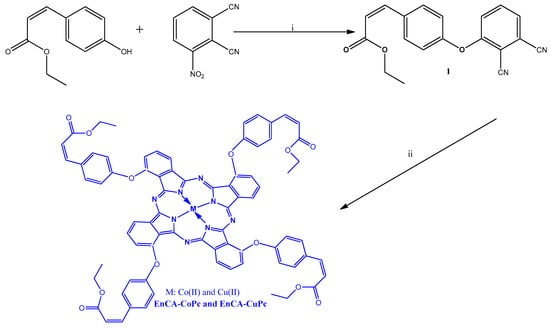
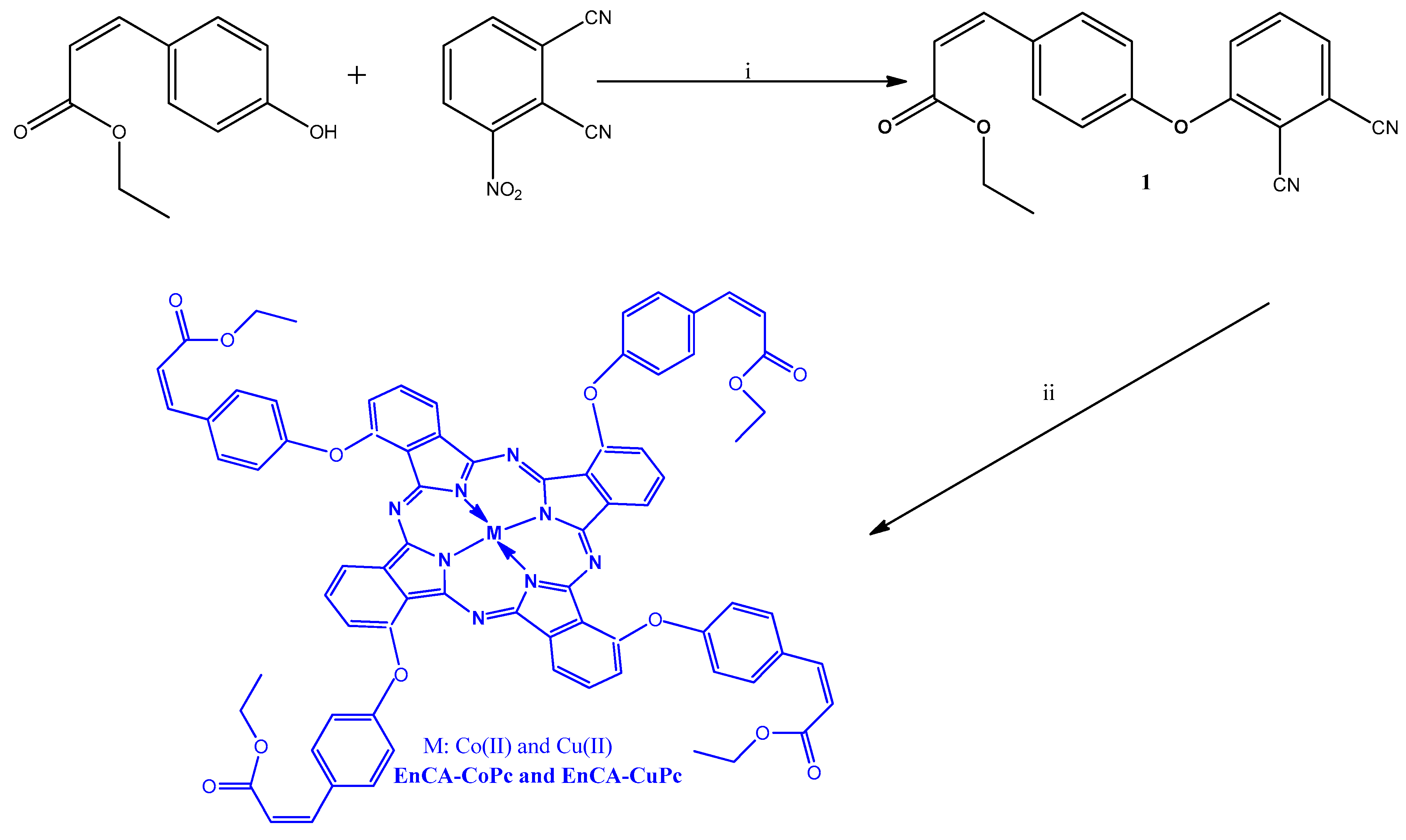
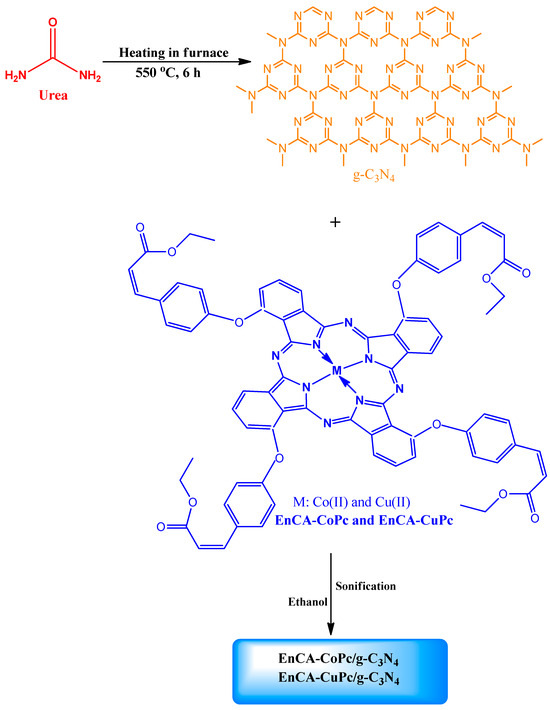
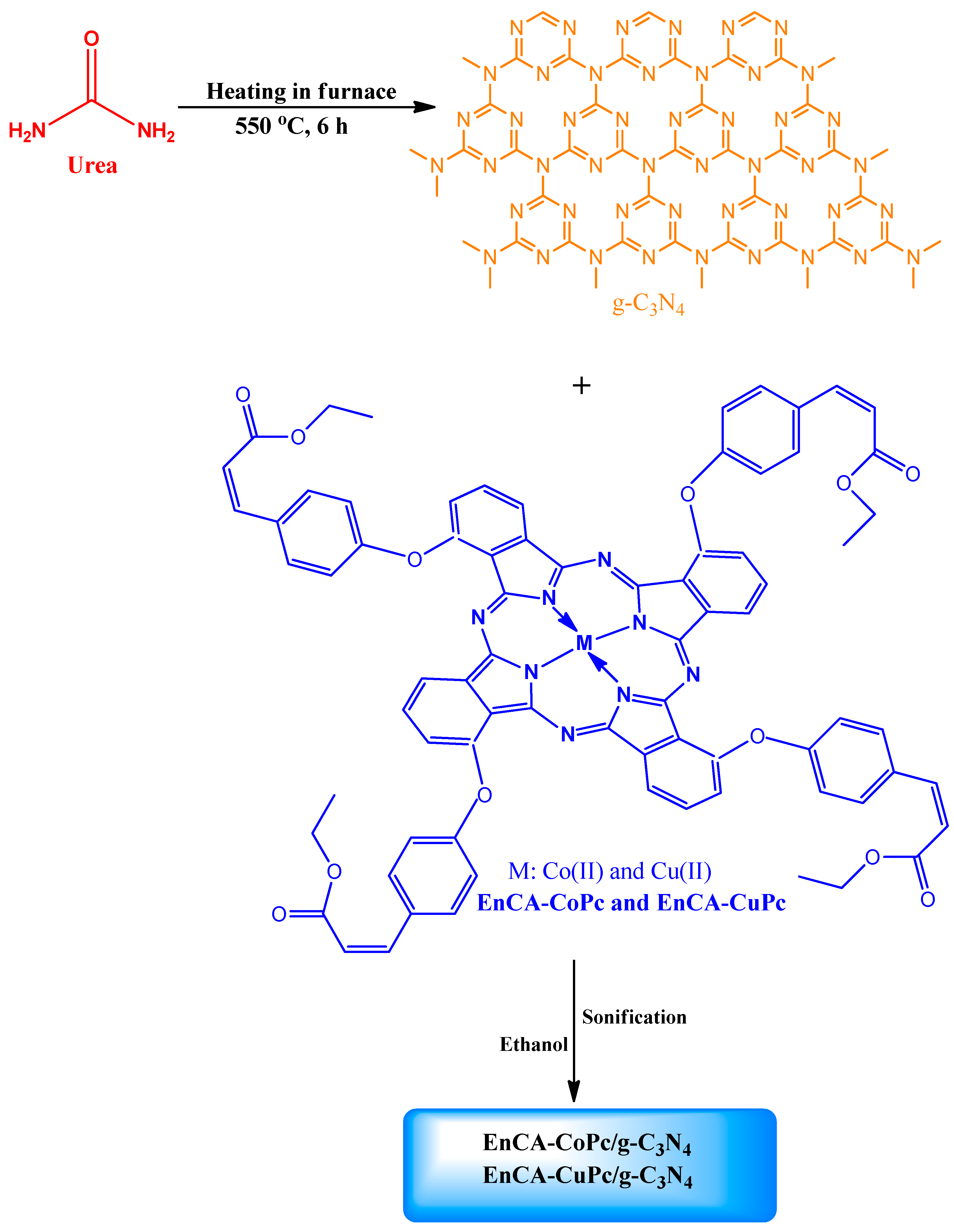
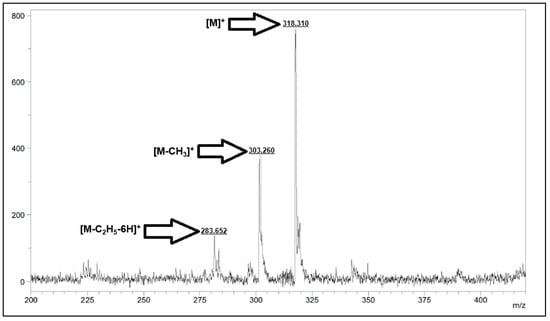
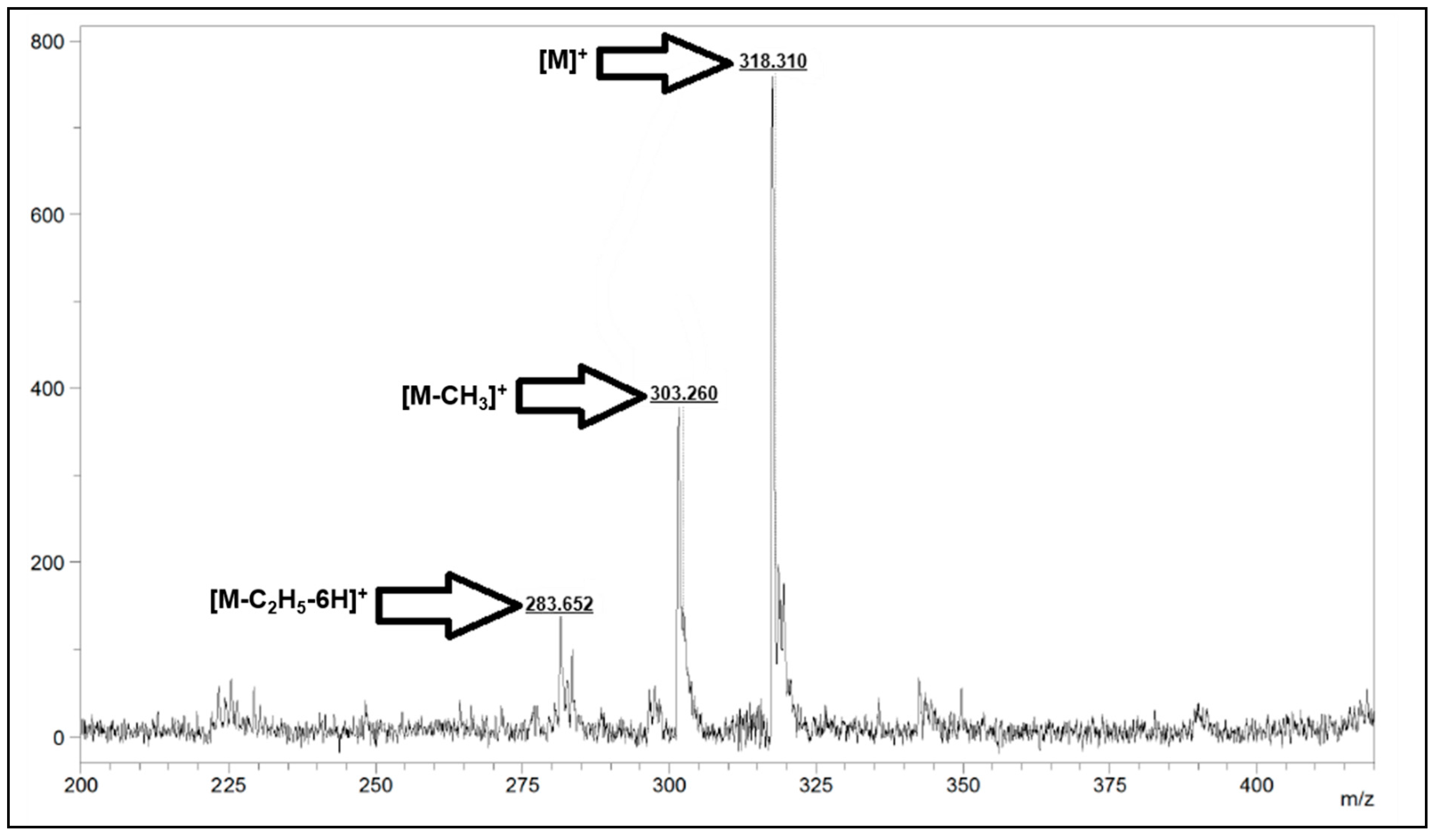
All synthetic pathways were given in Figure 1 and Figure 2. EnCA-CN was successfully synthesized and its structure was verified by FT-IR, NMR and Mass spectral techniques. In the FT-IR spectrum, the sharp absorption at 2225 cm−1 corresponds to the C≡N stretching vibration of the dicyano group, while the strong band at 1703 cm−1 confirms the ester C=O group. The characteristic aromatic (3078 cm−1) and aliphatic (2987 cm−1) C–H vibrations were also evident (Supplementary Figure S1). The 1H-NMR spectrum exhibited multiple aromatic proton signals between 7.52–8.13 ppm, confirming the presence of phenyl and phenoxy moieties. The signal at 6.62 ppm is attributed to the CH=CH protons of the conjugated acrylate group, the quartet at 4.17–4.23 ppm (CH2–O) and the triplet at 1.25 ppm (CH3) correspond to the ethyl ester moiety (Supplementary Figure S2). In 13C-NMR spectrum, the resonance at 166.62 ppm is assigned to the ester carbonyl carbon, while the signals between 115–123 ppm correspond to the cyano carbons (Supplementary Figure S3). MALDI-TOF-MS analysis showed a molecular ion peak at m/z = 318.310 [M]+, consistent with the calculated value (318.32 g/mol), confirming the successful formation of EnCA-CN (Figure 3).
Figure 1.
All synthetic pathways to synthesis the molecules. (i: K2CO3, DMF, 50 °C, 72 h, ii: n-pentanol, DBU, CoCl2 or CuCl2, 160 °C, 24 h).
Figure 2.
The reaction routes for preparation of metallophthalocyanine/graphitic carbon nitride structures.
Figure 3.
MALDI-TOF spectrum of ethyl (2Z)-3-(4-(2,3-dicyanophenoxy)phenyl)acrylate (EnCA-CN).
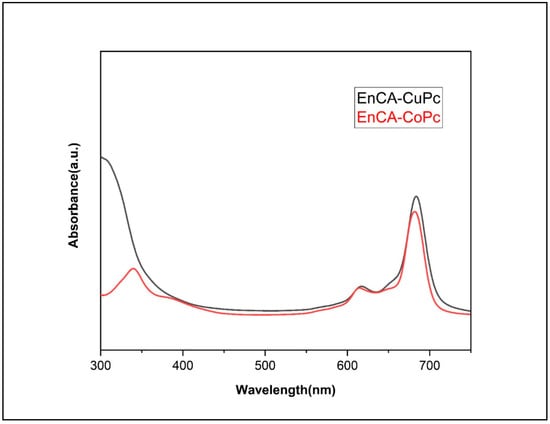
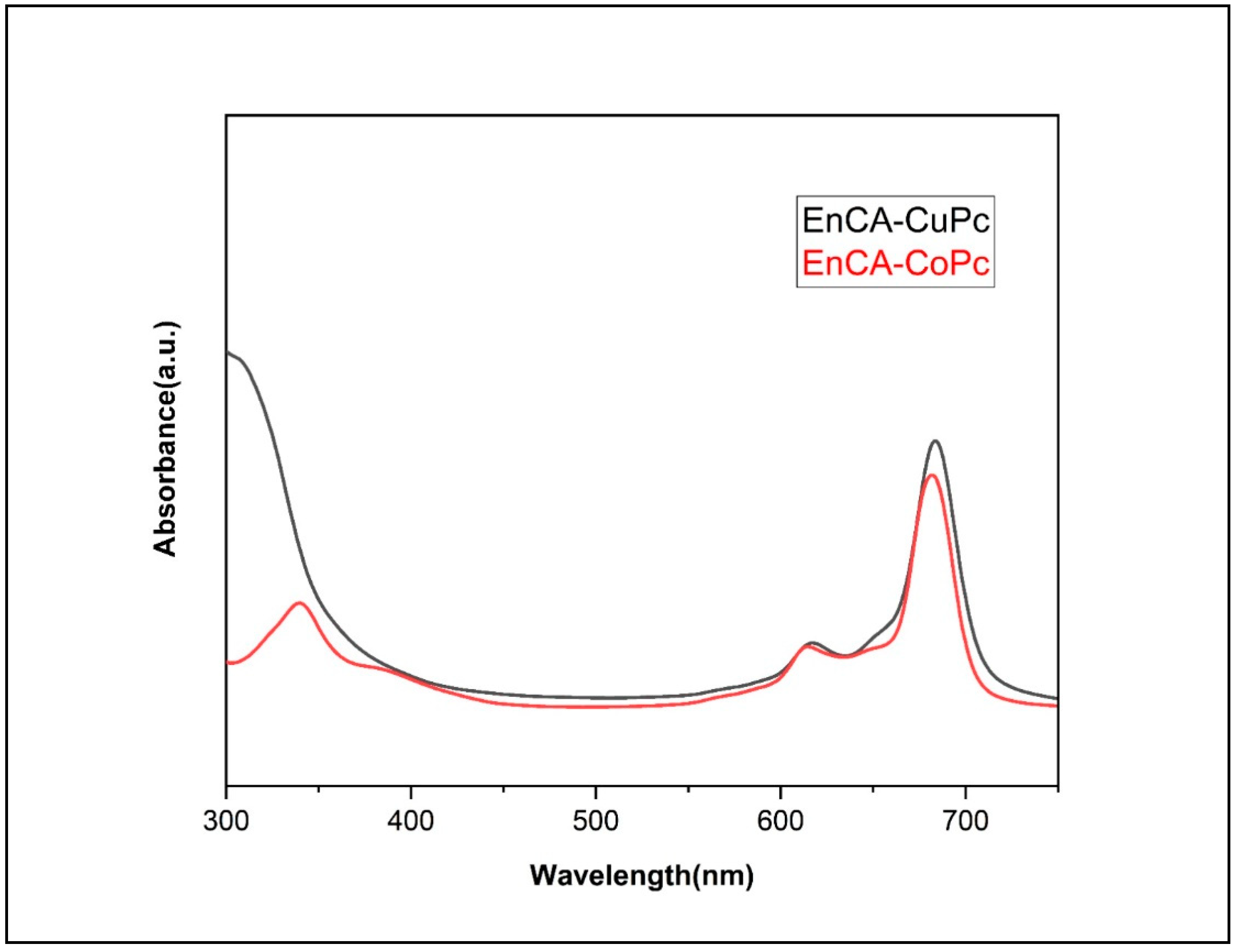
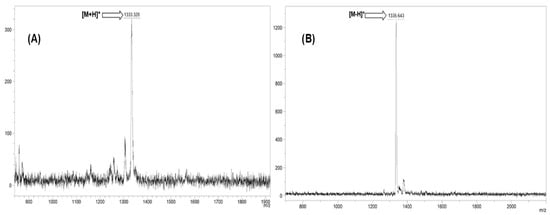
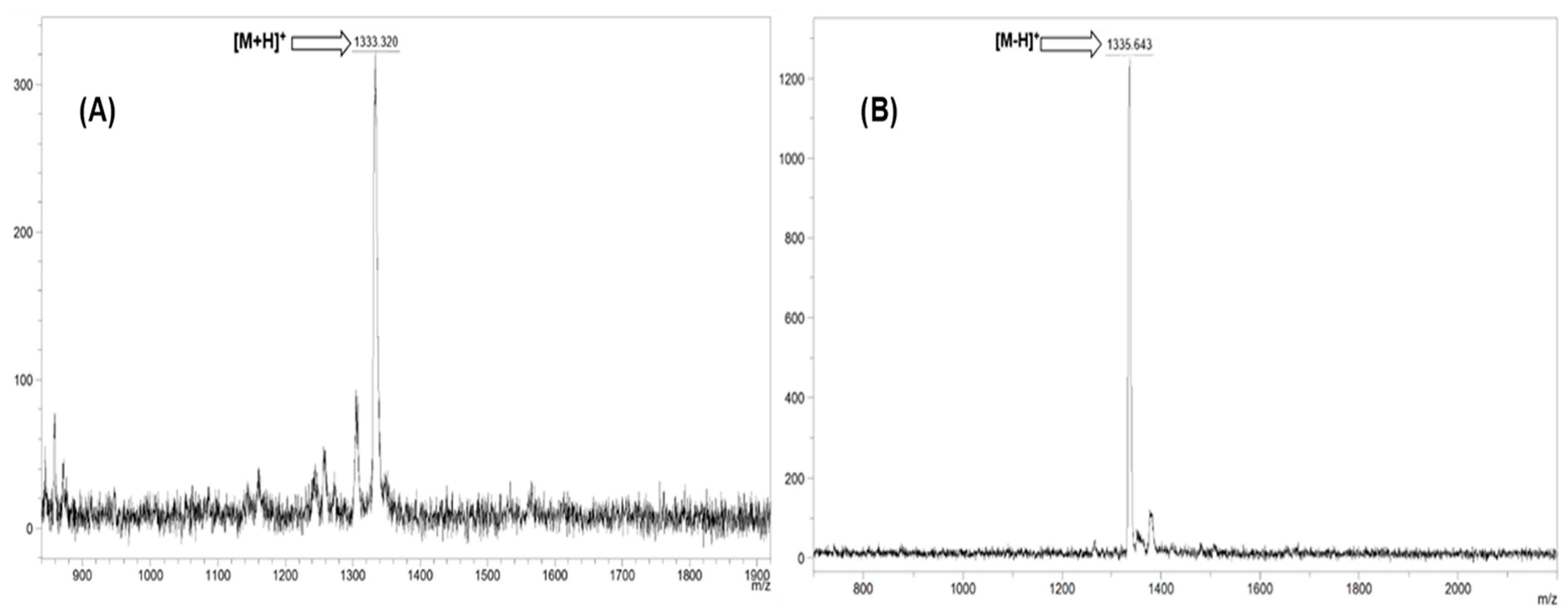
FT-IR spectrum revealed the retention of the C=O stretching at 1705 cm−1 for EnCA-CoPc and 1712 cm−1 for EnCA-CuPc. The aromatic C–O stretching bands at around 1250–1174 cm−1, indicating that the EnCA moiety was successfully incorporated into the phthalocyanine framework and the disappearance of the C≡N band verified the completion of the cyclotetramerization reaction, forming the phthalocyanine macrocycle. The UV–Vis spectrum displayed intense Q-bands at 6784 and 617 nm and a B (Soret) band at 295 nm, characteristic of metal phthalocyanines for EnCA-CoPc (Figure 4). The slight splitting and bathochromic shift of Q-bands are consistent with a D4h-symmetric Co(II) phthalocyanine structure and the paramagnetic nature of the Co2+ center. The MALDI-TOF-MS peak at m/z = 1333.32 [M+H]+ further confirmed molecular structure of EnCA-CoPc (Figure 5A). Similarly, UV–Vis spectrum of EnCA-CuPc showed Q-bands at 682 and 615 nm and a B-band at 342 nm, all characteristic of Cu(II) phthalocyanines (Figure 4). Compared with the CoPc analog, the CuPc complex exhibited a red-shifted Q-band (682 nm) and higher molar absorptivity (log ε = 5.20), indicating stronger π–π* delocalization and enhanced visible-light absorption due to the paramagnetic Cu2+ center. The MALDI-TOF-MS peak at m/z = 1335.64 [M-H]+ further confirmed molecular structure of EnCA-CoPc (Figure 5B).
Figure 4.
UV-Vis spectrum of EnCA-CoPc and EnCA-CuPc.
Figure 5.
MALDI-TOF spectra of (A) EnCA-CoPc and (B) EnCA-CuPc.
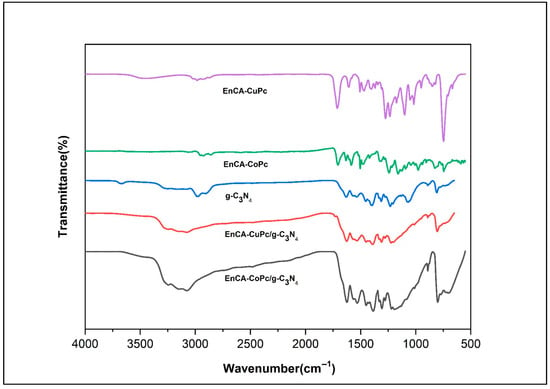
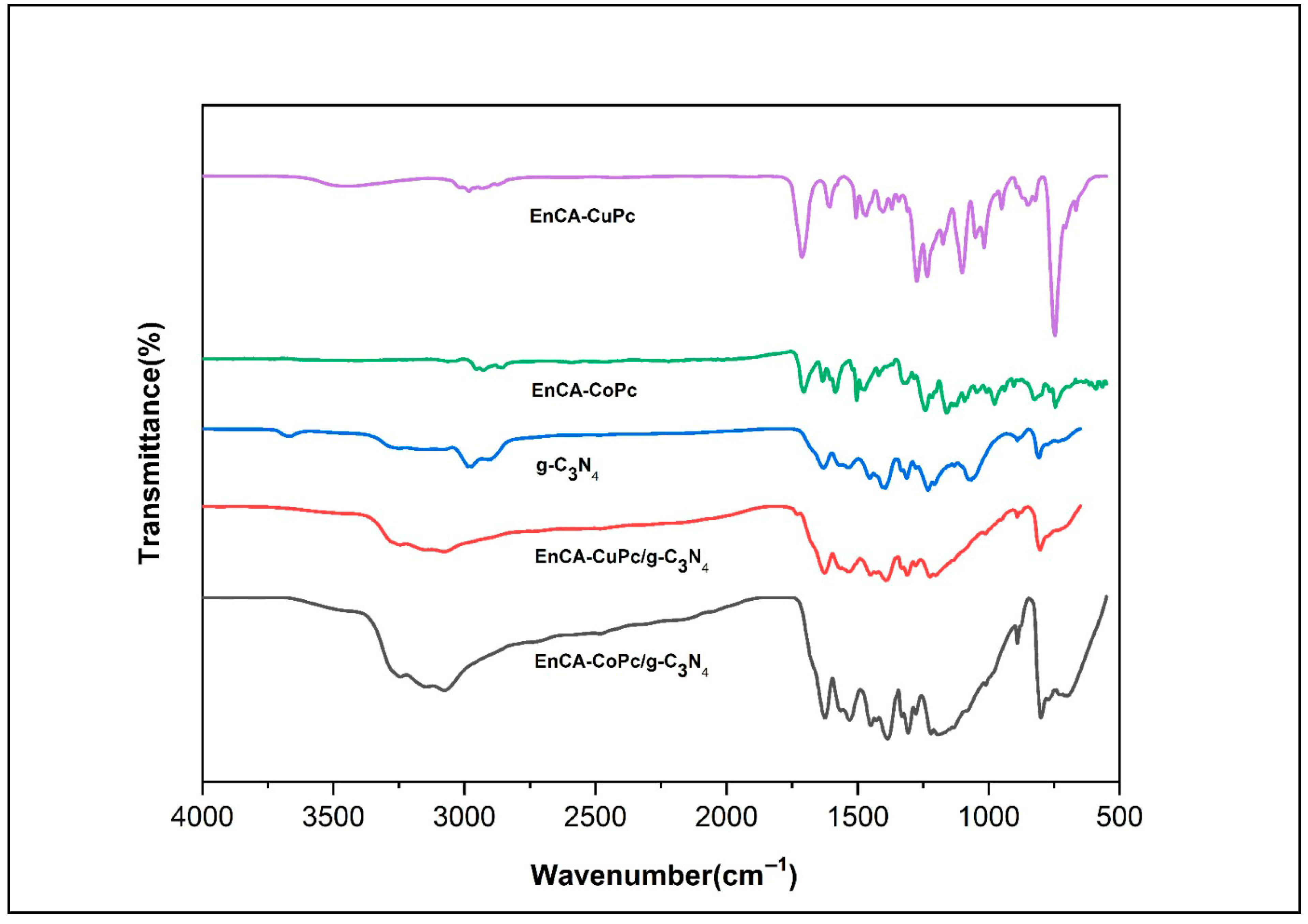
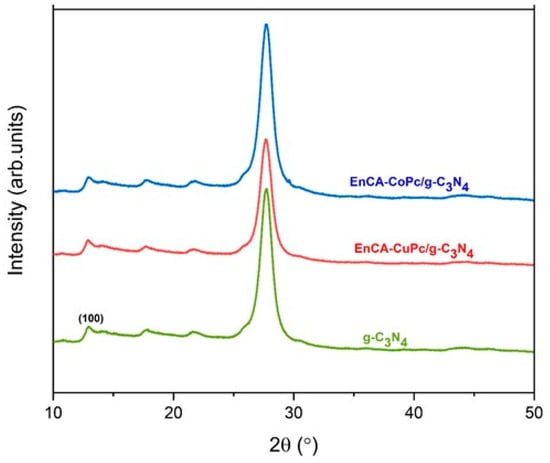
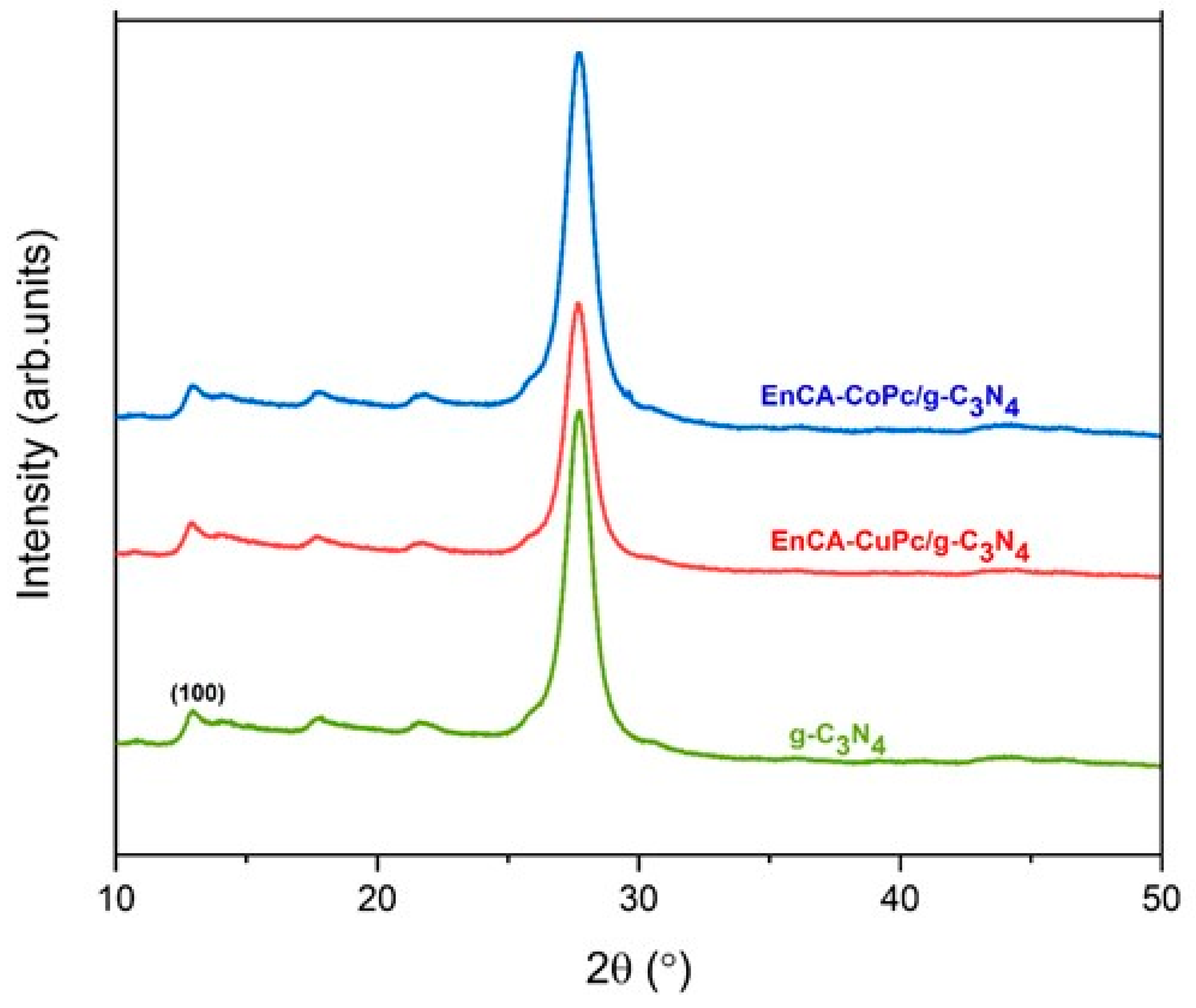
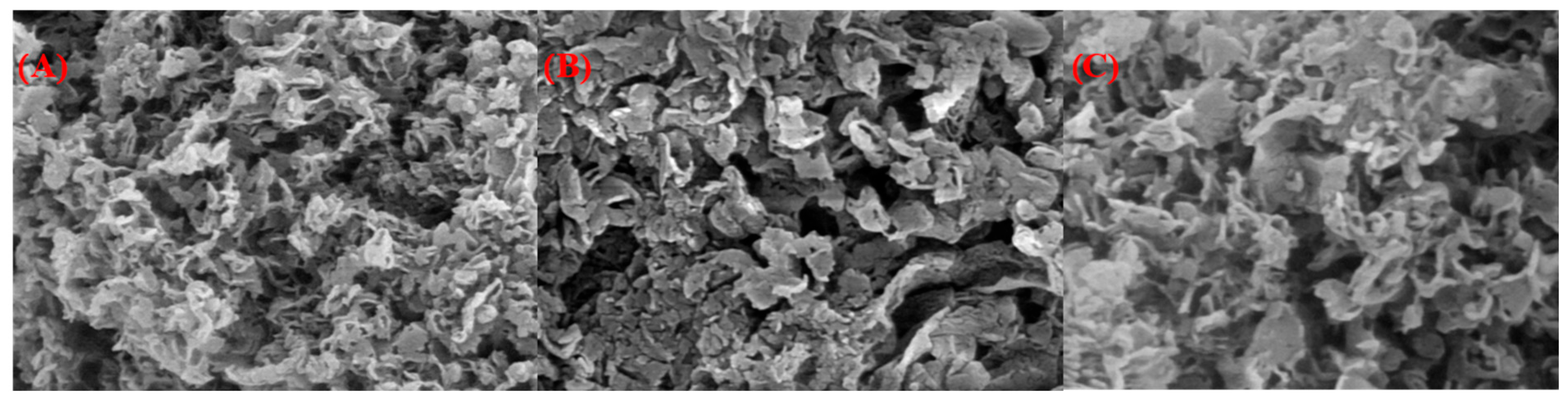
The structural interactions between phthalocyanine (MPc) and g-C3N4 were confirmed by FT-IR, XRD and SEM analyses, these techniques provided clear evidence of π–π stacking between the two components. In the FT-IR spectra, the characteristic bands of g-C3N4 appeared at around 810 cm−1 (triazine ring breathing) and in the 1200–1650 cm−1 region (C–N and C=N stretching), indicating that the basic framework of g-C3N4 remained intact after composite formation. However, slight red shifts of the C–N/C=N vibrations and the weakening of the broad N–H stretching band (3100–3300 cm−1) were observed, suggesting strong π–π interactions and possible hydrogen bonding between the aromatic π-systems of MPc and g-C3N4 (Figure 6). In addition, the retention of MPc-related C=O and Ar–C–O bands confirmed the successful incorporation of the phthalocyanine moiety onto the g-C3N4 surface. XRD patterns further supported these findings: pristine g-C3N4 exhibited two major diffraction peaks at 13.1° and 27.4° corresponding to in-plane structural packing and interlayer stacking of the conjugated layers. After MPc loading, the peak slightly shifted toward lower angles (≈27.0°) and decreased in intensity, indicating an increased interlayer spacing due to MPc insertion and a partial disturbance of the ordered stacking structure. The reflection also broadened slightly, suggesting reduced in-plane crystallinity caused by MPc–g-C3N4 interaction. Together, FT-IR and XRD results confirm that MPc molecules are effectively anchored onto g-C3N4 through noncovalent π–π stacking interactions, enhancing charge transfer pathways and creating a stable hybrid interface beneficial for photocatalytic activity (Figure 7). Figure 8A–C show the images of g-C3N4, EnCA-CoPc/g-C3N4, EnCA-CuPc/g-C3N4 to prove noncovalent π–π stacking interactions between metallophthalocyanines and g-C3N4.
Figure 6.
FT-IR spectra of g-C3N4, EnCA-CoPc, EnCA-CuPc, EnCA-CoPc/g-C3N4 and EnCA-CuPc/g-C3N4.
Figure 7.
XRD spectra of EnCA-CoPc/g-C3N4 and EnCA-CuPc/g-C3N4 and g-C3N4.
Figure 8.
SEM images of (A) g-C3N4 (B) EnCA-CoPc/g-C3N4 (C) EnCA-CuPc/g-C3N4.
2.2. Photocatalytical Studies
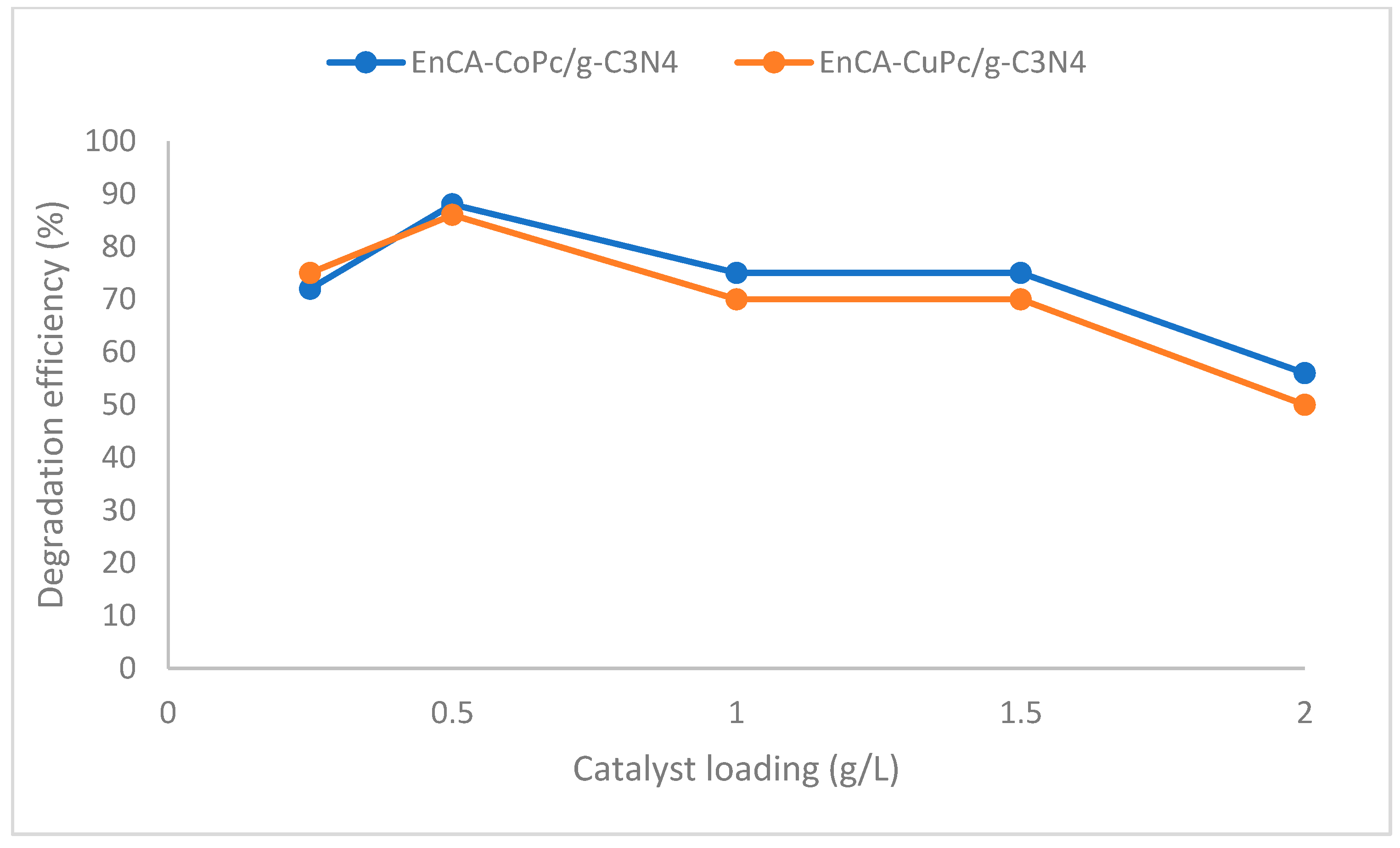
The photocatalytic efficiency of MPc/g-C3N4 composites in the degradation of chlorophenolic compounds is critically dependent on catalyst loading, which directly modulates the density of accessible active sites and the photonic absorption capacity of the system. At suboptimal loadings, the limited availability of catalytic sites constrains the generation of photogenerated electron–hole pairs, thereby attenuating the formation of key reactive oxygen species, including hydroxyl (•OH) and superoxide (O2•−) radicals, and consequently impeding the degradation kinetics of the target pollutants. Conversely, optimal catalyst loadings can induce light scattering and shielding phenomena, wherein the upper layers of the photocatalyst attenuate incident irradiation, reducing photon penetration into deeper layers and diminishing the overall photocatalytic activity. Moreover, excessive catalyst loading can promote the agglomeration of MPc/g-C3N4 particles, thereby diminishing the effective surface area available for pollutant adsorption and reactive radical generation. Optimal catalyst loading represents a balance between these competing effects, providing sufficient surface area, enhanced light-harvesting efficiency, and efficient generation of reactive oxygen species, ultimately maximizing photocatalytic degradation rates. Previous studies on MPc/g-C3N4 systems report optimum loadings typically within the range of 0.25–2.0 g/L; however, the precise value is contingent upon the specific MPc species, the morphology of g-C3N4, light intensity, and the concentration of the target pollutant [22,23,24]. The degradation efficiency was also evaluated at a lower dosage of 0.25 g/L; however, the results indicated a decline in performance (approx. 72–75%), confirming that 0.5 g/L is the optimal loading for the current system. In the present study, catalyst loadings within the 0.25–2.0 g/L range were investigated (Figure 9), and the optimal loading was identified as 0.5 g/L for both photocatalysts, corresponding to 25 mg of phthalocyanine dispersed in 50 mL of ethanol.
Figure 9.
Effect of catalyst loading on the photocatalytic performance of EnCA-CoPc/g-C3N4 and EnCA-CuPc/g-C3N4.
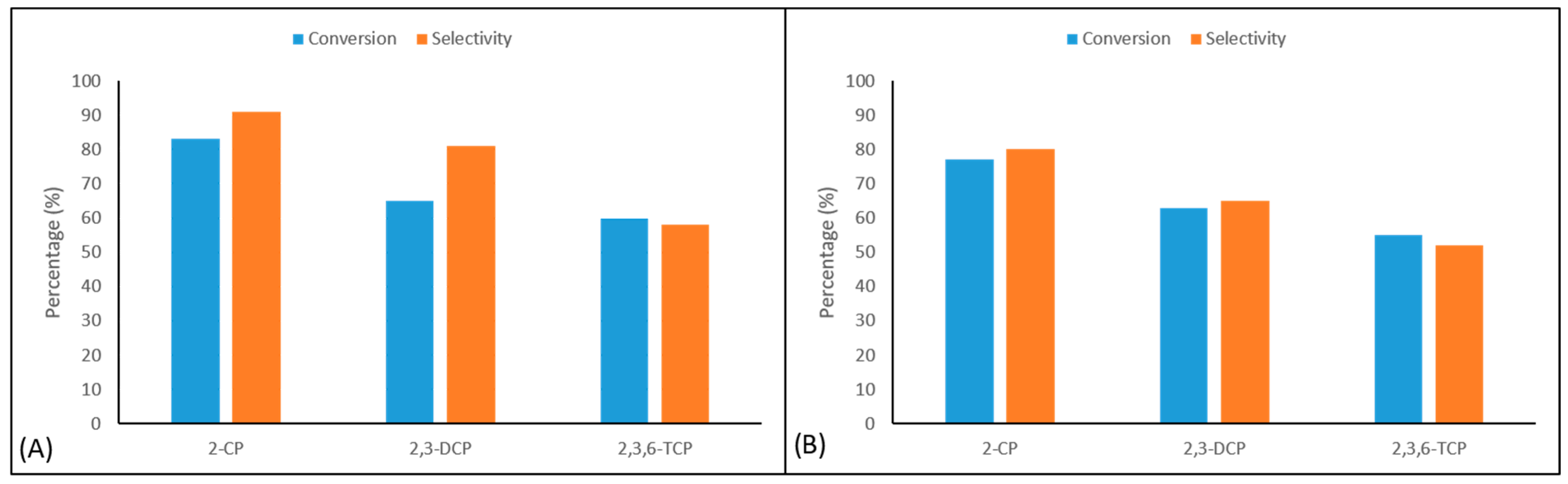
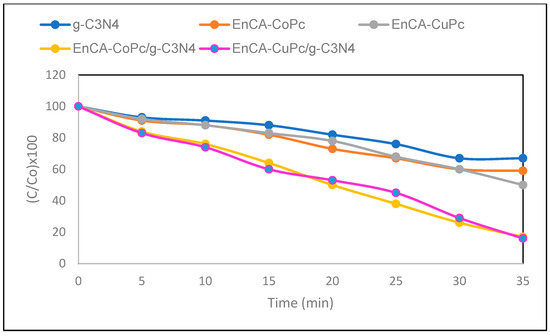
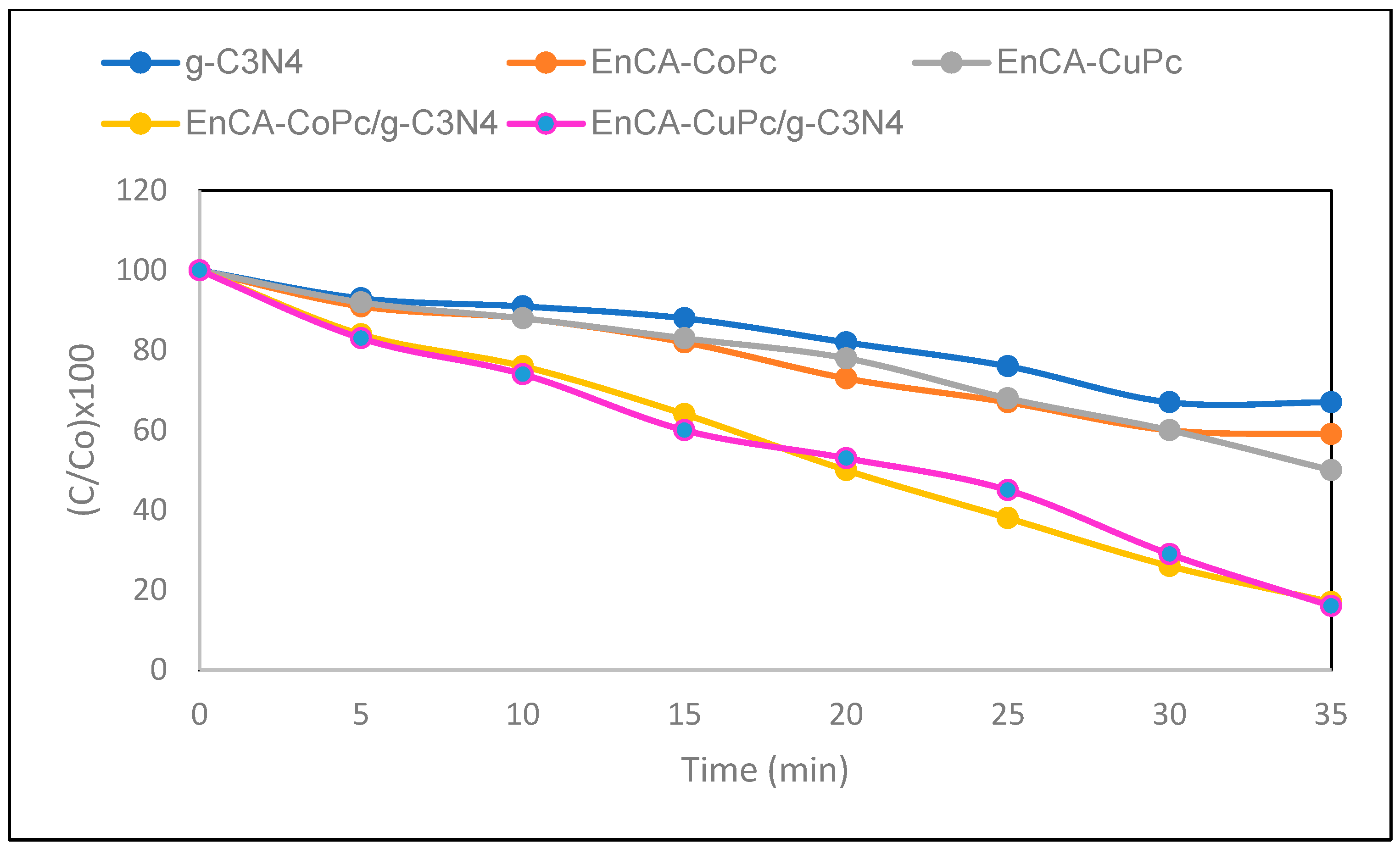
The susceptibility of phenolic derivatives to oxidative degradation is strongly influenced by the presence of electron-withdrawing or electron-donating substituents on the aromatic ring. In this study, the oxidation of 2-chlorophenol, 2,3-dichlorophenol, and 2,3,6-trichlorophenol yielded benzoquinone derivatives as the primary products (Table 1). The electronegative chlorine atom exerts an inductive electron-withdrawing effect on the aromatic system, which intensifies with an increasing number of chlorine substituents. Conversely, chlorine can partially contribute electron density through resonance (+M mesomeric effect), predominantly at ortho and para positions. Consequently, an increase in the number of chlorines generally hinders the oxidation process. Nevertheless, it is noteworthy that the presence of chlorine atoms at ortho positions can facilitate oxidation by enabling the transfer of π-electron density within the ring. In this study, both catalysts catalyzed 2-chlorophenol with high selectivity and product conversions, and the oxidation resulted in the formation of 2-chloro-1,4-benzoquinone. The order of highest product conversions for the pollutants was as follows; 2-chlorophenol > 2,3-dichlorophenol > 2,3,6-trichlorophenol. Looking at Table 1, the highest product selectivity and conversion rate was obtained in the oxidation of 2-chlorophenol with the EnCA-CoPc/g-C3N4 catalyst (82.6% selectivity, 90.8% conversion). The lowest product selectivity was determined as 51.6% in the oxidation of 2,3,6-trichlorophenol with the EnCA-CuPc/g-C3N4 catalyst (Figure 10). CoPc systems are known from previous studies to generally yield slightly higher selectivity than CuPc [25,26,27,28,29,30] because the redox cycle (Co2+/Co3+) of the Co center is more efficient in electron transfer. The results in Table 1 also demonstrate the importance of light, the catalyst, and g-C3N4 in the degradation of pollutants. One of our objectives in this study is to use photocatalysts to degrade harmful or persistent chlorophenols into less toxic and more environmentally friendly products under mild conditions. These pollutants can generally be efficiently oxidized or reduced using photocatalysts. It was calculated that the EnCA-CoPc/g-C3N4 catalyst degraded 2-chlorophenol by 82.6%, while the EnCA-CuPc/g-C3N4 catalyst degraded 2-chlorophenol by 77.4% (Figure 11).
Table 1.
All photocatalytic results with both catalysts for chlorophenols degradation.
Figure 10.
Photocatalytic selectivity and conversion using (A) EnCA-CoPc/g-C3N4 (B) EnCA-CuPc/g-C3N4 for chlorophenol derivatives. [The selectivity was calculated using the formula S = [Cproduct/(C0 − Ct)] × 100, where Cproduct represents the concentration of the identified oxidation products and (C0 − Ct) is the total amount of chlorophenol converted].
Figure 11.
Time-dependent photocatalytic degradation (C/C0 × 100) of chlorophenols over different catalysts from this work.
In light of the existing literature, the photocatalytic oxidation of chlorophenols—including 2-chlorophenol (2-CP), 2,3-dichlorophenol (2,3-DCP), and 2,3,6-trichlorophenol (2,3,6-TCP)—is understood to proceed predominantly through a radical-mediated pathway under irradiation in the presence of photocatalysts such as TiO2, g-C3N4, or phthalocyanine-based systems [6,22,31]. Upon absorption of photons with energy equal to or greater than the semiconductor bandgap, the photocatalyst generates electron–hole pairs (e−/h+), promoting electrons from the valence band (VB) to the conduction band (CB):
Catalyst + hν → e− (CB) + h+ (VB)
The photogenerated holes and electrons subsequently migrate to the catalyst surface, where they participate in oxidation and reduction reactions, respectively. The VB holes oxidize surface-bound water or hydroxyl groups to form hydroxyl radicals (•OH)—highly potent, nonselective oxidizing agents:
h+ + H2O → •OH + H+
Meanwhile, CB electrons are captured by molecular oxygen adsorbed on the catalyst surface, producing superoxide radicals (O2•−):
e− + O2 → O2•−
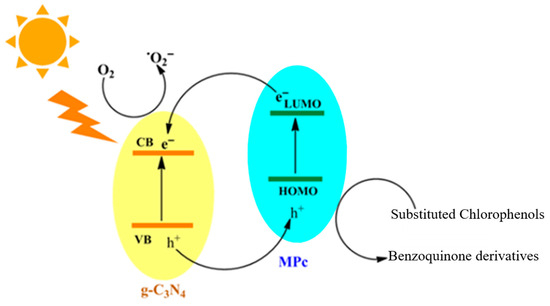
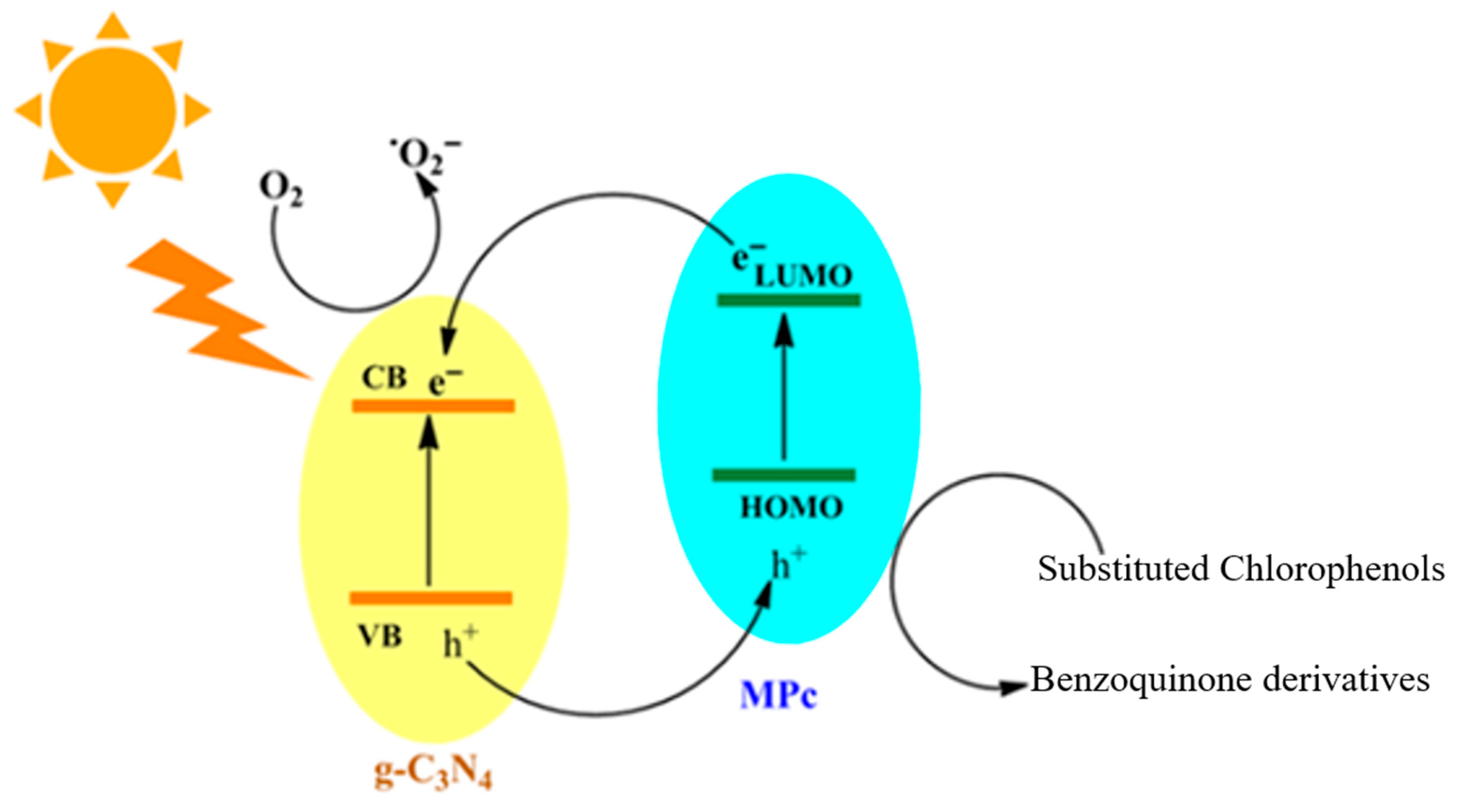
Hydroxyl radicals (•OH) possess sufficient redox potential to oxidize aromatic pollutants through electrophilic attack, while superoxide radicals (O2•−) promote stepwise electron transfer and partially oxidizing transformations [32,33,34] (Figure 12). Together with direct hole oxidation, these species establish a multiroute oxidative environment. Highly reactive hydroxyl (•OH) and superoxide (O2•−) radicals initiate the degradation of chlorophenols through electrophilic attack on the aromatic ring, leading first to hydroxylation and the formation of dihydroxy intermediates such as catechol- and hydroquinone-type compounds [35,36,37]. Consecutive hydroxylation steps weaken the C–Cl bonds, resulting in progressive dechlorination and the subsequent oxidation of these intermediates to benzoquinone derivatives [38,39,40].
Figure 12.
Proposed mechanism for the photocatalytic degradation of substitute chlorophenols under light using MPc/g-C3N4 composite.
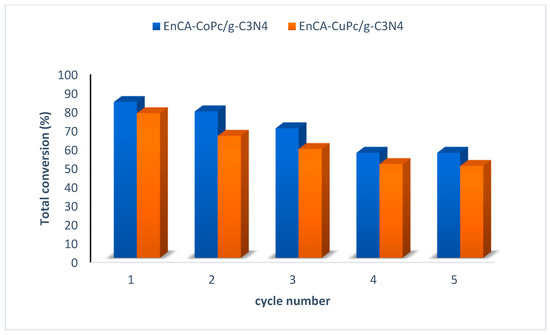
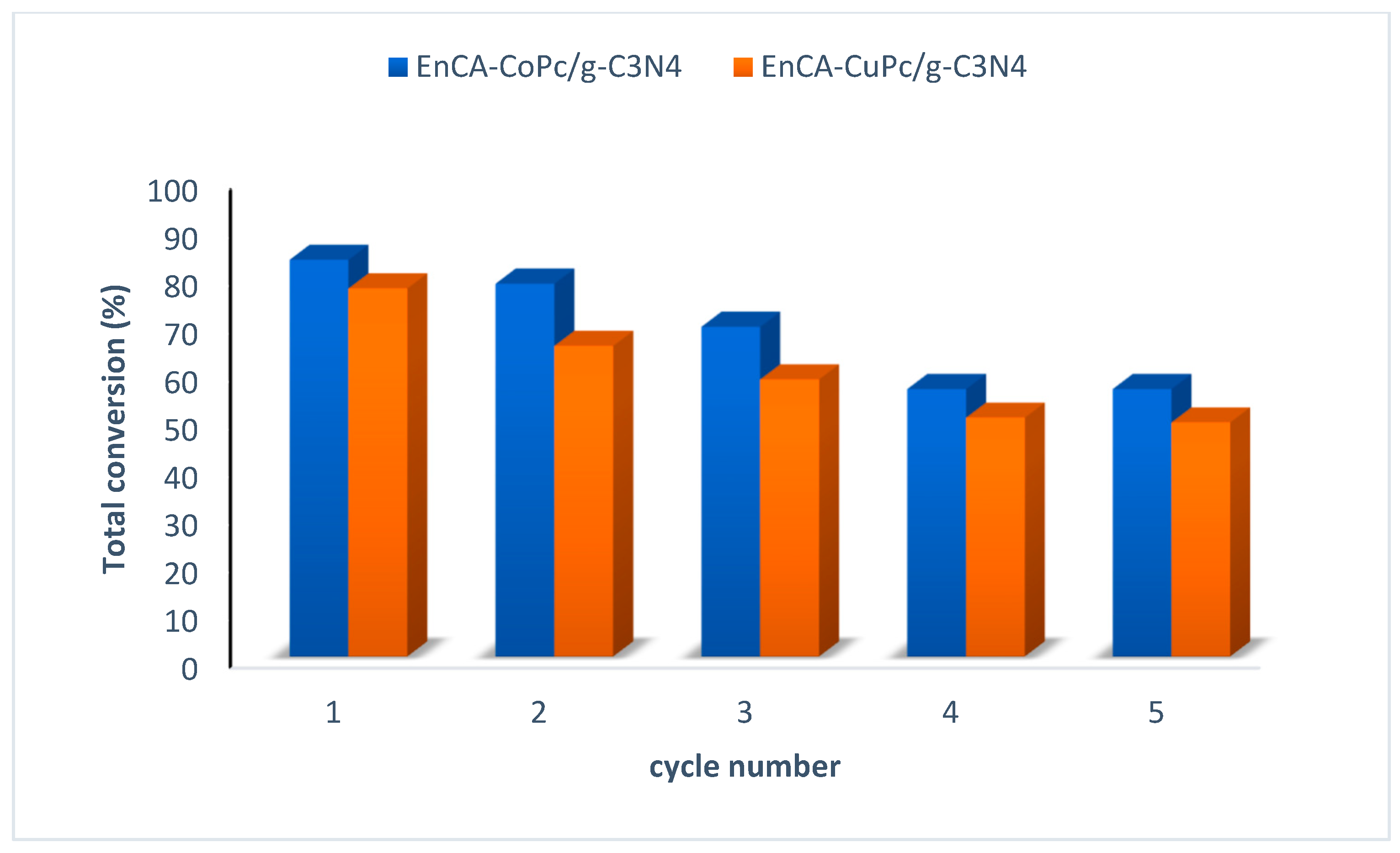
Photocatalyst recyclability is a critical consideration for both environmental sustainability and economic viability. Given that photocatalysts often incorporate costly metal centers or complex composite architectures, their reuse across multiple reaction cycles can substantially reduce operational costs. Moreover, preserving the structural integrity and photochemical activity of the catalyst enhances the reliability and longevity of the photocatalytic system. In the present study, recycling experiments were conducted to evaluate the durability and reusability of the employed photocatalysts, specifically assessing potential performance loss upon successive reuse. The catalysts were recovered after each reaction cycle, washed, and reintroduced under identical reaction conditions to monitor changes in degradation efficiency and product selectivity, providing insights into their operational stability over multiple cycles. In this study, both photocatalysts retained over 50% total product conversion after five successive reaction cycles, indicating significant preservation of their catalytic activity and structural integrity. Notably, the recycling experiments revealed that the EnCA-CoPc/g-C3N4 catalyst maintained approximately 68% total product conversion after five cycles, whereas the EnCA-CuPc/g-C3N4 catalyst exhibited approximately 60% total product conversion after four cycles. These results underscore the considerable durability and reusability of the synthesized catalysts under repeated operational conditions, highlighting their potential for sustainable photocatalytic applications (Figure 13).
Figure 13.
Recycling studies of En-CA-CoPc/g-C3N4 and EnCA-CuPc/g-C3N4.
In recent years, Advanced Oxidation Processes (AOPs) have emerged as a paramount strategy for the degradation of recalcitrant organic contaminants, owing to their ability to generate highly reactive species that facilitate complete mineralization. To enhance the efficiency of these processes, a diverse array of functional materials has been extensively investigated for their photocatalytic and catalytic activities [41,42,43]. Within this framework, the development of synergistic heterojunctions has gained significant traction as a means to overcome the limitations of single-component catalysts. Consequently, over the past decade, numerous studies have reported the preparation of phthalocyanine (MPc) and graphitic carbon nitride (g-C3N4) hybrid materials and investigated their applications across diverse fields [44,45,46,47,48,49,50,51,52,53]. However, only a limited number of studies have specifically focused on the photocatalytic degradation of phenolic or dye pollutants [54,55,56]. A summary of representative investigations involving ZnPc, CoPc, FePc, and NiPc incorporated into g-C3N4 matrices is presented in Table 2 [57,58,59,60,61]. Zada et al. demonstrated that ZnPc/g-C3N4 catalyzed the degradation of 2,4-dichlorophenol (2,4-DCP), achieving 85–90% conversion within 120 min under visible light irradiation [57], whereas Wang et al. reported approximately 80% degradation of 2,4-DCP in just 90 min in the presence of CoPc/g-C3N4 [58], highlighting the significant influence of redox-active metal centers on catalytic performance. Li and co-workers further showed that incorporating g-C3N4 into a FePc/CeO2 heterojunction led to ~90% degradation of 2,4-DCP within 60 min [59], whereas Khan et al. observed 80% removal of 4-chlorophenol using NiPc/g-C3N4 under similar conditions [60]. In comparison, photocatalytic degradation with pristine g-C3N4 typically achieves only 45–60% conversion for 2,4-DCP and 4-chlorophenol [61], emphasizing the critical role of phthalocyanines in enhancing photocatalytic efficiency. The incorporation of MPc units not only extends visible light absorption but also facilitates effective electron–hole separation, thereby promoting the generation of reactive species such as superoxide radicals (O2•−), photogenerated holes (h+), and, in some cases, singlet oxygen (1O2), which drive oxidative degradation. Despite these advances, a critical analysis of the literature (Table 2) reveals that studies addressing highly chlorinated phenolic compounds remain scarce, and essential information on photocatalyst photostability, recyclability, and by-product identification is often lacking, representing significant gaps in the field.
Table 2.
A summary of the studies on ZnPc, CoPc, FePc and NiPc incorporated into g-C3N4 matrices.
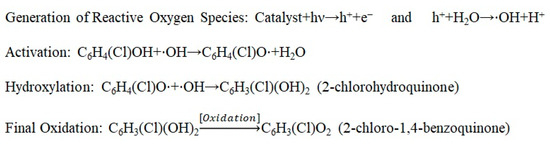
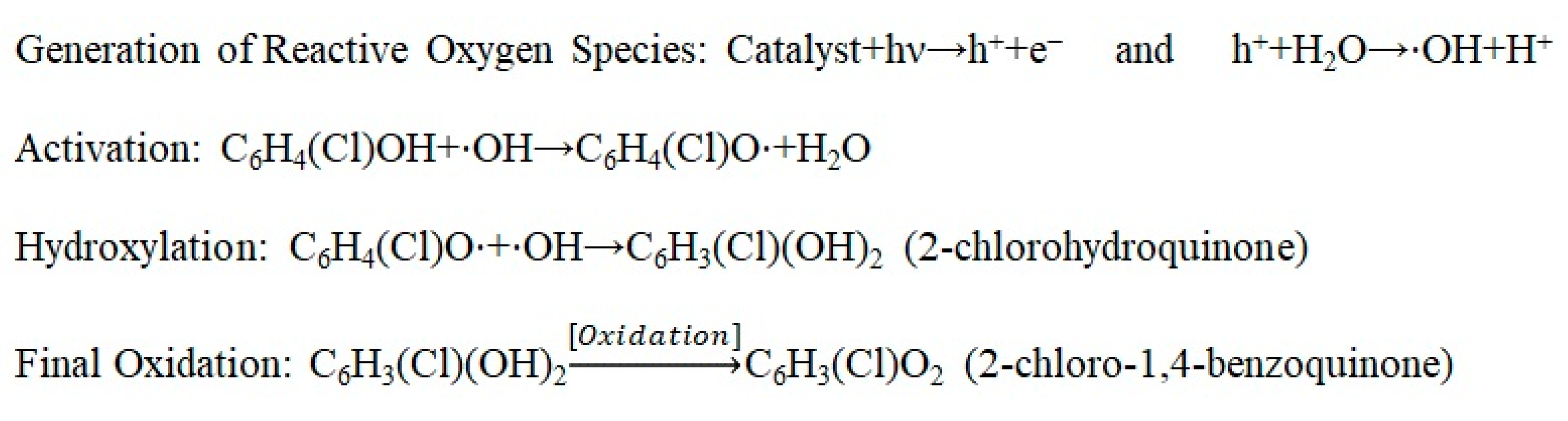
The transformation begins with the photocatalytic activation of the catalyst (such as TiO2), where incident light provides enough energy to promote electrons to the conduction band, leaving behind highly reactive “holes” (h+) in the valence band. These holes oxidize water or adsorbed hydroxyl ions to generate hydroxyl radicals (⋅OH), which act as the primary oxidants. The mechanism proceeds via the abstraction of a hydrogen atom from the phenolic −OH group of 2-chlorophenol, creating a 2-chlorophenoxy radical (Figure 14). Due to the resonance stabilization of this radical, the electron density shifts significantly to the para-position (carbon 4), making it the most favorable site for a second hydroxyl radical attack. This nucleophilic-like addition forms 2-chlorohydroquinone as a critical intermediate. In the final stage, the intermediate undergoes a rapid two-step dehydrogenation (oxidation), involving the loss of two protons and two electrons—often facilitated by the catalyst surface or dissolved oxygen—to yield the stable conjugated system of 2-chloro-1,4-benzoquinone [62,63,64].
Figure 14.
A plausible mechanism for the photocatalytic oxidation of 2-chlorophenol into 2-chloro-1,4-benzoquinone via radical intermediates.
3. Experimental
3.1. Materials
All materials, equipment, general procedures of EnCA-CN, EnCA-CoPc, EnCA-CuPc, EnCA-CoPc/g-C3N4, EnCA-CuPc/g-C3N4 and photocatalytic procedure are given as Supplementary File.
3.2. Synthesis
3.2.1. Synthesis of Ethyl (2Z)-3-(4-(2,3-Dicyanophenoxy)phenyl)acrylate (EnpCA-CN)
Yield: 2.64 g (80%); FT-IR: υmax /cm−1 3078 (Ar–H), 2987 (Alif. C–H), 2225 (C≡N), 1703 (C=O), 1571, 1444, 1270, 1160 (ArC–O), 980, 841. 1H-NMR. (DMSO), (d:ppm): 8.13 (d, J: 8.8, H, Ar-H), 7.85 (d, J: 8.8, 3H, Ar-H), 7.80 (s, H, Ar-H), 7.74 (d, J: 8.0, H, Ar-H), 7.52 (d, J: 6.0, 2H, CH=CH), 6.62 (d, J: 8.4, H, Ar-H), 4.23–4.17 (q, J: 7.2, 2H, CH2-O), 1.25 (t, J: 6.8, 3H, CH3). 13C-NMR. (DMSO), (d:ppm): 166.62, 163.56, 156.12, 143.72, 136.83, 131.90, 131.20, 123.81, 123.86, 123.12, 118.68, 117.27, 116.32, 115.32, 109.27, 60.54, 14.67. MALDI-TOF-MS: m/z: calcd. 318.32; found 318.310 [M]+, 303.260 [M-CH3]+, 283.652 [M-C2H5-6H]+.
3.2.2. Co(II) Phthalocyanine (EnCA-CoPc)
The green solid product had good solubility in THF, DMF, DMSO and CHCl3 solvents. Yield: 280 mg (%45); FT-IR: υmax /cm−1 3035 (Ar–H), 2954–2867 (Alif. C–H), 1705 (C=O), 1585, 1503, 1474, 1420, 1323, 1241–1159(ArC–O) 1091, 1046,1007, 939, 905, 825,824, 745. UV/Vis (DMSO): λmax (log ε) 684 (5.26), 617 (4.66), 295 (5.38). MALDI-TOF-MS: m/z: calcd. 1332.17; found 1333.32 [M+H]+.
3.2.3. Cu(II) Phthalocyanine (EnCA-CuPc)
The green solid product had good solubility in THF, DMF, DMSO, and CHCl3 solvents. Yield: 300 mg (%50); FT-IR: υmax /cm−1 3016 (Ar–H), 2982–2870 (Alif. C–H), 1712 (C=O), 1506, 1467, 1403, 1368, 1343, 1273–1174 (ArC–O), 1049, 1017, 950, 850, 822, 746. UV/Vis (DMSO): λmax (log ε) 682 (5.20), 615 (4.64), 342 (4.85). MALDI-TOF-MS m/z: calcd. 1336.78; found 1335.64 [M-H]+.
4. Conclusions
In summary, the present study demonstrates that EnCA-CoPc/g-C3N4 and EnCA-CuPc/g-C3N4 photocatalysts exhibit remarkable photocatalytic activity and structural stability for the degradation of chlorophenolic compounds under visible light irradiation. The optimal catalyst loading was determined to be 0.5 g/L, achieving an optimal balance between the accessibility of active sites and the efficiency of light absorption. Both photocatalysts efficiently facilitated the degradation of 2-chlorophenol, 2,3-dichlorophenol, and 2,3,6-trichlorophenol via radical-mediated oxidation pathways, with benzoquinone derivatives identified as the principal intermediates. Among the tested systems, EnCA-CoPc/g-C3N4 displayed superior catalytic performance and selectivity, achieving 90.8% conversion and 82.6% selectivity for 2-chlorophenol, which can be attributed to the efficient Co2+/Co3+ redox cycle that promotes effective charge separation and transfer. Recycling studies further confirmed the durability of both photocatalysts, with over 50% of their initial activity retained after five consecutive cycles. Building upon the robust empirical foundation established in this study, future research is poised to advance the frontiers of environmental remediation through innovative catalytic strategies. A primary objective of forthcoming investigations will be to enhance the degradation kinetics of these hybrid catalysts, particularly when targeting highly chlorinated and recalcitrant organic pollutants that exhibit greater resistance to oxidative processes. By leveraging the successful performance of the current system, future work may focus on optimizing the composite architecture through advanced chemical functionalization or the exploration of diverse g-C3N4 nanostructures to maximize photocatalytic stability and maintain peak efficiency well beyond five cycles. Furthermore, evaluating these materials within complex, real-world wastewater matrices and conducting exhaustive mechanistic analyses of degradation by-products will be essential to validate the system’s environmental safety and industrial scalability. These strategic research directions will facilitate the development of sustainable, high-performance solutions for the mineralization of a broad spectrum of persistent organic pollutants.
Supplementary Materials
The following supporting information can be downloaded at: https://www.mdpi.com/article/10.3390/molecules31020213/s1.
Author Contributions
Conceptualization, E.T.S.; Methodology, C.A., Y.C. and E.T.S.; Software, E.T.S.; Validation, Y.C. and E.T.S.; Formal analysis, Y.C. and E.T.S.; Investigation, C.A., Y.C. and E.T.S.; Resources, Y.C. and E.T.S.; Data curation, C.A., Y.C. and E.T.S.; Writing—original draft, C.A., Y.C. and E.T.S.; Writing—review & editing, C.A., Y.C. and E.T.S.; Visualization, C.A., Y.C. and E.T.S.; Supervision, Y.C. and E.T.S.; Project administration, E.T.S.; Funding acquisition, C.A. and E.T.S. All authors have read and agreed to the published version of the manuscript.
Funding
This study was supported by The Research Fund of Karadeniz Technical University (Project no: 16562) Trabzon, Turkiye.
Institutional Review Board Statement
Not applicable.
Informed Consent Statement
Not applicable.
Data Availability Statement
The datasets used and/or analyzed during the current study are available from the corresponding author on reasonable request.
Acknowledgments
AI-assisted tools were used solely for language editing and grammatical improvement; no content generation or data analysis was performed using AI.
Conflicts of Interest
The authors declare no conflict of interest.
References
- Yadav, S.; Kumar, S.; Haritash, A. A comprehensive review of chlorophenols: Fate, toxicology and its treatment. J. Environ. Manag. 2023, 342, 118254. [Google Scholar] [CrossRef] [Scilit]
- Jankowska, K.; Su, Z.; Zdarta, J.; Skiadas, I.; Woodley, J.; Pinelo, M. High performance removal of chlorophenols from an aqueous solution using an enzymatic membrane bioreactor. Environ. Pollut. 2024, 357, 124348. [Google Scholar] [CrossRef] [Scilit] [PubMed]
- Zada, A.; Khan, M.; Khan, M.; Khan, Q.; Habibi-Yangjeh, A.; Dang, A.; Maqbool, M. Review on the hazardous applications and photodegradation mechanisms of chlorophenols over different photocatalysts. Environ. Res. 2021, 195, 110742. [Google Scholar] [CrossRef] [Scilit]
- Jones, A.; Morehead, A.; Yang, Y. Degradation and Extraction of Organochlorine Pollutants from Environmental Solids under Subcritical Water Conditions. Molecules 2023, 28, 5445. [Google Scholar] [CrossRef] [Scilit]
- Li, S.; Liu, J.; Liu, X.; Yan, K.; Zhang, J. Nanozyme-coupled photoelectrocatalytic system based on peroxidase-mimetic BiOI cathode and WO3 photoanode for efficient degradation of 3-chlorophenol. Electrochim. Acta 2024, 484, 144058. [Google Scholar]
- Babaei, A.; Golshan, M.; Kakavandi, B. A heterogeneous photocatalytic sulfate radical-based oxidation process for efficient degradation of 4-chlorophenol using TiO2 anchored on Fe oxides@carbon. Process Saf. Environ. Prot. 2021, 149, 35–47. [Google Scholar]
- Shoneye, A.; Chang, J.; Chong, M.; Tang, J. Recent progress in photocatalytic degradation of chlorinated phenols and reduction of heavy metal ions in water by TiO2-based catalysts. Int. Mater. Rev. 2021, 67, 47–64. [Google Scholar] [CrossRef] [Scilit]
- Wang, M.; Ballabio, M.; Wang, M.; Lin, H.; Biswal, B.; Han, X.; Paasch, S.; Brunner, E.; Liu, P.; Chen, M.; et al. Unveiling Electronic Properties in Metal-Phthalocyanine-based Pyrazine-linked Conjugated Two-Dimensional Covalent Organic Frameworks. J. Am. Chem. Soc. 2019, 141, 16810–16816. [Google Scholar]
- Okawa, Y.; Endo, K.; Hakamata, Y.; Watanabe, S.; Yokoyama, A.; Sugimori, T.; Takagi, H.; Inamo, M. Thermal and photoinduced electron transfer reactions of phthalocyanine complexes of Zn(II) and Cu(II) in acetonitrile. Dalton Trans. 2022, 51, 15393–15402. [Google Scholar] [PubMed]
- Yalazan, H.; Akyüz, D.; Ünlüer, D.; Koca, A.; Kantekin, H.; Sancak, K. Synthesis, electrochemical and spectroelectrochemical properties of novel soluble peripheral tetra triazole substituted CoII, CuII, MnIIICl and TiIVO phthalocyanines. Polyhedron 2020, 180, 114419. [Google Scholar]
- Huu, H.; Thi, M.; Nguyen, V.; Thi, L.; Phan, T.; Hoang, Q.; Luc, H.; Kim, S.; Vo, V. One-pot synthesis of S-scheme MoS2/g-C3N4 heterojunction as effective visible light photocatalyst. Sci. Rep. 2021, 11, 14787. [Google Scholar]
- Alaghmandfard, A.; Ghandi, K. A Comprehensive Review of Graphitic Carbon Nitride (g-C3N4)–Metal Oxide-Based Nanocomposites: Potential for Photocatalysis and Sensing. Nanomaterials 2022, 12, 294. [Google Scholar]
- Yang, S.; Wu, T.; Li, K.; Huang, P.; Li, W.; Zhuo, Y.; Liu, K.; Yang, Z.; Han, D. Photocatalytic Enhancement and Recyclability in Visible-Light-Responsive 2D/2D g-C3N4/BiOI p-n Heterojunctions via a Z-Scheme Charge Transfer Mechanism. Molecules 2024, 29, 5418. [Google Scholar] [CrossRef] [Scilit] [PubMed]
- Xu, T.; Wang, D.; Dong, L.; Shen, H.; Lu, W.; Chen, W. Graphitic carbon nitride co-modified by zinc phthalocyanine and graphene quantum dots for the efficient photocatalytic degradation of refractory contaminants. Appl. Catal. B Environ. 2019, 244, 96–106. [Google Scholar]
- Mukhtar, S.; Szabó-Bárdos, E.; Őze, C.; Juzsakova, T.; Rácz, K.; Németh, M.; Horváth, O. g-C3N4 Modified with Metal Sulfides for Visible-Light-Driven Photocatalytic Degradation of Organic Pollutants. Molecules 2025, 30, 253. [Google Scholar] [CrossRef] [Scilit]
- Lin, H.; Xiao, Y.; Geng, A.; Bi, H.; Xu, X.; Xu, X.; Zhu, J. Research Progress on Graphitic Carbon Nitride/Metal Oxide Composites: Synthesis and Photocatalytic Applications. Int. J. Mol. Sci. 2022, 23, 12979. [Google Scholar] [CrossRef] [Scilit]
- Li, D.; Li, R.; Zeng, F.; Yan, W.; Deng, M.; Cai, S. The photoexcited electron transfer and photocatalytic mechanism of g-C3N4/TiO2 heterojunctions: Time-domain ab initio analysis. Appl. Surf. Sci. 2023, 614, 156104. [Google Scholar]
- Bera, S.; Won, D.; Rawal, S.; Kang, H.; Lee, W. Design of visible-light photocatalysts by coupling of inorganic semiconductors. Catal. Today 2019, 335, 3–19. [Google Scholar] [CrossRef] [Scilit]
- Krüger, K.; Wang, Y.; Tödter, S.; Debbeler, F.; Matveenko, A.; Hertl, N.; Zhou, X.; Jiang, B.; Guo, H.; Wodtke, A.; et al. Hydrogen atom collisions with a semiconductor efficiently promote electrons to the conduction band. Nat. Chem. 2022, 15, 326–331. [Google Scholar] [CrossRef] [Scilit]
- Chaves, A.; Azadani, J.; Alsalman, H.; Da Costa, D.; Frisenda, R.; Chaves, A.; Song, S.; Kim, Y.; He, D.; Zhou, J.; et al. Bandgap engineering of two-dimensional semiconductor materials. npj 2D Mater. Appl. 2020, 4, 29. [Google Scholar] [CrossRef] [Scilit]
- Li, W.; Yuan, S.; Sun, J.; Li, Q.; Jiang, W.; Cao, J. Ethyl p-coumarate exerts antifungal activity in vitro and in vivo against Alternaria alternata via membrane-targeted mechanism. Int. J. Food Microbiol. 2018, 278, 26–35. [Google Scholar]
- Mahmiani, Y.; Sevim, A.; Gül, A. Photocatalytic degradation of 4-chlorophenol under visible light by using TiO2 catalysts impregnated with Co(II) and Zn(II) phthalocyanine derivatives. J. Photochem. Photobiol. A Chem. 2016, 321, 24–32. [Google Scholar]
- Humayun, M.; Hu, Z.; Khan, A.; Cheng, W.; Yuan, Y.; Zheng, Z.; Fu, Q.; Luo, W. Highly efficient degradation of 2,4-dichlorophenol over CeO2/g-C3N4 composites under visible-light irradiation: Detailed reaction pathway and mechanism. J. Hazard. Mater. 2019, 364, 635–644. [Google Scholar]
- Cao, Z.; Jia, Y.; Wang, Q.; Cheng, H. High-efficiency photo-Fenton Fe/g-C3N4/kaolinite catalyst for tetracycline hydrochloride degradation. Appl. Clay Sci. 2021, 212, 106213. [Google Scholar] [CrossRef] [Scilit]
- Saka, E.T.; Bıyıklıoğlu, Z.; Kantekin, H. Microwave-assisted synthesis and characterization of Co(II) phthalocyanine and its catalytic activity on 4-nitrophenol oxidation. Turk. J. Chem. 2014, 38, 1166–1173. [Google Scholar] [CrossRef] [Scilit]
- Saka, E.T.; Kantekin, H.; Bıyıklıoğlu, Z. Facile synthesis of highly active Co(II) and Fe(II) phthalocyanine catalysts for aerobic oxidation of phenolic compounds. J. Coord. Chem. 2015, 68, 1132–1141. [Google Scholar] [CrossRef] [Scilit]
- Saka, E.T.; Çakır, D.; Bıyıklıoğlu, Z.; Kantekin, H. New soluble peripherally tetra-substituted Co(II), Fe(II) phthalocyanines: Synthesis, spectroscopic characterization and catalytic activity in cyclohexene oxidation. Dye. Pigment. 2013, 98, 255–262. [Google Scholar] [CrossRef] [Scilit]
- Saka, E.T.; Bıyıklıoğlu, Z.; Kantekin, H.; Kani, I. Synthesis, characterization and catalytic activity of peripherally tetra-substituted Co(II) phthalocyanines for cyclohexene oxidation. Appl. Organomet. Chem. 2013, 27, 59–67. [Google Scholar] [CrossRef] [Scilit]
- Saka, E.T.; Dügdü, E.; Ünver, Y. Degradation of substituted phenols with different oxygen sources catalyzed by Co(II) and Cu(II) phthalocyanine complexes. J. Coord. Chem. 2019, 72, 1589461. [Google Scholar] [CrossRef] [Scilit]
- Saka, E.T.; Acar, I.; Bıyıklıoğlu, Z.; Kantekin, H.; Aktas, A. Investigation of catalytic activity of new Co(II) phthalocyanine complexes in cyclohexene oxidation using different oxidants. J. Organomet. Chem. 2013, 745–746, 18–24. [Google Scholar]
- Zhou, T.; Wang, S.; Tai, M.; Du, J.; Sun, D.; Che, G.; Liu, L.; Ma, C.; Hu, B. Nitrogen-rich carbon nitride activated peroxymonosulfate for the efficient photodegradation of 2, 4-dichlorophenol: Performance and mechanism insight. Environ. Res. 2025, 275, 121406. [Google Scholar] [CrossRef] [Scilit] [PubMed]
- Fujishima, A.; Rao, T.N.; Tryk, D.A. Titanium dioxide photocatalysis. J. Photochem. Photobiol. C 2000, 1, 1–21. [Google Scholar] [CrossRef] [Scilit]
- Hoffmann, M.R.; Martin, S.T.; Choi, W.; Bahnemann, D.W. Environmental applications of semiconductor photocatalysis. Chem. Rev. 1995, 95, 69–96. [Google Scholar] [CrossRef] [Scilit]
- Kisch, H. Semiconductor Photocatalysis—Mechanistic and Synthetic Aspects. Angew. Chem. Int. Ed. 2013, 52, 812–847. [Google Scholar]
- Canonica, S.; Laubscher, H. Inhibitory effect of dissolved organic matter on the photochemical degradation of 4-chlorophenol. Environ. Sci. Technol. 2008, 42, 1156–1162. [Google Scholar]
- Wang, Y.; Hong, C.S. Mechanisms of the degradation of chlorophenols by UV/TiO2 process. Chemosphere 1999, 38, 273–282. [Google Scholar]
- Chen, C.; Ma, W.; Zhao, J. Semiconductor-mediated photodegradation of pollutants: A review. Chem. Soc. Rev. 2010, 39, 4206–4219. [Google Scholar] [CrossRef] [Scilit]
- Parsons, S. (Ed.) Advanced Oxidation Processes for Water and Wastewater Treatment; IWA Publishing: London, UK, 2004. [Google Scholar]
- Zhang, Y.; Liu, H.; Ma, J.; Qin, Q. Degradation of phenol using Fe(II)-oxone system: Kinetics and mechanism. Chem. Eng. J. 2010, 158, 569–578. [Google Scholar]
- Bae, S.; Kim, D.; Lee, W. Dechlorination of chlorophenols by NZVI in the presence of quinones. Chemosphere 2013, 91, 908–915. [Google Scholar]
- Ma, D.; Liang, F.; Xue, Q.; Liu, Y.; Zhuang, C.; Li, S. Interfacial engineering of Cd0.5Zn0.5S/BiOBr S-scheme heterojunction with oxygen vacancies for effective photocatalytic antibiotic removal. Acta Phys. Chim. Sin. 2025, 41, 100190. [Google Scholar]
- Fu, J.; Liang, F.; Zhong, W.; Kuang, T.; Yin, Z.; Li, Y.; Huang, Z.; Liu, H.; Ma, D. Enhanced catalytic degradation activity through quenching introduces Pd doping in TiO2 derived from NH2-MIL-125(Ti). Environ. Res. 2025, 285, 122387. [Google Scholar] [CrossRef] [Scilit]
- Ma, D.; Xue, Q.; Liu, Y.; Liang, F.; Li, W.; Liu, T.; Zhuang, C.; Zhao, Z.; Li, S. Manipulating interfacial charge redistribution in Mn0.5Cd0.5S/N-rich C3N5 S-scheme heterojunction for high-performance photocatalytic removal of emerging contaminants. J. Mater. Sci. Technol 2026, 243, 265–274. [Google Scholar] [CrossRef] [Scilit]
- Liu, G.; Wang, Y.; Zhou, Y.; Cao, J.; Yuan, M.; Lv, H. Phosphorous-doped g-C3N4 supported cobalt phthalocyanine for efficient CO2 reduction under visible light. Chem. Phys. 2021, 559, 112564. [Google Scholar]
- Bakhtiar, S.U.H.; Zada, A.; Raziq, F.; Ali, S.; Shah, M.I.A.; Ateeq, M.; Khan, M.; Alei, D.; Fazil, P.; Naeem, M.; et al. Zinc phthalocyanine sensitized g-C3N4 photocatalyst for exceptional photocatalytic hydrogen evolution and pollutant degradation. Int. J. Hydrogen Energy 2023, 48, 16320–16329. [Google Scholar] [CrossRef] [Scilit]
- Li, H.; Xu, W.; Qian, J.; Li, T. Construction of a polymeric cobalt phthalocyanine@mesoporous graphitic carbon nitride composite for efficient photocatalytic CO2 reduction. J. Mater. Chem. A 2021, 57, 6987–6990. [Google Scholar]
- Chu, C.; Li, N.; Xu, T.; Gao, F.; Qi, C.; Lu, W.; Chen, W. Polymeric iron phthalocyanine/g-C3N4 composite catalyst by mechanical force enhanced stripping and recombination for solar-induced contaminant degradation and CO2 reduction. Appl. Catal. B Environ. 2022, 305, 121119. [Google Scholar] [CrossRef] [Scilit]
- Sun, J.; Bian, J.; Li, J.; Zhang, Z.; Li, Z.; Qu, Y.; Bai, L.; Yang, Z.-D.; Jing, L. Efficiently photocatalytic conversion of CO2 on ultrathin metal phthalocyanine/g-C3N4 heterojunctions by promoting charge transfer and CO2 activation. Appl. Catal. B Environ. 2020, 277, 119199. [Google Scholar] [CrossRef] [Scilit]
- Chee, M.K.T.; Tan, T.; Li, S. Insights into zinc phthalocyanine as a photosensitizer for amorphous carbon nitride. ACS Appl. Energy Mater. 2023, 6, 1045–1055. [Google Scholar]
- Nataraj, N.; Jaihindh, D.P.; Chen, S.; Sabbah, S.; Muthusamy, S.; Devi, S.; Lin, Y.-F.; Mahalingam, A. Substitution-functionalized copper phthalocyanine (CuPc)/carbon nitride (g-C3N4) electrocatalysts for the simultaneous detection of 4-nitroaniline and nitrofurantoin. Environ. Sci. Nano 2025, 12, 3731–3746. [Google Scholar]
- Saka, E.T.; Senocak, A.; Akkol, C. Synthesis of phthalocyanine/C3N4 structures and investigation of photocatalytic activities in the oxidation reaction of 4-nitrophenol. J. Coord. Chem. 2024, 78, 31–43. [Google Scholar] [CrossRef] [Scilit]
- Zhang, X.; Peng, T.; Yu, L.; Li, R. Visible/near-infrared-light-induced H2 production over g-C3N4/polymeric iron phthalocyanine composites. ChemSusChem 2015, 8, 3124–3132. [Google Scholar]
- Qian, J.; Liu, Y.; Zheng, W.; Zhou, B.; Dong, X. Covalent modification of iron phthalocyanine into the skeleton of graphitic carbon nitride for enhanced visible-light photocatalytic reduction of nitroaromatic compounds. Catalysts 2022, 12, 752. [Google Scholar] [CrossRef] [Scilit]
- Lu, X.; Wang, Y.; Chen, L.; Zhang, Q. Enhanced visible-light degradation of 4-chlorophenol over Zn-phthalocyanine modified g-C3N4. Inorg. Chem. Commun. 2020, 118, 108019. [Google Scholar]
- Xu, J.; Zhao, S.; Li, H.; Chen, Z. Zn-tetracarboxyphthalocyanine/g-C3N4 nanofiber composites for photocatalytic degradation of chlorinated phenols under visible light. Inorg. Chem. Commun. 2016, 70, 43–48. [Google Scholar]
- Bakhtiar, S.; Khan, M.; Ullah, R.; Ali, S. Zn-phthalocyanine sensitized g-C3N4 for visible-light photocatalysis of 2,4-dichlorophenol. Inorg. Chem. Commun. 2023, 150, 110643. [Google Scholar]
- Zada, A.; Dong, Y.; Fu, X. Zinc phthalocyanine-sensitized g-C3N4 photocatalyst for enhanced visible-light degradation of chlorophenols. Appl. Catal. B Environ. 2021, 298, 120541. [Google Scholar]
- Wang, L.; Zhang, Y.; Liu, J. Cobalt phthalocyanine modified g-C3N4 for visible-light degradation of chlorophenols. J. Mol. Catal. A Chem. 2022, 432, 112736. [Google Scholar]
- Li, H.; Zhou, P.; Wu, S. Fe-phthalocyanine/CeO2 heterojunction with g-C3N4 for enhanced chlorophenol photodegradation under visible light. Dalton Trans. 2024, 53, 6123–6135. [Google Scholar]
- Khan, R.; Akhtar, M.; Nazir, R. Ni-phthalocyanine/g-C3N4 composite for visible-light assisted degradation of chlorophenols. J. Photochem. Photobiol. A Chem. 2023, 442, 114986. [Google Scholar]
- Sun, M.; Liu, Y. Advances in photocatalytic degradation of chlorophenols using phthalocyanine-modified g-C3N4 systems. RSC Adv. 2023, 13, 17248–17263. [Google Scholar]
- Czaplicka, M. Photo-degradation of chlorophenols in the aqueous solution. J. Hazard. Mater. 2006, 134, 45–59. [Google Scholar] [CrossRef] [Scilit] [PubMed]
- Rao, N.N.; Dubey, A.K.; Mohanty, S.; Khare, P.; Jain, R.; Kaul, S.N. Photocatalytic degradation of 2-chlorophenol: A study of kinetics, intermediates and biodegradability. J. Hazard. Mater. 2003, 101, 301–314. [Google Scholar] [CrossRef] [Scilit] [PubMed]
- Morales, G.V.; Sham, E.L.; Cornejo, R.; Farfan Torres, M.E. Photocatalytic degradation of 2-chlorophenol by tio2: Kinetic studies. Lat. Am. Appl. Res. 2013, 43, 325–328. [Google Scholar]

Disclaimer/Publisher’s Note: The statements, opinions and data contained in all publications are solely those of the individual author(s) and contributor(s) and not of MDPI and/or the editor(s). MDPI and/or the editor(s) disclaim responsibility for any injury to people or property resulting from any ideas, methods, instructions or products referred to in the content. |
© 2026 by the authors. Licensee MDPI, Basel, Switzerland. This article is an open access article distributed under the terms and conditions of the Creative Commons Attribution (CC BY) license.