Article

Theoretical Calculations on Hexagonal-Boron-Nitride-(h-BN)-Supported Single-Atom Cu for the Reduction of Nitrate to Ammonia


School of Information Technology, Jiangsu Open University, Nanjing 210017, China
*
Author to whom correspondence should be addressed.
Molecules 2025, 30(24), 4700; https://doi.org/10.3390/molecules30244700
Submission received: 14 November 2025 / Revised: 4 December 2025 / Accepted: 6 December 2025 / Published: 8 December 2025
(This article belongs to the Section Computational and Theoretical Chemistry)

Abstract

Nitrate (NO3), as a stable nitrogen-containing compound, has caused serious harm to the ecological environment and human health. To reduce nitrate pollution, the catalytic reduction of nitrate (NO3RR) to ammonia (NH3) is a very promising solution. Recently, single-atom catalysts (SACs) have received extensive attention due to their excellent activity and stability. Here, we study the nitrate catalytic reduction properties of hexagonal-boron-nitride-(h-BN)-supported single-atom Cu systematically and theoretically and compare it with monolayer h-BN. We find that (1) due to the stronger electronegativity of the N atom, Cu atom is preferentially doped at the N top site, resulting in the significant electron rearrangement; (2) the doped Cu atom at the N top site for monolayer h-BN can provide extra 3d-orbital electrons at the Fermi level, which can significantly enhance the conductivity, reduce the bandgap width, and increase the reducibility; (3) the NO3 ion preferentially adsorbs at the hollow site of monolayer h-BN, while the NO3 ion is adsorbed more strongly at the Cu top site of h-BN-supported single-atom Cu due to the abundant d-electron supply from the Cu atom; (4) single-atom Cu can significantly reduce the energy barrier of the rate-determining step (RDS) and increase the probability of nitrate reduction. In conclusion, h-BN-supported single-atom Cu exhibits excellent catalytic performance of NO3RR.

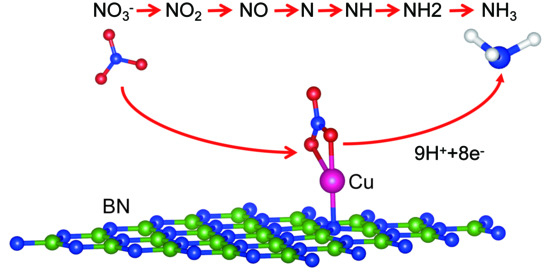
Graphical Abstract

1. Introduction

Due to the disruption of the natural nitrogen cycle by humans, as the most stable form of nitrogen-containing compound in an oxygen-rich environment, nitrate (NO3) is widely present in groundwater, rivers, lakes, and coastal water [1,2,3]. Excessive NO3 can lead to water eutrophication, seriously damaging the water ecosystem and further causing air pollution [4,5]. For human health, NO3 in drinking water can increase the risk of people falling ill [6,7]. To address this issue, the reduction of NO3 (NO3RR) to NH3 offers a very promising solution. This method not only removes harmful NO3, but also can synthesize NH3, a prominent chemical that is commonly used as a raw material in industry [8,9].
The reduction reaction of the NO3 ion (NO3RR) converted to NH3 by catalysis involves nitrogen-contained species with different valence states from +5 to −3 and is a complicated eight-electron process [10]. The reaction is given by the following equation:
NO 3 + 9 H + + 8 e NH 3 + 3 H 2 O
It can be seen from the above equation that the NO3RR is a complex process involving multi-electron coupled proton transfer, and it faces many challenges, which limits its practical application. Firstly, the reaction needs to overcome multiple kinetic energy barriers, resulting in an excessively high overpotential and sluggish rates [11]. Secondly, the presence of the competing hydrogen evolution reaction (HER) leads to a decrease in reaction efficiency [12]. Furthermore, during the reaction process, various intermediate products (NO2, NO, N2O, N2, NH2OH, etc.) will be generated, which reduces the selectivity of NH3 production [13,14]. Therefore, reducing the overpotential, enhancing NH3 selectivity, and inhibiting HER and the formation of intermediates are of great significance for efficiently achieving the conversion from NO3 to NH3.
Single-atom catalysts (SACs) exhibit high potential for efficient NH3 synthesis during the reduction reaction of the NO3 ion (NO3RR) due to the maximized atomic utilization and distinctive electronic structure [15,16,17]. SACs used for NO3RR mainly include the following categories: Cu-SACs, Fe-SCAs, Zn-SACs, Co-SACs, and single-atom alloys [18,19,20,21]. Among them, due to the abundant unpaired d-electrons, Cu-based catalysts have a tunable electronic structure, high abundance, flexible electrochemical activity, and are regarded as one of the optimal candidates for NO3RR [22,23]. For instance, Chunhua Feng et al. [24] have proved single-atom Cu catalysts can enhance the rate of nitrate conversion to ammonia because of the strong binding between Cu and N; Xiaoqin wang et al. [25] have experimentally demonstrated boron nitride-supported copper single-atom catalyst exhibits significantly high NH3 productivity in the NO3RR.
As an analog of graphene, hexagonal boron nitride (h-BN) is considered a new promising catalytic material due to its high chemical stability, low cost, and its low environmental impact. At present, h-BN has already been used as a catalyst in reactions such as CO2 reduction [26], N2 fixation [27], and others [28]. However, the wide bandgap energy limits the catalytic applications of h-BN. There have been a series of studies that attempted to enhance the catalytic properties of h-BN by doping metallic or non-metallic atoms [28,29,30].
Thus, in this paper, we attempted to combine the advantages of single-atom Cu and h-BN as catalysts and systematically studied the catalytic mechanism of nitrate to ammonia by single-atom Cu loaded on a monolayer h-BN (SA Cu@h-BN). Firstly, the doping energy was calculated to determine the most stable doping site for a Cu atom on monolayer h-BN, and the band structure and DOS of corresponding structures were analyzed to reveal the influence of single-atom Cu on the reduction ability of monolayer h-BN from the electronic level. Then, the adsorption energies of the NO3 ion on monolayer and SA Cu@h-BN were calculated to obtain the most stable adsorption site. Finally, the free energy diagrams for NO3 reduction to NH3 were obtained to further confirm the rate-determining steps and the corresponding energy barriers. It is expected to provide theoretical guidance for the development of single-atom Cu loaded on h-BN for catalytic reduction of the nitrate to ammonia.

2. Results and Discussion

2.1. h-BN-Supported Singe-Atom Cu

To study the doping site of singe-atom (SA) Cu on monolayer h-BN, we firstly constructed the (4 × 4) supercell structure of h-BN as shown in Figure 1a. The doping energy was calculated according to the following equation [31]:
Δ E = E f i n + E t [ B   o r   N 2 ] E i n i E t [ C u ]
where Efin and Eini represent the total energies of h-BN after and before Cu doping, respectively; Et is the total energy of B or Cu elemental substance or isolated N2 gas molecule. The calculated results are shown in Figure 1b.
There are two doping methods of SA Cu on monolayer h-BN: substitution and interstitial. Therefore, there exist a total of 6 dopant sites, which are Cu replacing B and N, and Cu inserting at B top, N top, B-N bridge, and hollow sites, respectively. The results in Figure 1b indicate the following: (1) The doping energy at any site is positive, indicating that the doping of SA Cu on monolayer h-BN is an endothermic reaction. Therefore, the lower the doping energy, the easier the doping process is. (2) The doping energy of the interstitial method is significantly lower than that of substitution doping. (3) The doping energy inserted at the hollow, N top, and bridge sites is almost the same (3.77 eV), and it is lower than that at the B top site (3.85 eV). From the optimized coordinates, it can be found that the Cu atom initially located at a hollow or bridge site will move to the N top site after the structural relaxation. This indicates that the N top and B top sites are the stale doping sites, and the N top site is the most optimal doping site, which is because N (3.04) has a stronger Pauling electronegativity than B (2.04), leading to a stronger attraction for the Cu atom.
Furthermore, to study the influence of SA Cu doping on the charge distribution of the monolayer h-BN, the charge difference was calculated and shown in Figure 1c. From Figure 1c, it can be observed that there exists a clear electron exchange between the SA Cu and the monolayer h-BN. The Bader charge calculations indicate that the number of electrons transferred from monolayer h-BN to SA Cu is 0.003 e.
To sum up, due to the stronger electronegativity of the N atom, the Cu atom is preferentially doped at the N top site, resulting in a significant electron rearrangement.

2.2. Band Structure and DOS

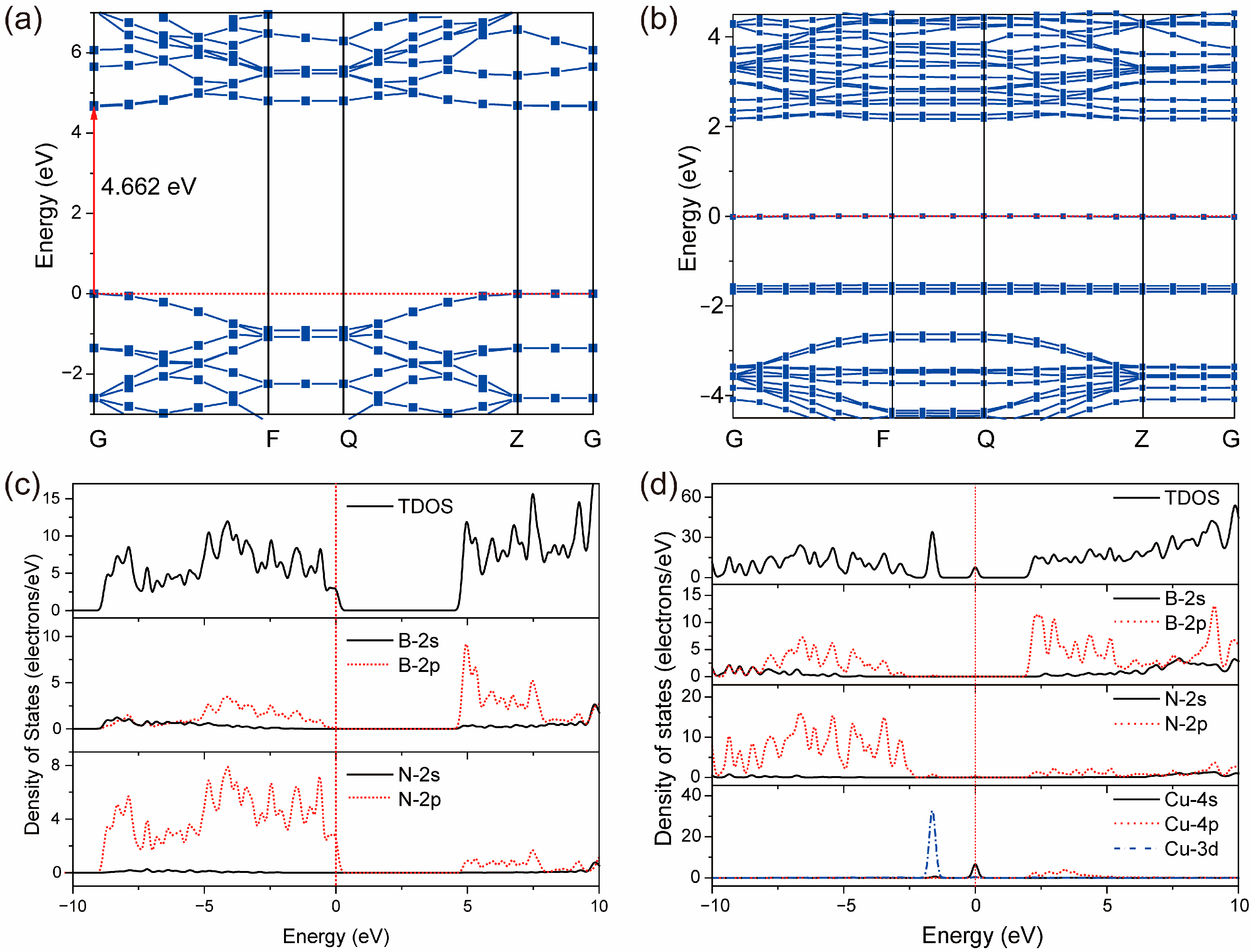
The calculated band structures of monolayer h-BN before and after SA Cu doped at the N top site shown in Figure 2a,b can demonstrate the following results: (1) after Cu doping, an energy band emerges at the Fermi level, leading to the enhancement of the conductivity of monolayer h-BN and the narrowing of the bandgap; (2) the conduction band minimum (CBM) moves toward the Fermi level, thereby improving the reduction capacity of monolayer h-BN. These results are further proved by the density of states (DOS) in Figure 2c,d. In addition, the calculated DOS also shows that (1) the obvious overlap between the 2p orbitals of B and N atoms in the valence band results in the strong covalent interaction between B and N of monolayer h-BN; (2) the new emerging energy bands near the Fermi level and about −1.8 eV originate from the 3d-orbital electrons of the doped Cu atom.
Therefore, the doped Cu atom at the N top site for monolayer h-BN can provide extra 3d-orbital electrons at the Fermi level, which can significantly enhance the conductivity, reduce the bandgap width, and increase the reducibility. This is beneficial for the reduction of NO3 to NH3.

2.3. NO3 Adsorption

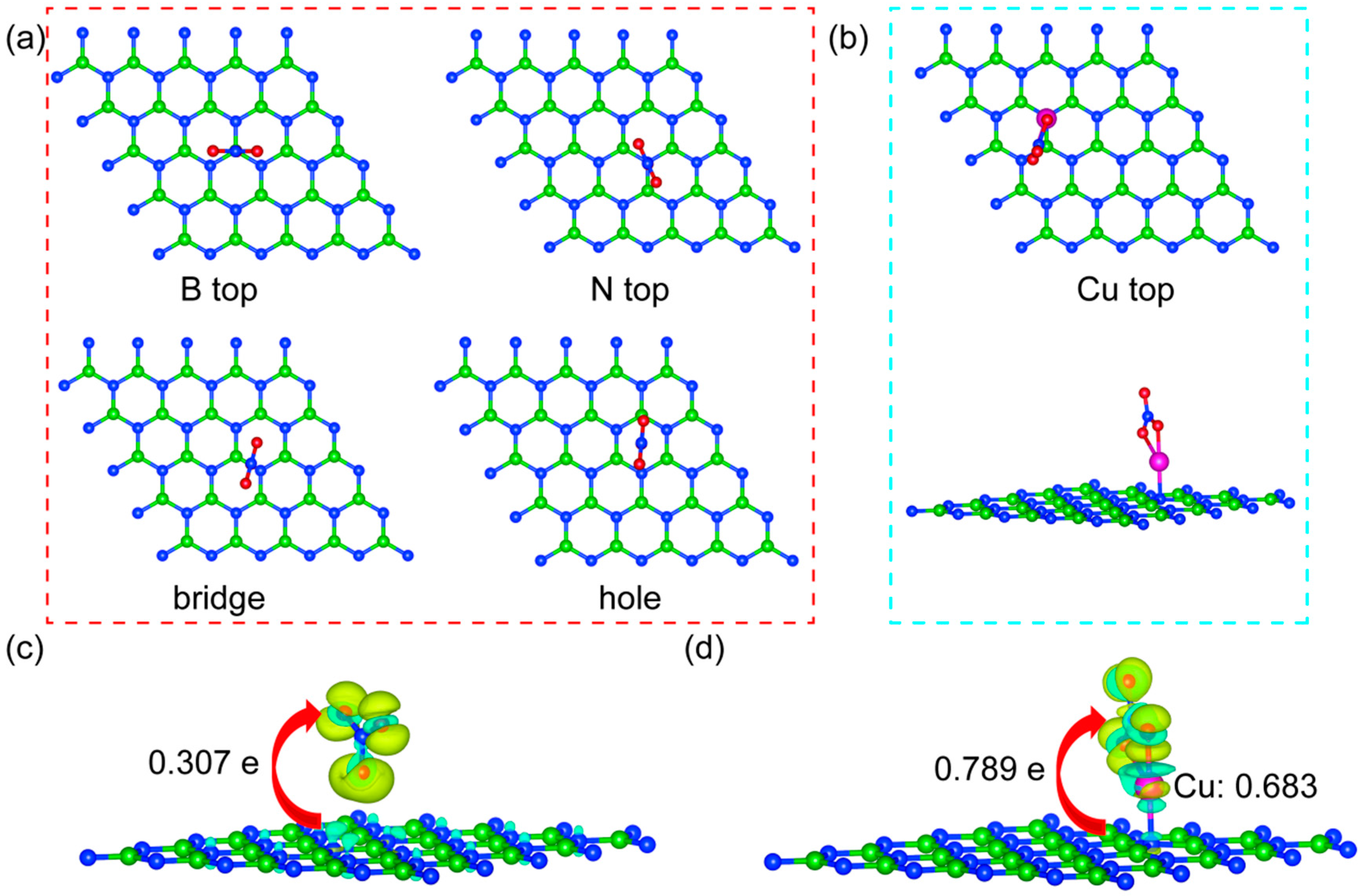
The adsorption of the NO3 ion on the surface is the key step in the reduction to form NH3. Figure 3a shows four possible adsorption sites of NO3 on monolayer h-BN, including the B top site, the N top site, the bridge site between B and N atoms, and the hollow site located at the center of the hexatomic ring. After SA Cu doped h-BN, we only consider Cu top site. The adsorption energy was calculated by using the following equation [32]:
E a d s = E N O 3 a d s E s u r f a c e E N O 3
where, E N O 3 a d s and E s u r f a c e represent the total energies of surface after and before NO3 adsorption. E N O 3 is the total energy of an isolated NO3 ion. The calculated adsorption energy Eads, the initial adsorption site, and the final adsorption site after structural optimization of the NO3 ion on monolayer h-BN and SA Cu@h-BN are listed in Table 1.
The calculated results in Table 1 demonstrate that (1) on monolayer h-BN, the optimal site of NO3 adsorption on monolayer h-BN is the hollow site (−1.715 eV), the next is the B top site (−1.712 eV), and the worst adsorption site is the N top site (−1.701 eV). The NO3 ion adsorption on the bridge site shifts to the B top site after structural relaxation. (2) The adsorption energies of NO3 at four sites of monolayer h-BN (about −1.71 eV) are not significantly different, but noticeably weaker than that at the Cu top site of SA Cu@h-BN (−5.554 eV).
To deeply reveal the mechanism of NO3 adsorption on monolayer h-BN and SA Cu@h-BN, the charge differences were calculated and shown in Figure 3c,d. Firstly, it can be observed that the NO3 ion is adsorbed on the surfaces in a vertical manner, and there is a significant electron rearrangement between the NO3 and surfaces. On monolayer h-BN, the NO3 ion interacts with the π bond at the center of the h-BN ring through the O atom at the bottom of NO3. On SA Cu@h-BN, the two downward-pointing O atoms of NO3 form a stronger interaction with the Cu atom. Secondly, the Bader charge calculations indicate that the number of electrons transferred from the surface to the NO3 ion increases from 0.307 e to 0.789 e after Cu doping. This is because on SA Cu@h-BN, the Cu atom, as the transition metal, possesses abundant d-orbital electrons, which can be supplied to the NO3 ion, thereby generating a stronger interaction.
In summary, on monolayer h-BN, the NO3 ion preferentially adsorbs at the hollow site. However, on SA Cu@h-BN, the NO3 ion is adsorbed more strongly at the Cu top site due to the abundant d-electron supply from the Cu atom, which is beneficial for the subsequent hydrogen reduction of the NO3 ion to NH3.

2.4. NO3 Reduction to NH3

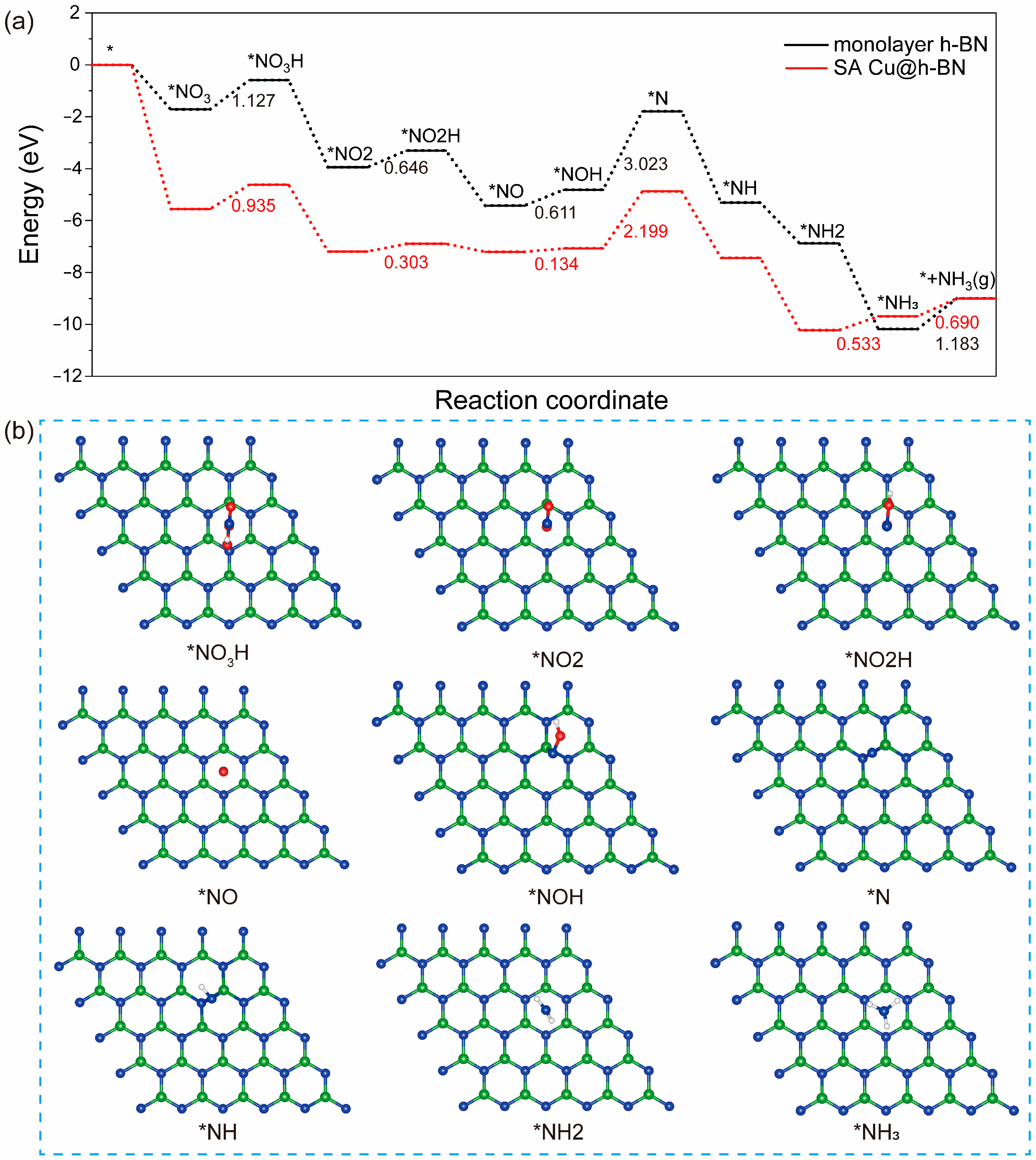
As shown in Figure 4a, the reduction reaction of the NO3 ion (NO3RR) converted to NH3 tends to proceed along the lines of * → *NO3 → *NO3H → *NO2 → *NO2H → *NO → *NOH → *N → *NH → *NH2 → *NH3 → NH3. The most stable adsorption structure of *NO3H, *NO2, *NO2H, *NO, *NOH, *NH, *NH2, *NH3 intermediates on the monolayer h-BN surface are shown in Figure 4b. The relative energies of the optimized intermediate adsorption configurations are listed in Table 2. As shown in Figure 4a, the entire reaction process can be divided into two parts: the reduction of the NO3 ion to an N atom, and the hydrogenation of the N atom to form NH3.
During the first part of the reduction reaction process, all O atoms in the NO3 ion are converted to H2O molecules through two steps of hydrogenation reactions in which the bonds between O and N atoms are broken. Among them, the first step of the hydrogenation reactions is an uphill reaction, while for the second step of the hydrogenation reactions, except for the conversion of *NOH to *N which is an uphill reaction, the others can occur spontaneously. On monolayer h-BN, the hydrogenation processes of *NO3 → *NO3H, *NO2 → *NO2H, *NO → *NOH and *NOH → *N need to overcome the energy barriers of 1.127 eV, 0.646 eV, 0.611 eV, and 3.023 eV, respectively. After single-atom Cu doping, all the corresponding energy barriers are reduced to 0.935 eV, 0.303 eV, 0.134 eV, and 2.199 eV, respectively. Obviously, the hydrogenation reaction from *NOH to *N is the rate-determining step (RDS). The energy barrier of RDS is decreased significantly by the Cu atom supported on monolayer h-BN, which is mainly due to the unique reducing ability of the d orbitals of the Cu atom.
Upon further analyzing the second part of NO3RR, it can be observed that three steps of hydrogenation reactions from *N to *NH3 on monolayer h-BN are all spontaneous, while the reaction of *NH2 to *NH3 on SA Cu@h-BN needs to overcome an energy barrier of 0.533 eV. The final dissociation reaction of NH3 is endothermic, requiring 1.183 eV and 0.690 eV of energy on monolayer h-BN and SA Cu@h-BN, respectively. Overall, on the SA Cu@h-BN surface, a total energy barrier of 1.223 eV is required to complete the reaction from *N to NH3 gas, which is higher than the 1.183 eV on monolayer h-BN. This is because of the stronger adsorption ability of the Cu atom supported on h-BN.
In summary, the reduction reaction of the NO3 ion (NO3RR) to NH3 can be divided into two parts: the reduction of *NO3 to *N and the hydrogenation of *N to NH3. The rate-determining steps are the reduction step of *NOH to *N and the dissociation step of NH3, respectively. Due to the strong reducing capacity of the d-orbital electrons of the Cu atom, the energy barrier of the RDS can be significantly decreased after the Cu doping of h-BN. However, the dissociation of NH3 becomes slightly more difficult. The loading single-atom Cu can improve the catalytic performance of monolayer h-BN, which is consistent with previous experimental results [25].

3. Computational Details

In this paper, all first-principles calculations were performed using Density Functional Theory (DFT) [33,34] by utilizing the program package DS-PAW (2023B) of Device Studio (2024A) software [35]. We employed the projector augmented wave (PAW) method [36] and the Perdew–Burke–Ernzerhof (PBE) form of the generalized-gradient approximation (GGA) exchange-correlation energy functional. The structure optimizations were carried out by allowing all atomic positions to vary and relaxing lattice parameters. To accurately calculate the van der Waals force, the DFT-D2 dispersion correction was considered using the Grimme method [37,38]. The calculations would stop once the total energies converged to 10−6 eV/atom and the forces on each unconstrained atom were smaller than 0.03 eV/Å. The plane-wave cutoff, Ecut, was chosen to be 400 eV. The k-point mesh of the Brillouin zone automatically was set to 4 × 4 × 1 by using the Gamma Center method.

4. Conclusions

In this paper, we have performed a series of first-principles calculations to investigate the catalytic mechanisms of NO3 reduction to NH3 on monolayer h-BN and SA Cu@h-BN. The following conclusions can be drawn:
1.
The Cu atom is preferentially loaded at the N top site of monolayer h-BN, which is because of the stronger electronegativity of the N atom than that of the B atom.
2.
The Cu atom supported on monolayer h-BN can enhance electroconductibility, reduce the bandgap width, and increase the reducibility due to its abundant 3d-orbital electrons
3.
On monolayer h-BN, the NO3 ion preferentially adsorbs at the hollow site, while on SA Cu@h-BN, the NO3 ion is adsorbed more strongly at the Cu top site.
4.
The rate-determining steps during the reduction of *NO3 to *N and the hydrogenation of *N to NH3 are the reduction step of *NOH to *N and the dissociation step of NH3, respectively. Due to the strong reducing capacity of the d-orbital electrons of the Cu atom, the energy barrier of the RDS can be significantly decreased. Consequently, SA Cu@h-BN exhibits excellent catalytic performance of NO3RR.
5.
The theoretical calculations in this paper can provide theoretical guidance for the development of h-BN-supported single-atom metal catalysts.

Author Contributions

Conceptualization, G.L.; Methodology, G.L.; Formal analysis, C.H.; Investigation, G.L. and C.H.; Resources, G.L.; Data curation, G.L. and C.H.; Writing—original draft, G.L.; Writing—review & editing, G.L. and C.H.; Visualization, C.H. All authors have read and agreed to the published version of the manuscript.

Funding

National Natural Science Foundation of China: 22005139.

Institutional Review Board Statement

Not applicable.

Informed Consent Statement

Not applicable.

Data Availability Statement

Research data will be made available on request.

Acknowledgments

We gratefully acknowledge HZWTECH for providing computation facilities. This research was supported by the 2024 Outstanding Young Backbone teachers project of Jiangsu Provincial “Qinglan Project”.

Conflicts of Interest

The authors declare no conflict of interest.

References

  1. Xu, H.; Ma, Y.; Chen, J.; Zhang, W.-X.; Yang, J. Electrocatalytic reduction of nitrate—A step towards a sustainable nitrogen cycle. Chem. Soc. Rev. 2022, 51, 2710–2758. [Google Scholar] [CrossRef]
  2. Liu, D.; Qiao, L.; Peng, S.; Bai, H.; Liu, C.; Ip, W.F.; Lo, K.H.; Liu, H.; Ng, K.W.; Wang, S.; et al. Recent Advances in Electrocatalysts for Efficient Nitrate Reduction to Ammonia. Adv. Funct. Mater. 2023, 33, 2303480. [Google Scholar] [CrossRef]
  3. Niu, Z.; Wang, G. Rational electrocatalyst design for selective nitrate reduction to ammonia. Chem. Phys. Rev. 2025, 6, 011307. [Google Scholar] [CrossRef]
  4. Zhang, W.; Wang, W.; Xu, S.; Sun, Q.; Shi, W.; Man, J.; Yu, S.; Yang, Y.; Wu, W.; Hu, X.; et al. Effectively mitigated eutrophication risk by strong biological carbon pump (BCP) effect in karst reservoirs. Water Res. 2025, 278, 123395. [Google Scholar] [CrossRef] [PubMed]
  5. Sun, C.; Wang, S.; Wang, H.; Hu, X.; Yang, F.; Tang, M.; Zhang, M.; Zhong, J. Internal nitrogen and phosphorus loading in a seasonally stratified reservoir: Implications for eutrophication management of deep-water ecosystems. J. Environ. Manag. 2022, 319, 115681. [Google Scholar] [CrossRef]
  6. Noori, R.; Farahani, F.; Jun, C.; Aradpour, S.; Bateni, S.M.; Ghazban, F.; Hosseinzadeh, M.; Maghrebi, M.; Vesali Naseh, M.R.; Abolfathi, S. A non-threshold model to estimate carcinogenic risk of nitrate-nitrite in drinking water. J. Clean. Prod. 2022, 363, 132432. [Google Scholar] [CrossRef]
  7. Hamlin, Q.F.; Martin, S.L.; Kendall, A.D.; Hyndman, D.W. Examining Relationships Between Groundwater Nitrate Concentrations in Drinking Water and Landscape Characteristics to Understand Health Risks. GeoHealth 2022, 6, e2021GH000524. [Google Scholar] [CrossRef]
  8. Pan, Y.; Xu, H.-M.; Zhu, H.-R.; Huang, C.-J.; Zhang, Z.-J.; Li, G.-R. Recent advances in electrocatalytic reduction of nitrate to ammonia: Current challenges, resolving strategies, and future perspectives. J. Mater. Chem. A 2025, 13, 21181–21232. [Google Scholar] [CrossRef]
  9. Xiong, Y.; Wang, Y.; Zhou, J.; Liu, F.; Hao, F.; Fan, Z. Electrochemical Nitrate Reduction: Ammonia Synthesis and the Beyond. Adv. Mater. 2024, 36, 2304021. [Google Scholar] [CrossRef]
  10. Chen, W.; Xu, Y.; Liu, J.; Cao, H.; Li, Y.; Ren, X.; Ye, S.; Liu, J.; Zhang, Q. Recent developments in Ti-based nanocatalysts for electrochemical nitrate-to-ammonia conversion. Inorg. Chem. Front. 2023, 10, 4901–4917. [Google Scholar] [CrossRef]
  11. Han, S.; Li, H.; Li, T.; Chen, F.; Yang, R.; Yu, Y.; Zhang, B. Ultralow overpotential nitrate reduction to ammonia via a three-step relay mechanism. Nat. Catal. 2023, 6, 402–414. [Google Scholar] [CrossRef]
  12. Cui, Y.; Sun, C.; Ding, G.; Zhao, M.; Ge, X.; Zhang, W.; Zhu, Y.; Wang, Z.; Jiang, Q. Synergistically tuning intermediate adsorption and promoting water dissociation to facilitate electrocatalytic nitrate reduction to ammonia over nanoporous Ru-doped Cu catalyst. Sci. China Mater. 2023, 66, 4387–4395. [Google Scholar] [CrossRef]
  13. An, L.; Narouz, M.R.; Smith, P.T.; De La Torre, P.; Chang, C.J. Supramolecular enhancement of electrochemical nitrate reduction catalyzed by cobalt porphyrin organic cages for ammonia electrosynthesis in water. Angew. Chem. 2023, 135, e202305719. [Google Scholar] [CrossRef]
  14. Rosca, V.; Duca, M.; de Groot, M.T.; Koper, M.T.M. Nitrogen Cycle Electrocatalysis. Chem. Rev. 2009, 109, 2209–2244. [Google Scholar] [CrossRef] [PubMed]
  15. Liu, L.; Yung, K.-F.; Yang, H.; Liu, B. Emerging single-atom catalysts in the detection and purification of contaminated gases. Chem. Sci. 2024, 15, 6285–6313. [Google Scholar] [CrossRef] [PubMed]
  16. Li, Z.; Hong, R.; Zhang, Z.; Wang, H.; Wu, X.; Wu, Z. Single-Atom Catalysts in Environmental Engineering: Progress, Outlook and Challenges. Molecules 2023, 28, 3865. [Google Scholar] [CrossRef]
  17. Xiang, T.; Liang, Y.; Zeng, Y.; Deng, J.; Yuan, J.; Xiong, W.; Song, B.; Zhou, C.; Yang, Y. Transition Metal Single-Atom Catalysts for the Electrocatalytic Nitrate Reduction: Mechanism, Synthesis, Characterization, Application, and Prospects. Small 2023, 19, 2303732. [Google Scholar] [CrossRef]
  18. Zhe, L.; Chuanju, Y.; Bin, X.; Li, Y.; Wenlei, Z.; Yibin, C. Electrochemically nitrate remediation by single-atom catalysts: Advances, mechanisms, and prospects. Energy Mater. 2024, 4, 400046. [Google Scholar] [CrossRef]
  19. Wu, Z.-Y.; Karamad, M.; Yong, X.; Huang, Q.; Cullen, D.A.; Zhu, P.; Xia, C.; Xiao, Q.; Shakouri, M.; Chen, F.-Y.; et al. Electrochemical ammonia synthesis via nitrate reduction on Fe single atom catalyst. Nat. Commun. 2021, 12, 2870. [Google Scholar] [CrossRef] [PubMed]
  20. Zhao, J.; Ren, X.; Liu, X.; Kuang, X.; Wang, H.; Zhang, C.; Wei, Q.; Wu, D. Zn single atom on N-doped carbon: Highly active and selective catalyst for electrochemical reduction of nitrate to ammonia. Chem. Eng. J. 2023, 452, 139533. [Google Scholar] [CrossRef]
  21. Huang, Y.; Tang, C.; Gong, J. Theoretically identifying the electrocatalytic activity and mechanism of Zn doped 2D h-BN for nitrate reduction to NH3. Chem. Commun. 2022, 58, 7156–7159. [Google Scholar] [CrossRef]
  22. Hu, T.; Wang, C.; Wang, M.; Li, C.M.; Guo, C. Theoretical Insights into Superior Nitrate Reduction to Ammonia Performance of Copper Catalysts. ACS Catal. 2021, 11, 14417–14427. [Google Scholar] [CrossRef]
  23. Hoekx, S.; Daems, N.; Arenas Esteban, D.; Bals, S.; Breugelmans, T. Toward the Rational Design of Cu Electrocatalysts for Improved Performance of the NO3RR. ACS Appl. Energy Mater. 2024, 7, 3761–3775. [Google Scholar] [CrossRef]
  24. Zhu, T.; Chen, Q.; Liao, P.; Duan, W.; Liang, S.; Yan, Z.; Feng, C. Single-Atom Cu Catalysts for Enhanced Electrocatalytic Nitrate Reduction with Significant Alleviation of Nitrite Production. Small 2020, 16, 2004526. [Google Scholar] [CrossRef]
  25. Huo, X.S.; Jeon, K.-W.; Fang, L.; de Graaf, K.; Espinosa, B.I.; Parker, S.D.T.; Piao, H.; Li, T.; Wang, X. Boron Nitride Supported Copper Single Atom Catalyst for Nitrate Reduction Reaction. Catal. Today 2025, 459, 115381. [Google Scholar] [CrossRef]
  26. Kan, A.; Duan, Y.; Guo, J.; Wu, T.; Wang, L.; Zhang, Y.; Luo, Q.; Lu, Q.; Zhang, Y.; Liang, Y.; et al. Cobalt single atom induced catalytic active site shift in carbon-doped BN for efficient photodriven CO2 reduction. Appl. Surf. Sci. 2023, 616, 156451. [Google Scholar] [CrossRef]
  27. Zhao, J.; Chen, Z. Single Mo Atom Supported on Defective Boron Nitride Monolayer as an Efficient Electrocatalyst for Nitrogen Fixation: A Computational Study. J. Am. Chem. Soc. 2017, 139, 12480–12487. [Google Scholar] [CrossRef]
  28. Lin, S.; Ye, X.; Johnson, R.S.; Guo, H. First-Principles Investigations of Metal (Cu, Ag, Au, Pt, Rh, Pd, Fe, Co, and Ir) Doped Hexagonal Boron Nitride Nanosheets: Stability and Catalysis of CO Oxidation. J. Phys. Chem. C 2013, 117, 17319–17326. [Google Scholar] [CrossRef]
  29. Liang, J.; Zhang, H.; Song, Q.; Liu, Z.; Xia, J.; Yan, B.; Meng, X.; Jiang, Z.; Wen Lou, X.; Lee, C.-S. Modulating Charge Separation of Oxygen-doped Boron Nitride with Isolated Co Atoms for Enhancing CO2-To-CO Photoreduction. Adv. Mater. 2023, 36, 2303287. [Google Scholar] [CrossRef]
  30. Asif, Q.u.A.; Hussain, A.; Nabi, A.; Tayyab, M.; Rafique, H.M. Computational study of X-doped hexagonal boron nitride (h-BN): Structural and electronic properties (X = P, S, O, F, Cl). J. Mol. Model. 2021, 27, 31. [Google Scholar] [CrossRef]
  31. Bhat, B.D. Tuning the magnetic and electronic properties of monolayer SnS2 by 3d transition metal doping: A DFT study. Mater. Today Commun. 2022, 33, 104626. [Google Scholar] [CrossRef]
  32. Wang, Y.; Tang, C.; Li, Q.; Xiao, T.; Xiong, F. Theoretical prediction of efficient Cu-based dual-atom alloy catalysts for electrocatalytic nitrate reduction to ammonia via high-throughput first-principles calculations. J. Mater. Chem. A 2025, 13, 3765–3776. [Google Scholar] [CrossRef]
  33. Hohenberg, P.; Kohn, W. Inhomogeneous Electron Gas. Phys. Rev. 1964, 136, B864–B871. [Google Scholar] [CrossRef]
  34. Kohn, W.; Sham, L.J. Self-Consistent Equations Including Exchange and Correlation Effects. Phys. Rev. 1965, 140, A1133–A1138. [Google Scholar] [CrossRef]
  35. Hongzhiwei Technology. Device Studio; Version 2023B; Hongzhiwei Technology: Shanghai, China, 2023; Available online: https://cloud.hzwtech.com/web/home (accessed on 1 September 2024).
  36. Blöchl, P.E. Projector augmented-wave method. Phys. Rev. B 1994, 50, 17953–17979. [Google Scholar] [CrossRef]
  37. Grimme, S.; Antony, J.; Ehrlich, S.; Krieg, H. A consistent and accurate ab initio parametrization of density functional dispersion correction (DFT-D) for the 94 elements H-Pu. J. Chem. Phys. 2010, 132, 154104. [Google Scholar] [CrossRef]
  38. Tkatchenko, A.; Scheffler, M. Accurate Molecular Van Der Waals Interactions from Ground-State Electron Density and Free-Atom Reference Data. Phys. Rev. Lett. 2009, 102, 073005. [Google Scholar] [CrossRef]
Figure 1. The 4 × 4 supercell of monolayer h-BN, in which the green and blue balls represent B and N atoms, respectively (a); the doping energy of Cu in h-BN (b); the top view and side view (c) of 3D charge difference of singe-atom (SA) Cu-doped h-BN at the N top site (iso-surface value 0.0075 eV/Bohr3), in which a Cu atom is represented by a red ball, and the yellow and green regions denote charge accumulation and depletion, respectively.
Molecules 30 04700 g001
Figure 2. The band structure and density of states (DOS) of monolayer h-BN (a,c) and SA Cu@h-BN (b,d). The symbols G, F, Q, and Z in (a,b) represent the high symmetry K-points over Brillouin zone and the corresponding fractional coordinates are G: (0, 0, 0), F: (0, 0.5, 0), Q: (0, 0.5, 0.5), and Z: (0, 0, 0.5), respectively.
Molecules 30 04700 g002
Figure 3. The adsorption site of NO3 on monolayer h-BN (a) and SA Cu@h-BN (b). The 3D charge difference of NO3 adsorption on the hollow site of monolayer h-BN (c) and Cu top of SA Cu@h-BN (d) (iso-surface value 0.0075 eV/Bohr3), where the yellow and green regions denote charge accumulation and depletion, respectively. The arrows in (c,d) indicate the direction of electron transfer.
Molecules 30 04700 g003
Figure 4. Free energy diagrams for NO3 reduction to NH3 on monolayer h-BN and SA Cu@h-BN (a) and the optimized intermediate adsorption configurations on monolayer h-BN (b). All “*” symbols indicate the surface adsorbed structures.
Molecules 30 04700 g004
Table 1. The adsorption energy Eads, the initial adsorption site, and the final adsorption site after structural optimization of the NO3 ion on monolayer h-BN and SA Cu@h-BN. The “/” represents that there is no change in atomic positions after structural optimization.
SystemInitial Adsorption SiteEads (eV)Shifting to
monolayer h-BNB top−1.712/
N top−1.701/
bridge−1.711B top
hollow−1.715/
SA Cu@h-BNCu top−5.554/
Table 2. The relative energies of the optimized intermediate adsorption configurations on monolayer h-BN and SA Cu@h-BN.
Systemh-BNSA Cu@h-BN
*NO3−1.715−5.554
*NO3H−0.589−4.618
*NO2−3.945−7.195
*NO2H−3.299−6.892
*NO−5.425−7.207
*NOH−4.813−7.073
*N−1.791−4.874
*NH−5.308−7.437
*NH2−6.877−10.223
*NH3−10.184−9.691
*+NH3−9.001−9.001
Disclaimer/Publisher’s Note: The statements, opinions and data contained in all publications are solely those of the individual author(s) and contributor(s) and not of MDPI and/or the editor(s). MDPI and/or the editor(s) disclaim responsibility for any injury to people or property resulting from any ideas, methods, instructions or products referred to in the content.