


Chemical Profiling of Latvian Propolis: Regional Variations and Botanical Origins

 , ,
, ,  , , and
Abstract
1. Introduction
2. Results
2.1. Propolis Composition
GC-MS Analysis
2.2. Isolation of Chemical Constituents
3. Discussion
4. Materials and Methods
4.1. Chemicals and Reagents
4.2. Propolis Samples
4.3. Extraction and Sample Preparation
4.4. GC-MS Analysis
4.5. Fractionation and Purification Procedures of Ethanolic Extract
4.6. Nuclear Magnetic Resonance (NMR)
5. Conclusions
Supplementary Materials
Author Contributions
Funding
Data Availability Statement
Acknowledgments
Conflicts of Interest
References
- Huang, S.; Zhang, C.-P.; Wang, K.; Li, G.; Hu, F.-L. Recent Advances in the Chemical Composition of Propolis. Molecules 2014, 19, 19610–19632. [Google Scholar] [CrossRef] [Scilit]
- López, B.G.-C.; Schmidt, E.M.; Eberlin, M.N.; Sawaya, A.C.H.F. Phytochemical Markers of Different Types of Red Propolis. Food Chem. 2014, 146, 174–180. [Google Scholar] [CrossRef] [Scilit]
- Sawaya, A.C.H.F.; Barbosa Da Silva Cunha, I.; Marcucci, M.C. Analytical Methods Applied to Diverse Types of Brazilian Propolis. Chem. Cent. J. 2011, 5, 27. [Google Scholar] [CrossRef] [Scilit] [PubMed]
- Kasote, D.; Bankova, V.; Viljoen, A.M. Propolis: Chemical Diversity and Challenges in Quality Control. Phytochem. Rev. 2022, 21, 1887–1911. [Google Scholar] [CrossRef] [Scilit]
- Sforcin, J.M. Propolis and the Immune System: A Review. J. Ethnopharmacol. 2007, 113, 1–14. [Google Scholar] [CrossRef] [Scilit]
- Bankova, V.; Popova, M.; Bogdanov, S.; Sabatini, A.-G. Chemical Composition of European Propolis: Expected and Unexpected Results. Z. Für Naturforsch. C 2002, 57, 530–533. [Google Scholar] [CrossRef] [Scilit]
- Isidorov, V.A.; Buczek, K.; Zambrowski, G.; Miastkowski, K.; Swiecicka, I. In Vitro Study of the Antimicrobial Activity of European Propolis against Paenibacillus larvae. Apidologie 2017, 48, 411–422. [Google Scholar] [CrossRef] [Scilit]
- Popova, M.; Trusheva, B.; Khismatullin, R.; Gavrilova, N.; Legotkina, G.; Lyapunov, J.; Bankova, V. The Triple Botanical Origin of Russian Propolis from the Perm Region, Its Phenolic Content and Antimicrobial Activity. Nat. Prod. Commun. 2013, 8, 1934578X1300800519. [Google Scholar] [CrossRef] [Scilit]
- Isidorov, V.A.; Szczepaniak, L.; Bakier, S. Rapid GC/MS Determination of Botanical Precursors of Eurasian Propolis. Food Chem. 2014, 142, 101–106. [Google Scholar] [CrossRef] [Scilit] [PubMed]
- Isidorov, V.A.; Bakier, S.; Pirożnikow, E.; Zambrzycka, M.; Swiecicka, I. Selective Behaviour of Honeybees in Acquiring European Propolis Plant Precursors. J. Chem. Ecol. 2016, 42, 475–485. [Google Scholar] [CrossRef] [Scilit]
- Burdock, G.A. Review of the Biological Properties and Toxicity of Bee Propolis (Propolis). Food Chem. Toxicol. 1998, 36, 347–363. [Google Scholar] [CrossRef] [Scilit]
- Jankevica, M. Evaluation of Landscape Ecological Aesthetics of Green Spaces in Latvian Large Cities. Moksl.-Liet. Ateitis 2013, 5, 208–215. [Google Scholar] [CrossRef] [Scilit]
- Pakalne, M.; Kalnina, L. Mire Ecosystems in Latvia. Stapfia 2005, 85, 147–174. [Google Scholar]
- Rūsiņa, S. Semi-Natural Grasslands in Latvia. In Outstanding Semi-Natural Grassland Sites in Latvia: Biodiversity, Management, Restoration; University of Latvia: Riga, Latvia, 2017; pp. 5–19. [Google Scholar]
- Lapina, L. Diversity of Honey in Latvia; University of Latvia: Jelgava, Latvia, 2016; pp. 134–138. [Google Scholar]
- Zacepins, A.; Kviesis, A.; Komasilovs, V.; Brusbardis, V.; Kronbergs, J. Status of the Precision Beekeeping Development in Latvia. Rural Sustain. Res. 2021, 45, 86–92. [Google Scholar] [CrossRef] [Scilit]
- Ramanauskienė, K.; Savickas, A.; Inkėnienė, A.; Vitkevičius, K.; Kasparavičienė, G.; Briedis, V.; Amšiejus, A. Analysis of Content of Phenolic Acids in Lithuanian Propolis Using High-Performance Liquid Chromatography Technique. Medicina 2009, 45, 712. [Google Scholar] [CrossRef] [Scilit]
- Garzon, N.; Luis, E.; Cuca, S.; Juan, C.; Martinez, V.; Yoshida, M.; Gottlieb, O.R. Flavonolignoid from the Fruit of Iryanthera laevis. Phytochemistry 1987, 26, 2835–2837. [Google Scholar] [CrossRef] [Scilit]
- Hermoso, A.; Jiménez, I.A.; Mamani, Z.A.; Bazzocchi, I.L.; Piñero, J.E.; Ravelo, A.G.; Valladares, B. Antileishmanial Activities of Dihydrochalcones from Piper elongatum and Synthetic Related Compounds. Structural Requirements for Activity. Bioorg. Med. Chem. 2003, 11, 3975–3980. [Google Scholar] [CrossRef] [Scilit]
- Lavoie, S.; Legault, J.; Simard, F.; Chiasson, É.; Pichette, A. New Antibacterial Dihydrochalcone Derivatives from Buds of Populus balsamifera. Tetrahedron Lett. 2013, 54, 1631–1633. [Google Scholar] [CrossRef] [Scilit]
- Chitiva-Chitiva, L.C.; Ladino-Vargas, C.; Cuca-Suárez, L.E.; Prieto-Rodríguez, J.A.; Patiño-Ladino, O.J. Antifungal Activity of Chemical Constituents from Piper pesaresanum C. DC. and Derivatives against Phytopathogen Fungi of Cocoa. Molecules 2021, 26, 3256. [Google Scholar] [CrossRef] [Scilit]
- Rapado, L.; Freitas, G.; Polpo, A.; Rojas-Cardozo, M.; Rincón, J.; Scotti, M.; Kato, M.; Nakano, E.; Yamaguchi, L. A Benzoic Acid Derivative and Flavokawains from Piper Species as Schistosomiasis Vector Controls. Molecules 2014, 19, 5205–5218. [Google Scholar] [CrossRef] [Scilit]
- Keat, N.B.; Umar, R.U.; Lajis, N.H.; Chen, T.Y.; Li, T.Y.; Rahmani, M.; Sukari, M.A. Chemical Constituents from Two Weed Species of Spermacoce (Rubiaceae). Malays. J. Anal. Sci. 2010, 14, 6–11. [Google Scholar]
- Tang, S.; Shen, Q.; He, P.; Li, J.; Yang, J.; Si, X.; Xia, J.; Han, Y.; Li, Z.; Liu, C.; et al. Synthesis of Esters from 2-Phenylimidazo [1,2-a] Pyridines Using Visible Light. Tetrahedron 2023, 131, 133140. [Google Scholar] [CrossRef] [Scilit]
- Bertelli, D.; Papotti, G.; Bortolotti, L.; Marcazzan, G.L.; Plessi, M. 1 H-NMR Simultaneous Identification of Health-Relevant Compounds in Propolis Extracts. Phytochem. Anal. 2012, 23, 260–266. [Google Scholar] [CrossRef] [Scilit] [PubMed]
- Vasas, A.; Lajter, I.; Kúsz, N.; Forgó, P.; Jakab, G.; Fazakas, C.; Wilhelm, I.; Krizbai, I.A.; Hohmann, J. Flavonoid, Stilbene and Diarylheptanoid Constituents of Persicaria maculosa Gray and Cytotoxic Activity of the Isolated Compounds. Fitoterapia 2020, 145, 104610. [Google Scholar] [CrossRef] [Scilit]
- Kuroyanagi, M.; Yamamoto, M.; Fukushima, S.; Ueno, A.; Noro, T.; Miyase, T. Chemical Studies on the Constituents of Polygonum Nodosum. Chem. Pharm. Bull. (Tokyo) 1982, 30, 1602–1608. [Google Scholar] [CrossRef] [Scilit]
- Isidorov, V.A.; Vinogorova, V.T. GC-MS Analysis of Compounds Extracted from Buds of Populus balsamifera and Populus nigra. Z. Für Naturforschung C 2003, 58, 355–360. [Google Scholar] [CrossRef] [Scilit]
- Ristivojević, P.; Trifković, J.; Andrić, F.; Milojković-Opsenica, D. Poplar-Type Propolis: Chemical Composition, Botanical Origin and Biological Activity. Nat. Prod. Commun. 2015, 10, 1934578X1501001117. [Google Scholar] [CrossRef] [Scilit]
- Rutkovska, S.; Pučka, I.; Evarts-Bunders, P.; Paidere, J. The Role of Railway Lines in the Distribution of Alien Plant Species in the Territory of Daugavpils City (Latvia); Pp. 212–225. Est. J. Ecol. 2013, 62, 212–225. [Google Scholar] [CrossRef] [Scilit]
- Drescher, N.; Wallace, H.M.; Katouli, M.; Massaro, C.F.; Leonhardt, S.D. Diversity Matters: How Bees Benefit from Different Resin Sources. Oecologia 2014, 176, 943–953. [Google Scholar] [CrossRef] [Scilit]
- Bankova, V.; Galabov, A.S.; Antonova, D.; Vilhelmova, N.; Di Perri, B. Chemical Composition of Propolis Extract ACF® and Activity against Herpes Simplex Virus. Phytomedicine 2014, 21, 1432–1438. [Google Scholar] [CrossRef] [Scilit]
- Aliboni, A. Propolis from Northern California and Oregon: Chemical Composition, Botanical Origin, and Content of Allergens. Z. Für Naturforsch. C 2014, 69, 10–20. [Google Scholar] [CrossRef] [Scilit]
- Greenaway, W.; May, J.; Scaysbrook, T.; Whatley, F.R. Identification by Gas Chromatography-Mass Spectrometry of 150 Compounds in Propolis. Z. Für Naturforsch. C 1991, 46, 111–121. [Google Scholar] [CrossRef] [Scilit]
- Shaheen, S.A.; Zarga, M.H.A.; Nazer, I.K.; Darwish, R.M.; Al-Jaber, H.I. Chemical Constituents of Jordanian Propolis. Nat. Prod. Res. 2011, 25, 1312–1318. [Google Scholar] [CrossRef] [Scilit]
- Lotti, C.; Piccinelli, A.L.; Arevalo, C.; Ruiz, I.; Migliani De Castro, G.M.; Figueira Reis De Sá, L.; Tessis, A.C.; Ferreira-Pereira, A.; Rastrelli, L. Constituents of Hondurian Propolis with Inhibitory Effects on Saccharomyces cerevisiae Multidrug Resistance Protein Pdr5p. J. Agric. Food Chem. 2012, 60, 10540–10545. [Google Scholar] [CrossRef] [Scilit]
- Li, F.; Awale, S.; Tezuka, Y.; Kadota, S. Cytotoxicity of Constituents from Mexican Propolis against a Panel of Six Different Cancer Cell Lines. Nat. Prod. Commun. 2010, 5, 1934578X1000501018. [Google Scholar] [CrossRef] [Scilit]
- Da Silva Mirowski, P.; Da Silva Coutinho De Araújo Bueno, G.; Elsner Rodrigues, V.; Fernandes Barros, T.; Da Costa, A.G.; Yoshida, N.C.; Da Rosa Guterres, Z.; Trentin, D.S.; Rodrigues Garcez, F. Chemical Composition and Evaluation of Antibacterial, Antibiofilm, and Mutagenic Potentials of a Propolis Sample from the Atlantic Forest of Midwest Brazil. Chem. Biodivers. 2023, 20, e202301238. [Google Scholar] [CrossRef] [Scilit] [PubMed]
- Wang, X.; Hu, H.; Luo, Z.; Liu, Y.; Zhang, H. A Plant Origin of Chinese Propolis: Populus canadensis Moench. J. Apic. Res. 2018, 57, 228–245. [Google Scholar] [CrossRef] [Scilit]
- Popova, M.; Giannopoulou, E.; Skalicka-Woźniak, K.; Graikou, K.; Widelski, J.; Bankova, V.; Kalofonos, H.; Sivolapenko, G.; Gaweł-Bęben, K.; Antosiewicz, B.; et al. Characterization and Biological Evaluation of Propolis from Poland. Molecules 2017, 22, 1159. [Google Scholar] [CrossRef] [Scilit] [PubMed]
- Bayram, N.E.; Sorkun, K.; Öz, G.C.; Salih, B.; Topçu, G. Chemical Characterization of 64 Propolis Samples from Hakkari, Turkey. Rec. Nat. Prod. 2018, 12, 569–581. [Google Scholar] [CrossRef] [Scilit]
- TemiZ, A.; Şener, A.; Tüylü, A.Ö.; Sorkun, K.; SaliH, B. Antibacterial Activity of Bee Propolis Samples from Different Geographical Regions of Turkey against Two Foodborne Pathogens, Salmonella enteritidis and Listeria monocytogenes. Turk. J. Biol. 2011, 35, 503–511. [Google Scholar] [CrossRef] [Scilit]
- Naik, R.R.; Shakya, A.K.; Oriquat, G.A.; Katekhaye, S.; Paradkar, A.; Fearnley, H.; Fearnley, J. Fatty Acid Analysis, Chemical Constituents, Biological Activity and Pesticide Residues Screening in Jordanian Propolis. Molecules 2021, 26, 5076. [Google Scholar] [CrossRef] [Scilit]
- Al-Juhaimi, F.Y.; Özcan, M.M.; Mohamed Ahmed, I.A.; Alsawmahia, O.N.; Özcan, M.M.; Ghafoor, K.; Babiker, E.E. Bioactive Compounds, Antioxidant Activity, Fatty Acid Composition, and Antimicrobial Activity of Propolis from Different Locations in Turkey. J. Apic. Res. 2022, 61, 246–254. [Google Scholar] [CrossRef] [Scilit]
- Rebiai, A.; Belfar, M.L.; Mesbahi, M.A.; Nani, S.; Tliba, A.; Amara, D.G. Fatty Acid Composition of Algerian Propolis. J. Fundam. Appl. Sci. 2017, 9, 1656–1671. [Google Scholar]
- Pant, K.; Thakur, M.; Chopra, H.K.; Dar, B.; Nanda, V. Assessment of Fatty Acids, Amino Acids, Minerals, and Thermal Properties of Bee Propolis from Northern India Using a Multivariate Approach. J. Food Compos. Anal. 2022, 111, 104624. [Google Scholar] [CrossRef] [Scilit]
- El-Guendouz, S.; Lyoussi, B.; Miguel, M.G. Insight on Propolis from Mediterranean Countries: Chemical Composition, Biological Activities and Application Fields. Chem. Biodivers. 2019, 16, e1900094. [Google Scholar] [CrossRef] [Scilit]
- Central Intelligence Agency. Latvia Map; Central Intelligence Agency: Washington, DC, USA. Available online: https://www.cia.gov/the-world-factbook/countries/latvia/ (accessed on 3 October 2025).
- Graikou, K.; Popova, M.; Gortzi, O.; Bankova, V.; Chinou, I. Characterization and Biological Evaluation of Selected Mediterranean Propolis Samples. Is It a New Type? LWT 2016, 65, 261–267. [Google Scholar] [CrossRef] [Scilit]
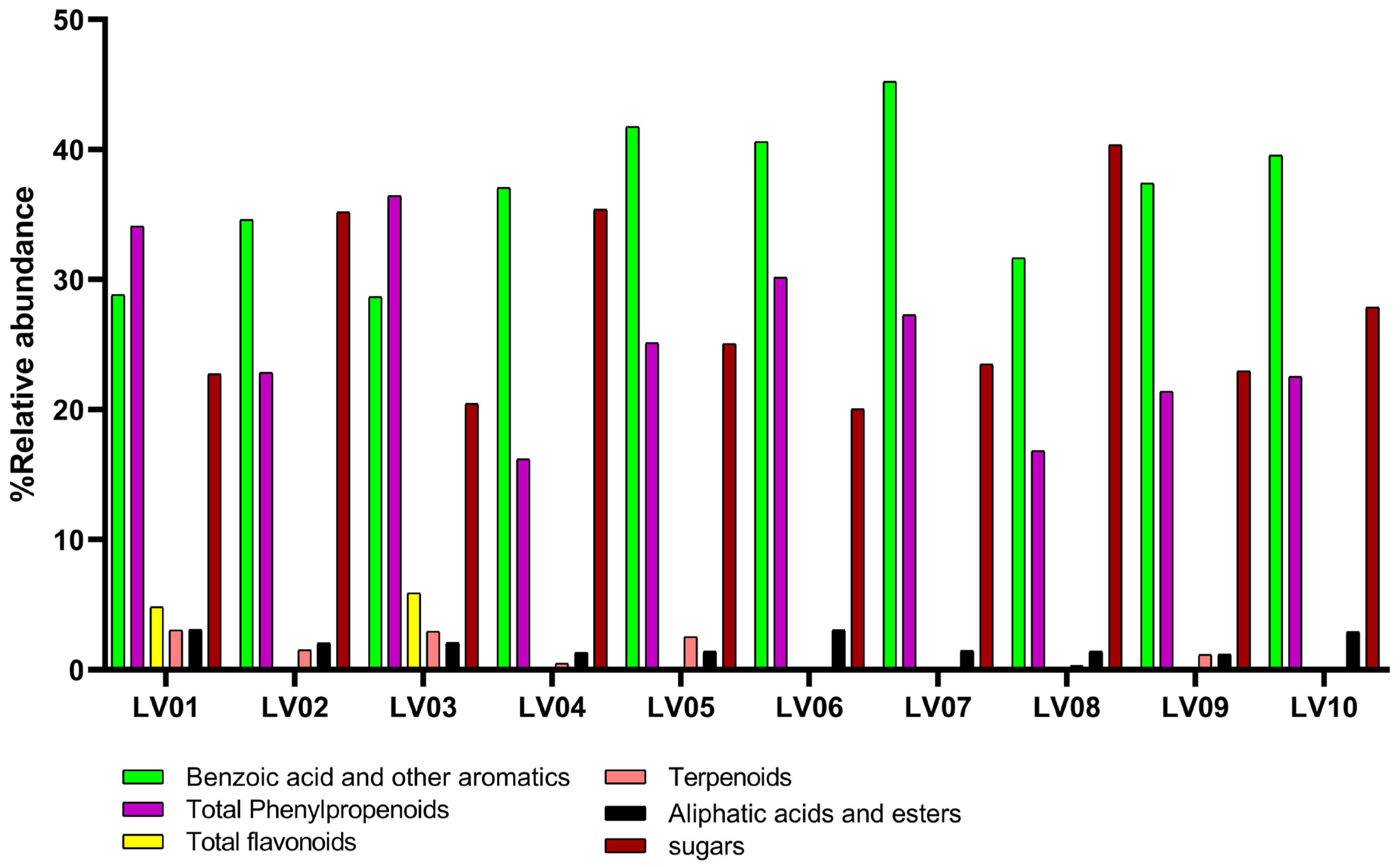

| Chemical Category | LV01 | LV02 | LV03 | LV04 | LV05 | LV06 | LV07 | LV08 | LV09 | LV10 |
|---|---|---|---|---|---|---|---|---|---|---|
| Total phenylpropenoids including | 34.1 | 22.84 | 36.44 | 16.2 | 25.13 | 30.16 | 27.29 | 16.82 | 21.38 | 22.53 |
| Cinnamic acids | 28.25 | 20.52 | 32.55 | 14.62 | 21.56 | 22.69 | 21.1 | 15.64 | 19.15 | 20.18 |
| Cinnamic acid esters | 5.85 | 2.32 | 3.89 | 1.58 | 3.57 | 7.47 | 6.19 | 1.18 | 2.23 | 2.35 |
| Benzoic acid and other aromatics | 28.84 | 34.59 | 28.65 | 37.07 | 41.76 | 40.59 | 45.23 | 31.66 | 37.4 | 39.56 |
| Total flavonoids including | 4.81 | 0.17 | 5.87 | |||||||
| Chalcones | 1.46 | 3.25 | ||||||||
| Flavanols | 1.5 | 1.07 | ||||||||
| Flavanones | 1.02 | 0.17 | 1.11 | |||||||
| Flavonols | 0.83 | 0.44 | ||||||||
| Terpenoids including | 3.04 | 1.52 | 2.94 | 0.48 | 2.53 | 0.28 | 0.31 | 1.15 | ||
| Sesquiterpenes | 3.04 | 1.52 | 2.94 | 0.48 | 2.53 | 0.31 | 1.15 | |||
| Aliphatic acids and esters including | 3.09 | 2.04 | 2.06 | 1.31 | 1.41 | 3.05 | 1.46 | 1.41 | 1.18 | 2.9 |
| Aliphatic C12-C30 acids | 2.48 | 2.04 | 2.06 | 1.31 | 1.41 | 3.05 | 1.46 | 1.41 | 1.18 | 2.9 |
| 3-Hydroxy C14-C22 acids | 0.61 | |||||||||
| Sugars | 22.73 | 35.18 | 20.45 | 35.4 | 25.06 | 20.04 | 23.48 | 40.35 | 22.97 | 27.86 |
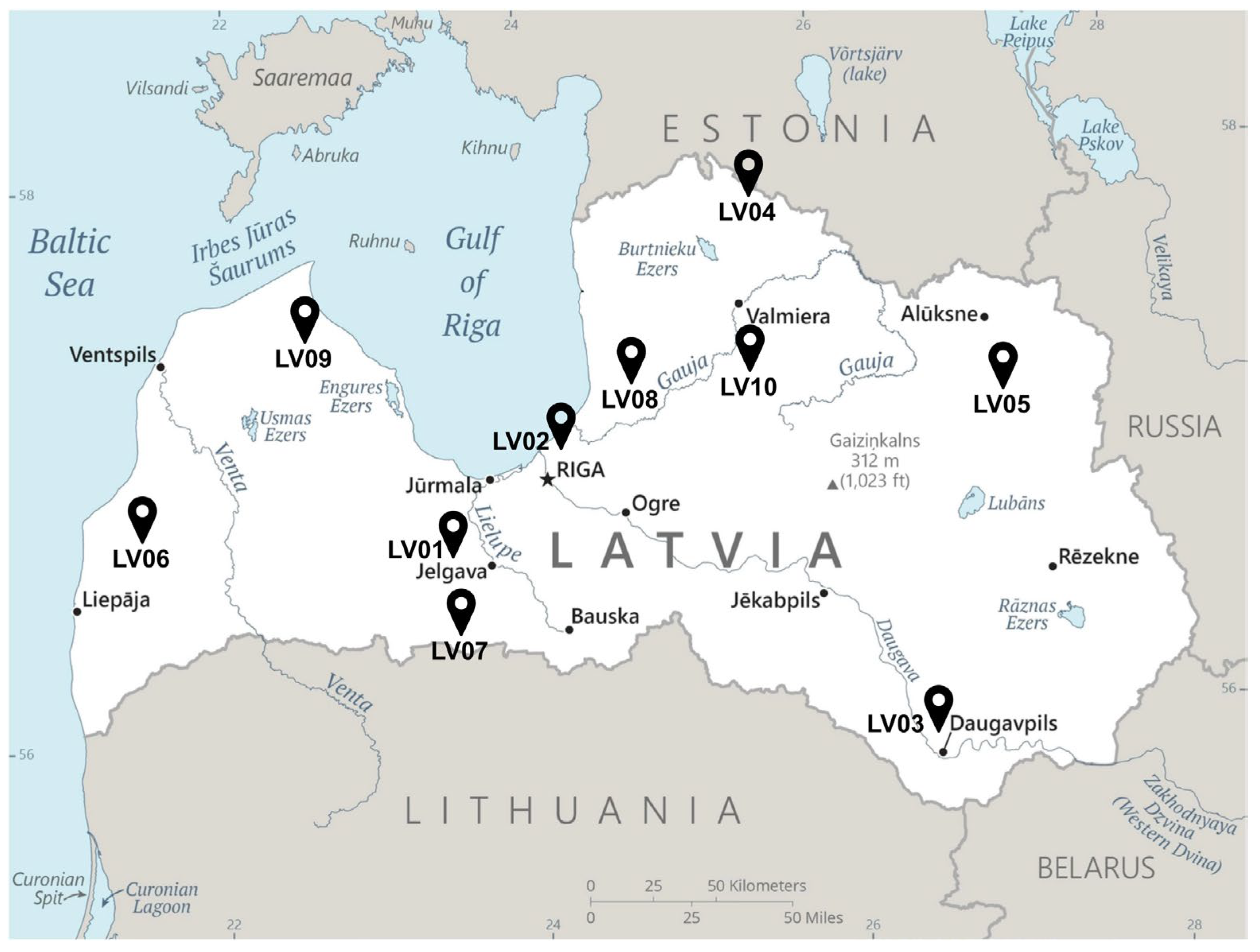
| Sample | Collection Area |
|---|---|
| LV01 | Jelgava, Central Latvia |
| LV02 | Riga, North-Coastal Latvia |
| LV03 | Daugavpils, Southeast Latvia |
| LV04 | Rujiena, Northern Latvia |
| LV05 | Balvi, Eastern Latvia |
| LV06 | Aizpute, Western Latvia |
| LV07 | Svete, Southern Latvia |
| LV08 | Ragana, North-Central Latvia |
| LV09 | Talsi, Northwest Latvia |
| LV10 | Cesis, Northeastern-Central Latvia |
Disclaimer/Publisher’s Note: The statements, opinions and data contained in all publications are solely those of the individual author(s) and contributor(s) and not of MDPI and/or the editor(s). MDPI and/or the editor(s) disclaim responsibility for any injury to people or property resulting from any ideas, methods, instructions or products referred to in the content. |
© 2025 by the authors. Licensee MDPI, Basel, Switzerland. This article is an open access article distributed under the terms and conditions of the Creative Commons Attribution (CC BY) license (https://creativecommons.org/licenses/by/4.0/).
Share and Cite
Papakosta, F.; Graikou, K.; Panou, E.; Hatjina, F.; Charistos, L.; Brusbardis, V.; van der Steen, J.J.M.; Chinou, I. Chemical Profiling of Latvian Propolis: Regional Variations and Botanical Origins. Molecules 2025, 30, 4533. https://doi.org/10.3390/molecules30234533
Papakosta F, Graikou K, Panou E, Hatjina F, Charistos L, Brusbardis V, van der Steen JJM, Chinou I. Chemical Profiling of Latvian Propolis: Regional Variations and Botanical Origins. Molecules. 2025; 30(23):4533. https://doi.org/10.3390/molecules30234533
Chicago/Turabian StylePapakosta, Freideriki, Konstantia Graikou, Evgenia Panou, Fani Hatjina, Leonidas Charistos, Valters Brusbardis, Josef J. M. van der Steen, and Ioanna Chinou. 2025. "Chemical Profiling of Latvian Propolis: Regional Variations and Botanical Origins" Molecules 30, no. 23: 4533. https://doi.org/10.3390/molecules30234533
APA StylePapakosta, F., Graikou, K., Panou, E., Hatjina, F., Charistos, L., Brusbardis, V., van der Steen, J. J. M., & Chinou, I. (2025). Chemical Profiling of Latvian Propolis: Regional Variations and Botanical Origins. Molecules, 30(23), 4533. https://doi.org/10.3390/molecules30234533

