Abstract
Effective degradation of κ-carrageenan by isolated Thalassospira sp. fjfst-332 is reported for the first time in this paper. It was identified by 16S rDNA sequencing and morphological observation using Transmission Electron Microscopy (TEM). Based on a Plackett–Burman design for significant variables, Box–Behnken experimental design and response surface methodology were used to optimize the culture conditions. Through statistical optimization, the optimum medium components were determined as follows: 2.0 g/L κ-carrageenan, 1.0 g/L yeast extract, 1.0 g/L FOS, 20.0 g/L NaCl, 2.0 g/L NaNO3, 0.5 g/L MgSO4·7H2O, 0.1 g/L K2HPO4, and 0.1 g/L CaCl2. The highest activity exhibited by Thalassospira sp. fjfst-332 was 267 U/mL, which makes it the most vigorous wild bacterium for κ-carrageenan production. In order to guide scaled-up production, two empirical models—the logistic equation and Luedeking–Piretequation—were proposed to predict the strain growth and enzyme production, respectively. Furthermore, we report the fermentation kinetics and every empirical equation of the coefficients (α, β, X0, Xm and μm) for the two models, which could be used to design and optimize industrial processes.
1. Introduction
Carrageenan, as a series of hydrophilic sulfated galactan multipolymers, is extracted from the red seaweed (Rhodophyceaea). Carrageenan consists of d-galactose residues linked by alternating linear chains of β-1,3-d-galactose (G) and α-1,4-linked-d-galactose (DA) [1]. Based on the number and position of sulfate ester units (S) and the presence of 3,6-anhydro galactose-bridges, carrageenan can be classified into κ-carrageenan (DA-G4S), ι-carrageenan (DA2S-G4S) and λ-carrageenan (D2S6S-G2S) [2]. κ-Carrageenan is composed of consecutive disaccharide units of β-d-galactose-4-sulfate and 3,6-anhydro-α-d-galactose, and it has been broadly applied in food, medicines, and biomaterials.
Carrageenan oligosaccharides are typically obtained through chemical hydrolysis [3], radiation [4] or carrageenase degradation, and they were reported to show potential bioactivities including anticoagulant, antithrombotic, antitumor and immunoregulation [3]. Chemical hydrolysis is the most common method to prepare carrageenan oligosaccharides. However, the method may cause damage to sulfate ester units and produce many complicated by-products, which limits it to industrial application. The enzymolysis approach has become a hot topic in research due to its high efficiency, specificity, and mild reaction conditions. According to this method, the main hydrophilic products are disaccharide, tetrasccharide, hexose, and octasaccharide [5]. Many carrageenases have been reported to be isolated from marine bacteria such as Alteromonas [6], Cytophaga [7], Vibrio [8], Pseudomonas carrageenanovora [9], and Cellulophaga [10]. However, the low activity and yield, along with the instability of the carrageenases, limit the utilization of this process for fermenting carrageenan oligosaccharides. Therefore, it is imperative to search for a bacterial strain that could produce carrageenase steadily and efficiently.
Recently, physical induction or gene modification has been taken to improve the biological fermentation of carrageenase. Kobayashi cloned a gene from original bacteria Pseudoalteromonas tetraodonis JAM-K142 for an enzyme named as Cgk-K142, but the productivity of Cgk-K142 was rather low and the enzyme was very unstable during purification [11]. Another recombinant bacterium, GgkZ, yielded complex products which were difficult further purify [1]. Another method to enhance the bacterial enzyme yield is by adding an enzymatic inducer, which is also a low-cost and valid approach to improve the microbial fermentation. For example, lactose was found to increase the ability of recombinant bacteria BL21-HTa-cgkZ to degrade κ-carrageenan, with enzyme activity increased up to 10.76 U/mL after the optimization [12]. Agarase could be induced by agarose, neoagarobiose, neoagarotetraose and neoagarohexaose, but was inhibited by d-glucose and d-galactose [13]. Meanwhile, maltose was the most useful inducer for Aspergillus niger to yield glucoamylase [14], so is worthwhile to screen for proper inducers for marine bacteria fermenting carrageenase.
In this study, a novel strain that could effectively hydrolyze κ-carrageenan has been isolated from dry Chondrus crispus for the first time. We attempted to increase the κ-carrageenase activity by statistical optimization and determining the fermentation kinetics model. In addition, two empirical models were proposed for designing and optimizing the industrial process in varied environments, which were simulated under different fermentation conditions.
2. Results and Discussion
2.1. Isolation and Identification of κ-Carrageenase-Producing Bacterium
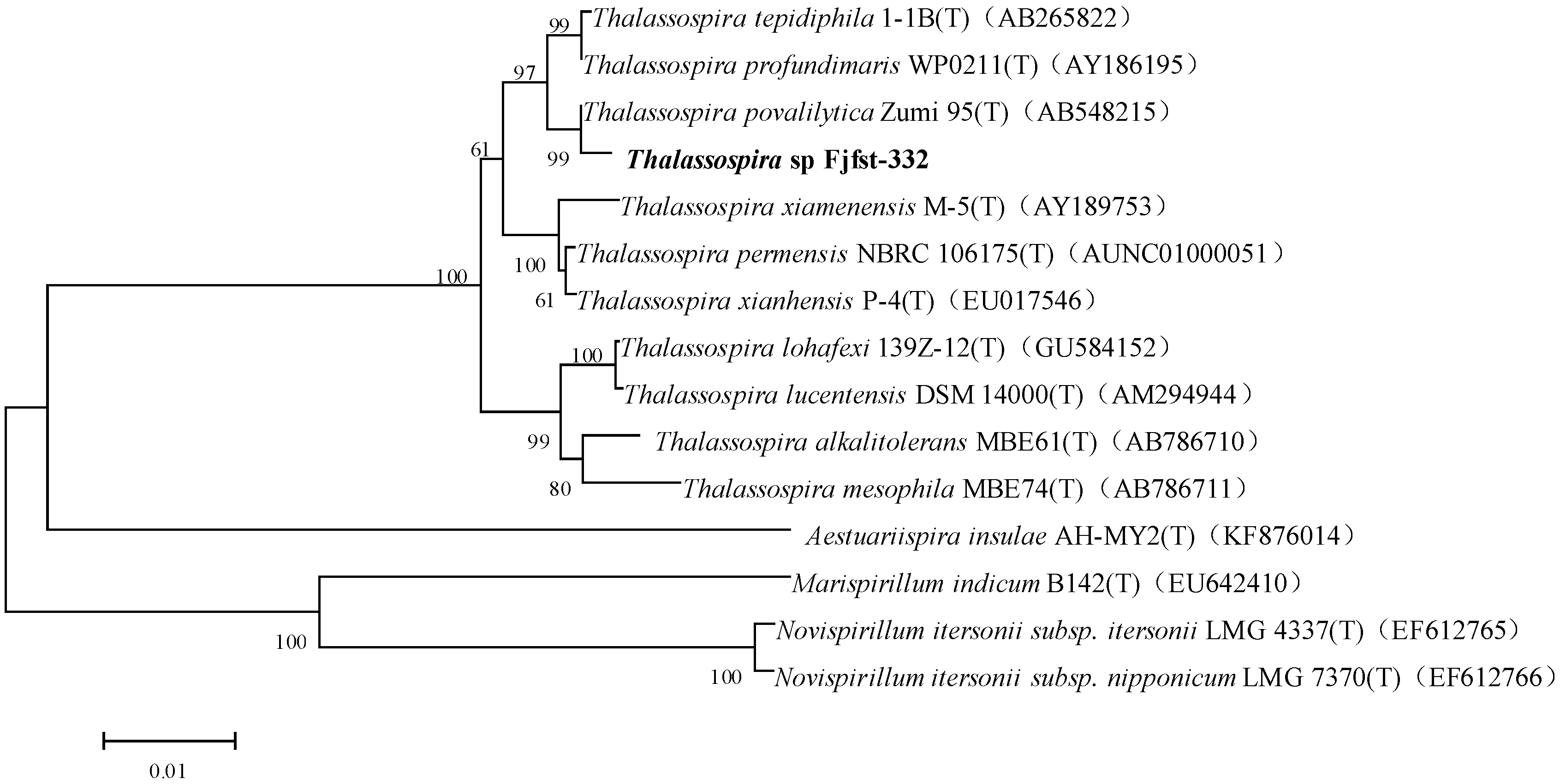
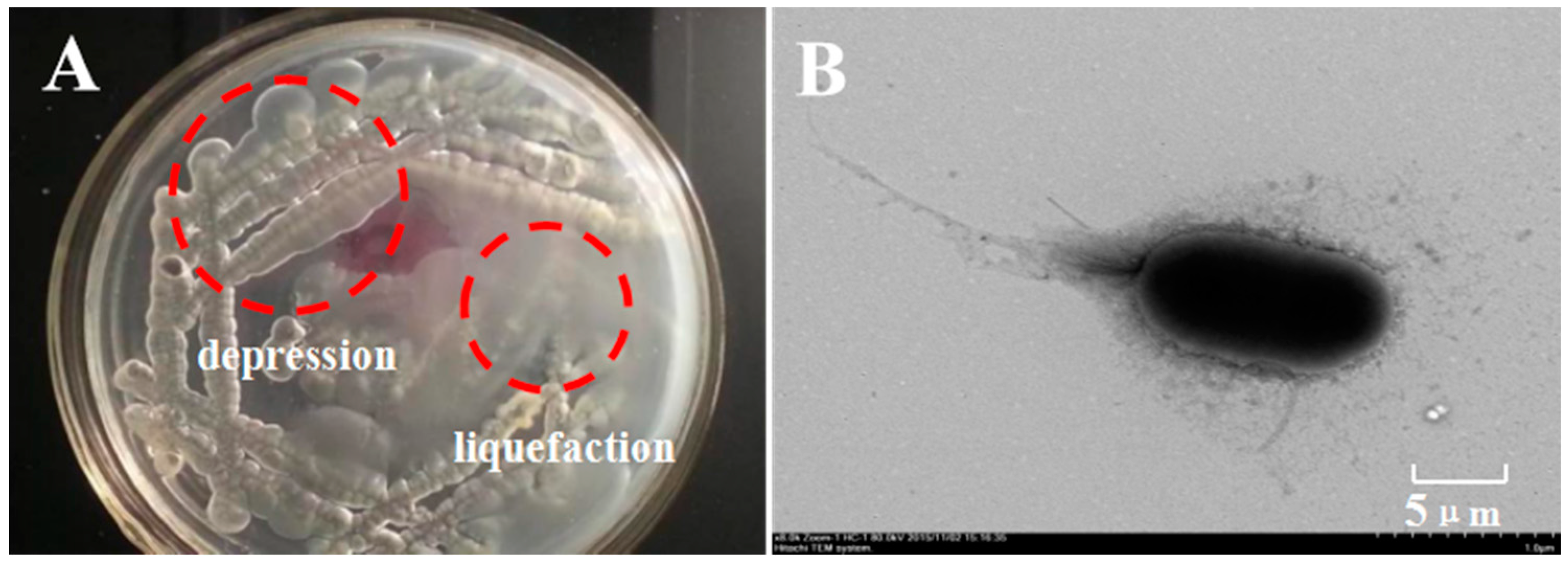
κ-Carrageenan, selected as the only carbon source, was used to isolate a potential bacterium which could degrade κ-carrageenan effectively. Thereinto, the strain fjfst-332 exhibited the maximum liquefaction and depression activity on the plate medium (Figure 1). The physiological and biochemical characteristics (Table 1) were investigated according to Bergey’s Manual and were analyzed by TEM (Figure 1). The PCR amplification of the 16S rDNA gene yielded a 1487-bp sequence of the strain fjfst-332. The 16S rDNA sequence of fjfst-332 showed 98.7% similarity to Thalassospira sp. (Figure 2) based on the public databases (GenBank Accession Number EU440790). Hence, it was concluded that the strain was Thalassospira sp. and numbered as Fjfst-332, which is a novel κ-carrageenan-degrading species.
Figure 1.
(A) The appearance of liquefaction and depression on plate medium and (B) the TEM image of Thalassospira sp. Fjfst-332.
Table 1.
Physiological and biochemical characteristics.
Figure 2.
Phylogenetic tree of Thalassospira sp. Fjfst-332 based on 16S rDNA sequences and Neighbor Joining analysis.
2.2. The Effect of Carbon Sources on the Enzyme Activity
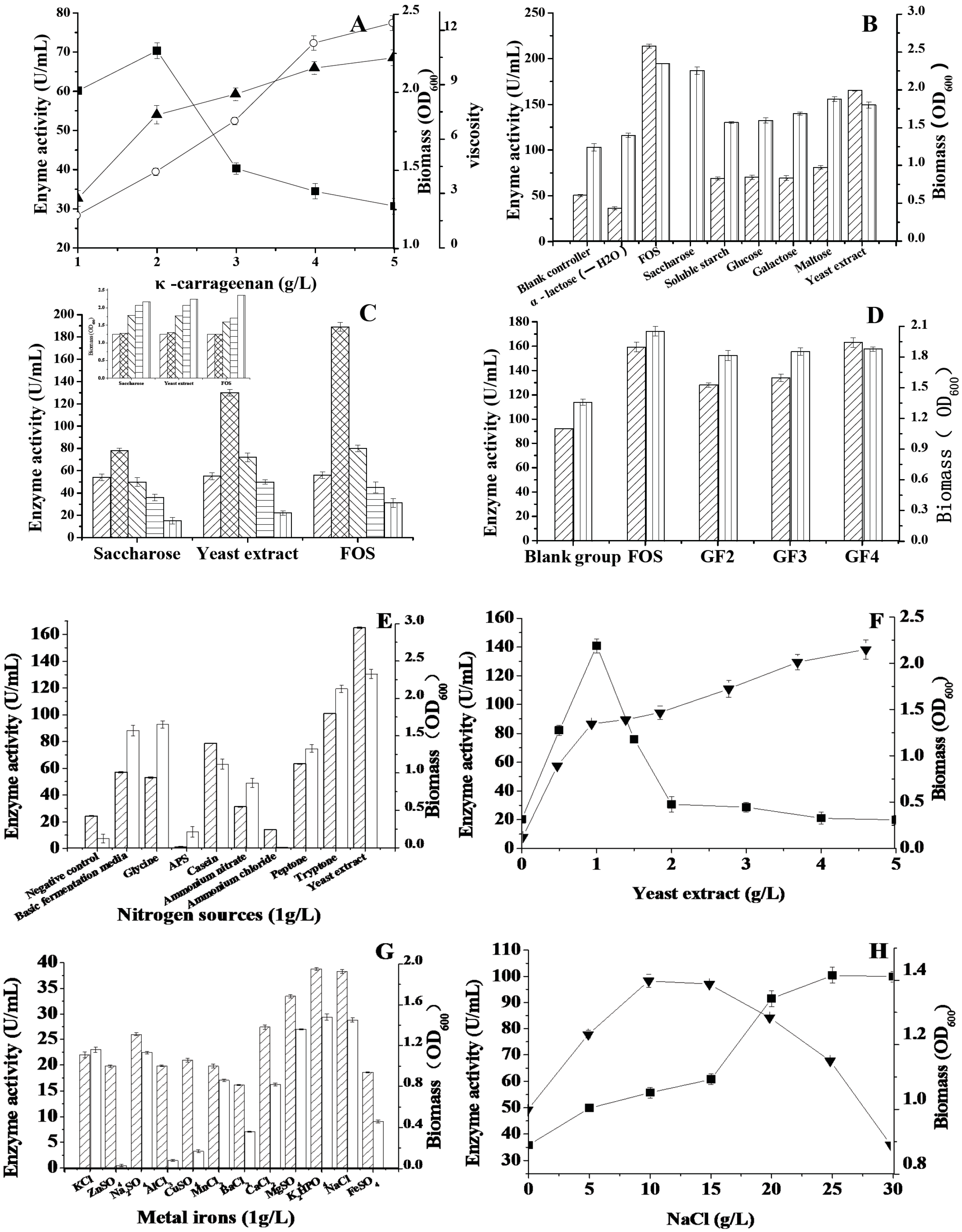
The results (Figure 3A) showed that the concentration of κ-carrageenan could impact the effectiveness of κ-carrageenase production by strain fjfst-332 [15]. In Figure 3A, the maximum activity was observed at 2.0 g/L κ-carrageenan. There was a sharp decrease in κ-carrageenase activity with further increase of κ-carrageenan concentration, probably because a high concentration of κ-carrageenan could cause excessive viscosity (Figure 3A) and restrict normal bacterial growth. Other carbon sources, shown in Figure 3B, also influenced the growth status and enzyme activity of strain fjfst-332. On a base of 2.0 g/L κ-carrageenan, monosaccharides, disaccharides, and soluble starch were able to multiply strain growth, but the enzyme activities were not affected by these carbon sources. Interestingly, FOS, saccharose, and yeast extract could enhance the biomass and enzyme activity of strain fjfst-332, respectively (Figure 3B). Yeast extract has generally been used to incubate bacteria, and FOS had been found to multiply on bifidobacterium [16,17]. Micromolecule substances, such as sophorose, cellobiose, and lactose were easily observed during the fermentation, especially with the enzyme production [18]. As shown in Figure 3C, 1 g/L FOS could induce strain fjfst-332 to yield κ-carrageenase effectively, in amounts almost three fold higher than the blank group. What’s more, we also researched the influence of specific components of FOS on κ-carrageenase activity (Figure 3D). GF4, the typical composition of FOS, was the optimal component for the enzyme activity of the isolated bacterium. In other reports, Zhou has published that glucose was the supplementary carbon resource for strain WZUC10 to degrade κ-carrageenan, but it did not explain the mechanism for carrageenase expression in microorganisms [2]. In our study, how the FOS or GF4 regulates gene expression and producing κ-carrageenase in strain fjfst-332 is not clear, yet. The mechanism needs further research.
Figure 3.
(A) Effects of κ-carrageenan on κ-carrageenase and biomass. ■ Enzyme activity, ▼ Biomass, ○ Viscosity; (B) Effects of other carbon sources on κ-carrageenase and biomass, including α-lactose (-H2O), FOS, saccharose, soluble starch, glucose, galactose, maltose and yeast extract with the concentration of 1 g/L, respectively.
Enzyme activity,
Biomass; (C) Effects of saccharose, yeast extract and FOS on κ-carrageenase and biomass (the small figure on the left).
0 g/L,
1 g/L,
2 g/L,
3 g/L,
4 g/L; (D) Effects of inducers on κ-carrageenase and biomass, including FOS, GF2, GF3, GF4 with the concentration of 1 g/L.
Enzyme activity,
Biomass; (E) Effects of nitrogen sources on κ-carrageenase and biomass, the test nitrogen sources with final concentration of 1 g/L
Enzyme activity,
Biomass; (F) Effects of yeast extract on κ-carrageenase and biomass, ■ Enzyme activity, ▼ Biomass; (G) Effects of metal irons on κ-carrageenase and biomass, all of the metal irons with the concentration of 0.2 g/L,
Enzyme activity;
Biomass; (H) Effects of NaCl on κ-carrageenase and biomass, ■ Enzyme activity, ▼ Biomass.
Enzyme activity,
Biomass; (C) Effects of saccharose, yeast extract and FOS on κ-carrageenase and biomass (the small figure on the left).
0 g/L,
1 g/L,
2 g/L,
3 g/L,
4 g/L; (D) Effects of inducers on κ-carrageenase and biomass, including FOS, GF2, GF3, GF4 with the concentration of 1 g/L.
Enzyme activity,
Biomass; (E) Effects of nitrogen sources on κ-carrageenase and biomass, the test nitrogen sources with final concentration of 1 g/L
Enzyme activity,
Biomass; (F) Effects of yeast extract on κ-carrageenase and biomass, ■ Enzyme activity, ▼ Biomass; (G) Effects of metal irons on κ-carrageenase and biomass, all of the metal irons with the concentration of 0.2 g/L,
Enzyme activity;
Biomass; (H) Effects of NaCl on κ-carrageenase and biomass, ■ Enzyme activity, ▼ Biomass.
2.3. The Effects of Nitrogen Sources, Metal Ions and NaCl on the Enzyme Activity
Both organic and inorganic nitrogen influenced the strain growth, and the nitrogen sources were studied based on 2.0 g/L κ-carrageenan. As shown in Figure 3E, yeast extract was the most suitable nitrogen source for κ-carrageenase production. The cell biomass was enhanced by increasing the yeast extract concentration from 0 g/L to 5g/L (Figure 3F). The maximum activity was observed at 1 g/L yeast extract. However, when the concentration of yeast extract exceeded 1 g/L, the activity of κ-carrageenase declined. Hence, the growth of the bacteria was induced by yeast extract, but the activity of κ-carrageenase did not increase with the same trend. The results were similar to findings on Vibrio sp. strain JT01017 [15], where polypeptone and yeast extract had the same effect on the growth of the strain and the production of agarase. It also could be observed that when the ratio of κ-carrageenan and yeast extract was lower than 2:1, the activity of κ-carrageenase obviously declined. The reason may be that the κ-carrageenase was an induced enzyme for strain Thalassospira sp. Fjfst-332, which only could be induced by the κ-carrageenan. When the concentration of yeast extract was high, the κ-carrageenan-degrading function would be inhibited because of substrate competition.
The possibility of an artificial sea water impact on κ-carrageenase production and cell growth was considered [19]. NaCl, NaNO3, MgSO4, 7H2O, K2HPO4, and CaC12 were found to have significant effects on catalyzing κ-carrageenan (Figure 3G). The results were consistent with a previous report by Mou [20], showing the influence of these ions on κ-carrageenase production. In addition, the concentration of NaCl also made a difference in the bacterial growth and the κ-carrageenan hydrolysis function. The optimal concentration of NaCl was found to be 25 g/L (Figure 3H). The effect of NaCl on strain fjfst-332 was similar to its effect on Pseudoalteromonas-like bacterium WZUC10 [2] and Pseudoalteromonas sp. QY203 [21], where 25 g/L was the optimal concentration. Nevertheless, there are also opposite conclusions showing that κ-carrageenase did not require NaCl for activity. Wang reported that a new recombinant κ-carrageenase CgkS exhibited a high specific activity to κ-carrageenan in the absence of NaCl [1].
2.4. Screening of Significant Variables by Plackett–Burman (PB) Design
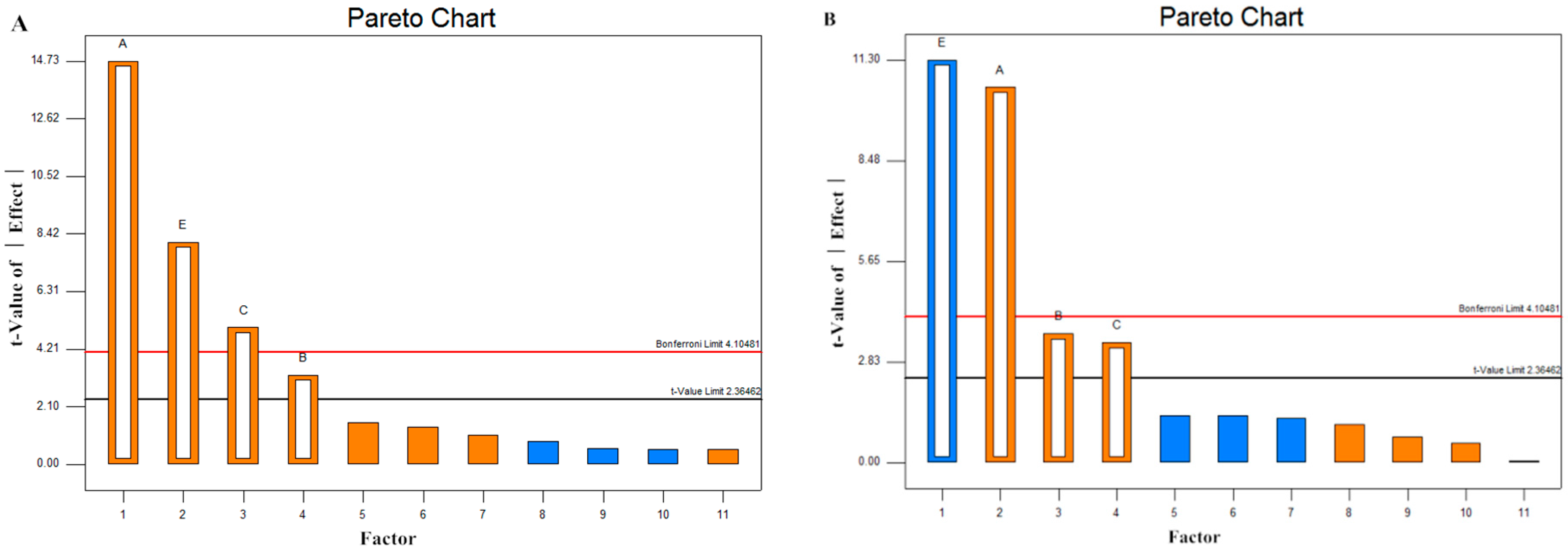
A two-level PB design with 11 runs was arranged as shown in Table 2, and the results are shown in Table 3. Figure 4 illustrates the Pareto Chart (p < 0.05) of significant effects. The t-values of κ-carrageenan, NaCl, yeast extract, and FOS were better than the t-value limit (t > 2.36462), which confirmed that the predicted value was significant and acceptable. According to the PB and the Pareto Chart regression results, the lack of significant dummy factors for any of the responses indicated that there were neither unknown variables nor systematic errors in the PB design. With respect to enzyme activity, κ-carrageenan, NaCl, yeast extract, and FOS had significant effects (Figure 4A). With respect to biomass, NaCl demonstrated significant negative effects (Figure 4B), which could mean that the strain was sensitive to salt and low NaCl was ideal. In addition, κ-carrageenan, yeast extract, and FOS were significant factors with positive effects on biomass (Figure 4B).
Table 2.
Arrangement and experimental results of the PB design.
Table 3.
The regression results for the PB design.
Figure 4.
Pareto Chart of Plackett-Burman design for enzyme activity (A) and Biomass (B). A: κ-carrageenan, B: FOS, C: tryptone, E: NaCl.
In sum, κ-carrageenan, NaCl, yeast extract, and FOS were the significant variables for enzyme activity (EA) and biomass. The optimal concentrations were chosen for RSM design as follows: κ-carrageenan (1, 2, 3 g/L), NaCl (15, 20, 25 g/L), yeast extract (1, 2, 3 g/L), and FOS (1, 2, 3 g/L).
2.5. Model Statistical Analysis
The RSM modeling results for EA and BM are presented in Table 4. The model’s R2 values were 0.9689 (EA) and 0.9700 (BM), respectively, with a 95% confidence level. The experimental data fit the second order polynomial model (Equations (1) and (2)) well and described the relationship among κ-carrageenan, NaCl, yeast extract, and FOS. Furthermore, the lack of fit was non-significant (EA 0.0888, BM 0.0598), indicating that the model was acceptable (Table 5).
EA = 266.19 − 11.23X1 + 7.06X2 − 11.57X3 − 9.06X4 + 22.73X1X2 − 27.38X1X3 − 41.04X1X4 + 14.87X2X3 + 1.91X2X4 − 44.73X3X4 − 22.03X12 − 23.43X22 − 41.11X32 − 49.78X42
BM = 0.52 + 0.010X1 − 0.018X2 + 0.0007833X3 + 0.00075X4 − 0.0009750X1X2 + 0.00075X1X3 − 0.013X1X4 + 0.00005X2X3 + 0.012X2X4 + 0.00005X3X4 − 0.032X12 − 0.082X22 − 0.025X32 − 0.013X42
Table 4.
Experiment design and result of response surface analysis.
Table 5.
ANOVA for response surface polynomial model of all independent variables.
2.6. Effect of Independent Variables on Enzyme Activity (EA) and Biomass (BM)
The positive linear effects of X1 (κ-carrageenan) and X3 (yeast extract) on EA were found to be highly significant (p < 0.01), and the effects of X2 (NaCl) and X4 (FOS) were significant (p < 0.05), which agrees with the conclusion of the PB analysis. Furthermore, all the quadratic effects of X12, X22, X32, and X42 were found to be significant (p < 0.05) and negative in value, which accounts for the equation of the parabola function decreasing and the maximum point. The results of the analysis of variance (ANOVA) indicated that the reciprocities of X1X2, X1X3, X1X4, and X3X4 were highly significant (p < 0.01), and the reciprocity of X2X3 was significant (p < 0.05) for κ-carrageenase activity (Table 5). The strain biomass was most affected by κ-carrageenan and NaCl (p < 0.001), followed by yeast extract and FOS (p < 0.05). All of the quadratics were significant items (p < 0.01). The reciprocities of X1X2, X1X3, X1X4, and X2X4 were highly significant (p < 0.01), yet those of X2X3 and X3X4 were non-significant (p > 0.05).
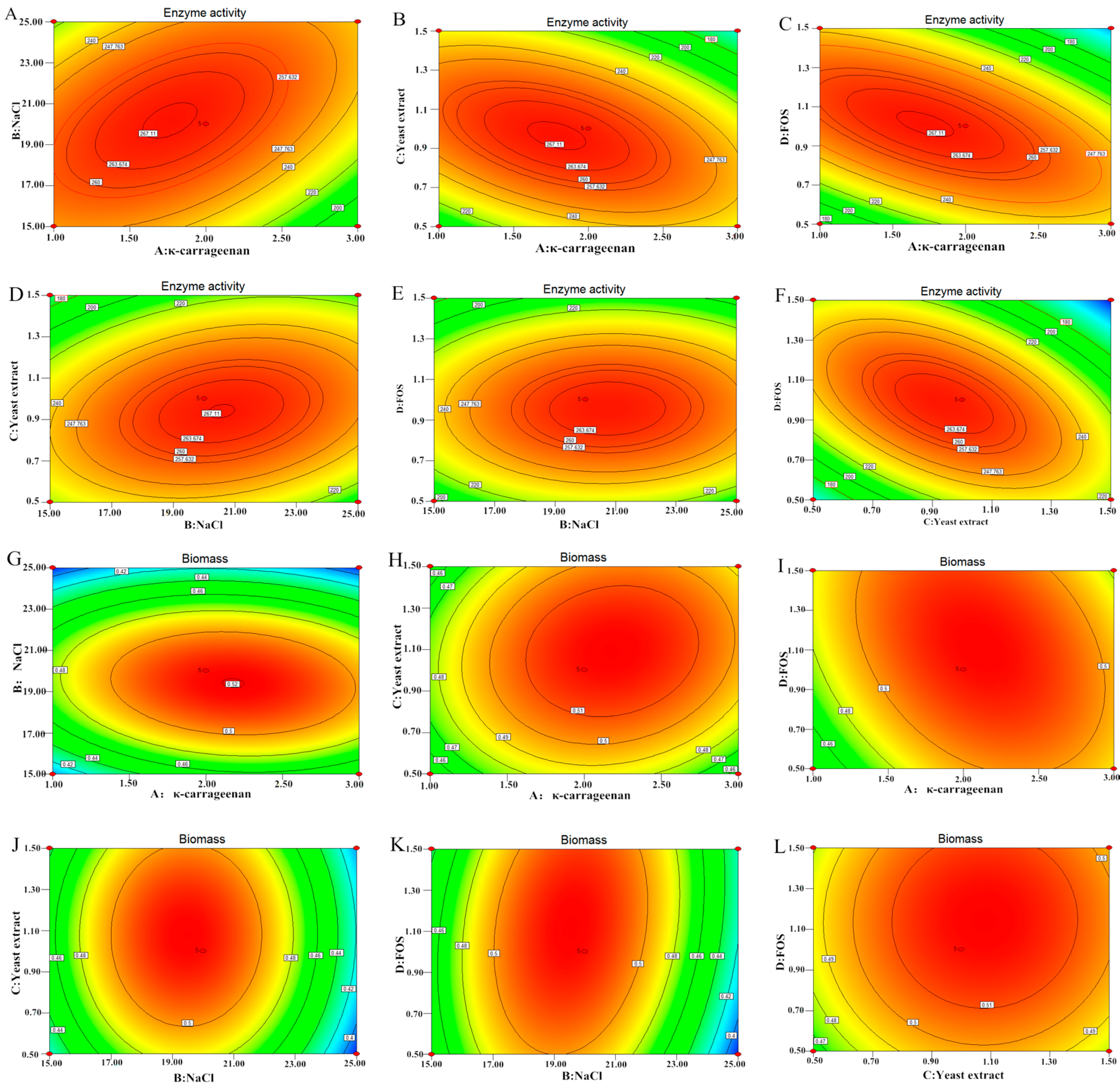
Enzyme activity increased with the four factors, with its peak activity approaching the midpoint of the response plot. The interaction of κ-carrageenan and NaCl was highly sensitive to EA, indicating that EA increased when they increased. However, high concentrations of κ-carrageenan and NaCl restrained EA (Figure 5A). Similarly, EA increased as yeast extract and FOS increased, but high concentrations led to low EA (Figure 5B,C,F). κ-carrageenase activity was negatively influenced by NaCl and FOS (Figure 5E). The biomass followed similar trends as EA (Figure 5G–L). A high concentration of NaCl inhibited BM but made enhanced EA, so the optimal amount was determined to be 20 g/L [2].
Figure 5.
(A–F) was the interaction effect of variables on enzyme activity (EA); (G–L) was the interaction effect of variables on biomass (BM).
The RSM results showed that the ideal EA was 267.851 U/mL with the medium composition: 1.76 g/L κ-carrageenan, 20.04 g/L NaCl, 0.96 g/L yeast extract, and 1.02 g/L FOS. The maximum predicted value of BM was 0.521281 (OD600) at 2.17 g/L κ-carrageenan, 19.47 g/L NaCl, 1.09 g/L yeast extract, and 1.08 g/L FOS. Combined with the actual operation and Plackett–Burman design, the test was executed five times using the simplified medium: 2 g/L κ-carrageenan, 20 g/L NaCl, 1 g/L yeast extract and 1 g/L FOS, and the average EA was 265 ± 1.56 U/mL. Compared with bacteria investigated in previous reports—Pseudoalteromonas sp. WZUC10, 50 U/mL [2] and ALAB-001, 170 U/mL [8], strain fjfst-332 showed the highest crude enzyme activity (EA).
2.7. Verification Tests
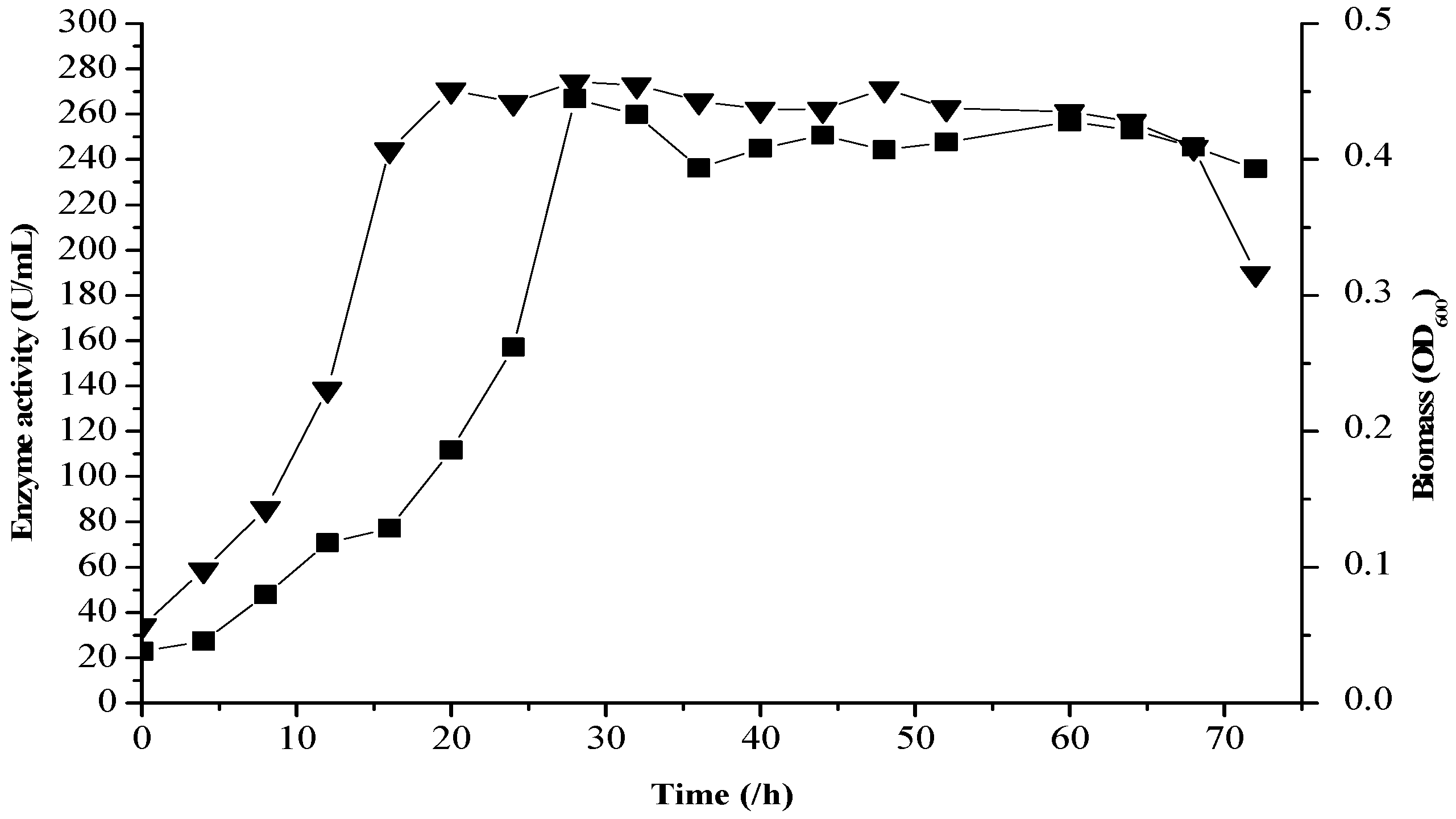
To verify the reliability of the RSM models, the strain fjfst-332 enzyme production and cell growth curve were investigated under the optimized medium (Figure 6). Strain fjfst-332 reached the logarithmic phase at 20 h and increased to the stationary phase at 24 h. Consideration the fermentation forms, the fermentation model of strain fjfst-332 was part of growth-related type II (α ≠ 0, β ≠ 0). In detail, the fastigia of bacterial growth (20 h) and metabolite accumulation (28 h) were not synchronous, and the fastigium of biomass growth was reached faster than that of κ-carrageenase. After the stationary phase (32 h), the growth of metabolite (oligosaccharide) was smooth and steady, eventually accompanied by the catabolite stacking and κ-carrageenan consumption. The growth of κ-carrageenan oligosaccharide increased in stability in 58 h. After 62 h both the enzyme production and the cell biomass went into the decline phase. It might be the effect of substrate consumption. At the fastigium, the maximum EA and BM yields were 266.84 U/mL and 0.519 (OD600), respectively, which matched the predicted values with relative error less than 2%. Thus, the RSM regression models could predict the EA and BM yields for the medium composition of κ-carrageenan, NaCl, yeast extract, and FOS.
Figure 6.
The cell growth (▼) and enzyme activity (■) curve of strain Thalassospira sp. fjfst-332.
2.8. Fermentation Kinetics
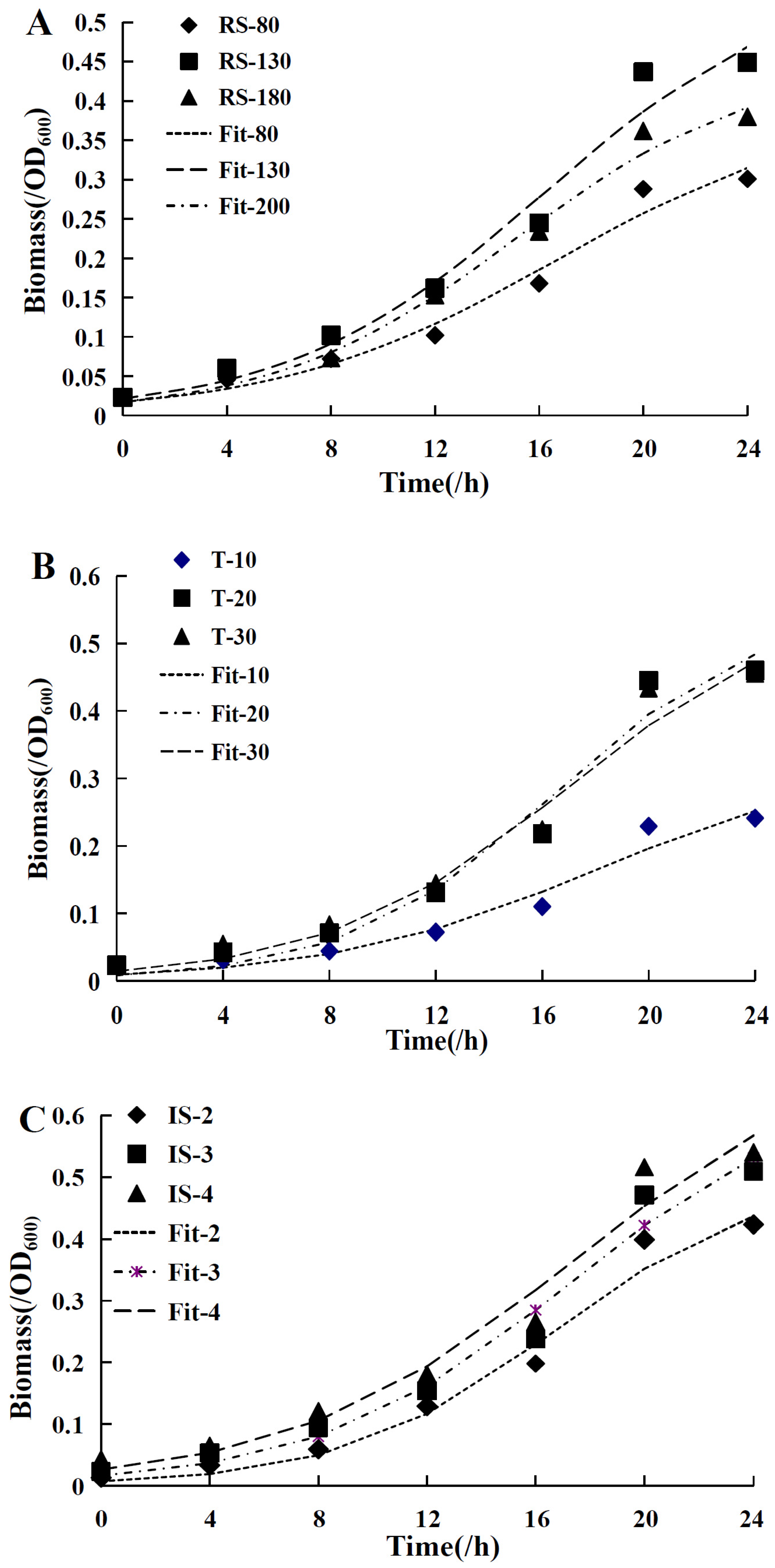
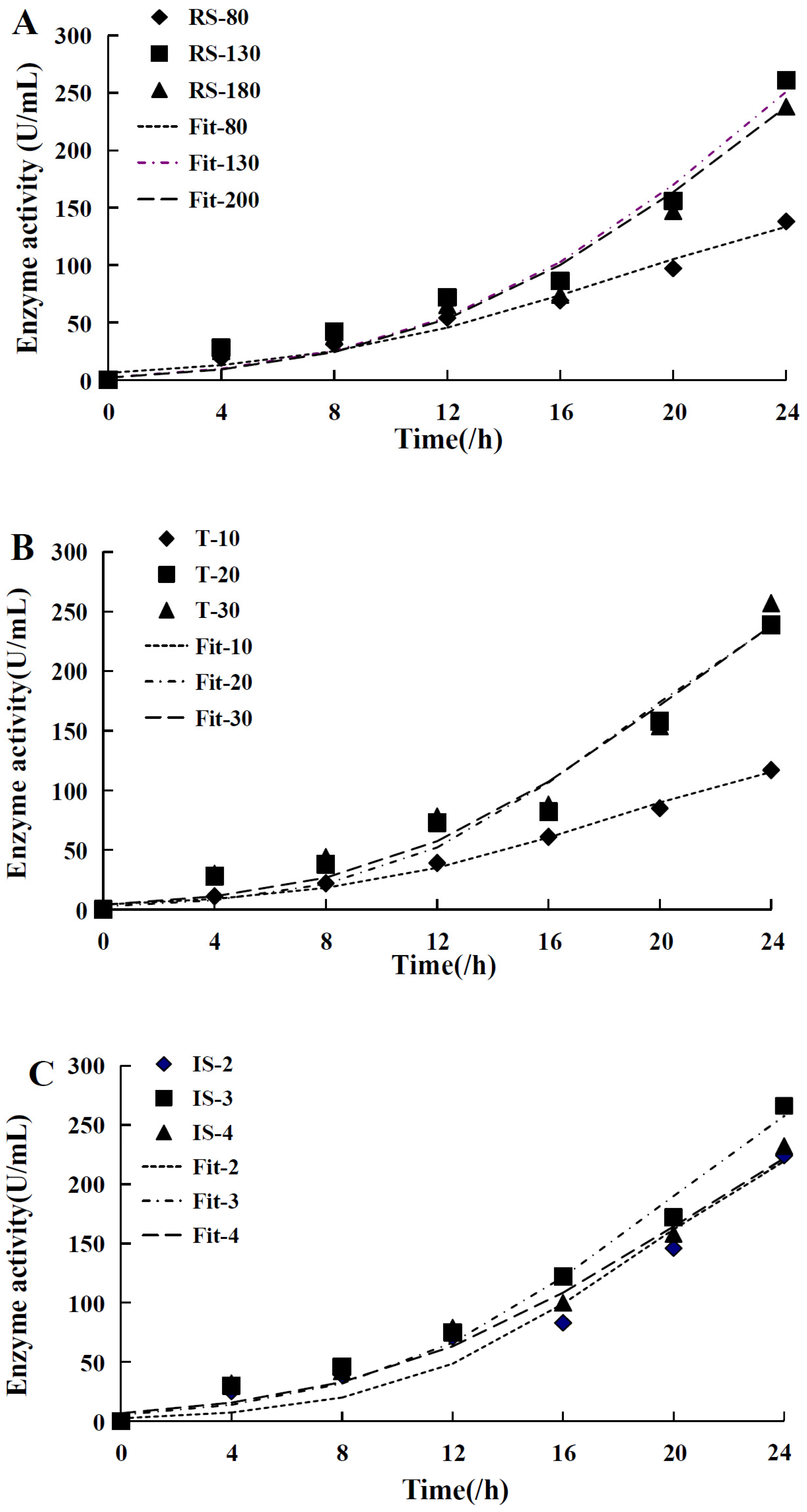
In order to investigate the cell growth curve and product formation curve of strain fjfst-332, the logistic equation and Luedeking–Piret equation were utilized to predict the experimental data, which are shown in Figure 7. The traditional fitting method appeared to be deficient because of only for each individual case, while the empirical model could be applied in various environments.
Figure 7.
(A) is the model fitting of revolving speed relative to biomass, altering variables 80r/min, 130 r/min and 180 r/min, quantifying temperature 30 °C, and inoculum size 3 mL; (B) was the model fitting of temperature relative to biomass, altering variables 10 °C, 20 °C and 30 °C, quantifying revolving speed 130 r/min, and inoculum size 3 mL; (C) was the model fitting of inoculum size relative to biomass, altering variables 2 mL, 3 mL and 4 mL, quantifying revolving speed 130 r/min and temperature 30 °C.
2.9. Logistic Cell Growth Model
The non-linear regression analysis was used to estimate the logistic model, and the data are shown in Table 6. Under the different conditions (stirring speed, temperature, and bacterial load), the parameters (X0, Xm, μm) varied. The results showed that all of the R2 > 0.96, indicating that the experimental data had a high degree of fit with the logistic equation. Furthermore, different conditions (RS, T, and IS) led to different parameters (X0, Xm, μm) in accordance with the logistic equation. SPSS software was used to fit the nonlinear regression connection of parameters with RS, T, and IS, which conformed to the polynomial equation. The empirical models are demonstrated in Equations (4)–(6). Establishing a system model to investigate cell growth in all kinds of fermentation environments would be well utilized in directing scale production (Figure 7). Goudar created a mathematical model according to logistic equations, which were helpful in the development of the early- and late-stage fed-batch process [22]:
X0 = 0.00004 − 0.000036I − 0.00000628T + 0.000053T2 − 0.00000018R2
Xm = −0001 − 0.002I + 0.002T + 0.006R − 0.002I × T + 0.005I2 − 0.001T2 − 0.000052R2
Um = −0.0000705 − 0.0000803I + 0.003T + 0.005R + 0.004I × T − 0.002I × R + 0.000044T × R + 0.012I2 − 0.001T2 − 0.0000036R2
Table 6.
Logistic’ model parameters Um (OD600/h), X0 (/OD600), Xm (/OD600) and Luedeking-Piret’ model parameters α and β coefficients of determination (R2) of fitted models for all the treatments.
2.10. The Luedeking–Piret Model
The Luedeking–Piret equation is a nonlinear regression equation used to simulate the relationship between bacterial growth concentration and product formation [23]. The verification test was carried out at optimal medium (fermentation conditions 125 r/min, 25 °C, and 3 mL inoculum size), and preliminary analysis was performed on the batch pattern owing to the growth type (II). The results were shown in Table 6. Particularly, the coefficients of α ≠ 0, β = 0 were fitted under the condition of 10 °C, which showed that the cell growth concentration and product formation pattern fell under growth type I (α ≠ 0, β = 0) and R2 > 0.990. In other conditions, the fermentation patterns were all type II, and R2 > 0.960 (Figure 8). This pattern has been seen infrequently in other reports. The explanation for the results may be that κ-carrageenan was easily coagulated at low temperature, so that it influenced the cell growth normally. Finally, the empirical models regarding α, β with X0, Xm, and μm were simulated using a polynomial equation in the same way (Equations (9) and (10)):
α = −4.15 − 0.91I − 0.18T + 7.21R − 4.72I × T − 2.29I ×R − 0.12T × R + 66.84I2 + 0.47T2 + 0.004R2
β = 0.14 − 0.09I + 0.42T + 0.03R + 1.30I × T + 0.23I × R − 0.001T × R − 11.78I2 − 0.07T2 − 0.001R2
Figure 8.
(A) was the model fitting of revolving speed relative to enzyme activity, altering variables 80 r/min, 130 r/min and 180 r/min, quantifying temperature 30 °C, and inoculum size 3 mL; (B) was the model fitting of temperature relative to enzyme activity, altering variables 10 °C, 20 °C and 30 °C, quantifying revolving speed 130 r/min, and inoculum size 3 mL; (C) was the model fitting of inoculum size relative to enzyme activity, altering variables 2 mL, 3 mL and 4 mL, quantifying revolving speed 130 r/min and temperature 30 °C.
3. Materials and Methods
3.1. Chemicals and Materials
κ-Carrageenan (BR) and fructo-oligosaccharide (BR) were purchased from Solarbio Company (Beijing, China); Kestose (GF2), nystose (GF3) and GF4 were purchased from Sigma-Aldrich (St. Louis, MO, USA); other chemical reagents were all BR grade.
3.2. Bacterial Isolation
The dried fragments of red seaweed Chondrus ocellatus (Zhangzhou Lvqi Colloid Food Company of Fujian Province, Zhangzhou, China) that is the raw material for extracting carrageenan was chosen to isolate κ-carrageenan-hydrolyzing bacterial strains. The plate medium (15 g/L NaCl, 15 g/L κ-carrageenan, 2 g/L NaNO3, 0.5 g/L MgSO4·7H2O, 1 g/L K2HPO4, 0.l g/L CaC12, pH = 7.5, 28 °C) was screened for bacterial colonies that manifested plate depression or liquefaction-forming activity. Pure cultures of the depression-forming bacterial isolates were obtained through repeated subculture at 28 °C for 24 h (the medium was supplemented by a nutritional ingredient with 5 g/L peptone).
3.3. Identification of Strain Fjfst-332
The cellular morphology and physiology of the strain were determined using a transmission electron microscope (TEM, JEM-1400 120kV, JEOL, Beijing, China) and Bergey’s Manual of Determinative Bacteriolog [24]. Genomic DNA was extracted using an Ezup Column Bacteria Genomic DNA Purification Kit (cat. NO. SK8255, Sangon Biotech, Shanghai, China). The 16S rDNA gene was amplified using the primer pair 7F (5′-CAGAGTTTGATCCTGGCT-3′) and 1540R (5′-AGGAGGTGATCCAGCCGCA-3′). The PCR products were sequenced and analyzed using a sequencing system (ABI 337 DNA, Model: 3730XL, Applied Biosystems, Foster City, CA, USA). Using the purified sequence as the query sequence, similar 16S rDNA sequence data were looked up in GenBank and downloaded from the NCBI online tool (http://rdp.cme.msu.edu/index.jsp; BLAST; Accession Number EU440790).
3.4. Selection of Significant Variables via Plackett–Burman (PB) Design
Based on the single-factor experiment results, the Plackett–Burman design [25] was used to investigate the influence of κ-carrageenan (A), FOS (B), tryptone (C), NaCl (E), K2HPO4 (F), MgSO4 (G), and CaCl2 (H) on the strain enzyme activity and biomass. Three dummy factors (D1, D2, D3) were introduced to investigate the systematic error.
3.5. Statistical Optimization
Many variables, such as the carbon source, nitrogen source, metal ions, etc., are known to affect enzyme activity and strain biomass. In the present study, the influence of κ-carrageenan and other auxiliary carbon sources was investigated. Organic and inorganic nitrogen sources were also investigated, and various valence metal ions were considered. Medium components with significant effects were screened based on PB experiments. All of the experiments for media components were carried out in triplicates.
A Box-Behnken experimental design and response surface methodology (RSM) were used to evaluate the relationship between the medium composition (κ-carrageenan, NaCl, yeast extract, FOS) and κ-carrageenase activity (EA). A three-level, four-factor Central Composite Design (CCD), consisting of 29 runs including 24 analytical points, was used. The four independent variables were arranged at three levels (−1, 0, +1) (Table 7). The test data were fitted to the generalized second order polynomial model equation (Equation (11)), which was used in the RSM analysis:
where, Y was the response variable (EA); Xi and Xj were the independent variables. β0 was the constant coefficient, βi was the linear coefficient, βii was the quadratic coefficient, and βij was the cross product coefficient.
Table 7.
Factors and levels of response surface analysis.
3.6. Evaluation of κ-Carrageenase Activity (EA)
κ-Carrageenase activity (EA) was determined by using the 3,5-dinitrosalicylic acid (DNS) method [26]. The incubation conditions were as follows: 5 mL κ-carrageenan solution (0.2% κ-carrageenan in deionized water) was degraded using 1 mL crude κ-carrageenase at 45 °C for 60 min, then mixed with 1 mL DNS; 1 mL resulting mixture was heated at 100 °C for 5 min. The absorbance of the mixture (10 times dilution) was read at 540 nm. One unit of κ-carrageenase activity (EA) is equivalent to an enzyme that produces 1 μg of d-galactose per minute under the given conditions. κ-Carrageenase activity was calculated using the formula:
where A is the absorbance under OD540, 640.5 and 13.99 are the constants for calculating liberated galactose, V is the total reaction volume (mL), n is the dilution factor, v is the volume of enzyme (mL), and T is the length of digestion time (min).
3.7. Determination of Cell Biomass (BM)
Turbidimetry was used to determine the fjfst-332 strain biomass (BM). A 250 mL Erlenmeyer flask containing 30 mL optimized fermentation medium with 3 mL seed culture was incubated at 125 r/min and 30 °C for 72 h. Samples were taken every 4 h and the turbidity at OD600 was measured.
3.8. Detemination of Viscosity
A NDJ-7 Rotary Viscosimeter (Beijing ZKDH, Beijing, China) was used to determine the viscosity. The initial medium with 1 g/L~5 g/L κ-carrageenan were determined under the room temperature. The viscosity was calculated using the formula: η = kα, where η is the viscosity; k is the coefficient of the rotor; α is the reading number.
3.9. Mathematical Model of Fermentation Process
3.9.1. Determination of Cell Growth Dynamics
In order to assess the growth pattern of strain fjfst-332, a logistic equation (Equation (13)) was used to predict the cell growth model at log phase and stable phase. The logistic equation describes the growth of a simple population in a confined space, where resources are limited [22]. Due to the bacteria having different growth curves in different fermentation environments [27], the dynamics equation was fitted at the conditions of revolving speed (RS 80 r/min, 130 r/min, 200 r/min), temperature (T 10 °C, 20 °C, 30 °C), and bacterial load (IS 2 mL, 3 mL, 4mL), based on the optimal medium:
Equation (13) integrated into the following algebraic equation:
where X0 is the initial cell biomass, Xm is the maximum cell biomass, μm is the maximum specific growth rate, and t is the fermentation time.
3.9.2. Analysis of Product Formation Kinetic
Gaden [28] generalized three fermentation forms: I. growth-related type; II. growth part-related type; III. non-growth-related type. Luedeking and Piret [29] proposed the Luedeking–Piret equation (Equation (7)) according Gaden’s conclusion, which considered the relationship of cell growth to product formation. When the cells, or some constituent of cells that is proportional to cell mass, are the product, the rate of product formation directly relates to the rate of growth. The relationship of product concentration with cell concentration can be rewritten into Equation (8):
where P is the product concentration, X is the concentration of cells, t is the fermentation time, and α and β are the coefficients. I: α ≠ 0, β = 0; II: α ≠ 0, β ≠ 0; III: α = 0, β ≠ 0.
where X0 is the initial cell biomass, Xm is the maximum cell biomass, μm is the maximum specific growth rate, t is the fermentation time, and α and β are the coefficients.
3.10. Statistical Analysis
The statistical analysis systems DPS (V9.50, Ruifeng Information Company, Hangzhou, China) and Origin Pro (V8.5, OriginLab, Wellesley Hills, WA, US) were used to analyze the data. A one-factor analysis of variance (ANOVA) was performed for each parameter. Values given below are the means of repeatedly measured values. The PB and RSM analysis were performed using Design-Expert (V8.0.6, State-East Company, Minneapolis, MN, USA). The fitting of two kinetic models (cell growth model, logistic equation, and product formation model, Luedeking–Piret equation) to the experimental data of each sample was carried out using IBM SPSS Statistics (V21.0, IBM, Armonk, NY, USA). The R2 coefficient was used to evaluate the accuracy of the experimental data’s fit to the models.
4. Conclusions
The strain Thalassospira sp. fjfst-332 isolated from dry Chondrus crispus was shown for the first time to degrade κ-carrageenan. According to statistical analysis, the optimal fermentation components for strain fjfst-332 were determined to be 2 g/L κ-carrageenan, 20 g/L NaCl, 1 g/L yeast extract, 1 g/L FOS, 2 g/L NaNO3, 0.5 g/L MgSO4·7H2O, 1 g/L K2HPO4, and 0.l g/L CaC12, resulting in the strain’s highest enzyme activity of 267 U/mL. Compared with previous reports, fjfst-332 was the most effective wild bacterium for obtaining κ-carrageenan oligosaccharides. We also identified an inducer (FOS) to make strain fjfst-332 more prolic and enable it to hydrolyze κ-carrageenan more effectively. What’s more, our research revealed three much more adaptive empirical models to describe the microorganism growth and product formation. All of this work will be useful as a foundation for the industrial production of κ-carrageenan oligosaccharide.
Acknowledgments
We gratefully acknowledge the financial support from the Science and Technology Major Project of Fujian Province (2015NZ0001-1); Science and Technology Plan Major Project of Fujian Province (2014I0008); National Marine Public Welfare Industry Special Scientific Research Projects (201505033).
Author Contributions
All the authors have mad substantive intellectual contributions to the study and given approval to the final version of the manuscript. Baodong Zheng, Shaoxiao Zeng and Yi Zhang mainly contributed to the study design and manuscript revision; Juanjuan Guo and Xu Lu contributed to the experimental studies and data analysis; Hui Xu, Longtao Zhang contributed to the manuscript editing.
Conflicts of Interest
The authors declare no conflict of interest.
References
- Wang, L.; Li, S.; Zhang, S.; Li, J.; Yu, W.; Gong, Q. A new κ-carrageenase CgkS from marine bacterium Shewanella sp. Kz7. J. Ocean Univ. China 2015, 14, 759–763. [Google Scholar] [CrossRef]
- Zhou, M.H.; Ma, J.S.; Li, J.; Ye, H.R.; Huang, K.X.; Zhao, X.W. A κ-Carrageenase from a Newly Isolated Pseudoalteromonas-like Bacterium, WZUC10. Biotechnol. Bioprocess Eng. 2008, 13, 545–551. [Google Scholar] [CrossRef]
- Yamada, T.; Ogamo, A.; Saito, T.; Uchiyama, H.; Nakagawa, Y. Preparation of O-acylated low-molecular-weight carrageenans with potent anti-HIV activity and low anticoagulant effect. Carbohydr. Polym. 2000, 41, 115–120. [Google Scholar] [CrossRef]
- Relleve, L.; Nagasawa, N.; Luan, L.Q.; Yagi, T.; Aranilla, C.; Abad, L.; Kume, T.; Yoshii, F.; dela Rosa, A. Degradation of carrageenan by radiation. Polym. Degrad. Stab. 2005, 87, 403–410. [Google Scholar] [CrossRef]
- Barbeyron, T.; Michel, G.; Potin, P.; Henrissat, B.; Kloareg, B. Iota-Carrageenases constitute a novel family of glycoside hydrolases, unrelated to that of kappa-carrageenases. J. Biol. Chem. 2000, 275, 35499–35505. [Google Scholar] [CrossRef]
- Barbeyron, T.; Potin, P.; Richard, C.; Collin, O.; Kloareg, B. Arylsulphatase from Alteromonas carrageenovora. Microbiology 1995, 141 Pt 11, 2897–2904. [Google Scholar] [CrossRef]
- Potin, P.; Sanseau, A.; Le Gall, Y.; Rochas, C.; Kloareg, B. Purification and characterization of a new kappa-carrageenase from a marine Cytophaga-like bacterium. Eur. J. Biochem. 1991, 201, 241–247. [Google Scholar] [CrossRef]
- Tayco, C.C.; Tablizo, F.A.; Regalia, R.S.; Lluisma, A.O. Characterization of a κ-Carrageenase-producing Marine Bacterium, Isolate ALAB-001. Philipp. J. Sci. 2013, 142, 45–54. [Google Scholar]
- Weigl, J.; Yaphe, W. The enzymic hydrolysis of carrageenan by Pseudomonas carrageenovora: Purification of a kappa-carrageenase. Can. J. Microbiol. 1966, 12, 939–947. [Google Scholar] [CrossRef]
- Sun, Y.; Liu, Y.; Jiang, K.; Wang, C.; Wang, Z.; Huang, L. Electrospray ionization mass spectrometric analysis of kappa-carrageenan oligosaccharides obtained by degradation with kappa-carrageenase from Pedobacter hainanensis. J. Agric. Food Chem. 2014, 62, 2398–2405. [Google Scholar] [CrossRef]
- Kobayashi, T.; Uchimura, K.; Koide, O.; Deguchi, S.; Horikoshi, K. Genetic and Biochemical Characterization of the Pseudoalteromonas tetraodonis Alkaline κ-Carrageenase. Biosci. Biotechnol. Biochem. 2012, 76, 506–511. [Google Scholar] [CrossRef]
- Duan, F.; Yu, Y.; Liu, Z.; Tian, L.; Mou, H. An effective method for the preparation of carrageenan oligosaccharides directly from Eucheuma cottonii using cellulase and recombinant κ-carrageenase. Algal. Res. 2016, 15, 93–99. [Google Scholar] [CrossRef]
- Whitehead, L.A.; Stosz, S.K.; Weiner, R.M. Characterization of the agarase system of a multiple carbohydrate degrading marine bacterium. Cytobios 2001, 106 (Suppl. 1), 99–117. [Google Scholar]
- Barton, L.L.; Georgi, C.E.; Lineback, D.R. Effect of maltose on glucoamylase formation by Aspergillus niger. J. Bacteriol. 1972, 111, 771–777. [Google Scholar]
- Sugano, Y.; Nagae, H.; Inagaki, K. Production and characteristics of some new β-agarases from a marine bacterium, Vibrio sp. strain JT0107. J. Ferment. Bioeng. 1995, 79, 549–554. [Google Scholar] [CrossRef]
- Gibson, G.R.; Beatty, E.R.; Wang, X.; Cummings, J.H. Selective stimulation of bifidobacteria in the human colon by oligofructose and inulin. Gastroenterology 1995, 108, 975–982. [Google Scholar] [CrossRef]
- Licht, T.R.; Hansen, M.; Poulsen, M.; Dragsted, L.O. Dietary carbohydrate source influences molecular fingerprints of the rat faecal microbiota. BMC Microbiol. 2006, 6, 1–10. [Google Scholar] [CrossRef] [Green Version]
- Zhang, Y.H.P.; Himmel, M.E.; Mielenz, J.R. Outlook for cellulase improvement: Screening and selection strategies. Biotechnol. Adv. 2006, 24, 452–481. [Google Scholar] [CrossRef]
- Sarwar, G.; Oda, H.; Sakata, T.; Kakimoto, D. Potentiality of artificial sea water salts for the production of carrageenase by a marine Cytophaga sp. Microbiol. Immunol. 1985, 29, 405–411. [Google Scholar] [CrossRef]
- Mou, H.J.; Jiang, X.L.; Guan, H.S. A kappa-carrageenan derived oligosaccharide prepared by enzymatic degradation containing anti-tumor activity. J. Appl. Phycol. 2003, 15, 297–303. [Google Scholar]
- Li, S.; Jia, P.; Wang, L.; Yu, W.; Han, F. Purification and characterization of a new thermostable κ-carrageenase from the marine bacterium Pseudoalteromonas sp. QY203. J. Ocean Univ. China 2013, 12, 155–159. [Google Scholar] [CrossRef]
- Goudar, C.T. Analyzing the dynamics of cell growth and protein production in mammalian cell fed-batch systems using logistic equations. J. Ind. Microbiol. Biotechnol. 2012, 39, 1061–1071. [Google Scholar] [CrossRef]
- Thierie, J. Computing and interpreting specific production rates in a chemostat in steady state according to the Luedeking-Piret model. Appl. Biochem. Biotechnol. 2013, 169, 477–492. [Google Scholar] [CrossRef]
- Bradbury, J.F.; Krieg, N.R.; Holt, J.G. (Eds.) Bergey’s Manual of Systematic Bacteriology; Springer: New York, NY, USA, 2011; Volume 1, pp. 89–100.
- Ma, L.; Wang, L.; Tang, J.; Yang, Z. Optimization of arsenic extraction in rice samples by Plackett-Burman design and response surface methodology. Food Chem. 2016, 204, 283–288. [Google Scholar] [CrossRef]
- Miller, G.L. Use of Dinitrosalicylic Acid Reagent for Determination of Reducing Sugar. Anal. Chem. 1959, 31, 426–428. [Google Scholar] [CrossRef]
- Omar, R.; Abdullah, M.A.; Hasan, M.A. Kinetics and modelling of cell growth and substrate uptake inCentella asiatica cell culture. Biotechnol. Bioprocess Eng. 2006, 11, 223–229. [Google Scholar] [CrossRef]
- Gaden, E.L. Fermentation process kinetics. J. Biochem. Microbiol. Technol. Eng. 2000, 1, 413–429. [Google Scholar] [CrossRef]
- Luedeking, R.; Piret, E.L. A kinetic study of the lactic acid fermentation. Batch process at controlled pH. Biotechnol. Bioeng. 2000, 67, 393–412. [Google Scholar] [CrossRef]
- Sample Availability: Samples of the compounds are not available from the authors.
© 2016 by the authors. Licensee MDPI, Basel, Switzerland. This article is an open access article distributed under the terms and conditions of the Creative Commons Attribution (CC-BY) license ( http://creativecommons.org/licenses/by/4.0/).