Abstract
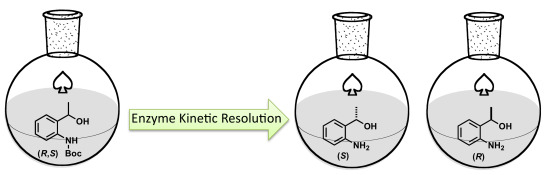
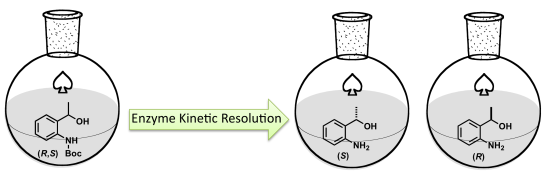
The enzymatic kinetic resolution of tert-butyl 2-(1-hydroxyethyl)phenylcarbamate via lipase-catalyzed transesterification reaction was studied. We investigated several reaction conditions and the carbamate was resolved by Candida antarctica lipase B (CAL-B), leading to the optically pure (R)- and (S)-enantiomers. The enzymatic process showed excellent enantioselectivity (E > 200). (R)- and (S)-tert-butyl 2-(1-hydroxyethyl)phenylcarbamate were easily transformed into the corresponding (R)- and (S)-1-(2-aminophenyl)ethanols.
1. Introduction
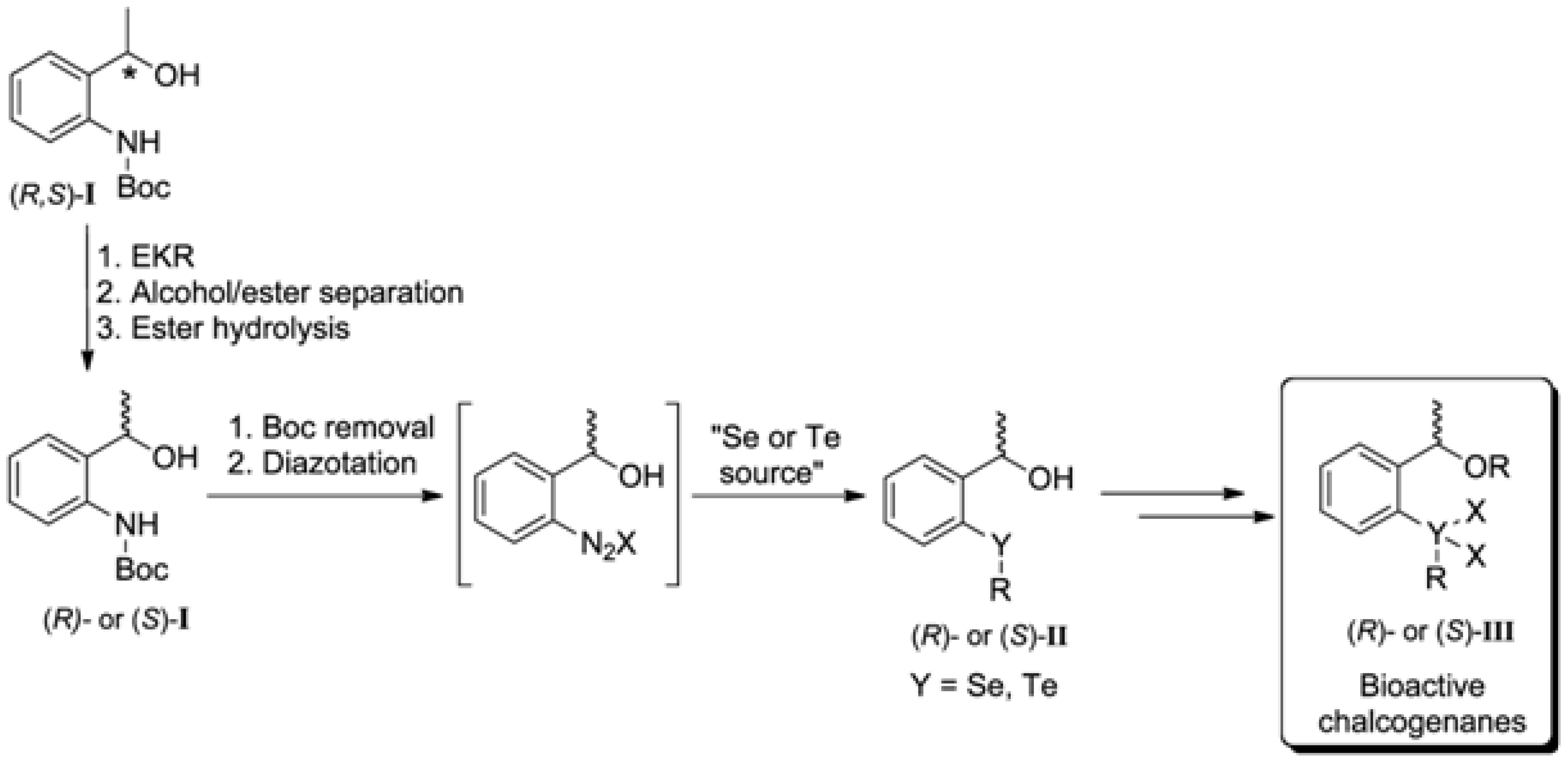
Selenium- and tellurium-containing compounds have drawn the attention of the scientific community due to their biological properties [1,2,3,4]. Notwithstanding the intense activity in the field of selenium and tellurium chemistry over the last three decades, organometallic reagents are commonly employed on the preparation of organo-selenium and -tellurium compounds. Moreover, hypervalent organoselenium(IV) compounds (organoselenanes) and organotellurium(IV) compounds (organotelluranes) have been investigated as cysteine protease [5,6,7,8], protein tyrosine phosphatase [9] and poliovirus 3C proteinase inhibitors [10]. Considering the biological activities of organoselenanes and telluranes, we have described chemoenzymatic methodologies to synthesize selenium compounds without employing organolithium or organomagnesium reagents [11,12]. Herein, we report the preparation of enantiopure organochalcogenane precursors, (R)- and (S)-tert-butyl 2-(1-hydroxyethyl)phenylcarbamate, employing enzymatic kinetic resolution (EKR) catalyzed by lipases. The chiral building blocks [(R)-I and (S)-I] could be applied as advanced synthetic intermediates of organotelluranes and organoselenanes III, containing an asymmetric center (Scheme 1). It is possible to transform (R)-I and (S)-I into their respective arene diazonium salts, followed by a reaction with a nucleophilic selenium/tellurium specie to give selenides/tellurides II, direct precursors of selenanes and telullaranes [12].
Scheme 1.
Synthetic route to bioactive chalcogenanes [5,6,9,12].
Scheme 1.
Synthetic route to bioactive chalcogenanes [5,6,9,12].

2. Results and Discussion
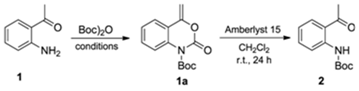
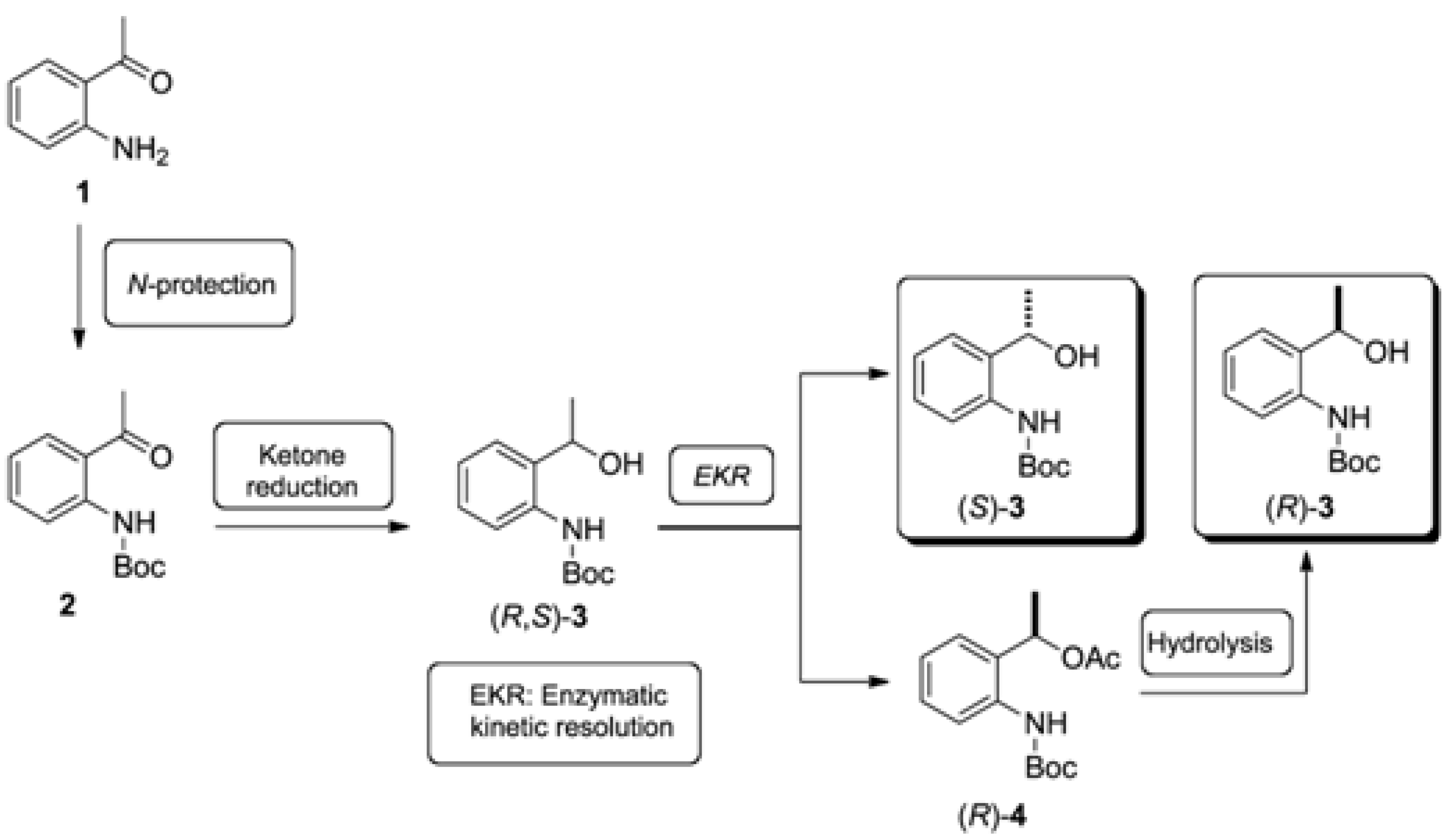
As outlined in Scheme 2, chiral building blocks (R)-3 and (S)-3 could be synthesized from commercially available 1-(2-aminophenyl)ethanone (1). Initially, the amine protection leads to the N-Boc-protected arylketone 2, which by reduction of the ketone group affords (R,S)-3. Then, the latter could be submitted to an enzymatic kinetic resolution (EKR) and, at the end of the process, both enantiomers could be easily separated.
2.1. Synthesis of the (R,S)-tert-butyl 2-(1-Hydroxyethyl)phenylcarbamate (3)
Several methods were evaluated to synthesize tert-butyl (2-acetylphenyl)carbamate (2) (Table 1). The protection of amine group was carried out by reacting 1-(2-aminophenyl)ethanone (1) with tert-butyl dicarbonate [(Boc)2O]. For example, by using dichloromethane (CH2Cl2) as solvent and DMAP as additive, after 24 h at room temperature, compound 2 was obtained in 60% yield (Entry 1). It is worth mentioning that the intermediate 1a was observed, then easily transformed to the compound 2 [13]. A second method, employing THF as solvent and under reflux was evaluated. However, a slight yield improvement (compound 2, 67%) was observed with a shorter reaction time, 12 h (Entry 2). Other reaction conditions were evaluated; however, the yields were lower than 40% (Entries 3–5). Next, we decided to apply the second method (Entry 2) to prepare the compound 2 in a preparative scale (5 mmol).
Scheme 2.
Synthetic route to enantiopure tert-butyl 2-(1-hydroxyethyl)phenylcarbamates.
Scheme 2.
Synthetic route to enantiopure tert-butyl 2-(1-hydroxyethyl)phenylcarbamates.

Table 1.
Synthesis of tert-butyl (2-acetylphenyl)carbamate (2).
| Entry | Additive (amount) | Solvent | t (°C) | Time (h) | Yield 2 (%) | Ref. |
|---|---|---|---|---|---|---|
| 1 | DMAP (1 equiv.) | CH2Cl2 | r.t. | 24 | 60 | [13] |
| 2 | DMAP (1 equiv.) | THF | reflux | 12 | 67 | [13,14] |
| 3 | I2 (2 equiv.) | -- | r.t. | 12 | 37 a | [15] |
| 4 | NaHCO3 (2 equiv.) | Dioxane | r.t. | 12 | traces a | [16] |
| 5 | NaOH (2 equiv.) | Dioxane | 0–r.t. | 12 | traces a | [17] |
Reaction conditions: Compound 1 (0.5 mmol), Boc)2O (1 mmol), solvent (5 mL), additive; a Determined by GC analysis; r.t. = room temperature.
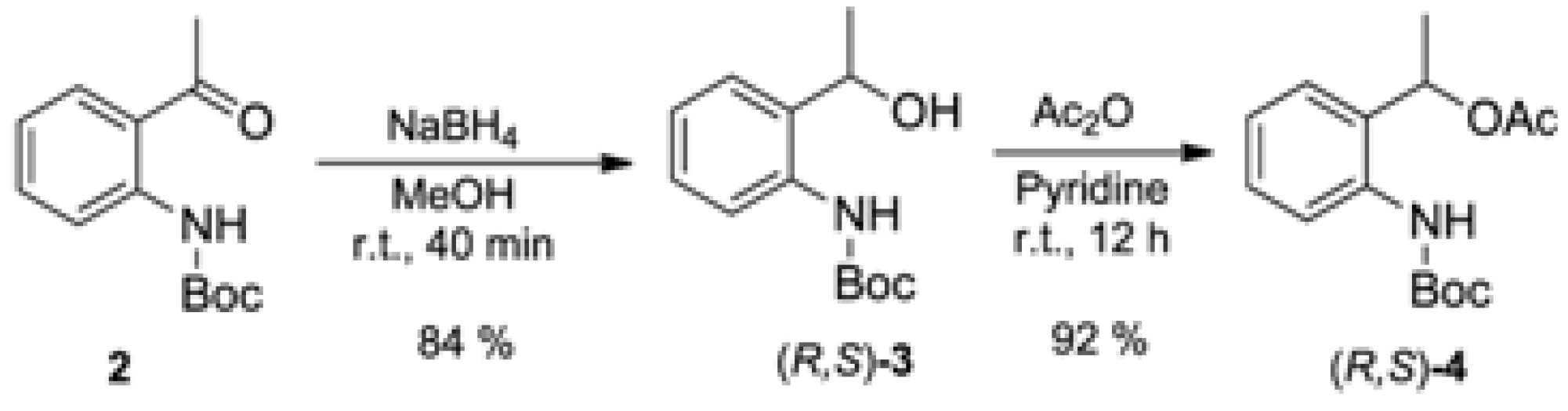
The reduction of tert-butyl (2-acetylphenyl)carbamate (2) with NaBH4 gave (R,S)-tert-butyl 2-(1-hydroxyethyl)phenylcarbamate (3) in 84% yield (Scheme 3). The acylated derivative (R,S)-4 was efficiently synthesized from (R,S)-3 and acetic anhydride (92% yield, Scheme 3).
Scheme 3.
Synthesis of racemic compounds 3 and 4.
Scheme 3.
Synthesis of racemic compounds 3 and 4.

2.2. Enzymatic Kinetic Resolution of the (R,S)-tert-butyl 2-(1-Hydroxyethyl)phenylcarbamate (3)

2.2.1. Screening of Lipases for Kinetic Resolution of (R,S)-3
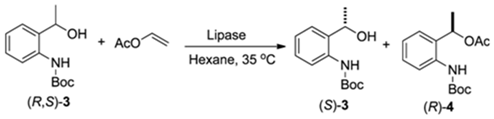
A screening set with 12 different lipases was carried out, looking for a enzyme able to mediate the transesterification of (R,S)-3 with high enantioselectivity and conversion in a short reaction time (Table 2).
Table 2.
Screening of lipases for kinetic resolution of (R,S)-3c.
| Entry | Lipase | Time (h) | c a(%) | ee b (%) (S)-3 (R)-4 | E c | |
|---|---|---|---|---|---|---|
| 1 | Candida Antarctica (Novozym® 435; immobilized on acrylic resin) | 12 | 47 | 88 | >99 | >200 |
| 2 | 24 | 50 | >99 | >99 | >200 | |
| 3 | 48 | 51 | >99 | 95 | >200 | |
| 4 | Pseudomonas cepacia (immobilized on ceramics) | 12 | 33 | 49 | >99 | >200 |
| 5 | 24 | 44 | 77 | >99 | >200 | |
| 6 | 48 | 49 | 95 | >99 | >200 | |
| 7 | Pseudomonas cepacia (immobilized on diatomite) | 12 | 16 | 19 | >99 | >200 |
| 8 | 24 | 26 | 34 | >99 | >200 | |
| 9 | 48 | 36 | 56 | >99 | >200 | |
| 10 | Candida rugosa | 12 | 14 | 13 | 81 | 10 |
| 11 | 24 | 17 | 17 | 81 | 11 | |
| 12 | 48 | 21 | 21 | 80 | 11 | |
| 13 | Candida cylindracea | 12 | 12 | 11 | 84 | 12 |
| 14 | 24 | 15 | 14 | 81 | 10 | |
| 15 | 48 | 18 | 17 | 80 | 10 | |
| 16 | Candida sp. (Novozymes® CALB L) | 24 | <5 d | nd | nd | nd |
| 17 | Thermomyces lanuginosus | 24 | <5 d | nd | nd | nd |
| 18 | Rhizomucor miehei | 24 | <5 d | nd | nd | nd |
| 19 | Porcine pancreas lipase | 24 | <5 d | nd | nd | nd |
| 20 | Aspergillus niger | 24 | <5 d | nd | nd | nd |
| 21 | Pseudomonas fluorescens | 24 | <5 d | nd | nd | nd |
| 22 | Penicillium camemberti | 24 | <5 d | nd | nd | nd |
| 23 | Mucor javanicus | 24 | <5 d | nd | nd | nd |
| 24 | Pseudomonas cepacia | 24 | <5 d | nd | nd | nd |
Reaction conditions: Compound (R,S)-3 (0.25 mmol), lipase (20 mg), vinyl acetate (1 mmol), hexane (1 mL), 35 °C, 160 rpm; a conversion: c = 100 × (ees/ees + eep); b enantiomeric excess: determined by HPLC analysis; c Enantiomeric ratio: E = ln{[eeP (1 − eeS)]/(eeP + eeS)}/ln{[eeP (1 + eeS)]/(eeP + eeS)}; d determined by GC analysis; nd: not determined due to low conversion.
Among the different type of lipases that were used as biocatalysts in the transesterification reaction, CAL-B presented high values of both conversion and enantioselectivity (Entries 1–3). After 12 h CAL-B-catalyzed reaction showed 47% conversion, high enantiomeric excess (ee) for (S)-3 (88%) and (R)-4 (>99%), and an enantiomeric ratio (E) higher than 200 (Entry 1). After 24 h, the conversion increased to 50% and both (S)-3 and (R)-4 were obtained with ee > 99% (Entry 2). After 48 h, the conversion was higher than 50% and consequently the ee of (R)-4 dropped to 95%. Based on these results, 24 h was selected as the most appropriate time to interrupt the kinetic resolution process.
Pseudomonas cepacia lipases also presented interesting results, but slightly inferior to those of CAL-B. For P. cepacia immobilized on ceramics, we observed high ee for (R)-4 (>99%) and E > 200 after 12 h (Entry 4). But, even after 48 h the conversion did not reach 50% and consequently the maximum ee for (S)-3 was 95% (Entry 6). For P. cepacia immobilized on diatomite, the conversion was lower than 40% and 56% ee for (S)-3 (Entry 9).
Lipases from Candida rugosa, Candida cylindracea, Candida sp., Thermomyces lanuginosus, Rhizomucor miehei, porcine pancreas, Aspergillus niger, Pseudomonas fluorescens, Penicillium camemberti, Mucor javanicus, Pseudomonas cepacia showed discouraging results (Entries 10–24), including cases in which the conversion was lower than 5% (Entries 16–24). Then, the CAL-B was selected as the appropriate lipase to be applied to the next studies.
2.2.2. Influence of Solvent in the Kinetic Resolution of (R,S)-3
The solvent influence on EKR of (R,S)-3 was also investigated (Table 3). The results demonstrated that the reaction in hexane presented high conversion (50%) and excellent enantioselectivity. For those reactions in toluene (Entries 3 and 4) and methyl tert-butyl ether (Entries 5 and 6) slightly inferior results were observed, in comparison with hexane. On the other hand, THF, CHCl3, i-PrOH and i-BuOH (Entries 7–10) showed a dramatic influence on the conversion, which resulted in low values, <30%.
2.2.3. Influence of Temperature in the Kinetic Resolution of (R,S)-3.
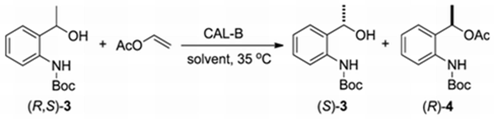
The temperature influence on EKR of (R,S)-3 (Table 4) was also studied. Different reaction time was also evaluated (12, 16, 20 and 24 h). In this study, we found that at 25 °C the perfect kinetic resolution of (R,S)-3 was achieved after 24 h (Entry 4). At 35 °C, the optimal values were achieved after 16 h (Entry 6). By increasing the temperature to 40 °C, the desired results were observed in 12 h (Entry 9). The same reaction-time tendency was verified at 50 °C. Therefore, 40 °C was chosen as the best temperature, since a reasonable reaction time with a relative low temperature can be used to obtain an excellent KR of (R,S)-3.
Table 3.
Influence of solvent in the lipase-catalyzed transesterfication of (R,S)-3.
| Entry | Solvent | Time (h) | c a (%) | eeb (%) (S)-3 (R)-4 | E c | |
|---|---|---|---|---|---|---|
| 1 | Hexane | 12 | 47 | 88 | >99 | >200 |
| 2 | 24 | 50 | 99 | >99 | >200 | |
| 3 | Toluene | 12 | 38 | 61 | >99 | >200 |
| 4 | 24 | 47 | 87 | >99 | >200 | |
| 5 | Methyl tert-butyl ether (MTE) | 12 | 42 | 73 | >99 | >200 |
| 6 | 24 | 49 | 94 | >99 | >200 | |
| 7 | Tetrahydrofuran (THF) | 24 | <30 d | nd | nd | nd |
| 8 | Cloroform (CHCl3) | 24 | <30 d | nd | nd | nd |
| 9 | Isobutylic alcohol (i-BuOH) | 24 | <30 d | nd | nd | nd |
| 10 | Diethylic ether (Et2O) | 24 | <30 d | nd | nd | nd |
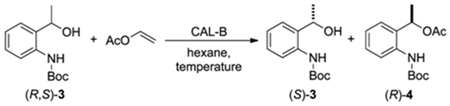
Reaction conditions: Compound (R,S)-3 (0.25 mmol), CAL-B (20 mg), vinyl acetate (1 mmol), solvent (1 mL), 35 °C, 160 rpm; a conversion: c = 100 × (ees/ees + eep); b enantiomeric excess: determined by HPLC analysis; c Enantiomeric ratio: E = ln{[eeP (1 − eeS)]/(eeP + eeS)}/ln{[eeP (1 + eeS)]/(eeP + eeS)}; d determined by GC analysis; nd: not determined due to low conversion.
Table 4.
Influence of temperature in the lipase-catalyzed transesterfication of (R,S)-3.
| Entry | Temperature (°C) | Tempo (h) | c a (%) | eeb (%) (S)-3 (R)-4 | Ec | |
|---|---|---|---|---|---|---|
| 1 | 25 | 12 | 45 | 80 | >99 | >200 |
| 2 | 25 | 16 | 46 | 86 | >99 | >200 |
| 3 | 25 | 20 | 49 | 95 | >99 | >200 |
| 4 | 25 | 24 | 50 | >99 | >99 | >200 |
| 5 | 35 | 12 | 48 | 89 | >99 | >200 |
| 6 | 35 | 16 | 50 | >99 | >99 | >200 |
| 7 | 35 | 20 | 50 | >99 | >99 | >200 |
| 8 | 35 | 24 | 50 | >99 | >99 | >200 |
| 9 | 40 | 12 | 50 | >99 | >99 | >200 |
| 10 | 40 | 16 | 50 | >99 | >99 | >200 |
| 11 | 40 | 20 | 51 | >99 | 98 | >200 |
| 12 | 40 | 24 | 52 | >99 | 97 | >200 |
| 13 | 50 | 12 | 50 | >99 | 98 | >200 |
| 14 | 50 | 16 | 50 | >99 | 98 | >200 |
| 15 | 50 | 20 | 52 | >99 | 97 | >200 |
| 16 | 50 | 24 | 53 | >99 | 94 | >200 |
Reaction conditions: Compound (R,S)-3 (0,25 mmol), CAL-B (20 mg), vinyl acetate (1 mmol), hexane (1 mL), 160 rpm; a conversion: c = 100 × (ees/ees + eep); b enantiomeric excess: determined by HPLC analysis; c Enantiomeric ratio: E = ln{[eeP (1 − eeS)]/(eeP + eeS)}/ln{[eeP (1 + eeS)]/(eeP + eeS)}.
2.2.4. Study of the Ratio of Enzyme to Substrate for Kinetic Resolution of (R,S)-3
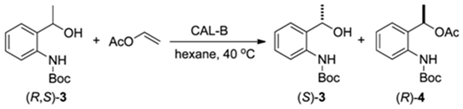
The ratio enzyme/substrate was also investigated for EKR of (R,S)-3 at 40 °C and 12 h (Table 5). It was observed that 10 mg of CAL-B was not enough to reach 50% of conversion (Entry 3). By using 20 and 40 mg the desired result was achieved just at the end of the experiments (Entries 6 and 9). However, the reaction with 80 mg of CAL-B showed 50% of conversion after 8 h (Entry 11) and for the reaction with 100 mg only 6 h were needed to obtain the desired results (Entry 13), but we considered the ratio of 100 mg CAL-B to 0.25 mmol substrate impracticable, so 20 mg was chosen as the optimal amount to achieve excellent values of conversion and enantiomeric excess.
Table 5.
Study of ratio CAL-B/substrate for kinetic resolution of (R,S)-3.
| Entrada | Massa(mg) | Tempo (h) | c(%) a | ee (%) b 3 4 | E c | |
|---|---|---|---|---|---|---|
| 1 | 10 | 6 | 30 | 63 | >99 | >200 |
| 2 | 10 | 8 | 39 | 75 | >99 | >200 |
| 3 | 10 | 12 | 45 | 90 | >99 | >200 |
| 4 | 20 | 6 | 40 | 84 | >99 | >200 |
| 5 | 20 | 8 | 45 | 93 | >99 | >200 |
| 6 | 20 | 12 | 50 | >99 | >99 | >200 |
| 7 | 40 | 6 | 43 | 86 | >99 | >200 |
| 8 | 40 | 8 | 48 | 97 | >99 | >200 |
| 9 | 40 | 12 | 50 | >99 | >99 | >200 |
| 10 | 80 | 6 | 48 | 97 | >99 | >200 |
| 11 | 80 | 8 | 50 | >99 | >99 | >200 |
| 12 | 80 | 12 | 51 | >99 | 97 | >200 |
| 13 | 100 | 6 | 50 | >99 | >99 | >200 |
| 14 | 100 | 8 | 50 | >99 | >99 | >200 |
| 15 | 100 | 12 | 52 | >99 | 95 | >200 |
Reaction conditions: Compound (R,S)-3 (0.25 mmol), CAL-B, vinyl acetate (1 mmol), hexane (1 mL), 40 °C, 160 rpm; a conversion: c = 100 × (ees/ees + eep); b enantiomeric excess: determined by HPLC analysis; c Enantiomeric ratio: E = ln{[eeP (1 − eeS)]/(eeP + eeS)}/ln{[eeP (1 + eeS)]/(eeP + eeS)}.
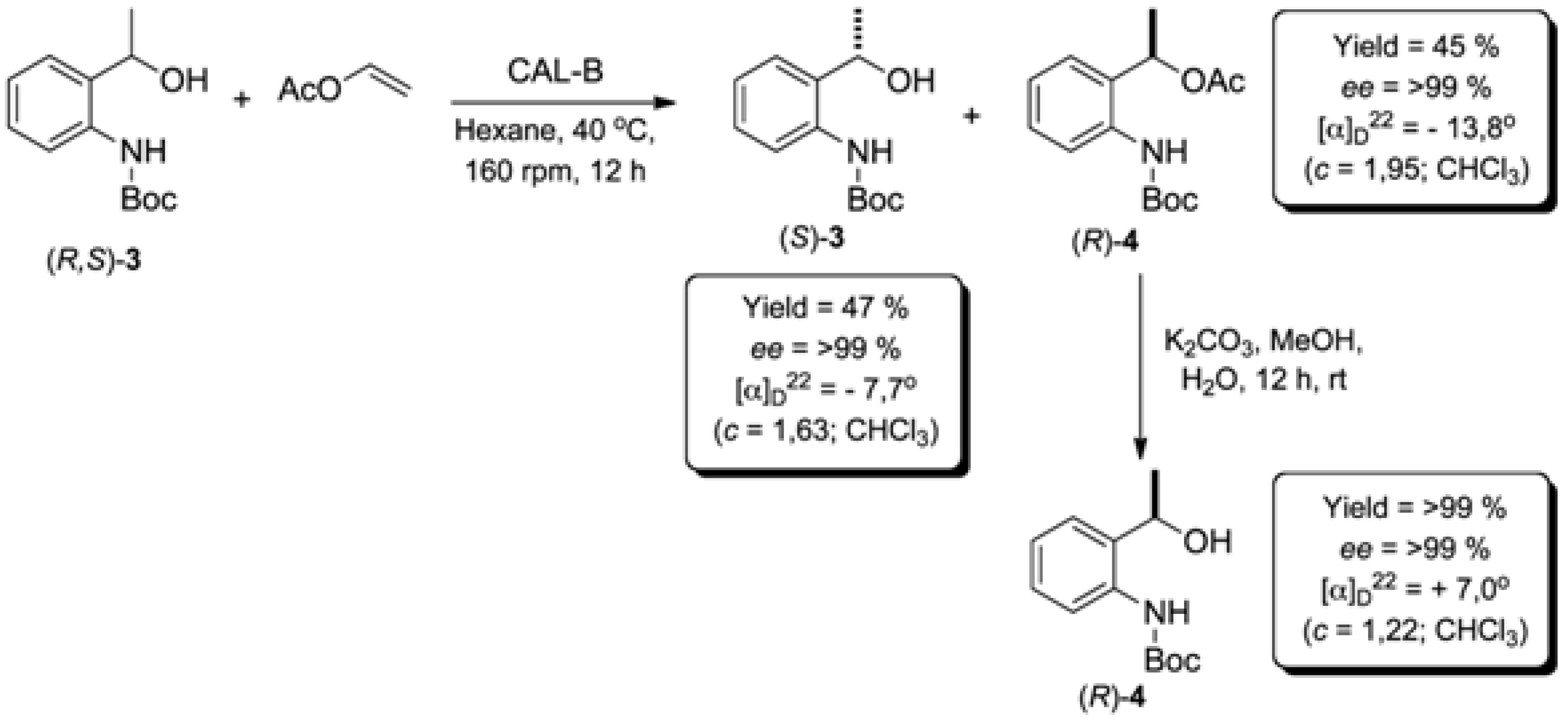
In order to obtain the compounds (S)-3 and (R)-3 and to assign the absolute configuration, a reaction on a preparative scale (5 mmol) was carried out. After quenching the reaction, the compounds (S)-3 and (R)-4 were separated by flash gel column chromatography. Then, the ester (R)-4 was submitted to a hydrolysis reaction to give the alcohol (R)-3 (Scheme 4). In this way, both enantiomers of 3 were obtained in high enantiomeric purity (ee > 99%) and yields (>45%).
Scheme 4.
Synthesis of (R)- and (S)-3.
Scheme 4.
Synthesis of (R)- and (S)-3.

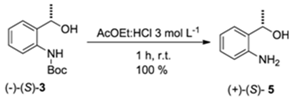
The absolute configuration of the compound 3 was indirectly attributed after deprotection of the amino group of (−)-(S)-3 [18]. Then, the optical rotation of the resulting amino-alcohol 5 was measured, and by comparison with literature data [18] its absolute configuration was attributed to (S)-5 (Table 6). Consequently, the configuration of the NH-Boc protected precursor was also attributed to (S)-3.
Table 6.
Assignment of the absolute configuration of tert-butyl 2-(1-hydroxyethyl)phenylcarbamate (3).
| # | ee (%) | [a]D |
|---|---|---|
| Literature [18] | 93 | +52, 5 (c = 1,0; CHCl3) |
| This work | >99 | +63,1 (c = 1,1; CHCl3) |
3. Experimental Section
Commercially available materials were used without further purification. Lipase from Candida antarctica (fraction B, CAL-B) immobilized, and commercially available as Novozym® 435 was kindly donated by Novozymes Latin America Ltda. All solvents were HPLC or ACS grade. Solvents used for moisture sensitive operations were distilled from drying reagents under a nitrogen atmosphere: THF was distilled from Na/benzophenone.
Analytical thin-layer chromatography (TLC) was performed using aluminum-backed silica plates coated with a 0.25 mm thickness of silica gel 60 F254 (Merck), visualized with an ultraviolet light (l = 254 nm), followed by exposure to p-anisaldehyde solution or vanillin solution and heating. Standard chromatographic purification methods were followed using 35–70 mm (240–400 mesh) silica gel purchased from Acros Organics®.
Nuclear magnetic resonance (NMR) spectra were recorded on a Bruker AC 200 spectrometer at operating frequencies of 200 (1H-NMR) and 50 MHz (13C-NMR). The 1H-NMR chemical shifts are reported in ppm relative to TMS peak. The data are reported as follows: chemical shift (δ), multiplicity (s = singlet, d = doublet, t = triplet, qd = quadruplet, dd = double dublet, td = triple dublet, m = multiplet), and coupling constant (J) in Hertz and integrated intensity. The 13C-NMR chemical shifts are reported in ppm relative to CDCl3 signal.
Reaction products were analyzed by a Shimadzu model GC-17A (FID) gas chromatograph equipped with a J&W Scientific HP5 column (30 m × 0.25 mm I.D.; 0.25 µm). The chromatographic conditions were as follows: Oven temperature initiated at 50 °C and increased at 10 °C/min; run time 20 min; injector temperature 230 °C; detector temperature 250 °C; injector split ratio 1:20; hydrogen carrier gas at a pressure of 100 kPa. The enantiomeric excesses of the products were determined by HPLC analyses performed in a Shimadzu model SPD-10Av instrument with UV-Vis detector (deuterium lamp 190–600 nm) and equipped with a Chiralcel® OD-H column (25 cm × 0.46 cm I.D.; Daicel Chemical Ind.) eluted with n-hexane (60%) and 2-propanol (99:1).
High-resolution mass spectra (HRMS) were acquired using a Bruker Daltonics MicroTOF instrument, operating in the electrospray ionization (ESI) mode.
Infrared spectra were recorded from KBr discs or from a thin film between NaCl plates on FTIR spectrometer (Bomem Michelson model 101). Absorption maxima (νmax) are reported in wavenumbers (cm−1).
Optical rotations were measured on a Perkin Elmer-343 digital polarimeter in a 1 mL cuvette with a 1 dm pathlength. All values are reported in the following format: [α]D(temperature of measurement) = specific rotation (concentration of the solution reported in units of 10 mg sample per 1 mL solvent used).
3.1. Synthesis of tert-butyl (2-Acetylphenyl)carbamate (2) (Adapted from References [13,14])
To a solution of the 1-(2-aminophenyl)ethanone (1, 1.35 g, 10 mmol) in anhydrous THF (100 mL) Boc)2O (6.48 g, 30 mmol) was added, followed by DMAP (122 mg, 1 mmol). The solution was stirred under reflux for 12 h then concentrated to dryness and partitioned between 0.5 mol L−1 HCl (100 mL) and EtOAc (100 mL). The aqueous layer was extracted with EtOAc (2 × 100 mL) and the combined organic phases were washed with brine (50 mL), dried over MgSO4, filtered and concentrated to afford the crude tert-butyl (2-acetylphenyl)carbamate (2) and the di-Boc derivative products. These compounds were separated by flash silica gel column chromatography eluted with hexane/EtOAc 9:1. (2-Acetylphenyl)carbamate (2) and the di-Boc derivative were isolated in 45% and 31% yields, respectively. The di-Boc compound (1.00 g) was dissolved in CH2Cl2 (100 mL) and Amberlyst 15 resin (1.00 g) was added. The mixture was stirred for 24 h in an orbital shaker. Then, the solvent was removed and the residue filtered through a silica gel column with hexane/EtOAc 9:1. The compound 2 was obtained in 67% yield. 1H-NMR (200 MHz, CDCl3); d (ppm): 10.95 (s, 1H); 8.46 (d, 1H, J = 8.3 Hz); 7.84 (dd, 1H, JA = 7.9 Hz; JB = 1.32 Hz); 7.50 (td, 1H, JA = 8.3 Hz; JB = 1.3 Hz); 7.01 (t, 1H, J = 7.9 Hz); 2.64 (s, 3H); 1.53 (s, 9H). 13C-NMR (50 MHz, CDCl3); d (ppm): 202.5; 153.4; 142.0; 135.2; 131.9; 121.6; 121.2; 119.4; 80.7; 28.8. IV (KBr), cm−1: 3432; 2947; 1713; 1656; 1562; 1239; 1108; 739. HRMS (ESI), [M+Na]+: Calculated for C13H17NO3Na: 258.1106. Found: 258, 1104.
3.2. Synthesis of Racemic tert-butyl (2-(1-Hydroxyethyl)phenyl)carbamate [(R,S)-3]
To a solution of tert-butyl (2-acetylphenyl)carbamate (2, 1.175 g, 5 mmol) in methanol (50 mL) NaBH4 (0.21 g, 5.5 mmol) at 0 °C was added. After adding NaBH4, the ice bath was removed and the solution was stirred at room temperature for 2 h then concentrated to dryness. To residue water (30 mL) was added and the pH adjusted to 6.0. In the sequence the mixture was extracted with CH2Cl2 (3 × 15 mL), dried over MgSO4, filtered and concentrated to afford the crude tert-butyl (2-(1-hydroxyethyl)phenyl)carbamate (3). This was purified by flash silica gel column chromatography eluted with hexane/EtOAc 9:1 to afford 3 in 84% yield. 1H-NMR (200 MHz, CDCl3);d (ppm): 8.01 (s, 1H); 7.90 (d, 1H, J = 8.3 Hz); 7.26 (t, 1H, J = 7.5 Hz); 7.14 (d, 1H, J = 7.5 Hz); 7,00 (t, 1H, J = 7.5 Hz); 4,95 (qd, 1H, J = 6.6 Hz); 1.54 (m, 12H). 13C-NMR (50 MHz, CDCl3); d (ppm): 153.5; 136.7; 132.7; 127.9; 126.4; 122.9; 121.4; 80.0; 69.5; 28.2; 22.1. IR (film), cm−1: 3457; 3343; 2979; 1761; 1727; 1524; 1449; 1254. HRMS (ESI), [M+Na]+: Calculated for C13H19NO3Na: 260.1263. Found: 260.1262.
3.3. Synthesis of Racemic 1-(2-((tert-Butoxycarbonyl)amino)phenyl)ethyl acetate [(R,S)-4]
To a solution of the (2-(1-hydroxyethyl)phenyl)carbamate (3, 237 g, 1 mmol) in pyridine (2 mL) was added Ac2O (0.10 g, 1 mmol). The solution was stirred at room temperature overnight then diluted in EtOAc (20 mL) and washed with CuSO4 (5 mL portions) to the complete removal of the pyridine. The organic phase was dried over MgSO4, filtered and concentrated to afford the crude 1-(2-((tert-butoxycarbonyl)amino)phenyl)ethyl acetate (4). The crude material was purified by flash silica gel column chromatography eluted with hexane/EtOAc 9:1 to afford 4 in 92% yield. 1H-NMR (200 MHz, CDCl3); d (ppm): 7.78 (d, 2H, J = 8.1 Hz); 7.66 (s, 1H); 7.32 (m, 2H); 7.12 (td, 1H, JA = 7.5 Hz; JB = 0.8 Hz); 5.98 (qd, 1H, J = 6.4 Hz); 2.0 (s, 3H); 1.61 (d, 3H, J = 6.4 Hz); 1.5 (s, 9H). 13C-NMR (50 MHz, CDCl3); d (ppm): 170.2; 152.8; 135.1; 130.7; 128.1; 126.3; 123.6; 122.9; 79.3; 68.1; 27.6; 20.3; 20.0. IR (film), cm−1: 3432; 3338; 2980; 1731; 1591; 1519; 1453; 1241; 1160. HRMS (ESI), [M+Na]+: Calculated for C15H21NO4Na: 302.1368. Found 302.1364.
3.4. Enzymatic Kinetic Resolution of the (R,S)-tert-butyl 2-(1-Hydroxyethyl)phenylcarbamate [(R,S)-3]
To solution of racemic tert-butyl (2-(1-hydroxyethyl)phenyl)carbamate (3, 1.185 g; 5 mmol) in hexane (20 mL), CAL-B (Novozym® 435; 400 mg) and vinyl acetate (1.72 g; 20 mmol) were added. The mixture was stirred in an orbital shaker at 40 °C for 12 h (160 rpm). Following that, the enzyme was filtered off and washed with dichloromethane (3 × 20 mL). The solvent was removed under reduced pressure and the residue was purified by flash silica gel column chromatography eluted with hexane/EtOAc 9:1 to afford (S)-3 (ee > 99%) in 47% yield and (R)-4 (ee > 99%) in 45% yield.
3.5. HPLC Analysis of (S)- and (R)-tert-butyl (2-(1-Hydroxyethyl)phenyl)carbamate (3)
HPLC conditions: Chiralcel® OD-H column, n-hexane/i-PrOH (99:1), 1.0 mL min−1, 254 nm UV detector. (S)-3: isolated yield = 45%; retention time: 23.7 min; ee > 99%; [α]D22 = −7.7 (c = 1.63; CHCl3). (R)-3: Isolated yield = 45%; retention time: 29.2 min; ee > 99%; [α]D22 = 7.0 (c = 1.22; CHCl3).
3.6. General Procedure to Remove Boc-Protecting Group (Adapted from Reference [19])
To a mixture of AcOEt:HCl 3 mol L−1 1:1 (5 mL), N-Boc protected compound (1 mmol) was added. The mixture was stirred at room temperature for 1 h. After that, the solvent was removed under vacuum. The residue was dissolved in CH2Cl2 (10 mL) and washed with saturated NaHCO3 solution (3 × 3 mL). Then, the organic layer was dried over MgSO4, filtered and concentrated to dryness under vacuum. The product was obtained in quantitative yield without further purification.
4. Conclusions
In summary, we have described an efficient methodology to obtain (R)- and (S)-tert-butyl 2-(1-hydroxyethyl)phenylcarbamates in enantiopure form (ee > 99%), using a kinetic resolution process mediated by lipase as a biocatalyst. Both enantiomers can be employed in the preparation of organochalcogenanes for further application in biological studies.
Acknowledgments
The authors thank CNPq, CAPES and FAPESP for their financial support.
References
- Mugesh, G.; du Mont, W.-W.; Sies, H. Chemistry of biologically important synthetic organoselenium compounds. Chem. Rev. 2001, 101, 2125–2179. [Google Scholar]
- Ba, L.A.; Döring, M.; Jamier, V.; Jacob, C. Tellurium: An element with great biological potency and potential. Org. Biomol. Chem. 2010, 8, 4203–4216. [Google Scholar]
- Brabak, K.P.; Mugesh, G. Functional mimics of glutathione peroxidase bioinspired synthetic antioxidants. Acc. Chem. Res. 2010, 43, 1408–1419. [Google Scholar] [CrossRef]
- Alberto, E.E.; do Nascimento, V.; Braga, A.L. Catalytic application of selenium and tellurium compounds as glutathione peroxidase enzyme mimetics. J. Braz. Chem. Soc. 2010, 21, 2032–2041. [Google Scholar] [CrossRef]
- Piovan, L.; Alves, M.F.M.; Juliano, L.; Bromme, D.; Cunha, R.L.O.R.; Andrade, L.H. Structure-activity relationships of hypervalent organochalcogenanes as inhibitors of cysteine cathepsins V and S. Bioorg. Med. Chem. 2011, 19, 2009–2014. [Google Scholar] [CrossRef]
- Piovan, L.; Alves, M.F.M.; Juliano, L.; Bromme, D.; Cunha, R.L.O.R.; Andrade, L.H. Chemoenzymatic synthesis of organoselenanium(IV) compounds and their evaluation as cysteine proteases inhibitors. J. Braz. Chem. Soc. 2010, 21, 2108–2118. [Google Scholar]
- Cunha, R.L.O.R.; Urano, M.E.; Chagas, J.R.; Almeida, P.C.; Bincoleto, C.; Tersariol, I.L.S.; Comasseto, J.V. Tellurium-based cysteine inhibitors: Evaluation of novel organotellurium(IV) compounds as inhibitors of human cathepsin B. Bioorg. Med. Chem. Lett. 2005, 15, 755–760. [Google Scholar] [CrossRef]
- Cunha, R.L.O.R.; Gouvêa, I.E.; Feitosa, G.P.V.; Alves, M.F.M.; Bromme, D.; Comasseto, J.V.; Tersariol, I.L.S.; Juliano, L. Irreversible inhibition of human cathepsins B, L, S, and K by hypervalent tellurium compounds. Biol. Chem. 2009, 390, 1205–1212. [Google Scholar] [CrossRef]
- Piovan, L.; Wu, L.; Zhang, Z.Y.; Andrade, L.H. Hypervalent organochalcogenanes as inhibitors of protein tyrosine phosphatases. Org. Biomol. Chem. 2011, 9, 1347–1351. [Google Scholar] [CrossRef]
- Gouveia, I.E.; Santos, J.A.N.; Burlandy, F.M.; Tersariol, I.L.S.; da Silva, E.E.; Juliano, M.A.; Juliano, L.; Cunha, R.L.O.R. Poliovirus 3C proteinase inhibition by organotelluranes. Biol. Chem. 2011, 392, 587–591. [Google Scholar]
- Silva, A.; Andrade, L.H. First chemoenzymatic synthesis of organoselenium amines and amides. Tetrahedron: Asymmetry 2008, 19, 1175–1181. [Google Scholar]
- Omori, A.T.; Assis, L.F.; Andrade, L.H.; Comasseto, J.V.; Porto, A.L.M. Enantiomerically pure organoseleno-1-arylethanols by enzymatic resolution with Candida antarctica lipase: Novozym 435. Tetrahedron: Asymmetry 2007, 18, 1048–1053. [Google Scholar] [CrossRef]
- Broutin, P.-E.; Hilty, P.; Thomas, A.W. An efficient synthesis of ortho-N-Boc-arylmethyl ketone derivatives. Tetrahedron Lett. 2003, 44, 6429–6432. [Google Scholar] [CrossRef]
- Darnbrough, S.; Mervic, M.; Condon, S.M.; Burns, C.J. An improved synthesis of N-Boc protected aryl amines. Syn. Commun. 2001, 31, 3273–3280. [Google Scholar]
- Varala, R.; Nuvula, S.; Adapa, S.R. Molecular iodine-catalyzed facile procedure for N-Boc protection of amines. J. Org. Chem. 2006, 71, 8283–8286. [Google Scholar]
- Braga, A.L.; Lüdtke, D.S.; Paixão, M.W.; Alberto, E.E.; Stefani, H.A.; Juliano, H. Straightforward synthesis of non-natural selenium containing amino acid derivatives and peptides. Eur. J. Org. Chem. 2005, 4260–4264. [Google Scholar]
- Chaume, G.; Kuligowski, C.; Benzzenine-Laffolée, S.; Ricard, L.; Pancrazi, A.; Ardisson, J. Zinc-acetic acid reductive cyclisation in a two-step synthesis of the S1-N10 nine-membered lactone core of ent-griseoviridin. Synthesis 2004, 18, 3029–3036. [Google Scholar]
- Mannan, S.; Sekar, G. An enantiopure galactose oxidase model: Synthesis of chiral amino alcohols through oxidative kinetic resolution catalyzed by a chiral copper complex. Tetrahedron: Asymmetry 2009, 20, 497–502. [Google Scholar]
- Stahl, G.L.; Walter, R.; Smith, C.W. General procedure for the synthesis of mono-N-acylated 1,6-diaminohexanes. J. Org. Chem. 1978, 43, 2285–2286. [Google Scholar]
- Sample Availability: Not available.
© 2011 by the authors; licensee MDPI, Basel, Switzerland. This article is an open access article distributed under the terms and conditions of the Creative Commons Attribution license ( http://creativecommons.org/licenses/by/3.0/).