

Synthesis of (R)-Dihydropyridones as Key Intermediates for an Efficient Access to Piperidine Alkaloids

Abstract
Introduction
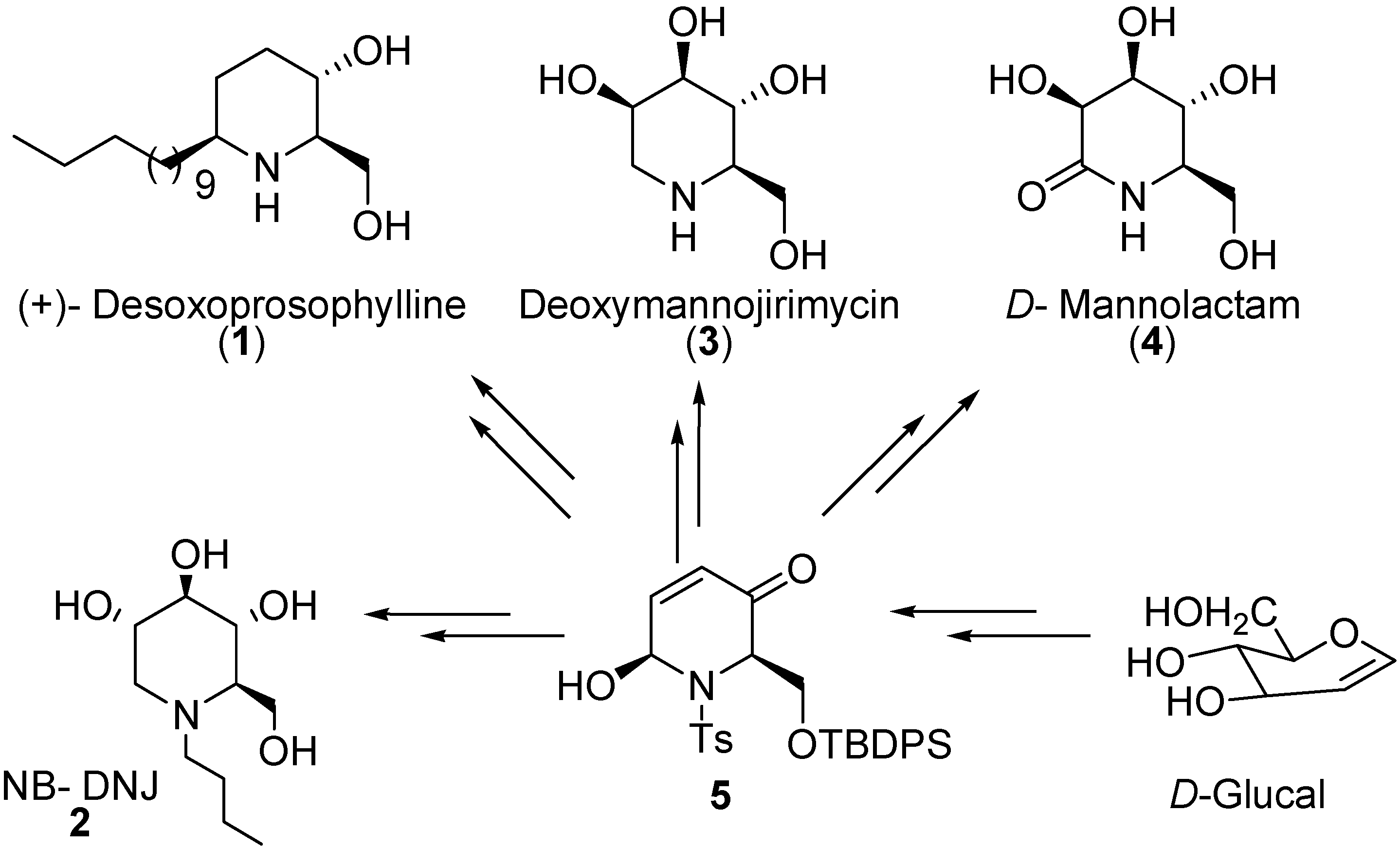
Results and Discussion
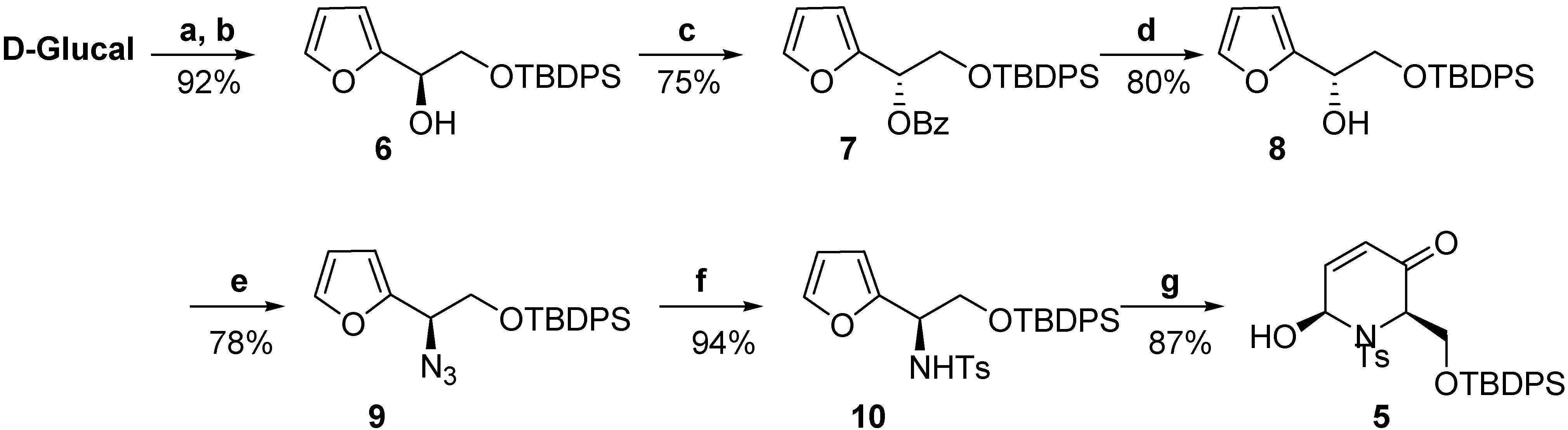
 –25.5) constitutes additional proof of the assigned configuration, since its enantiomer displays the opposite sign ( +27.9) [20b].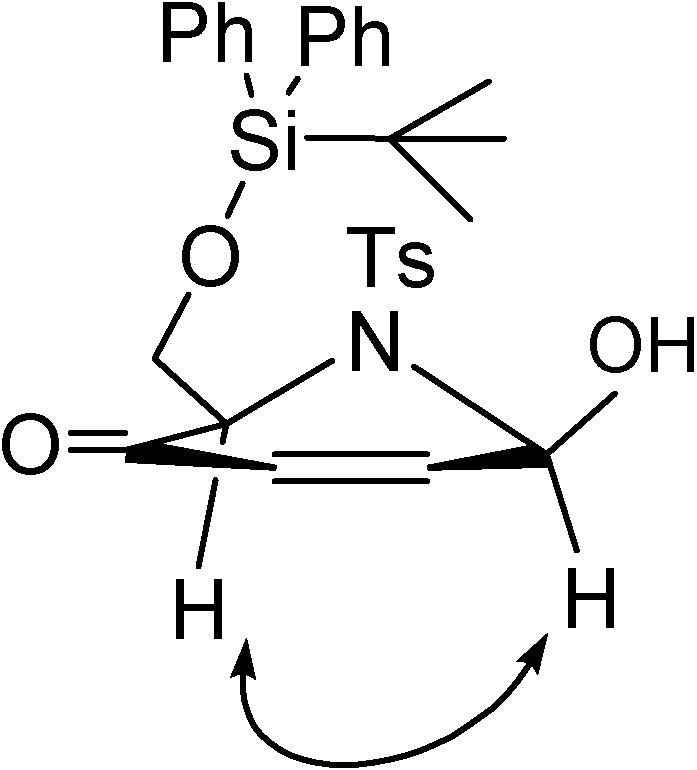
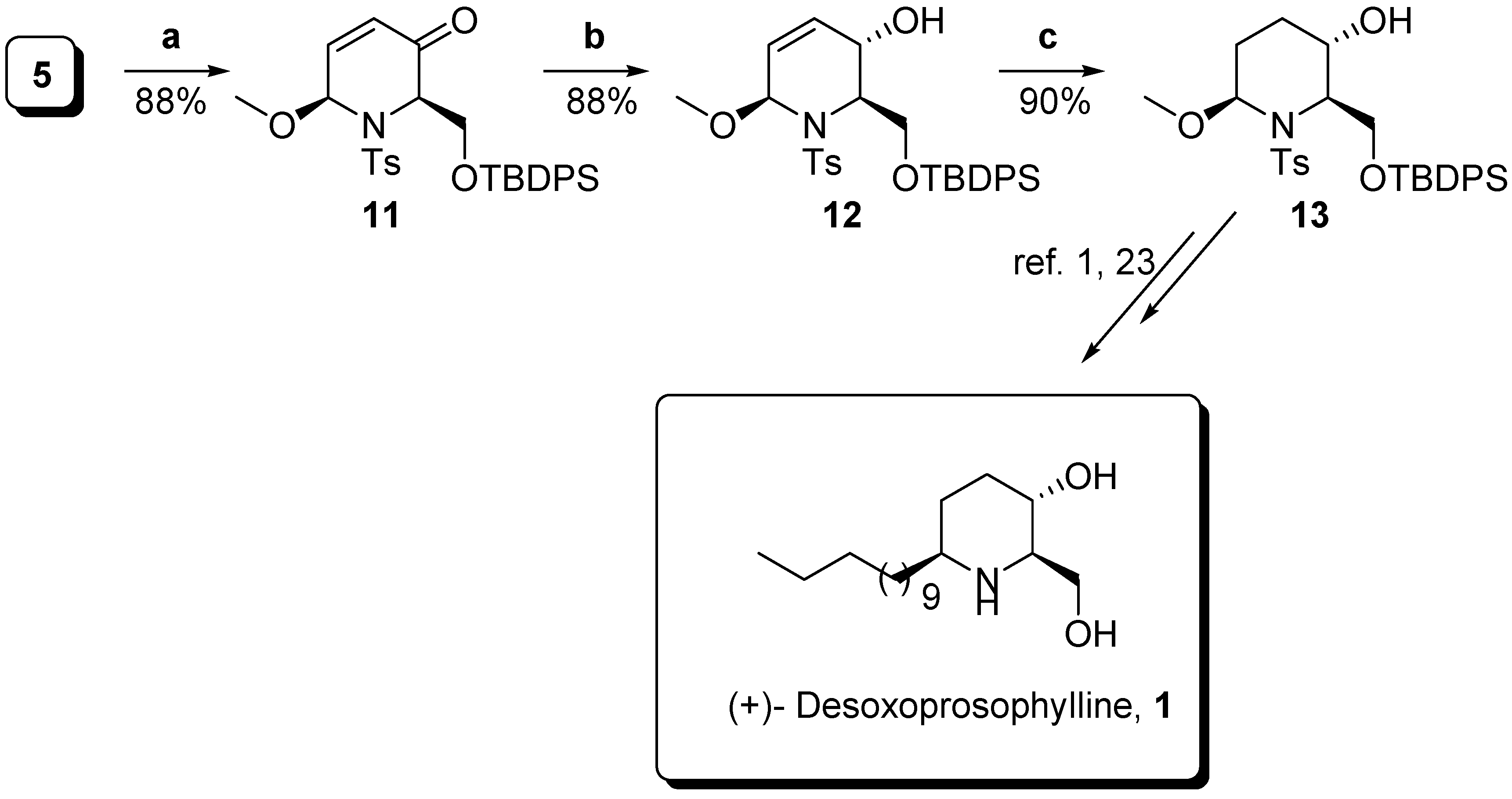
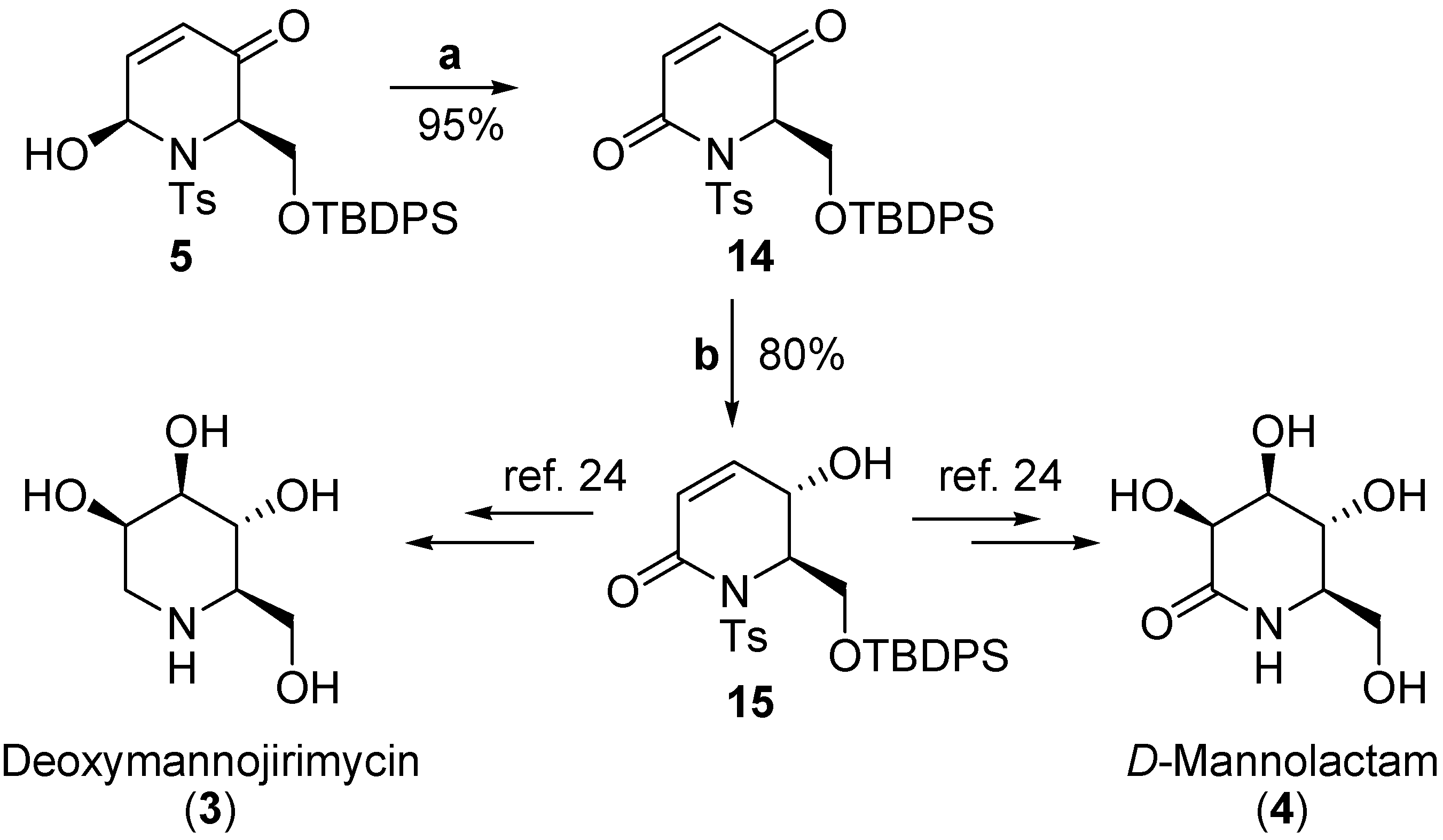
Conclusions
Experimental
General
+28.7, c 2.03, MeOH) was prepared according to a literature procedure [22]. All reactions were monitored by thin-layer chromatography using TLC sheets coated with silica gel 60 F254 (Merck); spots were visualized with UV light or/and an alcohol solution of anisaldehyde. Products were purified by flash chromatography on Merck silica gel 60 (230-400 mesh ASTM). Melting points (uncorrected): Büchi melting point apparatus. FT-IR: Nicolet Magna 750, series II. Samples were recorded as KBr pellets, unless otherwise stated. Optical rotations were measured with a Perkin-Elmer-241 polarimeter. 1H-NMR spectra were recorded on a Bruker DRX-400 (400 MHz) spectrometer, in CDCl3. Chemical shifts are referenced to internal TMS. Coupling constants (J) are expressed in Hz. HPLC: Hewlett Packard 1100 series instrument with a variable wavelength UV detector and coupled to HP Chem-Station utilizing the manufacturer’s 5.01 software package. −5.7 (c 1.00, EtOAc); 1H-NMR δ: 1.42 (s, 9H, C-CH3), 4.53 (dd, J = 10.7, 4.8, 1H, CH2), 4.65 (dd, J = 10.7, 4.8, 1H, CH2), 6.78 (dd, J = 7.2, 4.9, 1H, CH), 6.88 (d, J = 6.8, 1H, H-3), 7.70-8.10 (m, 15H, Ph-H, H-4, H-5), 8.50 (d, J = 6.8, 2H, Ph-H); Anal. Calcd. for C29H30O4Si (470.63) C, 74.01; H, 6.43. Found: C, 74.19; H, 6.30. –4.2 (c 1.03, EtOAc); IR (neat): ṽ= 3350 (OH), 740, 1020 (furan) cm-1; 1H-NMR δ: 1.07 (s, 9H, C-CH3), 3.95 (d, J = 1.4, 2H, CH2), 4.83 (m, 1H, CH), 6.27 (d, J = 3.2, 1H, H-3), 6.3 (dd, J = 5.0, 1.8, 1H, H-4), 7.3-7.6 (m, 11H, Ph-H, H-5); Anal. Calcd. for C22H26O3Si (366.53): C, 72.09; H, 7.15. Found: C, 72.31; H, 7.02. +50.8 (c 1.01, EtOAc); IR (neat): ṽ= 2110 (N3), 742, 1020 (furan) cm-1; 1H-NMR δ: 1.10 (s, 9H, C-CH3), 4.01 (d, J = 6.7, 2H, CH2), 4.60 (t, J = 5.5, 1H, CH), 6.37 (d, J = 1.8, 2H, H-3, H-4), 7.45 (m, 7H, H-5, Ph-H), 7.70 (m, 4H, Ph-H); Anal. Calcd. for C22H25N3O2Si (391.54): C, 67.49; H, 6.44; N, 10.73. Found: C, 67.27; H, 6.52; N, 10.59. +5.5 (c 1.01, EtOAc); IR (neat): ṽ= 3285 (N-H), 740, 1030 (furan), cm-1; 1H-NMR δ: 0.99 (s, 9H, C-CH3), 2.41 (s, 3H, PhCH3), 3.72 (dd, J = 10.1, 4.9, 1H, CH2), 3.85 (dd, J = 10.1, 4.9, 1H, CH2), 4.43 (m, 1H, CH), 5.2 (d, J = 7.6, 1H, NH), 6.13 (d, J = 3.11, 1H, H-3), 6.24 (dd, J = 3.1, 1.9, 1H, H-4), 7.20-7.52 (m, 13H, Ph-H, H-5), 7.22 (d, J = 8.3, 1H), 7.66 (d, J = 8.0, 2H, Ph-H); Anal. Calcd. for C29H33NO4SSi (519.73): C, 67.02; H, 6.40; N, 2.70. Found: C, 66.78; H, 6.30; N, 2.81. –25.5 (c 1.00, MeOH); IR (neat): ṽ= 3397 (OH), 1692 (C=O), 1595 (C=C) cm-1; 1H-NMR δ: 0.95 (s, 9H, C-CH3), 2.45 (s, 3H, PhCH3), 3.60 (dd, J = 10.7, 2.4, 1H, CH2), 3.90 (dd, J =10.7, 2.4, 1H, CH2 ), 4.55 (m, 1H, H-2), 4.96 (d, J = 11.5, 1H, OH), 6.10 (m, 1H, H-6), 6.22 (d, J = 10.4, 1H, H-4), 7.08 (dd, J = 10.4, 4.8, 1H, H-5), 7.3-7.5 (m, 12H, Ph-H), 7.79 (d, J = 8.0, 2H, Ph-H); Anal. Calcd. for C29H33NO5SSi (535.73): C, 65.02; H, 6.21; N, 2.61. Found: C, 65.17; H, 6.28; N, 2.68. −45 (c 1.02, EtOAc); IR (neat): ṽ= 1694 (C=O), 1596 (C=C) cm-1; 1H-NMR δ: 1.07 (s, 9H, C-CH3), 2.39 (s, 3H, PhCH3), 3.54 (s, 3H, CH3), 3.97 (dd, J = 10.2, 6.6, 1H, CH2), 4.07 (dd, J = 10.2, 6.6, 1H, CH2), 4.47 (t, J = 6.9, 1H, H-2), 5.51 (d, J = 4.3, 1H, H-6), 5.74 (d, J = 10.36, 1H, H-4), 6.68 (dd, J = 10.3, 4.4, 1H, H-5), 7.24 (d, J = 7.4, 2H, Ph-H), 7.44 (m, 6H, Ph-H), 7.55 (d, J = 8.2, 2H, Ph-H), 7.67 d, J = 7.4, 4H, Ph-H); Anal. Calcd. for C30H35NO5SSi (549.75): C, 65.54; H, 6.42; N, 2.55. Found: C, 65.69; H, 6.52; N, 2.44. −32.5 (c 0.98, EtOAc); IR (neat): ṽ= 3460 (OH), 1650 (C=C) cm-1; 1H-NMR δ: 1.05 (s, 9H, C-CH3), 2.42 (s, 3H, PhCH3), 3.31 (s, 3H, CH3), 3.77 (dd, J = 10.6, 4.2, 1H, CH2), 3.95 (m, 1H, H-3), 4.17 (d, J = 6.85, 1H, OH), 4.2 (m, 1H, H-2), 4.4 (t, J = 10.3, 1H, CH2), 5.24 (m, 1H, H-6), 5.69 (m, 1H, H-5), 5.84 (m, 1H, H-4), 7.25 (t, J = 9.01, 2H, Ph-H), 7.4-7.5 (m, 6H, Ph-H), 7.6-7.7 (m, 6H, Ph-H); Anal. Calcd. for C30H37NO5SSi (551.8): C, 65.30; H, 6.76; N, 2.54. Found: C, 65.55; H, 6.90; N, 2.63. −15.5 (c 1.02, EtOAc); IR (neat): ṽ= 3500 (OH) cm-1; 1H-NMR δ: 1.07 (s, 9H, C-CH3), 1.65 (m, 2H, H-4), 1.9 (m, 2H, H-5), 2.4 (s, 3H, PhCH3), 3.1 (s, 3H, CH3), 3.44 (m, 1H, H-3), 3.66 (m, 1H, CH2), 3.88 (dd, J = 10.2, 4.1, 1H, H-2), 4.35 (d, J = 6.26, 1H, OH), 4.5 (t, J = 10.4, 1H, CH2), 5.01 (m, 1H, H-6), 7.27 (t, J = 8.15, 2H, Ph-H), 7.3-7.5 (m, 6H, Ph-H), 7.6-7.7 (m, 6H, Ph-H); Anal. Calcd. for C30H39NO5SSi (553.8): C, 65.07; H, 7.10; N, 2.53. Found: C, 65.31; H, 7.23; N, 2.42. −10.7 (c 1.00, EtOAc); IR (neat): ṽ= 1725 (C=O), 1692 (N-C=O) cm-1; 1H-NMR δ: 0.92 (s, 9H, C-CH3), 2.44 (s, 3H, PhCH3), 4.11 (dd, J = 10.6, 1.6, 1H, CH2), 4.42 (dd, J =10.6, 1.6, 1H, CH2), 5.02 (s, 1H, H-6), 6.72 (d, J = 10.1, 1H, H-3), 6.8 (d, J = 10.1, 1H, H-4), 7.27 (d, J = 8.1, 2H, Ph-H), 7.3-7.55 (m, 10H, Ph-H), 7.94 (d, J = 8.3, 2H, Ph-H); Anal. Calcd. for C29H31NO5SSi (533.7): C, 65.26; H, 5.85; N, 2.62. Found. C, 65.01; H, 5.98; N, 2.49. −2.7 (c 1.02, EtOAc); IR (neat): ṽ= 1450 (C=O), 1670 (N-C=O) cm-1; 1H-NMR δ: 0.92 (s, 9H, C-CH3), 2.44 (s, 3H, PhCH3), 3.82 (dd, J = 10.6, 4.2, 1H, CH2), 4.02 (dd, J = 10.6, 4.2, 1H, CH2), 4.17 (d, J = 6.85, 1H, OH), 5.04 (m, 1H, H-5), 5.04 (m, 1H, H-5), 5.07 (m, 1H, H-6), 5.60 (dd, J = 10.0, 4.2, 1H, H-4), 7.01 (dt, J = 10.2, 1.7, 1H, H-3), 7.2 (d, J = 7.2, 2H, Ph-H), 7.40-7.52 (m, 6H, Ph-H), 7.60 (dd, J = 7.5, 1.5, 2H, Ph-H), 7.7 (d, J = 8.4, 4H, Ph-H); Anal. Calcd. for C29H31NO5SSi (533.7): C, 65.26; H, 5.85; N, 2.62. Found: C, 65.09; H, 5.71; N, 2.72.References
- Dransfield, J. R.; Gore, P. M.; Shipman, M.; Slawin, A. M. Z. Divergent approach to imino sugar C-glycosides using imino glycals: application to the stereocontrolled synthesis of (+)-deoxoprosophylline. Chem. Commun. 2002, 2, 150–151. [Google Scholar] Yang, C.-F.; Xu, Y.-M.; Liao, L.-X.; Zhou, W.-S. Asymmetric total synthesis of (+)-desoxoprosophylline. Tetrahedron Lett. 1998, 39, 9227–9228. [Google Scholar]
- Schneider, M. J. Alkaloids: Chemical and Biological Perspectives; Pelletier, S. W., Ed.; Pergamon: Oxford, 1996; Vol. 10, pp. 155–299. [Google Scholar]
- Stutz, A. E. Iminosugars as Glycosidase Inhibitors; Wiley-VCH: Weinheim, 1998. [Google Scholar]
- Hughes, A. B.; Rudge, A. J. Deoxynojirimycin – synthesis and biological activity. Nat. Prod. Rep. 1994, 11, 135–162. [Google Scholar]
- Butters, T. D.; Dwek, R. A.; Platt, F. M. Imino sugar inhibitors for treating the lysosomal glycosphingolipidoses. Glycobiology 2005, 10, R-43–R52. [Google Scholar] Butters, T. D.; Dwek, R. A.; Platt, F. M. Therapeutic applications of imino sugars in lysosomal storage disorders. Curr. Top. Med. Chem. 2003, 3, 561–574. [Google Scholar]
- Ye, X.-S.; Sun, F.; Liu, M.; Li, Q.; Wang, Y.; Zhang, G.; Zhang, L.-H.; Zhang, X.-L. Synthetic iminosugar derivatives as new potential immunosuppressive agents. J. Med. Chem. 2005, 48, 3688–3691. [Google Scholar] [CrossRef]
- Greimel, P.; Spreitz, J.; Stütz, A. E.; Wrodnigg, T. M. Iminosugars and relatives as antiviral and potential anti-infective agents. Curr. Topics Med. Chem. 2003, 3, 513–523. [Google Scholar] Robina, I.; Moreno-Vargas, A. J.; Carmona, A. T.; Vogel, P. Glycosidase inhibitors as potential HIV entry inhibitors? Curr. Drug. Metab. 2004, 5, 329–361. [Google Scholar]
- Somsak, L.; Nagy, V.; Hadazy, Z.; Dosca, T.; Gergely, P. Glucose analog inhibitors of glycogen phosphorylases as potential antidiabetic agents: Recent developments. Curr. Pharm. Design 2003, 9, 1177–1189. [Google Scholar]
- Lu, Y.; Xu, Y.-Y.; Fan, K.-Y.; Shen, Z.-H. 1-deoxymannojirimycin, the alpha 1,2-mannosidase inhibitor, induced cellular endoplasmic reticulum stress in human hepatocarcinoma cell 7721. Biochem. Biophys. Res. Commun. 2006, 344, 221–225. [Google Scholar] Martin, O. R.; Compain, P. Imino-sugars: Recent insights into their bioactivity and potential as therapeutic agents – Preface. Curr. Topics Med. Chem. 2003, 3, U2–U5. [Google Scholar]
- Fuhrmann, U.; Bause, E.; Legler, G.; Ploegh, H. Novel Mannosidase Inhibitor Blocking Conversion of High Mannose to Complex Oligosaccharides. Nature 1984, 307, 755–758. [Google Scholar] [CrossRef]
- Kato, A.; Kato, N.; Kano, E.; Adachi, I.; Ikeda, K.; Yu, L.; Okamoto, T.; Banba, Y.; Ouchi, H.; Takahata, H.; Asano, N. Biological properties of D- and L-1-deoxyazasugars. J. Med. Chem. 2005, 48, 2036–2044. [Google Scholar] [CrossRef]
- Spreitz, J.; Stütz, A. E. Golgi endomannosidase inhibitor, alpha-D-glucopyranosyl-(1->3)-1-deoxymannojirimycin: a five-step synthesis from maltulose and examples of N-modified derivatives. Carbohydr. Res. 2004, 339, 1823–1827. [Google Scholar] [CrossRef]
- Boucheron, C.; Compain, P.; Martin, O. R. A stereodivergent approach to 1-deoxynojirimycin, 1-deoxygalactonojirimycin and 1-deoxymannojirimycin derivatives. Tetrahedron Lett. 2006, 47, 3081–3084. [Google Scholar] [CrossRef]
- Kennedy, A.; Nelson, A.; Perry, A. Methods for the synthesis of polyhydroxylated piperidine by diastereoselective dihydroxylation. Exploitation in the two-directional synthesis of aza-C-linked disaccharide derivatives. Beilstein J. Org. Chem. 2005, 1, 2. [Google Scholar] [CrossRef]
- Singh, O. V.; Han, H. A general methodology for the asymmetric synthesis of 1-deoxy-iminosugars. Tetrahedron Lett. 2003, 44, 2387–2391. [Google Scholar]
- Boglio, C.; Stahlke, S.; Thorimbert, S.; Malacria, M. A stereoselective route toward poly-hydroxylated piperidines. A total synthesis of (+/-)-deoxymannojirimycin. Org. Lett. 2005, 7, 4851–4854. [Google Scholar] [CrossRef]
- Pyun, S.-J.; Lee, K.-Y.; Oh, C.-Y.; Joo, J.-E.; Cheon, S.-H.; Ham, W.-H. Total synthesis of 1-deoxygulonojirimycin. Revision of the absolute configuration of the natural product. Tetrahedron 2005, 61, 1413–1416. [Google Scholar]
- Takahata, H.; Banba, Y.; Sasatani, M.; Nemoto, H.; Kato, A.; Adachi, I. Asymmetric synthesis of 1-deoxynojirimycin and its congeners from a common chiral building block. Tetrahedron 2004, 60, 8199–8205. [Google Scholar] [CrossRef]
- Kirhara, M.; Nishio, T.; Yokohama, S.; Kakuda, H.; Momose, T. Hypervalent lambda(n)-iodane-mediated fragmentation of tertiary cyclopropanol systems - II: Application to asymmetric syntheses of piperidine and indolizidine alkaloids. Tetrahedron 1999, 55, 2911–2926. [Google Scholar] [CrossRef]
- Zhou, W. S.; Lu, Z. H.; Wang, Z. M. An efficient preparation of optically-active alpha-furfuryl amide by kinetic resolution using the modified sharpless asymmetric epoxidation reagents. Tetrahedron 1993, 49, 2641–2654. [Google Scholar] Koulocheri, S. D.; Magiatis, P.; Skaltsounis, A.-L.; Haroutounian, S. A. Stereoselective Michael addition of thiophenols, amino acids and hydrazoic acid to (2S)-hydroxymethyl-dihydropyridone as a convenient route to novel azasugar derivatives. Tetrahedron 2000, 56, 6135–6141. [Google Scholar]
- Koulocheri, S. D.; Haroutounian, S. A. Transformation of D-glucal to (2S)-hydroxymethyl-dihydropyridones as intermediates to piperidine alkaloids. Synthesis 1999, 11, 1889–1892. [Google Scholar] [CrossRef]
- Hauser, F. M.; Ellenberger, S. R.; Ellenberger, W. P. A simple procedure for the preparation of L-hexoses. Tetrahedron Lett. 1988, 29, 4939–4942. [Google Scholar] [CrossRef]
- Thompson, A. S.; Humphrey, G. R.; De Marco, A. M.; Mathre, D. J.; Grabowski, E. J. J. Direct conversion of activated alcohols to azides using diphenyl phosphorazidate – A practical alternative to Mitsunobu conditions. J. Org. Chem. 1993, 58, 5886–5888. [Google Scholar] [CrossRef]
- Yang, C.; Liao, L.; Xu, Y.; Zhang, H.; Xia, P.; Zhou, W. New concise asymmetric total synthesis of (+)-desoxoprosophylline and prosophylline. Tetrahedron: Asymmetry 1999, 10, 2311–2318. [Google Scholar] [CrossRef]
- Knight, J. G.; Tchabanenko, K. Total synthesis of deoxymannojirimycin and D-mannolactam via carbonylation of 5-vinyloxazolidin-2-ones. Tetrahedron 2003, 59, 281–286. [Google Scholar] [CrossRef]
- Sample availability: Available from the authors.
© 2007 by MDPI (http://www.mdpi.org). Reproduction is permitted for noncommercial purposes.
Share and Cite
Tzanetou, E.N.; Kasiotis, K.M.; Magiatis, P.; Haroutounian, S.A. Synthesis of (R)-Dihydropyridones as Key Intermediates for an Efficient Access to Piperidine Alkaloids. Molecules 2007, 12, 735-744. https://doi.org/10.3390/12040735
Tzanetou EN, Kasiotis KM, Magiatis P, Haroutounian SA. Synthesis of (R)-Dihydropyridones as Key Intermediates for an Efficient Access to Piperidine Alkaloids. Molecules. 2007; 12(4):735-744. https://doi.org/10.3390/12040735
Chicago/Turabian StyleTzanetou, Evangelia N, Konstantinos M Kasiotis, Prokopios Magiatis, and Serkos A Haroutounian. 2007. "Synthesis of (R)-Dihydropyridones as Key Intermediates for an Efficient Access to Piperidine Alkaloids" Molecules 12, no. 4: 735-744. https://doi.org/10.3390/12040735
APA StyleTzanetou, E. N., Kasiotis, K. M., Magiatis, P., & Haroutounian, S. A. (2007). Synthesis of (R)-Dihydropyridones as Key Intermediates for an Efficient Access to Piperidine Alkaloids. Molecules, 12(4), 735-744. https://doi.org/10.3390/12040735

