MaSS-Droid: Android Malware Detection Framework Using Multi-Layer Feature Screening and Stacking Integration


Abstract
1. Introduction
- Limitations of single-feature approaches: Extensive research and practice predominantly utilize single or highly restricted feature subsets. This single-dimensional feature extraction strategy introduces fundamental limitations within detection models. The behavioral patterns of malware are inherently complex and multi-dimensional. Focusing solely on a single feature is inherently insufficient to effectively characterize malicious behavior. This compromises detection efficacy and versatility, resulting in significant suboptimal performance particularly when detecting sophisticated and novel evasive threats.
- Feature redundancy: A pervasive issue of high feature correlation and duplication (termed feature redundancy) exists in malware samples. This not only increases model complexity but also impedes the learning of discriminative patterns, consequently diminishing detection accuracy. Hence, effective selection of salient features and dimensionality reduction are critically essential.
- Limitation of single-model approaches: Relying on a single detection model often induces convergence to local optima during training, inducing performance fluctuations and limited generalization capability. When processing polymorphic malware, it exhibits substantial instability. Developing methods to integrate multiple base learners and construct robust detection frameworks constitutes a critical research direction requiring urgent investigation.
- A novel framework integrating multi-feature selection and ensemble detection is devised. To overcome the limitation of single-feature representation in static detection, the MaSS-Droid framework is developed. This framework synthesizes permission features, API call graphs, and opcode sequences into a unified feature representation. This architecture enables comprehensive characterization of malware’s multi-dimensional behaviors through multi-view feature fusion, substantially improving detection capability against novel and variant malware.
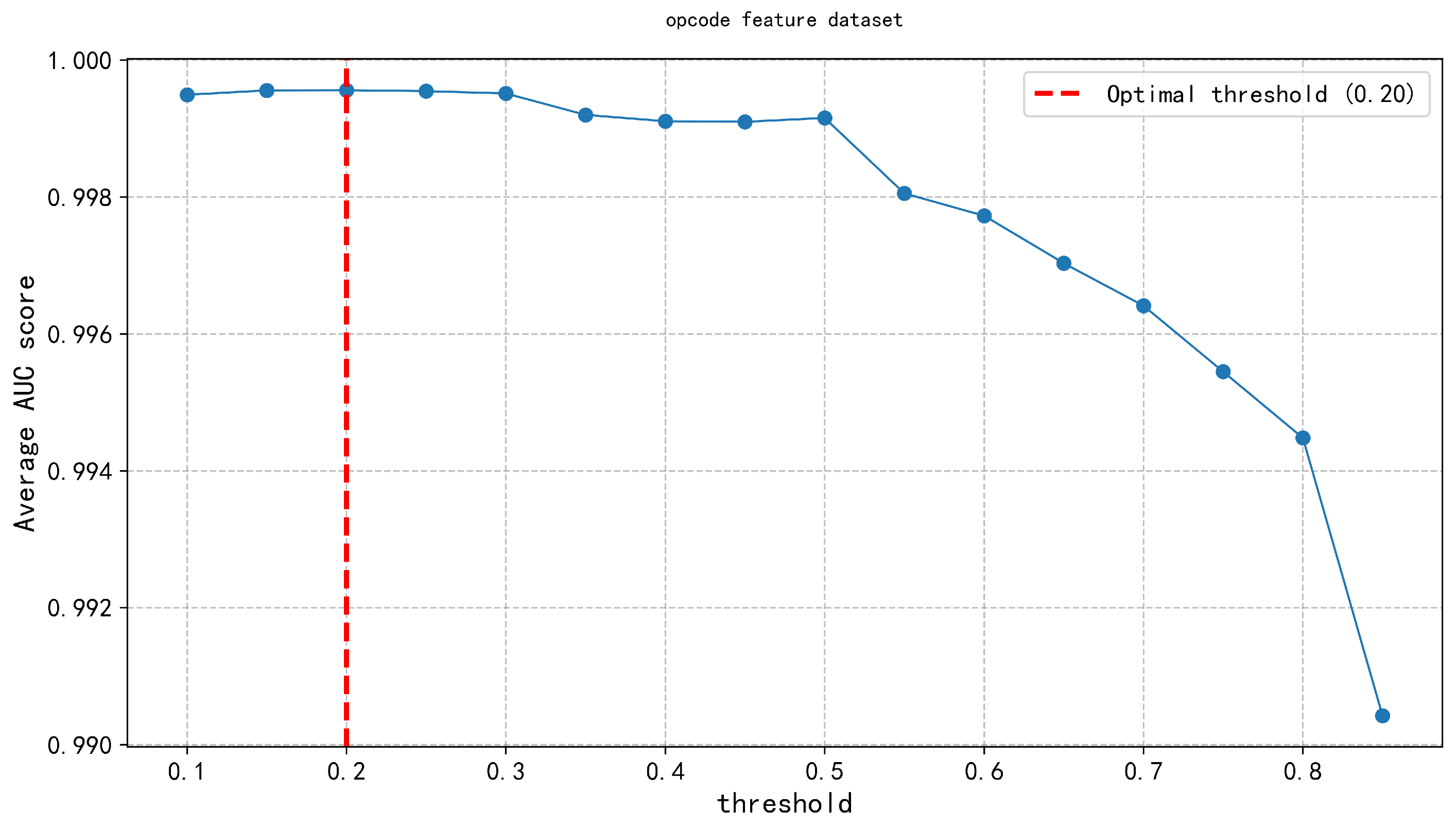
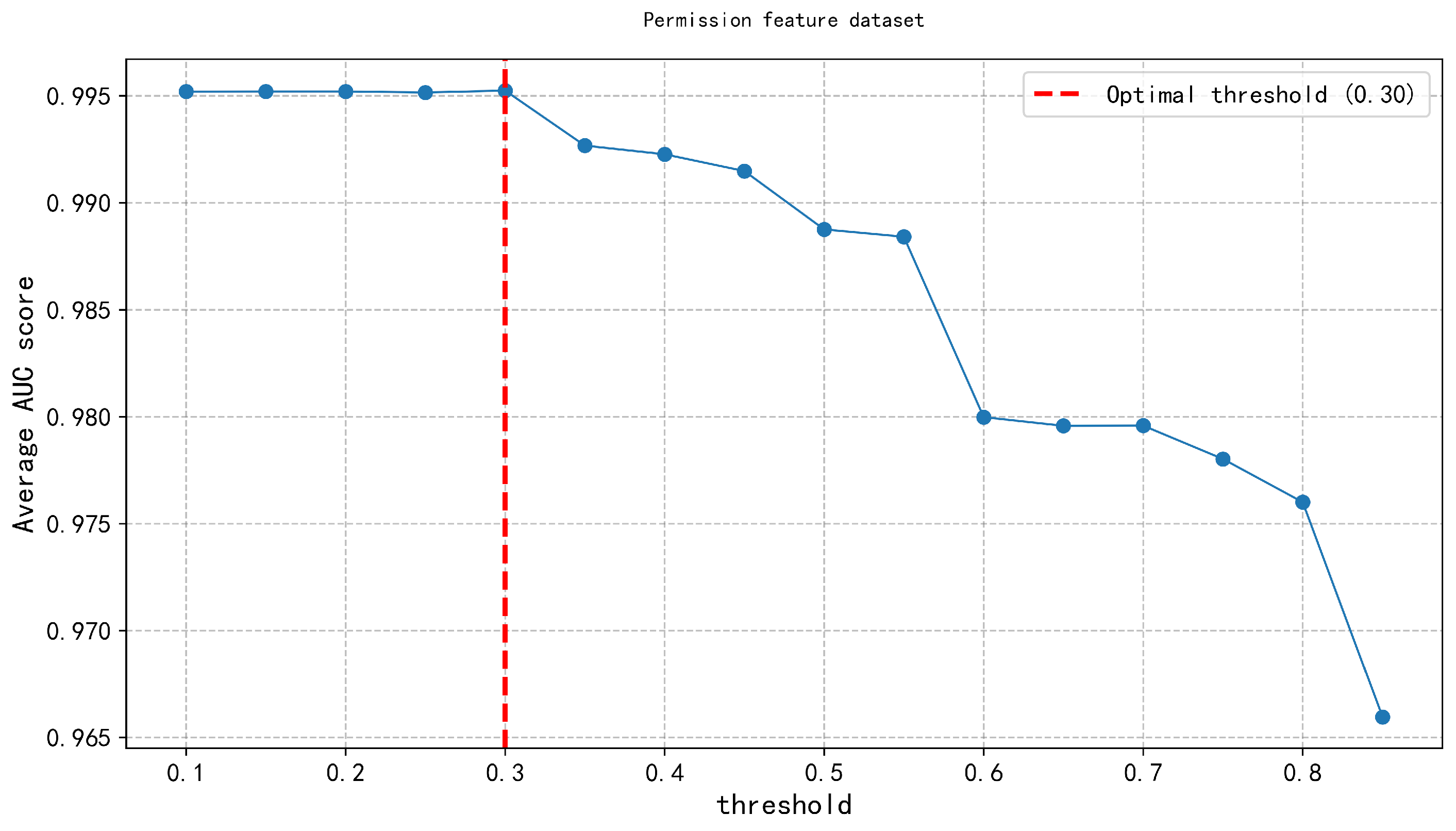
- We devise a three-stage feature screening mechanism. Stage 1 applies variance thresholding to eliminate low-variance features below a predefined threshold. Stage 2 evaluates feature discriminability, discarding features exhibiting insignificant distributional divergence between malware and benign samples. Stage 3 leverages information gain to filter low-importance features. This mechanism minimizes dimensionality while retaining discriminative signatures, reducing computational overhead.
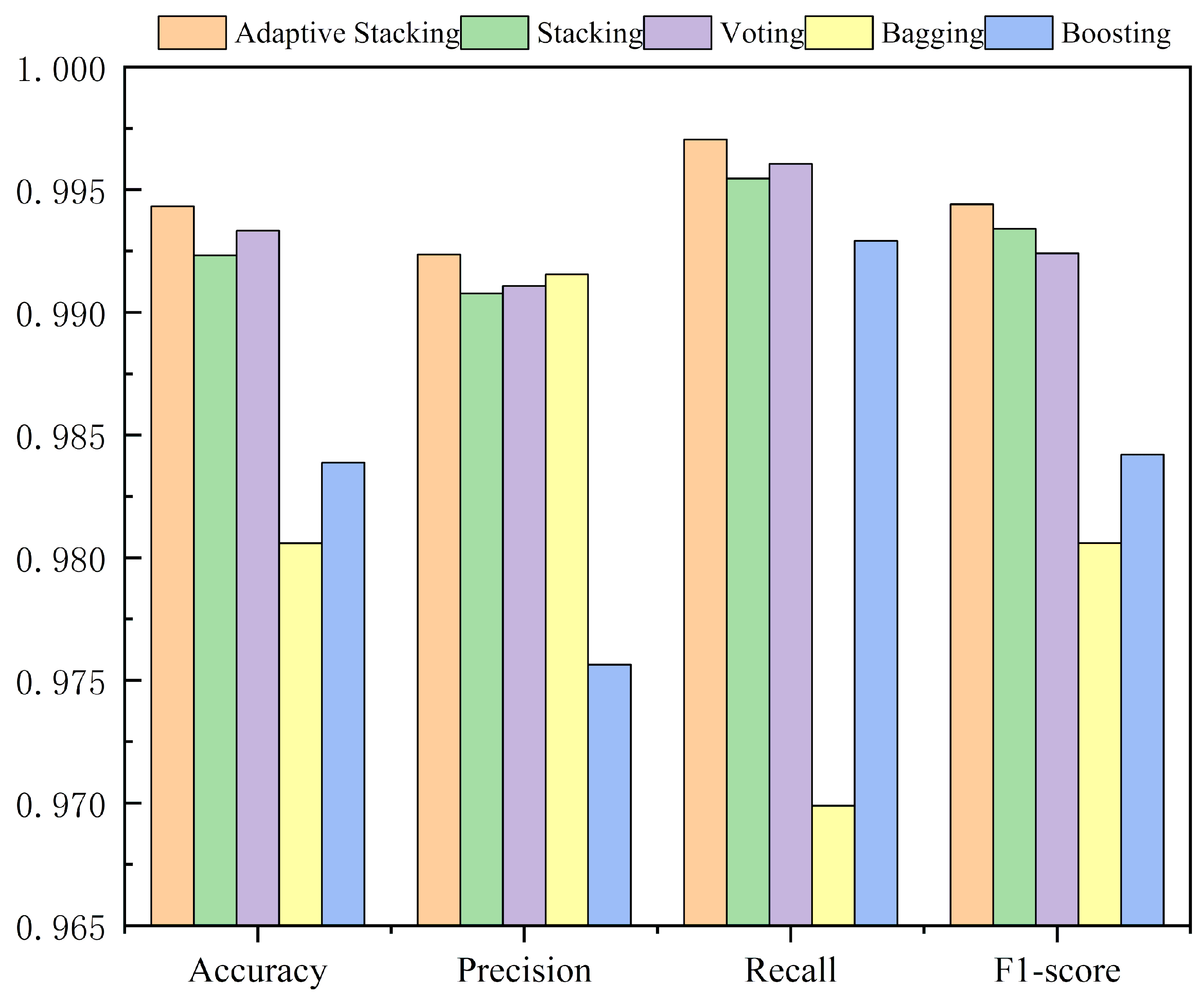
- In response to the significant performance fluctuations in and insufficient generalization ability of the single detection model, this paper proposes Stacking integration based on adaptive weight allocation. This framework integrates the decision advantages of heterogeneous base classifiers and combines adaptive dynamic adjustment of model weights, significantly enhancing the overall detection stability and generalization ability.
2. Related Work
3. Materials and Methods
3.1. Methodology Framework
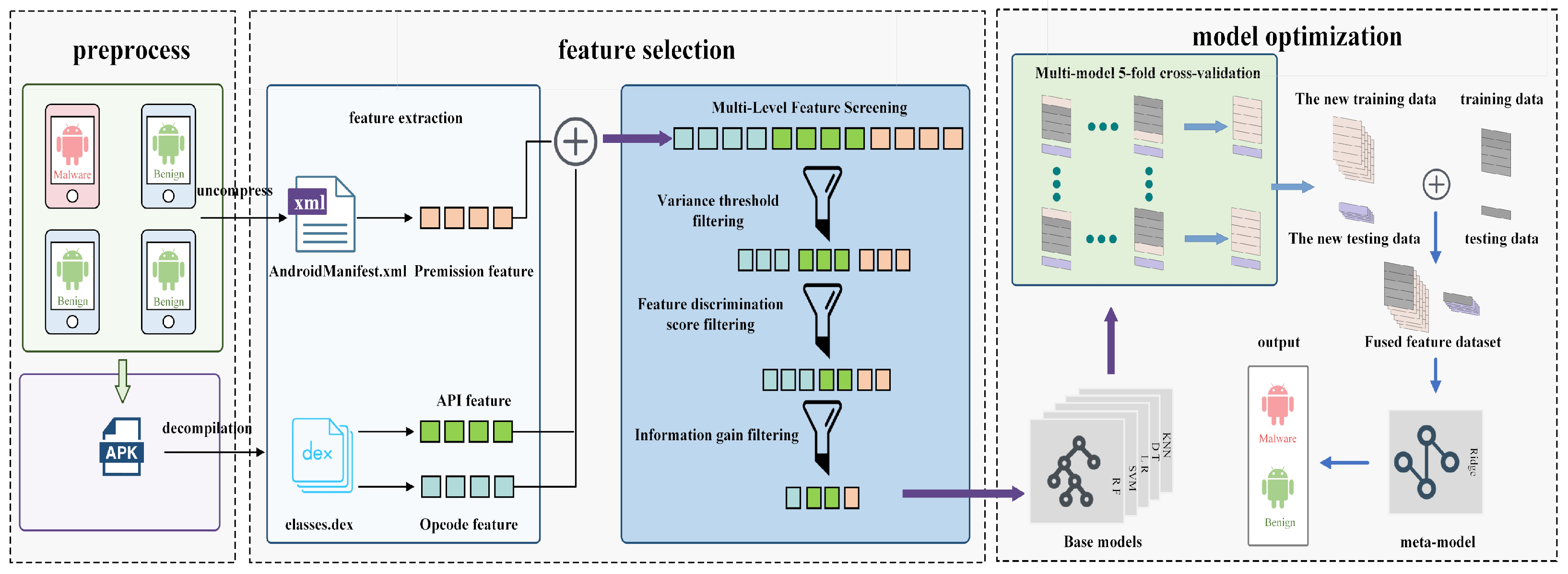
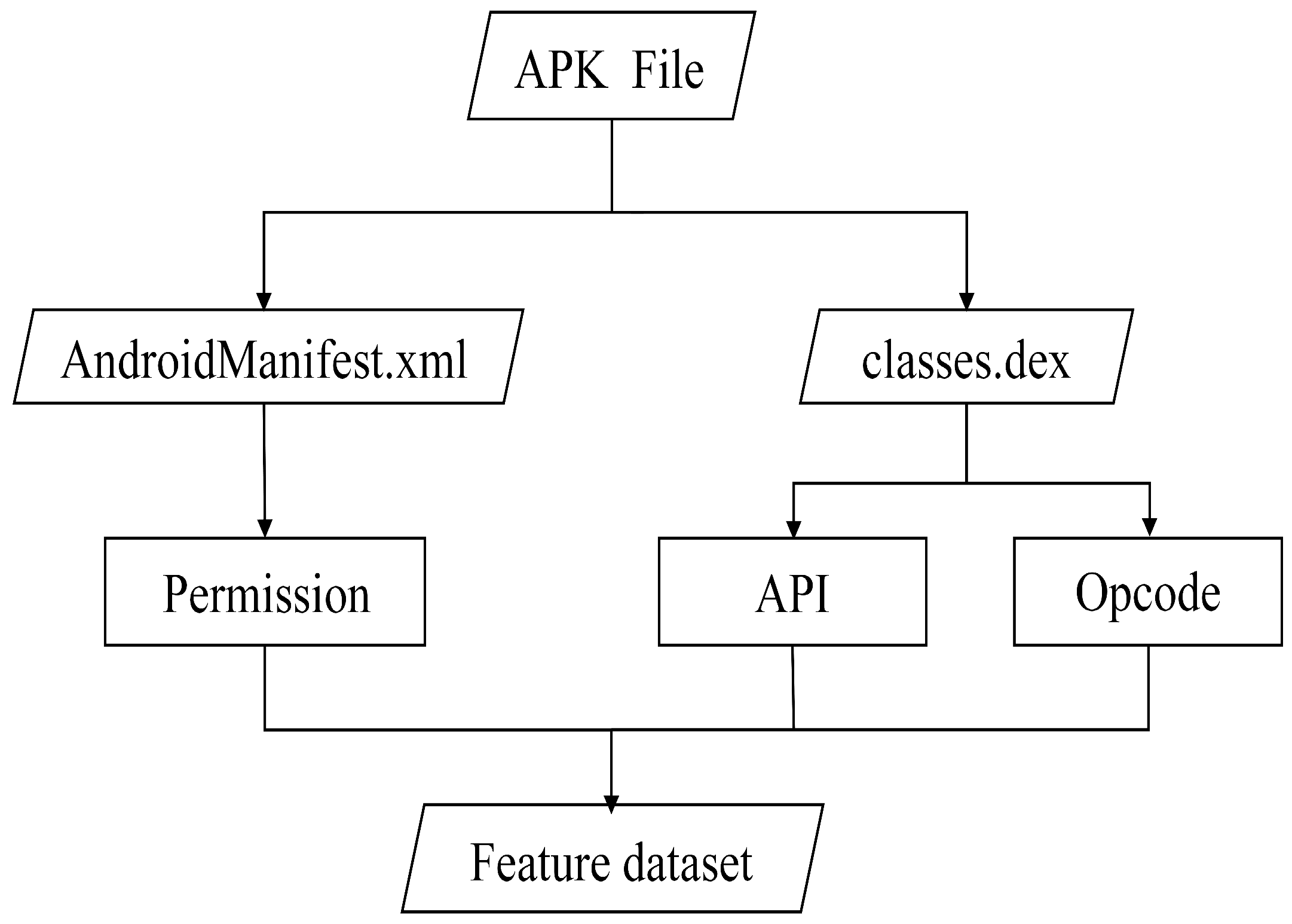
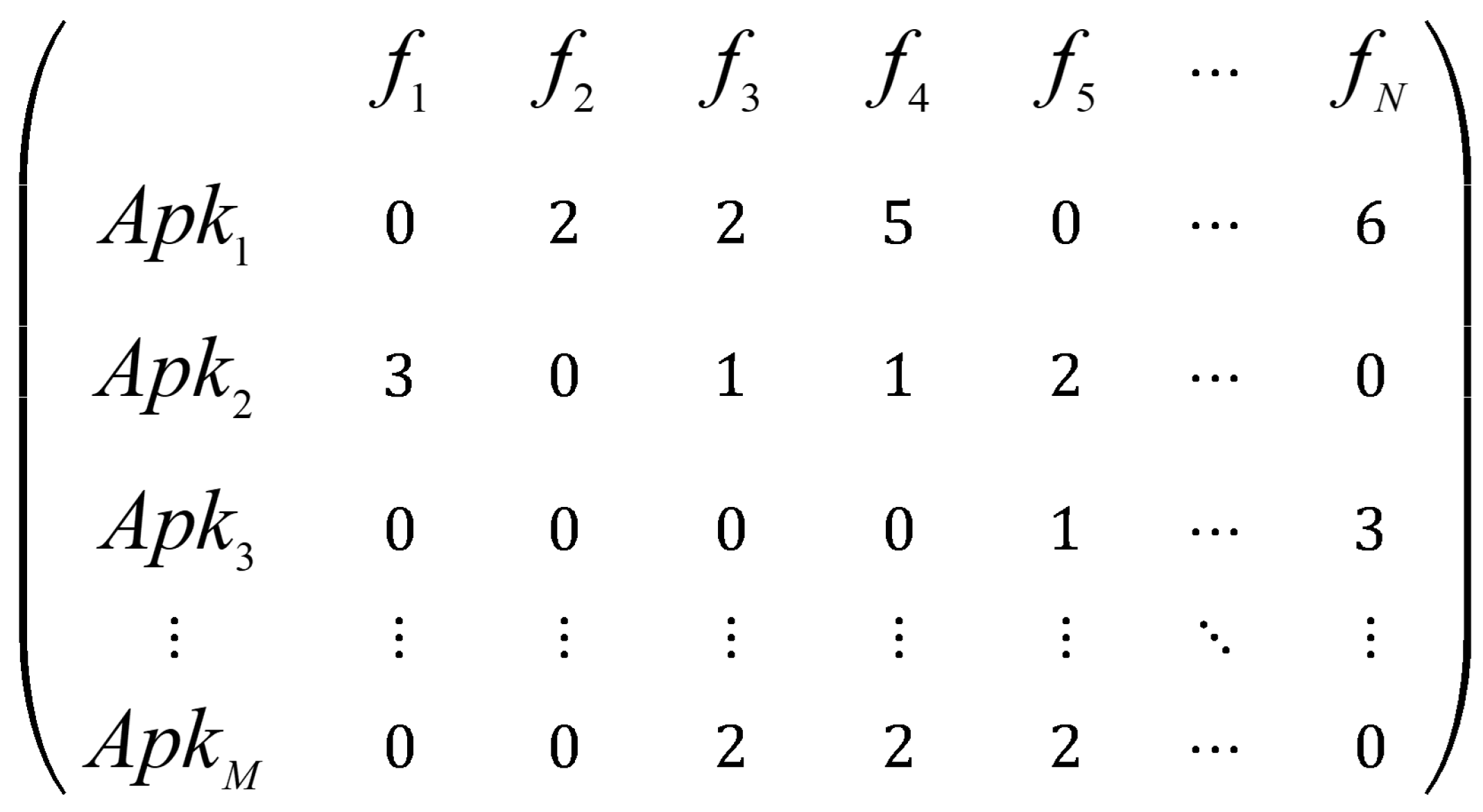
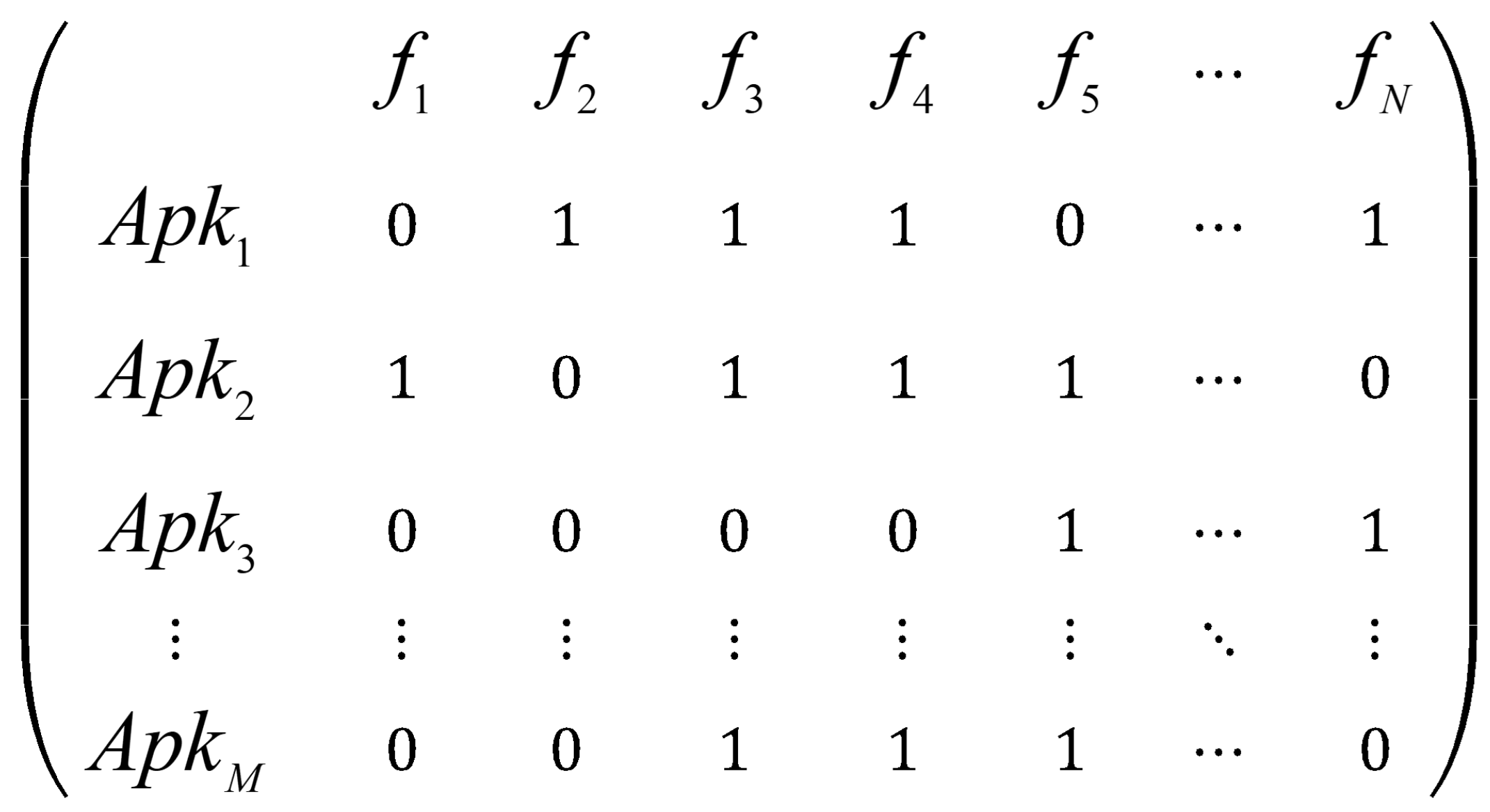
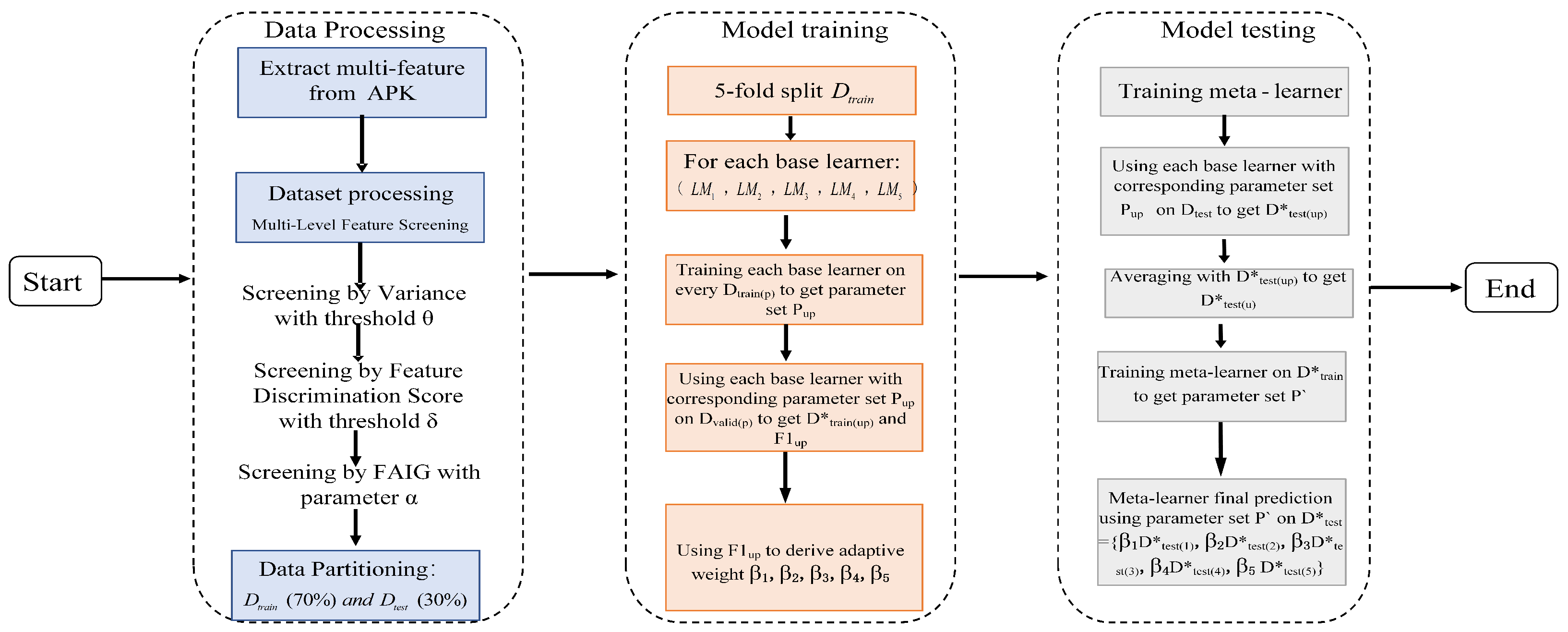
- Feature Extraction: Multiple feature sets are extracted from the APK files, encompassing permissions, API calls, and opcode sequences. Each feature set captures distinct aspects of the Android application, aiming to reveal potential indicators of malicious behavior.
- Data Processing: Data Reading and Preparation: The feature set files for permissions, API calls, and opcodes are first read. The data undergoes cleaning, standardization, and merging to ensure consistency and integrity. Feature Selection: To reduce dimensionality, mitigate feature redundancy and computational burden, while preserving critical discriminative information, feature selection is performed using three distinct metrics: (i) Variance Threshold: Filters out low-variance features. (ii) Feature Discrimination Score: Selects features based on their ability to distinguish between classes. and (iii) Prioritizes features based on the reduction in entropy/uncertainty they provide for classification. This process retains the most discriminative features crucial for effective malware detection.
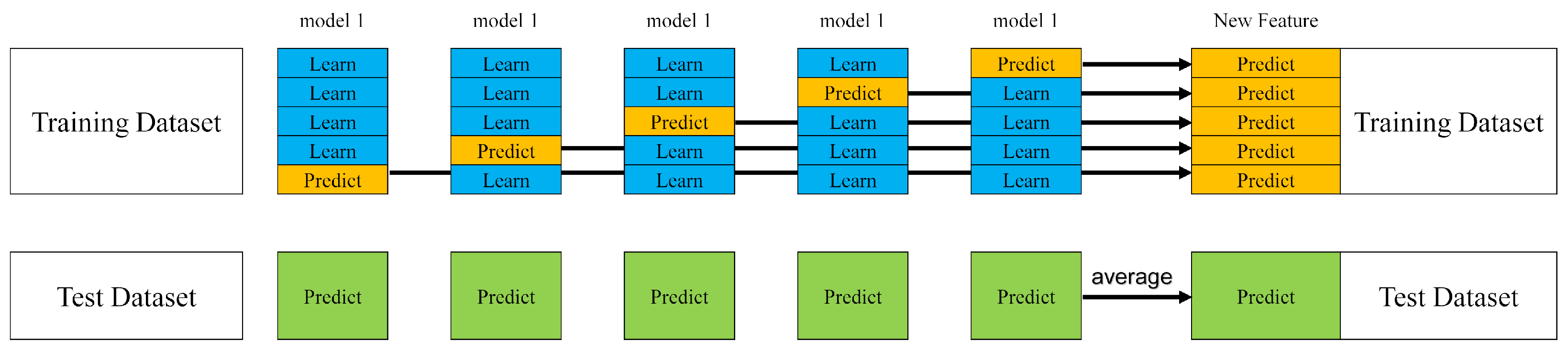
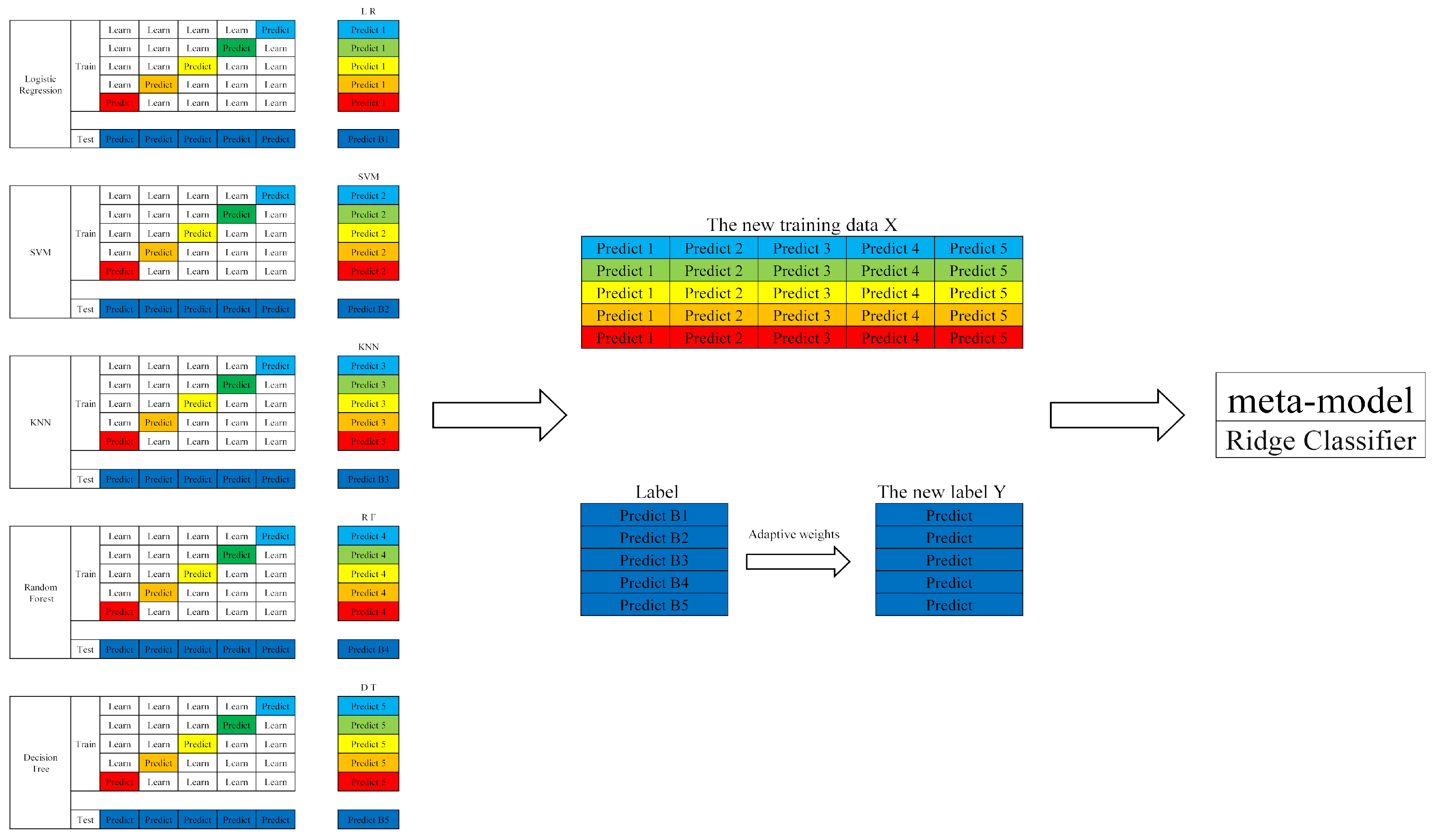
- Optimization of Ensemble Learning: A two-layer heterogeneous ensemble is established by first training five diverse base learners, including Support Vector Machine (SVM), k-Nearest Neighbors (KNN), Decision Tree (DT), Random Forest (RF), and Logistic Regression (LR), using five-fold cross-validation to generate meta-features. Each base model’s weight is adaptively assigned based on its validation F1-score, such that more reliable classifiers contribute proportionally to the final decision. Subsequently, a Ridge Classifier meta-learner is trained using these weighted meta-features to determine the optimal combination strategy. Consequently, the overall detection performance is enhanced.
3.2. Feature Extraction
3.3. Data Processing
3.3.1. Preprocessing
3.3.2. Multi-Level Feature Screening
Variance Threshold
Feature Discrimination Score
- : Frequency of feature j in benign files,
- : Frequency of feature j in malicious files.
Frequency Adjusted Information Gain
3.4. Adaptive Stacking Integration
3.5. Algorithm Analysis
| Algorithm 1 Malware detection algorithm based on multi-feature screening and Adaptive Stacking | |
| 1: Input: APK sample set ; Feature extraction methods (Permissions, API calls, Opcodes); Base learners ; Meta-learner ; Threshold ,; Density impact adjustment parameter ; | |
| 2: Output: Detection results R | |
| 3: for each APK sample in Y do | |
| 4: Extract permission, API call, and opcode features, and concatenate as feature vector | |
| 5: end for | |
| 6: Construct feature matrix X | |
| 7: // Step 1: Variance threshold screening (Equations (1) and (2)) | |
| 8: for each feature in X do | |
| 9: Compute variance | (Equation (2)) |
| 10: if then | |
| 11: Remove from X | |
| 12: end if | |
| 13: end for | |
| 14: // Step 2: Feature discrimination score (Equation (3)) | |
| 15: for each feature in X do | |
| 16: Compute and | |
| 17: Compute | (Equation (3)) |
| 18: if then | |
| 19: Remove from X | |
| 20: end if | |
| 21: end for | |
| 22: // Step 3: Frequency-adjusted information gain (Equations (4)–(8)) | |
| 23: for each feature in X do | |
| 24: Compute information gain | (Equation (6)) |
| 25: Compute feature frequency | (Equation (7)) |
| 26: Compute | (Equation (8)) |
| 27: end for | |
| 28: Rank all features by in descending order and select the top K as | (Equation (8)) |
| 29: Split dataset into (70%) and (30%) | |
| 30: Partition into 5 folds: | |
| 31: // Stacking training (Equations (9)–(14)) | |
| 32: for each base learner , do | |
| 33: for do | |
| 34: Let , | (Equations (10) and (11)) |
| 35: Train on to get parameter | (Equation (12)) |
| 36: Obtain a new training dataset using | (Equations (13) and (14)) |
| 37: Compute F1-score on | |
| 38: end for | |
| 39: Make output prediction by learning the parameter | (Equations (15) and (16)) |
| 40: end for | |
| 41: // Adaptive weight calculation (Equation (17)) | |
| 42: for each base learner do | |
| 43: Compute normalized weight | (Equation (17)) |
| 44: end for | |
| 45: // Step 4: Testing ((18)–(21)) | |
| 46: Obtain a new test dataset using | (Equations (18) and (19)) |
| 47: Obtain meta-learning parameter | (Equation (20)) |
| 48: Predict final results | (Equation (21)) |
| 49: return R | |
4. Experimental Setup
4.1. Evaluation Metrics
4.2. Datasets
5. Results and Analysis
5.1. Threshold Selection
5.2. Multi-Stage Screening
5.3. Model Optimization
5.4. Baseline Comparison
5.5. Detection Performance Against Emerging Malware
5.6. Quantitative Analysis of Module Ablation
6. Limitations
7. Conclusions
Author Contributions
Funding
Institutional Review Board Statement
Informed Consent Statement
Data Availability Statement
Acknowledgments
Conflicts of Interest
Abbreviations
| MaSS-Droid | Multi-feature And Multi-layer Screening For Adaptive Stacking Integration |
| API | Application Programming Interface |
| APK | Android Application Package |
| IG | Information Gain |
| FAIG | Requency Adjusted Information Gain |
| CI | Confidence Intervals |
| TP | True Positive |
| TN | True Negative |
| FP | False Positive |
| FN | False Negative |
| OOF | Out Of Fold |
| L R | Logistic Regression |
| SVM | Support Vector Machine |
| KNN | k-Nearest Neighbors |
| R F | Random Forest |
| D T | Decision Tree |
| MFS | Multi-Level Feature Screening |
| A-Stacking | Adaptive Stacking |
| VT | Variance Threshold |
| FDS | Feature Discrimination Score |
References
- Sharma, T.; Rattan, D. Characterization of Android Malwares and their families. ACM Comput. Surv. 2025, 57, 1–13. [Google Scholar] [CrossRef]
- Wang, H.; Cui, B.; Yuan, Q.; Shi, R.; Huang, M. A review of deep learning based malware detection techniques. Neurocomputing 2024, 598, 128010. [Google Scholar] [CrossRef]
- Bermejo Higuera, J.; Morales Moreno, J.; Bermejo Higuera, J.R.; Sicilia Montalvo, J.A.; Barreiro Martillo, G.J.; Sureda Riera, T.M. Benchmarking Android Malware Analysis Tools. Electronics 2024, 13, 2103. [Google Scholar] [CrossRef]
- Sun, T.; Daoudi, N.; Pian, W.; Kim, K.; Allix, K.; Bissyandé, T.F.; Klein, J. Temporal-Incremental Learning for Android Malware Detection. ACM Trans. Softw. Eng. Methodol. 2025, 34, 1–30. [Google Scholar] [CrossRef]
- Maniriho, P.; Mahmood, A.N.; Chowdhury, M.J.M. A study on malicious software behaviour analysis and detection techniques: Taxonomy, current trends and challenges. Future Gener. Comput. Syst. 2022, 130, 1–18. [Google Scholar] [CrossRef]
- Yan, P.; Tan, S.; Wang, M.; Huang, J. Enhanced Dynamic Analysis for Malware Detection with Gradient Attack. IEEE Signal Process. Lett. 2024, 31, 2825–2829. [Google Scholar] [CrossRef]
- Ilić, S.; Gnjatović, M.; Tot, I.; Jovanović, B.; Maček, N.; Gavrilović Božović, M. Going beyond API Calls in Dynamic Malware Analysis: A Novel Dataset. Electronics 2024, 13, 3553. [Google Scholar] [CrossRef]
- Aldhafferi, N. Android Malware Detection Using Support Vector Regression for Dynamic Feature Analysis. Information 2024, 15, 658. [Google Scholar] [CrossRef]
- Manzil, H.H.R.; Manohar Naik, S. Detection approaches for android malware: Taxonomy and review analysis. Expert Syst. Appl. 2024, 238, 122255. [Google Scholar] [CrossRef]
- Yan, H.; Zhang, J.; Tang, Z.; Long, H.; Zhu, M.; Zhang, T.; Luo, L.; Li, H. Malware classification method based on feature fusion. Int. J. Inf. Secur. 2025, 24, 97. [Google Scholar] [CrossRef]
- Sun, W. Malicious software identification based on deep learning algorithms and API feature extraction. EURASIP J. Inf. Secur. 2025, 2025, 10. [Google Scholar] [CrossRef]
- Hemalatha, J.; Roseline, S.A.; Geetha, S.; Kadry, S.; Damaševičius, R. An Efficient DenseNet-Based Deep Learning Model for Malware Detection. Entropy 2021, 23, 344. [Google Scholar] [CrossRef]
- Ananya, A.; Aswathy, A.; Amal, T.R.; Swathy, P.G.; Vinod, P.; Mohammad, S. SysDroid: A dynamic ML-based android malware analyzer using system call traces. Clust. Comput. 2020, 23, 2789–2808. [Google Scholar] [CrossRef]
- Mahindru, A.; Sangal, A.L. MLDroid—Framework for Android malware detection using machine learning techniques. Neural Comput. Appl. 2021, 33, 5183–5240. [Google Scholar] [CrossRef]
- Arif, J.M.; Razak, M.F.A.; Awang, S.; Mat, S.R.T.; Ismail, N.S.N.; Firdaus, A. A static analysis approach for Android permission-based malware detection systems. PLoS ONE 2021, 16, e0257968. [Google Scholar] [CrossRef]
- Li, J.; Sun, L.; Yan, Q.; Li, Z.; Srisa-an, W.; Ye, H. Significant Permission Identification for Machine-Learning-Based Android Malware Detection. IEEE Trans. Ind. Inform. 2018, 14, 3216–3225. [Google Scholar] [CrossRef]
- Pathak, A.; Kumar, T.S.; Barman, U. Static analysis framework for permission-based dataset generation and android malware detection using machine learning. EURASIP J. Inf. Secur. 2024, 2024, 33. [Google Scholar] [CrossRef]
- Arora, A.; Peddoju, S.K.; Conti, M. PermPair: Android Malware Detection Using Permission Pairs. IEEE Trans. Inf. Forensics Secur. 2020, 15, 1968–1982. [Google Scholar] [CrossRef]
- Pektaş, A.; Acarman, T. Learning to detect Android malware via opcode sequences. Neurocomputing 2020, 396, 599–608. [Google Scholar] [CrossRef]
- Wong, G.W.; Huang, Y.T.; Guo, Y.R.; Sun, Y.; Chen, M.C. Attention-Based API Locating for Malware Techniques. IEEE Trans. Inf. Forensics Secur. 2024, 19, 1199–1212. [Google Scholar] [CrossRef]
- Yousefi Azar, M.; Varadharajan, V.; Hamey, L.; Chen, S. Mutual Information and Feature Importance Gradient Boosting: Automatic byte n-gram feature reranking for Android malware detection. Softw. Pract. Exp. 2021, 51, 1518–1539. [Google Scholar] [CrossRef]
- Bhat, P.; Dutta, K. A multi-tiered feature selection model for android malware detection based on Feature discrimination and Information Gain. J. King Saud Univ.-Comput. Inf. Sci. 2022, 34, 9464–9477. [Google Scholar] [CrossRef]
- AlJarrah, M.N.; Yaseen, Q.M.; Mustafa, A.M. A Context-Aware Android Malware Detection Approach Using Machine Learning. Information 2022, 13, 563. [Google Scholar] [CrossRef]
- Yoo, S.; Kim, S.; Kim, S.; Kang, B.B. AI-HydRa: Advanced hybrid approach using random forest and deep learning for malware classification. Inf. Sci. 2021, 546, 420–435. [Google Scholar] [CrossRef]
- Zhu, H.J.; Wang, L.M.; Zhong, S.; Li, Y.; Sheng, V.S. A Hybrid Deep Network Framework for Android Malware Detection. IEEE Trans. Knowl. Data Eng. 2022, 34, 5558–5570. [Google Scholar] [CrossRef]
- Garcia, J.; Hammad, M.; Malek, S. Lightweight, Obfuscation-Resilient Detection and Family Identification of Android Malware. ACM Trans. Softw. Eng. Methodol. 2018, 26, 1–29. [Google Scholar] [CrossRef]
- de Amorim, R.C.; Lopez Ruiz, C.D. Identifying meaningful clusters in malware data. Expert Syst. Appl. 2021, 177, 114971. [Google Scholar] [CrossRef]
- Yuan, G.; Lu, L.; Zhou, X. Feature selection using a sinusoidal sequence combined with mutual information. Eng. Appl. Artif. Intell. 2023, 126, 107168. [Google Scholar] [CrossRef]
- Zhu, H.; Li, Y.; Li, R.; Li, J.; You, Z.; Song, H. SEDMDroid: An Enhanced Stacking Ensemble Framework for Android Malware Detection. IEEE Trans. Netw. Sci. Eng. 2021, 8, 984–994. [Google Scholar] [CrossRef]
- Wolpert, D.H. Stacked generalization. Neural Netw. 1992, 5, 241–259. [Google Scholar] [CrossRef]
- Joshi, A.; Kumar, S. Stacking-based ensemble model for malware detection in android devices. Int. J. Inf. Technol. 2023, 15, 2907–2915. [Google Scholar] [CrossRef]
- Zhu, L.; Zhang, Z.; Zhang, Y.; Yu, J.; Wang, H. Autonomous vehicle crash risk modeling by integrating data augmentation and two-layer stacking. Comput. Ind. 2025, 171, 104320. [Google Scholar] [CrossRef]
- Li, T.; Yao, Q.; Li, J.; Li, Q.; Wang, R.; Jia, C.; Xiao, Y. Malware detection model based on stacking ensemble technique. Appl. Soft Comput. 2025, 180, 113338. [Google Scholar] [CrossRef]
- Fang, W.; He, J.; Li, W.; Lan, X.; Chen, Y.; Li, T.; Huang, J.; Zhang, L. Comprehensive Android Malware Detection Based on Federated Learning Architecture. IEEE Trans. Inf. Forensics Secur. 2023, 18, 3977–3990. [Google Scholar] [CrossRef]
- Gibert, D.; Mateu, C.; Planes, J. HYDRA: A multimodal deep learning framework for malware classification. Comput. Secur. 2020, 95, 101873. [Google Scholar] [CrossRef]
- Wu, Y.; Li, X.; Zou, D.; Yang, W.; Zhang, X.; Jin, H. MalScan: Fast Market-Wide Mobile Malware Scanning by Social-Network Centrality Analysis. In Proceedings of the 2019 34th IEEE/ACM International Conference on Automated Software Engineering (ASE), San Diego, CA, USA, 11–15 November 2019; pp. 139–150. [Google Scholar] [CrossRef]



| Type | Dataset | Number | Time Range |
|---|---|---|---|
| Malware | Drebin | 5560 | Aug. 2010–Oct. 2012 |
| Malware | CICMalDroid2020 | 10,346 | Dec. 2017–Dec. 2018 |
| Benign Software | AndroZoo | 5600 | Up to Dec. 2022 |
| Benign Software | CICMalDroid2020 | 1253 | Dec. 2017–Dec. 2018 |
| Classifier | Data Type | Accuracy | Precision | Recall | F1-Score |
|---|---|---|---|---|---|
| L R | Original | 0.9905 | 0.9919 | 0.9889 | 0.9900 |
| Screened | 0.9955 | 0.9959 | 0.9947 | 0.9953 | |
| SVM | Original | 0.9918 | 0.9928 | 0.9900 | 0.9914 |
| Screened | 0.9952 | 0.9958 | 0.9941 | 0.9949 | |
| KNN | Original | 0.9912 | 0.9919 | 0.9887 | 0.9908 |
| Screened | 0.9914 | 0.9919 | 0.9900 | 0.9909 | |
| R F | Original | 0.9937 | 0.9943 | 0.9924 | 0.9933 |
| Screened | 0.9951 | 0.9957 | 0.9940 | 0.9948 | |
| D T | Original | 0.9884 | 0.9884 | 0.9873 | 0.9878 |
| Screened | 0.9896 | 0.9894 | 0.9888 | 0.9891 |
| Classifier | Data Type | Accuracy | Precision | Recall | F1-Score |
|---|---|---|---|---|---|
| L R | Original | 0.9809 | 0.9803 | 0.9797 | 0.9800 |
| Screened | 0.9862 | 0.9855 | 0.9855 | 0.9855 | |
| SVM | Original | 0.9873 | 0.9881 | 0.9852 | 0.9866 |
| Screened | 0.9887 | 0.9888 | 0.9875 | 0.9881 | |
| KNN | Original | 0.9866 | 0.9869 | 0.9850 | 0.9860 |
| Screened | 0.9877 | 0.9873 | 0.9870 | 0.9871 | |
| R F | Original | 0.9912 | 0.9922 | 0.9895 | 0.9908 |
| Screened | 0.9920 | 0.9928 | 0.9905 | 0.9916 | |
| D T | Original | 0.9852 | 0.9845 | 0.9845 | 0.9845 |
| Screened | 0.9848 | 0.9847 | 0.9836 | 0.9841 |
| Classifier | Data Type | Accuracy | Precision | Recall | F1-Score |
|---|---|---|---|---|---|
| L R | Original | 0.9600 | 0.9610 | 0.9550 | 0.9578 |
| Screened | 0.9709 | 0.9714 | 0.9674 | 0.9693 | |
| SVM | Original | 0.9655 | 0.9672 | 0.9604 | 0.9635 |
| Screened | 0.9720 | 0.9727 | 0.9684 | 0.9704 | |
| KNN | Original | 0.9605 | 0.9615 | 0.9554 | 0.9582 |
| Screened | 0.9571 | 0.9595 | 0.9504 | 0.9545 | |
| R F | Original | 0.9651 | 0.9663 | 0.9603 | 0.9631 |
| Screened | 0.9780 | 0.9781 | 0.9756 | 0.9768 | |
| D T | Original | 0.9633 | 0.9645 | 0.9584 | 0.9613 |
| Screened | 0.9677 | 0.9680 | 0.9642 | 0.9660 |
| Method | Accuracy | F1-Score | Precision | Recall | Time Complexity (Minutes) | CI |
|---|---|---|---|---|---|---|
| Ours | 0.9982 | 0.9988 | 0.9982 | 0.9985 | 2.2 ± 0.2 | ±0.001285 |
| FEDroid | 0.9271 | 0.9551 | 0.9551 | 0.9482 | 3.5 ± 0.2 | ±0.002035 |
| HYDRA | 0.9517 | 0.9589 | 0.9604 | 0.9556 | 4.1 ± 0.2 | ±0.001930 |
| MalScan | 0.9612 | 0.9517 | 0.9517 | 0.9432 | 3.0 ± 0.2 | ±0.002081 |
| Feature Name | Score () | Benign Usage | Malicious Usage |
|---|---|---|---|
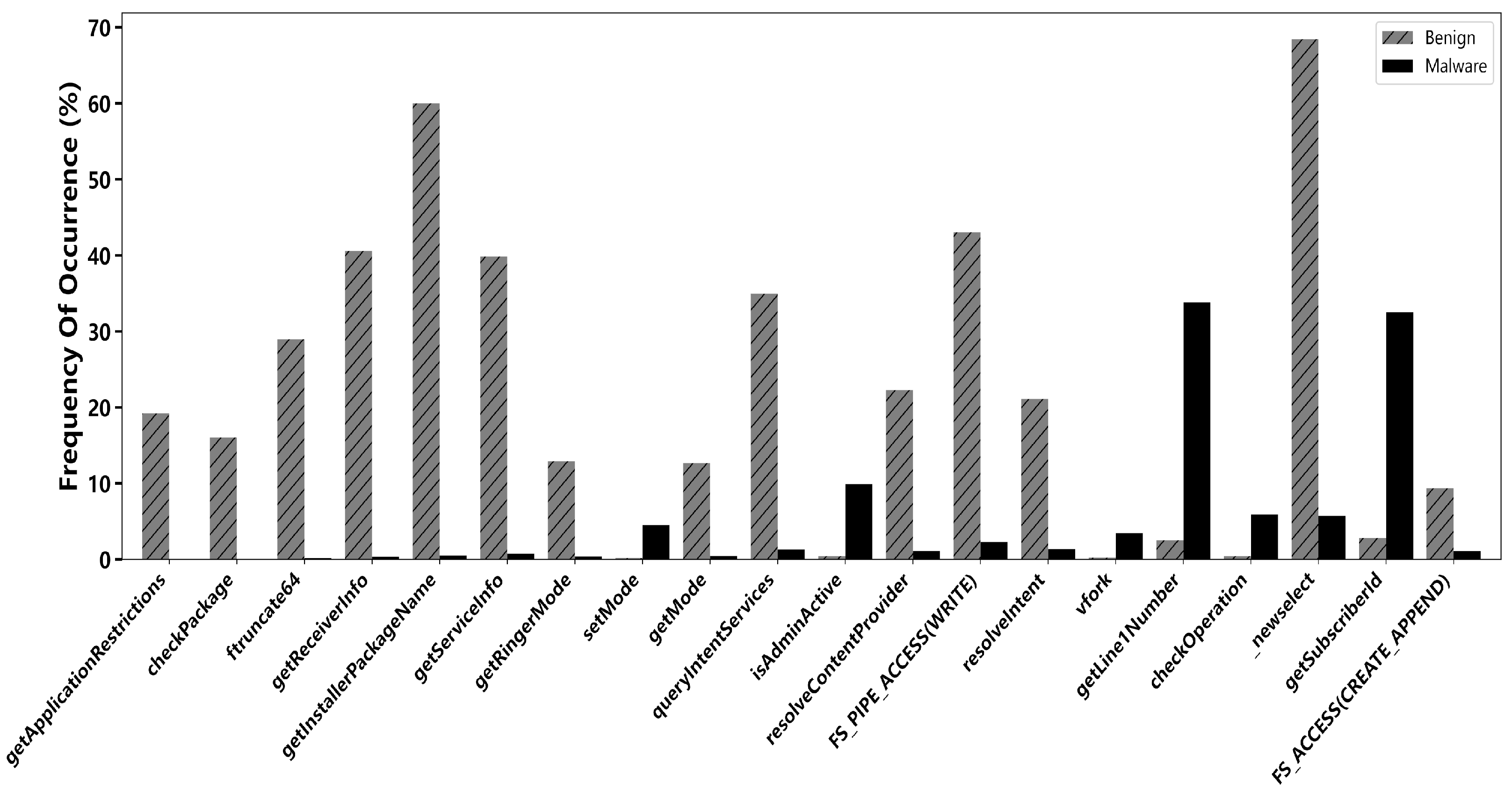
| getApplicationRestrictions | 0.9995 | 0.1922 | 0.0001 |
| checkPackage | 0.9987 | 0.1604 | 0.0002 |
| ftruncate64 | 0.9944 | 0.2897 | 0.0016 |
| getReceiverInfo | 0.9917 | 0.4061 | 0.0034 |
| getInstallerPackageName | 0.9913 | 0.6000 | 0.0052 |
| getServiceInfo | 0.9810 | 0.3983 | 0.0075 |
| getRingerMode | 0.9684 | 0.1292 | 0.0041 |
| setMode | 0.9629 | 0.0017 | 0.0451 |
| getMode | 0.9629 | 0.1265 | 0.0047 |
| queryIntentServices | 0.9626 | 0.3493 | 0.0131 |
| isAdminActive | 0.9551 | 0.0045 | 0.0992 |
| resolveContentProvider | 0.9496 | 0.2228 | 0.0112 |
| FS_PIPE_ACCESS(WRITE)___ | 0.9462 | 0.4306 | 0.0232 |
| resolveIntent | 0.9362 | 0.2111 | 0.0135 |
| vfork | 0.9361 | 0.0022 | 0.0349 |
| getLine1Number | 0.9259 | 0.0251 | 0.3384 |
| checkOperation | 0.9249 | 0.0045 | 0.0594 |
| _newselect | 0.9164 | 0.6847 | 0.0572 |
| getSubscriberId | 0.9126 | 0.0284 | 0.3250 |
| FS_ACCESS(CREATE__APPEND)__ | 0.8812 | 0.0936 | 0.0111 |
| ⋮ | ⋮ | ⋮ | ⋮ |
| FS_PIPE_ACCESS(READ__)_ | 0.5201 | 0.0440 | 0.0917 |
| performDeferredDestroy | 0.5121 | 0.0830 | 0.0405 |
| addToDisplayWithoutInputChannel | 0.5121 | 0.0830 | 0.0405 |
| getInstalledPackages | 0.5097 | 0.0808 | 0.1647 |
| fdatasync | 0.5065 | 0.7889 | 0.3893 |
| Feature | FAIG Score |
|---|---|
| statfs64 | 0.00040 |
| _newselect | 0.00033 |
| fdatasync | 0.00028 |
| fchmod | 0.00028 |
| NETWORK_ACCESS____ | 0.00028 |
| getInstallerPackageName | 0.00026 |
| pwrite64 | 0.00025 |
| remove | 0.00024 |
| NETWORK_ACCESS()____ | 0.00024 |
| fchown32 | 0.00023 |
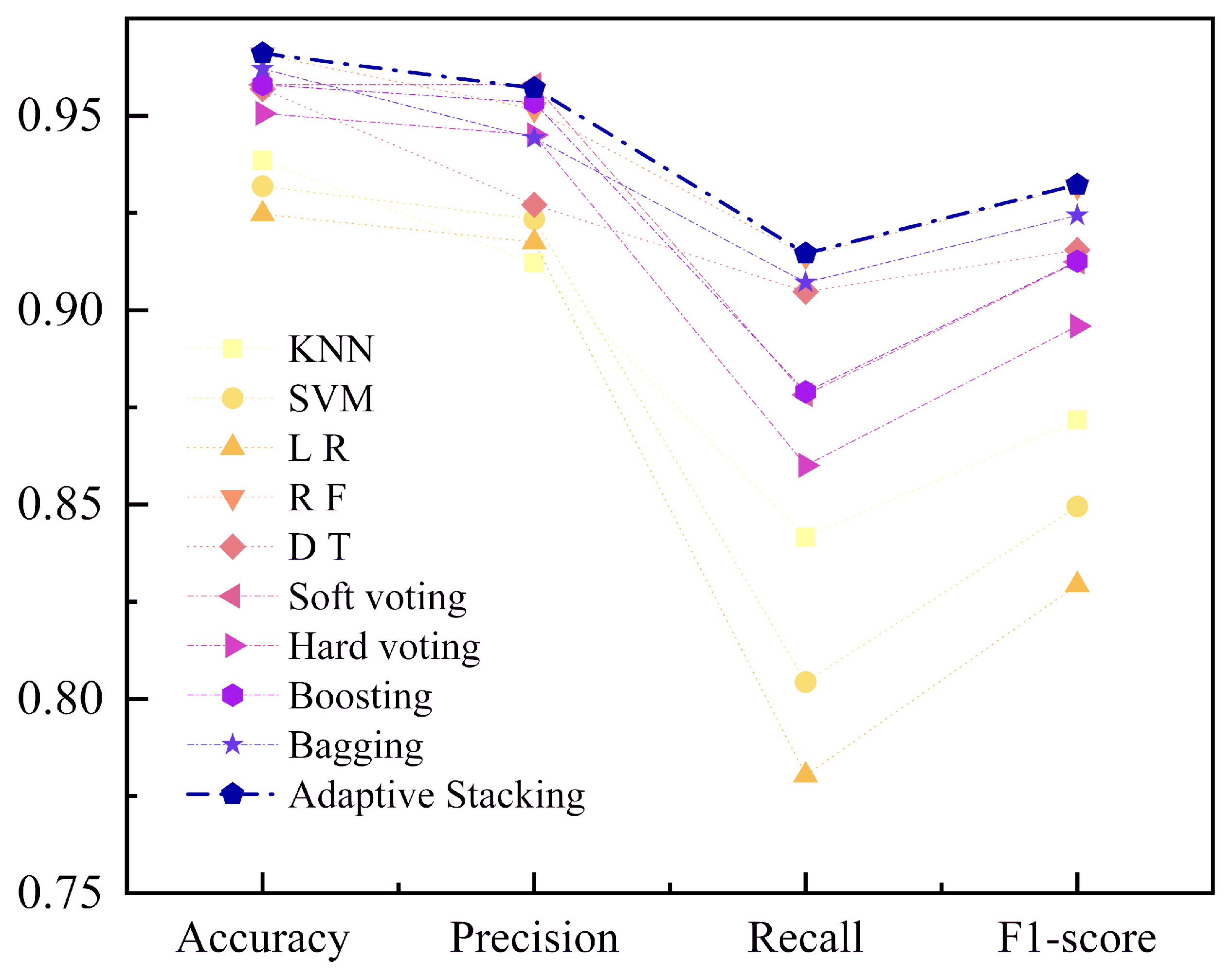
| Classifier | Features | Dataset | Accuracy | Precision | Recall | F1-Score |
|---|---|---|---|---|---|---|
| L R | 470 | Original | 0.9275 | 0.9014 | 0.8049 | 0.8431 |
| 21 | Screened | 0.9359 | 0.9328 | 0.8131 | 0.8587 | |
| SVM | 470 | Original | 0.8549 | 0.8234 | 0.5403 | 0.5367 |
| 21 | Screened | 0.8771 | 0.8391 | 0.6320 | 0.6711 | |
| KNN | 470 | Original | 0.9160 | 0.8577 | 0.8026 | 0.8264 |
| 21 | Screened | 0.9334 | 0.8978 | 0.8352 | 0.8623 | |
| R F | 470 | Original | 0.9766 | 0.9734 | 0.9361 | 0.9535 |
| 21 | Screened | 0.9653 | 0.9534 | 0.9110 | 0.9305 | |
| D T | 470 | Original | 0.9671 | 0.9397 | 0.9341 | 0.9369 |
| 21 | Screened | 0.9571 | 0.9350 | 0.8963 | 0.9142 |
| MFS (Based on KNN) | A-Stacking | Accuracy | Precision | Recall | F1-Score | ||
|---|---|---|---|---|---|---|---|
| VT | FDS | FAIG | |||||
| × | × | × | × | 0.9160 | 0.8577 | 0.8026 | 0.8264 |
| ✓ | × | × | × | 0.9188 | 0.8642 | 0.8075 | 0.8319 |
| ✓ | ✓ | × | × | 0.9213 | 0.8645 | 0.8203 | 0.8401 |
| ✓ | ✓ | ✓ | × | 0.9334 | 0.8978 | 0.8352 | 0.8623 |
| ✓ | ✓ | ✓ | ✓ | 0.9661 | 0.9571 | 0.9146 | 0.9323 |
Disclaimer/Publisher’s Note: The statements, opinions and data contained in all publications are solely those of the individual author(s) and contributor(s) and not of MDPI and/or the editor(s). MDPI and/or the editor(s) disclaim responsibility for any injury to people or property resulting from any ideas, methods, instructions or products referred to in the content. |
© 2025 by the authors. Licensee MDPI, Basel, Switzerland. This article is an open access article distributed under the terms and conditions of the Creative Commons Attribution (CC BY) license (https://creativecommons.org/licenses/by/4.0/).
Share and Cite
Zhang, Z.; Han, Q.; Shi, Z. MaSS-Droid: Android Malware Detection Framework Using Multi-Layer Feature Screening and Stacking Integration. Entropy 2025, 27, 1252. https://doi.org/10.3390/e27121252
Zhang Z, Han Q, Shi Z. MaSS-Droid: Android Malware Detection Framework Using Multi-Layer Feature Screening and Stacking Integration. Entropy. 2025; 27(12):1252. https://doi.org/10.3390/e27121252
Chicago/Turabian StyleZhang, Zihao, Qiang Han, and Zhichao Shi. 2025. "MaSS-Droid: Android Malware Detection Framework Using Multi-Layer Feature Screening and Stacking Integration" Entropy 27, no. 12: 1252. https://doi.org/10.3390/e27121252
APA StyleZhang, Z., Han, Q., & Shi, Z. (2025). MaSS-Droid: Android Malware Detection Framework Using Multi-Layer Feature Screening and Stacking Integration. Entropy, 27(12), 1252. https://doi.org/10.3390/e27121252