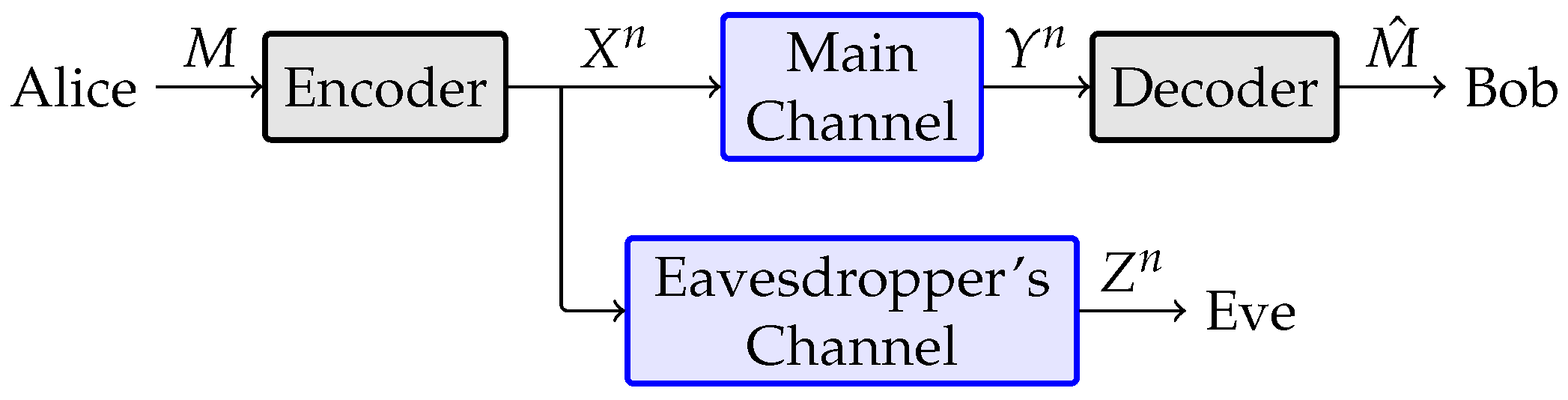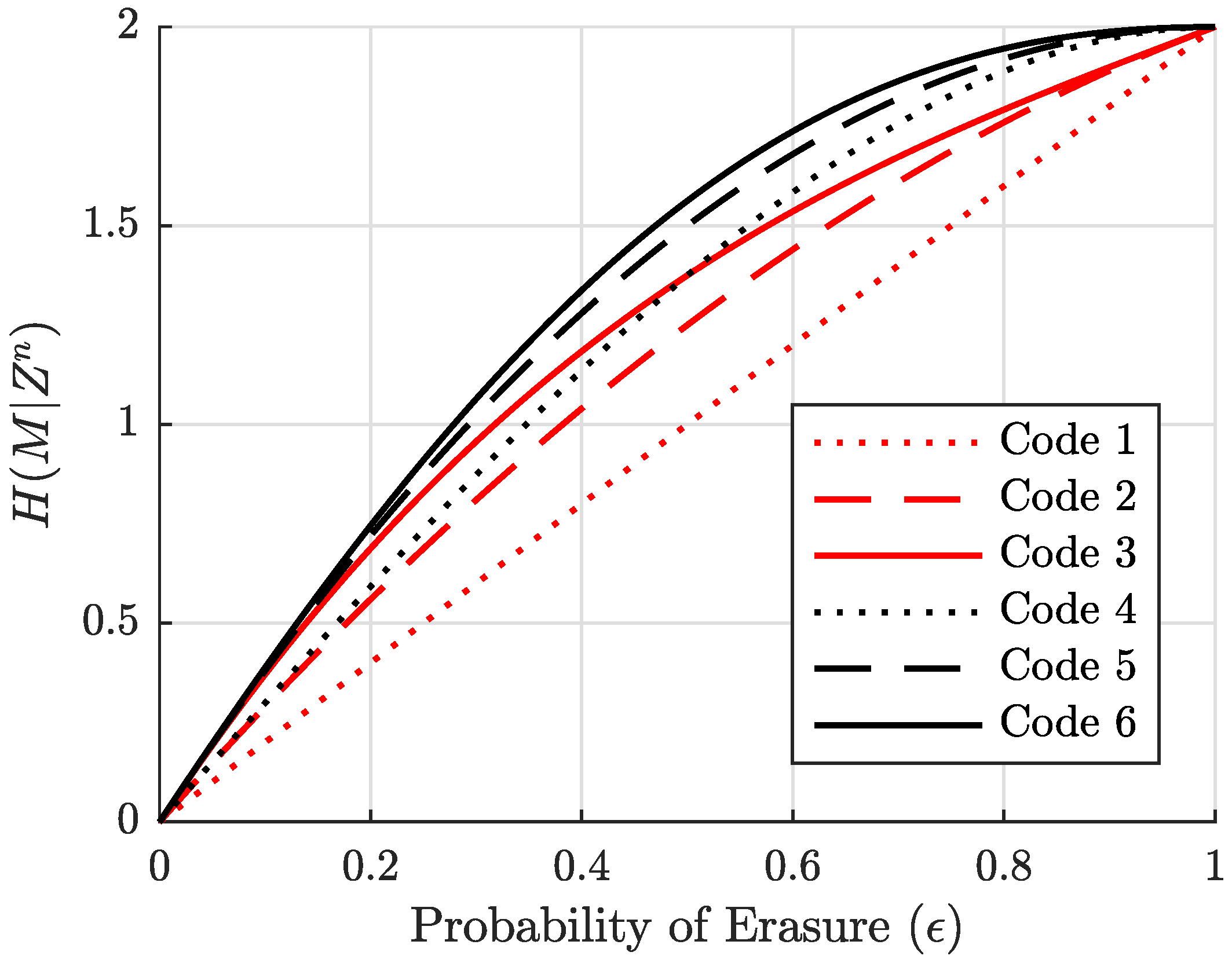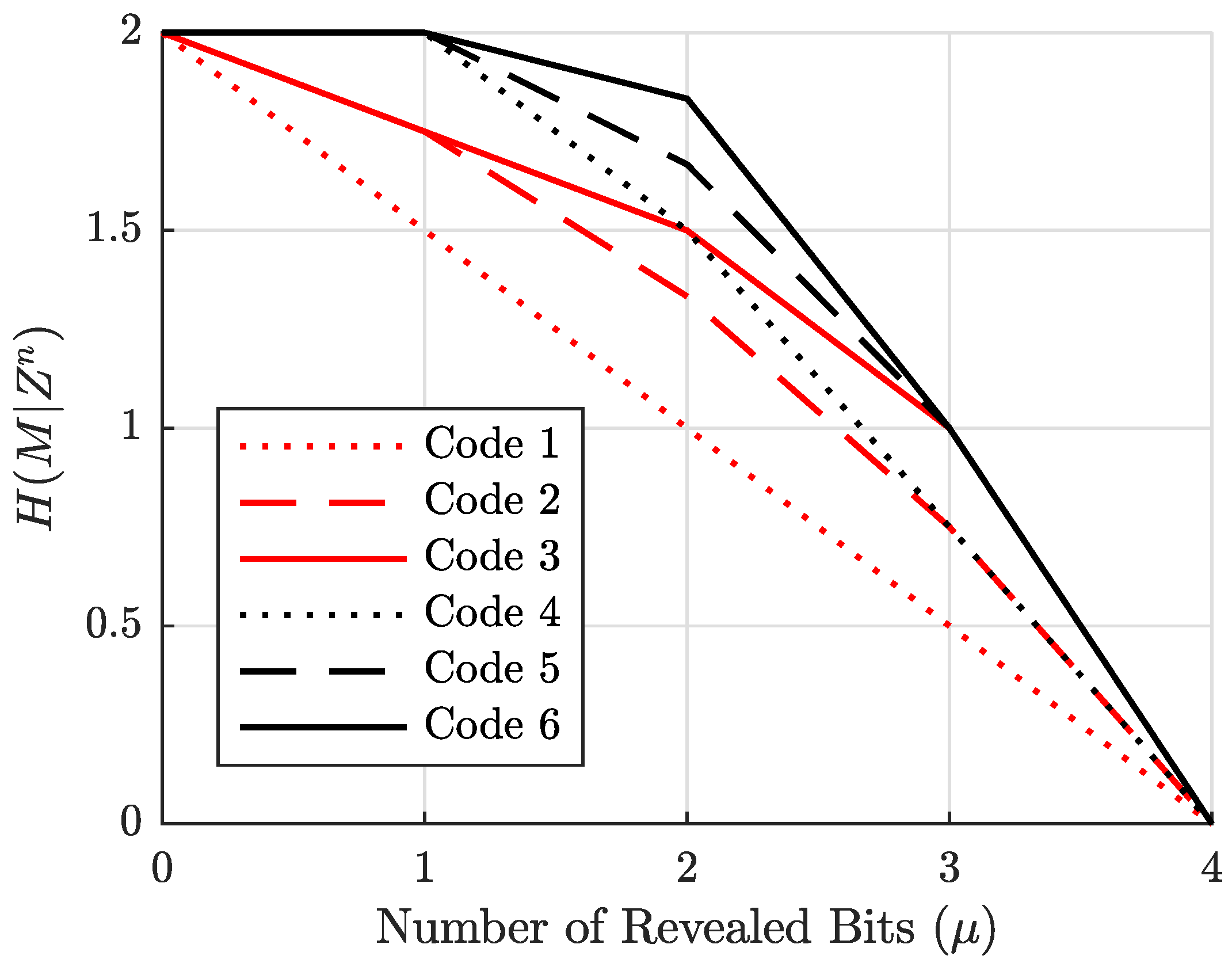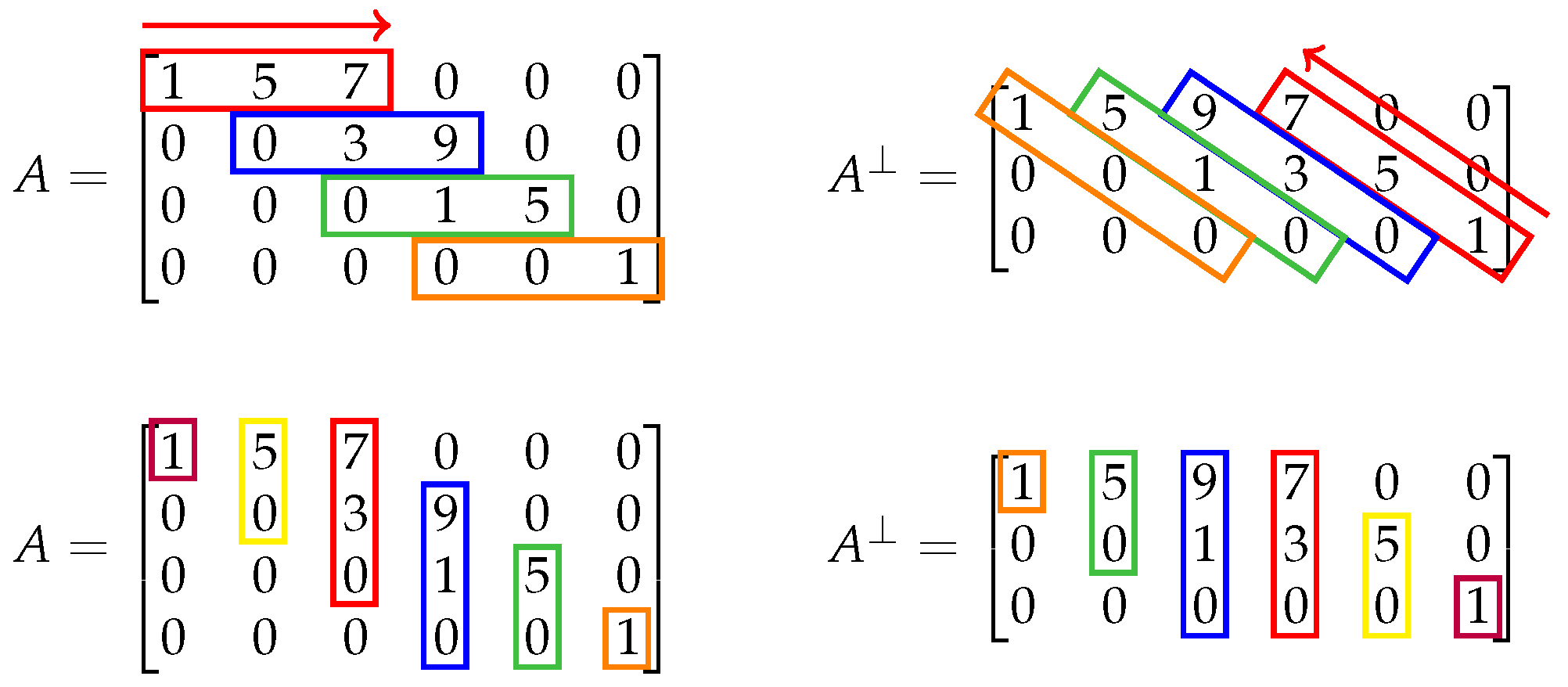
On Best Erasure Wiretap Codes: Equivocation Matrices and Design Principles


Abstract
1. Introduction
- , where , (weak secrecy);
- , where , (strong secrecy);
- , (semantic secrecy).
- , (reliability constraint);
- , where , (security constraint),
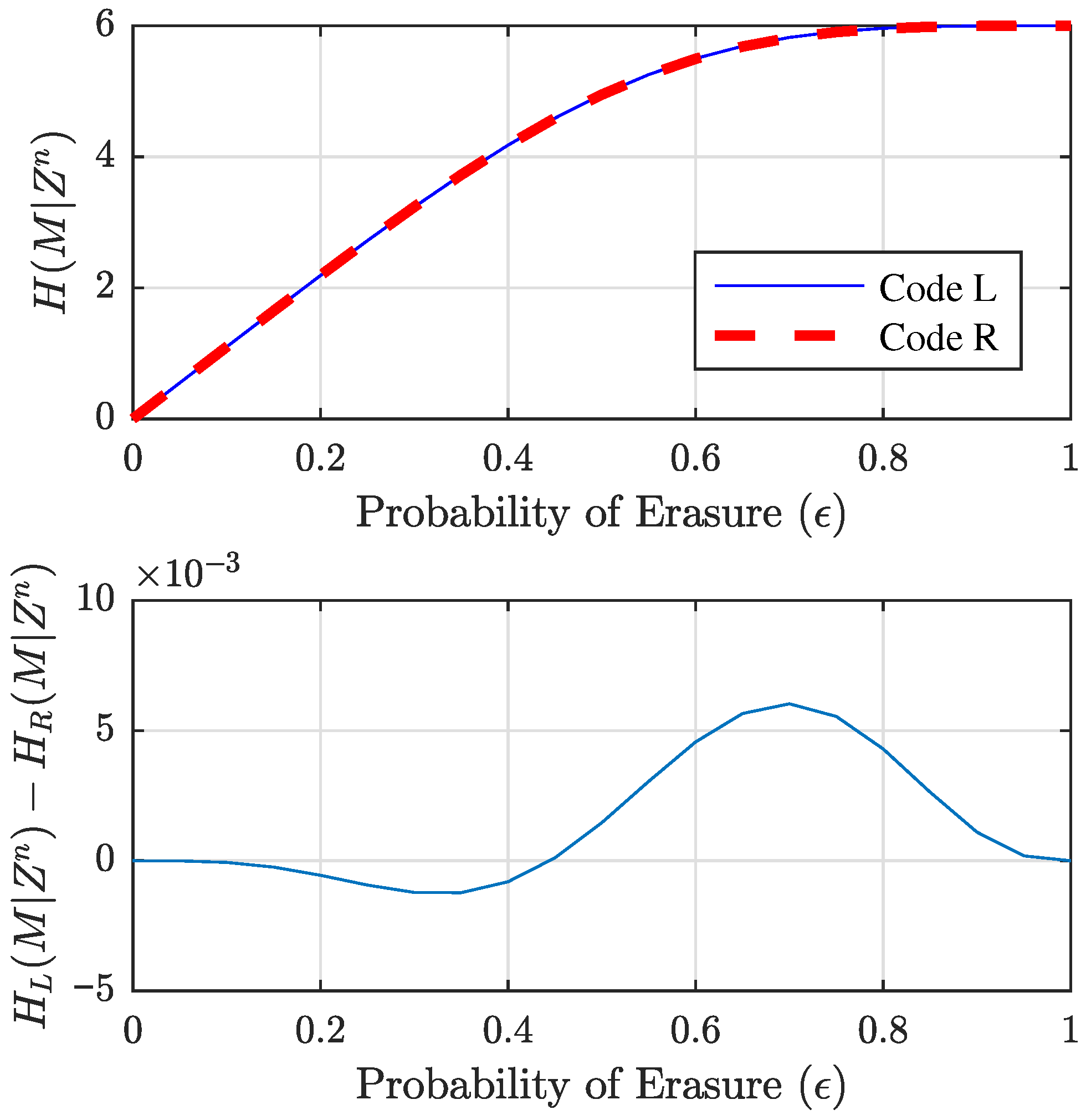
- A discussion of the results regarding the existence of best coset codes for information theoretic security (it has been hypothesized that a best code exists for all valid () pairs in [33], but this is proved otherwise herein by way of counterexample);
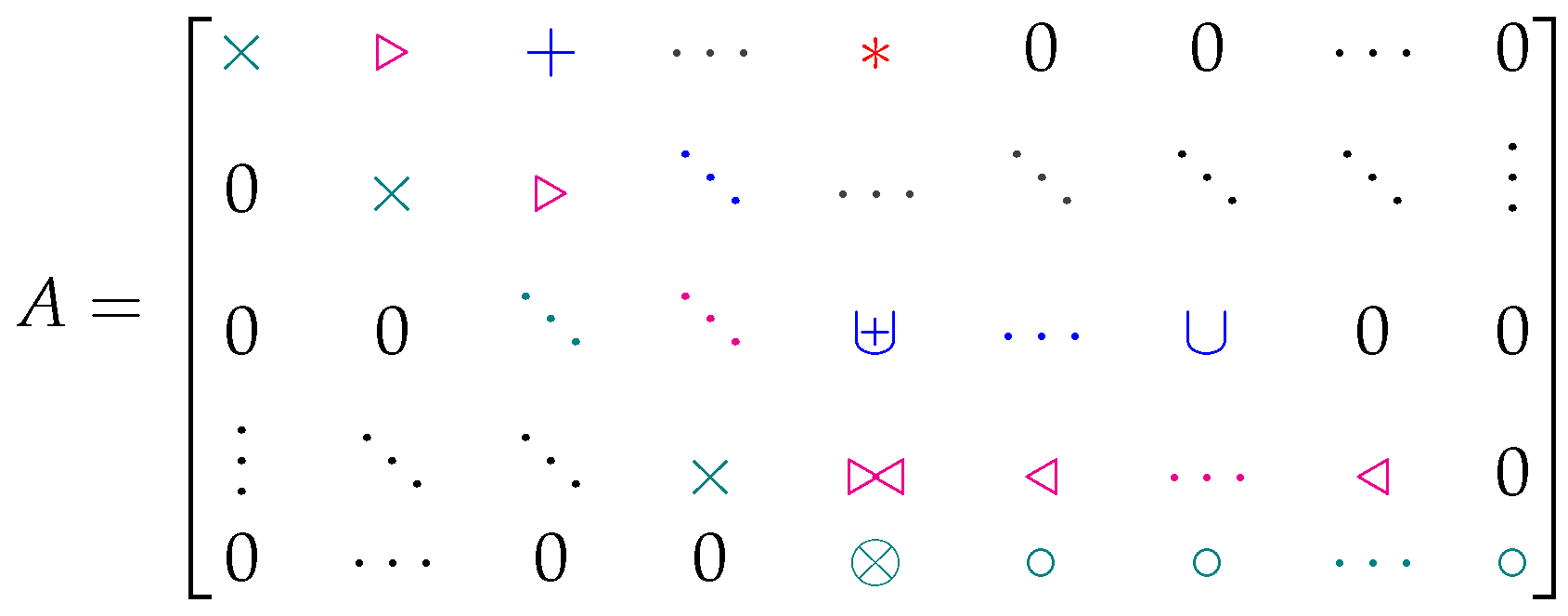
- A high-level algorithm for the design of good wiretap coset codes for the BEWC of any size that follows an outside-in approach to code design that is backed by equivocation matrix properties for best codes;
- Results related to simplex and Hamming codes: notably that the simplex code is better for all eavesdropper channel states than any code of its size with exactly one column of the generator matrix repeated any number of times.
2. Background
2.1. Coset Coding for the Wiretap Channel
2.2. Equivocation for Coset Codes
2.3. A Sufficient Condition for the Existence of Best Wiretap Coset Codes for All
3. Equivocation Matrices and Their Properties
3.1. Basic Definitions
3.2. Properties of the Equivocation Matrix
4. Searching for Best Codes
4.1. Notions of Equivalence in Wiretap Codes
4.2. Search Space Reduction Techniques
5. Search Results: Best Codes Do Not Always Exist
6. Principles of Code Design for Good Coset Codes of Any Size
6.1. High-Level Design of Good/Best Codes
6.2. Best Codes from the Outside in
7. On the Optimality of Simplex and Hamming Codes: Simplex Codes Are Better than Repeating Column Codes
8. Conclusions
Author Contributions
Funding
Data Availability Statement
Conflicts of Interest
References
- Mukherjee, A. Physical-Layer Security in the Internet of Things: Sensing and Communication Confidentiality Under Resource Constraints. Proc. IEEE 2015, 103, 1747–1761. [Google Scholar] [CrossRef]
- Zou, Y.; Zhu, J.; Wang, X.; Hanzo, L. A Survey on Wireless Security: Technical Challenges, Recent Advances, and Future Trends. Proc. IEEE 2016, 104, 1727–1765. [Google Scholar] [CrossRef]
- Luzzi, L. Coding Theory Advances in Physical-Layer Secrecy. In Physical-Layer Security for 6G; Wiley: Hoboken, NJ, USA, 2024; pp. 19–42. [Google Scholar]
- Durisi, G.; Koch, T.; Popovski, P. Toward Massive, Ultrareliable, and Low-Latency Wireless Communication with Short Packets. Proc. IEEE 2016, 104, 1711–1726. [Google Scholar] [CrossRef]
- Diffie, W.; Hellman, M. New directions in cryptography. IEEE Trans. Inf. Theory 1976, 22, 644–654. [Google Scholar] [CrossRef]
- Burange, A.; Misalkar, H. Review of Internet of Things in development of smart cities with data management amp; privacy. In Proceedings of the Computer Engineering and Applications (ICACEA), 2015 International Conference on Advances, Ghaziabad, India, 19–20 March 2015; pp. 189–195. [Google Scholar] [CrossRef]
- McKay, K.A.; Bassham, L.E.; Turan, M.S.; Mouha, N.W. Report on Lightweight Cryptography; NIST Publications: Gaithersburg, MD, USA, 2017; pp. 1–21. [Google Scholar]
- Xiong, L. Harnessing personal data from Internet of Things: Privacy enhancing dynamic information monitoring. In Proceedings of the Collaboration Technologies and Systems (CTS), 2015 International Conference, Atlanta, GA, USA, 1–5 June 2015; p. 37. [Google Scholar] [CrossRef]
- Liang, W.; Peiji, S. Research on the protection algorithm and model of personal privacy information in internet of thing. In Proceedings of the E-Business and E-Government (ICEE), 2011 International Conference, Shanghai, China, 6–8 May 2011; pp. 1–4. [Google Scholar] [CrossRef]
- Bloch, M.; Barros, J. Physical-Layer Security: From Information Theory to Security Engineering; Cambridge University Press: Cambridge, UK, 2011. [Google Scholar]
- Johnson, M.H.; Harrison, W.K. A rateless approach to physical-layer security. In Proceedings of the IEEE International Conference on Communications (ICC), Kansas City, MO, USA, 20–24 May 2018; IEEE: New York, NY, USA, 2018; pp. 1–6. [Google Scholar]
- Jensen, B.; Clark, B.; Flanary, D.; Norman, K.; Rice, M.; Harrison, W.K. Physical-Layer Security: Does it Work in a Real Environment? In Proceedings of the IEEE International Conference on Communications (ICC), Shanghai, China, 20–24 May 2019; pp. 1–7. [Google Scholar]
- Flanary, D.; Jensen, B.; Clark, B.; Norman, K.; Nelson, N.; Rice, M.; Harrison, W.K. Manufacturing an Erasure Wiretap Channel from Channel Sounding Measurements. In Proceedings of the IEEE International Symposium on Information Theory (ISIT), Paris, France, 7–12 July 2019; IEEE: New York, NY, USA, 2019; pp. 320–324. [Google Scholar]
- Rice, M.; Clark, B.; Flanary, D.; Jensen, B.; Nelson, N.; Norman, K.; Perrins, E.; Harrison, W.K. Physical-layer security for vehicle-to-everything networks: Increasing security while maintaining reliable communications. IEEE Veh. Technol. Mag. 2020, 15, 68–76. [Google Scholar] [CrossRef]
- Harman, D.; Knapp, K.; Sweat, T.; Lundrigan, P.; Rice, M.; Harrison, W. Physical Layer Security: Channel Sounding Results for the Multi-Antenna Wiretap Channel. Entropy 2023, 25, 1397. [Google Scholar] [CrossRef]
- Shannon, C.E. Communication Theory of Secrecy Systems. Bell Syst. Tech. J. 1948, 28, 656–715. [Google Scholar] [CrossRef]
- Wyner, A.D. The Wire-Tap Channel. Bell Syst. Tech. J. 1975, 54, 1355–1387. [Google Scholar] [CrossRef]
- Csiszár, I.; Körner, J. Broadcast Channels with Confidential Messages. IEEE Trans. Inf. Theory 1978, 24, 339–348. [Google Scholar] [CrossRef]
- Harrison, W.K.; Almeida, J.; Bloch, M.R.; McLaughlin, S.W.; Barros, J. Coding for Secrecy: An Overview of Error-Control Coding Techniques for Physical-Layer Security. IEEE Signal Process. Mag. 2013, 30, 41–50. [Google Scholar] [CrossRef]
- Bloch, M.R.; Hayashi, M.; Thangaraj, A. Error-Control Coding for Physical-Layer Secrecy. Proc. IEEE 2015, 103, 1725–1746. [Google Scholar] [CrossRef]
- Bloch, M.R.; Laneman, J.N. Strong Secrecy From Channel Resolvability. IEEE Trans. Inf. Theory 2013, 59, 8077–8098. [Google Scholar] [CrossRef]
- Cover, T.M.; Thomas, J.A. Elements of Information Theory; John Wiley & Sons, Inc.: Hoboken, NJ, USA, 2006. [Google Scholar]
- Ozarow, L.H.; Wyner, A.D. Wiretap Channel II. AT&T Bell Lab. Tech. J. 1984, 63, 2135–2157. [Google Scholar] [CrossRef]
- Wei, V. Generalized Hamming weights for linear codes. IEEE Trans. Inf. Theory 1991, 37, 1412–1418. [Google Scholar] [CrossRef]
- Lin, S.; Costello, D.J., Jr. Error Control Coding, 2nd ed.; Pearson Prentice Hall: Upper Saddle River, NJ, USA, 2004. [Google Scholar]
- Moon, T.K. Error Correction Coding: Mathematical Methods and Algorithms; John Wiley & Sons, Inc.: Hoboken, NJ, USA, 2005. [Google Scholar]
- Richardson, T.; Urbanke, R. Modern Coding Theory; Cambridge University Press: New York, NY, USA, 2008. [Google Scholar]
- Al-Hassan, S.; Ahmed, M.Z.; Tomlinson, M. Secrecy coding for the wiretap channel using best known linear codes. In Proceedings of the Global Information Infrastructure Symposium, Trento, Italy, 28–31 October 2013; pp. 1–6. [Google Scholar] [CrossRef]
- Al-Hassan, S.; Ahmed, M.; Tomlinson, M. Extension of the parity check matrix to construct the best equivocation codes for syndrome coding. In Proceedings of the Global Information Infrastructure and Networking Symposium (GIIS), Montreal, QC, Canada, 15–19 September 2014; pp. 1–3. [Google Scholar] [CrossRef]
- Zhang, K. Secure Coding Schemes and Code Design for the Wiretap Channel. Ph.D Thesis, University of Porto, Porto, Portugal, 2014. [Google Scholar]
- Zhang, K.; Tomlinson, M.; Ahmed, M.; Ambroze, M.; Rodrigues, M. Best binary equivocation code construction for syndrome coding. IET Commun. 2014, 8, 1696–1704. [Google Scholar] [CrossRef]
- Pfister, J.; Gomes, M.; Vilela, J.P.; Harrison, W.K. Quantifying Equivocation for Finite Blocklength Wiretap Codes. In Proceedings of the IEEE International Conference on Communications (ICC), Paris, France, 21–25 May 2017; pp. 1–6. [Google Scholar]
- Harrison, W.K.; Bloch, M.R. On Dual Relationships of Secrecy Codes. In Proceedings of the IEEE Allerton Conference on Communication, Control, and Computing (Allerton), Monticello, IL, USA, 2–5 October 2018; pp. 366–372. [Google Scholar]
- Harrison, W.K.; Bloch, M.R. Attributes of Generators for Best Finite Blocklength Coset Wiretap Codes over Erasure Channels. In Proceedings of the IEEE International Symposium on Information Theory (ISIT), Paris, France, 7–12 July 2019; pp. 827–831. [Google Scholar]
- Harrison, W.K. Exact Equivocation Expressions for Wiretap Coding Over Erasure Channel Models. IEEE Commun. Lett. 2020, 24, 2687–2691. [Google Scholar] [CrossRef]
- Swain, A.; Harrison, W.K. Best Linear Wiretap Coset Codes Must Maximize Minimum Distance. In Proceedings of the IEEE International Symposium on Information Theory (ISIT), Ann Arbor, MI, USA, 22–27 June 2025; pp. 1–6. [Google Scholar] [CrossRef]
- Forney, G. Dimension/length profiles and trellis complexity of linear block codes. IEEE Trans. Inf. Theory 1994, 40, 1741–1752. [Google Scholar] [CrossRef]
- Cai, N.; Chan, T. Theory of Secure Network Coding. Proc. IEEE 2011, 99, 421–437. [Google Scholar] [CrossRef]
- Wong, C.W.; Wong, T.; Shea, J. Secret-Sharing LDPC Codes for the BPSK-Constrained Gaussian Wiretap Channel. IEEE Trans. Inf. Forensics Secur. 2011, 6, 551–564. [Google Scholar] [CrossRef]
- Baldi, M.; Ricciutelli, G.; Maturo, N.; Chiaraluce, F. Performance assessment and design of finite length LDPC codes for the Gaussian wiretap channel. In Proceedings of the IEEE International Conference on Communication Workshop (ICCW), London, UK, 8–12 June 2015; pp. 435–440. [Google Scholar]
- Harrison, W.K.; Beard, E.; Dye, S.; Holmes, E.; Nelson, K.; Gomes, M.A.C.; Vilela, J.P. Implications of coding layers on physical-layer security: A secrecy benefit approach. Entropy 2019, 21, 755. [Google Scholar] [CrossRef] [PubMed]
- Thangaraj, A.; Dihidar, S.; Calderbank, A.R.; McLaughlin, S.W.; Merolla, J.M. Applications of LDPC Codes to the Wiretap Channels. IEEE Trans. Inf. Theory 2007, 53, 2933–2945. [Google Scholar] [CrossRef]
- Shoushtari, M.; Harrison, W.K. New Dual Relationships for Error-Correcting Wiretap Codes. In Proceedings of the 2021 IEEE Information Theory Workshop (ITW), Kanazawa, Japan, 17–21 October 2021; pp. 1–6. [Google Scholar] [CrossRef]





| Coset | |||||
|---|---|---|---|---|---|
| [0 0 0 0] | [0 0 1 1] | [1 1 0 1] | [1 1 1 0] | ||
| [1 0 1 0] | [1 0 0 1] | [0 1 1 1] | [0 1 0 0] | ||
| [1 1 0 0] | [1 1 1 1] | [0 0 0 1] | [0 0 1 0] | ||
| [0 1 1 0] | [0 1 0 1] | [1 0 1 1] | [1 0 0 0] |
Disclaimer/Publisher’s Note: The statements, opinions and data contained in all publications are solely those of the individual author(s) and contributor(s) and not of MDPI and/or the editor(s). MDPI and/or the editor(s) disclaim responsibility for any injury to people or property resulting from any ideas, methods, instructions or products referred to in the content. |
© 2025 by the authors. Licensee MDPI, Basel, Switzerland. This article is an open access article distributed under the terms and conditions of the Creative Commons Attribution (CC BY) license (https://creativecommons.org/licenses/by/4.0/).
Share and Cite
Harrison, W.K.; Welling, T.; Swain, A.; Shoushtari, M. On Best Erasure Wiretap Codes: Equivocation Matrices and Design Principles. Entropy 2025, 27, 1245. https://doi.org/10.3390/e27121245
Harrison WK, Welling T, Swain A, Shoushtari M. On Best Erasure Wiretap Codes: Equivocation Matrices and Design Principles. Entropy. 2025; 27(12):1245. https://doi.org/10.3390/e27121245
Chicago/Turabian StyleHarrison, Willie K., Truman Welling, Andrew Swain, and Morteza Shoushtari. 2025. "On Best Erasure Wiretap Codes: Equivocation Matrices and Design Principles" Entropy 27, no. 12: 1245. https://doi.org/10.3390/e27121245
APA StyleHarrison, W. K., Welling, T., Swain, A., & Shoushtari, M. (2025). On Best Erasure Wiretap Codes: Equivocation Matrices and Design Principles. Entropy, 27(12), 1245. https://doi.org/10.3390/e27121245