Abstract
We analyze the classical and quantum dynamics of the driven dissipative Bose–Hubbard dimer. Under variation of the driving frequency, the classical system is shown to exhibit a bifurcation to the limit cycle, where its steady-state solution corresponds to periodic oscillation with the frequency unrelated to the driving frequency. This bifurcation is shown to lead to a peculiarity in the stationary single-particle density matrix of the quantum system. The case of the Bose–Hubbard trimer, where the discussed limit cycle bifurcates into a chaotic attractor, is briefly discussed.
1. Introduction
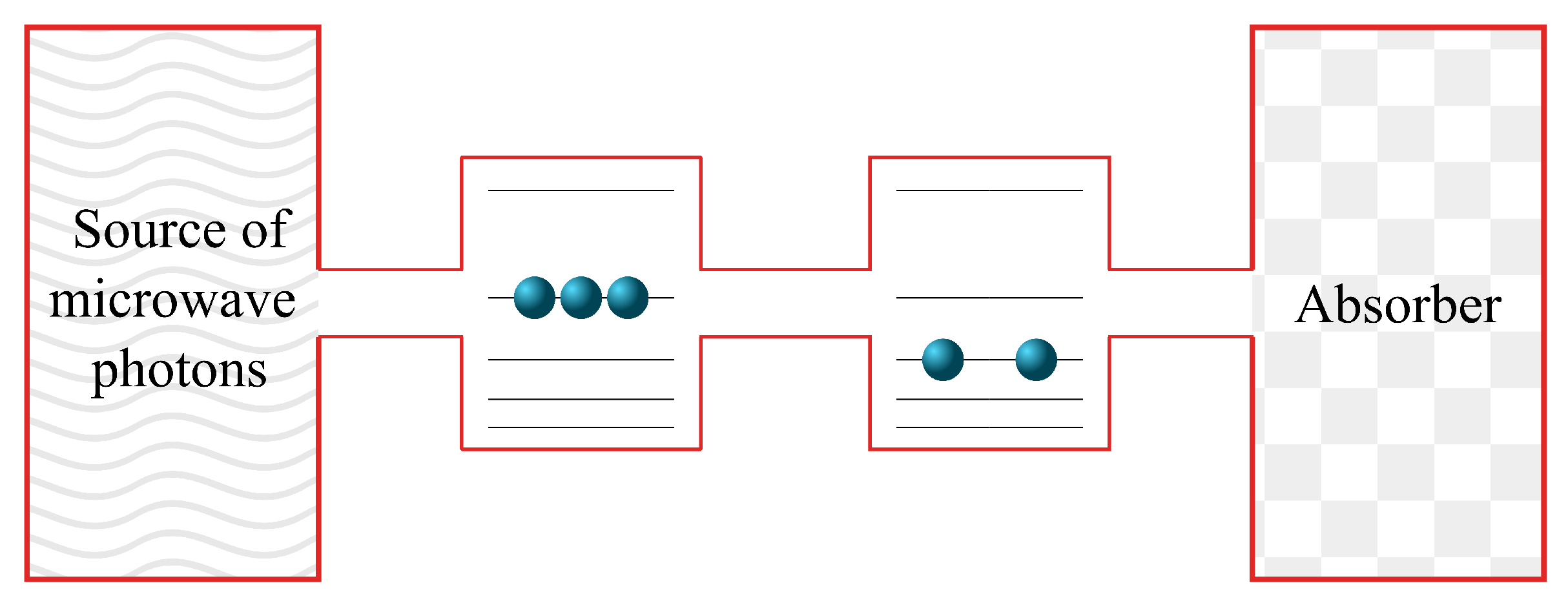
In the present work, we analyze the dynamics of the two-site driven dissipative Bose–Hubbard (BH) model. Similar to the conservative two-site BH model, which provides a model for the Josephson oscillations and the phenomenon of self-trapping [1,2,3,4], the driven dissipative BH systems model a number of phenomena in open quantum systems. For example, the one-site system, which is nothing else than the driven dissipative non-linear oscillators, is the paradigm system for quantum bistability (see Ref. [5] and references therein). Extending the system to two sites enriches its dynamics and drastically complicates the classical bifurcation diagram [6,7], which poses the problem of a quantum signature of these bifurcations [8,9]. Finally, the classical three-site BH system can show the chaotic attractor that brings us to the problem of the dissipative Quantum Chaos [10,11]. We mention that nowadays the few-site open BH model can be and has been realized experimentally by using different physical platforms, among which the most successful are exciton–polariton semi-conductor systems [4,12,13] and super-conducting circuits [14,15,16,17]. In what follows, we theoretically analyze the two- and three-site driven dissipative BH model by keeping in mind laboratory experiments on photon transport in the chain of transmons, which are micro-cavities coupled to Josephson’s junctions. The presence of Josephson’s junction introduces an effective inter-particle interaction for photons in the cavity and, thus, each transmon can be viewed as a quantum non-linear oscillator, see Figure 1. We mention that in the present work we do not try to relate the model parameters to the system parameters used in one or the other laboratory experiment. In this sense, the model depicted in Figure 1 captures only the general scheme of these experiments, where quantum non-linear oscillators are arranged in the ‘transmission line’ and one measures the amplitude of the transmitted signal, i.e., the current of the microwave photons.
Figure 1.
Pictorial presentation of the considered model. The figure shows two coupled non-linear micro-cavities with three photons in the first cavity and two photons in the second cavity. It is assumed that the microwave photons are injected into the first cavity by using a generator of the microwave field, and the transmitted photons are absorbed with some probability by a measurement device.
2. Quantum Dynamics
We consider two coupled transmons where the first transmon is excited by a microwave generator and the transmitted signal is read from the second transmon. The governing equation for the system density matrix reads [13,16]
where is the decay constant proportional to the absorption rate. Using the rotating wave approximation, the Hamiltonian in Equation (1) has the form
where and are the creation and annihilation operators with the commutation relation , is the number operator, is the Rabi frequency, the detuning defined as the difference between the driving frequency and the cavity eigen-frequency, J the coupling constant, U the microscopic interaction constant, and ℏ is the dimensionless Planck constant which determines how close is the system to its classical counterpart. For quantum systems with the conserved number of particles N, one can define the dimensionless Planck constant as . In our case, where the number of particles is not conserved, ℏ is just the scaling parameter that leaves invariant the classical dynamics. We focus on the case where the quantum dynamics shows similarities with the classical dynamics. In the opposite limit the system dynamics is dominated by the multi-photon resonances which have no classical analog.
Our main object of interest is the single-particle density matrix (SPDM) which is defined as follows,
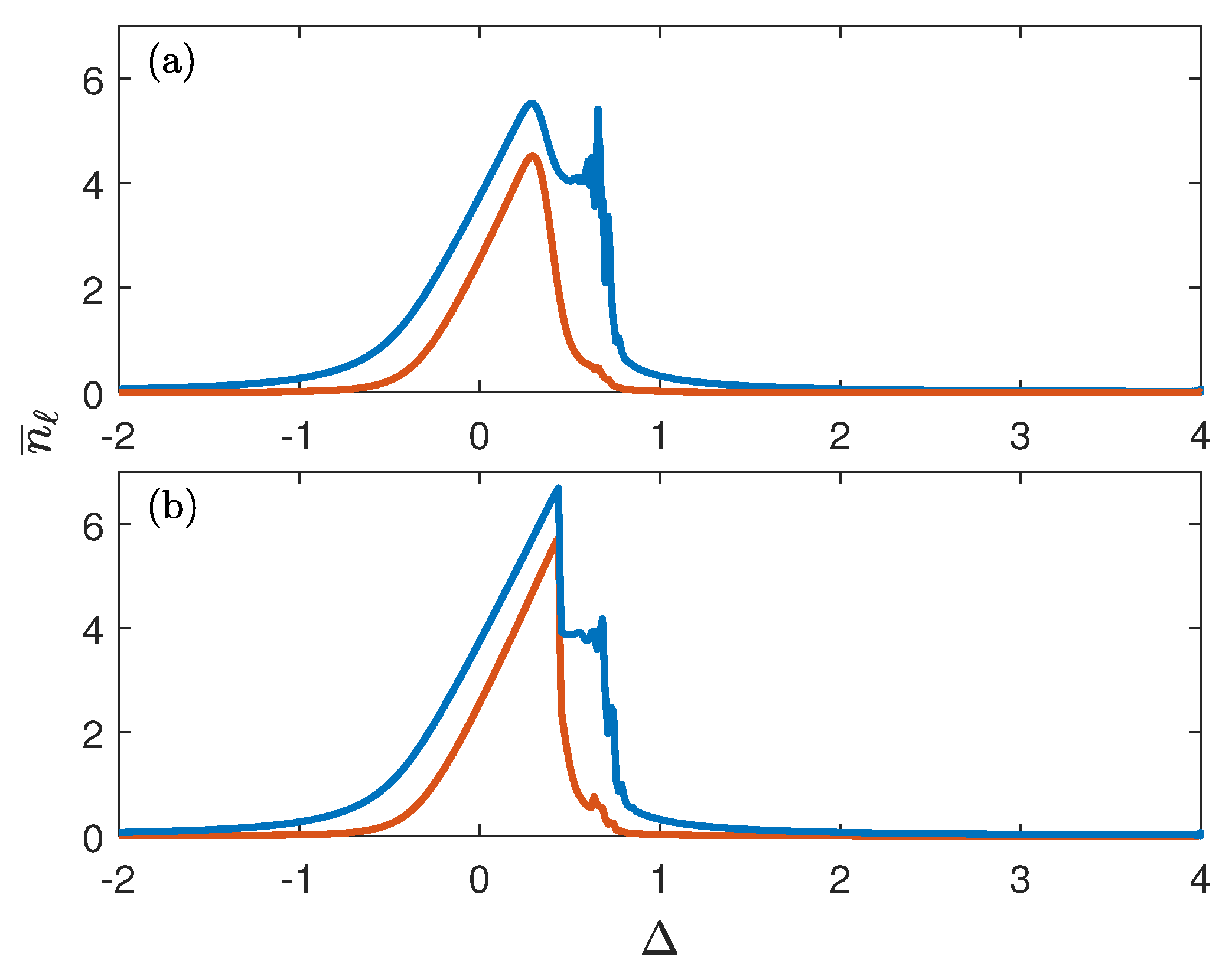
The diagonal elements of the SPDM obviously determine the populations of the sites, while off-diagonal elements determine the current of Bose particles (photons) between the sites. We find the stationary SPDM for different , which will be our control parameter, by using two methods: (i) by evolving the system for fixed for a long time sufficient to reach the steady-state regime, and (ii) by sweeping in the negative direction starting from a large positive . In both cases, the initial condition corresponds to the empty system, i.e., . The obtained results are depicted in Figure 2. It is seen in Figure 2 that stationary occupations of the chain sites (i.e., the mean number of photons in transmons) show a kind of plateau in the certain interval of . Notice that this plateau is absent for the one-site BH model. It is argued in the next section that this peculiarity is a signature of the attractor bifurcation which one finds in the classical counterpart of the system (2).
Figure 2.
The mean number of bosons in the BH dimer as the function of the detuning . The blue and red lines correspond to the first and second sites, respectively. (a) Quasi-adiabatic passage with the sweeping rate . (b) Steady-state solution for different . The system parameters are , , , , .
3. Classical Dynamics
The classical (mean-field) dynamics of the system is governed by the equations
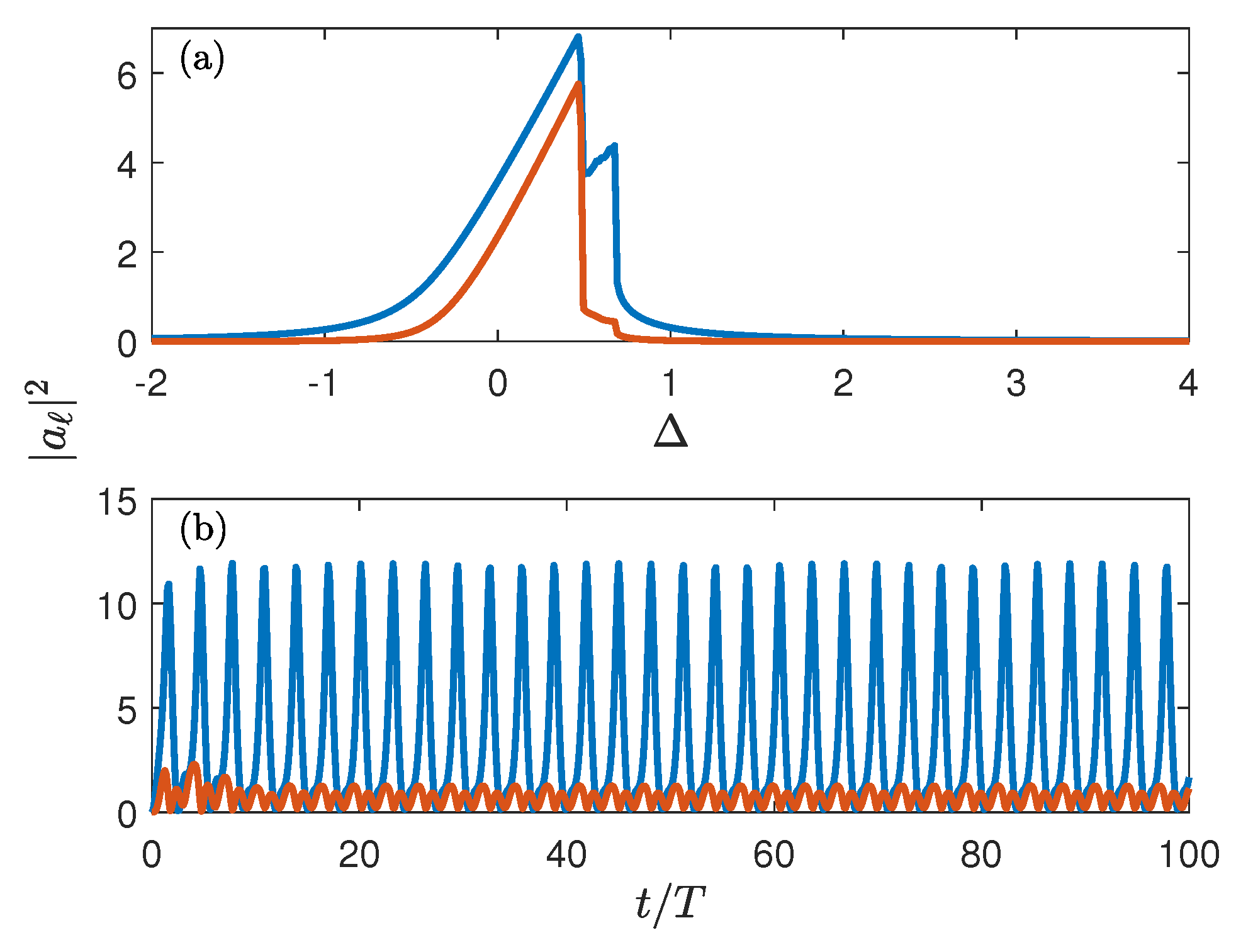
where are complex amplitudes of the local oscillators. The numerical simulations were performed by using the fourth-order Runge–Kutta method. It is found that for non-zero the system (4) relaxes in course of time to some attractor which determines the system’s stationary response to the external driving. In what follows, we shall be interested only in attractors whose basin contains the point . For and , we found these attractors to be simple focuses (in the rotating frame), where the populations approach their stationary values depicted in Figure 3a by the blue and red solid lines. However, in the interval these simple attractors bifurcate into the limit cycle, where the steady state solution of Equation (4) corresponds to periodic oscillations of the oscillator amplitudes with the frequency not related to the driving frequency, see Figure 3b. (Bifurcation of a simple attractor into a limit cycle in the driven dissipative two-site BH system was discussed earlier in Refs. [8,9] where the authors considered a specific model with non-local driving and dissipation. Additionally, when addressing the quantum system, the authors focussed on the transient dynamics for particular initial conditions but not on the stationary regime). In addition to this characteristic frequency, we also introduce the mean squared amplitudes where the bar denotes the time average. We depict these quantities in Figure 3a by using the same line styles. Comparing now Figure 2b and Figure 3a we conclude that bifurcation of the classical attractor is well reflected in the quantum dynamics of the BH dimer already for .
Figure 3.
(a) The mean number of bosons in the BH dimer averaged over time as a function of detuning . (b) System dynamics for . Shown are the squared amplitudes of the local oscillators as the function of time.
4. Dissipative BH Trimer
We repeated calculations for the BH trimer. The dynamics of the trimer is controlled by the following set of equations of motion
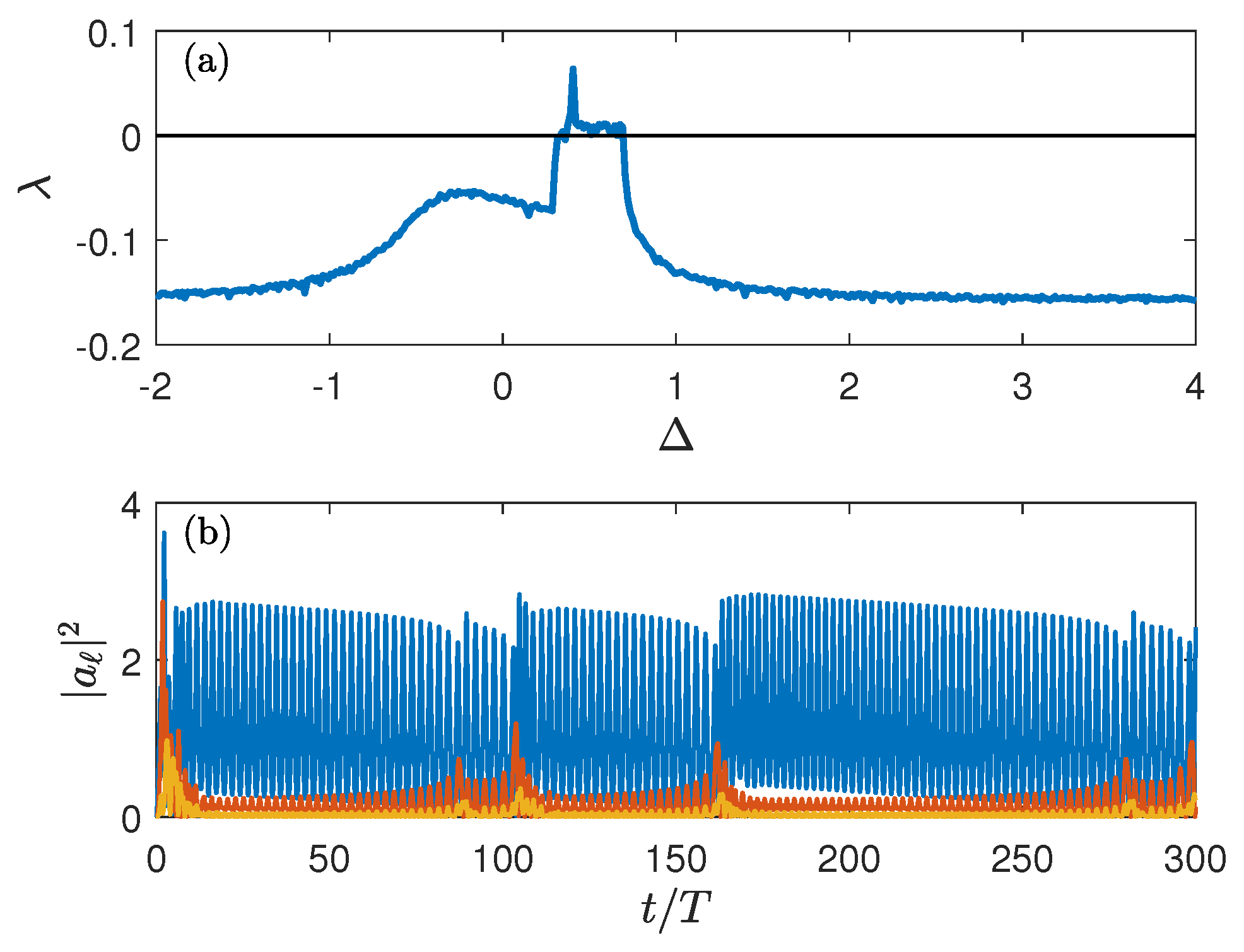
In the trimer, the new feature is that the above-discussed limit cycle bifurcates into a chaotic attractor, see the upper panel in Figure 4, which shows the Lyapunov exponent of the steady-state solution as the function of the control parameter . An example of this ‘stationary’ solution is given in the lower panel in Figure 4 for where the Lyapunov exponent is maximal.
Figure 4.
(a) Lyapunov exponent of the ‘stationary’ solution of the driven dissipative BH trimer as a function of the detuning . (b) System dynamics for . Shown are the squared amplitudes of the local oscillators as the function of time.
5. Summary
We showed that attractor bifurcations in the driven dissipative BH system can be well observed already for the value of the effective Planck constant . In the laboratory experiment, the value of this effective constant is determined by the ratio of the interaction constant U (non-linearity of the transmon spectrum) to the Rabi frequency , which is proportional to the amplitude of the microwave field. Clearly, the larger the Rabi frequency is, the more photons are simultaneously present in the system. The presented in this work results indicate that the quantum BH dimer reproduces the dynamics of the classical BH dimer when the mean number of photons is of the order of 10.
To conclude, we would like to briefly comment on the experiments where the detuning is monotonically swept in time. In the present work, we restricted ourselves by the case where is swept in the negative direction. If the sweeping direction is inverted, the result may strongly deviate from that shown in Figure 2a due to quantum hysteresis. Within the classical approach, the positive sweeping populates the other attractor whose basin excludes the point [18]. In the quantum approach, however, this attractor is a metastable state with a finite lifetime. Thus, unlike the case of negative sweeping, the result of a quasi-adiabatic passage in the positive direction strongly depends on the sweeping rate .
Author Contributions
Methodology, A.K.; Software, P.M.; Formal analysis, A.K.; Data curation, P.M., D.M. and A.K.; Writing—original draft, P.M. and A.K.; Writing—review & editing, D.M.; Visualization, P.M.; Supervision, A.K. All authors have read and agreed to the published version of the manuscript.
Funding
This work has been supported by Russian Science Foundation through grant N19-12-00167.
Conflicts of Interest
The authors declare no conflict of interest. The funders had no role in the design of the study; in the collection, analyses, or interpretation of data; in the writing of the manuscript; or in the decision to publish the results.
Abbreviations
The following abbreviations are used in this manuscript:
| BH | Bose–Hubbard |
| SPDM | Single-particle density matrix |
References
- Smerzi, A.; Fantoni, S.; Giovanazzi, S.; Shenoy, S.R. Quantum Coherent Atomic Tunneling between Two Trapped Bose-Einstein Condensates. Phys. Rev. Lett. 1997, 79, 4950–4953. [Google Scholar] [CrossRef]
- Albiez, M.; Gati, R.; Fölling, J.; Hunsmann, S.; Cristiani, M.; Oberthaler, M.K. Direct Observation of Tunneling and Nonlinear Self-Trapping in a Single Bosonic Josephson Junction. Phys. Rev. Lett. 2005, 95, 010402. [Google Scholar] [CrossRef] [PubMed]
- Levy, S.; Lahoud, E.; Shomroni, I.; Steinhauer, J. The a.c. and d.c. Josephson effects in a Bose–Einstein condensate. Nature 2007, 449, 579–583. [Google Scholar] [CrossRef] [PubMed]
- Abbarchi, M.; Amo, A.; Sala, V.G.; Solnyshkov, D.D.; Flayac, H.; Ferrier, L.; Sagnes, I.; Galopin, E.; Lemaître, A.; Malpuech, G.; et al. Macroscopic quantum self-trapping and Josephson oscillations of exciton polaritons. Nat. Phys. 2013, 9, 275–279. [Google Scholar] [CrossRef]
- Kolovsky, A. Bistability in the dissipative quantum systems I: Damped and driven nonlinear oscillator. arXiv 2020, arXiv:2002.11373. [Google Scholar] [CrossRef]
- Giraldo, A.; Krauskopf, B.; Broderick, N.G.R.; Levenson, J.A.; Yacomotti, A.M. The driven-dissipative Bose–Hubbard dimer: Phase diagram and chaos. New J. Phys. 2020, 22, 043009. [Google Scholar] [CrossRef]
- Giraldo, A.; Masson, S.J.; Broderick, N.G.R.; Krauskopf, B. Semiclassical bifurcations and quantum trajectories: A case study of the open Bose–Hubbard dimer. Eur. Phys. J. Spec. Top. 2022, 231, 385–401. [Google Scholar] [CrossRef]
- Lledó, C.; Mavrogordatos, T.K.; Szymańska, M.H. Driven Bose-Hubbard dimer under nonlocal dissipation: A bistable time crystal. Phys. Rev. B 2019, 100, 054303. [Google Scholar] [CrossRef]
- Lledó, C.; Szymańska, M.H. A dissipative time crystal with or without Z2 symmetry breaking. New J. Phys. 2020, 22, 075002. [Google Scholar] [CrossRef]
- Braun, D. Dissipative Quantum Chaos and Decoherence; Springer: Berlin/Heidelberg, Germany, 2001; Volume 172. [Google Scholar] [CrossRef]
- Sá, L.; Ribeiro, P.; Prosen, T. Complex Spacing Ratios: A Signature of Dissipative Quantum Chaos. Phys. Rev. X 2020, 10, 021019. [Google Scholar] [CrossRef]
- Lagoudakis, K.G.; Pietka, B.; Wouters, M.; André, R.; Deveaud-Plédran, B. Coherent Oscillations in an Exciton-Polariton Josephson Junction. Phys. Rev. Lett. 2010, 105, 120403. [Google Scholar] [CrossRef] [PubMed]
- Rodriguez, S.R.K.; Amo, A.; Sagnes, I.; Gratiet, L.L.; Galopin, E.; Lemaître, A.; Bloch, J. Interaction-induced hopping phase in driven-dissipative coupled photonic microcavities. Nat. Commun. 2016, 7, 1–6. [Google Scholar] [CrossRef] [PubMed]
- Eichler, C.; Salathe, Y.; Mlynek, J.; Schmidt, S.; Wallraff, A. Quantum-Limited Amplification and Entanglement in Coupled Nonlinear Resonators. Phys. Rev. Lett. 2014, 113, 110502. [Google Scholar] [CrossRef] [PubMed]
- Raftery, J.; Sadri, D.; Schmidt, S.; Türeci, H.; Houck, A. Observation of a Dissipation-Induced Classical to Quantum Transition. Phys. Rev. X 2014, 4, 031043. [Google Scholar] [CrossRef]
- Fitzpatrick, M.; Sundaresan, N.M.; Li, A.C.Y.; Koch, J.; Houck, A. Observation of a Dissipative Phase Transition in a One-Dimensional Circuit QED Lattice. Phys. Rev. X 2017, 7, 011016. [Google Scholar] [CrossRef]
- Fedorov, G.; Remizov, S.; Shapiro, D.; Pogosov, W.; Egorova, E.; Tsitsilin, I.; Andronik, M.; Dobronosova, A.; Rodionov, I.; Astafiev, O.; et al. Photon Transport in a Bose-Hubbard Chain of Superconducting Artificial Atoms. Phys. Rev. Lett. 2021, 126, 180503. [Google Scholar] [CrossRef] [PubMed]
- Muraev, P.S.; Maksimov, D.N.; Kolovsky, A.R. Ballistic transport of interacting Bose particles in a tight-binding chain. Phys. Rev. E 2022, 106, 064203. [Google Scholar] [CrossRef]
Disclaimer/Publisher’s Note: The statements, opinions and data contained in all publications are solely those of the individual author(s) and contributor(s) and not of MDPI and/or the editor(s). MDPI and/or the editor(s) disclaim responsibility for any injury to people or property resulting from any ideas, methods, instructions or products referred to in the content. |
© 2023 by the authors. Licensee MDPI, Basel, Switzerland. This article is an open access article distributed under the terms and conditions of the Creative Commons Attribution (CC BY) license (https://creativecommons.org/licenses/by/4.0/).