

A First Step to the Categorical Logic of Quantum Programs


Abstract
1. Introduction
2. Categorical Logic for Quantum Programs
2.1. Syntax
2.1.1. Constants from Categorical Quantum Mechanics
- Z-spiders , for every real number , of which the matrix interpretation and graphical representation are respectivelyWe call the phase of . The graph is read from bottom to top. We consider the wires at the bottom as input and those on the top as output. We usually omit the phase in the graphical representation when it is 0.

- X-spiders , for every real number , of which the matrix interpretation and graphical representation are respectivelySimilarly, we call the phase of .

- The identity morphism . The matrix interpretation of is the identity map on the Hilbert space . The graphical representation of is a straight line

- The H-box , of which the matrix interpretation and graphical representation are respectively

- is interpreted as the number 1. The graphical representation of e is the empty graph

- SWAP morphism , of which the matrix interpretation and graphical representation are respectively

- Bell state , of which the matrix interpretation and graphical representation are respectively

- Bell effect , of which the matrix interpretation and graphical representation are respectively


2.1.2. Syntax of Clqp
- is a program.
- U is an operational variable that refers to a unitary operation on .
- is the adjoint of U.
- is an operational constant that refers to a specific operation on .
- is the program that refers to the test of proposition .
- is the sequential composition of and (applying first and then ).
- is the non-deterministic choice between of and (applying either or ).
- is the iteration of , meaning that to repeat a finite, but non-deterministically determined, number of times.
- is a formula.
- ⊤ is a propositional constant representing logical truth.
- p is a propositional variable.
- is a propositional constant that refers to a specific state on .
- ¬ is the classical negation.
- ∧ is the classical conjunction.
- means that “ will be the case after every execution of ”.
- means that “subsystem I carries the information that is the case”.
- means that “testing property (on the current state) will succeed with probability ”.
2.2. Semantics
- 1.
- Σ is the set of all one-dimensional subspace of , called the set of states. We denote a state of using any of the non-zero vector that generates it.
- 2.
- Call two states s and t orthogonal and write if and only if and , . For a set of states , we put and we denote the biorthogonal closure of S.
- 3.
- A set of states is called a testable property iff it is biorthogonally closed, i.e., . We denote the set of all testable properties.
- 4.
- Every testable property S uniquely corresponds to a subspaces of by taking .
- 5.
- For every testable property S, there is a partial map on Σ, called a quantum test, induced by the projector onto the subspace :
- , if .
- undefined, otherwise.
We denote by the binary relation corresponding to the partial map , i.e., given by iff . - 6.
- is the set of all unitary maps on . For every unitary map U on , the corresponding binary relation is given by iff for some vector .
- .
- .
- , i.e., the reflexive transitive closure of .
- iff .
- iff .
- iff not .
- iff and .
- iff for all t, if then .
- iff for all t, if then . Here the relation is defined as follows. For all unit vector and , let and be the density operator of x and y respectively. Let be the partial trace over the environment . Then holds iff .
- iff for all unit vector , .
2.3. Axiomatization
- Axioms of dynamic logic:
- -
- All propositional tautologies.
- -
- Kripke Axiom: .
- -
- PDL1: .
- -
- PDL2: .
- -
- PDL3: .
- -
- PDL4: .
- Axioms of quantum system, in which we use the abbreviations , , .
- -
- Testability Axiom: .
- -
- Partial Functionality: .
- -
- Adequacy: .
- -
- Repeatability: .
- -
- Unitary bijectivity 1: .
- -
- Unitary bijectivity 2: .
- -
- Proper Superpositions: .
- -
- Adjointness: .
- Axioms of the epistemic modality:
- -
- K: .
- -
- T: .
- -
- S4: .
- -
- S5: .
- Axioms of probability:
- -
- .
- -
- .
- -
- .
- -
- .
- -
- .
- -
- .
- -
- .
- Rules:
- -
- Modus Ponens (MP): .
- -
- Necessitation (Nec): .
- -
- Uniform Substitution (US): .
- -
- ZX equivalence: if in the ZX-calculus, then .
3. CLQP for Verification
3.1. Deutsch’S Algorithm


- for all constant function f.
- for all balanced function
- Suppose the function is , then we haveFrom the rightmost graph we know that is satisfied the first qubit is in the state.

- Suppose the function is , then we haveApparently, is satisfied in the rightmost graph.

- Suppose the function is , then we haveNote that is 0. We know that is satisfied in the rightmost graph.

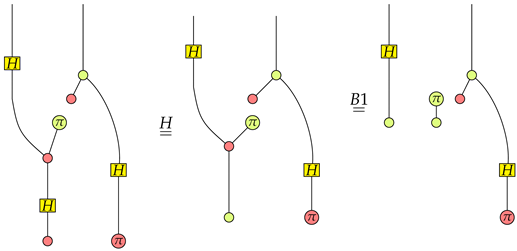
- Suppose the function is , then we haveSince the absorbing scalar 0 is in the rightmost graph, we know that is satisfied.



3.2. Quantum Bit Commitment
- The Hilbert space required to describe the protocol is the tensor product of the Hilbert spaces that play a role in the protocol.
- The total system is initially in a pure state.
- Every action taken by a party corresponds to that party performing a unitary operation on the systems in his/her possession.
- Every communication corresponds to a party sending a subset of the systems in his/her possession to the other party.
- 1.
- Two finite dimensional Hilbert spaces A and B.
- 2.
- Two pure states .
- 3.
- A completely positive map on such that is orthogonal to .
4. Conclusions and Future Work
Author Contributions
Funding
Acknowledgments
Conflicts of Interest
Appendix A. Dagger Symmetric Monoidal Category
- 1.
- a collection of objects,
- 2.
- for every pair of objects , a set of morphisms,
- 3.
- for every object A, a special identity morphism: ,
- 4.
- sequential composition operation for morphisms:
- 1.
- ∘ is associative on morphisms: ,
- 2.
- ∘ is unital on morphisms: , for all .
- 1.
- a parallel composition operation for objects:
- 2.
- a unit object ,
- 3.
- and a parallel composition operation for morphisms:
- 1.
- ⊗ is associative and unital on objects:
- 2.
- ⊗ is associative and unital on morphisms:
- 3.
- ⊗ and ∘ satisfy the interchange law:.
- ,
- ,
- , for all , ,
- .
- identity on objects: ,
- reserves morphisms: ,
- is involutive: ,
- and respects the symmetric monoidal category structure:
References
- Feng, Y.; Duan, R.; Ji, Z.; Ying, M. Probabilistic bisimulations for quantum processes. Inf. Comput. 2007, 205, 1608–1639. [Google Scholar] [CrossRef]
- Ying, M.; Feng, Y.; Duan, R.; Ji, Z. An algebra of quantum processes. ACM Trans. Comput. Log. 2009, 10, 19. [Google Scholar] [CrossRef]
- Feng, Y.; Duan, R.; Ying, M. Bisimulation for Quantum Processes. ACM Trans. Program. Lang. Syst. 2012, 34, 17. [Google Scholar] [CrossRef]
- Kubota, T.; Kakutani, Y.; Kato, G.; Kawano, Y.; Sakurada, H. Semi-automated verification of security proofs of quantum cryptographic protocols. J. Symb. Comput. 2016, 73, 192–220. [Google Scholar] [CrossRef]
- Birkhoff, G.; von Neumann, J. The Logic of Quantum Mechanics. Ann. Math. 1936, 37, 823–843. [Google Scholar] [CrossRef]
- Piron, C. Axiomatique quantique. Helv. Phys. Acta 1964, 37, 439–468. [Google Scholar]
- Malinowski, J. Quantum experiments and the lattice of orthomodular logics. Log. Anal. 1999, 35, 165–166. [Google Scholar]
- Malinowski, J. On the lattice of orthomodular logics. Bull. Sect. Log. 1999, 28, 11–18. [Google Scholar]
- Ledda, A.; Konig, M.; Paoli, F.; Giuntini, R. MV-Algebras and Quantum Computation. Stud. Log. 2006, 82, 245–270. [Google Scholar] [CrossRef]
- Giuntini, R.; Ledda, A.; Paoli, F. Expanding Quasi-MV Algebras by a Quantum Operator. Stud. Log. 2007, 87, 99–128. [Google Scholar] [CrossRef]
- Gudder, S. Quantum Computational Logic. Int. J. Theor. Phys. 2003, 42, 39–47. [Google Scholar] [CrossRef]
- Dunn, J.M.; Moss, L.S.; Wang, Z. Editors’ Introduction: The Third Life of Quantum Logic: Quantum Logic Inspired by Quantum Computing. J. Philos. Log. 2013, 42, 443–459. [Google Scholar] [CrossRef]
- Brunet, O.; Jorrand, P. Dynamic quantum logic for quantum programs. Int. J. Quantum Inf. 2004, 2, 45–54. [Google Scholar] [CrossRef]
- Chadha, R.; Mateus, P.; Sernadas, A. Reasoning About Imperative Quantum Programs. Electron. Notes Theor. Comput. Sci. 2006, 158, 19–39. [Google Scholar] [CrossRef]
- Feng, Y.; Duan, R.; Ji, Z.; Ying, M. Proof rules for the correctness of quantum programs. Theor. Comput. Sci. 2007, 386, 151–166. [Google Scholar] [CrossRef]
- Ying, M. Floyd-hoare logic for quantum programs. ACM Trans. Program. Lang. Syst. 2011, 33, 19:1–19:49. [Google Scholar] [CrossRef]
- Baltag, A.; Smets, S. Complete Axiomatizations for Quantum Actions. Int. J.Theor. Phys. 2005, 44, 2267–2282. [Google Scholar] [CrossRef]
- Baltag, A.; Smets, S. LQP: The dynamic logic of quantum information. Math. Struct. Comput. Sci. 2006, 16, 491–525. [Google Scholar] [CrossRef]
- Baltag, A.; Smets, S. A Dynamic-Logical Perspective on Quantum Behavior. Stud. Log. 2008, 89, 187–211. [Google Scholar] [CrossRef]
- Baltag, A.; Bergfeld, J.; Kishida, K.; Sack, J.; Smets, S.; Zhong, S. PLQP & Company: Decidable Logics for Quantum Algorithms. Int. J. Theor. Phys. 2014, 53, 3628–3647. [Google Scholar] [CrossRef]
- Bergfeld, J.M.; Sack, J. Deriving the correctness of quantum protocols in the probabilistic logic for quantum programs. Soft. Comput. 2017, 21, 1421–1441. [Google Scholar] [CrossRef][Green Version]
- Rad, S.R.; Shirinkalam, E.; Smets, S. A Logical Analysis of Quantum Voting Protocols. Int. J. Theor. Phys. 2017, 56, 3991–4003. [Google Scholar] [CrossRef]
- Abramsky, S.; Coecke, B. A Categorical Semantics of Quantum Protocols. In Proceedings of the 19th IEEE Symposium on Logic in Computer Science (LICS 2004), Turku, Finland, 14–17 July 2004; pp. 415–425. [Google Scholar] [CrossRef]
- Coecke, B.; Duncan, R. Interacting quantum observables: Categorical algebra and diagrammatics. New J. Phys. 2011, 13, 1–85. [Google Scholar] [CrossRef]
- Coecke, B.; Heunen, C.; Kissinger, A. Categories of quantum and classical channels. Quantum Inf. Process. 2016, 15, 5179–5209. [Google Scholar] [CrossRef]
- Coecke, B.; Kissinger, A. Picturing Quantum Processes: A First Course in Quantum Theory and Diagrammatic Reasoning; Cambridge University Press: Cambridge, UK, 2017. [Google Scholar]
- Coecke, B.; Duncan, R. Interacting Quantum Observables. In International Colloquium on Automata, Languages, and Programming; Springer: Berlin/Heidelberg, Germany, 2008; Volume 5126, pp. 298–310. [Google Scholar] [CrossRef]
- Backens, M. The ZX-calculus is complete for stabilizer quantum mechanics. New J. Phys. 2014, 16, 093021. [Google Scholar] [CrossRef]
- Jeandel, E.; Perdrix, S.; Vilmart, R. A Complete Axiomatisation of the ZX-Calculus for Clifford+T Quantum Mechanics. In Proceedings of the Thirty-Third Annual ACM/IEEE Symposium on Logic in Computer Science, Oxford, UK, 12 July 2018. [Google Scholar]
- Hadzihasanovic, A.; Ng, K.F.; Wang, Q. Two complete axiomatisations of pure-state qubit quantum computing. In Proceedings of the Thirty-Third Annual ACM/IEEE Symposium on Logic in Computer Science, Oxford, UK, 12 July 2018. [Google Scholar]
- Ambainis, A. Quantum walks and their algorithmic applications. Int. J. Quantum Inf. 2003, 1, 507–518. [Google Scholar] [CrossRef]
- Backens, M. The ZX-calculus is complete for the single-qubit Clifford+T group. In Proceedings of the 12th International Conference on Quantum Physics and Logic, Oxford, UK, 15–17 July 2015. [Google Scholar]
- Yanofsky, N.; Mannucci, M. Quantum Computing for Computer Scientists; Cambridge University Press: Cambridge, UK, 2008. [Google Scholar]
- Bennetta, C.; Brassard, G. Quantum cryptography: Public key distribution and coin tossing. In Proceedings of the IEEE International Conference on Computers, Systems and Signal Processing, Bangalore, India, 9–12 December 1984; pp. 175–179. [Google Scholar]
- Mayers, D. Unconditionally secure quantum bit commitment is impossible. Phys. Rev. Lett. 1997, 78, 3414–3417. [Google Scholar] [CrossRef]
- Lo, H.K.; Chau, H.F. Is Quantum Bit Commitment Really Possible? Phys. Rev. Lett. 1997, 78, 3410–3413. [Google Scholar] [CrossRef]
- Spekkens, R.W.; Rudolph, T. Degrees of concealment and bindingness in quantum bit commitment protocols. Phys. Rev. A 2001, 65, 012310. [Google Scholar] [CrossRef]
© 2020 by the authors. Licensee MDPI, Basel, Switzerland. This article is an open access article distributed under the terms and conditions of the Creative Commons Attribution (CC BY) license (http://creativecommons.org/licenses/by/4.0/).
Share and Cite
Sun, X.; He, F. A First Step to the Categorical Logic of Quantum Programs. Entropy 2020, 22, 144. https://doi.org/10.3390/e22020144
Sun X, He F. A First Step to the Categorical Logic of Quantum Programs. Entropy. 2020; 22(2):144. https://doi.org/10.3390/e22020144
Chicago/Turabian StyleSun, Xin, and Feifei He. 2020. "A First Step to the Categorical Logic of Quantum Programs" Entropy 22, no. 2: 144. https://doi.org/10.3390/e22020144
APA StyleSun, X., & He, F. (2020). A First Step to the Categorical Logic of Quantum Programs. Entropy, 22(2), 144. https://doi.org/10.3390/e22020144

