


Abstract
The time-fractional diffusion equation with mass absorption is studied in a half-line domain under the Dirichlet boundary condition varying harmonically in time. The Caputo derivative is employed. The solution is obtained using the Laplace transform with respect to time and the sin-Fourier transform with respect to the spatial coordinate. The results of numerical calculations are illustrated graphically.
1. Introduction
From a mathematical point of view, diffusion and heat conduction are described by the same equation of the parabolic type
where a is the diffusivity coefficient, t denotes time, is the Laplace operator, and u stands for concentration in the case of diffusion and for temperature in the case of heat conduction.
Ångström [1] was the first to consider Equation (1) under harmonic impact. In that case, sometimes the terms “oscillatory diffusion” or “diffusion waves” are used [2,3,4]. Introducing of oscillations into the diffusion equation can be done by two ways. The first possibility consists in considering the harmonic source term
Nowacki [5,6] studied the equation
in the domain with being the Dirac delta function under assumption
and obtained the solution
The square root is defined as a particular case of the general formula [7]
Another possibility to introduce oscillations in the diffusion equation consists in imposing the harmonic boundary condition. For example, the diffusion equation
is considered in the domain under condition
as well as under Assumption (4). The solution has the following form:
For the boundary condition
the solution becomes [8,9]
and for the boundary condition
one obtains [10]
In a medium with a chemical reaction or with heat absorption/release, in Equation (1) , there appears an additional linear term [11,12]
The values of the coefficient and correspond to mass/heat absorption and mass/heat release, respectively. Equation (14) also describes mass or heat transport in a thin plate which lateral surfaces exchange mass or heat with surroundings [13] as well as bio-heat transfer [14,15,16]. In the case of one spatial variable, Equation (14) governs propagation of neuronal signals and is known as the cable equation [17,18].
The hyperbolic Klein–Gordon equation is useful in different physical theories, for example, in solid state physics, quantum field theory, classical mechanics, and nonlinear optics [19,20]:
In materials with complex internal structure (amorphous, porous, random and disordered media, polymers, glasses, dielectrics, and semiconductors) memory effects play an important role [21,22]. The “long-tail” memory with power kernel can be interpreted in terms of fractional calculus. The theory of integrals and derivatives of non-integer order has many applications in physics, chemistry, biology, and engineering (see [23,24,25,26,27,28,29,30,31,32,33] and references therein).
The time-fractional counterpart of Equation (1) has the form [34,35,36]
where is the left-sided Caputo fractional derivative [7,23]
with being the gamma function. The Caputo derivative has the Laplace transform rule
Here, the asterisk denotes the transform, and s is the Laplace transform variable.
The equation
can be regarded as the time-fractional generalization of the diffusion, bio-heat, and cable equations as well as time-fractional generalization of the Klein–Gordon equation [37,38,39,40,41,42,43].
In this paper, we study Equation (19) in a half-line domain under the Dirichlet boundary condition varying harmonically in time; the paper develops the results of [44].
2. The Statement and Solution of the Problem
The equation
is considered in the domain under the boundary condition
For later use in numerical calculations, it is appropriate to introduce the following nondimensional quantities:
First, we investigate two particular cases of Equation (20) corresponding to the integer values of the order under Assumption (4).
2.1. Bio-Heat Equation: Quasi-Steady-State Oscillations
In this case and for the function we have equations
and
Using the sin-Fourier integral transform, we obtain
where the tilde denotes the transform, and is the transform variable. The inverse sin-Fourier transform yields for
and
If the boundary condition is
then
where
Figure 1 shows the dependence of the amplitude of oscillations described by Equation (29) on distance for different values of the parameter b.
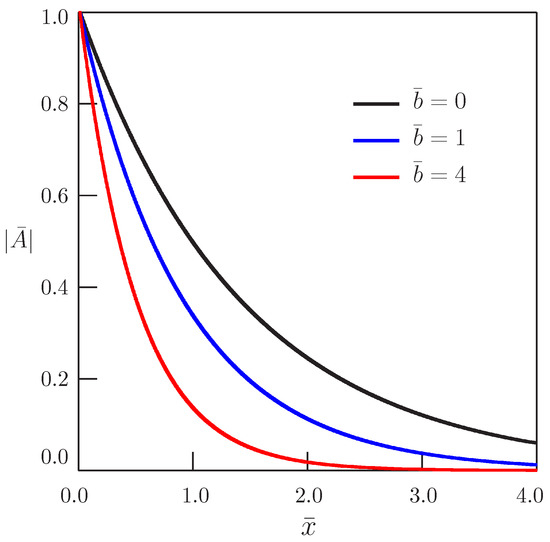
Figure 1.
Dependence of the oscillation amplitude of the solution in Equation (29) on distance for the bio-heat equation (, ).
2.2. Klein–Gordon Equation: Quasi-Steady State Oscillations
For the hyperbolic Klein–Gordon equation ()
under the boundary condition
and Assumption (4), we obtain
and
Applying the sin-Fourier transform to Equation (33), we obtain
The inversion of the transform depends on the relation between b and . For
whereas, for ,
Figure 2 shows the dependence of the nondimensional amplitude of oscillations described by Equations (36) and (37) on the frequency for .
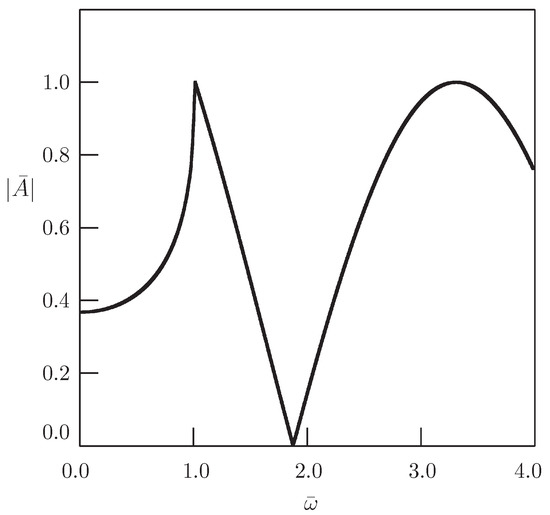
It should be noted the difference between the result of the present paper and the corresponding result of [44]. If Equation (31) is considered with the harmonic source term in the domain under Assumption (4), then there appears the resonance at (see Figure 3). In the case of the half-line domain with the harmonic Dirichlet boundary condition, there is no resonance.
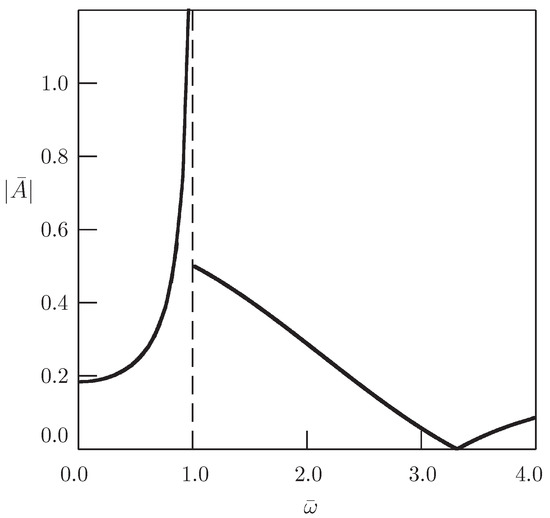
Figure 3.
Dependence of the oscillation amplitude on the frequency for the Klein–Gordon equation in the domain with the harmonic source term (, , ); see [44].
2.3. Equation with Time-Fractional Derivative
It should be emphasized that the equation with time-fractional derivative
under the boundary condition
cannot be considered under Assumption (4). This is due to the formula [45]
where is the incomplete gamma function [46]
For equations with time-derivative of the fractional order, the initial conditions should be imposed; for example,
and
The Laplace transform with respect to time t and the sin-Fourier transform with respect to the spatial coordinate x yield
Inversion of the integral transform using the convolution theorem results in the solution
where the following formula [7,23]
has been used. Here is the Mittag–Leffler function in two parameters and :
2.4. Bio-Heat Equation: The Solution with Zero Initial Condition
Equation (44) for takes the form
The inverse Laplace transform results in
and finally
where is the complementary error function.
2.5. Klein–Gordon Equation: The Solution with Zero Initial Conditions
For , Equation (44) becomes
The inverse sin-Fourier transform yields
The inverse Laplace transform of depends on the sign of b and reads [47]:
- (i)
- For ,
- (ii)
- For ,
Here, is the Bessel function of the first kind, is the modified Bessel function of the first kind.
Using the convolution theorem, we obtain, for ,
and, for ,
Figure 4 and Figure 5 present the dependence of the solution on the distance for and , respectively, and for different values of the order of time-derivative .
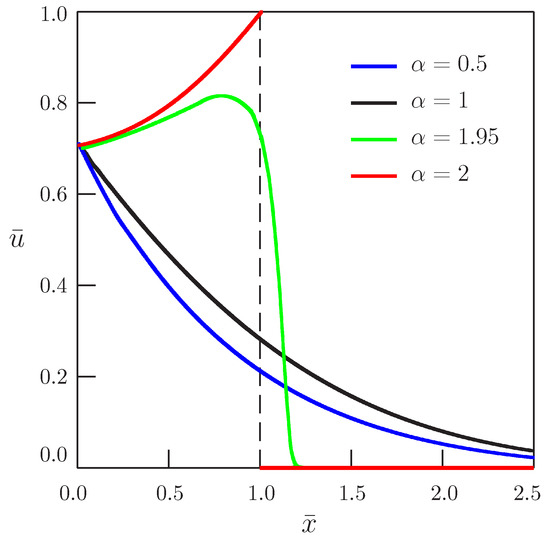
Figure 4.
Dependence of the solution of Equation (45) on distance (, ).
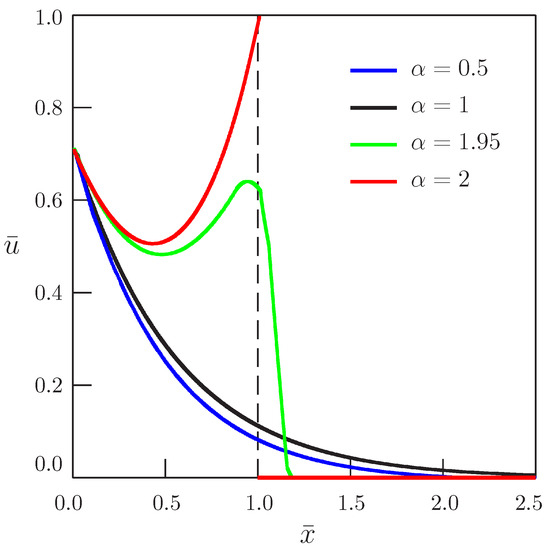
Figure 5.
Dependence of the solution of Equation (45) on distance (, ).
3. Conclusions
We have considered the time-fractional diffusion-wave equation with the Caputo fractional derivative of the order with mass absorption in a half-line domain under the Dirichlet boundary condition varying harmonically in time. The investigated equation can also be regarded as the time-fractional generalization of the bio-heat and Klein–Gordon equations. The Caputo derivative of the exponential function has more complicated form than the derivative of the integer order. As a consequence, the assumption that the solution can be represented as a product of a function of the spatial coordinate and the time-harmonic term without taking into account the initial conditions cannot be used. In the case of the standard Klein–Gordon equation, the solution of Equations (36) and (37) describes the quasi-steady-state oscillations, whereas the solution of Equations (55) and (56) also describes the transient process and has the wave front at . When approaches 2, the solution approximates this wave front.
Author Contributions
The authors have equally contributed to this work and have read and improved the final version of the manuscript.
Conflicts of Interest
The authors declare no conflict of interest.
References
- Ångström, A.J. Neue Methode, das Wärmeleitungsvermöogen der Köorper zu bestimmen. Ann. Phys. Chem. 1861, 144, 513–530. (In German) [Google Scholar]
- Mandelis, A. Diffusion waves and their uses. Phys. Today 2000, 53, 29–33. [Google Scholar] [CrossRef]
- Mandelis, A. Diffusion-Wave Fields: Mathematical Methods and Green Functions; Springer: New York, NY, USA, 2001. [Google Scholar]
- Vrentas, J.S.; Vrentas, C.M. Diffusion and Mass Transfer; CRC Press: Boca Raton, FL, USA, 2013. [Google Scholar]
- Nowacki, W. State of stress in an elastic space due to a source of heat varying harmonically as function of time. Bull. Acad. Polon. Sci. Sér. Sci. Techn. 1957, 5, 145–154. [Google Scholar]
- Nowacki, W. Thermoelasticity, 2nd ed.; PWN–Polish Scientific Publishers: Warsaw, Poland; Pergamon Press: Oxford, UK, 1986. [Google Scholar]
- Kilbas, A.A.; Srivastava, H.M.; Trujillo, J.J. Theory and Applications of Fractional Differential Equations; Elsevier: Amsterdam, The Netherlands, 2006. [Google Scholar]
- Baehr, H.D.; Stephan, K. Heat and Mass Transfer, 2nd ed.; Springer: Berlin/Heidelberg, Germany, 2006. [Google Scholar]
- Zudin, Y.B. Theory of Periodic Conjugate Heat Transfer; Springer: Berlin/Heidelberg, Germany, 2007. [Google Scholar]
- Bergman, T.L.; Lavine, A.S.; Incropera, F.P.; DeWitt, D.P. Fundamentals of Heat and Mass Transfer, 7th ed.; John Wiley & Sons: Hoboken, NJ, USA, 2011. [Google Scholar]
- Carslaw, H.S.; Jaeger, J.C. Conduction of Heat in Solids, 2nd ed.; Oxford University Press: Oxford, UK, 1959. [Google Scholar]
- Crank, J. The Mathematics of Diffusion, 2nd ed.; Oxford University Press: Oxford, UK, 1975. [Google Scholar]
- Polyanin, A.D. Handbook of Linear Partial Differential Equations for Engineers and Scientists; Chapman & Hall/CRC: Boca Raton, FL, USA, 2002. [Google Scholar]
- Shitzer, A.; Eberhart, R.C. (Eds.) Heat Transfer in Medicine and Biology; Plenum Press: New York, NY, USA, 1985. [Google Scholar]
- Lubashevsky, I.A.; Gafiychuk, V.V. Cooperative mechanisms of self-regulation in hierarchical living systems. SIAM J. Appl. Math. 2000, 60, 633–663. [Google Scholar] [CrossRef]
- Stańczyk, M.; Telega, J.J. Modelling of heat transfer in biomechanics—A review. Part I. Soft tissues. Acta Bioengng. Biomech. 2002, 4, 31–61. [Google Scholar]
- Jack, J.; Noble, D.; Tsien, R.W. Electric Current Flow in Excitable Cells, 2nd ed.; Oxford University Press: Oxford, UK, 1983. [Google Scholar]
- Gabbiani, F.; Cox, S.J. Mathematics for Neuroscientists, 2nd ed.; Academic Press: Amsterdam, The Netherlands, 2010. [Google Scholar]
- Wazwaz, A.-M. Partial Differential Equations and Solitary Waves Theory; Higher Education Press: Beijing, China; Springer: Berlin/Heidelberg, Germany, 2009. [Google Scholar]
- Gravel, P.; Gauthier, C. Classical applications of the Klein–Gordon equation. Am. J. Phys. 2011, 79, 447–453. [Google Scholar] [CrossRef]
- Alber, H.-D. Materials with Memory: Initial-Boundary Value Problems for Constitutive Equations with Internal Variables; Springer: Berlin/Heidelberg, Germany, 1998. [Google Scholar]
- Amendola, G.; Fabrizio, M.; Golden, J.M. Thermodynamics of Materials with Memory: Theory and Applications; Springer: New York, NY, USA, 2012. [Google Scholar]
- Podlubny, I. Fractional Differential Equations; Academic Press: San Diego, CA, USA, 1999. [Google Scholar]
- Magin, R.L. Fractional Calculus in Bioengineering; Begell House Publishers, Inc.: Redding, CA, USA, 2006. [Google Scholar]
- Mainardi, F. Fractional Calculus and Waves in Linear Viscoelasticity: An Introduction to Mathematical Models; Imperial College Press: London, UK, 2010. [Google Scholar]
- Tarasov, V.E. Fractional Dynamics: Applications of Fractional Calculus to Dynamics of Particles, Fields and Media; Higher Education Press: Beijing, China; Springer: Berlin/Heidelberg, Germany, 2010. [Google Scholar]
- Tenreiro Machado, J.; Kiryakova, V.; Mainardi, F. Recent history of fractional calculus. Comm. Nonlinear Sci. Numer. Simul. 2011, 16, 1140–1153. [Google Scholar] [CrossRef]
- Uchaikin, V.V. Fractional Derivatives for Physicists and Engineers; Springer: Berlin/Heidelberg, Germany, 2013. [Google Scholar]
- Povstenko, Y. Fractional Thermoelasticity; Springer: New York, NY, USA, 2015. [Google Scholar]
- Owolabi, K.M. Mathematical analysis and numerical simulation of patterns in fractional and classical reaction-diffusion systems. Chaos, Solitons Fractals 2016, 93, 89–98. [Google Scholar] [CrossRef]
- Owolabi, K.M.; Atangana, A. Analysis of mathematics and numerical pattern formation in superdiffusive fractional multicomponent system. Adv. Appl. Math. Mech. 2017, 9, 1438–1460. [Google Scholar] [CrossRef]
- Morales-Delgado, V.F.; Taneco-Hernández, M.A.; Gómez-Aguilar, J.F. On the solutions of fractional order of evolution equations. Eur. Phys. J. Plus 2017, 132, 1–14. [Google Scholar] [CrossRef]
- Datsko, B.; Gafiychuk, V. Complex spatio-temporal solutions in fractional reaction-diffusion systems near a bifurcation point. Fract. Calc. App. Anal. 2018, 21, 237–253. [Google Scholar] [CrossRef]
- Mainardi, F. The fundamental solutions for the fractional diffusion-wave equation. Appl. Math. Lett. 1996, 9, 23–28. [Google Scholar] [CrossRef]
- Mainardi, F. Fractional relaxation-oscillation and fractional diffusion-wave phenomena. Chaos, Solitons Fractals 1996, 7, 1461–1477. [Google Scholar] [CrossRef]
- Povstenko, Y. Linear Fractional Diffusion-Wave Equation for Scientists and Engineers; Birkhäuser: New York, NY, USA, 2015. [Google Scholar]
- Blackledge, J.; Babajanov, B. The fractional Schrödinger–Klein–Gordon equation and intermediate relativism. Math. Aeterna 2013, 3, 601–615. [Google Scholar]
- Cui, Z.; Chen, G.; Zhang, R. Analytical solution for the time-fractional Pennes bioheat transfer equation on skin tissue. Adv. Mater. Res. 2014, 1049–1050, 1471–1474. [Google Scholar] [CrossRef]
- Ezzat, M.A.; AlSowayan, N.S.; Al-Muhiameed, Z.I.A.; Ezzat, S.M. Fractional modeling of Pennes’ bioheat transfer equation. Heat Mass Transf. 2014, 50, 907–914. [Google Scholar] [CrossRef]
- Ferrás, L.L.; Ford, N.J.; Morgado, M.L.; Nóbrega, J.M.; Rebelo, M.S. Fractional Pennes’ bioheat equation: Theoretical and numerical studies. Fract. Calc. Appl. Anal. 2015, 18, 1080–1106. [Google Scholar] [CrossRef]
- Qin, Y.; Wu, K. Numerical solution of fractional bioheat equation by quadratic spline collocation method. J. Nonlinear Sci. Appl. 2016, 9, 5061–5072. [Google Scholar] [CrossRef]
- Damor, R.S.; Kumar, S.; Shukla, A.K. Solution of fractional bioheat equation in terms of Fox’s H-function. SpringerPlus 2016, 5, 111. [Google Scholar] [CrossRef] [PubMed]
- Vitali, S.; Castellani, G.; Mainardi, F. Time fractional cable equation and applications in neurophysiology. Chaos Solitons Fractals 2017, 102, 467–472. [Google Scholar] [CrossRef]
- Povstenko, Y.; Kyrylych, T. Time-fractional diffusion with mass absorption under harmonic impact. Fract. Calc. Appl. Anal. 2018, 21, 118–133. [Google Scholar] [CrossRef]
- Povstenko, Y. Fractional heat conduction in a space with a source varying harmonically in time and associated thermal stresses. J. Thermal Stresses 2016, 39, 1442–1450. [Google Scholar] [CrossRef]
- Abramowitz, M.; Stegun, I.A. (Eds.) Handbook of Mathematical Functions with Formulas, Graphs and Mathematical Tables; Dover: New York, NY, USA, 1972. [Google Scholar]
- Doetsch, G. Anleitung zum praktischen Gebrauch der Laplace-Transformation und der Z-Transformation; Springer: München, Germany, 1967. (In German) [Google Scholar]
© 2018 by the authors. Licensee MDPI, Basel, Switzerland. This article is an open access article distributed under the terms and conditions of the Creative Commons Attribution (CC BY) license (http://creativecommons.org/licenses/by/4.0/).