1. Introduction
One of the enduring milestones of classical statistical physics is the theorem of the equipartition of energy [
1], which states that energy is shared equally amongst all energetically-accessible degrees of freedom of a system and relates average energy to the temperature
T of the system. In particular, for each degree of freedom, the average kinetic energy is equal to
, where
is the Boltzmann constant. This relation is exploited in various aspects of many areas of physics, chemistry and biology. However, in many cases, it is applied in an unjustified way forgetting about assumptions used in proving this theorem. One can notice confusion and mess, in particular in the case of quantum systems. In the standard course of classical statistical physics, the equality
is derived under the following conditions:
The system is at thermal equilibrium of temperature T.
The state of the system is described by the Gibbs canonical probability distribution.
The Gibbs probability distribution describes an equilibrium state of the system in the limit of weak coupling with the thermostat.
The Gibbs probability distribution does not depend on the system-thermostat coupling constant.
It should be stressed that in classical statistical physics, the equality is universal: it does not depend either on the number of particles of the system or on the single-particle potential in which the i-th particle dwells, as well as it does not depend on the form of mutual interaction between i-th and j-th particles of the system.
In quantum physics, the problem is more complicated. In the weak coupling limit, the density operator (or the density matrix)
for the canonical ensemble describes a thermal equilibrium state and has the form:
where
H is a Hamiltonian of the system. In the book by Feynman [
2], one can find Expression (2.88) for average kinetic energy
of a quantum harmonic oscillator of the eigenfrequency
. It has the form:
where
p is momentum and
m is the mass of the oscillator. The Hamiltonian of the oscillator has the well-known form:
We can perform the limit
, which corresponds to the Hamiltonian of a free particle. In this limit, Equation (
2) assumes the form:
It is the same expression as for the classical free particle. However, Equations (
2) and (
4) are different. This means that for quantum systems, in contrast to a classical case, the average kinetic energy depends on the potential
, even in the weak coupling limit. If the weak coupling limit does not hold, the problem is even much more complicated. It is the aim of this paper to discuss the question of equipartition energy for an arbitrary system-thermostat coupling. We study only one specific and as simple as possible model of a quantum open system to present basic concepts and ideas. Therefore, we consider a free quantum particle coupled to its environment, which is modeled as a collection of harmonic oscillators of temperature
T. This old clichéd system-environment model [
3] has been re-considered many, many times by each next generation of physicists [
4]. However, it is still difficult to find a transparent presentation of this fundamental issue of the quantum statistical physics focused on the kinetic energy. To achieve the aim, we try to use the simplest techniques and methods to make the paper consistent and self-contained, and we neglect many unnecessary and redundant aspects of the theory.
The remaining part of the paper is organized as follows. In
Section 2, we describe the model and derive the integro-differential Generalized Langevin Equation (GLE); in
Section 3, the fluctuation-dissipation relation is presented; the form of the dissipation integral kernel of GLE is described in
Section 4; in
Section 5, we convert the integro-differential Langevin equation into a set of differential equations; the equipartition theorem is discussed in
Section 6; some selected physical regimes are analyzed in
Section 7; we conclude the work with a brief résumé in
Section 8; in
Appendix A,
Appendix B and
Appendix C, we present some auxiliary calculations.
2. Hamiltonian Model and Generalized Langevin Equation
A paradigmatic model of a one-dimensional quantum Brownian motion consists of a particle of mass
M subjected to the potential
and interacting with a large number of independent oscillators, which form a thermostat (environment)
of temperature
T being in an equilibrium canonical (Gibbs) state. The quantum-mechanical Hamiltonian of such a total system can be written in the form [
3,
4,
5]:
where the coordinate and momentum operators
refer to the Brownian particle and
are the coordinate and momentum operators of the
i-th heat bath oscillator of mass
and the eigenfrequency
. The parameter
characterizes the interaction strength of the particle with the
i-th oscillator. There is the counter-term, the last term proportional to
, which is included to cancel a harmonic contribution to the particle potential. All coordinate and momentum operators obey canonical equal-time commutation relations.
The next step is to write the Heisenberg equations of motion for all coordinate and momentum operators. For the Brownian particle, the Heisenberg equations are:
where:
For the environment operators, one gets:
What we need in Equation (
7) is the solution
, which can be obtained from Equations (
9) and (
10) with the result (see [
6]):
The following step is to integrate by parts the last term in Equation (
11) and insert it into Equation (
7) for
. Using Equation (
6), after some algebra, one can obtain an effective equation of motion for the particle coordinate
. It is called a generalized Langevin equation and has the form:
where
denotes differentiation with respect to
x,
is a dissipation function (damping or memory kernel) and
denotes the random force,
The dynamics of the quantum Brownian particle is therefore described by a stochastic integro-differential equation for the coordinate operator
. Probably Magalinskij [
3] was the first, in 1959, to derive the integro-differential Equation (
12) and formulated the problem in the above way. Next, from 1966, a series of papers were published on this topic, but a complete list of papers is too long to present here. We cite a part of them [
7,
8,
9,
10,
11,
12]. Generally, it is difficult to analyze this kind of integro-differential equation for operators. However, in the case of a free Brownian particle (when
) or for a harmonic oscillator (when
), Equation (
12) can be solved exactly, at least in a formal way. In the classical case, equations like Equation (
12) describe non-Markovian stochastic processes [
5]. In the quantum case, there is no good definition of Markovian or non-Markovian processes, and therefore, a classification with respect to these notions is not constructive.
3. Fluctuation-Dissipation Theorem
In the standard approach, it is assumed that the initial state
of the total system is uncorrelated, i.e.,
, where
is an arbitrary state of the Brownian particle and
is an equilibrium canonical state of the thermostat (environment)
of temperature
T, namely,
where:
is the Hamiltonian of the thermostat. The operator-valued random force
is a family of non-commuting operators whose commutators are
c-numbers. Its mean value is zero,
and the symmetrized correlation function:
takes the form:
The symmetrization is needed for to be a real function with a correct limit in the classical case. We observe that it depends on the time difference for . Statistical characteristics of the random force are similar to characteristics for a classical stationary Gaussian stochastic process, which models thermal equilibrium noise. Therefore, is called the Gaussian operator, which represents quantum thermal noise.
It is convenient to introduce the spectral function:
Then, the damping kernel Equation (
13) can be expressed as:
and the correlation function Equation (
19) reads:
If we introduce the Fourier transforms of the dissipation and correlation functions,
then we see that the following equality:
holds. We obtain the relation between the dissipation
and correlation
spectra. This is what is named the fluctuation-dissipation theorem [
12,
13,
14]. In this relation, quantum effects are incorporated via the prefactor in r.h.s. of Equation (
24).
4. Dissipation Function
The influence of the thermostat
on the Brownian particle is manifested through the correlation function Equation (
19) of the thermostat. If it is a finite quantum system, then its energy spectrum is discrete, and all its correlation functions are almost periodic in time. On the other hand, if the thermostat is an infinitely-extended system, then its correlation functions decay. Let us observe that if
is finite, then the spectral function
is a completely singular distribution (the sum in Equation (
20) is over discrete values of
i), and if
is infinite, then
is, at least on some intervals, a continuous function of
(in the thermodynamic limit for
, the summation in Equation (
20) is replaced by an integral over a frequency). Below and up to the end of the paper, we assume that the environment
is an infinite system.
In order to start an analysis of GLE Equation (
12), one has to specify at least one of three quantities: the dissipation kernel
, or the correlation function
of the random force
, or the spectral function
. We assume
to have the form:
with three non-negative parameters
and
. The parameter
is the system-environment coupling strength, and
defines decay or relaxation time and characterizes memory effects. Finally,
is the frequency in the relaxation process of the momentum (velocity). It is important to mention that
is, via the fluctuation-dissipation theorem, the correlation time of quantum thermal fluctuations and appears in the correlation function
defined by Equation (
18).
Why this form of the dissipation function? There are several reasons for this choice:
- -
In the classical limit, it is a direct relation between the dissipation kernel
and the correlation function
:
. Therefore, for Equation (
25), the correlation function is sufficiently universal and has been considered for many systems.
- -
When , it reduces to the exponential form and is known as a Drude model. Moreover, it has been considered in relation to colored noise problems.
- -
When and , then tends to the Dirac delta function, and the integral term reduces to (no memory effects), which is the well-known Stokes force with interpreted as a friction (damping) coefficient. Here, the parameter plays the role of coupling the strength of the Brownian particle to the thermostat.
- -
This form allows converting the integro-differential Equation (
12) into a set of differential equations, which can be handled by known methods. It is important from a technical point of view to have a method of any sort to analyze Equation (
12).
5. Generalized Langevin Equation as a Set of Differential Equations
The integral part of Equation (
12) is the convolution of
and
. It suggests applying integral transforms like the Laplace or Fourier ones to solve it. Here, we exploit another method, which is based on the observation that if
fulfills a linear ordinary differential equation with constant coefficients, then Equation (
12) can be converted to a set of ordinary differential equations. Note that the function
in Form (
25) fulfills a differential equation of second order, which is similar to the Newton equation for a damped harmonic oscillator. We introduce auxiliary variables (in fact, operators)
and
by the relations:
Then, Equation (
12) is converted to the following set of differential equations:
To proceed further, we have to specify the form of the potential
. The simplest case is when
, i.e., for the free particle. The second exactly solvable case is the harmonic oscillator with
. For other forms of
, the problem Equation (
29) cannot be solved, and only mathematically uncontrolled approximations have been applied. The main elements of analysis of averaged kinetic energy are similar for both a free particle and a harmonic oscillator. However, a more pedagogical example is a free particle because the calculations are less tedious. It is the only reason for our choice
. In such a case, in order to calculate the averaged kinetic energy, it is sufficient to consider the reduced set of equations:
It can be rewritten in the matrix form:
where:
and
denotes the transpose of a matrix, which switches the row into the column. The matrix
has the form:
The solution of the the non-homogeneous linear differential Equation (
31) reads [
6]:
where:
The spectrum of the matrix
and its invariant subspaces determine the time dependence of Equation (
35). Now, the only problem is to determine the exponential of the matrix
, i.e., the matrix
, which can be computed in many ways. The authors of the paper [
15] say about 19 ways. As they write: “In practice, consideration of computational stability and efficiency indicates that some of the methods are preferable to others, but that none are completely satisfactory”. The traditional way is to transform
into its Jordan canonical form. Here, we will use a less traditional method, namely the Putzer algorithm [
16], in which the exponential of the matrix
can be computed knowing nothing more than the eigenvalues of the matrix
. Moreover, the algorithm does not require that the matrix
is diagonalizable. We think that this method is simple, elegant and suitable for presentation to students and younger researchers. It is described in
Appendix A.
6. Average Kinetic Energy in Equilibrium
The operator of the kinetic energy
is expressed by the momentum
, which is the first component of the vector
determined by Equation (
35). We calculate its average in the long time limit
when a stationary state is approached. This stationary state is a thermal equilibrium state. The first component of
is:
where
is the first element of the matrix
. As is shown in
Appendix A, elements of this matrix are exponentially decreasing functions of time. This means that the average value of the momentum
as
. To evaluate the average kinetic energy, we consider the symmetrized momentum-momentum correlation function
. In the long time limit, the first two terms of Equation (
37) do not contribute to it, and only the last term contributes, yielding:
Now, we use the results of
Section 3 and insert the expression for the correlation function Equation (
23) of quantum thermal noise
into Equation (
38). The result is:
In particular, for
, it is the second statistical moment of the momentum,
We introduce new integration variables
and
to convert Equation (
40) into the form:
Finally, in the long time limit
, average kinetic energy is obtained as:
where:
At this point, we use the fluctuation-dissipation relation Equation (
24) to express the noise correlation spectrum
by the noise dissipation spectrum
, which, via Form (
25) for the dissipation function
and its inverse Fourier transform, is given by:
The function
in Equation (
43) is calculated from the relation Equation (
A11) in
Appendix A. Its explicit form is given by Equation (
A16) in
Appendix B. The numerator of
cancels with the denominator in Equation (
44), and finally, we obtain:
where:
We used the definition Equation (
28) for
. We rewrite it in this form because both
and
have the unit of frequency (1/s). Moreover,
defines the rescaled coupling strength of the Brownian particle to the thermostat. The reciprocal
has the unit of time, and in the case of a classical free Brownian particle, it is the relaxation time of the particle velocity
(obtained from the Newton equation
) or, equivalently, it is the correlation time occurring in the velocity-velocity correlation function.
The function
has no poles on a real axis because the denominator in Equation (
46) can be rewritten in the form
for
, positive
and positive
. As a consequence, the integral in Equation (
45) exists for any fixed values of parameters. Various forms of the expression Equation (
45) have previously been derived [
17,
18,
19]. However, the influence of the dissipation function Equation (
25) on system properties, in particular in the context of average kinetic energy, has not been discussed.
The expression Equation (
45) with the integrand Equation (
46) is a quantum version of the equipartition theorem. It differs from its classical counterpart, like in Equation (
4). The dependence of
on temperature is involved in the integrand of Equation (
45) and cannot be presented in an explicit, simple way. We note that there are four characteristic times
and
(called the thermal time) and four corresponding frequencies
and
(called the Matsubara frequency), which all influence the temperature dependence of
.
Now, we want to take a look at the relation Equation (
45) from another point of view. To this aim, we use the expression Equation (
2) for the average kinetic energy of a single harmonic oscillator and rewrite Equation (
45) in the form:
The function
is positive,
, and normalizable (see Equation (
A23) in
Appendix C),
Therefore, there exists a random variable
for which
is its probability distribution. From the mathematical point of view, Equation (
47) is an average value of the function
of the random variable
(physicists frequently equate it with the integration variable). It allows presenting an interesting interpretation of the quantum equipartition theorem: the average kinetic energy
of the Brownian particle is strongly related to the thermally-averaged kinetic energy
per one degree of freedom of oscillators of the environment. Because frequencies
of oscillators are random variables,
has to be additionally averaged over all possible frequencies
distributed according to the probability density
in which details of the particle-environment interaction are present via the parameters of the dissipation function
.
8. Conclusions
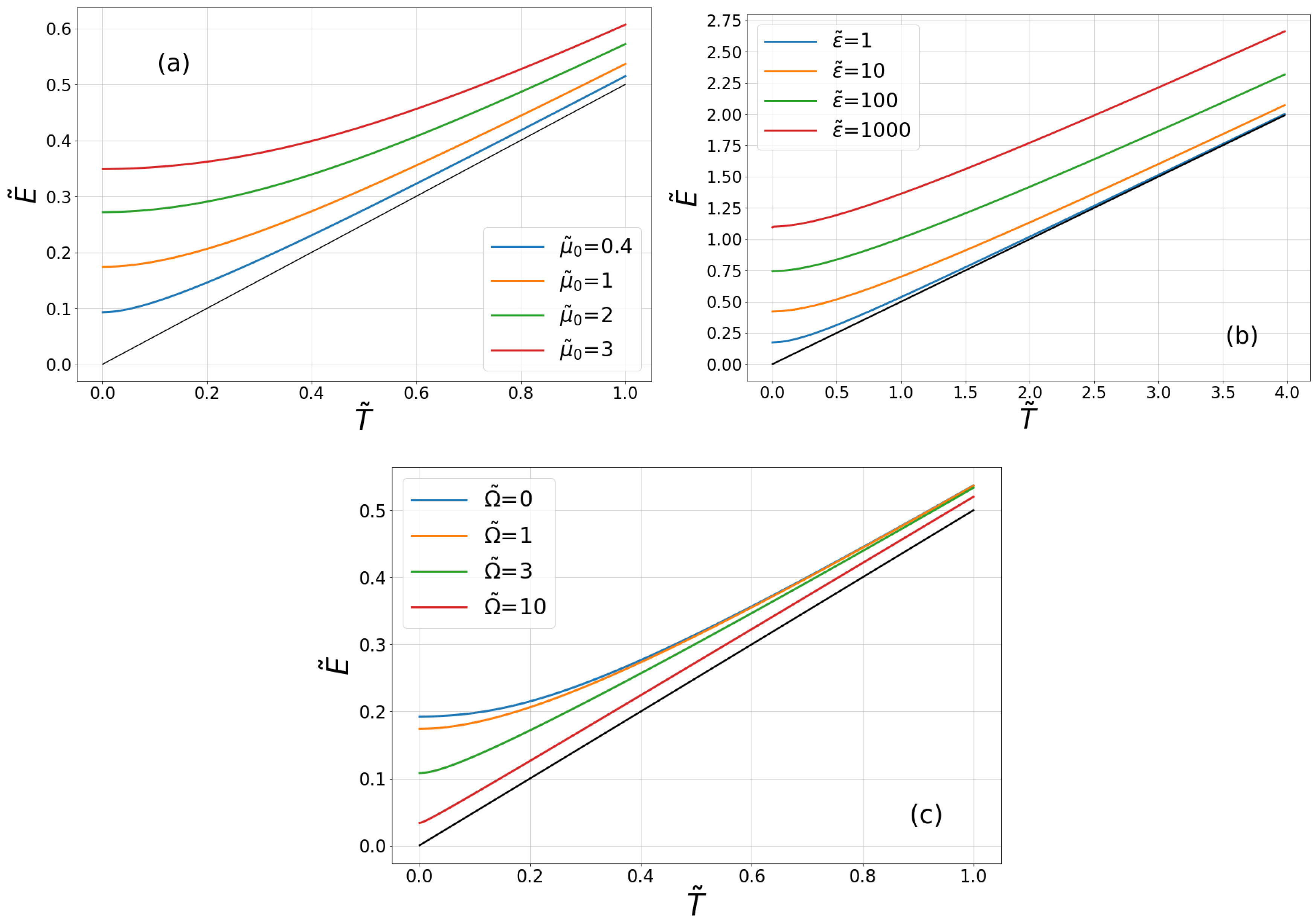
In summary, in the framework of the Generalized Langevin Equation (GLE), we studied the kinetic energy of a quantum Brownian particle in an equilibrium state. We assumed a relatively general form of the integral kernel of GLE and analyzed kinetic energy in selected regimes like high or low temperature limits. In the high temperature limit, the standard result of the classical statistical mechanics of the equipartition energy
is valid independently of the strength of the system-environment interaction, decay of the dissipation kernel and its frequency parameter. In the zero temperature regime, when fluctuations of the environment vacuum influence the system, average kinetic energy of the free Brownian particle is non-zero, and its value depends on parameters of the dissipation function. In particular, it is an increasing function of the coupling strength quantified by the parameter
or the rescaled parameter
. It is also interesting that when the decay time
in the dissipation kernel tends to zero, average kinetic energy grows to infinity [
19]. This means that the assumption of zero decay time is not physically correct, and memory effects have to be taken into account.
We propose a new interpretation of the relation Equation (
45): the average kinetic equation of the Brownian particle equals the thermally-averaged kinetic energy per one degree of freedom of thermostat oscillators, additionally averaged over randomly-distributed oscillator frequencies. Our conjecture is that this interpretation is not only for this particular system, but it may be universal, at least for some classes of systems.
We considered an exactly solved model of a quantum open system. In a general case, only approximate results can be derived, e.g., in the so-called quantum Smoluchowski regime, an effective evolution equation of the Fokker–Planck type has been derived [
21,
22] and applied to many problems such as quantum diffusion [
23,
24] or quantum Brownian motors [
25]. Some extensions to include reservoirs consisting of non-linear oscillators have been proposed [
26]. Finally, it is worth mentioning a novel and alternative approach to attack the problem of a quantum Brownian particle, which is based on an adjoint master equation for a generic operator of the system [
27].