A New Entropy-Based Atrial Fibrillation Detection Method for Scanning Wearable ECG Recordings


Abstract
1. Introduction
- (1)
- uses a ranged function to define the vector distance as RangeEn did,
- (2)
- uses a fuzzy function rather than the Heaviside function to determine vector state similarity,
- (3)
- replaces probability estimation with density estimation for entropy calculation,
- (4)
- utilizes a flexible distance threshold r, and
- (5)
- adjusts for heart rate by subtracting the natural log value of the mean RR interval.
2. Methods
2.1. Data
2.1.1. Online Open-Access Database
2.1.2. Clinical Wearable AF Recordings
2.2. New Entropy-Based AF Detection Method
2.3. Evaluation Method
- Sensitivity:
- Specificity:
- Accuracy:
- Positive predictive value:
- Negative predictive value:
- Total error:
3. Results
3.1. Results on the MIT-BIH AF Database (30-Beat Time Window)
3.2. Results on the Clinical Wearable AF Database (30-Beat Time Window)
3.3. Results When Using a 12-Beat Time Window
3.4. Results on the Time Cost
4. Discussion
Author Contributions
Funding
Acknowledgments
Conflicts of Interest
References
- Fuster, V.; Ryden, L.E.; Asinger, R.W.; Cannom, D.S.; Crijns, H.J.; Frye, R.L.; Halperin, J.L.; Kay, N.G.; Klein, W.W.; Lévy, S.; et al. ACC/AHA/ESC guidelines for the management of patients with atrial fibrillation: Executive summary. J. Am. Coll. Cardiol. 2001, 38, 1231–1265. [Google Scholar] [CrossRef] [Scilit]
- Lip, G.Y.H.; Fauchier, L.; Freedman, S.B.; Van Gelder, I.; Natale, A.; Gianni, C.; Nattel, S.; Potpara, T.; Rienstra, M.; Tse, H.; et al. Atrial fibrillation. Nat. Rev. Dis. Primers 2016, 2, 16016. [Google Scholar] [CrossRef] [Scilit] [PubMed]
- Colloca, R. Implementation and Testing of Atrial Fibrillation Detectors for a Mobile Phone Application. Master’s Thesis, Politecnico di Milano, Milan, Italy, 22 April 2013. [Google Scholar]
- Camm, A.J.; Kirchhof, P.; Lip, G.Y.; Schotten, U.; Savelieva, I.; Ernst, S.; Van Gelder, I.C.; Al-Attar, N.; Hindricks, G.; Prendergast, B.; et al. Guidelines for the management of atrial fibrillation: The task force for the management of atrial fibrillation of the european society of cardiology (esc). Eur. Heart J. 2010, 31, 2369–2429. [Google Scholar] [PubMed]
- Naccarelli, G.V.; Varker, H.; Lin, J.; Schulman, K.L. Increasing prevalence of atrial fibrillation and flutter in the united states. Am. J. Cardiol. 2009, 104, 1534–1539. [Google Scholar] [CrossRef] [Scilit] [PubMed]
- Kirchhof, P.; Benussi, S.; Kotecha, D.; Ahlsson, A.; Atar, D.; Casadei, B.; Castella, M.; Diener, H.C.; Heidbuchel, H.; Hendriks, J.; et al. 2016 esc guidelines for the management of atrial fibrillation developed in collaboration with eacts. Eur. J. Cardiothorac. Surg. 2016, 50, e1–e88. [Google Scholar] [CrossRef] [Scilit] [PubMed]
- Jahangir, A.; Lee, V.; Friedman, P.A.; Trusty, J.M.; Hodge, D.O.; Kopecky, S.L.; Packer, D.L.; Hammill, S.C.; Shen, W.K.; Gersh, B.J. Long-term progression and outcomes with aging in patients with lone atrial fibrillation: A 30-year follow-up study. Circulation 2007, 115, 3050–3056. [Google Scholar] [CrossRef] [Scilit] [PubMed]
- Dharmaprani, D.; Dykes, L.; McGavigan, A.D.; Kuklik, P.; Pope, K.; Ganesan, A.N. Information theory and atrial fibrillation (AF): A review. Front. Physiol. 2018, 9, 957. [Google Scholar] [CrossRef] [Scilit] [PubMed]
- Camm, A.J.; Corbucci, G.; Padeletti, L. Usefulness of continuous electrocardiographic monitoring for atrial fibrillation. Am. J. Cardiol. 2012, 110, 270–276. [Google Scholar] [CrossRef] [Scilit] [PubMed]
- Ladavich, S.; Ghoraani, B. Rate-independent detection of atrial fibrillation by statistical modeling of atrial activity. Biomed. Signal Process. Control 2015, 18, 274–281. [Google Scholar] [CrossRef] [Scilit]
- Carrara, M.; Carozzi, L.; Moss, T.J.; De Pasquale, M.; Cerutti, S.; Ferrario, M.; Lake, D.E.; Moorman, J.R. Heart rate dynamics distinguish among atrial fibrillation, normal sinus rhythm and sinus rhythm with frequent ectopy. Physiol. Meas. 2015, 36, 1873–1888. [Google Scholar] [CrossRef] [Scilit] [PubMed]
- Liu, C.Y.; Oster, J.; Li, Q.; Zhao, L.N.; Nemati, S.; Clifford, G.D. A comparison of entropy approaches for af discrimination. Physiol. Meas. 2018, 39, 74002. [Google Scholar] [CrossRef] [Scilit] [PubMed]
- Ródenas, J.; García, M.; Alcaraz, R.; Rieta, J.J. Wavelet entropy automatically detects episodes of atrial fibrillation from single-lead electrocardiograms. Entropy 2015, 17, 6179–6199. [Google Scholar] [CrossRef] [Scilit]
- Ruan, X.H.; Liu, C.C.; Liu, C.Y.; Wang, X.P.; Li, P. Automatic detection of atrial fibrillation using r-r interval signal. In Proceedings of the 4th International Conference on Biomedical Engineering and Informatics (BMEI), Shanghai, China, 15–17 October 2011; pp. 644–647. [Google Scholar]
- Park, J.; Lee, S.; Jeon, M. Atrial fibrillation detection by heart rate variability in poincare plot. Biomed. Eng. Online 2009, 8, 38. [Google Scholar] [CrossRef] [Scilit] [PubMed]
- Sarkar, S.; Ritscher, D.; Mehra, R. A detector for a chronic implantable atrial tachyarrhythmia monitor. IEEE Trans. Biomed. Eng. 2008, 55, 1219–1224. [Google Scholar] [CrossRef] [Scilit] [PubMed]
- Tateno, K.; Glass, L. Automatic detection of atrial fibrillation using the coefficient of variation and density histograms of rr and deltarr intervals. Med. Biol. Eng. Comput. 2001, 39, 664–671. [Google Scholar] [CrossRef] [Scilit] [PubMed]
- Linker, D.T. Long-Term Monitoring for Detection of Atrial Fibrillation. U.S. Patent No. 7,630,756, 8 December 2009. [Google Scholar]
- Garcia, M.; Ródenas, J.; Alcaraz, R.; Rieta, J.J. Application of the relative wavelet energy to heart rate independent detection of atrial fibrillation. Comput. Methods Programs Biomed. 2016, 131, 157–168. [Google Scholar] [CrossRef] [Scilit] [PubMed]
- Petrėnas, A.; Sörnmo, L.; Lukoševičius, A.; Marozas, V. Detection of occult paroxysmal atrial fibrillation. Med. Biol. Eng. Comput. 2015, 53, 287–297. [Google Scholar] [CrossRef] [Scilit] [PubMed]
- DeMazumder, D.; Lake, D.E.; Cheng, A.; Moss, T.J.; Guallar, E.; Weiss, R.G.; Jones, S.R.; Tomaselli, G.F.; Moorman, J.R. Dynamic analysis of cardiac rhythms for discriminating atrial fibrillation from lethal ventricular arrhythmias. Circ. Arrhythm. Electrophysiol. 2013, 6, 555–561. [Google Scholar] [CrossRef] [Scilit] [PubMed]
- Richman, J.S.; Moorman, J.R. Physiological time-series analysis using approximate entropy and sample entropy. Am. J. Physiol. Heart Circul. Physiol. 2000, 278, H2039–H2049. [Google Scholar] [CrossRef] [Scilit] [PubMed]
- Lake, D.E.; Moorman, J.R. Accurate estimation of entropy in very short physiological time series: The problem of atrial fibrillation detection in implanted ventricular devices. Am. J. Physiol. Heart Circ. Physiol. 2011, 300, H319–H325. [Google Scholar] [CrossRef] [Scilit] [PubMed]
- Liu, C.Y.; Zhao, L.N. Using fuzzy measure entropy to improve the stability of traditional entropy measures. In Proceedings of the Computing in Cardiology, Hangzhou, China, 18–21 September 2011; pp. 681–684. [Google Scholar]
- Liu, C.Y.; Li, K.; Zhao, L.N.; Liu, F.; Zheng, D.C.; Liu, C.C.; Liu, S.T. Analysis of heart rate variability using fuzzy measure entropy. Comput. Biol. Med. 2013, 43, 100–108. [Google Scholar] [CrossRef] [Scilit] [PubMed]
- Omidvarnia, A.; Mesbah, M.; Pedersen, M.; Jackson, G. Range entropy: A bridge between signal complexity and self-similarity. arXiv, 2018; arXiv:1809.06500.
- Liu, C.Y.; Zhang, X.Y.; Zhao, L.N.; Liu, F.F.; Chen, X.W.; Yao, Y.J.; Li, J.Q. Signal quality assessment and lightweight qrs detection for wearable ecg smartvest system. IEEE Internet Things J. 2018. [Google Scholar] [CrossRef] [Scilit]
- Li, Q.; Mark, R.G.; Clifford, G.D. Robust heart rate estimation from multiple asynchronous noisy sources using signal quality indices and a kalman filter. Physiol. Meas. 2008, 29, 15–32. [Google Scholar] [CrossRef] [Scilit] [PubMed]
- Clifford, G.D.; Behar, J.; Li, Q.; Rezek, I. Signal quality indices and data fusion for determining clinical acceptability of electrocardiograms. Physiol. Meas. 2012, 33, 1419–1433. [Google Scholar] [CrossRef] [Scilit] [PubMed]
- Liu, C.Y.; Li, L.P.; Zhao, L.N.; Zheng, D.C.; Li, P.; Liu, C.C. A combination method of improved impulse rejection filter and template matching for identification of anomalous intervals in electrocardiographic rr sequences. J. Med. Biol. Eng. 2012, 32, 245–250. [Google Scholar] [CrossRef]
- Pisters, R.; van Oostenbrugge, R.J.; Knottnerus, I.L.; de Vos, C.B.; Boreas, A.; Lodder, J.; Prins, M.H.; Crijns, H.J.; Tieleman, R.G. The likelihood of decreasing strokes in atrial fibrillation patients by strict application of guidelines. Europace 2010, 12, 779–784. [Google Scholar] [CrossRef] [Scilit] [PubMed]
- Tieleman, R.G.; Plantinga, Y.; Rinkes, D.; Bartels, G.L.; Posma, J.L.; Cator, R.; Hofman, C.; Houben, R.P. Validation and clinical use of a novel diagnostic device for screening of atrial fibrillation. Europace 2014, 16, 1291–1295. [Google Scholar] [CrossRef] [Scilit] [PubMed]
- Babaeizadeh, S.; Gregg, R.E.; Helfenbein, E.D.; Lindauer, J.M.; Zhou, S.H. Improvements in atrial fibrillation detection for real-time monitoring. J. Electrocardiol. 2009, 42, 522–526. [Google Scholar] [CrossRef] [Scilit] [PubMed]
- Perez, F.J.; Lung, T.H.; Ellenbogen, K.A.; Wood, M.A. Is time to first recurrence of atrial fibrillation correlated with atrial fibrillation burden? Am. J. Cardiol. 2006, 97, 1343–1345. [Google Scholar] [CrossRef] [Scilit] [PubMed]
- Pickering, J.W.; Endre, Z.H. New metrics for assessing diagnostic potential of candidate biomarkers. Clin. J. Am. Soc. Nephrol. 2012, 7, 1355–1364. [Google Scholar] [CrossRef] [Scilit] [PubMed]
- Li, Q.; Liu, C.Y.; Oster, J.; Clifford, G.D. Signal processing and feature selection preprocessing for classification in noisy healthcare data. In Machine Learning for Healthcare Technologies; Clifton, D.A., Ed.; IET: Stevenage, UK, 2016; Volume 3, pp. 33–58. [Google Scholar]
- Oster, J.; Clifford, G.D. Impact of the presence of noise on rr interval-based atrial fibrillation detection. J. Electrocardiol. 2015, 48, 947–951. [Google Scholar] [CrossRef] [Scilit] [PubMed]


| Variable | AF Rhythm | Non-AF Rhythm | |||
|---|---|---|---|---|---|
| N | AFL | J | Total | ||
| # rhythm episodes | 299 (48.0%) | 292 (46.9%) | 14 (2.2%) | 18 (2.9%) | 324 (52.0%) |
| Total time length (h) | 93.5 (37.5%) | 149.1 (59.8%) | 1.4 (0.6%) | 5.2 (2.1%) | 155.7 (62.5%) |
| # RR intervals | 521,415 (42.6%) | 663,202 (54.2%) | 11,710 (1.0%) | 26,818 (2.2%) | 701.730 (57.4%) |
| # RR intervals (≤2 s) | 521,359 (42.6%) | 662,971 (54.2) | 11,710 (1.0%) | 26,813 (2.2%) | 701,494 (57.4%) |
| # RR segments | 17,247 (42.6%) | 21,968 (54.3%) | 383 (0.9%) | 886 (2.2%) | 23,237 (57.4%) |
| SQI | Description | |
|---|---|---|
| bSQI [28,29] | Agreement level of two QRS detectors within a fixed time window (10-s). | |
| tSQI [27] | Morphology consistency of any two ECG beats within a fixed time window (10-s). | |
| iSQI [27] | Interval abnormal index for RR time series with a fixed time window (10-s). | |
| pSQI [28,29] | Power spectrum distribution—power ratio between 5–25 Hz and 5–50 Hz. | |
| kSQI [28,29] | The fourth moment (kurtosis) of the ECG signal distribution. |
| Variable | Noisy Signal | AF Rhythm | Non-AF Rhythm | Total |
|---|---|---|---|---|
| Total time length (h) | 71.8 (31.6%) | 35.2 (15.5%) | 120.3 (52.9%) | 227.3 (100%) |
| # Valid RR intervals | -- | 169,741 (25.5%) | 495,539 (74.5%) | 665,280 (100%) |
| # RR segments | -- | 5587 (25.4%) | 16,376 (74.6%) | 21,963 (100%) |
| Task | Metric | SampEn | FuzzyMEn | COSEn | EntropyAF |
|---|---|---|---|---|---|
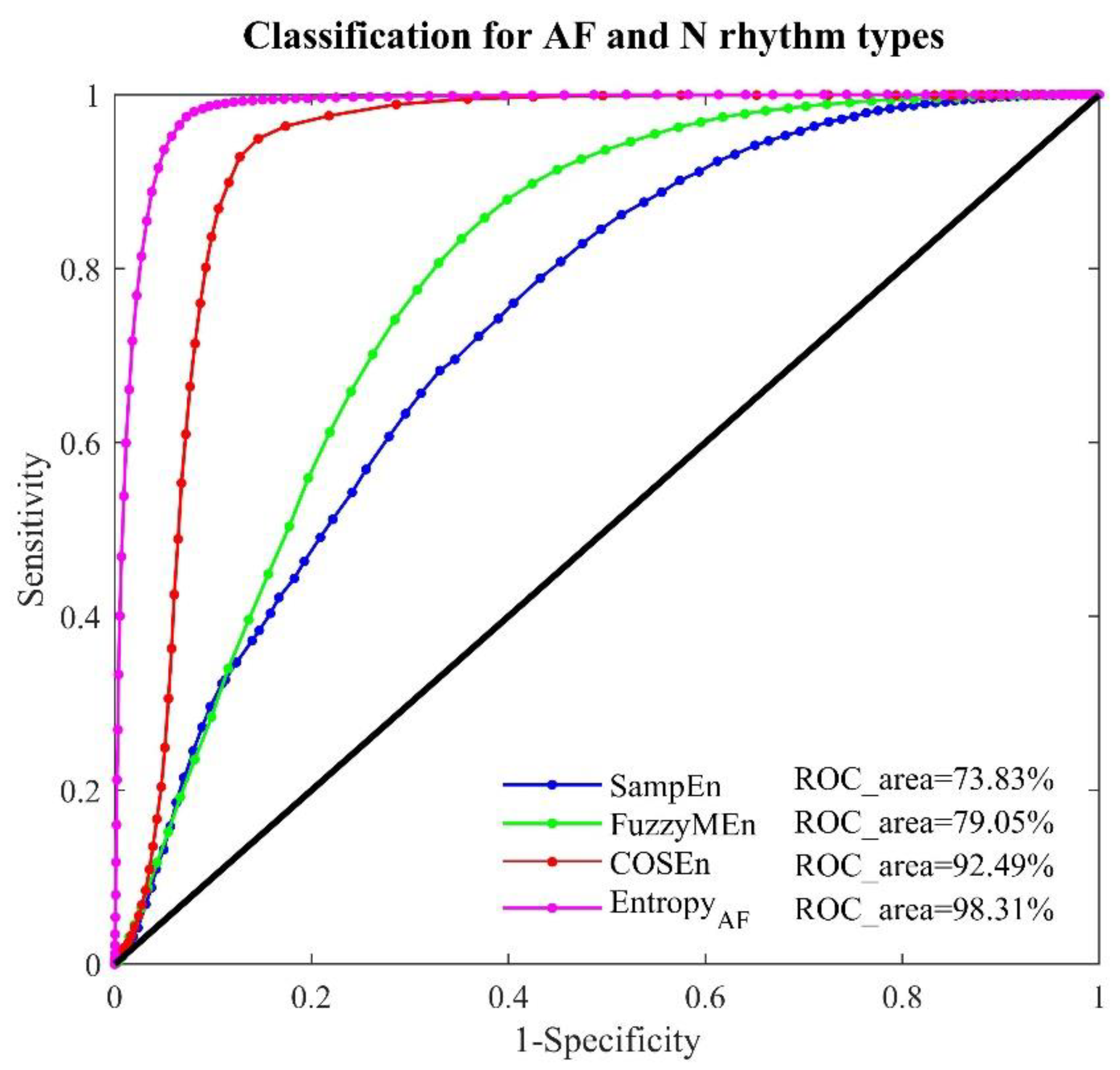
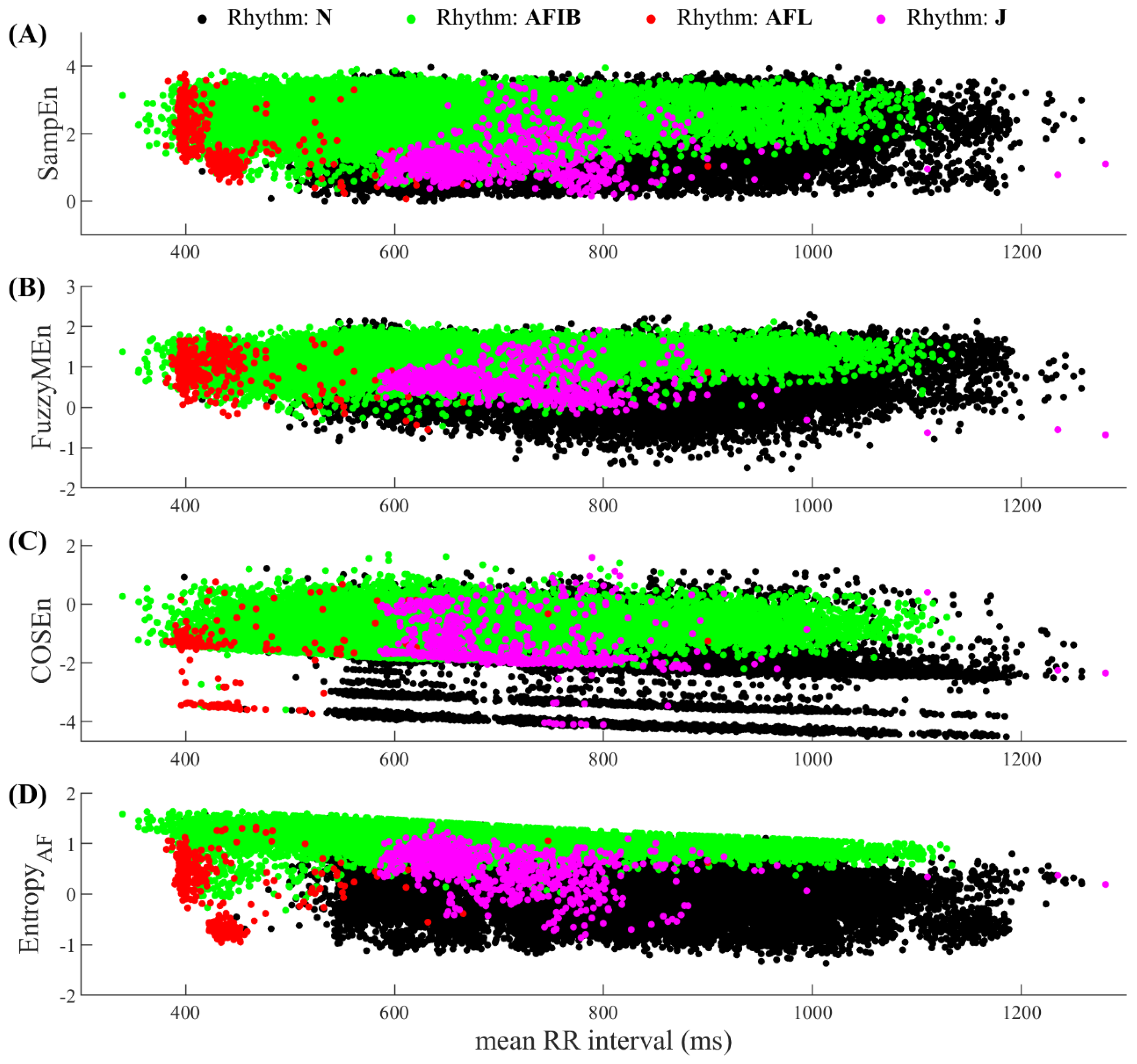
| AF vs. N rhythms | 2.29 | 0.98 | −1.51 | 0.72 | |
| (%) | 34.53 | 47.71 | 80.12 | 90.17 | |
| (%) | 65.64 | 80.65 | 92.83 | 97.45 | |
| (%) | 68.88 | 67.07 | 87.28 | 92.71 | |
| (%) | 67.56 | 73.04 | 89.73 | 94.80 | |
| (%) | 59.16 | 65.78 | 85.14 | 91.30 | |
| (%) | 74.49 | 81.53 | 93.94 | 97.89 | |
| (%) | 32.44 | 26.96 | 10.28 | 5.20 | |
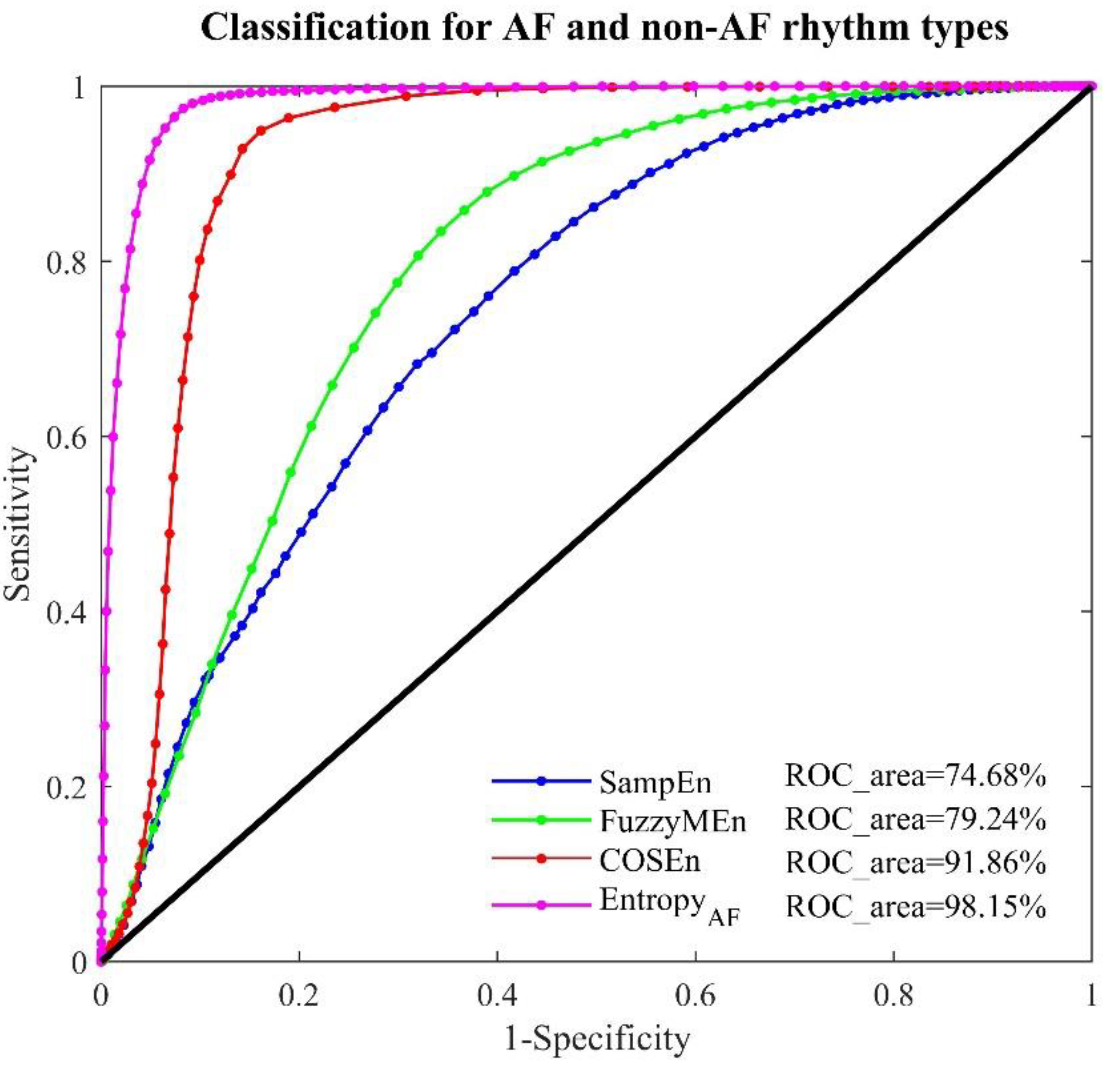
| AF vs. non-AF rhythms | 2.05 | 0.91 | −1.58 | 0.76 | |
| (%) | 37.16 | 48.73 | 78.78 | 89.07 | |
| (%) | 78.88 | 85.82 | 94.93 | 96.47 | |
| (%) | 58.28 | 62.91 | 83.85 | 92.59 | |
| (%) | 66.37 | 72.67 | 88.57 | 94.25 | |
| (%) | 55.03 | 63.20 | 81.35 | 90.63 | |
| (%) | 81.00 | 85.67 | 95.70 | 97.25 | |
| (%) | 33.63 | 27.33 | 11.43 | 5.75 |
| Task | Metric | SampEn | FuzzyMEn | COSEn | EntropyAF |
|---|---|---|---|---|---|
| AF vs. N rhythms | 1.04 | 0.29 | −1.88 | 0.54 | |
| (%) | 15.71 | 24.42 | 63.64 | 87.05 | |
| (%) | >99.0 | >99.0 | >99.0 | >99.0 | |
| (%) | 16.64 | 25.34 | 64.14 | 87.91 | |
| (%) | 50.20 | 57.77 | 79.69 | 92.85 | |
| (%) | 44.94 | 51.03 | 68.54 | 86.55 | |
| (%) | 96.32 | 97.24 | 99.39 | 99.24 | |
| (%) | 49.80 | 42.23 | 20.31 | 7.15 | |
| AF vs. non-AF rhythms | 1.04 | 0.29 | −1.88 | 0.54 | |
| (%) | 16.89 | 23.63 | 61.53 | 85.15 | |
| (%) | >99.0 | >99.0 | >99.0 | >99.0 | |
| (%) | 17.82 | 24.55 | 62.03 | 86.01 | |
| (%) | 49.75 | 56.30 | 77.99 | 91.60 | |
| (%) | 43.83 | 49.36 | 66.04 | 84.02 | |
| (%) | 96.74 | 97.30 | 99.41 | 99.26 | |
| (%) | 50.25 | 43.70 | 22.01 | 8.40 |
| Task | Metric | SampEn | FuzzyMEn | COSEn | EntropyAF |
|---|---|---|---|---|---|
| AF vs. N rhythms | 3.53 | 1.79 | 0.35 | 1.09 | |
| (%) | 0.12 | 0.41 | 0.93 | 52.87 | |
| (%) | 0.91 | 1.22 | 1.90 | 53.82 | |
| (%) | >99.0 | >99.0 | >99.0 | >99.0 | |
| (%) | 59.19 | 56.10 | 56.31 | 79.16 | |
| (%) | 44.06 | 54.12 | 60.52 | 97.81 | |
| (%) | 59.31 | 56.12 | 56.25 | 73.20 | |
| (%) | 40.81 | 43.90 | 43.69 | 20.84 | |
| AF vs. non-AF rhythms | 3.53 | 1.79 | 0.43 | 1.09 | |
| (%) | 0.13 | 0.44 | 0.57 | 52.83 | |
| (%) | 0.91 | 1.22 | 1.36 | 53.82 | |
| (%) | >99.0 | >99.0 | >99.0 | >99.0 | |
| (%) | 60.59 | 57.47 | 57.53 | 79.76 | |
| (%) | 43.15 | 53.85 | 56.25 | 97.59 | |
| (%) | 60.74 | 57.51 | 57.54 | 74.28 | |
| (%) | 39.41 | 42.53 | 42.47 | 20.24 |
| Metric | SampEn | FuzzyMEn | COSEn | EntropyAF |
|---|---|---|---|---|
| 2.05 | 0.91 | −1.58 | 0.76 | |
| (%) | 33.54 | 42.32 | 64.50 | 77.94 |
| (%) | 80.74 | 83.53 | 89.62 | 92.77 |
| (%) | 52.80 | 58.79 | 74.88 | 85.17 |
| (%) | 59.91 | 65.08 | 78.63 | 87.10 |
| (%) | 36.85 | 40.88 | 54.90 | 68.09 |
| (%) | 88.93 | 91.28 | 95.48 | 97.18 |
| (%) | 40.09 | 34.92 | 21.37 | 12.90 |
| 1.04 | 0.29 | −1.88 | 0.54 | |
| (%) | 12.11 | 19.13 | 57.17 | 72.19 |
| (%) | >99.0 | >99.0 | >99.0 | >99.0 |
| (%) | 13.06 | 20.10 | 58.14 | 73.14 |
| (%) | 34.93 | 40.18 | 68.54 | 79.73 |
| (%) | 27.99 | 29.72 | 44.66 | 55.72 |
| (%) | 97.58 | 98.39 | 99.44 | 99.56 |
| (%) | 65.07 | 59.82 | 31.46 | 20.27 |
| 3.53 | 1.79 | 0.43 | 1.09 | |
| (%) | 1.68 | 2.55 | 7.12 | 39.45 |
| (%) | 2.67 | 3.54 | 8.11 | 40.43 |
| (%) | >99.0 | >99.0 | >99.0 | >99.0 |
| (%) | 74.51 | 74.73 | 75.89 | 84.11 |
| (%) | 48.06 | 55.00 | 73.78 | 93.35 |
| (%) | 74.89 | 75.05 | 75.95 | 82.97 |
| (%) | 25.49 | 25.27 | 24.11 | 15.89 |
| Database | Metric | SampEn | FuzzyMEn | COSEn | EntropyAF |
|---|---|---|---|---|---|
| 1.08 | 1.01 | −1.32 | 0.04 | ||
| MIT-BIH AF database | (%) | 15.38 | 23.08 | 78.74 | 78.80 |
| (%) | 83.80 | 74.54 | 96.24 | 94.17 | |
| (%) | 31.58 | 48.63 | 82.49 | 84.63 | |
| (%) | 44.25 | 59.62 | 88.35 | 89.01 | |
| (%) | 28.19 | 51.82 | 80.33 | 82.34 | |
| (%) | 85.89 | 71.97 | 96.73 | 94.17 | |
| (%) | 55.75 | 40.38 | 11.65 | 11.26 | |
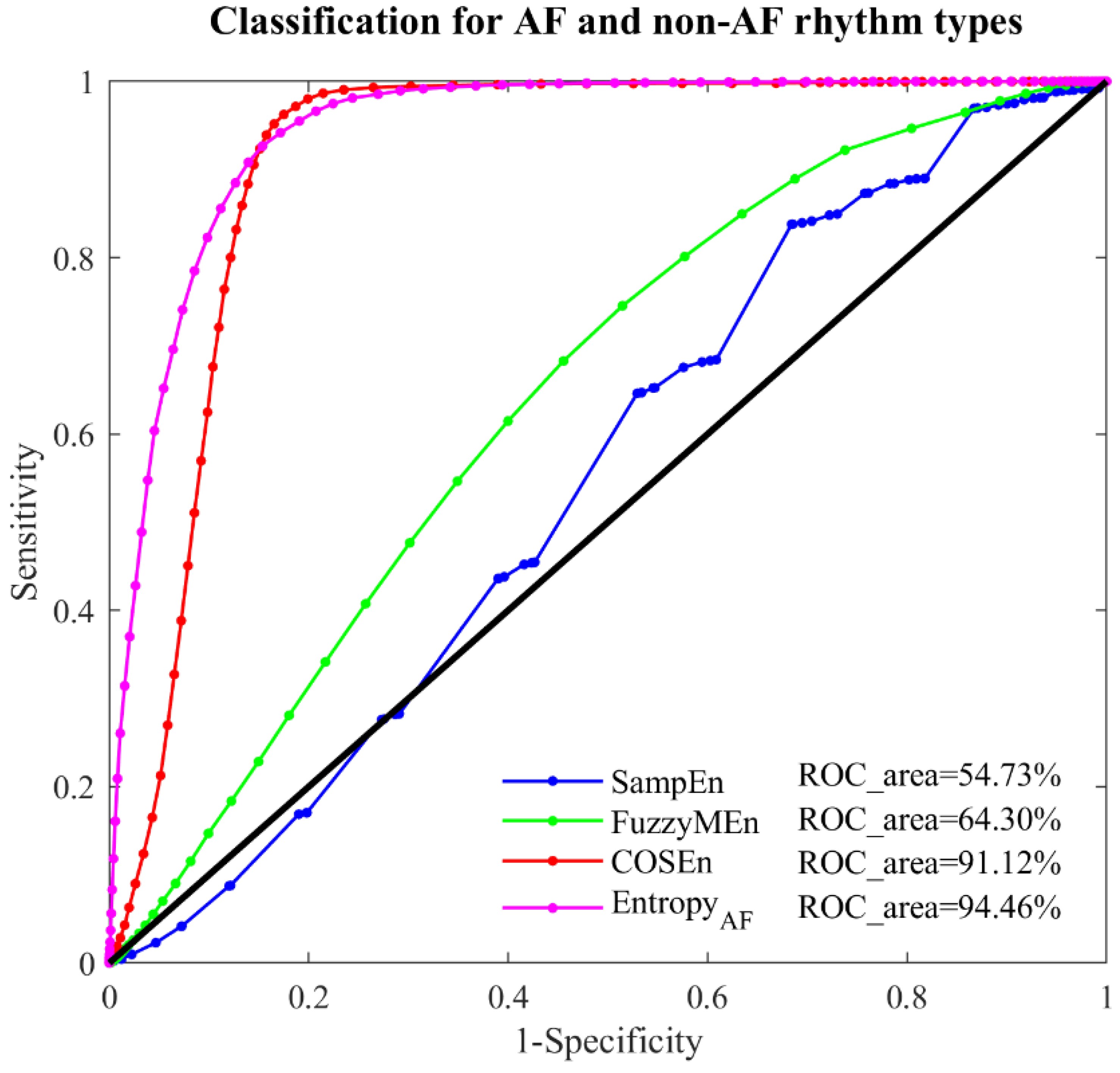
| Clinical wearable AF database | (%) | 15.05 | 19.79 | 53.18 | 63.00 |
| (%) | 70.18 | 73.32 | 84.20 | 85.38 | |
| (%) | 44.87 | 46.47 | 68.98 | 77.62 | |
| (%) | 51.31 | 53.31 | 72.85 | 79.59 | |
| (%) | 30.30 | 31.87 | 48.11 | 56.58 | |
| (%) | 81.50 | 83.61 | 92.74 | 93.96 | |
| (%) | 48.69 | 46.69 | 27.15 | 20.41 |
| Time Window | # Total Segments | Mean Time Cost (Unit: ms/Segment) | |||
|---|---|---|---|---|---|
| SampEn | FuzzyMEn | COSEn | EntropyAF | ||
| 30-beat | 40,484 | 0.24 | 0.66 | 1.72 | 1.62 |
| 12-beat | 101,618 | 0.15 | 0.49 | 1.58 | 1.47 |
© 2018 by the authors. Licensee MDPI, Basel, Switzerland. This article is an open access article distributed under the terms and conditions of the Creative Commons Attribution (CC BY) license (http://creativecommons.org/licenses/by/4.0/).
Share and Cite
Zhao, L.; Liu, C.; Wei, S.; Shen, Q.; Zhou, F.; Li, J. A New Entropy-Based Atrial Fibrillation Detection Method for Scanning Wearable ECG Recordings. Entropy 2018, 20, 904. https://doi.org/10.3390/e20120904
Zhao L, Liu C, Wei S, Shen Q, Zhou F, Li J. A New Entropy-Based Atrial Fibrillation Detection Method for Scanning Wearable ECG Recordings. Entropy. 2018; 20(12):904. https://doi.org/10.3390/e20120904
Chicago/Turabian StyleZhao, Lina, Chengyu Liu, Shoushui Wei, Qin Shen, Fan Zhou, and Jianqing Li. 2018. "A New Entropy-Based Atrial Fibrillation Detection Method for Scanning Wearable ECG Recordings" Entropy 20, no. 12: 904. https://doi.org/10.3390/e20120904
APA StyleZhao, L., Liu, C., Wei, S., Shen, Q., Zhou, F., & Li, J. (2018). A New Entropy-Based Atrial Fibrillation Detection Method for Scanning Wearable ECG Recordings. Entropy, 20(12), 904. https://doi.org/10.3390/e20120904