Abstract
Fractional repetition (FR) codes are a class of distributed storage codes that replicate and distribute information data over several nodes for easy repair, as well as efficient reconstruction. In this paper, we propose three new constructions of FR codes based on relative difference sets (RDSs) with . Specifically, we propose new FR codes using cyclic RDS with parameters constructed from q-ary m-sequences of period for a prime power q, FR codes using non-cyclic RDS with parameters for an odd prime p or and FR codes using non-cyclic RDS with parameters constructed from the Galois ring for a positive integer l. They are differentiated from the existing FR codes with respect to the constructable code parameters. It turns out that the proposed FR codes are (near) optimal for some parameters in terms of the FR capacity bound. Especially, and FR codes are optimal, that is, they meet the FR capacity bound for all k. To support various code parameters, we modify the proposed FR codes using decimation by a factor of the code length , which also gives us new good FR codes.
1. Introduction
As users of social media services and cloud services frequently upload large data files such as images and videos, huge storage space is required, which is implemented in the form of distributed storage systems (DSSs) [1,2]. DSSs manage a tremendous amount of storage nodes and a large number of failed nodes occur every day. Traditional solutions such as simple triplication and Reed–Solomon (RS) codes are no longer enough to efficiently maintain DSSs and enhance the reliability of stored data because, for node failure-handling, we have to consider the tremendous amount of data traffic over the network in DSS, the number of disk I/O (input/output) and the availability of local data processing, as well as the redundancy of stored data. Thus, it is necessary to find a new class of node failure-handling protocols that is well-fitted for the DSS environment, and for this reason, locally repairable codes [3,4,5,6,7] and regenerating codes [8] have recently attracted much attention.
Regenerating codes are proposed to minimize the total bandwidth of in-network data transfer required for repairing failed nodes, as well as to minimize the amount of stored data. Assume that each node stores symbols, and it suffices to connect to any d other nodes and download symbols from each node to repair a failed node. It turns out [9] that there is a tradeoff between the amount of stored data and the repair bandwidth , which is called the storage-bandwidth tradeoff. Minimum bandwidth regenerating (MBR) codes and minimum storage regenerating (MSR) codes are located at two extreme points of this tradeoff, respectively.
It is noted that the storage-bandwidth tradeoff was derived by allowing functional repair, where the repaired node may not have the same data as before, but it still plays the same role. The functional repair has some disadvantages against the exact repair in that all nodes may need to update the code information every time, and it is hard to maintain a systematic form of the code. Although it is proven that interior points on the tradeoff cannot be achieved with exact repair [10], many researches mainly focus on constructing exact regenerating codes and investigating the storage-bandwidth tradeoff for exact repair [11,12,13,14].
In general, DSSs handle an extremely large size of stored data, and thus, the data processing for node repairing requires a huge amount of computation. Thus, fractional repetition (FR) codes were firstly proposed in [15], which can be considered as a variant of MBR codes. FR codes enable repair-by-transfer to reduce computation in data processing for node repairing by relaxing the requirement of connecting to any d nodes. Instead, a repair is done by connecting to some d nodes based on a table. FR coding means that data symbols are replicated a few times and divided into several groups, each of which is stored at each node. Since no operations are used except for replication, computation for data processing becomes very small when repairing a failed node or collecting data symbol.
In designing DSSs, the system parameters can take arbitrary values based on the system environment, and this means many kinds of FR codes with various parameters need to be constructed. In [16], the existence of FR codes for each parameter set is shown by algorithm-based search, and some examples for each parameter set are provided. Many kinds of FR codes have been constructed mostly based on algebraic structures, combinatorial designs and graph theory [15,17,18,19,20,21,22]. In [15], Steiner systems are used as a class of FR codes with under the existence of Steiner system . In [17], FR codes are constructed for a prime power q and , which are based on the projective geometry and Latin squares. These FR codes are a subclass of the FR codes from Steiner systems in [15] and additionally designed to have a scalable property. In [18], various constructions of resolvable FR codes, especially net FR codes, are proposed by using grids, affine resolvable designs, Hadamard designs and mutually orthogonal Latin squares. The corresponding constructable parameters are with from grids, with from affine resolvable designs, with from Hadamard designs (where is an odd prime power) and or with from mutually orthogonal Latin squares (for a prime p, positive integers m and an integer ). Lastly, in [21], FR codes with are constructed from transversal designs for . Furthermore, FR codes with are constructed from generalized quadrangles for . These two classes of FR codes are optimal for selected parameters satisfying the conditions in [21].
The FR codes constructed from Steiner systems [15] support the number of data symbols equal to or slightly larger than the MBR capacity in (1). This means that the file size of the FR codes from Steiner systems shows a considerable gap from the upper bound of the FR capacity because any two rows of the incidence matrix of a Steiner system always have a collision [21]. On the other hand, in the incidence matrices of the proposed FR codes, there is no collision for some pairs of rows based on our analysis, and this property can make the proposed FR codes closer to optimal with respect to the FR capacity bound.
In this paper, we first propose new three constructions of , and FR codes based on relative difference sets with parameters , and , respectively, where q is a prime power, p is an odd prime or and l is a positive integer. Especially, and FR codes are optimal, that is, they meet the FR capacity bound in [15] for all k. We show via theoretical derivations and numerical analysis that the proposed FR codes are (near) optimal for some parameters in terms of the FR capacity bound. Finally, for various numbers of nodes, we modify the proposed FR codes using decimation by a factor of the code length , which also gives us new good FR codes. It is noted that some examples are already shown for small-valued parameter sets in [16], but we propose a systematic construction method of FR codes for the whole of the parameter sets based on well-organized mathematical structures unlike the algorithm-based search in [16]. It is also noted that the proposed FR codes can be seen as a part of the general class of FR code constructed from group divisible design (GDD) [19,20]. However, the contribution of this work is to explicitly provide three construction methods directly based on relative difference sets and m-sequences, propose a modification method from the three constructions to generate a new class of FR codes and analyze them in detail, while the basic idea and general framework are given in [19,20].
This paper is organized as follows. In Section 2, the basic definitions and notations are presented. The proposed FR codes are presented in Section 3. Additionally, we provide the characteristics of the proposed scheme and numerical results. In Section 4, we propose a modification method for Construction 1. Finally, we conclude this paper in Section 5.
2. Preliminaries
2.1. Regenerating Codes and Fractional Repetition Codes
In this paper, we assume that every node stores the same amount of data symbols. To clearly define regenerating codes and FR codes, we follow the notations in [21].
An regenerating code for and is defined as follows. The number of nodes and the number of information data symbols that need to be stored in DSS are denoted by n and M, respectively, and the symbols are in the finite field of q elements. Each node stores symbols. The parameter k is called the reconstruction degree, which means that a data collector can reconstruct all the stored information data by connecting to any k nodes and downloading symbols from each node. A failed node is repaired by connecting to any d other nodes and downloading symbols from each node. With this notation, the repair bandwidth becomes . We assume for the code construction throughout paper as in [11], which can be simply expanded to the case of . It is noted that this expansion does not cover all the FR codes for [18]. For MBR codes with , d is equal to , and the number of data symbols to be stored in DSS is given as:
which is called the MBR capacity.
In [18], the -recoverability and FR codes are formally defined as follows.
Definition 1.
Let and , be subsets of Ω. Let , and consider with . We say that A is β-recoverable from N if there exist for each such that , and [18].
Definition 2.
(FR codes [18]) An FR code with repetition degree ρ and normalized repair bandwidth (α and β are positive integers) is a set of n subsets of a symbol set with the following properties.
- 1.
- The cardinality of each is α.
- 2.
- Each element of Ω is contained in exactly ρ sets in N.
- 3.
- Let denote any -sized subset of N and . Each is β-recoverable from some d-sized subset of . Let be the maximum value of τ such that this property holds.
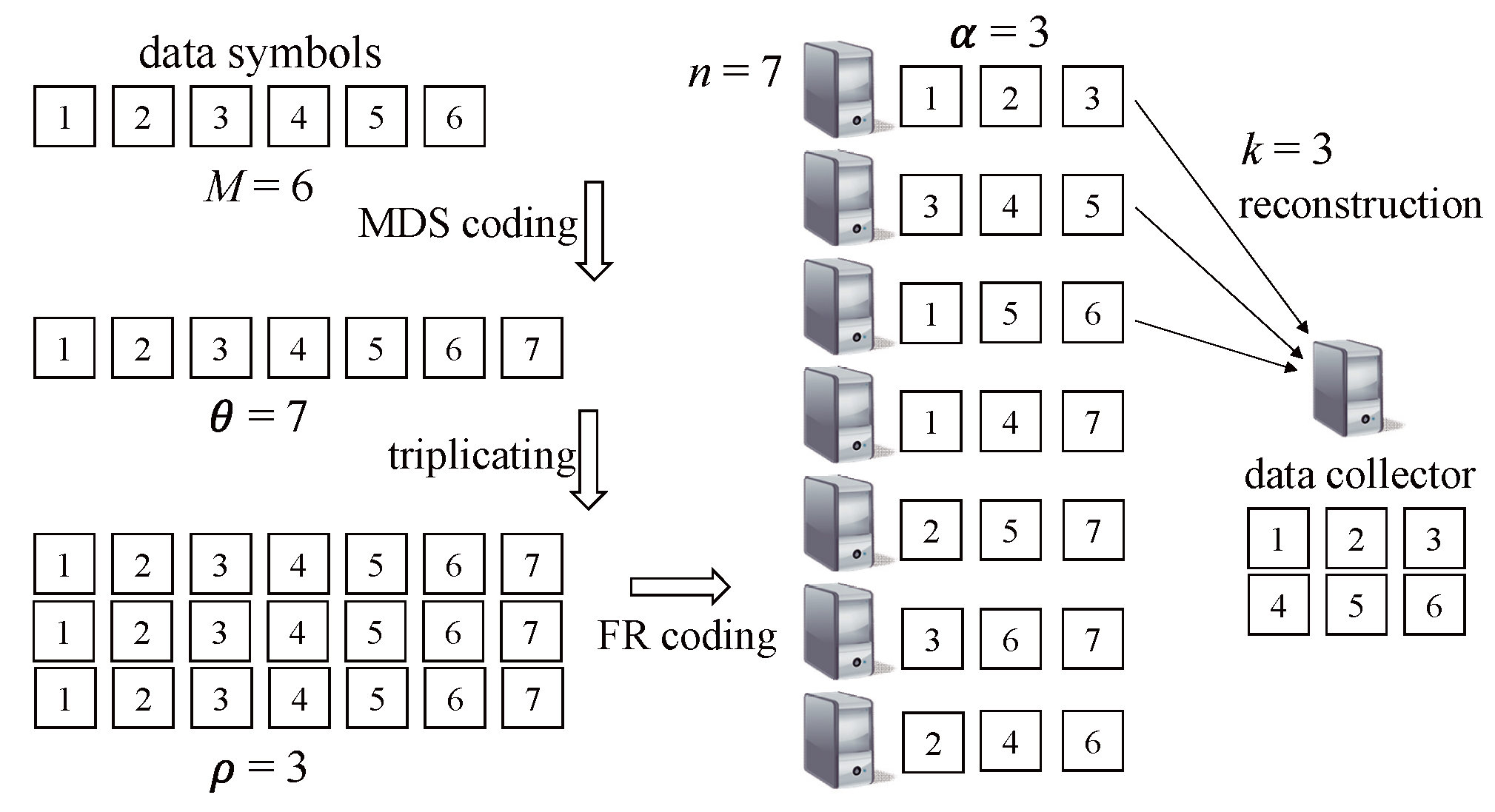
Note that an FR code satisfies . The parameter is called the repetition degree of . The incidence matrix of , denoted by , is defined by the binary matrix whose element is one if the set includes data symbol j or zero, otherwise. It is noted that the row and column weights of are and , respectively. An FR code can be used as an inner code together with an outer maximum distance separable (MDS) code. This concatenated code is called distributed replication-based exact simple storage (DRESS) code with parameters [23]. According to an FR code , node i, , stores the data symbols in . Figure 1 illustrates an example of a DRESS code.
Figure 1.
Structure of a distributed replication-based exact simple storage (DRESS) code.
For a given FR code, the maximum number of information data symbols M to be stored in DSS is determined as a function of k as:
It is addressed in [15] that for a well-constructed FR code, can be larger than the MBR capacity, that is,
holds for FR codes. For given parameters , the FR capacity, denoted by , is defined as the maximum value of among all FR codes with the parameters.
An upper bound for FR capacity was derived in [15] as:
where:
Capacity-achieving FR codes were constructed for some parameters in [21], but the FR capacity is unknown in general. An FR code is called k-optimal if . Furthermore, an FR code is called optimal if for any , it is k-optimal [21].
2.2. Relative Difference Sets and q-Ary m-Sequences
Let G be a group of order under an operation *, and let N be a normal subgroup of order u. Then, a relative difference set (RDS) in G relative to N is defined as a subset D with w elements of the group G such that the multiset of elements given by such that contains every element of exactly times and no element in N [24,25]. The parameters of RDSs satisfy the following equation:
If G is a cyclic group, D is called a cyclic RDS. If , D becomes a difference set. That is, a difference set is defined as a subset D with w elements of a group G with v elements such that the set of elements given by such that contains every element of exactly times.
Let D be an RDS with parameters given as , where are elements in G. It is easy to check the following lemmas. Even though it is not difficult to derive it, we provide proofs for clear understanding.
Lemma 1.
If D is an RDS, then its right coset is also an RDS for .
Proof.
Let . By the definition, for , , becomes all elements in exactly times, when i and j vary for all elements in D. ☐
Lemma 2.
For cosets and of an RDS D, we have if is not in N. Otherwise, .
Proof.
Common elements of and are given as for some . By the definition of RDS, covers all elements in . ☐
Let denote the finite field with elements, where p is a prime and e is a positive integer. The trace function from into is defined as:
Then, a q-ary m-sequence of period is defined as:
where denotes a primitive element of .
It is well-known that the q-ary m-sequence has the balance property, which means that zero appears times and each of the non-zero element in appears times in a period.
The -homogeneous function from to is introduced by Klapper [26], which is defined as for any and . Then, Kim et al. constructed an RDS from a -homogeneous function on [27]. In addition, a function is said to be difference-balanced if the difference function is balanced for any .
Theorem 1 ([27]).
Let q be a prime power and n a positive integer. If is a δ-homogeneous function on over with difference-balanced property, where δ is relatively prime to , then the set is a cyclic RDS with parameters in the multiplicative group relative to its normal subgroup .
It is clear that for , the trace function defined in (4) is a one-homogeneous function because we have for and . Therefore, from a q-ary m-sequence of period , we can construct a cyclic RDS with parameters .
Example 1.
For , let α be a primitive element of . Then, a relative difference set with parameters is given as . It is easy to check that for any two distinct elements can cover only once all elements in .
3. The Proposed FR Codes
In this section, we construct new classes of FR codes with parameters , and based on the cyclic RDS with parameters constructed from the q-ary m-sequences, the non-cyclic RDS with parameters and the non-cyclic RDS with parameters , respectively, for a prime power q, an odd prime p or and a positive integer l. Furthermore, it is demonstrated that these codes are (near) optimal for some parameters with respect to the FR capacity bound in (3).
3.1. Construction of FR Codes from RDSs
First, we propose a general construction method of FR codes based on the RDSs with parameters . Since the relative difference sets with are equivalent to a class of group divisible design (GDD), the proposed FR codes can be seen to originate from the common framework, which exploits the incidence matrix of a combinatorial design to construct an FR code. Particularly, the incidence matrix of a balanced incomplete block design (BIBD) or a GDD can be directly used as the incidence matrix of the corresponding FR code. Thus, the incidence matrix of an FR code can be directly constructed from a given RDS, and the general construction method is a result of this process.
Let be a group of order under an operation ∗, and let N be a normal subgroup of order u. Furthermore, let D be an RDS with parameters in G relative to N. Then, an incidence matrix of FR code is constructed from D as:
whose element is given as:
This is our basic method to construct three classes of FR codes from RDSs, which will be explicitly given as follows. It is noted that the GDDs corresponding to the proposed FR codes are symmetric, and more general parameter sets of the symmetric GDDs are found in [28]. Suppose that the i-th row of is denoted by for . For any pair of rows and in , we will say that there is a collision if for some j, .
Construction 1.
Define a map from to for as:
Furthermore, we define a binary sequence for the q-ary m-sequence of period . Then, a cyclic RDS with parameters in relative to is obtained as . According to the general construction method, we propose new FR codes whose incidence matrices have the form:
where:
and for .
Note that the cyclic RDS with parameters in Construction 1 is equivalent to the RDS with the same parameters from Theorem 1. The first row corresponds to the binary sequence -mapped from the q-ary m-sequence of period in (5). We call this sequence the characteristic sequence of the corresponding RDS. Each of the other rows is cyclically shifted to the right by one position from the row above it. The size of is , which means that the length of the FR code is and the parameter is also . It is easily shown from the balance property of the q-ary m-sequence that the row and column weights are q, that is, .
Example 2.
A ternary m-sequence of period eight is generated as
For , we have an RDS with parameters as , and its characteristic sequence is given as:
Then, the incidence matrix of the FR code is given as:
We can see that the row and column weights are .
Example 3.
A 5-ary m-sequence of period 24 is generated as:
For , we have an RDS with parameters as , and its characteristic sequence is given as:
In the same way as the ternary case, the incidence matrix of the corresponding FR code is constructed using cyclic shift, and its row and column weights are .
Example 4.
A 4-ary m-sequence of period 15 is generated as:
where γ is a primitive element of with the primitive polynomial and is an extended field of by . For , we have:
Then, the incidence matrix of the FR code is given as:
where the row and column weights are .
Remark 1.
In [18], the resolvable FR code is defined as follows. Let where is an FR code. A subset is said to be a parallel class if for and with , we have and . A partition of V into r parallel classes is a resolution. If there exists at least one resolution, then the code is called a resolvable FR code. It is clear that the FR codes from the first construction are not resolvable because q is not a factor of , while the FR codes from the net in [18] are always resolvable. This is evidence that the proposed construction is not a proper subset of the constructions in [18].
In 1966, Elliott and Butson [25] constructed non-cyclic RDSs with parameters and , where p is an odd prime. Using those RDSs, we can construct FR codes with parameters and , respectively.
In the following description, the symbol ⊕ means the direct sum, and denotes the additive group of integers modulo p. Let be the elementary Abelian p-group of order with identity zero, whose elements are expressed as n-tuples of elements of . Then, the RDS can be constructed as in the following theorem.
Theorem 2 ([25]).
Let , and let . For , ,
is an RDS with parameters of G relative to N, where .
Since we are interested in the case of , we only use the RDSs in Theorem 2 for the case of . In this case, we can simplify as for , and we have the RDS D with parameters , whose elements are given as .
Note that there is no explicit ordering among elements in the RDS D. However, for the construction of FR codes, we will use the arbitrary order of elements in D, for example, a lexicographic order i defined as for , which is in the range between zero and . Thus, construction of new FR codes by using the RDSs in Theorem 2 is given as follows.
Construction 2.
Let D be a non-cyclic RDS with parameters , where p is an odd prime or four. For , we have lexicographic orders and . According to the general construction method, we propose new FR codes whose incidence matrices have the form given by:
whose element is given as:
where .
In the following examples, we provide incidence matrices for FR codes with parameters , and .
Example 5.
Let , and . Then, we have and . The RDS D with parameters is given as , where . That is, we have . Then, we have the following cosets of D for all elements in as:
By using a lexicographic order, we can obtain the following incidence matrix for a FR code as:
Note that the proposed FR code meets the FR capacity bound in (3), that is, it is an optimal FR code with parameters .
Example 6.
An RDS with parameters can be obtained as of and the forbidden normal subgroup [29]. By using a lexicographic order, we can similarly obtain the following incidence matrix for a FR code as:
Example 7.
Let , and . Then, we have . Then, the RDS D with parameters is given as , which corresponds to the first row of the proposed incidence matrix when we use a lexicographic order. The remaining rows can be obtained by adding all elements in just as in the previous examples. Then, a FR code is obtained by using a lexicographic order.
In the third construction, we utilize the Galois ring , which is a local ring with maximum ideal . Hou and Sehgal proposed a semi-regular RDS from the Galois ring [30], where the semi-regular RDSs satisfy . It is known that , the group of units, contains a unique cyclic subgroup of order , and is called the Teichmuller set of . Then, each element has a unique two-adic representation , where . The Frobenius map is an automorphism of of order l. The relative trace of is the map defined by . Let W be a finite Abelian group and any function with . Let and:
Then, R is a semi-regular RDS in G relative to . It should be noted that the cardinality of W is related to . Thus, to construct RDS with , we only consider the case of and . Then,
is a non-cyclic RDS with parameters , where h is an element in T and l is a positive integer.
To assign the proper order to each element in , we denote , where each element in each set has component-wise correspondence. Then, an element of is indexed as for .
Construction 3.
Let D be a non-cyclic RDS with parameters , where l is a positive integer. According to the general construction method, we propose new FR codes C whose incidence matrices have the form given by:
where:
and .
In the following examples, we provide the incidence matrix for FR codes with parameters (16,4,4).
Example 8.
For , the Teichmuller set is given as:
where β is a root of . Then, all elements of are given as:
and .
Therefore, and , i.e., . Since it is a semi-regular RDS (), we have for the case of . Because h in (12) is an arbitrary element in T, we set . Thus, a semi-regular RDS D is given as , which is a RDS. We can apply the proposed ordering to construct a FR code as follows:
3.2. Properties of the Proposed FR Codes
In this subsection, we will investigate how good the number of data symbols to be stored in DSS is in terms of the upper bound of the FR capacity in (3) for the proposed FR codes. To this end, some properties of the incidence matrices of the proposed FR codes are given in the following theorems. From Lemma 2, it is easy to prove the following property of FR codes from Construction 1.
Theorem 3.
Let and be the -th and -th rows in of the proposed FR codes from Construction 1, where and . Then, the inner product of and is given as:
Proof.
Let and denote the corresponding cyclic group and the normal subgroup, respectively. From Lemma 2, since for , two rows and are orthogonal to each other. Otherwise, from , we have . ☐
That is, for any pair of two rows in , there is no collision or only one collision.
Similarly, we have the property of FR codes from Construction 2 as follows.
Theorem 4.
Let and be the i-th and j-th rows in of the proposed FR codes from Construction 2, where i and j are the lexicographic orders of and , respectively, for , . Then, the inner product of and is given as:
Proof.
From Lemma 2, since for , two rows and are orthogonal to each other. Otherwise, from , we have . ☐
That is, for any pair of two rows in , there is no collision or only one collision. Actually, of the proposed FR codes is very close to the FR capacity bound and greater than or equal to the MBR bound, which are shown via the following theorem and numerical analysis as below.
Theorem 5.
The number of data symbols to be stored in the proposed FR codes satisfies .
Proof.
The MBR capacity is found when every pair of rows among k rows chosen from the incidence matrix of an FR code has exactly one collision. Equation (2) says that can be strictly larger than the MBR capacity if some pairs of rows have no collision and the other pairs have one collision. The incidence matrices of the proposed FR codes satisfy the above condition for a given k, and thus, of the proposed FR codes is larger than or equal to the MBR capacity. ☐
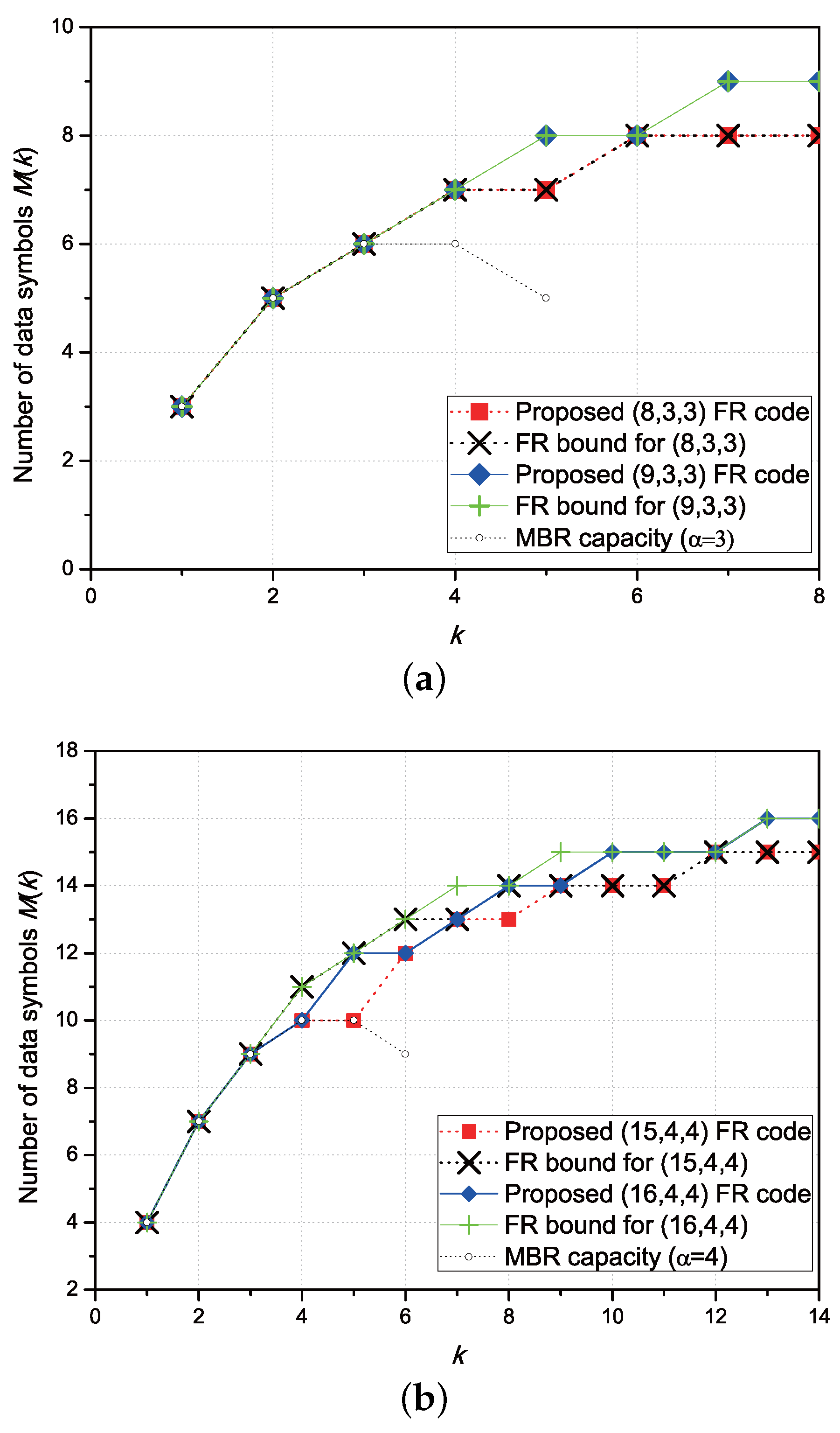
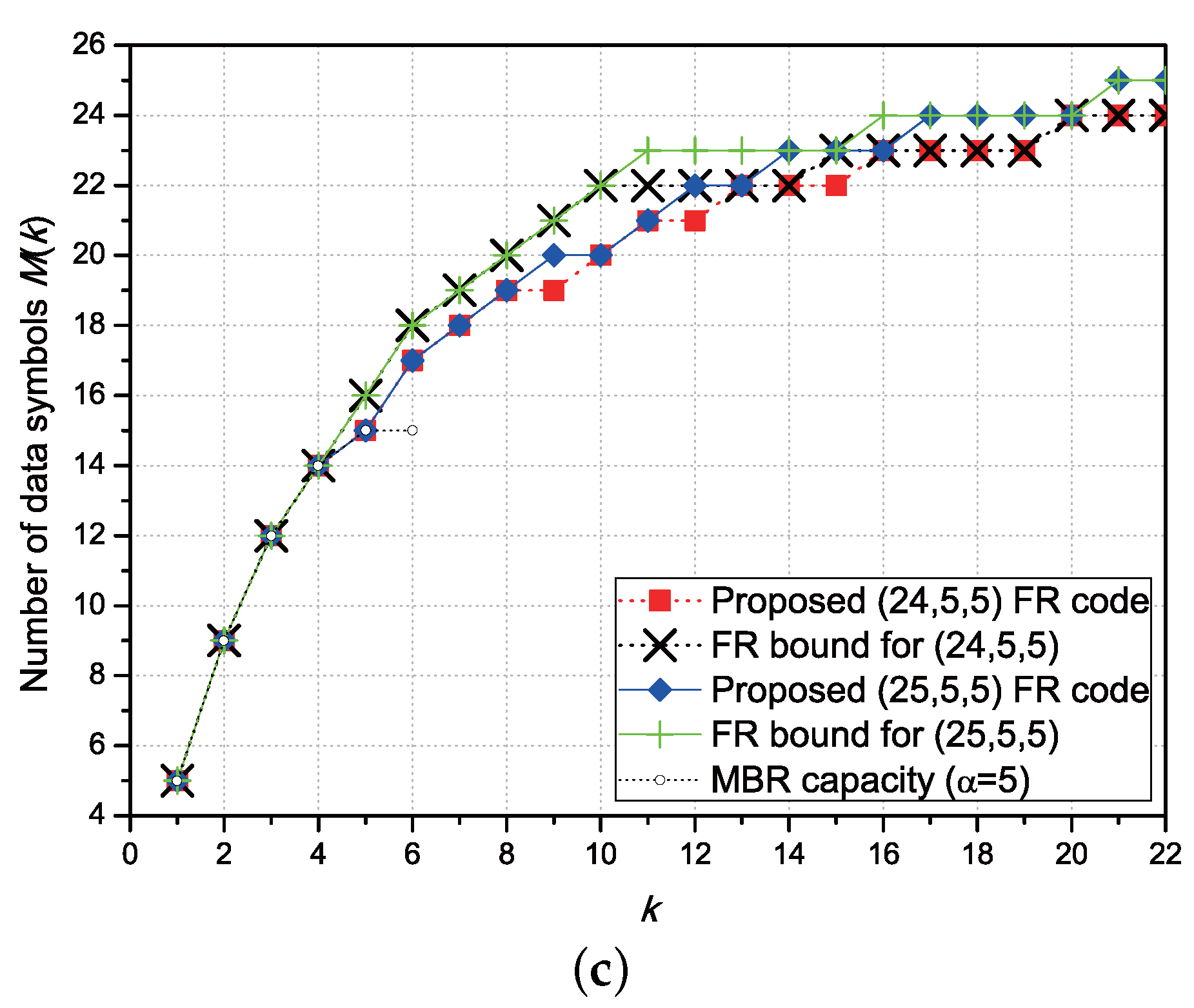
Figure 2 demonstrates the number of data symbols of the proposed FR codes with parameters , , , , and . We cannot find any existing FR code whose parameters are the same as the proposed ones, and thus, we plot the MBR capacity and the FR capacity bound in (3). We can see that the and FR codes are optimal because they achieve the FR capacity bound for all k. The , , and FR codes do not exactly achieve the FR capacity bound, but the gaps become smaller; thus, it deserves to be called FR capacity-approaching.

Figure 2.
Comparison of the number of data symbols to be stored in the proposed fractional repetition (FR) codes with the minimum bandwidth regenerating (MBR) capacity and the FR capacity bound. (a) and FR codes; (b) and FR codes; (c) and FR codes.
4. Modification of the Proposed FR Codes
In this section, we propose a modification method for the proposed FR codes from Construction 1 to support various numbers of storage nodes. It is trivial to obtain irregular incidence matrices from the regular ones by selecting some of the rows in the matrices, where “regular” means that all the rows in the incidence matrix have a constant Hamming weight and so do all the columns; otherwise, it is called “irregular”. Thus, we propose a method to obtain regular incidence matrices from larger regular incidence matrices.
Thus, by decimating an incidence matrix of Construction 1 in (13) by a decimation factor r, we have r matrices as follows.
Construction 4.
The incidence matrix for FR codes can be derived by decimating rows and columns of the original incidence matrix in Construction 1 by a factor r of as:
where for and .
Then, for the sub-incidence matrices in (14), we can determine parameters as in the following theorem.
Theorem 6.
In Construction 4, for , there are sub-incidence matrices of size with Hamming weights of rows and columns and a sub-incidence matrix of the same size with Hamming weights of rows and columns .
Proof.
Let , where , and . Then, we have:
where is a primitive element of . From (15), an m-sequence can be two-dimensionally represented as:
Note that each column in (16) contains all non-zero elements in since is a primitive element of except for one zero column such that . Therefore, when applying the binary mapping in (7), there is only one “1” in each column except for the zero column. Note that the zero column occurs at since , that is, .
Decimating by r, where , we only select some columns in (16) with for a sub-sequence . Then, among r sub-sequences, only a sub-matrix for has the all-zero column, and the others do not have the zero element. Since each element of occurs once and if we select columns, the decimated sub-sequences have ones (i.e., ) except for one sub-sequence, which contains the zero column with ones (i.e., ). Since we will construct each row of by cyclically shifting , we have for sub-incidence matrices and for . ☐
In addition, it is easy to see that the decimated incidence matrices inherit the same property in Theorem 3 as the original incidence matrices as follows.
Theorem 7.
The decimated incidence matrices of the proposed FR codes have the following properties. Let and be two distinct rows in , where and . Then, the inner product of and is given as:
Proof.
Since the decimated incidence matrices are generated from the original , it is not possible to have more than one collision in any pair of two rows in . In addition, the decimation factor r is a factor of , and two rows and with in the original are always included in the same . ☐
From Theorem 7, the following property straightforwardly holds.
Corollary 1.
The number of data symbols to be stored in the proposed FR codes satisfies .
As an example, we present the incidence matrix of the FR code as follows.
Example 9.
A seven-ary m-sequence of period 48 is generated as:
For , we have an RDS with parameters as , and its characteristic sequence is given as:
Decimating by a factor , we have:
In the same way as the previous examples, the incidence matrix of the corresponding FR codes is constructed using cyclic shift and its row and column weights are .
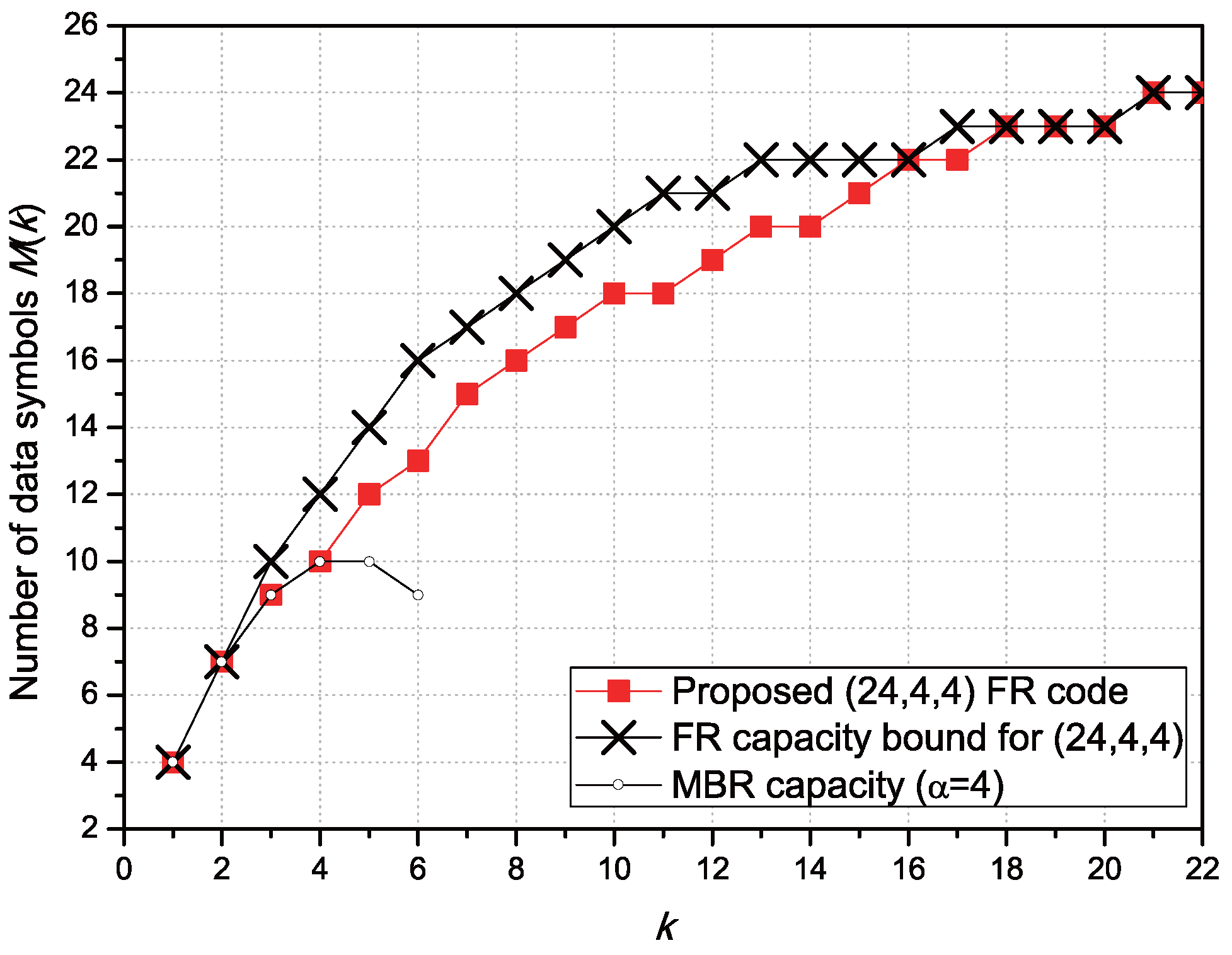
The number of data symbols of the FR code in Example 9 is presented with respect to k in Figure 3. Note that in this example, we can obtain another FR code with the same code length of 24 given in Figure 2c. However, they have different and such as and , respectively. Note that there is some deviation between the upper bound in (3) and of the proposed one in Figure 3. Remember that since (3) is the upper bound, there is no guarantee that the bound is the same as the actual capacity of FR codes. However, for the low k’s, which are less than or , we can see that the proposed FR code can achieve the capacity as in Figure 2a–c and Figure 3.
Figure 3.
Comparison of the number of data symbols to be stored in the proposed (24, 4, 4) FR codes with the MBR capacity and the FR capacity bound with the same size.
In Table 1, we list possible parameters from Constructions 1–4. As you can see, there are the same parameters from the distinct original m-sequences. However, even though they have the same parameters , this does not mean that the incidence matrices are equivalent. For example, we can obtain the same parameters from for and from for . However, the former has the binary sequence , and the later has the binary sequence by decimation. It is easy to see that we cannot obtain the later binary sequence by cyclically shifting the former binary sequence. That is, they are distinct instances with the same parameters.
Table 1.
Possible parameters obtained from the proposed constructions in Constructions 1–4 (decimation).
5. Concluding Remarks
In this paper, new constructions of FR codes with parameters , and are proposed, where q is a prime power and p is an odd prime. The proposed FR codes are constructed from RDSs with . It turns out that the proposed FR codes are near optimal with respect to the FR capacity bound, and especially, the proposed and FR codes are optimal with respect to the FR capacity bound. It is noted that there is no conventional FR codes whose parameters are the same as the proposed ones, and thus, the proposed construction enriches choices of parameters for FR code design. Finally, we also provide a modification method for the proposed incidence matrices to adapt various requirement of the number of storage nodes.
Acknowledgments
This research was supported by the Basic Science Research Program through the National Research Foundation of Korea (NRF) funded by the Ministry of Science, ICT & Future Planning (NRF-2014R1A2A2A01006870), and this research was also supported by the Basic Science Research Program through the National Research Foundation of Korea (NRF) funded by the Ministry of Education (NRF-2015R1D1A1A01060941).
Author Contributions
Young-Sik Kim and Hosung Park discussed the first idea of the proposed constructions; Jong-Seon No extended the idea and gave the insight of the analysis; Young-Sik Kim performed the simulations; Hosung Park verified the data; Young-Sik Kim wrote the paper; Jong-Seon No improved the presentation of the paper. All authors have read and approved the final manuscript.
Conflicts of Interest
The authors declare no conflict of interest.
References
- Kim, S.-H.; Lee, I.-Y. Block access token renewal scheme based on secret sharing in Apache Hadoop. Entropy 2014, 16, 4185–4198. [Google Scholar] [CrossRef]
- Tamura, Y.; Yamada, S. Reliability analysis based on a jump diffusion model with two Wiener processes for cloud computing with big data. Entropy 2015, 17, 4533–4546. [Google Scholar] [CrossRef]
- Gopalan, P.; Huang, C.; Simitci, H.; Yekhanin, S. On the locality of codeword symbols. IEEE Trans. Inf. Theory 2012, 58, 6925–6934. [Google Scholar] [CrossRef]
- Papailiopoulos, D.S.; Dimakis, A.G. Locally repairable codes. IEEE Trans. Inf. Theory 2014, 60, 5843–5855. [Google Scholar] [CrossRef]
- Song, W.; Dau, S.H.; Yuen, C.; Li, J. Optimal locally repairable linear codes. IEEE J. Sel. Areas Commun. 2014, 32, 1019–1036. [Google Scholar] [CrossRef]
- Song, W.; Dau, S.H.; Yuen, C. Erasure codes with symbol locality and group decodability for distributed storage. In Proceedings of the IEEE Information Theory Workshop, Jeju, Korea, 11–15 October 2015; pp. 74–78. [Google Scholar]
- Dau, S.H.; Kiah, H.M.; Song, W.; Yuen, C. Locally encodable and decodable codes for distributed storage systems. In Proceedings of the IEEE Global Communications Conference, San Diego, CA, USA, 6–10 December 2015; pp. 1–7. [Google Scholar]
- Dimakis, A.G.; Godfrey, P.B.; Wainwright, M.J.; Ramchandran, K. Network coding for distributed storage systems. In Proceedings of the IEEE International Conference on Computer Communications, Anchorage, AK, USA, 6–12 May 2007; pp. 2000–2008. [Google Scholar]
- Wu, Y.; Dimakis, A.G.; Ramchandran, K. Deterministic regenerating codes for distributed storage. In Proceedings of the Annual Allerton Conference on Communication, Control, and Computing, Urbana-Champaign, IL, USA, 18 September 2007. [Google Scholar]
- Shah, N.B.; Rashmi, K.V.; Kumar, P.V.; Ramchandran, K. Distributed storage codes with repair-by-transfer and nonachievability of interior points on the storage-bandwidth tradeoff. IEEE Trans. Inf. Theory 2012, 58, 1837–1852. [Google Scholar] [CrossRef]
- Rashmi, K.V.; Shah, N.B.; Kumar, P.V. Optimal exact-regenerating codes for distributed storage at the MSR and MBR points via a product-matrix construction. IEEE Trans. Inf. Theory 2011, 57, 5227–5239. [Google Scholar] [CrossRef]
- Tian, C. Characterizing the rate region of the (4, 3, 3) exact-repair regenerating codes. IEEE J. Sel. Areas Commun. 2014, 32, 967–975. [Google Scholar] [CrossRef]
- Ernvall, T. Codes between MBR and MSR points with exact repair property. IEEE Trans. Inf. Theory 2014, 60, 6993–7005. [Google Scholar] [CrossRef]
- Tian, C.; Sasidharan, B.; Aggarwal, V.; Vaishampayan, V.A.; Kumar, P.V. Layered exact-repair regenerating codes via embedded error correction and block designs. IEEE Trans. Inf. Theory 2015, 61, 1933–1947. [Google Scholar] [CrossRef]
- Rouayheb, S.E.; Ramchandran, K. Fractional repetition codes for repair in distributed storage systems. In Proceedings of the Annual Allerton Conference on Communication, Control, and Computing, Urbana-Champaign, IL, USA, 29 September–1 October 2010; pp. 1510–1517. [Google Scholar]
- Anil, S.; Gupta, M.K.; Gulliver, T.A. Enumerating Some Fractional Repetition Codes. arxiv 2013, arXiv:1303.6801. [Google Scholar]
- Koo, J.C.; Gill, J.T., III. Scalable constructions of fractional repetition codes in distributed storage systems. In Proceedings of the Annual Allerton Conference on Communication, Control, and Computing, Urbana-Champaign, IL, USA, 28–30 September 2011; pp. 1366–1373. [Google Scholar]
- Olmez, O.; Ramamoorthy, A. Fractional repetition codes with flexible repair from combinatorial designs. IEEE Trans. Inf. Theory 2016, 62, 1565–1591. [Google Scholar] [CrossRef]
- Zhu, B.; Shum, K.W.; Li, H.; Hou, H. General fractional repetition codes for distributed storage systems. IEEE Commun. Lett. 2014, 18, 660–663. [Google Scholar] [CrossRef]
- Zhu, B.; Shum, K.W.; Li, H. Heterogeneity-aware codes with uncoded repair for distributed storage systems. IEEE Commun. Lett. 2015, 19, 901–904. [Google Scholar] [CrossRef]
- Silberstein, N.; Etzion, T. Optimal fractional repetition codes based on graphs and designs. IEEE Trans. Inf. Theory 2015, 61, 4164–4180. [Google Scholar] [CrossRef]
- Park, H.; Kim, Y.-S. Construction of fractional repetition codes with variable parameters for distributed storage systems. Entropy 2016, 18, 441. [Google Scholar] [CrossRef]
- Pawar, S.; Noorshams, N.; Rouayheb, S.E.; Ramchandran, K. DRESS codes for the storage cloud: Simple randomized constructions. In Proceedings of the IEEE International Symposium on Information Theory, St. Petersburg, Russia, 31 July–5 August 2011; pp. 2338–2342. [Google Scholar]
- Butson, A.T. Relations among generalized Hadamard matrices, relative difference sets, and maximal length linear recurring sequences. Canad. J. Math. 1963, 15, 42–48. [Google Scholar] [CrossRef]
- Elliott, J.E.H.; Butson, A.T. Relative difference sets. Ill. J. Math. 1966, 10, 517–531. [Google Scholar]
- Klapper, A. d-Form sequence: Families of sequences with low correlation values and large linear span. IEEE Trans. Inf. Theory 1995, 41, 423–431. [Google Scholar] [CrossRef]
- Kim, S.-H.; No, J.-S.; Chung, H.; Helleseth, T. New cyclic relative difference sets constructed from homogeneous functions with difference-balanced property. IEEE Trans. Inf. Theory 2005, 51, 1155–1163. [Google Scholar] [CrossRef]
- Colbourn, C.J.; Dinitz, J.H. Handbook of Combinatorial Designs, 2nd ed.; Chapman & Hall/CRC: Boca Raton, FL, USA, 2007. [Google Scholar]
- Pott, A.; Schmidt, K.-U.; Zhou, Y. Semifields, relative difference sets, and bent functions. Radon Ser. Comput. Appl. Math. 2014, 16, 161–178. [Google Scholar]
- Hou, X.-D.; Sehgal, S.K. Two generalized constructions of relative difference sets. J. Algebraic Comb. 2000, 12, 145–153. [Google Scholar] [CrossRef]
© 2017 by the authors. Licensee MDPI, Basel, Switzerland. This article is an open access article distributed under the terms and conditions of the Creative Commons Attribution (CC BY) license (http://creativecommons.org/licenses/by/4.0/).