


An Evolutionary Game Theoretic Approach to Multi-Sector Coordination and Self-Organization

 ,
, 
Abstract
:1. Introduction
2. Evolutionary Game Theory
- (1)
- We are concerned with providing an example of multi-sector dynamics and as we will see, the analytical challenges of these dynamics can be grasped even considering the infinite population assumption and the analytical framework that this limit entails.
- (2)
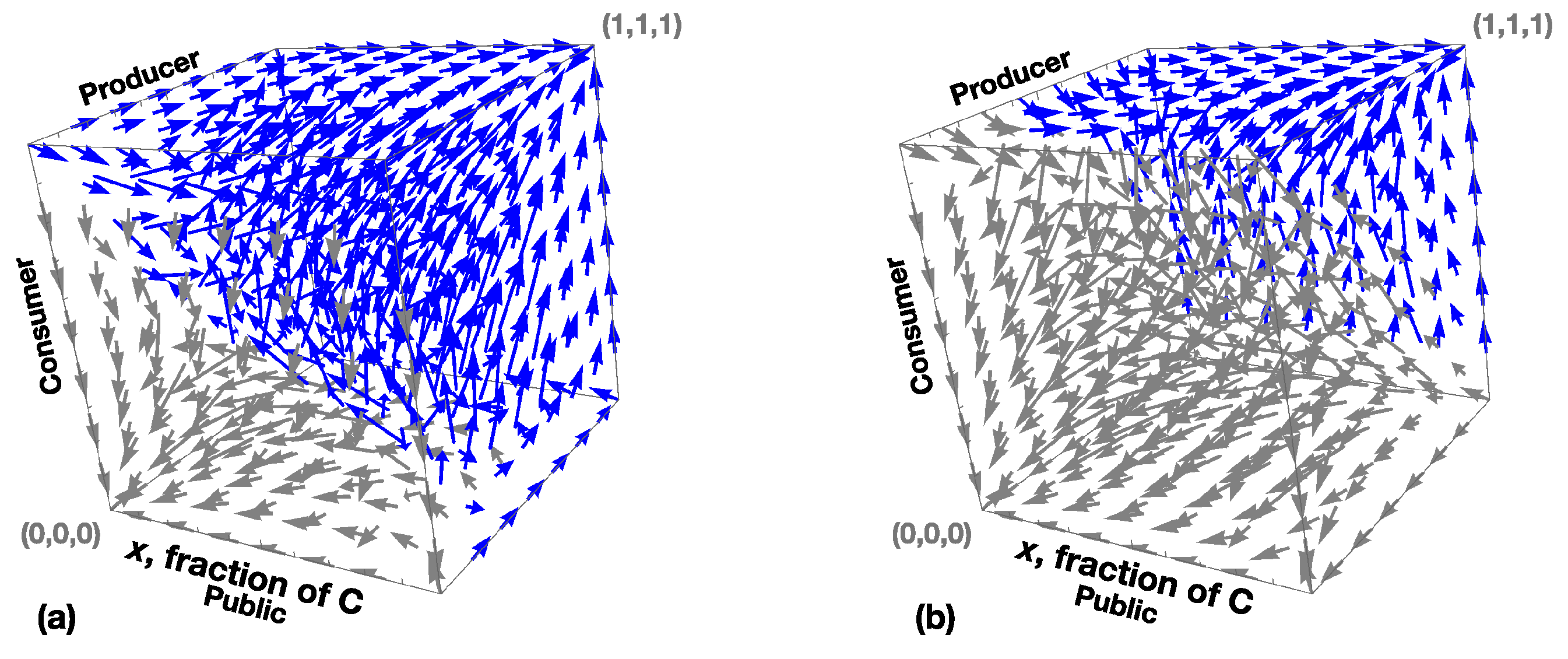
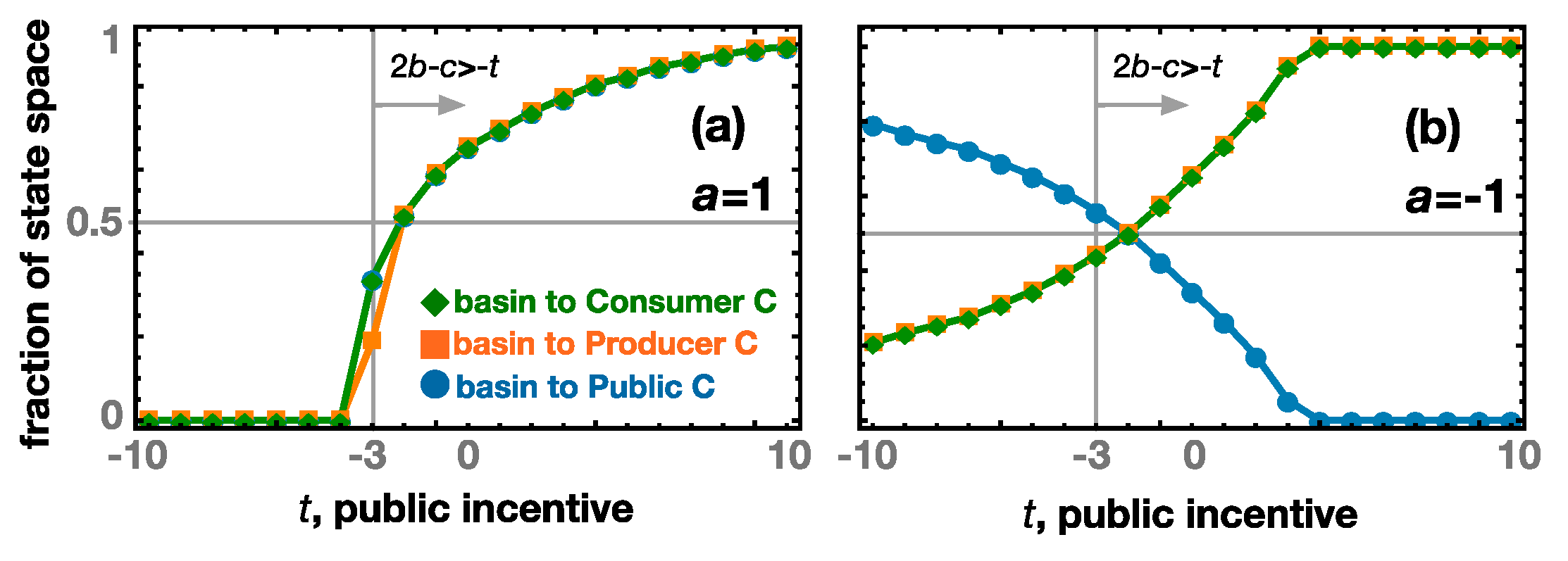
- The coordination nature of the games under study puts special relevance in the comprehension of the resulting self-organizing dynamics, namely, the characterization of each equilibrium, the phase space that leads to them and the qualitative changes (in the dynamical portrait) that result from adding new sectors.
A Simple Game—One Population, Two Strategies
3. Models for Multi-Sector Populations
3.1. Two Sectors, Two Strategies
3.2. Three Sectors, Two Strategies
4. Conclusions
Acknowledgments
Author Contributions
Conflicts of Interest
References
- Skyrms, B. The Stag Hunt and the Evolution of Social Structure; Cambridge University Press: Cambridge, UK, 2004. [Google Scholar]
- Huttegger, S.; Skyrms, B.; Tarrès, P.; Wagner, E. Some dynamics of signaling games. Proc. Natl. Acad. Sci. USA 2014, 111 (Suppl. 3), 10873–10880. [Google Scholar] [CrossRef] [PubMed]
- Lewis, D. Convention: A Philosophical Study; Wiley: Hoboken, NJ, USA, 2008. [Google Scholar]
- Skyrms, B. Evolution of the Social Contract; Cambridge University Press: Cambridge, UK, 2014. [Google Scholar]
- Skyrms, B. Signals: Evolution, Learning, and Information; Oxford University Press: Oxford, UK, 2010. [Google Scholar]
- Rand, D.G.; Nowak, M.A. Human cooperation. Trends Cogn. Sci. 2013, 17, 413–425. [Google Scholar] [CrossRef] [PubMed]
- Nowak, M.A. Five rules for the evolution of cooperation. Science 2006, 314, 1560–1563. [Google Scholar] [CrossRef] [PubMed]
- Nowak, M.A. Evolutionary Dynamics; Harvard University Press: Cambridge, MA, USA, 2006. [Google Scholar]
- Capraro, V. A model of human cooperation in social dilemmas. PLoS ONE 2013, 8, e72427. [Google Scholar] [CrossRef] [PubMed]
- Tomasello, M.; Melis, A.P.; Tennie, C.; Wyman, E.; Herrmann, E. Two key steps in the evolution of human cooperation. Curr. Anthropol. 2012, 53, 673–692. [Google Scholar] [CrossRef]
- Tomasello, M. A Natural History of Human Thinking; Harvard University Press: Cambridge, MA, USA, 2014. [Google Scholar]
- Santos, F.P.; Santos, F.C.; Paiva, A.; Pacheco, J.M. Evolutionary dynamics of group fairness. J. Theor. Biol. 2015, 378, 96–102. [Google Scholar] [CrossRef] [PubMed]
- Nowak, M.A.; Page, K.M.; Sigmund, K. Fairness versus reason in the ultimatum game. Science 2000, 289, 1773–1775. [Google Scholar] [CrossRef] [PubMed]
- Pacheco, J.M.; Santos, F.C.; Souza, M.O.; Skyrms, B. Evolutionary dynamics of collective action in N-person stag hunt dilemmas. Proc. R. Soc. Lond. B 2009, 276, 315–321. [Google Scholar] [CrossRef] [PubMed]
- Pacheco, J.M.; Vasconcelos, V.V.; Santos, F.C.; Skyrms, B. Co-evolutionary Dynamics of Collective Action with Signaling for a Quorum. PLoS Comput. Biol. 2015, 11, e1004101. [Google Scholar] [CrossRef] [PubMed]
- May, R.M.; Levin, S.A.; Sugihara, G. Complex systems: Ecology for bankers. Nature 2008, 451, 893–895. [Google Scholar] [CrossRef] [PubMed]
- Levin, S.; Xepapadeas, T.; Crépin, A.-S.; Norberg, J.; de Zeeuw, A.; Folke, C.; Hughes, T.; Arrow, K.; Barrett, S.; Daily, G. Social-ecological systems as complex adaptive systems: Modeling and policy implications. Environ. Dev. Econ. 2013, 18, 111–132. [Google Scholar] [CrossRef]
- Tavoni, A.; Levin, S. Managing the climate commons at the nexus of ecology, behaviour and economics. Nat. Clim. Chang. 2014, 4, 1057–1063. [Google Scholar] [CrossRef]
- Levin, S.A. Public goods in relation to competition, cooperation, and spite. Proc. Natl. Acad. Sci. USA 2014, 111 (Suppl. 3), 10838–10845. [Google Scholar] [CrossRef] [PubMed]
- Levin, S.A.; Lo, A.W. Opinion: A new approach to financial regulation. Proc. Natl. Acad. Sci. USA 2015, 112, 12543–12544. [Google Scholar] [CrossRef] [PubMed]
- Hume, D. A Treatise of Human Nature; Courier Corporation: North Chelmsford, MA, USA, 2012. [Google Scholar]
- Miller, J.H.; Page, S.E.; LeBaron, B. Complex adaptive systems: An introduction to computational models of social life. J. Econ. Lit. 2008, 46, 427–428. [Google Scholar]
- Schelling, T.C. Micromotives and Macrobehavior; W.W. Norton & Company: New York, NY, USA, 2006. [Google Scholar]
- Lamport, L.; Shostak, R.; Pease, M. The Byzantine generals problem. ACM Trans. Program. Lang. Syst. (TOPLAS) 1982, 4, 382–401. [Google Scholar] [CrossRef]
- Rubinstein, A. The Electronic Mail Game: Strategic Behavior Under “Almost Common Knowledge”. Am. Econ. Rev. 1989, 79, 385–391. [Google Scholar]
- Santos, F.C.; Pacheco, J.M.; Skyrms, B. Co-evolution of pre-play signaling and cooperation. J. Theor. Biol. 2011, 274, 30–35. [Google Scholar] [CrossRef] [PubMed]
- Haken, H.; Portugali, J. Information Adaptation: The Interplay between Shannon Information and Semantic Information in Cognition; Springer: Berlin/Heidelberg, Germany, 2014. [Google Scholar]
- Tavoni, A.; Dannenberg, A.; Kallis, G.; Löschel, A. Inequality, communication, and the avoidance of disastrous climate change in a public goods game. Proc. Natl. Acad. Sci. USA 2011, 108, 11825–11829. [Google Scholar] [CrossRef] [PubMed]
- Santos, F.C.; Pacheco, J.M. Risk of collective failure provides an escape from the tragedy of the commons. Proc. Natl. Acad. Sci. USA 2011, 108, 10421–10425. [Google Scholar] [CrossRef] [PubMed]
- Climate Change 2014: Synthesis Report. Available online: http://ar5-syr.ipcc.ch/ipcc/ipcc/resources/pdf/IPCC_SynthesisReport.pdf (accessed on 14 April 2016).
- Pacheco, J.M.; Vasconcelos, V.V.; Santos, F.C. Climate change governance, cooperation and self-organization. Phys. Life Rev. 2014, 11, 573–586. [Google Scholar] [CrossRef] [PubMed]
- Vasconcelos, V.V.; Santos, F.C.; Pacheco, J.M.; Levin, S.A. Climate policies under wealth inequality. Proc. Natl. Acad. Sci. USA 2014, 111, 2212–2216. [Google Scholar] [CrossRef] [PubMed]
- Portugali, J. Self-Organization and the City; Springer: Berlin/Heidelberg, Germany, 1999. [Google Scholar]
- Portugali, J.; Benenson, I. Artificial planning experience by means of a heuristic cell-space model: Simulating international migration in the urban process. Environ. Plan. A 1995, 27, 1647–1665. [Google Scholar] [CrossRef]
- Hofbauer, J.; Sigmund, K. Evolutionary Games and Population Dynamics; Cambridge University Press: Cambridge, UK, 1998. [Google Scholar]
- Weibull, J.W. Evolutionary Game Theory; MIT Press: Cambridge, MA, USA, 1997. [Google Scholar]
- Von Neumann, J.; Morgenstern, O. Theory of Games and Economic Behavior; Princeton University Press: Princeton, NJ, USA, 2007. [Google Scholar]
- Rendell, L.; Boyd, R.; Cownden, D.; Enquist, M.; Eriksson, K.; Feldman, M.W.; Fogarty, L.; Ghirlanda, S.; Lillicrap, T.; Laland, K.N. Why copy others? Insights from the social learning strategies tournament. Science 2010, 328, 208–213. [Google Scholar] [CrossRef] [PubMed]
- Tomasello, M.; Call, J. Primate Cognition; Oxford University Press: New York, NY, USA, 1997. [Google Scholar]
- Fudenberg, D.; Levine, D.K. The Theory of Learning in Games; MIT Press: Cambridge, MA, USA, 1998. [Google Scholar]
- Smith, J.M. Evolution and the Theory of Games; Cambridge University Press: Cambridge, UK, 1982. [Google Scholar]
- Smith, J.M.; Price, G.R. The Logic of Animal Conflict. Nature 1973, 246, 15–18. [Google Scholar] [CrossRef]
- Taylor, P.D.; Jonker, L.B. Evolutionary stable strategies and game dynamics. Math. Biosci. 1978, 40, 145–156. [Google Scholar] [CrossRef]
- Nowak, M.A.; Sasaki, A.; Taylor, C.; Fudenberg, D. Emergence of cooperation and evolutionary stability in finite populations. Nature 2004, 428, 646–650. [Google Scholar] [CrossRef] [PubMed]
- Santos, F.P.; Santos, F.C.; Pacheco, J.M. Social Norms of Cooperation in Small-Scale Societies. PLoS Comput. Biol. 2016, 12, e1004709. [Google Scholar] [CrossRef] [PubMed]
- Haken, H. Synergetics: Introduction and Advanced Topics; Springer: Berlin/Heidelberg, Germany, 2004. [Google Scholar]
- Weidlich, W. Sociodynamics—A systematic approach to mathematical modelling in the social sciences. Nonlinear Phenom. Complex Syst. 2002, 5, 479–487. [Google Scholar] [CrossRef]
- Traulsen, A.; Claussen, J.C.; Hauert, C. Coevolutionary dynamics: From finite to infinite populations. Phys. Rev. Lett. 2005, 95, 238701. [Google Scholar] [CrossRef] [PubMed]
- Chalub, F.A.C.C.; Souza, M.O. From discrete to continuous evolution models: A unifying approach to drift-diffusion and replicator dynamics. Theor. Popul. Biol. 2009, 76, 268–277. [Google Scholar] [CrossRef] [PubMed]
- Macy, M.W.; Flache, A. Learning dynamics in social dilemmas. Proc. Natl. Acad. Sci. USA 2002, 99 (Suppl. 3), 7229–7236. [Google Scholar] [CrossRef] [PubMed]
- Santos, F.C.; Pacheco, J.M.; Lenaerts, T. Evolutionary dynamics of social dilemmas in structured heterogeneous populations. Proc. Natl. Acad. Sci. USA 2006, 103, 3490–3494. [Google Scholar] [CrossRef] [PubMed]
- Traulsen, A.; Nowak, M.A.; Pacheco, J.M. Stochastic dynamics of invasion and fixation. Phys. Rev. E 2006, 74, 011909. [Google Scholar] [CrossRef] [PubMed]
- Hirsch, M.W.; Smale, S.; Devaney, R.L. Differential Equations, Dynamical Systems, and an Introduction to Chaos; Academic Press: Cambridge, MA, USA, 2012. [Google Scholar]

| C | D | |
|---|---|---|
| C | R | S |
| D | T | P |

© 2016 by the authors; licensee MDPI, Basel, Switzerland. This article is an open access article distributed under the terms and conditions of the Creative Commons Attribution (CC-BY) license (http://creativecommons.org/licenses/by/4.0/).
Share and Cite
Santos, F.P.; Encarnação, S.; Santos, F.C.; Portugali, J.; Pacheco, J.M. An Evolutionary Game Theoretic Approach to Multi-Sector Coordination and Self-Organization. Entropy 2016, 18, 152. https://doi.org/10.3390/e18040152
Santos FP, Encarnação S, Santos FC, Portugali J, Pacheco JM. An Evolutionary Game Theoretic Approach to Multi-Sector Coordination and Self-Organization. Entropy. 2016; 18(4):152. https://doi.org/10.3390/e18040152
Chicago/Turabian StyleSantos, Fernando P., Sara Encarnação, Francisco C. Santos, Juval Portugali, and Jorge M. Pacheco. 2016. "An Evolutionary Game Theoretic Approach to Multi-Sector Coordination and Self-Organization" Entropy 18, no. 4: 152. https://doi.org/10.3390/e18040152
APA StyleSantos, F. P., Encarnação, S., Santos, F. C., Portugali, J., & Pacheco, J. M. (2016). An Evolutionary Game Theoretic Approach to Multi-Sector Coordination and Self-Organization. Entropy, 18(4), 152. https://doi.org/10.3390/e18040152

