1. Introduction
Unitary transformations of the states of two quantum bits (qubits) play a prominent role in quantum information processing and computation [
1]. Physically, these quantum logic gates are generated by interactions between qubits and thus the vast majority of them are entangling operations, meaning that they can change the degree to which the states of two qubits are strongly correlated or entangled. The entangling two-qubit operations, together with suitable single-qubit gates, are also essential for universal quantum computation.
Two-qubit operations are elements of the Lie group
and so are conveniently represented by
unitary matrices of unit determinant. A comprehensive survey of such two-qubit gates is offered by their geometric theory, which was formulated by Zhang
et al. [
2]. This uses both the Cartan decomposition of
and the theory of local invariants of two-qubit operations [
3] to provide a very useful geometric classification of the two-qubit gates in terms of their local equivalence classes. These classes are the two-qubit operations that are equivalent up to single-qubit transformations, and thus each class is characterised by its unique nonlocal content and thus its unique entangling capabilities. The geometric theory of two-qubit gates has recently been utilised in the context of the physical generation of these gates using an optimal-control approach [
4].
The geometric theory also provides a useful framework for the characterisation of the specific two-qubit gates of most interest in quantum computing. These include not only familiar logical operations like CNOT and SWAP, but also perfect entanglers, gates that are capable of creating a maximally-entangled state out of some initial product state. Where these gates are located in , and the nature of the regions they are in, are issues that can only be properly understood when the geometric structure of is determined.
This geometry will have a major impact on the implementation of any working quantum computer. In constructing its gates, we need to know where they are in
and how likely it is that we can generate them. For instance, it was shown [
2] that perfect entanglers occupy exactly half of the volume of the space of all local equivalence classes of two-qubit gates. This naively suggests that if one randomly picks a nonlocal gate, there will be a
probability that it is a perfect entangler. This same picture also implies that all gates are equally probable; picking a gate at random is just as likely to produce a gate locally-equivalent to a CNOT gate as it is to give one locally-equivalent to a SWAP.
However, this view ignores the local (i.e., single-qubit) operations that are factored out from the local equivalence classes. These operations are represented by the subgroup whose curvature contributes to the overall geometry of , and thus to the distribution of locally-equivalent gates. To incorporate this curvature so as to correctly determine how the local equivalence classes are distributed, we must find an invariant Haar measure for .
These considerations motivate the present work. We first focus on the derivation of the metric structure of
, specifically its invariant length element and its Haar measure. We would like to point out that even though calculations using the Haar measure for various Lie groups, including
, have been carried out in the past [
5,
6,
7], they were not performed in the representation particularly applicable to dealing with entanglement in quantum information processing, namely, one that reflects the natural factorisation of
into the single-qubit
and purely nonlocal (two-qubit)
parts. This factorisation leads to a reduction from fifteen-dimensional
to a three-dimensional space in which all locally-equivalent gates live, and we discuss the form of the length element and measure for two particular choices of coordinates for this space.
We then use these derived geometric quantities to proceed towards our main objective: the calculation of the invariant volumes of the regions containing particular gates of interest in quantum information processing. First, we determine the total volume of the region occupied by perfect entanglers, and find the rather surprising result that these gates make up over
of
(thus quantifying the statement that most of the two-qubit operations are perfect entanglers). We then consider regions containing the gates most often used in quantum computing and find that their volume depends on where the gate is, and thus determine how big a “target” each gate would present to any quantum control technique designed to generate them. These calculations show that out of all two-qubit gates, those locally-equivalent to the B-gate (introduced and described in [
8]) present the largest effective targets.
The content of this paper has the following structure. After a discussion of the decomposition and parametrisation of
in
Section 2, we focus on its geometric properties in
Section 3, where we derive the invariant length element and Haar measure for the group, presenting the results in both the original parametrisation and in the context of the representation of two-qubit gates offered by the local invariants due to Makhlin [
3]. We then use this Haar measure to find the volume of the space of perfect entanglers in
Section 4.
Section 5 gives the invariant volumes of regions surrounding particular gates of interest, and shows explicitly that these volumes are entirely dependent on where the gate is located. The conclusion of the paper (
Section 6) is followed by two supplementary
appendices where we review two methods for finding an invariant measure, the first (A) using the methods of linear algebra and the second (B) using the properties of metric spaces.
2. Decomposition and Parametrisation of
All unitary gates operating on two-qubit states are described by a unitary matrix, an element of the compact group . Any such matrix may be written as an element of multiplied by a complex number of modulus 1, so the sixteen parameters we use to specify any gate are the phase of this prefactor (an angle modulo ) and the fifteen real parameters of .
Which fifteen parameters we choose is largely up to us; for instance, we could use the
polar coordinates [
5] or the analogues of the Euler angles familiar from classical mechanics [
6]. However, for our purposes, it is much more convenient to utilise the Cartan decomposition of the Lie algebra of the group (e.g., [
9,
10,
11,
12]); this allows us to write any element of
as a combination of matrices in
and the maximal Abelian subgroup
(which henceforth we will refer to as
for brevity’s sake).
The utility of this decomposition is apparent when we realise that, in the basis , any operation that affects only the first qubit is represented by , and one affecting only the second is , where and are each unitary matrices. These local operations, which act separately and independently on the two qubits, are therefore described by matrices in . The operations that entangle the two qubits must then be entirely determined by the matrices from the Abelian subgroup .
With all of this in hand, we choose the decomposition of
such that our matrices take the form
where
and
are
matrices in
and
A is in the maximal Abelian subgroup
of
. We can now parametrise the subgroups in the following way: let
and
be 3-dimensional vectors given in terms of spherical coordinates and Cartesian unit vectors by
with
,
and
. Then if
are the usual Pauli matrices, a generic element of
may be written as
The two
matrices in equation (
1) can then be parametrised by four vectors
,
,
and
via
This takes care of twelve of the fifteen coordinates necessary to specify any
element; the remaining three,
,
and
, parametrise the matrix
A through
To ensure that each
U is given by a unique set of coordinates, we must restrict
,
and
to the Weyl chamber given by
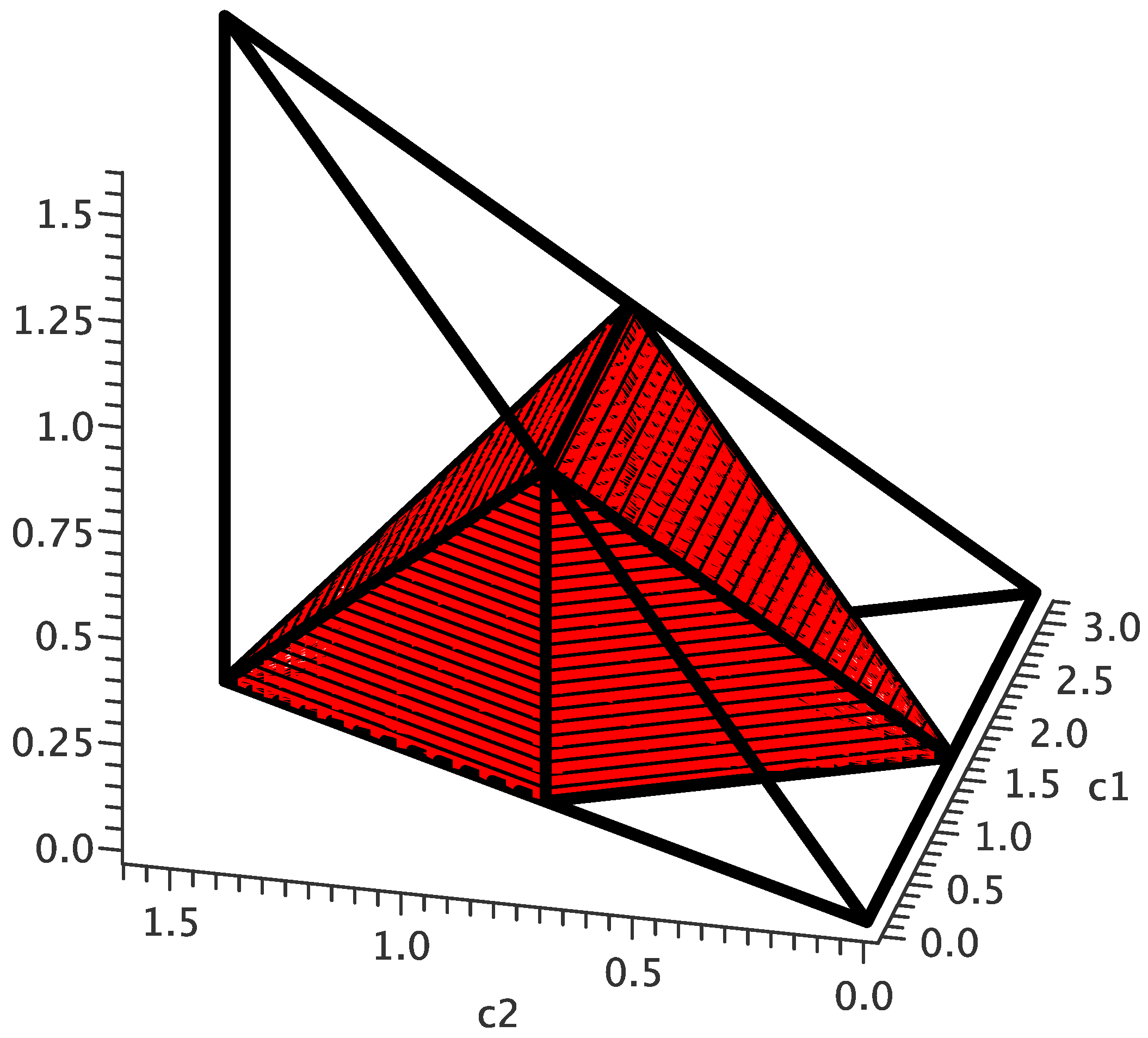
i.e., within the tetrahedron whose vertices are at
,
,
and
[
2], as shown in
Figure 1.
Now that we have defined the coordinates and determined their ranges of values, we can choose an orientation; in this paper, we take the one such that the ordering
forms a right-handed coordinate system.
We now want to find a Haar measure for
in terms of these fifteen parameters. The basic method for finding such a measure for an
N-dimensional simple compact Lie group
G is reviewed in the
appendices, and the first step is to compute the Maurer–Cartan form Θ and write it in terms of the
N Hermitian Lie algebra generators
and
N coordinate 1-forms
as
E is therefore a real
matrix whose determinant gives us our invariant measure (up to an overall factor):
where
. Two of the ways of motivating this particular form of the measure are covered in the
appendices, but both require us to somehow compute the determinant of
E, which for
is a
matrix.
Figure 1.
(Colour online) The Weyl chamber in -space. The perfect entanglers make up the region highlighted in red.
Figure 1.
(Colour online) The Weyl chamber in -space. The perfect entanglers make up the region highlighted in red.
3. The Invariant Length Element and Haar Measure for
In this section, we derive expressions for the invariant length element
and the Haar measure
for
. Both of these have been found before not just for
, but for
and, indeed, for a great variety of simple compact Lie groups (see, for example [
5,
6,
7] and references therein). However, the novelty of our approach is that these quantities will be in forms that are particularly suited for the description of two-qubit gates, namely, in the coordinate system defined in the previous section, which separates the purely local gates in
from the entangling gates in
.
3.1. The Length Element
We choose to do the computation by first finding an invariant length element
for
; since this will give the metric tensor via
, we may then use the relation
. We could also have explicitly found the full
matrix
and then computed its determinant; this can be done using methods similar to those in [
6,
7]. However, we found that the computation was somewhat simpler using
instead; we now describe the calculation that leads to this.
First, define the three 1-forms
by
(the latter holding because
is Abelian). It is straightforward to show that the
Maurer–Cartan form Θ can be written as
and that the invariant length, given (see Appendix B) by
can be expressed as
The traces can be evaluated quickly if we choose an orthonormal basis for
; we take the fifteen generators
,
and
,
, which satisfy
is spanned by the six matrices
and
by the three matrices
, so the matrices
k and
A are
Using these, we can explicitly compute
,
,
A and
, and thus the length element in equation (
13). The first three terms give the invariant length elements of
(twice) and
, and the next two terms vanish because the two subspaces are orthogonal to each other. The remaining term—the last—can be most conveniently written using what we know about
: the Maurer–Cartan form for this group has the form
where the three 1-forms
are
The invariant length element for
is therefore
where
is the
invariant length element.
3.2. The Haar Measure
The metric tensor
can be extracted from equation (
18), and, when considered as a
matrix, has an associated determinant. A lengthy but straightforward calculation gives the result
Since
, this allows us to determine, up to a proportionality constant, the Haar measure we want; to reflect the decomposition of
into two copies of
and
, we write it as
where
is the normalised
Haar measure in spherical coordinates
and
is the normalised Haar measure for the Abelian subgroup given by
(Conveniently, the quantity in the absolute value above is manifestly nonnegative when
lies in the Weyl chamber, so taking the absolute value is redundant and we drop it from now on.) It is straightforward to confirm that these measures both integrate to unity over
and
respectively. The normalised Haar measure on
is therefore the wedge product of the five measures given:
Two elements
U and
of
are locally equivalent to one another if one can be obtained from the other via either left or right multiplication by an element of
. In other words, when
U and
are decomposed into the form given in equation (
1), they have the same matrix
A. Thus, any local equivalence class
is uniquely determined by coordinates
in the Weyl chamber, and so the invariant measure for the space of these classes is obtained by integrating over all the
parameters. The result is the normalised Haar measure on
:
where
Alternatively, using some trigonometric identities and a bit of algebra, we may rewrite this in a form somewhat more useful for computations:
As this measure involves only elementary functions, computing the invariant volume of a region in
can often be done exactly, as we will show in
Section 4 and
Section 5.
3.3. Local Invariants
We have just derived expressions for the measure and metric in terms of the three parameters , and ; although both these expressions are (relatively) simple in form, they are only useful if we actually have values for these three coordinates. In practice, however, extracting , and from an arbitrary matrix U may be difficult. Fortunately, there are three far easier to obtain alternative parameters that can be used as coordinates on .
If we change from the standard computational basis
to the Bell basis
then our
matrices become
, where
The eigenvalues of the matrix
determine all the local invariants of
U, also called the Makhlin invariants [
3]. The characteristic equation of
m is
and so
and
give local invariants. These are complex numbers, so instead we may take as local invariants the three real numbers
m,
and their traces are readily computable using the simplest of matrix operations, and so values for
,
and
can be easily obtained for any
.
Since these are local invariants, they must be functions only of
,
and
; some computation shows that they are, and have the explicit forms
These can be used to embed the Weyl chamber into
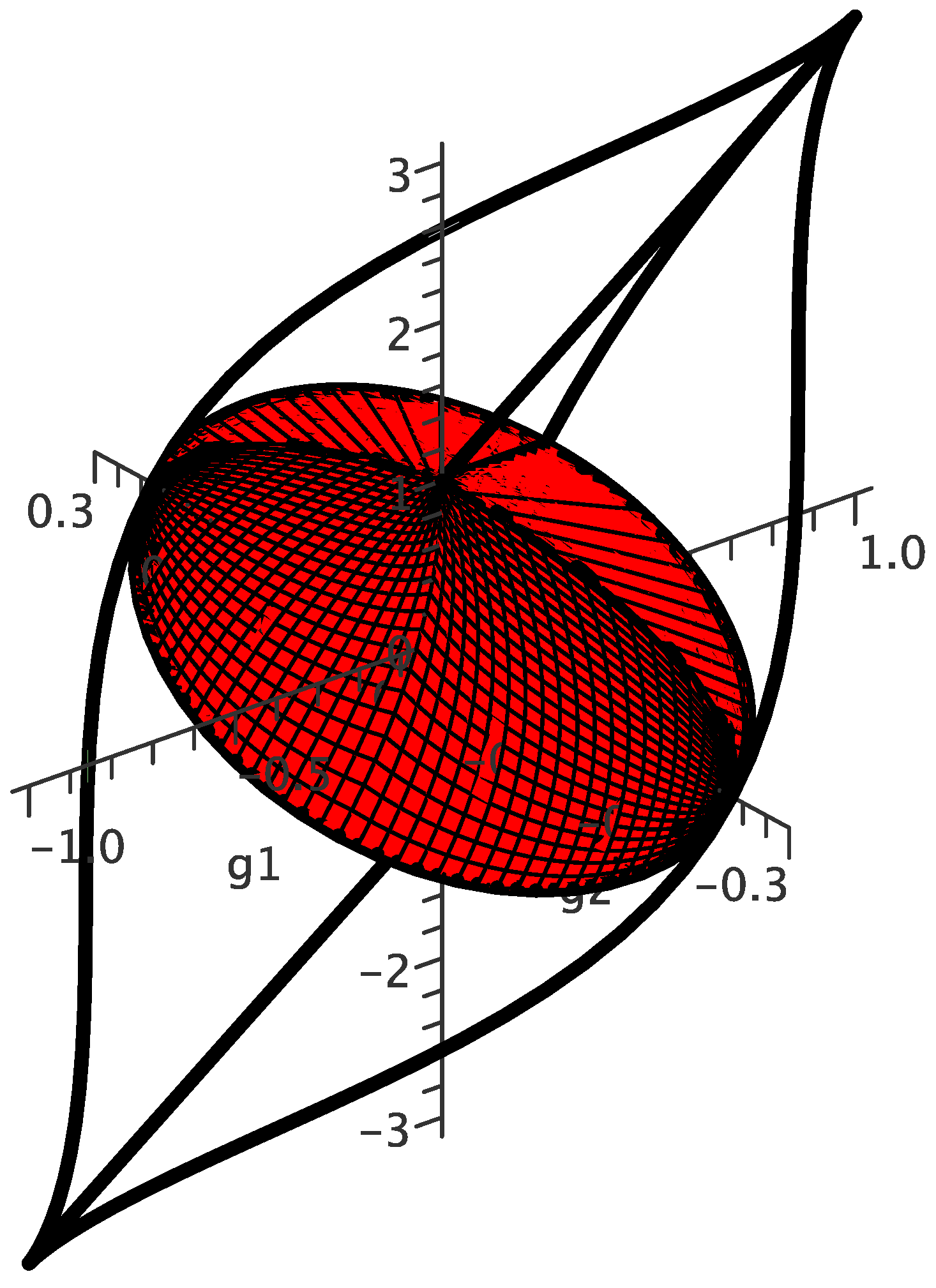
-space. However, the Weyl chamber is no longer a simple tetrahedron in these coordinates, but rather an elongated “Eye of Sauron” shape [
13,
14], as shown in
Figure 2.
Figure 2.
(Colour online) The Weyl chamber in -space, with the region of perfect entanglers highlighted in red.
Figure 2.
(Colour online) The Weyl chamber in -space, with the region of perfect entanglers highlighted in red.
These functions are bijective when
,
and
lie within the Weyl chamber and we use the following inverse map
: first, find
,
and
, the roots of the cubic equation
ordered so that
. Then
,
and
is given by either
if
or
if
. (As used here,
is the principal value of the arccosine function, lying between 0 and
π.)
The Haar measure in terms of the local invariants has the relatively simple form
However, the form of the length element is much more complicated in
,
and
than it is in
,
and
: the Jacobian matrix
J, which gives the coordinate transformation between
and
, is defined by
and has the entries
The Euclidean length element
therefore becomes
, and this can be written purely in terms of the local invariants:
where
. Inverting this matrix is possible but not particularly illuminating, so we do not do it here. However, it illustrates the key feature, that this part of
can be written explicitly in terms of the local invariants without needing to solve equation (
33).
Unfortunately, the cross-terms in equation (
18)—those involving the
ζ-forms—depend on the local invariants through
and
, and writing these explicitly in terms of
,
and
leads to an extremely complicated form for the length element. Although this part of
will not figure into any calculation at a fixed point in
, if one is to compute the invariant distance between two arbitrary points in
, it is this form that must be used if we choose the local invariants as coordinates.
3.4. Extension to
We have so far discussed only the two-qubit gates that lie in and we will continue to concentrate on this group for the remainder of this article; however, as stated in the introduction, a general two-qubit gate will be an element of , so we digress momentarily to explain how all of the results just obtained may be easily extended to all of .
This is done through the decomposition
, where the first term in the Cartesian product contributes to an overall phase factor:
with
,
and
A as before and
(considered as a group with addition modulo
). The invariant length element and Haar measure of
are therefore obtained from those of
via, respectively, the addition of
to equation (
18) and the wedge product of
with equation (
21).
However, the coordinates
,
and
as given in equation (
31) will depend on
χ, and so must be redefined so as to be independent of not only the
local gates, but also the
phase. Luckily, this is accomplished by simple division by the determinant of
U [
2]:
This modification ensures that the coordinate transformation from
to
given by equation (
32) remains the same. Thus, all our results for
will easily extend to
; however, for the remainder of this article, we shall once again concern ourselves only with
.
4. Perfect Entanglers
The elements of
that perfectly entangle two-qubit states all lie within the subset of the Weyl chamber bounded by the planes
,
and
. This region is the interior of the 7-faced polyhedron with vertices at
,
,
,
,
and
, the red volume illustrated in
Figure 1.
At any specific point in the orbit, this region fills exactly half of the Weyl chamber: if both and are constant, then , and the space is flat. The Euclidean volume—calculated with the normalised measure —is .
However, if we are more concerned with those elements that entangle the two qubits, we are not concerned with what the volume of the entangling chamber is at a specific point in ; in fact, since this subgroup only consists of local gates, we are not interested at all in the values of and , but rather only in those values of A where is in the perfectly-entangling chamber.
Therefore, the total volume in
occupied by the space of perfect entanglers is obtained by integrating the Haar measure around the full
orbit,
i.e., all values of
, as well as the values of
,
and
giving the perfect entanglers. Since the four
measures are already normalised, and
is symmetric around
, the integral over the subset of perfect entanglers is
so we obtain the rather surprising result that the perfect entanglers occupy over
of
!
There are two important remarks to make concerning this result: first, we chose to do the computation in
-space because, in these coordinates, the Haar measure has a relatively simple form and the boundary of the region of perfect entanglers is bounded by planes, making the integral of
very straightforward. We could also have chosen to do the integral in
-space using equation (
34), but the region of perfect entanglers—the red “pupil” in
Figure 2—has boundaries much more complicated than planes, and so the volume integral would be much more difficult to calculate. However, the invariance of our measure ensures that we would obtain the same result of
if we did use the Makhlin invariants.
Secondly, we have shown that perfect entanglers make up a majority of all two-qubit gates. From the point of view of quantum information processing, this is good news, because it suggests that it may be easier than expected to create a perfectly-entangling gate. In fact, if we are able to pick a two-qubit gate purely at random, we would get a perfect entangler nearly 85% of the time!
It is this second point that we will address in more detail in the next section: the computation of the invariant volumes of specific regions in , those surrounding the types of gates of particular interest to quantum computing, e.g., the CNOT and SWAP gates.
Note added in proof: During the refereeing process following the submission of this manuscript, we became aware of [
15], in which two of our results—the form of the Haar measure on
and the volume of the space of perfect entanglers—were independently obtained. However, the technique used in the aforementioned article differs greatly from ours: the measure was obtained by using results from the theory of random matrices [
16], which gives only its form on
and not on the entirety of
. In contrast, our approach is geometrically motivated and gives much more general results: we obtain the measure on
by first constructing an invariant length element for
and then using the associated metric to find a Haar measure for the entire group. The measure on
follows from integration around the orbit of
. However, in both cases, once a measure on
is obtained, the computation of the volume of the space of perfect entanglers readily follows.
5. Uses in Quantum Control
The implementation of any two-qubit quantum computer requires, of course, quantum gates that operate on the two qubits. Creating such gates presents a formidable technical challenge; one must devise a system in which an element of can evolve from an initial state (most usually the identity element, but in principle any matrix) to a final state that is the desired gate.
In practice, however, we cannot create a gate exactly. We can only end up within a certain neighbourhood of a given gate. For example, an arbitrary element of depends on fifteen parameters ; if the gate we want is located at the exact point , we will only ever be able to evolve to a matrix within a certain parameter range around this point, for example, a cubic region .
The likelihood of us being able to evolve the gate into this region depends on its size: the greater the volume of the region, the bigger a target it presents for us to shoot at. Certain gates may be easier to implement with greater precision if the target volume over a given parameter range is large; if it is small, then it may be quite difficult to end up inside the volume, and we may have to increase the parameter range (and thus lose precision) in order to finish near the desired gate.
So how do we determine the target sizes? If were a flat space, then all target sizes would be the same for a given parameter range; for example, the cubic region described above would have volume regardless of what was. But we know that has a non-Euclidean metric, and is not flat. Therefore, the volume of a region—obtained by integration of the Haar measure—can depend on both the location of the final gate and the range of parameters describing its neighbourhood. The resulting volumes will tell us how large a target the selected gates present for the range of parameters we choose, and can therefore be used as an indication of how difficult a gate is to achieve with precision.
5.1. Volumes of Target Cubes
As above, we are only concerned with gates that are equivalent up to local
operations, so any target volume we compute will include an integration over all of this subgroup. Thus, we will only have to compute integrals over regions of
, since all points in this Abelian group are indeed distinct modulo local single-qubit operations. So if
is the equivalence class of the gate
U, and
is a neighbourhood of
in
, the volume in
that this region occupies is
The nonzero curvature of makes it likely that regions in that are described by the same range of coordinates might not have the same volumes. Specifically, if we choose as our coordinates in , a cube of side length a centred at a point in the Weyl chamber will not only have a volume different from , but this volume will also vary depending on where it is centred.
The following results illustrate these properties. In all cases, the region integrated over is a cube of side length
a centred on the five basic gates discussed in [
4] (plus two others, for illustrative purposes) and whose sides are parallel to the
,
and
axes:
at
, with
:
For small
a, this is
.
at
, with
:
For small
a, this is
.
at
, with
:
For small
a, this is
.
at
, with
:
For small
a, this is
.
/
at
, with
:
For small
a, this is
.
at
, with
:
For small
a, this is
.
Gate at
, with
:
For small
a, this is
.
(The upper bounds on the values of
a in the above expressions come from the fact that if the cubes are too big, then we cannot use equation (
27), since it is valid only in the Weyl chamber. Computing the volumes of larger cubes is possible but difficult, and we do not do it here.)
The volumes for small values of a are included to provide a means of comparison: the smaller the cube is, the closer we are to the exact gate , and so if we are to implement this gate with any reasonable degree of precision, a will have to be small. The leading-order term in the small-a expansion therefore gives the approximate scaling behaviour for each volume, and we see that the largest volume occurs at the [B-gate] () and the smallest at the identity and [SWAP] gates (), with the volumes of all other gates lying in between.
All controlled gates have equivalence classes that lie on the
-axis between the origin and
, and the invariant volume of a cube of side length
a around each of them can be computed in the same fashion as the fixed gates above: if the centre of the cube is at
, then if
,
Thus, for any
, the invariant volume scales as
. (For
, we recover the previous result shared by the [CNOT] and [CPHASE] gates.)
All of the above gates lie somewhere on the boundary of the Weyl chamber; if we take a cube of side length
a that lies entirely
within the Weyl chamber, then its volume as a function of its centre
is
For small
a, the prefactor is approximately
, the Euclidean volume of the cube, and so in this limit
is
, and thus tells us how much larger or smaller the actual invariant volume is than the Euclidean volume.
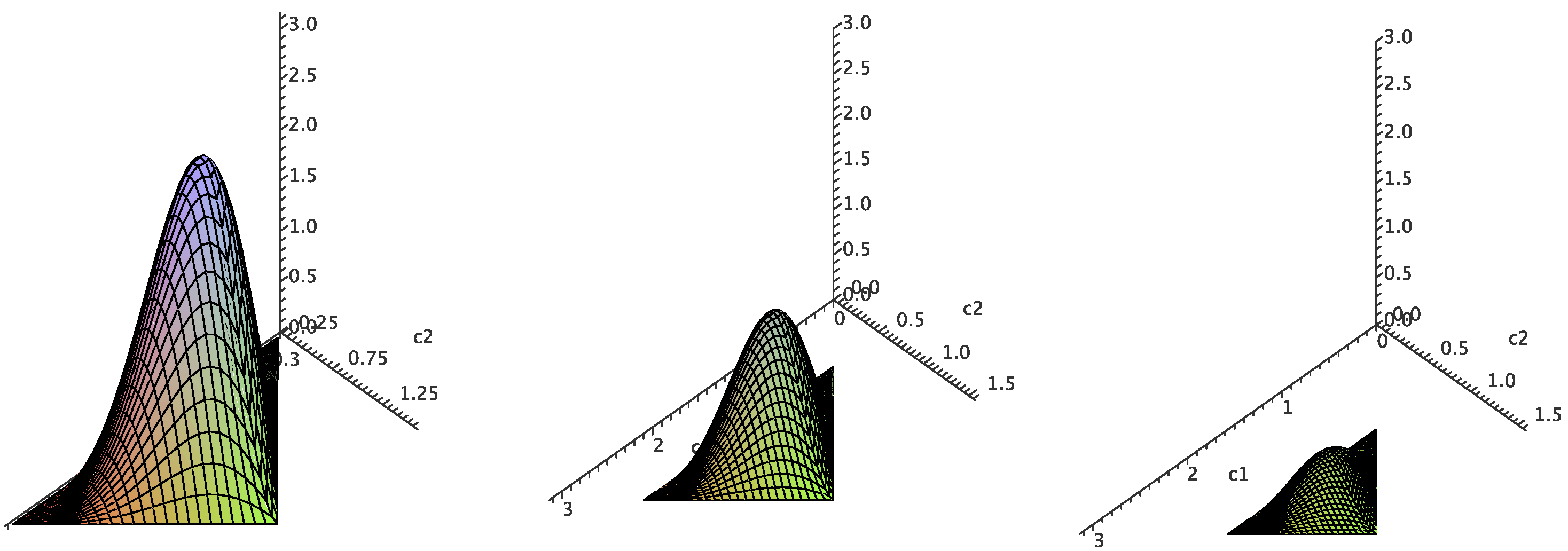
Figure 3 plots
for three horizontal slices of the Weyl chamber, at
,
and
. These illustrate that
vanishes on the boundary of the chamber and peaks in the interior for all
. Furthermore, this maximum value increases as
decreases toward zero. In fact, it is on this bottom face that
takes on its global maximum of
at
and
. This demonstrates that cubes near the [B-gate] present, for a given side length, the biggest targets.
Figure 3.
(Colour online) Cube volumes within the Weyl chamber. The volume factor as a function of on horizontal slices with, from left to right, , and .
Figure 3.
(Colour online) Cube volumes within the Weyl chamber. The volume factor as a function of on horizontal slices with, from left to right, , and .
5.2. Makhlin Invariants and Target Cylinders
As is evident from
Figure 2, the boundary of the Weyl chamber in
-space is no longer a collection of flat planes but a curved surface. Computing the volumes of regions that abut the boundary (precisely where many of the gates of interest are located) is therefore likely to be far more difficult than in
-space.
It is possible, however, to find exact expressions for the volumes of some regions that lie entirely within the Weyl chamber. This is most easily done by converting to cylindrical coordinates
given by
,
and
. The measure in these coordinates is very simple:
. Using this, we can explicitly compute the volumes of various regions centred on the origin:
For regions not centred on the origin, the volumes of cubes and spheres tend to be more difficult to compute, but a closed-form expression can be found for the volume of a cylinder (with axis in
direction) of height
h and radius
R centred at
. If
, the volume is the same as at the origin, namely,
. If either
or
is nonzero, then
is positive and the invariant volume of the cylinder is
where
and
are the complete elliptic integrals of the first and second kind respectively:
For small cylinders with
, we find
so the volume of the cylinder decreases as we move away from the
-axis, entirely consistent with the result we obtained in
-space.
6. Conclusions
In order to study the geometric properties of in a way that is particularly suitable to a quantum information context—where the emphasis is on the entangling capabilities of two-qubit operations—we have utilised a parametrisation of that reflects the natural decomposition of two-qubit gates into local (single-qubit) and purely nonlocal (two-qubit) factors. The latter (denoted by ) corresponds to the maximal Abelian subgroup of and is parametrised by three real coordinates.
In this parametrisation, we have calculated the invariant length element and the Haar measure of , with the latter normalised to provide unit total volume of the group. These calculations also show that while the purely nonlocal part of the two-qubit operations is geometrically flat, the local part carries a curvature that is carried over to the curvature of .
We continue with a discussion of the metric properties of the Abelian subgroup of in the context of a different choice of coordinates, namely, the Makhlin invariants. Although these invariants are easily determined from a general element of and the Haar measure takes a relatively simple form, the invariant length element is far more complicated. Its form can be determined but is not particularly illuminating; however, the results we present are sufficient to allow one to compute the invariant distance between two arbitrary points should the local invariants be selected as the preferred coordinates for .
These results allow us to compute the invariant volume of any region in the Abelian subgroup
of
,
i.e., any region in the space of local equivalence classes of two-qubit gates. We first apply it to the set of perfect entanglers; these gates, which are capable of creating maximally entangled states out of some product states, correspond to half of the local equivalence classes. We found that the invariant volume of perfect entanglers occupies more than
of the total volume of two-qubit gates, which means that, in fact, the
majority of the two-qubit gates are perfect entanglers. (Our form of the Haar measure on
and our volume of the space of perfect entanglers are in complete agreement with the recent independently-obtained results in [
15].)
Next, we use the Haar measure to find the invariant volumes of locally-equivalent regions around specific gates. All these regions are described by the same range of parameters, but due to the curvature of the space, not all these regions have the same volume. In fact, the invariant volumes depend entirely on where in the region lies. We find that the volume is smallest around the identity and SWAP gates and largest at the B-gate, with all other volumes falling in between.
These results are relevant to quantum information processing and its physical implementation in general, and in particular, to recent efforts [
4] to use optimal control approach to generate two-qubit quantum operations, where the control objective is any gate of a given entangling power rather than a specific two-qubit gate. In cases where the objective is to achieve a perfect entangling gate, our conclusion that the majority of
all gates are perfect entanglers is highly encouraging.
If the objective is to create one of the more familiar logical gates, our results show that generating a SWAP gate with any precision may be difficult due to the low density of gates in its neighbourhood, whereas the high density near the B-gate suggests that it could be relatively easy to generate. Since the B-gate is one of the gates that is needed to create a universal quantum computer, this is also an encouraging result.