


Abstract
A compressible single step chemistry Direct Numerical Simulation (DNS) database of freely propagating premixed flames has been used to analyze different entropy generation mechanisms. The entropy generation due to viscous dissipation within the flames remains negligible in comparison to the other mechanisms of entropy generation. It has been found that the entropy generation increases significantly due to turbulence and the relative magnitudes of the augmentation of entropy generation and burning rates under turbulent conditions ultimately determine the value of turbulent second law efficiency in comparison to the corresponding laminar values. It has been found that the entropy generation mechanisms due to chemical reaction, thermal conduction and mass diffusion in turbulent flames strengthen with decreasing global Lewis number in comparison to the corresponding values in laminar flames. The ratio of second law efficiency under turbulent conditions to its corresponding laminar value has been found to decrease with increasing global Lewis number. An increase in heat release parameter significantly augments the entropy generation due to thermal conduction, whereas other mechanisms of entropy generation are marginally affected. However, the effects of augmented entropy generation due to thermal conduction at high values of heat release parameter are eclipsed by the increased change in availability due to chemical reaction, which leads to an increase in the second law efficiency with increasing heat release parameter for identical flow conditions. The combustion regime does not have any major influence on the augmentation of entropy generation due to chemical reaction, thermal conduction and mass diffusion in turbulent flames in comparison to corresponding laminar flames, whereas the extent of augmentation of entropy generation due to viscous dissipation in turbulent conditions in comparison to corresponding laminar flames, is more significant in the thin reaction zones regime than in the corrugated flamelets regime. However, the ratio of second law efficiency under turbulent conditions to its corresponding laminar value does not get significantly affected by the regime of combustion, as viscous dissipation plays a marginal role in the overall entropy generation in premixed flames.
1. Introduction
Entropy generation mechanisms play key roles in determining the second-law irreversibility in energy-conversion processes in internal combustion (IC) engines and gas turbines. Fundamental understanding of entropy generation mechanisms is pivotal to the efficient design of new generation IC engines and gas turbines. For this purpose, it is important to understand local behaviour of the different entropy generation mechanisms. Bejan [1] analysed the entropy generation mechanisms due to viscous action and heat transfer in channel flows. Local entropy generations due to heat and mass transfers in addition to viscous effects have been analyzed by San et al. [2] and Poulikakos and Johnson [3]. Puri [4] analyzed entropy generation in the context of droplet combustion and identified the optimum transfer number for the purpose of minimization of entropy generation. Hiwase et al. [5] subsequently proposed a theoretical model for exergy analysis for droplet-laden flows where the exergy loss is expressed as a function of Damköhler number and initial droplet temperature. Exergy analysis in spray combustion was analyzed by Datta and Som [6] for different conditions in terms of pressure, temperature, swirl number, droplet diameter and spray cone angle. Arpaci and Selamet [7] analyzed entropy generation in laminar premixed flames on a flat flame burner using analytical means and expressed the entropy generation rate in terms of the quenching distance. Nishida et al. [8] analysed entropy generation mechanisms in laminar hydrogen-air and methane-air premixed flames based on detailed chemistry based simulations and demonstrated the effects of equivalence ratio on the entropy generation in premixed flames. Different mechanisms of entropy generation in multi-component reacting systems have been identified in a number of previous analyses [8,9,10,11,12,13,14,15] on premixed and non-premixed combustion. Interested readers are referred to [15] for an extensive review of entropy generation in reactive system. It has been found that viscous dissipation, thermal conduction, mass diffusion and irreversible chemical reaction give rise to generation of entropy in reacting flows.
To date, most analyses on local entropy generation mechanism have been carried out for laminar flows [7,8,10,11,12,13,14] and relatively limited effort was given to the entropy generation mechanism in turbulent flames [14,15,16,17]. OKong’o and Bellan [16] and Safari et al. [17] discussed the importance of the local entropy transport in the context of combustion modelling especially for Large Eddy Simulations (LES). The present analysis is carried out following the theoretical basis provided by Safari et al. [17], but the statistical behaviors of the entropy generation mechanisms in response to the variations of combustion regime, heat release parameter and global Lewis number in turbulent premixed flames were not addressed in [17]. However, these effects have been adequately addressed in this paper based on the analysis of Direct Numerical Simulations (DNS) data of statistically planar turbulent premixed flames.
In last two decades DNS has become an important tool for the analysis of turbulent flows where all the relevant length and time scales associated with turbulent flow processes are simulated without any recourse to physical approximations. Analysis of local entropy generation in turbulent flames based on DNS data has rarely been done in the existing literature. This void has been addressed here by analyzing entropy generation mechanisms in turbulent premixed flames based on three-dimensional compressible DNS data. As the nature of the fuel and the equivalence ratio of the mixture have significant influences on the entropy generation in turbulent premixed flames [8], a systematic parametric analysis based on DNS simulations has been carried out in this paper for different values of heat release parameter and global Lewis number (as the equivalence ratio, nature of the fuel and the level of preheating can be characterized by and ). The heat release parameter and global Lewis number are defined as follows:
where , , , , and are the adiabatic flame temperature, unburned gas temperature, thermal conductivity, gas density, specific heat at constant pressure and the mass diffusivity respectively. Moreover, turbulent flow conditions may have an influence on the entropy generation in turbulent premixed flames. Thus a DNS database of freely propagating statistically planar turbulent premixed flames with a range of values of heat release parameters (ranging from 2.3 to 4.5) and global Lewis numbers (ranging from 0.34 to 1.2) spanning both the corrugated flamelets and the thin reaction zones regimes, has been considered to analyze the different entropy generation mechanisms in turbulent premixed combustion. In this respect, the main objectives of the present investigation are as follows:
- (1).
- To analyze the relative contributions of viscous dissipation, heat conduction, mass diffusion and chemical reaction towards the overall entropy generation in turbulent premixed combustion.
- (2).
- To identify the effects of combustion regime, heat release parameter and global Lewis number on the different entropy generation mechanisms in turbulent premixed flames.
2. Mathematical Background
The volumetric rate of destruction of exergy in turbulent premixed flames due to irreversibilities can be expressed as:
where is the unburned gas temperature (which is considered to be the dead state in this analysis) and is the volumetric rate of entropy generation which can be obtained from the transport equation of entropy. The transport equation of entropy takes the following form [7,8,9,10,11,12,13,14,15,16,17]:
where , , , , , and are the temperature, internal energy, pressure, density, specific volume, specific chemical potential of species (per unit mass and not in terms of unit mole) and the mass fraction of species respectively. The specific chemical potential is given by:
where is the specific enthalpy of species , is the reference temperature, is the specific heat at constant pressure for species , is the partial specific entropy which is given by:
where and are the number of moles and molecular mass of species respectively and denotes the extensive entropy. Here all the species are considered to be ideal gases and for ideal gases can be expressed as:
where , and are the mole fraction, specific entropy and gas constant of the pure species with being the universal gas constant. Using Equations. (2)–(6) the entropy transport equation takes the following form:
where is the reaction rate for species , which is negative (positive) for a reactant (product). The components of viscous stress tensor and the i-th components of heat flux vector and mass flux vector are expressed using the Newton’s law of viscosity, Fourier’s law of heat conduction and Fick’s law of mass diffusion respectively, in the following manner:
where is the viscosity, is the i-th component of velocity, is the thermal conductivity, is the mass fraction of species and is the mass diffusivity of species . It is worth noting that Soret and Dufor effects are ignored here following several previous analyses on entropy generation in turbulent reacting flows [4,5,6,7,8,10,11,12,13,14,15,17]. Moreover, there have been several previous DNS based computational analyses [18,19,20,21,22,23,24,25,26,27,28,29,30,31,32,33,34], which ignored Dufor and Sorret effects without much loss of generality. These effects are not expected to play important roles in most hydrocarbon-air and hydrogen-air flames [35] unless extremely lean hydrogen-air flames are considered. Moreover, it is worth noting that this analysis follows the theoretical basis provided by Safari et al. [17], which also ignored Soret and Dufor effects. Equation (8) can be utilised to recast Equation (7) as:
For ideal gas the derivative of Equation (5) takes the following form:
where the last term on the right hand side is often neglected for low Mach number flows [7,8,9,10,11,12,13,14,15,16,17] and thus Equation (11) can be used in Equation (10) to yield:
Thus, the last term on right hand side of Equation (9) can be expressed as:
Here specific heats and mass diffusivities of all the species are taken to be identical (i.e., and ), which leads to:
Using Equations (12) and (14) in Equation (9) yields:
where:
The terms and denote entropy generation due to viscous action, chemical reaction, thermal conduction, and mass diffusion respectively. The volumetric rate of entropy generation is given by:
The second term on right hand side of Equation (15i) is identically zero for unity Lewis number cases (i.e., ). For non-unity Lewis number cases (i.e., ) is responsible for redistributing entropy and the volume integral of this term vanishes according to divergence theorem (i.e., where and are elemental surface area and volume respectively and is the outward normal on the elemental surface) because vanishes both on unburned and burned gas sides of the flame brush.
The extent of augmentation of entropy generation rate due to viscous dissipation in turbulent flames can be quantified by using a quantity which is defined as:
The subscripts “turb” and “lam” are used to refer to the values in turbulent and laminar flames respectively. Similarly, the augmentation of entropy generation rate due to , and in turbulent conditions in comparison to the corresponding laminar flames can be characterized by and , which are defined as:
Based on Equations (17)–(20) the overall augmentation of entropy generation in turbulent flames in comparison to the corresponding laminar flames can be characterized as:
Ideally DNS of turbulent premixed combustion should account for both three-dimensionality of turbulence and detailed chemical mechanism. However, until recently most combustion DNS simulations were carried out either in two-dimensions with detailed chemistry or in three-dimensions with simplified chemistry due to limitations in computer storage capacity. The CPU time for compressible DNS of turbulent reacting flows scales as: where is the turbulent Reynolds number, is the Karlovitz number, is the number of grid points within the thermal flame thickness , is the number of large-scale eddies within the domain and is the number of eddy turn-over times, where the subscript L refers to the unstrained planar laminar flame quantities. The value of remains of the order of 10 and 20 for simple chemistry and detailed chemistry based DNS simulations respectively. Moreover, one needs to have to obtain enough number of statistically independent turbulent velocity signals and in order to ensure that the simulation results are independent of initial conditions. This suggests that detailed chemistry simulations, for a given set of values of and , are several orders of magnitude more expensive than simple chemistry simulations, especially for hydrocarbon-air flames (e.g., 68 steps and 18 species are typically involved in detailed chemistry based methane-air flame simulations). Although three-dimensional DNS with detailed chemistry is becoming possible using multi-processor simulations [36], they still remain prohibitively expensive [36,37] for an extensive parametric analysis, as carried out in this paper. Thus the chemical mechanism is simplified here using a generic single-step Arrhenius type chemical reaction (i.e., ) and the three-dimensionality of turbulence is simulated without any physical approximation. Single step chemistry has been used successfully to obtain fundamental physical insight and to develop high-fidelity models in several analyses in the past [18,19,20,21,22,23,24,25,26,27,28,29,30,31,32,33,34] and the same methodology has been followed here. In the context of simplified chemistry the species field is characterized by a reaction progress variable , which can be defined in terms of a suitable reactant mass fraction as follows:
where subscripts and denote the values in pure reactants and fully burned products. In the context of single step chemistry the term takes the following form as :
where subscripts P and R refer to quantities for products and reactants respectively. The difference between chemical potentials between products and reactants (i.e., ) can be expressed as:
In the present analysis the generic chemical mechanism is taken to represent typical hydro-carbon/hydrogen-air combustion where the number of moles does not change significantly as a result of chemical reaction. For such chemical reactions remains almost same as (i.e., ) under globally adiabatic conditions. Based on the above theoretical background, the extent of irreversibility in turbulent premixed combustion can be expressed in the form of second-law efficiency which can be defined in the following manner:
The effects of combustion regime, heat release parameter and global Lewis number on the statistical behaviors of and will be discussed in detail in Section 4.2 of this paper.
It is important to note that the statistics of flame propagation and scalar gradient in turbulent premixed flames based on simple chemistry DNS are found to be in good agreement with the corresponding two-dimensional detailed chemistry DNS results (i.e.,. flame propagation statistics for simple chemistry DNS in [21,33] are in agreement with detailed chemistry DNS results in [38,39]; statistical behaviors of scalar gradient obtained from simple chemistry DNS in [24,40,41] are in agreement with detailed chemistry based results in [42,43,44] and [41] respectively). A comparison between References. [23] and [42] (see Figure 3a in [23] and Figure 1a in [42]) indicates that the variation of with obtained from single-step Arrhenius type chemistry is qualitatively similar to detailed chemistry based results for methane-air and hydrogen-air flames. It is worth noting that the simulations considered here mimic generic hydrocarbon-air flames (e.g., methane-air flames) for cases, whereas and 0.6 cases represent hydrogen-air/hydrogen-blended hydrocarbon-air combustion. In actual combustion process a change in equivalence ratio/fuel-type alters the values of heat release parameter and global Lewis number . Moreover, the level of pre-heating also affects the value of heat release parameter . It is worth noting that the global Lewis number is modified here independently of the other parameters for the purpose of identifying the effects of differential diffusion of heat and mass in isolation. However, it is difficult to assign a single characteristic Lewis number in a reacting flow field due to the presence of several species with different Lewis numbers. Often the Lewis number of deficient species is considered to be the global Lewis number characterizing the combustion process [35,45]. There have seen several studies in the past where the effects of differential diffusion of heat and mass have been analyzed by modifying the global Lewis number in isolation [18,19,20,21,22,23,24,25,26,46,47,48].The same approach has been adopted in this analysis. Equation (15ii) indicates that the entropy generation in premixed flames is dependent on the statistics of reaction rate and scalar gradients , and , and as the statistics of reaction rate and scalar gradients are adequately captured by single-step chemistry, it can be expected that fundamental features of entropy generation in turbulent premixed flames can also be addressed using simple chemistry. The effects of regime of combustion, and on local entropy generation due to and will be analyzed in detail in Section 4 of this paper.
3. Numerical Implementation
In the present study a DNS database of freely propagating statistically planar turbulent premixed flames under decaying turbulence has been considered. The initial values for the root-mean-square (rms) turbulent velocity fluctuation normalized by unstrained planar laminar burning velocity and the integral length scale to flame thickness ratio are presented in Table 1 along with the values of Damköhler number (i.e. the ratio of the integral time-scale to the chemical time-scale ), Karlovitz number , turbulent Reynolds number , heat release parameter and Lewis number . Standard values are taken for Prandtl number , ratio of specific heats and the Zel’dovich number (i.e., , , ). The thermo-chemical parameters for cases A–G are chosen in such a manner so that the thermal diffusivity of the unburned gas , specific heat at constant pressure , unstrained laminar burning velocity and unburned gas density remain the same for all cases considered here. It can be seen from Table 1 that the turbulent Reynolds numbers are comparable for all the cases considered here. The simulation domain is taken to be a rectangular parallelepiped of size () for case A (cases B-G), which is discretized by a Cartesian grid of () with uniform grid spacing in each direction. Each 230 × 230 × 230 simulation required approximately 2300CPU-hours using AMD Opteron 2214 2.2Ghz CPU processors and approximately 50 Gb per case for storage. In all cases the -direction is taken to align with the direction of mean flame propagation, whereas the other directions are considered to be periodic. The domain boundaries in the -direction in case A are taken to be turbulent inlet and outlet respectively. The domain boundaries in the direction of mean flame propagation in other cases are taken to be partially non-reflecting. The partially non-reflecting boundaries are specified using the Navier Stokes Characteristic Boundary Condition (NSCBC) technique [49]. According to NSCBC technique, the inviscid part of the Navier Stokes equations are specified using a characteristic analysis based on a locally one-dimensional system (for i = 1–5) where , , , and , and the wave velocities are given by , and with being the local acoustic speed. The wave amplitude variations directed into the domain need to be specified at the partially non-reflecting boundaries and the wave amplitude variations for the outgoing waves are estimated from internal solutions. For the incoming waves the following expressions for s : , , , and were considered, where and are the target values of and respectively and s are the relevant relaxation parameters [49]. The values of (for j= 1, 2 and 3) , and are considered to be zero at the partially non-reflecting boundaries [49], where and are the heat and mass fluxes respectively. Interested readers are referred to [49] for a more detailed discussion on boundary conditions.
In case A, the spatial differentiation in the -direction is carried out using a 6th order central difference scheme for the internal grid points but the order of the differentiation gradually deceases to one-sided 4th order difference scheme as the non-periodic boundaries are approached, whereas the differentiation in the transverse directions are carried out using a spectral method. For the other cases, a 10th order central-difference scheme is used for spatial discretisation for internal points in all directions which gradually decreases to a one-sided 2nd order scheme near non-periodic boundaries. The time advancement for all viscous and diffusive terms in case A is carried out using an implicit solver, whereas the convection terms in case A and all the terms in all other cases are time advanced using a low-storage third order Runge-Kutta method [50]. For all cases, the flame is initialized by a steady unstrained planar laminar flame solution, and the turbulent velocity fluctuation field is specified using an initially homogeneous isotropic field generated using a pseudo-spectral method [51]. The grid spacing is determined by the resolution of the flame structure, and about 10 grid points are kept within the thermal flame thickness for all cases considered here. Case A represents the corrugated flamelets regime combustion (i.e., ) [52], whereas other cases represent the thin reaction zones regime combustion (i.e., ) [52]. The values of heat release parameter are different for cases A, B and C-G. The Karlovitz number can be taken to scale as [52]:
where is the Kolmogorov length scale. Equation (26) suggests that the energetic turbulent eddies cannot penetrate into the flame in the corrugated flamelets regime combustion, whereas turbulent eddies are likely to penetrate into the preheat zone in the thin reaction zones regime combustion. However, the Kolmogorov length scale remains greater than the reaction zone thickness in the thin reaction zones regime combustion so that chemical reaction can be sustained.
In all cases flame-turbulence interaction takes place under decaying turbulence. Under decaying turbulence, simulations should be carried out for at least , where is the initial eddy turn over time and is the chemical time scale. The simulation in case A was run for about four initial eddy turn over times , whereas simulations were run for a time in cases B–G. The aforementioned simulation times remain either greater than (cases A) or equal to (cases B–G) one chemical time scale and are comparable to several previous analyses [18,19,20,21,22,23,24,25,26,27,28,29,30,31,32,33,34,35,38,39,40,41,42,43,44]. The turbulent kinetic energy and its dissipation rate in the unburned gas ahead of the flame were not varying significantly with time when statistics were extracted and the qualitative nature of the statistics was found to have remained unchanged since for all cases. The values of in the unburned reactants ahead of the flame at the time when statistics were extracted decreased by about 52% and 50%, of the initial values in cases A and B-G respectively. The values of have increased from their initial values by a factor of about 1.10 and 1.7 for cases A and B-G respectively, but there are still enough number of turbulent eddies on each side of the computational domain.
In Section 4 the Reynolds averaged values of and will be presented. For statistically planar flames the Reynolds/Favre averaged quantities are considered to be functions of the distance along the direction of mean flame propagation ( direction), and are evaluated by ensemble averaging the relevant quantities in transverse directions ( planes). The statistical convergence of the Reynolds/Favre averaged quantities are assessed by comparing the corresponding values obtained using half of the sample size in the transverse directions using a distinct half of the domain, with those obtained based on full sample size. Both qualitative and quantitative agreements between these sets of values are found to be satisfactory. In the next section, only the results obtained based on full sample size will be presented for the sake of brevity.
Table 1.
List of initial turbulence and combustion parameters for the present DNS database.
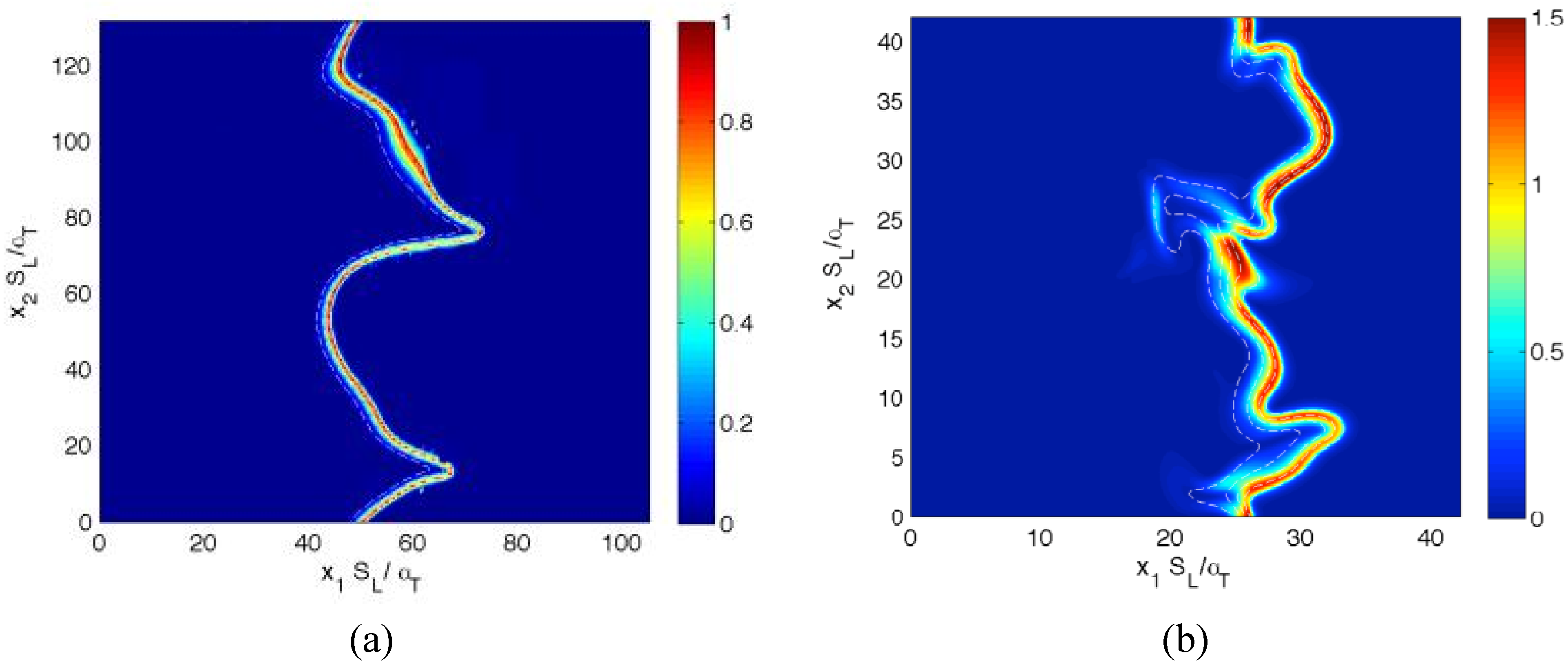
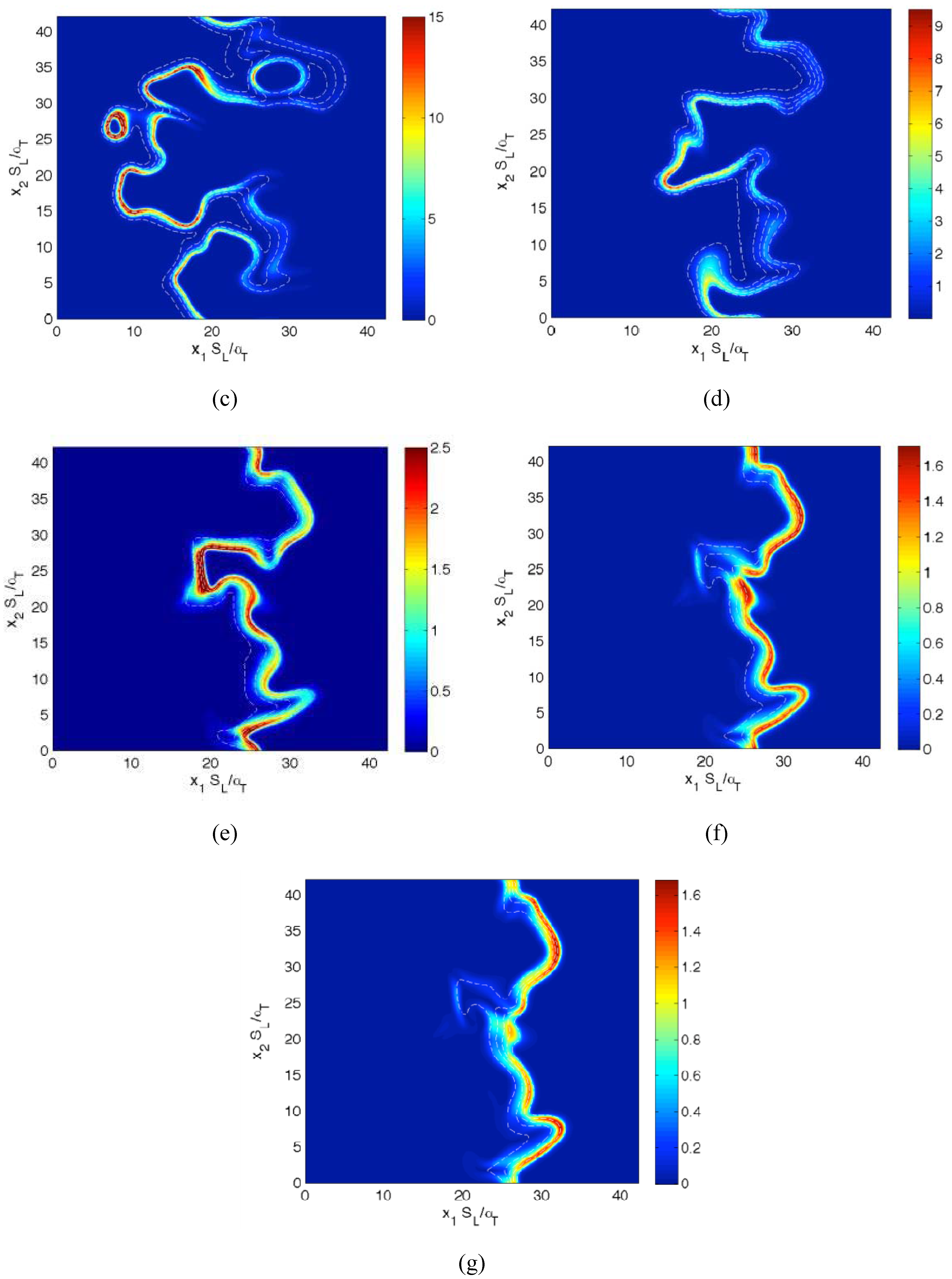
Figure 1.
Distributions of in the central plane for cases (a–g) A–G at the time when the statistics were extracted. The white lines indicate reaction progress variable c contours from c = 0.1 to 0.9, from left to right, in steps of 0.2.
4. Results and Discussion
4.1. Relative Contributions of Entropy Generation Mechanisms in Turbulent Premixed Flames
The local distributions of in the central plane at the time when statistics were extracted are shown in Figure 1a‒g for all cases considered here. The contours of from 0.1 to 0.9 (in steps of 0.2 from left to right) are also shown in Figure 1a‒g. It can be seen from Figure 1a that the contours of are parallel to each other in case A because turbulent eddies do penetrate into the flame structure in the corrugated flamelets regime combustion [52]. By contrast, turbulent eddies penetrate into the preheat zone in the thin reaction zones regime flames (i.e., cases B–G) and cause unsteady fluctuations, whereas the reaction zone (i.e., ) remains relatively unperturbed. Figure 1c–g show that the extent of flame wrinkling increases with decreasing and this tendency is prevalent in the flames due to thermo-diffusive instabilities [18,19,20,21,22,23,24,25,26,46,47,48,53]. In the flames, fresh reactants diffuse faster into the reaction zone than the rate at which heat diffuses out, which gives rise to augmentation of burning rate and flame area generation in comparison to the corresponding unity Lewis number flame, due to the simultaneous presence of high reactant concentration and high temperature. Just the opposite mechanism is responsible for reduced burning rate and flame area generation in the flames in comparison to the corresponding unity Lewis number flame. The normalized turbulent flame speed and normalized flame surface area are presented in Table 2. The values of have been evaluated by volume integrating the reaction rate using the expression where is the projected area of the flame in the direction of mean flame propagation, while the values of have been evaluated by volume integrating (i.e., ) under both turbulent and laminar conditions. Table 2 shows that and increase strongly with decreasing Lewis number, and that this effect is particularly prevalent in the flames with due to the presence of thermo-diffusive instabilities [18,19,20,21,22,23,24,25,26,46,47,48,53].
Figure 1a‒g show that the large values of (where is the thermal diffusivity in the unburned gas) are confined within the flame, and the entropy generation rate within the unburned reactants and fully burned products are much smaller than the values obtained within the flame (the value of entropy generation rate is not zero in unburned reactants and fully burned products).
Table 2.
The values of normalized turbulent flame speed and normalized flame surface area when statistics were extracted.
Figure 2.
Variations of mean values of and conditional on bins of c (i.e., and ) across the flame brush (a–g) A–G.
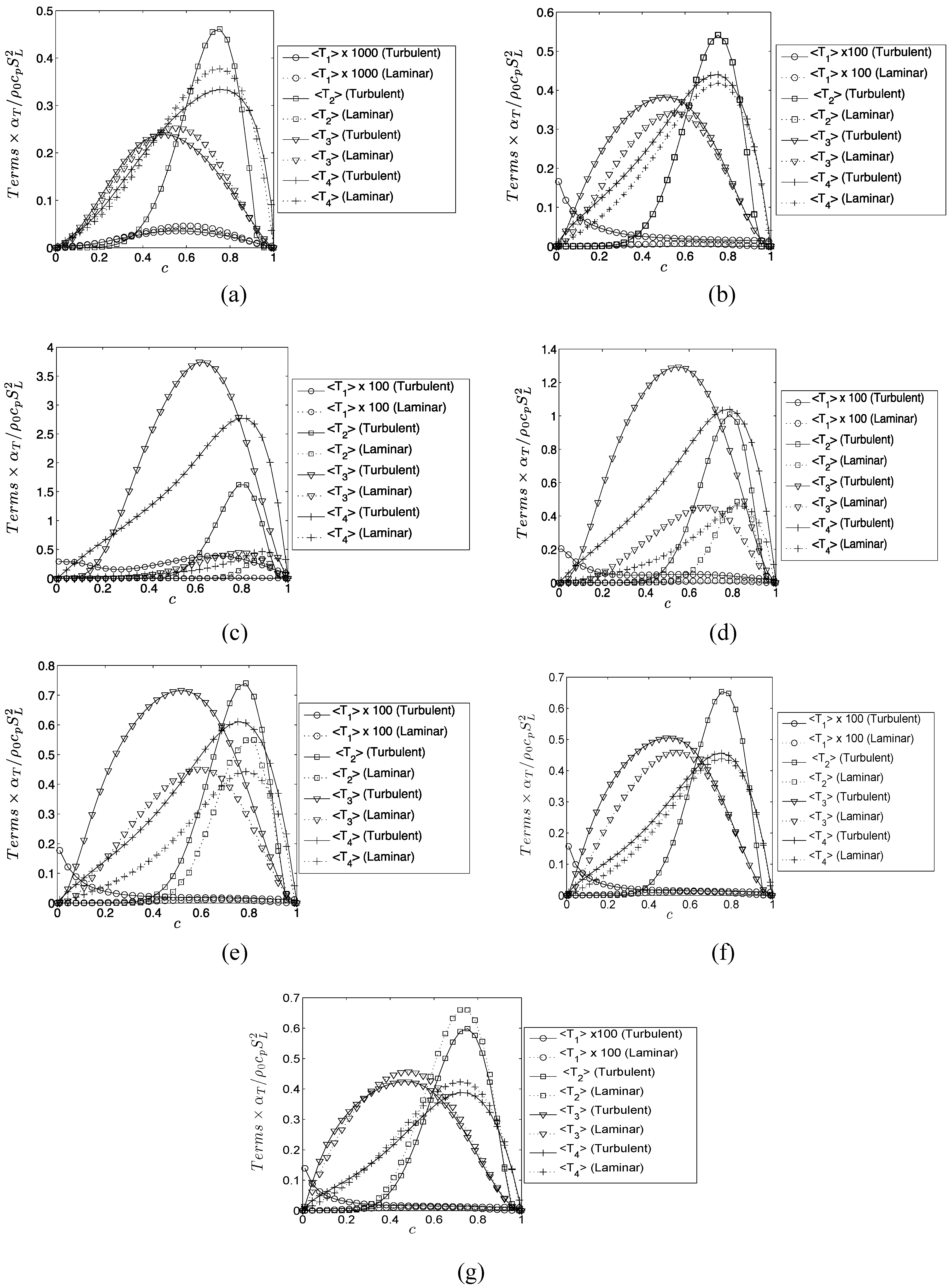
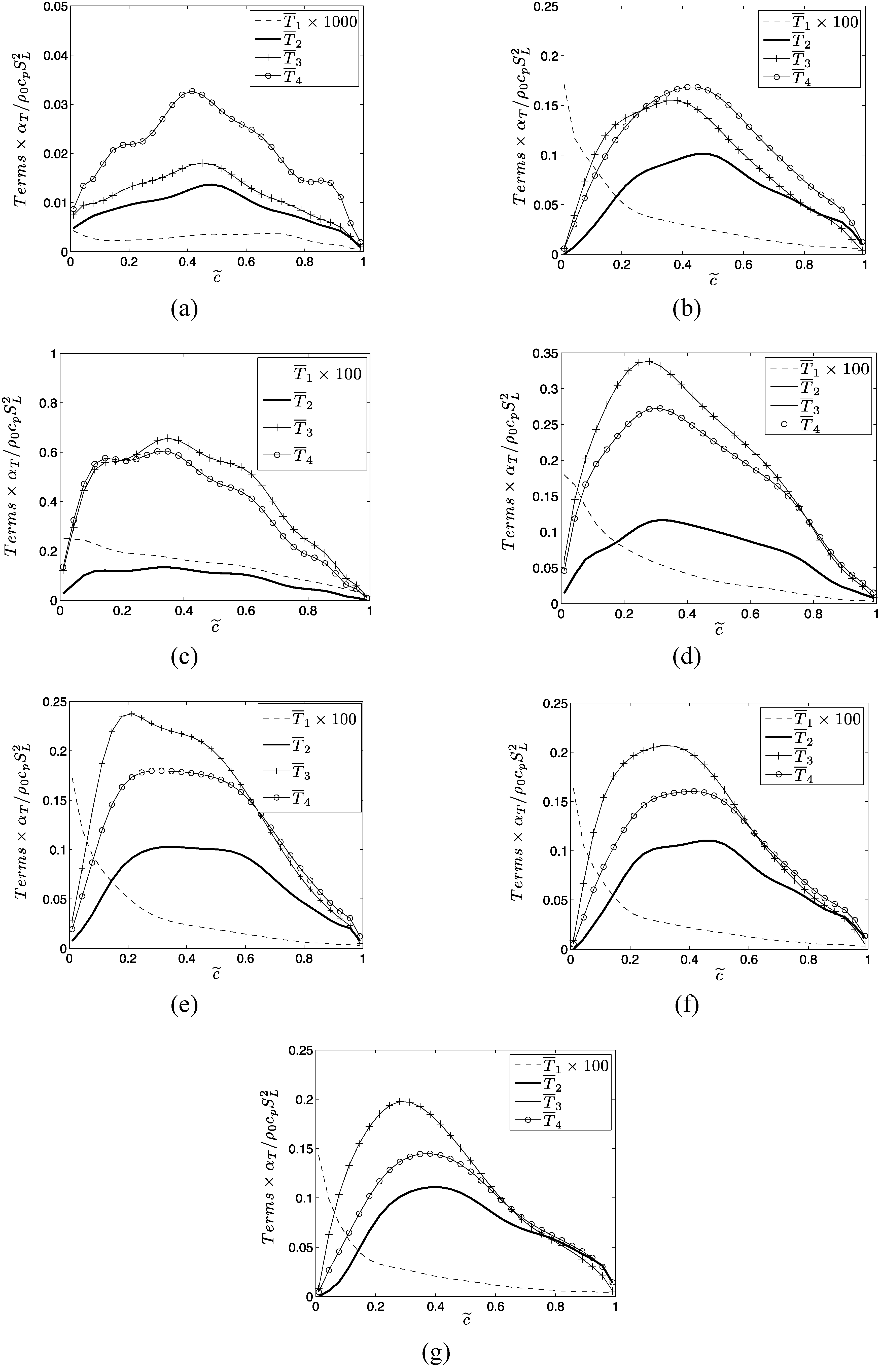
Figure 3.
Variations of mean values of and with across the flame brush: (a–g) A–G.
The values in unburned reactants and fully burned products are much smaller than the values obtained within the flame. Thus the colour bar in Figure 1a‒g tends to show a value close to zero for entropy generation rate in unburned and fully burned gases.
It is worth noting that the terms and assume non-zero values within the flame, whereas remains active throughout the domain. In order to understand the relative contributions of different entropy generation mechanisms, the contributions of and (where represents the ensemble averaged value of a quantity conditional on c values) across the flame brush are shown in Figure 2a–g for cases A–G respectively. The variations of the Reynolds averaged values of the different entropy generation mechanisms (i.e., and ) with for cases A-G are also presented in Figure 3a‒g, respectively. It is evident from Figure 2a‒g and Figure 3a‒g that and ( and ) remain major contributor to the entropy generation in all cases considered here. Moreover, the contribution of () remains several orders of magnitude smaller than the contributions of and ( and ) for all cases considered here. This behaviour is found to be consistent with previous findings of Nishida et al. [8] in the context of detailed chemistry based laminar flame simulations. The contributions of and for the respective laminar flames are shown as functions of in Figs. 2a-g, which also substantiate that the entropy generation due to viscous dissipation remains much smaller than the entropy generation due to chemical reaction, thermal conduction and species diffusion within the flame.
The observed behavior in Figure 3a–g (and also in Figure 2a–g) can be explained in terms of an order of magnitude analysis in the following manner:
where is the flame Mach number and in Equation (27) the length scales associated with the thermal gradient and species gradients (i.e., and ) are taken to scale with the Zel’dovich flame thickness , whereas both the viscous stress and velocity gradient are taken to scale with following Swaminathan and Bray [30]. According to Tennekes and Lumley [54] the fluctuating parts of and are taken to scale with and (i.e., and where and are Favre fluctuation and Favre mean values of ith component of velocity) respectively where is the Taylor micro-scale. The scaling arguments of Tennekes and Lumley [54] yield the following estimate of :
where is the dissipation rate of turbulent kinetic energy . It is clearly evident from Equation (28) that this scaling is only valid for turbulent flames, whereas scaling according to Equation (27) is also valid for laminar flames as well. However, Equation (28) suggests that the contribution of is likely to be stronger in the thin reaction zones regime (i.e., ) than in the corrugated flamelets regime (i.e., ), which can be substantiated from Figure 2 and Figure 3. Moreover, Equations (27) and (28) indicate that the entropy generation due to viscous dissipation is expected to be much smaller than the entropy generation due to chemical reaction rate, thermal conduction, and species diffusion (i.e., and ) for low Mach number (i.e., ) flames.
The scaling given by Equation (28) indicates that in case A (where ) the contribution of under turbulent conditions is likely to of the same order of under laminar conditions (), whereas for turbulent flames is expected to be much greater than in the corresponding laminar flames in cases B-G (where ).
It is worth noting that the statistical behaviour of is directly proportional to (see Equation (23)) but remains an increasing function of (i.e., where ) suggesting the exponential temperature dependence of dominates over the effects of . Thus, it can be expected that the high values of are associated with high values of burning rate . Thus the values of and are expected to increase with decreasing due to augmented burning rate for small values of global Lewis number (see Table 2).
It can further be seen from Figure 2a–g that the values of both and under turbulent conditions remain almost same as those in the laminar conditions in the unity Lewis number flames (e.g., cases A, B and F) but the values of and in turbulent flames are greater (smaller) than the corresponding laminar flame values for (). In order to understand the above behaviour can alternatively be expressed as:
On the other hand, can be taken to scale as:
Equations (29) and (30) suggest that the statistics of and are expected to play pivotal roles in the entropy generation due to and respectively. It is evident from the above discussion that the statistical behaviors of dissipation rate of turbulent kinetic energy , reaction rate of reaction progress variable, and in turbulent flames determine the extent of entropy generation due to and respectively along with the augmentation of flame surface area under turbulent conditions. The statistical behaviors of , , and will be discussed next in order to explain the observed behaviors of and ( and ) in Figure 2a‒g (Figure 3a–g).
4.2. Statistical Behaviors of , , and and Their Effects on Entropy Generation
4.2.1. Distribution of
The variations of and with for all cases considered here are shown in Figure. 4a,b respectively where and are the values of turbulent kinetic energy and its dissipation rate at . It is worth noting that and in case A are 36 and 390 times smaller than the corresponding values in cases B-G. It is also evident from Figure 4b that increases significantly with decreasing , which indicates that the magnitudes of and are expected to increase with decreasing Lewis number (see Figure 2 and Figure 3).
Figure 4.
The variations of (a) and (b) with for all cases considered here. The quantities and are the values of turbulent kinetic energy and its dissipation rate at .
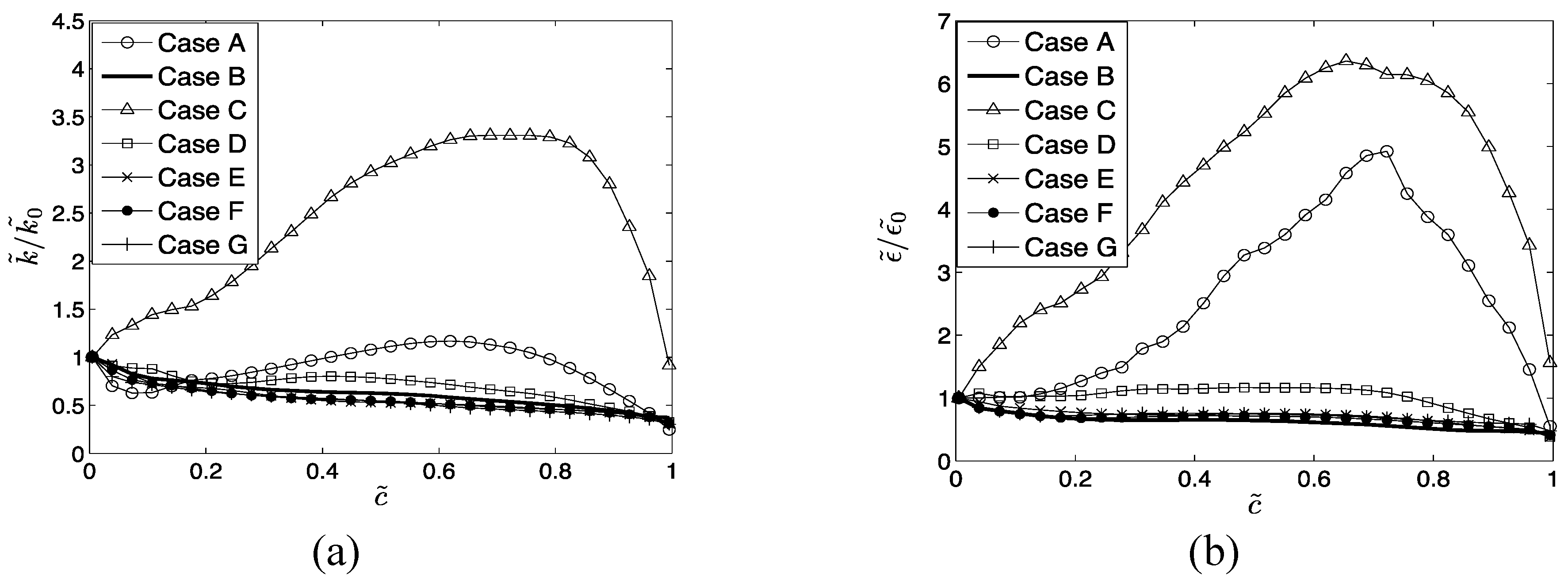
A comparison between Figure 4a,b reveals that high values of in the flames are also associated with high values. The augmentation of in the flames arises due to strong flame-generated turbulence due to strong flame normal acceleration and interested readers are referred to Reference [26] for a detailed discussion. The effects of on are much weaker than the Lewis number effects (see Figure 4b) and thus has a marginal influence on the variation of and within the flame brush (see Figure 2b,f and Figure3b,f).
4.2.2. Distribution of
The variations of () with () are shown in Figure 5a (Figure 5b), which indicates that the probability of finding high values of increases significantly with decreasing . Thus, the magnitudes of and in the flames with , 0.6 and 0.8 remain greater than the values of and in the corresponding laminar flames (see Figure 2c‒e). It is evident from Figure. 2a–g that the magnitude of in the (i.e., and 1.2) flames remains comparable to for laminar flames. However, flame surface area for turbulent flames is significantly greater than in the laminar flames, and, as a result, the volume integrated entropy generation due to in turbulent flames is expected to be greater than the values in the corresponding laminar flames.
4.2.3. Distributions of and
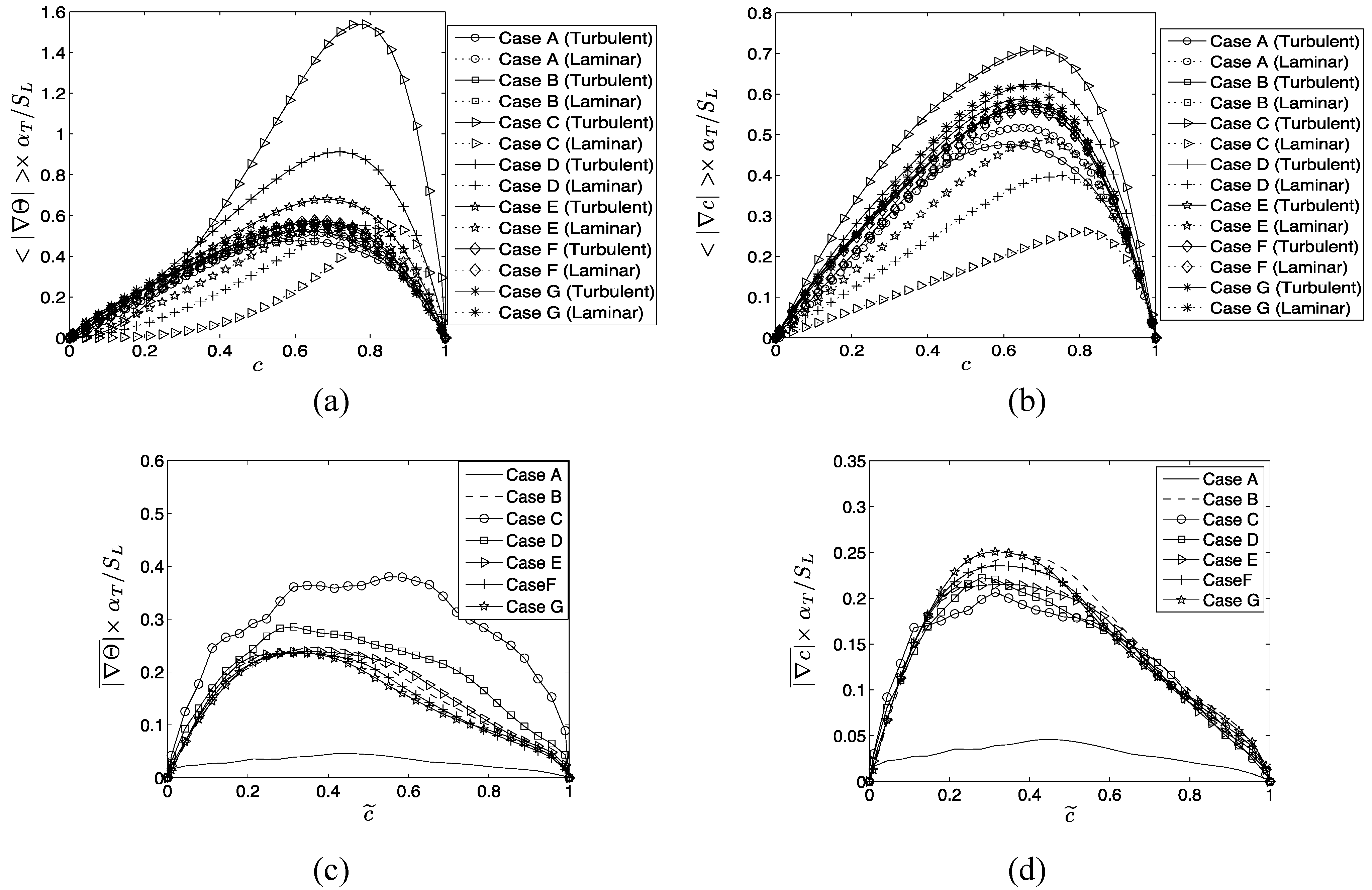
The variations of and ( and ) with () are shown in Figure 6a,b (Figure 6c,d), which indicate that the probability of finding high values of and increases significantly with decreasing . Moreover, the values of and in turbulent flames are greater (smaller) than the corresponding laminar flame values for (). The values of and for both laminar and turbulent flames remain comparable in the case of . The physical explanations behind the augmentation (reduction) of and in the () turbulent premixed flames in comparison to the corresponding laminar flames have been discussed in detail elsewhere [24,25,42,43] and thus are not repeated here. Increasing probability of finding high values of and with decreasing gives rise to increasing trends of and ( and ) with decreasing for low Mach number non-unity Lewis number flames. According to Equation (29) an increase in gives rise to an increase in the magnitude of on a given isosurface for the unity Lewis number flames and thus the magnitudes of and in turbulent flames increase with increasing (see Figure 2b,f and Figure 3b,f). Similarly the magnitudes of in laminar flames increase with increasing (see Figure 2b,f).
Figure 5.
(a) Variations of mean values of conditional on bins of c (i.e., ) across the flame brush for all cases. (b) Variations of with across the flame brush for all cases.
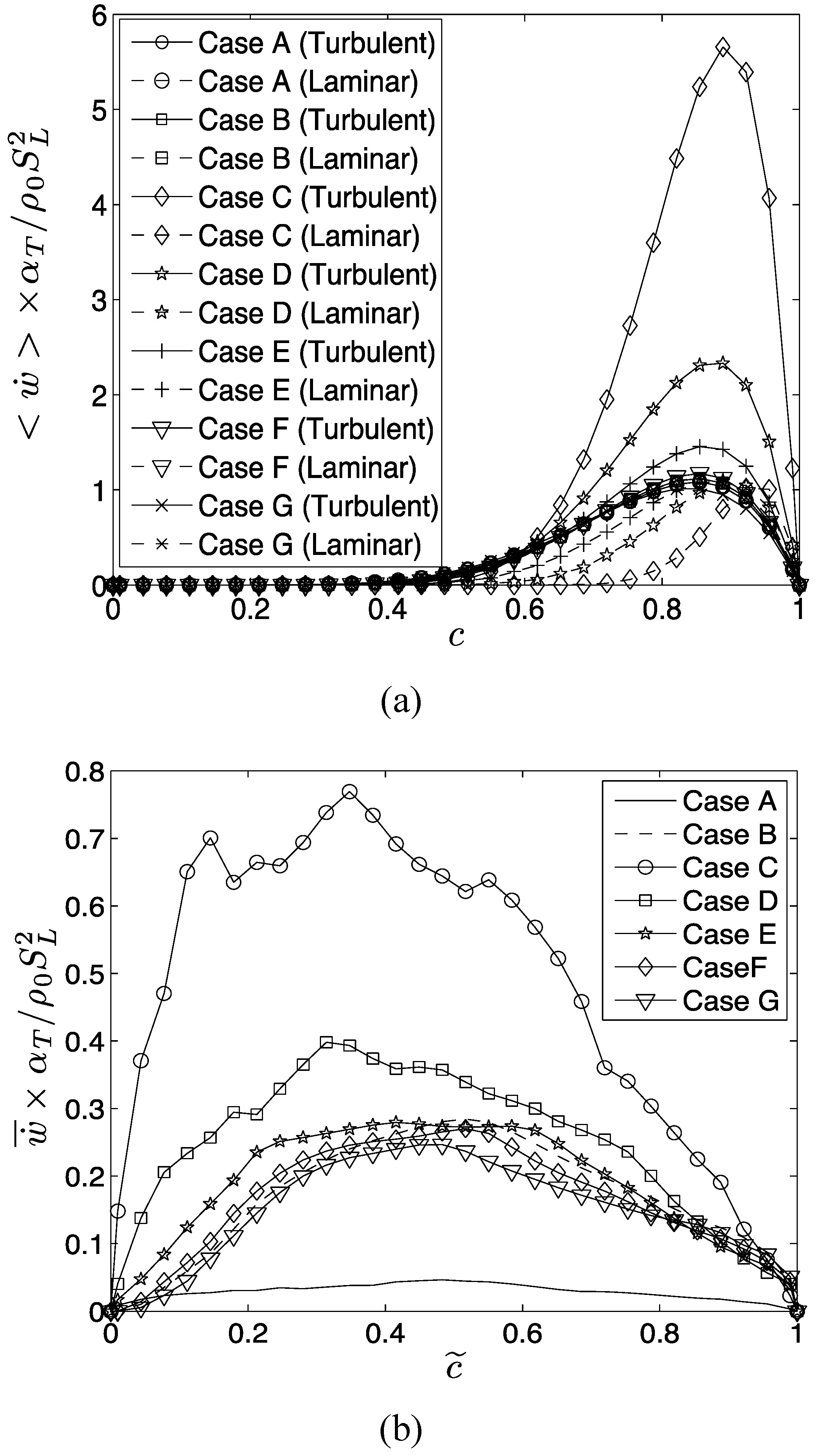
Figure 6.
Variations of mean values of (a) and (b) conditional on bins of c (i.e., and ) for all cases. Variations of (c) and (d) with across the flame brush.
4.3. Entropy Generation Augmentation Rates and in Turbulent Flames
The statistical behaviors of , , and , presented in Figure 2, Figure 3, Figure 4, Figure 5, Figure 6, will be utilized here to analyze the augmentation of entropy generation rates and (see Equations. (19)–(21)) in turbulent flames, in comparison to the corresponding laminar flames. The values of and for cases A–G are presented in Figure. 7a–e respectively. It is evident from Figure 7a that in the thin reaction zones regime flames assumes greater values than in the flame representing the corrugated flamelets regime, which is consistent with Equation (28), thus suggesting strengthening of the contribution of with increasing . The flame surface area for turbulent premixed flames is greater than that in the corresponding laminar flames, which leads to a value of much greater than unity (i.e., ) even in case A where values under both laminar and turbulent conditions remain of the same order (see Figure 2a). Augmentation of viscous dissipation rate with decreasing (see Figure 4b) gives rise to an increasing trend of with decreasing . By contrast, a comparison between cases B and F shows an increase in with decreasing . The values of () remain comparable (the same) for cases B and F and thus the higher value of in case B than in case F originates principally due to greater extent of flame surface area generation by turbulence in case B than in case F (see Table 2).
Figure 7.
Variations of (a) , (b) (c) , (d) and (e) for all cases considered here. (f) Percentage contributions to overall entropy generation by and for all cases.
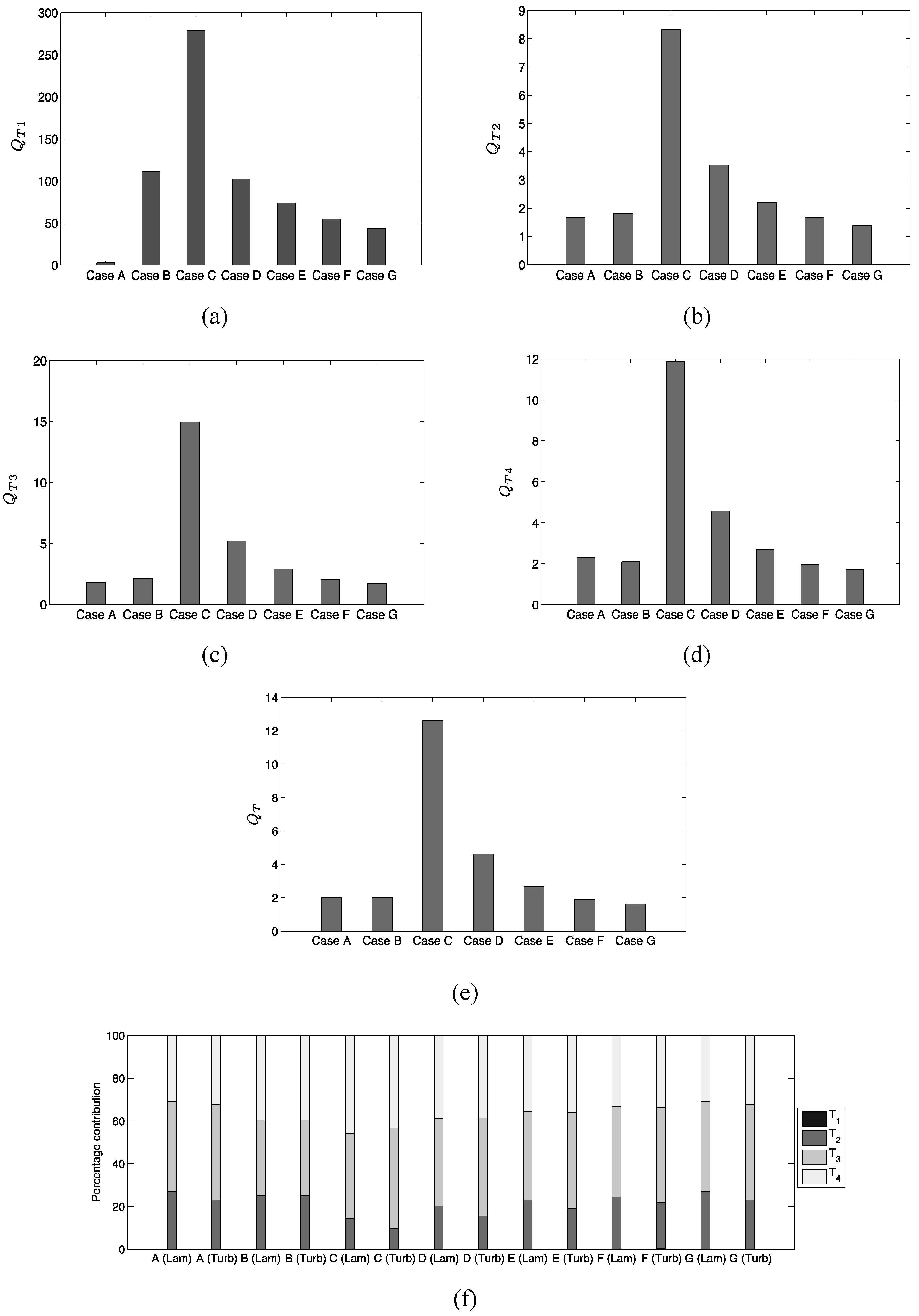
The variation of in Figure 7b shows that increases significantly with decreasing . A comparison between cases A, B and F in Figure 2, Figure 3 and Figure 5 reveals that the effects of and the regime of combustion on the statistical behaviors on , , and are much weaker than the effects of . This, in turn, leads to a significant increase in with decreasing for turbulent premixed flames, as the magnitudes of and in turbulent flames in comparison to these values under laminar conditions increase with decreasing for the flames with (see Figure 5b and Figure 2c–e). In the and 1.2 flames, the magnitudes of and under turbulent conditions remain comparable to these values under laminar conditions (see Figure 5b and Figure 2f,g) so the augmentation of entropy generation due to chemical reaction (i.e., ) in these cases arise principally due to greater flame surface area of turbulent flames than in the corresponding laminar flames. As remains uniform on a given isosurface due to equivalence of and for low Mach number, globally adiabatic unity Lewis number flames, values in cases A, B and F are determined by the augmentation of flame surface area. Comparable values of between cases A, B and F (see Table 2) lead to comparable values of in these cases. Thus, the regime of combustion does not significantly affect the statistical behavior of in the cases considered here.
For low Mach number adiabatic unity Lewis number flames the definitions of and non-dimensional temperature become identical to each other so remains uniform on a given isosurface. Thus, the increase in flame surface area in turbulent flames leads to and in the unity Lewis number flames, as demonstrated in Figure 7c,d. Increasing probability of finding high values of and with decreasing (see Figure 6a–d) gives rise to increasing trends of and (see Figure 7c,d) with decreasing for low Mach number non-unity Lewis number flames. Figure 7c,d demonstrate that the qualitative behaviors of and are not significantly affected by the regime of combustion, as the augmentation of flame surface area under turbulent conditions, in comparison to the corresponding laminar flames. remains comparable to each other for cases A, B and F (see values in Table 2).
The foregoing discussion clearly indicates that all the different entropy generation mechanisms in premixed combustion are augmented under turbulent conditions, which can be confirmed from Figure 7e where the variations of are shown for all cases considered here. It is evident from Figure 7e that remains greater than unity (i.e., ) for all cases considered here and increases significantly with decreasing . Moreover, Figure 7e shows that effects of and the regime of combustion on are much weaker than the effects of .
The percentage contributions to overall entropy generation by and for all cases are shown in Figure 7f for both turbulent and laminar conditions. It is evident that the contribution of remains small in comparison to the contributions of and under both laminar and turbulent conditions, which is consistent with previous findings of Nishida et al. [8] in the context of detailed chemistry based laminar flame simulations. It is evident from Figure 7f that the percentage contribution of to the overall entropy generation in turbulent flames decreases in comparison to the corresponding laminar flames. By contrast, the percentage contribution of to the overall entropy generation in turbulent flames increases in comparison to the corresponding laminar flames. The percentage contribution of () to the overall entropy generation decreases (increases) with decreasing . As the magnitude of increases with increasing (see Equation (29)) while the magnitudes of and are marginally affected by , the percentage contributions of and decrease with increasing , whereas the percentage contribution of increases with increasing . As the qualitative behavior of the augmentation of entropy generation due to and under turbulent conditions are not significantly affected by the regime of combustion (see Figure 4, Figure 5, Figure 6), and the contribution of remains negligible in comparison to the contributions of and under both laminar and turbulent conditions (see Figure 2, Figure 3), the percentage contribution of and to the overall entropy generation is not significantly affected by the regime of combustion (compare cases A, B and F in Figure 7f).
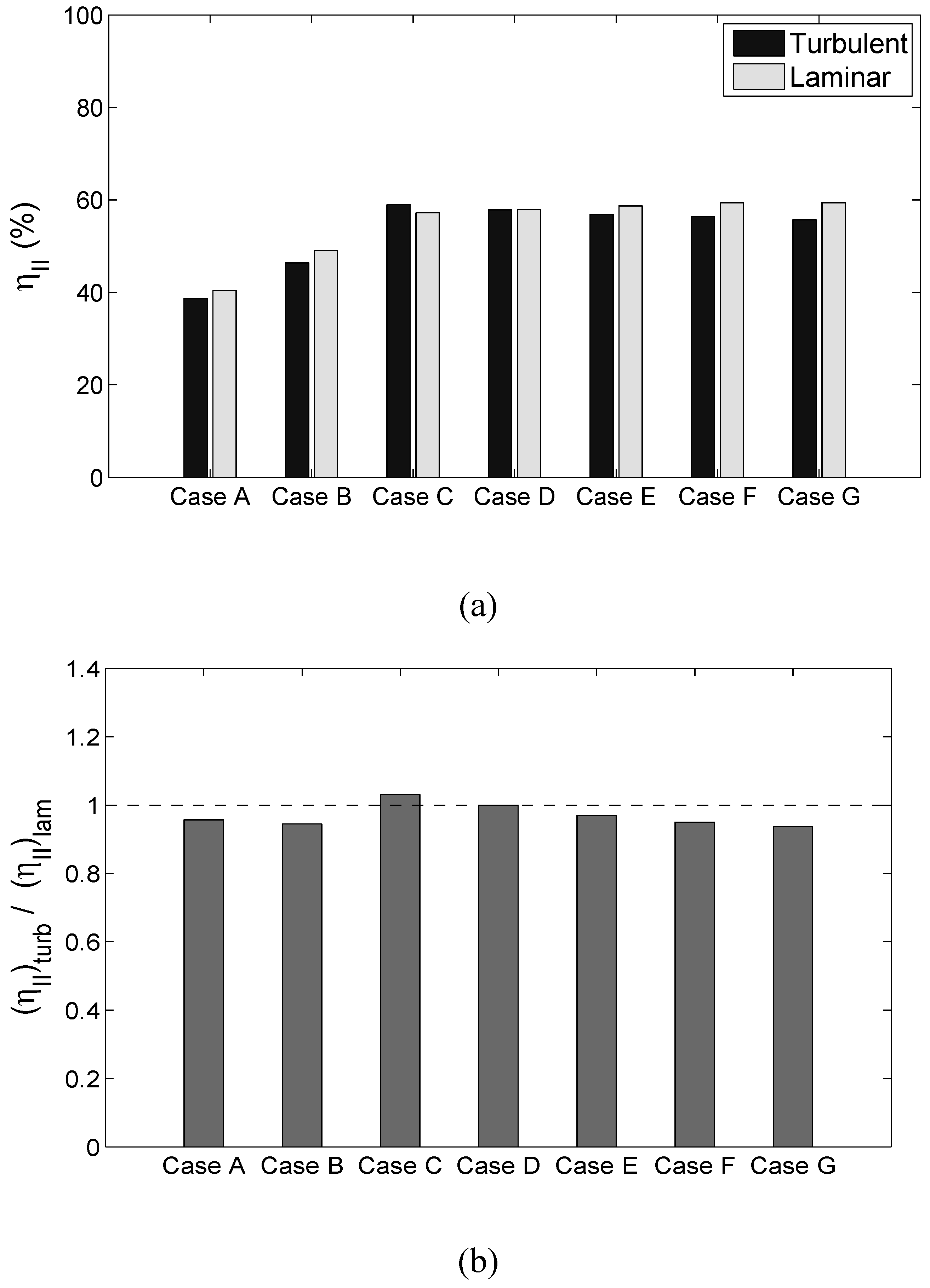
Figure 8.
(a) Variations of for all cases under both laminar and turbulent conditions. (b) Variations of the ratio of second law efficiencies under turbulent and laminar conditions (i.e., ) for all cases.
4.3. Statistical Behavior of Second-Law Efficiency
The values of for all cases under both laminar and turbulent conditions are shown in Figure 8a. The ratio of second law efficiencies under turbulent and laminar conditions (i.e., ) for all cases is shown in Figure 8b. It is evident from Figure 8a,b that decreases under turbulent conditions for the flames with (e.g., cases A, B, E–G). By contrast, the augmentation of burning rate in the cases (e.g. cases C and D) overcomes the enhancement of entropy generation under turbulent conditions, which gives rise to a greater value of in turbulent flames, than in the corresponding laminar flames (see Figure 8a,b). Moreover, a comparison between cases B and F reveals that increases with increasing . As in the present cases, can alternatively be expressed as: . Figure 2, Figure 3 and Figure 5 demonstrate that the contribution of increases significantly with increasing , whereas has marginal influence on the statistical behaviors of , and . By contrast, an increase in acts to increase according to , and this effect overcomes the effects of entropy generation augmentation due to , giving rise to an increase in with increasing (see Figure 8a). It can be seen by comparing the variations of and (see Figure 7) for cases A, B and F that the regime of combustion does not have any major influences on the augmentation of these modes of entropy generation under turbulent conditions in comparison to the corresponding laminar flames. However, assumes much smaller value in the corrugated flamelets regime than in the thin reaction zones regime (see Figure 7a). However, the magnitude of contribution remains small in comparison to the magnitudes of and (see Figure 2, Figure 3), and thus the statistical behaviors of and do not get significantly affected by the regime of combustion, which can be seen from the comparison between cases A, B and F in Figure 7, Figure 8.
5. Conclusions
Different mechanisms of entropy generation in turbulent premixed flames have been analyzed in detail based on a simple chemistry DNS database with a range of different values of heat release parameter , global Lewis number spanning both the corrugated flamelets and thin reaction zones regimes of combustion. It has been found that the entropy generation increases under turbulent conditions. It has been found that the regime of combustion does not significantly affect the augmentation of entropy generation due to chemical reaction, thermal conduction and mass diffusion in turbulent flames in comparison to the corresponding laminar flames, whereas the entropy generation in turbulent flames due to viscous dissipation in comparison to the corresponding laminar flames is stronger in the thin reaction zones regime than in the corrugated flamelets regime. However, the regime of combustion does not significantly affect , as viscous dissipation plays a marginal role in the overall entropy generation in premixed flames. The global Lewis number has been found have a profound influence on the entropy generation mechanism due to thermal conduction, chemical reaction and mass diffusion and the entropy generation by all the aforementioned mechanisms strengthen with decreasing . By contrast, significantly affects the entropy generation mechanism due to thermal conduction but other entropy generation mechanisms are marginally influenced. The entropy generation mechanism by the viscous dissipation remains negligible in comparison to the entropy generations due to chemical reaction, thermal conduction and mass diffusion for both laminar and turbulent conditions. Detailed physical explanations have been provided for the observed trends of entropy generation mechanisms in response to the changes in and . The enhancement of entropy generation rate under turbulent conditions is superseded by the augmentation of burning rate for flames and thus the second law efficiency for turbulent and 0.6 flames are found to be either greater than (for ) or comparable to () the corresponding laminar flame values. By contrast, enhancement of entropy generation rate overcomes the augmented burning rate under turbulent conditions, which in turn leads to smaller value of for turbulent flames, than in the corresponding laminar flames. Thus, a trade-off between heat release and second-law efficiency will be necessary for choosing an ideal fuel-air composition for a new industrial burner.
It is worth noting that this analysis has been carried out in the context of simplified chemistry and transport. The entropy generation in premixed flames is dependent on the statistical behaviors of reaction rate and scalar gradients , and , and as the statistics of reaction rate and scalar gradients are adequately captured by single-step chemistry (see comparison between References. [23] and [42] for reaction rate statistics between simple and detailed chemistry; comparison between References. [21,33] and [38,39] for flame propagation statistics between simple and detailed chemistry; comparison between References. [24,40,41] and [41,42,43,44] for scalar gradient statistics between simple and detailed chemistry) it can be expected that the present findings based on simplified chemistry will be at least qualitatively valid in the context of detailed chemistry based analysis. However, the quantitative prediction of entropy generation for each individual case is likely to be different due to the effects of detailed chemistry and transport on . Thus, further analysis with detailed chemistry and transport will be necessary for more comprehensive DNS based analysis of entropy generation mechanisms in turbulent premixed combustion.
Acknowledgments
The financial assistance of EPSRC is gratefully acknowledged.
References
- Bejan, A. A study of entropy generation in fundamental convective heat transfer. ASME J. Heat Trans. 1979, 101, 718–729. [Google Scholar] [CrossRef]
- San, J.Y.; Worek, W.M.; Lavan, Z. Entropy generation in combined heat and mass transfer, Int. J. Heat Mass Trans. 1987, 30, 1359–1369. [Google Scholar]
- Poulikakos, D.; Johnson, J.M. Second law analysis of combined heat and mass transfer phenomena in external flow. Energy 1989, 14, 67–73. [Google Scholar]
- Puri, I.K. Second law analysis of convective droplet burning. Int. J. Heat Mass Trans. 1992, 35, 2571–2578. [Google Scholar] [CrossRef]
- Hiwase, S.D.; Datta, A.; Som, S.K. Entropy balance and exergy analysis of the process of droplet combustion. J. Phys. D 1998, 31, 1601–1610. [Google Scholar] [CrossRef]
- Som, S.K.; Datta, A. Thermodynamic irreversibilities and second law analysis in a spray combustion process. Combust. Sci. Technol. 1999, 142, 29–54. [Google Scholar]
- Arpaci, V.S.; Selamet, A. Entropic efficiency of energy systems. Combust. Flame. 1988, 73, 251–259. [Google Scholar] [CrossRef]
- Nishida, K.; Takagi, T.; Kinoshita, S. Analysis of entropy generation and exergy loss during combustion. Proc. Combust. Inst. 2002, 29, 869–874. [Google Scholar]
- Hirschfelder, J.C.; Curtiss, C.F.; Bird, R.B. Molecular Theory of Gases and Liquids; Wiley: New York, NY, USA, 1954. [Google Scholar]
- Datta, A. Entropy generation in a confined laminar diffusion flame. Combust. Sci. Technol. 2000, 159, 39–56. [Google Scholar] [CrossRef]
- Dunbar, W.R.; Lior, N. Sources of combustion irreversibility. Combust. Sci. Technol. 1994, 103, 41–61. [Google Scholar] [CrossRef]
- Teng, H.; Kinoshita, C.M.; Masutani, S.M.; Zhou, J. Entropy generation in multicomponent reacting flows. J. Energ. Resour.—ASME 1998, 120, 226–232. [Google Scholar] [CrossRef]
- Briones, A.M.; Mukhopadhay, A.; Aggarwal, S. Analysis of entropy generation in hydrogen-enriched methane—Air propagating triple flames. Int. J. Hydrogen Energy 2009, 34, 1074–1083. [Google Scholar] [CrossRef]
- Som, S.K.; Agrawal, G.K.; Chakraborty, S. Thermodynamics of flame impingement heat transfer. J. Appl. Phys. 2007, 102, 1–9. [Google Scholar] [CrossRef]
- Som, S.K.; Datta, A. Thermodynamic irreversibilities and exergy balance in combustion processes. Prog. Energy Combust. Sci. 2008, 34, 351–376. [Google Scholar] [CrossRef]
- O’Kongo, N.; Bellan, J. Entropy production of emerging turbulent scales in a temporal supercritical n-Heptane/Nitrogen three-dimensional mixing layer. Proc. Combust. Inst. 2002, 28, 497–502. [Google Scholar] [CrossRef]
- Safari, M; Sheikhi, M.R.; Janborogzi, M.; Metghalchi, M. Entropy transport equation in large eddy simulation for exergy analysis of turbulent combustion systems. Entropy 2010, 12, 434–444. [Google Scholar]
- Ashurst, W.T.; Peters, N.; Smooke, M.D. Numerical Simulation of turbulent flame structure with non-unity Lewis number. Combust. Sci. Technol. 1987, 53, 339–375. [Google Scholar] [CrossRef]
- Haworth, D.C.; Poinsot, T.J. Numerical simulations of Lewis number effects in turbulent premixed flames. J. Fluid. Mech. 1992, 244, 405–436. [Google Scholar] [CrossRef]
- Rutland, C.J.; Trouvé, A. Direct simulations of premixed turbulent flames with nonunity Lewis numbers. Combust. Flame 1993, 94, 41–57. [Google Scholar] [CrossRef]
- Chakraborty, N.; Cant, R.S. Influence of Lewis Number on curvature effects in turbulent premixed flame propagation in the thin reaction zones regime. Phys. Fluids 2005, 17, 105105. [Google Scholar] [CrossRef]
- Chakraborty, N.; Cant, R.S. Influence of Lewis number on strain rate effects in turbulent premixed flame propagation in the thin reaction zones regime. Int. J. Heat Mass Trans. 2006, 49, 2158–2172. [Google Scholar] [CrossRef]
- Yuan, J.; Ju, Y.; Law, C.K. Coupled hydrodynamic and diffusional-thermal instabilities in flame propagation at small Lewis numbers, Phys. Fluids 2005, 17, 074106. [Google Scholar] [CrossRef]
- Chakraborty, N.; Klein, M. Influence of Lewis number on the surface density function transport in the thin reaction zones regime for turbulent premixed flames. Phys. Fluids 2008, 20, 065102. [Google Scholar] [CrossRef]
- Chakraborty, N.; Klein, M.; Swaminathan, N. Effects of Lewis number on reactive scalar gradient alignment with local strain rate in turbulent premixed flames. Proc. Combust. Inst. 2009, 32, 1409–1416. [Google Scholar] [CrossRef]
- Chakraborty, N.; Katragadda, M.; Cant, R.S. Effects of Lewis number on turbulent kinetic energy transport in turbulent premixed combustion. Phys. Fluids 2011, 23, 075109. [Google Scholar] [CrossRef]
- Veynante, D.; Trouvé, A.; Bray, K.N.C.; Mantel, T. Gradient and counter-gradient turbulent scalar transport in turbulent premixed flames. J. Fluid Mech. 1997, 332, 263–293. [Google Scholar]
- Boger, M.; Veynante, D.; Boughanem, H.; Trouvé, A. Direct Numerical Simulation analysis of flame surface density concept for Large Eddy Simulation of turbulent premixed combustion. Proc. Combust. Inst. 1998, 27, 917–925. [Google Scholar] [CrossRef]
- Charlette, F.; Meneveau, C.; Veynante, D. A power-law flame wrinkling model for LES of premixed turbulent combustion. Part I: Nondynamic formulation and initial tests. Combust. Flame 2002, 131, 159–180. [Google Scholar] [CrossRef]
- Swaminathan, N.; Bray, K.N.C. Effect of dilatation on scalar dissipation in turbulent premixed flames. Combust. Flame 2005, 143, 549–565. [Google Scholar] [CrossRef]
- Swaminathan, N.; Grout, R. Interaction of turbulence and scalar fields in premixed flames, Phys. Fluids. 2006, 18, 045102. [Google Scholar] [CrossRef]
- Grout, R. An age extended progress variable for conditioned reaction rates. Phys. Fluids 2007, 19, 105107. [Google Scholar] [CrossRef]
- Han, I.; Huh, K.H. Roles of displacement speed on evolution of flame surface density for different turbulent intensities and Lewis numbers for turbulent premixed combustion. Combust. Flame 2008, 152, 194–205. [Google Scholar] [CrossRef]
- Han, I.; Huh, K.H. Effects of Karlovitz number on the evolution of the flame surface density in turbulent premixed flames. Proc. Combust. Inst. 2009, 32, 1419–1425. [Google Scholar] [CrossRef]
- Im, H.G.; Chen, J.H. Preferential diffusion effects on the burning rate of interacting turbulent premixed Hydrogen-Air flames. Combust. Flame 2002, 131, 246–258. [Google Scholar] [CrossRef]
- Babkovskaia, N.; Haugen, N.E.L.; Brandenburg, A. A high order public domain for direct numerical simulations of turbulent combustion. J. Comp. Phys. 2011, 230, 1–12. [Google Scholar] [CrossRef]
- Chen, J.H.; Choudhary, A.; de Supinski, B.; DeVries, M.; Hawkes, E.R.; Klasky, S.; Liao, W.K.; Ma, K.L.; Mellor-Crummey, J.; Podhorski, N.; et al. Terascale direct numerical simulations of turbulent combustion using S3D. Comput. Sci. Discov. 2009, 2, 015001. [Google Scholar] [CrossRef]
- Echekki, T.; Chen, J.H. Analysis of the Contribution of Curvature to Premixed Flame Propagation. Combust. Flame 1999, 118, 303–311. [Google Scholar] [CrossRef]
- Peters, N.; Terhoeven, P.; Chen, J.H.; Echekki, T. Statistics of flame displacement speeds from computations of 2-D unsteady methane—Air flames. Proc. Combust. Inst. 1998, 27, 833–839. [Google Scholar] [CrossRef]
- Chakraborty, N.; Hawkes, E.R. Determination of 3D flame surface density variables from 2D measurements: Validation using direct numerical simulation. Phys. Fluids 2011, 23, 065113. [Google Scholar] [CrossRef]
- Chakraborty, N.; Kolla, H.; Sankaran, R.; Hawkes, E.R.; Chen, J.H.; Swaminathan, N. Determination of three-dimensional quantities related to scalar dissipation rate and its transport from two-dimensional measurements: Direct numerical simulation based validation. Proc. Combust. Inst. 2013, 34, 1151–1162. [Google Scholar] [CrossRef]
- Chakraborty, N.; Hawkes, E.R.; Chen, J.H.; Cant, R.S. Effects of strain rate and curvature on Surface Density Function transport in turbulent premixed CH4-air and H2-air flames: A comparative study. Combust. Flame 2008, 154, 259–280. [Google Scholar] [CrossRef]
- Sankaran, R.; Hawkes, E.R.; Chen, J.H.; Lu, T.; Law, C.K. Structure of a spatially developing turbulent lean methane-air Bunsen flame. Proc. Combust. Inst. 2007, 31, 1291–1298. [Google Scholar] [CrossRef]
- Hawkes, E.R.; Sankaran, R.; Chen, J.H. Estimates of the three-dimensional flame surface density and every term in its transport equation from two-dimensional measurements. Proc. Combust. Inst. 2011, 33, 1447–1454. [Google Scholar] [CrossRef]
- Mizomoto, M.; Asaka, S.; Ikai, S.; Law, C.K. Effects of preferential diffusion on the burning intensity of curved flames. Proc. Combust. Inst. 1984, 20, 1933–1939. [Google Scholar] [CrossRef]
- Sivashinsky, G.I. Instabilities, pattern formation and turbulence in flames. Annu. Rev. Fluid Mech. 1983, 15, 179–199. [Google Scholar] [CrossRef]
- Clavin, P.; Williams, F.A. Effects of Lewis number on propagation of wrinkled flames in turbulent flow. Prog. Aeronaut. Astronaut. 1981, 76, 403–442. [Google Scholar]
- Libby, P.A.; Linan, A.; Williams, F.A. Strained premixed laminar flames with non-unity Lewis numbers. Combust. Sci. Technol. 1983, 34, 257–293. [Google Scholar] [CrossRef]
- Poinsot, T.; Lele, S.K. Boundary conditions for direct simulation of compressible viscous flows. J. Comp. Phys. 1992, 101, 104–129. [Google Scholar] [CrossRef]
- Wray, A.A. Minimal Storage Time Advancement Schemes for Spectral Methods; Report No. MS 202 A-1; NASA Ames Research Center: California, CA, USA, 1990.
- Rogallo, R.S. Numerical Experiments in Homogeneous Turbulence; NASA Technical Memorandum 91416; NASA Ames Research Center: California, CA, USA, 1981.
- Peters, N. Turbulent Combustion; Cambridge University Press: Cambridge, UK, 2000. [Google Scholar]
- Abdel-Gayed, R.G.; Bradley, D.; Hamid, M.; Lawes, M. Lewis number effects on turbulent burning velocity. Proc. Combust. Inst. 1984, 20, 505–512. [Google Scholar] [CrossRef]
- Tennekes, H.; Lumley, J.L. A First Course in Turbulence; MIT Press: Massachusetts, MA, USA, 1972. [Google Scholar]
© 2013 by the author. Licensee MDPI, Basel, Switzerland. This article is an open access article distributed under the terms and conditions of the Creative Commons Attribution license ( http://creativecommons.org/licenses/by/3.0/).