Article

How AI-Driven User–Producer Interaction Fuels Interconnected Innovation: A Knowledge Exchange and Integration Perspective

1
Business School, Beijing Information Science and Technology University, Beijing 100101, China
2
College of Business Administration, Capital University of Economics and Business, Beijing 100070, China
3
Department of Information Management, Ming Chuan University, Taipei 111, Taiwan
*
Author to whom correspondence should be addressed.
J. Theor. Appl. Electron. Commer. Res. 2026, 21(2), 71; https://doi.org/10.3390/jtaer21020071 (registering DOI)
Submission received: 19 January 2026 / Revised: 11 February 2026 / Accepted: 15 February 2026 / Published: 21 February 2026
(This article belongs to the Special Issue Human–Technology Synergies in AI-Driven E-Commerce Environments)

Abstract

In the rapid diffusion of artificial intelligence (AI), firms increasingly rely on AI to reshape user interactions, yet how such interactions translate into sustained innovation remains unclear. Adopting a user–producer interaction perspective, this study examines how AI-Driven User–Producer Interaction (ADUPI) affects User–Producer Interconnected Innovation (UPII), focusing on the mediating roles of User–Producer Knowledge Exchange (UPKE) and User–Producer Knowledge Integration (UPKI), as well as the moderating effect of AI Readiness (AIR). Using survey data from 974 firms and applying regression, mediation, moderation, and bootstrap analyses, the findings show that ADUPI significantly enhances UPII. Moreover, UPKE and UPKI jointly mediate this relationship, forming a dual mediation mechanism in which knowledge integration exerts a stronger effect than knowledge exchange. In addition, AIR positively moderates the effects of ADUPI on both UPKE and UPKI, amplifying innovation outcomes under higher AI readiness. This study advances AI and innovation research by shifting the focus from internal firm capabilities to cross-actor interaction, clarifying differentiated knowledge mechanisms, and highlighting AI readiness as a key condition for value realization. The results also provide actionable insights for firms seeking to convert AI-driven interaction into interconnected innovation through improved AI readiness and knowledge management.

1. Introduction

In the current era marked by the rapid global diffusion of artificial intelligence (AI) technologies, an increasing number of firms are actively leveraging intelligent algorithms, data analytics, and automated systems to reconfigure interactions between firms and users. For example, platform-based firms employ intelligent recommendation systems to precisely match user needs; manufacturing firms utilize AI-driven customer service and data feedback systems to obtain real-time insights into user experiences; and service-oriented firms rely on AI technologies to enable continuous, cross-scenario, and cross-channel communication with users. These practices indicate that AI technologies are profoundly reshaping the nature and patterns of interactions between Producers and users, rendering such interactions more frequent, precise, and continuous. However, these AI-enabled practices raise a critical yet underexplored question: Do AI-driven user–producer interactions necessarily translate into sustained open innovation outcomes, and if so, through what underlying mechanisms? Despite firms’ increasing investments in AI technologies, substantial heterogeneity persists in their open innovation performance. This empirical phenomenon provides an important practical context and a compelling research opportunity for the present study.
Building on the above practical observations, existing studies have primarily examined the impact of AI on firm innovation and financial performance from the perspectives of technology adoption or internal organizational capabilities. However, relatively limited attention has been paid to the mechanisms through which AI reshapes user–producer interactions and subsequently drives interconnected innovation characterized by distributed multi-actor participation. From a knowledge management perspective, interactions between Producers and users inherently involve the bidirectional flow, integration, and re-creation of knowledge, and innovation outcomes depend on whether knowledge can evolve from simple exchange into deep integration. Nevertheless, prior research often treats knowledge exchange and knowledge integration as interchangeable processes, with insufficient differentiation of their distinct functions in the innovation process. Moreover, from an AI capability perspective, AI technologies do not automatically generate value; rather, their value creation effects critically depend on firms’ preparedness in terms of technological infrastructure, organizational support, and strategic alignment—namely, AI Readiness. Differences in AI readiness across firms may therefore represent a key factor in explaining why AI-driven interactions lead to substantial heterogeneity in innovation outcomes. Accordingly, how to systematically explain the influence of AI-driven user–producer interaction on interconnected innovation by integrating knowledge management mechanisms with the contextual role of AI readiness constitutes an important theoretical gap that this study seeks to address.
In light of the above, this study develops a systematic theoretical framework and conducts an empirical investigation into the relationship between AI-Driven User–Producer Interaction (ADUPI) and User–Producer Interconnected Innovation (UPII). Specifically, this study first defines the core concepts and proposes research hypotheses from a theoretical perspective. It then collects firm-level data through a questionnaire survey and empirically tests the proposed hypotheses using regression analysis, mediation analysis, moderation analysis, and bootstrap procedures. Subsequently, this study examines the mediating roles of User–Producer Knowledge Exchange (UPKE) and User–Producer Knowledge Integration (UPKI) in the relationship between ADUPI and UPII, as well as the moderating effect of AI Readiness (AIR). Finally, the research findings are comprehensively discussed, and corresponding theoretical and managerial implications are derived.
To position our study within recent AI-enabled platform and ecosystem research (2024–2025), prior work has primarily focused on how generative AI reshapes platform architectures, value creation logics, and ecosystem-level orchestration and governance. In contrast, our study theorizes and empirically tests a micro-level mechanism through which ADUPI translates into UPII via two distinct knowledge pathways—UPKE and UPKI—and further explains heterogeneity through AIR as a key boundary condition.
This study contributes important insights at both the theoretical and practical levels. From a theoretical perspective, this study extends the analytical boundaries of AI and innovation research by adopting a user–producer interaction perspective, elucidates the underlying mechanism of “user–producer interaction–knowledge mechanisms–interconnected innovation,” and differentiates the distinct roles of knowledge exchange and knowledge integration in the innovation process. Moreover, by incorporating AI Readiness, this study addresses the critical issue of firm heterogeneity in the realization of AI value. In addition, by introducing AI Readiness, the study addresses a key issue of firm heterogeneity in realizing AI-enabled value. The findings also carry strong relevance for e-commerce contexts—such as digital platforms, online marketplaces, and AI-enabled customer interaction systems—by providing a theoretical basis for firms to optimize producer–user interaction and enhance innovation performance in digital environments. From a practical perspective, the findings provide targeted managerial implications for firms on how to effectively transform AI-driven interactions into interconnected innovation performance by enhancing AI readiness and optimizing knowledge management mechanisms, thereby offering valuable guidance for firms in formulating AI-enabled user–producer interaction and innovation strategies.

2. Hypotheses Development

2.1. AI-Driven User–Producer Interaction and Interconnected Innovation

AI-Driven User–Producer Interaction (ADUPI) refers to the highly efficient interaction and communication between Producers and users enabled by AI technologies throughout marketing and transaction processes [1]. This form of interaction is characterized by three key features: real-time responsiveness, intelligent matching, and continuity. Real-time responsiveness indicates that, under the support of AI technologies, Producers and users are able to engage in high-frequency and real-time interactions during marketing and transactional activities [2]. Intelligent matching refers to the ability of users, driven by AI technologies, to conduct precise searches and obtain relevant information regarding product or service attributes—such as functionality, price, quality, and after-sales service—while Producers can leverage AI algorithms to analyze users’ demand preferences and evolving trends and proactively deliver products or services that are well aligned with these needs, thereby achieving dynamic and precise matching between supply and demand [3,4]. Continuity denotes that, based on data generated through AI algorithms and interactions between Producers and users, firms are able to continuously adjust and optimize interaction mechanisms, leading to sustained, stable, and accurate dynamic interactions between the two sides [5]. Existing studies find that AI algorithms enhance interaction and coordination between Producers and users by optimizing service processes, improving decision-making procedures, reallocating resources, and accelerating demand responsiveness, thereby promoting sustainable improvements in supply chains [6,7]. For example, AI-driven online customer service systems provide round-the-clock support and shorten response times, which significantly improves interaction efficiency between Producers and users [8]. AI-based predictive analytics technologies offer personalized product recommendations based on user preferences and optimize service-related decisions through advanced data analysis, further strengthening interaction quality and matching effectiveness between Producers and users [9]. In the context of commercial aircraft spare parts, the introduction of AI algorithms has reshaped supply–demand response processes within supply chains, effectively improving the speed and accuracy of demand fulfillment for spare parts [10].
Interconnected innovation refers to a process in which distributed multi-actors embedded in the Internet—including firms, heterogeneous knowledge entities, and consumers—establish extensive connections through goal-oriented knowledge search, thereby enabling knowledge transformation and the emergence of innovation under the support of next-generation general purpose information technologies [11]. In this study, interconnected innovation specifically refers to the interconnection between Producers and users (UPII), that is, Producers and users engage in interaction and communication driven by AI technologies and collaboratively promote the continuous optimization and innovation of products and services through knowledge sharing. User–producer UPII exhibits two key characteristics: knowledge transferability and user–producer synergy. Knowledge transferability refers to the bidirectional flow of information—such as demand and feedback—generated during interactions between Producers and users [12,13], enabling the complementarity and sharing of innovation resources. User–producer synergy denotes that Producers and users, as two distinct actors, collaboratively advance product or service innovation through interaction, and such innovations are difficult for any single actor to achieve independently [14]. Existing studies argue that UPII takes the interconnection between Producers and users as its core mechanism and promotes knowledge flows among actors by constructing multi-actor innovation networks, thereby significantly enhancing the efficiency and flexibility of innovation activities [11]. Meanwhile, UPII reshapes firms’ innovation collaboration paradigms by further blurring the boundaries of innovation actors, substantially increasing the accessibility of large-scale knowledge resources, and accelerating the transfer of both explicit and tacit knowledge within innovation networks. As a result, it breaks traditional path dependence in innovation and accelerates the continuous optimization and innovation of products or services [15].
ADUPI facilitates the realization of UPII by enhancing information and knowledge sharing, enabling precise demand alignment, and identifying innovation opportunities. First, AI-driven intelligent customer service systems, data mining technologies, and real-time analytics significantly reduce information asymmetry between Producers and users, thereby improving the timeliness and accuracy of information transmission [16]. On this basis, firms are able to gain precise insights into user needs and market trends, which in turn promotes the generation of UPII outcomes [17]. Second, based on real-time feedback from users, AI algorithms can identify user needs and usage scenarios, enabling firms to continuously adjust product or service optimization strategies and achieve precise alignment between supply and demand, thus driving the realization of UPII [18]. Finally, by analyzing interaction data between Producers and users, AI algorithms empower Producers to timely identify latent demands and market opportunities and to transform dispersed demand information into usable innovation resources. This provides support for the continuous iterative upgrading of products and services and further promotes the realization of UPII [19,20]. In summary, this study argues that ADUPI can effectively promote the realization of UPII.
Accordingly, the following hypothesis is proposed:
H1. 
AI-Driven User–Producer Interaction has a significant positive effect on User–Producer Interconnected Innovation.

2.2. The Mediating Role of Knowledge Exchange and Knowledge Integration

2.2.1. User–Producer Knowledge Exchange

Knowledge exchange refers to the bidirectional flow of knowledge between producers and users, which typically occurs among actors who share common interests or seek to enhance organizational well-being [21]. In this study, User–Producer Knowledge Exchange (UPKE) is defined as the bidirectional process of knowledge flows between Producers and users. Accordingly, UPKE is characterized by two key features: bidirectionality and interactivity [22]. The bidirectionality of UPKE indicates that both Producers and users simultaneously act as knowledge producers and knowledge users, satisfying their respective needs through two-way knowledge flows—whereby Producers can accurately capture user demands and users are able to purchase products that meet their expectations [23]. The interactivity of UPKE refers to the process through which Producers and users promote effective knowledge flows via continuous communication and real-time feedback [24]. Existing studies show that UPKE can generate a virtuous learning cycle, progressing from successful learning to process improvement, followed by mutual inspiration and imitation, and ultimately resulting in effective knowledge sharing [25]. Because critical product-related knowledge often resides outside firms’ specific domains, firms increasingly rely on interaction and collaboration with users; through UPKE, they are able to accurately meet user needs in a cost-efficient and effective manner [26]. Moreover, by engaging in UPKE with users, Producers can better understand and leverage key user information to optimize managerial decision-making, thereby enhancing overall financial and market performance [27].
Existing research indicates that ADUPI provides critical support for bidirectional knowledge exchange between Producers and users through real-time data analytics and intelligent feedback mechanisms. On the one hand, AI algorithms continuously monitor and dynamically analyze user behaviors, product usage scenarios, and changes in preferences, transforming users’ knowledge from fragmented and lagged information into dynamic and interpretable user data assets [28]. Through feedback mechanisms, such knowledge is rapidly transmitted to Producers, thereby enhancing their ability to perceive and respond to market changes [29,30]. On the other hand, Producers rely on AI algorithms to simulate and optimize product design, functional improvements, and new technological solutions [31], and convey relevant information to users in more intuitive and personalized forms. This process helps enhance users’ understanding of technological feasibility and innovation directions [32]. In this context, Producers and users are no longer confined to one-way knowledge transfer; instead, they achieve bidirectional knowledge flows and co-evolution through continuous interaction [22]. Furthermore, this AI-enabled bidirectional knowledge exchange process mitigates information asymmetry inherent in traditional supply–demand relationships [33] and facilitates the deep coupling of user demand knowledge with product technological knowledge, transforming users into important participants and contributors in the product innovation process [24,34]. As a result, innovation activities shift from a firm-centered, closed model to a data-driven UPII mode.
Accordingly, the following hypothesis is proposed:
H2a. 
Knowledge exchange mediates the relationship between AI-Driven User–Producer Interaction and User–Producer Interconnected Innovation.

2.2.2. User–Producer Knowledge Integration

Knowledge integration refers to the process and outcome of organizing, linking, combining, and reconstructing knowledge derived from different sources, disciplines, or experiential domains to form a more systematic, meaningful, and applicable body of new knowledge [35]. In this study, User–Producer Knowledge Integration (UPKI) is defined as the process through which Producers and users exchange and share knowledge through interaction and achieve knowledge fusion and reconstruction [36]. UPKI is characterized by two key features: synergy and dynamism [29,37]. Synergy refers to the process whereby Producers and users effectively transmit their respective knowledge and experiences through interaction, thereby enhancing the sharing, integration, and reconstruction of knowledge between the two sides [29]. Dynamism indicates that, as a continuously evolving process, UPKI requires sustained inter-actor interaction to deepen the understanding and linkage of specific knowledge, thereby ensuring the continuity of knowledge integration [38]. Firms not only need to possess abundant internal knowledge resources but also continuously acquire external knowledge and effectively integrate it with internal knowledge to optimize their knowledge structures and promote knowledge recombination and innovation emergence [39,40]. Existing studies show that knowledge integration plays an increasingly important role in firms’ innovation activities [41,42]. Particularly in new product development processes, the integration of internal and external knowledge helps shorten development cycles and enhance market adaptability, and is therefore regarded as a critical strategy and capability for achieving superior innovation performance [43].
Existing research indicates that ADUPI significantly enhances the efficiency of information sharing and the depth of knowledge integration between Producers and users through the systematic collection, analysis, and intelligent matching of product information and demand data [3,29]. On the one hand, AI technologies enable precise identification and dynamic prediction of user needs, allowing latent demands to be articulated and structured, thereby providing Producers with more forward-looking and targeted decision support [44]. On the other hand, by leveraging AI to conduct in-depth analysis and visual representation of product performance, usage scenarios, and technical parameters, Producers can reduce information asymmetry and enhance users’ understanding of products and technologies [16,32]. Through this bidirectional flow of knowledge, Producers and users gradually achieve the absorption, recombination, and re-creation of each other’s knowledge elements, thereby promoting UPKI [40]. Furthermore, this AI-driven knowledge integration mechanism breaks the constraints of firm boundaries and traditional role divisions between Producers and users [45], enabling users to participate earlier and more deeply in the product innovation process, while allowing Producers to continuously learn from market feedback and iteratively upgrade their knowledge bases [46]. As a result, innovation activities gradually shift from a producer-dominated linear model to a UPII mode characterized by collaborative interaction between Producers and users.
Accordingly, the following hypothesis is proposed:
H2b. 
Knowledge integration mediates the relationship between AI-Driven User–Producer Interaction and User–Producer Interconnected Innovation.
This study differentiates the distinct roles and operating conditions of UPKE and UPKI in interaction-driven innovation. UPKE emphasizes the sharing and transfer of knowledge between Producers and users and represents a necessary condition for knowledge to take effect within AI-driven user–producer interaction. By contrast, UPKI builds on knowledge exchange and involves the recombination, integration, and deeper utilization of knowledge derived from multiple actors, reflecting a more advanced knowledge-processing mechanism.

2.3. The Moderating Role of AI Readiness

AI Readiness (AIR) refers to a firm’s comprehensive capability to successfully deploy artificial intelligence technologies and transform them into actual business value. Alsheibani et al. (2018) describe AI readiness as “the state of an organization’s preparedness to implement changes involving AI applications and technologies [47].” This concept is commonly regarded as a foundational condition enabling organizations to implement AI applications effectively and achieve the expected performance outcomes [48]. It is characterized by three core features: multidimensionality, dynamism, and value orientation [49]. Multidimensionality emphasizes that AIR is not a single technological capability, but rather reflects a firm’s overall level of preparedness across multiple interrelated dimensions, including technological infrastructure, business processes, organizational structure and boundaries, and strategic objectives, highlighting the alignment between technological capabilities and organizational contexts [47]. Dynamism indicates that AIR not only concerns a firm’s current level of AI application but also captures its potential for continuous learning, capability renewal, and future AI deployment planning, thereby reflecting the firm’s adaptability and evolutionary capacity in uncertain environments [50]. Value orientation suggests that the fundamental purpose of assessing AIR lies not in the technology itself, but in leveraging effective AI deployment and application to generate sustainable business performance and innovation value, ultimately transforming technological capabilities into tangible competitive advantages [48].
ADUPI is typically accompanied by the continuous generation and rapid circulation of large volumes of heterogeneous knowledge [17], which poses substantial challenges to firms’ capabilities in data collection, analysis, and interpretation. Firms with higher levels of AIR generally possess more advanced technological infrastructures, stronger data-processing capabilities, and organizational support mechanisms that are well aligned with business processes [48]. Such firms are better able to utilize AI tools to conduct real-time analysis and filtering of information and data generated during user–producer interactions, thereby reducing data noise and latency [28] and enhancing the efficiency and accuracy of knowledge exchange between Producers and users. Under these conditions, ADUPI is more likely to be translated into high-quality UPKE [22]. In contrast, when firms exhibit low levels of AIR, even frequent interactions between Producers and users may fail to fully unlock the value embedded in interaction-generated information and data due to insufficient technological capabilities or limited organizational support [44,47], thereby weakening the positive effect of ADUPI on knowledge exchange.
Accordingly, the following hypothesis is proposed:
H3a. 
AI Readiness positively moderates the relationship between AI-Driven User–Producer Interaction and User–Producer Knowledge Exchange.
Compared with User–Producer Knowledge Exchange (UPKE), User–Producer Knowledge Integration (UPKI) imposes more complex requirements on firms’ capabilities, as it involves not only the acquisition and transmission of knowledge but also the systematic analysis, reconstruction, and re-creation of knowledge from diverse sources [35]. In AI-Driven User–Producer Interaction, a higher level of AI Readiness (AIR) enables firms to leverage AI technologies to identify latent knowledge linkages arising from interactions between Producers and users and to integrate and transform dispersed knowledge through data modeling, pattern recognition, and related techniques [51]. Through these mechanisms, firms are better able to convert interaction-generated knowledge resources into new product solutions, service models, or innovation opportunities [40]. In contrast, lower levels of AIR imply that firms lack the necessary AI technologies and organizational foundations [47], making it difficult to effectively support complex knowledge integration processes [52]. As a result, the role of ADUPI in promoting UPKI is substantially weakened.
Accordingly, the following hypothesis is proposed:
H3b. 
AI Readiness positively moderates the relationship between AI-Driven User–Producer Interaction and User–Producer Knowledge Integration.

2.4. Research Model Development

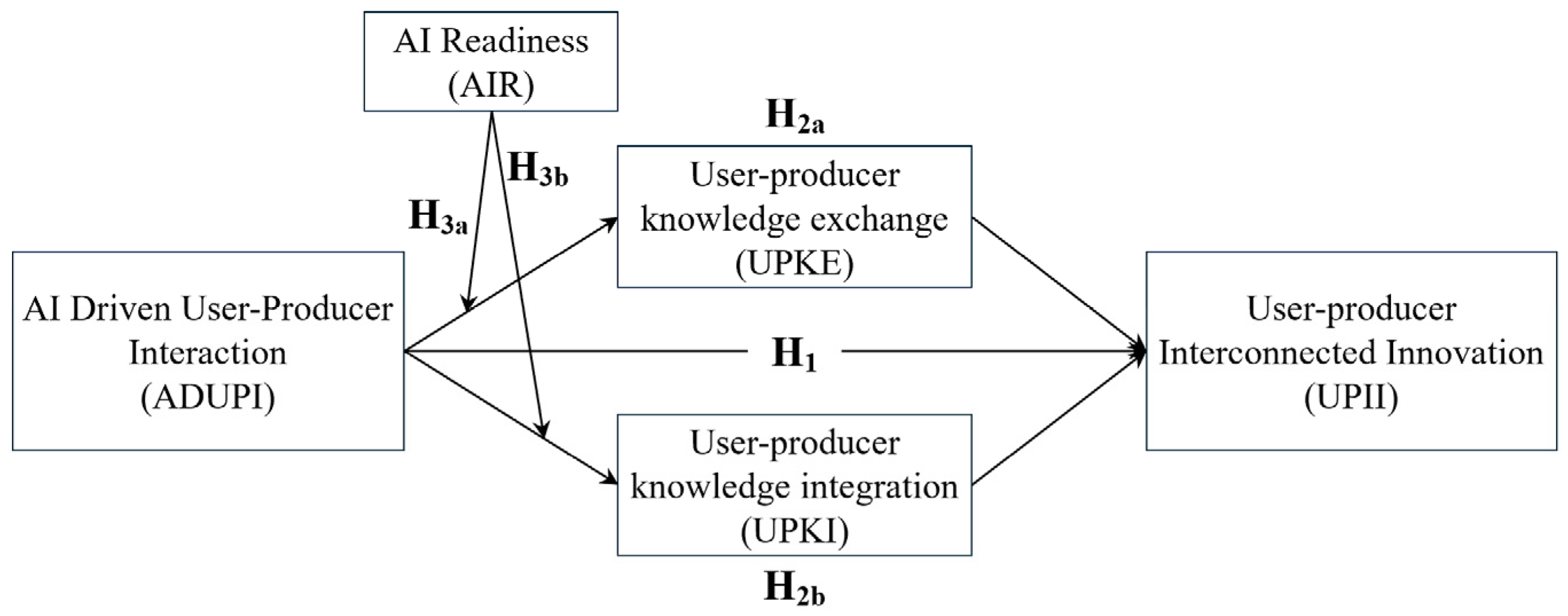
Based on the foregoing literature review, this study develops an empirical research model to elucidate the mechanisms through which AI-Driven User–Producer Interaction (ADUPI) influences User–Producer Interconnected Innovation (UPII) from the perspectives of User–Producer Knowledge Exchange (UPKE) and User–Producer Knowledge Integration (UPKI). In addition, this study further examines the moderating roles of AI Readiness (AIR) in the relationships between ADUPI and UPKE as well as between ADUPI and UPKI, respectively. The research model is presented in Figure 1.

3. Research Design

3.1. Sample and Data Collection

This study collected sample data through a questionnaire survey, with existing measurement items adapted to better align with the research objectives. To limit potential measurement bias, the original scale structure and dimensions were retained, while only the focal concepts and terminology were modified, as illustrated in Table 1. Because this study examines how firms perceive and leverage AI-driven interaction mechanisms to promote interconnected innovation outcomes, the unit of analysis is the firm, and all variables were measured from the firm’s perspective. In the scale design, producer–user interaction is organized into three stages—pre-transaction, in-transaction, and post-transaction. Notably, these stages are conceptual phases used to theoretically capture how firms acquire, integrate, and apply user-related knowledge across different interaction moments. In the questionnaire, this staging enables respondents to evaluate items based on their perceptions of firm practices, thereby enhancing construct clarity and operationalizability. A total of 1239 questionnaires were returned. To ensure data quality and consistency with the target population, invalid responses were excluded based on two criteria: (1) questionnaires showing clear signs of inattentive responding, such as selecting the same option throughout or exhibiting illogical skip patterns; and (2) responses completed in less than 60 s, given an average completion time of approximately 3–5 min. After screening, 974 valid questionnaires were retained, yielding an effective response rate of 78.6%.

3.2. Variable Measurement

All variables were measured on a five-point Likert scale. Control variables comprised firm age, number of employees, ownership type, revenue scale, industry, department, managerial position, and tenure. Descriptive statistics are reported in Table 2.

4. Empirical Analysis and Hypothesis Testing

4.1. Reliability and Validity Analysis

4.1.1. Reliability Analysis

Reliability analysis assesses the consistency and stability of measurement results and constitutes a fundamental prerequisite for ensuring the rigor of empirical research. In this study, internal consistency was evaluated using Cronbach’s alpha based on 22 measurement items, as reported in Table 3. The corrected item total correlations for all items exceed 0.40, indicating that each item contributes adequately to its corresponding construct. Moreover, the overall reliability coefficients remain stable when individual items are removed, suggesting a sound item structure. All constructs exhibit Cronbach’s alpha values above the recommended threshold of 0.70, demonstrating satisfactory internal consistency. These results confirm the reliability of the measurement instrument and provide strong support for the robustness of the empirical findings.

4.1.2. Validity Analysis

The validity of the questionnaire data was examined from the perspectives of convergent and discriminant validity. Prior research suggests that AVE is a relatively conservative indicator of convergent validity; when composite reliability is high, convergent validity may still be considered adequate even if AVE falls below 0.50 [54,55]. As reported in Table 3, the AVE values of all constructs are above or close to the recommended threshold of 0.50, and their corresponding CR values exceed 0.80, indicating that the measurement items adequately capture the underlying latent constructs.
As reported in Table 4, the square roots of AVE for each construct are greater than or comparable to the correlations with other constructs, and no excessively high inter-construct correlations are observed, supporting satisfactory discriminant validity. Furthermore, as reported in Table 5, the results of confirmatory factor analysis (CFA) show that all model fit indices meet commonly accepted standards, providing additional evidence for the overall validity of the measurement model.

4.2. Correlation Analysis

Pearson correlation analysis was conducted to examine the associations among the key variables. As shown in Table 6, ADUPI exhibits significant positive correlations with UPKE, UPKI, AIR, and UPII (r = 0.620, 0.588, 0.555, and 0.678, respectively). In addition, UPKE, UPKI, and AIR are each positively and significantly related to UPII (r = 0.641, 0.677, and 0.536, respectively). These results confirm the expected relationships among the study variables and provide a preliminary empirical foundation for subsequent hypothesis testing.

4.3. Common Method Bias and Variance Inflation Factor Tests

During the questionnaire design process, several procedural remedies—such as guaranteeing respondent anonymity and introducing psychological separation among measurement items—were implemented to alleviate potential common method bias (CMB). In addition, the results of Harman’s single-factor test indicate that the largest factor accounts for 35.725% of the total variance, which is below the conventional 40% threshold, suggesting that CMB is unlikely to be a serious concern in this study. We further assessed CMB using the ULMC approach. As shown in Table 7, adding a common method factor did not materially improve model fit, and the changes in the fit indices remained below the recommended cutoffs, suggesting that CMB is unlikely to be a serious concern in this study. Variance inflation factor (VIF) diagnostics were then conducted. As reported in Table 8, all four independent variables exhibit VIF values well below 10, indicating the absence of problematic multicollinearity. Taken together, these results suggest that the data are suitable for subsequent regression analyses.

4.4. Empirical Testing

4.4.1. Direct Effects of ADUPI on UPII

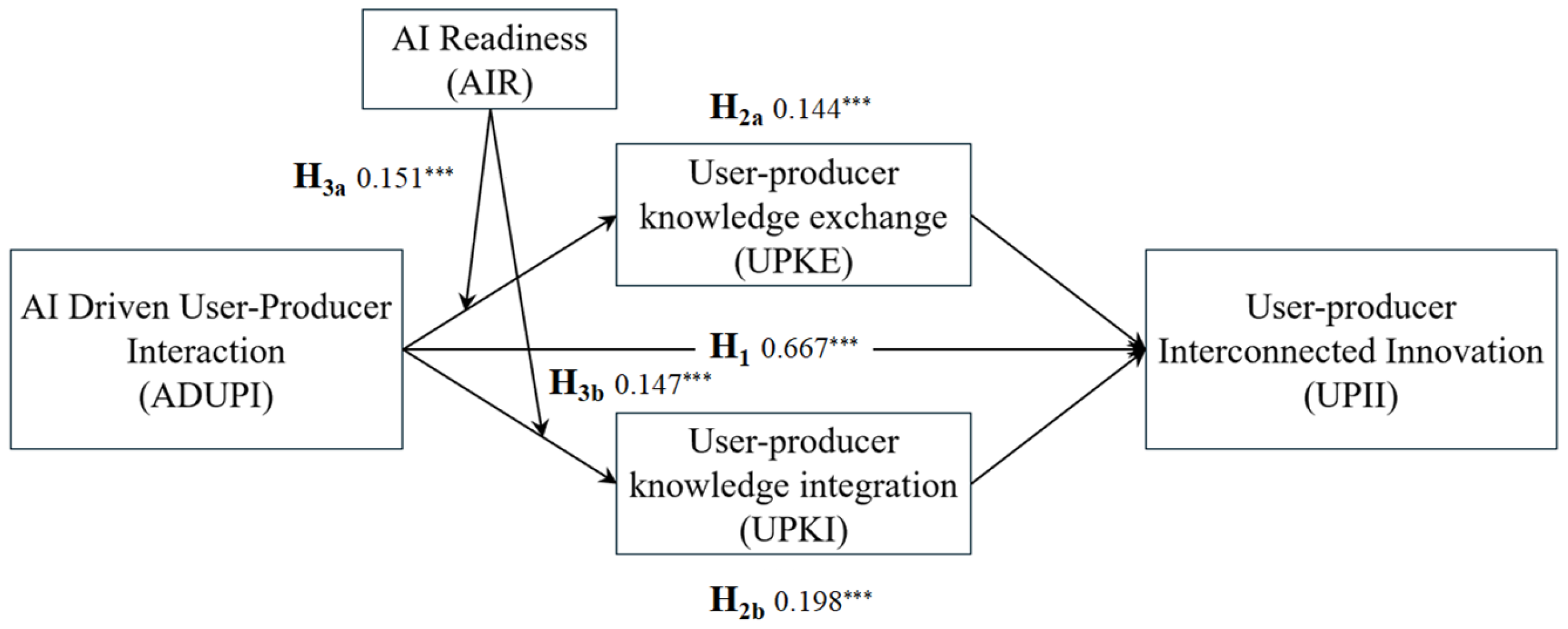
In this study, In the regression analyses, ADUPI was specified as the independent variable, with UPKE, UPKI, and UPII treated as dependent variables. In addition, UPKE and UPKI were each entered as predictors of UPII to examine their respective effects. As reported in Table 9, ADUPI exerts a significant positive influence on UPII (Model 6: β = 0.667, p < 0.001), with an adjusted R2 of 0.465, indicating that ADUPI accounts for 46.5% of the variance in UPII and thus supporting Hypothesis H1.
ADUPI also shows significant positive effects on UPKE (Model 2: β = 0.691, p < 0.001; adjusted R2 = 0.384) and UPKI (Model 4: β = 0.689, p < 0.001; adjusted R2 = 0.346), suggesting that ADUPI explains 38.4% and 34.6% of the variance in UPKE and UPKI, respectively. Furthermore, both UPKE (Model 7: β = 0.564, p < 0.001; adjusted R2 = 0.428) and UPKI (Model 8: β = 0.563, p < 0.001; adjusted R2 = 0.468) have significant positive effects on UPII, accounting for 42.8% and 46.8% of its variance, respectively. These findings establish a solid basis for subsequent mediation analyses.
Notably, the coefficients of control variables—including firm age, firm size, and ownership type—do not reach statistical significance. This suggests that, after controlling for basic firm characteristics, UPII is primarily driven by ADUPI and operates through the knowledge exchange and knowledge integration mechanisms. The inclusion of control variables helps rule out alternative explanations and enhances the statistical rigor of the regression results.

4.4.2. Indirect Effects of UPKE and UPKI

To examine the mediating roles of UPKE and UPKI in the relationship between ADUPI and UPII, stepwise regression analyses were conducted following the procedure suggested by Baron and Kenny (1986) [56]. As shown in Table 10, ADUPI has a significant positive effect on UPII (Model 10: β = 0.667, p < 0.001). When UPKE is introduced into the model, both ADUPI (Model 11: β = 0.443, p < 0.001) and UPKE (Model 11: β = 0.324, p < 0.001) remain significant predictors of UPII, although the effect size of ADUPI is noticeably reduced. This pattern indicates that UPKE partially mediates the relationship between ADUPI and UPII, providing support for Hypothesis H2a.
Similarly, when UPKI is included as a mediator, ADUPI (Model 12: β = 0.420, p < 0.001) and UPKI (Model 12: β = 0.358, p < 0.001) both exert significant positive effects on UPII, with the coefficient of ADUPI further attenuated. This result suggests a partial mediating role of UPKI in the ADUPI–UPII relationship, thereby supporting Hypothesis H2b.

4.4.3. Dual Mediating Effects of UPKE and UPKI

The Mediation effects were further examined using the bootstrap procedure implemented in the PROCESS macro. The results confirm the mediating roles of UPKE and UPKI in the relationship between ADUPI and UPII. As reported in Table 11, the total indirect effect of ADUPI on UPII is 0.342, with a bootstrap standard error of 0.036 and a 95% bootstrap confidence interval of [0.271, 0.412]. Because this interval does not include zero, the dual mediation effect is statistically significant. Moreover, the total indirect effect accounts for 51.27% of the overall effect, indicating that a substantial portion of ADUPI’s influence on UPII operates through the two knowledge-based mechanisms.
Decomposing the indirect effects reveals two specific mediation pathways. The first pathway, ADUPI → UPKE → UPII, yields an indirect effect of 0.144 (SE = 0.023; 95% bias-corrected CI = [0.099, 0.190]), representing 21.59% of the total effect. This result suggests that ADUPI enhances UPII in part by facilitating user–producer knowledge exchange. The second pathway, ADUPI → UPKI → UPII, produces a larger indirect effect of 0.198 (SE = 0.025; 95% bias-corrected CI = [0.150, 0.245]), accounting for 29.69% of the total effect, indicating that knowledge integration constitutes a more influential transmission mechanism. In addition, ADUPI not only shows a significant direct association with UPII (direct effect = 0.324) but also exerts significant indirect effects via UPKE (indirect effect = 0.144) and UPKI (indirect effect = 0.198). Notably, the UPKI pathway is stronger than the UPKE pathway, suggesting that UPII relies not merely on information transfer but more critically on the integration, recombination, and application of knowledge from multiple sources.
Taken together, the two mediation paths contribute comparable but distinct proportions—approximately 22% and 30%—to the overall indirect effect, underscoring the importance of both UPKE and UPKI in translating AI-driven interaction into interconnected innovation. These findings provide further empirical support for Hypotheses H2a and H2b and highlight the critical role of fostering both knowledge exchange and knowledge integration within AI-enabled interaction processes.

4.4.4. Moderating Effects of AI Readiness

Hierarchical linear regression was employed to examine the moderating role of AI Readiness (AIR) in the relationships between ADUPI and both UPKE and UPKI. Prior to constructing the interaction terms, the independent and moderating variables were mean-centered and then multiplied to reduce potential multicollinearity between the interaction terms, the predictors, and the control variables.
The results are presented in Table 12. The interaction between ADUPI and AIR has a significant positive effect on UPKE (Model 16: β = 0.151, p < 0.001), indicating that AIR strengthens the impact of ADUPI on knowledge exchange and thereby supporting Hypothesis H3a. Similarly, the ADUPI × AIR interaction term also exhibits a significant positive effect on UPKI (Model 20: β = 0.147, p < 0.001), suggesting that AIR positively moderates the relationship between ADUPI and knowledge integration. Thus, Hypothesis H3b is also supported.

4.4.5. Further Tests of the Moderating Effects of AI Readiness

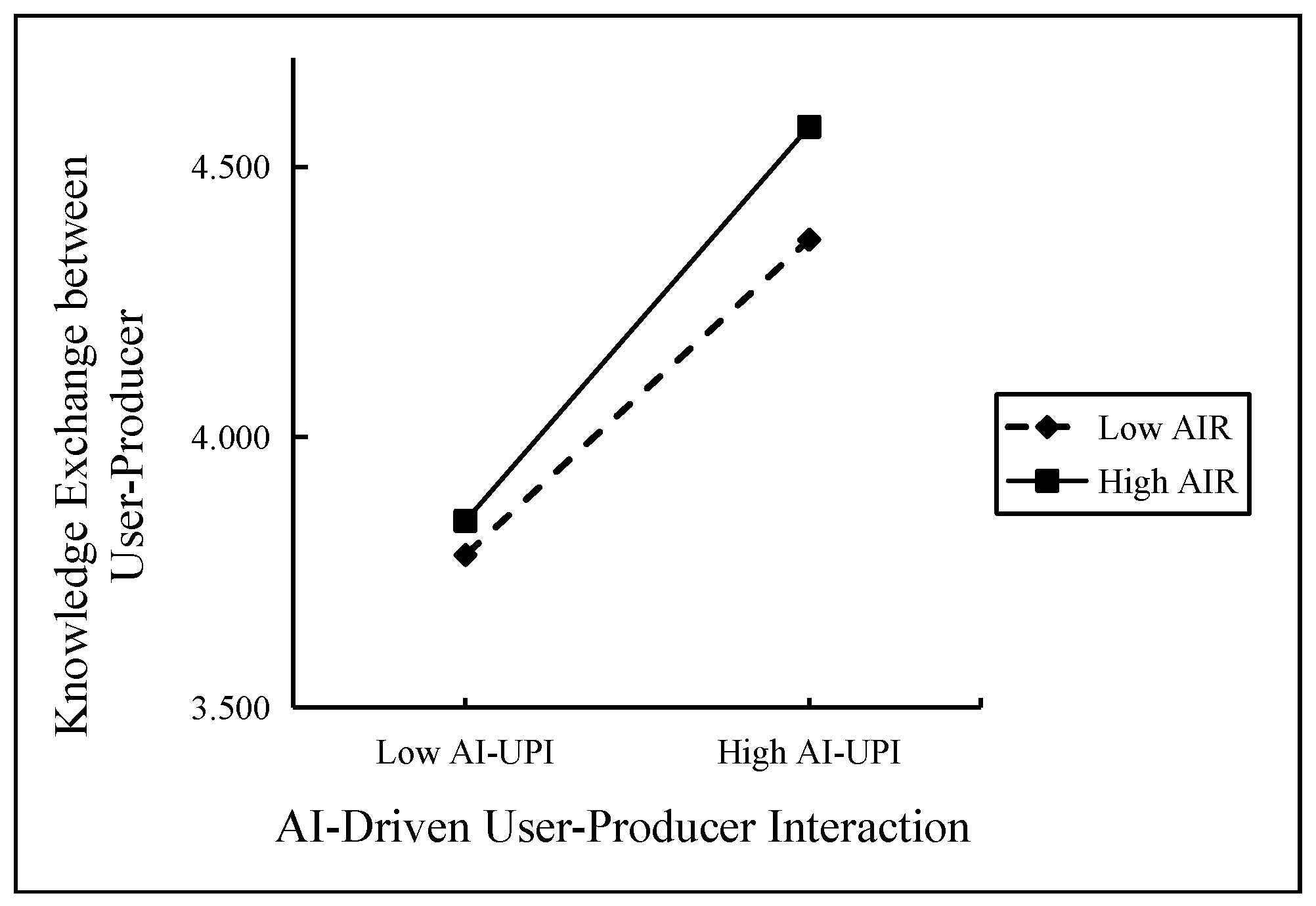
To further illustrate the moderating role of AI Readiness (AIR) in the relationships between ADUPI and both UPKE and UPKI, interaction effects were visualized by plotting simple slopes at one standard deviation above and below the mean of AIR. As shown in Figure 2, the effect of ADUPI on UPKE is stronger under high AIR conditions (simple slope = 0.77, p < 0.001) than under low AIR conditions (simple slope = 0.62, p < 0.001). This pattern indicates a significant positive moderating effect of AIR on the ADUPI–UPKE relationship, providing further support for Hypothesis H3a.
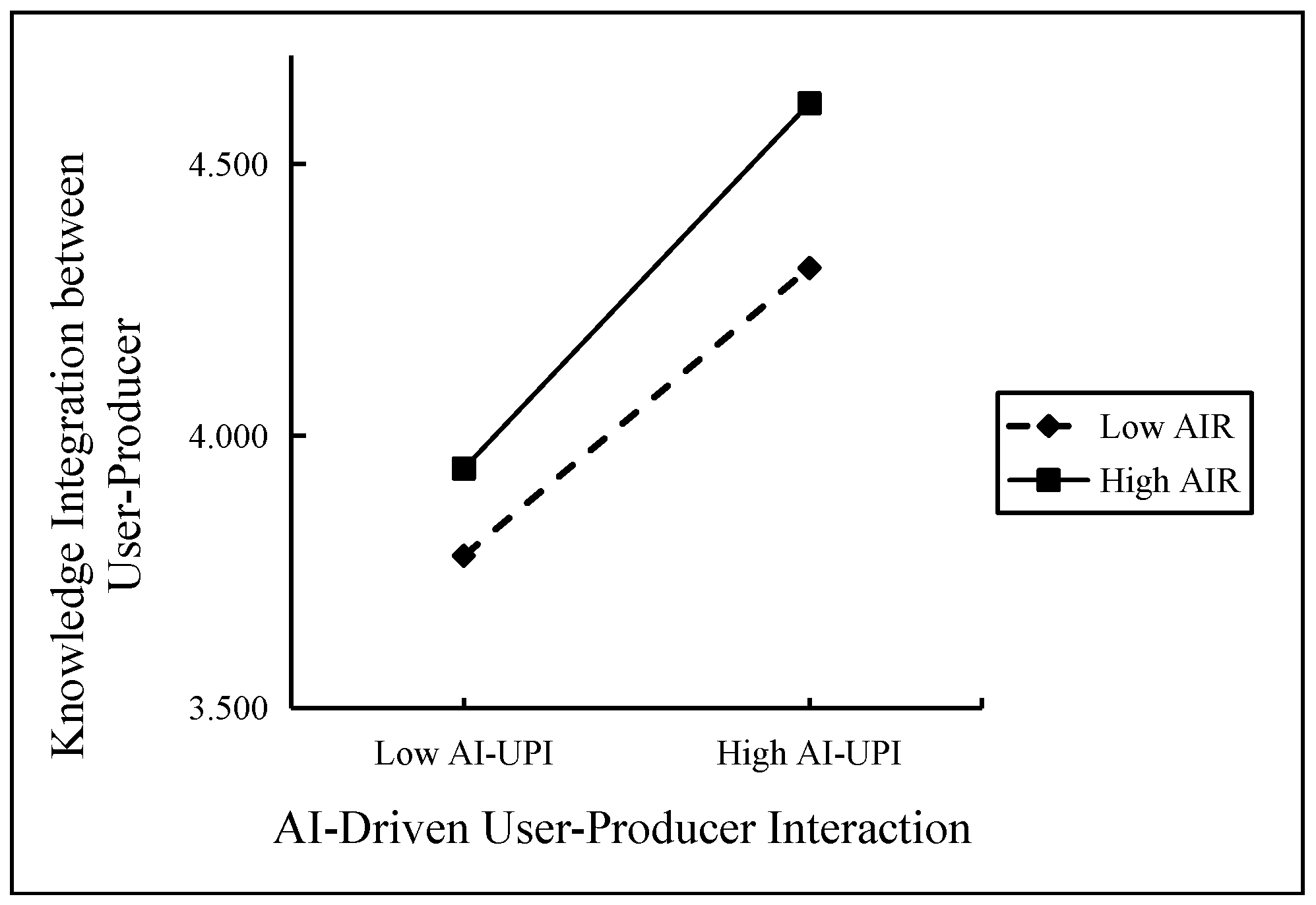
Figure 3 presents a similar pattern for UPKI. Specifically, ADUPI exerts a more pronounced effect on UPKI when AIR is high (simple slope = 0.71, p < 0.001), whereas the effect is weaker under low AIR conditions (simple slope = 0.56, p < 0.001). These results suggest that the positive influence of ADUPI on knowledge integration intensifies as AI readiness increases, confirming the moderating role of AIR in the ADUPI–UPKI relationship and lending additional support to Hypothesis H3b.

4.5. Summary of Empirical Results

To assess the robustness of our conclusions, we conducted several alternative model specifications. First, we re-estimated the dual-mediation model by decomposing it into single-path models and a parallel mediation model. The results show that the coefficients remain significant and consistent in direction across specifications, supporting the stability of the main findings. Second, although the cross-sectional survey design limits the availability of archival instrumental variables, we provide a theoretical rationale for the relative exogeneity of the focal predictor in terms of temporal ordering and causal logic, and we include key controls (e.g., firm size and industry) to mitigate potential endogeneity concerns as much as possible.
As summarized in Table 13, ADUPI exerts both a significant direct effect on UPII and significant indirect effects through UPKE and UPKI, with the dual mediation mechanism accounting for a substantial proportion of the overall influence. These findings indicate that ADUPI not only directly stimulates interconnected innovation but also enhances UPII indirectly by facilitating knowledge exchange and knowledge integration.
Further moderation analyses reveal that AI Readiness (AIR) positively moderates the relationships between ADUPI and both UPKE and UPKI. Specifically, under conditions of higher AIR, the positive effects of ADUPI on knowledge exchange and knowledge integration become more pronounced, thereby amplifying the overall impact of ADUPI on UPII through the dual mediation pathways.
These findings provide empirical evidence clarifying how ADUPI translates into UPII and offer valuable managerial implications, suggesting that firms can enhance interaction outcomes and develop more effective marketing strategies by strengthening algorithmic capabilities, digital infrastructure, and AI readiness. The empirically validated research model and the estimated effects of each pathway are illustrated in Figure 4.

5. Discussion and Conclusions

5.1. Research Conclusions

Based on questionnaire survey data and empirical analysis methods, this study systematically examines the mechanisms through which AI-Driven User–Producer Interaction (ADUPI) influences User–Producer Interconnected Innovation (UPII), with a particular focus on the mediating roles of User–Producer Knowledge Exchange (UPKE) and User–Producer Knowledge Integration (UPKI), as well as the moderating effect of AI Readiness (AIR). The results indicate that ADUPI not only positively associated with UPII but also exerts significant indirect effects through the two pathways of UPKE and UPKI, forming a clear and robust dual mediating mechanism.
First, the regression analysis shows a significant positive association between ADUPI and UPII, confirming the critical role of AI technologies in empowering user–producer relationships and facilitating the transformation of innovation models. This finding suggests that, with the support of AI technologies, Producers and users are more likely to engage in more frequent and higher-quality interactions, thereby effectively stimulating cross-actor collaborative innovation and driving the continuous optimization of products and services.
Second, the mediation analysis reveals the underlying theoretical mechanisms through which ADUPI promotes UPII. Both UPKE and UPKI play significant mediating roles in the relationship between ADUPI and UPII, with the dual mediating effects accounting for a substantial proportion of the overall impact of ADUPI on UPII. This result indicates that AI-driven user–producer interaction does not automatically translate into innovation outcomes; rather, its innovation potential is typically realized through the exchange and integration of knowledge between Producers and users. Compared with simple information transmission, the knowledge fusion and reconstruction mechanism represented by UPKI exhibits stronger explanatory power for innovation outcomes, highlighting the pivotal role of deep knowledge integration in interconnected innovation.
Finally, the moderating effect analysis demonstrates that AIR positively moderates the relationships between ADUPI and UPKE as well as between ADUPI and UPKI. When firms exhibit higher levels of AI Readiness, the positive effects of ADUPI on knowledge exchange and knowledge integration become stronger, thereby further strengthening its overall impact on UPII through the dual mediating pathways. In contrast, under conditions of lower AIR, even frequent interactions between Producers and users may fail to generate effectively identifiable, integrable, and exploitable knowledge value, which in turn weakens the role of interaction in promoting innovation.
Taken together, in e-commerce settings, AI-driven producer–user interaction can significantly shape firms’ innovation outcomes through UPKE and UPKI, offering empirical insights for platform firms and online marketplace operators.

5.2. Theoretical Contributions

First, this study deepens the theoretical understanding of the relationship between AI and interconnected innovation by adopting a user–producer interaction perspective, thereby extending the analytical boundaries of existing AI innovation research. Most prior studies have examined the impact of AI technologies on innovation performance, decision efficiency, or organizational capabilities from an internal firm perspective, emphasizing the instrumental role of AI in data analytics, process optimization, and R&D support [57,58]. Although a small number of studies have begun to explore the influence of AI on business models, business ecosystems, or value networks [59], limited attention has been paid to how AI reshapes interactions between firms and users and, in turn, drives interconnected innovation characterized by distributed multi-actor participation. To address this gap, this study introduces the concept of AI-Driven User–Producer Interaction (ADUPI) and systematically elucidates how AI technologies empower user–producer relationships by enhancing interaction frequency, enabling precise matching, and facilitating continuous feedback, thereby promoting User–Producer Interconnected Innovation (UPII). In doing so, this study advances AI innovation research from an emphasis on “internal firm enablement” toward a broader theoretical perspective of “cross-actor collaborative innovation.”
Second, by distinguishing and integrating User–Producer Knowledge Exchange (UPKE) and User–Producer Knowledge Integration (UPKI), this study develops a dual mediating theoretical framework of “user–producer interaction–knowledge mechanisms–interconnected innovation,” thereby enriching the knowledge-based view and open innovation theory. Although existing studies widely acknowledge the central role of knowledge in innovation, most focus on a single mechanism, such as knowledge acquisition or knowledge sharing [23,29], and pay limited attention to the differentiated functions of knowledge across the stages of knowledge flow and knowledge integration. Within the context of user–producer interaction, this study clearly distinguishes between the bidirectional knowledge flow mechanism represented by UPKE and the knowledge fusion, reconstruction, and re-creation mechanism embodied in UPKI. The empirical results demonstrate that both mechanisms play critical but differential mediating roles in the relationship between ADUPI and UPII. This finding responds to the long-standing debate in open innovation research regarding whether knowledge flows necessarily translate into innovation outcomes [60], indicating that knowledge exchange alone is insufficient to sustain innovation, and that deep knowledge integration constitutes a necessary condition for achieving interconnected innovation.
Third, this study introduces AI Readiness (AIR) as a key contextual variable and reveals the moderating role of firm heterogeneity in the process of AI value realization, thereby enriching research on dynamic capabilities and technological readiness. Prior studies suggest that technologies per se do not automatically generate performance or innovation advantages; rather, their value critically depends on firms’ organizational capabilities to absorb, integrate, and apply them [61,62]. The findings of this study further show that AIR not only affects firms’ direct application outcomes of AI technologies but also significantly moderates the efficiency with which ADUPI is transformed into UPKE and UPKI. This result advances explanations in the AI capability literature regarding why similar AI investments may lead to divergent innovation outcomes across firms [48], highlighting the bridging role of AI readiness between technological potential and open innovation outputs. This study is based on firm-level evidence from Mainland China. China’s institutional environment—characterized by policy support for digital transformation and AI adoption, industrial guidance, and evolving frameworks for data openness and regulation—provides an enabling backdrop for firms to implement AI. At the same time, substantial variation exists in firms’ digital infrastructure, informatization, and data governance maturity, which directly affects their ability to convert AI into tangible business value, namely AIR. Specifically, stronger digital infrastructure and more mature data management processes can enable firms to engage in more efficient interaction with users, thereby reinforcing the positive moderating role of AIR on UPKE and UPKI. In contrast, firms with weaker digital capabilities or limited institutional support may face constraints that dampen the effect of AIR. By explicating the contingent roles of institutional conditions and digital maturity, this study offers theoretical and empirical grounding for understanding the boundary conditions of AIR across different contexts.
Finally, from an interconnected innovation perspective, this study responds to theoretical issues and emerging trends related to the evolution of innovation modes in the era of digital intelligence. Unlike traditional firm-centered and linear innovation models, interconnected innovation emphasizes multi-actor participation, knowledge co-creation, and continuous evolution [63]. The findings of this study indicate that, under the support of AI technologies, Producers and users can jointly participate in the innovation process through interaction, knowledge exchange, and knowledge integration, thereby driving a transition in innovation modes from a producer-dominated logic toward a user–producer collaborative logic. This conclusion not only enriches the literature on open innovation and platform-based innovation but also provides new empirical evidence for understanding the formation mechanisms of innovation ecosystems in AI-enabled contexts. Moreover, by clarifying how ADUPI influences UPII via UPKE and UPKI, this study offers an actionable theoretical foundation for future work that models producer–user collaborative innovation from complex systems or network perspectives.

5.3. Managerial Implications

First, firms should position AI technologies as critical infrastructures for restructuring user–producer interactions, rather than merely as tools for internal efficiency improvement. This study demonstrates that AI-Driven User–Producer Interaction (ADUPI) constitutes a direct driver of User–Producer Interconnected Innovation (UPII). Accordingly, when advancing AI applications, firms should prioritize the value of AI in connecting Producers and users and enhancing interaction quality, rather than focusing solely on automation or cost reduction. By developing intelligent customer service systems, personalized recommendation engines, real-time feedback mechanisms, and data analytics platforms, firms can continuously capture user needs and feedback before, during, and after transactions, thereby providing stable and dynamic data foundations for innovation activities [64,65,66]. Such practices enable firms to shift from passively responding to demand toward proactively guiding innovation through interaction. In addition, e-commerce firms should invest in building AI-enabled interaction systems, and by enhancing interaction frequency and quality as well as strengthening capabilities for UPKE and UPKI, they can more effectively promote product and service innovation and achieve sustainable competitive advantage on digital platforms.
Second, firms should move beyond merely increasing interaction frequency and instead focus on deepening knowledge mechanisms by enhancing capabilities for knowledge exchange and knowledge integration. The empirical results indicate that the impact of ADUPI on UPII is primarily realized through the two pathways of User–Producer Knowledge Exchange (UPKE) and User–Producer Knowledge Integration (UPKI), with knowledge integration exhibiting stronger explanatory power. This implies that interaction alone does not automatically generate innovation advantages; rather, the key lies in firms’ ability to transform dispersed information generated through interaction into reconstructable and applicable knowledge. Firms should therefore establish data governance systems, cross-functional coordination mechanisms, and user-involved innovation processes to systematically integrate user feedback, usage behaviors, and demand information into product development, service optimization, and business model innovation, thereby facilitating a transition from information accumulation to knowledge creation.
Third, firms should systematically enhance AI Readiness (AIR) to amplify the overall effect of transforming ADUPI into UPII. This study finds that AIR positively moderates the relationships between ADUPI and both UPKE and UPKI, such that the interconnected innovation effects of AI-driven interaction are significantly strengthened under conditions of high AIR. Consequently, when implementing AI strategies, firms should not concentrate solely on technology adoption itself, but should simultaneously advance the development of technological infrastructure, data processing capabilities, organizational support mechanisms, and strategic alignment. By improving AI readiness, firms can more effectively identify, integrate, and exploit knowledge resources generated through interaction, thereby achieving sustained interconnected innovation in highly uncertain market environments.

5.4. Research Limitations and Future Research Directions

Despite its contributions, this study has limitations. First, this study relies on cross-sectional survey evidence. Although multiple remedies were adopted to mitigate CMB, a cross-sectional design cannot support strict causal inference and therefore cannot fully rule out potential reverse causality or endogeneity concerns. In other words, the relationships identified in this study primarily reflect statistical associations and their consistency with the theoretical framework rather than definitive causal effects. Future research could address this limitation by incorporating longitudinal or secondary data, collecting information on interaction, knowledge mechanisms, and UPII at multiple time points to better capture the dynamic evolution of these processes.
Second, this study primarily measures user–producer interaction and innovation outcomes from the firm perspective. The measures therefore capture firms’ subjective perceptions of user interaction behaviors rather than directly observing users as independent actors, which limits the granularity with which the micro-level interaction process can be portrayed. Future research could incorporate user-side data by using matched firm–user samples to collect information from both users and firms and to examine how user behaviors relate to firms’ innovation outcomes, thereby offering a more comprehensive account of how collaborative innovation emerges. Alternatively, researchers could adopt multi-actor or multi-level designs (e.g., multilevel modeling) to more fully capture the formation mechanisms of collaborative innovation between the two sides.
Third, this study focuses on the moderating role of overall AI Readiness (AIR). Future research could further disaggregate AI readiness into its constituent dimensions and examine the differential effects of technological, organizational, and strategic AI capabilities on interaction-driven innovation processes. For example, technological AIR may be captured through data infrastructure and algorithmic capability; organizational AIR may be reflected in employee skills and process optimization; and strategic AIR may be indicated by top management support and the clarity of AI strategy. Such a more fine-grained approach would help clarify the specific channels through which AIR shapes interaction and innovation outcomes. Such extensions would deepen insights into how specific AI-related capabilities condition the transformation of AI-driven interaction into knowledge exchange, knowledge integration, and ultimately interconnected innovation.


Author Contributions

Conceptualization, H.L.; methodology, Y.Y. and H.L.; data curation, Y.Y., H.L. and M.L.; investigation, H.L.; formal analysis, Y.Y., H.L. and M.L.; writing—original draft, Y.Y., H.L. and M.L.; writing—review & editing, H.L. and Y.Y.; visualization, Y.Y. and M.L.; supervision, H.L.; project administration, H.L.; Resources, H.L.; Software, M.L. and K.W.; Validation, Y.Y., H.L. and K.W.; funding acquisition, H.L. All authors have read and agreed to the published version of the manuscript.

Funding

This study was supported by the National Social Science Fund of China (Grant No. 24AGL016).

Institutional Review Board Statement

The study was conducted in accordance with the Declaration of Helsinki, and approved by the Ethics Committee of Business School, Beijing Information Science and Technology University (protocol code EA20250925, 25 September 2025).

Informed Consent Statement

Informed consent was obtained from all subjects involved in the study.

Data Availability Statement

The data presented in this study are available on request from the author.

Acknowledgments

The authors would like to thank the anonymous reviewers for their reviews and comments.

Conflicts of Interest

The author declares no conflicts of interest.

References

  1. Spreitzenbarth, J.M.; Bode, C.; Stuckenschmidt, H. Artificial intelligence and machine learning in purchasing and supply management: A mixed-methods review of the state-of-the-art in literature and practice. J. Purch. Supply Manag. 2024, 30, 100896. [Google Scholar] [CrossRef]
  2. Chau, H.K.L.; Ngo, T.T.A.; Bui, C.T.; Tran, N.P.N. Human-AI Interaction in E-Commerce: The Impact of AI-Powered Customer Service on User Experience and Decision-Making. Comput. Hum. Behav. Rep. 2025, 19, 100725. [Google Scholar] [CrossRef]
  3. Jin, S.; Wang, H. The disruptive innovation impact of supply and demand matching in digital platforms using fuzzy-set qualitative comparative analysis methodology: Evidence from China. Sustainability 2024, 16, 540. [Google Scholar] [CrossRef]
  4. Yin, J.; Qiu, X.; Wang, Y. The Impact of AI-Personalized Recommendations on Clicking Intentions: Evidence from Chinese E-Commerce. J. Theor. Appl. Electron. Commer. Res. 2025, 20, 21. [Google Scholar] [CrossRef]
  5. Pedreschi, D.; Pappalardo, L.; Ferragina, E.; Baeza-Yates, R.; Barabási, A.L.; Dignum, F.; Dignum, V.; Eliassi-Rad, T.; Giannotti, F.; Kertész, J.; et al. Human-AI coevolution. Artif. Intell. 2025, 339, 104244. [Google Scholar] [CrossRef]
  6. Muhammad, R.A.; Tjahjono, B.; Kader Ibrahim, B.S.K.M.; Dewi Ridlo, S.R.K.; Yuwono, T.Y. A Decision Process for the Applications of Artificial Intelligence in Sustainable Operations and Supply Chain Management. In Proceedings of the 11th Annual International Conference on Industrial Engineering and Operations Management (IEOM 2021), Virtual/Online, 7–11 March 2021; IEOM Society International: Singapore, 2021; pp. 5071–5082. [Google Scholar] [CrossRef]
  7. Alomar, M.A. Performance optimization of industrial supply chain using artificial intelligence. Comput. Intell. Neurosci. 2022, 2022, 9306265. [Google Scholar] [CrossRef]
  8. Qin, M.; Zhu, W.; Zhao, S.; Zhao, Y. Is artificial intelligence better than manpower? The effects of different types of online customer services on customer purchase intentions. Sustainability 2022, 14, 3974. [Google Scholar] [CrossRef]
  9. Bunea, O.I.; Corboș, R.A.; Mișu, S.I.; Triculescu, M.; Trifu, A. The next-generation shopper: A study of generation-Z perceptions of AI in online shopping. J. Theor. Appl. Electron. Commer. Res. 2024, 19, 2605–2629. [Google Scholar] [CrossRef]
  10. Amirkolaii, K.N.; Baboli, A.; Shahzad, M.K.; Tonadre, R. Demand forecasting for irregular demands in business aircraft spare parts supply chains by using artificial intelligence (AI). IFAC-PapersOnLine 2017, 50, 15221–15226. [Google Scholar] [CrossRef]
  11. An, T.L.; Wei, J.; Jiang, G. Complex Networks-Based Interconnected Innovation in Chinese Enterprises. Soc. Sci. China 2023, 10, 24–43+204–205. [Google Scholar]
  12. Wang, J. Research on the impact of customer participation in virtual community on service innovation performance—The role of knowledge transfer. Front. Psychol. 2022, 13, 847713. [Google Scholar] [CrossRef]
  13. Balboni, B.; Marchi, G.; Vignola, M. Knowledge transfer in the context of buyer–supplier relationship: An analysis of a supplier’s customer portfolio. J. Bus. Res. 2017, 80, 277–287. [Google Scholar] [CrossRef]
  14. Khan, I.S.; Kauppila, O.; Fatima, N.; Majava, J. Stakeholder interdependencies in a collaborative innovation project. J. Innov. Entrep. 2022, 11, 38. [Google Scholar] [CrossRef]
  15. Wang, K.; Gao, Y.Y. How Does the Enterprise Interconnected Innovation Model Drive Disruptive Innovation? Micro-evidence from Zhongguancun Haidian Science Park, China. J. Beijing Technol. Bus. Univ. (Soc. Sci.) 2025, 40, 116–130. [Google Scholar]
  16. Agate, J. Artificial intelligence methods and approaches to improve data quality in helthcare data. Artif. Intell. Life Sci. 2025, 8, 100135. [Google Scholar] [CrossRef]
  17. D’Amico, E.; Belitski, M.; Braga, A.; Savoie, R. Enhancing knowledge spillover of innovation through artificial intelligence: An empirical investigation. J. Technol. Transf. 2025, 1–29. [Google Scholar] [CrossRef]
  18. Lenka, S.; Parida, V.; Wincent, J. Digitalization capabilities as enablers of value co-creation in servitizing firms. Psychol. Mark. 2017, 34, 92–100. [Google Scholar] [CrossRef]
  19. Batt, P.J.; Purchase, S. Managing collaboration within networks and relationships. Ind. Mark. Manag. 2004, 33, 169–174. [Google Scholar] [CrossRef]
  20. Oganisjana, K.; Kozlovskis, K. The identification of opportunities for innovations through collecting problems from citizens. J. Open Innov. Technol. Mark. Complex. 2019, 5, 76. [Google Scholar] [CrossRef]
  21. Imran, M.K.; Iqbal, S.M.J.; Aslam, U.; Fatima, T. Does social media promote knowledge exchange? A qualitative insight. Manag. Decis. 2019, 57, 688–702. [Google Scholar] [CrossRef]
  22. Mitton, C.; Adair, C.E.; McKenzie, E.; Patten, S.B.; Perry, B.W. Knowledge transfer and exchange: Review and synthesis of the literature. Milbank Q. 2007, 85, 729–768. [Google Scholar] [CrossRef]
  23. Grant, R.M. Toward a knowledge-based theory of the firm. Strateg. Manag. J. 1996, 17, 109–122. [Google Scholar] [CrossRef]
  24. Vargo, S.L.; Lusch, R.F. Evolving to a new dominant logic for marketing. In the Service-Dominant Logic of Marketing; Routledge: New York, NY, USA, 2014; pp. 3–28. [Google Scholar]
  25. Barreau, J.; Havard, C.; Bah, A.N. Global union federations and international framework agreements: Knowledge exchange and creation. Eur. J. Ind. Relat. 2020, 26, 41–57. [Google Scholar] [CrossRef]
  26. Ye, F.; Agarwal, R. Strategic information technology partnerships in outsourcing as a distinctive source of information technology value: A social capital perspective. In Proceedings of the ICIS 2003 Proceedings, Seattle, WA, USA, 14–17 December 2003; p. 26. [Google Scholar]
  27. Mabert, V.A.; Venkataramanan, M.A. Special research focus on supply chain linkages: Challenges for design and management in the 21st century. Decis. Sci. 1998, 29, 537–552. [Google Scholar] [CrossRef]
  28. Wang, X.; Arnett, D.B.; Hou, L. Using external knowledge to improve organizational innovativeness: Understanding the knowledge leveraging process. J. Bus. Ind. Mark. 2016, 31, 164–173. [Google Scholar] [CrossRef]
  29. Von Hippel, E. Democratizing Innovation; MIT Press: Cambridge, MA, USA, 2006; p. 216. [Google Scholar]
  30. Chang, J. The effects of buyer-supplier’s collaboration on knowledge and product innovation. Ind. Mark. Manag. 2017, 65, 129–143. [Google Scholar] [CrossRef]
  31. Davenport, T.; Guha, A.; Grewal, D.; Bressgott, T. How artificial intelligence will change the future of marketing. J. Acad. Mark. Sci. 2020, 48, 24–42. [Google Scholar] [CrossRef]
  32. Rai, A. Explainable AI: From black box to glass box. J. Acad. Mark. Sci. 2020, 48, 137–141. [Google Scholar] [CrossRef]
  33. Marwala, T.; Hurwitz, E. Artificial intelligence and asymmetric information theory. arXiv 2015, arXiv:1510.02867. [Google Scholar] [CrossRef]
  34. Franke, N.; Von Hippel, E. Satisfying heterogeneous user needs via innovation toolkits: The case of Apache security software. Res. Policy 2003, 32, 1199–1215. [Google Scholar] [CrossRef]
  35. Vogel, O.; Hunecke, M. Fostering knowledge integration through individual competencies: The impacts of perspective taking, reflexivity, analogical reasoning and tolerance of ambiguity and uncertainty. Instr. Sci. 2024, 52, 227–248. [Google Scholar] [CrossRef]
  36. Eslami, M.H.; Lakemond, N. Knowledge integration with customers in collaborative product development projects. J. Bus. Ind. Mark. 2016, 31, 889–900. [Google Scholar] [CrossRef]
  37. Huang, J.C.; Newell, S. Knowledge integration processes and dynamics within the context of cross-functional projects. Int. J. Proj. Manag. 2003, 21, 167–176. [Google Scholar] [CrossRef]
  38. Shah, R.; Ward, P.T. Defining and developing measures of lean production. J. Oper. Manag. 2007, 25, 785–805. [Google Scholar] [CrossRef]
  39. Luo, Y.; Child, J. A composition-based view of firm growth. Manag. Organ. Rev. 2015, 11, 379–411. [Google Scholar] [CrossRef]
  40. Lyu, C.; Zhang, F.; Ji, J.; Teo, T.S.; Wang, T.; Liu, Z. Competitive intensity and new product development outcomes: The roles of knowledge integration and organizational unlearning. J. Bus. Res. 2022, 139, 121–133. [Google Scholar] [CrossRef]
  41. Roller, D.; Eck, O.; Dalakakis, S. Knowledge-based support of rapid product development. J. Eng. Des. 2004, 15, 367–388. [Google Scholar] [CrossRef]
  42. Amankwah-Amoah, J.; Adomako, S. The effects of knowledge integration and contextual ambidexterity on innovation in entrepreneurial ventures. J. Bus. Res. 2021, 127, 312–321. [Google Scholar] [CrossRef]
  43. Jayaram, J.; Pathak, S. A holistic view of knowledge integration in collaborative supply chains. Int. J. Prod. Res. 2013, 51, 1958–1972. [Google Scholar] [CrossRef]
  44. Shamsuddoha, M.; Khan, E.A.; Chowdhury, M.M.H.; Nasir, T. Revolutionizing supply chains: Unleashing the power of AI-driven intelligent automation and real-time information flow. Information 2025, 16, 26. [Google Scholar] [CrossRef]
  45. Huang, X.; Zhou, Q. Knowledge management model in the integration of open innovation and circular economy driven by digital intelligence: A comparative multi-case study. J. Innov. Knowl. 2025, 10, 100839. [Google Scholar] [CrossRef]
  46. Berghman, L.; Matthyssens, P.; Vandenbempt, K. Value innovation, deliberate learning mechanisms and information from supply chain partners. Ind. Mark. Manag. 2012, 41, 27–39. [Google Scholar] [CrossRef]
  47. Alsheibani, S.; Cheung, Y.; Messom, C. Artificial intelligence adoption: AI-readiness at firm-level. In Proceedings of the Pacific Asia Conference on Information Systems, Yokohama, Japan, 26 June–30 June 2018; Association for Information Systems: Atlanta, GA, USA; p. 37. [Google Scholar]
  48. Jöhnk, J.; Weißert, M.; Wyrtki, K. Ready or not, AI comes—An interview study of organizational AI readiness factors. Bus. Inf. Syst. Eng. 2021, 63, 5–20. [Google Scholar] [CrossRef]
  49. Holmström, J. From AI to digital transformation: The AI readiness framework. Bus. Horiz. 2022, 65, 329–339. [Google Scholar] [CrossRef]
  50. Molla, A.; Cooper, V.A.; Pittayachawan, S. IT and eco-sustainability: Developing and validating a green IT readiness model. In Proceedings of the International Conference on Information Systems, ICIS 2009 proceedings, Phoenix, AZ, USA, 15–18 December 2009; p. 141. [Google Scholar] [CrossRef]
  51. Sundaresan, S.; Zhang, Z. AI-enabled knowledge sharing and learning: Redesigning roles and processes. Int. J. Organ. Anal. 2022, 30, 983–999. [Google Scholar] [CrossRef]
  52. Gelashvili-Luik, T.; Vihma, P.; Pappel, I. Navigating the AI Revolution: Challenges and Opportunities for Integrating Emerging Technologies into Knowledge Management Systems. Systematic Literature Review. Front. Artif. Intell. 2025, 8, 1595930. [Google Scholar] [CrossRef]
  53. Collins, C.J.; Smith, K.G. Knowledge exchange and combination: The role of human resource practices in the performance of high-technology firms. Acad. Manag. J. 2006, 49, 544c560. [Google Scholar] [CrossRef]
  54. Hair, J.F.; Black, W.C.; Babin, B.J.; Anderson, R.E. Multivariate Data Analysis, 8th ed.; Cengage: Boston, MA, USA, 2019. [Google Scholar]
  55. Fornell, C.; Larcker, D.F. Evaluating structural equation models with unobservable variables and measurement error. J. Mark. Res. 1981, 18, 39–50. [Google Scholar] [CrossRef]
  56. Baron, R.M.; Kenny, D.A. The moderator-mediator variable distinction in social psychological research: Conceptual, strategic, and statistical considerations. J. Pers. Soc. Psychol. 1986, 51, 1173–1182. [Google Scholar] [CrossRef]
  57. Davenport, T.H.; Ronanki, R. Artificial intelligence for the real world. Harv. Bus. Rev. 2018, 96, 108–116. [Google Scholar]
  58. Raisch, S.; Krakowski, S. Artificial intelligence and management: The automation-augmentation paradox. Acad. Manag. Rev. 2021, 46, 192–210. [Google Scholar] [CrossRef]
  59. Iansiti, M.; Lakhani, K.R. Competing in the Age of AI: Strategy and Leadership When Algorithms and Networks Run the World; Harvard Business Press: Boston, MA, USA, 2020. [Google Scholar]
  60. Laursen, K.; Salter, A. Open for innovation: The role of openness in explaining innovation performance among UK manufacturing firms. Strateg. Manag. J. 2006, 27, 131–150. [Google Scholar] [CrossRef]
  61. Zahra, S.A.; George, G. Absorptive capacity: A review, reconceptualization, and extension. Acad. Manag. Rev. 2002, 27, 185–203. [Google Scholar] [CrossRef]
  62. Teece, D.J. Explicating dynamic capabilities: The nature and microfoundations of (sustainable) enterprise performance. Strateg. Manag. J. 2007, 28, 1319–1350. [Google Scholar] [CrossRef]
  63. Nambisan, S.; Lyytinen, K.; Majchrzak, A.; Song, M. Digital innovation management: Reinventing innovation management research in a digital world. MIS Q. 2017, 41, 223–238. [Google Scholar] [CrossRef]
  64. Su, Y.S.; Wang, J.Q.; Tu, S.H.; Liao, K.T.; Lin, C.L. Detecting Latent Topics and Trends in IoT and E-Commerce Using BERTopic Modeling. Internet Things 2025, 32, 101604. [Google Scholar] [CrossRef]
  65. Xie, Z.; Niu, W.; Lin, C.; Fu, S.; Liao, K.; Zhang, W. Loss of Control: AI-Based Decision-Making Induces Negative Company Evaluation. Chin. Manag. Stud. 2025. [Google Scholar] [CrossRef]
  66. Shiau, W.L.; Shih, C.H.; Lin, C.L.; Jiang, S.Z.; Dwivedi, Y.K.; Yu, W.P.; Chen, K. Exploring Core Knowledge in Mobile Payment Research. J. Organ. End User Comput. 2025, 37, 1–38. [Google Scholar] [CrossRef]
Figure 1. The Proposed Research Model.
Jtaer 21 00071 g001
Figure 2. The moderating effect of AIR on ADUPI and UPKE.
Jtaer 21 00071 g002
Figure 3. The moderating effect of AIR on ADUPI and UPKI.
Jtaer 21 00071 g003
Figure 4. Tested research model and effect sizes. Remark 8: “*” “**” and “***” indicate significance at the 0.05, 0.01, and 0.001 levels (two-tailed), respectively.
Jtaer 21 00071 g004
Table 1. Scale items design of the survey questionnaire.
VariablesCodeItemReference
ADUPIA1Based on AI technologies, our firm can establish effective communication with users to accurately identify their needs and changes.Spreitzenbarth et al. (2024) [1]
A2Based on AI technologies, users can quickly access information on our firm’s new products, technological updates, quality, and services.
A3Based on AI algorithms, our firm can dynamically match and recommend suitable products and services to meet users’ real-time needs.
A4Based on AI algorithms, users can obtain real-time information on our products, prices, quality, and services, improving purchasing efficiency.
A5Based on AI technologies, our firm can promptly collect post-transaction usage data to continuously enhance after-sales services.
A6Based on AI technologies, users can provide real-time post-transaction feedback and suggestions to support continuous product iteration.
UPKEB1Before transactions, our firm can effectively exchange product and demand information with users.Collins and Smith (2006) [53]
B2During transactions, our firm can maintain real-time interaction with users to exchange views on product–need fit.
B3After transactions, our firm can continuously capture user experiences and satisfaction to support product and service updates.
UPKIC1Before transactions, our firm can integrate user information to promote continuous product and service innovation.Lyu et al. (2022) [40]
C2During transactions, our firm can integrate diverse user needs and accurately recommend optimal products.
C3After transactions, our firm can integrate user experiences and feedback to advance product innovation and business improvement.
AIRD1Based on existing AI technologies and algorithms, our firm can deliver improved products and services to users.Holmström (2022) [49]
D2Based on existing AI technologies and algorithms, our firm can efficiently conduct key activities such as product development and design.
D3Based on existing AI technologies and algorithms, our firm can carry out innovation, design, after-sales, and marketing across organizational boundaries.
D4Based on existing AI technologies and algorithms, our firm can efficiently achieve current and future strategic and operational goals.
UPIIE1Through real-time interaction with potential users, our firm can accurately identify user needs and track market demand changes.An et al. (2023) [11]
E2Through real-time interaction with potential users, our firm can identify innovation opportunities and continuously improve offerings.
E3Our firm can engage in real-time interaction with users on product functions and follow-up services to promote innovation.
E4Based on users’ expressed needs, our firm can continuously update product functions and adjust innovation plans.
E5After transactions, real-time interaction on product quality and functionality supports product and service improvement.
E6After transactions, discussions with users help identify market trends and emerging needs, enabling sustained innovation.
Table 2. Descriptive statistics of the sample (N = 974).
VariablesCategoryFrequencyPercentage
Firm AgeLess than 3 years454.6%
3–5 years11812.1%
6–10 years22823.4%
11–15 years21922.5%
More than 15 years36437.4%
Number of EmployeesFewer than 10022423.0%
101–50038739.7%
501–100019520.0%
1001–500012112.4%
More than 5000474.8%
Ownership TypeState-owned22423.0%
Privately owned68770.5%
Foreign-owned313.2%
Joint venture232.4%
Others90.9%
Revenue ScaleLess than RMB 5 million15916.3%
RMB 5–10 million20521.0%
RMB 10.01–50 million23924.5%
RMB 50–300 million26327.0%
More than RMB 300 million10811.1%
IndustryManufacturing32733.6%
Construction575.9%
Wholesale and retail10911.2%
Transportation, warehousing, and postal services333.4%
Information, computer, and software services20420.9%
Insurance, banking, and securities555.6%
Others18919.4%
DepartmentStrategic planning/General management office404.1%
Human resources/Finance/Legal affairs24024.6%
Marketing/Branding/Sales23624.2%
Product/R&D/Technology32833.7%
Operations/Supply chain13013.3%
Managerial PositionDecision-making level90.9%
Senior management939.5%
Middle management26927.6%
Executive management41542.6%
Junior management18819.3%
TenureOne year or less798.1%
1–3 years26827.5%
4–6 years30030.8%
7–10 years20420.9%
More than 10 years12312.6%
Table 3. Reliability test of scale items (N = 974).
VariablesItemCorrected Item Total Correlation (CITC)Factor LoadingsCronbach’s α If Item DeletedCronbach’s αCRAVE
ADUPIA10.5650.7210.7470.7840.8490.484
A20.5650.7180.744
A30.5180.6770.756
A40.5010.6710.760
A50.5550.7150.747
A60.5110.6720.757
UPKEB10.5480.8060.6260.7210.8430.642
B20.5610.8160.609
B30.5160.7820.664
UPKIC10.5560.8160.5870.7110.8380.634
C20.5030.7760.652
C30.5280.7960.622
AIRD10.5280.7570.6550.7240.8290.549
D20.4790.7060.682
D30.5040.7290.670
D40.5430.7690.645
UPIIE10.5040.6770.7250.7610.8340.456
E20.4960.6700.727
E30.5110.6850.723
E40.5000.6740.726
E50.4730.6450.733
E60.5260.6980.719
Remark 1: CR = composite reliability; AVE = average variance extracted.
Table 4. Discriminative validity analysis (N = 974).
VariablesADUPIUPKEUPKIAIRUPII
ADUPI0.696
UPKE0.6200.801
UPKI0.5880.5980.796
AIR0.5550.4030.4440.741
UPII0.6780.6410.6770.5360.675
Remark 2: The diagonal number is the AVE square root value; AVE = average variance extracted.
Table 5. Confirmatory factor analysis.
MeasureValueThreshold
χ2/df2.365acceptable if <3
RMR0.014acceptable if <0.08
GFI0.958acceptable if >0.90
NFI0.933acceptable if >0.90
IFI0.960acceptable if >0.90
CFI0.960acceptable if >0.90
Table 6. Correlations among variables (N = 974).
VariablesMeanStd.DevADUPIUPKEUPKIAIRUPII
ADUPI4.2170.4731
UPKE4.1620.5260.620 **1
UPKI4.1800.5550.588 **0.598 **1
AIR4.1840.5110.555 **0.403 **0.444 **1
UPII4.2500.4730.678 **0.641 **0.677 **0.536 **1
Remark 3: “*” “**” and “***” indicate significance at the 0.05, 0.01, and 0.001 levels (two-tailed), respectively.
Table 7. Common method bias.
χ2/dfRMSEACFIGFIIFITLI
Original model2.3650.0370.9600.9580.9600.954
Common method factor model1.9760.0320.9750.9690.9750.967
Changes in model fit ∆RMSEA∆CFI∆GFI∆IFI∆TLI
0.0050.0150.0110.0150.013
Evaluation criteria <0.05<0.1<0.1<0.1<0.1
Table 8. VIF test result.
MeasureToleranceVIF
ADUPI0.4692.130
UPKE0.5321.881
UPKI0.5531.810
AIR0.6701.492
Table 9. The direct effect of ADUPI on UPII (N = 974).
Explanatory VariableDependent Variable
UPKEUPKIUPII
M1M2M3M4M5M6M7M8
Constant4.072 ***1.210 ***4.288 ***1.438 ***4.265 ***1.504 ***1.968 ***1.852 ***
Control VariableControlControlControlControlControlControlControlControl
ADUPI 0.691 *** 0.689 *** 0.667 ***
UPKE 0.564 ***
UPKI 0.563 ***
R-squared0.0230.3890.0250.3520.0490.4700.4330.473
Adjusted R-squared0.0150.3840.0170.3460.0410.4650.4280.468
F2.811 **68.260 ***3.131 **58.191 ***6.153 ***95.002 ***81.752 ***96.173 ***
Remark 4: “*” “**” and “***” indicate significance at the 0.05, 0.01, and 0.001 levels (two-tailed), respectively.
Table 10. The indirect effect of ADUPI on UPII (N = 974).
Explanatory VariableDependent Variable
UPII
M9M10M11M12
Constant4.265 ***1.504 ***1.113 ***0.989 ***
Control VariableControlControlControlControl
ADUPI 0.667 ***0.443 ***0.420 ***
UPKE 0.324 ***
UPKI 0.358 ***
R-squared0.0490.4700.5490.584
Adjusted R-squared0.0410.4650.5440.580
F6.153 ***95.002 ***117.302 ***135.399 ***
Remark 5: “*” “**” and “***” indicate significance at the 0.05, 0.01, and 0.001 levels (two-tailed), respectively.
Table 11. Parallel dual mediation (N = 974).
VariablesEffect ValueSELLCIULCIEffect Size
Total effect0.6670.0240.6200.714100%
Direct effect0.3240.0280.2700.37948.58%
Indirect effectUPKE0.1440.0230.0990.19021.59%
UPKI0.1980.0250.1500.24529.69%
Remark 6: SE = standard error; LLCI/ULCI = lower/upper 95% confidence bounds.
Table 12. Test of the moderating role of AIR (N = 974).
Explanatory VariableDependent Variable
UPKEUPKI
M13M14M15M16M17M18M19M20
Constant4.072 ***1.210 ***1.051 ***0.608 **4.288 ***1.438 ***1.115 ***0.683 **
Control VariableControlControlControlControlControlControlControlControl
ADUPI 0.691 ***0.639 ***0.694 *** 0.689 ***0.582 ***0.635 ***
AIR 0.091 **0.133 *** 0.186 ***0.227 ***
ADUPI × AIR 0.151 *** 0.147 ***
R-squared0.0230.3890.3950.4120.0250.3520.3720.387
Adjusted R-squared0.0150.3840.3880.4050.0170.3460.3660.380
F2.811 **68.260 ***62.764 ***61.242 ***3.131 **58.191 ***57.050 ***55.158 ***
Remark 7: “*” “**” and “***” indicate significance at the 0.05, 0.01, and 0.001 levels (two-tailed), respectively.
Table 13. Results of hypothesis tests (N = 974).
HypothesesPathEffect ValueConclusion
H1AI-Driven User–Producer Interaction → User–producer Interconnected Innovation0.667 ***Support
H2aAI-Driven User–Producer Interaction → User–producer knowledge exchange → User–producer Interconnected Innovation0.144 ***Support
H2bAI-Driven User–Producer Interaction → User–producer knowledge integration → User–producer Interconnected Innovation0.198 ***Support
H3aAI-Driven User–Producer Interaction × AI Readiness → User–producer knowledge exchange0.151 ***Support
H3bAI-Driven User–Producer Interaction × AI Readiness → User–producer knowledge integration0.147 ***Support
Remark 8: “*” “**” and “***” indicate significance at the 0.05, 0.01, and 0.001 levels (two-tailed), respectively.
Disclaimer/Publisher’s Note: The statements, opinions and data contained in all publications are solely those of the individual author(s) and contributor(s) and not of MDPI and/or the editor(s). MDPI and/or the editor(s) disclaim responsibility for any injury to people or property resulting from any ideas, methods, instructions or products referred to in the content.