


Informal Caregiving, Loneliness and Social Isolation: A Systematic Review

Abstract
1. Introduction
2. Methods
2.1. Search Strategy and Selection Criteria
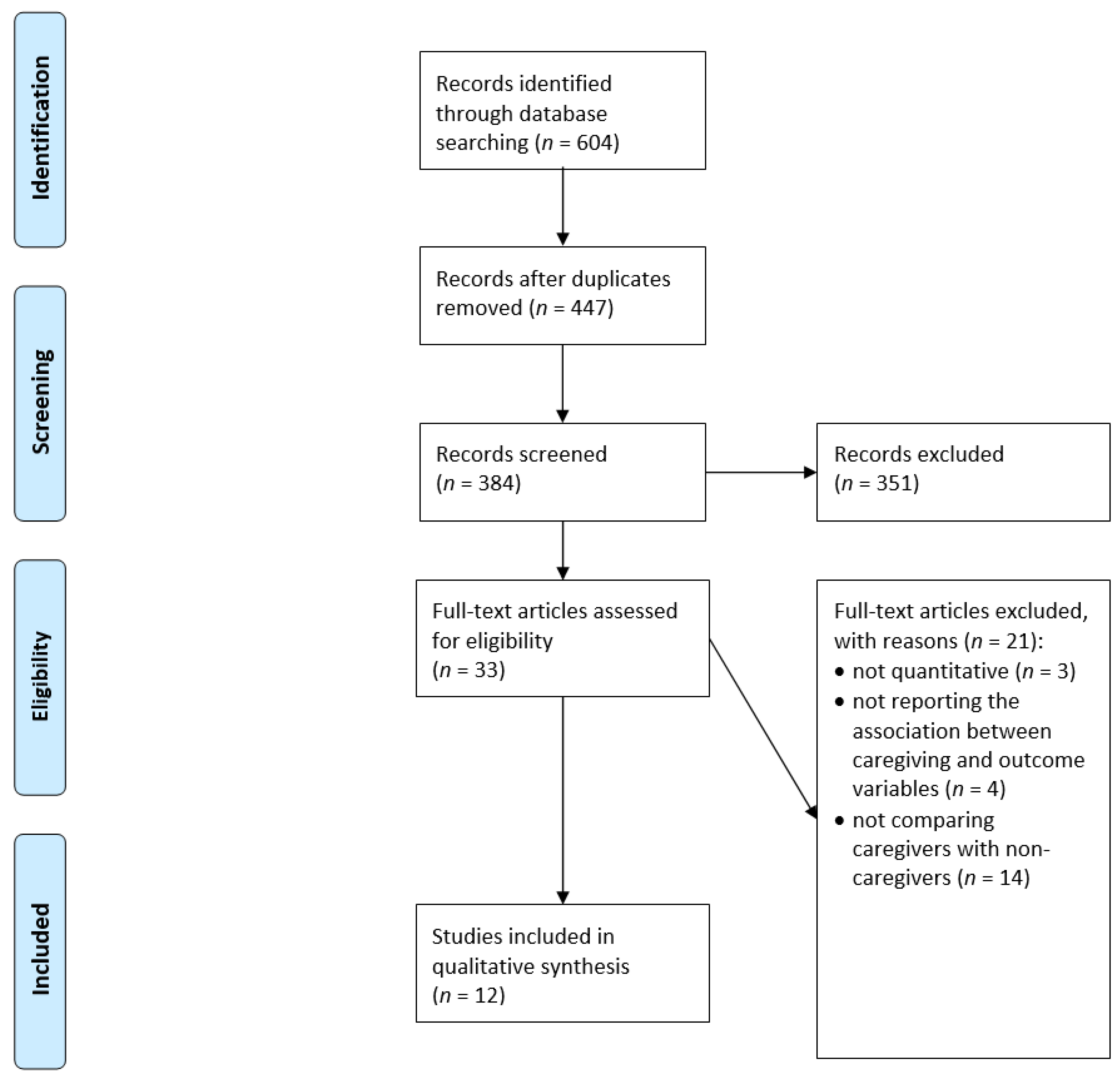
- cross-sectional and longitudinal observational studies analyzing the association between informal caregiving for adults (i.e., ≥18 years) and loneliness or social isolation
- operationalization of main variables with established tools
- studies in English or German language
- published in a peer-reviewed, scientific journal
- studies examining private care for chronically ill children
- studies exclusively using samples with a specific disorder among the caregivers (e.g., studies solely including caregivers with specific disorders)
- Prior to the final eligibility criteria, a pre-test was conducted (with a sample of 100 title/abstracts). Nevertheless, it should be emphasized that our criteria remained unchanged.
2.2. Data Extraction and Analysis
2.3. Assessment of Study Quality/Risk of Bias
3. Results
3.1. Overview of Included Studies
3.2. Informal Caregiving and Loneliness
3.3. Informal Caregiving and Social Isolation
3.4. Quality Assessment
4. Discussion
4.1. Main Findings
4.2. Possible Mechanisms
4.3. Comparability of Studies
4.4. Gaps in Knowledge and Guidance for Future Research
4.5. Strengths and Limitations
5. Conclusions
Author Contributions
Funding
Institutional Review Board Statement
Informed Consent Statement
Data Availability Statement
Conflicts of Interest
References
- Prieto-Flores, M.-E.; Forjaz, M.J.; Fernandez-Mayoralas, G.; Rojo-Perez, F.; Martinez-Martin, P. Factors associated with loneliness of noninstitutionalized and institutionalized older adults. J. Aging Health 2011, 23, 177–194. [Google Scholar] [CrossRef] [PubMed]
- Victor, C.R. Loneliness in care homes: A neglected area of research? Aging Health 2012, 8, 637–646. [Google Scholar] [CrossRef]
- Hajek, A.; Lehnert, T.; Wegener, A.; Riedel-Heller, S.G.; Koenig, H.-H. Long-Term Care Preferences Among Individuals of Advanced Age in Germany: Results of a Population-Based Study. Gesundheitswesen (Bundesverb. Arzte Offentlichen Gesundh.) 2018, 80, 685–692. [Google Scholar]
- Hajek, A.; Lehnert, T.; Wegener, A.; Riedel-Heller, S.G.; König, H.-H. Factors associated with preferences for long-term care settings in old age: Evidence from a population-based survey in Germany. BMC Health Serv. Res. 2017, 17, 156. [Google Scholar] [CrossRef]
- Zwar, L.; König, H.-H.; Hajek, A. Do informal caregivers expect to die earlier? A longitudinal study with a population-based sample on subjective life expectancy of informal caregivers. Gerontology 2021, 67, 467–481. [Google Scholar] [CrossRef]
- Bauer, J.M.; Sousa-Poza, A. Impacts of informal caregiving on caregiver employment, health, and family. J. Popul. Ageing 2015, 8, 113–145. [Google Scholar] [CrossRef]
- Hajek, A.; König, H.-H. Informal caregiving and subjective well-being: Evidence of a population-based longitudinal study of older adults in Germany. J. Am. Med. Dir. Assoc. 2016, 17, 300–305. [Google Scholar] [CrossRef]
- Kaschowitz, J.; Brandt, M. Health effects of informal caregiving across Europe: A longitudinal approach. Soc. Sci. Med. 2017, 173, 72–80. [Google Scholar] [CrossRef]
- Pearlin, L.I.; Mullan, J.T.; Semple, S.J.; Skaff, M.M. Caregiving and the stress process: An overview of concepts and their measures. Gerontologist 1990, 30, 583–594. [Google Scholar] [CrossRef]
- Gallicchio, L.; Siddiqi, N.; Langenberg, P.; Baumgarten, M. Gender differences in burden and depression among informal caregivers of demented elders in the community. Int. J. Geriatr. Psychiatry 2002, 17, 154–163. [Google Scholar] [CrossRef]
- Zwar, L.; König, H.-H.; Hajek, A. Psychosocial consequences of transitioning into informal caregiving in male and female caregivers: Findings from a population-based panel study. Soc. Sci. Med. 2020, 264, 113281. [Google Scholar] [CrossRef]
- Brodaty, H.; Hadzi-Pavlovic, D. Psychosocial effects on carers of living with persons with dementia. Aust. N. Z. J. Psychiatry 1990, 24, 351–361. [Google Scholar] [CrossRef] [PubMed]
- Curvers, N.; Pavlova, M.; Hajema, K.; Groot, W.; Angeli, F. Social participation among older adults (55+): Results of a survey in the region of South Limburg in the Netherlands. Health Soc. Care Community 2018, 26, e85–e93. [Google Scholar] [CrossRef]
- Hajek, A.; König, H.-H. Impact of informal caregiving on loneliness and satisfaction with leisure-time activities. Findings of a population-based longitudinal study in germany. Aging Ment. Health 2019, 23, 1539–1545. [Google Scholar] [CrossRef]
- Stoltz, P.; Uden, G.; Willman, A. Support for family carers who care for an elderly person at home–a systematic literature review. Scand. J. Caring Sci. 2004, 18, 111–119. [Google Scholar] [CrossRef]
- Schüz, B.; Czerniawski, A.; Davie, N.; Miller, L.; Quinn, M.G.; King, C.; Carr, A.; Elliott, K.E.J.; Robinson, A.; Scott, J.L. Leisure Time Activities and Mental Health in Informal Dementia Caregivers. Appl. Psychol. Health Well-Being 2015, 7, 230–248. [Google Scholar] [CrossRef] [PubMed]
- Hajek, A.; König, H.-H. Do loneliness and perceived social isolation reduce expected longevity and increase the frequency of dealing with death and dying? longitudinal findings based on a nationally representative sample. J. Am. Med. Dir. Assoc. 2021, 22, 1720–1725.e5. [Google Scholar] [CrossRef] [PubMed]
- Hajek, A.; König, H.H. Do lonely and socially isolated individuals think they die earlier? The link between loneliness, social isolation and expectations of longevity based on a nationally representative sample. Psychogeriatrics 2021, 21, 571–576. [Google Scholar] [CrossRef]
- Rico-Uribe, L.A.; Caballero, F.F.; Martín-María, N.; Cabello, M.; Ayuso-Mateos, J.L.; Miret, M. Association of loneliness with all-cause mortality: A meta-analysis. PLoS ONE 2018, 13, e0190033. [Google Scholar] [CrossRef]
- Valtorta, N.K.; Kanaan, M.; Gilbody, S.; Ronzi, S.; Hanratty, B. Loneliness and social isolation as risk factors for coronary heart disease and stroke: Systematic review and meta-analysis of longitudinal observational studies. Heart 2016, 102, 1009–1016. [Google Scholar] [CrossRef]
- Victor, C.; Scambler, S.; Bond, J.; Bowling, A. Being alone in later life: Loneliness, social isolation and living alone. Rev. Clin. Gerontol. 2000, 10, 407–417. [Google Scholar] [CrossRef]
- Petersen, N.; König, H.-H.; Hajek, A. The link between falls, social isolation and loneliness: A systematic review. Arch. Gerontol. Geriatr. 2020, 88, 104020. [Google Scholar] [CrossRef] [PubMed]
- Wenger, G.C.; Davies, R.; Shahtahmasebi, S.; Scott, A. Social isolation and loneliness in old age: Review and model refinement. Ageing Soc. 1996, 16, 333–358. [Google Scholar] [CrossRef]
- Bunt, S.; Steverink, N.; Olthof, J.; van der Schans, C.; Hobbelen, J. Social frailty in older adults: A scoping review. Eur. J. Ageing 2017, 14, 323–334. [Google Scholar] [CrossRef] [PubMed]
- Moher, D.; Liberati, A.; Tetzlaff, J.; Altman, D.G.; Group, P. Preferred reporting items for systematic reviews and meta-analyses: The PRISMA statement. PLoS Med. 2009, 6, e1000097. [Google Scholar] [CrossRef] [PubMed]
- Hajek, A.; Kretzler, B.; König, H.-H. Informal caregiving for adults, loneliness and social isolation: A study protocol for a systematic review. BMJ Open 2021, 11, e044902. [Google Scholar] [CrossRef]
- Quirke, E.; König, H.-H.; Hajek, A. Association between caring for grandchildren and feelings of loneliness, social isolation and social network size: A cross-sectional study of community dwelling adults in Germany. BMJ Open 2019, 9, e029605. [Google Scholar] [CrossRef]
- Quirke, E.; König, H.-H.; Hajek, A. What are the social consequences of beginning or ceasing to care for grandchildren? Evidence from an asymmetric fixed effects analysis of community dwelling adults in Germany. Aging Ment. Health 2021, 25, 969–975. [Google Scholar] [CrossRef]
- National Heart, Lung, and Blood Institute. Study Quality Assessment Tools. Available online: https://www.nhlbi.nih.gov/health-topics/study-quality-assessment-tools (accessed on 17 November 2021).
- Hajek, A.; Kretzler, B.; König, H.-H. Multimorbidity, loneliness, and social isolation. A systematic review. Int. J. Environ. Res. Public Health 2020, 17, 8688. [Google Scholar] [CrossRef]
- Xiong, C.; Biscardi, M.; Astell, A.; Nalder, E.; Cameron, J.I.; Mihailidis, A.; Colantonio, A. Sex and gender differences in caregiving burden experienced by family caregivers of persons with dementia: A systematic review. PLoS ONE 2020, 15, e0231848. [Google Scholar] [CrossRef]
- Beach, S.R.; Schulz, R.; Donovan, H.; Rosland, A.-M. Family Caregiving During the COVID-19 Pandemic. Gerontologist 2021, 61, 650–660. [Google Scholar] [CrossRef]
- Beeson, R.A. Loneliness and depression in spousal caregivers of those with Alzheimer’s disease versus non-caregiving spouses. Arch. Psychiatr. Nurs. 2003, 17, 135–143. [Google Scholar] [CrossRef]
- Brandt, M.; Garten, C.; Grates, M.; Kaschowitz, J.; Quashie, N.; Schmitz, A. Veränderungen von Wohlbefinden und privater Unterstützung für Ältere: Ein Blick auf die Auswirkungen der COVID-19-Pandemie im Frühsommer 2020. Z. Gerontol. Geriatr. 2021, 54, 240–246. [Google Scholar] [CrossRef] [PubMed]
- Ekwall, A.K.; Sivberg, B.; Hallberg, I.R. Loneliness as a predictor of quality of life among older caregivers. J. Adv. Nurs. 2005, 49, 23–32. [Google Scholar] [CrossRef] [PubMed]
- Gallagher, S.; Wetherell, M.A. Risk of depression in family caregivers: Unintended consequence of COVID-19. BJPsych Open 2020, 6, e119. [Google Scholar] [CrossRef] [PubMed]
- Hansen, T.; Slagsvold, B. Feeling the squeeze? The effects of combining work and informal caregiving on psychological well-being. Eur. J. Ageing 2015, 12, 51–60. [Google Scholar] [CrossRef] [PubMed]
- Hawkley, L.; Zheng, B.; Hedberg, E.; Huisingh-Scheetz, M.; Waite, L. Cognitive limitations in older adults receiving care reduces well-being among spouse caregivers. Psychol. Aging 2020, 35, 28. [Google Scholar] [CrossRef] [PubMed]
- Robinson-Whelen, S.; Tada, Y.; MacCallum, R.C.; McGuire, L.; Kiecolt-Glaser, J.K. Long-term caregiving: What happens when it ends? J. Abnorm. Psychol. 2001, 110, 573. [Google Scholar] [CrossRef]
- Robison, J.; Fortinsky, R.; Kleppinger, A.; Shugrue, N.; Porter, M. A broader view of family caregiving: Effects of caregiving and caregiver conditions on depressive symptoms, health, work, and social isolation. J. Gerontol. Ser. B Psychol. Sci. Soc. Sci. 2009, 64, 788–798. [Google Scholar] [CrossRef]
- Wagner, M.; Brandt, M. Long-term care provision and the well-being of spousal caregivers: An analysis of 138 European regions. J. Gerontol. Ser. B 2018, 73, e24–e34. [Google Scholar] [CrossRef]
- Cameron, A.C.; Trivedi, P.K. Microeconometrics: Methods and Applications; Cambridge University Press: Cambridge, UK, 2005. [Google Scholar]
- Zwar, L.; König, H.-H.; Hajek, A. The impact of different types of informal caregiving on cognitive functioning of older caregivers: Evidence from a longitudinal, population-based study in Germany. Soc. Sci. Med. 2018, 214, 12–19. [Google Scholar] [CrossRef]
- Hajek, A.; König, H.-H. How does beginning or ceasing of informal caregiving of individuals in poor health influence sleep quality? Findings from a nationally representative longitudinal study. Aging Ment. Health 2020, 1–6. [Google Scholar] [CrossRef] [PubMed]
- Hajek, A.; König, H.-H. The relation between personality, informal caregiving, life satisfaction and health-related quality of life: Evidence of a longitudinal study. Qual. Life Res. 2018, 27, 1249–1256. [Google Scholar] [CrossRef]
- Hajek, A.; Brettschneider, C.; Eisele, M.; Lühmann, D.; Mamone, S.; Wiese, B.; Weyerer, S.; Werle, J.; Fuchs, A.; Pentzek, M.; et al. Disentangling the complex relation of disability and depressive symptoms in old age–findings of a multicenter prospective cohort study in Germany. Int. Psychogeriatr. 2017, 29, 885–895. [Google Scholar] [CrossRef] [PubMed]
- Hill, M.M.S.; Yorgason, J.B.; Nelson, L.J.; Miller, R.B. Social withdrawal and psychological well-being in later life: Does marital status matter? Aging Ment. Health 2021. [Google Scholar] [CrossRef] [PubMed]
- Rokach, A.; Miller, Y.; Schick, S.; Bercovitch, M. Coping with loneliness: Caregivers of cancer patients. Clin. Nurs. Stud. 2014, 2, 42–50. [Google Scholar] [CrossRef][Green Version]
- Rokach, A.; Rosenstreich, E.; Brill, S.; Aryeh, I.G. Caregivers of chronic pain patients: Their loneliness and burden. Nurs. Palliat. Care 2016, 1, 111–117. [Google Scholar] [CrossRef]
- Rokach, A.; Rosenstreich, E.; Brill, S.; Aryeh, I.G. People with chronic pain and caregivers: Experiencing loneliness and coping with it. Curr. Psychol. 2018, 37, 886–893. [Google Scholar] [CrossRef]
- Ory, M.G.; Hoffman, R.R., III; Yee, J.L.; Tennstedt, S.; Schulz, R. Prevalence and impact of caregiving: A detailed comparison between dementia and nondementia caregivers. Gerontologist 1999, 39, 177–186. [Google Scholar] [CrossRef]
- Zwar, L.; König, H.-H.; Hajek, A. Consequences of different types of informal caregiving for mental, self-rated, and physical health: Longitudinal findings from the German Ageing Survey. Qual. Life Res. 2018, 27, 2667–2679. [Google Scholar] [CrossRef]

| # | Search Term |
|---|---|
| #1 | Informal Careg * |
| #2 | Family careg * |
| #3 | Private careg * |
| #4 | Spousal careg * |
| #5 | Parental careg * |
| #6 | #1 OR #2 OR #3 OR #4 OR #5 |
| #7 | Lonel * |
| #8 | Social isolation |
| #9 | Social exclusion |
| #10 | #7 OR #8 OR #9 |
| #11 | #6 AND #10 |
| First Author | Country | Assessment of Informal Care | Assessment of Loneliness or Social Isolation | Study Type | Sample Characteristics | Sample Size; Age; Females in Total Sample | Results |
|---|---|---|---|---|---|---|---|
| Beach (2021) [32] | United States | dichotomous (yes/no) | increase in loneliness due to COVID-19 (yes/no) | cross-sectional | family caregivers and non-caregivers | n = 3509; M: 58.5, SD: 16.2; 18–100; 69.5% | Regarding a t-test, there were no differences in the changes of loneliness due to COVID-19 between caregivers and non-caregivers. |
| Beeson (2003 [33]) | United States | dichotomous (yes/no) | UCLA Loneliness Scale (20 items) | cross-sectional | Alzheimer’s disease caregiving spouses and non-caregiving spouses | n = 101; M: 75.8, SD: 8.4; 58.4% | According to a t-test, caregiving spouses had significantly higher loneliness levels than non-caregiving spouses (37.4 vs. 33.1, p < 0.05). |
| Brandt (2021) [34] | Germany | providing assistance which is necessary for others (yes/no) | missing company (yes/no) | cross-sectional | community-dwelling individuals aged 40 years and older | n = 353; M: 58.9, 40–91; 72.0% | According to logistic regression, people who provided assistance were significantly less likely to miss company (ß = −0.17, p < 0.05). |
| Ekwall (2005) [35] | Sweden | dichotomous (yes/no) | loneliness (three items rated on four-point-scale) | cross-sectional | population-based sample consisting of individuals aged 75 years and older | n = 4278; M: 83.7, SD: 5.5; 60.6% | Feelings of loneliness were more frequent among non-caregivers (e.g., recurrent feelings of loneliness: 10.9% vs. 5.8%, p < 0.001). |
| Gallagher (2020) [36] | United Kingdom | dichotomous (yes/no) | loneliness during the last three weeks rated on a three-point scale | longitudinal (two waves from 2017 to 2020) | Understanding Society/UK Household Longitudinal Study | n = 7537; M: 48.4, SD: 17.2; 53.1% | Regarding F-tests, carers had significantly higher levels of loneliness before COVID-19 (8.0% vs 7.5%, p < 0.001) and during COVID-19 (8.2% vs 7.1%, p < 0.05). |
| Hajek (2019) [14] | Germany | dichotomous (yes/no) | De Jong Gierveld Loneliness Scale (eleven items) | longitudinal (four waves from 2002 to 2014) | German Ageing Survey | n = 21,762; M: 62.3, SD: 11.4, 40–95; 49.6% | According to fixed-effects regression, there were no significant differences in loneliness. |
| Hansen (2015) [37] | Norway | non-caregiver; in-household caregiver; out-of-household caregiver | De Jong Gierveld Loneliness Scale (eight items) | cross-sectional | Norwegian Life Course, Ageing and Generation study | n = 11,047; M: 45.0, SD: 11.0, 25–64; 51.2% | Regression analysis showed that in-household caregivers (compared to non-caregivers) have increased levels of loneliness (ß = 0.13, p < 0.05). In addition, the interactions in-household caregiver x part-time employment (ß = 0.27, p < 0.05) and in-household caregiver x non-working (ß = 0.20, p < 0.05) were also related to increased loneliness. |
| Hawkley (2020) [38] | United States | spousal caregiver (yes/no) | UCLA Loneliness Scale (three items) | longitudinal (two waves from 2010 to 2015) | National Social Life, Health and Aging Project | n = 970; ≤64: 32.0% 65–74: 46.8% 75–84: 19.9% ≥85: 1.5%; 50.0% | t-tests revealed no significant differences between caregivers and non-caregivers. |
| Robinson-Whelen (2001) [39] | United States | current caregiver; former caregiver; non-caregiver | New York University Loneliness Scale (three items) | longitudinal (four waves during four years) | caregivers and control participants | n = 143; M: 69.3, SD: 8.9 Female: not specified | Regarding the graphical presentation, both former and current caregivers had higher levels of loneliness than a control group. |
| Robison (2009) (Robison et al., 2009) [40] | United States | dichotomous (yes/no) | going out too little | cross-sectional | Connecticut Long-Term Care Needs Assessment | n = 4041; M: 71.5; 61.1% | Logistic regression did not reveal a significant association between caregiving and social isolation. |
| Wagner (2018) [41] | Austria, Belgium, the Czech Republic, Denmark, Estonia, France, Germany, Italy, Luxembourg, Spain, and Switzerland | spousal caregiver (yes/no) | UCLA Loneliness Scale (three items) | cross-sectional | Survey of Health, Ageing and Retirement in Europe | n = 29,458; M: 64.5 SD: 9.4 30–95; 50.4% | According to regression analysis, spousal care was correlated with increased levels of loneliness (ß = 0.12, p < 0.001). |
| Zwar (2020) [11] | Germany | not reporting care at baseline but having started to do so at follow-up | loneliness: De Jong Gierveld Loneliness Scale (six items)social isolation: instrument from Bude and Lantermann (2006) (Bude and Lantermann, 2006) (four items) | longitudinal (two waves from 2014 to 2017) | German Ageing Survey | n = 8658; M: 65.9 SD: 10.6; 54.5% | Fixed-effects regression found caregiving to be significantly associated with higher levels of loneliness among men (ß = 0.93, p < 0.01), but not with social isolation. |
| Paper Author and Date | 1. Was the Research Question or Objective in This Paper Clearly Stated? | 2. Was the Study Population Clearly Specified and Defined? | 3. Was the Participation Rate of Eligible Persons at Least 50%? | 4. Were all the Subjects Selected or Recruited from the Same or Similar Populations (Including the Same Time Period)? Were Inclusion and Exclusion Criteria for Being in the Study Prespecified and Applied Uniformly to All Participants? | 5. Was a Sample Size Justification, Power Description, or Variance and Effect Estimates Provided? | 6. For the Analyses in This Paper, Were the Exposure(s) of Interest Measured Prior to the Outcome(s) Being Measured? (if not Prospective Should Be Answered as ‘no’, Even Is Exposure Predated Outcome) | 7. Was the Timeframe Sufficient so That One Could Reasonably Expect to See an Association between Exposure and Outcome if It Existed? |
|---|---|---|---|---|---|---|---|
| Beach (2021)) [32] | Yes | Yes | No (40%) | Yes | No | No (cross-sectional) | No (cross-sectional) |
| Beeson (2003 [33]) | Yes | Yes | Not reported | Yes | No | No (cross-sectional) | No (cross-sectional) |
| Brandt (2021) [34] | Yes | Yes | Not reported | Yes | No | No (cross-sectional) | No (cross-sectional) |
| Ekwall (2005) [35] | Yes | Yes | Yes (52.8%) | Yes | Yes | No (cross-sectional) | No (cross-sectional) |
| Gallagher (2020) [36] | Yes | Yes | Not reported | Yes | No | No (simultaneously) | Yes |
| Hajek (2019) [14] | Yes | Yes | No (e.g., 38% response rate in wave 2) | Yes | No | No (simultaneously) | Yes |
| Hansen (2015) [37] | Yes | Yes | No (43.2%) | Yes | No | No (cross-sectional) | No (cross-sectional) |
| Hawkley (2020) [38] | Yes | Yes | Yes (e.g., 87% in wave 2) | Yes | No | No (simultaneously) | Yes |
| Robinson-Whelen (2001) [39] | Yes | Yes | Not reported | Yes | No | No (simultaneously) | Yes |
| Robison (2009) (Robison et al., 2009) [40] | Yes | Yes | No (29%) | Yes | No | No (cross-sectional) | No (cross-sectional) |
| Wagner (2018) [41] | Yes | Yes | Not reported | Yes | No | No (cross-sectional) | No (cross-sectional) |
| Zwar (2020) [11] | Yes | Yes | No (e.g., 27.1% in wave 5) | Yes | No | No (simultaneously) | Yes |
| Paper Author and Date | 8. For exposures that can vary in amount or level, did the study examine different levels of the exposure as related to the outcome (e.g., categories of exposure, or exposure measured as continuous variable)? | 9. Were the exposure measures (independent variables) clearly defined, valid, reliable, and implemented consistently across all study participants? | 10. Was the exposure(s) assessed more than once over time? | 11. Were the outcome measures (dependent variables) clearly defined, valid, reliable, and implemented consistently across all study participants? | 12. Was loss to follow-up after baseline 20% or less? | 13. Were key potential confounding variables measured and adjusted statistically for their impact on the relationship between exposure(s) and outcome(s)? | Overall quality judgement |
| Beach (2021)) [32] | Dichotomous | Yes | Not applicable | Yes | Not applicable | No | Good |
| Beeson (2003 [33]) | Dichotomous | Yes | Not applicable | Yes | Not applicable | No | Fair |
| Brandt (2021) [34] | Dichotomous | Yes | Not applicable | Yes | Not applicable | Yes | Fair |
| Ekwall (2005) [35] | Dichotomous | Yes | Not applicable | Yes | Not applicable | No | Fair |
| Gallagher (2020) [36] | Dichotomous | Yes | Yes | Yes | Not reported | No | Fair |
| Hajek (2019) [14] | Dichotomous | Yes | Yes | Yes | Not reported | Yes | Good |
| Hansen (2015) [37] | Three categories | Yes | Not applicable | Yes | Not applicable | Yes | Good |
| Hawkley (2020) [38] | Dichotomous | Yes | Yes | Yes | Not reported | Yes | Good |
| Robinson-Whelen (2001) [39] | Three categories | Yes | Yes | Yes | Not reported | No | Fair |
| Robison (2009) (Robison et al., 2009) [40] | Dichotomous | Yes | Not applicable | Yes | Not applicable | Yes | Good |
| Wagner (2018) [41] | Dichotomous | Yes | Not applicable | Yes | Not applicable | Yes | Good |
| Zwar (2020) [11] | Dichotomous | Yes | Yes | Yes | No (e.g., follow-up rate from the panel sample was 63% in wave 6) | Yes | Good |
Publisher’s Note: MDPI stays neutral with regard to jurisdictional claims in published maps and institutional affiliations. |
© 2021 by the authors. Licensee MDPI, Basel, Switzerland. This article is an open access article distributed under the terms and conditions of the Creative Commons Attribution (CC BY) license (https://creativecommons.org/licenses/by/4.0/).
Share and Cite
Hajek, A.; Kretzler, B.; König, H.-H. Informal Caregiving, Loneliness and Social Isolation: A Systematic Review. Int. J. Environ. Res. Public Health 2021, 18, 12101. https://doi.org/10.3390/ijerph182212101
Hajek A, Kretzler B, König H-H. Informal Caregiving, Loneliness and Social Isolation: A Systematic Review. International Journal of Environmental Research and Public Health. 2021; 18(22):12101. https://doi.org/10.3390/ijerph182212101
Chicago/Turabian StyleHajek, André, Benedikt Kretzler, and Hans-Helmut König. 2021. "Informal Caregiving, Loneliness and Social Isolation: A Systematic Review" International Journal of Environmental Research and Public Health 18, no. 22: 12101. https://doi.org/10.3390/ijerph182212101
APA StyleHajek, A., Kretzler, B., & König, H.-H. (2021). Informal Caregiving, Loneliness and Social Isolation: A Systematic Review. International Journal of Environmental Research and Public Health, 18(22), 12101. https://doi.org/10.3390/ijerph182212101

