


Birds of a Feather Flock Together: Disadvantageous Decision Making in Augmented Restless Legs Syndrome Patients with and without Impulse Control Disorders
 , ,
, ,  ,
,
Abstract
1. Introduction
2. Methods
3. Statistics
4. Results
5. Discussion
Author Contributions
Funding
Institutional Review Board Statement
Informed Consent Statement
Data Availability Statement
Acknowledgments
Conflicts of Interest
References
- Didriksen, M.; Rigas, A.S.; Allen, R.P.; Burchell, B.J.; Di Angelantonio, E.; Nielsen, M.H.; Jennum, P.; Werge, T.; Erikstrup, C.; Pedersen, O.B.; et al. Prevalence of restless legs syndrome and associated factors in an otherwise healthy population: Results from the Danish Blood Donor Study. Sleep Med. 2017, 36, 55–61. [Google Scholar] [CrossRef]
- Högl, B.; Kiechl, S.; Willeit, J.; Saletu, M.; Frauscher, B.; Seppi, K.; Müller, J.; Rungger, G.; Gasperi, A.; Wenning, G.; et al. Restless legs syndrome: A community-based study of prevalence, severity, and risk factors. Neurology 2005, 64, 1920–1924. [Google Scholar] [CrossRef]
- Wijemanne, S.; Jankovic, J. Restless legs syndrome: Clinical presentation diagnosis and treatment. Sleep Med. 2015, 16, 678–690. [Google Scholar] [CrossRef] [PubMed]
- Haschka, D.; Volani, C.; Stefani, A.; Tymoszuk, P.; Mitterling, T.; Holzknecht, E.; Heidbreder, A.; Coassin, S.; Sumbalova, Z.; Seifert, M.; et al. Association of mitochondrial iron deficiency and dysfunction with idiopathic restless legs syndrome. Mov. Disord. 2019, 34, 114–123. [Google Scholar] [CrossRef]
- Allen, R.P. Restless Leg Syndrome/Willis-Ekbom Disease Pathophysiology. Sleep Med. Clin. 2015, 10, 207–214. [Google Scholar] [CrossRef]
- Allen, R.P.; Ondo, W.G.; Ball, E.; Calloway, M.O.; Manjunath, R.; Higbie, R.L.; Lee, M.R.; Nisbet, P.A. Restless legs syndrome (RLS) augmentation associated with dopamine agonist and levodopa usage in a community sample. Sleep Med. 2011, 12, 431–439. [Google Scholar] [CrossRef] [PubMed]
- Voon, V.; Schoerling, A.; Wenzel, S.; Ekanayake, V.; Reiff, J.; Trenkwalder, C.; Sixel-Döring, F. Frequency of impulse control behaviours associated with dopaminergic therapy in restless legs syndrome. BMC Neurol. 2011, 11, 117. [Google Scholar] [CrossRef] [PubMed]
- Heim, B.; Djamshidian, A.; Heidbreder, A.; Stefani, A.; Zamarian, L.; Pertl, M.T.; Brandauer, E.; Delazer, M.; Seppi, K.; Poewe, W.; et al. Augmentation and impulsive behaviors in restless legs syndrome: Coexistence or association? Neurology 2016, 87, 36–40. [Google Scholar] [CrossRef]
- Heim, B.; Pertl, M.T.; Stefani, A.; Delazer, M.; Heidbreder, A.; Zamarian, L.; Brandauer, E.; Seppi, K.; Högl, B.; Poewe, W.; et al. Haste makes waste: Decision making in patients with restless legs syndrome with and without augmentation. PLoS ONE 2017, 12, e0174793. [Google Scholar] [CrossRef] [PubMed]
- Heim, B.; Pertl, M.T.; Stefani, A.; Heidbreder, A.; Zamarian, L.; Brandauer, E.; Averbeck, B.; Delazer, M.; Seppi, K.; Högl, B.; et al. Reflection impulsivity perceptual decision-making in patients with restless legs syndrome. Ann. Clin. Transl. Neurol. 2018, 5, 315–322. [Google Scholar] [CrossRef]
- Weintraub, D.; Hoops, S.; Shea, J.A.; Lyons, K.E.; Pahwa, R.; Driver-Dunckley, E.D.; Adler, C.H.; Potenza, M.N.; Miyasaki, J.; Siderowf, A.D.; et al. Validation of the questionnaire for impulsive-compulsive disorders in Parkinson’s disease. Mov. Disord. 2009, 24, 1461–1467. [Google Scholar] [CrossRef] [PubMed]
- Garcia-Borreguero, D.; Silber, M.H.; Winkelman, J.W.; Högl, B.; Bainbridge, J.; Buchfuhrer, M.; Hadjigeorgiou, G.; Inoue, Y.; Manconi, M.; Oertel, W.; et al. Guidelines for the first-line treatment of restless legs syndrome/Willis-Ekbom disease, prevention and treatment of dopaminergic augmentation: A combined task force of the IRLSSG, EURLSSG, and the RLS-foundation. Sleep Med. 2016, 21, 1–11. [Google Scholar] [CrossRef] [PubMed]
- Huq, S.F.; Garety, P.A.; Hemsley, D.R. Probabilistic judgements in deluded and non-deluded subjects. Q. J. Exp. Psychol. A 1988, 40, 801–812. [Google Scholar] [CrossRef] [PubMed]
- Djamshidian, A.; O’Sullivan, S.S.; Sanotsky, Y.; Sharman, S.; Matviyenko, Y.; Foltynie, T.; Michalczuk, R.; Aviles-Olmos, I.; Fedoryshyn, L.; Doherty, K.M.; et al. Decision making, impulsivity, and addictions: Do Parkinson’s disease patients jump to conclusions? Mov. Disord. 2012, 27, 1137–1145. [Google Scholar] [CrossRef]
- Heim, B.; Peball, M.; Saft, C.; von Hein, S.M.; Ellmerer, P.; Piater, J.M.; Seppi, K.; Djamshidian, A. Time will tell: Decision making in premanifest and manifest Huntington’s disease. Brain Behav. 2020, 10, e01843. [Google Scholar] [CrossRef]
- Clark, L.; Robbins, T.W.; Ersche, K.D.; Sahakian, B.J. Reflection impulsivity in current and former substance users. Biol. Psychiatry 2006, 60, 515–522. [Google Scholar] [CrossRef]
- Furl, N.; Averbeck, B.B. Parietal cortex and insula relate to evidence seeking relevant to reward-related decisions. J. Neurosci. 2011, 31, 17572–17582. [Google Scholar] [CrossRef]
- Ye, Z.; Hammer, A.; Camara, E.; Munte, T.F. Pramipexole modulates the neural network of reward anticipation. Hum. Brain Mapp. 2011, 32, 800–811. [Google Scholar] [CrossRef]
- Rao, H.; Mamikonyan, E.; Detre, J.A.; Siderowf, A.D.; Stern, M.B.; Potenza, M.N.; Weintraub, D. Decreased ventral striatal activity with impulse control disorders in Parkinson’s disease. Mov. Disord. 2010, 25, 1660–1669. [Google Scholar] [CrossRef]
- Steeves, T.D.; Miyasaki, J.; Zurowski, M.; Lang, A.E.; Pellecchia, G.; Van Eimeren, T.; Rusjan, P.; Houle, S.; Strafella, A.P. Increased striatal dopamine release in Parkinsonian patients with pathological gambling: A [11C] raclopride PET study. Brain 2009, 132 Pt 5, 1376–1385. [Google Scholar] [CrossRef]
- Djamshidian, A.; O’Sullivan, S.S.; Foltynie, T.; Aviles-Olmos, I.; Limousin, P.; Noyce, A.; Zrinzo, L.; Lees, A.J.; Averbeck, B.B. Dopamine agonists rather than deep brain stimulation cause reflection impulsivity in Parkinson’s disease. J. Parkinsons. Dis. 2013, 3, 139–144. [Google Scholar] [CrossRef] [PubMed]
- Stefani, A.; Mitterling, T.; Heidbreder, A.; Steiger, R.; Kremser, C.; Frauscher, B.; Gizewski, E.R.; Poewe, W.; Högl, B.; Scherfler, C. Multimodal Magnetic Resonance Imaging reveals alterations of sensorimotor circuits in restless legs syndrome. Sleep 2019, 42. [Google Scholar] [CrossRef]
- Ellmerer, P.S.A.; Heim, B.; Bergmann, M.; Seppi, K.; Poewe, W.; Hoegl, B.; Djamshidian, A. The Frontal Assessment Battery in RLS patients with and without augmentation. Sleep Med. 2020, in press. [Google Scholar] [CrossRef]
- Santangelo, G.; Vitale, C.; Trojano, L.; Verde, F.; Grossi, D.; Barone, P. Cognitive dysfunctions and pathological gambling in patients with Parkinson’s disease. Mov. Disord. 2009, 24, 899–905. [Google Scholar] [CrossRef]
- Bayard, S.; Langenier, M.C.; Dauvilliers, Y. Decision-making, reward-seeking behaviors and dopamine agonist therapy in restless legs syndrome. Sleep 2013, 36, 1501–1507. [Google Scholar] [CrossRef]

| AUG + ICD | AUG | HC | p-Value | |
|---|---|---|---|---|
| Number (n) | 19 | 21 | 21 | |
| Mild augmentation (n = 26) | 9 | 17 | - | 0.026 * |
| Severe augmentation (n = 14) | 10 | 4 | ||
| ICD symptoms | 19 | - | - | - |
| Gender (male:female) | 9:9 | 8:14 | 7:14 | 0.73 |
| Age (years) | 61.6 ± 12.0 | 66.6 ± 7.6 | 59.5 ± 11.1 | 0.098 |
| Education (years) | 11.0 ± 3.1 | 10.1 ± 1.8 | 11.1 ± 1.6 | 0.46 |
| Disease duration (years) | 19.9 ± 16.0 | 16.3 ± 13.1 | - | 0.15 |
| IRLS (at time of assessment) | 25.3 ± 7.8 | 24.2 ± 7.5 | - | 1.0 |
| LEU (mg) | 153.1 ± 180.4 | 109.1 ± 133.1 | - | 0.81 |
| DA monotherapy (all) | 15 | 15 | - | - |
| Pramipexole | 11 | 12 | ||
| Rotigotine | 3 | 2 | ||
| Ropinirole | 1 | 1 | ||
| Levodopa monotherapy | 2 | 3 | - | - |
| Levodopa plus DA | 1 | 4 * | - | - |
| Pramipexole | - | 3 | ||
| Rotigotine | 1 | 2 | ||
| Ropinirole | - | 1 | ||
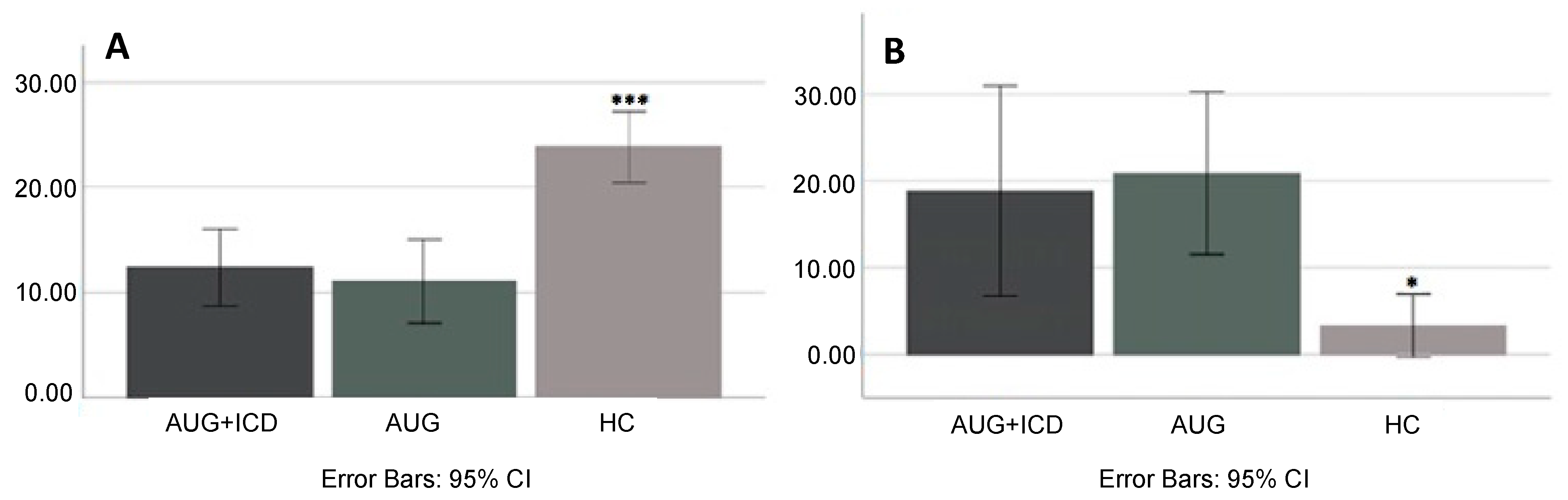
| Total draws (n) ± SD a | 12.4 ± 15.7 | 11.1 ± 18.1 | 22.9 ± 16.0 | <0.001 *** |
| Irrational choices (n) ± SD b | 2.0 ± 2.4 | 2.0 ± 2.1 | 0.3 ± 0.8 | 0.008 ** |
Publisher’s Note: MDPI stays neutral with regard to jurisdictional claims in published maps and institutional affiliations. |
© 2021 by the authors. Licensee MDPI, Basel, Switzerland. This article is an open access article distributed under the terms and conditions of the Creative Commons Attribution (CC BY) license (http://creativecommons.org/licenses/by/4.0/).
Share and Cite
Heim, B.; Ellmerer, P.; Stefani, A.; Heidbreder, A.; Brandauer, E.; Högl, B.; Seppi, K.; Djamshidian, A. Birds of a Feather Flock Together: Disadvantageous Decision Making in Augmented Restless Legs Syndrome Patients with and without Impulse Control Disorders. Brain Sci. 2021, 11, 383. https://doi.org/10.3390/brainsci11030383
Heim B, Ellmerer P, Stefani A, Heidbreder A, Brandauer E, Högl B, Seppi K, Djamshidian A. Birds of a Feather Flock Together: Disadvantageous Decision Making in Augmented Restless Legs Syndrome Patients with and without Impulse Control Disorders. Brain Sciences. 2021; 11(3):383. https://doi.org/10.3390/brainsci11030383
Chicago/Turabian StyleHeim, Beatrice, Philipp Ellmerer, Ambra Stefani, Anna Heidbreder, Elisabeth Brandauer, Birgit Högl, Klaus Seppi, and Atbin Djamshidian. 2021. "Birds of a Feather Flock Together: Disadvantageous Decision Making in Augmented Restless Legs Syndrome Patients with and without Impulse Control Disorders" Brain Sciences 11, no. 3: 383. https://doi.org/10.3390/brainsci11030383
APA StyleHeim, B., Ellmerer, P., Stefani, A., Heidbreder, A., Brandauer, E., Högl, B., Seppi, K., & Djamshidian, A. (2021). Birds of a Feather Flock Together: Disadvantageous Decision Making in Augmented Restless Legs Syndrome Patients with and without Impulse Control Disorders. Brain Sciences, 11(3), 383. https://doi.org/10.3390/brainsci11030383

