
Need Help?
20 May 2026
Prof. Dr. Donghai Wu Appointed Section Editor-in-Chief of Section “Semiconductor Devices” in Electronics
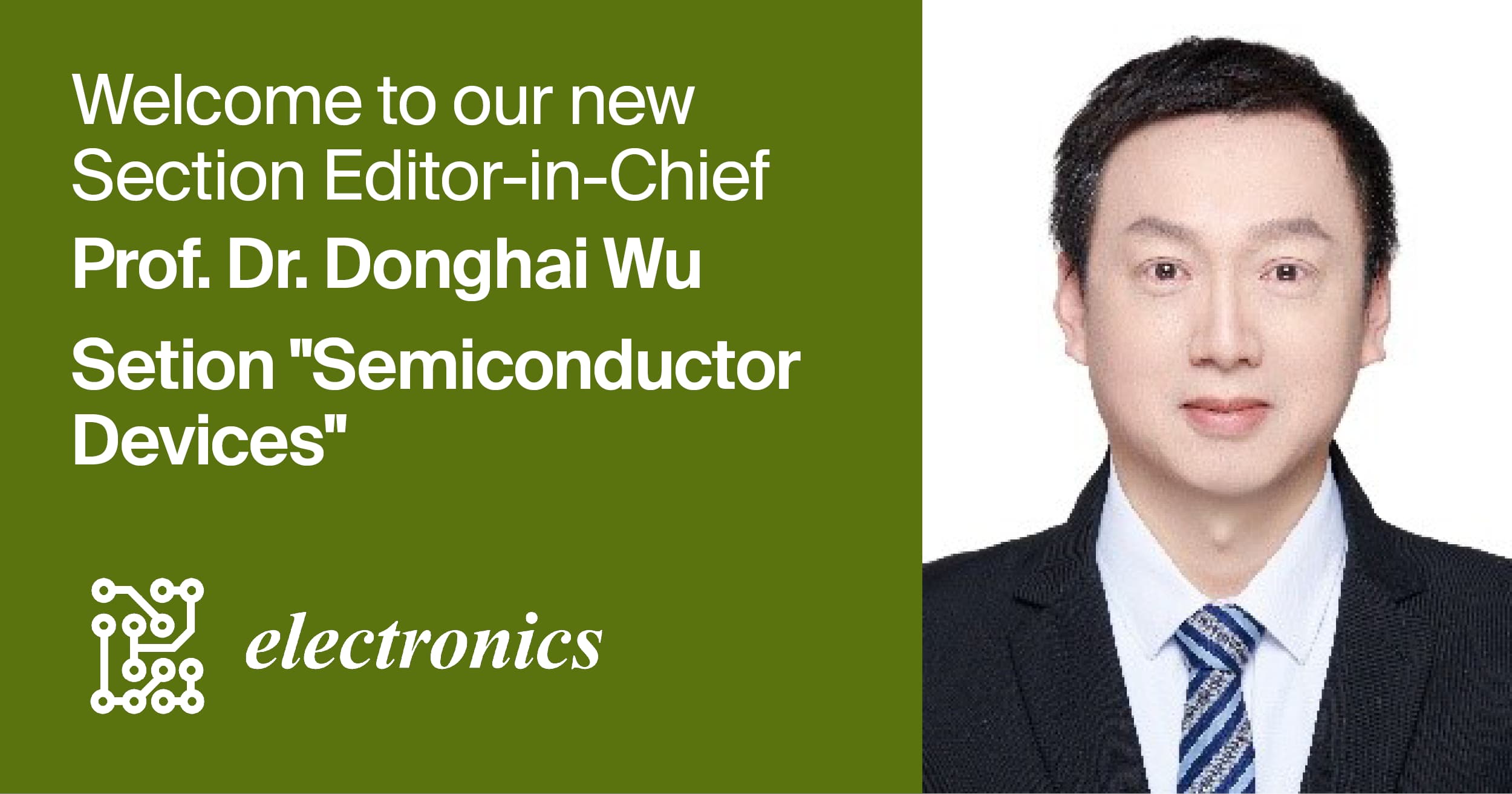
In this issue of our interview series, Electronics is honored to invite Prof. Dr. Donghai Wu, a researcher at the Institute of Semiconductors, Chinese Academy of Sciences, and the newly appointed Section Editor-in-Chief for the “Semiconductor Devices” Section. Dr. Wu has long been dedicated to antimonide semiconductors and infrared optoelectronic devices, and possesses a diverse academic background spanning university research, industrial experience, and overseas training. He has achieved several key technological breakthroughs in material epitaxial growth and novel device design. In this interview, Dr. Wu shares the latest progress of his research group, offers insights into future trends in the semiconductor field, discusses his views on open access publishing, and outlines his vision for the development of the journal section.
Prof. Dr. Donghai Wu, is a researcher and PhD Supervisor at the State Key Laboratory of Optoelectronic Materials and Devices, Institute of Semiconductors, Chinese Academy of Sciences. He obtained his PhD in engineering from the Institute of Semiconductors, CAS, in 2008. From 2008 to 2014, he worked at Tsinghua Tongfang Co., Ltd. Between 2014 and 2020, he served as a Research Assistant Professor at the Center for Quantum Devices at Northwestern University (USA). In November 2020, he returned to China and joined the Institute of Semiconductors. In recent years, Prof. Dr. Wu has focused on semiconductor optoelectronic materials and devices, particularly the molecular beam epitaxy growth of III–V compound semiconductors, infrared detectors, and infrared laser technologies.
The following is a short Q&A with Prof. Dr. Donghai Wu, who shared his vision for the journal with us, as well as his views of the research area and open access publishing:
1. Could you introduce the main research directions of your group and your latest progress?
Our research group focuses on optoelectronic materials and devices based on III–V compound semiconductors. Our work includes molecular beam epitaxy growth of semiconductor materials, high-performance photodetectors, lasers, and single-photon devices.
Regarding recent progress, we have made breakthroughs in interface engineering of antimonide superlattices. By optimizing growth conditions and band structure design, we have effectively suppressed dark current, increasing the operating temperature of infrared detectors to nearly 200 K while maintaining high detectivity.
Our group is committed to full-chain innovation—from material epitaxy and device fabrication to system integration—promoting infrared and quantum optoelectronic devices toward higher performance and practical applications.
2. In your opinion, what research topics will attract the most attention in this field over the next 3–5 years?
Given my background, my focus is mainly on semiconductor optoelectronic materials and devices. Over the next 3–5 years, key research directions will include novel low-dimensional semiconductor materials, deep integration with micro- and nano-photonic structures, new light sources and detectors from the mid-infrared to terahertz range, and intelligent and bio-inspired optoelectronic devices.
These frontier explorations aim to overcome bottlenecks in efficiency, size, power consumption, and heterogeneous integration, driving optoelectronic technologies toward higher integration, greater intelligence, and broader spectral coverage.
3. What has been the biggest challenge in your academic career, and how did you overcome it?
The biggest challenge in the early stage of my academic career was identifying the right research direction and building confidence. My approach can be summarized as: progressing in small steps, actively seeking help, embracing imperfection, and maintaining balance.
Through in-depth investigation, I identified feasible entry points and used short-cycle experiments for rapid validation and iteration, avoiding anxiety about finding the “perfect” direction. Regular communication with peers helped break fixed thinking patterns. I learned to treat failure as a process of acquiring data rather than a denial of my abilities.
Maintaining a regular schedule and moderate exercise is also important. When facing repeated setbacks, I step away from experiments temporarily and reorganize my thoughts through reading or writing. Research directions are not found out of thin air—they emerge through action.
4. What kind of impact do you hope your research will have, and what are its core innovations?
I hope my research can generate tangible societal impact, not just high-level publications. The core innovation of our work lies in being application-driven, aiming to bridge the gap between laboratory prototypes and real-world systems in semiconductor optoelectronics.
By jointly optimizing efficiency, power consumption, integration, and manufacturability, we promote the practical implementation of low-dimensional materials, micro-/nano-photonic structures, and mid-infrared devices, ensuring that research outcomes truly serve societal needs.
5. Why did you accept the invitation to serve as Section Editor-in-Chief for Electronics, and what are your expectations for the “Semiconductor” Section?
My decision was based on two main reasons. First, the open access model ensures efficient dissemination and enhances global visibility of research outcomes. Second, the Section covers the full chain from semiconductor materials to devices and applications, which aligns closely with my long-term focus in optoelectronics. Serving as an editor is both a responsibility and an opportunity to promote academic exchange.
For the future development of the Section, my plans include organizing Special Issues on hot topics such as low-dimensional materials, micro-/nano-photonic structures, and mid-infrared to terahertz devices to enhance academic leadership. Additionally, I aim to increase the section’s influence through webinars, scholar interviews, and other outreach activities, gradually strengthening its reputation.
For young scholars:
- Focus on one direction and build your own research identity step by step;
- Connect proactively with application needs to avoid working in isolation;
- Be patient, maintain a regular schedule and exercise—research is a marathon, and confidence builds from solving small problems.
For graduate students:
Build a strong foundation in fundamental knowledge, engage actively in hands-on practice, and develop rigorous scientific logic. Fundamental knowledge determines how deep you can go, practical skills determine how fast you can progress, and logical thinking helps extract patterns from experimental phenomena and avoid detours. These three aspects are equally indispensable.
First, establish rigorous publication processes that also allow solid, reproducible, non-breakthrough work to be published, reducing publication pressure on young scholars.
Second, optimize peer review processes so that reviewers not only identify flaws but also provide constructive suggestions, making peer review a learning opportunity.
Third, organize writing workshops, topic seminars, and industry–academia matchmaking events, and create Special Issues led by young scholars as Guest Editors to enhance their academic organizational skills.
Fourth, promote open data and code-sharing mechanisms to improve reproducibility and reduce redundant trial-and-error efforts.
Fifth, provide fee waivers or review-credit offset programs for early-career researchers with limited funding.
