


Conferences
Upcoming Journal Conferences (0)
No conferences found for the selection.Upcoming MDPI Conferences (1)
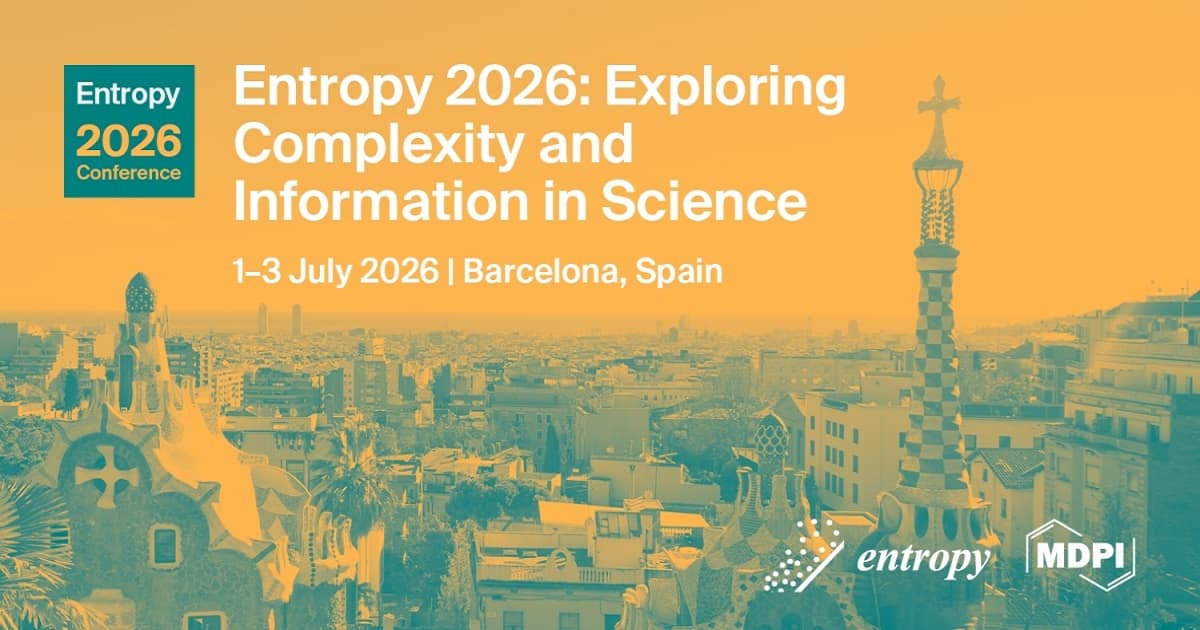
Barcelona, Spain
We are pleased to announce that Entropy 2026: Exploring Complexity and Information in Science will be held in Barcelona, Spain, from 1 to 3 July 2026.
This conference, organized by MDPI's open-access journal Entropy (ISSN 1099-4300; IF: 2.0), offers an exciting opportunity to explore cutting-edge advances and foster collaboration in the rapidly evolving fields of fundamental and applied physics, information theory, mathematics, and complex systems. We anticipate that Entropy 2026 will bring together more than 200 participants from around the world.
Topics of Interest
S1. Complex Systems and Network Science;
S2. Information Theory, Data Science, and Artificial Intelligence;
S3. Quantum Information and Quantum Computing;
S4. Thermodynamics and Energy Systems;
S5. Non-Equilibrium Systems and Entropy Production;
S6. Statistical Physics and Stochastic Processes;
S7. Soft and Living Matter;
S8. Applications of Entropy in Science and Engineering.
Conference Chairs
Prof. Dr. Miguel Rubi, University of Barcelona, Spain.
Prof. Dr. Kevin H. Knuth, University at Albany, USA.
Important Dates
Abstract submission deadline: 1 March 2026
Acceptance notification deadline: 30 March 2026
Early Bird Registration Deadline: 31 March 2026
Registration: 15 June 2026
For any enquiries regarding the event, please contact entropy2026@mdpi.com.
We look forward to seeing you at Entropy 2026.


Upcoming Partner Conferences (3)
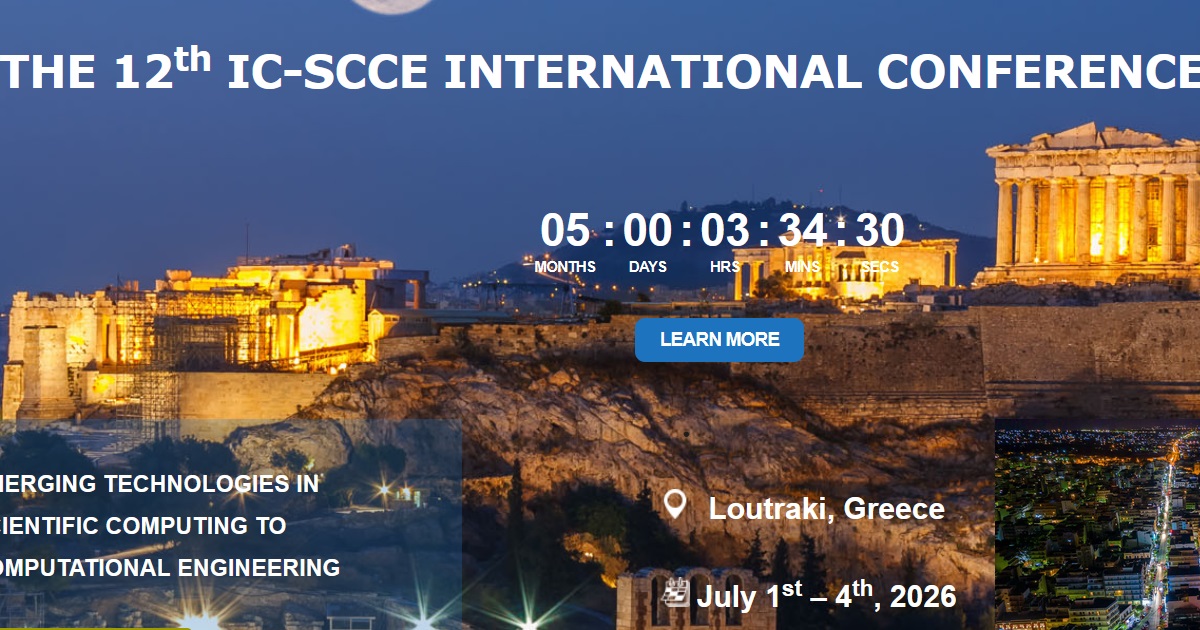
Loutraki, Greece
After the successful outcome of the in-person 2024 11th IC-SCCE, the Learning Foundation in Mechatronics (LFME), Athens, Greece, is organizing the 12th International Conference from Scientific Computing to Computational Engineering (12th IC-SCCE) to be held in Loutraki, Greece, from July 1st to July 4th, 2026, at the Alexandreio Conference Center.
The Chairman of the 12th International Conference “from Scientific Computing to Computational Engineering”, Prof. Demos T. Tsahalis, who is also the Director of LFME, invites all scientists and engineers from the academic, scientific, engineering, and industrial sectors to participate in the conference and to contribute to both the promotion and the dissemination of the scientific knowledge.
►Contributions Invited
Contributions related to any aspects from Scientific Computing to Computational Engineering and Numerical Analysis are enthusiastically encouraged. The contributions will be published in the conference proceedings with their ISSN and ISBN numbers.
Abstracts of papers proposed for oral or poster presentation at the 12th IC-SCCE should be approximately 200 words in length and must be submitted together with the abstract cover sheet (please refer to the conference’s website). Before acceptance, all contributions will be assessed by experienced reviewers.
Corvinus University, Budapest, Hungary
The convergence of Knowledge Management (KM) and Artificial Intelligence (AI) is transforming how organizations generate, share, and apply knowledge to pursue sustainability. At the heart of this transformation lies the concept of intelligent knowledge: systems that dynamically combine human cognitive capacities with advanced AI-based tools to foster ethical, inclusive, and purpose-driven innovation.
In a time of ecological, social, economic, and technological upheaval, organizations must innovate while meeting long-term sustainability goals such as the United Nations Sustainable Development Goals (SDGs) and Environmental, Social, and Governance (ESG) commitments. Intelligent knowledge offers a way to navigate this complexity by positioning AI not as a replacement for human thinking but as an enhancement—expanding analytical capacity while preserving human judgment, imagination, aesthetic experience, and values.
For decades, KM has addressed the challenges of systematically creating, storing, sharing, and applying knowledge within organizations. Traditional problems included how to capture and diffuse technical knowledge, how to bridge silos, and how to ensure that knowledge supports decision-making and innovation. Today, AI promises to solve some of these long-standing challenges by providing unprecedented computational power, automating processes, and enabling rapid access to vast knowledge repositories.
Simultaneously, new and pressing challenges are emerging. Organizations must now question what it truly means to create intelligent knowledge in an era dominated by digital technologies. How can they ensure the validity and reliability of AI-generated knowledge? How can they manage the ethical risks of algorithmic bias and automated decision-making? How can they preserve the richness of tacit, embodied, and emotional expertise that machines cannot codify? The task ahead is not only to adopt advanced technologies but also to re-imagine KM practices that cultivate hybrid knowledge ecosystems where human creativity, critical judgment, and relational intelligence work in synergy with AI’s computational power.
This shift calls for a new vision of KM: one that views knowledge not just as information to be stored, retrieved, and managed mainly by people, but as a dynamic capability integrating the capacity of both human and new digital systems, which enables organizations to adapt, learn, and thrive in complex environments. Intelligent knowledge thus becomes a cornerstone of organizational excellence, resilience, and sustainability.
IFKAD 2026 will offer an international platform to explore key frontier issues. The conference will promote dialogue on how intelligent knowledge can support sustainable innovation, organizational resilience, and responsible governance in the digital age. It encourages contributions that analyze the opportunities, challenges, and implications of AI-enabled knowledge systems for organizations, economies, and societies.
Moreover, IFKAD is primarily a scientific event that brings together academics. It aims to foster conversation and create a learning experience in which academics, practitioners, and policymakers discuss the role of intelligent knowledge in building sustainable future organizations. IFKAD 2026 will explore these urgent questions, advancing both theoretical understanding and practical insights. The conference will serve as a vibrant platform for co-creating knowledge to build intelligent, adaptive, and sustainable organizations that can flourish in an age of complexity.
Istanbul, Turkey
Short Name: FLUIDMEET2026
Conference Name: 2nd International Meet and Expo on Fluid Mechanics and Thermodynamics
Dates: August 10-12, 2026
Website: https://fluidmechanics2026.acmemeetings.com/
Email: fluidmeet2026@acmemeetings.com
We are pleased to announce that the 2nd International Meet and Expo on Fluid Mechanics and Thermodynamics (FLUIDMEET2026) will take place in Istanbul, Turkey, from August 10 to 12, 2026.
This major international event brings together leading researchers, engineers, and innovators to discuss recent advances and explore emerging directions in fluid mechanics and thermodynamics. The conference highlights the growing role of interdisciplinary approaches, including the integration of classical theory with high‑performance computing, precision experimentation, and data‑driven analysis. These developments are driving transformative progress across key sectors such as clean energy, transportation, and sustainable engineering.
The conference will be co‑presided over by Istanbul Medeniyet University, which will provide the venue and conference hall facilities to support the scientific program. A portion of the conference revenues will be allocated to academic units to strengthen the research and educational activities, while the remaining organizational and operational expenses will be covered by the professional conference management company, ensuring a smooth and well‑coordinated event.
We encourage researchers and practitioners working in fluid mechanics, thermodynamics, energy systems, and related computational fields to participate, exchange ideas, and build new relationships that may lead to significant academic and technological innovations.
For more information, please visit the official conference website or contact the organizing committee.
