
Need Help?
8 June 2026
Interview with Dr. José Luis Rivera-Armenta—Winner of the Polymers Outstanding Reviewer Award
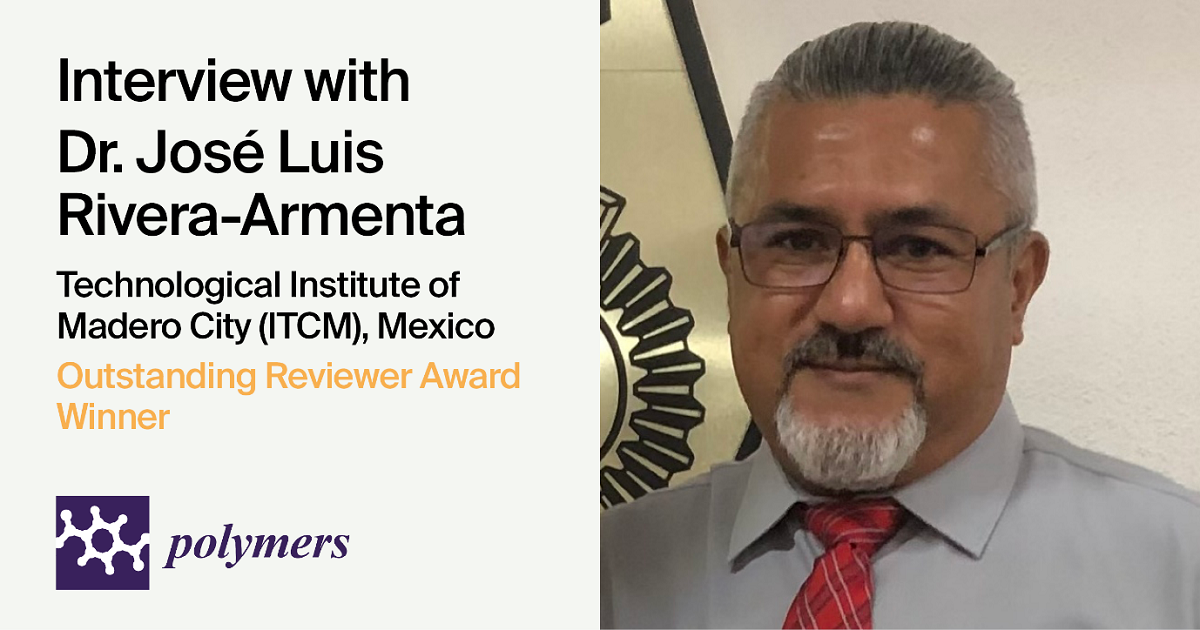
Polymers (ISSN: ISSN 2073-4360) is pleased to present one of the winners of the Polymers Outstanding Reviewer Award—Dr. José Luis Rivera-Armenta.
Dr. José Luis Rivera-Armenta has a BSc in chemical engineering, an MSc in petroleum technology and petrochemicals, and a PhD in chemical engineering, all from the Technological Institute of Madero City (ITCM), Mexico. Since 2003, he has been a full-time professor in Postgraduate programs at ITCM and head of the Thermal Analysis, Injection, and Extrusion laboratories. He has been responsible for several research projects sponsored by Consejo Nacional de Ciencia y Tecnología (CONACYT) and the National Technological Institute of México (TecNM). He has advised 11 PhD students, 26 master’s degrees, and 8 bachelor’s degree theses. He has published 81JCR articles, 6 book chapters, and has edited 6 books and 2 Special Issues; he is an Editor of Digital Ciencia@UAQRO, and has participated as Chairman in the International Materials Research Congress in 2024 and 2025. Dr. Rivera-Armenta is also an active reviewer for several journals, and has received the Polymers Outstanding Reviewer Award twice, in 2023 and 2025.
We welcome you to read the interview below.
1. Could you briefly introduce yourself and your current main research focuses?
I have been a professor at the Technological Institute of Madero City (ITCM) since 2003, so I have around 23 years of research experience. I work in polymers, composites, polymer processing, and polymer characterization. In recent years, my work has focused on using waste materials as additives in polymer formulations. We have worked with materials such as sargassum, garlic husk particles, pistachio shells, and other natural waste materials. We have published articles in several MDPI journals, including Polymers, Applied Sciences, and Polysaccharides. We also work on asphalt binder modification and the use of these waste materials as modifiers. Several years ago, we also started working with chicken feather-based materials. In general, our research group tries to find applications for waste materials that currently have no industrial use. Since the region where I live has an important petrochemical industry, it creates interesting opportunities for this type of research.
2. What are your thoughts after receiving the Outstanding Reviewer Award? Would you like to share some insights and suggestions for prospective reviewers?
I would like to express my appreciation for the confidence placed in my work. Receiving the Outstanding Reviewer Award twice is very meaningful to me. It motivates me and gives me more energy to continue contributing to the scientific community. Reviewing is important to me because it helps me stay updated with new technologies, new research directions, and emerging sustainability topics. Some people believe that if publication is quick, then the review process is not rigorous. However, the review process in Polymers is rigorous and detailed. As a reviewer myself, I have rejected several manuscripts, so I know that the reviews are serious and detailed. As an author, I have received reviewer comments that were difficult to answer, but that is important because it improves the quality of the research. I have also had manuscripts rejected after deep reviews, which demonstrates that publication is not automatic or easy.
3. When reviewing manuscripts, what aspects do you typically focus on?
In the peer review process, I mainly focus on novelty and on whether the methodology is described in enough detail for the work to be reproducible. I also pay attention to how authors explain their results. If there is a change in properties, authors should clearly explain the scientific reason behind it. Since I teach characterization techniques, I also focus on the quality of data presentation, graphics, and interpretation. Figures are extremely important because they are usually the first thing readers look at. Good figures attract attention and help readers understand the work quickly. I always recommend that my students use the original software from analytical equipment manufacturers because it allows better data handling and higher-quality graphics. Some authors rely too heavily on Excel or Origin, which can limit figure quality. Graphical abstracts are also very important because they attract readers and increase visibility. In many ways, I approach reviews similarly to how I teach my students.
4. Could you share your views on how open access (OA) impacts the author community?
Some evaluation systems and government departments are beginning to recognize the importance of OA because it increases visibility and citations. It also helps researchers avoid using illegal platforms to download articles. Personally, I trust MDPI because I have worked with the publisher for around ten years. That experience has given me confidence in the editorial process.
5. Based on your extensive review experience, have you identified which research topics will attract particular academic attention in the coming years?
Sustainability is clearly one of the most important topics in polymer science today. Many companies in the petrochemical sector are now trying to develop polymers that reduce environmental impact. In Mexico, plastic contamination is a major issue, and many single-use plastic products are increasingly restricted. Because of these environmental concerns, sustainability-related polymer research will continue to grow worldwide.
