
Need Help?
21 May 2026
Interview with Dr. Silvia Belloni—Winner of the Current Oncology Outstanding Reviewer Award
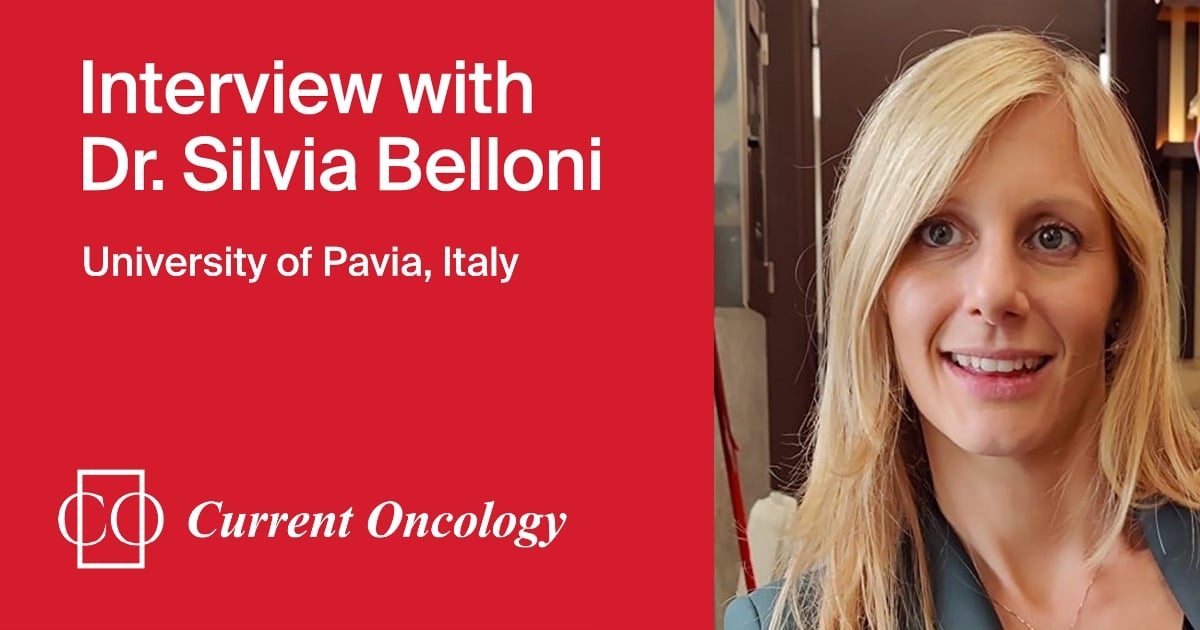
We had the pleasure of speaking with Dr. Silvia Belloni, who is the winner of the Current Oncology Outstanding Reviewer award in 2026. Here, she will share her peer review experience, research interests, and academic journey.
Dr. Silvia Belloni graduated in 2011 with a bachelor’s degree in nursing (RN) and in 2019 with a Master of Science in Nursing (MSc/MSN). She developed advanced knowledge and competencies in cancer care through a postgraduate oncology program at the European Institute of Oncology in Milan (Italy) in 2015. She worked for several years as an oncology nurse and clinical research nurse at Humanitas Research Hospital in Milan (Italy). In 2016, she worked as a breast care nurse at the Bupa Cromwell Hospital in London (UK). She obtained a PhD in nursing and public health in 2022 and has worked in the Department of Public Health, Experimental and Forensic Medicine, Section of Hygiene, in Pavia (Italy), as a researcher and Director of Nursing Educational Activities for the Nursing Bachelor’s degree. She has been the regional (Lombardy) coordinator of the Italian Association of Oncology Nurses since 2019. She has the National Scientific Qualification (ASN 2023-2025) for Sector 06/M1 – MED/45 - General, Clinical and Pediatric Nursing Sciences (Associate Professor).
The following is an interview with Dr. Silvia Belloni:
1. Could you briefly introduce yourself to our readers?
I am a passionate nurse with about 15 years of experience in oncology, having worked in clinical and scientific settings, both nationally and internationally, as well as in academic contexts. I have worked in dynamic, innovation-oriented environments, maturing over time in clinical and scientific research, as well as in strong organizational and collaboration skills focused on achieving objectives and results. Having worked in various contexts (clinical and academic) has enabled me to become a well-rounded professional. My research area focuses on symptom science in cancer care with a specific expertise in conducting systematic reviews and meta-analyses. I actually have extensive experience serving as an article reviewer for numerous international journals.
2. What motivates you to serve as a reviewer for Current Oncology, and what do you find most rewarding about the peer-review process?
Current Oncology is a highly respected journal encompassing a wide range of scopes in the field of oncology. Reviewing for Current Oncology keeps me constantly updated and, at the same time, allows me to learn from colleagues and professionals around the world. The most rewarding thing is that the reviewers’ work is partly recognized through vouchers and awards. This aspect is motivating for the professional and, at the same time, allows the journal to meet review and publication deadlines, which represent the best way to feed a complex system that requires increasingly up-to-date evidence. I believe this is a successful system because, on the one hand, it directly rewards the professional, and, on the other, in a university system where researchers spend part of their time reviewing, the university benefits from publishing at no cost. This approach certainly supports a complex financing and structural system and promotes the dissemination of scientific knowledge, especially in open-access journals.
3. When reviewing manuscripts, what aspects do you typically focus on (e.g., originality, methodological rigor, logical structure, ethical compliance, etc.)?
The manuscript’s layout and logical structure are the first things I look at; they are like a "business card" of the professional. A chaotic manuscript and an altered structure are frequently indicators of the author’s misunderstanding of basic criteria that must be observed in scientific research. Similarly, methodological rigor is the other most relevant aspect, as it affects the reliability of the results. Originality, on the other hand, is a quality that, while essential in publishing in terms of study novelty, is sometimes dependent on the intrinsic professional skill. Considering originality as an essential criterion would preclude many authors from publishing, even if the study was conducted rigorously and competently. Sometimes, redundant literature helps to select and benefit from the most representative, appropriate and reliable results.
4. For young scholars who are just beginning to participate in peer review, what specific advice would you offer?
Reviewing is an act of professional responsibility that requires scientific writing and methodological competencies, clinical expertise in the field of study, and knowledge regarding the editorial process. In some cases, I recommend declaring the expert view that was given or not given (i.e., clinical, methodological, statistical), especially at the beginning of the reviewer’s career.
5. Based on your experience reviewing manuscripts, what suggestions do you have for authors to make their manuscripts more readable and engaging?
I suggest that authors draft their papers as the research progresses. This approach helps ensure that all study-related information is preserved and not forgotten, even after the study has been planned and conducted. I am almost certain that many submitted works with poor reporting lose numerous details concerning planning and procedures over time, especially in long experimental studies. Writing while conducting your research saves time and ensures proper reporting.
6. How do you see the role of reviewers evolving with advancements in artificial intelligence and automated tools in research publishing?
Artificial intelligence (AI) can be a powerful tool for supporting authors, reviewers, and editors in facilitating some technical aspects and procedures. However, critical thinking and skills cannot be replaced by AI, as each scientist can make a unique contribution to a project in terms of professional identity and “fingerprint”. If artificial intelligence produces different results depending on the user, it means that human contribution remains essential!
7. How has your experience been with Current Oncology as a reviewer? What kind of support would you like to see from the journal?
Despite my initial skepticism, I can say now that it has been a valuable and inspiring experience that has absolutely fostered my professional growth, exceeding my initial expectations. Access to platforms that allow reviewers to rapidly check for plagiarism, artificial intelligence use, outdated or unverified references, grammatical errors, and unverified authors is undoubtedly a valuable support for reviewers.
8. Current Oncology is an open access journal, as you know, so what is your opinion of the open access model of publication?
Although institutional policies and public funds widely support the open-access system, there is ongoing debate over the economic sustainability of publishing costs (APCs), which are certainly high for individual researchers or clinicians not supported by their own institutions. But here, the problem is not open access but the possibility of guaranteeing publication funds to those who produce research. However, I am absolutely in favor of the open access system because it provides equal access to research results for everyone and promotes education and knowledge equality. The presence of results that are not always accessible leads to fragmentation and heterogeneity of knowledge, with important consequences for clinical practice.
