
Need Help?
21 May 2026
Interview with Dr. Christina Emmanouil—Winner of the Environments Outstanding Reviewer Award
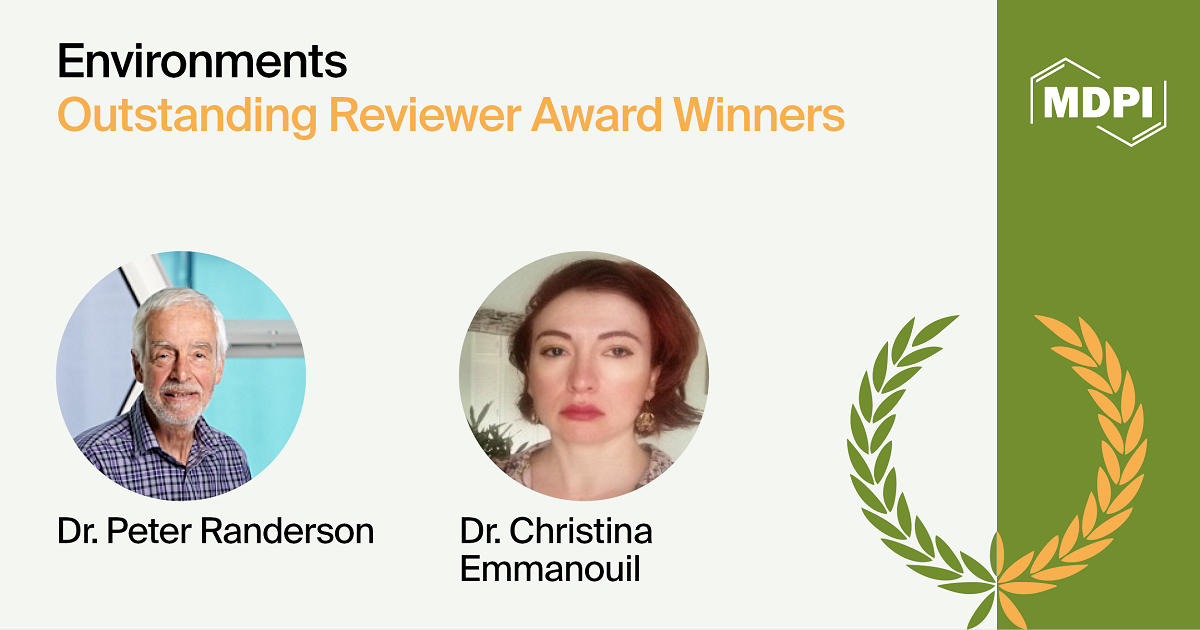
Name: Dr. Christina Emmanouil
Affiliation: School of Spatial Planning and Development, Aristotle University of Thessaloniki, Thessaloniki, Greece
Research interests: environmental management; ecotoxicology; risk assessment; waste management
The following is a short interview with Dr. Christina Emmanouil:
1. Could you briefly introduce yourself to our readers and tell us a little bit about your fields of interest?
I have a degree in life sciences from National University of Athens and post doc degrees from University of Birmingham in UK. I have worked as an ecotoxicology evaluator for the Greek Ministry of Agriculture and now I am a teaching personnel member at Aristotle University of Thessaloniki in Thessaloniki, Greece. I have also taught graduate and post-graduate levels in 4 additional Greek public universities. Nowadays I am mostly interested in how land-uses may pollute the environment and what we can do to mitigate this problem.
2. Which qualities do you think reviewers need? Do you have anything to say to other reviewers?
You need to be quick, thorough and effective. You need to be clear in your comments, if possible, quoting lines and pages. Vague recommendations are of no use; give suggestions to the writers. At the same time, reviewers should remember that they are neither parents, nor employers, nor lieutenants. The role is to help improve the manuscript, not to command the authors.
3. What motivated you to serve as a reviewer for Environments, and could you share your experience reviewing for the journal?
My professional trajectory has been somewhat non-linear, moving from a STEM background into the public policy sector, and currently into academia at the School of Spatial Planning and Development which belongs to Faculty of Engineering. This path has shaped my interest in multidisciplinary approaches to environmental challenges. For that reason, I was particularly motivated to contribute to Environments, a journal that exhibits an integrating, multidisciplinary aspect while maintaining a clear focus on environmental protection.
4. In your opinion, what are the key elements of a high-quality manuscript? What aspects do you pay the most attention to when reviewing?
Simplicity and parsimony are of outmost importance for me. A high-quality manuscript should communicate a clear and meaningful scientific contribution, supported by a sound and transparent methodology. In the introduction, the reader should be briefly informed of the environmental problem targeted, the aim of the research and its importance. Do not give any results in Methodology and do not present outcomes in Results that do not correspond to methods described. My advice is to be sincere with the study limitations, stick to facts, and do not chase an overwrought conclusion.
5. How has your reviewing experience influenced your own research or academic writing? Do you have any advice for early career researchers on how to write a strong manuscript and respond effectively to reviewers’ comments?
Reviewing has helped me improve my own writing style a lot; furthermore, I have encountered many interesting ideas that I could easily scale down for my students’ dissertations. Finally, several manuscripts have made me think: how can I incorporate the aspects I see in my line of work?
My honest advice is that you must approach your paper as if you are the most knowledgeable or at least one of the most knowledgeable people in the room while simultaneously presenting it in simple terms, almost like a layman’s report—your aim should be to inform, communicate and disseminate.
6. What role do you think reviewers play in the process of paper publication?
Reviewers should not serve as props to validate a superficially objective process. Their role is to engage critically with the manuscript, providing an independent and constructive evaluation of its scientific quality, methodological soundness, and relevance. They should delve into the manuscript, being honestly curious, identifying flaws and offering constructive feedback that can meaningfully improve the manuscript.
7. Please briefly describe your experience with our services and journals so far?
I have had a wonderful collaboration so far with Environments as well as other journals such as Sustainability, Toxics, Journal of Xenobiotics, Water, to name a few. Feedback was punctual, detailed, and informative. I also appreciate that on those occasions when you are tempted to delay, the journal provides a gentle but persistent reminder that the work should be done in a timely manner.
