
Need Help?
19 May 2026
Interview with Dr. Anastasia Bougea—Winner of the Medicina Editor of Distinction Award
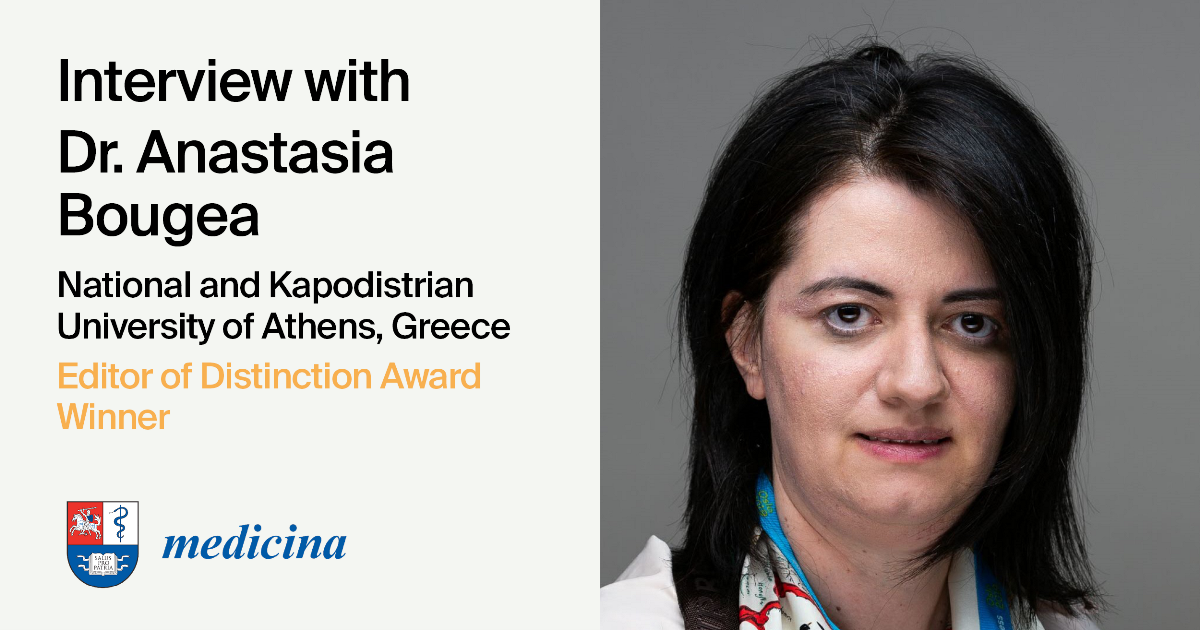
1. Could you briefly introduce your academic background and current research focus?
I am a neurologist and clinical researcher holding an MD, MSc, and PhD, with extensive postdoctoral training. My primary clinical and scientific focus centers on neurodegenerative disorders, specifically Parkinson’s disease, Alzheimer’s disease, and atypical Parkinsonian syndromes. I am currently investigating the use of fluid biomarkers, such as alpha-synuclein and tau proteins, to improve early diagnostic accuracy and track disease progression. Additionally, I am deeply engaged in the intersection of artificial intelligence and clinical medicine; I am currently pursuing a master’s candidate degree in “Translational Engineering in Health and Medicine” at the National Technical University of Athens, Greece. This allows me to explore how machine learning algorithms and digital biomarkers can be leveraged to standardize and enhance clinical workflows.
2. How was your experience being an editor for Medicina? What motivated you to participate actively in the editorial process, and what do you find most rewarding about it?
Serving as an Editor for the “Neurology” Section and leading Special Issues on topics like biomarkers and non-motor disorders has been a highly fulfilling journey. My motivation stems from a deep commitment to advancing the field; the peer-review process is the absolute bedrock of scientific integrity. As a peer reviewer educator for the Movement Disorder Society, the most rewarding aspect of this role is working collaboratively with authors and reviewers to refine manuscripts. Helping to ensure that rigorous, high-impact research reaches the medical community—and ultimately translates into better patient care—is incredibly gratifying.
3. As a journal Editorial Board Member, what do you believe is the most critical step in maintaining the journal’s academic standards? Is it the evaluation of innovation during the precheck stage, the precise selection of reviewers, or the final decision of controversial manuscripts?
While the precheck stage and the final editorial decisions are undeniably important, the precise selection of expert reviewers is the most critical step. Reviewers are the gatekeepers of scientific validity. Identifying peers with the exact methodological and clinical expertise required for a specific paper ensures a fair, rigorous, and constructive evaluation. It is this robust foundation of peer review that empowers the editorial board to make sound, evidence-based final decisions, especially when navigating controversial or highly novel manuscripts.
4. How do you see the role of editors evolving with the advancements in artificial intelligence and automated tools in research publishing?
Artificial intelligence and automated tools are rapidly transforming research publishing, much like they are reshaping clinical diagnostics. I see AI serving as a powerful complementary tool for editors—assisting with plagiarism detection, formatting checks, and even suggesting appropriate reviewers by mapping complex academic networks. However, the core editorial responsibilities—evaluating true clinical innovation, navigating ethical nuances, and exercising complex scientific judgment—cannot be automated. Editors will evolve into curators who leverage AI for efficiency while providing the indispensable human oversight required to maintain the soul and standard of scientific inquiry.
5. Do you have any advice for early career researchers in terms of research or publishing?
Embrace interdisciplinary collaboration and maintain unwavering methodological rigor. The most significant breakthroughs often happen at the intersection of different fields, such as merging clinical neurology with computational engineering. Rejections and extensive revisions are an inevitable part of publishing, so it is vital to cultivate resilience and view the peer-review process as a constructive mechanism to elevate your work. Finally, actively seek out mentorship, continuously educate yourself on good clinical practices, and eventually pay it forward by mentoring the next generation of researchers.
