1. Introduction
The rapid digital transformation of healthcare has reshaped access to care, improved patient outcomes, and enhanced cost-efficiency [
1]. Telemedicine became indispensable during the COVID-19 pandemic, accelerating the adoption of remote consultations to maintain continuity of care [
2]. However, digital health technologies risk widening health inequalities by excluding individuals who are unable to access or use them effectively [
3]. Digital exclusion, defined as limited or no access to digital tools or skills, disproportionately affects vulnerable populations including older adults, ethnic minorities, and those in socio-economically deprived areas [
4]. In the UK, 1.7 million households lack internet access, and 10 million people do not possess basic digital skills [
5]. In this paper, telemedicine refers to healthcare delivered or supported using electronic communication technologies when patients and healthcare professionals are separated by distance. Tele-ophthalmology refers to the use of telemedicine in eye care, including remote consultation, digital image review, screening, monitoring, and patient education.
In England, the National Health Service (NHS)—the publicly funded healthcare system—has placed digital health at the centre of efforts to relieve pressure on traditional services and transition to ‘out-of-hospital’ models of care [
6]. However, successful implementation depends on patients’ ability to engage with digital platforms. This is particularly challenging in ophthalmology, where service demand continues to rise due to an ageing population and advances in treatment [
7]. Although tele-ophthalmology offers significant promise, digital exclusion remains a major barrier, particularly for patients who lack suitable devices or digital literacy [
8]. Importantly, individuals who may benefit most from digital interventions are often the least likely to access them [
9].
Patients with visual impairment may face additional barriers to digital participation, including inaccessible websites or applications, poor screen-reader compatibility, limited keyboard navigation, inadequate labelling of links or buttons, and the cost or complexity of assistive technologies [
10,
11]. These barriers may reduce confidence and increase the risk of digital exclusion within ophthalmic populations.
The NHS has acknowledged this disparity through its framework for inclusive digital healthcare, which calls for targeted strategies to support digitally excluded groups, including older adults, disabled individuals, and ethnic minorities [
12]. Without such measures, digital transformation risks deepening existing health inequalities [
13].
Previous healthcare-based digital inclusion initiatives have shown that providing devices, connectivity, and personalised support can improve access to digital services, wellbeing, and patient empowerment [
14]. However, these initiatives have largely been delivered outside specialist ophthalmology settings, with limited evidence on how device provision models can be adapted for visually impaired patients using digital health services [
8,
9,
14]. These programmes suggest that device provision alone may be insufficient unless combined with tailored training, ongoing support, and reliable pathways to identify patients at risk of digital exclusion [
14,
15,
16].
Digital exclusion also intersects with the environmental impact of healthcare delivery. The NHS, which contributes to approximately 4–5% of the UK’s total carbon emissions [
17], has committed to achieving net-zero emissions by 2040 [
18]. Reducing electronic waste (e-waste) through device reuse is one component of this strategy. Refurbishing devices for redistribution can reduce emissions associated with the production of new hardware. Within the NHS, this practice has been estimated to save up to 202 kilotonnes of carbon dioxide equivalent (ktCO
2e). Similarly, telemedicine may reduce emissions by decreasing patient travel, which accounts for around 6.7 billion road miles annually [
17].
In this pilot service evaluation, we implemented a digital inclusion initiative at Moorfields Eye Hospital, London, England, a tertiary specialist ophthalmology hospital with established clinical, digital innovation, and information and communications technology (ICT) support, supported by the NHS Healthier Future Fund. The project involved refurbishing and distributing donated laptops to digitally excluded patients, alongside digital literacy support.
Guided by WHO guidance on monitoring and evaluating digital health interventions, this study is positioned at the pilot stage, corresponding primarily to feasibility and usability evaluation [
19]. It evaluates the feasibility and exploratory service impact of a device recycling and digital inclusion initiative in a tertiary ophthalmology setting, focusing on implementation feasibility, digital engagement, self-reported confidence, and indicative environmental impact.
The project aligns with both the NHS Long Term Plan [
6] and the World Health Organization’s Global Strategy on Digital Health [
20].
2. Materials and Methods
2.1. Study Design and Setting
This project was conducted as a service evaluation and quality improvement initiative at Moorfields Eye Hospital, London, England. The intervention was delivered over six months, with data collection and analysis conducted over a further three months.
The study aimed to address digital exclusion by refurbishing and distributing donated electronic devices, including laptops, tablets, and mobile phones, to digitally excluded patients. It was designed to assess feasibility and exploratory service impact rather than establish causal effectiveness; therefore, no control group was included.
2.2. Device Sourcing and Refurbishment
Devices were sourced through two distinct pathways:
- (1)
In-hospital donations, including staff-donated personal devices and decommissioned Trust laptops provided by the IT department;
- (2)
External donations, including laptops and mobile phones supplied by Mer-IT (London, UK) [
21], a London-based Community Interest Company focused on reducing electronic waste and addressing digital exclusion through the repair, reuse and redistribution of digital devices, with SIM cards and data provided by the Good Things Foundation (Sheffield, UK) [
22].
All donated devices underwent a two-stage refurbishment process, carried out by Mer-IT [
21]. First, devices were securely wiped using Blancco data erasure software (Drive Eraser v7.9.0, Austin, TX, USA) [
23], generating a sanitation certificate for each device. Devices were then tested using Portable Appliance Testing (PAT) [
24], and any malfunctioning components were repaired or replaced.
All laptops were installed with Windows 10 operating system software, including built-in accessibility features [
25]. Devices deemed obsolete or incompatible with current software requirements were excluded from refurbishment.
2.3. Patient Recruitment and Eligibility
Patients were identified through two pathways: staff referrals and direct patient outreach, including posters and engagement stalls within the hospital. In the later stages of recruitment, Eye Clinic Liaison Officers (ECLOs) played a key role in identifying suitable participants.
Eligibility criteria were intentionally broad to reflect the multifactorial nature of digital exclusion. Participants were eligible if they were aged 18 years or older and had limited or unreliable access to a suitable digital device. Evidence of impact on health or wellbeing was assessed pragmatically through patient self-report or staff referral.
All participants in this pilot had visual impairment, reflecting the clinical population served and referral pathways utilised. Visual impairment was defined as individuals registered as sight impaired or severely sight impaired under the Certificate of Vision Impairment (CVI) framework.
Demographic data collected included sex and referral source. Age and ethnicity were not systematically collected, as this project was designed as a pragmatic service evaluation focused on intervention delivery and feasibility rather than population-level analysis. Data collection was therefore intentionally limited to variables necessary for feasibility assessment, implementation monitoring, and exploratory service impact evaluation.
2.4. Device Distribution and Digital Champion Training
Volunteers from the Friends of Moorfields Foundation [
26], a charitable organisation supporting Moorfields Eye Hospital, were trained as Digital Champions to provide one-to-one support.
Training included an online session covering the project aims, donation process, and Digital Champion Skills Checklist. The Royal National Institute of Blind People (RNIB) [
27] also delivered a one-day session on supporting people with visual impairment to use Microsoft laptop accessibility features, including font enlargement, colour and contrast adjustment, voice commands, and display settings.
Volunteers were considered suitable if they completed the training and demonstrated familiarity with the checklist and basic accessibility features.
2.5. Donation Day and Follow-Up
To standardise delivery of digital literacy support, a Digital Champion Skills Checklist (
Supplementary S1) was developed. This was adapted from the UK Government’s Essential Digital Skills Framework [
28], outlining core digital competencies required for everyday life and healthcare access.
The checklist was divided into three key categories:
- -
Foundation Skills: Basic device operation, including turning on the device, using accessibility tools, connecting to the internet, and managing passwords securely.
- -
Communication Skills: Setting up email accounts, using messaging apps, and sharing photos or documents via email.
- -
Digital Health Services: Accessing online health services, booking GP appointments, and completing online forms such as GP eConsult.
Pre- and post-donation questionnaires were developed as evaluation metrics to measure changes in digital engagement and self-reported confidence, based on the above domains. The questionnaire assessed practical digital activities including device use, email, document handling, internet use, apps, online safety, booking GP appointments online and contacting friends or family. For each activity, participants reported frequency of engagement and confidence using a score from 1 to 10. The questionnaire was not formally validated or piloted (
Supplementary S2).
Pre-donation questionnaires were completed in person at the time of device distribution. Follow-up questionnaires were administered by telephone at 1, 3, and 6 months to allow consistent assessment at the planned follow-up intervals and to reduce the need for additional hospital visits. For analysis, pre-donation and six-month follow-up outcomes were used.
Case illustrations were included to provide contextual insight into participant experiences. These were selected at random from participants who completed follow-up and provided consent for their anonymised experiences to be reported.
2.6. Environmental Impact Estimation
Environmental impact was estimated using published lifecycle assessment data comparing carbon dioxide equivalent (CO2eq) emissions from newly manufactured and remanufactured laptops. Avoided emissions per device were derived from literature values and applied to the number of devices refurbished in this study.
These estimates represent model-based approximations derived from secondary data and may not fully reflect the specific characteristics of the devices, refurbishment processes, or associated logistical factors within this project. Therefore, the environmental impact should be interpreted as indicative rather than a precise measure of emissions reduction.
2.7. Statistical Analysis
Descriptive statistics were used to summarise questionnaire responses. Categorical variables are presented as frequencies and percentages, and confidence scores are presented as mean values.
Confidence was assessed across 12 questionnaire items, each scored from 1 to 10, giving a possible total confidence score range from 12 to 120 per participant. Total confidence scores were calculated by summing the 12 item-level confidence scores for each participant at baseline and at six-month follow-up. Mean item-level confidence scores were calculated by dividing the total confidence score by the number of completed items. No missing confidence responses were present in the paired dataset used for analysis.
Paired pre- and post-intervention total confidence scores were compared using the Wilcoxon signed-rank test. This non-parametric test was selected due to the paired nature of the data and the ordinal scale of the confidence measures.
A
p-value of <0.05 was considered statistically significant. Descriptive analyses were performed using Microsoft Excel [
29] and inferential analyses were conducted using R [
30], using the stats package (
wilcox.test function).
Effect size (r) was calculated using the standard approach (r = Z/√N), where Z represents the standardised test statistic and N is the number of non-zero paired observations.
3. Results
A total of 22 patients were enrolled in the device recycling scheme, receiving 17 laptops and five mobile phones. One additional laptop was donated to the RNIB to support digital education. Referral sources included Moorfields Stratford clinic referrals (n = 9), poster advertisement self-referrals (n = 8), and promotional stalls (n = 5). Fifteen participants were female and seven were male.
Of the 22 enrolled patients, 18 engaged with the programme, three did not engage with the intervention, and one was unable to use the device because of technical faults despite initial support. Among the 18 participants who engaged, all had visual impairment and were able to use their devices. Sixteen received initial Digital Champion training at setup, while two preferred support from family or friends.
3.1. Pre-Donation Data: Engagement and Confidence
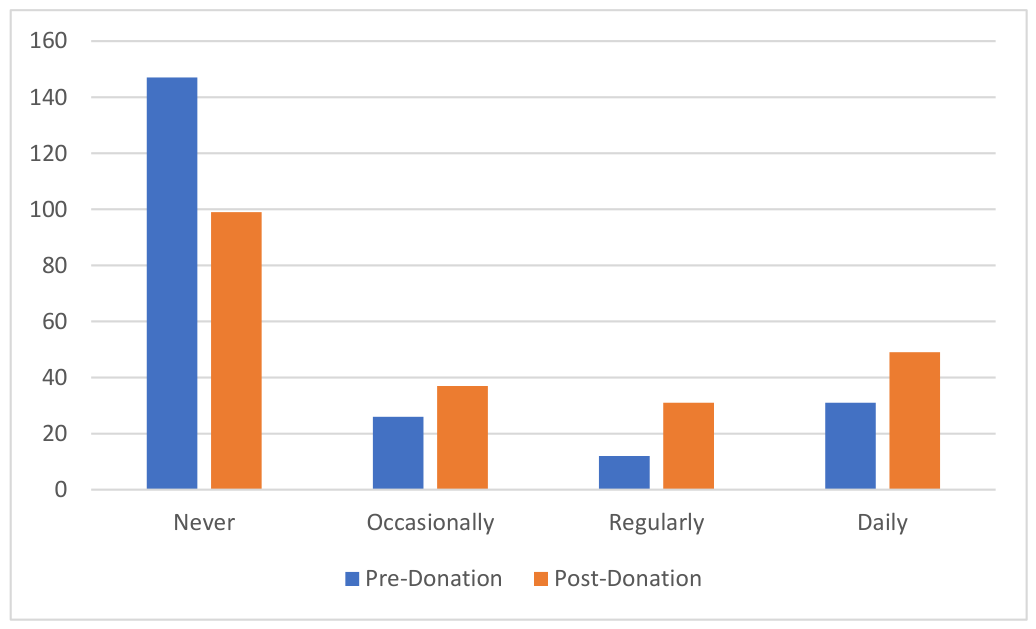
Engagement frequency responses were analysed across 18 participants and 12 questionnaire items, giving 216 total responses at each time point. Before device donation, “Never” was recorded 147 times (68%), “Occasionally” 26 times (12%), “Regularly” 12 times (5%), and “Daily” 31 times (14%). General device use was the most frequent pre-donation activity, while digital health tasks such as booking GP appointments online were rarely or never attempted.
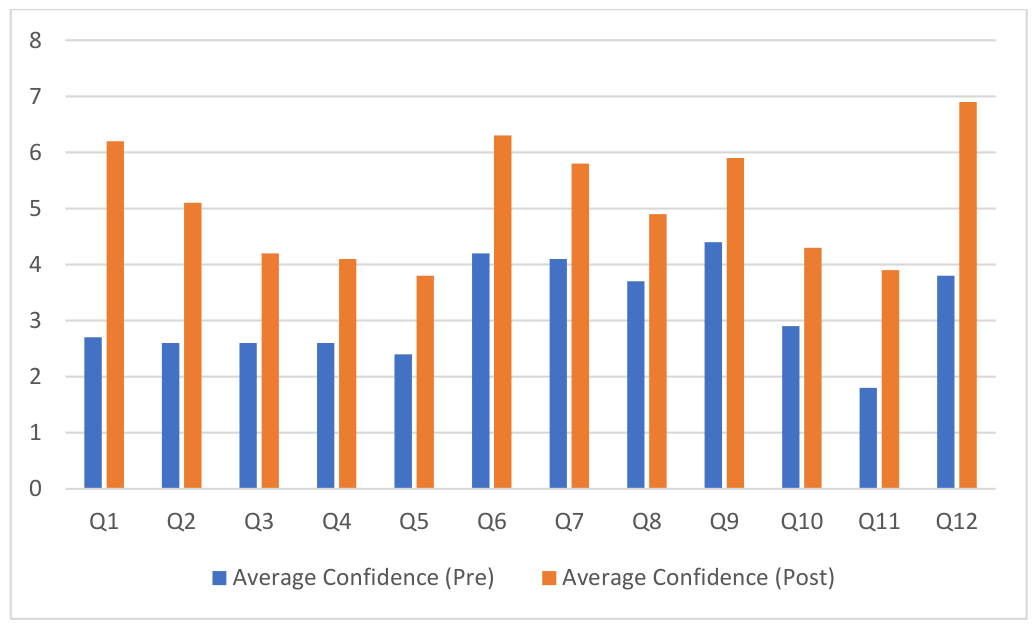
Confidence was also low before donation. The most frequently reported score was 1 out of 10, recorded 127 times. The mean item-level confidence score was 3.1 out of 10.
3.2. Post-Donation Data: Engagement and Confidence
At six-month follow-up, digital engagement shifted towards more frequent use. Across the same 216 possible engagement frequency responses, “Never” was recorded 99 times (46%), “Occasionally” 37 times (17%), “Regularly” 31 times (14%), and “Daily” 49 times (23%). Participants reported more frequent internet browsing, messaging app use, and access to digital healthcare services.
Confidence scores also improved. Scores of 10 out of 10 were reported 39 times, and the mean item-level confidence score increased to 5.1 out of 10.
3.3. Pre- and Post-Donation Data: Engagement and Confidence
Across the 12 engagement frequency questionnaire items, “Daily” responses increased by 58%, from 31 to 49 out of 216 total responses. This reflects an increase in daily response counts across assessed activities, rather than the proportion of participants using digital tools daily (
Figure 1).
Mean total confidence score increased from 37.6 pre-intervention to 61.3 post-intervention, corresponding to an increase in mean item-level confidence from 3.1 to 5.1 out of 10 (
Figure 2). This improvement was statistically significant (Wilcoxon signed-rank test, V = 148,
p = 0.0008), with a large effect size (r = 0.81) (
Table 1).
3.4. Case Illustrations
The following randomly selected case illustrations are descriptive and are not intended as generalisable outcomes.
3.4.1. Case Study 1: Ms. G
An older adult with severe visual impairment due to glaucoma and cataracts increased her confidence score from 5/10 to 9/10 over six months. During a prolonged hospital stay, the donated device helped her remain connected with family, news, and healthcare services. She later used the device for online banking, shopping, NHS services, and community volunteering programmes. She described the scheme as “life-changing” and would re-engage “without regret”.
3.4.2. Case Study 2: Mr. T
A registered blind refugee and former university lecturer had strong digital skills but no laptop access, limiting his ability to apply for work or training. Following donation, he reported daily digital use and 10/10 confidence across domains. Within six months, he had completed online courses, applied for volunteering roles within the UK, and enrolled in academic courses.
3.4.3. Case Study 3: Ms. R
A young adult with severe glaucoma and severe visual impairment had never owned or used a laptop before the project. By three months, she was using the internet, social media, and communication apps daily, and had booked a GP appointment online for the first time. At six months, she described plans to attend college once her digital confidence improved further.
3.5. Environmental Impact Estimation
The environmental impact of the intervention was estimated using published lifecycle assessment data. Previous studies have reported that the production of a new laptop is associated with approximately 331 kg of carbon dioxide (CO
2) emissions, while remanufacturing reduces this to approximately 21 kg, resulting in an avoided impact of approximately 310 kg CO
2 per device [
31].
Based on these estimates, the refurbishment and redistribution of 17 laptops in this study was associated with an estimated reduction of approximately 5.3 tonnes of CO2 emissions.
This estimate represents an approximation based on published secondary data rather than a direct environmental assessment conducted within this study.
4. Discussion
This pilot feasibility service evaluation suggests that refurbished device provision combined with tailored digital literacy support can be delivered within a specialist ophthalmology setting, and was associated with exploratory improvements in self-reported digital engagement and confidence among digitally excluded adults with visual impairment. Across 216 item-level engagement responses, daily response counts increased from 31 to 49, and mean item-level confidence increased from 3.1 to 5.1 out of 10. Given the feasibility design, small sample size, and absence of a comparator group, these findings should be interpreted as preliminary signals of promise rather than evidence of effectiveness.
These findings are consistent with previous healthcare-based digital inclusion initiatives, including a NHS mental health Digital Inclusion Scheme that combined loan devices, connectivity, and personalised support to improve access, wellbeing, and empowerment [
14]. Community device bank and Digital Champion models similarly suggest that device provision is most useful when combined with connectivity and personalised support [
15,
16].
However, previous work has largely focused on community, primary care, or mental health settings. The present pilot extends this evidence by applying a combined refurbished device and digital skills model within a specialist ophthalmology setting, where patients with visual impairment may face additional accessibility barriers to digital participation.
Interpreted within the digital health intervention maturity lifecycle, this project sits at the pilot/feasibility stage rather than the effectiveness or implementation stage [
19]. The findings should therefore be interpreted as exploratory rather than causal. The evaluation demonstrates that the intervention could be delivered in practice, participants could be recruited and followed up, and changes in digital engagement and confidence could be measured. These findings can inform future larger-scale evaluation using validated measures, longer follow-up and, where appropriate, comparator or implementation effectiveness designs.
The case illustrations suggest that, for some participants, lack of access to a suitable device was a major barrier rather than lack of motivation or ability. Following device provision, participants described using digital tools for healthcare access, communication, education, employment-related activities, and social participation. These wider benefits were not formally measured and should be interpreted cautiously, but they highlight potential mechanisms through which digital inclusion interventions may support independence and wellbeing.
The intervention also has implications for environmental sustainability. Based on published lifecycle estimates, refurbishment of 17 laptops was associated with an indicative reduction of approximately 5.3 tonnes CO2 compared with new device manufacture. As these estimates were derived from secondary data rather than direct measurement, they should be interpreted as approximate. Nevertheless, the model suggests that digital inclusion and e-waste reduction may be addressed together through device reuse and refurbishment.
Several implementation lessons emerged. Future scaling would require a reliable device supply chain, clear referral routes, early assessment of connectivity needs, structured Digital Champion training, and access to ongoing technical support after device distribution. In this pilot, Trust device sourcing was inconsistent, recruitment improved after direct clinician and outreach referral routes were introduced, and one participant experienced device failure after the refurbishment support period. Operational constraints also affected delivery, as the project was conducted alongside routine clinical duties, resulting in delays in recruitment, follow-up, and data collection. Embedding future programmes within a dedicated project team or structured volunteer programme may improve consistency, reduce reliance on ad hoc clinical capacity, and support long-term sustainability, although volunteer turnover would require ongoing training and support.
5. Limitations
As this was a pilot/feasibility service evaluation, the sample size was small, and no control group was included. The study was not designed to establish causal effectiveness, and findings should therefore be interpreted as exploratory.
Outcomes were based on self-reported measures, which may be subject to reporting and social desirability bias. Pre-donation questionnaires were completed in person, whereas follow-up questionnaires were administered by telephone. This difference in administration mode may have introduced measurement variability and may have overestimated improvements in digital engagement and confidence.
The questionnaire was developed pragmatically for this service evaluation and was not formally validated or piloted. Its reliability and construct validity are therefore uncertain, limiting comparability with studies using validated instruments.
Although case illustrations were selected at random, they remain descriptive and may not capture the full range of participant experiences.
Demographic data such as age and ethnicity were not systematically collected, limiting assessment of subgroup differences and reducing generalisability to broader digitally excluded populations.
Environmental impact estimates were derived from published lifecycle assessment data rather than direct measurement. These model-based estimates may not fully reflect the specific devices, refurbishment processes, or logistics used in this project and should be interpreted as indicative rather than precise.
6. Conclusions
This service evaluation highlights digital exclusion as a persistent barrier to equitable access to healthcare, particularly for patients with visual impairment, within increasingly digital healthcare systems.
A multi-component intervention combining device refurbishment with tailored digital literacy support was associated with improved digital engagement and confidence. Although the intervention was not specifically targeted at this population, all participants had visual impairment, underscoring the intersection between disability and digital exclusion and the importance of inclusive digital health strategies.
In addition to improving access, device reuse offers potential environmental benefits by reducing electronic waste (e-waste) and associated carbon emissions, demonstrating potential co-benefits across healthcare delivery and sustainability.
These findings support the feasibility of integrating digital inclusion initiatives within specialist clinical settings. Scaling such interventions will require sustainable device sourcing, structured referral pathways, and dedicated coordination to support long-term implementation.
Further research with larger samples, validated outcome measures, and longer follow-up is needed to evaluate the broader and sustained impact of such interventions.
Author Contributions
Conceptualisation, M.A.-A., L.R. and S.K.; Methodology, M.A.-A., L.R. and S.K.; Investigation, M.A.-A. and M.S.; Data Curation, M.A.-A., M.S. and S.K.; Formal Analysis, M.A.-A.; Writing—Original Draft Preparation, M.A.-A.; Writing—Review and Editing, L.R., C.L., P.T. and S.K.; Supervision, S.K. and P.T.; Project Administration, S.K.; Funding Acquisition, L.R. All authors have read and agreed to the published version of the manuscript.
Funding
This research was funded by the NHS England Healthier Future Fund (Application Reference Number 540). The funder had no role in the design of the study; in the collection, analyses, or interpretation of data; in the writing of the manuscript; or in the decision to publish the results. The APC was self-funded by MA.
Institutional Review Board Statement
Ethical review and approval were waived for this study in accordance with institutional policy, as the project was conducted as a service evaluation and quality improvement initiative and did not meet the criteria for research requiring formal ethics committee approval. The study was conducted in accordance with the Declaration of Helsinki.
Informed Consent Statement
Informed consent was obtained from all subjects involved in the study. Written informed consent for participation in the device recycling scheme and associated digital literacy training was obtained from all participants. Additional consent was obtained from participants whose anonymised experiences were included as case studies.
Data Availability Statement
The data presented in this study are not publicly available due to the small sample size and the potential for indirect identification of participants. Anonymised data may be made available from the corresponding author upon reasonable request.
Acknowledgments
The authors would like to thank the patients who participated in this study and the clinical and administrative staff at Moorfields Eye Hospital who supported the implementation of the device recycling and digital literacy programme.
Conflicts of Interest
The authors declare no conflicts of interest.
References
- Stoumpos, A.I.; Kitsios, F.; Talias, M.A. Digital Transformation in Healthcare: Technology Acceptance and Its Applications. Int. J. Environ. Res. Public Health 2023, 20, 3407. [Google Scholar] [CrossRef] [PubMed]
- Omboni, S.; Padwal, R.S.; Alessa, T.; Benczúr, B.; Green, B.B.; Hubbard, I.; Kario, K.; Khan, N.A.; Konradi, A.; Logan, A.G.; et al. The worldwide impact of telemedicine during COVID-19: Current evidence and recommendations for the future. Connect. Health 2022, 1, 7–35. [Google Scholar] [CrossRef] [PubMed]
- Yao, R.; Zhang, W.; Evans, R.; Cao, G.; Rui, T.; Shen, L. Inequities in Health Care Services Caused by the Adoption of Digital Health Technologies: Scoping Review. J. Med. Internet Res. 2022, 24, e34144. [Google Scholar] [CrossRef] [PubMed]
- Sanders, C.K.; Scanlon, E. The Digital Divide Is a Human Rights Issue: Advancing Social Inclusion Through Social Work Advocacy. J. Hum. Rights Soc. Work 2021, 6, 130–143. [Google Scholar] [CrossRef] [PubMed]
- The Catalyst. Why Digital Exclusion Is a Tech Justice Issue. Available online: https://www.thecatalyst.org.uk/resource-articles/why-digital-exclusion-is-a-tech-justice-issue/ (accessed on 25 June 2025).
- Alderwick, H.; Dixon, J. The NHS long term plan. BMJ 2019, 364, l84. [Google Scholar] [CrossRef] [PubMed]
- The Royal College of Ophthalmologists. RCOphth Calls for Action on Workforce to Reduce Strain. Available online: https://www.rcophth.ac.uk/news-views/rcophth-calls-for-action-on-workforce-to-reduce-strain/ (accessed on 16 June 2025).
- Scanzera, A.C.; Kim, S.J.; Chan, R.V. Teleophthalmology and the digital divide: Inequities highlighted by the COVID-19 pandemic. Eye 2021, 35, 1529–1531. [Google Scholar] [CrossRef] [PubMed]
- Stagg, B.C.; Schlechter, C.R.; Del Fiol, G. The Digital Divide in Eye Health Care Delivery. JAMA Ophthalmol. 2024, 142, 452–453. [Google Scholar] [CrossRef] [PubMed]
- Hamideh Kerdar, S.; Bächler, L.; Kirchhoff, B.M. The accessibility of digital technologies for people with visual impairment and blindness: A scoping review. Discov. Comput. 2024, 27, 24. [Google Scholar] [CrossRef]
- Royal National Institute of Blind People. Sight Loss and Technology. 2024. Available online: https://www.rnib.org.uk/professionals/research-and-data/reports-and-insight/sight-loss-and-technology/ (accessed on 17 May 2026).
- NHS England. Inclusive Digital Healthcare: A Framework for NHS Action on Digital Inclusion. Available online: https://www.england.nhs.uk/long-read/inclusive-digital-healthcare-a-framework-for-nhs-action-on-digital-inclusion/ (accessed on 16 June 2025).
- Alderwick, H.; Dixon, A. Designing Inclusive Digital Health Services with Communities. King’s Fund. Available online: https://www.kingsfund.org.uk/insight-and-analysis/long-reads/inclusive-digital-services-people-communities (accessed on 25 June 2025).
- Oliver, A.; Chandler, E.; Gillard, J.A. Impact of Digital Inclusion Initiative to Facilitate Access to Mental Health Services: Service User Interview Study. JMIR Ment. Health 2024, 11, e51315. [Google Scholar] [CrossRef] [PubMed]
- Good Things Foundation. National Device Bank. Available online: https://www.goodthingsfoundation.org/our-services/national-device-bank/ (accessed on 17 May 2026).
- Age UK. Digital Champion Programme 2022–2026. Available online: https://www.ageuk.org.uk/our-impact/programmes/digital-skills/digital-champions/ (accessed on 17 May 2026).
- NHS England. Greener NHS Campaign to Tackle Climate Health Emergency. Available online: https://www.england.nhs.uk/2020/01/greener-nhs-campaign-to-tackle-climate-health-emergency/ (accessed on 14 March 2025).
- NHS England and NHS Improvement. Delivering a Net Zero National Health Service. Available online: https://www.england.nhs.uk/greenernhs/publication/delivering-a-net-zero-national-health-service/ (accessed on 25 March 2025).
- World Health Organization. Monitoring and Evaluating Digital Health Interventions: A Practical Guide to Conducting Research and Assessment; World Health Organization: Geneva, Switzerland, 2016; Available online: https://www.who.int/publications/i/item/9789241511766 (accessed on 17 May 2026).
- World Health Organization. Global Strategy on Digital Health 2020–2025. Available online: https://www.who.int/publications/i/item/9789240020924 (accessed on 25 March 2025).
- Mer-IT Digital. Device Refurbishment and Data Wiping. Available online: https://www.mer-it.org (accessed on 25 March 2025).
- Good Things Foundation. National Device Bank. Available online: https://www.goodthingsfoundation.org/our-services/national-databank.html (accessed on 25 March 2025).
- Blancco. Blancco Wiping Software. Available online: https://www.blancco.com/ (accessed on 25 March 2025).
- Institution of Engineering and Technology (IET). Code of Practice for In-Service Inspection and Testing of Electrical Equipment. Available online: https://www.theiet.org (accessed on 25 March 2025).
- Microsoft. Windows 10 Accessibility Features. Available online: https://www.microsoft.com/en-us/accessibility/windows (accessed on 25 March 2025).
- Friends of Moorfields Foundation. Supporting Digital Inclusion at Moorfields Eye Hospital. Available online: https://www.friendsofmoorfields.org.uk (accessed on 25 March 2025).
- Royal National Institute of Blind People (RNIB). Digital Inclusion for People with Sight Loss. Available online: https://www.rnib.org.uk (accessed on 25 March 2025).
- Department for Education. Essential Digital Skills Framework. Available online: https://www.gov.uk/government/publications/essential-digital-skills-framework (accessed on 25 March 2025).
- Microsoft Corporation. Microsoft Excel. Available online: https://www.microsoft.com/en-gb/microsoft-365/excel (accessed on 27 March 2025).
- R Core Team. R: A Language and Environment for Statistical Computing; R Foundation for Statistical Computing: Vienna, Austria, 2026; Available online: https://www.r-project.org/ (accessed on 1 May 2026).
- Yuksek, Y.A.; Haddad, Y.; Pagone, E.; Jagtap, S.; Haskew, S.; Salonitis, K. Sustainability Assessment of Electronic Waste Remanufacturing: The Case of Laptop. Procedia CIRP 2023, 116, 378–383. [Google Scholar] [CrossRef]
| Disclaimer/Publisher’s Note: The statements, opinions and data contained in all publications are solely those of the individual author(s) and contributor(s) and not of MDPI and/or the editor(s). MDPI and/or the editor(s) disclaim responsibility for any injury to people or property resulting from any ideas, methods, instructions or products referred to in the content. |