Abstract
Zentropy theory has emerged as a multiscale thermodynamic framework that bridges quantum mechanics, statistical mechanics, and macroscopic materials behavior by embedding internal degrees of freedom within configurational ensembles. This review summarizes its theoretical foundations, representative applications, current limitations, and future directions. By incorporating intrinsic configurational entropy and free-energy-based statistical weighting, zentropy theory enables improved descriptions of phase stability, thermal expansion, and phase transitions in materials such as ferroelectrics, magnetic systems, high-entropy materials, and superconductors. Recent extensions also connect zentropy with artificial intelligence through data-driven thermodynamic modeling. Despite these advances, several challenges remain, including the ambiguity of configurational coarse-graining, strong cross-degree-of-freedom coupling, propagation of density functional theory errors, and limited applicability to delocalized or non-crystalline states. Future progress will require theoretical advances, including non-ergodic extensions, rigorous mathematical treatment of recursive multiscale entropy, and improved descriptions of low-temperature quantum effects. These efforts should be complemented by standardized software workflows, machine learning integration, and robust uncertainty quantification. Addressing these bottlenecks will help to further develop zentropy theory as a critically assessed framework for multiscale thermodynamic modeling and materials design.
1. Theoretical Foundations
Zentropy theory fundamentally redefines entropy as a multiscale concept, where the total entropy of a system is expressed as the weighted average of entropies from individual configurations plus the configurational entropy among these configurations [1]. The core mathematical formulation is given by the following:
where represents the probability of configuration k, is the entropy of that configuration, and the second term accounts for the configurational entropy among all microstates. This formulation bridges the gap between quantum-level descriptions and macroscopic thermodynamic properties, addressing the long-standing challenge of incorporating sub-scale entropy contributions. Here, pk is the probability of configuration k, Sk is the entropy of configuration k, k runs over the selected configurational ensemble, and kB denotes the Boltzmann constant.
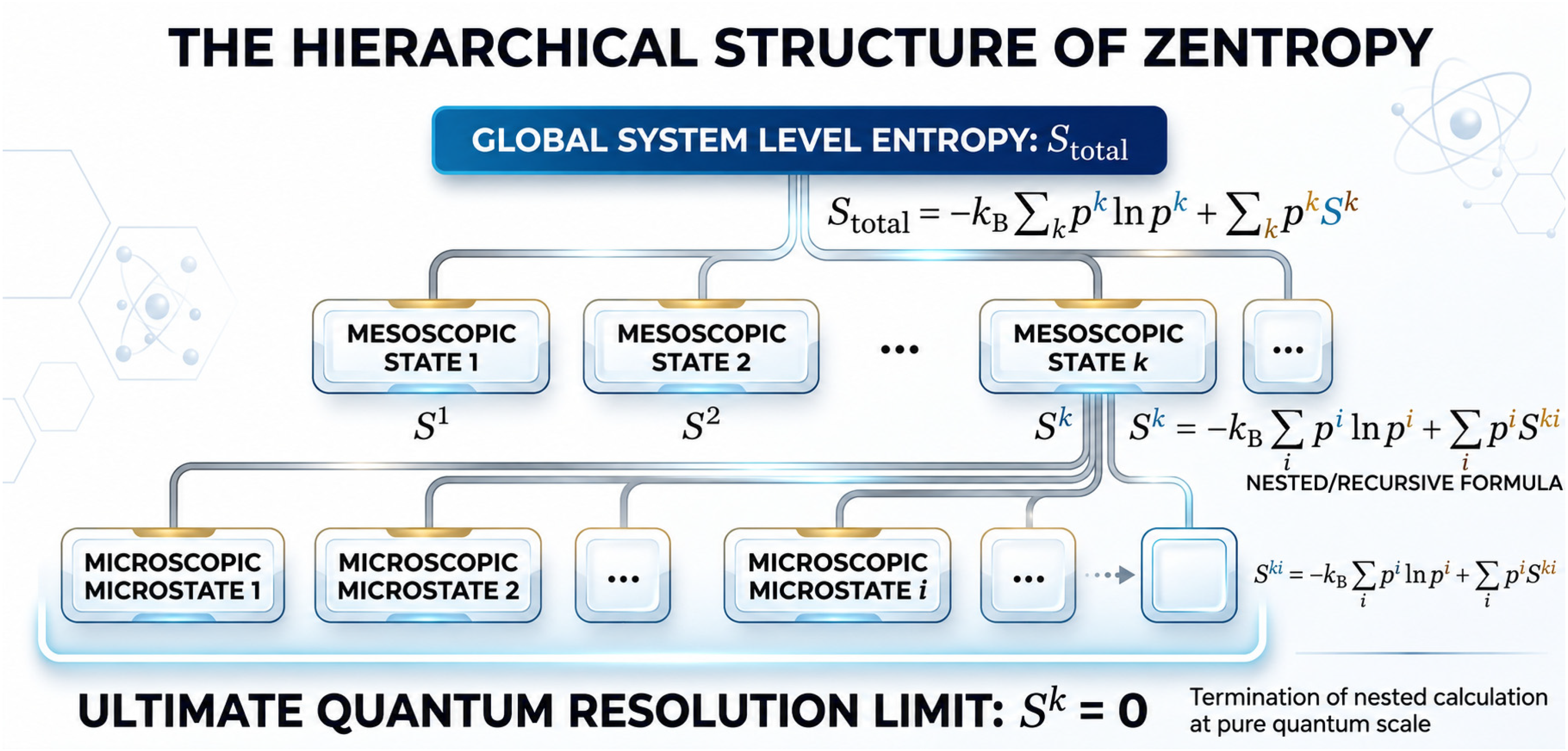
Figure 1 depicts the schematic paradigm of zentropy theory. In contrast to traditional statistical mechanics, which only considers the configurational entropy term , zentropy theory explicitly includes the weighted average of entropies from individual configurations . This key difference allows zentropy to capture the multiscale nature of entropy, where each configuration itself contains internal degrees of freedom and associated entropy contributions. The physical meaning becomes clearer when we consider that a system at any given scale can be decomposed into subsystems (configurations), each with its own entropy, while the inter-configurational statistics contribute an additional entropy term [2].
Figure 1.
The schematic paradigm of zentropy theory [2]. For visual simplicity, only one mesoscopic state is expanded into microscopic branches; the same recursive decomposition can be applied to each mesoscopic state and, in principle, to lower-level sub-configurations.
The recursive nature of zentropy theory deserves particular attention. If we continue the decomposition process, each sub-configuration can be further divided into finer sub-configurations until we reach pure quantum states. In this limiting case, the zentropy formulation naturally reduces to the classical Gibbs entropy form, demonstrating the internal consistency and fundamental nature of the theory. This recursive structure implies that entropy is not merely a static property but rather emerges from the hierarchical organization of matter across different scales.
The theory also redefines other thermodynamic quantities to be consistent with this multiscale approach. The free energy, for example, is given by
where is the free energy of configuration k, rather than simply using the total energy , as in traditional statistical mechanics. This shift from energy to free energy in the partition function calculation is a crucial innovation that enables more accurate predictions of temperature-dependent properties. The rationale behind this modification lies in the recognition that at finite temperatures, configurations are not frozen but rather thermally accessible, and their statistical weights must reflect free energies rather than just static energies. In the partition function expressions below, kB denotes the Boltzmann constant and T denotes absolute temperature.
The partition function in zentropy theory is correspondingly modified as follows:
leading to the following configuration probabilities:
This formulation ensures that the probability of each configuration depends on its full free energy (including entropy contributions) rather than just its total energy, providing a more physically realistic description of systems with multiple competing configurations. This fundamental change modifies the calculation of thermodynamic properties, putting entropy and energy on an equal basis for determining configuration probabilities.
It is important, however, to distinguish the practical utility of this framework for systematically organizing entropy contributions from the stronger assertion that it already constitutes a complete statistical–mechanical theory. At its current stage, zentropy offers a coherent framework for describing entropy contributions across configurational hierarchies; however, the rigorous formulation of unique configuration spaces, projection operators, and recursive entropy measures remains an open theoretical challenge.
2. Applications
2.1. Zentropy in Materials Science
Zentropy theory has found widespread applications across various materials science fields, demonstrating its versatility and predictive power. In thermal expansion studies, the theory has successfully explained positive, negative, and zero thermal expansion in diverse materials such as Ce and Fe3Pt [1]. By considering volume differences between ground-state and non-ground-state configurations, zentropy provides a unified mechanism for understanding thermal expansion behaviors that were previously explained by multiple distinct models. The key insight is that thermal expansion arises not merely from anharmonic lattice dynamics but from the temperature-dependent population of configurations with different volumes. When non-ground-state configurations have smaller volumes than the ground state and become thermally populated, negative thermal expansion results; conversely, when non-ground-state configurations have larger volumes, positive thermal expansion occurs.
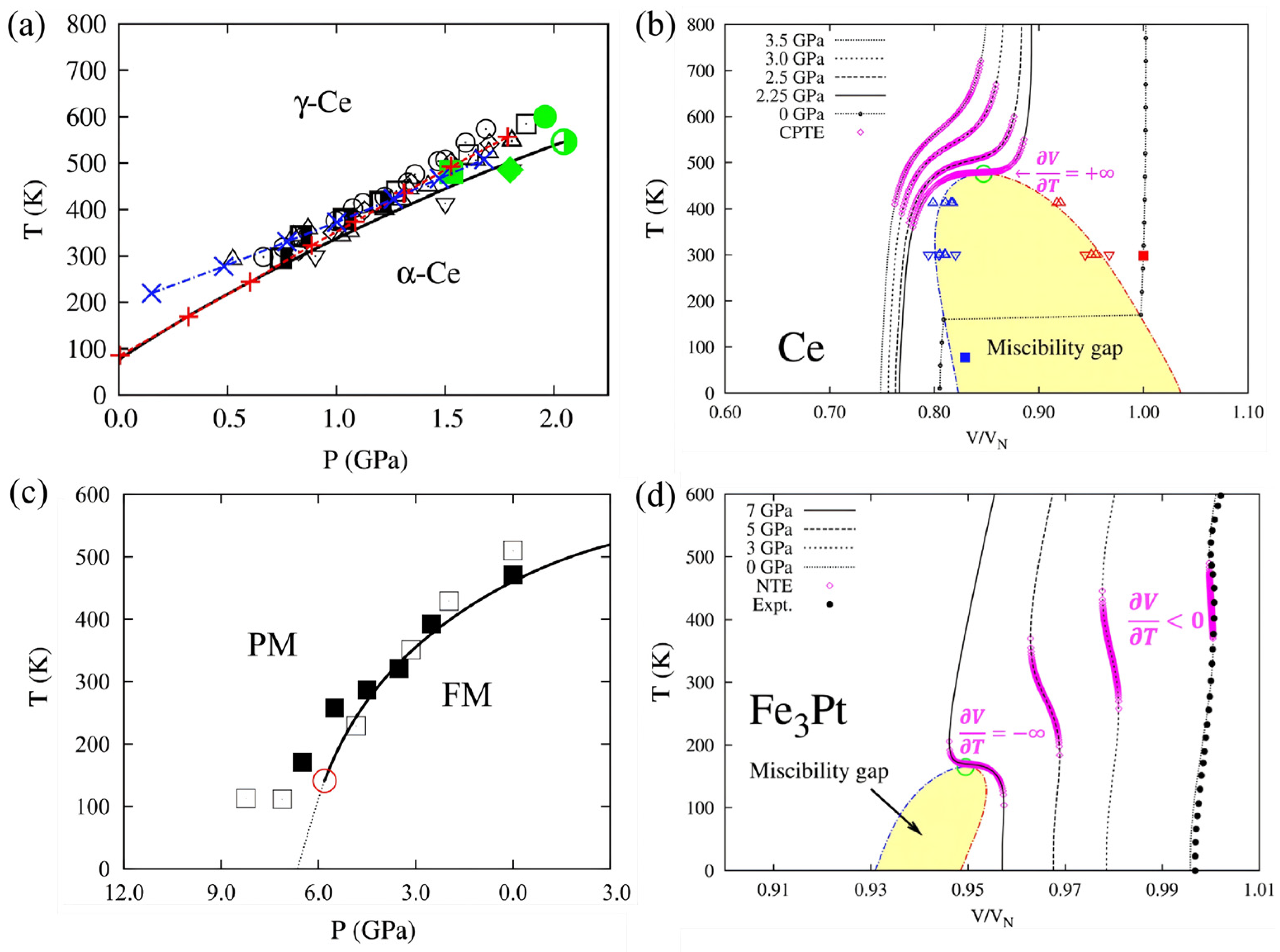
In the prediction of critical phenomena, zentropy has accurately captured critical points in Ce (γ-α transition) and Fe3Pt (magnetic transition) without empirical parameters, as shown in Figure 2a–c [2]. This capability arises from the theory’s ability to properly account for entropy contributions from multiple configurations near phase boundaries, where traditional methods often fail [3]. Near critical points, thermodynamic quantities such as heat capacity exhibit divergent behavior that reflects the increasing importance of configurational fluctuations. Zentropy theory captures this by explicitly treating the competition between configurations as the system approaches instability [3]. For phase transition temperatures, zentropy has predicted ferroelectric–paraelectric transition temperatures in PbTiO3 with remarkable accuracy (776 K vs. experimental 763 K) and antiferromagnetic transitions in YNiO3 (144 K vs. experimental 145 K) [4,5]. Figure 2d presents the temperature–volume phase diagram of Fe3Pt, analogous to that of Ce, featuring multiple isobaric volume curves. These experimental points exhibit excellent agreement with the predicted values, particularly within the temperature range where negative thermal expansion occurs. These predictions demonstrate the theory’s ability to capture the delicate balance between energy and entropy that determines transition temperatures.
Figure 2.
Predicted phase diagrams of Ce: (a) temperature–pressure and (b) temperature–volume, with experimental data overlaid. The dot–dashed (red) and solid (blue) looping branches denote α-Ce and γ-Ce, respectively. (green) represents the predicted critical point (Tc) from the present work; the dashed (green) line denotes a tentative phase boundary above Tc (Figure 2a). Purple diamonds in (b) indicate the anomalous thermal expansion region. Predicted phase diagrams of Fe3Pt: (c) temperature–pressure, showing decreasing pressure from left to right, and (d) temperature–volume. Experimental data are shown as black circles, while purple diamonds denote the negative thermal expansion region. In Figure 2b,d, the volume V is expressed relative to the equilibrium volume VN at ambient pressure and room temperature. The predicted CPTE regions are indicated by pink open diamonds. Below the critical point, denoted by the green open circle, the homogeneous single-phase state becomes unstable and separates into a two-phase mixture within the miscibility gap. The plotted data and curves are adapted from the cited reference [2].
In order–disorder transitions, zentropy has quantified disorder degrees and predicted Curie temperatures in Fe3Pt (400 K vs. 425 K) and Ni-based alloys [3,6]. By explicitly considering the entropy contributions from different atomic and magnetic configurations, the theory provides a more comprehensive description of disordering processes than traditional methods. The degree of disorder can be quantitatively tracked as a function of temperature, revealing how the system evolves from an ordered ground state to a disordered high-temperature state. Zentropy has also extended CALPHAD approaches by incorporating multiscale entropy contributions [7]. This integration has enabled more accurate phase diagram predictions, particularly for systems with multiple competing phases and complex configurational disorders. The ability to predict phase stability without relying on empirical fitting parameters represents a significant advancement in computational thermodynamics.
Validation against experiments and other computational approaches is therefore essential. Reported zentropy studies have compared predicted transition temperatures, thermal expansion trends, disorder parameters, and phase-stability boundaries with experimental measurements in systems such as Ce [2], Fe3Pt [3], PbTiO3 [4], and YNiO3 [5]. These comparisons show encouraging agreement for selected benchmark materials, but they should not be interpreted as universal validation. Broader assessments using calorimetry, diffraction, spectroscopy, and independent first-principle or CALPHAD calculations are still needed to quantify transferability and uncertainty [6].
2.2. Zentropy in AI
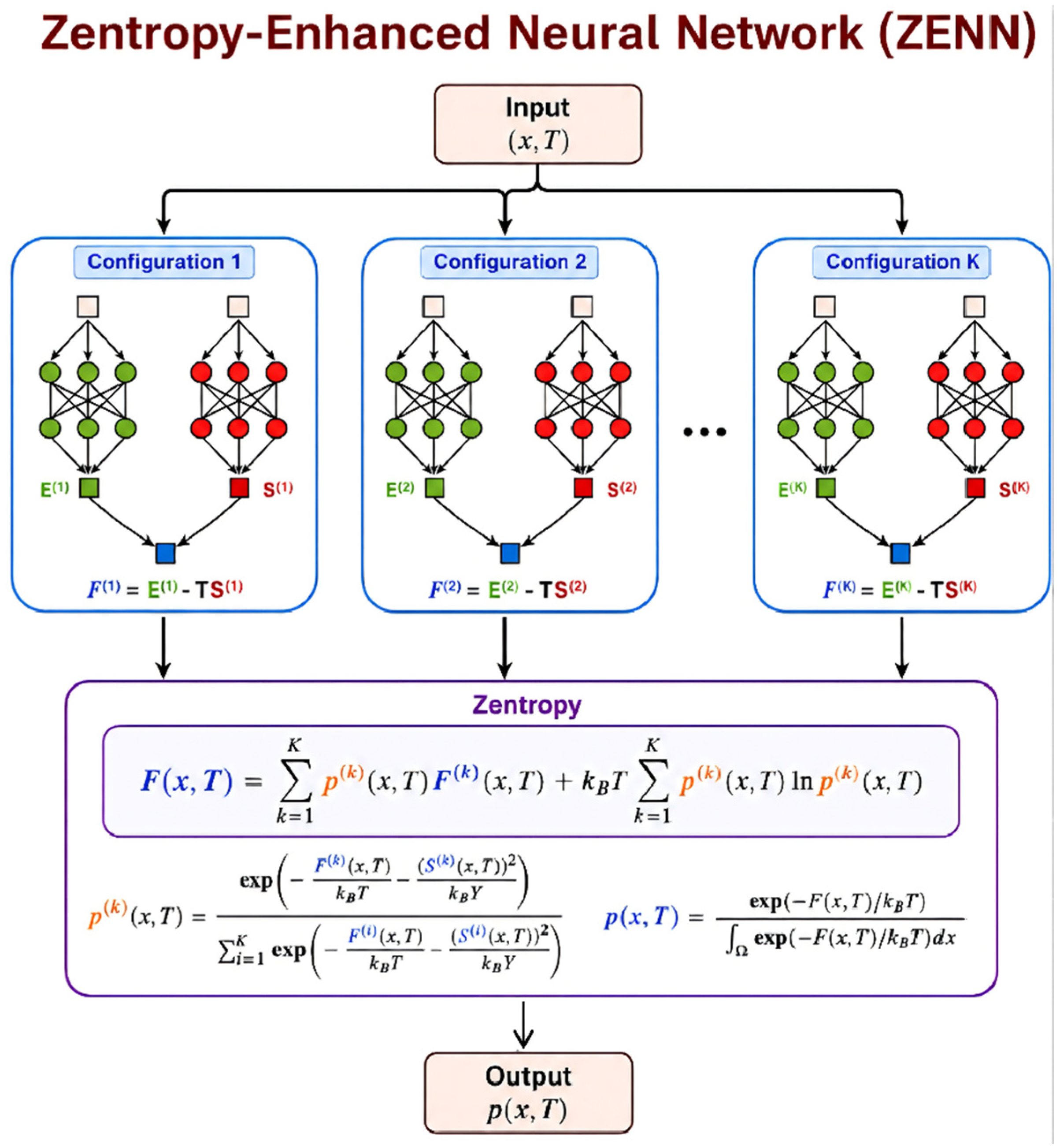
Current research on zentropy theory in artificial intelligence focuses heavily on enhancing robust feature selection and optimizing deep learning architectures for heterogeneous and multi-source data fusion [8]. In the realm of high-dimensional data processing, traditional feature selection approaches often struggle with severe noise and complex interaction patterns among features. To address these vulnerabilities, recent methodologies, such as the Neighborhood-Aware Fuzzy Rough Set based on Fuzzy Granule Zentropy (NAFRS-FGZE), leverage zentropy to quantify structural information across different granularity levels of fuzzy relations. By capturing multi-layered relationships between attributes and decision labels, the fuzzy granule zentropy measure delivers a far more resilient significance metric that effectively handles boundary data, class imbalances, and severe noise, consistently outperforming traditional Shannon-entropy-based feature selection models in accuracy and stability [8]. Concurrently, zentropy has emerged as a groundbreaking framework for integrating physics-informed constraints into machine learning, particularly through the introduction of Zentropy-Enhanced Neural Networks (ZENNs). The schematic diagram of a ZENN is depicted in Figure 3. Instead of treating multi-source data with standard cross-entropy losses, ZENNs conceptualize heterogeneous datasets under a thermodynamic framework where each data source is assigned an intrinsic entropy, and the total system entropy accounts for both these intrinsic properties and the statistical interactions between configurations. Supported by learnable latent temperature variables, this architecture excels at integrating conflicting or heterogeneously scaled data—such as image and text streams—while showing exceptional utility in AI for Science (AI4S) by directly learning Helmholtz energy landscapes, often also called Helmholtz free energy landscapes, and successfully predicting complex physical phase behaviors, such as negative thermal expansion in materials science. Consequently, zentropy is transitioning from an advanced statistical mechanics concept into a vital architectural tool in AI, offering a robust mathematical foundation for the next generation of explainable, physically consistent, and noise-tolerant machine learning models [9].
Figure 3.
Schematic diagram of the Zentropy-Enhanced Neural Network (ZENN) framework, adapted from Reference [9]. The scheme illustrates how heterogeneous input data are mapped to latent thermodynamic variables, weighted by entropy-related contributions, and used to learn physically constrained Helmholtz energy landscapes [9].
2.3. Comparison with Conventional Thermodynamic Approaches
Compared with CALPHAD, quasiharmonic approximation (QHA), and conventional statistical thermodynamics, zentropy emphasizes configurational ensembles whose members carry their own internal free energies and entropies. CALPHAD is powerful for assessed phase diagrams and engineering thermodynamics, but it often relies on fitted parameters and database availability. QHA provides an efficient route to vibrational free energies and thermal expansion in crystalline phases, but it is less suited to systems where several structural, magnetic, electronic, or domain configurations compete. Zentropy can, in favorable cases, combine first-principle free energies with statistical weighting over such competing configurations. Its present limitations are equally important: the configuration set must be chosen carefully, the required free-energy calculations can be expensive, and the method remains sensitive to errors in the underlying quantum–mechanical inputs.
3. Limitations and Challenges
3.1. Theoretical Limitations
3.1.1. Configurational Fine-Graining Challenge
A foundational postulate of zentropy theory relies on partitioning the system’s total partition function into a set of distinct, multiscale configurations denoted by the index k. However, within the continuous energy landscape of condensed matter systems, the strict mathematical definition and rigorous enumeration of these individual configurations remain largely arbitrary. In prevailing implementations, researchers must rely on physics-driven intuition or observed macroscopic symmetry-breaking phenomena to artificially construct the phase space of configurations [9]. From a rigorous statistical mechanics perspective, the theory currently lacks a formal, self-consistent algorithmic protocol capable of automated exploration to guarantee the mathematical completeness of the assumed configurational set. More fundamentally, this issue is connected to the debate over whether zentropy should presently be viewed as a new theory or as a detailed multiscale thermodynamic bookkeeping framework. Without a unique statistical prescription for the configuration basis, different decompositions may lead to different entropy partitions even when they describe the same physical system.
3.1.2. Independence Approximations Under Strong Multi-Degree-of-Freedom Coupling
The fundamental mathematical construct of zentropy decomposes the generalized total entropy into a canonical weighted summation of intrinsic configurational entropies and a statistical mixing entropy, expressed as follows [1]:
This factorization implicitly presumes that the fast internal degrees of freedom (DoFs)—such as high-frequency phonon vibrations and electronic excitations—are statistically decoupled from, or adiabatically enslaved to, the slow macro-configurational fluctuations indexed by k. In strongly correlated electron systems or materials undergoing concurrent structural and magnetic transitions, this independent subsystem approximation breaks down due to severe, nonlinear cross-DoF coupling (e.g., pronounced spin–phonon or electron–phonon interactions). When the characteristic timescales of intrinsic transitions approach those of external configurational hopping, the system exhibits non-ergodic behavior, rendering the simple superposition of decoupled entropies physically inadequate. A rigorous thermodynamic framework to systematically project, untangle, and recouple these intertwined intra- and inter-configurational interactions remains an unresolved frontier in top-down entropy nesting [10,11]. This limitation is especially serious for complex quantum states, where entanglement, delocalized electronic character, or fluctuating spin–lattice states cannot always be represented as a small set of discrete, weakly coupled configurations. In such cases, the apparent simplicity of the zentropy decomposition may obscure unresolved statistical correlations between the chosen configuration labels and the internal quantum degrees of freedom.
3.1.3. Error Propagation from Density Functional Theory Approximations
As a bottom-up predictive tool, zentropy theory exhibits an acute, nonlinear sensitivity to the accuracy of the underlying quantum mechanical inputs. The thermodynamic probability of occupying a specific configuration k is calculated via Boltzmann-like factors governed by the free energy. Because these energy terms are often obtained from density functional theory (DFT), whose modern formulation began with the Hohenberg–Kohn theorem and Kohn–Sham equations, systemic deficiencies in contemporary exchange-correlation functionals—such as the over-delocalization of d- or f-electrons in Generalized Gradient Approximations (GGAs)—can be heavily penalized. It is therefore more appropriate to state that errors of a few meV per atom are already demanding relative to the practical accuracy of many DFT workflows, rather than to imply that such errors are routinely within chemical accuracy. For instance, when predicting the Fe phase transitions of fcc and hcp structures, a 5 meV/atom energy discrepancy in the Gibbs free energy difference calculated using CALPHAD results in a 150 K deviation in the predicted transition temperatures [12]. In addition, when calculating the melting point of silicon, even a minor error in the solid–liquid free energy difference can result in a prediction deviation of hundreds of K: conventional GGA-DFT underestimates by approximately 200 K, while hybrid functional methods overestimate by about 150 K. This further demonstrates how subtle errors in DFT calculations, including functional selection, can lead to substantial differences in final macroscopic properties [13]. This severe sensitivity causes dramatic shifts in predicted macro-properties, such as phase transition temperatures or thermal expansion coefficients, highlighting the fact that zentropy theory currently lacks an intrinsic self-correcting or error-resilient mathematical architecture to buffer against quantum-level calculation inaccuracies [14,15].
3.1.4. Delocalized and Non-Crystalline Continuum States
While zentropy theory has demonstrated notable success in systems governed by well-defined lattice sites—such as crystalline alloys and ordered ferroelectrics—extending its mathematical architecture to non-crystalline, continuously evolving states remains a formidable theoretical hurdle. In liquids, molten salts, and amorphous glasses, atoms lack long-range order and fixed equilibrium coordinates, causing the potential energy surface to be continuous and highly delocalized rather than partitioned into discrete minima [16]. For example, the bottom of the potential energy surface (PEL) of a metallic glass is not a smooth deep valley but rather is covered with numerous tiny “ripples”. The energy barrier between adjacent metastable states is only about 1 meV—significantly lower than conventional relaxation barriers—and can be easily overcome by quantum zero-point vibrations [17]. Consequently, the distinct assignment of a discrete configurational index k and its associated localized intrinsic entropy Sk becomes conceptually ill-defined. Therefore, establishing a mathematically rigorous, fully transferable partition function for amorphous networks without relying on underlying lattice projections remains an open, intensely debated challenge in modern materials physics.
3.2. Application Challenges
3.2.1. Software Development and Toolchains
A primary hurdle in the practical adoption of zentropy theory is the severe fragmentation of software toolchains and the complete lack of native integration within mainstream first-principles electronic structure codes (e.g., VASP [18], Quantum ESPRESSO [19], CP2K [20]). Current zentropy implementations rely heavily on disparate, customized scripts developed by individual research groups to bridge independent calculations of phonon spectra, magnetic configurations, and electronic densities of states. To date, Professor Zikui Liu’s team has made significant progress in addressing this issue. For instance, they released the open-source Python package pyzentropy, which applies the recursive properties of entropy from information theory to first-principles thermodynamic calculations—filling a gap in specialized tools for this field—and validated its effectiveness using the Fe3Pt alloy as a case study. Nevertheless, despite these achievements, without a unified, open-source, and standardized end-to-end automation suite—analogous to industrial-grade workflows found in frameworks like Pymatgen [21], AiiDA [22], or Atomate [23]—researchers must execute complex, manual data extraction and multi-stage fitting routines. This operational bottleneck severely limits the scalability, reproducibility, and accessibility of the theory for the broader materials engineering community and industrial applications.
3.2.2. High-Throughput Databases and AI
From a computational perspective, zentropy calculations are typically more demanding than single-configuration QHA or standard ground-state DFT workflows because each relevant configuration may require its own structural relaxation, phonon or magnetic free-energy calculation, and temperature-dependent statistical weighting. The cost, therefore, scales with both the number of configurations and the complexity of the internal degrees of freedom assigned to each configuration. Practical scalability will depend on automated configuration generation, surrogate models, active learning, uncertainty-aware screening, and careful selection of the minimum physically meaningful configurational basis.
Existing high-throughput materials science repositories (e.g., the Materials Project, OQMD, and AFLOW) are fundamentally optimized around static, zero-temperature properties like ground-state energies, crystal structures, and electronic bandgaps [24,25]. Conversely, evaluating macroscopic emergent phenomena via zentropy theory demands a comprehensive, multi-dimensional thermodynamic dataset spanning continuous temperature and pressure ranges across a dense ensemble of configurations. Storing and indexing such rich data patterns—where a single material composition requires dozens of distinct magnetic or structural configurations, each associated with its own temperature-dependent free energy curve—imposes an exponential burden on database infrastructure. Current high-throughput paradigms lack schemas flexible enough to handle the data ingestion, complex querying, and indexing required for these multiscale properties, creating a vast data infrastructure gap.
This infrastructural bottleneck directly impacts the application of Artificial Intelligence for Science (AI4S). While deep learning frameworks and material graph neural networks (GNNs) have revolutionized property prediction on millions of static DFT data points [26,27], zentropy-based modeling faces a severe scarcity of high-quality training data. Due to the extreme computational expense of fully sampling configuration spaces under the zentropy protocol, datasets mapping multi-configuration free energies across temperatures are critically insufficient, leaving AI models starved of the data required for robust generalization. Furthermore, conventional geometric descriptors in materials AI are intrinsically limited; they are designed to map a single, static crystalline topology rather than an ensemble of competing states [28]. Consequently, developing advanced descriptors capable of representing a temperature-dependent probability distribution of diverse, symmetry-breaking configurations—while maintaining rigorous physical equivariance—remains a prominent challenge [29].
3.2.3. Applications in Materials Science
In applied materials engineering, zentropy theory is most urgently needed to predict phenomena in strongly correlated or multi-field coupled systems, such as giant magnetocaloric effects, ferroelectric/ferromagnetic switchable states, and high-temperature superconducting phases. However, the constituent transition metal oxides or rare-earth compounds in these applications feature localized d- or f-electrons that are poorly described by standard density functional approximations [30]. Because phase transition boundaries and critical fields are extraordinarily sensitive to minuscule free energy differences, underlying quantum-level calculation errors frequently manifest as significant temperature shifts in the predicted macroscopic transition thresholds. For advanced industries demanding strict process windows, such as spintronics and semiconductor logic gates, this level of predictive drift remains a critical barrier to direct prototyping [31].
4. Future Directions and Emerging Research
4.1. Theoretical Developments
Future theoretical developments in zentropy theory should focus on several key areas. Addressing the ergodicity assumption for systems with high energy barriers requires developing non-ergodic extensions that can account for metastable states and kinetic effects. This might involve incorporating transition state theory or kinetic Monte Carlo methods to capture the time evolution of configuration probabilities [32]. In addition, mathematical formalization of the recursive entropy concept across multiple scales would provide a more rigorous foundation for the theory. This includes developing systematic procedures for decomposing configurations into sub-configurations, defining appropriate variables at each scale [33], and handling the coupling between scales in a consistent manner [34]. Furthermore, improved treatment of quantum effects at low temperatures would expand the theory’s applicability to strongly correlated systems and low-temperature phenomena. This might involve incorporating quantum statistical mechanics more explicitly, including zero-point energy contributions [35] and quantum fluctuation effects [36].
4.2. Expanded Applications in Materials Science
Zentropy theory has significant potential for application in a wide range of materials systems. In phase transition materials, it can provide insights into phase transitions in magnetic materials [3] and domain wall dynamics in ferroelectrics [4]. Understanding these phase transitions at the configuration level can guide the design of materials with tailored transformation temperatures and hysteresis properties. In ferroelectric materials, zentropy can help design materials with tailored phase transition temperatures and enhanced piezoelectric properties. By understanding how different domain wall configurations contribute to the free energy, one can engineer materials with optimized electromechanical responses. For ferromagnetic materials, the theory can guide the development of permanent magnets with optimized coercivity and magnetic shape memory alloys with improved functional properties. Zentropy also holds promise for understanding superconductivity by capturing the entropy balance near superconducting transitions. The competition between different electronic configurations, including superconducting and normal states, can be naturally described within the zentropy framework. This might provide insights into the mechanisms of unconventional superconductors and guide the discovery of new superconducting materials. In high-entropy materials, the theory can predict phase stability and guide the design of alloys with tailored thermal expansion and mechanical properties [1]. The high configurational entropy that gives these materials their name arises naturally from the zentropy formalism, and the theory can quantify how different atomic configurations contribute to the overall entropy and free energy.
4.3. Software Development and Automated Workflows
The future of zentropy theory depends heavily on software development and automated workflows. High-throughput tools like DFTTK need continued refinement to handle larger systems and more complex configurations [37]. This includes improving the efficiency of configuration generation, enhancing the robustness of DFT calculations, and developing better algorithms for free energy calculations. Furthermore, integration with machine learning approaches can accelerate configuration space exploration and reduce computational costs [26]. Machine learning models can be trained to predict configuration energies with DFT accuracy at a fraction of the computational cost, enabling the study of larger systems and more configurations. Active learning strategies can identify which new calculations are most informative to perform, maximizing the efficiency of the overall workflow.
Developing user-friendly interfaces and educational resources will increase the theory’s accessibility to the broader materials science community. Cross-scale automated workflows that connect electronic structure calculations to mesoscale modeling will also enable more comprehensive materials design [38]. The output from zentropy calculations can serve as the input for phase-field simulations, finite element models, and other mesoscale methods, enabling the prediction of microstructure evolution and device performance. Quantification of prediction uncertainties and validation against experimental data will be crucial for establishing the theory’s reliability across different material systems. This requires developing systematic methods for error propagation, benchmarking against well-characterized experimental systems, and building databases of validated predictions that can be used to assess the theory’s accuracy.
4.4. Scope and Limitations of This Review
This review focuses on the conceptual basis of zentropy theory, selected materials science applications, AI-related extensions, and major theoretical and practical challenges. It does not provide an exhaustive bibliometric survey, a complete derivation of all statistical–mechanical variants, or a detailed software tutorial for every available implementation. Topics such as nonequilibrium thermodynamics, kinetic pathways, molecular-dynamics sampling protocols, and full uncertainty-propagation formalisms are discussed only when they directly affect the present scope.
5. Conclusions
Zentropy theory has emerged as a promising framework in computational thermodynamics, offering a useful route to organize material properties across multiple scales. Its practical value lies in combining quantum–mechanical inputs, configurational statistics, and thermodynamic modeling to describe phase transitions, thermal behavior, and material stability in selected benchmark systems. At the same time, the present review emphasizes that zentropy should not yet be regarded as a universally established theory. Its broader impact depends on resolving foundational issues in configuration space definition, statistical–mechanical derivation, treatment of strongly coupled quantum states, computational scalability, and uncertainty propagation. With these qualifications, zentropy may become an important component of multiscale materials modeling and may contribute to the rational design of materials with tailored properties for future technologies.
Author Contributions
Conceptualization, S.X.; methodology, S.X.; investigation, S.X.; formal analysis, S.X.; data curation, S.X.; writing—original draft preparation, S.X.; writing—review and editing, J.Z. and Z.S.; visualization, S.X.; supervision, J.Z. and Z.S. All authors have read and agreed to the published version of the manuscript.
Funding
This work was supported by the National Natural Science Foundation of China (Grant No. 52332005).
Data Availability Statement
No new data were created or analyzed in this study. Data sharing is not applicable to this article.
Conflicts of Interest
The authors declare no conflicts of interest.
References
- Liu, Z.-K.; Wang, Y.; Shang, S.-L. Zentropy Theory for Positive and Negative Thermal Expansion. J. Phase Equilibria Diffus. 2022, 43, 598–605. [Google Scholar] [CrossRef]
- Liu, Z.-K. Theory of Cross Phenomena and Their Coefficients beyond Onsager Theorem. Mater. Res. Lett. 2022, 10, 393–439. [Google Scholar] [CrossRef]
- Shang, S.-L.; Wang, Y.; Liu, Z.-K. Quantifying the Degree of Disorder and Associated Phenomena in Materials through Zentropy: Illustrated with Invar Fe3Pt. Scr. Mater. 2023, 225, 115164. [Google Scholar] [CrossRef]
- Liu, Z.-K.; Shang, S.-L.; Du, J.; Wang, Y. Parameter-Free Prediction of Phase Transition in PbTiO3 through Combination of Quantum Mechanics and Statistical Mechanics. Scr. Mater. 2023, 232, 115480. [Google Scholar] [CrossRef]
- Du, J.L.; Malyi, O.I.; Shang, S.-L.; Wang, Y.; Zhao, X.-G.; Liu, F.; Zunger, A.; Liu, Z.-K. Density Functional Thermodynamic Description of Spin, Phonon and Displacement Degrees of Freedom in Antiferromagnetic-to-Paramagnetic Phase Transition in YNiO3. Mater. Today Phys. 2022, 27, 100805. [Google Scholar] [CrossRef]
- Olson, G.B.; Liu, Z.K. Genomic Materials Design: CALculation of PHAse Dynamics. Calphad 2023, 82, 102590. [Google Scholar] [CrossRef]
- Ågren, J. The Materials Genome and CALPHAD. Chin. Sci. Bull. 2014, 59, 1635–1640. [Google Scholar] [CrossRef]
- Yuan, K.; Miao, D.; Zhang, H.; Pedrycz, W. An Efficient and Robust Feature Selection Approach Based on Zentropy Measure and Neighborhood-Aware Model. IEEE Trans. Neural Netw. Learn. Syst. 2025, 36, 16351–16365. [Google Scholar] [CrossRef] [PubMed]
- Wang, S.; Shang, S.-L.; Liu, Z.-K.; Hao, W. ZENN: A Thermodynamics-Inspired Computational Framework for Heterogeneous Data–Driven Modeling. Proc. Natl. Acad. Sci. USA 2026, 123, e2511227122. [Google Scholar] [CrossRef] [PubMed]
- Werner, P.; Millis, A.J. Efficient Dynamical Mean Field Simulation of the Holstein-Hubbard Model. Phys. Rev. Lett. 2007, 99, 146404. [Google Scholar] [CrossRef] [PubMed]
- Miao, H.; Zhang, T.T.; Li, H.X.; Fabbris, G.; Said, A.H.; Tartaglia, R.; Yilmaz, T.; Vescovo, E.; Yin, J.-X.; Murakami, S.; et al. Signature of Spin-Phonon Coupling Driven Charge Density Wave in a Kagome Magnet. Nat. Commun. 2023, 14, 6183. [Google Scholar] [CrossRef] [PubMed]
- Gambino, D.; Klarbring, J.; Alling, B. Phase Stability of Fe from First Principles: Atomistic Spin Dynamics Coupled with Ab Initio Molecular Dynamics Simulations and Thermodynamic Integration. Phys. Rev. B 2023, 107, 014102. [Google Scholar] [CrossRef]
- Dorner, F.; Sukurma, Z.; Dellago, C.; Kresse, G. Melting Si: Beyond Density Functional Theory. Phys. Rev. Lett. 2018, 121, 195701. [Google Scholar] [CrossRef] [PubMed]
- Hohenberg, P.; Kohn, W. Inhomogeneous Electron Gas. Phys. Rev. 1964, 136, B864–B871. [Google Scholar] [CrossRef]
- Kohn, W.; Sham, L.J. Self-Consistent Equations Including Exchange and Correlation Effects. Phys. Rev. 1965, 140, A1133–A1138. [Google Scholar] [CrossRef]
- Berthier, L.; Ozawa, M.; Scalliet, C. Configurational Entropy of Glass-Forming Liquids. J. Chem. Phys. 2019, 150, 160902. [Google Scholar] [CrossRef] [PubMed]
- Zella, L.; Moon, J.; Egami, T. Ripples in the Bottom of the Potential Energy Landscape of Metallic Glass. Nat. Commun. 2024, 15, 1358. [Google Scholar] [CrossRef] [PubMed]
- Kresse, G.; Furthmüller, J. Efficiency of Ab-Initio Total Energy Calculations for Metals and Semiconductors Using a Plane-Wave Basis Set. Comput. Mater. Sci. 1996, 6, 15–50. [Google Scholar] [CrossRef]
- Giannozzi, P.; Baroni, S.; Bonini, N.; Calandra, M.; Car, R.; Cavazzoni, C.; Ceresoli, D.; Chiarotti, G.L.; Cococcioni, M.; Dabo, I.; et al. QUANTUM ESPRESSO: A Modular and Open-Source Software Project for Quantum Simulations of Materials. J. Phys. Condens. Matter 2009, 21, 395502. [Google Scholar] [CrossRef] [PubMed]
- Kühne, T.D.; Iannuzzi, M.; Del Ben, M.; Rybkin, V.V.; Seewald, P.; Stein, F.; Laino, T.; Khaliullin, R.Z.; Schütt, O.; Schiffmann, F.; et al. CP2K: An Electronic Structure and Molecular Dynamics Software Package—Quickstep: Efficient and Accurate Electronic Structure Calculations. J. Chem. Phys. 2020, 152, 194103. [Google Scholar] [CrossRef] [PubMed]
- Hew, N.L.E.; Myers, L.A.; Shang, S.-L.; Liu, Z.-K. Pyzentropy: A Python Package Implementing Recursive Entropy for First-Principles Thermodynamics. arXiv 2026, arXiv:2604.17665. [Google Scholar]
- Pizzi, G.; Cepellotti, A.; Sabatini, R.; Marzari, N.; Kozinsky, B. AiiDA: Automated Interactive Infrastructure and Database for Computational Science. Comput. Mater. Sci. 2016, 111, 218–230. [Google Scholar] [CrossRef]
- Mathew, K.; Montoya, J.H.; Faghaninia, A.; Dwarakanath, S.; Aykol, M.; Tang, H.; Chu, I.; Smidt, T.; Bocklund, B.; Horton, M.; et al. Atomate: A High-Level Interface to Generate, Execute, and Analyze Computational Materials Science Workflows. Comput. Mater. Sci. 2017, 139, 140–152. [Google Scholar] [CrossRef]
- Curtarolo, S.; Setyawan, W.; Wang, S.; Xue, J.; Yang, K.; Taylor, R.H.; Nelson, L.J.; Hart, G.L.W.; Sanvito, S.; Buongiorno-Nardelli, M.; et al. AFLOWLIB.ORG: A Distributed Materials Properties Repository from High-Throughput Ab Initio Calculations. Comput. Mater. Sci. 2012, 58, 227–235. [Google Scholar] [CrossRef]
- Jain, A.; Ong, S.P.; Hautier, G.; Chen, W.; Richards, W.D.; Dacek, S.; Cholia, S.; Gunter, D.; Skinner, D.; Ceder, G.; et al. Commentary: The Materials Project: A Materials Genome Approach to Accelerating Materials Innovation. APL Mater. 2013, 1, 011002. [Google Scholar] [CrossRef]
- Deng, B.; Zhong, P.; Jun, K.; Riebesell, J.; Han, K.; Bartel, C.J.; Ceder, G. CHGNet as a Pretrained Universal Neural Network Potential for Charge-Informed Atomistic Modelling. Nat. Mach. Intell. 2023, 5, 1031–1041. [Google Scholar] [CrossRef]
- Chen, C.; Ong, S.P. A Universal Graph Deep Learning Interatomic Potential for the Periodic Table. Nat. Comput. Sci. 2022, 2, 718–728. [Google Scholar] [CrossRef] [PubMed]
- Behler, J. Four Generations of High-Dimensional Neural Network Potentials. Chem. Rev. 2021, 121, 10037–10072. [Google Scholar] [CrossRef] [PubMed]
- Batzner, S.; Musaelian, A.; Sun, L.; Geiger, M.; Mailoa, J.P.; Kornbluth, M.; Molinari, N.; Smidt, T.E.; Kozinsky, B. E(3)-Equivariant Graph Neural Networks for Data-Efficient and Accurate Interatomic Potentials. Nat. Commun. 2022, 13, 2453. [Google Scholar] [CrossRef] [PubMed]
- Himmetoglu, B.; Floris, A.; de Gironcoli, S.; Cococcioni, M. Hubbard-Corrected DFT Energy Functionals: The LDA+U Description of Correlated Systems. Int. J. Quantum Chem. 2014, 114, 14–49. [Google Scholar] [CrossRef]
- Manipatruni, S.; Nikonov, D.E.; Young, I.A. Beyond CMOS Computing with Spin and Polarization. Nat. Phys. 2018, 14, 338–343. [Google Scholar] [CrossRef]
- Voter, A.F. Introduction to the Kinetic Monte Carlo Method. In Radiation Effects in Solids; Sickafus, K.E., Kotomin, E.A., Uberuaga, B.P., Eds.; Springer: Dordrecht, The Netherlands, 2007; pp. 1–23. [Google Scholar]
- Costa, M.; Goldberger, A.L.; Peng, C.-K. Multiscale Entropy Analysis of Complex Physiologic Time Series. Phys. Rev. Lett. 2002, 89, 068102. [Google Scholar] [CrossRef] [PubMed]
- Noid, W.G.; Chu, J.-W.; Ayton, G.S.; Krishna, V.; Izvekov, S.; Voth, G.A.; Das, A.; Andersen, H.C. The Multiscale Coarse-Graining Method. I. A Rigorous Bridge between Atomistic and Coarse-Grained Models. J. Chem. Phys. 2008, 128, 244114. [Google Scholar] [CrossRef] [PubMed]
- Grabowski, B.; Ismer, L.; Hickel, T.; Neugebauer, J. Ab Initio up to the Melting Point: Anharmonicity and Vacancies in Aluminum. Phys. Rev. B 2009, 79, 134106. [Google Scholar] [CrossRef]
- Manzano, G.; Horowitz, J.M.; Parrondo, J.M.R. Quantum Fluctuation Theorems for Arbitrary Environments: Adiabatic and Nonadiabatic Entropy Production. Phys. Rev. X 2018, 8, 031037. [Google Scholar] [CrossRef]
- Wang, Y.; Liao, M.; Bocklund, B.J.; Gao, P.; Shang, S.-L.; Kim, H.; Beese, A.M.; Chen, L.-Q.; Liu, Z.-K. DFTTFK: Density Functional Theory ToolKit for High-Throughput Lattice Dynamics Calculations. Calphad 2021, 75, 102355. [Google Scholar] [CrossRef]
- Wang, G.; Peng, L.; Li, K.; Zhu, L.; Zhou, J.; Miao, N.; Sun, Z. ALKEMIE: An Intelligent Computational Platform for Accelerating Materials Discovery and Design. Comput. Mater. Sci. 2021, 186, 110064. [Google Scholar] [CrossRef]
Disclaimer/Publisher’s Note: The statements, opinions and data contained in all publications are solely those of the individual author(s) and contributor(s) and not of MDPI and/or the editor(s). MDPI and/or the editor(s) disclaim responsibility for any injury to people or property resulting from any ideas, methods, instructions or products referred to in the content. |
© 2026 by the authors. Licensee MDPI, Basel, Switzerland. This article is an open access article distributed under the terms and conditions of the Creative Commons Attribution (CC BY) license.