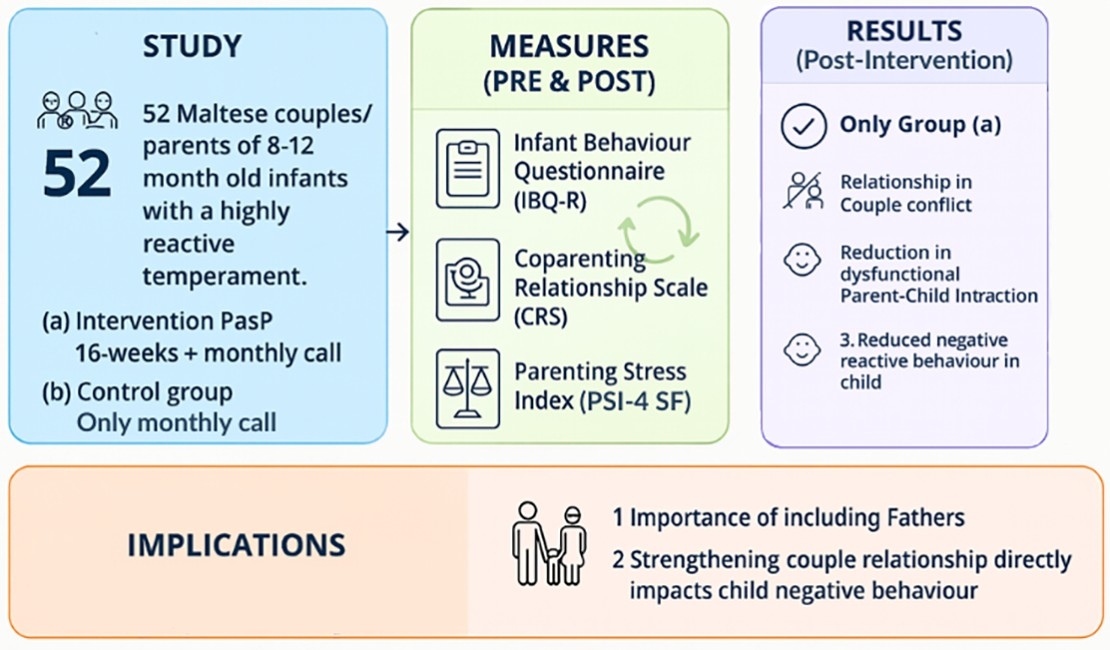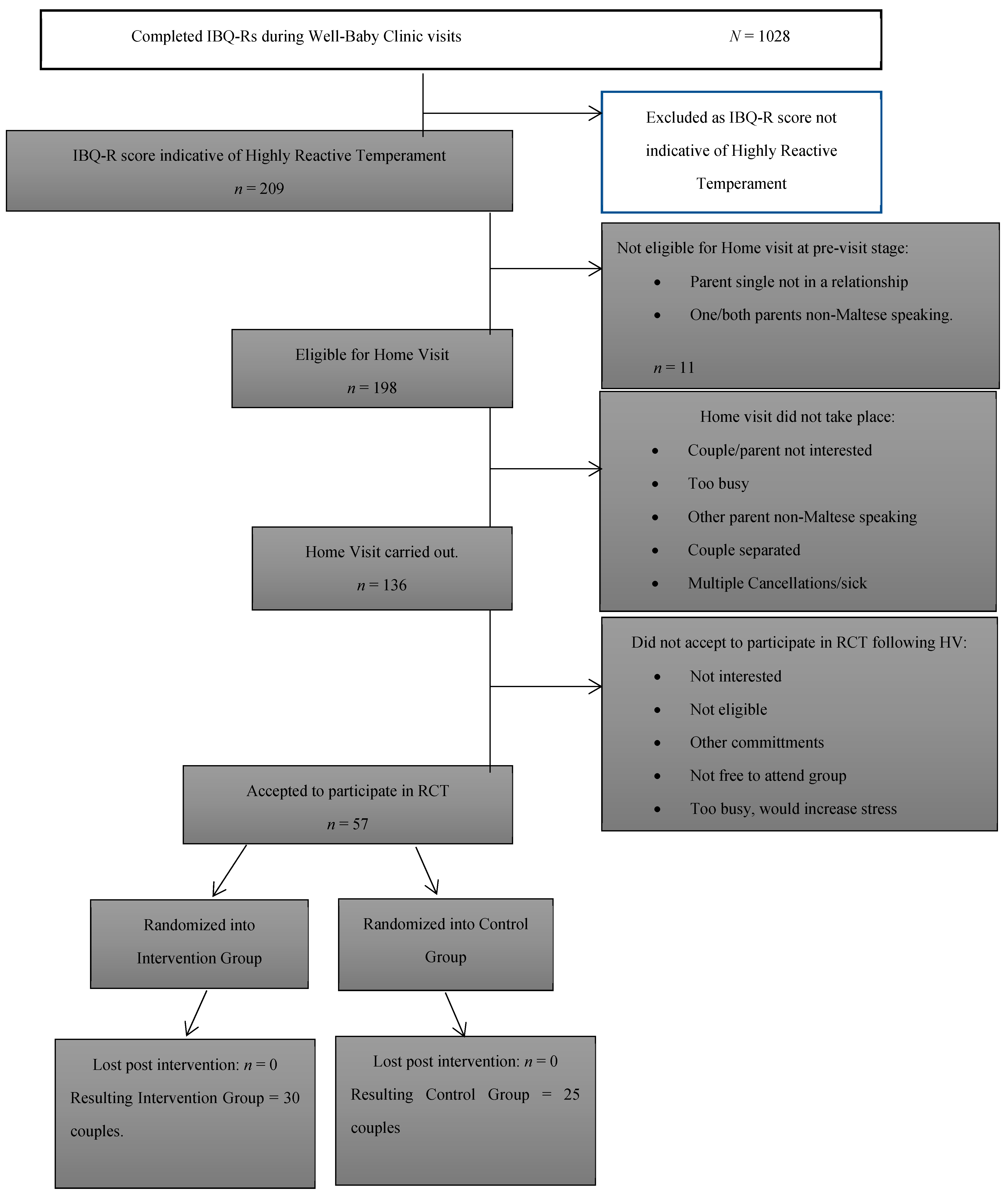

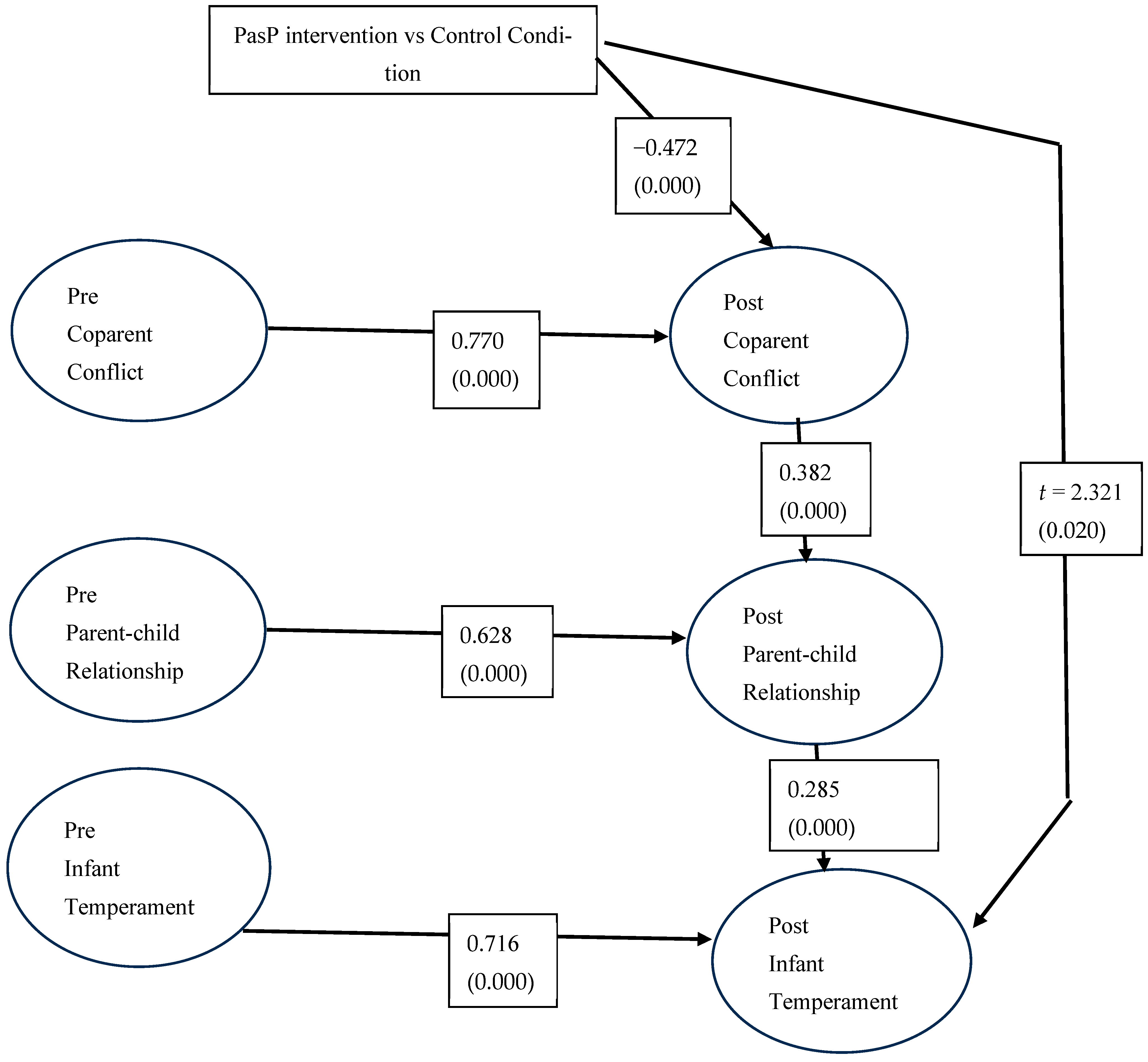
‘Parents as Partners’ Coparenting Programme with Parents of Infants with a Highly Reactive Temperament: A Randomised Controlled Study


Abstract
1. Introduction
2. Materials and Methods
2.1. Participants
2.2. Target Sample
2.3. Recruitment
2.4. Procedure
2.5. Measures
2.6. Analysis
3. Results
3.1. Statistically Significant Interventions
3.1.1. Couple/Coparenting Effects
3.1.2. Child Effects
3.1.3. Indirect Effects of the Intervention
4. Discussion
4.1. Mothers, Fathers, and Their Infants Affected Positively by the PasP
4.2. Generalisability and Relevance of Findings to Existing Research on Supporting Couples
4.3. Impact of Stress on Parenting
4.4. Increasing Support by Increasing Father Involvement
4.5. Limitations
4.6. Implications for Practice
5. Conclusions
Author Contributions
Funding
Institutional Review Board Statement
Informed Consent Statement
Data Availability Statement
Conflicts of Interest
Abbreviations
| HRT | Highly reactive temperament |
| SFI | Supporting Father Involvement |
| PasP | Parents as Partners |
| RCT | Randomised Controlled Trial |
References
- Abidin, R. R. (2012). Parenting stress index—PSI-4-SF (4th ed.). Available online: https://www.parinc.com/products/PSI-4 (accessed on 17 November 2025).
- Aracena, M., Gomez Muzzio, E. A., Undurraga, C., Leiva, L., Marinkovic, K., & Molina, Y. (2016). Validity and reliability of the Parenting Stress Index Short Form (PSI-SF) applied to a Chilean sample. Journal of Child and Family Studies, 25(12), 3554–3564. [Google Scholar] [CrossRef] [Scilit]
- Bornstein, M. H., Arterberry, M. E., & Lamb, M. E. (2014). Development in infancy: A contemporary introduction (5th ed.). Taylor & Francis Group, Psychology Press. [Google Scholar]
- Bornstein, M. H., Putnick, D. L., Gartstein, M. A., Hahn, C.-S., Auestad, N., & O’Connor, D. L. (2015). Infant temperament: Stability by age, gender, birth order, term status and SES. Child Development, 86(3), 844–863. [Google Scholar] [CrossRef] [Scilit]
- Brown, T. (2008). An evaluation of a new post-separation and divorce parenting program. Family Matters, 78, 44–51. [Google Scholar]
- Burney, R. V., & Leerkes, E. M. (2010). Links between mothers’ and fathers’ perception of infant temperament and coparenting. Infant Behaviour and Development, 33, 125–135. [Google Scholar] [CrossRef] [Scilit]
- Buss, K. A., & Kiel, E. J. (2013). Temperamental risk factors for pediatric anxiety disorders. Current Clinical Psychiatry, 2013, 47–68. [Google Scholar]
- Casey, P., Cowan, P. A., Cowan, C. P., Draper, L., Mwamba, N., & Hewison, D. (2017). Parents as partners: A U.K. trial of a U.S. couples-based parenting intervention for at risk low-income families. Family Process, 56(3), 589–606. [Google Scholar] [CrossRef] [Scilit] [PubMed]
- Clifford, S. M., Hudry, K., Elsabbagh, M., Charman, T., Johnson, M. H., & The BASIS Team. (2013). Temperament in the first 2 years of life in infants at high risk for autism spectrum disorders. Journal of Autism Developmental Disorder, 43(3), 673–686. [Google Scholar] [CrossRef] [Scilit]
- Cohen, J. (1988). Statistical power analysis for behavioural sciences (2nd ed.). Lawrence Erlbaum Associates, Publishers. [Google Scholar]
- Cook, J. C., Schoppe-Sullivan, S. J., Buckley, C. K., & Davis, E. F. (2009). Are some children harder to co-parent than others? Children’s negative emotionality and coparenting relationship quality. Journal of Family Psychology, 23(4), 606–610. [Google Scholar] [CrossRef] [Scilit] [PubMed]
- Cowan, P. A., & Cowan, C. P. (2008). Diverging family policies to promote children’s well-being in the UK and US: Some relevant data from family research and intervention studies. Journal of Children’s Services, 3(4), 4–16. [Google Scholar] [CrossRef] [Scilit]
- Cowan, P. A., & Cowan, C. P. (2018). Enhancing parenting effectiveness, fathers’ involvement, couple relationship quality, and children’s development: Breaking down silos in family policy making and service delivery. Journal of Family Theory & Review, 11(1), 92–111. [Google Scholar] [CrossRef] [Scilit]
- Cowan, P. A., Cowan, C. P., & Gillett, P. F. (2022). TRUE dads: The impact of a couples-based fatherhood intervention on family relationships, child outcomes, and economic self-sufficiency. Family Process, 61(3), 1021. [Google Scholar] [CrossRef] [Scilit]
- Dynarski, M., & Del Grosso, P. (2008). Random assignment in programme evaluation and intervention research: Questions and answers. Journal of Children’s Services, 3, 9–13. [Google Scholar] [CrossRef] [Scilit]
- Feinberg, M. E. (2002). Coparenting and the transition to parenthood: A framework for prevention. Clinical Child and Family Psychology Review, 5(3), 172–195. [Google Scholar] [CrossRef] [Scilit] [PubMed]
- Feinberg, M. E. (2003). The internal structure and ecological context of coparenting: A framework for research and intervention. Parenting: Science and Practice, 3, 95–132. [Google Scholar]
- Gartstein, M. A., & Rothbart, M. K. (2003). Studying infant temperament via the revised infant behaviour questionnaire. Infant Behaviour & Development, 26(1), 64–86. [Google Scholar] [CrossRef] [Scilit]
- Gatt, M., & Cardona, T. (2019). NOIS annual report 2018. National Obstatric Information System, Directorate for Health Information and Research. Available online: https://dhir.gov.mt/wp-content/uploads/2024/05/NOIS-Annual-Report-2018.pdf (accessed on 17 November 2025).
- Glynn, L., & Dale, M. (2016). Engaging dads: Enhancing support for fathers through parenting programmes. AOTEAROA New Zealand Social Work, 27(1–2), 59–72. [Google Scholar] [CrossRef] [Scilit]
- Grevenstein, D., Bluemke, M., & Schweitzer, J. (2019). Better family relationships–higher wellbeing: The connection between relationship quality and health-related resources. Mental Health & Prevention, 14, 200160. [Google Scholar] [CrossRef] [Scilit]
- Hair, J. F., Jr., Hult, G. T. M., Ringle, C., & Sarstedt, M. (2016). The primer on partial least squares structural equation modeling (PLS-SEM). Sage. [Google Scholar]
- Hong, R. Y., Tan, C. S., Lee, S. S. M., Tan, S.-H., Tsai, F.-F., Poh, X.-T., Zhou, Y., Sum, E. L., & Zhou, Y. (2015). Interactive effects of parental personality and child temperament with parenting and family cohesion. Parenting: Science and Practice, 15(2), 92–118. [Google Scholar] [CrossRef] [Scilit]
- Kozlova, E. Q., Slobodskaya, H., & Gartstein, M. A. (2019). Early temperament as a predictor of child mental health. International Journal of Mental Health and Addiction, 18(6), 1493–1506. [Google Scholar] [CrossRef] [Scilit]
- McCoy, C. E. (2017). Understanding the intentions-to-treat principle in randomised controlled trials. Western Journal of Emergency Medicine, 18(6), 1075–1078. [Google Scholar] [CrossRef] [Scilit] [PubMed]
- McDaniel, B. T., Teti, D. M., & Feinberg, M. E. (2018). Predicting coparenting quality in daily life in mothers and fathers. Journal of Family Psychology, 32(7), 904–914. [Google Scholar] [CrossRef] [Scilit]
- McHale, J. P., & Lindahl, K. M. (2011). Coparenting: A conceptual and clinical examination of family systems. American Psychological Association. [Google Scholar]
- Meadows, D. H. (2008). Thinking in systems. Chelsea Green Publishing. [Google Scholar]
- Montgomery, P., Grant, S., Mayo-Wilson, E., Macdonald, G., Michie, S., Hopewell, S., & Moher, D. (2018). Reporting randomised trials of social and psychological interventions: The CONSORT-SPI 2018 extension. Trials, 19, 407. [Google Scholar] [CrossRef] [Scilit]
- Norman, H. (2017). Paternal involvement in childcare: How can it be classified and what are the key influences? Families, Relationships and Societies, 6(1), 89–105. [Google Scholar] [CrossRef] [Scilit]
- Pruett, M. K., Cowan, P. A., Cowan, C. P., Gillette, P., & Pruett, K. (2019). Supporting father involvement: A group intervention for low-income community and child welfare referred couples. Family Relations, 68(1), 51–67. [Google Scholar] [CrossRef] [Scilit]
- Pruett, M. K., Pruett, K., Cowan, C. P., & Cowan, P. A. (2017). Enhancing father involvement in low-income families: A couples group approach to preventive intervention. Child Development, 88(2), 398–407. [Google Scholar] [CrossRef] [Scilit]
- Putnam, S. P., Helbig, A. L., Gartstein, M. A., Rothbart, M. K., & Leerkes, E. (2014). Development and assessment of short and very short forms of the infant behaviour questionnaire-revised. Journal of Personality Assessment, 96, 445–458. [Google Scholar] [CrossRef] [Scilit]
- Putnam, S. P., Jacobs, J. F., Gartstein, M. A., & Rothbart, M. K. (2010, March 11–14). Development and assessment of short and very short forms of the early childhood behaviour questionnaire. International Conference on Infant Studies, Baltimore, MD, USA. [Google Scholar]
- Putnam, S. P., Rothbart, M. K., & Gartstein, M. A. (2008). Homotypic and heterotypic continuity of fine-grained temperament during infancy, toddlerhood, and early childhood. Infant & Child Development, 17, 387–405. [Google Scholar] [CrossRef] [Scilit]
- Redshaw, M., & Martin, C. (2014). The couple relationship before and during transition to parenthood [Editorial]. Journal of Reproductive and Infant Psychology, 32(2), 109–111. [Google Scholar] [CrossRef] [Scilit]
- Rothbart, M. K. (1981). Measure of temperament in infancy. Child Development, 52(2), 569–578. [Google Scholar] [CrossRef]
- Rothbart, M. K. (2011). Becoming who we are: Temperament and personality in development. Guilford Press. [Google Scholar]
- Rothbart, M. K., & Derryberry, D. (1981). Development of individual differences in temperament. In M. E. Lamb, & A. L. Brown (Eds.), Advances in developmental psychology (1st ed., Vol. 1). Psychology Press. [Google Scholar]
- Suor, J. H., Sturge-Apple, M. L., Davies, P. T., & Cicchetti, D. (2017). A life history approach to delineating how harsh environments and hawk temperament traits differentially shape children’s problem-solving skills. Journal of Child Psychology and Psychiatry, 58(8), 902–909. [Google Scholar] [CrossRef] [Scilit]
- Tavistock Relationships. (2017). Parents as partners groupwork manual. Tavistock Relationships. [Google Scholar]
- Tully, L. A., Piotrowska, P. J., Collins, D. A. J., Mairet, K. S., Black, N., Kimonis, E. R., Hawes, D. J., Moul, C., Lenroot, R. K., Frick, P. J., Anderson, V., & Dadds, M. R. (2017). Optimising child outcomes from parenting interventions: Fathers’ experiences, preferences and barriers to participation. BMC Public Health, 17(1), 550. [Google Scholar] [CrossRef] [Scilit] [PubMed]
- Wheelan, S. (2009). Group size, group development, and group productivity. Small Group Research, 40(2), 247–262. [Google Scholar] [CrossRef] [Scilit]


| Parents as Partners Group | Total Number of Participants | Education Level | ||
|---|---|---|---|---|
| University | Secondary | Post-Secondary | ||
| Intervention group fathers | 30 | 11 | 10 | 9 |
| Intervention group mothers | 30 | 19 | 5 | 6 |
| Control group fathers | 25 | 10 | 6 | 9 |
| Control group mothers | 25 | 14 | 4 | 7 |
| Experimental | Control | p-Value | ||||
|---|---|---|---|---|---|---|
| Mother | Father | Mother | Father | Mother | Father | |
| Infant Behaviour | 0.374 | 0.119 | ||||
| M | 5.40 | 5.09 | 5.26 | 5.13 | ||
| SD | 0.442 | 0.793 | 0.382 | 0.582 | ||
| Parenting Stress Index | 0.060 | 0.070 | ||||
| M | 2.16 | 2.19 | 2.28 | 2.12 | ||
| SD | 0.472 | 0.474 | 0.580 | 0.390 | ||
| Coparenting Agreement | 0.460 | 0.681 | ||||
| M | 4.69 | 4.63 | 5.04 | 4.56 | ||
| SD | 1.074 | 1.027 | 0.786 | 1.217 | ||
| Coparenting Closeness | 0.875 | 0.042 | ||||
| M | 4.81 | 4.83 | 4.67 | 4.42 | ||
| SD | 1.018 | 0.828 | 1.033 | 1.092 | ||
| Exposure to Conflict | 0.183 | 0.455 | ||||
| M | 1.38 | 1.45 | 1.74 | 1.57 | ||
| SD | 1.028 | 1.017 | 1.330 | 1.393 | ||
| Coparenting Support | 0.375 | 0.034 | ||||
| M | 4.67 | 4.59 | 4.29 | 4.21 | ||
| SD | 1.447 | 0.975 | 1.255 | 1.225 | ||
| Coparenting Undermining | 0.135 | 0.778 | ||||
| M | 3.88 | 3.87 | 3.70 | 3.94 | ||
| SD | 0.482 | 0.478 | 0.571 | 0.414 | ||
| Endorse Partner Parenting | 0.159 | 0.735 | ||||
| M | 4.77 | 5.51 | 4.78 | 5.38 | ||
| SD | 0.992 | 0.530 | 0.911 | 0.808 | ||
| Division of Labour | 0.029 | 0.440 | ||||
| M | 4.15 | 5.15 | 3.78 | 4.66 | ||
| SD | 1.318 | 0.902 | 1.458 | 1.891 | ||
| Brief Measure of Coparenting | 0.438 | 0.424 | ||||
| M | 3.58 | 3.85 | 3.61 | 3.78 | ||
| SD | 0.519 | 0.351 | 0.489 | 0.567 | ||
| Experimental | Control | p-Value | ||||
|---|---|---|---|---|---|---|
| Mother | Father | Mother | Father | Mother | Father | |
| Infant Behaviour | 0.732 | 0.137 | ||||
| M | 3.00 | 2.92 | 3.05 | 3.22 | ||
| SD | 0.622 | 0.702 | 0.860 | 0.724 | ||
| Parenting Stress Index | 0.887 | 0.598 | ||||
| M | 2.08 | 2.07 | 2.14 | 2.13 | ||
| SD | 0.358 | 0.470 | 0.534 | 0.421 | ||
| Coparenting Agreement | 0.499 | 0.743 | ||||
| M | 4.91 | 4.75 | 4.61 | 4.51 | ||
| SD | 0.845 | 0.997 | 1.166 | 1.160 | ||
| Coparenting Closeness | 0.197 | 0.042 | ||||
| M | 5.06 | 4.89 | 4.55 | 4.21 | ||
| SD | 0.747 | 0.919 | 1.360 | 1.351 | ||
| Exposure to Conflict | 0.023 | 0.317 | ||||
| M | 1.05 | 1.04 | 1.95 | 1.52 | ||
| SD | 0.729 | 0.846 | 1.563 | 1.265 | ||
| Coparenting Support | 0.286 | 0.017 | ||||
| M | 4.84 | 4.94 | 4.35 | 4.14 | ||
| SD | 1.043 | 0.922 | 1.219 | 1.372 | ||
| Coparenting Undermining | 0.336 | 0.495 | ||||
| M | 0.56 | 1.02 | 0.67 | 1.35 | ||
| SD | 0.616 | 1.209 | 1.216 | 0.944 | ||
| Endorse Partner Parenting | 0.118 | 0.294 | ||||
| M | 4.83 | 5.42 | 4.79 | 5.17 | ||
| SD | 0.856 | 0.392 | 0.952 | 0.798 | ||
| Division of Labour | 0.117 | 0.676 | ||||
| M | 3.87 | 5.08 | 4.10 | 4.82 | ||
| SD | 1.358 | 1.001 | 1.384 | 1.593 | ||
| Brief Measure of Coparenting | 0.440 | 0.651 | ||||
| M | 3.64 | 3.91 | 3.56 | 3.85 | ||
| SD | 0.448 | 0.270 | 0.511 | 0.479 | ||
| Intervention Effect (Condition × Time) | Effect Size | Different Intervention Effect for Fathers and Mothers (Condition × Time × Gender) | Effect Size | |
|---|---|---|---|---|
| Couple/Coparenting Effects | ||||
| Exposing child to couple conflict | F = 4.443 ** | 0.42 | F = 5.747 ** | 0.48 |
| Coparenting closeness | F = 3.462 * | 0.37 | ||
| Endorse partner parenting | F = 2.047 * | 0.29 | ||
| Undermining | F = 8.193 *** | 0.58 | ||
| Agreement | F = 4.880 ** | 0.44 | ||
| Support | ||||
| Parenting effects | ||||
| Shared division of childcare | F = 4.303 * | 0.42 | F = 11.641 *** | 0.69 |
| Parenting Stress Index | F = 7.183 *** | 0.54 | ||
| Dysfunctional parent–child interaction | ||||
| Child Effects | ||||
| Reactive temperament | F = 4.443 * | 0.42 |
Disclaimer/Publisher’s Note: The statements, opinions and data contained in all publications are solely those of the individual author(s) and contributor(s) and not of MDPI and/or the editor(s). MDPI and/or the editor(s) disclaim responsibility for any injury to people or property resulting from any ideas, methods, instructions or products referred to in the content. |
© 2025 by the authors. Licensee MDPI, Basel, Switzerland. This article is an open access article distributed under the terms and conditions of the Creative Commons Attribution (CC BY) license (https://creativecommons.org/licenses/by/4.0/).
Share and Cite
Lanfranco, I.M.; Abela, A.; Cowan, P.A.; Cowan, C.P. ‘Parents as Partners’ Coparenting Programme with Parents of Infants with a Highly Reactive Temperament: A Randomised Controlled Study. Fam. Sci. 2025, 1, 14. https://doi.org/10.3390/famsci1020014
Lanfranco IM, Abela A, Cowan PA, Cowan CP. ‘Parents as Partners’ Coparenting Programme with Parents of Infants with a Highly Reactive Temperament: A Randomised Controlled Study. Family Sciences. 2025; 1(2):14. https://doi.org/10.3390/famsci1020014
Chicago/Turabian StyleLanfranco, Ingrid M., Angela Abela, Philip A. Cowan, and Carolyn Pape Cowan. 2025. "‘Parents as Partners’ Coparenting Programme with Parents of Infants with a Highly Reactive Temperament: A Randomised Controlled Study" Family Sciences 1, no. 2: 14. https://doi.org/10.3390/famsci1020014
APA StyleLanfranco, I. M., Abela, A., Cowan, P. A., & Cowan, C. P. (2025). ‘Parents as Partners’ Coparenting Programme with Parents of Infants with a Highly Reactive Temperament: A Randomised Controlled Study. Family Sciences, 1(2), 14. https://doi.org/10.3390/famsci1020014