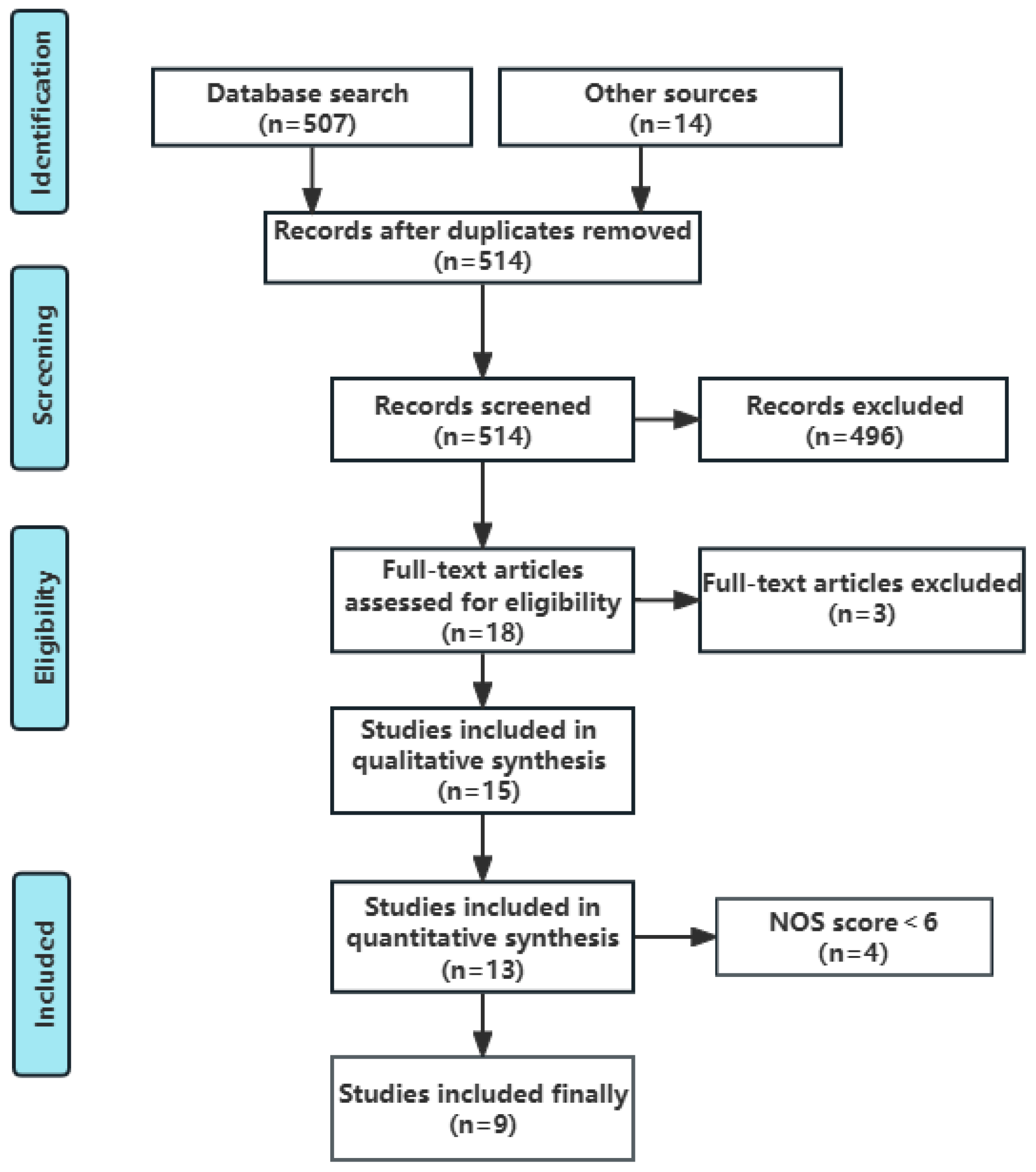

Domestic Burning of Incense and Mosquito Coils on the Risk of Nasopharyngeal Carcinoma: A Systematic Review and Meta-Analysis


Abstract
1. Introduction
2. Methods
2.1. Search Strategy
2.2. Inclusion Criteria
2.3. Assessment of Study Quality
2.4. Meta-Analysis
3. Results
3.1. Cohort Study
3.2. Case–Control Studies
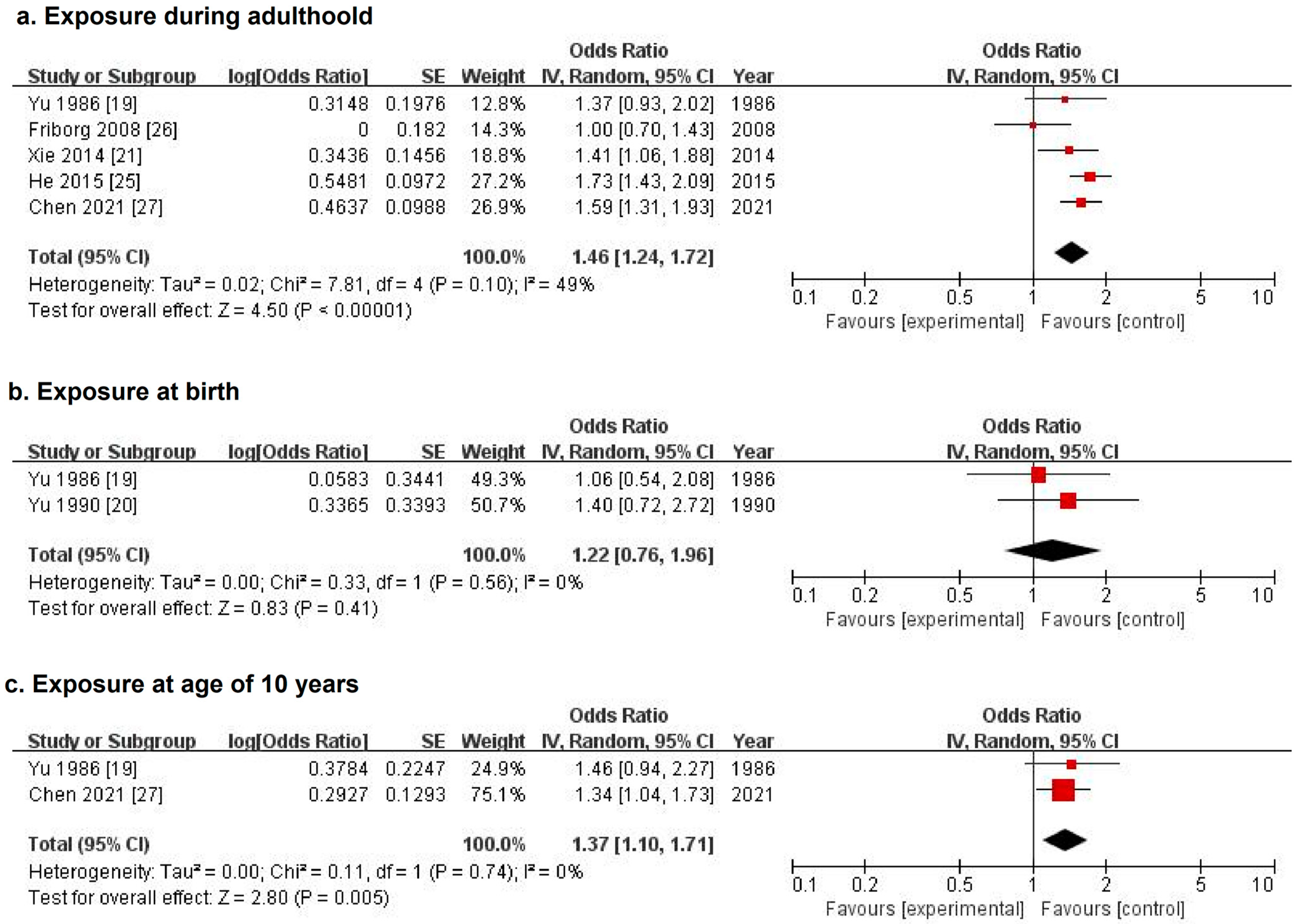
3.2.1. Incense Burning During Adulthood
3.2.2. Incense Burning During Childhood
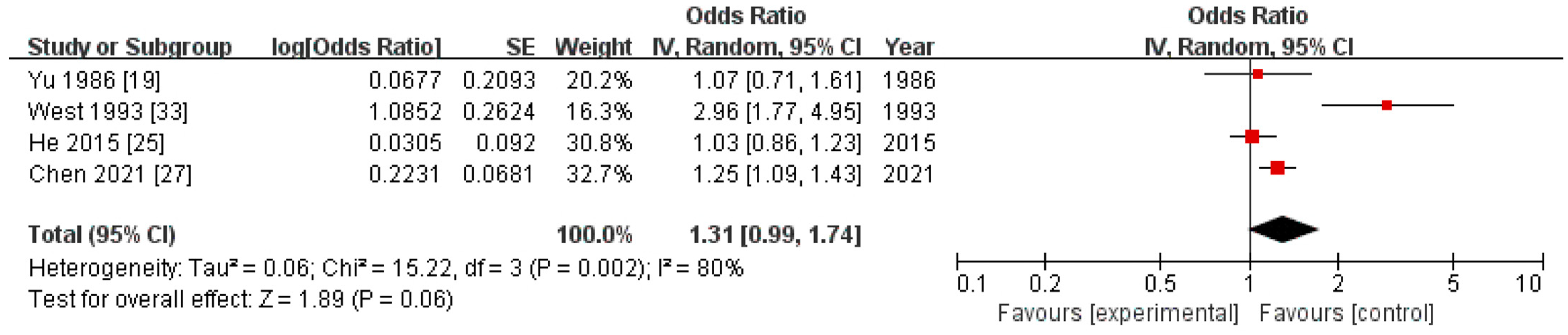
3.2.3. Mosquito-Coil Burning During Adulthood
3.2.4. Mosquito-Coil Burning During Childhood
4. Discussion
5. Conclusions
Supplementary Materials
Author Contributions
Funding
Institutional Review Board Statement
Informed Consent Statement
Data Availability Statement
Conflicts of Interest
References
- Chang, E.T.; Adami, H.-O. The Enigmatic Epidemiology of Nasopharyngeal Carcinoma. Cancer Epidemiol. Biomark. Prev. 2006, 15, 1765–1777. [Google Scholar] [CrossRef] [PubMed]
- Busson, P.; Keryer, C.; Ooka, T.; Corbex, M. EBV-associated nasopharyngeal carcinomas: From epidemiology to virus-targeting strategies. Trends Microbiol. 2004, 12, 356–360. [Google Scholar] [CrossRef]
- Zhang, Y.; Rumgay, H.; Li, M.; Cao, S.; Chen, W. Nasopharyngeal Cancer Incidence and Mortality in 185 Countries in 2020 and the Projected Burden in 2040: Population-Based Global Epidemiological Profiling. JMIR Public Health Surveill. 2023, 9, e49968. [Google Scholar] [CrossRef] [PubMed]
- Song, Y.; Cheng, W.; Li, H.; Liu, X. The global, regional, national burden of nasopharyngeal cancer and its attributable risk factors (1990–2019) and predictions to 2035. Cancer Med. 2022, 11, 4310–4320. [Google Scholar] [CrossRef]
- Chang, E.T.; Ye, W.; Zeng, Y.-X.; Adami, H.-O. The Evolving Epidemiology of Nasopharyngeal Carcinoma. Cancer Epidemiol. Biomark. Prev. 2021, 30, 1035–1047. [Google Scholar] [CrossRef]
- Jia, W.-H.; Qin, H.-D. Non-viral environmental risk factors for nasopharyngeal carcinoma: A systematic review. Semin. Cancer Biol. 2012, 22, 117–126. [Google Scholar] [CrossRef]
- Tse, L.A.; Yu, I.T.S.; Mang, O.W.K.; Wong, S.L. Incidence rate trends of histological subtypes of nasopharyngeal carcinoma in Hong Kong. Brit. J. Cancer 2006, 95, 1269–1273. [Google Scholar] [CrossRef]
- Luo, J.; Chia, K.S.; Chia, S.E.; Reilly, M.; Tan, C.S.; Ye, W. Secular trends of nasopharyngeal carcinoma incidence in Singapore, Hong Kong and Los Angeles Chinese populations, 1973–1997. Eur. J. Epidemiol. 2007, 22, 513–521. [Google Scholar] [CrossRef] [PubMed]
- Lee, A.W.M.; Foo, W.; Mang, O.; Sze, W.M.; Chappell, R.; Lau, W.H.; Ko, W.M. Changing epidemiology of nasopharyngeal carcinoma in Hong Kong over a 20-year period (1980–99): An encouraging reduction in both incidence and mortality. Int. J. Cancer 2003, 103, 680–685. [Google Scholar] [CrossRef]
- Hsu, C.; Shen, Y.-C.; Cheng, C.-C.; Hong, R.-L.; Chang, C.-J.; Cheng, A.-L. Difference in the Incidence Trend of Nasopharyngeal and Oropharyngeal Carcinomas in Taiwan: Implication from Age-Period-Cohort Analysis. Cancer Epidemiol. Biomark. Prev. 2006, 15, 856–861. [Google Scholar] [CrossRef]
- Löfroth, G.; Stensman, C.; Brandhorst-Satzkorn, M. Indoor sources of mutagenic aerosol particulate matter: Smoking, cooking and incense burning. Mutat. Res. Toxicol. 1991, 261, 21–28. [Google Scholar] [CrossRef]
- Lin, J.M.; Tang, C.S. Characterization and aliphatic aldehyde content of particulates in Chinese incense smoke. Bull. Environ. Contam. Toxicol. 1994, 53, 895–901. [Google Scholar] [CrossRef]
- Koo, L.C.; Matsushita, H.; Ho, J.H.C.; Wong, M.C.; Shimizu, H.; Mori, T.; Matsuki, H.; Tominaga, S. Carcinogens in the indoor air of Hong Kong homes: Levels, sources, and ventilation effects on 7 polynuclear aromatic hydrocarbons. Environ. Technol. 1994, 15, 401–418. [Google Scholar] [CrossRef]
- Rasmussen, R.E. Mutagenic activity of incense smoke inSalmonella typhimurium. Bull. Environ. Contam. Toxicol. 1987, 38, 827–833. [Google Scholar] [CrossRef]
- Chen, C.-C.; Lee, H. Genotoxicity and DNA adduct formation of incense smoke condensates: Comparison with environmental tobacco smoke condensates. Mutat. Res. Toxicol. 1996, 367, 105–114. [Google Scholar] [CrossRef] [PubMed]
- Liu, W.; Zhang, J.; Hashim, J.H.; Jalaludin, J.; Hashim, Z.; Goldstein, B.D. Mosquito coil emissions and health implications. Environ. Health Perspect. 2003, 111, 1454–1460. [Google Scholar] [CrossRef] [PubMed]
- Chang, J.-Y.; Lin, J.-M. Aliphatic aldehydes and allethrin in mosquito-coil smoke. Chemosphere 1998, 36, 617–624. [Google Scholar] [CrossRef] [PubMed]
- Yu, M.C.; Mo, C.C.; Chong, W.X.; Yeh, F.S.; Henderson, B.E. Preserved foods and nasopharyngeal carcinoma: A case-control study in Guangxi, China. Cancer Res. 1988, 48, 1954–1959. [Google Scholar]
- Yu, M.C.; Ho, J.H.; Lai, S.H.; Henderson, B.E. Cantonese-style salted fish as a cause of nasopharyngeal carcinoma: Report of a case-control study in Hong Kong. Cancer Res. 1986, 46, 956–961. [Google Scholar] [CrossRef]
- Yu, M.C.; Garabrant, D.H.; Huang, T.B.; Henderson, B.E. Occupational and other non-dietary risk factors for nasopharyngeal carcinoma in Guangzhou, China. Int. J. Cancer 1990, 45, 1033–1039. [Google Scholar] [CrossRef]
- Xie, S.-H.; Yu, I.T.-S.; Tse, L.-A.; Mang, O.W.-k.; Yue, L. Sex difference in the incidence of nasopharyngeal carcinoma in Hong Kong 1983–2008: Suggestion of a potential protective role of oestrogen. Eur. J. Cancer 2013, 49, 150–155. [Google Scholar] [CrossRef] [PubMed]
- Sturton, S.D.; Wen, H.L.; Sturton, O.G. Etiology of cancer of the nasopharynx. Cancer 1966, 19, 1666–1669. [Google Scholar] [CrossRef]
- Lin, T.M.; Chen, K.P.; Lin, C.C.; Hsu, M.M.; Tu, S.M.; Chiang, T.C.; Jung, P.F.; Hirayama, T. Retrospective Study on Nasopharyngeal Carcinoma2. JNCI-J. Natl. Cance R. Inst. 1973, 51, 1403–1408. [Google Scholar] [CrossRef]
- Lee, H.P.; Gourley, L.; Duffy, S.W.; Esteve, J.; Lee, J.; Day, N.E. Preserved foods and nasopharyngeal carcinoma: A case-control study among singapore chinese. Int. J. Cancer 1994, 59, 585–590. [Google Scholar] [CrossRef]
- He, Y.-Q.; Xue, W.-Q.; Shen, G.-P.; Tang, L.-L.; Zeng, Y.-X.; Jia, W.-H. Household inhalants exposure and nasopharyngeal carcinoma risk: A large-scale case-control study in Guangdong, China. BMC Cancer 2015, 15, 1–8. [Google Scholar] [CrossRef]
- Friborg, J.T.; Yuan, J.M.; Wang, R.; Koh, W.P.; Lee, H.P.; Yu, M.C. Incense use and respiratory tract carcinomas: A prospective cohort study. Cancer 2008, 113, 1676–1684. [Google Scholar] [CrossRef] [PubMed]
- Chen, Y.; Chang, E.T.; Liu, Z.; Liu, Q.; Cai, Y.; Zhang, Z.; Chen, G.; Huang, Q.-H.; Xie, S.-H.; Cao, S.-M.; et al. Residence characteristics and risk of nasopharyngeal carcinoma in southern China: A population-based case-control study. Environ. Int. 2021, 151, 106455. [Google Scholar] [CrossRef] [PubMed]
- Yu, M.C.; Yuan, J.-M. Epidemiology of nasopharyngeal carcinoma. Semin. Cancer Biol. 2002, 12, 421–429. [Google Scholar] [CrossRef]
- Yu, I.T.; Tse, S.L. Workshop 10-appraising a study on risk factors or aetiology. Hong Kong Med. J. 2013, 19, 50–51. [Google Scholar]
- Yu, I.T.; Tse, S.L. Workshop 5-Sources of bias in cohort studies. Hong Kong Med. J. 2012, 18, 137–138. [Google Scholar]
- Yu, I.T.; Tse, S.L. Workshop 4-Sources of bias in case-referent studies. Hong Kong Med. J. 2012, 18, 46–47. [Google Scholar] [PubMed]
- Stang, A. Critical evaluation of the Newcastle-Ottawa scale for the assessment of the quality of nonrandomized studies in meta-analyses. Eur. J. Epidemiol. 2010, 25, 603–605. [Google Scholar] [CrossRef]
- West, S.; Hildesheim, A.; Dosemeci, M. Non-viral risk factors for nasopharyngeal carcinoma in the philippines: Results from a case-control study. Int. J. Cancer 1993, 55, 722–727. [Google Scholar] [CrossRef]
- Shanmugaratnam, K.; Tye, C.Y.; Goh, E.H.; Chia, K.B. Etiological factors in nasopharyngeal carcinoma: A hospital-based, retrospective, case-control, questionnaire study. IARC Sci. Publ. 1978, 20, 199–212. [Google Scholar]
- Geser, A.; Charnay, N.; Day, N.E.; Ho, H.C. Environmental factors in the etiology of nasopharyngeal carcinoma: Report on a case-control study in Hong Kong. IARC Sci. Publ. 1978, 20, 213–229. [Google Scholar]
- Jetter, J.J.; Guo, Z.; McBrian, J.A.; Flynn, M.R. Characterization of emissions from burning incense. Sci. Total Environ. 2002, 295, 51–67. [Google Scholar] [CrossRef]
- Fang, G.-C.; Chu, C.-C.; Wu, Y.-S.; Fu, P.P.-C. Emission characters of particulate concentrations and dry deposition studies for incense burning at a Taiwanese temple. Toxicol. Ind. Health 2002, 18, 183–190. [Google Scholar] [CrossRef]
- Fang, G.-C.; Chang, C.-N.; Wu, Y.-S.; Yang, C.-J.; Chang, S.-C.; Yang, I.L. Suspended particulate variations and mass size distributions of incense burning at Tzu Yun Yen temple in Taiwan, Taichung. Sci. Total Environ. 2002, 299, 79–87. [Google Scholar] [CrossRef]
- Fang, G.-C.; Chang, C.-N.; Chu, C.-C.; Wu, Y.-S.; Pi-Cheng Fu, P.; Chang, S.-C.; Yang, I.L. Fine (PM 2.5), coarse (PM 2.5–10), and metallic elements of suspended particulates for incense burning at Tzu Yun Yen temple in central Taiwan. Chemosphere 2003, 51, 983–991. [Google Scholar] [CrossRef] [PubMed]
- Brauer, M.; Hirtle, R.; Lang, B.; Ott, W. Assessment of indoor fine aerosol contributions from environmental tobacco smoke and cooking with a portable nephelometer. J. Expo. Sci. Environ. Epidemiol. 2000, 10, 136–144. [Google Scholar] [CrossRef] [PubMed]
- Mannix, R.C.; Nguyen, K.P.; Tan, E.W.; Ho, E.E.; Phalen, R.F. Physical characterization of incense aerosols. Sci. Total Environ. 1996, 193, 149–158. [Google Scholar] [CrossRef]
- Yang, T.-T.; Lin, S.-T.; Lin, T.-S.; Hong, W.-L. Characterization of polycyclic aromatic hydrocarbon emissions in the particulate phase from burning incenses with various atomic hydrogen/carbon ratios. Sci. Total Environ. 2012, 414, 335–342. [Google Scholar] [CrossRef]
- Wang, B.; Lee, S.; Ho, K.; Kang, Y. Characteristics of emissions of air pollutants from burning of incense in temples, Hong Kong. Sci. Total Environ. 2007, 377, 52–60. [Google Scholar] [CrossRef] [PubMed]
- Schoental, R.; GlBbard, S. Carcinogens in Chinese Incense Smoke. Nature 1967, 216, 612. [Google Scholar] [CrossRef] [PubMed]
- Manoukian, A.; Quivet, E.; Temime-Roussel, B.; Nicolas, M.; Maupetit, F.; Wortham, H. Emission characteristics of air pollutants from incense and candle burning in indoor atmospheres. Environ. Sci. Pollut. Res. 2013, 20, 4659–4670. [Google Scholar] [CrossRef]
- Lin, T.-C.; Chang, F.-H.; Hsieh, J.-H.; Chao, H.-R.; Chao, M.-R. Characteristics of polycyclic aromatic hydrocarbons and total suspended particulate in indoor and outdoor atmosphere of a Taiwanese temple. J. Hazard. Mater. 2002, 95, 1–12. [Google Scholar] [CrossRef]
- Lin, J.M.; Wang, L.H. Gaseous aliphatic aldehydes in Chinese incense smoke. Bull. Environ. Contam. Toxicol. 1994, 53, 374–381. [Google Scholar] [CrossRef]
- Lee, R.S.; Lin, J.M. Gaseous Aliphatic Aldehydes in Smoke from Burning Raw Materials of Chinese Joss Sticks. Bull. Environ. Contam. Toxicol. 1996, 57, 361–366. [Google Scholar] [CrossRef] [PubMed]
- Ho, S.S.H.; Yu, J.Z. Concentrations of formaldehyde and other carbonyls in environments affected by incense burning. J. Environ. Monit. 2002, 4, 728–733. [Google Scholar] [CrossRef]
- Guo, Z.; Jetter, J.J.; McBrian, J.A. Rates of Polycyclic Aromatic Hydrocarbon Emissions from Incense. Bull. Environ. Contam. Toxicol. 2004, 72, 186–193. [Google Scholar] [CrossRef]


| First Author | Year | Region | Ethnicity | Sex (% Male) | Age (Year) | Period | No. of Cases | No. of Controls |
|---|---|---|---|---|---|---|---|---|
| Sturton [22] | 1966 | Hong Kong | Chinese | Cases: 62%; controls: 35% | 70% of cases and 35% of controls were under 50 years | Oct 1963–Jun 1965 | 47 | 217 |
| Lin [23] | 1973 | Taiwan | Chinese | 73% | Cases: 46.7 ± 11.5; controls: 46.2 ± 11.4 | Dec 1969–May 1971 | 343 | 1017 |
| Geser [35] | 1978 | Hong Kong | Chinese | 70% | 15–65+; Median: cases 49.1, controls 51.1 | Jan 1973–Feb 1974 | 150 | 150 |
| Shanmugaratnam [34] | 1978 | Singapore | Chinese | Cases: 70%; controls: 64% | Cases: 10–70+, median 47.4; controls: 0–70+, median 46.3 | Mar 1966–Aug 1968 | 379 | 1639 |
| Yu [19] | 1986 | Hong Kong | Chinese | 64% | Under 35; cases: mean 29.2; controls: mean 28.6 | Feb 1981– | 250 | 250 |
| Yu [18] | 1988 | Guangxi, China | Chinese | 70% | Under 45; cases: mean 36.0; controls: mean 35.8 | May 1984–Nov 1986 | 128 | 174 |
| Yu [20] | 1990 | Guangzhou, China | Chinese | 68% | Under 50 | Mar 1983–Aug 1985 | 306 | 306 |
| West [33] | 1993 | Philippine | Filipino | 73% | 11–83, median 46 | Duration of 24 months | 104 | 208 |
| Lee [24] | 1994 | Singapore | Chinese | Cases: 73%; controls: 71% | Cases: median 37.9; controls: median 38.5 | Mar 1988–Dec 1990 | 200 | 406 |
| He [25] | 2015 | Guangdong | Chinese | Cases: 73.12%; controls: 70.77% | Cases: 46.11 ± 10.99; controls: 46.42 ± 11.74 | Oct 2005–Oct 2007 | 1845 | 2275 |
| Chen [27] | 2021 | Guangdong, Guangxi | Chinese | Cases: 73.4%; controls: 73.5% | 20–74 | 2010–2014 | 2533 | 2597 |
| Xie [21] | 2014 | Hong Kong | Chinese | Cases: 71.9%; controls: 73.4% | 20–75 | Jun 2010–Dec 2012 | 352 | 410 |
| Study | Type of Cases | Histological Confirmation | Source of Controls | Response | Matched Factors | Adjusted Factors |
|---|---|---|---|---|---|---|
| Sturton 1966 [22] | N/A | N/A | Hospital (cancer patients) | N/A | Stratified by age and sex. | |
| Lin 1973 [23] | Incident | 95.90% | Community | Cases: 91.9%; controls: 85% | Sex, age, and neighborhood. | |
| Geser 1978 [35] | Incident | N/A | Hospital | N/A | Sex and age. | |
| Shanmugaratnam 1978 [34] | N/A | 100% | Hospital | N/A | Age, sex, and interviewer. | |
| Yu 1986 [19] | Incident | 98% | Community (friend) | Cases: 94.0%; controls: 99.2% | Sex and age. | Salted fish intake during weaning and at age 10 years. |
| Yu 1988 [18] | Incident | 100% | Community | Cases: 90.7%; controls: N/A | Sex, age, and race. | |
| Yu 1990 [20] | Incident | 100% | Community | 100% | Sex, age, and residence. | Dietary factors. |
| West 1993 [33] | Incident | 100% | Two series: hospital and community | Cases: 100%; hospital controls: 100%; community controls: 77% | Hospital controls: sex, age, and hospital ward type. Community controls: sex, age, and neighborhood. | Education, occupational exposures, smoking, fresh fish and processed meat intake, and herbal medicine use. |
| Lee 1994 [24] | Incident | N/A | Hospital | Cases: 88.6%; controls: 92.5% | ||
| He 2015 [25] | N/A | N/A | Hospital | Cases: 94.7%; controls: 95.5% | Sex and age. | Age, sex, education, housing type, smoking, salted fish, other dietary factors tea, herbal tea, and family history. |
| Chen 2021 [27] | Incident | 100% | Community | Cases: 84%; controls: 83% | Sex, age, and geographic area distribution. | Age, sex, geographic area, education, occupation, family history, smoking, tea, oral hygiene and salted fish intake. |
| Xie 2014 [21] | Incident | 100% | Hospital | Cases: 94.4%; controls: 93.8% | Age, sex, and residence. | Men: age, smoking, environmental tobacco smoke, education, housing type, family history, dietary factors, vitamins and supplements, occupational exposures, and cooking experience at home. Women: age, environmental tobacco smoke, education, and family history. |
| Study | Exposure Periods | Frequency | Intensity | Duration | Cumulative Exposure | |
|---|---|---|---|---|---|---|
| Incense Burning | Mosquito-Coil Burning | |||||
| Cohort study | ||||||
| Friborg 2008 [26] | at baseline | not assessed | yes | yes | yes | yes |
| Case–control studies | ||||||
| Sturton 1966 [22] | adulthood | not assessed | no | no | no | no |
| Lin 1973 [23] | adulthood | not assessed | no | no | no | no |
| Geser 1978 [35] | adulthood | not assessed | no | no | no | no |
| Shanmugaratnam 1978 [34] | adulthood, childhood | adulthood | yes | no | no | no |
| Yu 1986 [19] | 3 years ago, age 10, at birth | 3 years ago, age 10, at birth | no | no | no | no |
| Yu 1988 [18] | at birth, age 10 | at birth, age 10 | yes | no | no | no |
| Yu 1990 [20] | 3 years ago, age 10, at birth | 3 years ago, age 10, at birth | yes | no | no | no |
| West 1993 [33] | not assessed | adulthood | yes | no | no | no |
| Lee 1994 [24] | adulthood | not assessed | no | no | no | no |
| He 2015 [25] | adulthood | adulthood | yes | no | no | no |
| Chen 2021 [27] | ages of 10, 18 and 30 in the last 10 years | ages of 10, 18, and 30 in the last 10 years | yes | no | no | no |
| Xie 2014 [21] | adulthood | adulthood | yes | yes | yes | no |
Disclaimer/Publisher’s Note: The statements, opinions and data contained in all publications are solely those of the individual author(s) and contributor(s) and not of MDPI and/or the editor(s). MDPI and/or the editor(s) disclaim responsibility for any injury to people or property resulting from any ideas, methods, instructions or products referred to in the content. |
© 2025 by the authors. Licensee MDPI, Basel, Switzerland. This article is an open access article distributed under the terms and conditions of the Creative Commons Attribution (CC BY) license (https://creativecommons.org/licenses/by/4.0/).
Share and Cite
Xu, J.-X.; Tse, L.A.; Yu, I.T.-S.; Xie, S.-H. Domestic Burning of Incense and Mosquito Coils on the Risk of Nasopharyngeal Carcinoma: A Systematic Review and Meta-Analysis. Green Health 2025, 1, 23. https://doi.org/10.3390/greenhealth1030023
Xu J-X, Tse LA, Yu IT-S, Xie S-H. Domestic Burning of Incense and Mosquito Coils on the Risk of Nasopharyngeal Carcinoma: A Systematic Review and Meta-Analysis. Green Health. 2025; 1(3):23. https://doi.org/10.3390/greenhealth1030023
Chicago/Turabian StyleXu, Jia-Xiu, Lap Ah Tse, Ignatius Tak-Sun Yu, and Shao-Hua Xie. 2025. "Domestic Burning of Incense and Mosquito Coils on the Risk of Nasopharyngeal Carcinoma: A Systematic Review and Meta-Analysis" Green Health 1, no. 3: 23. https://doi.org/10.3390/greenhealth1030023
APA StyleXu, J.-X., Tse, L. A., Yu, I. T.-S., & Xie, S.-H. (2025). Domestic Burning of Incense and Mosquito Coils on the Risk of Nasopharyngeal Carcinoma: A Systematic Review and Meta-Analysis. Green Health, 1(3), 23. https://doi.org/10.3390/greenhealth1030023