Proceeding Paper

Reconstruction of Flooding Patterns in Endorheic Wetlands in Semi-Arid Zones: A Case Study from the LIFE IP Duero Project †

by
Africa De La Hera-Portillo
1,*,
Carlos Novillo Camacho
2,
Miguel Llorente
1,
Carlos Marcos Primo
3 and
Mónica Gómez Gamero
4
1
Instituto Geológico y Minero de España (IGME)-Consejo Superior de Investigaciones Científicas (CSIC), 28003 Madrid, Spain
2
Department of Chemical and Environmental Technology, Rey Juan Carlos University (Madrid), 28933 Móstoles, Spain
3
Confederación Hidrográfica del Duero, 47004 Valladolid, Spain
4
TRAGSATEC, 28006 Madrid, Spain
*
Author to whom correspondence should be addressed.
Presented at the 9th International Electronic Conference on Water Sciences, 11–14 November 2025; Available online: https://sciforum.net/event/ECWS-9.
Environ. Earth Sci. Proc. 2024, 31(1), 1012; https://doi.org/10.3390/eesp2026040012
Published: 31 March 2026
(This article belongs to the Proceedings of The 4th International Electronic Conference on Forests)

Abstract

This study analyses two wetlands within the Medina del Campo groundwater body (Duero River Basin, Spain) to reconstruct flood patterns and quantify the hydrological volumes involved in episodic inundation. We integrate Sentinel satellite imagery (2015–2024), targeted field campaigns (2024–2025), and preliminary water-balance assessments (2015–2022). Calculations were constrained to the inundated cells of each wetland bed to reduce spatial heterogeneity issues. For Laguna de los Lavajares, an initial standing water depth was assumed to estimate infiltration losses more accurately. We discuss the primary sources of uncertainty—particularly the representation of atmospheric losses as evaporation versus evapotranspiration—and recommend computing water balances for wet, average, and dry years to capture interannual variability. Key findings include the identification of distinct hydroperiods for each wetland, the dominant role of infiltration in the water balance of Laguna de los Lavajares, and the critical influence of vegetation-driven evapotranspiration in Laguna Redonda.

1. Introduction

Wetlands connected to groundwater are highly susceptible to aquifer exploitation, especially in semi-arid contexts where recharge is limited. This study characterises the flooding regimes and quantifies the hydrological volumes of two representative wetlands —Laguna de los Lavajares and Laguna Redonda—within the framework of the LIFE IP Duero Project. The aim is to provide robust hydrological information to support ecological restoration and water allocation strategies.
Laguna de los Lavajares and Laguna Redonda are historically connected to an aquifer that has been intensively exploited for decades. However, the current hydrological functioning and restoration potential differ markedly due to their respective position within the groundwater system and their distinct local hydrogeological settings.
Laguna de los Lavajares is currently disconnected from the regional aquifer and receives water only from surface runoff during exceptionally wet years, showing a highly altered and fragile hydrological regime. In contrast, Laguna Redonda exhibits more favourable conditions for hydrological recovery. Its proximity to the main recharge area of the aquifer, together with its hydrogeological setting, allows temporary inundation of the wetland. The basin of Laguna Redonda is hydraulically connected to a shallow alluvial aquifer, which in turn receives groundwater inflows from deeper aquifer units, enabling partial restoration of groundwater–surface water interactions [1].
The geographical location and hydrogeological context of the two studied wetlands are shown in Figure 1, and their main characteristics are summarised in Table 1. By comparing these contrasting cases, this work aims to assess the role of aquifer connectivity, recharge dynamics, and local hydrogeological controls in determining the feasibility and effectiveness of hydrological restoration measures in groundwater-dependent wetlands.

2. Study Area

Both wetlands lie within the Los Arenales, Tierras de Medina y La Moraña groundwater body (ATMMGWB), a multilayer aquifer system subject to decades of intensive abstraction. Laguna de los Lavajares currently shows limited connectivity to the regional aquifer and floods episodically, while Laguna Redonda maintains intermittent hydraulic connections to a shallow alluvial aquifer, allowing more frequent inundation.
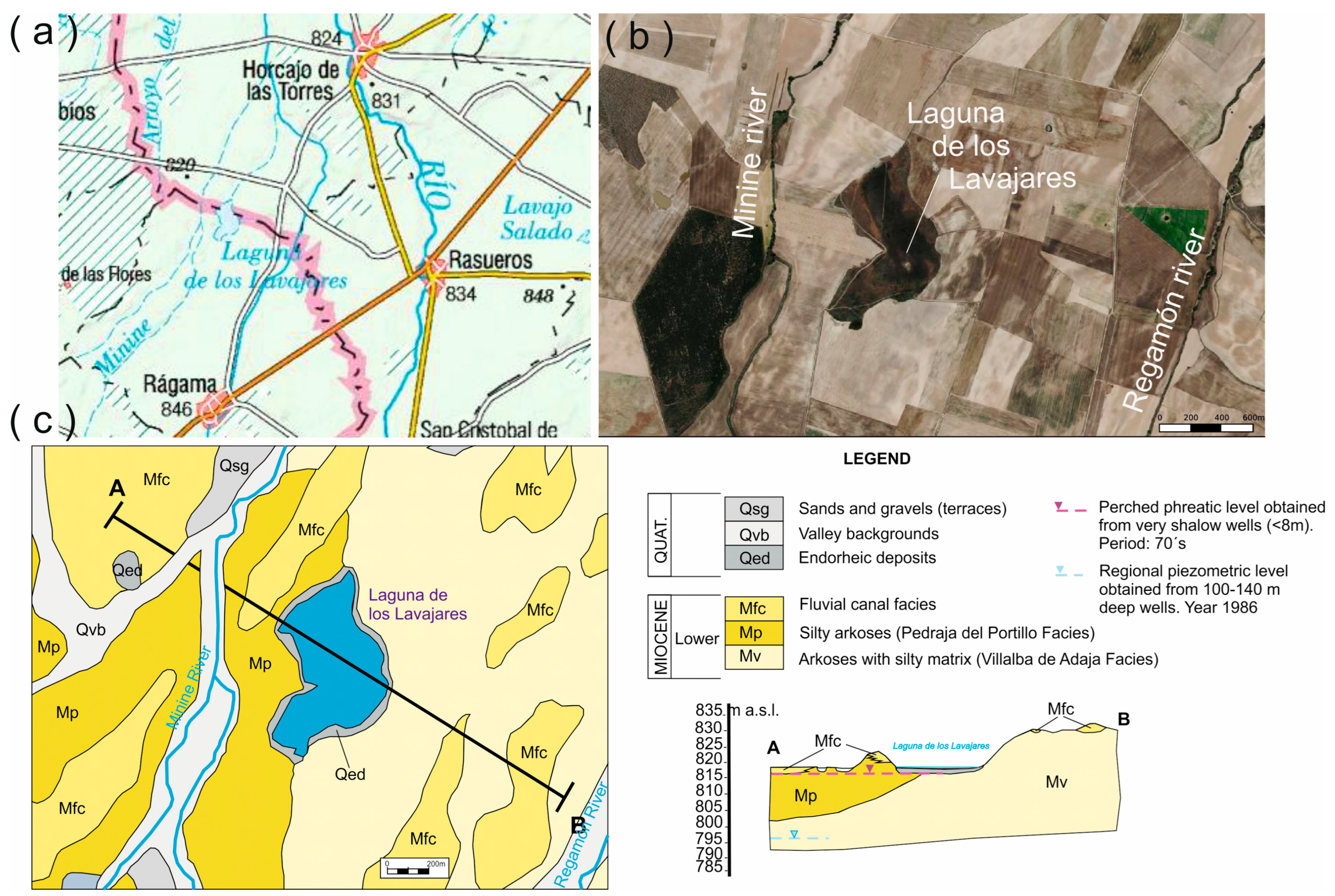
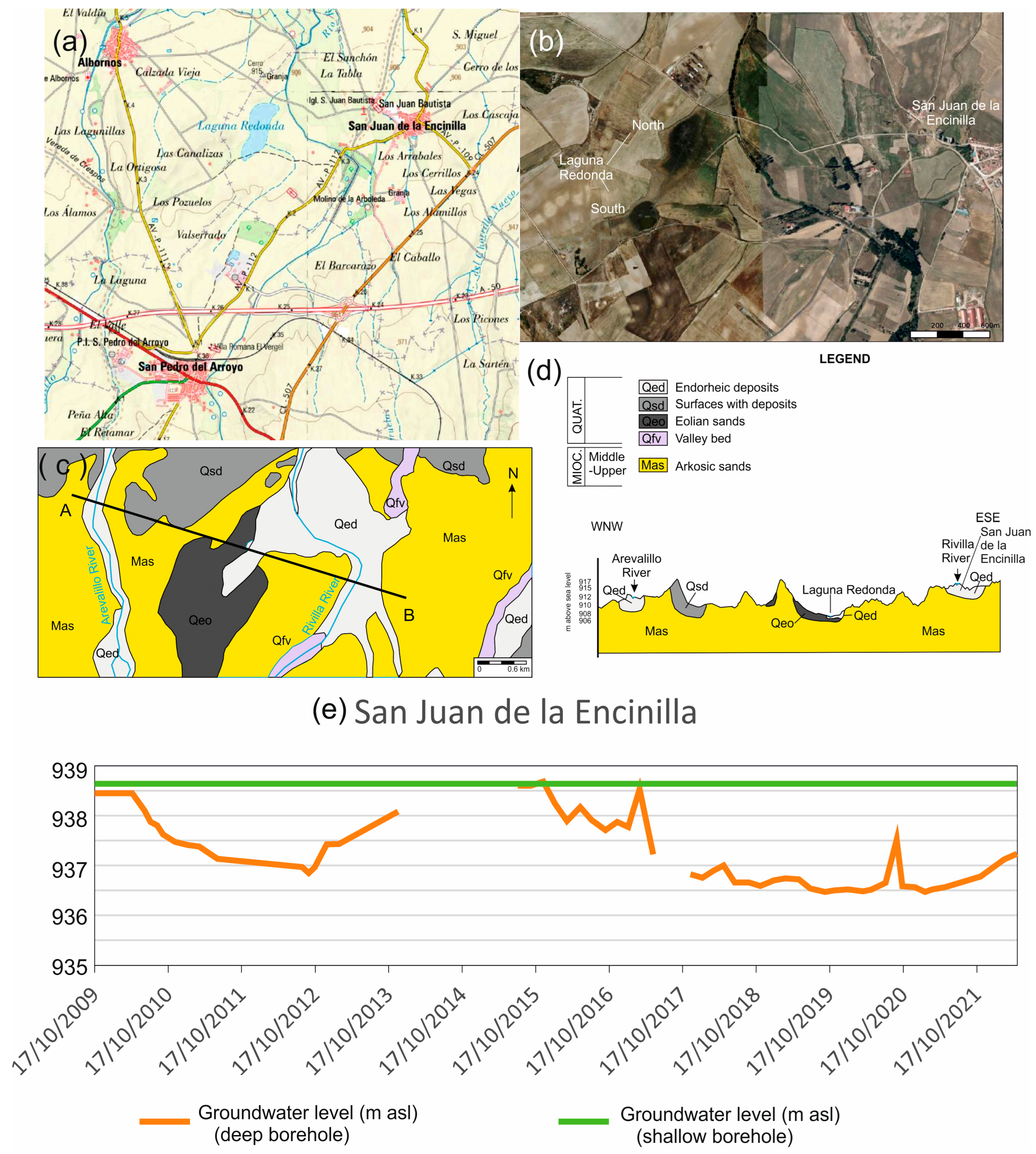
The Laguna de los Lavajares, located between the municipalities of Rágama (Salamanca) and Horcajo de las Torres (Ávila) (Figure 2), is the largest wetland in the region known as La Moraña. It is part of the Special Protection Area “Tierras de Campiña” (ES0000204) under the Habitats Directive. This wetland historically flooded in winter, supporting a notable number of migratory birds. Currently, it remains dry most of the year, except during exceptionally wet periods when it retains a shallow layer of water for a few days. The Laguna Redonda, in the north-west of Ávila (Figure 3), is not within a protected area. This wetland also historically flooded in winter, providing habitat for migratory bird species.
Both wetlands are associated with the Los Arenales, Tierras de Medina y La Moraña groundwater body (ATMMGWB), which is a complex intensively exploited multilayer aquifer. This aquifer has experienced a cumulative decline in piezometric levels from the late 1960s until 2005, when it reached the lowest levels ever recorded. Since 2006, although there has been a slight recovery, the disconnection between wetlands and aquifers has persisted [1].

3. Data and Methods

We combined several indices (AWEI variants, NDWI, RWI, WR) (see Appendix B) derived from Sentinel imagery (2017–2024) with field measurements collected during three field campaigns (November 2024–September 2025). A high-resolution 25 m DTM from the Instituto Geográfico Nacional was used to derive bathymetry and volume–area relationships. Daily water balances were computed for discrete filling events using precipitation from the SARAI database [3], interpolated open-water evaporation, measured groundwater levels, and estimated uncontrolled fluxes (surface inflows/outflows plus infiltration).

3.1. Satellite Data

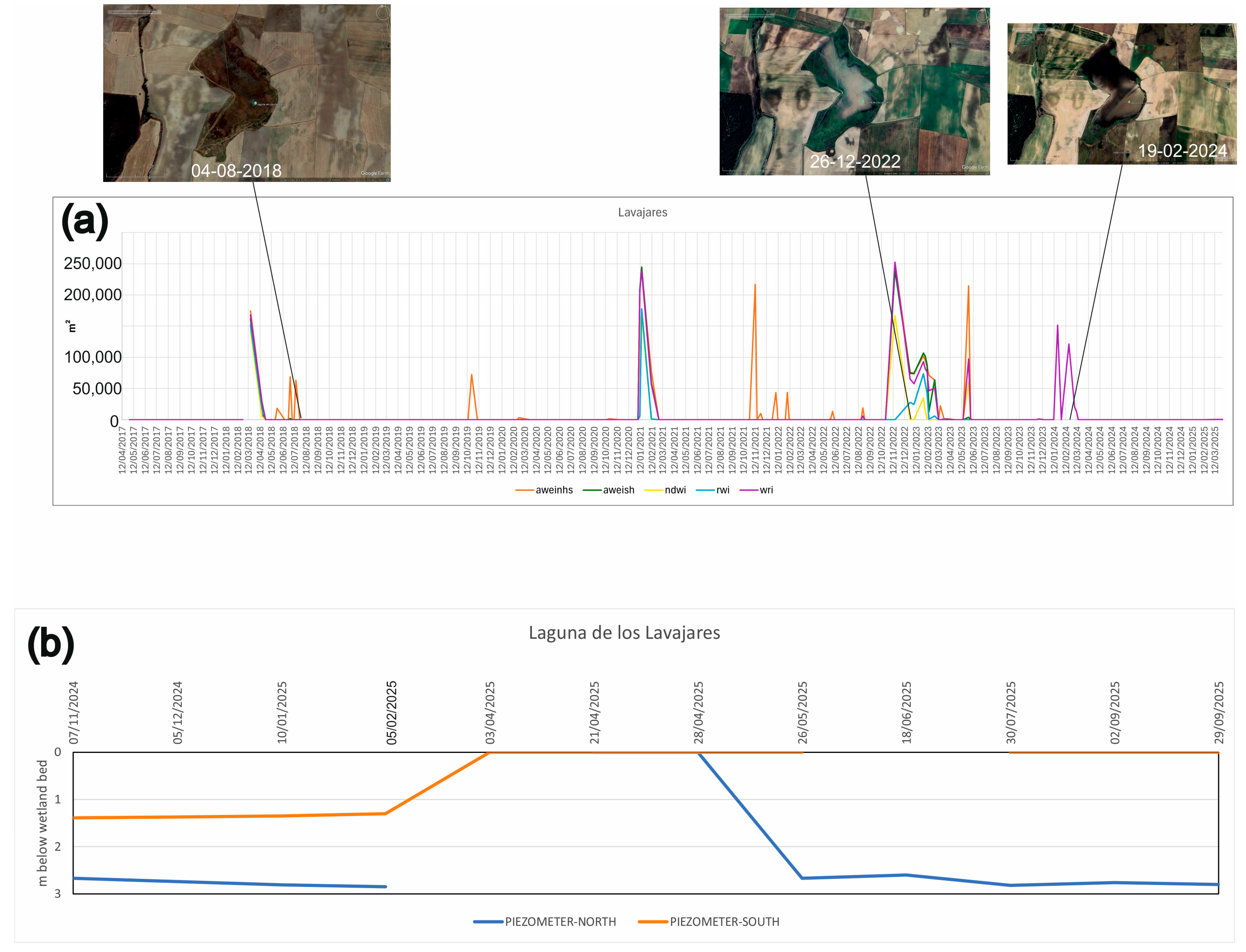
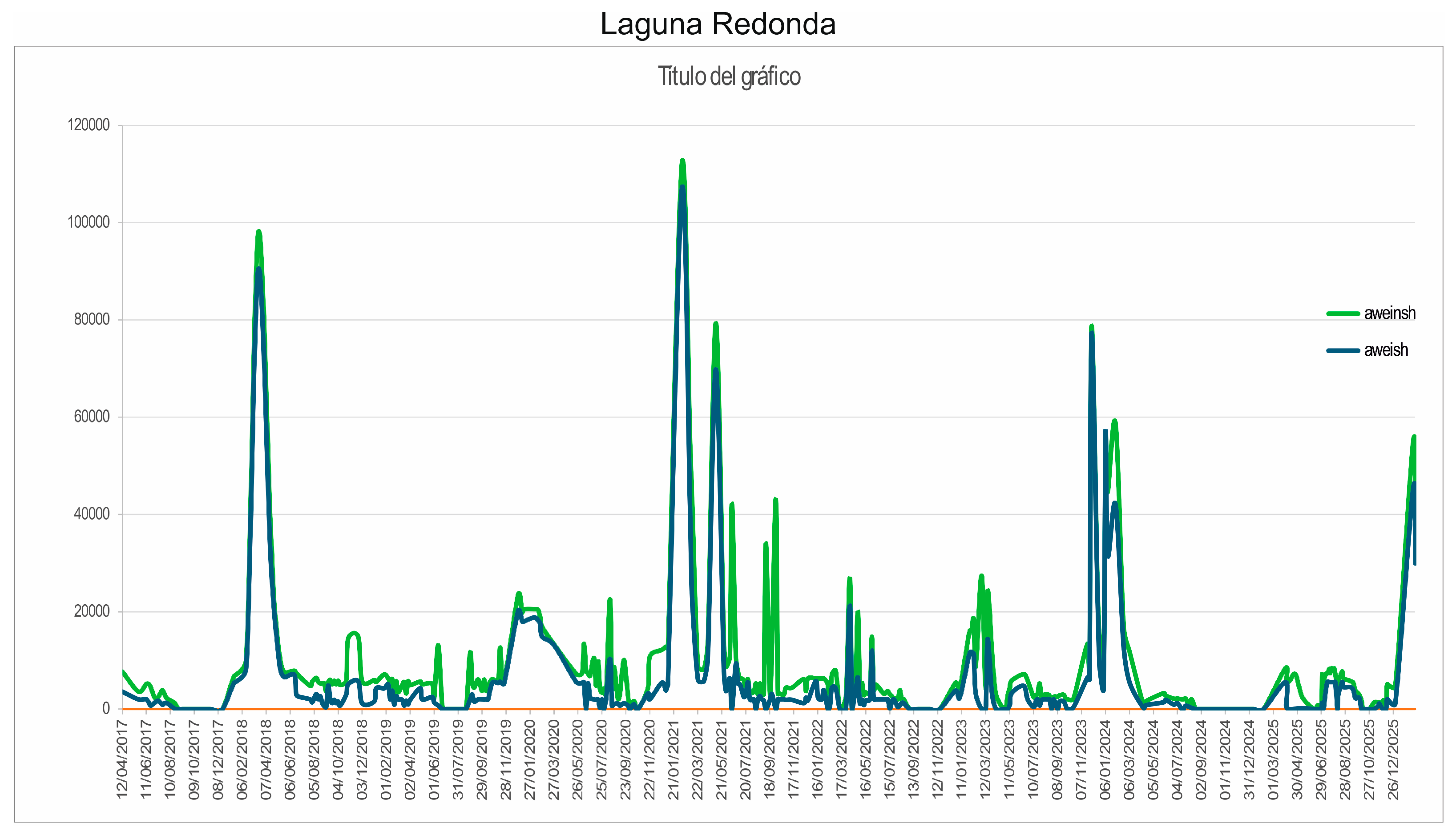
Mapping long-term wetland inundation dynamics over spatial and temporal domains provides the basis for quantifying the relationships between stream flows and flooding regimes in riparian wetland floodplains [4,5,6] and to evaluating their characteristic metrics and ecological response [7]. Such knowledge and insights are relevant in formulating sustainable water policy and for designing an effective environmental water allocation framework, including the timing and magnitude of environmental water releases [8,9]. In this study, Sentinel images from 2017 to 2024 were analysed considering five indices for the Laguna de los Lavajares (AWEInshs, AWEIsh, NDWI, RWI, WRI) and only NDWI for Laguna Redonda (Figure 4a).

3.2. Digital Terrain Model (DTM)

The Digital Terrain Model (DTM) developed by Ref. [2], with a spatial resolution of 25 m, was used as the starting point. This data provided the basis for generating bathymetries and flooded area vs. accumulated water–volume curves for both wetlands. Likewise, the depth of the water table was estimated from the DTM, integrating groundwater levels obtained during field campaigns for the hydrological year 2024/25.

3.3. Field Data

Three field campaigns were carried out between November 2024 and September 2025. Measurements during such campaigns provided (a) groundwater levels in both wetlands, which were used for the water-balance assessment (Figure 3e and Figure 4b); (b) surface inflows and outflows to and from the wetlands.

3.4. Water-Balances

The components of the water budget are:
(a)
Precipitation. Through a dedicated application, SARAI extracts the precipitation values from the grid cell corresponding to the coordinates of interest, providing daily rainfall records for the nearest meteorological station to each wetland, as well as interpolated values from surrounding stations. The available time series covers the period from 1 January 1951 to 31 December 2022. For Laguna Redonda, extraction coordinates are (EPGS: 25830, x, y; m) 321415.86; 4544617.66. For Laguna de los Lavajares, 343058.; 4521479.57;
(b)
Infiltration. Incorporated into the water budget as part of the uncontrolled fluxes.
(c)
Evaporation. Interpolated from the main meteorological stations in the study area (Valladolid, Zamora, Salamanca and Ávila; Figure 1).
(d)
Storage changes. Variations were estimated through remote sensing analysis.
S = P + G i n + S i n E T G o u t S o u t Q i n
w h e r e
Δ S = c h a n g e   i n   w a t e r   s t o r a g e
 P = precipitation directly on the wetland;
  G i n ;   G o u t = groundwater inflow and outflow;
  S i n ;   S o u t = surface water inflow and outflow (often episodic);
 ET = Evapotranspiration. It has been considered as open-water evaporation;
  Q i n = Uncontrolled infiltration losses.
 By constraining the domain to the inundated cell, uncertainties linked to lateral fluxes across adjacent non-inundated terrain are minimised. For these calculations, Table A1, Table A2, Table A3 and Table A4 were used.
(e)
Remaining inflows and outflows. All other inflows and outflows were included as the closing component of the water budget.
The spatial-temporal domain of the water budget has been the flooded area inside the wetland’s bed. The temporal resolution was set to daily time steps. The control volume was the flooded cell within the wetland bed.

3.4.1. Key Assumptions and Parametrisation

For Laguna de los Lavajares, an initial standing water depth was prescribed to estimate early-stage infiltration accurately, as infiltration rates are depth-dependent. Evaporation was interpolated from nearby meteorological stations. For Laguna Redonda, however, when emergent or floating vegetation colonises the open water surface, evaporative loss becomes increasingly dominated by vegetation transpiration—an effect that is not captured by open water evaporation estimates.

3.4.2. Restrictions

The analysis was conducted under the following methodological restrictions:
  • The elevations of the piezometers were obtained using a high-precision GPS during the fieldwork;
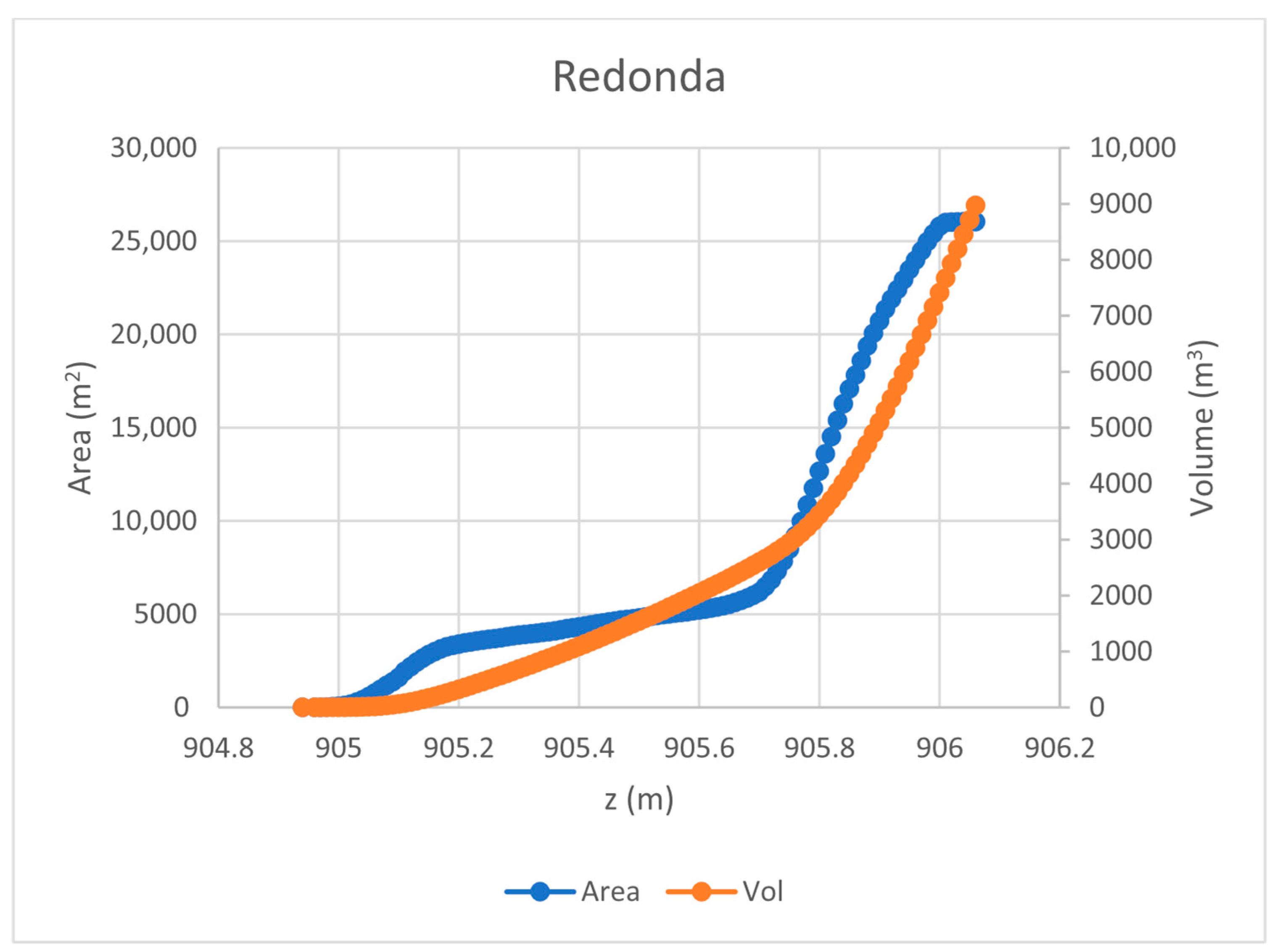
The flooded-surface vs. accumulated-volume curves were derived for each wetland using an elevation limit of 906 m a.s.l. for Laguna Redonda and 819 m a.s.l. for Laguna de los Lavajares (see Figure A1 and Figure A2).

3.4.3. Validation

The water balance was validated by assessing the consistency between observed and modelled water level fluctuations.

4. Results

4.1. Laguna De Los Lavajares

The reconstruction of flooded periods for Laguna de los Lavajares is shown in Figure 4a, using the five indices described earlier.
We assume that the actual flooded periods are those identified simultaneously by all five indices. The spatio-temporal evolution of the Laguna de los Lavajares over the study period, according to the indices, shows three filling events and four emptying events (Figure 4a):
  • 12 March–30 April 2018: hydroperiod recession phase, incomplete;
  • 12 January–1 February 2021: rising phase; and 2 February–12 March 2021: recession phase;
  • 20 October–15 November 2022: rising phase and 16 November–31 December 2022: recession phase;
  • 12 May–5 June 2023: rising phase and 6–10 June 2023: recession phase.
Only the first three periods are considered in the water budget (Table 2), according to the availability of precipitation data from the SARAI Project [9].
Infiltration is the most relevant parameter among the components of the water balance. Its determination could be refined in the near future using data collected from monitored piezometers during selected time periods that meet the following conditions (Table A3):
(a)
No rainfall;
(b)
No surface water runoff inflows to the wetland.
Satellite indices reveal several short-lived inundation episodes (2018, 2021, 2022) with limited changes in water level. Water balance closure suggests that infiltration is the principal loss term, although uncertainty in infiltration estimates limits the accuracy of the computed volumes. Table 2 presents the estimated budgets for selected events.

4.2. Laguna Redonda

This wetland is located in a depression where some springs emerge nearby, whose discharges flood areas near the main basin of the wetland, producing localised discharges that intermittently flood areas adjacent to the main basin. For this reason, two zones are distinguished in Figure 5: the southern zone, corresponding to the true wetland basin, and the northern zone, representing a depressed area where the springs are located. Figure 5 illustrates the evolution of the flooded area for both zones, based on the NDWI. Focusing on the behaviour of the basin, the wetland dried out during the summers of 2017 (an incomplete year included only for reference), 2019, 2020, and 2022. This pattern reflects a marked seasonality that also allows the hydroperiod to be characterised. Over the seven-year sequence (2018–2024), water is generally present between October and June, and absent between July and September, with the extent and duration varying from year to year.
The spatio-temporal evolution of Laguna Redonda over the study period shows the following filling and recession phases (Figure 5):
  • 22 May–21 July 2017: hydroperiod recession phase, incomplete;
  • 17 April 2018: rising phase, just one day; maximum extent reached by the flooded area during the analysed period: 5284 m2 which means a volume of 2198.93 m3;
  • 18 April–4 September 2018: recession phase;
  • 19 September–6 February 2019: rising phase;
  • 7 February–12 April 2019: recession phase;
  • 22 April–27 April 2019: rising phase;
  • 28 April–1 June 2019: recession phase;
  • 6–21 February 2020: rising phase;
  • 22 February–3 September 2020: recession phase with some temporal inflows;
  • 22 November–12 December 2020: rising phase;
  • 13 December–16 March 202: recession phase;
  • 17 March–22 March 2021: rising phase;
  • 23 March–25 June 2021: recession phase;
  • 10 July–8 September 2021: rising phase;
  • 9 September 2021–19 February 2022: recession phase;
  • 20 February 2022: rising phase, just one day;
  • 21 February–27 March 2022: recession phase;
  • 28 March–21 April 2022: rising phase;
  • 22 April–20 July 2022: recession phase;
  • 12 March–15 June 2023: rising phase;
  • 16 June–24 August 2023: recession phase;
  • 8 September 2023–11 January 2024: rising phase.
The basin exhibits a pronounced seasonal hydroperiod (approximately October–June). Rapid inundation events can occur within a single day under favourable conditions. Preliminary water balances (computed for the inundated cell and incorporating an assumed initial water depth) provide first-order estimates of filling volumes, yet the attribution of atmospheric losses (evaporation versus evapotranspiration) remains a major source of uncertainty.
These results characterise the behavioural pattern of the Redonda wetland. Inundation can occur within a single day when climatic conditions are favourable, whereas drainage unfolds over much longer periods, ranging from several days to several months, depending on prevailing conditions.
The estimation of the water volumes involved in the filling of the wetland was carried out using a water balance approach. To minimise potential errors associated with spatial heterogeneity, the calculations were restricted exclusively to the flooded cell corresponding to the wetland bed. By limiting the analysis to the inundated area of the wetland delineation, uncertainties related to lateral exchanges with adjacent non-flooded zones and transitional areas were avoided, thereby improving the consistency of the water balance.
For the specific case of the Laguna Redonda, an initial water depth was assumed as a starting condition. This initial water level was necessary to estimate infiltration losses, as infiltration rates depend on the presence and thickness of the water layer above the substrate. Neglecting this initial condition would lead to an underestimation of infiltration, particularly during the early stages of the hydrological cycle when the wetland already contains standing water.
The main limitation of the present calculation is that it was performed for a single hydrological year. While this approach provides a first-order quantification of the volumes involved, a robust assessment of the wetland’s hydrological functioning requires applying the same methodology across different climatic conditions. Specifically, the water balance should be computed for a wet year, an average year and a dry year in order to adequately capture interannual variability and assess the system’s sensitivity to climatic fluctuations.
Additional uncertainties are associated with the estimation of atmospheric water losses. In the present study, evaporation from a free-water surface was used as a proxy for this component of the water balance. However, field observations indicate that during certain periods of the year, once the wetland becomes filled and the water surface persists, abundant vegetation progressively colonises not only the peripheral fringe but also the open water area. At times, the wetland surface may become almost completely covered by emergent and aquatic vegetation.
This seasonal evolution of vegetation cover has important implications for the water balance, as it alters the dominant atmospheric loss mechanism. Under such conditions, evapotranspiration becomes the relevant flux, replacing simple open water evaporation. Consequently, a more accurate representation of the wetland’s hydrological behaviour requires incorporating evapotranspiration explicitly into the water balance rather than relying solely on evaporation estimates.

5. Limitations and Uncertainties

Temporal representativeness: Current calculations were performed for specific events or single years, which is insufficient to characterise interannual variability. Water-balance analyses should be carried out for a wet year, an average year, and a dry year.
  • Evapotranspiration versus evaporation: Open water evaporation was used as a proxy for atmospheric losses; however, vegetation colonisation during much of the year requires the use of evapotranspiration estimates instead;
  • Infiltration: Infiltration is depth-dependent and spatially heterogeneous. Improved estimation requires continuous piezometer monitoring during dry-down, filling, and persistence phases;
  • Remote-sensing constraints: Satellite spatial resolution and index selection introduce classification uncertainties, particularly when vegetation partially or fully covers the water surface.

6. Conclusions

The methodology presented here corresponds to a multicriteria analysis that integrates experimental measurements together with direct and indirect datasets to characterise wetland functioning. This work builds upon established methodologies that use remote sensing analysis to estimate changes in flooded surface area in lentic habitats, and it draws on the hydrological data infrastructure developed within the LIFE IP Duero project.
The working method consisted of identifying filling and recession processes as an initial approach to understanding the functioning of Laguna de los Lavajares and Laguna Redonda and to quantifying the associated water volumes. However, these results remain preliminary and must be refined by integrating field observations with weather data over overlapping time periods (2023–2025). We expect to undertake this work as the next step in the research.
Despite the promising results, uncertainties remain due to the limited temporal coverage of field data and the spatial resolution of the imagery. Future research will focus on refining the volume–area relationships to improve the accuracy of the water balance calculations and to assess the long-term sustainability of the system under changing climate scenarios.
Key findings of this study include the following items:
  • The multicriteria approach successfully identified hydroperiods and yielded first-order volume estimates for small endorheic wetlands;
  • For Laguna de los Lavajares, infiltration is the dominant loss mechanism during episodic filling events, and the wetland’s limited storage capacity underscores its susceptibility to desiccation;
  • Laguna Redonda exhibits rapid hydrological responses to incoming water; however, vegetation-mediated evapotranspiration substantially modifies the water balance once the water surface becomes colonised.
Restricting the control volume to the flooded cell reduces heterogeneity-related errors but limits the scope of inference to the basin interior. The assumption of open water evaporation simplifies the water budget but underestimates atmospheric losses during periods of extensive vegetation cover. Vegetation colonisation alters both surface roughness and the energy balance, increasing transpiration and modifying the local microclimate; therefore, evapotranspiration should be incorporated into future water balance calculations, using methods such as eddy covariance, Penman–Monteith with crop coefficient adjustments, or direct lysimeter measurements.
This study demonstrates that a multicriteria methodology combining remote sensing, hydrometeorological data and water balance modelling can effectively describe and quantify the functioning of small endorheic wetlands. The results highlight the strong influence of climate variability and the importance of maintaining groundwater–surface-water connectivity. This approach is currently being applied to support restoration planning within the LIFE IP Duero project and could be replicated in other Mediterranean basins facing similar challenges.
Restoration interventions should prioritise measures that increase connectivity to sustained aquifer recharge and reduce uncontrolled infiltration where feasible. Environmental water allocations must account for vegetation dynamics and seasonal evapotranspiration to avoid overestimating the volume of free water available.

Author Contributions

Conceptualization: A.D.L.H.-P. Methodology, A.D.L.H.-P. and C.N.C. DTM: M.L. Validation, C.N.C. Formal analysis: A.D.L.H.-P. and C.N.C. Investigation: A.D.L.H.-P. Resources: C.M.P. Data curation, M.G.G. Original draft preparation: A.D.L.H.-P. Review and editing: A.D.L.H.-P. and M.L. Visualisation: A.D.L.H.-P. Supervision: A.D.L.H.-P. Project administration: C.M.P., M.G.G. Funding acquisition: C.M.P. and M.G.G. All authors have read and agreed to the published version of the manuscript.

Funding

This research was funded by LIFE IP Duero Project LIFE16 IPE/ES/019.

Institutional Review Board Statement

Not applicable.

Informed Consent Statement

Not applicable.

Data Availability Statement

Data Availability Statements are available in NAIAD publications by CHD.

Acknowledgments

Thanks to the technical team responsible for the data and infrastructure in the LIFE IP Duero project.

Conflicts of Interest

The authors declare no conflicts of interest.

Abbreviations

The following abbreviations are used in this manuscript:
CHDConfederación Hidrográfica del Duero
ATMMGWBMedina del Campo Groundwater Body
SPASpecial Protection Area

Appendix A. Curves Flooded Area Versus Water Volume Storage
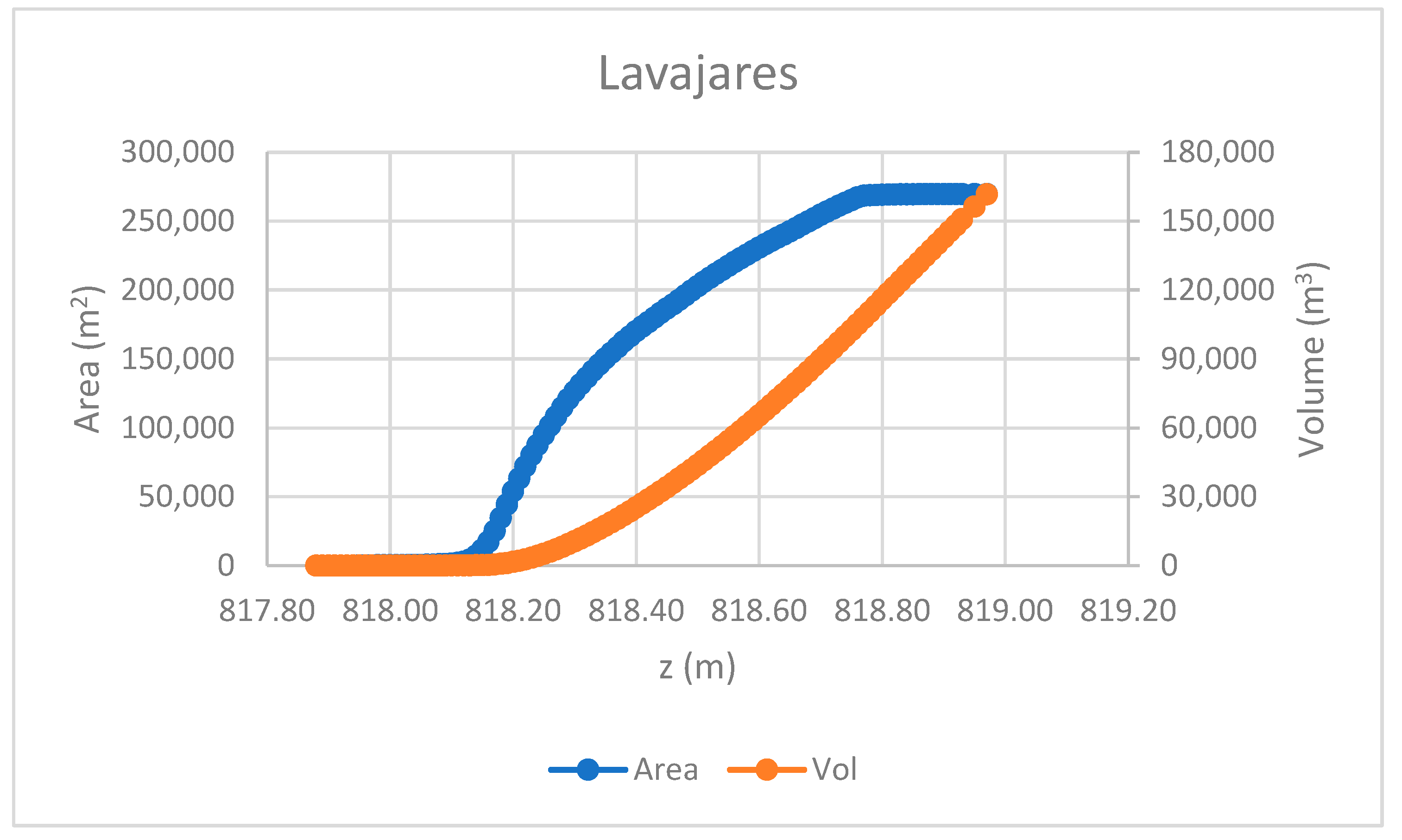
Figure A1. Elevation–surface area–stored volume curve for the Laguna de los Lavajares.
Eesp 31 01012 g0a1
Table A1. Equations of the different sectors of the water level–flooded surface curve in the Laguna de los Lavajares wetland.
Elevation Section (m)Fitting Equation
818.00 ≤ z ≤ 818.15A = 0
818.15 < z ≤ 818.35A = 750,000⋅z−613,500,000
818.35 < z ≤ 818.70A = 380,000⋅z−310,000,000
818.70 < z ≤ 819.00A = 120,000⋅z−98,000,000
Table A2. Equations of the different sectors of the stage–storage curve in the Lavajares wetland.
Elevation Section (m)Fitting Equation
818.00 ≤ z ≤ 818.20V = 0
818.20 < z ≤ 818.40V = 140,000⋅z−114,600,000
818.40 < z ≤ 818.60V = 220,000⋅z−180,000,000
818.60 < z ≤ 818.80V = 300,000⋅z−246,000,000
818.80 < z ≤ 819.00V = 360,000⋅z−295,000,000
Table A3. Equations of the different sectors of the water level–flooded surface curve in the Laguna Redonda.
Elevation Section (m asl)Fitting Equation
905.00 ≤ x ≤ 905.20Y = 17,500x−15,840,000
905.20 < x ≤ 905.70Y = 3800x−3,430,000
905.70 < x ≤ 906.05Y = 58,000x−52,450,000
Table A4. Equations of the different sectors of the stage–storage curve in the Laguna Redonda.
Elevation Section (m asl)Fitting Equation
905.00 ≤ x ≤ 905.20Y = 2800x−2,534,000
905.20 < x ≤ 905.70Y = 8200x−7,410,000
905.70 < x ≤ 906.05Y = 25,000x−22,540,000
Figure A2. Elevation–surface area–stored volume curve for the Laguna Redonda.
Eesp 31 01012 g0a2

Appendix B. Spectral Indices for the Assessment of Wetland Inundation Using Sentinel Data

Appendix B.1. Indices

The interpretation of wetland inundation dynamics using Sentinel imagery relies heavily on spectral indices designed to enhance the radiometric response of surface water while suppressing vegetation, soil, and built-up features. Among the most commonly applied indices for this purpose are the Automated Water Extraction Indices (AWEI), the Normalised Difference Water Index (NDWI), the Ratio Water Index (RWI), and the Water Ratio Index (WRI). Each index exploits the distinctive spectral behaviour of water, particularly its strong absorption in the near-infrared (NIR) and short-wave infrared (SWIR) regions.

Appendix B.1.1. Automated Water Extraction Index for Non-Shadow Areas (AWEInshs)

The AWEInshs index is specifically designed to enhance open water bodies in environments where terrain and cloud shadows are minimal. It combines green, NIR, and SWIR bands to maximise water detectability while minimising confusion with vegetation and bare soil. In Sentinel-2 imagery, water surfaces exhibit high reflectance in the green band and strong absorption in the NIR and SWIR bands; AWEInshs leverages this contrast to generate high positive values for water pixels. In wetland flood studies, this index is particularly effective for delineating inundated areas in flat landscapes where shadows do not significantly interfere with spectral signatures.

Appendix B.1.2. Automated Water Extraction Index for Shadow Areas (AWEIsh)

The AWEIsh index extends the AWEI concept by explicitly accounting for shadowed areas, which often exhibit spectral characteristics similar to water in NIR-based indices. By placing greater emphasis on SWIR bands, where water absorption is especially strong, AWEIsh improves discrimination between true inundation and terrain or vegetation shadows. This makes it highly valuable for wetland systems adjacent to forested areas, reed beds, or topographic relief, where shadow effects can otherwise lead to overestimation of flooded surfaces.

Appendix B.1.3. Normalised Difference Water Index (NDWI)

The NDWI is one of the most widely used indices for surface water detection. It is calculated using the normalised difference between green and NIR reflectance. Water bodies typically produce positive NDWI values due to their relatively high green reflectance and low NIR reflectance. In wetland environments, NDWI is effective for identifying open water and shallow inundation; however, its performance can be reduced in densely vegetated wetlands, where emergent or floating vegetation increases NIR reflectance and masks underlying water.

Appendix B.1.4. Ratio Water Index (RWI)

The RWI is a simple ratio-based index that compares reflectance in the NIR band to that in the green band. Because water strongly absorbs NIR radiation, flooded areas yield low RWI values, whereas dry land and vegetation produce higher ratios. Although less sophisticated than normalised or multi-band indices, RWI can provide a straightforward indicator of inundation extent and is particularly useful for temporal analyses, where relative changes in flooding conditions are of primary interest.

Appendix B.1.5. Water Ratio Index (WRI)

The WRI incorporates visible and near-infrared bands to distinguish water from non-water surfaces through a combined reflectance ratio. Water pixels typically yield values above a defined threshold, reflecting their low NIR and relatively higher visible reflectance. In wetland flood assessments, WRI can complement NDWI by improving separation between water and moist soil or sparse vegetation, although its sensitivity to atmospheric effects and turbidity must be considered.
These five indices have been applied for the analyses of images of Laguna de los Lavajares, and only NDWI in the case of Laguna Redonda due to time availability.

Appendix B.1.6. Contribution to Wetland Inundation Analysis

Together, these indices provide complementary information on wetland inundation status. NDWI and RWI offer robust and computationally efficient indicators of open water presence, while AWEInshs and AWEIsh improve accuracy under complex conditions involving shadows, mixed pixels, or heterogeneous vegetation cover. WRI further supports water discrimination in transitional zones between flooded and non-flooded surfaces. When applied jointly to multi-temporal Sentinel data, these indices enable detailed characterisation of flood extent, duration, and seasonal dynamics in wetland ecosystems, thereby supporting hydrological analysis, ecological assessment, and wetland management.

References

  1. NAIAD Project. NAture Insurance Value: Assessment and Demonstration. Available online: https://cordis.europa.eu/project/id/730497 (accessed on 26 December 2025).
  2. IGN, Instituto Geográfico Nacional. 2024. Available online: https://www.ign.es (accessed on 29 December 2025).
  3. SARAI Project. Available online: https://sarai.igme.es (accessed on 15 December 2025).
  4. Pinel, S.; Bonnet, M.P.; Da Silva, J.S.; Sampaio, T.C.; Garnier, J.; Catry, T.; Calmant, S.; Fragoso, C.R., Jr.; Moreira, D.; Motta Marques, D. Flooding dynamics within an Amazonian floodplain: Water circulation patterns and inundation duration. Water Resour. Res. 2020, 56, e2019WR026081. [Google Scholar] [CrossRef]
  5. Wen, L.; Macdonald, R.; Morrison, T.; Hameed, T.; Saintilan, N.; Ling, J. From hydrodynamic to hydrological modelling: Investigating long-term hydrological regimes of key wetlands in the Macquarie Marshes, a semi-arid lowland floodplain in Australia. J. Hydrol. 2013, 500, 45–61. [Google Scholar] [CrossRef]
  6. Shaeri Karimi, S.; Saintilan, N.; Wen, L.; Valavi, R. Application of machine learning to model wetland inundation patterns acrossa large semiarid floodplain. Water Resour. Res. 2019, 55, 8765–8778. [Google Scholar] [CrossRef]
  7. Wen, L.; Saintilan, N. Linking local ecological outcomes with basin-wide water planning: A case study of Yanga National Park, an important Australian inland forested wetland. Hydrol. Sci. J. 2014, 59, 904–915. [Google Scholar] [CrossRef][Green Version]
  8. Chen, N.; He, Y.; Zhang, X. Nir-red spectra-based disaggregation of SMAP soil moisture to 250 m resolution based on smapex-4/5 in southeastern Australia. Remote Sens. 2017, 9, 51. [Google Scholar] [CrossRef]
  9. Poff, N.L.; Richter, B.D.; Arthington, A.H.; Bunn, S.E.; Naiman, R.J.; Kendy, E.; Acreman, M.; Apse, C.; Bledsoe, B.P.; Freeman, M.C. The ecological limits of hydrologic alteration (ELOHA): A new framework for developing regional environmental flow standards. Freshw. Biol. 2010, 55, 147–170. [Google Scholar] [CrossRef]
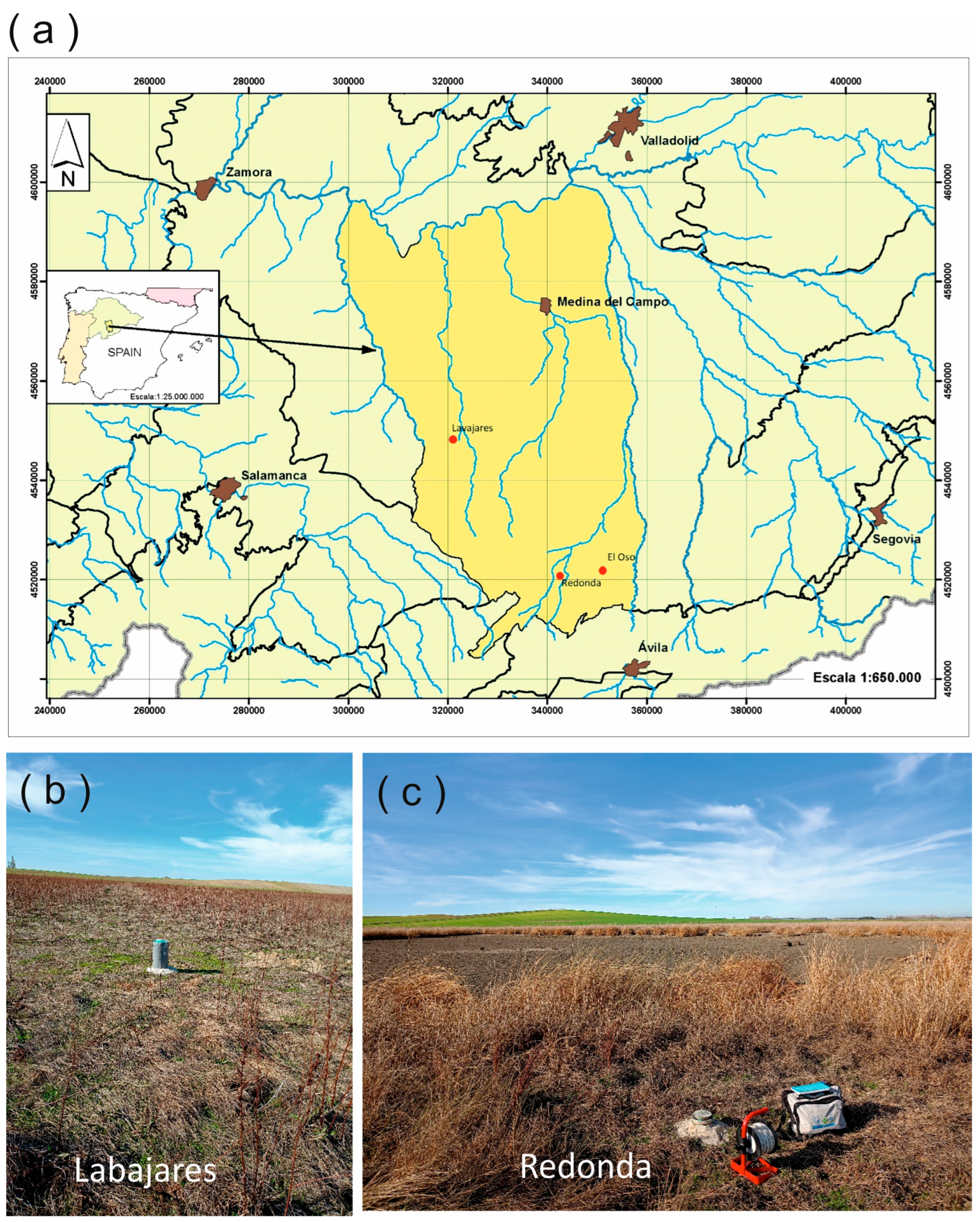
Figure 1. (a) Location of the study area within the Duero River basin. Yellow color indicates the Los Arenales, Tierras de Medina y La Moraña groundwater body (ATMMGWB). (b) Wetlands studied: Laguna de los Lavajares, located in the central part of the ATMMGWB and (c) Laguna Redonda, located in the southern sector.
Eesp 31 01012 g001
Figure 2. (a) Location of Laguna de los Lavajares (Iberpix, IGN). (b) Iberpiximage of Laguna de los Lavajares located between the Minine (West) and Regamón (East) rivers. (Modified from Ref. [2]). (c) Map and hydrogeological cross section of Laguna de los Lavajares.
Eesp 31 01012 g002
Figure 3. (a) Laguna Redonda location within the 1/50,000 National Topographical Map (IGN) (Modified from Ref. [2]). (b) Image of Laguna Redonda and Rivilla River (Iberpix, IGN) (Reprinted from Ref. [2]). (c) Hydrogeological cross section of Laguna Redonda showing the three piezometers in its bed; (d) Legend of (3); (e) Groundwater levels in the double borehole located 3 km South-east from Laguna Redonda. Orange corresponds to a borehole 190 m depth meanwhile green corresponds to a borehole 90 m depth.
Eesp 31 01012 g003
Figure 4. (a) Evolution of the flooded area (m2) in Laguna de los Lavajares according to the five indices described in Section 2, together with Google Earth imagery from specific dates within the represented period (2017–2024). (b) Groundwater levels measured in the Lavajares-North piezometer.
Eesp 31 01012 g004
Figure 5. Evolution of the flooded area in Laguna Redonda for the southern (blue) and northern (orange) sectors during the period 2017–2024, using the NDWI. Our analysis focuses on the southern sector (blue), where the wetland bed is located. Images come from Google Earth.
Eesp 31 01012 g005
Table 1. Main challenges identified in the Laguna de los Lavajares and Laguna Redonda wetlands.
LocationChallengeApproachSolutionResults
Los
Lavajares
Groundwater
discharge does
not exist
Water flow
control
Water contributions from a WWTP (not yet applied)No progress
RedondaGuarantee
enough water
of good
quality
Natural
water
regime
Hydrological alterations (derivation from Rivilla river)Recovery of wetland flooded surface
Table 2. Water budget for Laguna de los Lavajares (details are shown in Appendix A). “Uncontrolled flows” includes Surface Inflows and Outflows + Infiltration.
PeriodFlooded Area (m2)Prec (mm/m3)Evap. (mm/m3)Uncontrolled
Flows (m3)
12/03/2018–30/04/201815,00096.63/1449.4578/117018.29
12/01/2021–01/02/202117,00016.16/2725/85188.37
20/10/2022–15/11/202219,00053.81/1022.3917.70/336.30153,726.91
Disclaimer/Publisher’s Note: The statements, opinions and data contained in all publications are solely those of the individual author(s) and contributor(s) and not of MDPI and/or the editor(s). MDPI and/or the editor(s) disclaim responsibility for any injury to people or property resulting from any ideas, methods, instructions or products referred to in the content.